

- Market Size (2026)
- USD 1.6 Bn
- Forecast (2036)
- USD 3.0 Bn
- CAGR (2026 to 2036)
- 6.5%
Odor-Management and Cabin Fragrance Control Systems Market Size, Market Forecast and Outlook By FMI
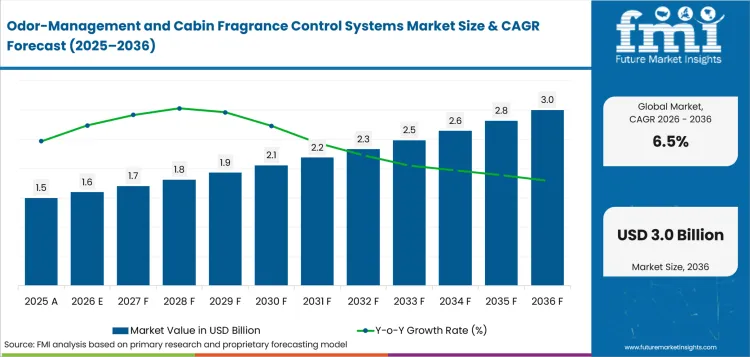
The odor-management and cabin fragrance control systems market is forecasted to grow from USD 1.5 billion in 2025 to USD 3.0 billion by 2036, at a 6.5% CAGR, driven by demand for cleaner cabin air and rising use of premium comfort features, with OEM fitment accounting for 61% share and premium passenger cars contributing 52% share as companies prioritize cabin comfort and service-based revenue.
Key Takeaways, Market Size, and Forecast
- 2026 Market Size: USD 1.6 billion
- 2036 Market Size: USD 3.0 billion
- Forecast CAGR: 6.5% from 2026 to 2036
- Leading Integration Route: OEM fitment
- OEM Fitment Share in 2026: 61%
- Leading Vehicle Class: Premium passenger cars
- Premium Passenger Cars Share in 2026: 52%
- Fastest-growing Country: China
- China CAGR: 7.8% through 2036
Summary of the Odor-Management and Cabin Fragrance Control Systems Market
- Demand and Growth Drivers
- Drivers want cleaner cabin air because traffic smell and parked-vehicle heat can make daily travel uncomfortable.
- Workshops can explain odor-filter replacement during regular air-conditioning service, which makes the upgrade easier to sell.
- Premium vehicle makers use fragrance control to improve cabin comfort and make higher trims feel more refined.
- Product and Segment View
- Activated carbon odor filters lead product demand because they reduce fuel smell, road fumes and stale cabin odor.
- Fragrance diffusers work best in premium vehicles because scent control needs safe placement and balanced airflow.
- HVAC-integrated modules are preferred because they use existing vents to spread scent and manage odor more evenly.
- Geography and Competitive Outlook
- China and India offer faster demand because vehicle ownership and cabin comfort features are expanding across more models.
- Germany and Japan support premium system demand because automakers focus on quiet airflow and clean cabin feel.
- Suppliers with proven filter media and safe fragrance delivery will hold better positions in OEM and service channels.
- Analyst Opinion
- Nikhil Kaitwade, principal consultant at FMI says, “Odor control is becoming part of cabin comfort planning. Drivers want clean air and a pleasant cabin feel without extra noise or service difficulty. Suppliers combining activated carbon media with reliable HVAC control will get better access to vehicle programs.”
- Odor-Management and Cabin Fragrance Control Systems Market Value Analysis
- The odor-management and cabin fragrance control systems market is developing from a basic cabin filter business into a higher-value vehicle comfort area.
- Market value is rising as drivers expect cleaner cabin air during city travel and long daily commutes.
- OEMs are using fragrance control to make premium cabins feel more personal and comfortable.
- Aftermarket value is increasing as workshops add odor filters and refill products to regular air-conditioning service.
Cabin odor control is moving from a comfort feature into a compliance and service-linked system. Cabin odor control is moving closer to service-led filtration as drivers face odors and gases during city and tunnel driving. In February 2026, MANN+HUMMEL stated that activated carbon cabin filters protect against unpleasant odors and harmful gases such as ozone and nitrogen oxides. This pushes OEMs and interior suppliers toward lower-emission trim materials and stronger validation before vehicle launch. MANN+HUMMEL is strengthening the service side through cabin filter replacement. In June 2024, MANN-FILTER said its FreciousPlus nanofiber cabin filter must be replaced once a year or every 15,000 km. Workshops can use odor control as a repeat maintenance item instead of a one-time accessory sale. Fleet odor management is becoming more evidence-led. In April 2025, DENSO International America received patent US12269315B2 for measuring and managing odor brought into rental vehicles through VOC and particulate sensing. Rental operators get a clearer basis for cleaning decisions and vehicle redeployment.
Odor-Management and Cabin Fragrance Control Systems Market Definition
The odor-management and cabin fragrance control systems market refers to vehicle air-care systems that reduce unwanted cabin smells and deliver controlled fragrance inside the passenger space. These systems work with cabin airflow to improve comfort during daily driving, especially in traffic and warm weather. Odor filters help remove fumes and stale smells before air reaches passengers. Fragrance modules add a light scent through vents or dedicated release units. The market is closely tied to cabin comfort, HVAC design and vehicle interior experience.
Odor-Management and Cabin Fragrance Control Systems Market Inclusions
Market scope covers odor-management and cabin fragrance control systems categorized by product type, including activated carbon odor filters and fragrance diffusers, along with ionizer modules and purifier modules. Scope covers vehicle class, including premium passenger cars and mass cars, along with SUVs and fleet vehicles. Scope includes integration route, covering OEM fitment, dealer retrofit and independent aftermarket sales. Control mode includes HVAC-integrated modules, app-controlled units, manual vents and sensor-triggered control. Refill format includes cartridge refills, liquid refills, dry pads and scent capsules. Revenue scope covers 2026 to 2036. Key stakeholders include automakers, cabin filter manufacturers, HVAC system suppliers, fragrance module developers, interior system suppliers, dealer service centers, independent workshops, aftermarket distributors, online parts platforms and vehicle owners.
Odor-Management and Cabin Fragrance Control Systems Market Exclusions
Scope excludes home fragrance devices and building air fresheners. General HVAC compressors are excluded unless sold with a cabin odor-control package. Standalone perfume products are excluded unless made for vehicle cabin systems. Automotive exterior cleaning products are excluded. Air quality sensors are excluded if they do not control filtration, purifier action or fragrance release.
Odor-Management and Cabin Fragrance Control Systems Market Research Methodology
- Primary Research: FMI analysts reviewed cabin filter makers and HVAC system suppliers across major automotive countries. Inputs from service channels were used to understand filter replacement and refill demand.
- Desk Research: Public data from OICA and ACEA supported vehicle production and sales checks. Cabin air-quality sources were reviewed to understand odor control and filtration needs.
- Market Sizing and Forecasting: Market size was estimated using vehicle production and premium feature fitment. Aftermarket cabin filter replacement and fragrance refill sales were used for forecast checks.
- Data Validation: Forecast checks compared vehicle sales and cabin filter replacement cycles. OEM fragrance packages and supplier product activity were reviewed across global vehicle models.
Why is the Odor-Management and Cabin Fragrance Control Systems Market Growing?
- Cabin filter service is supporting odor control demand as workshops connect smell complaints with air-conditioning checks.
- Activated carbon filters are being used as city driving exposes cabins to exhaust gases and tunnel odors.
- Premium cars use fragrance control to make cabin comfort feel more personal and easier to adjust.
Cabin air comfort is moving closer to regular vehicle service because drivers notice smell before filter performance. MANN-FILTER stated in February 2026 that air pollution inside vehicles can be up to five times higher than outside depending on traffic. The company also said cabin filters clean intake air by reducing particles and harmful gases. Odor control supports car air purifier demand as drivers look for simple cabin upgrades. Workshops can pair filter replacement with evaporator cleaning. The practical result is a clearer aftermarket route for odor-management systems.
Market Segmentation Analysis
- Activated carbon odor filters are forecast to hold 43.5% share of product type demand in 2026.
- Comfort packages make premium passenger cars the leading vehicle class, with 52% share expected in 2026.
- OEM fitment is expected to account for 61% share of integration route demand in 2026.
- Control mode demand is forecast to give the segment 48% share in 2026.
- Cartridge refills are forecast to hold 49% share of refill format demand in 2026.
The market is divided into five primary segment groups based on product type and vehicle class. Integration route, control mode and refill format complete the structure. Product type covers activated carbon odor filters and fragrance diffusers. Ionizer modules, sensor modules and purifier modules complete the group. Vehicle class covers premium passenger cars and mass cars. SUVs, fleet vehicles and buses complete the vehicle scope. Integration route covers OEM fitment and dealer retrofit. Independent aftermarket and refill sales complete the route. Control mode covers HVAC-integrated modules and app-controlled units. Manual vents and sensor-triggered control complete the control scope. Refill format covers cartridge refills and liquid refills. Dry pads and scent capsules complete the refill scope.
Insights into Odor-Management and Cabin Fragrance Control Systems Market by Product Type
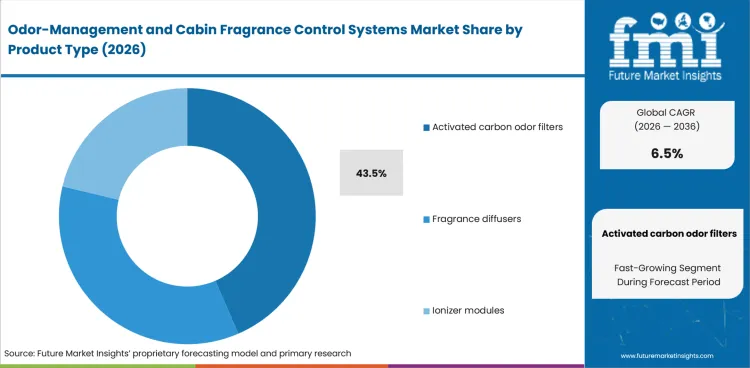
- Activated carbon odor filters are forecast to hold 43.5% share in 2026. Carbon media helps reduce gas-based smells from traffic and parked-vehicle heat.
- Fragrance diffusers add value in premium cabins through controlled scent release. Sensor modules improve air-care response by vehicle interior air quality monitoring technology.
Insights into Odor-Management and Cabin Fragrance Control Systems Market by Vehicle Class
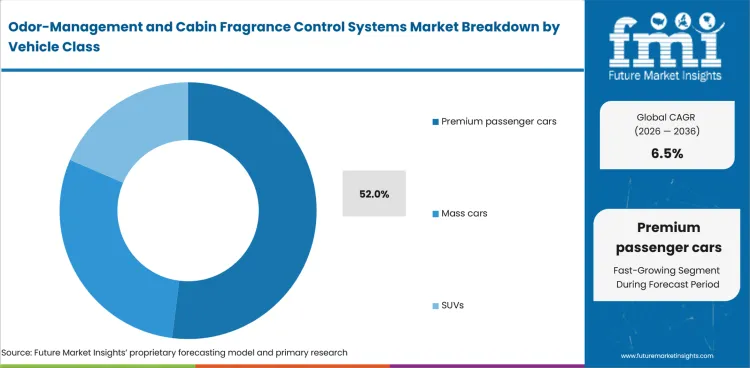
- Premium passenger cars are expected to account for 52% share in 2026 with higher trims using scent and air-care features to improve cabin comfort.
- Mass cars use simpler odor filters because replacement cost matters in routine service. SUVs need odor control for family travel and pet use.
Insights into Odor-Management and Cabin Fragrance Control Systems Market by Integration Route
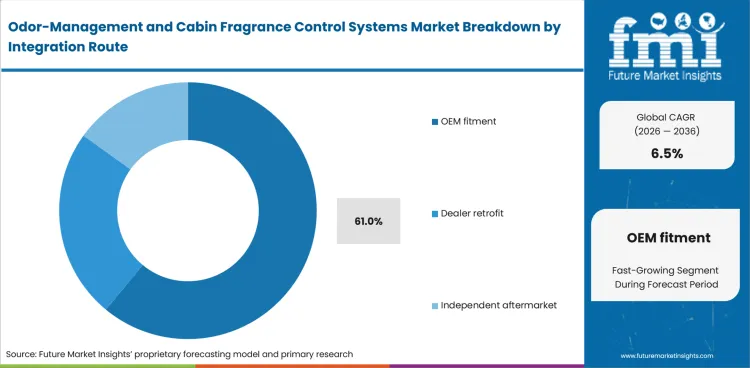
- OEM fitment is forecast to represent 61% share in 2026 as factory installation helps fragrance hardware match vent position and safety needs.
- Dealer retrofit creates an extra service route after vehicle sale. Independent aftermarket channels benefit from refill sales through automotive e-tailing market.
Insights into Odor-Management and Cabin Fragrance Control Systems Market by Control Mode
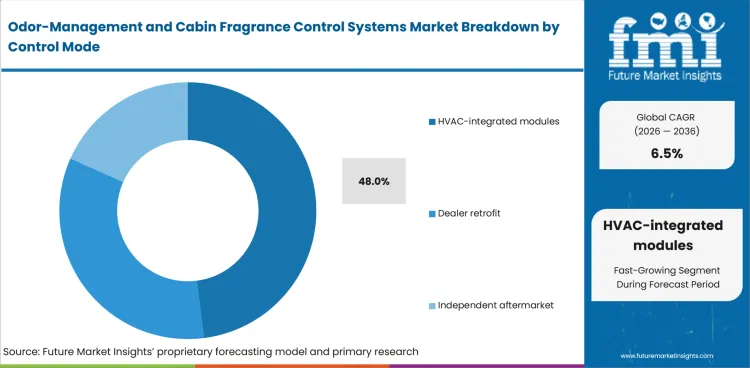
- HVAC-integrated modules are expected to hold 48% share in 2026. Shared airflow helps spread scent and remove odor through existing vents.
- App-controlled units serve premium models with user profiles and intensity settings. Manual vents keep basic systems simple for lower-cost accessories.
Insights into Odor-Management and Cabin Fragrance Control Systems Market by Refill Format
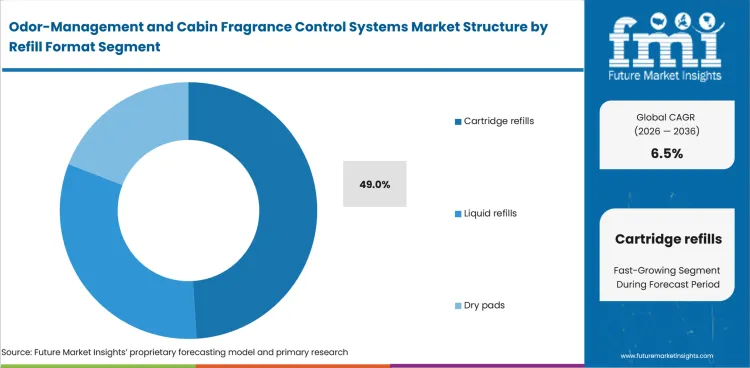
- Cartridge refills are forecast to account for 49% share in 2026. Sealed packs reduce leakage risk and make replacement easier for service staff.
- Liquid refills fit premium fragrance systems that need steady scent output. Dry pads work better in low-cost accessories with simple cabin placement.
Odor-Management and Cabin Fragrance Control Systems Market Drivers, Restraints, and Opportunities
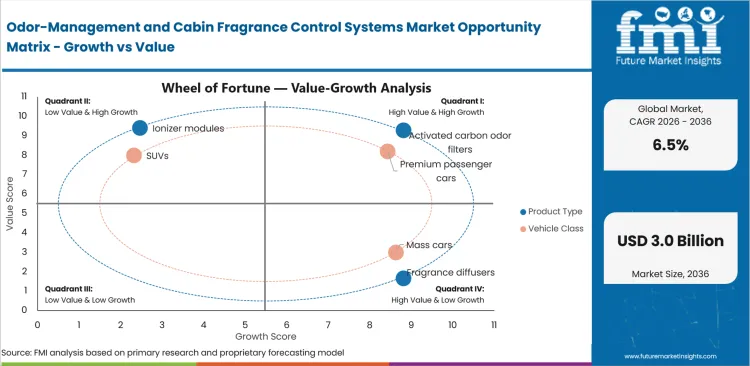
- Activated carbon filtration supports odor removal as traffic exposure brings gases into the cabin.
- Refill cost can limit repeat use as drivers compare fragrance cartridges with basic cabin filter service.
- HVAC-connected controls create a better route as airflow can spread scent more evenly through vents.
Activated Carbon Filters Address City Odors
Activated carbon filters are becoming the main practical answer to cabin smell. MANN-FILTER said in February 2026 that activated carbon filters protect against unpleasant odors and harmful gases such as ozone and nitrogen oxides. That source makes demand for activated carbon fiber important for filter suppliers working on gas capture. Odor control needs low airflow resistance so the fan does not work harder. Suppliers that keep replacement simple can support workshops and drivers without making service confusing.
Refill Price Limits Repeat Use
Fragrance modules need cartridge replacement after the first scent cycle. Drivers may delay a refill if scent bottles cost much more than a cabin filter. Premium brands can support repeat use with simple menus and clear intensity levels. Low-cost accessories may sell more units. Weaker scent control can reduce repeat buying after the first trial. Better refill design must prevent leakage and keep scent output stable inside hot cabins.
HVAC Controls Raise System Value
Odor control works better through vent-directed airflow. Mercedes-Benz 2025 owner material states its fragrance system distributes scent throughout the vehicle. The feature suits premium cars because scent output can be tied to cabin settings. Automotive HVAC blower market design affects airflow noise and scent spread. Suppliers able to integrate filters and scent modules into existing ducts can win more OEM work.
Competitive Landscape and Strategic Positioning
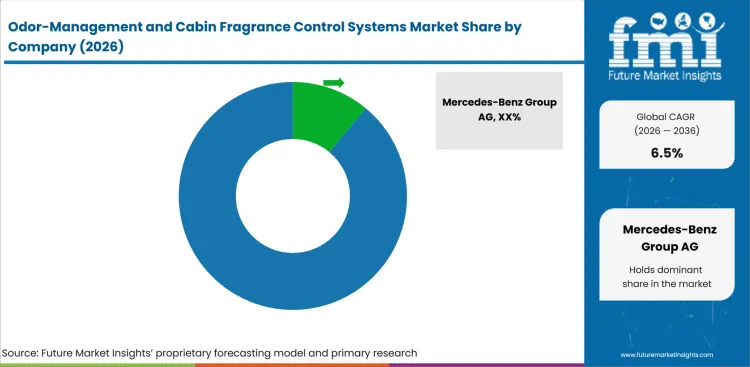
- Competition centers on carbon media depth and safe scent delivery.
- Filter specialists hold an edge through tested media and clear service intervals.
- Premium OEMs control fragrance value through bottle design and in-cabin settings.
- Entry barriers include material safety checks and leakage control inside hot cabins.
Competitive positions differ across odor removal and scent delivery. MANN+HUMMEL introduced a FreciousPlus cabin filter featuring nanofibers in June 2024 for BMW 5 Series and 7 Series saloons. The company said the media removes 90% of PM1 particles and up to 80% of ultrafine particles. Such claims raise the standard for cabin air filter housing replacement parts market because service parts must fit without hurting airflow.
MAHLE product material updated in 2024 identifies CareMetix cabin filters with S5 broadband technology and five- fold protection. The same material says up to three- hundred cubic meters of outside air can pass through the cabin filter each hour. High airflow makes odor capture important for automotive interior comfort because untreated smells reach passengers quickly. MAHLE works mainly through filter media and service coverage. MANN+HUMMEL adds nanofiber media as a premium filter option.
Premium automakers shape the fragrance side of the market through controlled in-cabin systems. Mercedes-Benz 2025 owner material confirms its fragrance system distributes a pleasant fragrance throughout the vehicle. BMW says its Ambient Air Package can clean and subtly perfume the interior. Premium brand examples explain why scent delivery is treated as a controlled cabin comfort function. Automotive AC compressor market and HVAC calibration are important because fragrance output must not add noise or uneven airflow.
Key Companies in the Odor-Management and Cabin Fragrance Control Systems Market
- Premium Fragrance System Owners: Mercedes-Benz Group AG and BMW Group hold strong positions through branded in-cabin scent control and driver-selectable fragrance modes.
- Odor Filtration Specialists: MAHLE GmbH and MANN+HUMMEL serve the market through activated carbon media and filter replacement channels.
- Cabin Purification Technology Suppliers: DENSO Corporation and Panasonic Holdings Corporation support air-care features through purifier modules and electronics.
- Connected Cabin Suppliers: Hyundai Mobis Co., Ltd. and FORVIA SE support sensor-ready cabin systems for future vehicle programs.
Competitive Benchmarking: Odor-Management and Cabin Fragrance Control Systems Market
| Company | Odor Filtration Depth | HVAC Control Integration | Refill System Fit | Geographic Footprint |
|---|---|---|---|---|
| Mercedes-Benz Group AG | Medium | High | High | Global premium vehicle reach |
| BMW Group | Medium | High | High | Global premium vehicle reach |
| MAHLE GmbH | High | Medium | Medium | Europe and global aftermarket |
| MANN+HUMMEL | High | Medium | Medium | Global filtration presence |
| DENSO Corporation | High | High | Medium | Japan-based global OE reach |
| Panasonic Holdings Corporation | Medium | Medium | Medium | Asia and global electronics |
| Hyundai Mobis Co., Ltd. | Medium | High | Medium | Korea-based global OE reach |
Source: Future Market Insights competitive analysis, 2026.
Key Developments in Odor-Management and Cabin Fragrance Control Systems Market
- In January 2026, DENSO Europe launched its ClearAir+ Premium Cabin Air Filter line. The product update states 5-layer filtration up to 99% bacterial and viral elimination, forty-five new part numbers and coverage for about one-hundred fifty million vehicles across Europe.
- In August 2025, DENSO Europe expanded its cabin air filter range with eighty-two new part numbers, including sixty-eight carbon cabin filters and fourteen pollen cabin filters.
Key Players in the Odor-Management and Cabin Fragrance Control Systems Market
Major Global Players
- Mercedes-Benz Group AG
- BMW Group
- MAHLE GmbH
- MANN+HUMMEL
- DENSO Corporation
Specialist and Technology Players
- Panasonic Holdings Corporation
- Hyundai Mobis Co., Ltd.
- Marelli Holdings Co., Ltd.
- FORVIA SE
- Valeo SE
Analysis of Odor-Management and Cabin Fragrance Control Systems Market by Key Countries
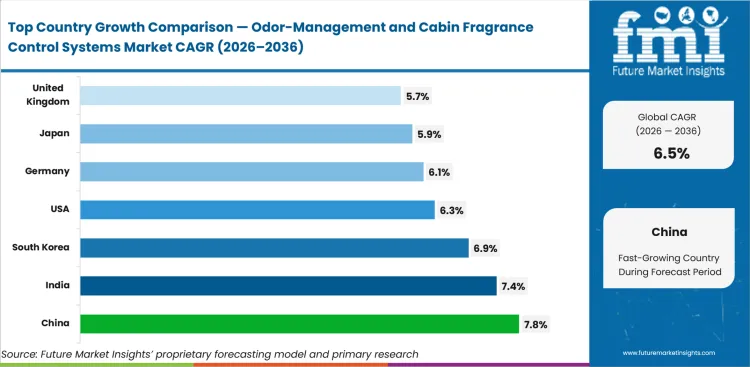
.webp "Top Country Growth Comparison Odor-Management and Cabin Fragrance Control Systems Market Cagr (2026 2036)")
| Country | CAGR |
|---|---|
| United States | 6.3% |
| China | 7.8% |
| India | 7.4% |
| Germany | 6.1% |
| Japan | 5.9% |
| South Korea | 6.9% |
| United Kingdom | 5.7% |
Source: Future Market Insights, 2026.
Demand Outlook for Odor-Management and Cabin Fragrance Control Systems Market in the United States
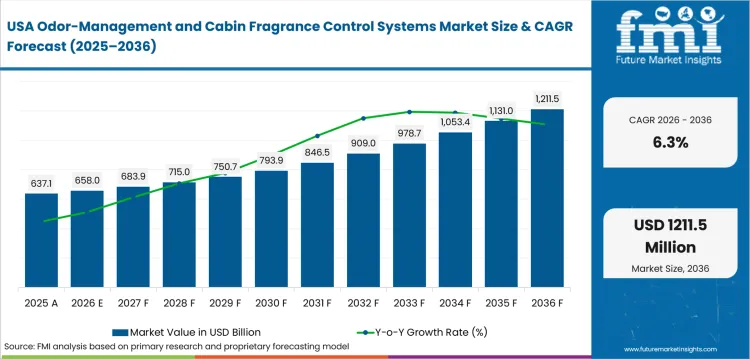
Large service market · 2026 to 2036
Country Market Snapshot Table
| Parameter | Value |
|---|---|
| Market Size in 2025 (Value) | USD 310.0 million |
| Market Forecast in 2036 (Value) | USD 610.0 million |
| CAGR (2026-2036) | 6.3% |
| Years Considered | 2016-2036 |
| Base Year | 2025 |
| Forecast Period | 2026-2036 |
| Units Considered | Value (USD Mn) |
| Leading Sub-Region | Great Lakes vehicle corridor |
United States Odor-Management and Cabin Fragrance Control Systems Market Outlook
USA demand comes from regular HVAC service and a large passenger vehicle parc. Drivers notice smell during air-conditioning use, so odor filters are easier to explain during service visits.
Premium SUVs and ride-hailing vehicles create another route for cabin comfort upgrades. Fragrance modules work better in higher trims because the cabin already uses advanced vent and comfort controls.
Key Growth Drivers
- Routine HVAC service creates replacement demand for odor filters. OICA listed 16.7 million USA vehicle sales in 2025, which keeps service networks active across a broad car parc.
- Fleet and commercial vehicles need cleaner cabins for repeated passenger and staff use. GM said GM Envolve sales to fleet and commercial customers grew 10% in 2025.
- Premium SUVs create a route for fragrance modules because higher trims already carry comfort features and better airflow control.
- E-commerce parts platforms make refill and filter access easier for private drivers outside dealership service networks.
Key Restraints
- Vehicle model variety can slow common cartridge formats because suppliers must match different duct sizes and glove-box layouts.
- Low-cost filters can limit premium media sales since some drivers replace filters only after odor becomes noticeable.
- Fitment coverage is costly for smaller suppliers. Toyota Motor North America reported 2.5 million USA vehicle sales in 2025, which shows why model coverage needs deep catalog planning.
What makes United States unique
United States is unique because a large vehicle parc meets a deep aftermarket service network. Odor filters can move through workshops, auto parts retailers and online parts stores.
Key Companies
- Ford Motor Company
- General Motors LLC
- Gentherm Incorporated
- K&N Engineering, Inc.
- Donaldson Company, Inc.
Sales & Marketing Channels
- Dealer service centers
- Auto parts retail chains
- Independent repair workshops
- E-commerce parts platforms
Country Segment Breakdown Table
| Segment | Sub-Segments |
|---|---|
| By Product Type | Activated Carbon Odor Filters · Fragrance Diffusers · Ionizer Modules · Sensor Modules · Purifier Modules |
| By Vehicle Class | Premium Passenger Cars · Mass Cars · SUVs · Fleet Vehicles · Buses |
| By Integration Route | OEM Fitment · Dealer Retrofit · Independent Aftermarket · Refill Sales |
| By Control Mode | HVAC-Integrated Modules · App-Controlled Units · Manual Vents · Sensor-Triggered Control |
| By Refill Format | Cartridge Refills · Liquid Refills · Dry Pads · Scent Capsules |
| Key Sub-Regions Covered, States / Corridors | Michigan · Ohio · Indiana · Kentucky · Tennessee · Alabama · South Carolina · Texas |
Frequently Asked Questions
How fast is the United States odor-management and cabin fragrance control systems market moving?
The country snapshot table gives the 2026 to 2036 pace. Service replacement and premium trim features guide the outlook.
Who leads the United States market?
Ford Motor Company and General Motors LLC influence OEM cabin comfort planning. Gentherm Incorporated and K&N Engineering, Inc. add value through comfort systems and filtration products.
What is driving adoption in the United States?
Drivers notice odor during air-conditioning use. Workshops can turn cabin filter replacement into a simple comfort upgrade.
Market Taxonomy and Sub-Regions Covered
Sales Analysis of Odor-Management and Cabin Fragrance Control Systems Market in China
High vehicle output · 2026 to 2036
Country Market Snapshot Table
| Parameter | Value |
|---|---|
| Market Size in 2025 (Value) | USD 260.0 million |
| Market Forecast in 2036 (Value) | USD 590.0 million |
| CAGR (2026-2036) | 7.8% |
| Years Considered | 2016-2036 |
| Base Year | 2025 |
| Forecast Period | 2026-2036 |
| Units Considered | Value (USD Mn) |
| Leading Sub-Region | Yangtze River Delta vehicle cluster |
China Odor-Management and Cabin Fragrance Control Systems Market Outlook
China’s market benefits from fast vehicle output and smart cabin design. Automakers use air-care features to make interiors feel cleaner during city driving.
Local suppliers can pair fragrance control with infotainment settings. Activated carbon filters serve mass models first and sensor-triggered purifier modules fit premium electric vehicles.
Key Growth Drivers
- High vehicle output creates a wide base for cabin odor-control parts. CAAM reported that China produced 34.531 million vehicles in 2025. NEV sales reached 16.49 million units, and vehicle exports reached 7.098 million units.
- NEV platforms make screen-based cabin controls easier to add. China sold 16.5 million NEVs in 2025, which supports purifier and fragrance controls in software-rich cabins.
- Domestic brands use cabin comfort features to separate higher trims from standard variants.
- Connected cockpit systems make fragrance intensity easier to manage through screens and driver profiles.
Key Restraints
- Price pressure can limit branded fragrance refill uptake in entry and mid-price cars.
- Fast model cycles make validation difficult because suppliers must qualify parts before launch timing closes.
- Export growth can shift supplier focus toward overseas homologation. China exported 7.1 million vehicles in 2025, which may pull engineering resources away from domestic accessory variants.
What makes China unique
China is unique because smart cabin systems and high NEV volume move together. Cabin fragrance and odor filtration can be added as part of a wider digital cabin package.
Key Companies
- BYD Company Limited
- Zhejiang Geely Holding Group Co., Ltd.
- Yanfeng International Automotive Technology Co., Ltd.
- Ningbo Joyson Electronic Corp.
- Desay SV Automotive Co., Ltd.
Sales & Marketing Channels
- OEM platform supply programs
- Dealer accessory counters
- Online parts marketplaces
- Smart cabin system integrators
Country Segment Breakdown Table
| Segment | Sub-Segments |
|---|---|
| By Product Type | Activated Carbon Odor Filters · Fragrance Diffusers · Ionizer Modules · Sensor Modules · Purifier Modules |
| By Vehicle Class | Premium Passenger Cars · Mass Cars · SUVs · Fleet Vehicles · Buses |
| By Integration Route | OEM Fitment · Dealer Retrofit · Independent Aftermarket · Refill Sales |
| By Control Mode | HVAC-Integrated Modules · App-Controlled Units · Manual Vents · Sensor-Triggered Control |
| By Refill Format | Cartridge Refills · Liquid Refills · Dry Pads · Scent Capsules |
| Key Sub-Regions Covered, Provinces / Municipalities | Shanghai · Jiangsu · Zhejiang · Guangdong · Chongqing · Anhui · Beijing · Hubei |
Frequently Asked Questions
How fast is China demand expected to move?
The country snapshot table covers the 2026 to 2036 outlook. Electric vehicle fitment and smart cockpit features guide demand.
Which companies are active in China?
BYD Company Limited and Zhejiang Geely Holding Group Co., Ltd. influence vehicle fitment. Yanfeng International Automotive Technology Co., Ltd. supports interior system planning.
What makes China important for this market?
China has high vehicle output and fast cabin feature upgrades. Smart cockpit systems create a clear route for controlled fragrance and purifier modules.
Demand Outlook for Odor-Management and Cabin Fragrance Control Systems Market in India
Service-led cabin comfort · 2026 to 2036
Country Market Snapshot Table
| Parameter | Value |
|---|---|
| Market Size in 2025 (Value) | USD 75.0 million |
| Market Forecast in 2036 (Value) | USD 165.0 million |
| CAGR (2026-2036) | 7.4% |
| Years Considered | 2016-2036 |
| Base Year | 2025 |
| Forecast Period | 2026-2036 |
| Units Considered | Value (USD Mn) |
| Leading Sub-Region | Western and Southern auto belt |
India Odor-Management and Cabin Fragrance Control Systems Market Outlook
India’s cabin odor-management market is helped by dense traffic and higher air-conditioning use. Drivers often replace filters during seasonal service before summer and monsoon use.
Mid-price cars create a practical route for carbon filters. Fragrance systems are more likely to start in higher trims and dealer accessory programs.
Key Growth Drivers
- Passenger vehicle service creates a route for odor filter replacement. SIAM reported 4.3 million passenger vehicle sales in FY 2024-25, giving service networks a wide cabin filter opportunity.
- Utility vehicles create more room for comfort accessories. SIAM said UVs contributed 65% of total passenger vehicle sales in FY 2024-25.
- Dealer service networks can sell odor filters during air-conditioning checks before hot-season usage.
- Online parts sales make refills easier for drivers outside large metro service centers.
Key Restraints
- Price sensitivity can slow fragrance cartridge replacement after the first vehicle service cycle.
- Dust-heavy driving conditions can shorten perceived filter life and raise replacement complaints.
- Two-wheeler ownership limits the addressable car-cabin upgrade pool. SIAM reported 19.6 million two-wheeler sales in FY 2024-25, much above passenger vehicle volume.
What makes India unique
India is unique because odor filters fit naturally with air-conditioning service. Fragrance control can expand through dealer accessories before wider factory fitment.
Key Companies
- Subros Limited
- UNO Minda Limited
- Tata AutoComp Systems Limited
- Bosch Limited
- Lumax Auto Technologies Limited
Sales & Marketing Channels
- Authorized service workshops
- Dealer accessory counters
- Independent garages
- Online spare parts platforms
Country Segment Breakdown Table
| Segment | Sub-Segments |
|---|---|
| By Product Type | Activated Carbon Odor Filters · Fragrance Diffusers · Ionizer Modules · Sensor Modules · Purifier Modules |
| By Vehicle Class | Premium Passenger Cars · Mass Cars · SUVs · Fleet Vehicles · Buses |
| By Integration Route | OEM Fitment · Dealer Retrofit · Independent Aftermarket · Refill Sales |
| By Control Mode | HVAC-Integrated Modules · App-Controlled Units · Manual Vents · Sensor-Triggered Control |
| By Refill Format | Cartridge Refills · Liquid Refills · Dry Pads · Scent Capsules |
| Key Sub-Regions Covered, States / Corridors | Maharashtra · Gujarat · Tamil Nadu · Karnataka · Haryana · Uttar Pradesh · Rajasthan · Telangana |
Frequently Asked Questions
How fast is India demand expected to move?
The country snapshot table gives the 2026 to 2036 pace. Urban traffic and seasonal HVAC service guide demand.
Which companies are active in India?
Subros Limited and UNO Minda Limited are active in automotive systems. Tata AutoComp Systems Limited and Bosch Limited add supplier depth.
What is driving adoption in India?
Odor control fits air-conditioning service. Urban traffic makes activated carbon filters easier to sell during routine maintenance.
Opportunity Analysis of Odor-Management and Cabin Fragrance Control Systems Market in Germany
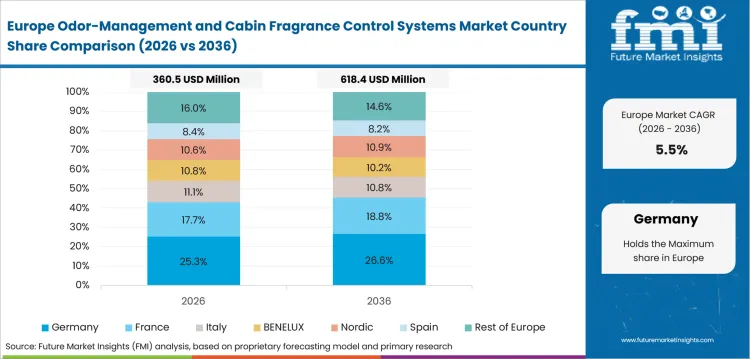
Premium cabin engineering · 2026 to 2036
Country Market Snapshot Table
| Parameter | Value |
|---|---|
| Market Size in 2025 (Value) | USD 140.0 million |
| Market Forecast in 2036 (Value) | USD 265.0 million |
| CAGR (2026-2036) | 6.1% |
| Years Considered | 2016-2036 |
| Base Year | 2025 |
| Forecast Period | 2026-2036 |
| Units Considered | Value (USD Mn) |
| Leading Sub-Region | Southern premium vehicle belt |
Germany Odor-Management and Cabin Fragrance Control Systems Market Outlook
Germany has a premium vehicle culture that values quiet airflow and clean cabin feel. Fragrance systems need careful bottle safety and vent calibration before factory programs.
Filter suppliers in Germany have deep media knowledge. Premium OEMs create demand for odor-control systems that work without adding noise or service complexity.
Key Growth Drivers
- Premium vehicle programs create a route for factory-installed fragrance modules. ACEA said Germany produced 21% of cars sold in the EU in 2025.
- Electric vehicle cabins need low-noise air-care features. BMW Group reported 290,742 BMW and MINI registrations in Germany in 2025, up 8.7%. Fully electric BMW Group deliveries in Europe rose 28.2%, showing stronger premium electric vehicle demand for quiet cabin comfort systems.
- Filter media specialists can serve odor capture needs through activated carbon and fine particle layers.
- Dealer workshops can sell branded replacement filters during annual maintenance visits.
Key Restraints
- OEM validation can take longer because fragrance liquids must be checked for heat exposure and leakage.
- Premium users expect low noise, which makes airflow tuning harder for compact modules.
- Import pressure can affect local supplier pricing. ACEA said cars made in China accounted for 7% of EU car sales in 2025.
What makes Germany unique
Germany is unique because premium carmakers and filter media specialists operate in close supplier networks. This creates a clear route for tested odor-control systems in factory programs.
Key Companies
- Mercedes-Benz Group AG
- BMW AG
- MAHLE GmbH
- MANN+HUMMEL International GmbH & Co. KG
- Freudenberg Filtration Technologies SE & Co. KG
Sales & Marketing Channels
- OEM engineering programs
- Dealer service networks
- Premium accessory channels
- Authorized aftermarket distributors
Country Segment Breakdown Table
| Segment | Sub-Segments |
|---|---|
| By Product Type | Activated Carbon Odor Filters · Fragrance Diffusers · Ionizer Modules · Sensor Modules · Purifier Modules |
| By Vehicle Class | Premium Passenger Cars · Mass Cars · SUVs · Fleet Vehicles · Buses |
| By Integration Route | OEM Fitment · Dealer Retrofit · Independent Aftermarket · Refill Sales |
| By Control Mode | HVAC-Integrated Modules · App-Controlled Units · Manual Vents · Sensor-Triggered Control |
| By Refill Format | Cartridge Refills · Liquid Refills · Dry Pads · Scent Capsules |
| Key Sub-Regions Covered, States / Corridors | Bavaria · Baden-Württemberg · Lower Saxony · North Rhine-Westphalia · Saxony · Hesse · Bremen · Saarland |
Frequently Asked Questions
How fast is Germany demand expected to move?
The country snapshot table covers the 2026 to 2036 pace. Premium vehicle programs and filter replacement guide the outlook.
Who leads Germany’s market?
Mercedes-Benz Group AG and BMW AG influence fragrance system fitment. MAHLE GmbH and MANN+HUMMEL add filtration depth.
What makes Germany important for cabin fragrance systems?
Germany has premium OEMs and advanced filter suppliers. That mix helps convert cabin air comfort into factory-installed features.
Future Outlook for Odor-Management and Cabin Fragrance Control Systems Market in Japan
Compact cabin systems · 2026 to 2036
Country Market Snapshot Table
| Parameter | Value |
|---|---|
| Market Size in 2025 (Value) | USD 105.0 million |
| Market Forecast in 2036 (Value) | USD 190.0 million |
| CAGR (2026-2036) | 5.9% |
| Years Considered | 2016-2036 |
| Base Year | 2025 |
| Forecast Period | 2026-2036 |
| Units Considered | Value (USD Mn) |
| Leading Sub-Region | Chubu automotive corridor |
Japan Odor-Management and Cabin Fragrance Control Systems Market Outlook
Japan’s demand is guided by compact cabins and high service expectations. Drivers value quiet systems that do not reduce air-conditioning comfort.
Odor filters have a clearer service route than complex fragrance systems. Premium models and dealer accessories can create smaller but higher-value demand pockets.
Key Growth Drivers
- Compact vehicle ownership creates demand for low-pressure odor filters. OICA listed 4.6 million vehicle sales in Japan during 2025.
- Domestic vehicle production keeps cabin system engineering close to OEM programs. OICA listed 7.2 million vehicles produced in Japan in 2025.
- Regular inspection habits create a route for scheduled cabin filter replacement.
- Premium models can use scent control as part of a quiet interior comfort package.
Key Restraints
- Compact HVAC space can limit larger purifier modules and thicker filter packs.
- Older vehicle owners may choose low-cost filters over premium odor-control media.
- Supplier coverage must account for many compact models. JAMA’s 2025 Japan Mobility Show release said one-hundred thirty six exhibitors would display mobility products across several vehicle-related areas.
What makes Japan unique
Japan is unique because small cabin layouts push suppliers toward compact and quiet systems. Odor control must protect airflow before fragrance control can scale.
Key Companies
- DENSO Corporation
- Panasonic Automotive Systems Co., Ltd.
- Toyota Boshoku Corporation
- Marelli Corporation
- Yazaki Corporation
Sales & Marketing Channels
- OEM supply programs
- Dealer maintenance networks
- Auto parts wholesalers
- Electronics accessory channels
Country Segment Breakdown Table
| Segment | Sub-Segments |
|---|---|
| By Product Type | Activated Carbon Odor Filters · Fragrance Diffusers · Ionizer Modules · Sensor Modules · Purifier Modules |
| By Vehicle Class | Premium Passenger Cars · Mass Cars · SUVs · Fleet Vehicles · Buses |
| By Integration Route | OEM Fitment · Dealer Retrofit · Independent Aftermarket · Refill Sales |
| By Control Mode | HVAC-Integrated Modules · App-Controlled Units · Manual Vents · Sensor-Triggered Control |
| By Refill Format | Cartridge Refills · Liquid Refills · Dry Pads · Scent Capsules |
| Key Sub-Regions Covered, Prefectures / Corridors | Aichi · Shizuoka · Tokyo · Kanagawa · Saitama · Fukuoka · Hiroshima · Osaka |
Frequently Asked Questions
How fast is Japan demand expected to move?
The country snapshot table gives the 2026 to 2036 pace. Service replacement and compact cabin design guide demand.
Which companies are active in Japan?
DENSO Corporation and Panasonic Automotive Systems Co., Ltd. are active in cabin electronics and filtration. Toyota Boshoku Corporation supports interior system demand.
What drives Japan’s cabin odor-control market?
Drivers value quiet airflow and clean cabins. Compact vehicle layouts make low-pressure odor filters important.
Opportunity Analysis of Odor-Management and Cabin Fragrance Control Systems Market in South Korea
Connected cabin feature base · 2026 to 2036
Country Market Snapshot Table
| Parameter | Value |
|---|---|
| Market Size in 2025 (Value) | USD 70.0 million |
| Market Forecast in 2036 (Value) | USD 145.0 million |
| CAGR (2026-2036) | 6.9% |
| Years Considered | 2016-2036 |
| Base Year | 2025 |
| Forecast Period | 2026-2036 |
| Units Considered | Value (USD Mn) |
| Leading Sub-Region | Ulsan and Gyeonggi vehicle belt |
South Korea Odor-Management and Cabin Fragrance Control Systems Market Outlook
South Korea has a strong route for connected cabin features. Local automakers can place air-care controls inside digital cockpit menus and vehicle comfort settings.
Cabin fragrance systems can expand through premium trims first. Filter demand is steadier because drivers replace cabin filters during normal service visits.
Key Growth Drivers
- Connected cabin programs create a path for software-based scent control. Hyundai Motor sold 4.1 million vehicles worldwide in 2025, keeping cabin feature planning active across many models.
- Electrified vehicle cabins need quiet and low-power comfort systems. Hyundai Motor’s 2025 business results stated that the company sold 961,812 electrified vehicles globally in 2025, up 27% year over year. The total included 275,669 EVs and 634,990 HEVs.
- Dealer service networks can sell cabin filters during regular maintenance.
- Domestic HVAC suppliers can align filter performance with heat pump and blower systems.
Key Restraints
- Cost targets in mass cars can slow fragrance module fitment outside premium trims.
- Quiet cabin design raises pressure on suppliers to limit fan noise and scent intensity.
- Large investment programs can pull engineering focus toward core electrification. Hyundai Motor set a KRW 17.8 trillion annual investment forecast for 2026.
What makes South Korea unique
South Korea is unique because automakers can link cabin scent settings with connected cockpit controls. This makes software-based comfort features easier to package.
Key Companies
- Hyundai Mobis Co., Ltd.
- Hanon Systems
- Hyundai Motor Company
- Kia Corporation
- HL Mando Corporation
Sales & Marketing Channels
- OEM cockpit programs
- Dealer service centers
- Thermal systems suppliers
- Online accessory platforms
Country Segment Breakdown Table
| Segment | Sub-Segments |
|---|---|
| By Product Type | Activated Carbon Odor Filters · Fragrance Diffusers · Ionizer Modules · Sensor Modules · Purifier Modules |
| By Vehicle Class | Premium Passenger Cars · Mass Cars · SUVs · Fleet Vehicles · Buses |
| By Integration Route | OEM Fitment · Dealer Retrofit · Independent Aftermarket · Refill Sales |
| By Control Mode | HVAC-Integrated Modules · App-Controlled Units · Manual Vents · Sensor-Triggered Control |
| By Refill Format | Cartridge Refills · Liquid Refills · Dry Pads · Scent Capsules |
| Key Sub-Regions Covered, Provinces / Municipalities | Ulsan · Gyeonggi · Seoul · Incheon · Busan · Daegu · Gwangju · Chungcheong |
Frequently Asked Questions
How fast is South Korea demand expected to move?
The country snapshot table shows the 2026 to 2036 outlook. Connected cabin features and premium electric vehicles guide demand.
Who are the key companies in South Korea?
Hyundai Mobis Co., Ltd. and Hanon Systems are important suppliers. Hyundai Motor Company and Kia Corporation influence factory fitment.
Why is South Korea important for this market?
South Korea has strong connected cabin capability. That gives fragrance and odor-control systems a better path into digital vehicle menus.
Future Outlook for Odor-Management and Cabin Fragrance Control Systems Market in the United Kingdom
Service channel strength · 2026 to 2036
Country Market Snapshot Table
| Parameter | Value |
|---|---|
| Market Size in 2025 (Value) | USD 60.0 million |
| Market Forecast in 2036 (Value) | USD 110.0 million |
| CAGR (2026-2036) | 5.7% |
| Years Considered | 2016-2036 |
| Base Year | 2025 |
| Forecast Period | 2026-2036 |
| Units Considered | Value (USD Mn) |
| Leading Sub-Region | Midlands service and vehicle corridor |
United Kingdom Odor-Management and Cabin Fragrance Control Systems Market Outlook
United Kingdom demand is guided by premium vehicle ownership and regular service access. Drivers using vehicles for commuting need simple odor-control fixes through cabin filters.
Fragrance modules are more selective and fit better with premium models. Aftermarket filter demand is wider because service networks and parts retailers can supply replacement filters across many models.
Key Growth Drivers
- Service centers can bundle cabin filters with air-conditioning checks. SMMT said UK new car registrations reached 2.02 million in 2025.
- Electric and premium models give air-care features a better route into higher trims. SMMT said almost 0.5 million BEVs joined UK roads in 2025.
- Ride-hailing and executive transport operators value cleaner cabins for passenger comfort.
- Online parts retailers make activated carbon filter replacement easier for private drivers.
Key Restraints
- Smaller vehicle production scale can limit local OEM fitment volume for fragrance modules.
- Consumer spending pressure can shift owners toward basic cabin filters.
- Powertrain mix can slow premium fragrance uptake. SMMT said internal combustion engine vehicles still held 51.5% of UK new car registrations in 2025.
What makes United Kingdom unique
United Kingdom is unique because parts retail and service networks are easy to access. Odor filters can move through aftermarket routes even if OEM fragrance fitment stays selective.
Key Companies
- Jaguar Land Rover Automotive plc
- Comline Auto Parts Ltd.
- LKQ Euro Car Parts Limited
- Halfords Limited
- Valeo Service UK Ltd.
Sales & Marketing Channels
- Dealer workshops
- National parts retailers
- Independent garages
- Online filter and accessory stores
Country Segment Breakdown Table
| Segment | Sub-Segments |
|---|---|
| By Product Type | Activated Carbon Odor Filters · Fragrance Diffusers · Ionizer Modules · Sensor Modules · Purifier Modules |
| By Vehicle Class | Premium Passenger Cars · Mass Cars · SUVs · Fleet Vehicles · Buses |
| By Integration Route | OEM Fitment · Dealer Retrofit · Independent Aftermarket · Refill Sales |
| By Control Mode | HVAC-Integrated Modules · App-Controlled Units · Manual Vents · Sensor-Triggered Control |
| By Refill Format | Cartridge Refills · Liquid Refills · Dry Pads · Scent Capsules |
| Key Sub-Regions Covered, Nations / Corridors | West Midlands · East Midlands · North West England · South East England · Greater London · Wales · Scotland · Northern Ireland |
Frequently Asked Questions
How fast is United Kingdom demand expected to move?
The country snapshot table covers the 2026 to 2036 pace. Service replacement and premium vehicle ownership guide demand.
Which companies are active in the United Kingdom?
Jaguar Land Rover Automotive plc influences premium cabin feature needs. Comline Auto Parts Ltd. and LKQ Euro Car Parts Limited support aftermarket filter access.
What is driving adoption in the United Kingdom?
Drivers need simple odor-control fixes during HVAC service. Parts retailers make activated carbon filters easy to find.
Report Scope and Coverage
| Parameter | Details |
|---|---|
| Market size by 2036 | USD 3.0 billion |
| Growth rate | 6.5% CAGR (2026-2036) |
| Forecast period | 2026 to 2036 |
| Market size in 2026 | USD 1.6 billion |
| By product type | Activated Carbon Odor Filters, Fragrance Diffusers, Ionizer Modules, Sensor Modules, Purifier Modules |
| By vehicle class | Premium Passenger Cars, Mass Cars, SUVs, Fleet Vehicles, Buses |
| By integration route | OEM Fitment, Dealer Retrofit, Independent Aftermarket, Refill Sales |
| By control mode | HVAC-Integrated Modules, App-Controlled Units, Manual Vents, Sensor-Triggered Control |
| By refill format | Cartridge Refills, Liquid Refills, Dry Pads, Scent Capsules |
| Regions covered | North America, Latin America, Western Europe, Eastern Europe, East Asia, South Asia and Pacific, Middle East & Africa |
| Countries covered | United States, China, India, Germany, Japan, South Korea, United Kingdom, 30 plus countries |
| Key companies profiled | Mercedes-Benz Group AG, BMW Group, MAHLE GmbH, MANN+HUMMEL International GmbH & Co. KG, DENSO Corporation, Panasonic Automotive Systems Co., Ltd., Hyundai Mobis Co., Ltd., Marelli Corporation, FORVIA SE, Valeo SE |
| Approach | Hybrid bottom-up and top-down methodology starting with vehicle production, cabin filter replacement, OEM fitment, refill sales, and regional adoption patterns. |
Source: Future Market Insights, 2026.
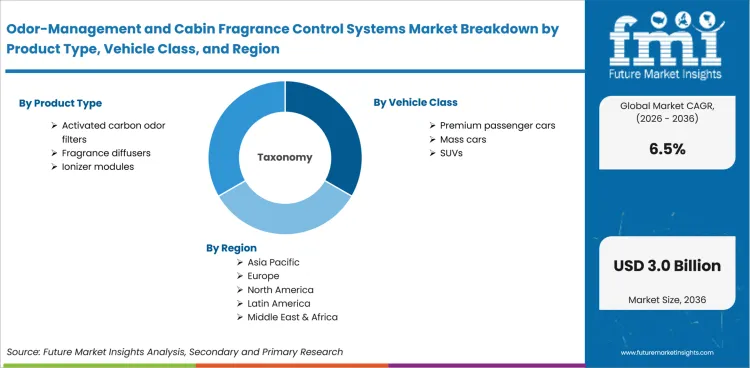
Odor-Management and Cabin Fragrance Control Systems Market Breakdown by Product Type, Vehicle Class, Integration Route, Control Mode, Refill Format, and Region
Odor-Management and Cabin Fragrance Control Systems Market Segmented by Product Type
- Activated carbon odor filters
- Fragrance diffusers
- Ionizer modules
- Sensor modules
- Purifier modules
Odor-Management and Cabin Fragrance Control Systems Market Segmented by Vehicle Class
- Premium passenger cars
- Mass cars
- SUVs
- Fleet vehicles
- Buses
Odor-Management and Cabin Fragrance Control Systems Market Segmented by Integration Route
- OEM fitment
- Dealer retrofit
- Independent aftermarket
- Refill sales
Odor-Management and Cabin Fragrance Control Systems Market Segmented by Control Mode
- HVAC-integrated modules
- App-controlled units
- Manual vents
- Sensor-triggered control
Odor-Management and Cabin Fragrance Control Systems Market Segmented by Refill Format
- Cartridge refills
- Liquid refills
- Dry pads
- Scent capsules
Odor-Management and Cabin Fragrance Control Systems Market Segmented by Region
- North America
- Latin America
- Western Europe
- Eastern Europe
- East Asia
- South Asia and Pacific
- Middle East & Africa
Research Sources and Bibliography
- BMW Group. (2026, January 9). BMW Group vehicle sales grew in 2025 - strong performance particularly in Europe and the US, and with electrified models. BMW Group PressClub.
- DENSO Europe B.V. (2025, July 28). Cabin air filter range expanded: 82 new part numbers added, 14 pollen, 68 carbon. DENSO.
- DENSO Europe B.V. (2026, January). DENSO launches new premium cabin air filter line. DENSO.
- Denso International America, Inc. (2025, April 8). Systems and methods for measuring and managing odor brought into rental vehicles (USA Patent No. 12,269,315 B2). USA Patent and Trademark Office.
- MANN+HUMMEL. (2026, February 24). Clean air on every journey: Cabin air filters for motorhomes. MANN+HUMMEL.
- General Motors. (2026, January 5). GM leads USA industry, 2025 sales up 6%. General Motors.
- Hyundai Motor Company. (2026, January 29). Hyundai Motor announces 2025 annual and Q4 business results. Hyundai Motor Company.
- International Organization of Motor Vehicle Manufacturers. (2026). Production statistics. OICA.
- International Organization of Motor Vehicle Manufacturers. (2026). Sales statistics. OICA.
- International Organization of Motor Vehicle Manufacturers. (2026, April 23). Auto industry moved east in 2025 amid global repositioning. OICA.
- MANN+HUMMEL. (2025, March 24). Filtration of the future inspired by nature. MANN+HUMMEL.
- MANN+HUMMEL. (2026, February 24). Clean air on every journey: Cabin air filters for motorhomes. MANN+HUMMEL.
- Mercedes-Benz India. (2025). Mercedes-Maybach GLS SUV owner’s manual: Activating/deactivating the fragrance system using the multimedia system. Mercedes-Benz.
- Society of Indian Automobile Manufacturers. (2025, April 15). Performance of Indian auto industry during FY 2024-25. SIAM.
- Society of Motor Manufacturers and Traders. (2026, January 6). UK new car market breaches two million as almost one in four buyers go electric. SMMT.
- Toyota Motor North America. (2026, January 5). Toyota Motor North America reports 2025 USA sales results. Toyota Motor North America.
This Report Answers
- How large is the odor-management and cabin fragrance control systems market in 2026?
- What value is industry demand expected to reach by 2036?
- What CAGR is expected between 2026 and 2036?
- Which product type is forecast to hold a strong share in 2026?
- Which integration route is expected to lead demand in 2026?
- Which countries are forecast to record faster adoption by 2036?
- How does cabin filter replacement affect aftermarket demand?
- Which suppliers are active in odor filtration and fragrance control systems?
- What methodology supports FMI’s market sizing and forecast?
Frequently Asked Questions
What is the size of the odor-management and cabin fragrance control systems market in 2026?
Odor-management and cabin fragrance control systems demand is expected to reach USD 1.6 billion in 2026.
What is the expected value of the market by 2036?
Industry demand is forecast to reach USD 3.0 billion by 2036 as odor filtration and premium fragrance features move into wider vehicle programs.
What is the expected CAGR for the market?
Odor-management and cabin fragrance control systems market is expected to rise at 6.5% CAGR during the 2026 to 2036 forecast period.
Which segment leads product type demand?
Activated carbon odor filters are forecast to hold 43.5% share of product type demand in 2026 as gas adsorption suits routine cabin filter replacement.
Which integration route leads the market?
OEM fitment is forecast to hold 61.0% share of integration route demand in 2026 as fragrance hardware needs safe HVAC integration before launch.
Which country is forecast to have the faster pace?
China is forecast to record 7.8% CAGR by 2036 due to high vehicle output and wider cabin comfort integration.
Who are the key companies in the market?
Mercedes-Benz Group AG and BMW Group are active companies. MAHLE GmbH is another active supplier in the market. MANN+HUMMEL and DENSO Corporation hold active positions in odor filtration.
Preview the report firsthand - request a free sample
Get SampleGet the brochure for pricing and purchase details.
Get PDFTable of Content
- Executive Summary
- Global Market Outlook
- Demand-side Trends
- Supply-side Trends
- Technology Roadmap Analysis
- Analysis and Recommendations
- Market Overview
- Market Coverage / Taxonomy
- Market Definition / Scope / Limitations
- Research Methodology
- Chapter Orientation
- Analytical Lens and Working Hypotheses
- Market Structure, Signals, and Trend Drivers
- Benchmarking and Cross-market Comparability
- Market Sizing, Forecasting, and Opportunity Mapping
- Research Design and Evidence Framework
- Desk Research Programme (Secondary Evidence)
- Company Annual and Sustainability Reports
- Peer-reviewed Journals and Academic Literature
- Corporate Websites, Product Literature, and Technical Notes
- Earnings Decks and Investor Briefings
- Statutory Filings and Regulatory Disclosures
- Technical White Papers and Standards Notes
- Trade Journals, Industry Magazines, and Analyst Briefs
- Conference Proceedings, Webinars, and Seminar Materials
- Government Statistics Portals and Public Data Releases
- Press Releases and Reputable Media Coverage
- Specialist Newsletters and Curated Briefings
- Sector Databases and Reference Repositories
- FMI Internal Proprietary Databases and Historical Market Datasets
- Subscription Datasets and Paid Sources
- Social Channels, Communities, and Digital Listening Inputs
- Additional Desk Sources
- Expert Input and Fieldwork (Primary Evidence)
- Primary Modes
- Qualitative Interviews and Expert Elicitation
- Quantitative Surveys and Structured Data Capture
- Blended Approach
- Why Primary Evidence is Used
- Field Techniques
- Interviews
- Surveys
- Focus Groups
- Observational and In-context Research
- Social and Community Interactions
- Stakeholder Universe Engaged
- C-suite Leaders
- Board Members
- Presidents and Vice Presidents
- R&D and Innovation Heads
- Technical Specialists
- Domain Subject-matter Experts
- Scientists
- Automotive Interior Engineers and Cabin Air Quality Specialists
- Governance, Ethics, and Data Stewardship
- Research Ethics
- Data Integrity and Handling
- Primary Modes
- Tooling, Models, and Reference Databases
- Desk Research Programme (Secondary Evidence)
- Data Engineering and Model Build
- Data Acquisition and Ingestion
- Cleaning, Normalisation, and Verification
- Synthesis, Triangulation, and Analysis
- Quality Assurance and Audit Trail
- Market Background
- Market Dynamics
- Drivers
- Restraints
- Opportunity
- Trends
- Scenario Forecast
- Demand in Optimistic Scenario
- Demand in Likely Scenario
- Demand in Conservative Scenario
- Opportunity Map Analysis
- Product Life Cycle Analysis
- Supply Chain Analysis
- Investment Feasibility Matrix
- Value Chain Analysis
- PESTLE and Porter’s Analysis
- Regulatory Landscape
- Regional Parent Market Outlook
- Production and Consumption Statistics
- Import and Export Statistics
- Market Dynamics
- Global Market Analysis 2016 to 2025 and Forecast, 2026 to 2036
- Historical Market Size Value (USD Million) Analysis, 2016 to 2025
- Current and Future Market Size Value (USD Million) Projections, 2026 to 2036
- Y-o-Y Growth Trend Analysis
- Absolute $ Opportunity Analysis
- Global Market Pricing Analysis 2016 to 2025 and Forecast 2026 to 2036
- Global Market Analysis 2016 to 2025 and Forecast 2026 to 2036, By Product Type
- Introduction / Key Findings
- Historical Market Size Value (USD Million) Analysis By Product Type, 2016 to 2025
- Current and Future Market Size Value (USD Million) Analysis and Forecast By Product Type, 2026 to 2036
- Activated carbon odor filters
- Fragrance diffusers
- Ionizer modules
- Activated carbon odor filters
- Y-o-Y Growth Trend Analysis By Product Type, 2016 to 2025
- Absolute $ Opportunity Analysis By Product Type, 2026 to 2036
- Global Market Analysis 2016 to 2025 and Forecast 2026 to 2036, By Vehicle Class
- Introduction / Key Findings
- Historical Market Size Value (USD Million) Analysis By Vehicle Class, 2016 to 2025
- Current and Future Market Size Value (USD Million) Analysis and Forecast By Vehicle Class, 2026 to 2036
- Premium passenger cars
- Mass cars
- SUVs
- Premium passenger cars
- Y-o-Y Growth Trend Analysis By Vehicle Class, 2016 to 2025
- Absolute $ Opportunity Analysis By Vehicle Class, 2026 to 2036
- Global Market Analysis 2016 to 2025 and Forecast 2026 to 2036, By Integration Route
- Introduction / Key Findings
- Historical Market Size Value (USD Million) Analysis By Integration Route, 2016 to 2025
- Current and Future Market Size Value (USD Million) Analysis and Forecast By Integration Route, 2026 to 2036
- OEM fitment
- Dealer retrofit
- Independent aftermarket
- OEM fitment
- Y-o-Y Growth Trend Analysis By Integration Route, 2016 to 2025
- Absolute $ Opportunity Analysis By Integration Route, 2026 to 2036
- Global Market Analysis 2016 to 2025 and Forecast 2026 to 2036, By Control Mode
- Introduction / Key Findings
- Historical Market Size Value (USD Million) Analysis By Control Mode, 2016 to 2025
- Current and Future Market Size Value (USD Million) Analysis and Forecast By Control Mode, 2026 to 2036
- HVAC-integrated modules
- Dealer retrofit
- Independent aftermarket
- HVAC-integrated modules
- Y-o-Y Growth Trend Analysis By Control Mode, 2016 to 2025
- Absolute $ Opportunity Analysis By Control Mode, 2026 to 2036
- Global Market Analysis 2016 to 2025 and Forecast 2026 to 2036, By Refill Format
- Introduction / Key Findings
- Historical Market Size Value (USD Million) Analysis By Refill Format, 2016 to 2025
- Current and Future Market Size Value (USD Million) Analysis and Forecast By Refill Format, 2026 to 2036
- Cartridge refills
- Liquid refills
- Dry pads
- Cartridge refills
- Y-o-Y Growth Trend Analysis By Refill Format, 2016 to 2025
- Absolute $ Opportunity Analysis By Refill Format, 2026 to 2036
- Global Market Analysis 2016 to 2025 and Forecast 2026 to 2036, By Region
- Introduction
- Historical Market Size Value (USD Million) Analysis By Region, 2016 to 2025
- Current Market Size Value (USD Million) Analysis and Forecast By Region, 2026 to 2036
- North America
- Latin America
- Western Europe
- Eastern Europe
- East Asia
- South Asia and Pacific
- Middle East & Africa
- Market Attractiveness Analysis By Region
- North America Market Analysis 2016 to 2025 and Forecast 2026 to 2036, By Country
- Historical Market Size Value (USD Million) Trend Analysis By Market Taxonomy, 2016 to 2025
- Market Size Value (USD Million) Forecast By Market Taxonomy, 2026 to 2036
- By Country
- USA
- Canada
- Mexico
- By Product Type
- By Vehicle Class
- By Integration Route
- By Control Mode
- By Refill Format
- By Country
- Market Attractiveness Analysis
- By Country
- By Product Type
- By Vehicle Class
- By Integration Route
- By Control Mode
- By Refill Format
- Key Takeaways
- Latin America Market Analysis 2016 to 2025 and Forecast 2026 to 2036, By Country
- Historical Market Size Value (USD Million) Trend Analysis By Market Taxonomy, 2016 to 2025
- Market Size Value (USD Million) Forecast By Market Taxonomy, 2026 to 2036
- By Country
- Brazil
- Chile
- Rest of Latin America
- By Product Type
- By Vehicle Class
- By Integration Route
- By Control Mode
- By Refill Format
- By Country
- Market Attractiveness Analysis
- By Country
- By Product Type
- By Vehicle Class
- By Integration Route
- By Control Mode
- By Refill Format
- Key Takeaways
- Western Europe Market Analysis 2016 to 2025 and Forecast 2026 to 2036, By Country
- Historical Market Size Value (USD Million) Trend Analysis By Market Taxonomy, 2016 to 2025
- Market Size Value (USD Million) Forecast By Market Taxonomy, 2026 to 2036
- By Country
- Germany
- UK
- Italy
- Spain
- France
- Nordic
- BENELUX
- Rest of Western Europe
- By Product Type
- By Vehicle Class
- By Integration Route
- By Control Mode
- By Refill Format
- By Country
- Market Attractiveness Analysis
- By Country
- By Product Type
- By Vehicle Class
- By Integration Route
- By Control Mode
- By Refill Format
- Key Takeaways
- Eastern Europe Market Analysis 2016 to 2025 and Forecast 2026 to 2036, By Country
- Historical Market Size Value (USD Million) Trend Analysis By Market Taxonomy, 2016 to 2025
- Market Size Value (USD Million) Forecast By Market Taxonomy, 2026 to 2036
- By Country
- Russia
- Poland
- Hungary
- Balkan & Baltic
- Rest of Eastern Europe
- By Product Type
- By Vehicle Class
- By Integration Route
- By Control Mode
- By Refill Format
- By Country
- Market Attractiveness Analysis
- By Country
- By Product Type
- By Vehicle Class
- By Integration Route
- By Control Mode
- By Refill Format
- Key Takeaways
- East Asia Market Analysis 2016 to 2025 and Forecast 2026 to 2036, By Country
- Historical Market Size Value (USD Million) Trend Analysis By Market Taxonomy, 2016 to 2025
- Market Size Value (USD Million) Forecast By Market Taxonomy, 2026 to 2036
- By Country
- China
- Japan
- South Korea
- By Product Type
- By Vehicle Class
- By Integration Route
- By Control Mode
- By Refill Format
- By Country
- Market Attractiveness Analysis
- By Country
- By Product Type
- By Vehicle Class
- By Integration Route
- By Control Mode
- By Refill Format
- Key Takeaways
- South Asia and Pacific Market Analysis 2016 to 2025 and Forecast 2026 to 2036, By Country
- Historical Market Size Value (USD Million) Trend Analysis By Market Taxonomy, 2016 to 2025
- Market Size Value (USD Million) Forecast By Market Taxonomy, 2026 to 2036
- By Country
- India
- ASEAN
- Australia & New Zealand
- Rest of South Asia and Pacific
- By Product Type
- By Vehicle Class
- By Integration Route
- By Control Mode
- By Refill Format
- By Country
- Market Attractiveness Analysis
- By Country
- By Product Type
- By Vehicle Class
- By Integration Route
- By Control Mode
- By Refill Format
- Key Takeaways
- Middle East & Africa Market Analysis 2016 to 2025 and Forecast 2026 to 2036, By Country
- Historical Market Size Value (USD Million) Trend Analysis By Market Taxonomy, 2016 to 2025
- Market Size Value (USD Million) Forecast By Market Taxonomy, 2026 to 2036
- By Country
- Kingdom of Saudi Arabia
- Other GCC Countries
- Turkiye
- South Africa
- Other African Union
- Rest of Middle East & Africa
- By Product Type
- By Vehicle Class
- By Integration Route
- By Control Mode
- By Refill Format
- By Country
- Market Attractiveness Analysis
- By Country
- By Product Type
- By Vehicle Class
- By Integration Route
- By Control Mode
- By Refill Format
- Key Takeaways
- Key Countries Market Analysis
- USA
- Pricing Analysis
- Market Share Analysis, 2025
- By Product Type
- By Vehicle Class
- By Integration Route
- By Control Mode
- By Refill Format
- Canada
- Pricing Analysis
- Market Share Analysis, 2025
- By Product Type
- By Vehicle Class
- By Integration Route
- By Control Mode
- By Refill Format
- Mexico
- Pricing Analysis
- Market Share Analysis, 2025
- By Product Type
- By Vehicle Class
- By Integration Route
- By Control Mode
- By Refill Format
- Brazil
- Pricing Analysis
- Market Share Analysis, 2025
- By Product Type
- By Vehicle Class
- By Integration Route
- By Control Mode
- By Refill Format
- Chile
- Pricing Analysis
- Market Share Analysis, 2025
- By Product Type
- By Vehicle Class
- By Integration Route
- By Control Mode
- By Refill Format
- Germany
- Pricing Analysis
- Market Share Analysis, 2025
- By Product Type
- By Vehicle Class
- By Integration Route
- By Control Mode
- By Refill Format
- UK
- Pricing Analysis
- Market Share Analysis, 2025
- By Product Type
- By Vehicle Class
- By Integration Route
- By Control Mode
- By Refill Format
- Italy
- Pricing Analysis
- Market Share Analysis, 2025
- By Product Type
- By Vehicle Class
- By Integration Route
- By Control Mode
- By Refill Format
- Spain
- Pricing Analysis
- Market Share Analysis, 2025
- By Product Type
- By Vehicle Class
- By Integration Route
- By Control Mode
- By Refill Format
- France
- Pricing Analysis
- Market Share Analysis, 2025
- By Product Type
- By Vehicle Class
- By Integration Route
- By Control Mode
- By Refill Format
- India
- Pricing Analysis
- Market Share Analysis, 2025
- By Product Type
- By Vehicle Class
- By Integration Route
- By Control Mode
- By Refill Format
- ASEAN
- Pricing Analysis
- Market Share Analysis, 2025
- By Product Type
- By Vehicle Class
- By Integration Route
- By Control Mode
- By Refill Format
- Australia & New Zealand
- Pricing Analysis
- Market Share Analysis, 2025
- By Product Type
- By Vehicle Class
- By Integration Route
- By Control Mode
- By Refill Format
- China
- Pricing Analysis
- Market Share Analysis, 2025
- By Product Type
- By Vehicle Class
- By Integration Route
- By Control Mode
- By Refill Format
- Japan
- Pricing Analysis
- Market Share Analysis, 2025
- By Product Type
- By Vehicle Class
- By Integration Route
- By Control Mode
- By Refill Format
- South Korea
- Pricing Analysis
- Market Share Analysis, 2025
- By Product Type
- By Vehicle Class
- By Integration Route
- By Control Mode
- By Refill Format
- Russia
- Pricing Analysis
- Market Share Analysis, 2025
- By Product Type
- By Vehicle Class
- By Integration Route
- By Control Mode
- By Refill Format
- Poland
- Pricing Analysis
- Market Share Analysis, 2025
- By Product Type
- By Vehicle Class
- By Integration Route
- By Control Mode
- By Refill Format
- Hungary
- Pricing Analysis
- Market Share Analysis, 2025
- By Product Type
- By Vehicle Class
- By Integration Route
- By Control Mode
- By Refill Format
- Kingdom of Saudi Arabia
- Pricing Analysis
- Market Share Analysis, 2025
- By Product Type
- By Vehicle Class
- By Integration Route
- By Control Mode
- By Refill Format
- Turkiye
- Pricing Analysis
- Market Share Analysis, 2025
- By Product Type
- By Vehicle Class
- By Integration Route
- By Control Mode
- By Refill Format
- South Africa
- Pricing Analysis
- Market Share Analysis, 2025
- By Product Type
- By Vehicle Class
- By Integration Route
- By Control Mode
- By Refill Format
- USA
- Market Structure Analysis
- Competition Dashboard
- Competition Benchmarking
- Market Share Analysis of Top Players
- By Region
- By Product Type
- By Vehicle Class
- By Integration Route
- By Control Mode
- By Refill Format
- Competition Analysis
- Competition Deep Dive
- Mercedes-Benz Group AG
- Overview
- Product Portfolio
- Profitability by Market Segments (Product Type/Vehicle Class/Integration Route/Control Mode/Refill Format/Region)
- Sales Footprint
- Strategy Overview
- Marketing Strategy
- Product Strategy
- Channel Strategy
- BMW Group
- MAHLE GmbH
- MANN+HUMMEL
- DENSO Corporation
- Mercedes-Benz Group AG
- Competition Deep Dive
- Assumptions & Acronyms Used


