
- Market Size (2026)
- USD 910.5 Mn
- Forecast (2036)
- USD 2096.9 Mn
- CAGR (2026 to 2036)
- 8.7%
How big is Panthenol Market in 2026?
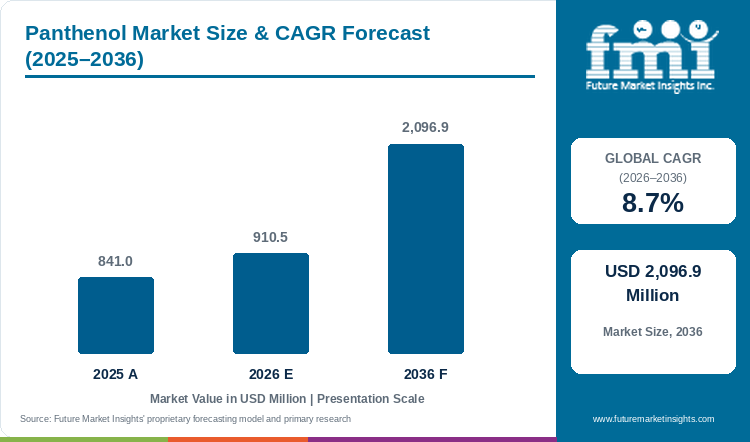
Having recorded a market size of USD 841.0 million in 2025 and moving to USD 910.5 million in 2026, the panthenol market is projected to scale up to USD 2,096.9 million by the end of 2036, maintaining an 8.7% CAGR.
Skincare and clinical hair-care brands are raising active provitamin B5 concentrations from trace label claims to 5% therapeutic barrier levels to win ingredient-conscious buyers. Global panthenol valuation reached USD 841.0 million during 2025 and advances to USD 910.5 million in 2026. Long-term projections place 2036 market size at USD 2,096.9 million, reflecting an 8.7% CAGR from 2026 to 2036. D-panthenol dexpanthenol viscous liquid holds 50.9% of 2026 demand because only the biologically active D-form converts into pantothenic acid inside skin cells [1]. That cellular repair advantage separates high-purity dexpanthenol supply from basic nourishing hair and skin formulations sold in mass retail. FMI industry evaluation indicates that strict pharmacopeial purity checks and the thick, sticky nature of pure D-panthenol liquid lengthen supplier qualification and blending cycles.
Key Market Trends & Insights
- By stereoisomer form: D-Panthenol Dexpanthenol Viscous Liquid holds a 50.9% share in 2026 because full cellular conversion to coenzyme A accelerates stratum corneum lipid synthesis.
- By grade specification: Cosmetic Formulation Grade represents 71.3% in 2026 as global shampoo and conditioner lines alongside facial serums incorporate provitamin B5 at 0.5% to 3.0% weight ratios.
- By end-use sector: Hair Care Conditioners Shampoos and Serums account for 50.0% in 2026 since panthenol penetrates damaged hair shafts to reduce wet-combing breakage.
- By delivery format: Aqueous and Viscous Liquid Concentrates secure 58.4% in 2026 because pre-diluted 50% and 75% solutions eliminate heated tank melting in cold-process emulsions.
- By sales channel: Direct to Personal Care and Pharma Manufacturers commands 56.2% in 2026 through multi-year bulk drum and IBC tote supply contracts.
Regional Highlights
- Top national expansion: Saudi Arabia leads country growth projections at a 10.1% CAGR through 2036 via pharmacy dermo-cosmetic expansion and high-humidity hair repair demand.
- Broader country progression: South Korea tracks at a 10.0% CAGR ahead of Switzerland at 9.1% and the United Kingdom at 9.0%, driven by cica-panthenol ampoule exports and Alpine active synthesis.
Market Size & Forecast
Table 1: Market Size and Forecast for the Panthenol Market (USD million and CAGR percentage), 2025 to 2036
| Metric | Value |
|---|---|
| 2025 Market Size | USD 841.0 million |
| Estimated Market Size in 2026 | USD 910.5 million |
| Projected Market Size by 2036 | USD 2,096.9 million |
| CAGR, 2026 to 2036 | 8.7% |
| Added Value, 2026 to 2036 | USD 1,186.4 million |
Widespread consumer use of strong exfoliating acids and aesthetic laser treatments has created surging demand for soothing barrier-repair creams. Basic petroleum jelly or silicone lotions sit on top of the skin to trap moisture, but they do not speed up cellular skin recovery. A July 2025 randomized clinical trial in the Journal of Cosmetic Dermatology demonstrated that applying a panthenol-enriched recovery mask after facial laser treatment cut skin redness and moisture loss much faster than control dressings [2]. Skincare formulators are therefore combining high-load D-panthenol with multi-lamellar ceramide blends to sell premium post-procedure recovery balms.
Formulation Batch and Active-Dosage Sizing
Table 2: Formulation Batch and Active-Dosage Sizing for the Panthenol Market (USD million and operational ranges), 2025 to 2036
| Metric | 2025 | 2026 | 2036 |
|---|---|---|---|
| Market size (USD million) | 841.0 | 910.5 | 2,096.9 |
| Formulated personal care & pharma output (million metric tons) | 4.8 to 5.4 | 5.2 to 5.8 | 11.5 to 12.9 |
| Bulk panthenol & pantothenate volume (thousand metric tons) | 34.2 to 38.0 | 36.8 to 41.0 | 79.5 to 88.5 |
| Average active realization per kilogram (USD) | 22.1 to 24.6 | 22.2 to 24.7 | 23.7 to 26.4 |
Operational note on formulation ranges reflects 0.5% to 2.0% active inclusion in rinse-off hair care and 2.5% to 5.0% dosing in topical barrier ointments.
Factory mixing efficiency strongly influences which physical form of panthenol contract beauty packers purchase. Pure D-panthenol is an extremely thick, syrup-like liquid that is hard to pump and weigh accurately unless storage tanks are heated. To avoid costly heating lines and slow mixing batches, shampoo and lotion factories buy pre-diluted 75% aqueous D-panthenol liquids or free-flowing DL-panthenol powders. Formulation teams blend these easy-to-handle grades directly into epidermal healing skin care batches at room temperature.
Per Capita & Personal Care Line Sizing
Table 3: Per Capita and Formulation Line Valuation Indicators for the Panthenol Market (USD), 2025 to 2036
| Metric | 2025 | 2026 | 2036 |
|---|---|---|---|
| World population (billion) | 8.2 | 8.3 | 9.0 |
| Valuation per 1,000 people (USD) | 102.6 | 109.7 | 233.0 |
| Annual procurement per personal care plant (USD thousand) | 128.0 to 145.0 | 138.0 to 156.0 | 305.0 to 345.0 |
| High-load (>=3% D-panthenol) dermo-cosmetic share (%) | 28.0% to 31.0% | 30.0% to 33.5% | 44.0% to 48.5% |
Table 4: Personal Care & Pharma Channel Valuation Indicators for the Panthenol Market (USD and percentages), 2026
| Metric | Value | Institutional Reference Basis |
|---|---|---|
| Market size, 2026 | USD 910.5 million | 2026 global valuation baseline |
| Personal care & topical pharma plants global | 6,200 facilities | Hair care, skincare, wound ointment & eye drop plants |
| Market valuation per facility | USD 146,854.8 | Annualized provitamin B5 procurement |
| Direct to Manufacturers value, 2026 | USD 511.7 million | 56.2% sales channel allocation |
Parents and dermatologists routinely look for gentle, fragrance-free barrier ointments that heal infant diaper rash and minor burns without stinging sensitive skin. Dexpanthenol at 5% concentration softens rough skin and speeds up natural tissue repair without relying on topical steroids. Baby care and pharmacy brands pair pharmaceutical-grade dexpanthenol with zinc oxide in pediatric diaper barrier creams to capture hospital maternity and retail pharmacy sales.
Analyst Perspective
"Cosmetic and pharmaceutical buyers no longer treat panthenol as an interchangeable label-claim humectant. Dermo-cosmetic brands specify optically pure D-panthenol at 3% to 5% concentrations to back clinical transepidermal water-loss claims, while mass hair-care plants procure 75% aqueous liquid blends for cold-process tank efficiency. Producers that guarantee sub-ppm 3-aminopropanol impurity ceilings alongside low-carbon fermentation or continuous pantolactone synthesis will win direct multi-national supply agreements through 2036."
- Nandini Roy Choudhury, Principal Consultant, Future Market Insights.
How is the panthenol market segmented?
The panthenol market is segmented by stereoisomer form, grade specification, end-use sector, delivery format, and sales channel. In 2026, D-Panthenol Dexpanthenol Viscous Liquid is projected at 50.9%, Cosmetic Formulation Grade at 71.3%, Hair Care Conditioners Shampoos and Serums at 50.0%, Aqueous and Viscous Liquid Concentrates at 58.4%, and Direct to Personal Care and Pharma Manufacturers at 56.2%.
By stereoisomer form: D-Panthenol Dexpanthenol Viscous Liquid and DL-Panthenol Crystalline Powder alongside Calcium Pantothenate Solid Salt.
By grade specification: Cosmetic Formulation Grade and Pharmaceutical Topical and Injectable Grade alongside Food and Nutraceutical Fortification Grade.
By end-use sector: Hair Care Conditioners Shampoos and Serums with Facial Moisturizers and After-Sun Lotions alongside Wound Healing Ointments and Diaper Rash Creams and Ophthalmic Eye Lubricant Drops.
By delivery format: Aqueous and Viscous Liquid Concentrates and Free-Flowing Crystalline Powders alongside Pre-Dispersed Liposomal and Ceramide Complexes.
By sales channel: Direct to Personal Care and Pharma Manufacturers alongside Specialty Chemical and Ingredient Distributors and Contract Formulators and Compounding Pharmacies.
Why does D-Panthenol Dexpanthenol Viscous Liquid lead the stereoisomer form category?
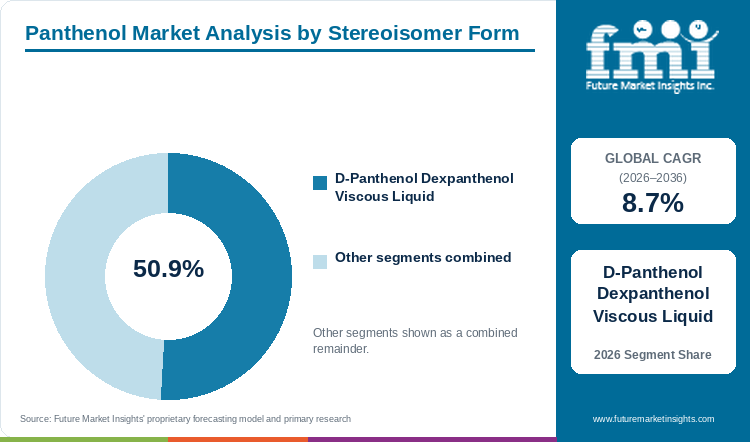
D-Panthenol Dexpanthenol Viscous Liquid holds an estimated 50.9% of stereoisomer form demand in 2026, anchored by full enzymatic conversion to pantothenic acid in skin and scalp tissues.
Table 5: Stereoisomer Form Share for the Panthenol Market (percentage share), 2026
| Stereoisomer Form | Share (2026) |
|---|---|
| D-Panthenol Dexpanthenol Viscous Liquid | 50.9% |
| Other Segments Combined | 49.1%* |
| Total | 100.0% |
*Note that remaining stereoisomer form categories account for the balance of 2026 global panthenol demand.
Table 6: Stereoisomer Form Leadership and Market Growth for the Panthenol Market (segment and CAGR percentage), 2026 to 2036
| Metric | Value |
|---|---|
| Global CAGR (2026 to 2036) | 8.7% |
| Leading Segment | D-Panthenol Dexpanthenol Viscous Liquid |
Strong consumer willingness to pay for clinically proven skin-repair serums and salon hair treatments keeps D-panthenol viscous liquid ahead of racemic powder alternatives. Because only the D-isomer is biologically active in human skin, dermatological brands specify pure dexpanthenol whenever they want to substantiate fast hydration and wound-soothing claims on product labels. Hair growth and scalp care brands also combine liquid D-panthenol with water-soluble biotin ingredients in premium thickening ampoules.
- D-Panthenol Dexpanthenol Viscous Liquid holds 50.9% of stereoisomer form value in 2026 because biological chirality delivers twice the cellular provitamin B5 activity of racemic DL-panthenol.
- A July 2025 clinical microbiome study in Scientific Reports confirmed that topical panthenol stimulates fibroblast migration and collagen synthesis to accelerate epidermal repair [3].
What sustains Cosmetic Formulation Grade leadership in the grade specification segment?
Cosmetic Formulation Grade represents 71.3% of the grade specification category in 2026, supported by high-volume hair care, facial serum, and body lotion production.
High daily consumption of mass-market shampoos and body washes as well as facial moisturizers anchors demand for cosmetic formulation grade panthenol. Personal care brands do not need expensive injectable-grade endotoxin testing for rinse-off hair and body products, so cosmetic-grade provitamin B5 offers the best balance of purity and cost. Shampoo formulators add cosmetic panthenol into surfactant clarifying shampoos to prevent harsh detergents from drying out the scalp.
- Cosmetic Formulation Grade represents 71.3% of the grade specification segment in 2026 as global beauty conglomerates standardize provitamin B5 across mass and prestige hair and skin lines.
- In January 2026, dsm-firmenich highlighted its cosmetic D-Panthenol 75L and DL-Panthenol 50L portfolio for high-volume skin and hair moisturizing applications [4].
How do Hair Care Conditioners Shampoos and Serums lead the end-use sector category?
Hair Care Conditioners Shampoos and Serums account for 50.0% of end-use sector volume in 2026, driven by cuticle film-forming hydration and anti-breakage performance.
Frequent hair bleaching and heat styling among consumers are fueling steady demand for panthenol in conditioners and leave-in serums. Panthenol binds directly to damaged hair keratin, coating each strand in a smooth moisture film that reduces tangling and snapping during brushing. Prestige hair brands pair provitamin B5 with leave-in scalp care treatments to soothe dry scalps and repair split ends.
- Hair Care Conditioners Shampoos and Serums account for 50.0% of end-use sector demand in 2026 because high global wash frequency drives continuous bulk replenishment.
- A September 2025 nuclear magnetic resonance study in Int. J. Cosmet. Sci. proved that panthenol penetrates the inner hair cortex and forms hydrogen bonds with hair proteins to boost tensile strength [5].
Why do Aqueous and Viscous Liquid Concentrates lead the delivery format category?
Aqueous and Viscous Liquid Concentrates secure 58.4% of delivery format value in 2026, supported by ambient pumpability in cold-process personal care lines.
Contract cosmetics factories are shifting toward cold-process manufacturing to cut electricity bills and speed up tank turnaround times. Pre-diluted 50% and 75% aqueous liquid panthenol concentrates pour and mix instantly into water-based shampoos and serums without heating.
- Aqueous and Viscous Liquid Concentrates secure 58.4% of delivery format demand in 2026 as automated liquid dosing cuts batch cycle time across contract beauty plants.
- Technical hair-care data from dsm-firmenich in February 2026 confirmed that liquid panthenol and ethyl-panthenol solutions boost active deposition onto damaged hair fibers during rapid wash cycles [6].
What gives Direct to Personal Care and Pharma Manufacturers the leading position in sales channel?
Direct to Personal Care and Pharma Manufacturers commands 56.2% of sales channel share in 2026, anchored by factory-direct chiral purity audits and IBC tote contracts.
Large beauty conglomerates and pharmaceutical ointment makers buy panthenol directly from primary vitamin producers to lock in multi-year price stability and audit factory quality. Direct supply contracts guarantee consistent optical purity and bulk tote delivery across global filling plants.
- Direct to Personal Care and Pharma Manufacturers accounts for 56.2% of channel demand in 2026 as large beauty and OTC pharma groups audit primary synthesis plants directly.
- A July 2025 prospective clinical study in the Journal of Cosmetic Dermatology showed that a facial cream combining panthenol and ceramide NP with Centella asiatica cut sensitive-skin redness and irritation scores by 76% over four weeks [7].
What are the growth drivers and restraints alongside opportunities in the panthenol market?
In the panthenol market, clinical skin-barrier repair creams and bond-building hair care drive adoption whereas D-pantolactone feedstock swings and 3-aminopropanol limits restrain unintegrated blenders and sterile ophthalmic gels generate high-margin growth.
- Driver: Consumer demand for clinical skin-barrier repair creams and cica-panthenol facial serums alongside bond-building hair conditioners accelerates high-load D-panthenol consumption.
- Restraint: Energy-intensive D-pantolactone intermediate synthesis and strict pharmacopeial limits on 3-aminopropanol impurities expose unintegrated formulators to spot price volatility.
- Opportunity: Preservative-free dexpanthenol ophthalmic lubricant drops and liposomal post-aesthetic procedure hydrogels generate high-margin medical and dermo-cosmetic growth.
Growth Analysis and Future Potential: Qualitative Demand Drivers
Consumer complaints of sensitive, over-exfoliated skin and oncology treatment side effects are driving dermatologists to recommend high-strength panthenol repair balms. Patients using harsh prescription creams or retinoids experience peeling and burning that cause many to quit treatment early unless they apply a soothing barrier ointment. An April 2026 randomized controlled trial in Dermatology and Therapy showed that a prebiotic and panthenol repair balm markedly improved skin tolerance and reduced severe redness in patients undergoing topical 5-fluorouracil therapy [8]. Beauty brands are pairing provitamin B5 with intensive dehydrated skin moisturizers to capture this sensitive-skin buyer segment.
Risk Assessment of the Panthenol Market: Operational and Formulation Friction
Volatile petrochemical feedstock costs for D-pantolactone synthesis and rare contact-allergy concerns in ultra-sensitive patients represent the main restraints on market growth. Unintegrated blenders face margin squeezes when energy or chemical precursor prices spike, while dermatologists monitor patch-test reactions in chronic eczema patients. A June 2026 clinical review in Nutrients noted that although panthenol is widely tolerated, formulators must control trace impurities and preservative pairings in atopic skincare lines [9]. Medical ointment makers also evaluate regenerative wound care dressings when designing hypoallergenic hospital wound care.
Commercial Opportunity Analysis: Formulation Differentiation and Value-Add Formats
Heavy daily screen time and laser eye surgeries are creating strong commercial growth for dexpanthenol eye drops and corneal gels. Standard saline drops evaporate within minutes, whereas dexpanthenol eye gels lubricate the ocular surface and help scratched corneal cells heal overnight. A January 2025 ophthalmology study in Cornea demonstrated that topical dexpanthenol markedly reduces corneal inflammation and unwanted blood-vessel growth after ocular surface injury [10]. Eye-care manufacturers are combining provitamin B5 with hyaluronic acid in ocular lubricant artificial tears to win pharmacy and optometry clinic shelf space.
Panthenol Market by Country (2026 to 2036)
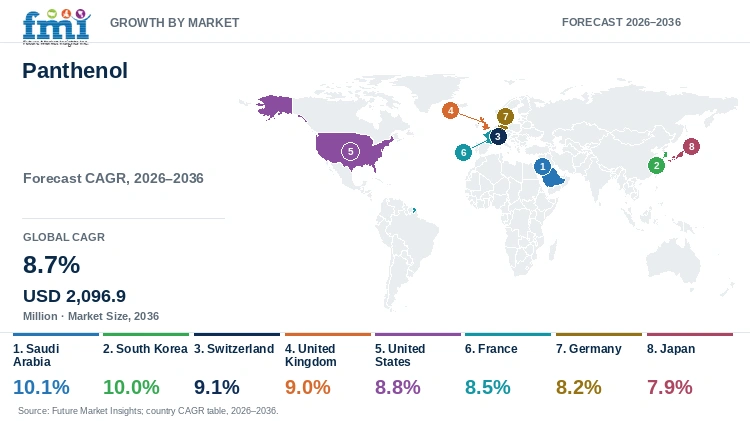
National growth modeling shows Saudi Arabia topping panthenol expansion at a 10.1% CAGR through 2036, whereas Japan records a 7.9% pace across hair and eye care.
Table 7: Country CAGR and Primary Growth Levers for the Panthenol Market (CAGR percentage and operational drivers), 2026 to 2036
| Country | CAGR (2026 to 2036) | Primary Growth Lever |
|---|---|---|
| Saudi Arabia | 10.1% | Arid-climate skin barrier repair demand and retail pharmacy dermo-cosmetic expansion |
| South Korea | 10.0% | Global K-beauty cica-panthenol ampoule exports and post-laser clinic protocols |
| Switzerland | 9.1% | Primary fine-chemical vitamin B5 synthesis and global Bepanthen R&D stewardship |
| United Kingdom | 9.0% | Pharmacy dermo-cosmetic retail expansion and cold-process liquid contract packing |
| United States | 8.8% | Prestige hair-repair lines, dermatologist-backed barrier balms, and OTC baby care |
| France | 8.5% | Parapharmacy cicatrizing balm exports and Cosmetic Valley bulk tank off-take |
| Germany | 8.2% | Integrated chemical synthesis and Apotheke wound, nasal, and ophthalmic gels |
| Japan | 7.9% | MHLW quasi-drug scalp care lotions and over-the-counter vitamin eye drops |
Source: Future Market Insights analysis
Saudi Arabia Panthenol Market Outlook (2026 to 2036)
Consumption in Saudi Arabia expands at a table-topping 10.1% CAGR from 2026 to 2036, driven by harsh desert weather and indoor air conditioning as well as fast-growing pharmacy chains in Riyadh and Jeddah. Consumers in Saudi Arabia spend heavily on 5% dexpanthenol barrier creams and anti-breakage hair serums to counter dry skin and mineral-heavy desalinated tap water. In August 2025, the U.S. International Trade Administration highlighted Saudi Food and Drug Authority Circular No. 37719/2, which tightened cosmetic labeling and registration rules for imported and local personal care brands in Saudi Arabia [11]. Major pharmacy chains including Nahdi and Al-Dawaa continue expanding shelf space for compliant dermo-cosmetic repair lines.
Key takeaway: In Saudi Arabia, arid-climate skin barrier repair demand and expanding retail pharmacy dermo-cosmetic chains are projected to drive a 10.1% CAGR.
South Korea Panthenol Market Outlook (2026 to 2036)
Unlike Middle Eastern markets centered on finished product imports, South Korea scales domestic ODM and OEM cosmetic manufacturing at a 10.0% CAGR between 2026 and 2036. Contract formulators in South Korea including Cosmax and Kolmar Korea formulate high-load 5% to 10% D-panthenol ampoules and madecassoside-panthenol barrier creams as well as scalp-cooling tonics for global export. According to the March 2025 Ministry of Food and Drug Safety cosmetic export report, functional skincare and hair-loss relief shipments from South Korea reached record export valuation across North America and Japan [12]. Aesthetic dermatology clinics in Seoul and Busan in addition to Gangnam drive high-purity pharmaceutical dexpanthenol ointment consumption following picosecond laser and microneedling procedures.
Key takeaway: In South Korea, global K-beauty barrier-ampoule exports and post-procedure dermatology clinic protocols are expected to sustain a 10.0% CAGR through 2036.
Switzerland Panthenol Market Outlook (2026 to 2036)
Switzerland is forecast to advance at a 9.1% CAGR from 2026 to 2036, anchored by primary fine-chemical vitamin synthesis and global dermatological brand stewardship. As the corporate home of dsm-firmenich in Kaiseraugst and the global consumer health hub for Bayer's Bepanthen franchise in Basel, Switzerland commands high-value pharmaceutical and cosmetic D-panthenol research and active production. In February 2026, dsm-firmenich reported full-year 2025 financial results highlighting strong commercial performance across its Beauty & Care and high-purity vitamin active portfolios [13]. Specialized alpine contract manufacturers in Zurich and Geneva as well as Basel formulate ultra-pure liposomal dexpanthenol cellular creams and sterile ophthalmic gels for export across luxury pharmacy channels in Europe and Asia.
Key takeaway: In Switzerland, fine-chemical provitamin B5 synthesis and global dermatology brand leadership in Basel are forecast to support a 9.1% CAGR.
United Kingdom Panthenol Market Outlook (2026 to 2036)
In the United Kingdom, market valuation tracks at a 9.0% CAGR through 2036 as pharmacy chains and indie skincare brands embrace dermatologist-backed barrier repair formulations. High consumer adoption of retinoids and chemical exfoliants across beauty retail in the United Kingdom has elevated 5% panthenol soothing balms and ceramide-panthenol lotions into daily staple categories at Boots and Superdrug. According to the June 2025 Cosmetic, Toiletry and Perfumery Association annual industry review, science-led dermo-cosmetics and multifunctional hair-repair treatments outperformed general mass toiletries across the United Kingdom [14]. Domestic personal care contract packers across England and Scotland also expand cold-process 75% liquid D-panthenol procurement to lower factory heating emissions.
Key takeaway: Within the United Kingdom, pharmacy dermo-cosmetic retail growth and cold-process contract manufacturing drive a 9.0% CAGR.
United States Panthenol Market Outlook (2026 to 2036)
Whereas continental sales center on pharmacy ointments, the United States grows at an 8.8% CAGR from 2026 to 2036 across salon bond-building hair care and clinical facial serums as well as OTC tattoo and baby balms. Ingredient-savvy shoppers in the United States actively search for provitamin B5 on Sephora and Ulta as well as Amazon product pages when buying hair masks and redness-relief moisturizers. According to the May 2026 NIH Office of Dietary Supplements health professional fact sheet, panthenol and calcium pantothenate remain the principal commercial forms used across topical cosmetics and nutritional supplements in the United States [15]. Personal care plants in New Jersey and California procure bulk IBC totes of liquid D-panthenol.
Key takeaway: Within the United States, prestige hair-repair lines and dermatologist-endorsed barrier moisturizers support an 8.8% CAGR through 2036.
France Panthenol Market Outlook (2026 to 2036)
France is projected to record an 8.5% CAGR from 2026 to 2036, backed by its massive parapharmacy export industry and consumer loyalty to soothing cicatrizing balms. Flagship dermo-cosmetic brands in France combine 5% D-panthenol with thermal spring water and trace minerals in post-procedure repair creams and baby diaper pastes sold across more than 130 countries. An August 2026 clinical dermatology study in the Journal of Cosmetic Dermatology confirmed that a topical barrier cream containing panthenol and zinc oxide with taurine delivered high skin tolerability and barrier protection on sensitive skin [16]. Large factories in France's Cosmetic Valley remain Western Europe's biggest buyers of bulk liquid D-panthenol totes.
Key takeaway: In France, global parapharmacy cicatrizing balm exports and Cosmetic Valley production scale are slated to sustain an 8.5% CAGR.
Germany Panthenol Market Outlook (2026 to 2036)
Germany advances at an 8.2% CAGR between 2026 and 2036, combining domestic vitamin active synthesis with strong Apotheke pharmacy sales of wound ointments and medicated nasal sprays. Consumers in Germany routinely buy dexpanthenol nasal sprays during winter cold seasons to heal dry, irritated nasal passages caused by decongestant overuse. A June 2026 study from researchers in Germany published in Ear, Nose & Throat archives showed that combining dexpanthenol with xylometazoline protects nasal respiratory cells and speeds up mucosal recovery [17]. Major personal care makers in Germany including Beiersdorf and Henkel also purchase large volumes of cosmetic-grade panthenol for mass hair and skin care lines across domestic plants.
Key takeaway: In Germany, integrated chemical manufacturing alongside Apotheke wound and ophthalmic formulations are predicted to sustain an 8.2% CAGR.
Japan Panthenol Market Outlook (2026 to 2036)
Unlike Western markets where thick barrier ointments dominate, Japan expands at a 7.9% CAGR through 2036 through lightweight quasi-drug scalp tonics and hydrating sheet masks as well as vitamin eye drops. Under Japan's quasi-drug regulations, panthenol and pantothenyl ethyl ether are widely used in hair-growth essences and post-laser facial masks sold in Tokyo and Osaka drugstores. A July 2025 clinical trial in the Journal of Cosmetic Dermatology demonstrated that a panthenol-enriched sheet mask accelerated skin barrier recovery and hydration after non-ablative fractional laser treatments in East Asia patients [18]. Cosmetic formulators in Japan pay a premium for ultra-clear and low-odor D-panthenol grades that leave zero stickiness on skin.
Key takeaway: In Japan, MHLW quasi-drug scalp care approvals and over-the-counter vitamin eye drop formulations are likely to support a 7.9% CAGR.
Country CAGRs in the full study span North America and Latin America alongside Western Europe and Eastern Europe. Coverage also tracks East Asia and South Asia and Pacific with Middle East and Africa.
Who are the notable companies in the panthenol market?
dsm-firmenich AG, BASF SE, Shandong Xinfa Pharmaceutical Co., Ltd., Brother Enterprises Holding Co., Ltd., Yifan Pharmaceutical Co., Ltd., Bayer AG, Evonik Industries AG, Merck KGaA, Ashland Inc., and Croda International Plc are the notable companies in the panthenol market.
Competitive positioning in the panthenol industry separates vertically integrated vitamin B5 chemical producers in Europe and China from global dermatological leaders and formulation complex innovators.
- Integrated Vitamin B5 and D-Panthenol Synthesis Leaders: dsm-firmenich AG and BASF SE alongside Shandong Xinfa Pharmaceutical Co. Ltd. and Brother Enterprises Holding Co. Ltd. with Yifan Pharmaceutical Co. Ltd. operate large-scale synthesis plants.
- Dermatological Brand and Pharmaceutical Grade Specialists: Bayer AG and Merck KGaA steward flagship clinical dexpanthenol dermatology franchises and multi-compendial Ph. Eur. and USP alongside JP excipient portfolios.
- Personal Care Specialty and Delivery Complex Formulators: Evonik Industries AG and Ashland Inc. alongside Croda International Plc engineer pre-dispersed ceramide-panthenol complexes and conditioning polymers.
Competitive Benchmarking: Panthenol Market
Table 8: Competitive Benchmarking for the Panthenol Market (qualitative capability ratings), 2026
| Company | Chiral Synthesis Scale | Pharma & Cosmetic Grade Fit | Liquid & Complex Formats | Geographic Reach |
|---|---|---|---|---|
| dsm-firmenich AG | High | High | High | Global Quali-B D-panthenol and D-Panthenol 75L network across Europe, Americas, and Asia |
| BASF SE | High | High | High | Global D-Panthenol Care and 75 W portfolio; integrated continental and global supply |
| Shandong Xinfa Pharmaceutical Co., Ltd. | High | High | Medium | Major China-based vitamin B5, D-panthenol, and calcium pantothenate exporter |
| Brother Enterprises Holding Co., Ltd. | High | High | Medium | Global vitamin B5 and panthenol synthesis scale serving over 100 countries |
| Yifan Pharmaceutical Co., Ltd. | High | High | High | Leading Hangzhou-based USP/Ph. Eur. D-panthenol and calcium pantothenate producer |
| Bayer AG | Unscored | High | High | Global Bepanthen dexpanthenol dermatology leader; EUR 642M 2025 franchise valuation |
| Evonik Industries AG | Medium | High | High | Global personal care ceramide-panthenol barrier complexes and skin delivery systems |
| Merck KGaA | Medium | High | Medium | Global Emprove multi-compendial Ph. Eur./USP/JP dexpanthenol excipient portfolio |
| Ashland Inc. | Medium | High | High | Global hair care conditioning polymers and provitamin B5 bio-functional blends |
| Croda International Plc | Medium | High | High | Global prestige beauty active complexes and hair-shaft conditioning technologies |
Capability ratings evaluate documented chiral D-panthenol synthesis scale and USP or Ph. Eur. pharmaceutical grade compliance alongside cold-process liquid formats and global technical distribution.
Key Developments in the Panthenol Market
- dsm-firmenich AG reported in its February 2026 Integrated Annual Report strong 2025 financial performance across its Perfumery & Beauty and Health, Nutrition & Care active ingredient divisions [19].
- Evonik Industries AG expanded its Care Solutions personal care active delivery and skin-barrier ceramide portfolio in January 2026 ahead of SCS Formulate 2026 [20].
- dsm-firmenich AG detailed in its February 2026 Full-Year Management Report strategic prioritization of high-margin nutrition and beauty bioactives including Quali-B panthenol [21].
Key Players in the Panthenol Market
Integrated Vitamin B5 and D-Panthenol Synthesis Leaders
- dsm-firmenich AG
- BASF SE
- Shandong Xinfa Pharmaceutical Co., Ltd.
- Brother Enterprises Holding Co., Ltd.
Yifan Pharmaceutical Co., Ltd.
- Dermatological Brand and Pharmaceutical Grade Specialists
- Bayer AG
- Merck KGaA
- Personal Care Specialty and Delivery Complex Formulators
Evonik Industries AG
- Ashland Inc.
- Croda International Plc
Panthenol Market - Report Scope
Table 9: Report Scope for the Panthenol Market (coverage fields and definitions), 2026 to 2036
| Coverage field | Report scope |
|---|---|
| Market breakdown | Stereoisomer Form; Grade Specification; End-Use Sector; Delivery Format; Sales Channel |
| Quantitative Units | USD Million |
| Market Definition | Includes commercial supplier valuation from optically active D-panthenol (dexpanthenol), racemic DL-panthenol, calcium pantothenate, and pre-dispersed panthenol complexes used across personal care, topical pharmaceutical, ophthalmic, and nutraceutical formulations. Category Scope Note: Excludes bulk commodity animal-feed premixes and downstream finished retail cosmetic bottle margins except where explicitly noted in brand benchmarks. |
| Regions Covered | North America; Latin America; Western Europe; Eastern Europe; East Asia; South Asia and Pacific; Middle East and Africa |
| Countries Covered | Saudi Arabia, South Korea, Switzerland, United Kingdom, United States, France, Germany, Japan, and additional countries in the full report |
| Key Companies Covered | dsm-firmenich AG, BASF SE, Shandong Xinfa Pharmaceutical Co., Ltd., Brother Enterprises Holding Co., Ltd., Yifan Pharmaceutical Co., Ltd., Bayer AG, Evonik Industries AG, Merck KGaA, Ashland Inc., Croda International Plc |
| Forecast Period | 2026 to 2036 |
| Approach | Primary and secondary research with top-down and bottom-up market triangulation. |
Panthenol Market - Research Methodology
Table 10: Research Methodology for the Panthenol Market (research methods and approach), 2026 edition
| Method | Approach |
|---|---|
| Primary Research | Structured interviews with personal care formulation directors, vitamin B5 synthesis plant managers, pharmaceutical ointment QA leads, and specialty chemical distributors. |
| Secondary Research | Analysis of USP and Ph. Eur. dexpanthenol monographs, PubMed and PMC dermatological and ophthalmic clinical trials, MFDS and SFDA cosmetic registries, and corporate annual reports. |
| Market Sizing and Forecasting | Top-down personal care and pharmaceutical active ingredient baselines reconciled against bottom-up bulk panthenol tonnage (36.8K to 41.0K MT in 2026) and grade-weighted price realizations from 2026 to 2036. |
| Country Forecasting Model | Econometric country projections weight dermo-cosmetic barrier cream launches, ODM/OEM export production, hair-care wash frequency, and ophthalmic lubricant adoption across eight countries. |
| Operational Benchmark Traceability | Batch volume and plant procurement indicators in Tables 2, 3, and 4 trace to CTPA and MFDS production registries, clinical 0.5% to 5.0% inclusion rates, and audited corporate disclosures. |
| Data Triangulation and Validation | Valuation estimates isolate D-panthenol, DL-panthenol, and specialty pantothenate active trade while excluding unformulated petrochemical precursors, compounding at a validated 8.7% CAGR. |
Panthenol Market by Segments
Panthenol Market segmented by Stereoisomer Form:
- D-Panthenol Dexpanthenol Viscous Liquid
- DL-Panthenol Crystalline Powder
- Calcium Pantothenate Solid Salt
- Pantothenyl Ethyl Ether Derivatives
Panthenol Market segmented by Grade Specification:
- Cosmetic Formulation Grade
- Pharmaceutical Topical and Injectable Grade
- Food and Nutraceutical Fortification Grade
- Animal Nutrition and Veterinary Grade
Panthenol Market segmented by End-Use Sector:
- Hair Care Conditioners Shampoos and Serums
- Facial Moisturizers and After-Sun Lotions
- Wound Healing Ointments and Diaper Rash Creams
- Ophthalmic Eye Lubricant Drops
- Nasal Sprays and Oral Care Gels
Panthenol Market segmented by Delivery Format:
- Aqueous and Viscous Liquid Concentrates
- Free-Flowing Crystalline Powders
- Pre-Dispersed Liposomal and Ceramide Complexes
- Anhydrous Oil-Dispersible Blends
Panthenol Market segmented by Sales Channel:
- Direct to Personal Care and Pharma Manufacturers
- Specialty Chemical and Ingredient Distributors
- Contract Formulators and Compounding Pharmacies
- Online B2B Ingredient Portals
Panthenol Market by Region
- North America
- United States
- Canada
- Latin America
- Brazil
- Mexico
- Argentina
- Chile
- Western Europe
- Germany
- France
- United Kingdom
- Italy
- Spain
- Benelux
- Nordics
- Eastern Europe
- Poland
- Czech Republic
- Romania
- Hungary
- East Asia
- China
- Japan
- South Korea
- South Asia and Pacific
- India
- ASEAN
- Australia and New Zealand
- Middle East and Africa
- GCC Countries
- South Africa
- Türkiye
- Israel
Research Sources and Bibliography
- [1] Sanvictores, T., & Chauhan, S.. (2026, September 8). Vitamin B5 (Pantothenic Acid) and Dexpanthenol Clinical and Cosmetic Applications. StatPearls Publishing / National Library of Medicine (NBK563233).
- [2] Lueangarun, S., & Tempark, T.. (2025, July 4). Evaluation of the Efficacy and Safety of a Panthenol-Enriched Mask for Skin Barrier Recovery After Facial Laser Treatment: Results of a Double-Blind Randomized Controlled Study. Journal of Cosmetic Dermatology (PubMed Central PMC12232337).
- [3] Proksch, E., & Baron, J. M.. (2025, July 1). Clinical profiling of skin microbiome and metabolome during re-epithelialization with topical panthenol. Scientific Reports (PubMed Central PMC12219420).
- [4] dsm-firmenich AG. (2026, January 15). Panthenol (Provitamin B5) Portfolio for Skin and Hair Care Cosmetic Formulations. dsm-firmenich Perfumery & Beauty Technical Solutions.
- [5] Marsh, J. M., & Davis, M. G.. (2025, September 4). Strengthening benefits of panthenol for hair: Mechanistic evidence of cortical protein hydrogen bonding. International Journal of Cosmetic Science (PubMed PMID 40905518).
- [6] dsm-firmenich AG. (2026, February 10). Hair Care Products and Panthenol Cuticle Deposition Solutions. dsm-firmenich Beauty & Care Kaiseraugst.
- [7] Wang, X., & Li, L.. (2025, July 19). The Effectiveness and Safety of a Skin Care Product With Centella asiatica Leaf Extract, Ceramide NP, and Panthenol in Subjects With Sensitive Skin: A Prospective, Observational Study. Journal of Cosmetic Dermatology (PubMed Central PMC12274965).
- [8] Pellacani, G., & Peris, K.. (2026, April 30). A Prebiotic and Panthenol-Containing Repair Balm Improves Tolerability of Topical 5-Fluorouracil Field Therapy for Actinic Keratoses: A Randomised Controlled Trial. Dermatology and Therapy (PubMed PMID 42053970).
- [9] Śpiewak, R., & Gregorius, A.. (2026, June 24). Pantothenic Acid as an Unexpected Cause of Hypersensitivity to Sensitive or Atopic Skin Care Products: A Narrative Review. Nutrients (PubMed Central PMC13415447).
- [10] Bozkurt, B., & Yildirim, Y.. (2025, January 14). Effects of Dexpanthenol on Corneal Neovascularization and Inflammation. Cornea (PubMed PMID 39808129).
- [11] International Trade Administration. (2025, August 4). Saudi Arabia Cosmetics & Perfumery Labeling Update: SFDA Circular No. 37719/2. U.S. Department of Commerce International Trade Administration.
- [12] International Trade Administration. (2025, September 30). South Korea Cosmetics Safety Regulations and Functional Cosmetics Assessment. U.S. Department of Commerce International Trade Administration.
- [13] dsm-firmenich AG. (2026, February 12). dsm-firmenich reports full year 2025 results. dsm-firmenich AG Corporate Press Releases.
- [14] Nisbet, S. J., & Dermo, C.. (2025, August 19). Clinical Evaluation of a Soap-Free Cleansing Lotion Containing D-Panthenol for Sensitive Skin. Cosmetics (PubMed Central PMC12446884).
- [15] National Institutes of Health Office of Dietary Supplements. (2026, May 1). Pantothenic Acid and Provitamin B5 Derivatives: Health Professional Fact Sheet. U.S. Department of Health and Human Services NIH.
- [16] Pinto, P., & Marques, C.. (2026, August 5). Skin Acceptability of a Topical Cream Containing Zinc Oxide, Zinc Gluconate, Taurine, and Panthenol. Journal of Cosmetic Dermatology (PubMed Central PMC13439332).
- [17] Mösges, R., & Achilles, N.. (2026, June 12). Preclinical in vitro evaluation of a new nasal formulation combining xylometazoline and dexpanthenol. European Archives of Oto-Rhino-Laryngology (PubMed PMID 42285446).
- [18] Kim, J. E., & Park, H. J.. (2025, July 15). Evaluation of the Efficacy and Safety of a Panthenol-Enriched Mask After Non-Ablative Fractional Laser Treatment. Journal of Cosmetic Dermatology (PubMed PMID 40613435).
- [19] dsm-firmenich AG. (2026, February 20). Financial results: Integrated Annual Report 2025. dsm-firmenich AG Kaiseraugst.
- [20] Evonik Industries AG. (2026, January 20). Beauty & Personal Care: Skin Barrier Active Delivery Systems and Formulations. Evonik Care Solutions Essen.
- [21] dsm-firmenich AG. (2026, February 12). dsm-firmenich Full-Year 2025 Management Report: Perfumery & Beauty and Health, Nutrition & Care. dsm-firmenich Investor Relations.
- [22] Zhang, B., & Liu, Z.. (2026, September 3). Enhancing d-Pantothenic Acid Production in Corynebacterium glutamicum via Integrating Dynamic Regulation With Structure-Guided Protein Engineering of Ketopantoate Reductase. Biotechnology and Bioengineering (PubMed PMID 42693614).
- [23] Lee, S., & Kim, D.. (2026, August 13). Hyaluronic Acid Hydrogel Incorporating Dexpanthenol-Engineered Extracellular Vesicles for Accelerated Wound Closure and Mitigated Secondary Infection Risk. Pharmaceutics (PubMed Central PMC13516435).
- [24] Schmitt, L., & Heise, R.. (2026, April 22). Deciphering molecular responses to radiofrequency microneedling post-treated with a dexpanthenol-containing ointment. Lasers in Medical Science (PubMed PMID 42100252).
This bibliography is supplied for executive reference and is not exhaustive. The full market study contains the complete source list and primary validation methodology.
This Report Answers
- How large is the panthenol market in 2026 and what is forecast for 2036?
- Which dermo-cosmetic barrier repair and hair-shaft conditioning trends support demand for panthenol?
- Why does D-Panthenol Dexpanthenol Viscous Liquid lead the stereoisomer form category?
- Why does Cosmetic Formulation Grade lead the grade specification category globally?
- How do country growth rates compare across Saudi Arabia and South Korea alongside Switzerland and the United Kingdom?
- Which leading companies operate primary D-pantolactone synthesis versus specialty cosmetic complexes today?
- What impurity limits or viscosity handling hurdles challenge formulators in the panthenol market?
- What should personal care and pharmaceutical buyers evaluate before qualifying a bulk D-panthenol supplier?
Table of Content
Table of Content
- Key Takeaways
- Market Size and CAGR
- Top Growth Driver
- Fastest Growing Segment
- Leading Region
- Key Companies
- Emerging Opportunities
- Executive Summary
- Global Market Outlook
- Demand-side Trends
- Supply-side Trends
- Technology Roadmap Analysis
- Analysis and Recommendations
- Analyst Perspective (What is happening? Why now? What should investors know?)
- Key Questions Answered
- How large is the market?
- What is the CAGR?
- What are key trends?
- Which region dominates?
- Who are the leaders?
Read More...
- Market Overview
- Market Coverage / Taxonomy
- Market Definition / Scope / Limitations
- Research Methodology
- Chapter Orientation
- Analytical Lens and Working Hypotheses
- Market Structure, Signals, and Trend Drivers
- Benchmarking and Cross-market Comparability
- Market Sizing, Forecasting, and Opportunity Mapping
- Research Design and Evidence Framework
- Desk Research Programme (Secondary Evidence)
- Expert Input and Fieldwork (Primary Evidence)
- Tooling, Models, and Reference Databases
- Data Engineering and Model Build
- Quality Assurance and Audit Trail
- Market Background
- Market Dynamics (Drivers, Restraints, Opportunity, Trends)
- Scenario Forecast (Optimistic, Likely, Conservative)
- Impact Analysis
- AI Impact
- Sustainability Impact
- Regulatory Impact
- Technology Impact
- Consumer / Buyer Analysis
- Purchase Drivers
- Adoption Barriers
- Buyer Journey
- Opportunity Map Analysis
- Product Life Cycle Analysis
- Supply Chain Analysis
- Investment Feasibility Matrix
- Value Chain Analysis
- PESTLE and Porter's Analysis
- Regulatory Landscape
- Regional Parent Market Outlook
- Production and Consumption Statistics
- Import and Export Statistics
- Global Market Analysis and Forecast, 2021 to 2036
- Historical Market Size Value (USD Million) Analysis, 2021 to 2025
- Current and Future Market Size Value (USD Million) Projections, 2026 to 2036
- Y-o-Y Growth Trend Analysis
- Absolute $ Opportunity Analysis
- Global Market Pricing Analysis, 2021 to 2036
- Global Market Analysis and Forecast, By Stereoisomer Form, 2021 to 2036
- Introduction / Key Findings
- Historical Market Size Value (USD Million) Analysis By Stereoisomer Form, 2021 to 2025
- Current and Future Market Size Value (USD Million) Analysis and Forecast By Stereoisomer Form, 2026 to 2036
- D-Panthenol Dexpanthenol Viscous Liquid
- DL-Panthenol Crystalline Powder
- Calcium Pantothenate Solid Salt
- Pantothenyl Ethyl Ether Derivatives
- Y-o-Y Growth Trend Analysis By Stereoisomer Form, 2021 to 2025
- Absolute $ Opportunity Analysis By Stereoisomer Form, 2026 to 2036
- Global Market Analysis and Forecast, By Grade Specification, 2021 to 2036
- Introduction / Key Findings
- Historical Market Size Value (USD Million) Analysis By Grade Specification, 2021 to 2025
- Current and Future Market Size Value (USD Million) Analysis and Forecast By Grade Specification, 2026 to 2036
- Cosmetic Formulation Grade
- Pharmaceutical Topical and Injectable Grade
- Food and Nutraceutical Fortification Grade
- Animal Nutrition and Veterinary Grade
- Y-o-Y Growth Trend Analysis By Grade Specification, 2021 to 2025
- Absolute $ Opportunity Analysis By Grade Specification, 2026 to 2036
- Global Market Analysis and Forecast, By End-Use Sector, 2021 to 2036
- Introduction / Key Findings
- Historical Market Size Value (USD Million) Analysis By End-Use Sector, 2021 to 2025
- Current and Future Market Size Value (USD Million) Analysis and Forecast By End-Use Sector, 2026 to 2036
- Hair Care Conditioners Shampoos and Serums
- Facial Moisturizers and After-Sun Lotions
- Wound Healing Ointments and Diaper Rash Creams
- Ophthalmic Eye Lubricant Drops
- Nasal Sprays and Oral Care Gels
- Y-o-Y Growth Trend Analysis By End-Use Sector, 2021 to 2025
- Absolute $ Opportunity Analysis By End-Use Sector, 2026 to 2036
- Global Market Analysis and Forecast, By Delivery Format, 2021 to 2036
- Introduction / Key Findings
- Historical Market Size Value (USD Million) Analysis By Delivery Format, 2021 to 2025
- Current and Future Market Size Value (USD Million) Analysis and Forecast By Delivery Format, 2026 to 2036
- Aqueous and Viscous Liquid Concentrates
- Free-Flowing Crystalline Powders
- Pre-Dispersed Liposomal and Ceramide Complexes
- Anhydrous Oil-Dispersible Blends
- Y-o-Y Growth Trend Analysis By Delivery Format, 2021 to 2025
- Absolute $ Opportunity Analysis By Delivery Format, 2026 to 2036
- Global Market Analysis and Forecast, By Sales Channel, 2021 to 2036
- Introduction / Key Findings
- Historical Market Size Value (USD Million) Analysis By Sales Channel, 2021 to 2025
- Current and Future Market Size Value (USD Million) Analysis and Forecast By Sales Channel, 2026 to 2036
- Direct to Personal Care and Pharma Manufacturers
- Specialty Chemical and Ingredient Distributors
- Contract Formulators and Compounding Pharmacies
- Online B2B Ingredient Portals
- Y-o-Y Growth Trend Analysis By Sales Channel, 2021 to 2025
- Absolute $ Opportunity Analysis By Sales Channel, 2026 to 2036
- Global Market Analysis and Forecast, By Region, 2021 to 2036
- Introduction
- Historical Market Size Value (USD Million) Analysis By Region, 2021 to 2025
- Current Market Size Value (USD Million) Analysis and Forecast By Region, 2026 to 2036
- North America
- Latin America
- Western Europe
- Eastern Europe
- East Asia
- South Asia and Pacific
- Middle East and Africa
- Market Attractiveness Analysis By Region
- North America Market Analysis and Forecast, By Country, 2021 to 2036
- Historical Market Size Value (USD Million) Trend Analysis By Market Taxonomy, 2021 to 2025
- Market Size Value (USD Million) Forecast By Market Taxonomy, 2026 to 2036
- By Country
- United States
- Canada
- By Stereoisomer Form
- By Grade Specification
- By End-Use Sector
- By Delivery Format
- By Sales Channel
- By Country
- Market Attractiveness Analysis
- By Country
- By Stereoisomer Form
- By Grade Specification
- By End-Use Sector
- By Delivery Format
- By Sales Channel
- Key Takeaways
- Latin America Market Analysis and Forecast, By Country
- Historical Market Size Value (USD Million) Trend Analysis By Market Taxonomy, 2021 to 2025
- Market Size Value (USD Million) Forecast By Market Taxonomy, 2026 to 2036
- By Country
- Brazil
- Mexico
- Argentina
- Chile
- By Stereoisomer Form
- By Grade Specification
- By End-Use Sector
- By Delivery Format
- By Sales Channel
- By Country
- Market Attractiveness Analysis
- By Country
- By Stereoisomer Form
- By Grade Specification
- By End-Use Sector
- By Delivery Format
- By Sales Channel
- Key Takeaways
- Western Europe Market Analysis and Forecast, By Country
- Historical Market Size Value (USD Million) Trend Analysis By Market Taxonomy, 2021 to 2025
- Market Size Value (USD Million) Forecast By Market Taxonomy, 2026 to 2036
- By Country
- Germany
- France
- United Kingdom
- Italy
- Spain
- Benelux
- Nordics
- By Stereoisomer Form
- By Grade Specification
- By End-Use Sector
- By Delivery Format
- By Sales Channel
- By Country
- Market Attractiveness Analysis
- By Country
- By Stereoisomer Form
- By Grade Specification
- By End-Use Sector
- By Delivery Format
- By Sales Channel
- Key Takeaways
- Eastern Europe Market Analysis and Forecast, By Country
- Historical Market Size Value (USD Million) Trend Analysis By Market Taxonomy, 2021 to 2025
- Market Size Value (USD Million) Forecast By Market Taxonomy, 2026 to 2036
- By Country
- Poland
- Czech Republic
- Romania
- Hungary
- By Stereoisomer Form
- By Grade Specification
- By End-Use Sector
- By Delivery Format
- By Sales Channel
- By Country
- Market Attractiveness Analysis
- By Country
- By Stereoisomer Form
- By Grade Specification
- By End-Use Sector
- By Delivery Format
- By Sales Channel
- Key Takeaways
- East Asia Market Analysis and Forecast, By Country
- Historical Market Size Value (USD Million) Trend Analysis By Market Taxonomy, 2021 to 2025
- Market Size Value (USD Million) Forecast By Market Taxonomy, 2026 to 2036
- By Country
- China
- Japan
- South Korea
- By Stereoisomer Form
- By Grade Specification
- By End-Use Sector
- By Delivery Format
- By Sales Channel
- By Country
- Market Attractiveness Analysis
- By Country
- By Stereoisomer Form
- By Grade Specification
- By End-Use Sector
- By Delivery Format
- By Sales Channel
- Key Takeaways
- South Asia and Pacific Market Analysis and Forecast, By Country
- Historical Market Size Value (USD Million) Trend Analysis By Market Taxonomy, 2021 to 2025
- Market Size Value (USD Million) Forecast By Market Taxonomy, 2026 to 2036
- By Country
- India
- ASEAN
- Australia and New Zealand
- By Stereoisomer Form
- By Grade Specification
- By End-Use Sector
- By Delivery Format
- By Sales Channel
- By Country
- Market Attractiveness Analysis
- By Country
- By Stereoisomer Form
- By Grade Specification
- By End-Use Sector
- By Delivery Format
- By Sales Channel
- Key Takeaways
- Middle East and Africa Market Analysis and Forecast, By Country
- Historical Market Size Value (USD Million) Trend Analysis By Market Taxonomy, 2021 to 2025
- Market Size Value (USD Million) Forecast By Market Taxonomy, 2026 to 2036
- By Country
- GCC Countries
- South Africa
- Türkiye
- Israel
- By Stereoisomer Form
- By Grade Specification
- By End-Use Sector
- By Delivery Format
- By Sales Channel
- By Country
- Market Attractiveness Analysis
- By Country
- By Stereoisomer Form
- By Grade Specification
- By End-Use Sector
- By Delivery Format
- By Sales Channel
- Key Takeaways
- Key Countries Market Analysis
- United States
- Pricing Analysis
- Market Share Analysis, 2025
- By Stereoisomer Form
- By Grade Specification
- By End-Use Sector
- By Delivery Format
- By Sales Channel
- Canada
- Pricing Analysis
- Market Share Analysis, 2025
- By Stereoisomer Form
- By Grade Specification
- By End-Use Sector
- By Delivery Format
- By Sales Channel
- Mexico
- Pricing Analysis
- Market Share Analysis, 2025
- By Stereoisomer Form
- By Grade Specification
- By End-Use Sector
- By Delivery Format
- By Sales Channel
- Brazil
- Pricing Analysis
- Market Share Analysis, 2025
- By Stereoisomer Form
- By Grade Specification
- By End-Use Sector
- By Delivery Format
- By Sales Channel
- Chile
- Pricing Analysis
- Market Share Analysis, 2025
- By Stereoisomer Form
- By Grade Specification
- By End-Use Sector
- By Delivery Format
- By Sales Channel
- Germany
- Pricing Analysis
- Market Share Analysis, 2025
- By Stereoisomer Form
- By Grade Specification
- By End-Use Sector
- By Delivery Format
- By Sales Channel
- United Kingdom
- Pricing Analysis
- Market Share Analysis, 2025
- By Stereoisomer Form
- By Grade Specification
- By End-Use Sector
- By Delivery Format
- By Sales Channel
- Italy
- Pricing Analysis
- Market Share Analysis, 2025
- By Stereoisomer Form
- By Grade Specification
- By End-Use Sector
- By Delivery Format
- By Sales Channel
- Spain
- Pricing Analysis
- Market Share Analysis, 2025
- By Stereoisomer Form
- By Grade Specification
- By End-Use Sector
- By Delivery Format
- By Sales Channel
- France
- Pricing Analysis
- Market Share Analysis, 2025
- By Stereoisomer Form
- By Grade Specification
- By End-Use Sector
- By Delivery Format
- By Sales Channel
- India
- Pricing Analysis
- Market Share Analysis, 2025
- By Stereoisomer Form
- By Grade Specification
- By End-Use Sector
- By Delivery Format
- By Sales Channel
- ASEAN
- Pricing Analysis
- Market Share Analysis, 2025
- By Stereoisomer Form
- By Grade Specification
- By End-Use Sector
- By Delivery Format
- By Sales Channel
- Australia and New Zealand
- Pricing Analysis
- Market Share Analysis, 2025
- By Stereoisomer Form
- By Grade Specification
- By End-Use Sector
- By Delivery Format
- By Sales Channel
- China
- Pricing Analysis
- Market Share Analysis, 2025
- By Stereoisomer Form
- By Grade Specification
- By End-Use Sector
- By Delivery Format
- By Sales Channel
- Japan
- Pricing Analysis
- Market Share Analysis, 2025
- By Stereoisomer Form
- By Grade Specification
- By End-Use Sector
- By Delivery Format
- By Sales Channel
- South Korea
- Pricing Analysis
- Market Share Analysis, 2025
- By Stereoisomer Form
- By Grade Specification
- By End-Use Sector
- By Delivery Format
- By Sales Channel
- Poland
- Pricing Analysis
- Market Share Analysis, 2025
- By Stereoisomer Form
- By Grade Specification
- By End-Use Sector
- By Delivery Format
- By Sales Channel
- Hungary
- Pricing Analysis
- Market Share Analysis, 2025
- By Stereoisomer Form
- By Grade Specification
- By End-Use Sector
- By Delivery Format
- By Sales Channel
- Türkiye
- Pricing Analysis
- Market Share Analysis, 2025
- By Stereoisomer Form
- By Grade Specification
- By End-Use Sector
- By Delivery Format
- By Sales Channel
- South Africa
- Pricing Analysis
- Market Share Analysis, 2025
- By Stereoisomer Form
- By Grade Specification
- By End-Use Sector
- By Delivery Format
- By Sales Channel
- Saudi Arabia
- Pricing Analysis
- Market Share Analysis, 2025
- By Stereoisomer Form
- By Grade Specification
- By End-Use Sector
- By Delivery Format
- By Sales Channel
- Switzerland
- Pricing Analysis
- Market Share Analysis, 2025
- By Stereoisomer Form
- By Grade Specification
- By End-Use Sector
- By Delivery Format
- By Sales Channel
- United States
- Market Structure Analysis
- Competition Dashboard
- Competition Benchmarking
- Market Share Analysis of Top Players
- By Regional
- By Stereoisomer Form
- By Grade Specification
- By End-Use Sector
- By Delivery Format
- By Sales Channel
- Emerging Startups
- Innovation Benchmarking
- Competition Analysis
- Competition Deep Dive
- dsm-firmenich AG
- Overview
- Product Portfolio
- Profitability by Market Segments
- Sales Footprint
- Strategy Overview
- Marketing Strategy
- Product Strategy
- Channel Strategy
- BASF SE
- Shandong Xinfa Pharmaceutical Co., Ltd.
- Brother Enterprises Holding Co., Ltd.
- Yifan Pharmaceutical Co., Ltd.
- Bayer AG
- Evonik Industries AG
- Merck KGaA
- Ashland Inc.
- Croda International Plc
- Dermatological Brand and Pharmaceutical Grade Specialists
- Personal Care Specialty and Delivery Complex Formulators
- dsm-firmenich AG
- Case Studies
- Success Stories
- Recent Developments
- Competition Deep Dive
- Assumptions & Acronyms Used
List of Tables
- Table 1: Global Market Value (USD Million) Forecast by Region, 2021 to 2036
- Table 2: Global Market Value (USD Million) Forecast by Stereoisomer Form, 2021 to 2036
- Table 3: Global Market Value (USD Million) Forecast by Grade Specification, 2021 to 2036
- Table 4: Global Market Value (USD Million) Forecast by End-Use Sector, 2021 to 2036
- Table 5: Global Market Value (USD Million) Forecast by Delivery Format, 2021 to 2036
- Table 6: Global Market Value (USD Million) Forecast by Sales Channel, 2021 to 2036
- Table 7: North America Market Value (USD Million) Forecast by Country, 2021 to 2036
- Table 8: North America Market Value (USD Million) Forecast by Stereoisomer Form, 2021 to 2036
- Table 9: North America Market Value (USD Million) Forecast by Grade Specification, 2021 to 2036
- Table 10: North America Market Value (USD Million) Forecast by End-Use Sector, 2021 to 2036
- Table 11: North America Market Value (USD Million) Forecast by Delivery Format, 2021 to 2036
- Table 12: North America Market Value (USD Million) Forecast by Sales Channel, 2021 to 2036
- Table 13: Latin America Market Value (USD Million) Forecast by Country, 2021 to 2036
- Table 14: Latin America Market Value (USD Million) Forecast by Stereoisomer Form, 2021 to 2036
- Table 15: Latin America Market Value (USD Million) Forecast by Grade Specification, 2021 to 2036
- Table 16: Latin America Market Value (USD Million) Forecast by End-Use Sector, 2021 to 2036
- Table 17: Latin America Market Value (USD Million) Forecast by Delivery Format, 2021 to 2036
- Table 18: Latin America Market Value (USD Million) Forecast by Sales Channel, 2021 to 2036
- Table 19: Western Europe Market Value (USD Million) Forecast by Country, 2021 to 2036
- Table 20: Western Europe Market Value (USD Million) Forecast by Stereoisomer Form, 2021 to 2036
- Table 21: Western Europe Market Value (USD Million) Forecast by Grade Specification, 2021 to 2036
- Table 22: Western Europe Market Value (USD Million) Forecast by End-Use Sector, 2021 to 2036
- Table 23: Western Europe Market Value (USD Million) Forecast by Delivery Format, 2021 to 2036
- Table 24: Western Europe Market Value (USD Million) Forecast by Sales Channel, 2021 to 2036
- Table 25: Eastern Europe Market Value (USD Million) Forecast by Country, 2021 to 2036
- Table 26: Eastern Europe Market Value (USD Million) Forecast by Stereoisomer Form, 2021 to 2036
- Table 27: Eastern Europe Market Value (USD Million) Forecast by Grade Specification, 2021 to 2036
- Table 28: Eastern Europe Market Value (USD Million) Forecast by End-Use Sector, 2021 to 2036
- Table 29: Eastern Europe Market Value (USD Million) Forecast by Delivery Format, 2021 to 2036
- Table 30: Eastern Europe Market Value (USD Million) Forecast by Sales Channel, 2021 to 2036
- Table 31: East Asia Market Value (USD Million) Forecast by Country, 2021 to 2036
- Table 32: East Asia Market Value (USD Million) Forecast by Stereoisomer Form, 2021 to 2036
- Table 33: East Asia Market Value (USD Million) Forecast by Grade Specification, 2021 to 2036
- Table 34: East Asia Market Value (USD Million) Forecast by End-Use Sector, 2021 to 2036
- Table 35: East Asia Market Value (USD Million) Forecast by Delivery Format, 2021 to 2036
- Table 36: East Asia Market Value (USD Million) Forecast by Sales Channel, 2021 to 2036
- Table 37: South Asia and Pacific Market Value (USD Million) Forecast by Country, 2021 to 2036
- Table 38: South Asia and Pacific Market Value (USD Million) Forecast by Stereoisomer Form, 2021 to 2036
- Table 39: South Asia and Pacific Market Value (USD Million) Forecast by Grade Specification, 2021 to 2036
- Table 40: South Asia and Pacific Market Value (USD Million) Forecast by End-Use Sector, 2021 to 2036
- Table 41: South Asia and Pacific Market Value (USD Million) Forecast by Delivery Format, 2021 to 2036
- Table 42: South Asia and Pacific Market Value (USD Million) Forecast by Sales Channel, 2021 to 2036
- Table 43: Middle East and Africa Market Value (USD Million) Forecast by Country, 2021 to 2036
- Table 44: Middle East and Africa Market Value (USD Million) Forecast by Stereoisomer Form, 2021 to 2036
- Table 45: Middle East and Africa Market Value (USD Million) Forecast by Grade Specification, 2021 to 2036
- Table 46: Middle East and Africa Market Value (USD Million) Forecast by End-Use Sector, 2021 to 2036
- Table 47: Middle East and Africa Market Value (USD Million) Forecast by Delivery Format, 2021 to 2036
- Table 48: Middle East and Africa Market Value (USD Million) Forecast by Sales Channel, 2021 to 2036
List of Figures
- Figure 1: Global Market Pricing Analysis
- Figure 2: Global Market Value (USD Million) Forecast 2021-2036
- Figure 3: Global Market Value Share and BPS Analysis by Stereoisomer Form, 2026 and 2036
- Figure 4: Global Market Y-o-Y Growth Comparison by Stereoisomer Form, 2026-2036
- Figure 5: Global Market Attractiveness Analysis by Stereoisomer Form
- Figure 6: Global Market Value Share and BPS Analysis by Grade Specification, 2026 and 2036
- Figure 7: Global Market Y-o-Y Growth Comparison by Grade Specification, 2026-2036
- Figure 8: Global Market Attractiveness Analysis by Grade Specification
- Figure 9: Global Market Value Share and BPS Analysis by End-Use Sector, 2026 and 2036
- Figure 10: Global Market Y-o-Y Growth Comparison by End-Use Sector, 2026-2036
- Figure 11: Global Market Attractiveness Analysis by End-Use Sector
- Figure 12: Global Market Value Share and BPS Analysis by Delivery Format, 2026 and 2036
- Figure 13: Global Market Y-o-Y Growth Comparison by Delivery Format, 2026-2036
- Figure 14: Global Market Attractiveness Analysis by Delivery Format
- Figure 15: Global Market Value Share and BPS Analysis by Sales Channel, 2026 and 2036
- Figure 16: Global Market Y-o-Y Growth Comparison by Sales Channel, 2026-2036
- Figure 17: Global Market Attractiveness Analysis by Sales Channel
- Figure 18: Global Market Value (USD Million) Share and BPS Analysis by Region, 2026 and 2036
- Figure 19: Global Market Y-o-Y Growth Comparison by Region, 2026-2036
- Figure 20: Global Market Attractiveness Analysis by Region
- Figure 21: North America Market Incremental Dollar Opportunity, 2026-2036
- Figure 22: Latin America Market Incremental Dollar Opportunity, 2026-2036
- Figure 23: Western Europe Market Incremental Dollar Opportunity, 2026-2036
- Figure 24: Eastern Europe Market Incremental Dollar Opportunity, 2026-2036
- Figure 25: East Asia Market Incremental Dollar Opportunity, 2026-2036
- Figure 26: South Asia and Pacific Market Incremental Dollar Opportunity, 2026-2036
- Figure 27: Middle East and Africa Market Incremental Dollar Opportunity, 2026-2036
- Figure 28: North America Market Value Share and BPS Analysis by Country, 2026 and 2036
- Figure 29: North America Market Value Share and BPS Analysis by Stereoisomer Form, 2026 and 2036
- Figure 30: North America Market Y-o-Y Growth Comparison by Stereoisomer Form, 2026-2036
- Figure 31: North America Market Attractiveness Analysis by Stereoisomer Form
- Figure 32: North America Market Value Share and BPS Analysis by Grade Specification, 2026 and 2036
- Figure 33: North America Market Y-o-Y Growth Comparison by Grade Specification, 2026-2036
- Figure 34: North America Market Attractiveness Analysis by Grade Specification
- Figure 35: North America Market Value Share and BPS Analysis by End-Use Sector, 2026 and 2036
- Figure 36: North America Market Y-o-Y Growth Comparison by End-Use Sector, 2026-2036
- Figure 37: North America Market Attractiveness Analysis by End-Use Sector
- Figure 38: North America Market Value Share and BPS Analysis by Delivery Format, 2026 and 2036
- Figure 39: North America Market Y-o-Y Growth Comparison by Delivery Format, 2026-2036
- Figure 40: North America Market Attractiveness Analysis by Delivery Format
- Figure 41: North America Market Value Share and BPS Analysis by Sales Channel, 2026 and 2036
- Figure 42: North America Market Y-o-Y Growth Comparison by Sales Channel, 2026-2036
- Figure 43: North America Market Attractiveness Analysis by Sales Channel
- Figure 44: Latin America Market Value Share and BPS Analysis by Country, 2026 and 2036
- Figure 45: Latin America Market Value Share and BPS Analysis by Stereoisomer Form, 2026 and 2036
- Figure 46: Latin America Market Y-o-Y Growth Comparison by Stereoisomer Form, 2026-2036
- Figure 47: Latin America Market Attractiveness Analysis by Stereoisomer Form
- Figure 48: Latin America Market Value Share and BPS Analysis by Grade Specification, 2026 and 2036
- Figure 49: Latin America Market Y-o-Y Growth Comparison by Grade Specification, 2026-2036
- Figure 50: Latin America Market Attractiveness Analysis by Grade Specification
- Figure 51: Latin America Market Value Share and BPS Analysis by End-Use Sector, 2026 and 2036
- Figure 52: Latin America Market Y-o-Y Growth Comparison by End-Use Sector, 2026-2036
- Figure 53: Latin America Market Attractiveness Analysis by End-Use Sector
- Figure 54: Latin America Market Value Share and BPS Analysis by Delivery Format, 2026 and 2036
- Figure 55: Latin America Market Y-o-Y Growth Comparison by Delivery Format, 2026-2036
- Figure 56: Latin America Market Attractiveness Analysis by Delivery Format
- Figure 57: Latin America Market Value Share and BPS Analysis by Sales Channel, 2026 and 2036
- Figure 58: Latin America Market Y-o-Y Growth Comparison by Sales Channel, 2026-2036
- Figure 59: Latin America Market Attractiveness Analysis by Sales Channel
- Figure 60: Western Europe Market Value Share and BPS Analysis by Country, 2026 and 2036
- Figure 61: Western Europe Market Value Share and BPS Analysis by Stereoisomer Form, 2026 and 2036
- Figure 62: Western Europe Market Y-o-Y Growth Comparison by Stereoisomer Form, 2026-2036
- Figure 63: Western Europe Market Attractiveness Analysis by Stereoisomer Form
- Figure 64: Western Europe Market Value Share and BPS Analysis by Grade Specification, 2026 and 2036
- Figure 65: Western Europe Market Y-o-Y Growth Comparison by Grade Specification, 2026-2036
- Figure 66: Western Europe Market Attractiveness Analysis by Grade Specification
- Figure 67: Western Europe Market Value Share and BPS Analysis by End-Use Sector, 2026 and 2036
- Figure 68: Western Europe Market Y-o-Y Growth Comparison by End-Use Sector, 2026-2036
- Figure 69: Western Europe Market Attractiveness Analysis by End-Use Sector
- Figure 70: Western Europe Market Value Share and BPS Analysis by Delivery Format, 2026 and 2036
- Figure 71: Western Europe Market Y-o-Y Growth Comparison by Delivery Format, 2026-2036
- Figure 72: Western Europe Market Attractiveness Analysis by Delivery Format
- Figure 73: Western Europe Market Value Share and BPS Analysis by Sales Channel, 2026 and 2036
- Figure 74: Western Europe Market Y-o-Y Growth Comparison by Sales Channel, 2026-2036
- Figure 75: Western Europe Market Attractiveness Analysis by Sales Channel
- Figure 76: Eastern Europe Market Value Share and BPS Analysis by Country, 2026 and 2036
- Figure 77: Eastern Europe Market Value Share and BPS Analysis by Stereoisomer Form, 2026 and 2036
- Figure 78: Eastern Europe Market Y-o-Y Growth Comparison by Stereoisomer Form, 2026-2036
- Figure 79: Eastern Europe Market Attractiveness Analysis by Stereoisomer Form
- Figure 80: Eastern Europe Market Value Share and BPS Analysis by Grade Specification, 2026 and 2036
- Figure 81: Eastern Europe Market Y-o-Y Growth Comparison by Grade Specification, 2026-2036
- Figure 82: Eastern Europe Market Attractiveness Analysis by Grade Specification
- Figure 83: Eastern Europe Market Value Share and BPS Analysis by End-Use Sector, 2026 and 2036
- Figure 84: Eastern Europe Market Y-o-Y Growth Comparison by End-Use Sector, 2026-2036
- Figure 85: Eastern Europe Market Attractiveness Analysis by End-Use Sector
- Figure 86: Eastern Europe Market Value Share and BPS Analysis by Delivery Format, 2026 and 2036
- Figure 87: Eastern Europe Market Y-o-Y Growth Comparison by Delivery Format, 2026-2036
- Figure 88: Eastern Europe Market Attractiveness Analysis by Delivery Format
- Figure 89: Eastern Europe Market Value Share and BPS Analysis by Sales Channel, 2026 and 2036
- Figure 90: Eastern Europe Market Y-o-Y Growth Comparison by Sales Channel, 2026-2036
- Figure 91: Eastern Europe Market Attractiveness Analysis by Sales Channel
- Figure 92: East Asia Market Value Share and BPS Analysis by Country, 2026 and 2036
- Figure 93: East Asia Market Value Share and BPS Analysis by Stereoisomer Form, 2026 and 2036
- Figure 94: East Asia Market Y-o-Y Growth Comparison by Stereoisomer Form, 2026-2036
- Figure 95: East Asia Market Attractiveness Analysis by Stereoisomer Form
- Figure 96: East Asia Market Value Share and BPS Analysis by Grade Specification, 2026 and 2036
- Figure 97: East Asia Market Y-o-Y Growth Comparison by Grade Specification, 2026-2036
- Figure 98: East Asia Market Attractiveness Analysis by Grade Specification
- Figure 99: East Asia Market Value Share and BPS Analysis by End-Use Sector, 2026 and 2036
- Figure 100: East Asia Market Y-o-Y Growth Comparison by End-Use Sector, 2026-2036
- Figure 101: East Asia Market Attractiveness Analysis by End-Use Sector
- Figure 102: East Asia Market Value Share and BPS Analysis by Delivery Format, 2026 and 2036
- Figure 103: East Asia Market Y-o-Y Growth Comparison by Delivery Format, 2026-2036
- Figure 104: East Asia Market Attractiveness Analysis by Delivery Format
- Figure 105: East Asia Market Value Share and BPS Analysis by Sales Channel, 2026 and 2036
- Figure 106: East Asia Market Y-o-Y Growth Comparison by Sales Channel, 2026-2036
- Figure 107: East Asia Market Attractiveness Analysis by Sales Channel
- Figure 108: South Asia and Pacific Market Value Share and BPS Analysis by Country, 2026 and 2036
- Figure 109: South Asia and Pacific Market Value Share and BPS Analysis by Stereoisomer Form, 2026 and 2036
- Figure 110: South Asia and Pacific Market Y-o-Y Growth Comparison by Stereoisomer Form, 2026-2036
- Figure 111: South Asia and Pacific Market Attractiveness Analysis by Stereoisomer Form
- Figure 112: South Asia and Pacific Market Value Share and BPS Analysis by Grade Specification, 2026 and 2036
- Figure 113: South Asia and Pacific Market Y-o-Y Growth Comparison by Grade Specification, 2026-2036
- Figure 114: South Asia and Pacific Market Attractiveness Analysis by Grade Specification
- Figure 115: South Asia and Pacific Market Value Share and BPS Analysis by End-Use Sector, 2026 and 2036
- Figure 116: South Asia and Pacific Market Y-o-Y Growth Comparison by End-Use Sector, 2026-2036
- Figure 117: South Asia and Pacific Market Attractiveness Analysis by End-Use Sector
- Figure 118: South Asia and Pacific Market Value Share and BPS Analysis by Delivery Format, 2026 and 2036
- Figure 119: South Asia and Pacific Market Y-o-Y Growth Comparison by Delivery Format, 2026-2036
- Figure 120: South Asia and Pacific Market Attractiveness Analysis by Delivery Format
- Figure 121: South Asia and Pacific Market Value Share and BPS Analysis by Sales Channel, 2026 and 2036
- Figure 122: South Asia and Pacific Market Y-o-Y Growth Comparison by Sales Channel, 2026-2036
- Figure 123: South Asia and Pacific Market Attractiveness Analysis by Sales Channel
- Figure 124: Middle East and Africa Market Value Share and BPS Analysis by Country, 2026 and 2036
- Figure 125: Middle East and Africa Market Value Share and BPS Analysis by Stereoisomer Form, 2026 and 2036
- Figure 126: Middle East and Africa Market Y-o-Y Growth Comparison by Stereoisomer Form, 2026-2036
- Figure 127: Middle East and Africa Market Attractiveness Analysis by Stereoisomer Form
- Figure 128: Middle East and Africa Market Value Share and BPS Analysis by Grade Specification, 2026 and 2036
- Figure 129: Middle East and Africa Market Y-o-Y Growth Comparison by Grade Specification, 2026-2036
- Figure 130: Middle East and Africa Market Attractiveness Analysis by Grade Specification
- Figure 131: Middle East and Africa Market Value Share and BPS Analysis by End-Use Sector, 2026 and 2036
- Figure 132: Middle East and Africa Market Y-o-Y Growth Comparison by End-Use Sector, 2026-2036
- Figure 133: Middle East and Africa Market Attractiveness Analysis by End-Use Sector
- Figure 134: Middle East and Africa Market Value Share and BPS Analysis by Delivery Format, 2026 and 2036
- Figure 135: Middle East and Africa Market Y-o-Y Growth Comparison by Delivery Format, 2026-2036
- Figure 136: Middle East and Africa Market Attractiveness Analysis by Delivery Format
- Figure 137: Middle East and Africa Market Value Share and BPS Analysis by Sales Channel, 2026 and 2036
- Figure 138: Middle East and Africa Market Y-o-Y Growth Comparison by Sales Channel, 2026-2036
- Figure 139: Middle East and Africa Market Attractiveness Analysis by Sales Channel
- Figure 140: Global Market - Tier Structure Analysis
- Figure 141: Global Market - Company Share Analysis
Frequently Asked Questions
How big is the panthenol market in 2026, and what is forecast for 2036?
Global panthenol demand stood at USD 841.0 million during 2025 and reached USD 910.5 million for 2026. FMI forecasts 2036 market value at USD 2,096.9 million as beauty and pharma brands increase active provitamin B5 dosing.
What is the CAGR for the panthenol market from 2026 to 2036?
Annualized growth for panthenol reaches an 8.7% CAGR from 2026 through 2036, creating USD 1,186.4 million in new value across the ten-year horizon.
Which stereoisomer form segment leads the panthenol market?
D-Panthenol Dexpanthenol Viscous Liquid holds 50.9% of stereoisomer form demand in 2026 because biological chirality enables complete intracellular conversion into pantothenic acid.
Which grade specification segment leads the panthenol market?
Cosmetic Formulation Grade represents 71.3% of the grade specification category in 2026 as hair conditioners and shampoos alongside facial moisturizers account for the largest global batch volumes.
Which country has a notable growth outlook during the assessment period?
Saudi Arabia paces country-level growth at a 10.1% CAGR through 2036 on arid-climate skin barrier repair demand and pharmacy dermo-cosmetic expansion.
Who are the key players in the market?
dsm-firmenich AG and BASF SE alongside Shandong Xinfa Pharmaceutical Co. Ltd. and Brother Enterprises Holding Co. Ltd. lead global supply. Yifan Pharmaceutical Co. Ltd. and Bayer AG with Evonik Industries AG and Merck KGaA alongside Ashland Inc. and Croda International Plc also hold key positions.
Preview the report firsthand - request a free sample
Get SampleGet the brochure for pricing and purchase details.
Get PDF
