

- Market Size (2026)
- USD 592.1 Mn
- Forecast (2036)
- USD 2009.9 Mn
- CAGR (2026 to 2036)
- 13.0%
How big is Pao de Queijo Market in 2026?
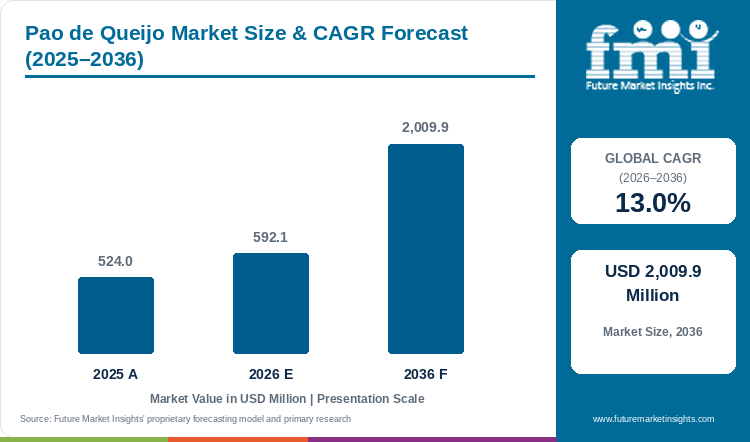
Accounting for USD 524.0 million in 2025 and rising to USD 592.1 million in 2026, the pao de queijo market is projected to expand to USD 2,009.9 million by 2036, advancing at a CAGR of 13.0%.
In March 2026, Grupo 3coracoes signed a definitive agreement to take General Mills' Brazil business, including the Yoki pao de queijo mix and cassava starch plants at Pouso Alegre and Campo Novo do Parecis, moving a national staple into domestic control [6] [16]. The global pao de queijo market was valued at USD 524.0 million in 2025 and is estimated to reach USD 592.1 million in 2026. The market is projected to reach USD 2,009.9 million by 2036, expanding at a compound annual growth rate (CAGR) of 13.0% between 2026 and 2036. Frozen ready-to-bake formats are projected at 51.0% of 2026 type demand, since a 20-minute freezer-to-oven bake decouples staffing from footfall in café and deli counters. Demand growth runs at twice the pace of the frozen bakery market at 6.5% CAGR, because pao de queijo converts cold storage into fresh-baked aroma theater that frozen bread cannot price. The consumption signal widened in August 2026 when Brazi Bites pushed Bacon Cheddar Cheese Bread across Whole Foods and independent US grocers as its first flavor innovation in three years [2], and OXXO paired with Forno de Minas in August 2025 to sell hot bake-off units inside convenience stores in Campinas [4]. Cassava supply control now separates the operators, since the acquirer of the Yoki plants owns both the starch source and the recipe equity behind the fastest-growing bake-off SKU in the category.
Key Market Trends & Insights
- By product type: Frozen Ready-to-Bake is projected to account for 51.0% of the product type segment in 2026 because 20-minute freezer-to-oven baking decouples factory dough scalding from café serving peaks.
- By claim / nature: Conventional products are estimated to hold 56.0% of the claim / nature segment in 2026 as cured cheese and sweet-and-sour cassava starch recipes win mainstream repeat orders.
- By format: Fresh offerings are expected to represent 39.0% of the format segment in 2026 through immediate warm counter consumption across padarias and forecourt coffee stores.
- By packaging format: Multipack pouches are forecast to capture 29.0% of the packaging format segment in 2026 owing to resealable 11.5-ounce to 400-gram bags that support multi-day household baking.
- By sales channel: Supermarkets & Hypermarkets are anticipated to command 38.0% of the sales channel segment in 2026 through mainstream natural and conventional freezer-aisle placements.
Regional Highlights
- Top national expansion: The UK is projected to lead evaluated country growth at a 14.3% CAGR through 2036 as domestic artisan wholesalers and café chains adopt bake-off cheese bread.
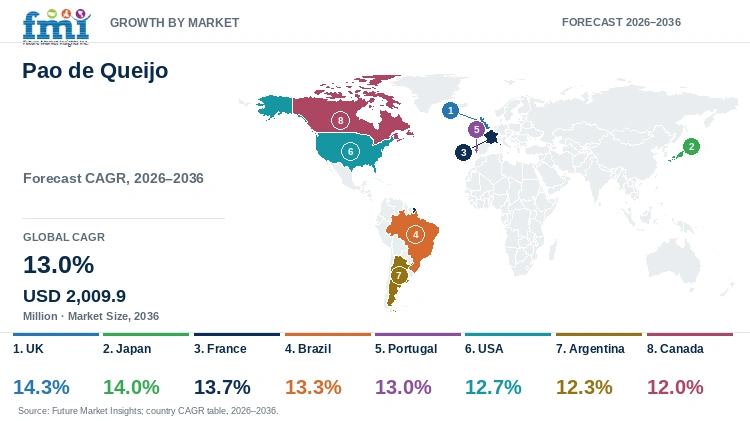
- Broader country progression: Japan is expected to expand at a 14.0% CAGR ahead of France at a 13.7% CAGR and Brazil at a 13.3% CAGR, while Canada is forecast to advance at a 12.0% CAGR.
Market Size & Forecast
Table 1: Market Size and Forecast for the Pao de Queijo Market (USD million and CAGR percentage), 2025 to 2036
| Metric | Value |
|---|---|
| 2025 Market Size | USD 524.0 million |
| Estimated Market Size in 2026 | USD 592.1 million |
| Projected Market Size by 2036 | USD 2,009.9 million |
| CAGR, 2026 to 2036 | 13.0% |
| Added Revenue, 2026 to 2036 | USD 1,417.8 million |
Broader adoption of pao de queijo beyond Latin America diaspora grocers requires translating a traditional Minas Gerais snack into recognizable mainstream supermarket flavor profiles. International shoppers actively seek naturally gluten-free appetizers that bake in home air fryers or convection ovens within 15 to 20 minutes, which lifts demand for tapioca and cassava-based bakery items. In August 2026, Brazi Bites launched Bacon Cheddar Cheese Bread in 11.5-ounce (18-count) bags across Whole Foods Market and independent U.S. grocers at a USD 6.99 to USD 7.99 retail price point [2]. High farmgate cured-cheese costs and rapid amylopectin retrogradation after cooling still penalize operators that hold baked units on ambient counters longer than 45 minutes.
Outlet-Pool and Portion-Requirement Sizing
Table 2: Outlet-Pool and Portion-Requirement Sizing for the Pao de Queijo Market (USD million and operational ranges), 2025 to 2036
| Metric | 2025 | 2026 | 2036 |
|---|---|---|---|
| Market size (USD million) | 524.0 | 592.1 | 2,009.9 |
| Active retail & foodservice outlets (thousand) | 142.0 to 158.0 | 156.0 to 174.0 | 385.0 to 430.0 |
| Daily baked cheese-bread units (million pieces) | 18.5 to 21.2 | 20.8 to 23.9 | 62.0 to 71.5 |
| Factory-gate realization per 400g pack (USD) | 2.45 to 2.85 | 2.50 to 2.95 | 3.10 to 3.60 |
Operational note: Outlet and daily unit ranges reconcile standardized 18-gram to 25-gram cocktail bites and 50-gram to 70-gram café snack portions across 400-gram retail bags and 1-kilogram foodservice pouches as well as 5-kilogram dry-mix sacks.
Commercial bakeries and forecourt convenience chains require uniform dough ball expansion and hollow alveolar crumb structure without wheat gluten. Industrial processors blend sweet polvilho doce and fermented sour polvilho azedo cassava flour and starch grades to lock in crust blister and elastic interior chew.
Per Capita & Retail/Café Outlet Sizing
Table 3: Per Capita and Outlet Spending Indicators for the Pao de Queijo Market (USD), 2025 to 2036
| Metric | 2025 | 2026 | 2036 |
|---|---|---|---|
| World population (million) | 8,200.0 | 8,300.0 | 9,000.0 |
| Spend per 1,000 people (USD) | 63.9 | 71.3 | 223.3 |
| Annual turnover per stocking outlet (USD) | 3,316 to 3,690 | 3,403 to 3,795 | 4,674 to 5,220 |
| Frozen ready-to-bake revenue share (%) | 49.5% to 51.5% | 50.0% to 52.0% | 54.0% to 57.0% |
Table 4: Retail & Foodservice Channel Spending Indicators for the Pao de Queijo Market (USD and percentages), 2026
| Metric | Value | Institutional Reference Basis |
|---|---|---|
| Market size, 2026 | USD 592.1 million | 2026 global valuation baseline |
| Stocking supermarkets, padarias & cafés | 165,000 outlets | Midpoint retail & foodservice outlet universe |
| Average annual pao de queijo sales per outlet | USD 3,588.5 | Annualized manufacturer & distributor realization |
| Supermarkets & Hypermarkets revenue, 2026 | USD 225.0 million | 38.0% sales channel segment allocation |
Repeat order velocity across international grocery chains requires clear front-of-pack differentiation between grain-free cassava status and mandatory dairy-and-egg allergen warnings. Commercial mix suppliers also compete in the gluten-free flours channel by supplying 250-gram retail boxes and 5-kilogram institutional sacks.
Analyst Perspective
"The decisive commercial threshold in the pao de queijo market is not initial shopper curiosity but whether a grocery chain or café operator achieves consistent crust expansion and low freezer-burn waste with compliant milk-and-egg allergen labeling across routine reorders. Manufacturers pairing standardized sour-cassava rheology with air-fryer-ready multipacks will lead export growth."
- Nandini Roy Choudhury, Principal Analyst at Future Market Insights
How is the pao de queijo market segmented?
The pao de queijo market is segmented by product type, claim / nature, format, packaging format, and sales channel. In 2026, Frozen Ready-to-Bake is projected at 51.0%, Conventional at 56.0%, Fresh at 39.0%, Multipack at 29.0%, and Supermarkets & Hypermarkets at 38.0%.
By product type: Frozen Ready-to-Bake, Chilled Fresh, Shelf-Stable Mixes, and Snack-Size Packs.
By claim / nature: Conventional, Clean Label, Organic, Gluten-Free, and High-Protein & Fortified.
By format: Fresh, Frozen, Ambient Packaged, Chilled, and Par-Baked Thaw-and-Serve.
By packaging format: Multipack, Single-Serve, Family Pack, and Bulk Foodservice.
By sales channel: Supermarkets & Hypermarkets, Artisan & Specialty Bakeries, Convenience & Forecourt, Online & DTC, and Foodservice Distributors.
Why does Frozen Ready-to-Bake lead the product type segment?
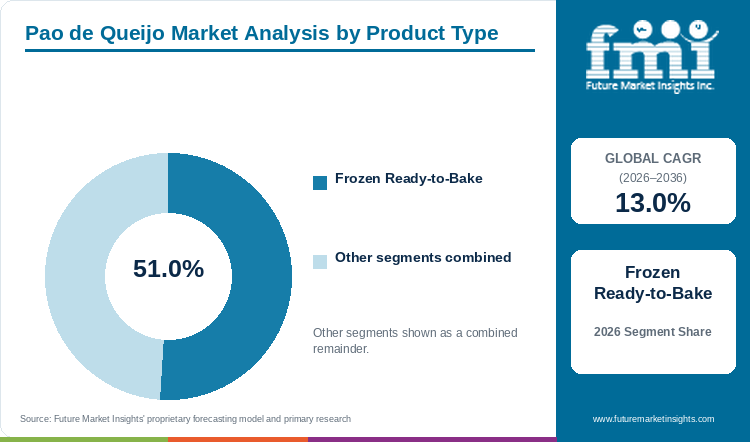
Frozen Ready-to-Bake is projected to capture 51.0% of the product type segment in 2026, supported by zero-proof freezer-to-oven convenience and extended export shelf life.
Table 5: Product Type Share for the Pao de Queijo Market (percentage share), 2026
| Product Type | Share (2026) |
|---|---|
| Frozen Ready-to-Bake | 51.0% |
| Other Segments Combined | 49.0%* |
| Total | 100.0% |
*Note: Remaining product type subsegments (Chilled Fresh, Shelf-Stable Mixes, and Snack-Size Packs) sum to 100.0% of 2026 revenue.
Table 6: Product Type Leadership and Market Growth for the Pao de Queijo Market (segment and CAGR percentage), 2026 to 2036
| Metric | Value |
|---|---|
| Global CAGR (2026 to 2036) | 13.0% |
| Leading Segment | Frozen Ready-to-Bake |
Pre-formed IQF dough balls shift boiling-water and hot-oil starch scalding (`escaldamento`) into climate-controlled factories while letting cafés and households bake small batches to order in 20 minutes. Because cassava dough requires zero yeast proofing, frozen units move directly from minus-18-degree storage into ovens across frozen baked goods programs.
- Frozen Ready-to-Bake is projected to account for 51.0% of the product type segment in 2026 because bake-on-demand portioning eliminates morning dough mixing and reduces end-of-day staling waste.
- In August 2026, Brazi Bites expanded its U.S. frozen ready-to-bake portfolio across Whole Foods Market and independent grocers with 18-count Bacon Cheddar bags priced at USD 6.99 to USD 7.99 [2].
Why does Conventional define the largest claim / nature segment?
Conventional formulations are estimated to secure 56.0% of the claim / nature segment in 2026, driven by authentic cured-cheese flavor and broad retail price accessibility.
Everyday buyers in Brazil and Portugal as well as wider Latin America purchase pao de queijo as an indulgent savory cheese roll rather than a specialized medical diet product. Conventional formulations use standard sweet and sour cassava starches blended with cured Minas or mozzarella cheese inputs across bakery products lines without incurring third-party organic certification fees.
- Conventional offerings are estimated to command 56.0% of the claim / nature segment in 2026 as mass-market bakeries and supermarkets compete on authentic cheese pull and unit cost.
- A January 2026 review in Food Chemistry examining cassava starch modification strategies from 2005 to 2025 confirmed that esterification and cross-linking lift type-4 resistant starch yields by 40% to 60% and improve thermal stability in baked applications [3].
What keeps Fresh ahead in the format segment?
Fresh offerings are expected to hold 39.0% of the format segment in 2026 through immediate warm counter consumption at bakeries and convenience stores.
Because cassava starch retrogrades rapidly upon cooling, pao de queijo achieves its signature crisp outer shell and aerated elastic center during the first 30 minutes out of the oven. Bakery counters and convenience forecourts bake continuous micro-batches throughout the day and match fresh service models in the gluten-free food sector.
- Fresh presentations are expected to capture 39.0% of the format segment in 2026 because morning coffee commuters prioritize warm oven-fresh texture at the point of purchase.
- In August 2025, convenience retailer OXXO and Forno de Minas launched a flagship foodservice store activation in Campinas featuring fresh-baked pao de queijo com calabresa priced at BRL 5.99 [4].
Why does Multipack lead the packaging format segment?
Multipack configurations are forecast to generate 29.0% of the packaging format segment in 2026 by enabling portioned household baking across multiple snack occasions.
Resealable 300-gram to 1-kilogram stand-up pouches containing 12 to 40 frozen dough balls allow households to bake four to six units per breakfast or snack occasion while keeping the remaining inventory frozen. High-barrier polyethylene films prevent freezer burn and moisture sublimation across par-baked bread and frozen snack cabinets.
- Multipack bags are forecast to represent 29.0% of the packaging format segment in 2026 as suburban shoppers stock multi-occasion snacks for oven and air-fryer preparation.
- Mixture-design optimization trials published in Foods in April 2026 demonstrated that blending 30% tapioca starch with 15% to 30% red lentil flour lowered gluten-free bread crumb hardness and reduced predicted glycemic index to the 70 to 87 range [5].
What gives Supermarkets & Hypermarkets the leading sales channel share?
Supermarkets & Hypermarkets are anticipated to account for 38.0% of the sales channel segment in 2026 through frozen bakery doors and in-store bake-off counters as well as dry-mix aisles.
Modern supermarkets merchandise pao de queijo across multi-deck frozen bakery doors and in-store hot bake-off counters as well as ambient dry-baking-mix shelves. National retail chains in Brazil and the USA along with Portugal consolidate household volume beside United States cassava flour and specialty baking ingredients.
- Supermarkets & Hypermarkets are anticipated to secure 38.0% of the sales channel segment in 2026 because multi-zone grocery merchandising captures both frozen convenience shoppers and home mix bakers.
- On March 17, 2026, Grupo 3coracoes announced a definitive agreement to acquire General Mills' operations in Brazil including the Yoki pao de queijo mix and cassava starch brand and plants in Pouso Alegre and Campo Novo do Parecis [6].
What are the drivers, restraints, and opportunities in the pao de queijo market?
In the pao de queijo market, bake-from-frozen café convenience and grain-free snack demand propel growth while milk-and-egg allergen compliance and post-bake starch firming restrain adoption; meanwhile, enzymatically modified cassava starches unlock new channels.
- Driver: Zero-proof freezer-to-oven preparation and naturally wheat-free cassava starch formulations enable cafés and grocers to serve hot savory snacks with minimal labor.
- Restraint: Mandatory milk-and-egg allergen disclosures and strict 20-ppm gluten-free cross-contact testing restrict uncertified suppliers as well as rapid starch retrogradation after cooling.
- Opportunity: Enzymatically standardized sour cassava starch and protein-fortified bite-sized formats unlock mainstream retail and airline catering accounts.
Growth Analysis and Future Potential: Qualitative Demand Drivers
Unlike yeast-leavened wheat rolls that require 60 to 90 minutes of proofing before baking, pao de queijo relies on water-vapor expansion trapped inside a gelatinized cassava-starch and cheese network. Foodservice operators and household air-fryer users can bake frozen dough balls directly from minus 18 degrees Celsius in 18 to 20 minutes with zero thawing delay. April 2026 rheology research in the Journal of Texture Studies confirmed that tapioca starch exhibits a peak viscosity 1.68 times higher than corn starch, which reduces gluten-free bread hardness from 6.81 N to 3.47 N and raises springiness from 0.76 to 0.92 [7]. Industrial formulators also pair native cassava with modified starch grades to prevent dough collapse during freezer transit.
Risk Assessment of the Pao de Queijo Market: Operational and Formulation Friction
Allergen compliance complexity and rapid post-bake crumb firming represent the primary operational barriers limiting category expansion across international foodservice accounts. Although cassava root is intrinsically free of wheat gluten, traditional pao de queijo contains 20% to 35% dairy cheese and whole liquid eggs. These ingredients trigger mandatory milk and egg allergen declarations under U.S. FDA and EU Regulation 1169/2011 rules as well as Canadian Food Inspection Agency standards. also a January 2026 PRISMA synthesis of 41 gluten-free baking studies published in Food Science & Nutrition confirmed that starch-based matrices without hydrocolloid reinforcement suffer rapid moisture loss and structural hardening after baking [8]. Bakeries that fail to control holding temperatures face high counter discard rates within one hour of baking.
Commercial Opportunity Analysis: Formulation Differentiation and Value-Add Formats
Enzymatic calibration of sour cassava starch (`polvilho azedo`) combined with protein-enriched flours allows manufacturers to standardize loaf volume while targeting health-focused snackers. In January 2026, food scientists at the Federal University of Jequitinhonha and Mucuri Valleys and the Federal University of Vicosa published gluten-free baking trials in the Journal of Food Science demonstrating that blending pseudocereal and whole flours into gluten-free batters achieved 8.56% to 11.44% dietary fiber with high sensory acceptance [9]. A December 2025 study from the Federal Rural University of Pernambuco in Food Technology and Biotechnology also formulated sour-cassava-starch snacks fortified with 5% protein concentrate and 2% passion-fruit peel fiber [10], which demonstrates a scalable pathway for high-protein, fiber-enriched pao de queijo bites.
Pao de Queijo Market by Country (2026 to 2036)
According to FMI, the UK is projected to lead pao de queijo expansion across evaluated countries at a 14.3% CAGR through 2036, whereas Canada is forecast to advance at a 12.0% CAGR. Commercial realization across Western Europe and East Asia as well as Latin America and North America depends on diaspora population hubs and local bake-off café adoption as well as gluten-free retail shelf productivity.
Table 7: Country CAGR and Primary Growth Levers for the Pao de Queijo Market (CAGR percentage and operational drivers), 2026 to 2036
| Country | CAGR (2026 to 2036) | Primary Commercial Growth Lever |
|---|---|---|
| UK | 14.3% | Specialty café bake-off programs and domestic artisan wholesale dough balls |
| Japan | 14.0% | Brazil diaspora retail channels and mochi-like chewy texture affinity |
| France | 13.7% | Gougère cheese-pastry familiarity and gourmet frozen apéritif retail |
| Brazil | 13.3% | Convenience forecourt bake-off partnerships and dry-mix M&A consolidation |
| Portugal | 13.0% | 484,596 Brazil-born resident base and hypermarket private-label packs |
| USA | 12.7% | 20,000+ store natural/conventional grocery freezer doors and flavor SKUs |
| Argentina | 12.3% | Shared chipá cassava-cheese snack habit and urban café standardization |
| Canada | 12.0% | Gluten-free specialty e-commerce and bilingual retail freezer expansion |
Source: Future Market Insights analysis
UK Pao de Queijo Market Outlook (2026 to 2036)
The UK pao de queijo market is projected to expand at a leading 14.3% CAGR from 2026 to 2036, driven by specialty coffee-shop chains and hospitality caterers seeking warm gluten-free savory snacks. Unlike markets reliant solely on container imports from South America, the UK benefits from domestic wholesale producers such as The Cheesebread Company and specialist distributors like Grove Foods supplying frozen bake-off pouches to cafés and hotels. In September 2025, response-surface baking research published in Foods confirmed that pairing egg white and milk powder with hydrocolloids in gluten-free dough lifts specific volume from 1.7 to 2.8 cm3/g and cuts crumb firmness from 10.6 N to 3.7 N [11]. High commercial freezer energy costs still require strong daily café counter sell-through.
Key takeaway: In the UK, domestic wholesale frozen dough-ball production and specialty café bake-off adoption are projected to drive a 14.3% CAGR.
Japan Pao de Queijo Market Outlook (2026 to 2036)
In Japan, commercial demand is anchored by more than 210,000 residents of Brazil origin concentrated in Aichi and Shizuoka prefectures as well as domestic consumer affinity for chewy mochi-like (`mochi-mochi`) bakery textures. Commercial pao de queijo revenues in Japan are forecast to rise at a 14.0% CAGR between 2026 and 2036 through imported Forno de Minas freezer packs and domestic convenience-store bake-off counters. A June 2026 study in the Journal of Food Science demonstrated that optimizing moisture and volumetric expansion in reduced-salt cheese snacks preserves crisp-and-chewy textural contrast [12]. Strict Food Sanitation Act import inspections in Japan and localized kanji allergen labeling requirements nevertheless lengthen onboarding for overseas suppliers.
Key takeaway: In Japan, consumer preference for chewy tapioca-starch textures and established diaspora retail routes are forecast to sustain a 14.0% CAGR.
France Pao de Queijo Market Outlook (2026 to 2036)
France offers a natural culinary bridge for pao de queijo because consumers already recognize baked cheese choux pastries (`gougères`) as warm apéritif and bakery snacks. Specialist importers such as Mon Petit Brésil distribute 1-kilogram frozen traditional cheese-bread bags across the Paris metropolitan region while gourmet grocers test smaller retail multipacks. Sales of pao de queijo in France are expected to climb at a 13.7% CAGR through 2036 across specialty frozen food stores and urban cafés. In February 2026, a meta-analysis of 50 prospective cohorts co-authored by INRAE researchers at Université Clermont Auvergne in Frontiers in Nutrition confirmed favorable health outcomes associated with fermented dairy and cheese consumption [13], although EU milk-and-egg allergen rules govern retail packaging.
Key takeaway: In France, culinary familiarity with warm cheese apéritif pastries and specialty frozen retail expansion are expected to support a 13.7% CAGR.
Brazil Pao de Queijo Market Outlook (2026 to 2036)
Brazil represents the global production heartland and largest volume base for pao de queijo across supermarket frozen bags from Forno de Minas and Seara as well as dry mixes from Yoki and Amafil. Convenience forecourts and franchise cafés are actively expanding hot-service occasions, exemplified by the August 2025 OXXO and Forno de Minas flagship foodservice store partnership in Campinas [4] and Grupo Trigo's acquisition of the Casa do Pao de Queijo café chain in March 2025 [21]. Corporate consolidation also accelerated when Grupo 3coracoes agreed to acquire Yoki from General Mills in March 2026 [6]. so domestic pao de queijo revenue in Brazil is estimated to expand at a 13.3% CAGR from 2026 to 2036.
Key takeaway: In Brazil, convenience-forecourt bake-off partnerships and domestic M&A consolidation are estimated to generate a 13.3% CAGR through 2036.
Portugal Pao de Queijo Market Outlook (2026 to 2036)
Portugal's pao de queijo market is anticipated to grow at a 13.0% CAGR between 2026 and 2036, underpinned by the largest resident Brazil expatriate community in Europe and mainstream hypermarket integration. National grocery chains including Auchan Portugal (marketing private-label 300-gram gluten-free frozen pao de queijo) and Continente (stocking Yoki dry mixes) have transitioned the product from specialist ethnic shops into everyday family baskets. In August 2026, research in Foods demonstrated that pairing 6 U/g alpha-amylase with 6 mg/g calcium lactate creates a standardized sour-cassava-starch substitute that maximizes bread specific volume and gelatinization torque while holding estimated glycemic index at 50.9 [14]. Price competition between low-cost dry mixes and imported frozen bags still moderates retail margin expansion.
Key takeaway: In Portugal, large resident diaspora demand and private-label hypermarket freezer listings are anticipated to sustain a 13.0% CAGR.
USA Pao de Queijo Market Outlook (2026 to 2036)
In the USA, pao de queijo has scaled from regional steakhouses into more than 20,000 natural and conventional grocery stores as a grain-free frozen snack and breakfast slider carrier. Commercial pao de queijo sales in the USA are slated to expand at a 12.7% CAGR from 2026 to 2036 on the back of air-fryer household penetration and flavor-led SKU extensions. In August 2026, Brazi Bites launched Bacon Cheddar Cheese Bread across Whole Foods Market and independent grocers nationwide ahead of fall Walmart and Kroger rollouts [2]. Suppliers must still satisfy U.S. FDA 21 CFR 101.91 (<20 ppm gluten) verification along with mandatory milk and egg allergen declarations and high supermarket freezer slotting fees.
Key takeaway: In the USA, mainstream grocery freezer distribution across 20,000+ stores and savory flavor innovation are slated to drive a 12.7% CAGR.
Argentina Pao de Queijo Market Outlook (2026 to 2036)
Argentina presents a distinctive commercial environment because consumers across its northern and metropolitan regions already consume `chipá`, a closely related cassava-starch and hard-cheese baked roll. Packaged pao de queijo brands and industrial dry-mix suppliers from Brazil compete in Buenos Aires supermarkets by emphasizing standardized frozen bake-off uniformity for urban cafés and hotel buffets. Revenue from packaged pao de queijo in Argentina is predicted to progress at a 12.3% CAGR over the 2026 to 2036 period. An October 2025 supermarket survey of 3,915 packaged foods in Buenos Aires published in Revista Panamericana de Salud Pública documented median hard-cheese sodium levels at 900 mg/100 g and savory snacks at 68% to 77% above PAHO regional targets [15], which pressures formulators to manage sodium levels.
Key takeaway: In Argentina, urban café bake-off standardization and sodium-conscious recipe reformulation are predicted to support a 12.3% CAGR through 2036.
Canada Pao de Queijo Market Outlook (2026 to 2036)
Canada's demand is led by health-conscious suburban households and gluten-free e-commerce platforms such as NaturaMarket as well as natural-food grocers in Ontario and western provinces. Imported frozen multipacks from Brazi Bites and historical export lots from Forno de Minas use grain-free tapioca positioning to win space in specialty freezer doors. In July 2026, cassava-starch fermentation and extrusion trials published in Foods confirmed that cassava starch promotes melt cohesion and structural expansion while maintaining low water activity between 0.426 and 0.524 for extended shelf stability [17]. Because Canadian Food Inspection Agency rules mandate strict bilingual labeling and separate intentional milk-and-egg allergen declarations from cross-contact warnings, Canada's market is projected to grow at a measured 12.0% CAGR through 2036.
Key takeaway: In Canada, natural-channel freezer expansion and strict CFIA allergen and bilingual packaging compliance are projected to anchor a 12.0% CAGR.
Full report country CAGRs cover: North America; Latin America; Western Europe; Eastern Europe; East Asia; South Asia and Pacific; Middle East and Africa.
Who are the notable companies in the pao de queijo market?
Forno de Minas, Brazi Bites, BRF (Sadia), Casa do Pao de Queijo, Amafil, Yoki (General Mills), Vilma Alimentos, Massa Leve, and JBS (Seara) are the notable companies in the pao de queijo market.
Competitive participation in the pao de queijo market divides between IQF frozen ready-to-bake manufacturers and shelf-stable cassava-mix producers as well as fresh-serving café franchise networks. Forno de Minas (controlled by McCain Foods) and Brazi Bites along with BRF (Qualy/Sadia) and JBS (Seara) supply packaged frozen dough balls for retail and foodservice bake-off. Amafil and Yoki (divested by General Mills to Grupo 3coracoes in 2026) along with Vilma Alimentos supply dry cassava-starch mixes that allow bakeries and households to add fresh cheese and eggs. Casa do Pao de Queijo (acquired by Grupo Trigo in March 2025) operates a café franchise network and retail frozen packs.
- Frozen Dough and Packaged Cheese-Bread Suppliers: Forno de Minas and Brazi Bites along with BRF (Sadia) and JBS (Seara) manufacture IQF ready-to-bake cheese bread for grocery freezers and foodservice kitchens.
- Cassava-Based Prepared Mix Specialists: Amafil and Yoki (General Mills / Grupo 3coracoes) along with Vilma Alimentos produce 250-gram to 5-kilogram shelf-stable pao de queijo dry mixes.
- Café and Franchise Fresh-Serving Operators: Casa do Pao de Queijo (Grupo Trigo) monetizes warm counter service and standardized franchise bake-off across shopping centers and transport hubs.
Competitive Benchmarking: Pao de Queijo Market
Table 8: Competitive Benchmarking for the Pao de Queijo Market (qualitative capability ratings), 2026
| Company | Participation Model | Format & Recipe Breadth | Channel & Pack Coverage | Geographic Reach |
|---|---|---|---|---|
| Forno de Minas | Frozen Cheese-Bread Leader (McCain) | High (traditional, artisanal, calabresa, sticks) | High (retail pouches & foodservice bake-off) | Brazil; exports to USA, Portugal, UK & Japan |
| Brazi Bites | North America Grain-Free Specialist | High (Cheddar Parm & Bacon Cheddar plus Pizza & Garlic) | High (11.5oz retail to club multipacks) | USA (20,000+ stores) & Canada retail |
| BRF (Sadia) | Diversified Frozen Food Group (MBRF) | Medium-High (Qualy & Sadia frozen cheese bread) | High (400g & 1kg supermarket freezer packs) | Brazil national retail & foodservice |
| Casa do Pao de Queijo | Café Franchise & Retail Brand (Grupo Trigo) | High (warm counter bake-off & retail frozen) | High (144+ franchise cafés & grocery packs) | Brazil nationwide malls, airports & retail |
| Amafil | Cassava Starch & Dry-Mix Producer | Medium-High (prepared mix & polvilho starches) | High (250g/500g retail to 5kg foodservice) | Brazil & Portugal / export diaspora |
| Yoki (General Mills) | Branded Dry-Mix Leader (3coracoes) | Medium-High (250g prepared pao de queijo mix) | High (supermarket dry-grocery & export) | Brazil national retail & Portugal export |
| Vilma Alimentos | Regional Milling & Dry-Mix Producer | Medium (prepared 250g & 5kg institutional mix) | Medium-High (Minas Gerais retail & bakery B2B) | Brazil (Southeast & regional foodservice) |
| Massa Leve | Frozen Bakery Producer (Grupo Bimbo) | Medium-High (1kg cocktail & traditional frozen) | Medium-High (supermarket & padaria cold chain) | Brazil retail & bake-off channels |
| JBS (Seara) | Diversified Frozen Food Platform | Medium (Seara & Turma da Mônica frozen packs) | High (national hypermarket freezer doors) | Brazil mass grocery & modern trade |
Scoring basis: Capability ratings evaluate documented SKU breadth across IQF frozen dough balls and shelf-stable dry mixes (250 g to 5 kg) as well as dedicated foodservice or franchise café formats. Geographic reach reflects verified supermarket freezer listings and export distribution logs as well as active corporate ownership through September 2026.
Key Developments in the Pao de Queijo Market
- In March 2026, General Mills entered a definitive agreement to sell its Brazil business including the Yoki pao de queijo mix and cassava starch portfolio and manufacturing plants in Pouso Alegre and Campo Novo do Parecis to Grupo 3coracoes [6] [16].
- In August 2026, Brazi Bites launched Bacon Cheddar Cheese Bread in 11.5-ounce (18-count) bags across Whole Foods Market and independent U.S. grocers as its first cheese-bread flavor innovation in three years [2].
- In August 2025, OXXO and Forno de Minas partnered to open a flagship foodservice-focused store in Campinas featuring hot bake-off pao de queijo and a limited-edition calabresa-filled variant [4].
Key Players in the Pao de Queijo Market
Frozen Dough and Packaged Cheese-Bread Suppliers
- Forno de Minas
- Brazi Bites
- BRF (Sadia)
- Massa Leve
- JBS (Seara)
Cassava-Based Prepared Mix Specialists
- Amafil
- Yoki (General Mills)
- Vilma Alimentos
Café and Franchise Fresh-Serving Operators
- Casa do Pao de Queijo
Pao de Queijo Market - Report Scope
Table 9: Report Scope for the Pao de Queijo Market (coverage fields and definitions), 2026 to 2036
| Coverage field | Report scope |
|---|---|
| Market breakdown | Product Type; Claim / Nature; Format; Packaging Format; Sales Channel |
| Quantitative Units | USD Million |
| Market Definition | Includes commercial manufacturer and importer revenue from packaged pao de queijo sold as frozen ready-to-bake dough balls and chilled or fresh baked units as well as dedicated pao de queijo prepared dry mixes. Category Scope Note: Excludes unblended commodity cassava starch (`polvilho`) and standalone cheeses as well as adjacent South America cheese breads (`chipá` and `pandebono`) and café beverage revenues. |
| Regions Covered | North America; Latin America; Western Europe; Eastern Europe; East Asia; South Asia and Pacific; Middle East and Africa |
| Countries Covered | UK, Japan, France, Brazil, Portugal, USA, Argentina, Canada, and additional countries in the full report |
| Key Companies Covered | Forno de Minas, Brazi Bites, BRF (Sadia), Casa do Pao de Queijo, Amafil, Yoki (General Mills), Vilma Alimentos, Massa Leve, JBS (Seara) |
| Forecast Period | 2026 to 2036 |
| Approach | Primary and secondary research with top-down and bottom-up market triangulation. |
Pao de Queijo Market - Research Methodology
Table 10: Research Methodology for the Pao de Queijo Market (research methods and approach), 2026 edition
| Method | Approach |
|---|---|
| Primary Research | Structured interviews with frozen cheese-bread plant directors and cassava-starch millers as well as franchise café operators to validate bake-off yields and freezer slotting economics. |
| Secondary Research | Analysis of corporate transaction filings from General Mills and Grupo Trigo as well as PubMed cassava-starch rheology studies and national food-labeling registries. |
| Market Sizing and Forecasting | Hybrid top-down frozen bakery parent reconciliation and bottom-up IQF forming and dry-mix line modeling anchored on 400-gram retail bags and 1-kilogram foodservice pouches from 2026 to 2036. |
| Country Forecasting Model | Econometric national projections weight Brazil diaspora resident counts and specialty coffee-shop bake-off penetration as well as mainstream supermarket gluten-free freezer door allocations across eight countries. |
| Operational Benchmark Traceability | Outlet-pool and unit consumption indicators in Tables 2 through 4 trace to Brazi Bites store-count disclosures and Grupo Trigo franchise network records. |
| Data Triangulation and Validation | Factory-gate and wholesale realizations are cross-checked against retail scanner listings while excluding raw commodity cassava starch and standalone cheese to prevent double counting. |
Pao de Queijo Market by Segments
Pao de Queijo Market segmented by Product Type:
- Frozen Ready-to-Bake
- Chilled Fresh
- Shelf-Stable Mixes
- Snack-Size Packs
Pao de Queijo Market segmented by Claim / Nature:
- Conventional
- Clean Label
- Organic
- Gluten-Free
- High-Protein & Fortified
Pao de Queijo Market segmented by Format:
- Fresh
- Frozen
- Ambient Packaged
- Chilled
- Par-Baked Thaw-and-Serve
Pao de Queijo Market segmented by Packaging Format:
- Multipack
- Single-Serve
- Family Pack
- Bulk Foodservice
Pao de Queijo Market segmented by Sales Channel:
- Supermarkets & Hypermarkets
- Artisan & Specialty Bakeries
- Convenience & Forecourt
- Online & DTC
- Foodservice Distributors
Pao de Queijo Market by Region
- North America
- United States
- Canada
- Latin America
- Brazil
- Argentina
- Mexico
- Chile
- Western Europe
- United Kingdom
- France
- Portugal
- Germany
- Italy
- Spain
- Benelux
- Eastern Europe
- Poland
- Czech Republic
- Romania
- Hungary
- East Asia
- Japan
- China
- South Korea
- South Asia and Pacific
- Australia and New Zealand
- India
- ASEAN
- Middle East and Africa
- GCC Countries
- South Africa
- Israel
Research Sources and Bibliography
- [1] Abad-Quevedo, V., Cornejo, F., & Maldonado-Alvarado, P. (2026, June 18). Evaluation of the Functional and Nutritional Properties of Alpha-Amylase-Modified Cassava Starch in Breadmaking. Foods, 15(12), 2197 (PubMed PMID 42354165).
- [2] Brazi Bites (2026, August 25). Brazi Bites Turns Up the Flavor with New Bacon Cheddar Brazilian Cheese Bread. NOSH Press Releases.
- [3] Nainggolan, E. A., Banout, J., & Urbanová, K. (2026, January 15). Chemical approaches to improve resistant starch type 4 content and functional properties of cassava starch. Food Chemistry, 499, 147300 (PubMed PMID 41344237).
- [4] Giro News (2025, August 15). OXXO e Forno de Minas se unem em loja emblemática focada no food service. Giro News Food Service.
- [5] Bianchi, F., Agnolin, L., & Simonato, B. (2026, April 3). Functional Optimization of a Novel Gluten-Free Bread Made with Tapioca Starch and Red Lentil Flour. Foods, 15(7), 1230 (PubMed PMID 41976524).
- [6] Grupo 3corações (2026, March 17). Grupo 3corações invests in portfolio diversification and acquires assets and operations from General Mills in Brazil. Grupo 3corações Corporate Releases.
- [7] An, D., Zhang, J., Xu, J., Du, J., Xiang, J., Zhao, F., Xu, B., & Zhang, A. (2026, April 10). Starch Properties Modulate Gluten-Free Steamed Bread Texture via Regulating Structural Evolution During Fermentation. Journal of Texture Studies, 57(2), e70080 (PubMed PMID 41983624).
- [8] Fetriyuna, F., Salma, A. N., Harlina, P. W., Yarlina, V. P., & Purwestri, R. C. (2026, January 14). The Role of Xanthan Gum and Hydroxypropyl Methylcellulose in Gluten-Free Bread: A Study of Physical Characteristics, Texture, and Nutrition. Food Science & Nutrition, 14(1), e71292 (PubMed PMID 41541707).
- [9] Araújo, M. A., Neves, N. A., Andressa, I., Amaral, T. N., & Schmiele, M. (2026, January 10). Enhancing Gluten-Free Bread With Whole Flours From Forage Palm, Buckwheat, and Teff: Physicochemical Composition, Technological Properties, and Sensory Evaluation. Journal of Food Science, 91(1), e70812 (PubMed PMID 41491645).
- [10] Benevides, A. B., Amaral, R. P. C., da Silva, E. D. C., Maciel, M. I. S., Shinohara, N. K. S., Gloria, M. B. A., & de Oliveira Filho, P. R. C. (2025, December 26). Snacks Fortified with Protein Concentrate from Spotted Goatfish (Pseudupeneus maculatus) and Passion Fruit (Passiflora edulis) Shell Flour. Food Technology and Biotechnology, 63(4), 449-458 (PubMed PMID 41426366).
- [11] Rodríguez-España, M., Figueroa-Hernández, C. Y., Suárez-Quiroz, M. L., Canelo-Álvarez, F., Figueroa-Cárdenas, J. D., González-Ríos, O., Rayas-Duarte, P., & Hernández-Estrada, Z. J. (2025, September 5). Optimization of Gluten-Free Bread Formulation Using Whole Sorghum-Based Flour by Response Surface Methodology. Foods, 14(17), 3113 (PubMed PMID 40941231).
- [12] Ayrancı, V. K., Mzoughi, M., Salum, P., Zemzemoğlu, T. E. A., & Erbay, Z. (2026, June 15). Production and Multi-Criteria Evaluation of Healthy White Cheese Snacks Using Microwave-Vacuum Drying. Journal of Food Science, 91(6), e71170 (PubMed PMID 42212361).
- [13] Matalas, A., Panagiotakos, D., Fardet, A., Savary-Auzeloux, I., Chassard, C., Praćer, S., Vergères, G., & Paveljšek, D. (2026, February 26). Fermented foods consumption, all-cause, and cause-specific mortality: a meta-analysis of prospective cohort studies. Frontiers in Nutrition, 13, 1714437 (PubMed PMID 41835372).
- [14] Abad-Quevedo, V., Correa, M. J., Cornejo, F., & Maldonado-Alvarado, P. (2026, August 27). Alpha-Amylase-Modified Cassava Starch in the Presence of Calcium Lactate as a Sour Starch Substitute for Gluten-Free Breadmaking. Foods, 15(17), 3013 (PubMed Central PMCID PMC13565634).
- [15] Guarnieri, L., Cámara, F., Tiscornia, M. V., Pirola, M., & Castronuovo, L. (2025, October 10). Sodium content in packaged foods and beverages in Argentina in 2024 and policy implications. Revista Panamericana de Salud Pública, 49, e98 (PubMed PMID 41079054).
- [16] General Mills, Inc. (2026, March 17). General Mills to Sell its Business in Brazil. General Mills Investor Relations.
- [17] Machinjili, T. T., Sumila, J. G., Raungsri, C., Salvador, E. M., & Tridtitanakiat, P. C. (2026, July 16). Integrating Fermentation and Extrusion to Enhance Texture, Stability, and Nutritional Quality of Pigeon Pea (Cajanus cajan L.)-Based Chunk Products. Foods, 15(14), 2514 (PubMed PMID 42511260).
- [18] Voučko, B., Drakula, S., Čukelj Mustač, N., Pleš, V., Nanjara, L., Grgić, T., & Novotni, D. (2026, April 25). Gluten-Free Flatbread with Carob Flour and Sourdough: Nutritional Composition, Technological Properties and Storage Stability. Foods, 15(9), 1504 (PubMed PMID 42121447).
- [19] Santamaria, M., Leguet, C., Doumani, N., Le-Bail, P., & Rosell, C. M. (2026, January 26). Substitution of Salt with Choline Chloride in Double-Layer Flatbreads: Impact on Technological Properties and Starch Digestibility. Plant Foods for Human Nutrition, 81(1), 16 (PubMed PMID 41586942).
- [20] Rasheed, M., Fan, X., Guo, B., Jiang, J., Li, M., Zhang, Y., Zhang, B., & Cui, Y. (2025, March 15). Unveiling the dynamic interactions of gluten-starch-water in frozen dough: An in-depth review. Comprehensive Reviews in Food Science and Food Safety, 24(2), e370120 (PubMed PMID 39921295).
- [21] Mercado & Consumo (2025, March 11). Grupo Trigo compra a rede Casa do Pão de Queijo e entra no segmento de cafeterias. Mercado & Consumo Foodservice.
This bibliography is provided for reader reference and is not exhaustive. The full report contains the complete reference list and detailed citations.
This Report Answers
- How large is the pao de queijo market in 2026 and what is forecast for 2036?
- Which café and grocery pressures support demand for bake-on-demand cheese bread?
- Why does Frozen Ready-to-Bake lead the product type segment?
- Why does Conventional lead the claim / nature segment globally?
- How do growth rates compare across the UK and Japan as well as France?
- Which leading companies supply frozen cheese bread and dry mixes as well as café service today?
- What limits adoption or supplier switching in the pao de queijo market?
- What should buyers evaluate before approving a pao de queijo supplier?
Frequently Asked Questions
How big is the pao de queijo market in 2026, and what is forecast for 2036?
According to FMI, global pao de queijo market size is estimated to reach USD 592.1 million in 2026 from USD 524.0 million in 2025. The industry valuation is forecast to hit USD 2,009.9 million by 2036 as supermarkets and coffee chains expand grain-free bake-off assortments.
What is the CAGR for the pao de queijo market from 2026 to 2036?
Future Market Insights projects a 13.0% CAGR between 2026 and 2036, which generates an anticipated USD 1,417.8 million incremental expansion in annual market value across retail and foodservice channels.
Which product type segment leads the pao de queijo market?
Frozen Ready-to-Bake is projected to capture 51.0% of the product type segment in 2026 because IQF dough balls bake directly from frozen in 20 minutes without scratch starch scalding.
Which claim / nature segment leads the pao de queijo market?
Conventional formulations are estimated to secure 56.0% of the claim / nature segment in 2026 as cured Minas and mozzarella cheese recipes anchor mainstream household and bakery demand.
Which country has a notable growth outlook during the assessment period?
The UK is projected to lead national growth at a 14.3% CAGR through 2036, supported by domestic wholesale frozen dough-ball production and specialty coffee-shop bake-off adoption.
Who are the key players in the market?
Forno de Minas, Brazi Bites, BRF (Sadia), Casa do Pao de Queijo, Amafil, Yoki (General Mills), Vilma Alimentos, Massa Leve, and JBS (Seara) lead commercial supply across frozen retail and dry-mix channels.
Preview the report firsthand - request a free sample
Get SampleGet the brochure for pricing and purchase details.
Get PDFTable of Content
- Key Takeaways
- Market Size and CAGR
- Top Growth Driver
- Fastest Growing Segment
- Leading Region
- Key Companies
- Emerging Opportunities
- Executive Summary
- Global Market Outlook
- Demand-side Trends
- Supply-side Trends
- Technology Roadmap Analysis
- Analysis and Recommendations
- Analyst Perspective (What is happening? Why now? What should investors know?)
- Key Questions Answered
- How large is the market?
- What is the CAGR?
- What are key trends?
- Which region dominates?
- Who are the leaders?
- Market Overview
- Market Coverage / Taxonomy
- Market Definition / Scope / Limitations
- Research Methodology
- Chapter Orientation
- Analytical Lens and Working Hypotheses
- Market Structure, Signals, and Trend Drivers
- Benchmarking and Cross-market Comparability
- Market Sizing, Forecasting, and Opportunity Mapping
- Research Design and Evidence Framework
- Desk Research Programme (Secondary Evidence)
- Expert Input and Fieldwork (Primary Evidence)
- Tooling, Models, and Reference Databases
- Data Engineering and Model Build
- Quality Assurance and Audit Trail
- Market Background
- Market Dynamics (Drivers, Restraints, Opportunity, Trends)
- Scenario Forecast (Optimistic, Likely, Conservative)
- Impact Analysis
- AI Impact
- Sustainability Impact
- Regulatory Impact
- Technology Impact
- Consumer / Buyer Analysis
- Purchase Drivers
- Adoption Barriers
- Buyer Journey
- Opportunity Map Analysis
- Product Life Cycle Analysis
- Supply Chain Analysis
- Investment Feasibility Matrix
- Value Chain Analysis
- PESTLE and Porter's Analysis
- Regulatory Landscape
- Regional Parent Market Outlook
- Production and Consumption Statistics
- Import and Export Statistics
- Global Market Analysis and Forecast, 2021 to 2036
- Historical Market Size Value (USD Million) Analysis, 2021 to 2025
- Current and Future Market Size Value (USD Million) Projections, 2026 to 2036
- Y-o-Y Growth Trend Analysis
- Absolute $ Opportunity Analysis
- Global Market Pricing Analysis, 2021 to 2036
- Global Market Analysis and Forecast, By Product Type, 2021 to 2036
- Introduction / Key Findings
- Historical Market Size Value (USD Million) Analysis By Product Type, 2021 to 2025
- Current and Future Market Size Value (USD Million) Analysis and Forecast By Product Type, 2026 to 2036
- Frozen Ready-to-Bake
- Chilled Fresh
- Shelf-Stable Mixes
- Snack-Size Packs
- Y-o-Y Growth Trend Analysis By Product Type, 2021 to 2025
- Absolute $ Opportunity Analysis By Product Type, 2026 to 2036
- Global Market Analysis and Forecast, By Claim / Nature, 2021 to 2036
- Introduction / Key Findings
- Historical Market Size Value (USD Million) Analysis By Claim / Nature, 2021 to 2025
- Current and Future Market Size Value (USD Million) Analysis and Forecast By Claim / Nature, 2026 to 2036
- Conventional
- Clean Label
- Organic
- Gluten-Free
- High-Protein & Fortified
- Y-o-Y Growth Trend Analysis By Claim / Nature, 2021 to 2025
- Absolute $ Opportunity Analysis By Claim / Nature, 2026 to 2036
- Global Market Analysis and Forecast, By Format, 2021 to 2036
- Introduction / Key Findings
- Historical Market Size Value (USD Million) Analysis By Format, 2021 to 2025
- Current and Future Market Size Value (USD Million) Analysis and Forecast By Format, 2026 to 2036
- Fresh
- Frozen
- Ambient Packaged
- Chilled
- Par-Baked Thaw-and-Serve
- Y-o-Y Growth Trend Analysis By Format, 2021 to 2025
- Absolute $ Opportunity Analysis By Format, 2026 to 2036
- Global Market Analysis and Forecast, By Packaging Format, 2021 to 2036
- Introduction / Key Findings
- Historical Market Size Value (USD Million) Analysis By Packaging Format, 2021 to 2025
- Current and Future Market Size Value (USD Million) Analysis and Forecast By Packaging Format, 2026 to 2036
- Multipack
- Single-Serve
- Family Pack
- Bulk Foodservice
- Y-o-Y Growth Trend Analysis By Packaging Format, 2021 to 2025
- Absolute $ Opportunity Analysis By Packaging Format, 2026 to 2036
- Global Market Analysis and Forecast, By Sales Channel, 2021 to 2036
- Introduction / Key Findings
- Historical Market Size Value (USD Million) Analysis By Sales Channel, 2021 to 2025
- Current and Future Market Size Value (USD Million) Analysis and Forecast By Sales Channel, 2026 to 2036
- Supermarkets & Hypermarkets
- Artisan & Specialty Bakeries
- Convenience & Forecourt
- Online & DTC
- Foodservice Distributors
- Y-o-Y Growth Trend Analysis By Sales Channel, 2021 to 2025
- Absolute $ Opportunity Analysis By Sales Channel, 2026 to 2036
- Global Market Analysis and Forecast, By Region, 2021 to 2036
- Introduction
- Historical Market Size Value (USD Million) Analysis By Region, 2021 to 2025
- Current Market Size Value (USD Million) Analysis and Forecast By Region, 2026 to 2036
- North America
- Latin America
- Western Europe
- Eastern Europe
- East Asia
- South Asia and Pacific
- Middle East and Africa
- Market Attractiveness Analysis By Region
- North America Market Analysis and Forecast, By Country, 2021 to 2036
- Historical Market Size Value (USD Million) Trend Analysis By Market Taxonomy, 2021 to 2025
- Market Size Value (USD Million) Forecast By Market Taxonomy, 2026 to 2036
- By Country
- United States
- Canada
- By Product Type
- By Claim / Nature
- By Format
- By Packaging Format
- By Sales Channel
- By Country
- Market Attractiveness Analysis
- By Country
- By Product Type
- By Claim / Nature
- By Format
- By Packaging Format
- By Sales Channel
- Key Takeaways
- Latin America Market Analysis and Forecast, By Country
- Historical Market Size Value (USD Million) Trend Analysis By Market Taxonomy, 2021 to 2025
- Market Size Value (USD Million) Forecast By Market Taxonomy, 2026 to 2036
- By Country
- Brazil
- Argentina
- Mexico
- Chile
- By Product Type
- By Claim / Nature
- By Format
- By Packaging Format
- By Sales Channel
- By Country
- Market Attractiveness Analysis
- By Country
- By Product Type
- By Claim / Nature
- By Format
- By Packaging Format
- By Sales Channel
- Key Takeaways
- Western Europe Market Analysis and Forecast, By Country
- Historical Market Size Value (USD Million) Trend Analysis By Market Taxonomy, 2021 to 2025
- Market Size Value (USD Million) Forecast By Market Taxonomy, 2026 to 2036
- By Country
- United Kingdom
- France
- Portugal
- Germany
- Italy
- Spain
- Benelux
- By Product Type
- By Claim / Nature
- By Format
- By Packaging Format
- By Sales Channel
- By Country
- Market Attractiveness Analysis
- By Country
- By Product Type
- By Claim / Nature
- By Format
- By Packaging Format
- By Sales Channel
- Key Takeaways
- Eastern Europe Market Analysis and Forecast, By Country
- Historical Market Size Value (USD Million) Trend Analysis By Market Taxonomy, 2021 to 2025
- Market Size Value (USD Million) Forecast By Market Taxonomy, 2026 to 2036
- By Country
- Poland
- Czech Republic
- Romania
- Hungary
- By Product Type
- By Claim / Nature
- By Format
- By Packaging Format
- By Sales Channel
- By Country
- Market Attractiveness Analysis
- By Country
- By Product Type
- By Claim / Nature
- By Format
- By Packaging Format
- By Sales Channel
- Key Takeaways
- East Asia Market Analysis and Forecast, By Country
- Historical Market Size Value (USD Million) Trend Analysis By Market Taxonomy, 2021 to 2025
- Market Size Value (USD Million) Forecast By Market Taxonomy, 2026 to 2036
- By Country
- Japan
- China
- South Korea
- By Product Type
- By Claim / Nature
- By Format
- By Packaging Format
- By Sales Channel
- By Country
- Market Attractiveness Analysis
- By Country
- By Product Type
- By Claim / Nature
- By Format
- By Packaging Format
- By Sales Channel
- Key Takeaways
- South Asia and Pacific Market Analysis and Forecast, By Country
- Historical Market Size Value (USD Million) Trend Analysis By Market Taxonomy, 2021 to 2025
- Market Size Value (USD Million) Forecast By Market Taxonomy, 2026 to 2036
- By Country
- Australia and New Zealand
- India
- ASEAN
- By Product Type
- By Claim / Nature
- By Format
- By Packaging Format
- By Sales Channel
- By Country
- Market Attractiveness Analysis
- By Country
- By Product Type
- By Claim / Nature
- By Format
- By Packaging Format
- By Sales Channel
- Key Takeaways
- Middle East and Africa Market Analysis and Forecast, By Country
- Historical Market Size Value (USD Million) Trend Analysis By Market Taxonomy, 2021 to 2025
- Market Size Value (USD Million) Forecast By Market Taxonomy, 2026 to 2036
- By Country
- GCC Countries
- South Africa
- Israel
- By Product Type
- By Claim / Nature
- By Format
- By Packaging Format
- By Sales Channel
- By Country
- Market Attractiveness Analysis
- By Country
- By Product Type
- By Claim / Nature
- By Format
- By Packaging Format
- By Sales Channel
- Key Takeaways
- Key Countries Market Analysis
- United States
- Pricing Analysis
- Market Share Analysis, 2025
- By Product Type
- By Claim / Nature
- By Format
- By Packaging Format
- By Sales Channel
- Canada
- Pricing Analysis
- Market Share Analysis, 2025
- By Product Type
- By Claim / Nature
- By Format
- By Packaging Format
- By Sales Channel
- Mexico
- Pricing Analysis
- Market Share Analysis, 2025
- By Product Type
- By Claim / Nature
- By Format
- By Packaging Format
- By Sales Channel
- Brazil
- Pricing Analysis
- Market Share Analysis, 2025
- By Product Type
- By Claim / Nature
- By Format
- By Packaging Format
- By Sales Channel
- Chile
- Pricing Analysis
- Market Share Analysis, 2025
- By Product Type
- By Claim / Nature
- By Format
- By Packaging Format
- By Sales Channel
- Germany
- Pricing Analysis
- Market Share Analysis, 2025
- By Product Type
- By Claim / Nature
- By Format
- By Packaging Format
- By Sales Channel
- United Kingdom
- Pricing Analysis
- Market Share Analysis, 2025
- By Product Type
- By Claim / Nature
- By Format
- By Packaging Format
- By Sales Channel
- Italy
- Pricing Analysis
- Market Share Analysis, 2025
- By Product Type
- By Claim / Nature
- By Format
- By Packaging Format
- By Sales Channel
- Spain
- Pricing Analysis
- Market Share Analysis, 2025
- By Product Type
- By Claim / Nature
- By Format
- By Packaging Format
- By Sales Channel
- France
- Pricing Analysis
- Market Share Analysis, 2025
- By Product Type
- By Claim / Nature
- By Format
- By Packaging Format
- By Sales Channel
- India
- Pricing Analysis
- Market Share Analysis, 2025
- By Product Type
- By Claim / Nature
- By Format
- By Packaging Format
- By Sales Channel
- ASEAN
- Pricing Analysis
- Market Share Analysis, 2025
- By Product Type
- By Claim / Nature
- By Format
- By Packaging Format
- By Sales Channel
- Australia and New Zealand
- Pricing Analysis
- Market Share Analysis, 2025
- By Product Type
- By Claim / Nature
- By Format
- By Packaging Format
- By Sales Channel
- China
- Pricing Analysis
- Market Share Analysis, 2025
- By Product Type
- By Claim / Nature
- By Format
- By Packaging Format
- By Sales Channel
- Japan
- Pricing Analysis
- Market Share Analysis, 2025
- By Product Type
- By Claim / Nature
- By Format
- By Packaging Format
- By Sales Channel
- South Korea
- Pricing Analysis
- Market Share Analysis, 2025
- By Product Type
- By Claim / Nature
- By Format
- By Packaging Format
- By Sales Channel
- Poland
- Pricing Analysis
- Market Share Analysis, 2025
- By Product Type
- By Claim / Nature
- By Format
- By Packaging Format
- By Sales Channel
- Hungary
- Pricing Analysis
- Market Share Analysis, 2025
- By Product Type
- By Claim / Nature
- By Format
- By Packaging Format
- By Sales Channel
- South Africa
- Pricing Analysis
- Market Share Analysis, 2025
- By Product Type
- By Claim / Nature
- By Format
- By Packaging Format
- By Sales Channel
- Portugal
- Pricing Analysis
- Market Share Analysis, 2025
- By Product Type
- By Claim / Nature
- By Format
- By Packaging Format
- By Sales Channel
- Argentina
- Pricing Analysis
- Market Share Analysis, 2025
- By Product Type
- By Claim / Nature
- By Format
- By Packaging Format
- By Sales Channel
- United States
- Market Structure Analysis
- Competition Dashboard
- Competition Benchmarking
- Market Share Analysis of Top Players
- By Regional
- By Product Type
- By Claim / Nature
- By Format
- By Packaging Format
- By Sales Channel
- Emerging Startups
- Innovation Benchmarking
- Competition Analysis
- Competition Deep Dive
- Forno de Minas
- Overview
- Product Portfolio
- Profitability by Market Segments
- Sales Footprint
- Strategy Overview
- Marketing Strategy
- Product Strategy
- Channel Strategy
- Brazi Bites
- BRF (Sadia)
- Casa do Pao de Queijo
- Amafil
- Yoki (General Mills)
- Vilma Alimentos
- Massa Leve
- JBS (Seara)
- Forno de Minas
- Case Studies
- Success Stories
- Recent Developments
- Competition Deep Dive
- Assumptions & Acronyms Used


