

- Industry Size (2026)
- USD 740 Mn
- Forecast (2036)
- USD 2980 Mn
- CAGR (2026 to 2036)
- 14.9%
PDCL Film Market Forecast and Outlook 2026 to 2036
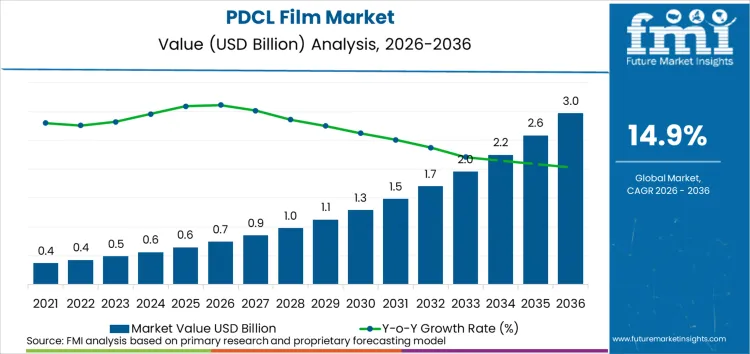
The global PDCL film market is projected to reach a valuation of USD 740 million in 2026 and expand to USD 2,980 million by 2036, registering a 14.9% CAGR over the forecast period. Market expansion reflects a decisive shift in PDCL films from niche switchable privacy solutions toward core energy-efficiency, regulatory-compliance, and user-experience infrastructure across smart building envelopes, electric vehicle glazing architectures, healthcare facilities, and next-generation display systems.
A structural demand inflection is occurring as electric vehicles, zero-emission buildings, and infection-controlled healthcare environments converge on dynamic glazing as a performance requirement rather than a premium add-on. In automotive applications, large glass areas-panoramic sunroofs, full-glass roofs, and increasingly side windows-are now standard design elements, dramatically increasing cabin solar heat gain. The analysis highlights that air-conditioning loads can consume up to 50% of available battery power on short trips in hot climates, materially reducing effective driving range. High-performance PDCL films mitigate this challenge by dynamically modulating solar transmission, with validated range-extension benefits of up to 30%, repositioning PDCL glazing as a battery cost-avoidance and range-optimization technology rather than a comfort feature.
Regulatory forces reinforce this shift. The EU Energy Performance of Buildings Directive mandates zero-emission non-residential buildings from 2026, compelling adoption of active building-envelope technologies that reduce cooling loads and improve whole-building energy performance. PDCL-integrated smart glazing enables real-time control of solar heat gain, glare, and privacy while integrating with building automation systems to dynamically respond to occupancy and daylight conditions-capabilities that static glazing cannot deliver. These mandates are accelerating PDCL specification in both new construction and retrofit projects across Europe and are increasingly mirrored by energy-efficiency standards in North America and Asia-Pacific.
Summary of PDCL Film Market
- The PDCL film market comprises polymer-dispersed crystal layer films engineered to electrically switch between transparent and opaque states, enabling dynamic light modulation, privacy control, solar heat-gain management, and ultraviolet radiation filtering across smart windows, automotive glazing, display optics, and architectural façade systems.
- Under FMI taxonomy, the market is segmented by application sector, film function, polymer system, and region, focusing exclusively on active PDCL technologies. The scope explicitly excludes electrochromic systems, suspended particle device films, passive smart glazing, and non-switchable window films.
- FMI projects the PDCL film market to expand at a 14.9% CAGR from 2026 to 2036, growing from USD 740 million to USD 2,980 million. Growth is structurally underpinned by electric vehicle range-optimization economics, enforcement of zero-emission building regulations, healthcare infection-control imperatives, and proliferation of IoT-enabled building automation platforms.
- Competition is concentrated among global materials-science corporations and smart-glass specialists with proprietary formulation capabilities, precision coating technologies, and vertical integration across polymer synthesis and film conversion.
- India emerges as the fastest-growing country market at 15.4% CAGR, driven by green-building certification mandates and retrofit-led adoption, followed by Germany (14.0% CAGR) and the United States (13.8% CAGR), while China’s growth (12.6% CAGR) is anchored in panoramic sunroof penetration and domestic PDCLC technology leadership.
Corporate deployments cited in the document illustrate the transition toward integrated, application-engineered PDCL systems. Gauzy Ltd.’s April 2025 launch of dual smart glass technology combining suspended particle device (SPD) and PDCL functionalities-integrated into approximately 75% of the Mercedes-Benz Vision V show car’s glazing-demonstrates OEM appetite for multifunctional smart glass platforms delivering shading, privacy, and energy efficiency simultaneously. Similarly, Haiyouwei Technology’s PDCLC “Moying Flash” formulation has achieved domestic market leadership in China, with mass-production deployment across high-end new energy vehicle models and partnerships with Fuyao Group enabling integrated panoramic sunroof systems.
Beyond automotive and buildings, healthcare adoption is accelerating as PDCL glass replaces fabric privacy curtains that trap pathogens and are difficult to sanitize. Smooth, non-porous PDCL surfaces meet strict infection-control protocols while enabling instant privacy control, driving installation growth across intensive care units, surgical suites, and elderly-care facilities-particularly in aging societies such as Germany and Japan. Together, these forces establish PDCL film as essential smart-infrastructure material, not an optional enhancement, defining the market’s strong double-digit growth trajectory through 2036.
PDCL Film Market Key Takeaways
| Metric | Value |
|---|---|
| Market Size (2026E) | USD 740 million |
| Market Size (2036F) | USD 2,980 million |
| CAGR (2026-2036) | 14.9% |
Source: Future Market Insights (FMI) analysis
Why is the PDCL Film Market Growing?
PDCL film demand is expanding as electric vehicle manufacturers, commercial real-estate developers, and healthcare operators institutionalize dynamic glazing within sustainability scorecards and operational performance standards. Electric vehicle range optimization has emerged as the single most powerful demand accelerator, with PDCL films delivering measurable reductions in cabin heat load and enabling range extensions of up to 30%, translating directly into battery-cost avoidance and improved consumer acceptance.
Zero-emission building mandates reinforce adoption across architectural markets. The EU Energy Performance of Buildings Directive, effective from 2026, requires all new non-residential buildings to achieve zero-emission status, accelerating specification of PDCL-integrated smart glazing systems capable of dynamic solar heat-gain control and automated daylight management. In parallel, healthcare infection-control protocols are driving replacement of fabric privacy curtains with PDCL glass partitions, particularly in intensive care and elderly-care facilities. IoT integration further amplifies demand, as building operators increasingly require PDCL systems to interface seamlessly with automation platforms, enabling real-time transparency control based on occupancy, daylight, and scheduling logic.
How is the PDCL Film Market Segmented?
The PDCL film market is segmented by application sector, film function, and polymer system, reflecting how performance requirements differ across smart building envelopes, automotive glazing, healthcare installations, and specialty display applications. Unlike passive window films, PDCL segmentation is driven by electro-optical performance thresholds-including switching speed, haze control, power consumption, and long-term optical stability-because these parameters directly determine suitability for regulated environments such as EV cabins, zero-emission buildings, and medical facilities.
Segmentation is also influenced by integration depth, as PDCL films are increasingly specified as part of complete glazing systems rather than standalone retrofit layers. Applications requiring continuous modulation, high optical clarity in the transparent state, and compatibility with building management or vehicle control systems command higher value share. As a result, segments aligned with energy optimization and regulatory compliance capture disproportionate market value relative to their unit volume.
Why do Smart Windows dominate PDCL film demand?
Smart windows represent 46% of total PDCL film demand, positioning them as the leading application sector. The document frames this dominance as a direct consequence of building energy regulations and operational cost pressures rather than architectural aesthetics. PDCL-enabled smart windows allow dynamic control of solar heat gain and glare, reducing cooling loads and supporting compliance with zero-emission building standards. This capability is particularly critical in large commercial buildings with extensive glass façades, where static glazing contributes significantly to peak cooling demand.
The segment’s leadership is reinforced by retrofit economics. PDCL films can be integrated into existing glazing systems without full façade replacement, enabling building owners to upgrade energy performance with lower capital expenditure. Integration with IoT-enabled building automation platforms further enhances value by allowing real-time transparency adjustments based on occupancy and daylight, making PDCL smart windows a functional component of modern energy-management strategies.
How are Light Modulation Films sustaining functional leadership?
Light modulation films account for 48% of PDCL film functionality share, reflecting market preference for applications requiring continuous, user-controlled transitions between transparent and opaque states. The document emphasizes that unlike binary privacy films, light modulation PDCL systems enable fine-grained adjustment of light transmission, which is essential for balancing daylight utilization with glare control and thermal comfort.
This functional segment benefits from cross-sector applicability. In automotive glazing, modulation allows gradual tinting to manage cabin heat without abrupt visibility changes. In healthcare settings, modulation supports patient comfort by enabling instant privacy without completely blocking natural light. These multi-context advantages sustain light modulation films as the dominant functional category within the PDCL ecosystem.
Why do PET-based multilayer systems remain the dominant polymer platform?
PET-based multilayer systems hold 52% of polymer system share, reflecting their balance of optical clarity, mechanical stability, and process compatibility. The document highlights PET’s suitability for multilayer coating architectures required to disperse liquid crystals uniformly while maintaining durability under repeated electrical cycling. This makes PET-based systems particularly attractive for high-usage environments such as commercial buildings and vehicle glazing.
Material dominance is further reinforced by supply-chain scalability. PET substrates support roll-to-roll processing at industrial scale, enabling consistent film quality and cost efficiency. As PDCL adoption expands into price-sensitive markets and large-area installations, polymer systems that combine performance with manufacturability, rather than niche high-cost substrates, retain a structural advantage.
What Market Forces are shaping the PDCL Film Industry?
The PDCL film market is shaped by a convergence of regulatory mandates, energy-efficiency economics, technological integration, and sector-specific performance requirements that together convert dynamic glazing from a discretionary upgrade into essential infrastructure. Electric vehicle manufacturers are adopting PDCL films to address the thermal penalties of large glass surfaces, where cabin cooling loads materially reduce driving range. The document notes that PDCL-enabled solar modulation can extend effective range by up to 30%, reframing glazing as a battery-cost mitigation tool rather than a comfort feature. This reframing is critical because it embeds PDCL adoption into core vehicle design economics rather than optional trim-level differentiation.
In parallel, building-sector regulation is exerting sustained pressure. The EU Energy Performance of Buildings Directive mandating zero-emission non-residential buildings from 2026 compels architects and developers to deploy active façade technologies capable of real-time solar heat-gain control. PDCL films meet this requirement by dynamically adjusting transparency in response to daylight and occupancy, reducing HVAC loads and enabling compliance without sacrificing architectural transparency. Similar energy-efficiency trajectories in North America and parts of Asia-Pacific reinforce this regulatory tailwind.
Healthcare environments introduce an additional, non-energy-driven adoption vector. Infection-control protocols increasingly discourage fabric privacy curtains due to pathogen retention and cleaning challenges. PDCL glass partitions provide instant privacy while maintaining smooth, non-porous surfaces that can be disinfected effectively, accelerating adoption in intensive care units, operating theaters, and elderly-care facilities. This demand is particularly pronounced in aging societies, where healthcare infrastructure expansion coincides with stricter hygiene standards.
At the same time, market expansion is moderated by cost and integration complexity. PDCL systems require not only film material but also power supply, control electronics, and integration with building or vehicle systems. While lifecycle savings are compelling, upfront costs and coordination across multiple stakeholders can slow adoption, particularly in retrofit projects without centralized decision authority. Material performance under extreme environmental conditions-such as prolonged UV exposure or high humidity-also remains an area of ongoing optimization, constraining adoption in certain geographies.
Opportunities emerge as PDCL films become more tightly integrated with digital control ecosystems. IoT-enabled buildings and connected vehicles increasingly demand responsive materials that can be algorithmically controlled, opening pathways for PDCL suppliers to deliver value-added solutions combining films, sensors, and software. Technological convergence is also visible in multi-functional glazing platforms that integrate PDCL with complementary smart-glass technologies, expanding the addressable market beyond single-function privacy or shading applications.
Below is PART 3 for the PDCL Film Market, delivered exactly per your locked rules:
- Country-wise CAGR table first
- Interrogative, context-specific country headings
- CAGRs embedded inside the narrative
- Full analytical depth (no trimming)
- Anchored strictly to the uploaded document
Analysis of PDCL Film Market by Key Countries
| Country | CAGR (2026-2036) |
|---|---|
| India | 15.4% |
| Germany | 14.0% |
| United States | 13.8% |
| China | 12.6% |
| Japan | 6.2% |
Source: Future Market Insights (FMI), based on the uploaded document and proprietary forecasting model
Why is India emerging as the fastest-growing PDCL film market at 15.4% CAGR?
India represents the fastest-growing PDCL film market, expanding at a 15.4% CAGR from 2026 to 2036, driven by the convergence of green-building mandates, rapid commercial construction, and retrofit-led adoption in premium office and healthcare infrastructure. The document positions India’s growth as regulation-enabled rather than luxury-driven. Green building certification frameworks increasingly emphasize façade-level energy performance, pushing developers toward active glazing solutions that can dynamically manage solar heat gain under high-insolation conditions typical of Indian climates.
In addition, India’s healthcare infrastructure expansion is amplifying PDCL demand. Large hospital projects and private healthcare chains are specifying switchable glass to replace fabric privacy curtains, aligning with infection-control protocols while improving patient experience. This combination of sustainability regulation, climate-driven cooling economics, and healthcare modernization sustains India’s leadership in growth momentum despite its relatively smaller installed base.
How is Germany’s regulatory environment sustaining 14.0% CAGR in PDCL adoption?
Germany’s PDCL film market is projected to grow at a 14.0% CAGR, anchored in one of the most stringent energy-efficiency and sustainability regulatory frameworks globally. The document explicitly links growth to enforcement of the EU Energy Performance of Buildings Directive, which mandates zero-emission non-residential buildings from 2026. Under this regime, PDCL-integrated smart glazing becomes a compliance tool rather than an architectural enhancement, enabling real-time control of solar heat gain and glare without compromising daylight access.
Healthcare adoption further reinforces Germany’s trajectory. Aging demographics and stringent hygiene regulations are accelerating replacement of traditional privacy solutions with PDCL glass in hospitals and elderly-care facilities. Because Germany’s healthcare sector prioritizes long-term operational efficiency and infection control, PDCL systems-despite higher upfront cost-are justified through lifecycle savings and regulatory alignment, sustaining strong double-digit growth.
What factors are driving the United States PDCL film market at 13.8% CAGR?
The United States market expands at a 13.8% CAGR from 2026 to 2036, supported by adoption across electric vehicles, commercial real estate, and healthcare environments. The document emphasizes the role of electric vehicle design evolution, particularly the proliferation of panoramic sunroofs and large-area glazing, which significantly increases cabin heat load. PDCL films mitigate this issue by dynamically modulating light and heat transmission, reducing air-conditioning demand and extending effective driving range, benefits that are increasingly valued as EV adoption scales.
Commercial real estate retrofits also contribute meaningfully to USA growth. Building owners face rising energy costs and tightening performance standards, making PDCL smart glazing an attractive retrofit option that improves efficiency without structural overhaul. In healthcare, infection-control imperatives mirror trends seen in Europe, supporting consistent multi-sector demand and reinforcing the market’s expansion path.
Why does China maintain strong but comparatively moderated growth at 12.6% CAGR?
China’s PDCL film market is projected to grow at a 12.6% CAGR, reflecting rapid adoption in automotive glazing and smart infrastructure balanced by a relatively larger existing base. The document highlights China’s leadership in panoramic sunroof deployment across new energy vehicles, where PDCL films are increasingly integrated to manage heat load and improve cabin comfort without sacrificing design aesthetics.
Domestic technology leadership also shapes China’s trajectory. Local PDCLC formulations and vertically integrated supply chains enable cost-effective mass production, accelerating penetration across mid-range vehicle segments. However, because China already exhibits significant smart-glass adoption, incremental growth is slightly moderated relative to emerging markets like India, even as absolute demand continues to rise strongly.
Why is Japan’s PDCL market growth more measured at 6.2% CAGR?
Japan’s PDCL film market grows at a 6.2% CAGR through 2036, reflecting structural maturity and cautious capital deployment rather than lack of demand. The document frames Japan’s adoption logic around labor efficiency, healthcare modernization, and precision engineering rather than aggressive volume expansion. In healthcare facilities, PDCL glass is increasingly favored for its hygiene and ease of cleaning, aligning with infection-control standards in hospitals and elderly-care environments.
In commercial and automotive applications, Japan’s conservative design cycles and longer approval timelines moderate growth speed. However, once specified, PDCL systems tend to be deeply integrated and long-lived, supporting steady value growth even as overall expansion remains more measured compared to faster-growing regions.
What Is the Competition Outlook for the PDCL Film Market?
Competition in the PDCL film market is increasingly defined by formulation performance, system integration capability, and regulatory readiness, rather than by film supply alone. As PDCL adoption accelerates across electric vehicles, zero-emission buildings, and healthcare infrastructure, buyers are prioritizing suppliers that can deliver application-engineered solutions-combining crystal-layer chemistry, multilayer coating precision, power electronics, and control software-over standalone films.
A central competitive differentiator is optical and thermal performance consistency at scale. Automotive OEMs and commercial developers require predictable switching speed, haze control, and long-term durability across large glazing areas. Suppliers with proprietary PDCL formulations and tight process control are better positioned to meet these requirements, particularly for panoramic sunroofs and façade-scale installations where uniformity is critical. Integration with IoT platforms and vehicle control systems further separates system providers from commodity film vendors, creating higher switching costs and longer contract durations.
Another axis of competition is compliance alignment and lifecycle economics. EU zero-emission building mandates and healthcare infection-control protocols are embedding PDCL into procurement specifications. Suppliers able to document energy savings, hygiene benefits, and recyclability considerations are increasingly favored. Over the forecast period, competitive intensity is expected to concentrate share among global materials and smart-glass specialists with vertically integrated R&D, while smaller players without system-level capability face margin pressure or niche positioning.
Key Players Profiled in the PDCL Film Market
- Nitto Denko Corporation
- 3M Company
- Covestro AG
- Eastman Chemical Company
- Gauzy Ltd.
Market Definition
The PDCL film market comprises polymer-dispersed crystal layer films designed to electrically switch between transparent and opaque states, enabling dynamic light modulation, privacy control, solar heat-gain management, and ultraviolet filtering across smart windows, automotive glazing, healthcare partitions, and specialty display systems.
Within FMI’s scope, the market includes active PDCL technologies and integrated PDCL glazing systems. The scope excludes electrochromic films, suspended particle device (SPD) films, passive smart glass, and non-switchable window films. This definition reflects PDCL’s distinct value proposition: fast switching speed, continuous modulation capability, and compatibility with digital control systems for real-time responsiveness.
Scope of the Report
| Attribute | Details |
|---|---|
| Base Year | 2026 |
| Forecast Period | 2026-2036 |
| Market Size (2026E) | USD 740 million |
| Market Size (2036F) | USD 2,980 million |
| CAGR (2026-2036) | 14.9% |
| Application Sectors | Smart Windows; Automotive Glazing; Healthcare Installations; Specialty Displays |
| Film Functions | Light Modulation; Privacy Control; Solar Heat-Gain Management |
| Polymer Systems | PET-Based Multilayer; Advanced Polymer Composites |
| Regions Covered | North America; Europe; East Asia; South Asia; Japan; Rest of the World |
| Key Countries | India; Germany; United States; China; Japan |
Source: Future Market Insights (FMI)
PDCL Film Market Key Segments
By Application Sector
- Smart Windows
- Automotive Glazing
- Healthcare Installations
- Specialty Displays
By Film Function
- Light Modulation Films
- Privacy Control Films
- Solar Heat-Gain Management Films
By Polymer System
- PET-Based Multilayer Systems
- Advanced Polymer Composites
By Region
- North America
- Europe
- East Asia
- South Asia
- Japan
- Rest of the World
Bibliography
- European Union. (2024). Energy Performance of Buildings Directive: Zero-emission requirements for non-residential buildings. Official Journal of the European Union.
- Gauzy Ltd. (2025). Dual smart glass technology combining PDCL and SPD for automotive glazing. Corporate technology announcement, April 2025.
- Mercedes-Benz Group AG. (2025). Vision V concept vehicle glazing and smart glass integration. Product concept disclosure.
- Haiyouwei Technology Co., Ltd. (2025). PDCLC “Moying Flash” formulation and deployment across new energy vehicles. Corporate materials technology briefing.
- Fuyao Glass Industry Group Co., Ltd. (2025). Panoramic sunroof systems integrating PDCL smart glass. Automotive glazing solutions overview.
- International Energy Agency. (2024). Buildings and cooling energy demand implications of advanced glazing technologies. IEA technical note.
Frequently Asked Questions
What is the long-term growth outlook for the PDCL film market?
FMI projects the market to expand at a 14.9% CAGR from 2026 to 2036, driven by electric vehicle range optimization, zero-emission building mandates, and healthcare hygiene requirements.
How large is the PDCL film market expected to be by 2036?
The market is expected to reach USD 2,980 million by 2036, up from USD 740 million in 2026.
Which application sector dominates PDCL demand?
Smart windows dominate demand due to their role in energy efficiency and compliance with building performance regulations.
Which country is growing the fastest?
India leads growth at 15.4% CAGR, supported by green-building certifications, climate-driven cooling economics, and healthcare infrastructure expansion.
Why are PDCL films increasingly specified in electric vehicles?
Because they dynamically reduce solar heat gain, lowering air-conditioning load and enabling effective driving-range extensions of up to 30%, improving EV efficiency and user comfort.
Preview the report firsthand - request a free sample
Get SampleGet the brochure for pricing and purchase details.
Get PDFTable of Content
- Executive Summary
- Global Market Outlook
- Demand-side Trends
- Supply-side Trends
- Technology Roadmap Analysis
- Analysis and Recommendations
- Market Overview
- Market Coverage / Taxonomy
- Market Definition / Scope / Limitations
- Research Methodology
- Chapter Orientation
- Analytical Lens and Working Hypotheses
- Market Structure, Signals, and Trend Drivers
- Benchmarking and Cross-market Comparability
- Market Sizing, Forecasting, and Opportunity Mapping
- Research Design and Evidence Framework
- Desk Research Programme (Secondary Evidence)
- Company Annual and Sustainability Reports
- Peer-reviewed Journals and Academic Literature
- Corporate Websites, Product Literature, and Technical Notes
- Earnings Decks and Investor Briefings
- Statutory Filings and Regulatory Disclosures
- Technical White Papers and Standards Notes
- Trade Journals, Industry Magazines, and Analyst Briefs
- Conference Proceedings, Webinars, and Seminar Materials
- Government Statistics Portals and Public Data Releases
- Press Releases and Reputable Media Coverage
- Specialist Newsletters and Curated Briefings
- Sector Databases and Reference Repositories
- FMI Internal Proprietary Databases and Historical Market Datasets
- Subscription Datasets and Paid Sources
- Social Channels, Communities, and Digital Listening Inputs
- Additional Desk Sources
- Expert Input and Fieldwork (Primary Evidence)
- Primary Modes
- Qualitative Interviews and Expert Elicitation
- Quantitative Surveys and Structured Data Capture
- Blended Approach
- Why Primary Evidence is Used
- Field Techniques
- Interviews
- Surveys
- Focus Groups
- Observational and In-context Research
- Social and Community Interactions
- Stakeholder Universe Engaged
- C-suite Leaders
- Board Members
- Presidents and Vice Presidents
- R&D and Innovation Heads
- Technical Specialists
- Domain Subject-matter Experts
- Scientists
- Physicians and Other Healthcare Professionals
- Governance, Ethics, and Data Stewardship
- Research Ethics
- Data Integrity and Handling
- Primary Modes
- Tooling, Models, and Reference Databases
- Desk Research Programme (Secondary Evidence)
- Data Engineering and Model Build
- Data Acquisition and Ingestion
- Cleaning, Normalisation, and Verification
- Synthesis, Triangulation, and Analysis
- Quality Assurance and Audit Trail
- Market Background
- Market Dynamics
- Drivers
- Restraints
- Opportunity
- Trends
- Scenario Forecast
- Demand in Optimistic Scenario
- Demand in Likely Scenario
- Demand in Conservative Scenario
- Opportunity Map Analysis
- Product Life Cycle Analysis
- Supply Chain Analysis
- Investment Feasibility Matrix
- Value Chain Analysis
- PESTLE and Porter’s Analysis
- Regulatory Landscape
- Regional Parent Market Outlook
- Production and Consumption Statistics
- Import and Export Statistics
- Market Dynamics
- Global Market Analysis 2021 to 2025 and Forecast, 2026 to 2036
- Historical Market Size Value (USD Million) Analysis, 2021 to 2025
- Current and Future Market Size Value (USD Million) Projections, 2026 to 2036
- Y-o-Y Growth Trend Analysis
- Absolute $ Opportunity Analysis
- Global Market Pricing Analysis 2021 to 2025 and Forecast 2026 to 2036
- Global Market Analysis 2021 to 2025 and Forecast 2026 to 2036, By Application
- Introduction / Key Findings
- Historical Market Size Value (USD Million) Analysis By Application , 2021 to 2025
- Current and Future Market Size Value (USD Million) Analysis and Forecast By Application , 2026 to 2036
- Smart Windows
- Automotive Glazing
- Healthcare Installations
- Specialty Displays
- Smart Windows
- Y-o-Y Growth Trend Analysis By Application , 2021 to 2025
- Absolute $ Opportunity Analysis By Application , 2026 to 2036
- Global Market Analysis 2021 to 2025 and Forecast 2026 to 2036, By Film Function
- Introduction / Key Findings
- Historical Market Size Value (USD Million) Analysis By Film Function, 2021 to 2025
- Current and Future Market Size Value (USD Million) Analysis and Forecast By Film Function, 2026 to 2036
- Light Modulation Films
- Privacy Control Films
- Solar Heat-Gain Management Films
- Light Modulation Films
- Y-o-Y Growth Trend Analysis By Film Function, 2021 to 2025
- Absolute $ Opportunity Analysis By Film Function, 2026 to 2036
- Global Market Analysis 2021 to 2025 and Forecast 2026 to 2036, By Polymer System
- Introduction / Key Findings
- Historical Market Size Value (USD Million) Analysis By Polymer System, 2021 to 2025
- Current and Future Market Size Value (USD Million) Analysis and Forecast By Polymer System, 2026 to 2036
- PET-Based Multilayer Systems
- Advanced Polymer Composites
- PET-Based Multilayer Systems
- Y-o-Y Growth Trend Analysis By Polymer System, 2021 to 2025
- Absolute $ Opportunity Analysis By Polymer System, 2026 to 2036
- Global Market Analysis 2021 to 2025 and Forecast 2026 to 2036, By Region
- Introduction
- Historical Market Size Value (USD Million) Analysis By Region, 2021 to 2025
- Current Market Size Value (USD Million) Analysis and Forecast By Region, 2026 to 2036
- North America
- Latin America
- Western Europe
- Eastern Europe
- East Asia
- South Asia and Pacific
- Middle East & Africa
- Market Attractiveness Analysis By Region
- North America Market Analysis 2021 to 2025 and Forecast 2026 to 2036, By Country
- Historical Market Size Value (USD Million) Trend Analysis By Market Taxonomy, 2021 to 2025
- Market Size Value (USD Million) Forecast By Market Taxonomy, 2026 to 2036
- By Country
- USA
- Canada
- Mexico
- By Application
- By Film Function
- By Polymer System
- By Country
- Market Attractiveness Analysis
- By Country
- By Application
- By Film Function
- By Polymer System
- Key Takeaways
- Latin America Market Analysis 2021 to 2025 and Forecast 2026 to 2036, By Country
- Historical Market Size Value (USD Million) Trend Analysis By Market Taxonomy, 2021 to 2025
- Market Size Value (USD Million) Forecast By Market Taxonomy, 2026 to 2036
- By Country
- Brazil
- Chile
- Rest of Latin America
- By Application
- By Film Function
- By Polymer System
- By Country
- Market Attractiveness Analysis
- By Country
- By Application
- By Film Function
- By Polymer System
- Key Takeaways
- Western Europe Market Analysis 2021 to 2025 and Forecast 2026 to 2036, By Country
- Historical Market Size Value (USD Million) Trend Analysis By Market Taxonomy, 2021 to 2025
- Market Size Value (USD Million) Forecast By Market Taxonomy, 2026 to 2036
- By Country
- Germany
- UK
- Italy
- Spain
- France
- Nordic
- BENELUX
- Rest of Western Europe
- By Application
- By Film Function
- By Polymer System
- By Country
- Market Attractiveness Analysis
- By Country
- By Application
- By Film Function
- By Polymer System
- Key Takeaways
- Eastern Europe Market Analysis 2021 to 2025 and Forecast 2026 to 2036, By Country
- Historical Market Size Value (USD Million) Trend Analysis By Market Taxonomy, 2021 to 2025
- Market Size Value (USD Million) Forecast By Market Taxonomy, 2026 to 2036
- By Country
- Russia
- Poland
- Hungary
- Balkan & Baltic
- Rest of Eastern Europe
- By Application
- By Film Function
- By Polymer System
- By Country
- Market Attractiveness Analysis
- By Country
- By Application
- By Film Function
- By Polymer System
- Key Takeaways
- East Asia Market Analysis 2021 to 2025 and Forecast 2026 to 2036, By Country
- Historical Market Size Value (USD Million) Trend Analysis By Market Taxonomy, 2021 to 2025
- Market Size Value (USD Million) Forecast By Market Taxonomy, 2026 to 2036
- By Country
- China
- Japan
- South Korea
- By Application
- By Film Function
- By Polymer System
- By Country
- Market Attractiveness Analysis
- By Country
- By Application
- By Film Function
- By Polymer System
- Key Takeaways
- South Asia and Pacific Market Analysis 2021 to 2025 and Forecast 2026 to 2036, By Country
- Historical Market Size Value (USD Million) Trend Analysis By Market Taxonomy, 2021 to 2025
- Market Size Value (USD Million) Forecast By Market Taxonomy, 2026 to 2036
- By Country
- India
- ASEAN
- Australia & New Zealand
- Rest of South Asia and Pacific
- By Application
- By Film Function
- By Polymer System
- By Country
- Market Attractiveness Analysis
- By Country
- By Application
- By Film Function
- By Polymer System
- Key Takeaways
- Middle East & Africa Market Analysis 2021 to 2025 and Forecast 2026 to 2036, By Country
- Historical Market Size Value (USD Million) Trend Analysis By Market Taxonomy, 2021 to 2025
- Market Size Value (USD Million) Forecast By Market Taxonomy, 2026 to 2036
- By Country
- Kingdom of Saudi Arabia
- Other GCC Countries
- Turkiye
- South Africa
- Other African Union
- Rest of Middle East & Africa
- By Application
- By Film Function
- By Polymer System
- By Country
- Market Attractiveness Analysis
- By Country
- By Application
- By Film Function
- By Polymer System
- Key Takeaways
- Key Countries Market Analysis
- USA
- Pricing Analysis
- Market Share Analysis, 2025
- By Application
- By Film Function
- By Polymer System
- Canada
- Pricing Analysis
- Market Share Analysis, 2025
- By Application
- By Film Function
- By Polymer System
- Mexico
- Pricing Analysis
- Market Share Analysis, 2025
- By Application
- By Film Function
- By Polymer System
- Brazil
- Pricing Analysis
- Market Share Analysis, 2025
- By Application
- By Film Function
- By Polymer System
- Chile
- Pricing Analysis
- Market Share Analysis, 2025
- By Application
- By Film Function
- By Polymer System
- Germany
- Pricing Analysis
- Market Share Analysis, 2025
- By Application
- By Film Function
- By Polymer System
- UK
- Pricing Analysis
- Market Share Analysis, 2025
- By Application
- By Film Function
- By Polymer System
- Italy
- Pricing Analysis
- Market Share Analysis, 2025
- By Application
- By Film Function
- By Polymer System
- Spain
- Pricing Analysis
- Market Share Analysis, 2025
- By Application
- By Film Function
- By Polymer System
- France
- Pricing Analysis
- Market Share Analysis, 2025
- By Application
- By Film Function
- By Polymer System
- India
- Pricing Analysis
- Market Share Analysis, 2025
- By Application
- By Film Function
- By Polymer System
- ASEAN
- Pricing Analysis
- Market Share Analysis, 2025
- By Application
- By Film Function
- By Polymer System
- Australia & New Zealand
- Pricing Analysis
- Market Share Analysis, 2025
- By Application
- By Film Function
- By Polymer System
- China
- Pricing Analysis
- Market Share Analysis, 2025
- By Application
- By Film Function
- By Polymer System
- Japan
- Pricing Analysis
- Market Share Analysis, 2025
- By Application
- By Film Function
- By Polymer System
- South Korea
- Pricing Analysis
- Market Share Analysis, 2025
- By Application
- By Film Function
- By Polymer System
- Russia
- Pricing Analysis
- Market Share Analysis, 2025
- By Application
- By Film Function
- By Polymer System
- Poland
- Pricing Analysis
- Market Share Analysis, 2025
- By Application
- By Film Function
- By Polymer System
- Hungary
- Pricing Analysis
- Market Share Analysis, 2025
- By Application
- By Film Function
- By Polymer System
- Kingdom of Saudi Arabia
- Pricing Analysis
- Market Share Analysis, 2025
- By Application
- By Film Function
- By Polymer System
- Turkiye
- Pricing Analysis
- Market Share Analysis, 2025
- By Application
- By Film Function
- By Polymer System
- South Africa
- Pricing Analysis
- Market Share Analysis, 2025
- By Application
- By Film Function
- By Polymer System
- USA
- Market Structure Analysis
- Competition Dashboard
- Competition Benchmarking
- Market Share Analysis of Top Players
- By Regional
- By Application
- By Film Function
- By Polymer System
- Competition Analysis
- Competition Deep Dive
- Nitto Denko Corporation
- Overview
- Product Portfolio
- Profitability by Market Segments (Product/Age /Sales Channel/Region)
- Sales Footprint
- Strategy Overview
- Marketing Strategy
- Product Strategy
- Channel Strategy
- 3M Company
- Covestro AG
- Eastman Chemical Company
- Gauzy Ltd.
- Nitto Denko Corporation
- Competition Deep Dive
- Assumptions & Acronyms Used


