

- Industry Size (2025)
- USD 172.8 Mn
- Forecast (2035)
- USD 311.1 Mn
- CAGR (2025 to 2035)
- 6.1%
Film Forming Polymers VP VA Market Forecast and Outlook 2025 to 2035
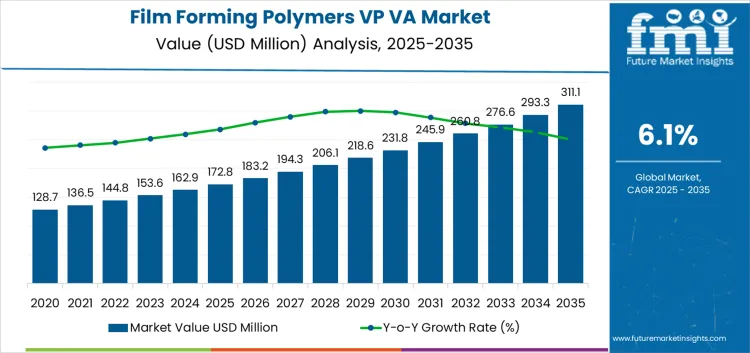
Starting from a base of USD 172.8 million in 2025, the VP VA film forming polymers market is expected to reach USD 311.1 million by 2035 at a CAGR of 6.1%. Early expansion is tied to steady demand from personal care, pharmaceuticals, and industrial coatings where uniform film formation and adhesion control are essential. Production volumes rise in line with capacity additions at specialty polymer plants focused on vinylpyrrolidone and vinyl acetate copolymerization. Procurement is driven by viscosity grade control, residual monomer limits, and batch consistency for regulated end uses. Contract based supply dominates large buyers, while spot purchasing remains limited to small formulators and regional blenders. Plant utilization rates and energy input costs shape near term operating margins for producers.
Application use remains concentrated in hair styling products, color cosmetics, and skin care where VP VA copolymers provide hold, gloss, and wash off control. In pharmaceuticals, the polymers serve as tablet binders and film coatings for modified release systems. Industrial demand covers inks, pressure sensitive adhesives, and protective coatings that require fast drying and surface uniformity. Through 2030, volume gains are driven by expansion of grooming products and oral solid dosage manufacturing. After 2030, growth reflects wider penetration into water-based coatings and packaging inks as solvent systems decline. Distribution continues through direct supply to large brand owners, supported by specialty chemical distributors serving mid-scale formulators. Logistics planning emphasizes bulk handling, inventory buffering, and forecast alignment with downstream customers.
Quick Stats of the Film Forming Polymers VP VA Market
- Film Forming Polymers VP VA Market Value (2025): USD 172.8 million
- Film Forming Polymers VP VA Market Forecast Value (2035): USD 311.1 million
- Film Forming Polymers VP VA Market Forecast CAGR (2025-2035): 6.1%
- Leading End Use in Film Forming Polymers VP VA Market: Skin Care (9.1%)
- Key Growth Regions in Film Forming Polymers VP VA Market: Asia Pacific, Europe
- Top Players in Film Forming Polymers VP VA Market: BASF SE, Croda International, Evonik Industries, Symrise (incl. IFF/Givaudan actives), Dow / Dow Inc., Ashland, Clariant, Seppic
What is the Growth Forecast for the Film Forming Polymers VP VA Market through 2035?
The global Film Forming Polymers VP VA Market expands from USD 172.8 million in 2025 to USD 218.6 million by 2030, delivering an absolute increase of USD 45.8 million in the first half of the forecast period. This phase is shaped by the structural reliance of hair styling, long-wear cosmetics, and skin adhesion systems on VP VA copolymers for flexible hold, humidity resistance, and rapid film formation. Demand growth is anchored in daily-use personal care products such as hair sprays, gels, mascaras, and transfer-resistant foundations rather than in niche cosmetic lines. Industrial use in coatings, inks, and pressure-sensitive adhesives adds a secondary demand layer. Growth in this phase is broadly formulation-led, supported by stable brand reformulation cycles and consistent product launch pipelines.
From 2030 to 2035, the market advances from USD 218.6 million to USD 311.1 million, adding a larger USD 92.5 million in the second half of the decade. This back-weighted expansion reflects deeper penetration of VP VA polymers into hybrid skincare-makeup products, dermatology-linked hair treatments, and high-performance film systems for flexible packaging and specialty coatings. Demand also strengthens through customization of molecular weight grades for texture control, gloss modulation, and controlled release performance. As personal care brands intensify long-wear and climate-resilient formulation strategies and industrial users pursue thinner, stronger films, VP/VA polymers transition from standard binders into performance-critical polymer backbones, materially lifting global market value through 2035.
Film Forming Polymers (VP VA) Industry Key Takeaways
| Metric | Value |
|---|---|
| Industry Value (2025) | USD 172.8 million |
| Forecast Value (2035) | USD 311.1 million |
| Forecast CAGR (2025–2035) | 6.1% |
How Is the VP VA Film Forming Polymers Market Shaping Performance Across Personal Care and Industrial Formulations?
The VP VA film forming polymers market developed from the need for materials that could create flexible, transparent, and fast drying films on hair, skin, and coated surfaces. Early growth was tied closely to hair styling products such as sprays, gels, and mousses where hold strength, humidity resistance, and ease of removal defined product performance. VP VA copolymers gained preference because they balanced stiffness with flexibility and delivered consistent film integrity across varying climate conditions. Over time, their use expanded into color cosmetics, sunscreens, and peelable masks where uniform film formation controls wear time and visual finish. Industrial use also emerged in inks, coatings, and adhesive systems where quick setting and surface adhesion are required.
Future growth of the VP VA film forming polymers market will be shaped by reformulation trends, demand for long wear performance, and evolving regulatory expectations around polymer safety. As personal care products shift toward lighter textures and transfer resistant finishes, these polymers will remain central to product structure. Expansion is expected in hybrid makeup skincare products, water resistant sunscreens, and sprayable formats. Barriers include rising pressure to reduce non-biodegradable synthetic polymers, competition from bio based film formers, and sensitivity to solvent system compatibility. Cost volatility in raw polymer feedstocks and the need to tailor performance for low alcohol or water heavy formulations will also influence broader adoption.
How Are End Use Application and Product Form Structuring the Demand for Film-Forming Polymers VP VA?
The demand for VP VA film-forming polymers is structured by end use application and product form. Skin care represents 9.1% of total demand, followed by body care, hair care, sun care, color cosmetics, men grooming, baby and kids care, and dermocosmetic and professional care. By product form, powder accounts for 16.1% of total consumption, followed by granules and agglomerates, flakes, pellets and prills, liquid solutions, high active concentrates, dispersions and suspensions, emulsions, pastes, gels, wax or solid block formats, and oils. Demand behavior is shaped by film elasticity, humidity resistance, adhesion strength, drying speed, and compatibility with water-based and alcohol-based delivery systems.
Why Does Skin Care Lead the VP VA Film-Forming Polymer End Use Demand?
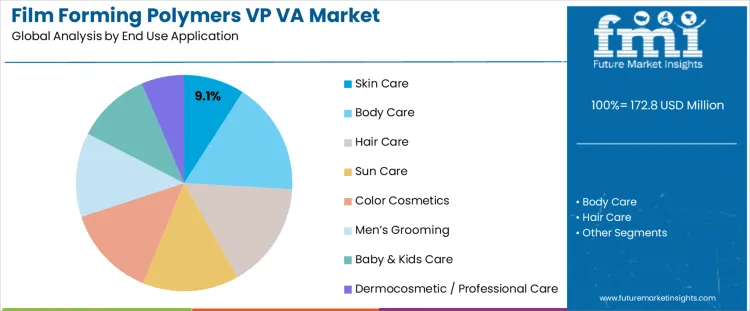
Skin care accounts for 9.1% of total VP VA polymer demand due to its role in creating continuous, flexible films that enhance product longevity and surface protection. VP VA polymers are widely used in peel-off masks, long-wear serums, tightening formulations, and barrier-enhancing treatments where controlled film formation improves skin adherence and active retention. The polymer film reduces transepidermal moisture loss while maintaining breathability, which supports daily wear comfort.
Skin care formulators rely on VP VA for its balance between rigidity and flexibility, allowing visible tightening effects without cracking during facial movement. It also stabilizes pigments and actives on the skin surface, improving uniformity of application. Compatibility with sensitive skin formulations further supports its use in recovery and treatment products. These film performance properties, moisture control behavior, and surface adhesion advantages sustain skin care as the leading end use segment.
Why Does Powder Lead the VP VA Film-Forming Polymer Product Form Demand?
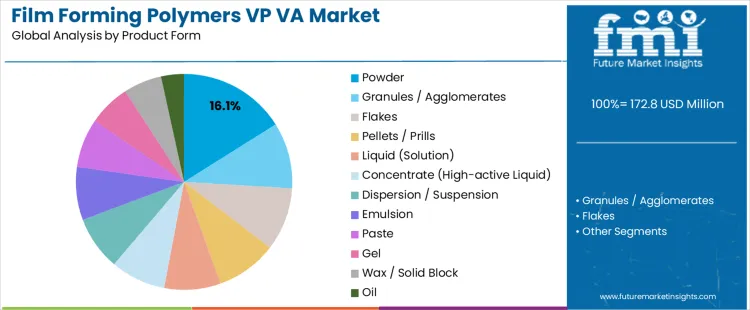
Powder accounts for 16.1% of total VP VA demand due to its superior storage stability, controlled solubility, and precise concentration management during formulation. Powdered VP VA allows manufacturers to adjust film strength and flexibility by varying polymer loading at the hydration stage, which is critical for achieving consistent peel strength, gloss, and wear time. Low moisture content minimizes premature agglomeration and microbial exposure during storage.
Powder form also supports efficient transport and centralized compounding, where hydration occurs only during final formulation. It dissolves predictably in water or hydroalcoholic systems under controlled mixing conditions. Packaging in moisture barrier sacks and lined drums preserves polymer chain integrity during distribution. These processing control, formulation precision, and shelf stability advantages position powder as the leading product form within the VP VA film-forming polymer demand structure.
How Did VP/VA Film-Forming Polymers Become The Hidden Framework Of Styling And Color Products?
In the global market, VP/VA copolymers sit behind a large share of hair sprays, styling gels, mascaras, eyeliners, and transfer resistant complexion products. They create the thin, continuous film that locks pigments or resins where formulators want them. They dissolve in alcohol or water, dry quickly, and form clear layers that do not cloud color. Brands choose them when they need predictable hold, non tacky feel, and simple removal with shampoo or cleanser. Demand is tied directly to everyday styling and makeup habits rather than to niche specialty launches.
Why Do Formulators Treat VP/VA As A Dial Between Persistence And Wash Off?
VP/VA copolymers give chemists a practical way to tune film behavior without rebuilding formulas from scratch. Small adjustments in molecular weight, ratio, neutralization, and plasticizer level shift hair stiffness, flake tendency, and wash off time. In styling products, the goal is often a film that resists humidity for several hours yet still breaks under the mechanical action of brushing and washing. In makeup, films must grip pigment on skin while resisting smudge from sebum and sweat. This balance makes VP/VA a controllable workhorse rather than a one note hard resin.
What Practical Limits Stop VP/VA from Becoming the Default Film Former in Every Category?
The same chemistry that gives VP/VA fast film build and hold also creates constraints. Films can turn brittle in very low humidity or feel tacky in high humidity if plasticizer balance is not correct. Pure VP/VA struggles in extreme long wear lip or eyeliner systems that face constant oil exposure, so acrylates and polyurethane dispersions often share the film load. Solvent choice is under pressure from VOC rules, which complicates traditional alcohol heavy hairsprays. Cost targets in mass products also encourage blending with lower priced polymers instead of using VP/VA alone.
Where Is Demand Concentrating as Formats Shift in Styling, Color, And Water Based Systems?
Growth for VP/VA film forming polymers is concentrating where light feel and simple removal matter more than extreme permanence. Pump hair sprays, flexible creams, hybrid styling serums, and everyday mascaras continue to rely on VP/VA for controlled hold with easy cleansing. Water based sprays and low alcohol formats increase demand for grades that dissolve or disperse cleanly in water while still forming stable films. Skin tint and soft focus base products use VP/VA to fix pigment without heavy occlusion. The market is moving toward flexible, comfort focused films rather than rigid, high impact coatings.
What Is the Global Growth Outlook for the Film Forming Polymers VP VA Industry by Country?
| Country | CAGR (%) |
|---|---|
| India | 8.2 |
| China | 7.6 |
| Japan | 7.0 |
| UK | 6.4 |
| Germany | 5.8 |
| USA | 5.1 |
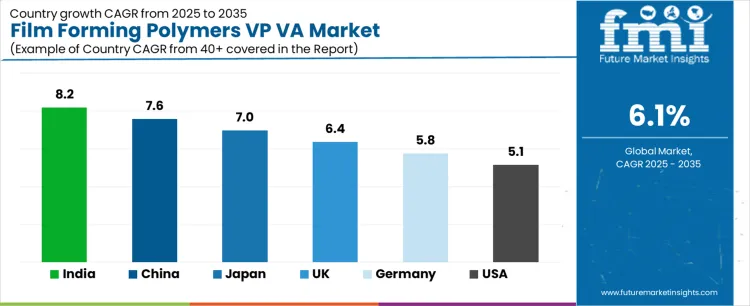
The film forming polymers VP VA industry is showing steady global expansion across major personal care, pharmaceutical, and industrial formulation markets, with India leading at an 8.2% CAGR. Growth in India is supported by rising production of hair styling products, oral care formulations, and pharmaceutical coatings that rely on VP VA polymers for adhesion and film formation. China follows at 7.6%, driven by large scale cosmetics manufacturing, strong export oriented production, and expanding use in industrial coatings. Japan at 7.0% reflects stable demand from premium personal care, medical coatings, and specialty chemical formulations. The UK and Germany record 6.4% and 5.8% growth, supported by steady use in cosmetics, packaging coatings, and specialty industrial applications. The USA at 5.1% reflects a mature but steadily advancing market driven by personal care innovation and pharmaceutical excipient demand.
What Is Driving Film Forming Polymer Demand Growth in India Personal Care Production?
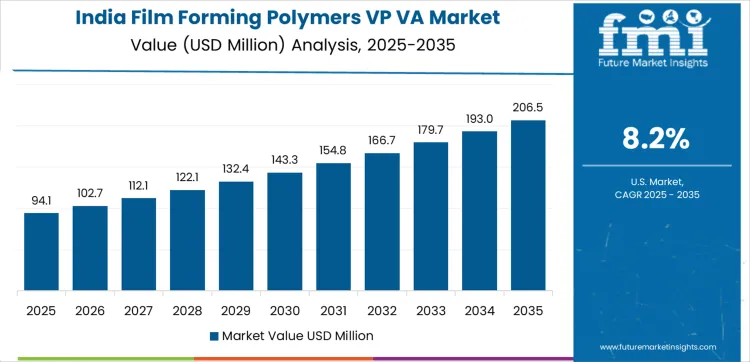
Expansion in India is progressing at a CAGR of 8.2% through 2035 for film forming polymers VP VA demand, driven by rising hair styling product manufacturing, color cosmetics growth, and domestic personal care brand expansion. These polymers are used in hair sprays, gels, mascaras, and peel off face masks for hold, gloss, and film flexibility. Contract manufacturing for export oriented beauty brands adds further volume. Imports dominate high performance grades, while local blending supports mass market products. Demand remains formulation driven and retail aligned, shaped by fast moving beauty trends, youth driven grooming habits, and steady online cosmetic retail growth.
- Hair styling products anchor primary formulation demand
- Color cosmetics expand decorative application volume
- Contract manufacturing supports export oriented output
- Import based sourcing dominates high performance grades
How Is China Scaling VP VA Polymer Consumption Across Mass Cosmetics?
Growth in China reflects a CAGR of 7.6% through 2035 for film forming polymers VP VA utilization, supported by large scale personal care manufacturing, private label cosmetics expansion, and export focused beauty production. These polymers appear in styling gels, long wear makeup, and facial mask films. Domestic chemical plants supply high volume industrial grades at controlled cost. Export oriented cosmetic producers sustain steady polymer offtake. Demand remains production driven and volume oriented, aligned with mass beauty product output, rapid private brand turnover, and continuous scale up of decorative and functional cosmetic manufacturing.
- Mass cosmetics manufacturing sustains bulk polymer demand
- Private label brands drive rapid formulation cycles
- Domestic chemical supply stabilizes cost and availability
- Export focused production supports high volume offtake
Why Does Japan Maintain Stable Demand for High Purity Film Forming Polymers?
Demand in Japan is increasing at a CAGR of 7.0% through 2035 for film forming polymers VP VA usage, sustained by premium cosmetics, dermatology aligned formulations, and precision makeup performance requirements. These polymers are used in long wear foundations, waterproof mascaras, and controlled hold hair products. Domestic formulation standards emphasize uniform film formation and low irritation. Local chemical refiners maintain strict purity control. Demand stays quality driven and performance focused, supported by aging population cosmetics demand, steady premium brand development, and continued preference for high durability cosmetic finishes.
- Long wear makeup products drive premium polymer usage
- Waterproof formulations sustain technical demand
- Domestic refining stabilizes purity and consistency
- Dermatology aligned brands strengthen regulated applications
What Is Supporting Film Forming Polymer Market Expansion in the United Kingdom?
Growth in the UK is advancing at a CAGR of 6.4% through 2035 for film forming polymers VP VA demand, supported by clean label cosmetics, professional salon styling products, and growing interest in long hold makeup formats. These polymers appear in styling mousses, brow gels, and peel off skincare masks. Independent beauty brands and contract formulators support steady product launches. Imports dominate polymer sourcing. Demand remains retail driven and trend focused, shaped by rising professional haircare adoption, premium makeup positioning, and strong penetration of salon linked cosmetic brands.
- Professional haircare products support steady polymer usage
- Brow and lash makeup drives decorative demand
- Contract formulators sustain product diversity
- Imported sourcing dominates polymer supply
How Is Germany Integrating VP VA Polymers into Regulated Cosmetics Manufacturing?
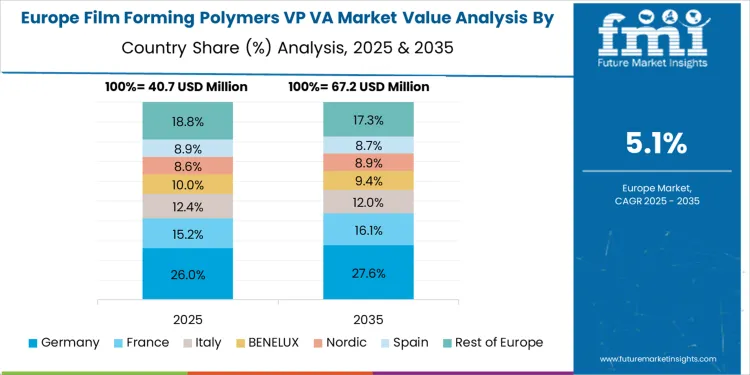
Growth in Germany reflects a CAGR of 5.8% through 2035 for film forming polymers VP VA consumption, driven by certified dermacosmetics, pharmacy grade hair styling products, and regulated personal care manufacturing. These polymers are used in skin fixing sprays, medical makeup, and sensitive scalp hair products. Strict formulation standards govern polymer selection and residual monomer control. Imports remain the primary supply route for cosmetic grade materials. Demand stays quality focused and regulation aligned, supported by controlled cosmetic usage patterns, preventive skin health practices, and steady demand from pharmacy distributed beauty products.
- Pharmacy grade cosmetics anchor regulated polymer demand
- Sensitive scalp products support controlled usage
- Compliance standards shape material qualification
- Medical retail channels stabilize long term consumption
What Is Driving Measured Film Forming Polymer Growth in the United States?
Expansion in the United States is moving at a CAGR of 5.1% through 2035 for film forming polymers VP VA demand, supported by mass cosmetics production, salon grade hair styling, and long wear makeup development. These polymers appear in hair sprays, setting powders, liquid foundations, and peel off facial products. Professional salon brands and mass retail labels both contribute to volume consumption. Imports supply most cosmetic grade polymer. Demand remains formulation driven and application diverse, shaped by stable salon industry activity, steady product innovation, and consistent consumer demand for long lasting cosmetics.
- Hair spray and setting products anchor bulk demand
- Professional salon brands support repeat polymer usage
- Long wear foundations sustain decorative applications
- Import dependence dominates cosmetic grade sourcing
What Is Driving the Global Demand for Film Forming Polymers (VP/VA) and Who Are the Key Suppliers Supplying Them
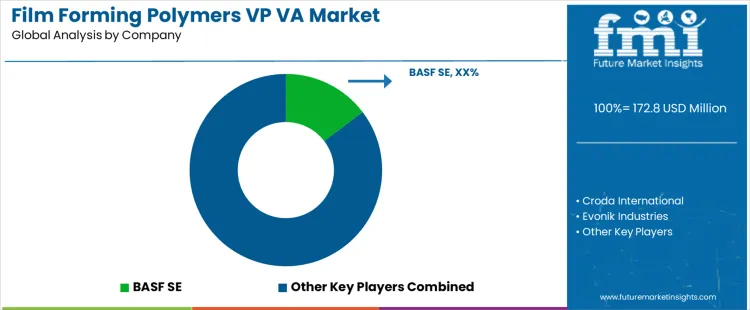
Global demand for VP/VA film forming polymers is rising as cosmetics, personal care, pharmaceutical, and industrial formulators seek versatile polymers that deliver consistent film formation, adhesion, moisture barrier, and styling properties. The copolymer of vinylpyrrolidone (VP) and vinyl acetate (VA) balances hydrophilicity and flexibility so it can form transparent, flexible films on skin, hair, nails, or substrates. In hair care and styling products, it supports strong hold, humidity resistance, and shape retention while keeping softness. In skin care and makeup, it helps produce smooth texture, enhance product stability, reduce transepidermal water loss, and enable long lasting coatings or finishes. Growth in demand for long wear, high performance, multi functional formulations supports uptake of VP/VA polymers across various product categories.
Key suppliers that contribute to the VP/VA film forming polymer supply base include large specialty chemicals and ingredient firms such as BASF SE, Croda International, Evonik Industries, Symrise (including IFF/Givaudan actives), Dow / Dow Inc., Ashland, Clariant, and a number of smaller or niche companies (e.g. Seppic, Lubrizol, Lonza, Inolex). These firms supply bulk grade VP/VA copolymers, standardized formulations, and grades optimized for cosmetics, haircare, pharmaceuticals, and industrial coatings. Large suppliers ensure consistent quality, global supply chain stability, and compliance with regulatory standards. Smaller or specialized firms offer application specific variants optimized for premium, natural product, or sensitive skin formulations. This multi tier supplier ecosystem supports broad adoption of VP/VA film forming polymers across global markets and end use segments ranging from hair styling to skincare and coating applications.
Key Players in the Film Forming Polymers VP VA Market
- BASF SE
- Croda International
- Evonik Industries
- Symrise (incl. IFF/Givaudan actives)
- Dow / Dow Inc.
- Ashland
- Clariant
- Seppic
- Others
Scope of the report
| Items | Values |
|---|---|
| Quantitative Units (2025) | USD million |
| End-Use Applications | Skin Care, Body Care, Hair Care, Sun Care, Color Cosmetics, Men’s Grooming, Baby & Kids Care, Dermocosmetic / Professional Care |
| Product Forms | Powder, Granules/Agglomerates, Flakes, Pellets/Prills, Liquid (Solution), Concentrate (High-active Liquid), Dispersion/Suspension, Emulsion, Paste, Gel, Wax / Solid Block, Oil |
| Regions Covered | Asia Pacific, Europe, North America, Latin America, Middle East & Africa |
| Countries Covered | China, Japan, South Korea, India, Australia & New Zealand, ASEAN, Germany, United Kingdom, France, Italy, Spain, Nordic, BENELUX, USA, Canada, Mexico, Brazil, Chile, Saudi Arabia, Turkey, South Africa, plus 40+ additional countries globally |
| Key Companies Profiled | BASF SE, Croda International, Evonik Industries, Symrise (incl. IFF/Givaudan actives), Dow Inc., Ashland, Clariant, Seppic, Lubrizol, Lonza, Inolex |
| Additional Attributes | Dollar by sales breakdown by region, country, end-use, and product form; global growth projections; multi-sector adoption (cosmetic, nutraceutical, functional food); extract bioactivity profiling; iodine and polyphenol standardization; contract harvesting; vertical integration; supply chain stability; regulatory compliance; sensory and bioavailability performance |
Film Forming Polymers VP VA Market Segmentation
End Use Application:
- Skin Care
- Body Care
- Hair Care
- Sun Care
- Color Cosmetics
- Men’s Grooming
- Baby & Kids Care
- Dermocosmetic / Professional Care
Product Form:
- Powder
- Granules / Agglomerates
- Flakes
- Pellets / Prills
- Liquid (Solution)
- Concentrate (High-active Liquid)
- Dispersion / Suspension
- Emulsion
- Paste
- Gel
- Wax / Solid Block
- Oil
Region
-
Asia Pacific
- China
- Japan
- South Korea
- India
- Australia & New Zealand
- ASEAN
- Rest of Asia Pacific
- Europe
- Germany
- United Kingdom
- France
- Italy
- Spain
- Nordic
- BENELUX
- Rest of Europe
- North America
- United States
- Canada
- Mexico
- Latin America
- Brazil
- Chile
- Rest of Latin America
- Middle East & Africa
- Kingdom of Saudi Arabia
- Other GCC Countries
- Turkey
- South Africa
- Other African Union
- Rest of Middle East & Africa
Frequently Asked Questions
How big is the film forming polymers vp va market in 2025?
The global film forming polymers vp va market is estimated to be valued at USD 172.8 million in 2025.
What will be the size of film forming polymers vp va market in 2035?
The market size for the film forming polymers vp va market is projected to reach USD 311.1 million by 2035.
How much will be the film forming polymers vp va market growth between 2025 and 2035?
The film forming polymers vp va market is expected to grow at a 6.1% CAGR between 2025 and 2035.
What are the key product types in the film forming polymers vp va market?
The key product types in film forming polymers vp va market are skin care, body care, hair care, sun care, color cosmetics, men’s grooming, baby & kids care and dermocosmetic / professional care.
Which product form segment to contribute significant share in the film forming polymers vp va market in 2025?
In terms of product form , powder segment to command 16.1% share in the film forming polymers vp va market in 2025.
Preview the report firsthand - request a free sample
Get SampleGet the brochure for pricing and purchase details.
Get PDFTable of Content
- Executive Summary
- Global Market Outlook
- Demand-side Trends
- Supply-side Trends
- Technology Roadmap Analysis
- Analysis and Recommendations
- Market Overview
- Market Coverage / Taxonomy
- Market Definition / Scope / Limitations
- Market Background
- Market Dynamics
- Drivers
- Restraints
- Opportunity
- Trends
- Scenario Forecast
- Demand in Optimistic Scenario
- Demand in Likely Scenario
- Demand in Conservative Scenario
- Opportunity Map Analysis
- Product Life Cycle Analysis
- Supply Chain Analysis
- Investment Feasibility Matrix
- Value Chain Analysis
- PESTLE and Porter’s Analysis
- Regulatory Landscape
- Regional Parent Market Outlook
- Production and Consumption Statistics
- Import and Export Statistics
- Market Dynamics
- Global Market Analysis 2020 to 2024 and Forecast, 2025 to 2035
- Historical Market Size Value (USD Million) Analysis, 2020 to 2024
- Current and Future Market Size Value (USD Million) Projections, 2025 to 2035
- Y-o-Y Growth Trend Analysis
- Absolute $ Opportunity Analysis
- Global Market Pricing Analysis 2020 to 2024 and Forecast 2025 to 2035
- Global Market Analysis 2020 to 2024 and Forecast 2025 to 2035, By End Use Application
- Introduction / Key Findings
- Historical Market Size Value (USD Million) Analysis By End Use Application , 2020 to 2024
- Current and Future Market Size Value (USD Million) Analysis and Forecast By End Use Application , 2025 to 2035
- Skin Care
- Body Care
- Hair Care
- Sun Care
- Color Cosmetics
- Men’s Grooming
- Baby & Kids Care
- Dermocosmetic / Professional Care
- Y-o-Y Growth Trend Analysis By End Use Application , 2020 to 2024
- Absolute $ Opportunity Analysis By End Use Application , 2025 to 2035
- Global Market Analysis 2020 to 2024 and Forecast 2025 to 2035, By Product Form
- Introduction / Key Findings
- Historical Market Size Value (USD Million) Analysis By Product Form, 2020 to 2024
- Current and Future Market Size Value (USD Million) Analysis and Forecast By Product Form, 2025 to 2035
- Powder
- Granules / Agglomerates
- Flakes
- Pellets / Prills
- Liquid (Solution)
- Concentrate (High-active Liquid)
- Dispersion / Suspension
- Emulsion
- Paste
- Gel
- Wax / Solid Block
- Y-o-Y Growth Trend Analysis By Product Form, 2020 to 2024
- Absolute $ Opportunity Analysis By Product Form, 2025 to 2035
- Global Market Analysis 2020 to 2024 and Forecast 2025 to 2035, By Region
- Introduction
- Historical Market Size Value (USD Million) Analysis By Region, 2020 to 2024
- Current Market Size Value (USD Million) Analysis and Forecast By Region, 2025 to 2035
- North America
- Latin America
- Western Europe
- Eastern Europe
- East Asia
- South Asia and Pacific
- Middle East & Africa
- Market Attractiveness Analysis By Region
- North America Market Analysis 2020 to 2024 and Forecast 2025 to 2035, By Country
- Historical Market Size Value (USD Million) Trend Analysis By Market Taxonomy, 2020 to 2024
- Market Size Value (USD Million) Forecast By Market Taxonomy, 2025 to 2035
- By Country
- USA
- Canada
- Mexico
- By End Use Application
- By Product Form
- By Country
- Market Attractiveness Analysis
- By Country
- By End Use Application
- By Product Form
- Key Takeaways
- Latin America Market Analysis 2020 to 2024 and Forecast 2025 to 2035, By Country
- Historical Market Size Value (USD Million) Trend Analysis By Market Taxonomy, 2020 to 2024
- Market Size Value (USD Million) Forecast By Market Taxonomy, 2025 to 2035
- By Country
- Brazil
- Chile
- Rest of Latin America
- By End Use Application
- By Product Form
- By Country
- Market Attractiveness Analysis
- By Country
- By End Use Application
- By Product Form
- Key Takeaways
- Western Europe Market Analysis 2020 to 2024 and Forecast 2025 to 2035, By Country
- Historical Market Size Value (USD Million) Trend Analysis By Market Taxonomy, 2020 to 2024
- Market Size Value (USD Million) Forecast By Market Taxonomy, 2025 to 2035
- By Country
- Germany
- UK
- Italy
- Spain
- France
- Nordic
- BENELUX
- Rest of Western Europe
- By End Use Application
- By Product Form
- By Country
- Market Attractiveness Analysis
- By Country
- By End Use Application
- By Product Form
- Key Takeaways
- Eastern Europe Market Analysis 2020 to 2024 and Forecast 2025 to 2035, By Country
- Historical Market Size Value (USD Million) Trend Analysis By Market Taxonomy, 2020 to 2024
- Market Size Value (USD Million) Forecast By Market Taxonomy, 2025 to 2035
- By Country
- Russia
- Poland
- Hungary
- Balkan & Baltic
- Rest of Eastern Europe
- By End Use Application
- By Product Form
- By Country
- Market Attractiveness Analysis
- By Country
- By End Use Application
- By Product Form
- Key Takeaways
- East Asia Market Analysis 2020 to 2024 and Forecast 2025 to 2035, By Country
- Historical Market Size Value (USD Million) Trend Analysis By Market Taxonomy, 2020 to 2024
- Market Size Value (USD Million) Forecast By Market Taxonomy, 2025 to 2035
- By Country
- China
- Japan
- South Korea
- By End Use Application
- By Product Form
- By Country
- Market Attractiveness Analysis
- By Country
- By End Use Application
- By Product Form
- Key Takeaways
- South Asia and Pacific Market Analysis 2020 to 2024 and Forecast 2025 to 2035, By Country
- Historical Market Size Value (USD Million) Trend Analysis By Market Taxonomy, 2020 to 2024
- Market Size Value (USD Million) Forecast By Market Taxonomy, 2025 to 2035
- By Country
- India
- ASEAN
- Australia & New Zealand
- Rest of South Asia and Pacific
- By End Use Application
- By Product Form
- By Country
- Market Attractiveness Analysis
- By Country
- By End Use Application
- By Product Form
- Key Takeaways
- Middle East & Africa Market Analysis 2020 to 2024 and Forecast 2025 to 2035, By Country
- Historical Market Size Value (USD Million) Trend Analysis By Market Taxonomy, 2020 to 2024
- Market Size Value (USD Million) Forecast By Market Taxonomy, 2025 to 2035
- By Country
- Kingdom of Saudi Arabia
- Other GCC Countries
- Turkiye
- South Africa
- Other African Union
- Rest of Middle East & Africa
- By End Use Application
- By Product Form
- By Country
- Market Attractiveness Analysis
- By Country
- By End Use Application
- By Product Form
- Key Takeaways
- Key Countries Market Analysis
- USA
- Pricing Analysis
- Market Share Analysis, 2024
- By End Use Application
- By Product Form
- Canada
- Pricing Analysis
- Market Share Analysis, 2024
- By End Use Application
- By Product Form
- Mexico
- Pricing Analysis
- Market Share Analysis, 2024
- By End Use Application
- By Product Form
- Brazil
- Pricing Analysis
- Market Share Analysis, 2024
- By End Use Application
- By Product Form
- Chile
- Pricing Analysis
- Market Share Analysis, 2024
- By End Use Application
- By Product Form
- Germany
- Pricing Analysis
- Market Share Analysis, 2024
- By End Use Application
- By Product Form
- UK
- Pricing Analysis
- Market Share Analysis, 2024
- By End Use Application
- By Product Form
- Italy
- Pricing Analysis
- Market Share Analysis, 2024
- By End Use Application
- By Product Form
- Spain
- Pricing Analysis
- Market Share Analysis, 2024
- By End Use Application
- By Product Form
- France
- Pricing Analysis
- Market Share Analysis, 2024
- By End Use Application
- By Product Form
- India
- Pricing Analysis
- Market Share Analysis, 2024
- By End Use Application
- By Product Form
- ASEAN
- Pricing Analysis
- Market Share Analysis, 2024
- By End Use Application
- By Product Form
- Australia & New Zealand
- Pricing Analysis
- Market Share Analysis, 2024
- By End Use Application
- By Product Form
- China
- Pricing Analysis
- Market Share Analysis, 2024
- By End Use Application
- By Product Form
- Japan
- Pricing Analysis
- Market Share Analysis, 2024
- By End Use Application
- By Product Form
- South Korea
- Pricing Analysis
- Market Share Analysis, 2024
- By End Use Application
- By Product Form
- Russia
- Pricing Analysis
- Market Share Analysis, 2024
- By End Use Application
- By Product Form
- Poland
- Pricing Analysis
- Market Share Analysis, 2024
- By End Use Application
- By Product Form
- Hungary
- Pricing Analysis
- Market Share Analysis, 2024
- By End Use Application
- By Product Form
- Kingdom of Saudi Arabia
- Pricing Analysis
- Market Share Analysis, 2024
- By End Use Application
- By Product Form
- Turkiye
- Pricing Analysis
- Market Share Analysis, 2024
- By End Use Application
- By Product Form
- South Africa
- Pricing Analysis
- Market Share Analysis, 2024
- By End Use Application
- By Product Form
- USA
- Market Structure Analysis
- Competition Dashboard
- Competition Benchmarking
- Market Share Analysis of Top Players
- By Regional
- By End Use Application
- By Product Form
- Competition Analysis
- Competition Deep Dive
- BASF SE
- Overview
- Product Portfolio
- Profitability by Market Segments (Product/Age /Sales Channel/Region)
- Sales Footprint
- Strategy Overview
- Marketing Strategy
- Product Strategy
- Channel Strategy
- Croda International
- Evonik Industries
- Symrise (incl. IFF/Givaudan actives)
- Dow / Dow Inc.
- Ashland
- Clariant
- Seppic
- Others
- BASF SE
- Competition Deep Dive
- Assumptions & Acronyms Used
- Research Methodology


