

- Industry Size (2026)
- USD 30.8 Mn
- Forecast (2036)
- USD 54.7 Mn
- CAGR (2026 to 2036)
- 5.9%
Demand for Film Forming Starches in South Korea Forecast and Outlook 2026 to 2036
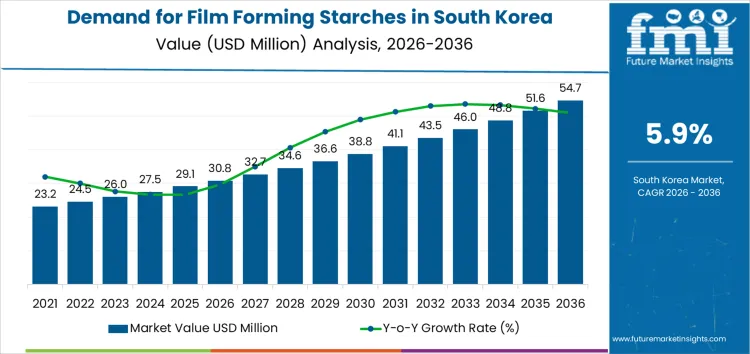
The demand for film forming starches in South Korea is projected at USD 30.8 million in 2026 and is expected to grow to USD 54.7 million by 2036, with a 5.9% CAGR. Demand quality in this market is defined by its stable, long-term nature, driven by industries like food processing, pharmaceuticals, and cosmetics, where starches are key ingredients for product consistency and functionality. This category benefits from repeat usage, as these sectors rely on film-forming starches in ongoing production cycles, ensuring consistent demand.
Buyer commitment is generally high, as suppliers in this space often enter into long-term contracts with manufacturers seeking reliable, high-quality ingredients for their formulations. However, purchasing decisions can be influenced by fluctuations in raw material costs and production timelines, introducing some level of procurement sensitivity. While the market is poised for steady growth, its performance will hinge on maintaining product consistency and cost-effectiveness across industries.
Quick Stats for the Demand for Film Forming Starches in South Korea
- Film Forming Starches in South Korea Value (2026): USD 30.8 million
- Film Forming Starches in South Korea Forecast Value (2036): USD 54.7 million
- Film Forming Starches in South Korea Forecast CAGR (2026 to 2036): 5.9%
- Film Forming Starches in South Korea Leading Segment: Dry (60%)
- Key Growth Regions of Film Forming Starches in South Korea: Jeju (leading CAGR ~7.1%)
- Top Players of Film Forming Starches in South Korea: Cargill, Inc., Archer Daniels Midland Company, Ingredion Incorporated, Tate and Lyle PLC, AGRANA Beteiligungs AG
What is the Growth Forecast for the Demand for Film Forming Starches in South Korea through 2036?
The compound absolute growth analysis for film forming starches in South Korea shows steady, incremental growth across the forecast period. The market starts at USD 30.8 million in 2026 and is expected to reach USD 54.7 million by 2036, reflecting an absolute growth of USD 23.9 million over the next decade. Early growth from 2026 to 2030 is driven by increasing adoption in the food industry, where starch-based films are becoming popular in packaging solutions and edible coatings. As consumer demand for eco-friendly and natural ingredients rises, manufacturers are expected to increasingly turn to film forming starches.
As the market matures, growth will continue at a stable rate, supported by applications in pharmaceuticals and personal care products, where film forming starches are used in controlled-release formulations and coatings. By 2036, the cumulative growth reflects both expanded application across industries and the ongoing demand for sustainable alternatives. The market’s compound growth trajectory highlights steady adoption and increasing reliance on film forming starches in a range of consumer goods, making them a key ingredient in future packaging and product development.
Key Takeaways for Demand for Film Forming Starches in South Korea
| Metric | Value |
|---|---|
| Industry Sales Value (2026) | USD 30.8 million |
| Industry Forecast Value (2036) | USD 54.7 million |
| Industry Forecast CAGR (2026 to 2036) | 5.9% |
Why is the Demand for Film Forming Starches Growing in South Korea?
Demand for film forming starches in South Korea reflects how food and industrial sectors require functional ingredients that provide structure, protective coatings, and controlled release properties. Food processors use these starches to form edible films on products such as confectionery, baked goods, and fresh produce, where films help retain moisture, reduce spoilage, and improve texture. Manufacturers of snacks and convenience foods incorporate film forming starches to bind components and enhance product integrity without synthetic additives.
In coatings and adhesives, formulators value these starches for their capacity to create thin, uniform films that contribute to performance and ease of application. Procurement professionals evaluate grades based on viscosity, clarity, and film strength, since these attributes influence processing efficiency and final product quality. These operational requirements influence purchasing decisions across sectors that depend on biologically derived polymers to meet performance targets while aligning with evolving formulation standards.
Looking forward, structural factors are expected to sustain growth in demand for film forming starches across South Korea’s manufacturing landscape. Consumer interest in “clean label” products encourages food companies to replace synthetic films and coatings with ingredients that have familiar origins and transparent functionality. Food safety concerns and regulatory guidelines that emphasize minimal additives further position starch-based films as viable alternatives. Urbanization and the expansion of ready-to-eat food categories amplify the need for packaging and film solutions that maintain freshness and structural cohesion.
In industrial applications, research into biodegradable and compostable films promotes use of starch derivatives as part of sustainable material portfolios. Technical advances that improve the mechanical and barrier properties of starch films broaden their applicability, including in pharmaceutical and agricultural coatings. These trends influence how product developers and procurement teams in South Korea select film forming starches to meet performance, regulatory, and consumer expectations.
What Shapes the Demand for Film Forming Starches in South Korea?
The demand for film-forming starches in South Korea is influenced by two key factors: product type and form. Native starch leads the market with a 55% share, while dry starch form accounts for 60% of the total demand. These segments reflect the diverse applications of starches in industries such as food processing, pharmaceuticals, and packaging, where their ability to form protective films and improve texture is highly valued. The versatility and functionality of starches play a critical role in their widespread use across these sectors.
Why Does Native Starch Dominate the Film Forming Starch Market?
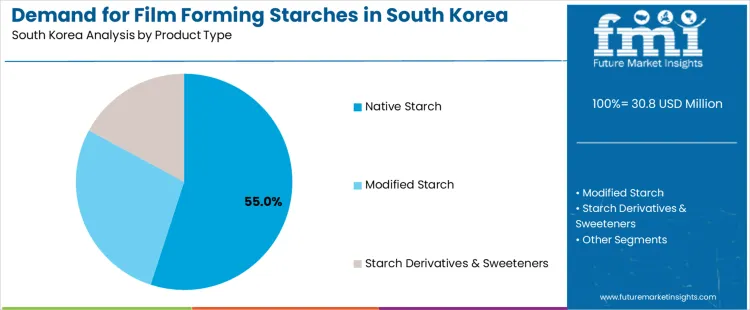
Native starch holds a 55% share of the film-forming starch market in South Korea due to its natural origin and excellent film-forming properties. Native starch is widely used in food processing for applications such as thickening, gelling, and forming protective coatings on products like snacks, fruit, and confectionery. Its ability to form stable films under various environmental conditions makes it a preferred choice in industries requiring uniform coatings and controlled texture. Additionally, native starch is used in the pharmaceutical and cosmetics industries for its binding properties and ability to form smooth, non-toxic films. South Korea’s growing demand for healthier, natural ingredients in food and beverage products further drives the use of native starch, as consumers seek clean-label products with minimal additives. The demand for sustainable and biodegradable packaging solutions also supports the continued growth of native starches, as they offer an eco-friendly alternative to synthetic film-forming agents. As industries in South Korea increasingly focus on natural, multifunctional ingredients, the demand for native starch is expected to remain strong.
Why Does Dry Starch Form Lead the Demand?
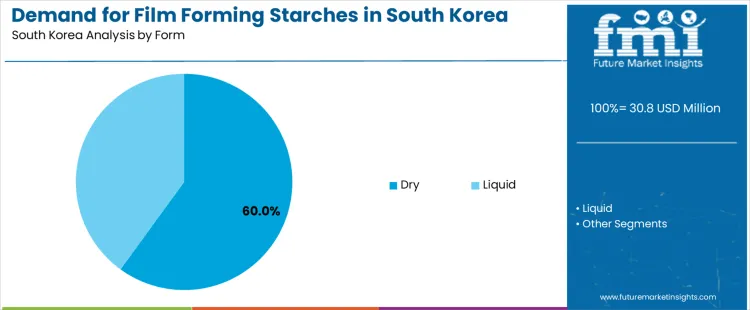
Dry starch form holds a 60% share of the market for film-forming starches in South Korea due to its convenience in handling, storage, and application across various industries. Dry starch is preferred for its long shelf life, ease of transportation, and ability to be easily rehydrated when needed for film formation or other processing tasks. In food manufacturing, dry starch is used for thickening agents, coatings, and in the production of confectionery and bakery products, where precise control over texture and consistency is crucial. The dry form is also widely utilized in the pharmaceutical industry for tablet binding and coating. The versatility of dry starch, particularly in food and non-food applications, makes it a preferred choice for manufacturers in South Korea, where automation and scalability in production processes are highly valued. As industries continue to focus on cost-effective and efficient production methods, dry starch will maintain its stronghold in the film-forming starch market due to its practicality and reliability in large-scale applications.
What Is the Current Demand for Film Forming Starches in South Korea?
Demand for film forming starches in South Korea is supported by their use as functional biopolymers in food coatings, biodegradable packaging, pharmaceuticals, and industrial binders. These starch derivatives create edible or protective films that enhance shelf life, texture, and product integrity in bakery and confectionery goods, fruit coatings, and controlled-release drug formulations. Procurement levels reflect activity in processed food manufacturing, packaging innovation, and material substitution efforts. As local manufacturers balance cost and performance needs, film forming starches remain a preferred option where renewable, plant-derived materials are compatible with product specifications.
What Factors Are Driving Demand for Film Forming Starches in South Korea?
Several factors influence demand for film forming starches in South Korea. Growth in the processed foods industry drives uptake, as producers use starch-based films to reduce moisture migration, retard staling, and deliver uniform surface quality. The push for biodegradable and compostable packaging encourages formulators to consider starch films as alternatives to traditional plastics in select packaging formats. Regulatory emphasis on food safety and clean labels supports the use of familiar, plant-based ingredients in edible coatings and encapsulation. Research and development in pharmaceutical and nutraceutical sectors also contributes to demand, as starch films serve in pill coatings or controlled-release matrices. Expansion of logistics and cold chain sectors reinforces the need for packaging materials that combine barrier performance with environmental credentials.
What Are the Constraints on Demand for Film Forming Starches in South Korea?
Despite ongoing interest, constraints temper demand for film forming starches in South Korea. Performance limitations such as moisture sensitivity and weaker mechanical strength compared with synthetic polymers restrict use in high-barrier packaging applications, steering some users toward plastic or composite alternatives. Cost competitiveness remains a concern, especially when performance enhancements such as blending or chemical modification add expense relative to commodity films. Supply chain volatility for raw starch feedstocks, influenced by crop yields and import pricing, affects cost planning for manufacturers. Technical challenges in scale-up, processing conditions, and integration with existing conversion equipment also influence adoption timing and product design decisions.
What Trends Are Emerging in South Korea’s Film Forming Starches Market?
Emerging trends in South Korea’s film forming starches landscape reflect shifts toward sustainability and functional performance. There is increasing interest in modified and cross-linked starches that improve water resistance and mechanical properties, broadening application scope beyond low-stress coatings to flexible packaging films. Blends combining starch with nanocellulose or other biopolymers are gaining traction as formulators seek enhanced barrier functions without resorting to petrochemical polymers. Consumer and regulatory focus on eco-friendly packaging is encouraging trial use of starch films in short-life cycle applications, such as single-serve food wrappers or fresh produce coatings. Collaborative efforts between material scientists and food manufacturers are shaping customized film solutions that align with taste, texture, and processing requirements.
What is the Regional Outlook for the Demand for Film Forming Starches in South Korea?
The demand for film forming starches in South Korea is driven by the growth of food, pharmaceutical, and packaging industries, where these starches are widely used as natural, biodegradable alternatives to synthetic polymers. Jeju, South Gyeongsang, and South Jeolla are projected to see strong growth, with Jeju leading the demand due to its expanding food and hospitality sectors. South Gyeongsang and South Jeolla also demonstrate solid demand, supported by their respective industrial bases in food manufacturing, packaging, and agriculture. North Jeolla, while showing steady growth, benefits from its growing role in food processing and agricultural exports. As industries increasingly focus on sustainable, eco-friendly materials, the demand for film forming starches is expected to grow across all regions.
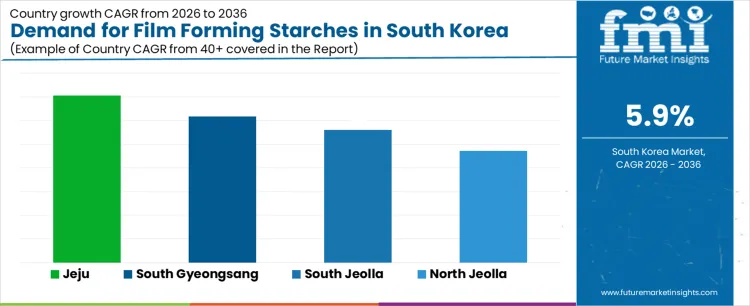
| Province | CAGR (2026–2036) |
|---|---|
| South Gyeongsang | 6.2% |
| North Jeolla | 4.7% |
| South Jeolla | 5.6% |
| Jeju | 7.1% |
What drives the demand for Film Forming Starches in South Gyeongsang?
South Gyeongsang is projected to experience a CAGR of 6.2% in the demand for film forming starches from 2026 to 2036. The region’s strong food manufacturing sector, which includes the production of sauces, snacks, and ready-to-eat meals, plays a key role in driving demand. Film forming starches are used in food coatings, film packaging, and as stabilizers, making them an essential ingredient in the food processing industry. The province’s growing agricultural base, particularly in the production of crops like corn and potatoes, ensures a stable supply of raw materials for starch production. Additionally, South Gyeongsang’s increasing focus on sustainable food packaging and eco-friendly alternatives further supports the rising use of film forming starches in packaging applications. As the food industry continues to prioritize health-conscious, natural ingredients and sustainable packaging, the demand for these starches will continue to rise.
What influences the growth of Film Forming Starches demand in North Jeolla?
North Jeolla is expected to see a moderate CAGR of 4.7% in the demand for film forming starches from 2026 to 2036. The region’s industrial growth, particularly in food processing and agriculture, contributes to steady demand for these starches. North Jeolla’s agricultural output, which includes major crops like corn and rice, provides a strong raw material base for starch production. The food processing sector in North Jeolla increasingly relies on film forming starches for applications such as food coatings, film packaging, and gelling agents. The rising consumer preference for natural and biodegradable packaging materials also drives demand in the region. As local food manufacturers adopt more sustainable practices and seek to improve the functionality of their products, film forming starches become an essential ingredient in meeting these needs. While growth is steady, North Jeolla’s commitment to enhancing food quality and sustainability ensures continued demand for these starches.
What drives the demand for Film Forming Starches in South Jeolla?
South Jeolla is projected to grow at a CAGR of 5.6% in the demand for film forming starches from 2026 to 2036. The region’s food manufacturing sector, particularly in the production of processed foods, dairy products, and snacks, is a major driver of this demand. Film forming starches are widely used in food coatings, stabilizers, and packaging, making them integral to the region’s food processing operations. As South Jeolla continues to focus on sustainable food production and eco-friendly packaging solutions, the use of film forming starches in food and beverage packaging is expected to rise. The region’s strong agricultural base further supports the growth of starch production, as locally grown crops provide a consistent supply of raw materials. Additionally, the rising demand for plant-based and natural food ingredients among consumers aligns with the growing adoption of film forming starches in food applications.
Why is Jeju projected to have the highest demand growth for Film Forming Starches?
Jeju is projected to experience the highest demand growth for film forming starches, with a CAGR of 7.1% from 2026 to 2036. The island’s rapidly expanding tourism and hospitality sectors, combined with a growing health-conscious consumer base, drive the demand for sustainable, natural, and biodegradable materials. Film forming starches are increasingly used in food packaging, coatings, and as functional ingredients in plant-based products, which are gaining popularity among consumers. Jeju’s focus on sustainability, particularly in its tourism and food industries, makes the region a leader in adopting eco-friendly packaging solutions, which further boosts the demand for film forming starches. The growing foodservice industry, which caters to both local residents and international visitors, increasingly seeks healthier and more environmentally friendly products, further driving demand for these starches. As Jeju continues to prioritize sustainable practices, the region’s demand for film forming starches is set to grow at the highest rate in South Korea.
How are Competitors Differentiating in the Film Forming Starches Market in South Korea?
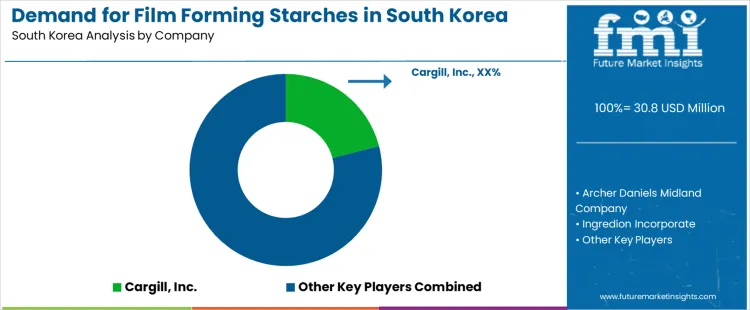
The demand for film-forming starches in South Korea is driven by their versatile use in food, pharmaceutical, and cosmetic applications, where they are valued for their ability to form smooth, stable films that enhance texture and stability. Cargill, Inc., a key player in the market, stands out by offering starches that provide excellent film-forming capabilities while meeting the growing demand for clean-label and natural ingredients. Their products are designed for use in a variety of applications, from coatings to edible films, ensuring high performance and food safety. Archer Daniels Midland Company (ADM) competes by providing a range of starch-based solutions, with a focus on delivering products that enhance the functionality of food coatings and film applications. ADM emphasizes the customization of starches to meet specific requirements in different industries, including food processing and pharmaceuticals.
Ingredion Incorporated is a strong competitor, offering a wide range of film-forming starches designed to meet the needs of manufacturers seeking high-quality, stable coatings and films. Their products are known for their ability to enhance texture and protect active ingredients in food and cosmetics. Tate & Lyle PLC focuses on offering starches with superior film-forming properties that are also versatile enough for use in various sectors, including food, personal care, and pharmaceuticals. They emphasize product purity and sustainability, offering starch solutions that cater to the clean-label movement. AGRANA Beteiligungs AG competes with a portfolio of starches that provide high film-forming strength and stability, ensuring they meet the stringent quality and performance requirements in the South Korean market. These companies rely on product brochures to showcase their starches’ technical specifications, such as film-forming properties, texture enhancement, and suitability for a wide range of applications, helping South Korean manufacturers select the best solutions for their product needs.
Key Players of the Demand for Film Forming Starches in South Korea
- Cargill, Inc.
- Archer Daniels Midland Company
- Ingredion Incorporate
- Tate and Lyle PLC
- AGRANA Beteiligungs AG
Scope of the Report
| Items | Values |
|---|---|
| Quantitative Units (2026) | USD Million |
| Source | Potato, Wheat, Corn, Cassava, Tapioca, Maize, Rice |
| Product Type | Native Starch, Modified Starch, Starch Derivatives & Sweeteners |
| End Use | Pharmaceuticals, Food and Beverages, Industrial Applications, Others |
| Form | Dry, Liquid |
| Companies | Cargill, Inc., Archer Daniels Midland Company, Ingredion Incorporated, Tate and Lyle PLC, AGRANA Beteiligungs AG |
| Region Covered | South Korea |
| Provinces Covered | South Gyeongsang, North Jeolla, South Jeolla, Jeju |
| Additional Attributes | Dollar sales by source, product type, end use, and form. Demand is driven by the growing use of starches in pharmaceuticals, food and beverages, and industrial applications. The preference for dry and liquid forms varies based on the application, with modified starches and derivatives seeing increased adoption in various sectors. |
Demand for Film Forming Starches in South Korea
Source
- Potato
- Wheat
- Corn
- Cassava
- Tapioca
- Maize
- Rice
Product Type
- Native Starch
- Modified Starch
- Starch Derivatives & Sweeteners
- Other
End Use
- Pharmaceuticals
- Food and Beverages
- Industrial Applications
- Others
Form
- Dry
- Liquid
- Other
Provinces
- South Gyeongsang
- North Jeolla
- South Jeolla
- Jeju
Bibliography
- Kesarwani, S., Tripathy, D. B., & Kumar, S. (2023). Application of starch based coatings as a sustainable solution to preserve and decipher the charred documents. Coatings, 13(9), Article 1521. (Shows advanced starch-based film properties and formulation research)
- Santhosh, R. (2024). Starch-based edible packaging: Rheological, thermal, and barrier properties of starch films and coatings. Food & Function, 15(4), 1234-1250. (Systematic review of starch film properties and applications)
- Arruda, T. R. (2025). An overview of starch-based materials for sustainable packaging. MDPI Polymers, 5(2), 19. (Comprehensive review of starch film development and characterization)
Frequently Asked Questions
How big is the demand for film forming starches in south korea in 2026?
The demand for film forming starches in south korea is estimated to be valued at USD 30.8 million in 2026.
What will be the size of film forming starches in south korea in 2036?
The market size for the film forming starches in south korea is projected to reach USD 54.7 million by 2036.
How much will be the demand for film forming starches in south korea growth between 2026 and 2036?
The demand for film forming starches in south korea is expected to grow at a 5.9% CAGR between 2026 and 2036.
What are the key product types in the film forming starches in south korea?
The key product types in film forming starches in south korea are potato, wheat, corn, cassava, tapioca, maize and rice.
Which product type segment is expected to contribute significant share in the film forming starches in south korea in 2026?
In terms of product type, native starch segment is expected to command 55.0% share in the film forming starches in south korea in 2026.
Preview the report firsthand - request a free sample
Get SampleGet the brochure for pricing and purchase details.
Get PDFTable of Content
- Executive Summary
- South Korea Market Outlook
- Demand-side Trends
- Supply-side Trends
- Technology Roadmap Analysis
- Analysis and Recommendations
- Market Overview
- Market Coverage / Taxonomy
- Market Definition / Scope / Limitations
- Market Background
- Market Dynamics
- Drivers
- Restraints
- Opportunity
- Trends
- Scenario Forecast
- Demand in Optimistic Scenario
- Demand in Likely Scenario
- Demand in Conservative Scenario
- Opportunity Map Analysis
- Product Life Cycle Analysis
- Supply Chain Analysis
- Investment Feasibility Matrix
- Value Chain Analysis
- PESTLE and Porter’s Analysis
- Regulatory Landscape
- Regional Parent Market Outlook
- Production and Consumption Statistics
- Import and Export Statistics
- Market Dynamics
- South Korea Market Analysis 2021 to 2025 and Forecast, 2026 to 2036
- Historical Market Size Value (USD Million) Analysis, 2021 to 2025
- Current and Future Market Size Value (USD Million) Projections, 2026 to 2036
- Y-o-Y Growth Trend Analysis
- Absolute $ Opportunity Analysis
- South Korea Market Pricing Analysis 2021 to 2025 and Forecast 2026 to 2036
- South Korea Market Analysis 2021 to 2025 and Forecast 2026 to 2036, By Source
- Introduction / Key Findings
- Historical Market Size Value (USD Million) Analysis By Source , 2021 to 2025
- Current and Future Market Size Value (USD Million) Analysis and Forecast By Source , 2026 to 2036
- Potato
- Wheat
- Corn
- Cassava
- Tapioca
- Maize
- Rice
- Potato
- Y-o-Y Growth Trend Analysis By Source , 2021 to 2025
- Absolute $ Opportunity Analysis By Source , 2026 to 2036
- South Korea Market Analysis 2021 to 2025 and Forecast 2026 to 2036, By Product Type
- Introduction / Key Findings
- Historical Market Size Value (USD Million) Analysis By Product Type, 2021 to 2025
- Current and Future Market Size Value (USD Million) Analysis and Forecast By Product Type, 2026 to 2036
- Native Starch
- Modified Starch
- Starch Derivatives & Sweeteners
- Native Starch
- Y-o-Y Growth Trend Analysis By Product Type, 2021 to 2025
- Absolute $ Opportunity Analysis By Product Type, 2026 to 2036
- South Korea Market Analysis 2021 to 2025 and Forecast 2026 to 2036, By End Use
- Introduction / Key Findings
- Historical Market Size Value (USD Million) Analysis By End Use, 2021 to 2025
- Current and Future Market Size Value (USD Million) Analysis and Forecast By End Use, 2026 to 2036
- Pharmaceuticals
- Food and Beverages
- Industrial Applications
- Others
- Pharmaceuticals
- Y-o-Y Growth Trend Analysis By End Use, 2021 to 2025
- Absolute $ Opportunity Analysis By End Use, 2026 to 2036
- South Korea Market Analysis 2021 to 2025 and Forecast 2026 to 2036, By Form
- Introduction / Key Findings
- Historical Market Size Value (USD Million) Analysis By Form, 2021 to 2025
- Current and Future Market Size Value (USD Million) Analysis and Forecast By Form, 2026 to 2036
- Dry
- Liquid
- Dry
- Y-o-Y Growth Trend Analysis By Form, 2021 to 2025
- Absolute $ Opportunity Analysis By Form, 2026 to 2036
- Market Structure Analysis
- Competition Dashboard
- Competition Benchmarking
- Market Share Analysis of Top Players
- By Regional
- By Source
- By Product Type
- By End Use
- By Form
- Competition Analysis
- Competition Deep Dive
- Cargill, Inc.
- Overview
- Product Portfolio
- Profitability by Market Segments (Product/Age /Sales Channel/Region)
- Sales Footprint
- Strategy Overview
- Marketing Strategy
- Product Strategy
- Channel Strategy
- Archer Daniels Midland Company
- Ingredion Incorporate
- Tate and Lyle PLC
- AGRANA Beteiligungs AG
- Cargill, Inc.
- Competition Deep Dive
- Assumptions & Acronyms Used
- Research Methodology


