

- Industry Size (2026)
- USD 3.2 Bn
- Forecast (2036)
- USD 9 Bn
- CAGR (2026 to 2036)
- 12.20%
Pediatric Non-invasive Wearables Market Forecast and Outlook 2026 to 2036
The pediatric non-invasive wearables market is valued at USD 3.2 billion in 2026 and is projected to reach USD 9 billion by 2036, expanding at a CAGR of 12.2% over the forecast period. From 2026 to 2036, market outcomes are increasingly defined by cost discipline and value capture rather than unit shipment growth alone. While component costs for sensors, connectivity modules, and pediatric-grade materials continue to normalize, margin concentration shifts toward companies that own proprietary signal processing, clinical-grade algorithms, and regulated data workflows.
Pricing control rests with players able to position devices as part of continuous monitoring systems rather than standalone hardware, allowing monetization through software access, analytics, and long-term service engagement. Firms embedded within hospital programs or trusted home-monitoring ecosystems retain stronger negotiating leverage and recurring revenue visibility. In contrast, vendors competing primarily on device volume face margin pressure as commoditization intensifies. Over the forecast period, value accrues to organizations that translate pediatric physiological data into clinically credible insights, maintain regulatory alignment, and secure durable caregiver trust, enabling sustained pricing resilience beyond hardware sales.
Quick Stats for Pediatric Non-Invasive Wearables Market
- Pediatric Non-Invasive Wearables Market Value (2026): USD 3.2 Billion
- Pediatric Non-Invasive Wearables Market Forecast Value (2036): USD 9 Billion
- Pediatric Non-Invasive Wearables Market Forecast CAGR 2026 to 2036: 12.20%
- Leading Monitoring Type in Pediatric Non-Invasive Wearables Market: Vitals & Temperature Wearables
- Leading Sales Channel in Pediatric Non-Invasive Wearables Market: D2C Brands & Online
- Key Growth Regions in Pediatric Non-Invasive Wearables Market: Asia Pacific, Middle East & Africa, Latin America
- Top Key Players in Pediatric Non-Invasive Wearables Market: Philips, Masimo, Withings, Fitbit (Google), Garmin, Owlet, Xiaomi, Apple, Samsung, iRhythm
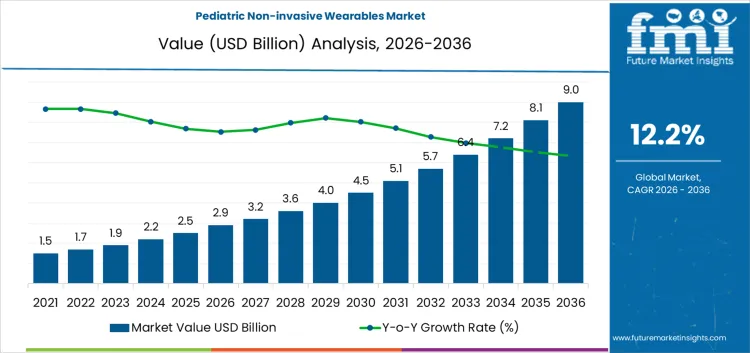
Pediatric Non-invasive Wearables Market Key Takeaways
| Metric | Value |
|---|---|
| Industry Value (2026) | USD 3.2 Billion |
| Forecast Value (2036) | USD 9 Billion |
| Forecast CAGR 2026 to 2036 | 12.20% |
How Is the Global Pediatric Non-invasive Wearables Market Advancing?
The global pediatric non-invasive wearables market is advancing rapidly, driven by increasing adoption of continuous health monitoring solutions designed specifically for children. These wearables are used to track vital parameters such as heart rate, oxygen saturation, temperature, activity levels, and sleep patterns without the need for invasive procedures. Their growing use spans hospitals, outpatient care, and home monitoring settings, supporting both clinical oversight and caregiver awareness.
A key driver supporting market growth is the rising focus on remote pediatric monitoring and early identification of health anomalies. Non-invasive wearable devices enable continuous data collection in real-world environments, reducing the need for frequent hospital visits while improving visibility into a child’s health status. This approach is particularly valuable for managing chronic pediatric conditions, post-discharge monitoring, and preventive care applications.
Technological advancements are further strengthening market expansion. Improvements in sensor accuracy, skin-friendly materials, and wireless connectivity are enhancing comfort and reliability for pediatric users. Integration with mobile applications and healthcare platforms allows caregivers and clinicians to access real-time alerts and long-term health trends. As pediatric healthcare increasingly adopts connected monitoring solutions that prioritize comfort and continuous insight, the pediatric non-invasive wearables market is expected to maintain strong growth over the forecast period.
What Is the Segment-Wise Overview of the Pediatric Non-Invasive Wearables Market?
The pediatric non-invasive wearables market is driven by continuous health monitoring needs and consumer-led purchasing behavior. Vitals and temperature wearables lead with a 34% share, reflecting strong demand for simple, comfortable devices that enable early detection of fever and basic physiological changes in children. These products are widely used for home monitoring and post-care observation. On the sales channel side, D2C brands and online platforms account for 44% of demand, supported by convenience, direct caregiver engagement, and integrated mobile health ecosystems. Parents increasingly favor online access for product information, updates, and home delivery.
Why Do Vitals & Temperature Wearables Lead the Pediatric Non-Invasive Wearables Market?
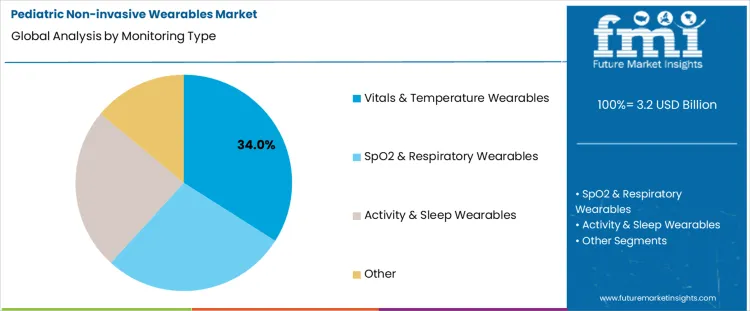
Vitals and temperature wearables account for 34% of the pediatric non-invasive wearables market due to their critical role in continuous health monitoring for children. These devices enable real-time tracking of body temperature, heart rate, and basic physiological indicators without causing discomfort, making them suitable for infants and young children. Parents and caregivers increasingly rely on these wearables for early detection of fever, infection risk, and abnormal vitals, particularly in home settings. Their ease of use, skin-friendly designs, and smartphone connectivity support frequent monitoring without clinical intervention. Healthcare providers also recognize their value for post-discharge observation and chronic condition management. As demand grows for preventive pediatric care and continuous, non-invasive monitoring solutions, vitals and temperature wearables remain the most widely adopted product category.
Why Do D2C Brands and Online Channels Dominate Sales in the Pediatric Non-Invasive Wearables Market?
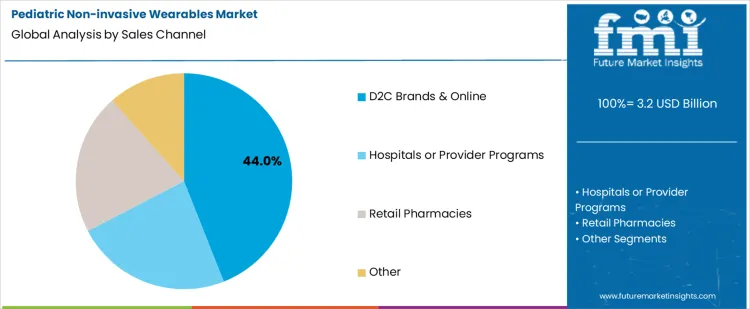
D2C brands and online channels represent 44% of total sales, making them the dominant distribution route in the pediatric non-invasive wearables market. Parents increasingly prefer online platforms due to convenience, product transparency, and access to detailed usage information and reviews. D2C models allow manufacturers to engage directly with caregivers, offering subscription services, software updates, and personalized health insights. Online sales channels also support faster product launches and broader geographic reach compared to traditional retail. Competitive pricing, bundled app ecosystems, and home delivery further strengthen adoption. As pediatric health monitoring shifts toward consumer-driven decision-making and home-based care, D2C and online channels continue to drive market penetration and product visibility.
What Are the Key Dynamics for the Pediatric Non-invasive Wearables Market?
The pediatric non-invasive wearables market is driven by increasing emphasis on continuous health monitoring for infants and children without the need for invasive procedures. Pediatric non-invasive wearables include devices that track vital signs such as heart rate, respiratory rate, oxygen saturation, temperature, and activity levels through sensors worn on the body. Key market dynamics include rising prevalence of pediatric health conditions that benefit from regular monitoring, growing awareness among caregivers about early detection of anomalies, and adoption of convenient, child-friendly monitoring technologies. Technological advancements enabling miniaturized, wireless, and comfortable wearable devices have further stimulated market growth.
Why Is the Pediatric Non-invasive Wearables Market Growing?
The pediatric non-invasive wearables market is growing as healthcare providers and parents increasingly prefer non-invasive monitoring solutions that improve patient comfort and reduce clinical visits. Rising incidence of chronic pediatric conditions such as asthma, congenital heart disease, and sleep disorders has amplified the need for continuous and remote health tracking. Improvements in sensor technologies, Bluetooth connectivity, and integration with mobile applications allow real-time data transmission and remote clinician access, enhancing care coordination. The expansion of telehealth services and home health monitoring frameworks supports the adoption of wearable health tracking devices for children.
How Are the Key Drivers Shaping the Pediatric Non-invasive Wearables Market?
Key drivers shaping the pediatric non-invasive wearables market include ongoing innovation in wearable sensors and flexible electronics that improve device accuracy, comfort, and battery life. Increased healthcare digitization and connectivity infrastructure enable seamless data sharing between caregivers, patients, and healthcare providers. Parents and caregivers are becoming more health-aware and tech-savvy, encouraging use of pediatric wearables for preventive health tracking and early intervention. Integration with electronic health records (EHRs) and clinical decision-support systems enhances the utility of wearable data in clinical settings. Partnerships between device manufacturers, healthcare institutions, and pediatric specialists are accelerating product development and adoption.
What Is the Growth Outlook for the Pediatric Non-Invasive Wearables Market by Country?
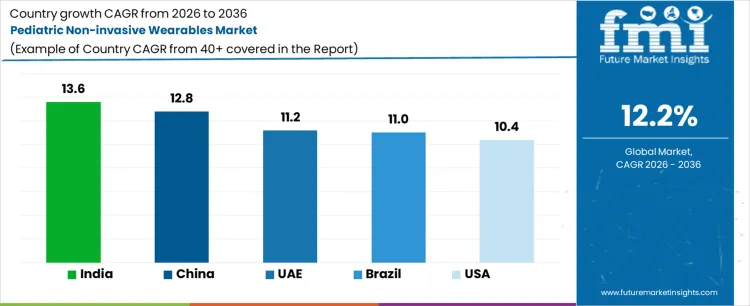
| Country | CAGR (%) |
|---|---|
| India | 13.6% |
| China | 12.8% |
| UAE | 11.2% |
| Brazil | 11.0% |
| USA | 10.4% |
The pediatric non-invasive wearables market is expanding rapidly as healthcare systems adopt continuous and child-friendly monitoring solutions. India leads at 13.6%, driven by digital health expansion and rising pediatric care awareness. China follows at 12.8%, supported by smart healthcare investments and strong device manufacturing. The UAE grows at 11.2%, benefiting from advanced healthcare infrastructure and digital adoption. Brazil expands at 11.0%, driven by telehealth growth and improving access to pediatric monitoring. The USA grows at 10.4%, supported by technological innovation and strong clinical adoption.
What Is Driving the Growth of the Pediatric Non-Invasive Wearables Market in India?
The pediatric non-invasive wearables market in India is growing at a CAGR of 13.6%, driven by rising adoption of digital health technologies in pediatric care. Increasing prevalence of pediatric respiratory conditions, cardiac monitoring needs, and post-treatment observation is supporting demand for continuous, non-invasive monitoring solutions. Expansion of private pediatric hospitals and growing availability of wearable-enabled remote monitoring platforms are improving access to these devices. Parents are increasingly preferring non-invasive wearables due to comfort, safety, and ease of long-term use. Government initiatives focused on child health digitization and telemedicine are also supporting adoption. Falling device costs and smartphone penetration further enable integration of wearables into routine care. As awareness of early detection and continuous monitoring improves, demand for pediatric non-invasive wearables in India is expected to grow rapidly.
How Is the Pediatric Non-Invasive Wearables Market Expanding in China?
The pediatric non-invasive wearables market in China is expanding at a CAGR of 12.8%, supported by strong investment in digital healthcare and smart medical devices. Hospitals and pediatric care centers are increasingly deploying wearable monitoring solutions for heart rate, oxygen saturation, sleep patterns, and activity tracking. Rising incidence of chronic pediatric conditions and growing focus on preventive care are encouraging continuous monitoring outside hospital settings. China’s strong electronics manufacturing ecosystem enables rapid development and commercialization of pediatric-specific wearable devices. Integration with mobile health platforms and hospital information systems is further improving clinical usability. Government support for healthcare digitalization and remote patient monitoring is also strengthening adoption. As pediatric healthcare shifts toward data-driven and home-based monitoring models, demand for non-invasive wearable devices is expected to grow steadily in China.
What Is Supporting Growth of the Pediatric Non-Invasive Wearables Market in the UAE?
The pediatric non-invasive wearables market in the UAE is growing at a CAGR of 11.2%, driven by advanced healthcare infrastructure and strong adoption of digital health technologies. Pediatric hospitals and specialty clinics are increasingly integrating wearable monitoring devices to enhance patient observation and reduce hospital stays. High healthcare spending and focus on premium care quality support adoption of advanced non-invasive solutions. Wearables are particularly valued for managing chronic pediatric conditions and post-surgical monitoring in home settings. Government-led digital health initiatives and smart healthcare strategies further support market growth. High smartphone penetration and connectivity enable seamless integration of wearable data into clinical workflows. As the UAE continues to emphasize technology-driven healthcare delivery, demand for pediatric non-invasive wearables is expected to rise steadily.
How Is the Pediatric Non-Invasive Wearables Market Developing in Brazil?
The pediatric non-invasive wearables market in Brazil is expanding at a CAGR of 11.0%, supported by growing awareness of remote monitoring and improving access to pediatric healthcare services. Increasing adoption of wearable devices in private hospitals and clinics is driving early market growth. Pediatric wearables help monitor vital signs and chronic conditions without invasive procedures, improving comfort and compliance. Expansion of telehealth services is also encouraging integration of wearable monitoring into outpatient care. Public healthcare initiatives aimed at improving child health outcomes are indirectly supporting demand. While cost sensitivity remains a factor, availability of affordable wearable solutions is improving adoption. As digital health penetration increases and pediatric care models evolve, demand for non-invasive wearable devices in Brazil is expected to grow steadily.
How Is the Pediatric Non-Invasive Wearables Market Expanding in the USA?
The Pediatric Non-Invasive Wearables Market in the USA is growing at a CAGR of 10.4%, driven by advanced healthcare systems and strong adoption of connected medical devices. Pediatric hospitals and home-care providers increasingly use wearables for continuous monitoring of vital signs, sleep, and activity levels. Rising focus on preventive care, early diagnosis, and post-discharge monitoring is supporting demand. Technological advancements, including wireless sensors and cloud-based analytics, are improving device accuracy and usability. Strong reimbursement frameworks and regulatory clarity further support adoption. Parents are increasingly comfortable using wearables for long-term monitoring due to safety and convenience. As digital pediatric care continues to expand, demand for non-invasive wearable monitoring devices in the USA is expected to remain strong.
How Are Companies Competing in the Pediatric Non-Invasive Wearables Market?
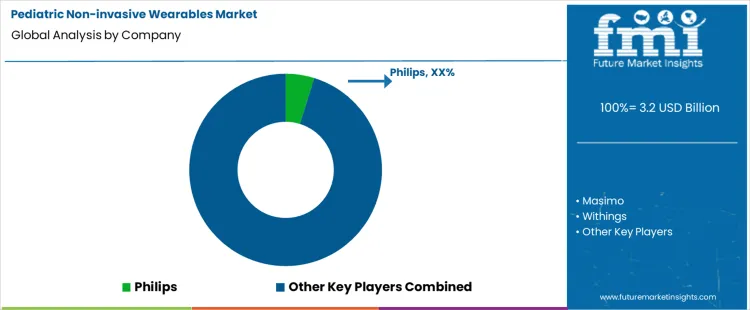
Competition in the pediatric non-invasive wearables market is shaped by measurement accuracy, child-safe design, comfort, and the ability to translate continuous physiological data into actionable insights for parents and clinicians. Pediatric wearables must operate reliably on small bodies with frequent motion while maintaining soft materials, secure fit, and low power consumption. Vendors differentiate through sensor miniaturization, advanced algorithms for motion artifact reduction, and mobile platforms that present health insights in an intuitive, caregiver-friendly format.
Philips, Masimo, iRhythm, and Owlet compete strongly in clinically oriented monitoring solutions. Philips leverages its medical-grade sensing and analytics to extend continuous monitoring capabilities into pediatric and home-care settings. Masimo differentiates through high-accuracy non-invasive sensors and signal processing technologies optimized for low perfusion and motion, supporting reliable pediatric measurements. iRhythm focuses on wearable cardiac rhythm monitoring, emphasizing extended wear periods and clinically validated data for pediatric arrhythmia detection. Owlet positions around infant and toddler monitoring, combining soft wearable designs with real-time alerts that support at-home monitoring and parental reassurance.
Withings, Fitbit (Google), Garmin, Apple, Samsung, and Xiaomi compete by adapting consumer wearable ecosystems to pediatric use cases. These companies emphasize sleek form factors, long battery life, and integration with smartphone platforms, enabling activity tracking, heart rate monitoring, and sleep insights tailored for children and adolescents. Apple and Samsung differentiate through ecosystem integration and advanced health sensors, while Fitbit, Garmin, and Withings focus on wellness tracking, durability, and ease of use. Xiaomi competes on affordability and wide market reach. Across the market, competitive advantage is defined by sensor reliability, child-centric design, data interpretation quality, regulatory alignment, and trust among parents, clinicians, and healthcare providers.
Key Players in Pediatric Non-invasive Wearables Market
- Philips
- Masimo
- Withings
- Fitbit (Google)
- Garmin
- Owlet
- Xiaomi
- Apple
- Samsung
- iRhythm
Scope of Report
| Attributes | Description |
|---|---|
| Quantitative Unit (2026) | USD Billion |
| Monitoring Type | Vitals & Temperature Wearables, SpO2 & Respiratory Wearables, Activity & Sleep Wearables, Other |
| Sales Channel | D2C Brands & Online, Hospitals or Provider Programs, Retail Pharmacies, Other |
| Regions Covered | Asia Pacific, Europe, North America, Latin America, Middle East & Africa |
| Countries Covered | China, Japan, South Korea, India, Australia & New Zealand, ASEAN, Rest of Asia Pacific, Germany, United Kingdom, France, Italy, Spain, Nordic, BENELUX, Rest of Europe, United States, Canada, Mexico, Brazil, Chile, Rest of Latin America, Kingdom of Saudi Arabia, Other GCC Countries, Turkey, South Africa, Other African Union, Rest of Middle East & Africa |
| Key Companies Profiled | Philips, Masimo, Withings, Fitbit (Google), Garmin, Owlet, Xiaomi, Apple, Samsung, iRhythm |
| Additional Attributes | Dollar sales by monitoring type and sales channel; regional market size and forecast analysis; growth outlook across major regions; adoption trends for pediatric non-invasive wearable monitoring solutions; assessment of device comfort, data accuracy, connectivity features, and demand patterns across consumer, clinical, and retail distribution channels. |
Pediatric Non-invasive Wearables Market by Key Segments
Monitoring Type
- Vitals & Temperature Wearables
- SpO2 & Respiratory Wearables
- Activity & Sleep Wearables
- Other
Sales Channel
- D2C Brands & Online
- Hospitals or Provider Programs
- Retail Pharmacies
- Other
Region
- Asia Pacific
- China
- Japan
- South Korea
- India
- Australia & New Zealand
- ASEAN
- Rest of Asia Pacific
- Europe
- Germany
- United Kingdom
- France
- Italy
- Spain
- Nordic
- BENELUX
- Rest of Europe
- North America
- United States
- Canada
- Mexico
- Latin America
- Brazil
- Chile
- Rest of Latin America
- Middle East & Africa
- Kingdom of Saudi Arabia
- Other GCC Countries
- Turkey
- South Africa
- Other African Union
- Rest of Middle East & Africa
Bibliography
- USA Food & Drug Administration (FDA). De Novo Classification Request: Dream Sock (DEN220091). Decision date: 08 Nov 2023.
- USA Food & Drug Administration (FDA). Decision Summary: Dream Sock (DEN220091). (2023 record).
- iRhythm Technologies, Inc. Form 10-K (Fiscal Year Ended 31 Dec 2023). Filed: 2024. Source: USA SEC EDGAR
- Koninklijke Philips N.V. Philips Second-Quarter Results 2024-Report (PDF). Published: 29 Jul 2024.
- Magsayo, C. et al. Non-Invasive Wearables in Pediatric Healthcare: A Comprehensive Review. Published: 2025.
Frequently Asked Questions
How big is the pediatric non-invasive wearables market in 2026?
The global pediatric non-invasive wearables market is estimated to be valued at USD 3.2 billion in 2026.
What will be the size of pediatric non-invasive wearables market in 2036?
The market size for the pediatric non-invasive wearables market is projected to reach USD 10.1 billion by 2036.
How much will be the pediatric non-invasive wearables market growth between 2026 and 2036?
The pediatric non-invasive wearables market is expected to grow at a 12.2% CAGR between 2026 and 2036.
What are the key product types in the pediatric non-invasive wearables market?
The key product types in pediatric non-invasive wearables market are vitals & temperature wearables, spo2 & respiratory wearables, activity & sleep wearables and other.
Which sales channel segment to contribute significant share in the pediatric non-invasive wearables market in 2026?
In terms of sales channel, d2c brands & online segment to command 44.0% share in the pediatric non-invasive wearables market in 2026.
Preview the report firsthand - request a free sample
Get SampleGet the brochure for pricing and purchase details.
Get PDFTable of Content
- Executive Summary
- Global Market Outlook
- Demand-side Trends
- Supply-side Trends
- Technology Roadmap Analysis
- Analysis and Recommendations
- Market Overview
- Market Coverage / Taxonomy
- Market Definition / Scope / Limitations
- Market Background
- Market Dynamics
- Drivers
- Restraints
- Opportunity
- Trends
- Scenario Forecast
- Demand in Optimistic Scenario
- Demand in Likely Scenario
- Demand in Conservative Scenario
- Opportunity Map Analysis
- Product Life Cycle Analysis
- Supply Chain Analysis
- Investment Feasibility Matrix
- Value Chain Analysis
- PESTLE and Porter’s Analysis
- Regulatory Landscape
- Regional Parent Market Outlook
- Production and Consumption Statistics
- Import and Export Statistics
- Market Dynamics
- Global Market Analysis 2021 to 2025 and Forecast, 2026 to 2036
- Historical Market Size Value (USD Million) Analysis, 2021 to 2025
- Current and Future Market Size Value (USD Million) Projections, 2026 to 2036
- Y-o-Y Growth Trend Analysis
- Absolute $ Opportunity Analysis
- Global Market Pricing Analysis 2021 to 2025 and Forecast 2026 to 2036
- Global Market Analysis 2021 to 2025 and Forecast 2026 to 2036, By Monitoring Type
- Introduction / Key Findings
- Historical Market Size Value (USD Million) Analysis By Monitoring Type , 2021 to 2025
- Current and Future Market Size Value (USD Million) Analysis and Forecast By Monitoring Type , 2026 to 2036
- Vitals & Temperature Wearables
- SpO2 & Respiratory Wearables
- Activity & Sleep Wearables
- Other
- Vitals & Temperature Wearables
- Y-o-Y Growth Trend Analysis By Monitoring Type , 2021 to 2025
- Absolute $ Opportunity Analysis By Monitoring Type , 2026 to 2036
- Global Market Analysis 2021 to 2025 and Forecast 2026 to 2036, By Sales Channel
- Introduction / Key Findings
- Historical Market Size Value (USD Million) Analysis By Sales Channel, 2021 to 2025
- Current and Future Market Size Value (USD Million) Analysis and Forecast By Sales Channel, 2026 to 2036
- D2C Brands & Online
- Hospitals or Provider Programs
- Retail Pharmacies
- Other
- D2C Brands & Online
- Y-o-Y Growth Trend Analysis By Sales Channel, 2021 to 2025
- Absolute $ Opportunity Analysis By Sales Channel, 2026 to 2036
- Global Market Analysis 2021 to 2025 and Forecast 2026 to 2036, By Region
- Introduction
- Historical Market Size Value (USD Million) Analysis By Region, 2021 to 2025
- Current Market Size Value (USD Million) Analysis and Forecast By Region, 2026 to 2036
- North America
- Latin America
- Western Europe
- Eastern Europe
- East Asia
- South Asia and Pacific
- Middle East & Africa
- Market Attractiveness Analysis By Region
- North America Market Analysis 2021 to 2025 and Forecast 2026 to 2036, By Country
- Historical Market Size Value (USD Million) Trend Analysis By Market Taxonomy, 2021 to 2025
- Market Size Value (USD Million) Forecast By Market Taxonomy, 2026 to 2036
- By Country
- USA
- Canada
- Mexico
- By Monitoring Type
- By Sales Channel
- By Country
- Market Attractiveness Analysis
- By Country
- By Monitoring Type
- By Sales Channel
- Key Takeaways
- Latin America Market Analysis 2021 to 2025 and Forecast 2026 to 2036, By Country
- Historical Market Size Value (USD Million) Trend Analysis By Market Taxonomy, 2021 to 2025
- Market Size Value (USD Million) Forecast By Market Taxonomy, 2026 to 2036
- By Country
- Brazil
- Chile
- Rest of Latin America
- By Monitoring Type
- By Sales Channel
- By Country
- Market Attractiveness Analysis
- By Country
- By Monitoring Type
- By Sales Channel
- Key Takeaways
- Western Europe Market Analysis 2021 to 2025 and Forecast 2026 to 2036, By Country
- Historical Market Size Value (USD Million) Trend Analysis By Market Taxonomy, 2021 to 2025
- Market Size Value (USD Million) Forecast By Market Taxonomy, 2026 to 2036
- By Country
- Germany
- UK
- Italy
- Spain
- France
- Nordic
- BENELUX
- Rest of Western Europe
- By Monitoring Type
- By Sales Channel
- By Country
- Market Attractiveness Analysis
- By Country
- By Monitoring Type
- By Sales Channel
- Key Takeaways
- Eastern Europe Market Analysis 2021 to 2025 and Forecast 2026 to 2036, By Country
- Historical Market Size Value (USD Million) Trend Analysis By Market Taxonomy, 2021 to 2025
- Market Size Value (USD Million) Forecast By Market Taxonomy, 2026 to 2036
- By Country
- Russia
- Poland
- Hungary
- Balkan & Baltic
- Rest of Eastern Europe
- By Monitoring Type
- By Sales Channel
- By Country
- Market Attractiveness Analysis
- By Country
- By Monitoring Type
- By Sales Channel
- Key Takeaways
- East Asia Market Analysis 2021 to 2025 and Forecast 2026 to 2036, By Country
- Historical Market Size Value (USD Million) Trend Analysis By Market Taxonomy, 2021 to 2025
- Market Size Value (USD Million) Forecast By Market Taxonomy, 2026 to 2036
- By Country
- China
- Japan
- South Korea
- By Monitoring Type
- By Sales Channel
- By Country
- Market Attractiveness Analysis
- By Country
- By Monitoring Type
- By Sales Channel
- Key Takeaways
- South Asia and Pacific Market Analysis 2021 to 2025 and Forecast 2026 to 2036, By Country
- Historical Market Size Value (USD Million) Trend Analysis By Market Taxonomy, 2021 to 2025
- Market Size Value (USD Million) Forecast By Market Taxonomy, 2026 to 2036
- By Country
- India
- ASEAN
- Australia & New Zealand
- Rest of South Asia and Pacific
- By Monitoring Type
- By Sales Channel
- By Country
- Market Attractiveness Analysis
- By Country
- By Monitoring Type
- By Sales Channel
- Key Takeaways
- Middle East & Africa Market Analysis 2021 to 2025 and Forecast 2026 to 2036, By Country
- Historical Market Size Value (USD Million) Trend Analysis By Market Taxonomy, 2021 to 2025
- Market Size Value (USD Million) Forecast By Market Taxonomy, 2026 to 2036
- By Country
- Kingdom of Saudi Arabia
- Other GCC Countries
- Turkiye
- South Africa
- Other African Union
- Rest of Middle East & Africa
- By Monitoring Type
- By Sales Channel
- By Country
- Market Attractiveness Analysis
- By Country
- By Monitoring Type
- By Sales Channel
- Key Takeaways
- Key Countries Market Analysis
- USA
- Pricing Analysis
- Market Share Analysis, 2025
- By Monitoring Type
- By Sales Channel
- Canada
- Pricing Analysis
- Market Share Analysis, 2025
- By Monitoring Type
- By Sales Channel
- Mexico
- Pricing Analysis
- Market Share Analysis, 2025
- By Monitoring Type
- By Sales Channel
- Brazil
- Pricing Analysis
- Market Share Analysis, 2025
- By Monitoring Type
- By Sales Channel
- Chile
- Pricing Analysis
- Market Share Analysis, 2025
- By Monitoring Type
- By Sales Channel
- Germany
- Pricing Analysis
- Market Share Analysis, 2025
- By Monitoring Type
- By Sales Channel
- UK
- Pricing Analysis
- Market Share Analysis, 2025
- By Monitoring Type
- By Sales Channel
- Italy
- Pricing Analysis
- Market Share Analysis, 2025
- By Monitoring Type
- By Sales Channel
- Spain
- Pricing Analysis
- Market Share Analysis, 2025
- By Monitoring Type
- By Sales Channel
- France
- Pricing Analysis
- Market Share Analysis, 2025
- By Monitoring Type
- By Sales Channel
- India
- Pricing Analysis
- Market Share Analysis, 2025
- By Monitoring Type
- By Sales Channel
- ASEAN
- Pricing Analysis
- Market Share Analysis, 2025
- By Monitoring Type
- By Sales Channel
- Australia & New Zealand
- Pricing Analysis
- Market Share Analysis, 2025
- By Monitoring Type
- By Sales Channel
- China
- Pricing Analysis
- Market Share Analysis, 2025
- By Monitoring Type
- By Sales Channel
- Japan
- Pricing Analysis
- Market Share Analysis, 2025
- By Monitoring Type
- By Sales Channel
- South Korea
- Pricing Analysis
- Market Share Analysis, 2025
- By Monitoring Type
- By Sales Channel
- Russia
- Pricing Analysis
- Market Share Analysis, 2025
- By Monitoring Type
- By Sales Channel
- Poland
- Pricing Analysis
- Market Share Analysis, 2025
- By Monitoring Type
- By Sales Channel
- Hungary
- Pricing Analysis
- Market Share Analysis, 2025
- By Monitoring Type
- By Sales Channel
- Kingdom of Saudi Arabia
- Pricing Analysis
- Market Share Analysis, 2025
- By Monitoring Type
- By Sales Channel
- Turkiye
- Pricing Analysis
- Market Share Analysis, 2025
- By Monitoring Type
- By Sales Channel
- South Africa
- Pricing Analysis
- Market Share Analysis, 2025
- By Monitoring Type
- By Sales Channel
- USA
- Market Structure Analysis
- Competition Dashboard
- Competition Benchmarking
- Market Share Analysis of Top Players
- By Regional
- By Monitoring Type
- By Sales Channel
- Competition Analysis
- Competition Deep Dive
- Philips
- Overview
- Product Portfolio
- Profitability by Market Segments (Product/Age /Sales Channel/Region)
- Sales Footprint
- Strategy Overview
- Marketing Strategy
- Product Strategy
- Channel Strategy
- Masimo
- Withings
- Fitbit (Google)
- Garmin
- Owlet
- Xiaomi
- Apple
- Samsung
- iRhythm
- Philips
- Competition Deep Dive
- Assumptions & Acronyms Used
- Research Methodology


