


Pharma Grade Synthetic Camphor Market
The pharma grade synthetic camphor market is segmented by Formulation Type, covering Topical and Inhalation. Application coverage includes Respiratory Disorders and Muscular Rheumatism across the forecast scope. Further application coverage includes Counterirritant and Antipruritic and other therapeutic uses. Distribution Channel coverage includes Conventional B2B and Online B2B channels. Forecast for the market covers the period from 2026 to 2036.
Pharma Grade Synthetic Camphor Market Size, Market Forecast and Outlook By FMI
The pharma grade synthetic camphor market is expected to increase from USD 484.1 million in 2026 to USD 703.0 million by 2036. The market is anticipated to register a 3.8% CAGR during the forecast period. Topical formulations are likely to lead with 73% share in 2026. Respiratory disorder treatments are projected to account for 27% of application demand in 2026.
Summary of the Pharma Grade Synthetic Camphor Market
- Demand and Growth Drivers
- Pharmaceutical manufacturers are expected to use synthetic camphor in pain relief balms and inhalants.
- Topical ointments and respiratory care products are likely to strengthen ingredient demand across healthcare formulations.
- Demand is likely to rise as buyers prefer consistent purity and stable availability.
- Documented quality is expected to influence sourcing decisions for pharmaceutical-grade ingredients.
- Over-the-counter healthcare use is anticipated to increase adoption across self-care products.
- Congestion relief and localized pain management are likely to strengthen routine consumer use.
- Product and Segment View
- Topical formulations are expected to lead the formulation type segment through strong use in creams and ointments.
- Balms and gels are likely to widen formulation demand across pain relief applications.
- Respiratory disorder treatments are likely to retain strong demand through vapor rubs and inhalants.
- Topical decongestant products are expected to sustain application use across self-care routines.
- Conventional B2B channels are anticipated to account for major purchasing activity through tenders and direct procurement.
- Wholesalers and distributors are likely to remain important for pharmaceutical ingredient supply access.
- Geography and Competitive Outlook
- India is expected to lead country-level expansion as pharmaceutical manufacturing scale increases synthetic camphor consumption.
- Export demand is likely to strengthen India’s role in regulated pharmaceutical ingredient supply.
- China is likely to record steady demand backed by large-scale production capacity.
- Rising healthcare product consumption is expected to keep China important for synthetic camphor use.
- Companies with stronger quality systems are anticipated to gain preference among pharmaceutical buyers.
- Reliable documentation and controlled synthesis processes are likely to strengthen supplier selection.
- Analyst Opinion
- Sabyasachi Ghosh, Principal Consultant for Healthcare at FMI, suggests, “The pharma grade synthetic camphor market is likely to favor suppliers able to deliver purity consistency. Reliable regulatory documentation is expected to strengthen buyer confidence across pharmaceutical sourcing decisions. Pharmaceutical buyers are expected to prioritize manufacturers with stable production systems. Stronger quality controls are likely to improve supplier preference across topical and respiratory formulations.”
- Pharma Grade Synthetic Camphor Market Value Analysis
- The pharma grade synthetic camphor market is moving into a quality-sensitive pharmaceutical supply opportunity.
- Ingredient demand is expected to rise across topical pain relief and respiratory formulations.
- Regulated production environments are likely to increase the need for consistent purity.
- Adoption is likely to gain traction as synthetic camphor offers stable supply.
- Natural alternatives may face sourcing pressure across some healthcare formulation requirements.
- Spending is anticipated to be backed by pharmaceutical manufacturing expansion and self-care product use.
- Stronger quality expectations are expected to influence supplier selection across major markets.
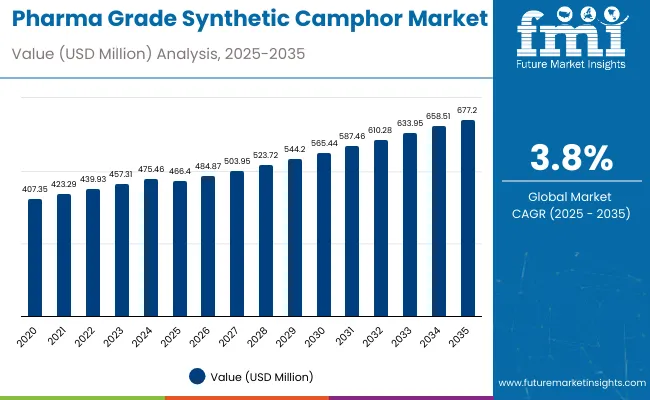
Pharma Grade Synthetic Camphor Market Key Takeaways
| Metric | Value |
|---|---|
| Market Value (2026) | USD 484.1 million |
| Market Forecast Value (2036) | USD 703.0 million |
| Forecast CAGR (2026-2036) | 3.8% |
How Are the Segments Classified in the Pharma Grade Synthetic Camphor Market?
The pharma grade synthetic camphor market is segmented based on formulation type, application, distribution channel, and region. By formulation type, the industry is divided into topical and inhalation forms. Based on application, demand is categorized into respiratory disorders, muscular rheumatism, counterirritant and antipruritic uses, and other applications such as pain relief, skin care, and miscellaneous therapeutic uses. In terms of distribution channel, the industry includes conventional B2B channels such as tenders, direct procurement, and wholesalers and distributors, as well as online B2B channels through internal and external platforms. Regionally, the industry spans North America, Latin America, Western Europe, Eastern Europe, South Asia and Pacific, East Asia, and the Middle East and Africa.
Which Formulation Type Accounts for the Largest Share of Global Demand?
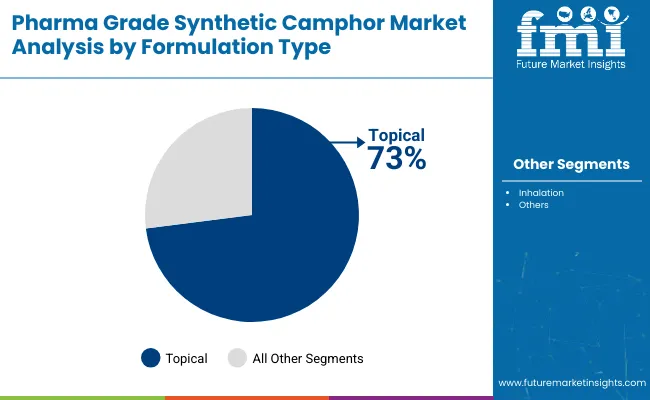
Topical formulations account for around 73% of global demand, making them the dominant formulation type in the pharma grade synthetic camphor market in 2026. This leadership is driven by the widespread use of synthetic camphor in creams, ointments, balms, and gels designed for pain relief, muscle relaxation, and anti-inflammatory support. Camphor’s ability to penetrate the skin and act as a counterirritant enhances blood circulation and provides a cooling sensation, making it highly effective for conditions such as arthritis, sprains, back pain, and muscular fatigue. Its antiseptic and antipruritic properties further expand its use in dermatological products for skin irritation, rashes, and insect bites. Growing consumer preference for over-the-counter, non-invasive, and fast-acting topical therapies continues to reinforce the dominance of this segment across developed and emerging markets.
Which Application Segment Represents the Largest Share of Global Demand?
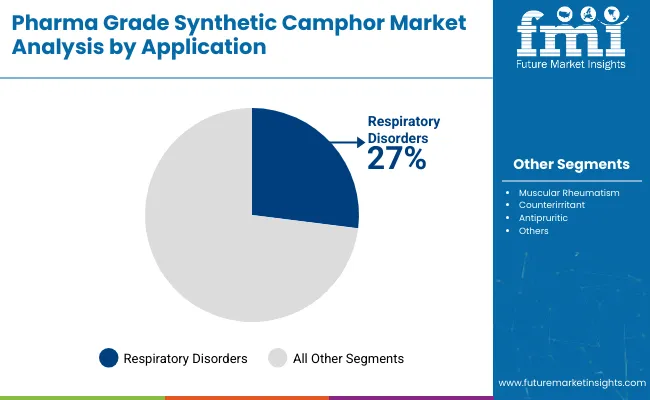
Respiratory disorders represent the largest application segment, accounting for approximately 27% of market demand in 2026. Synthetic camphor is widely used in inhalants, vapor rubs, and topical decongestants to relieve symptoms associated with coughs, colds, nasal congestion, bronchitis, and asthma. Its ability to open airways and provide rapid symptomatic relief supports strong adoption in both prescription and OTC respiratory products. Rising incidence of respiratory conditions linked to pollution, allergies, and seasonal infections has further increased demand. In addition, strong consumer acceptance of camphor-based remedies in self-care routines, particularly across North America, Europe, and Asia Pacific, continues to support steady growth of this application segment.
What Are the Key Dynamics in the Pharma Grade Synthetic Camphor Market?
The pharma grade synthetic camphor market is driven by steady demand from pharmaceutical manufacturers that rely on camphor for a variety of therapeutic applications. It is widely used in topical pain relief products, medicated balms, inhalers, and cold and cough formulations, where high purity and predictable performance are essential. Synthetic camphor offers manufacturers a reliable substitute for natural camphor, ensuring consistent availability, uniform quality, and easier adherence to regulatory standards. Rising consumer preference for non opioid pain management options and convenient over the counter healthcare solutions continues to support sustained demand for pharma grade synthetic camphor.
How Are Therapeutic Uses and Healthcare Trends Shaping Demand?
Topical applications remain the main area of use, as camphor is valued for its cooling and counterirritant effects in products aimed at relieving muscle pain, joint discomfort, and minor skin irritation. Respiratory care also remains important, with camphor widely used in vapor rubs and inhalation products for congestion and cough relief. Rising awareness of self care, an aging population, and frequent respiratory issues are helping sustain demand across both developed and emerging markets.
How Do Regulations, Production Standards, and Supply Conditions Affect the industry?
Regulatory requirements strongly influence the industry, with manufacturers required to meet strict standards for purity, safety, and documentation. While this limits new entrants, it builds confidence among pharmaceutical buyers. Production also depends on reliable access to chemical intermediates, and changes in raw material availability can affect costs and output. To stay competitive, producers emphasize efficient manufacturing processes, strong quality control systems, and long term sourcing arrangements. Market stability depends on maintaining regulatory compliance, managing costs, and ensuring consistent supply to meet pharmaceutical industry needs.
How Is Demand Shifting Across Major Markets for Pharma Grade Synthetic Camphor?
Demand for pharma grade synthetic camphor continues to rise as pharmaceutical companies increase its use in topical pain relief, respiratory care, and widely used over the counter medicines. Manufacturers favor synthetic camphor for its consistent purity, predictable quality, and dependable supply compared with natural alternatives. Country level trends differ based on pharmaceutical production capacity, healthcare spending, aging demographics, and growing preference for non opioid and self care treatments. Emerging manufacturing centers show faster momentum, while developed markets sustain stable demand driven by quality standards, regulatory compliance, and established therapeutic use.
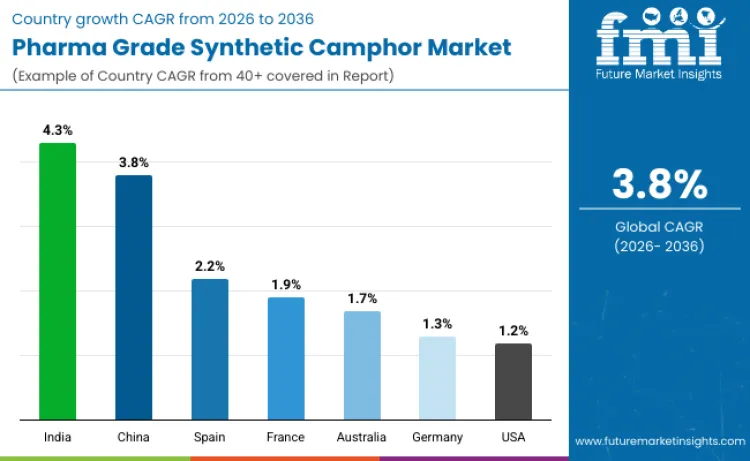
| Country | CAGR (%) |
|---|---|
| India | 4.3% |
| China | 3.8% |
| Spain | 2.2% |
| France | 1.9% |
| Australia | 1.7% |
| Germany | 1.3% |
| United States | 1.2% |
Why Does India Continue to Lead Growth in Pharma Grade Synthetic Camphor Use?
India records the fastest growth with a CAGR of 4.3%, supported by a well established pharmaceutical manufacturing base and rising domestic as well as export demand. Synthetic camphor is widely used in affordable topical analgesics and respiratory products that cater to large population needs. Expanding healthcare access, growing self medication awareness, and strong demand from export markets support consumption. Government policies encouraging pharmaceutical manufacturing, combined with cost efficient production and adherence to quality standards, allow Indian producers to strengthen their position in both regional and global supply chains.
How Are Manufacturing Scale and Healthcare Expansion Shaping Demand in China?
China shows steady growth at a CAGR of 3.8%, supported by large scale manufacturing capacity and rising healthcare consumption. Pharma grade synthetic camphor is increasingly used in pain relief and respiratory therapies as healthcare access improves. Investments in modern synthesis techniques and tighter quality controls have enhanced product consistency and regulatory acceptance. China’s ability to produce at scale while meeting international quality expectations reinforces its role as both a major domestic consumer and a key exporter serving pharmaceutical markets across Asia, Europe, and other regions.
What Factors Are Influencing Spain’s Steady Pharma Grade Synthetic Camphor Consumption?
Spain experiences moderate growth with a CAGR of 2.2%, shaped largely by an aging population and steady demand for topical pain management products. Synthetic camphor is commonly used in formulations addressing muscle aches, joint discomfort, and respiratory issues. The country’s pharmaceutical industry operates under strict regulatory supervision, supporting high safety and quality benchmarks. Ongoing collaboration between local producers and multinational pharmaceutical companies sustains demand, particularly for formulations that emphasize reliability, clinical validation, and compliance with European healthcare standards.
Why Do Quality Focused Healthcare Systems Sustain Demand in France?
France records a CAGR of 1.9%, reflecting demand from a well developed healthcare system that prioritizes high quality pharmaceutical ingredients. Synthetic camphor continues to be used in trusted topical and inhalation therapies, supported by strong research activity and consistent prescribing practices. Strict regulatory oversight ensures stable usage levels rather than rapid expansion. Consumer confidence in established therapeutic products and continued focus on safety, efficacy, and formulation integrity help maintain steady demand across both prescription and over the counter segments.
How Are Wellness Trends Supporting Synthetic Camphor Adoption in Australia?
Australia shows growth at a CAGR of 1.7%, driven by advanced healthcare infrastructure and sustained use of camphor based pain relief and respiratory products. Rising consumer interest in wellness oriented and natural inspired remedies supports ongoing demand. Pharmaceutical companies focus on improving formulations, ensuring quality assurance, and meeting regulatory expectations. While overall market expansion remains measured, consistent investment in product development and strong consumer trust in established therapies help reinforce long term demand for pharma grade synthetic camphor.
What Role Do Regulation and R&D Play in Germany’s Market Outlook?
Germany grows at a CAGR of 1.3%, supported by its emphasis on pharmaceutical quality, safety, and research driven development. Demand is linked to aging demographics and ongoing need for treatments addressing chronic pain and respiratory conditions. Manufacturers prioritize strict regulatory compliance and controlled production processes, which support consistent but gradual growth. Sustainability considerations and precision manufacturing also influence market behavior, keeping demand stable rather than expansion focused within the highly regulated German healthcare environment.
Why Does Demand in the United States Reflect a Mature but Stable Market?
The United States records a CAGR of 1.2%, reflecting a mature market where growth is driven more by formulation improvement than volume increase. Synthetic camphor remains an important ingredient in non opioid pain relief and respiratory care products. Strong regulatory oversight, advanced healthcare infrastructure, and continued investment in improved delivery systems support steady consumption. Demand is reinforced by ongoing interest in effective, trusted over the counter therapies rather than rapid expansion in new applications.
What Defines the Competitive Landscape of the Pharma Grade Synthetic Camphor Market?
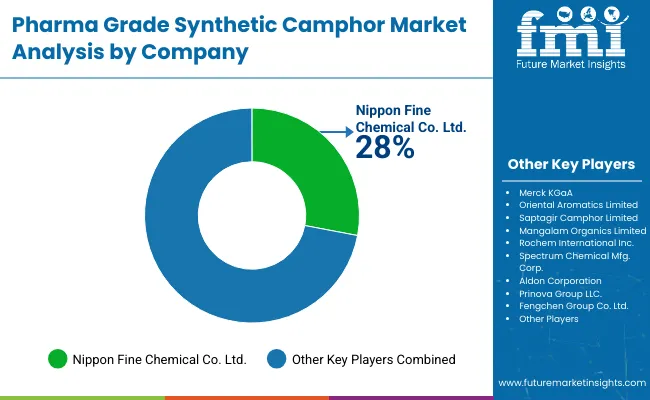
The competitive landscape of the pharma grade synthetic camphor market is shaped less by aggressive price competition and more by reliability, purity standards, and long term trust with pharmaceutical buyers. The industry remains moderately consolidated, with a small group of established manufacturers accounting for a significant share of global supply. Companies that lead this space are those capable of consistently delivering pharmaceutical grade camphor that meets strict pharmacopoeia requirements across multiple regions. Buyers prioritize suppliers with proven quality systems, regulatory transparency, and stable production processes, as synthetic camphor is widely used in sensitive applications such as topical analgesics, inhalants, and respiratory formulations.
Leading players such as Nippon Fine Chemical Co. Ltd. and Merck KGaA maintain strong competitive positions by investing heavily in advanced synthesis and purification technologies. Their strength lies in their ability to ensure batch to batch consistency, high purity levels, and compliance with global regulatory frameworks. These companies typically serve multinational pharmaceutical clients that demand dependable supply, detailed documentation, and technical support for formulation development. Their global footprint and strong compliance culture allow them to navigate regulatory differences across North America, Europe, and Asia with relative ease.
Asian manufacturers including Oriental Aromatics Ltd., Saptagir Camphor Ltd., and Mangalam Organics Ltd. play an increasingly important role, particularly in serving cost sensitive and fast growing markets. These companies benefit from vertical integration into turpentine based intermediates, which helps stabilize raw material supply and manage costs. Many are expanding capacity and refining crystallization and odor control techniques to align more closely with pharmaceutical grade expectations. Across the industry, competition is gradually shifting toward cleaner production methods, sustainability focused operations, and tighter quality controls, as regulatory scrutiny increases and pharmaceutical customers demand greater assurance on safety, traceability, and long term supply stability.
Key Players in the Pharma Grade Synthetic Camphor Market
- Nippon Fine Chemical Co. Ltd.
- Oriental Aromatics Ltd.
- Saptagir Camphor Ltd.
- Mangalam Organics Ltd.
- Merck KGaA
Report Scope
| Items | Values |
|---|---|
| Quantitative Units | USD million |
| Formulation Types Analyzed | Topical, Inhalation |
| Applications Covered | Respiratory Disorders, Muscular Rheumatism, Counterirritant and Antipruritic, Others including cosmetic and personal care uses |
| Distribution Channels | Conventional B2B including tenders, direct procurement, wholesalers and distributors; Online B2B including internal and external channels |
| Regions Covered | North America, Latin America, Europe, Asia Pacific, Middle East & Africa |
| Countries Covered | United States, Canada, Mexico, Germany, United Kingdom, France, China, India, Japan, Australia, South Korea, Brazil, and 40+ other countries |
| Key Companies Profiled | Nippon Fine Chemical Co. Ltd., Oriental Aromatics Ltd., Saptagir Camphor Ltd., Mangalam Organics Ltd., Merck KGaA |
| Additional Attributes | Revenue analysis by formulation type and application, country wise demand assessment, focus on high purity and specialty products, synthesis and formulation innovation trends, expansion across pharmaceutical and personal care sectors, supply chain efficiency and quality assurance analysis |
Key Segments
By Formulation Type:
- Topical
- Inhalation
- By Application:
- Respiratory Disorders
- Muscular Rheumatism
- Counterirritant and Antipruritic
- Other Applications including pain relief, cosmetic, and personal care uses
By Distribution Channel:
- Conventional B2B
- Tenders
- Direct Procurement
- Wholesalers and Distributors
- Online B2B
- Internal Channels
- External Channels
By Region:
- North America
- United States
- Canada
- Mexico
- Latin America
- Brazil
- Rest of Latin America
- Western Europe
- United Kingdom
- Germany
- France
- Italy
- Spain
- BENELUX
- Nordic Countries
- Rest of Western Europe
- Eastern Europe
- Poland
- Czech Republic
- Hungary
- Rest of Eastern Europe
- East Asia
- China
- Japan
- South Korea
- South Asia & Pacific
- India
- Australia
- Rest of South Asia & Pacific
- Middle East and Africa
- GCC
- South Africa
- Rest of Middle East and Africa
Frequently Asked Questions
How big is the pharma grade synthetic camphor market in 2026?
The global pharma grade synthetic camphor market is valued at USD 484.1 million in 2026.
What will be the size of the pharma grade synthetic camphor market in 2036?
The global pharma grade synthetic camphor market is valued at USD 484.1 million in 2026.
How fast will the pharma grade synthetic camphor market grow between 2026 and 2036?
The industry is expected to expand at a CAGR of 3.8% during the forecast period.
Which formulation type leads the pharma grade synthetic camphor market in 2026?
Topical formulations dominate the industry with a 73% share in 2026.
Which application segment holds a significant share in the pharma grade synthetic camphor market?
Respiratory disorders account for around 27% share of the industry in 2026.
Table of Content
- Executive Summary
- Market Overview
- Key Market Trends
- Market Size and Forecast Snapshot (2026 to 2036)
- Key Segment Highlights
- Regional Insights Overview
- Competitive Landscape Overview
- Market Introduction
- Market Definition and Scope
- Market Taxonomy
- Research Assumptions and Limitations
- Market Dynamics
- Drivers
- Restraints
- Opportunities
- Trends
- Global Market Analysis and Forecast, 2020 to 2036
- Market Size and Value Forecast
- Market Volume Analysis
- Pricing Analysis
- Value Chain Analysis
- Global Market Analysis by Formulation Type
- Topical
- Inhalation
- Global Market Analysis by Application
- Respiratory Disorders
- Muscular Rheumatism
- Counterirritant and Antipruritic
- Other Applications
- Global Market Analysis by Distribution Channel
- Conventional B2B
- Online B2B
- Global Market Analysis by Region
- North America
- Latin America
- Western Europe
- Eastern Europe
- East Asia
- South Asia and Pacific
- Middle East and Africa
- North America Market Analysis
- Latin America Market Analysis
- Western Europe Market Analysis
- Eastern Europe Market Analysis
- East Asia Market Analysis
- South Asia and Pacific Market Analysis
- Middle East and Africa Market Analysis
- Competitive Landscape
- Market Structure Analysis
- Company Market Share Analysis
- Strategic Developments
- Company Profiles
- Nippon Fine Chemical Co. Ltd.
- Oriental Aromatics Ltd.
- Saptagir Camphor Ltd.
- Mangalam Organics Ltd.
- Merck KGaA
- Research Methodology
- Assumptions and Acronyms
List of Tables
- Table 1: Global Market Value (USD Million) Forecast by Region, 2020 to 2036
- Table 2: Global Market Value (USD Million) Forecast by Formulation Type, 2020 to 2036
- Table 3: Global Market Value (USD Million) Forecast by Application, 2020 to 2036
- Table 4: Global Market Value (USD Million) Forecast by Distribution Channel, 2020 to 2036
- Table 5: North America Market Value (USD Million) Forecast by Country, 2020 to 2036
- Table 6: North America Market Value (USD Million) Forecast by Formulation Type, 2020 to 2036
- Table 7: North America Market Value (USD Million) Forecast by Application, 2020 to 2036
- Table 8: Latin America Market Value (USD Million) Forecast by Country, 2020 to 2036
- Table 9: Latin America Market Value (USD Million) Forecast by Formulation Type, 2020 to 2036
- Table 10: Latin America Market Value (USD Million) Forecast by Application, 2020 to 2036
- Table 11: Europe Market Value (USD Million) Forecast by Country, 2020 to 2036
- Table 12: Europe Market Value (USD Million) Forecast by Formulation Type, 2020 to 2036
- Table 13: Europe Market Value (USD Million) Forecast by Application, 2020 to 2036
- Table 14: Asia Pacific Market Value (USD Million) Forecast by Country, 2020 to 2036
- Table 15: Asia Pacific Market Value (USD Million) Forecast by Formulation Type, 2020 to 2036
- Table 16: Asia Pacific Market Value (USD Million) Forecast by Application, 2020 to 2036
- Table 17: Middle East and Africa Market Value (USD Million) Forecast by Country, 2020 to 2036
- Table 18: Middle East and Africa Market Value (USD Million) Forecast by Formulation Type, 2020 to 2036
- Table 19: Middle East and Africa Market Value (USD Million) Forecast by Application, 2020 to 2036
List of Figures
- Figure 1: Market Research Framework
- Figure 2: Global Market Value Share by Region, 2026
- Figure 3: Global Market Value Share by Formulation Type, 2026
- Figure 4: Global Market Value Share by Application, 2026
- Figure 5: Global Market Value Trend, 2020 to 2036
- Figure 6: Asia Pacific Market Growth Trend
- Figure 7: Competitive Landscape Overview
Full Research Suite comprises of:

Market outlook & trends analysis
Interviews & case studies
Strategic recommendations
Vendor profiles & capabilities analysis
5-year forecasts
8 regions and 60+ country-level data splits
Market segment data splits
12 months of continuous data updates
DELIVERED AS:
PDF EXCEL ONLINE


