

- Industry Size (2026)
- USD 639.1 Mn
- Forecast (2036)
- USD 1555.1 Mn
- CAGR (2026 to 2036)
- 9.3%
Photo Booth Market Size, Market Forecast and Outlook By FMI
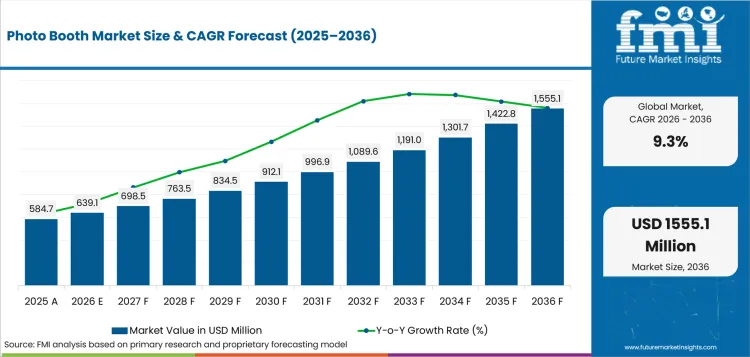
The photo booth market is projected to rise from USD 584.7 million in 2025 to USD 1,555.1 million by 2036 at a 9.3% CAGR. Growth is supported by corporate event activations and wedding rental demand. Enclosed booths are expected to account for 35.4% share in 2026. Commercial end users are anticipated to represent 63.2% share as event clients prioritize guest engagement and branded photo delivery.
Key Takeaways, Market Size, and Forecast
| Metric | Value |
|---|---|
| Market Size (2026) | USD 639.1 Million |
| Market Size (2036) | USD 1,555.1 Million |
| Forecast CAGR | 9.3% from 2026 to 2036 |
| Leading Product Type | Enclosed Booths |
| Enclosed Booths Share In 2026 | 35.4% |
| Leading End User | Commercial |
| Commercial Share In 2026 | 63.2% |
| Fastest-Growing Country | India |
| India CAGR | 12.4% through 2036 |
Summary of the Photo Booth Market
- Demand and Growth Drivers
- Photo booths are used more often for events because they give guests a simple way to take and share photos during the program.
- Corporate clients use booths for branded guest photos, which helps them continue event engagement after the session ends.
- Wedding planners prefer booths that are easy to place at venues and simple enough for guests to use without support.
- Product and Segment View
- Enclosed booths work well for weddings and private events because guests feel more comfortable taking candid photos.
- Open-air booths suit corporate events because larger groups can join the photo session without crowding the setup.
- Tablet-based booths are useful for rental firms because they are easier to carry and quicker to set up at different venues.
- Geography and Competitive Outlook
- The United States maintains booth demand from corporate events and private celebrations across major cities.
- India and China offer faster demand routes as weddings, malls and entertainment venues use booths for guest engagement.
- Suppliers with reliable hardware and simple sharing tools can serve repeat event clients better than firms offering basic booth rentals.
- Analyst Opinion
- Rahul Pandita, Principal Consultant at FMI says, “Photo booths are moving into a more measurable event technology role. Operators now sell guest capture and brand-safe delivery instead of a simple camera box. Enclosed booths keep wedding demand active. Corporate clients create higher booking values. Suppliers able to pair reliable print hardware with simple consent tools should hold stronger account quality during the forecast decade.”
- Photo Booth Market Value Analysis
- The photo booth market has shifted from simple event entertainment into a guest engagement service.
- Corporate events drive adoption because clients need branded photos and easy guest sharing.
- Wedding planners also support demand by using booths as private entertainment for guests.
- Demand also comes from event services that combine photo capture with instant printing and digital delivery.
Event organizers now expect photo activations to show engagement value beyond simple image capture. In 2024, Snapbar positioned AI Video Booths as an event format for personalized content. This supports premium pricing and stronger brand participation. Software integration also shapes purchasing. dslrBooth expanded its workflow by helping operators manage photos and GIFs. The same workflow also covers videos and 360 experiences with SMS and QR code sharing. The change reduces setup friction and helps rental providers handle higher guest volumes during peak events. Mobility needs are reshaping booth formats as experiential campaigns move beyond fixed installations. Mobibooth introduced its Cruise M roaming solution with a carry weight of just over 5 pounds This allows staff to engage attendees across venues instead of working from one location. These changes give operators clearer routes to differentiate services through engagement outcomes and flexible use models.
Photo Booth Market Definition
The photo booth market refers to the business of providing self-service photo capture systems used at events, venues, retail locations, and entertainment spaces. It covers photo booth hardware, software, rental services, instant printing, branded templates, digital sharing tools, and related consumables used to capture and deliver guest photos. The market includes open-air booths, enclosed booths, mirror booths, 360-degree booths, roaming booths, tablet-based systems, DSLR-based systems, and AI-enhanced booths. It serves corporate events, weddings, private parties, retail activations, and entertainment venues where clients need simple guest engagement, branded photo output, and quick image delivery.
Photo Booth Market Inclusions
Market scope covers photo booth solutions categorized by product type, including open-air booths, enclosed booths, mirror booths, 360-degree booths, and roaming booths; end user, including commercial clients and individual users; application, including corporate events, weddings, retail activations, private parties, and entertainment venues; technology, including DSLR-based systems, tablet-based systems, AI-enhanced systems, GIF booths, and video booths; and component, including hardware, software, services, and consumables. The scope also includes rental-based booth services where setup support, branded templates, guest photo capture, instant printing, and digital sharing operate as a single event service. Revenue scope covers 2026 to 2036. The key stakeholders include photo booth manufacturers, rental operators, event agencies, wedding planners, corporate event teams, retail activation firms, entertainment venues, software platform providers, printing hardware suppliers, consumable suppliers, and implementation service providers.
Photo Booth Market Exclusions
Scope excludes government passport photo kiosks and studio portrait services. Pure digital signage and vending kiosks are excluded if photo capture is not part of the user experience. General self-checkout systems are excluded unless a booth-style photo workflow is built into the service. Standalone cameras and ordinary printers are outside scope unless sold as part of a booth package. Event videography services are excluded if booth hardware is not part of delivery.
Photo Booth Market Research Methodology
- Primary Research: FMI analysts reviewed photo booth manufacturers and rental operators. Event service needs were checked across corporate events, weddings, retail activations, and entertainment venues.
- Desk Research: Official event data and company releases were used for demand checks. Booth product literature was used for supplier validation.
- Market Sizing and Forecasting: Market size was estimated through event activity and booth rental frequency. Average booth package pricing was used to cross-check value.
- Data Validation: Forecast checks compared event demand and booth format adoption. Supplier activity was reviewed across main countries.
Why is the Photo Booth Market Growing?
- Corporate activations are raising booth value as brands seek guest photos and consent-based contact capture.
- Wedding and private event clients keep repeat rental demand active through printed keepsakes.
- AI photo effects create premium booth packages because avatars and themed portraits raise event pricing.
Photo booth demand is increasing as event clients want simple guest capture during live programs. ME Group reported GBP 166.2 million in photobooth vending revenue for fiscal 2025. The figure supports the role of self-service photo units in paid consumer photo services. Event operators can use the same customer habit in weddings and corporate programs. Better booth packages help rental firms serve more events without turning every booking into a full photography job.
Software has become more important for booth operators because mixed event formats need one control layer. Photobooth Supply Co. stated in December 2025 that Fiesta software has four event types for different booth needs. Operators can manage iPad events and DSLR events from the same control layer. The software can also support 360 events and virtual booth sessions. This gives sponsors more value from event apps after the event ends. Clear software control helps small rental firms handle mixed event formats with fewer setup issues.
Market Segmentation Analysis
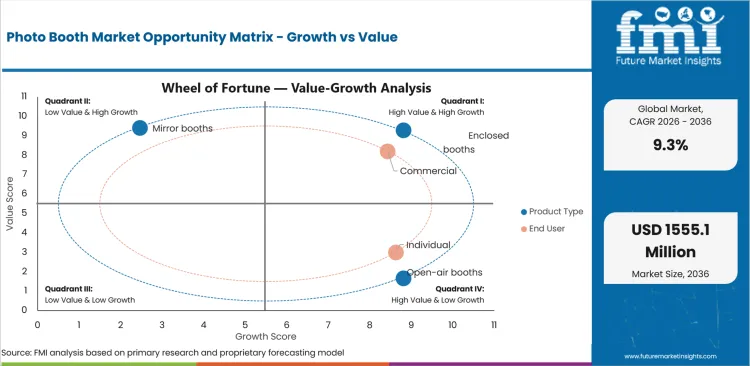
- Enclosed booths are expected to account for 35.4% share in 2026.
- Commercial end users are forecast to represent 63.2% of demand in 2026.
- Application demand is forecast to place corporate events at 31.8% share in 2026.
- Tablet-based systems are estimated to hold 37.6% technology share in 2026.
- Services are forecast to account for 46.8% component demand in 2026.
The market is divided into five primary segment groups based on product type and end user. Application, technology and component complete the structure. Product type covers open-air booths and enclosed booths. Mirror booths and 360-degree booths complete the main product group. Roaming booths are included for mobile event use. End user covers commercial clients and individual users. Application covers corporate events and weddings. Retail activations and private parties complete the main application scope. Entertainment venues are included for paid guest photo experiences. Technology covers DSLR-based systems and tablet-based systems. AI-enhanced systems and GIF booths complete the technology scope. Video booths are included for social event output. Component covers hardware and software. Services and consumables complete the component scope.
Insights into Photo Booth Market by Product Type
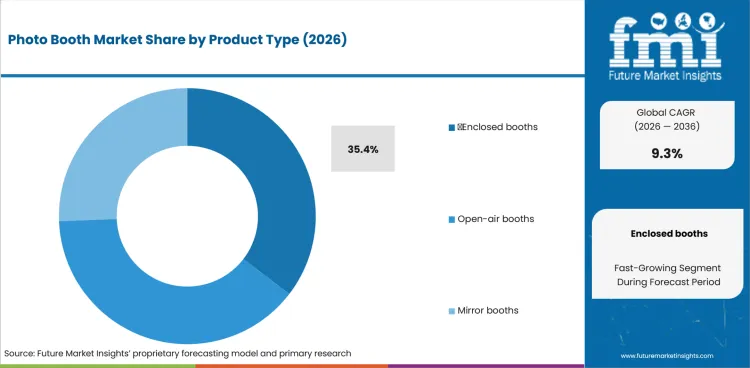
- Enclosed booths are projected to account for 35.4% share in 2026. Private spaces make guests more comfortable at weddings and formal parties.
- Open-air booths fit brand events that need group visibility. 360-degree booths support video sharing for launches and entertainment venues.
Insights into Photo Booth Market by End User
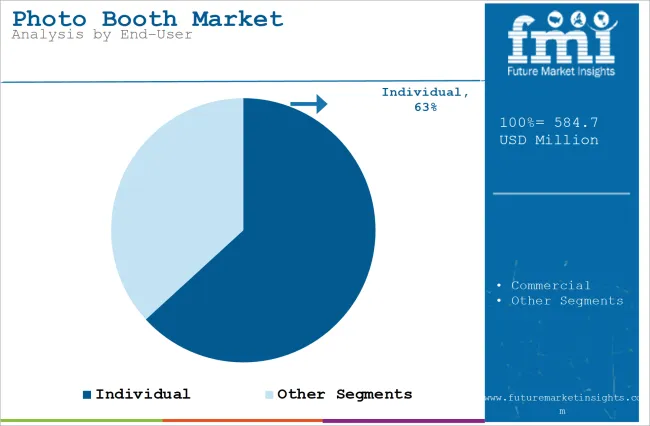
- Commercial end users are forecast to represent 63.2% share in 2026. Brand teams use booths for guest capture and campaign output.
- Individual users support wedding and birthday rentals. Event agencies prefer booth formats that fit corporate event planners workflows.
Insights into Photo Booth Market by Application
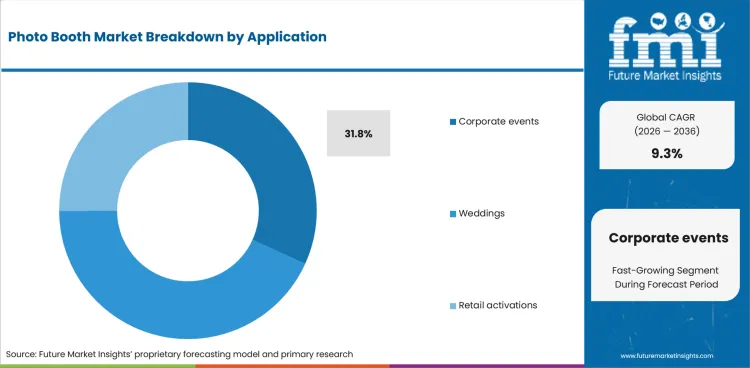
- Corporate events are projected to hold 31.8% share in 2026. Branded templates help sponsors keep guest attention after the event.
- Weddings need booths that feel easy and private for guests. Retail activations use booth photos to connect visitors with product campaigns.
Insights into Photo Booth Market by Technology
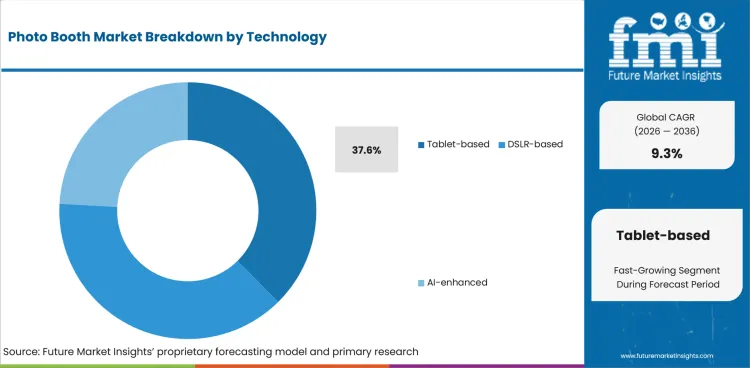
- Tablet-based systems are estimated to account for 37.6% share in 2026. Lighter kits reduce setup time for small rental firms.
- AI-enhanced systems use editing software to create themed output faster. DSLR-based booths serve premium events with sharper image quality.
Insights into Photo Booth Market by Component
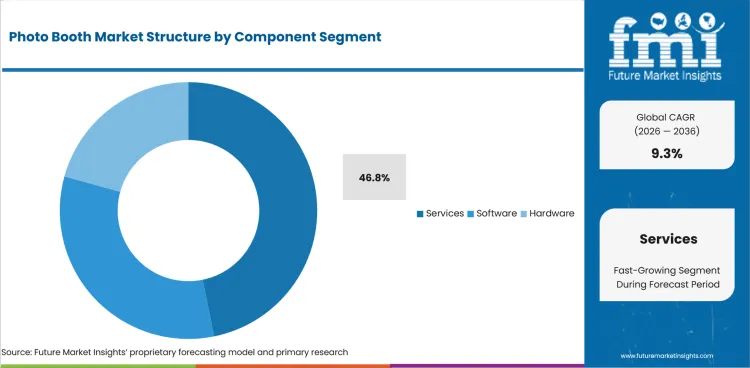
- Services are forecast to hold 46.8% share in 2026. Rental packages need setup support and live event handling.
- Hardware demand is linked with cameras and thermal printing supplies. Software value improves when operators can control templates and guest delivery.
Photo Booth Market Drivers, Restraints, and Opportunities
- Brand activation needs are raising demand for booths with guest consent capture and fast image delivery.
- Low-cost local rentals can reduce pricing power for small operators.
- Multi-format booth tools create premium packages because launches and entertainment venues need several content outputs per booking.
Brand Capture Needs Lift Booth Value
Corporate clients now ask booth firms for output they can use after the event. Snapbar’s official AI photo booth page says its booth activations capture leads and create shareable content. The page also states that the experience can work on any device. Photo booths fit brand programs because guests receive a fun image during the event. Sponsors get a cleaner way to continue contact after the session. Suppliers with lead capture tools can support brand teams beyond simple photo delivery.
Price Pressure Slows Small Operators
Local operators often enter the business with tablet stands and basic lighting. Low setup cost can make rental quotes fall in crowded wedding markets. Photobooth Supply Co. presents Salsa 2 as a booth that can work in stationary mode or roaming mode. This gives small firms a way to sell two service styles from one booth. Local operators therefore need better templates and dependable field support to avoid selling only on price.
Multi-format Booth Tools Create Premium Upside
Premium booth packages now need more than a camera and a backdrop. Photobooth Supply Co. added unlimited Sharing Stations to Fiesta Pro on June 2, 2026. The update removed a previous USD 79 per month add-on and allowed operators to run unlimited sharing stations across simultaneous events. Each format fits a different event need. Multi-format control gives rental firms a stronger upsell route for brand launches and premium private events.
Analysis of Photo Booth Market by Key Countries
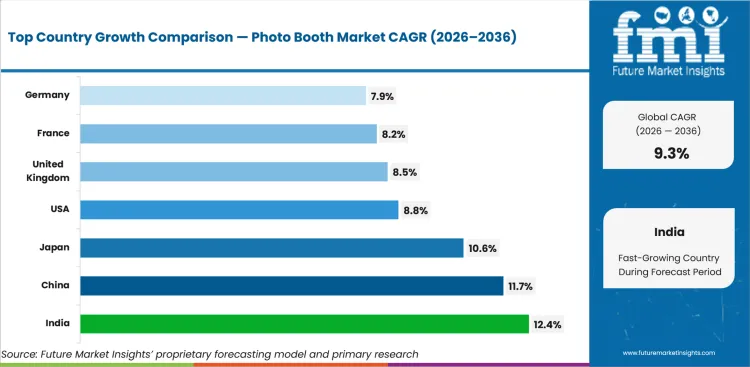
.webp "Top Country Growth Comparison Photo Booth Market Cagr (2026 2036)")
| Country | CAGR |
|---|---|
| United States | 8.8% |
| China | 11.7% |
| India | 12.4% |
| Germany | 7.9% |
| United Kingdom | 8.5% |
| Japan | 10.6% |
| France | 8.2% |
Source: Future Market Insights, 2026.
Demand Outlook for Photo Booth Market in the United States
Large corporate event base · 2026 to 2036
Country Market Snapshot Table
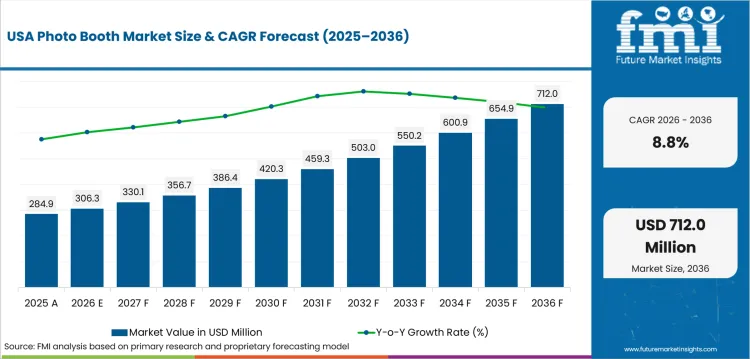
| Parameter | Value |
|---|---|
| Market Size in 2025 | USD 180.2 million |
| Market Forecast in 2036 | USD 455.7 million |
| CAGR 2026-2036 | 8.8% |
| Years Considered | 2021-2036 |
| Base Year | 2025 |
| Forecast Period | 2026-2036 |
| Units Considered | Value USD Million |
| Leading Sub-Region | California event corridor |
United States Photo Booth Market Outlook
USA booth demand comes from corporate activations and wedding rentals. Large event cities use booths for branded photos and guest delivery. Rental firms are adding stronger software because sponsors want cleaner guest records after events.
Premium clients often prefer booths with stable printers and fast image sharing. Event planners also value vendors that can work with tight setup windows. Operators with reliable field teams can serve business events and private celebrations with the same booth stock.
Key Growth Drivers
- Self-service photo habits remain visible in the United States, as the U.S. Department of State reported 27,348,416 U.S. passports issued in fiscal 2025. This supports event operators that sell fast image capture and delivery.
- Event photography services need a steady talent pool, as the U.S. Bureau of Labor Statistics projected about 12,700 photographer openings each year from 2024 to 2034. This supports booth firms that hire attendants and event photographers.
- Wedding planners use enclosed booths because guests feel more relaxed in a private photo space.
- Corporate venues use booth templates because branded photos help sponsors stay in front of guests after the event.
Key Restraints
- Local rental pricing can fall when small operators use basic tablet booths.
- Staffing cost can reduce margins for events that need attendants.
- Booth firms need to manage labor cost, as the USA Bureau of Labor Statistics reported a median photographer wage of USD 20.44 per hour in May 2024. This can make low-price event packages harder to protect.
What makes the United States unique
The United States is unique because corporate events and social celebrations both create repeat booth demand. Rental firms can build stronger accounts through quick setup and reliable image delivery.
Key Companies
- Photobooth Supply Co.
- Simple Booth
- Snapbar
- Face Place
- Photo Booth International
Sales and Marketing Channels
- Corporate event agencies
- Wedding planner networks
- Brand activation firms
- Direct online rental booking
- Venue partnership programs
Country Segment Breakdown Table
| Segment | Sub-Segments |
|---|---|
| By Product Type | Open-air Booths · Enclosed Booths · Mirror Booths · 360-degree Booths · Roaming Booths |
| By End User | Commercial · Individual |
| By Application | Corporate Events · Weddings · Retail Activations · Private Parties · Entertainment Venues |
| By Technology | DSLR-based · Tablet-based · AI-enhanced · GIF Booths · Video Booths |
| By Component | Hardware · Software · Services · Consumables |
| Key Sub-Regions Covered, States | California · New York · Florida · Texas · Illinois · Nevada · Georgia · Washington |
Frequently Asked Questions
How fast is the United States photo booth market expanding?
The United States photo booth market is forecast to expand at 8.8% CAGR from 2026 to 2036. Corporate events and wedding rentals create the main demand base.
Who leads the United States photo booth market?
Photobooth Supply Co., Simple Booth and Snapbar are important names in U.S. booth software and event activation services.
What is driving photo booth demand in the United States?
Corporate clients need branded guest capture. Wedding clients need printed keepsakes and simple event entertainment.
Sales Analysis of Photo Booth Market in China
Mall activation and entertainment venue demand · 2026 to 2036
Country Market Snapshot Table
| Parameter | Value |
|---|---|
| Market Size in 2025 | USD 75.4 million |
| Market Forecast in 2036 | USD 254.7 million |
| CAGR 2026-2036 | 11.7% |
| Years Considered | 2021-2036 |
| Base Year | 2025 |
| Forecast Period | 2026-2036 |
| Units Considered | Value USD Million |
| Leading Sub-Region | Pearl River Delta event supply belt |
China Photo Booth Market Outlook
China’s booth demand comes from malls and entertainment venues. Local firms supply mirror booths and 360-degree booths to event rental companies. Compact systems work well because malls need quick setup and short user sessions.
Domestic manufacturers can adjust designs quickly for retail campaigns. Booth operators also benefit from local access to screens and printing parts. This keeps hardware supply close to the rental channel.
Key Growth Drivers
- Shopping malls need guest engagement tools, as China recorded 501 million domestic tourist trips during the 2025 Spring Festival holiday. This supports booth use in retail and leisure venues.
- Retail activations need high-traffic consumer settings, as China’s National Bureau of Statistics reported 44,322 billion yuan in retail sales of goods in 2025. This gives brands a large offline setting for photo-based campaigns.
- Wedding venues use mirror booths because the format feels interactive during receptions.
- Entertainment venues use compact booths because paid photo sessions can fit into small floor areas.
Key Restraints
- Price pressure can rise when similar booth models are sold to many local operators.
- Small rental firms may struggle to prove image quality at premium events.
- Social-event demand can soften by quarter, as official data showed 1.81 million marriage registrations in China in Q1 2025. This was 8% lower than the same period in 2024.
What makes China unique
China is unique because booth hardware supply and event demand sit close together in major city clusters. Local rental firms can test new booth styles faster than import-heavy markets.
Key Companies
- PhoPrint
- Shenzhen Vanya Intelligent Co., Ltd.
- Shenzhen TouchCloud Video Technology Co., Ltd.
- Shenzhen WiViTouch Technology Co., Ltd.
- Shenzhen Chestnuter Technology Co., Ltd.
Sales and Marketing Channels
- Local booth distributors
- Wedding service vendors
- Mall event agencies
- Entertainment venue operators
- Direct factory sales
Country Segment Breakdown Table
| Segment | Sub-Segments |
|---|---|
| By Product Type | Open-air Booths · Enclosed Booths · Mirror Booths · 360-degree Booths · Roaming Booths |
| By End User | Commercial · Individual |
| By Application | Corporate Events · Weddings · Retail Activations · Private Parties · Entertainment Venues |
| By Technology | DSLR-based · Tablet-based · AI-enhanced · GIF Booths · Video Booths |
| By Component | Hardware · Software · Services · Consumables |
| Key Sub-Regions Covered, Provinces / Municipalities | Guangdong · Shanghai · Beijing · Zhejiang · Jiangsu · Sichuan · Fujian · Shandong |
Frequently Asked Questions
How fast is China’s photo booth market expanding?
China’s photo booth market is likely to post 11.7% CAGR in the sector by 2036. Mall activations and entertainment venues are key demand centers.
Who leads China’s photo booth supplier base?
PhoPrint and Shenzhen-based booth manufacturers are active in mirror booths and 360-degree booth supply.
What is driving photo booth demand in China?
Retail campaigns and weddings drive demand. Local hardware supply also keeps booth availability strong.
Demand Outlook for Photo Booth Market in India
Wedding rental and mall activation demand · 2026 to 2036
Country Market Snapshot Table
| Parameter | Value |
|---|---|
| Market Size in 2025 | USD 39.8 million |
| Market Forecast in 2036 | USD 144 million |
| CAGR 2026-2036 | 12.4% |
| Years Considered | 2021-2036 |
| Base Year | 2025 |
| Forecast Period | 2026-2036 |
| Units Considered | Value USD Million |
| Leading Sub-Region | Mumbai and Delhi NCR event belt |
India Photo Booth Market Outlook
India’s booth demand comes from weddings and corporate events in large cities. Mall activations also create repeat work for operators in large cities. Portable booths fit the market because venues change often and transport cost affects margins.
Rental firms are moving toward lighter booth formats and faster sharing tools. Event clients often want décor-friendly booths that do not disrupt the venue layout. Operators with quick setup and simple booking flow should hold stronger city accounts.
Key Growth Drivers
- Destination events need simple guest photo tools, as India recorded 20.57 million international tourist arrivals in 2024. This supports booth use in hotels and event venues.
- Mall activations need large consumer footfall, as India recorded 303.59 crore domestic tourist visits till August 2025. This gives booth operators a wider base for leisure and retail events.
- Wedding planners use enclosed booths because large receptions need simple guest entertainment.
- Corporate offices use portable booths because employee events often have short setup windows.
Key Restraints
- Transport cost can reduce margins when operators serve distant venues.
- Low-cost booth copies can make service quality uneven in price-sensitive cities.
- Document-photo demand is shifting toward faster digital processing, as India granted 14.7 million passports in 2024. Booth operators must offer event value beyond basic photo capture.
What makes India unique
India is unique because social events often have large guest counts and long schedules. Photo booths fit well because guests need simple entertainment across several event stages.
Key Companies
- The PhotoBooth Company
- GoKapture
- Photo Master India
- Ice Digitek India Private Limited
- Bamigos
Sales and Marketing Channels
- Wedding planners
- Corporate event agencies
- Mall activation vendors
- Direct social media booking
- Event technology partners
Country Segment Breakdown Table
| Segment | Sub-Segments |
|---|---|
| By Product Type | Open-air Booths · Enclosed Booths · Mirror Booths · 360-degree Booths · Roaming Booths |
| By End User | Commercial · Individual |
| By Application | Corporate Events · Weddings · Retail Activations · Private Parties · Entertainment Venues |
| By Technology | DSLR-based · Tablet-based · AI-enhanced · GIF Booths · Video Booths |
| By Component | Hardware · Software · Services · Consumables |
| Key Sub-Regions Covered, States / Cities | Maharashtra · Delhi NCR · Karnataka · Tamil Nadu · Telangana · Gujarat · Rajasthan · Goa |
Frequently Asked Questions
How fast is India’s photo booth market expanding?
India’s photo booth market is expected to record 12.4% CAGR through 2036. Weddings and mall events create the main rental pool.
Who leads India’s photo booth market?
The PhotoBooth Company, GoKapture and Photo Master India are active names in event photo booth services.
What is driving photo booth demand in India?
Wedding events and corporate launches drive demand. Portable booth formats work well because venues change often.
Opportunity Analysis of Photo Booth Market in Germany
Trade fair and corporate event demand · 2026 to 2036
Country Market Snapshot Table
| Parameter | Value |
|---|---|
| Market Size in 2025 | USD 36.9 million |
| Market Forecast in 2036 | USD 85.2 million |
| CAGR 2026-2036 | 7.9% |
| Years Considered | 2021-2036 |
| Base Year | 2025 |
| Forecast Period | 2026-2036 |
| Units Considered | Value USD Million |
| Leading Sub-Region | Rhine-Main and Bavaria event corridor |
Germany Photo Booth Market Outlook
Germany’s photo booth demand is linked with exhibitions and company events. Booths are used for branded guest photos at trade fairs. Wedding rentals add a separate private-event route outside the business calendar.
Operators serving Germany need reliable setup and clean booth design. Exhibitors expect fast service because trade fair schedules leave little room for technical delays. Rental firms with event staff and print backup can serve business clients more confidently.
Key Growth Drivers
- Trade fair exhibitors need booth tools that pull visitors into stand activity, as AUMA reported 322 trade fairs in Germany in 2024. These events counted over 11.7 million visitors.
- Event venues need guest photo services for travel and business meetings, as Germany recorded 496.1 million overnight stays in 2024. This gives booth firms a large hospitality-linked event pool.
- Corporate events use branded templates because exhibitors need quick follow-up content.
- Wedding venues use compact booths because printed guest books are common in private celebrations.
Key Restraints
- Exhibition schedules can make demand uneven across months.
- Business clients often expect faster service than private-event clients.
- Private-event demand has a limited marriage base, as Destatis reported 348,655 marriages in Germany in 2025. This can keep wedding-focused operators dependent on business events.
What makes Germany unique
Germany is unique because trade fairs create a direct route to corporate booth buyers. Operators can serve exhibitors and wedding clients with different service packages.
Key Companies
- KRUU GmbH
- foboxy
- HappyFotoBox
- Fotobox Deluxe
- Knips-O-Mat
Sales and Marketing Channels
- Trade fair service vendors
- Wedding venue partners
- Corporate event agencies
- Online rental platforms
- Local technician networks
Country Segment Breakdown Table
| Segment | Sub-Segments |
|---|---|
| By Product Type | Open-air Booths · Enclosed Booths · Mirror Booths · 360-degree Booths · Roaming Booths |
| By End User | Commercial · Individual |
| By Application | Corporate Events · Weddings · Retail Activations · Private Parties · Entertainment Venues |
| By Technology | DSLR-based · Tablet-based · AI-enhanced · GIF Booths · Video Booths |
| By Component | Hardware · Software · Services · Consumables |
| Key Sub-Regions Covered, States / Cities | Bavaria · North Rhine-Westphalia · Hesse · Berlin · Hamburg · Baden-Württemberg · Lower Saxony · Saxony |
Frequently Asked Questions
How fast is Germany’s photo booth market expanding?
Germany is forecast to register 7.9% CAGR over the forecast period. Trade fair use gives booth firms a steady business-event route.
Who leads Germany’s photo booth market?
KRUU GmbH, foboxy and HappyFotoBox are active booth rental and service names in Germany.
What is driving photo booth demand in Germany?
Trade fairs and company events create commercial demand. Weddings add a separate private-event rental base.
Sales Analysis of Photo Booth Market in the United Kingdom
Business events and private celebration demand · 2026 to 2036
Country Market Snapshot Table
| Parameter | Value |
|---|---|
| Market Size in 2025 | USD 34.6 million |
| Market Forecast in 2036 | USD 84.9 million |
| CAGR 2026-2036 | 8.5% |
| Years Considered | 2021-2036 |
| Base Year | 2025 |
| Forecast Period | 2026-2036 |
| Units Considered | Value USD Million |
| Leading Sub-Region | Greater London event belt |
United Kingdom Photo Booth Market Outlook
United Kingdom demand comes from weddings and business events. Corporate clients use booths for brand activations and staff functions. Private clients book booths for weddings and milestone parties.
Operators in the United Kingdom often sell compact packages for city venues. Clear booking pages and fast print delivery matter because clients compare services online. London gives booth suppliers strong corporate demand while regional cities add wedding work.
Key Growth Drivers
- Business events need quick guest engagement, as VisitBritain reported 2.6 million inbound MICE visits in 2024. This supports booth demand at conferences and exhibitions.
- Tourism venues need easy photo experiences, as final ONS estimates cited by VisitBritain showed 42.6 million inbound visits to the UK in 2024. This supports booth use in city venues and attractions.
- Wedding clients choose photo booths because printed guest books add personal value.
- City venues use compact booths because floor space is often limited.
Key Restraints
- Weather and transport issues can affect outdoor event delivery.
- London service costs can pressure smaller operators with low rental prices.
- Travel-linked event demand can change quickly, as VisitBritain estimated 43.6 million inbound visits in 2025 with only 2% growth from 2024. This can limit short-term uplift for venue-led booth demand.
What makes the United Kingdom unique
The United Kingdom is unique because wedding rentals and corporate events are both strong in major cities. Operators can serve private and business clients with clear package tiers.
Key Companies
- BoothHire
- PictureBlast
- The Photo Booth Company UK Limited
- The Proper Booth
- Event Rhino
Sales and Marketing Channels
- Venue referral programs
- Wedding fairs
- Corporate event planners
- Online rental booking
- Brand activation agencies
Country Segment Breakdown Table
| Segment | Sub-Segments |
|---|---|
| By Product Type | Open-air Booths · Enclosed Booths · Mirror Booths · 360-degree Booths · Roaming Booths |
| By End User | Commercial · Individual |
| By Application | Corporate Events · Weddings · Retail Activations · Private Parties · Entertainment Venues |
| By Technology | DSLR-based · Tablet-based · AI-enhanced · GIF Booths · Video Booths |
| By Component | Hardware · Software · Services · Consumables |
| Key Sub-Regions Covered, Cities / Regions | London · Birmingham · Manchester · Leeds · Bristol · Liverpool · Glasgow · Cardiff |
Frequently Asked Questions
How fast is the United Kingdom photo booth market expanding?
The United Kingdom market is forecast to record 8.5% CAGR through 2036. Weddings and business events create steady booth rental use.
Who leads the United Kingdom photo booth market?
BoothHire, PictureBlast and The Photo Booth Company UK Limited are active names in the United Kingdom.
What is driving photo booth demand in the United Kingdom?
Corporate events and weddings drive demand. Compact booths work well for city venues with limited space.
Future Outlook for Photo Booth Market in Japan
Purikura culture and compact retail booths · 2026 to 2036
Country Market Snapshot Table
| Parameter | Value |
|---|---|
| Market Size in 2025 | USD 42.7 million |
| Market Forecast in 2036 | USD 129.3 million |
| CAGR 2026-2036 | 10.6% |
| Years Considered | 2021-2036 |
| Base Year | 2025 |
| Forecast Period | 2026-2036 |
| Units Considered | Value USD Million |
| Leading Sub-Region | Tokyo entertainment corridor |
Japan Photo Booth Market Outlook
Japan has a deep culture of sticker photo booths and compact self-service photo formats. Arcades and retail locations use booths as paid entertainment. Wedding and tourism use adds another demand layer for instant prints.
Operators in Japan need compact machines that fit dense retail sites. Character themes and clean editing features are important because younger users expect playful output. Tourist areas can add booth sessions as souvenir photo experiences.
Key Growth Drivers
- Tourism districts need fast souvenir formats, as Japan National Tourism Organization data showed visitor arrivals to Japan reached about 42.7 million in 2025. This gives booth operators a wide tourist pool.
- Wedding venues need print-based entertainment, as Japan’s official vital statistics recorded about 500 thousand marriages in 2024. This supports booth use for receptions and celebration events.
- Arcade venues use purikura-style booths because photo stickers are familiar to young consumers.
- Retail sites use character themes because seasonal campaigns need visual participation.
Key Restraints
- Space cost can limit larger booth formats in dense retail areas.
- Arcade foot traffic can change quickly when entertainment habits shift.
- Domestic travel pressure can affect leisure spending, as Japan Tourism Agency data cited about 13 million Japanese outbound travelers in 2024. This shows that travel behavior is improving but not fully back to pre-pandemic levels.
What makes Japan unique
Japan is unique because photo sticker booths are part of youth and arcade culture. The market can use booth design and character themes better than most countries.
Key Companies
- SEGA FAVE Corporation
- FURYU Corporation
- Taito Corporation
- Bandai Namco Amusement Inc.
- GENDA GiGO Entertainment Inc.
Sales and Marketing Channels
- Arcade chains
- Retail entertainment sites
- Tourism locations
- Wedding venues
- Character brand partners
Country Segment Breakdown Table
| Segment | Sub-Segments |
|---|---|
| By Product Type | Open-air Booths · Enclosed Booths · Mirror Booths · 360-degree Booths · Roaming Booths |
| By End User | Commercial · Individual |
| By Application | Corporate Events · Weddings · Retail Activations · Private Parties · Entertainment Venues |
| By Technology | DSLR-based · Tablet-based · AI-enhanced · GIF Booths · Video Booths |
| By Component | Hardware · Software · Services · Consumables |
| Key Sub-Regions Covered, Prefectures / Cities | Tokyo · Osaka · Aichi · Kanagawa · Kyoto · Fukuoka · Hokkaido · Hyogo |
Frequently Asked Questions
How fast is Japan’s photo booth market expanding?
Japan is projected to record 10.6% CAGR during the forecast period. Purikura culture and compact retail use drive the pace.
Who leads Japan’s photo booth market?
SEGA FAVE Corporation and FURYU Corporation are important names in Japan’s photo sticker booth ecosystem.
What is driving photo booth demand in Japan?
Arcades and retail entertainment sites drive demand. Instant-print habits also make booth output familiar to consumers.
Future Outlook for Photo Booth Market in France
Wedding events and cultural venue demand · 2026 to 2036
Country Market Snapshot Table
| Parameter | Value |
|---|---|
| Market Size in 2025 | USD 31.8 million |
| Market Forecast in 2036 | USD 75.7 million |
| CAGR 2026-2036 | 8.2% |
| Years Considered | 2021-2036 |
| Base Year | 2025 |
| Forecast Period | 2026-2036 |
| Units Considered | Value USD Mn |
| Leading Sub-Region | Île-de-France event corridor |
France Photo Booth Market Outlook
France has booth demand across weddings and brand events. Paris creates premium work for fashion events and luxury launches. Regional cities add private-event rentals through weddings and social functions.
Operators need booth designs that look clean in premium venues. French event clients often value visual style as much as technical setup. Tourism venues can also use compact booths for souvenir photos and instant sharing.
Key Growth Drivers
- Tourist venues need quick souvenir experiences, as Atout France estimated 102 million international arrivals in 2025. This supports booth placement in high-visitor leisure areas.
- Cultural venues create a strong photo setting, as the Louvre welcomed 8.7 million visitors in 2024. This helps explain demand for compact photo experiences near museums and heritage sites.
- Paris events use photo booths because fashion and brand launches need guest social content.
- Wedding planners use enclosed booths because private guest capture fits formal receptions.
Key Restraints
- Premium venues may reject booth setups that look bulky.
- Smaller towns can have fewer repeat corporate bookings for booth operators.
- Wedding demand has limits in some private-event segments, as INSEE reported 6.8 thousand same-sex marriages in 2024, equal to 3% of all marriages. This keeps operators focused on several event types.
What makes France unique
France is unique because booth demand can connect private weddings with fashion and cultural events. Premium design matters more in Paris than in many other markets.
Key Companies
- My Selfie Company
- Selfizee
- Coste Agency
- Fotoautomat France
- S2A Production
Sales and Marketing Channels
- Wedding planner networks
- Luxury event agencies
- Cultural venue partners
- Online rental booking
- Brand launch agencies
Country Segment Breakdown Table
| Segment | Sub-Segments |
|---|---|
| By Product Type | Open-air Booths · Enclosed Booths · Mirror Booths · 360-degree Booths · Roaming Booths |
| By End User | Commercial · Individual |
| By Application | Corporate Events · Weddings · Retail Activations · Private Parties · Entertainment Venues |
| By Technology | DSLR-based · Tablet-based · AI-enhanced · GIF Booths · Video Booths |
| By Component | Hardware · Software · Services · Consumables |
| Key Sub-Regions Covered, Regions / Cities | Île-de-France · Auvergne-Rhône-Alpes · Provence-Alpes-Côte d’Azur · Occitanie · Nouvelle-Aquitaine · Hauts-de-France · Grand Est · Brittany |
Frequently Asked Questions
How fast is France’s photo booth market expanding?
France is projected to register 8.2% CAGR by 2036. Paris events and wedding rentals create the main demand pool.
Who leads France’s photo booth market?
My Selfie Company, Selfizee and Coste Agency are active names in French booth rental and supply.
What is driving photo booth demand in France?
Premium events and weddings drive demand. Cultural venues also use compact booths for souvenir photos.
Competitive Landscape and Strategic Positioning
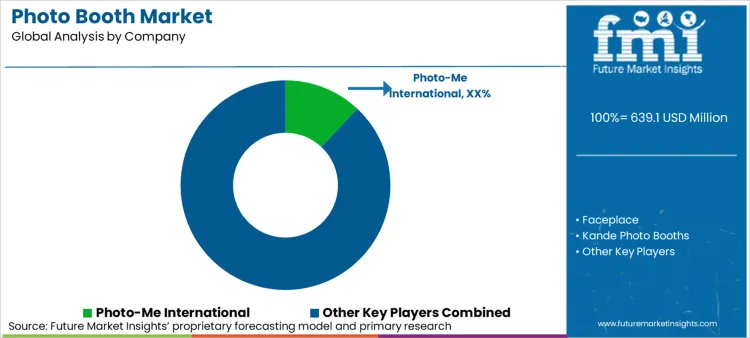
- Competition centers on booth portability and event software control.
- Instant delivery and print reliability shape repeat bookings from event clients.
- Hardware suppliers need sturdy enclosures and reliable camera-lighting fit.
- Software suppliers need branded templates and consent capture tools for corporate activations.
- Entry barriers include local event relationships and reliable field support during live bookings.
Competitive positioning is split between booth hardware suppliers and software platforms. ME Group has scale in self-service photo vending through its photobooth business. Photobooth Supply Co. supports rental operators through Salsa hardware and Fiesta software. Snapbar focuses on brand activations through visual lead capture. Operators with reliable equipment and easy guest delivery should protect stronger corporate accounts.
Smaller rental firms can win local wedding work through design flexibility and quick venue service. Corporate activations are harder because clients ask for consent tools and output control. Professional print formats affect quality expectations at premium events. Booth providers serving retailers can learn from bluetooth photo capture devices as connected capture supports easier sharing. Supplier choice will depend on setup speed and post-event proof of delivery.
Key Companies in the Photo Booth Market
- Kiosk and Hardware Producers: ME Group, Face Place and Photo Booth International hold positions through booth hardware and public-location experience.
- Software and Experience Platforms: Simple Booth, Snapbar and Photobooth Supply Co. stand out through templates and AI-enhanced output.
- Regional Rental Specialists: Kande Photo Booths and ShutterBooth serve weddings and corporate events through local service networks.
Competitive Benchmarking: Photo Booth Market
| Company | Booth Hardware Depth | Software Workflow Control | Event Field Support | Geographic Footprint |
|---|---|---|---|---|
| ME Group | High | Medium | High | Europe and Japan centered |
| Simple Booth | Medium | High | Medium | North America centered with software reach |
| Photobooth Supply Co. | High | High | Medium | United States centered |
| Fujifilm | Medium | Medium | Medium | Japan and global instant-print reach |
| Snapbar | Low | High | Medium | United States digital activation focus |
| Face Place | High | Low | Medium | North America venue and arcade focus |
| Photo Booth International | High | Medium | Medium | United States operator supply focus |
Source: Future Market Insights competitive analysis, 2026.
Key Developments in Photo Booth Market
- In April 2026, Fujifilm launched the instax SPOT photobooth and print station. Fujifilm introduced instax SPOT as a free-standing photobooth and print station for high-traffic venues such as movie theaters and museums.
- In November 2025, Simple Booth added DSLR support for HALO 5.0. Simple Booth confirmed that DSLR integration is supported on HALO 5.0. The app was available in the App Store as of November 20, 2025.
Key Players in the Photo Booth Market
Kiosk and Hardware Producers
- ME Group
- Fujifilm
- Face Place
- Photo Booth International
- PhoPrint
Software and Experience Platforms
- Simple Booth
- Snapbar
- Photobooth Supply Co.
- Custom Booth Co.
- BoothBook
Regional Rental Specialists
- Kande Photo Booths
- Open Air Photobooth
- ShutterBooth
- 321 Photo Booths
- TapSnap
Report Scope and Coverage
| Parameter | Details |
|---|---|
| Market size by 2036 | USD 1,555.1 million |
| Growth rate | 9.3% CAGR from 2026 to 2036 |
| Forecast period | 2026 to 2036 |
| Base year value 2026 | USD 639.1 million |
| By product type | Open-air booths, enclosed booths, mirror booths, 360-degree booths, roaming booths |
| By end user | Commercial, individual |
| By application | Corporate events, weddings, retail activations, private parties, entertainment venues |
| By technology | DSLR-based systems, tablet-based systems, AI-enhanced systems, GIF booths, video booths |
| By component | Hardware, software, services, consumables |
| Regions covered | North America, Latin America, Western Europe, Eastern Europe, East Asia, South Asia and Pacific, Middle East and Africa |
| Countries covered | United States, China, India, Germany, United Kingdom, Japan, France, and more than 40 countries |
| Key companies profiled | ME Group, Fujifilm, Face Place, Photo Booth International, PhoPrint, Simple Booth, Snapbar, Photobooth Supply Co., Custom Booth Co., BoothBook |
| Approach | Hybrid bottom-up and top-down methodology using event activity, booth pricing, rental demand, hardware adoption, software revenue, and regional event-use patterns |
Source: Future Market Insights, 2026.
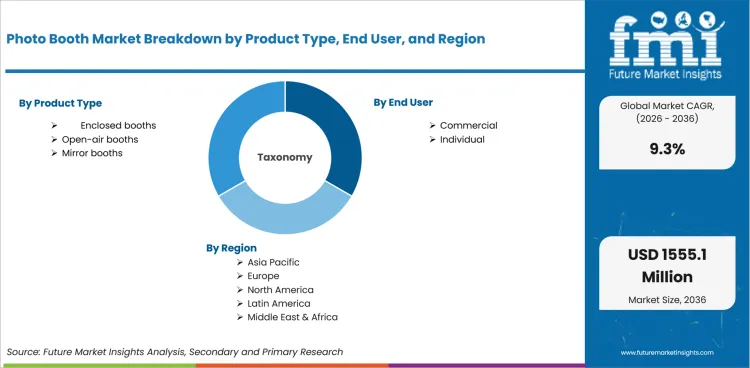
Photo Booth Market Breakdown by Product Type, End User, Application, Technology, Component, and Region
Photo Booth Market Segmented by Product Type:
- Open-air booths
- Enclosed booths
- Mirror booths
- 360-degree booths
- Roaming booths
Photo Booth Market Segmented by End User:
- Commercial
- Individual
Photo Booth Market Segmented by Application:
- Corporate events
- Weddings
- Retail activations
- Private parties
- Entertainment venues
Photo Booth Market Segmented by Technology:
- DSLR-based
- Tablet-based
- AI-enhanced
- GIF booths
- Video booths
Photo Booth Market Segmented by Component:
- Hardware
- Software
- Services
- Consumables
Photo Booth Market by Region:
- North America
- Latin America
- Western Europe
- Eastern Europe
- East Asia
- South Asia and Pacific
- Middle East and Africa
Research Sources and Bibliography
- Atout France. (2026, February 19). Bilan touristique de l’année 2025 : Avec 102 millions de visiteurs, la France, pays le plus visité du monde, enregistre une nouvelle hausse massive de ses recettes touristiques (+9%). Atout France.
- AUMA - Association of the German Trade Fair Industry. (2025, June 26). 2.5 million foreign visitors: Germany leading trade fair venue worldwide. AUMA.
- dslrBooth. (n.d.). LumaShare. dslrBooth.
- dslrBooth. (n.d.). LumaBooth: The professional photo booth and booth app for iPad, iPhone and Mac. dslrBooth.
- FUJIFILM North America Corporation. (2026, April 15). Fujifilm introduces the next generation in photo printing experiences: instax SPOT photobooth and print station. FUJIFILM.
- Institut national de la statistique et des études économiques. (2026, April 23). In 2024, 3% of marriages were between same-sex partners. INSEE.
- Japan National Tourism Organization. (2026, January 21). 訪日外客数(2025年12月推計値). JNTO.
- ME Group International plc. (2026, March 23). 2025 annual results. ME Group International plc.
- Ministry of Health, Labour and Welfare. (2025, September 16). 令和6年人口動態統計(確定数). Ministry of Health, Labour and Welfare.
- Ministry of Tourism, Government of India. (2025, September 26). World Tourism Day. Press Information Bureau.
- Ministry of Tourism, Government of India. (2026, March 16). International tourist arrivals. Press Information Bureau.
- Mobibooth. (2025, May 5). Cruise M roaming photo booth for iPad & DSLR. Mobibooth.
- Musée du Louvre. (2025, January 6). 8.7 million visitors to the Musée du Louvre in 2024. Musée du Louvre.
- National Bureau of Statistics of China. (2026, January 20). Total retail sales of consumer goods in December 2025. National Bureau of Statistics of China.
- Photobooth Supply Co. (2026, May 28). New features & pricing changes - June 2nd, 2026. Photobooth Supply Co.
- Simple Booth. (2025, November 20). DSLR integration. Simple Booth.
- Statistisches Bundesamt. (2025, February 11). Tourismus in Deutschland im Jahr 2024: Mehr Übernachtungen als je zuvor. Destatis.
- Statistisches Bundesamt. (2026, April 28). Marriages and average age at marriage of singles. Destatis.
- State Council Information Office of the People’s Republic of China. (2025, May 12). Marriage registration further streamlined amid China’s pro-marriage policy push. SCIO.
- The State Council of the People’s Republic of China. (2025, February 5). China sees record 501 million domestic trips during 2025 Spring Festival holiday. The State Council.
- USA Bureau of Labor Statistics. (2025). Photographers: Occupational Outlook Handbook. USA Department of Labor.
- USA Department of State. (2025, October 17). Reports and statistics. USA Department of State.
- VisitBritain. (2025, August 26). 2024 IPS UK total inbound update. VisitBritain.
- VisitBritain. (2026, February 5). 2026 inbound tourism forecast. VisitBritain.
This bibliography is provided for reader reference and is not exhaustive. The full report contains the complete reference list and detailed citations
This Report Answers
- What is the current and future value of the photo booth market from 2026 to 2036?
- What CAGR is expected for the photo booth market during the forecast period?
- Which product type is expected to lead photo booth demand in 2026?
- Which end user segment is expected to hold a strong share in photo booth demand?
- What factors are driving booth use in corporate events and wedding rentals?
- How do AI features affect photo booth pricing and operator margins?
- Which countries are expected to move faster in the photo booth market?
- Which companies are positioned across booth hardware and software platforms?
- How does FMI define the photo booth market scope?
- What forecasting approach was used to estimate photo booth demand from 2026 to 2036?
Frequently Asked Questions
What is the global market demand for photo booths in 2026?
In 2026, global photo booth demand is expected to reach USD 639.1 million as event rentals and corporate activations expand.
What will the photo booth market be worth by 2036?
By 2036, photo booth market revenue is forecast to reach USD 1,555.1 million as software-enabled booths widen commercial use.
What CAGR is expected for the photo booth market?
Photo booth demand is projected to expand at 9.3% CAGR from 2026 to 2036, supported by corporate and wedding use.
Which product type is expected to lead photo booth demand?
Enclosed booths are expected to account for 35.4% share in 2026 as privacy supports weddings and formal social events.
Which end user segment is expected to lead demand?
Commercial end users are anticipated to represent 63.2% share in 2026 as brands use booths for engagement and data capture.
Which country has the faster country outlook?
India is expected to record 12.4% CAGR through 2036 as wedding services and metro event venues widen booth use.
What does the photo booth market include?
The market includes booth hardware, rental services, software subscriptions, printing supplies and branded templates tied to photo capture.
How was the photo booth forecast prepared?
FMI used event activity, booth pricing, supplier interviews, rental transactions and software revenue checks to build the forecast.
How much does a photo booth rental cost for a corporate event?
Corporate photo booth rentals often cost more than social events since clients need branding and staff support. Premium AI packages can command far stronger event fees.
How does a modern photo booth work at an event?
A modern booth captures guest images through a camera or tablet. Branded templates are applied before output is sent by QR code or print.
Are enclosed booths better than open-air booths?
Enclosed booths work better for privacy and candid guest behavior. Open-air booths suit brand events needing higher visibility and larger group photos.
Who uses photo booths the most?
Commercial clients use booths for campaigns and conferences. Individual users book booths mainly for weddings and private celebrations.
How long does photo booth hardware last?
Hardware life depends on transport care and printer use. Well-maintained booths can serve many rental cycles with regular checks.
Preview the report firsthand - request a free sample
Get SampleGet the brochure for pricing and purchase details.
Get PDFTable of Content
- Key Takeaways
- Market Size and CAGR
- Top Growth Driver
- Fastest Growing Segment
- Leading Region
- Key Companies
- Emerging Opportunities
- Executive Summary
- Global Market Outlook
- Demand-side Trends
- Supply-side Trends
- Technology Roadmap Analysis
- Analysis and Recommendations
- Analyst Perspective (What is happening? Why now? What should investors know?)
- Key Questions Answered
- How large is the market?
- What is the CAGR?
- What are key trends?
- Which region dominates?
- Who are the leaders?
- Market Overview
- Market Coverage / Taxonomy
- Market Definition / Scope / Limitations
- Research Methodology
- Chapter Orientation
- Analytical Lens and Working Hypotheses
- Market Structure, Signals, and Trend Drivers
- Benchmarking and Cross-market Comparability
- Market Sizing, Forecasting, and Opportunity Mapping
- Research Design and Evidence Framework
- Desk Research Programme (Secondary Evidence)
- Expert Input and Fieldwork (Primary Evidence)
- Tooling, Models, and Reference Databases
- Data Engineering and Model Build
- Quality Assurance and Audit Trail
- Market Background
- Market Dynamics (Drivers, Restraints, Opportunity, Trends)
- Scenario Forecast (Optimistic, Likely, Conservative)
- Impact Analysis
- AI Impact
- Sustainability Impact
- Regulatory Impact
- Technology Impact
- Consumer / Buyer Analysis
- Purchase Drivers
- Adoption Barriers
- Buyer Journey
- Opportunity Map Analysis
- Product Life Cycle Analysis
- Supply Chain Analysis
- Investment Feasibility Matrix
- Value Chain Analysis
- PESTLE and Porter's Analysis
- Regulatory Landscape
- Regional Parent Market Outlook
- Production and Consumption Statistics
- Import and Export Statistics
- Global Market Analysis and Forecast, 2021 to 2036
- Historical Market Size Value (USD Million) Analysis, 2021 to 2025
- Current and Future Market Size Value (USD Million) Projections, 2026 to 2036
- Y-o-Y Growth Trend Analysis
- Absolute $ Opportunity Analysis
- Global Market Pricing Analysis, 2021 to 2036
- Global Market Analysis and Forecast, By Product Type, 2021 to 2036
- Introduction / Key Findings
- Historical Market Size Value (USD Million) Analysis By Product Type, 2021 to 2025
- Current and Future Market Size Value (USD Million) Analysis and Forecast By Product Type, 2026 to 2036
- Enclosed booths
- Open-air booths
- Mirror booths
- 360-degree booths
- Roaming booths
- Enclosed booths
- Y-o-Y Growth Trend Analysis By Product Type, 2021 to 2025
- Absolute $ Opportunity Analysis By Product Type, 2026 to 2036
- Global Market Analysis and Forecast, By End User, 2021 to 2036
- Introduction / Key Findings
- Historical Market Size Value (USD Million) Analysis By End User, 2021 to 2025
- Current and Future Market Size Value (USD Million) Analysis and Forecast By End User, 2026 to 2036
- Commercial
- Individual
- Commercial
- Y-o-Y Growth Trend Analysis By End User, 2021 to 2025
- Absolute $ Opportunity Analysis By End User, 2026 to 2036
- Global Market Analysis and Forecast, By Application, 2021 to 2036
- Introduction / Key Findings
- Historical Market Size Value (USD Million) Analysis By Application, 2021 to 2025
- Current and Future Market Size Value (USD Million) Analysis and Forecast By Application, 2026 to 2036
- Corporate events
- Weddings
- Retail activations
- Private parties
- Entertainment venues
- Corporate events
- Y-o-Y Growth Trend Analysis By Application, 2021 to 2025
- Absolute $ Opportunity Analysis By Application, 2026 to 2036
- Global Market Analysis and Forecast, By Application, 2021 to 2036
- Introduction / Key Findings
- Historical Market Size Value (USD Million) Analysis By Application, 2021 to 2025
- Current and Future Market Size Value (USD Million) Analysis and Forecast By Application, 2026 to 2036
- Corporate events
- Weddings
- Retail activations
- Private parties
- Entertainment venues
- Corporate events
- Y-o-Y Growth Trend Analysis By Application, 2021 to 2025
- Absolute $ Opportunity Analysis By Application, 2026 to 2036
- Global Market Analysis and Forecast, By Technology, 2021 to 2036
- Introduction / Key Findings
- Historical Market Size Value (USD Million) Analysis By Technology, 2021 to 2025
- Current and Future Market Size Value (USD Million) Analysis and Forecast By Technology, 2026 to 2036
- Tablet-based
- DSLR-based
- AI-enhanced
- GIF booths
- Video booths
- Tablet-based
- Y-o-Y Growth Trend Analysis By Technology, 2021 to 2025
- Absolute $ Opportunity Analysis By Technology, 2026 to 2036
- Global Market Analysis and Forecast, By Component
- Introduction / Key Findings
- Historical Market Size Value (USD Million) Analysis By Component, 2021 to 2025
- Current and Future Market Size Value (USD Million) Analysis and Forecast By Component, 2026 to 2036
- Services
- Hardware
- Software
- Consumables
- Services
- Y-o-Y Growth Trend Analysis By Component, 2021 to 2025
- Absolute $ Opportunity Analysis By Component, 2026 to 2036
- Global Market Analysis and Forecast, By Region, 2021 to 2036
- Introduction
- Historical Market Size Value (USD Million) Analysis By Region, 2021 to 2025
- Current Market Size Value (USD Million) Analysis and Forecast By Region, 2026 to 2036
- North America
- Latin America
- Western Europe
- Eastern Europe
- East Asia
- South Asia and Pacific
- Middle East & Africa
- Market Attractiveness Analysis By Region
- North America Market Analysis and Forecast, By Country, 2021 to 2036
- Historical Market Size Value (USD Million) Trend Analysis By Market Taxonomy, 2021 to 2025
- Market Size Value (USD Million) Forecast By Market Taxonomy, 2026 to 2036
- By Country
- USA
- Canada
- By Product Type
- By End User
- By Application
- By Application
- By Technology
- By Component
- By Country
- Market Attractiveness Analysis
- By Country
- By Product Type
- By End User
- By Application
- By Application
- By Technology
- By Component
- Key Takeaways
- Latin America Market Analysis and Forecast, By Country
- Historical Market Size Value (USD Million) Trend Analysis By Market Taxonomy, 2021 to 2025
- Market Size Value (USD Million) Forecast By Market Taxonomy, 2026 to 2036
- By Country
- Brazil
- Mexico
- Chile
- Rest of Latin America
- By Product Type
- By End User
- By Application
- By Application
- By Technology
- By Component
- By Country
- Market Attractiveness Analysis
- By Country
- By Product Type
- By End User
- By Application
- By Application
- By Technology
- By Component
- Key Takeaways
- Western Europe Market Analysis and Forecast, By Country
- Historical Market Size Value (USD Million) Trend Analysis By Market Taxonomy, 2021 to 2025
- Market Size Value (USD Million) Forecast By Market Taxonomy, 2026 to 2036
- By Country
- Germany
- UK
- Italy
- Spain
- France
- Nordic
- BENELUX
- Rest of Western Europe
- By Product Type
- By End User
- By Application
- By Application
- By Technology
- By Component
- By Country
- Market Attractiveness Analysis
- By Country
- By Product Type
- By End User
- By Application
- By Application
- By Technology
- By Component
- Key Takeaways
- Eastern Europe Market Analysis and Forecast, By Country
- Historical Market Size Value (USD Million) Trend Analysis By Market Taxonomy, 2021 to 2025
- Market Size Value (USD Million) Forecast By Market Taxonomy, 2026 to 2036
- By Country
- Russia
- Poland
- Hungary
- Balkan & Baltic
- Rest of Eastern Europe
- By Product Type
- By End User
- By Application
- By Application
- By Technology
- By Component
- By Country
- Market Attractiveness Analysis
- By Country
- By Product Type
- By End User
- By Application
- By Application
- By Technology
- By Component
- Key Takeaways
- East Asia Market Analysis and Forecast, By Country
- Historical Market Size Value (USD Million) Trend Analysis By Market Taxonomy, 2021 to 2025
- Market Size Value (USD Million) Forecast By Market Taxonomy, 2026 to 2036
- By Country
- China
- Japan
- South Korea
- By Product Type
- By End User
- By Application
- By Application
- By Technology
- By Component
- By Country
- Market Attractiveness Analysis
- By Country
- By Product Type
- By End User
- By Application
- By Application
- By Technology
- By Component
- Key Takeaways
- South Asia and Pacific Market Analysis and Forecast, By Country
- Historical Market Size Value (USD Million) Trend Analysis By Market Taxonomy, 2021 to 2025
- Market Size Value (USD Million) Forecast By Market Taxonomy, 2026 to 2036
- By Country
- India
- ASEAN
- Australia & New Zealand
- Rest of South Asia and Pacific
- By Product Type
- By End User
- By Application
- By Application
- By Technology
- By Component
- By Country
- Market Attractiveness Analysis
- By Country
- By Product Type
- By End User
- By Application
- By Application
- By Technology
- By Component
- Key Takeaways
- Middle East & Africa Market Analysis and Forecast, By Country
- Historical Market Size Value (USD Million) Trend Analysis By Market Taxonomy, 2021 to 2025
- Market Size Value (USD Million) Forecast By Market Taxonomy, 2026 to 2036
- By Country
- Kingdom of Saudi Arabia
- Other GCC Countries
- Türkiye
- South Africa
- Other African Union
- Rest of Middle East & Africa
- By Product Type
- By End User
- By Application
- By Application
- By Technology
- By Component
- By Country
- Market Attractiveness Analysis
- By Country
- By Product Type
- By End User
- By Application
- By Application
- By Technology
- By Component
- Key Takeaways
- Key Countries Market Analysis
- USA
- Pricing Analysis
- Market Share Analysis, 2025
- By Product Type
- By End User
- By Application
- By Application
- By Technology
- By Component
- Canada
- Pricing Analysis
- Market Share Analysis, 2025
- By Product Type
- By End User
- By Application
- By Application
- By Technology
- By Component
- Mexico
- Pricing Analysis
- Market Share Analysis, 2025
- By Product Type
- By End User
- By Application
- By Application
- By Technology
- By Component
- Brazil
- Pricing Analysis
- Market Share Analysis, 2025
- By Product Type
- By End User
- By Application
- By Application
- By Technology
- By Component
- Chile
- Pricing Analysis
- Market Share Analysis, 2025
- By Product Type
- By End User
- By Application
- By Application
- By Technology
- By Component
- Germany
- Pricing Analysis
- Market Share Analysis, 2025
- By Product Type
- By End User
- By Application
- By Application
- By Technology
- By Component
- UK
- Pricing Analysis
- Market Share Analysis, 2025
- By Product Type
- By End User
- By Application
- By Application
- By Technology
- By Component
- Italy
- Pricing Analysis
- Market Share Analysis, 2025
- By Product Type
- By End User
- By Application
- By Application
- By Technology
- By Component
- Spain
- Pricing Analysis
- Market Share Analysis, 2025
- By Product Type
- By End User
- By Application
- By Application
- By Technology
- By Component
- France
- Pricing Analysis
- Market Share Analysis, 2025
- By Product Type
- By End User
- By Application
- By Application
- By Technology
- By Component
- India
- Pricing Analysis
- Market Share Analysis, 2025
- By Product Type
- By End User
- By Application
- By Application
- By Technology
- By Component
- ASEAN
- Pricing Analysis
- Market Share Analysis, 2025
- By Product Type
- By End User
- By Application
- By Application
- By Technology
- By Component
- Australia & New Zealand
- Pricing Analysis
- Market Share Analysis, 2025
- By Product Type
- By End User
- By Application
- By Application
- By Technology
- By Component
- China
- Pricing Analysis
- Market Share Analysis, 2025
- By Product Type
- By End User
- By Application
- By Application
- By Technology
- By Component
- Japan
- Pricing Analysis
- Market Share Analysis, 2025
- By Product Type
- By End User
- By Application
- By Application
- By Technology
- By Component
- South Korea
- Pricing Analysis
- Market Share Analysis, 2025
- By Product Type
- By End User
- By Application
- By Application
- By Technology
- By Component
- Russia
- Pricing Analysis
- Market Share Analysis, 2025
- By Product Type
- By End User
- By Application
- By Application
- By Technology
- By Component
- Poland
- Pricing Analysis
- Market Share Analysis, 2025
- By Product Type
- By End User
- By Application
- By Application
- By Technology
- By Component
- Hungary
- Pricing Analysis
- Market Share Analysis, 2025
- By Product Type
- By End User
- By Application
- By Application
- By Technology
- By Component
- Kingdom of Saudi Arabia
- Pricing Analysis
- Market Share Analysis, 2025
- By Product Type
- By End User
- By Application
- By Application
- By Technology
- By Component
- Türkiye
- Pricing Analysis
- Market Share Analysis, 2025
- By Product Type
- By End User
- By Application
- By Application
- By Technology
- By Component
- South Africa
- Pricing Analysis
- Market Share Analysis, 2025
- By Product Type
- By End User
- By Application
- By Application
- By Technology
- By Component
- USA
- Market Structure Analysis
- Competition Dashboard
- Competition Benchmarking
- Market Share Analysis of Top Players
- By Regional
- By Product Type
- By End User
- By Application
- By Application
- By Technology
- By Component
- Emerging Startups
- Innovation Benchmarking
- Competition Analysis
- Competition Deep Dive
- ME Group
- Overview
- Product Portfolio
- Profitability by Market Segments
- Sales Footprint
- Strategy Overview
- Marketing Strategy
- Product Strategy
- Channel Strategy
- Fujifilm
- Face Place
- Photo Booth International
- PhoPrint
- Simple Booth
- Snapbar
- Photobooth Supply Co.
- Custom Booth Co.
- BoothBook
- ME Group
- Case Studies
- Success Stories
- Recent Developments
- Competition Deep Dive
- Assumptions & Acronyms Used


