

- Market Size (2026)
- USD 201.7 Mn
- Forecast (2036)
- USD 672.6 Mn
- CAGR (2026 to 2036)
- 12.8%
How big is Photonic Fabric Topology Optimization Software Market in 2026?
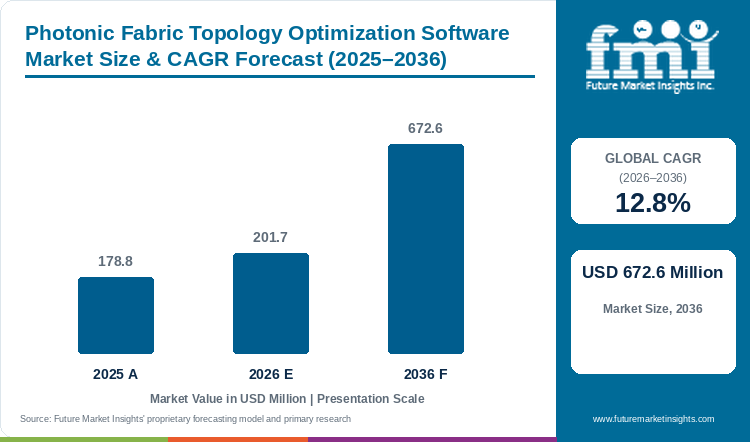
Demand for photonic fabric topology optimization software is projected to expand at 12.8% CAGR between 2026 and 2036. Industry value grows from USD 178.8 million in 2025 to USD 201.7 million in 2026 and is projected to reach USD 672.6 million by 2036.
FMI estimates photonic fabric topology optimization software market at USD 178.8 million in 2025, USD 201.7 million in 2026 and USD 672.6 million by 2036. Increasing number of optical links in AI clusters is creating demand for software that can select paths and locate weak links before the network is used. In March 2025, NVIDIA introduced Spectrum-X Photonics with 1.6 terabit-per-second ports.[1] Expansion from 800G towards 1.6T increases the number of routes, test records and fiber connections that needs to be managed. This is expected to support photonic fabric topology optimization software market growth.
Regional adoption patterns will differ as South Korea is projected to grow at 14.2% CAGR, whereas Japan is anticipated to grow at 13.9% through 2036. In February 2025, South Korea announced a plan to secure 18,000 high-performance GPUs and expand AI computing infrastructure.[10] Japan also linked growing generative AI use with support for semiconductors, data centers and software.[11] New AI campuses can include optical route planning before equipment is installed, while existing facilities requires the software to work with installed fibers and switches. Local documentation and link test records is expected to remain the final selection factor in both markets.
Key Takeaways
- Increasing number of optical links in AI clusters is boosting the demand for photonic fabric topology optimization software.
- By link speed, 800G is projected to account for 38.0% share in 2026. Wider availability of 800G switches, optics and testing equipment is expected to support the segment demand during the forecast period.
- Topology and path optimization is estimated to account for 26.0% of software function demand in 2026.
- Inter-rack scale-out is forecast to represent 36.0% of deployment location demand in 2026.
- South Korea photonic fabric topology optimization software market is projected to grow at 14.2% CAGR from 2026 to 2036.
- Some of the key companies operating in photonic fabric topology optimization software market are VIAVI Solutions, EXFO, Corning and AP Sensing. These companies are focusing on high-speed network testing, dense optical connection and fiber monitoring in order to cater the growing AI data center demand.
Analyst Perspective
“I expect software demand to increase as 1.6T moves from testing into AI networks. Companies combining measured link records with route planning will gain better adoption.”
- Sudip Saha, Principal Consultant, Future Market Insights.
How is the photonic fabric topology optimization software market segmented?
Photonic Fabric Topology Optimization Software Market is segmented by five primary categories and region: link speed, software function, deployment location, data center type, route to market, and region. In 2026, 800G is projected at 38.0%, topology and path optimization at 26.0%, inter-rack scale-out at 36.0%, hyperscale AI data centers at 48.0%, and OEM direct at 39.0% in their respective categories.
On the basis of link speed, photonic fabric topology optimization software market is segmented into 800G, 400G, 1.6T and 3.2T and above.
On the basis of software function, the market is segmented into topology and path optimization, link-margin analytics, fault localization, power-budget automation and capacity planning.
On the basis of deployment location, the market is segmented into inter-rack / scale-out, intra-rack / scale-up, spine-leaf fabric and campus / DCI.
On the basis of data center type, the market is segmented into hyperscale AI data centers, colocation AI facilities, enterprise AI/HPC and research / sovereign compute.
On the basis of route to market, the market is segmented into OEM direct, network system integrators, fiber/cabling specialists and test & managed-service providers.
What makes 800G central to the Link Speed category?
By link speed, 800G is estimated to hold 38.0% in 2026, owing to wider deployment and testing availability.
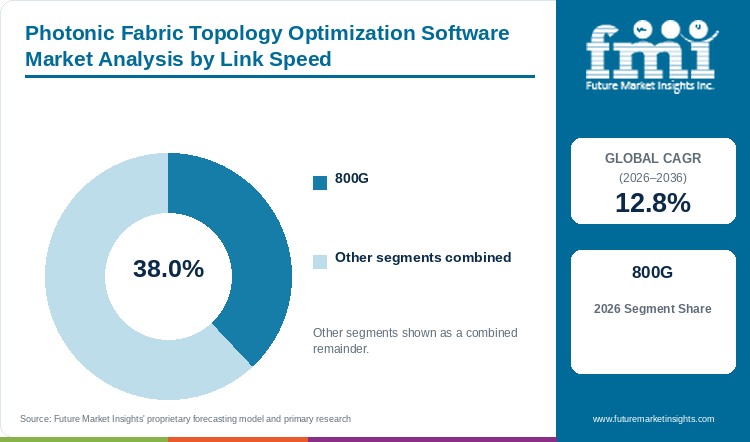
800G has gained higher use in AI and hyperscale networks as it provides more bandwidth than 400G and has a wider testing base than 1.6T. In October 2025, Ethernet Alliance reported that multivendor 800G links had moved towards routine operation, while 1.6T interoperability was continuing to advance.[2] Availability of field testers and established link measurements is expected to support the 800G segment during the forecast period.
- 800G is expected to hold 38.0% share in 2026. Increasing installation of 800G links in AI and hyperscale networks along with availability of established testing is supporting the segment demand.
- 800G network testing has reached a wider commercial stage, whereas 1.6T is moving through interoperability and early deployment. This transition is expected to increase demand for software which can retain the same topology records when the link speed changes.
Why does Topology & path optimization lead the Software Function category?
In 2026, topology and path optimization is expected to lead software function with 26.0% share, due to increasing route decisions.
Topology and path optimization software selects the optical route on the basis of link condition, available capacity and power limits. Increasing adoption of optical circuit switching is making the route changeable instead of remaining fixed. In July 2025, Open Compute Project introduced an Optical Circuit Switching subproject with software-defined interfaces for photonic route control.[3] Wider use of these interfaces is anticipated to support topology and path optimization demand.
- Topology and path optimization is expected to hold 26.0% share in 2026. The software combines link health, power limit and capacity information, which helps operators select an available optical path.
- Software-defined optical switching is making the network route changeable instead of remaining fixed. Increasing use of open control and telemetry interfaces is expected to support the topology and path optimization segment growth.
Why is Inter-rack / scale-out central to the Deployment Location category?
Inter-rack scale-out is projected to hold 36.0% of deployment location demand in 2026, attributed to rising east-west AI traffic.
Inter-rack scale-out connects a large number of accelerators placed in separate racks and switching stages. Slow or unbalanced links can delay the collective AI workload, due to which data center operators are increasing optical links between racks. In March 2026, Corning stated that scale-out and scale-up AI networks can increase optical connection density into thousands of fibers per server rack and switch rack.[4] Expansion of such optical networks is expected to drive the inter-rack segment growth.
- Inter-rack scale-out is projected to hold 36.0% share in 2026. Higher movement of AI traffic between racks is increasing requirement for balanced optical links and faster fault locating.
- Large AI factories use several switching stages between accelerator racks. Increasing number of optical connections at these stages is expected to drive demand for software that can keep route and link records together.
What makes Hyperscale AI data centers the leading Data Center Type?
Hyperscale AI data centers are set to lead data center type with 48.0% share in 2026, owing to higher optical link density.
Hyperscale AI data centers use a high number of optical links as thousands of accelerators are connected in one cluster. A weak link can delay the complete workload, due to which topology planning and fault locating software is increasingly being used. In July 2026, NIST published its AI data center security analysis for purpose-built infrastructure used in model training, inference and applications.[5] Increasing use of planned architecture records and operating controls is expected to support this segment.
- Hyperscale AI data centers are estimated to account for 48.0% share in 2026. Higher number of accelerators and optical links in one cluster is supporting the demand for topology planning and fault localization software.
- A weak optical link can delay a complete AI workload in a hyperscale facility. Due to this, operators are increasingly combining fiber monitoring, network records and operating controls, which is anticipated to support the segment growth.
Why does OEM direct lead the Route to Market category?
OEM direct is expected to command 39.0% of route to market demand in 2026, supported by tested hardware and software combinations.
OEM direct route has gained preference as topology software needs to work with the switch, optics and test interfaces used in the network. Buyers can receive the hardware, software and support from one supplier, which reduces problems during new link-rate deployment. In March 2025, VIAVI added an 800G transport module to OneAdvisor 800 with automatic configuration and built-in guidance.[6] Such vendor-based testing workflow is anticipated to support OEM direct sales.
- OEM direct is anticipated to account for 39.0% share in 2026. Buyers are preferring tested hardware and software combinations as new link speeds require repeatable configuration and acceptance.
- Direct purchase from the equipment supplier can provide testing guidance, software update and support through one route. This reduces integration issues during deployment and is expected to support OEM direct sales.
What are the drivers, restraints and opportunities in the photonic fabric topology optimization software market?
In the photonic fabric topology optimization software market, the key driver is expansion of AI fabrics, the key restraint is multi-vendor validation, and the key opportunity is closed-loop optical control.
- Driver: Expanding AI fabrics and the 800G-to-1.6T transition increase the value of software that selects paths, models link margins and shortens commissioning.
- Restraint: Different optics, switches and fiber conditions can provide different signal margin, which may restrict software use in multi-vendor networks.
- Opportunity: Integration of link testing, fiber sensing and topology records is expected to create growth opportunities for closed-loop optical control.
AI Fabrics Expand Optical Route Requirements
Increasing number of GPUs in AI clusters is expanding the optical fabric between servers, racks and switches. In April 2026, Open Compute Project published an optical circuit switching paper covering static and dynamic AI cluster reconfiguration, hardware-failure resiliency and spine replacement.[7] Software-defined optical paths can help operators select a route before production traffic is shifted. Expansion of larger AI fabrics is expected to drive demand for topology optimization and route validation software.
Mixed Optics Complicate Validation
Different optics, switches and fibers can provide different signal margin even when the calculated route is same. In September 2026, EXFO stated that 1.6T Ethernet uses eight 200 Gbit/s lanes in each direction, which is twice the per-lane data rate used for 800G Ethernet.[8] Software results requires comparable measurements from each vendor combination. Lack of common telemetry and test records may limiting adoption of topology optimization software in mixed networks.
Measured Links Open Optimization Routes
Topology software can move from network planning towards live route control when current link-test and sensing records are available. In June 2026, VIAVI launched an Ultra Ethernet Transport validation solution that emulates realistic AI traffic, congestion control and dynamic multipathing without dedicated GPU infrastructure.[9] Combining fiber maps, test results and fault signals can allow the software to check a path before changing it. This is expected to create growth opportunities for closed-loop photonic fabric optimization software.
Which country CAGRs are profiled in the photonic fabric topology optimization software market?
The profiled country CAGRs below cover 2026 to 2036.
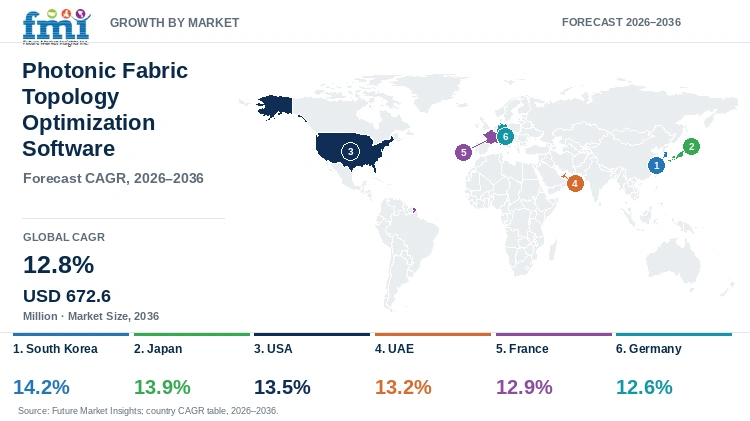
| Country | CAGR |
|---|---|
| South Korea | 14.2% |
| Japan | 13.9% |
| USA | 13.5% |
| UAE | 13.2% |
| France | 12.9% |
| Germany | 12.6% |
How do country-level CAGRs compare in the photonic fabric topology optimization software market?
Country outlook remains positive where public AI computing programs and large data center projects are increasing optical connections. Mature country markets will also require software that can add usable network capacity without replacing working fiber and switches.
- South Korea: Public-private compute expansion and support for facility power access favor faster adoption of software that can standardize large AI fabric builds.
- Japan: Policy support for semiconductors, data centers and software raises the value of reliable planning tools as compute capacity expands.
- USA: Hyperscale depth supports demand, but electricity and transmission constraints make utilization efficiency and deployment timing central purchasing tests.
- UAE: Large greenfield AI campus plans favor standardized topology design and OEM-led qualification across new high-density optical networks.
- France: Infrastructure investment and low-carbon power support expansion, while grid connection and project execution remain important gates.
- Germany: A national data center strategy supports capacity growth with strong emphasis on efficiency, siting and technical sovereignty.
The full report provides country-wise CAGR outlooks across North America, Latin America, Western Europe, Eastern Europe, East Asia, South Asia and Pacific, and the Middle East and Africa.
Country-wise Analysis
- South Korea is projected at 14.2% from 2026 to 2036. In February 2025, the Ministry of Science and ICT set out a plan to secure 18,000 high-performance GPUs and expand AI computing infrastructure.[10] The program also addressed private investment and facility power supply. That policy direction supports new cluster deployments where topology software can be specified early rather than retrofitted after congestion or link problems appear. Suppliers still need to fit domestic network architectures and local operating requirements. Purchases should favor tools that can consume multi-vendor telemetry and maintain repeatable validation as AI compute expands beyond a single facility. Those changes give planners more links to verify before changing live paths.
- Japan photonic fabric topology optimization software market is anticipated to advance at 13.9% CAGR over the assessment period. In February 2025, Ministry of Economy, Trade and Industry connected rising generative AI demand with support for semiconductors, data centers and software.[11] Japan has an established enterprise and carrier network base, due to which new topology software must work with installed fibers and existing change controls. Increasing investment in AI compute along with requirement for traceable network changes is expected to support demand for route planning, measured link records and photonic fault location software.
- Photonic fabric topology optimization software demand in the USA is forecast to rise at 13.5% CAGR over the forecast period. Lawrence Berkeley National Laboratory estimated in June 2026 that data centers could use 11.8% of U.S. electricity by 2030, with a scenario range of 9.5% to 15.3%.[12] Higher power requirement is increasing pressure on operators to use installed accelerator and network capacity more efficiently. Topology software can identify optical paths that leave bandwidth unused or delay AI workloads. Expansion of hyperscale facilities and need to improve usable capacity without replacing the complete network is expected to drive the USA photonic fabric topology optimization software market.
- Adoption of photonic fabric topology optimization software in the UAE is estimated to expand at 13.2% CAGR through 2036. In May 2025, UAE and U.S. governments announced a framework that included a 1 GW AI data center in a planned 5 GW technology cluster in Abu Dhabi.[13] New campuses can standardize fiber maps, route templates and link test records before the network begins operation. A large greenfield cluster will also require controlled access and clear limits for automatic route changes. Expansion of sovereign AI infrastructure and high-density optical networks is expected to create demand for topology design, capacity planning and repeatable acceptance software in the UAE market.
- France photonic fabric topology optimization software market is projected to record 12.9% CAGR during the assessment period. In February 2025, the French presidency announced AI infrastructure projects and referred to availability of decarbonized electricity and data center sites.[14] Larger facilities will increase optical paths between racks and buildings, whereas staged construction will require planned and installed fiber records to remain updated. Topology software can compare the route planned for each stage with equipment already available at the site. Expansion of AI data center capacity and requirement for phased network planning is anticipated to support demand for photonic fabric topology optimization software in France.
- Germany is estimated to post 12.6% CAGR over the forecast period. In March 2026, the federal government approved a strategy seeking to double data center IT connection capacity by 2030 compared with 2025 and increase high-performance computing and AI connection capacity by at least four times.[15] New capacity must also meet energy, siting, sustainability and technical sovereignty requirements. Existing enterprise fibers and operating rules will remain part of many network expansions, due to which route changes needs measured link records before traffic is moved. These conditions are expected to support demand for photonic topology planning, capacity checking and fault location software in Germany.
Who are the notable companies in the photonic fabric topology optimization software market?
AP Sensing, VIAVI Solutions, EXFO, and Corning are the notable companies profiled in this market.
Competition in photonic fabric topology optimization software market is moderately fragmented with presence of testing companies, optical connectivity suppliers and fiber sensing providers. VIAVI Solutions and EXFO are focusing on high-speed Ethernet testing and automated acceptance. Corning is expanding dense optical connection for AI data centers, whereas AP Sensing provides distributed fiber monitoring software. Companies are increasing 800G and 1.6T related products in order to cater the growing demand. Availability of test records, product compatibility and support for installed equipment is expected to affect company selection.
- AI-Fabric Validation and Test Automation: VIAVI Solutions and EXFO are offering high-speed Ethernet testing, optical validation and automated acceptance tools. These tools can provide the link records required for topology decisions.
- Optical Infrastructure Design and Connectivity: Corning is focusing on dense AI data center fiber design, co-packaged optics connection and network deployment support.
- Distributed Photonic Sensing and Facility Observability: AP Sensing provides fiber-based monitoring software and data integration for data center infrastructure.
- Optical Infrastructure Design and Connectivity: Corning supports dense AI data center fiber design, co-packaged optics connectivity and network planning or deployment services.
Competitive Benchmarking: Photonic Fabric Topology Optimization Software Market
| Company | Topology & Path Optimization Fit | Link-Margin & Fault Analytics | AI Data Center Optical Deployment Support | Geographic Reach |
|---|---|---|---|---|
| AP Sensing | Low | Medium | Medium | Medium |
| VIAVI Solutions | Medium | High | High | High |
| EXFO | Medium | High | High | High |
| Corning | Medium | Low | High | High |
Scoring basis: Topology & Path Optimization Fit measures documented planning or fabric validation that can influence topology decisions. It also includes documented control capability where available. Link-Margin & Fault Analytics measures documented ability to quantify optical condition and errors or faults. AI Data Center Optical Deployment Support measures the breadth of documented design or validation for AI data centers. It also covers connectivity support. High indicates broad documented capability while Medium indicates a credible but narrower role. Low is reserved for a documented limitation and unavailable public information is left Unscored.
Key Developments in the Photonic Fabric Topology Optimization Software Market
- In March 2026, VIAVI Solutions launched TestCenter D2 1.6T Appliance for AI workloads and multi-vendor 1.6T networks. The platform provides large-scale traffic generation and analysis, which can support validation of high-speed routes before production deployment.
- In April 2025, EXFO introduced BA-1600 Bit Analyzer for lab-to-fabrication 1.6T validation. Availability of physical-layer test data can help engineers check link margin before selecting optical paths for AI fabrics.
- In May 2025, Corning announced collaboration with Broadcom for optical components used in the 51.2 Tbps Bailly co-packaged optics system. Denser fiber connection near switching silicon is expected to increase requirement for accurate connector maps and capacity planning.
Key Players in the Photonic Fabric Topology Optimization Software Market
AI-Fabric Validation and Test Automation
- VIAVI Solutions
- EXFO
Optical Infrastructure Design and Connectivity
- Corning
Distributed Photonic Sensing and Facility Observability
- AP Sensing
Photonic Fabric Topology Optimization Software Market - Report Scope
| Coverage field | Report scope |
|---|---|
| Market breakdown | Link Speed; Software Function; Deployment Location; Data Center Type; Route to Market |
| Quantitative Units | USD Million |
| Market Definition | Revenue includes stand-alone or separately allocable software used for modeling, planning, optimizing, validating or tuning photonic fabric topology and related link decisions. Physical switches, optics, fiber, compute systems and general software without direct photonic-fabric optimization function are excluded. |
| Regions Covered | North America; Latin America; Western Europe; Eastern Europe; East Asia; South Asia and Pacific; Middle East and Africa |
| Countries Covered | USA; Japan; South Korea; France; Germany; UAE |
| Key Companies Profiled | AP Sensing; VIAVI Solutions; EXFO; Corning |
| Forecast Period | 2026 to 2036 |
| Approach | Primary and secondary research with market triangulation. |
Photonic Fabric Topology Optimization Software Market - Research Methodology
| Method | Approach |
|---|---|
| Market inputs | FMI analysts collected information from manufacturers, service providers, technology developers, distributors, end users, procurement teams and industry experts. Interviews covers product evaluation, purchase decision, pricing, adoption barriers, approval requirement and technical support. Respondents were also asked about evidence required before trial, pilot and regular purchase. |
| Desk Research | Desk research includes government statistics, regulatory publications, industry associations, technical literature, company filings, product information and official company announcements. Sources were reviewed on the basis of publication date, market relevance and geographic coverage. Claims related to product performance, capacity, investment and commercial activity were included where direct supporting evidence was available. |
| Market Sizing and Forecasting | Market sizing combines the base value with historical growth, segment structure, pricing, adoption, company participation and country demand condition. Forecast assumptions includes investment trend, economic activity, technology adoption, purchasing cycle and supply availability. Segment and regional values were checked before arriving at the final market total. |
| Data Validation | Market estimates were checked with public data, company activity, technical developments and primary interview findings. Products and services outside the stated market definition were excluded. Unsupported claims, overlapping revenue and adjacent activities were also excluded in order to reduce double counting. |
Photonic Fabric Topology Optimization Software Market by Segments
Photonic Fabric Topology Optimization Software Market segmented by Link Speed:
- 800G
- 400G
- 1.6T
- 3.2T and above
Photonic Fabric Topology Optimization Software Market segmented by Software Function:
- Topology & path optimization
- Link-margin analytics
- Fault localization
- Power-budget automation
- Capacity planning
Photonic Fabric Topology Optimization Software Market segmented by Deployment Location:
- Inter-rack / scale-out
- Intra-rack / scale-up
- Spine-leaf fabric
- Campus / DCI
Photonic Fabric Topology Optimization Software Market segmented by Data Center Type:
- Hyperscale AI data centers
- Colocation AI facilities
- Enterprise AI/HPC
- Research / sovereign compute
Photonic Fabric Topology Optimization Software Market segmented by Route to Market:
- OEM direct
- Network system integrators
- Fiber/cabling specialists
- Test & managed-service providers
Photonic Fabric Topology Optimization Software Market by Region
- North America
- United States
- Canada
- Latin America
- Brazil
- Mexico
- Argentina
- Chile
- Western Europe
- Germany
- France
- United Kingdom
- Italy
- Spain
- Benelux
- Nordics
- Eastern Europe
- Poland
- Czech Republic
- Romania
- Hungary
- East Asia
- China
- Japan
- South Korea
- South Asia and Pacific
- India
- ASEAN
- Australia and New Zealand
- Middle East and Africa
- GCC Countries
- South Africa
- Türkiye
- Israel
Research Sources and Bibliography
- [1] NVIDIA. (2025, March 18). NVIDIA announces Spectrum-X Photonics, co-packaged optics networking switches to scale AI factories to millions of GPUs.
- [2] Ethernet Alliance. (2025, October 27). ECOC 2025: Interoperability at 800G is given, advancing toward 1.6T.
- [3] Open Compute Project Foundation. (2025, July 21). The Open Compute Project announces new Optical Circuit Switching project.
- [4] Corning Incorporated. (2026, March 11). Corning expands AI data center connectivity portfolio with PRIZM TMT technology.
- [5] National Institute of Standards and Technology. (2026, July 27). AI data center security analysis: A high-performance computing driven approach.
- [6] VIAVI Solutions. (2025, March 18). VIAVI adds 800G module to the OneAdvisor 800 family of field testers.
- [7] Open Compute Project Foundation. (2026, April). Optical circuit switching for AI and hyperscale datacenters: Benefits, technologies, current and future deployments.
- [8] EXFO. (2026, September 8). What is 1.6T Ethernet? A Q&A for network and test engineers.
- [9] VIAVI Solutions. (2026, June 23). VIAVI launches industry first validation solution for Ultra Ethernet Transport, accelerating AI data center deployments.
- [10] Ministry of Science and ICT, Republic of Korea. (2025, February 20). Korea to expand AI computing infrastructure to strengthen national AI capabilities and achieve global leadership.
- [11] Ministry of Economy, Trade and Industry, Japan. (2025, February 7). Cabinet decision on the bill for partially amending the Act on Facilitation of Information Processing and the Act on Special Accounts.
- [12] Lawrence Berkeley National Laboratory. (2026, June). United States data center energy usage report: 2025 update.
- [13] UAE Ministry of Foreign Affairs. (2025, May 16). UAE/US framework on advanced technology cooperation.
- [14] Élysée. (2025, February 11). Make France an AI powerhouse.
- [15] German Federal Government. (2026, March 18). Mehr Rechenpower für Deutschland.
This bibliography is provided for reader reference. The full report contains the complete reference list and detailed citations.
This Report Answers
- How big is the Photonic Fabric Topology Optimization Software market in 2026?
- What value is the Photonic Fabric Topology Optimization Software market projected to reach by 2036?
- Which segment leads the Photonic Fabric Topology Optimization Software market in 2026?
- Which sales channel is prominent in the Photonic Fabric Topology Optimization Software market?
- Which countries show notable Photonic Fabric Topology Optimization Software market growth through 2036?
- Who are notable companies in the Photonic Fabric Topology Optimization Software market?
Frequently Asked Questions
How big is the photonic fabric topology optimization software market in 2026?
Future Market Insights estimates the photonic fabric topology optimization software market at USD 201.7 million in 2026 and projects USD 672.6 million by 2036.
What is the photonic fabric topology optimization software market CAGR from 2026 to 2036?
FMI projects a 12.8% CAGR for the photonic fabric topology optimization software market from 2026 to 2036.
Why is 800g prominent in the photonic fabric topology optimization software market?
800g is expected to lead its parent segment in 2026 because active deployment across AI and hyperscale networks rather than the still-earlier commercial maturity of 1.6T.
Why does topology & path optimization matter in the photonic fabric topology optimization software market?
Topology & path optimization is projected to retain a notable parent-segment share because path selection can consume link health, power limits and capacity inputs within one fabric-level decision process.
Which country has notable photonic fabric topology optimization software market growth?
South Korea is projected to expand at 14.2% CAGR from 2026 to 2036 under the report's country outlook.
Who are notable companies in the photonic fabric topology optimization software market?
Notable companies include AP Sensing, VIAVI Solutions, EXFO, and Corning and other companies named in the competitive assessment.
Preview the report firsthand - request a free sample
Get SampleGet the brochure for pricing and purchase details.
Get PDFTable of Content
- Key Takeaways
- Market Size and CAGR
- Top Growth Driver
- Fastest Growing Segment
- Leading Region
- Key Companies
- Emerging Opportunities
- Executive Summary
- Global Market Outlook
- Demand-side Trends
- Supply-side Trends
- Technology Roadmap Analysis
- Analysis and Recommendations
- Analyst Perspective (What is happening? Why now? What should investors know?)
- Key Questions Answered
- How large is the market?
- What is the CAGR?
- What are key trends?
- Which region dominates?
- Who are the leaders?
- Market Overview
- Market Coverage / Taxonomy
- Market Definition / Scope / Limitations
- Research Methodology
- Chapter Orientation
- Analytical Lens and Working Hypotheses
- Market Structure, Signals, and Trend Drivers
- Benchmarking and Cross-market Comparability
- Market Sizing, Forecasting, and Opportunity Mapping
- Research Design and Evidence Framework
- Desk Research Programme (Secondary Evidence)
- Expert Input and Fieldwork (Primary Evidence)
- Tooling, Models, and Reference Databases
- Data Engineering and Model Build
- Quality Assurance and Audit Trail
- Market Background
- Market Dynamics (Drivers, Restraints, Opportunity, Trends)
- Scenario Forecast (Optimistic, Likely, Conservative)
- Impact Analysis
- AI Impact
- Sustainability Impact
- Regulatory Impact
- Technology Impact
- Consumer / Buyer Analysis
- Purchase Drivers
- Adoption Barriers
- Buyer Journey
- Opportunity Map Analysis
- Product Life Cycle Analysis
- Supply Chain Analysis
- Investment Feasibility Matrix
- Value Chain Analysis
- PESTLE and Porter's Analysis
- Regulatory Landscape
- Regional Parent Market Outlook
- Production and Consumption Statistics
- Import and Export Statistics
- Global Market Analysis and Forecast, 2021 to 2036
- Historical Market Size Value (USD Million) Analysis, 2021 to 2025
- Current and Future Market Size Value (USD Million) Projections, 2026 to 2036
- Y-o-Y Growth Trend Analysis
- Absolute $ Opportunity Analysis
- Global Market Pricing Analysis, 2021 to 2036
- Global Market Analysis and Forecast, By Link Speed, 2021 to 2036
- Introduction / Key Findings
- Historical Market Size Value (USD Million) Analysis By Link Speed, 2021 to 2025
- Current and Future Market Size Value (USD Million) Analysis and Forecast By Link Speed, 2026 to 2036
- 800G
- 400G
- 1.6T
- 3.2T and above
- Y-o-Y Growth Trend Analysis By Link Speed, 2021 to 2025
- Absolute $ Opportunity Analysis By Link Speed, 2026 to 2036
- Global Market Analysis and Forecast, By Software Function, 2021 to 2036
- Introduction / Key Findings
- Historical Market Size Value (USD Million) Analysis By Software Function, 2021 to 2025
- Current and Future Market Size Value (USD Million) Analysis and Forecast By Software Function, 2026 to 2036
- Topology & path optimization
- Link-margin analytics
- Fault localization
- Power-budget automation
- Capacity planning
- Y-o-Y Growth Trend Analysis By Software Function, 2021 to 2025
- Absolute $ Opportunity Analysis By Software Function, 2026 to 2036
- Global Market Analysis and Forecast, By Deployment Location, 2021 to 2036
- Introduction / Key Findings
- Historical Market Size Value (USD Million) Analysis By Deployment Location, 2021 to 2025
- Current and Future Market Size Value (USD Million) Analysis and Forecast By Deployment Location, 2026 to 2036
- Inter-rack / scale-out
- Intra-rack / scale-up
- Spine-leaf fabric
- Campus / DCI
- Y-o-Y Growth Trend Analysis By Deployment Location, 2021 to 2025
- Absolute $ Opportunity Analysis By Deployment Location, 2026 to 2036
- Global Market Analysis and Forecast, By Data Center Type, 2021 to 2036
- Introduction / Key Findings
- Historical Market Size Value (USD Million) Analysis By Data Center Type, 2021 to 2025
- Current and Future Market Size Value (USD Million) Analysis and Forecast By Data Center Type, 2026 to 2036
- Hyperscale AI data centers
- Colocation AI facilities
- Enterprise AI/HPC
- Research / sovereign compute
- Y-o-Y Growth Trend Analysis By Data Center Type, 2021 to 2025
- Absolute $ Opportunity Analysis By Data Center Type, 2026 to 2036
- Global Market Analysis and Forecast, By Route to Market, 2021 to 2036
- Introduction / Key Findings
- Historical Market Size Value (USD Million) Analysis By Route to Market, 2021 to 2025
- Current and Future Market Size Value (USD Million) Analysis and Forecast By Route to Market, 2026 to 2036
- OEM direct
- Network system integrators
- Fiber/cabling specialists
- Test & managed-service providers
- Y-o-Y Growth Trend Analysis By Route to Market, 2021 to 2025
- Absolute $ Opportunity Analysis By Route to Market, 2026 to 2036
- Global Market Analysis and Forecast, By Region, 2021 to 2036
- Introduction
- Historical Market Size Value (USD Million) Analysis By Region, 2021 to 2025
- Current Market Size Value (USD Million) Analysis and Forecast By Region, 2026 to 2036
- North America
- Latin America
- Western Europe
- Eastern Europe
- East Asia
- South Asia and Pacific
- Middle East and Africa
- Market Attractiveness Analysis By Region
- North America Market Analysis and Forecast, By Country, 2021 to 2036
- Historical Market Size Value (USD Million) Trend Analysis By Market Taxonomy, 2021 to 2025
- Market Size Value (USD Million) Forecast By Market Taxonomy, 2026 to 2036
- By Country
- United States
- Canada
- By Link Speed
- By Software Function
- By Deployment Location
- By Data Center Type
- By Route to Market
- By Country
- Market Attractiveness Analysis
- By Country
- By Link Speed
- By Software Function
- By Deployment Location
- By Data Center Type
- By Route to Market
- Key Takeaways
- Latin America Market Analysis and Forecast, By Country
- Historical Market Size Value (USD Million) Trend Analysis By Market Taxonomy, 2021 to 2025
- Market Size Value (USD Million) Forecast By Market Taxonomy, 2026 to 2036
- By Country
- Brazil
- Mexico
- Argentina
- Chile
- By Link Speed
- By Software Function
- By Deployment Location
- By Data Center Type
- By Route to Market
- By Country
- Market Attractiveness Analysis
- By Country
- By Link Speed
- By Software Function
- By Deployment Location
- By Data Center Type
- By Route to Market
- Key Takeaways
- Western Europe Market Analysis and Forecast, By Country
- Historical Market Size Value (USD Million) Trend Analysis By Market Taxonomy, 2021 to 2025
- Market Size Value (USD Million) Forecast By Market Taxonomy, 2026 to 2036
- By Country
- Germany
- France
- United Kingdom
- Italy
- Spain
- Benelux
- Nordics
- By Link Speed
- By Software Function
- By Deployment Location
- By Data Center Type
- By Route to Market
- By Country
- Market Attractiveness Analysis
- By Country
- By Link Speed
- By Software Function
- By Deployment Location
- By Data Center Type
- By Route to Market
- Key Takeaways
- Eastern Europe Market Analysis and Forecast, By Country
- Historical Market Size Value (USD Million) Trend Analysis By Market Taxonomy, 2021 to 2025
- Market Size Value (USD Million) Forecast By Market Taxonomy, 2026 to 2036
- By Country
- Poland
- Czech Republic
- Romania
- Hungary
- By Link Speed
- By Software Function
- By Deployment Location
- By Data Center Type
- By Route to Market
- By Country
- Market Attractiveness Analysis
- By Country
- By Link Speed
- By Software Function
- By Deployment Location
- By Data Center Type
- By Route to Market
- Key Takeaways
- East Asia Market Analysis and Forecast, By Country
- Historical Market Size Value (USD Million) Trend Analysis By Market Taxonomy, 2021 to 2025
- Market Size Value (USD Million) Forecast By Market Taxonomy, 2026 to 2036
- By Country
- China
- Japan
- South Korea
- By Link Speed
- By Software Function
- By Deployment Location
- By Data Center Type
- By Route to Market
- By Country
- Market Attractiveness Analysis
- By Country
- By Link Speed
- By Software Function
- By Deployment Location
- By Data Center Type
- By Route to Market
- Key Takeaways
- South Asia and Pacific Market Analysis and Forecast, By Country
- Historical Market Size Value (USD Million) Trend Analysis By Market Taxonomy, 2021 to 2025
- Market Size Value (USD Million) Forecast By Market Taxonomy, 2026 to 2036
- By Country
- India
- ASEAN
- Australia and New Zealand
- By Link Speed
- By Software Function
- By Deployment Location
- By Data Center Type
- By Route to Market
- By Country
- Market Attractiveness Analysis
- By Country
- By Link Speed
- By Software Function
- By Deployment Location
- By Data Center Type
- By Route to Market
- Key Takeaways
- Middle East and Africa Market Analysis and Forecast, By Country
- Historical Market Size Value (USD Million) Trend Analysis By Market Taxonomy, 2021 to 2025
- Market Size Value (USD Million) Forecast By Market Taxonomy, 2026 to 2036
- By Country
- GCC Countries
- South Africa
- Türkiye
- Israel
- By Link Speed
- By Software Function
- By Deployment Location
- By Data Center Type
- By Route to Market
- By Country
- Market Attractiveness Analysis
- By Country
- By Link Speed
- By Software Function
- By Deployment Location
- By Data Center Type
- By Route to Market
- Key Takeaways
- Key Countries Market Analysis
- United States
- Pricing Analysis
- Market Share Analysis, 2025
- By Link Speed
- By Software Function
- By Deployment Location
- By Data Center Type
- By Route to Market
- Canada
- Pricing Analysis
- Market Share Analysis, 2025
- By Link Speed
- By Software Function
- By Deployment Location
- By Data Center Type
- By Route to Market
- Mexico
- Pricing Analysis
- Market Share Analysis, 2025
- By Link Speed
- By Software Function
- By Deployment Location
- By Data Center Type
- By Route to Market
- Brazil
- Pricing Analysis
- Market Share Analysis, 2025
- By Link Speed
- By Software Function
- By Deployment Location
- By Data Center Type
- By Route to Market
- Chile
- Pricing Analysis
- Market Share Analysis, 2025
- By Link Speed
- By Software Function
- By Deployment Location
- By Data Center Type
- By Route to Market
- Germany
- Pricing Analysis
- Market Share Analysis, 2025
- By Link Speed
- By Software Function
- By Deployment Location
- By Data Center Type
- By Route to Market
- United Kingdom
- Pricing Analysis
- Market Share Analysis, 2025
- By Link Speed
- By Software Function
- By Deployment Location
- By Data Center Type
- By Route to Market
- Italy
- Pricing Analysis
- Market Share Analysis, 2025
- By Link Speed
- By Software Function
- By Deployment Location
- By Data Center Type
- By Route to Market
- Spain
- Pricing Analysis
- Market Share Analysis, 2025
- By Link Speed
- By Software Function
- By Deployment Location
- By Data Center Type
- By Route to Market
- France
- Pricing Analysis
- Market Share Analysis, 2025
- By Link Speed
- By Software Function
- By Deployment Location
- By Data Center Type
- By Route to Market
- India
- Pricing Analysis
- Market Share Analysis, 2025
- By Link Speed
- By Software Function
- By Deployment Location
- By Data Center Type
- By Route to Market
- ASEAN
- Pricing Analysis
- Market Share Analysis, 2025
- By Link Speed
- By Software Function
- By Deployment Location
- By Data Center Type
- By Route to Market
- Australia and New Zealand
- Pricing Analysis
- Market Share Analysis, 2025
- By Link Speed
- By Software Function
- By Deployment Location
- By Data Center Type
- By Route to Market
- China
- Pricing Analysis
- Market Share Analysis, 2025
- By Link Speed
- By Software Function
- By Deployment Location
- By Data Center Type
- By Route to Market
- Japan
- Pricing Analysis
- Market Share Analysis, 2025
- By Link Speed
- By Software Function
- By Deployment Location
- By Data Center Type
- By Route to Market
- South Korea
- Pricing Analysis
- Market Share Analysis, 2025
- By Link Speed
- By Software Function
- By Deployment Location
- By Data Center Type
- By Route to Market
- Poland
- Pricing Analysis
- Market Share Analysis, 2025
- By Link Speed
- By Software Function
- By Deployment Location
- By Data Center Type
- By Route to Market
- Hungary
- Pricing Analysis
- Market Share Analysis, 2025
- By Link Speed
- By Software Function
- By Deployment Location
- By Data Center Type
- By Route to Market
- Türkiye
- Pricing Analysis
- Market Share Analysis, 2025
- By Link Speed
- By Software Function
- By Deployment Location
- By Data Center Type
- By Route to Market
- South Africa
- Pricing Analysis
- Market Share Analysis, 2025
- By Link Speed
- By Software Function
- By Deployment Location
- By Data Center Type
- By Route to Market
- UAE
- Pricing Analysis
- Market Share Analysis, 2025
- By Link Speed
- By Software Function
- By Deployment Location
- By Data Center Type
- By Route to Market
- United States
- Market Structure Analysis
- Competition Dashboard
- Competition Benchmarking
- Market Share Analysis of Top Players
- By Regional
- By Link Speed
- By Software Function
- By Deployment Location
- By Data Center Type
- By Route to Market
- Emerging Startups
- Innovation Benchmarking
- Competition Analysis
- Competition Deep Dive
- AP Sensing
- Overview
- Product Portfolio
- Profitability by Market Segments
- Sales Footprint
- Strategy Overview
- Marketing Strategy
- Product Strategy
- Channel Strategy
- VIAVI Solutions
- EXFO
- Corning
- AP Sensing
- Case Studies
- Success Stories
- Recent Developments
- Competition Deep Dive
- Assumptions & Acronyms Used


