

- Market Size (2026)
- USD 240.0 Mn
- Forecast (2036)
- USD 508.9 Mn
- CAGR (2026 to 2036)
- 7.8%
Plant-Based Egg Bites Market Size, Market Forecast and Outlook By FMI
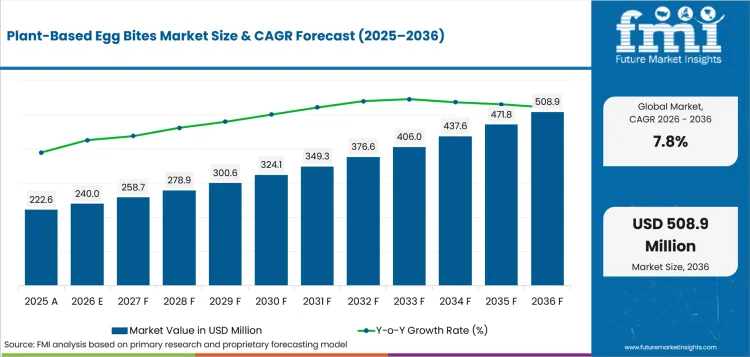
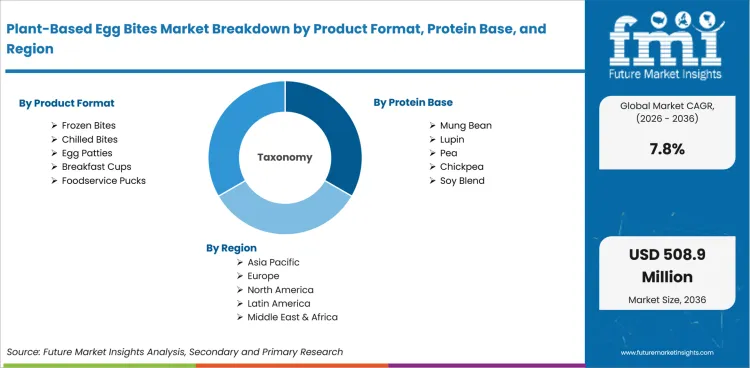
The plant-based egg bites market is expected to move from USD 222.6 million in 2025 to USD 508.9 million by 2036 at 7.8% CAGR, driven by frozen breakfast use and egg supply risk. Retail freezer is forecast to account for 64.2% share as shoppers compare egg alternatives beside breakfast meals. Frozen bites are expected to secure 58.4% share since heat-and-eat portions reduce cooking effort.
Key Takeaways, Market Size, and Forecast
- 2026 Market Size: USD 240.0 million
- 2036 Market Size: USD 508.9 million
- Forecast CAGR: 7.8% from 2026 to 2036
- Leading Sales Channel: Retail Freezer
- Retail Freezer Share in 2026: 64.2%
- Leading Product Format: Frozen Bites
- Frozen Bites Share in 2026: 58.4%
- Fastest-growing Country: Saudi Arabia
- Saudi Arabia CAGR: 8.8% by 2036
Summary of Plant-Based Egg Bites Market
- Demand and Expansion Drivers
- Breakfast brands are adding egg-free bites because shoppers want quick meals with simple heating steps.
- Foodservice operators are testing bite formats because fixed portions reduce kitchen work during busy breakfast hours.
- Ingredient suppliers are improving plant protein systems so finished bites can hold texture after freezing and reheating.
- Product and Segment View
- Frozen bites are expected to lead because they fit retail freezer cases and allow longer shelf handling.
- Mung bean and pea protein systems are expected to gain attention because they help create egg-like bite structure.
- Four-pack formats are expected to work well for first-time shoppers because the pack size feels easier to try.
- Geography and Competitive Outlook
- The United States is expected to stay important because frozen breakfast shelves already support egg alternative products.
- Saudi Arabia and the United Kingdom are expected to build demand through premium grocery and foodservice channels.
- Leading suppliers are expected to compete on texture and protein claims along with freezer performance and retail placement.
- Analyst Opinion
- Nandini Roy Choudhury, Principal Consultant for Food and Beverage at FMI, states, “Plant-based egg bites are moving beyond vegan replacement into breakfast risk planning. Retailers and co-manufacturers compare freezer stability and reheating texture before listing new items. Suppliers with reliable bite texture and retail-ready pack economics should protect repeat contracts.”
- Plant-Based Egg Bites Market Value Analysis
- Market value is based on ready-to-eat egg alternative bites after liquid substitutes and bakery-only powders are excluded.
- Supplier revenue reflects frozen and chilled finished bites sold through retail freezer and foodservice channels.
- Revenue improves as brands shift from single-use scrambles into breakfast portions with repeat freezer occasions.
- Buyer trust improves as co-manufacturers provide texture sheets and reheating instructions for bite formats.
Breakfast buyers are looking for egg-free products that are easy to heat and do not lose texture after freezing. This matters because many shoppers want a quick breakfast item, not a liquid egg substitute that needs cooking in a pan. In December 2024, Crafty Counter said WunderEggs would enter 1,600 Albertsons banner stores after already reaching 1,000 stores. This retail expansion shows that finished egg-style products can move from specialty shelves into mainstream grocery channels. Plant-based egg bite suppliers can use the same path by offering frozen breakfast portions that sit beside familiar morning meal products and feel easy for shoppers to try.
Why is the Plant-Based Egg Bites Market Growing?
- Frozen breakfast brands are using bite formats to make egg alternatives easier for households to use.
- Foodservice operators need egg-style portions that reduce waste and fit griddle-free kitchen setups.
- Ingredient suppliers are improving gelling and water control so bite texture stays stable after reheating.
Plant-based egg bite demand is moving toward prepared formats that feel like breakfast food instead of cooking ingredients. Crafty Counter stated in November 2025 that its Protein Buns contain 11 g protein and 4 g dietary fiber per bun. Proeon said in April 2025 that it received about EUR 1 million for Project EGGcellent to develop vegan egg alternatives for industrial baking. The same texture work can guide frozen plant-based meals that use egg-style bites.
Market Segmentation Analysis
- Frozen bites are forecast to account for 58.4% share in 2026, supported by freezer durability and fast reheating.
- Mung bean is expected to hold 41.7% protein share in 2026 because commercial egg alternatives already use its gel behavior.
- Retail freezer share is projected at 64.2% in 2026 since shoppers compare egg alternatives beside breakfast meals.
- Four-pack units could secure 47.6% share in 2026 with smaller boxes reducing first-purchase risk.
- Retail brands are forecast to capture 56.9% buyer-type share in 2026 as grocery programs move faster than menu tests.
The market is divided into five primary segment groups based on product format and protein base. Sales channel, pack size and buyer type complete the structure. Product format covers frozen bites and chilled bites. Egg patties, breakfast cups and foodservice pucks complete the format group. Protein base covers mung bean and lupin. Pea, chickpea and soy blend systems complete the protein scope. Sales channel covers retail freezer and club stores. Online grocery, foodservice and meal kits complete the channel scope. Pack size covers four pack and family pack. Single serve, bulk case and mixed kit complete the pack scope. Buyer type covers retail brands and private label. Foodservice operators, meal kit brands and co-manufacturers complete the buyer scope. Product fit overlaps with plant-based meals as breakfast portions enter frozen ready food.
Insights into Plant-Based Egg Bites Market by Product Format
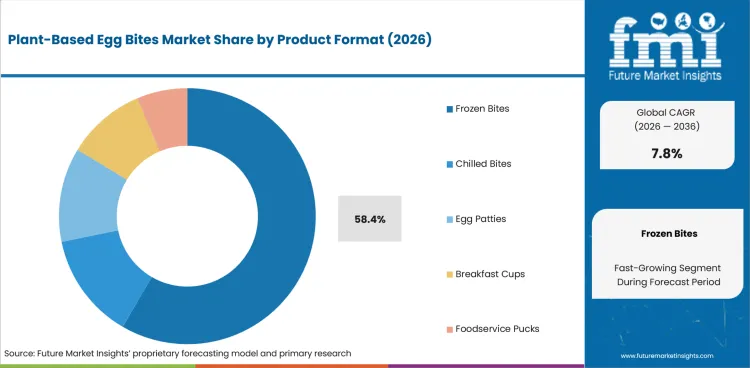
- Frozen bites are projected to account for 58.4% share in 2026 because freezer storage keeps texture more stable for retail handling.
- Chilled bites are expected to serve premium breakfast shelves, while ready-to-eat food demand can help stores test smaller egg-free portions.
Insights into Plant-Based Egg Bites Market by Protein Base
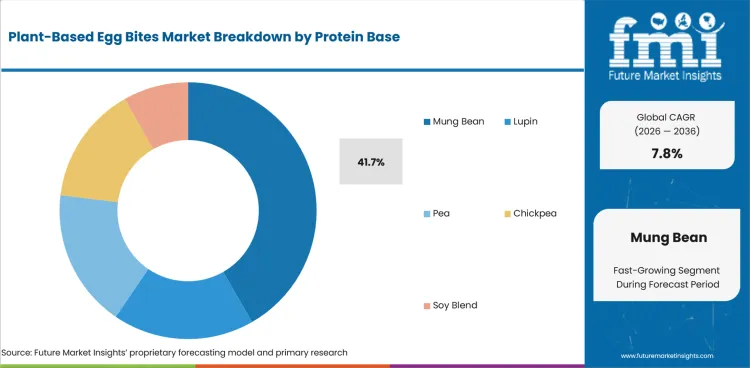
- Mung bean is expected to hold 41.7% share in 2026 due to its proven use in egg-style texture and soft bite structure.
- Pea protein is likely to draw more interest from allergen-aware brands, since it works well in plant-based protein systems.
Insights into Plant-Based Egg Bites Market by Sales Channel
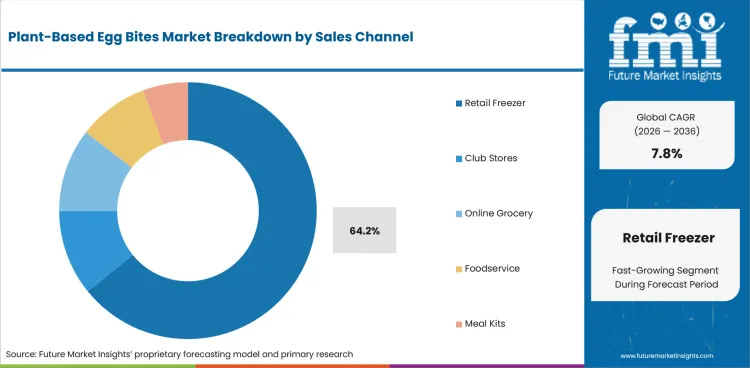
- Retail freezer is projected to capture 64.2% share in 2026, helped by shopper habits around frozen breakfast items.
- Foodservice is expected to expand through cafes and hotels, since fixed-size bites can reduce kitchen work and portion waste.
Insights into Plant-Based Egg Bites Market by Pack Size
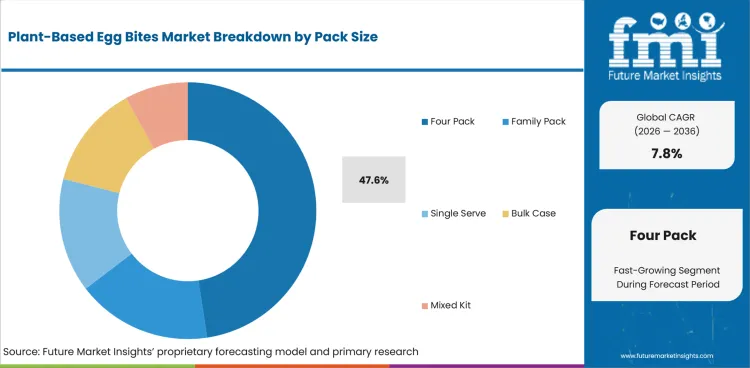
- Four-pack units are expected to secure 47.6% share in 2026 because small boxes make first-time trial easier for shoppers.
- Bulk cases are likely to fit foodservice kitchens, since operators need steady portions for breakfast plates and buffet service.
Insights into Plant-Based Egg Bites Market by Buyer Type
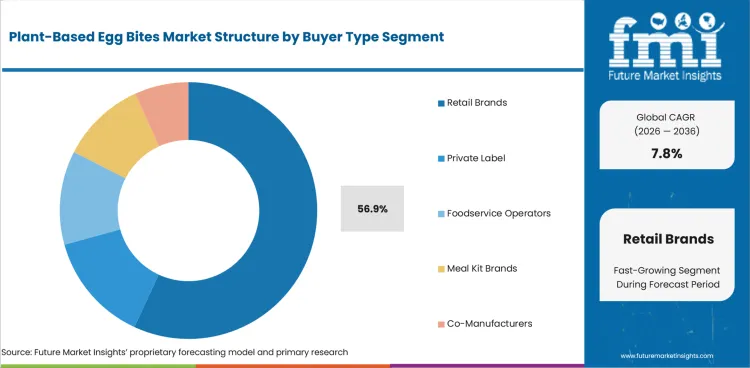
- Retail brands are forecast to capture 56.9% share in 2026, with frozen shelves giving them a clear launch route.
- Co-manufacturers are expected to play a bigger role as plant-based food brands need texture control and freezer-ready formats.
Plant-Based Egg Bites Market Drivers, Restraints, and Opportunities
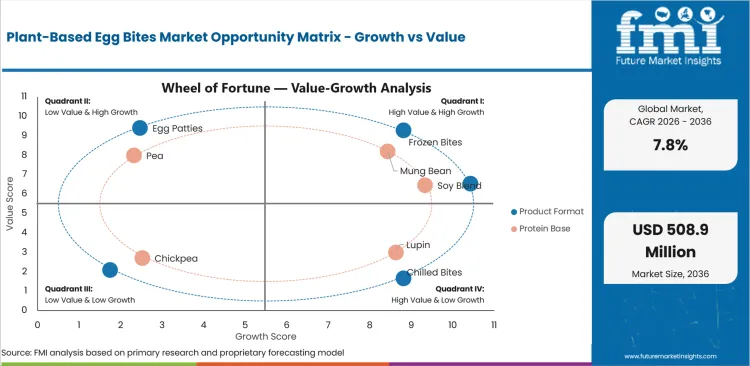
- Driver: Egg-price volatility is turning frozen egg alternatives into a planning tool for retailers and foodservice kitchens.
- Restraint: Protein systems face taste gaps and reheating texture risk across larger production runs.
- Opportunity: Private-label breakfast bites can create premium positions for brands with reliable freezer stability.
Egg supply risk gives plant-based egg bites a clearer business reason than vegan positioning alone. USDA ERS reported 50.7 million egg-laying hens were depopulated from mid-October 2024 through early March 2025 during the HPAI wave. HHS directed FDA in March 2025 to explore changes to the GRAS pathway. FDA had completed more than 1,000 GRAS notices at that point. Ingredient files have become a practical listing issue for novel proteins. Brands with safety records and sensory proof should move faster into egg replacement ingredient launches.
Raw Material Price and Formulation Cost Analysis
Plant-based egg bite cost is sensitive to protein price, oil choice, stabilizer use, and freezer packaging. Onego Bio received a U.S. FDA no-questions letter for Bioalbumen GRAS status in 2025. Proeon received an approximately EUR 1 million grant in April 2025 to develop egg alternatives for industrial bakery use. Such ingredient work may not reduce bite cost at once. The work widens options for foaming, binding, and heat stability. Brands using egg white substitute systems need cost-in-use proof before broad rollout.
Consumer Segmentation and Purchase Behavior Analysis
Early consumers are not limited to strict vegan households. Mainstream buyers compare plant-based egg bites with frozen patties and snack cups. Cholesterol-free positioning supports health-aware consumers. Taste and protein count decide repeat purchase after trial. Club shoppers respond to larger packs after household acceptance. Foodservice users evaluate waste reduction and breakfast speed. A narrow ready-to-eat format gives suppliers a clearer offer than multi-use liquid bottles. The same habit supports premium plant-based snacks used beyond breakfast.
Analysis of Plant-Based Egg Bites Market by Key Countries
.webp "Top Country Growth Comparison Plant Based Egg Bites Market Cagr (2026 2036)")
| Country | CAGR |
|---|---|
| Saudi Arabia | 8.8% |
| United States | 8.2% |
| United Kingdom | 7.9% |
| Germany | 7.3% |
| Canada | 7.1% |
| Australia | 6.9% |
| Japan | 6.4% |
Source: Future Market Insights, 2026.
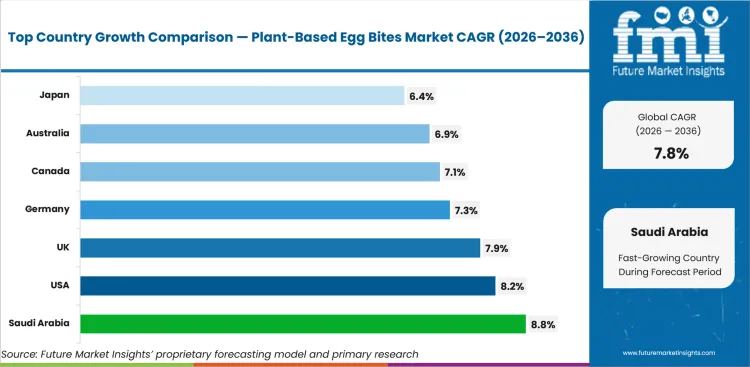
Plant-Based Egg Bites Market CAGR Analysis by Country
- Saudi Arabia is expected to record 8.8% CAGR by 2036, helped by premium grocery expansion and hotel breakfast trials.
- The United States is projected to expand at 8.2% CAGR through 2036, with frozen breakfast shelves giving egg-free bites a clear retail route.
- The United Kingdom is expected to post 7.9% CAGR by 2036, helped by vegan retail familiarity and chilled breakfast product testing.
- Germany is forecast to advance at 7.3% CAGR over the same period, with discount retail making price discipline important for suppliers.
- Canada is anticipated to rise at 7.1% CAGR through 2036, helped by pulse protein access and grocery trial in urban stores.
- Australia is projected to move at 6.9% CAGR by 2036, with urban freezer retail and clearer label review guiding early product placement.
- Japan is expected to register 6.4% CAGR through 2036, driven by convenience food habits and demand for small breakfast portions.
Sales Outlook for Plant-Based Egg Bites Market in Saudi Arabia
Modern frozen retail · 2026 to 2036
Country Market Snapshot Table
| Parameter | Value |
|---|---|
| Market Size in 2025 (Value) | USD 5.7 million |
| Market Forecast in 2036 (Value) | USD 14.4 million |
| CAGR (2026-2036) | 8.8% |
| Years Considered | 2021-2036 |
| Base Year | 2025 |
| Forecast Period | 2026-2036 |
| Units Considered | Value USD Mn |
| Leading Sub-Region | Riyadh premium grocery corridor |
Saudi Arabia Plant-Based Egg Bites Market Outlook
Saudi Arabia plant-based egg bite demand is expected to move through premium grocery stores and hotel breakfast menus. Imported frozen foods already have a clear route into Riyadh and Jeddah retail networks.
The market in Saudi Arabia is projected to expand at 8.8% CAGR through 2036. Brands are expected to need halal files, cold-chain discipline, and plain allergen wording before wider placement.
Key Growth Drivers
- Premium grocery stores can test frozen egg-free bites first. USDA FAS reported food retail sales above USD 50.0 billion in 2024, which gives imported breakfast formats a strong retail entry point.
- Hotel breakfast menus can place egg-free bites beside buffet items. USDA FAS reported foodservice sales at USD 30.0 billion in 2024, which gives suppliers a clear hospitality route.
- Frozen food importers are expected to prefer bite formats that move through existing cold-chain routes. Small breakfast portions reduce product training needs for store teams.
- Halal review is expected to favor suppliers with clear ingredient files and clean allergen wording. Better documents can improve buyer confidence before new plant-based breakfast launches.
Key Restraints
- Imported frozen products can carry higher landed costs due to storage and transport needs.
- Supplier approval can slow if halal documents or allergen statements are incomplete.
- Import reliance can raise planning risk for frozen alternatives. USDA FAS stated Saudi Arabia depends on imports for 70.0% of its food needs.
What makes Saudi Arabia different
Saudi Arabia has a premium grocery route and a strong hospitality channel for breakfast trial. Plant-based egg bites are expected to work first as imported frozen items for hotels and high-income retail shoppers.
Key Companies
- Almunajem Foods Company
- Abdullah Al Othaim Markets Company
- Panda Retail Company
- Tamimi Markets Company
- LuLu Saudi Hypermarket LLC
Sales & Marketing Channels
- Premium grocery distributors
- Hotel foodservice suppliers
- Frozen food importers
- Online grocery platforms
Country Segment Breakdown Table
| Segment | Sub-Segments |
|---|---|
| By Product Format | Frozen Bites · Chilled Bites · Egg Patties · Breakfast Cups · Foodservice Pucks |
| By Protein Base | Mung Bean · Lupin · Pea · Chickpea · Soy Blend |
| By Sales Channel | Retail Freezer · Club Stores · Online Grocery · Foodservice · Meal Kits |
| By Pack Size | Four Pack · Family Pack · Single Serve · Bulk Case · Mixed Kit |
| By Buyer Type | Retail Brands · Private Label · Foodservice Operators · Meal Kit Brands · Co-Manufacturers |
| Key Sub-Regions Covered, Retail and Foodservice Areas | Riyadh · Jeddah · Dammam · Makkah · Medina · Khobar |
Frequently Asked Questions
How fast is Saudi Arabia plant-based egg bites market growing?
Saudi Arabia plant-based egg bites market is forecast to expand at 8.8% CAGR from 2026 to 2036. Premium grocery and hotel breakfast channels are expected to guide early trial.
Who leads Saudi Arabia plant-based egg bites market?
Almunajem Foods Company, Panda Retail Company, and LuLu Saudi Hypermarket LLC are relevant through frozen food distribution and retail access.
What is driving adoption of plant-based egg bites in Saudi Arabia?
Premium frozen retail and hotel breakfast service are expected to create the first route for egg-free bite formats.
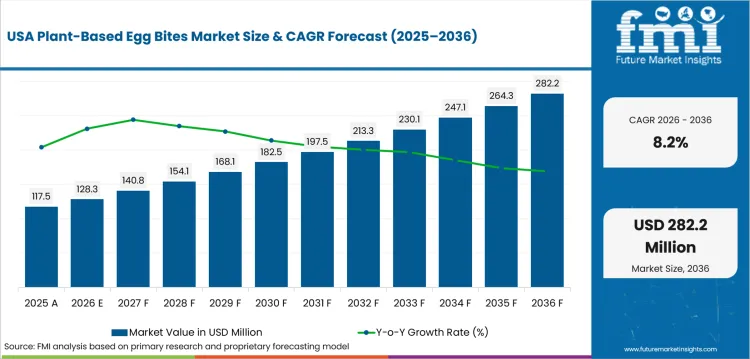
Opportunity Analysis for Plant-Based Egg Bites Market in the United States
Frozen breakfast aisle · 2026 to 2036
Country Market Snapshot Table
| Parameter | Value |
|---|---|
| Market Size in 2025 (Value) | USD 81.8 million |
| Market Forecast in 2036 (Value) | USD 194.5 million |
| CAGR (2026-2036) | 8.2% |
| Years Considered | 2021-2036 |
| Base Year | 2025 |
| Forecast Period | 2026-2036 |
| Units Considered | Value USD Mn |
| Leading Sub-Region | West Coast and Northeast retail corridor |
United States Plant-Based Egg Bites Market Outlook
U.S. plant-based egg bite demand is expected to come from frozen breakfast habits and egg-price volatility. Shoppers already compare egg-free products with burritos and breakfast cups in freezer cases.
The United States market is anticipated to expand at 8.2% CAGR through 2036. Brands with strong freezer performance and clear protein claims are expected to move faster into national grocery programs.
Key Growth Drivers
- Retailers have a large plant-based shelf to use for egg-free breakfast tests. GFI valued U.S. plant-based retail at USD 7.9 billion in 2025, which gives egg bites a familiar buyer context.
- Household trial is already broad across plant-based foods. GFI reported 60.0% of U.S. households bought plant-based products in 2025, which creates a wider trial pool for frozen egg-free bites.
- Foodservice kitchens are expected to test fixed-size bites for faster breakfast assembly. Portion control can reduce waste in cafe and hotel breakfast service.
- Co-manufacturers with freezer packing lines are expected to shorten launch cycles for retail brands. Tray filling and fast freezing are central to bite texture.
Key Restraints
- Taste gaps can reduce repeat buying after first purchase.
- Freezer space is costly, so slow-moving products can lose listings quickly.
- Egg-price swings can alter the shopper value comparison. USDA ERS reported average retail egg price at USD 5.12 per dozen in April 2025.
What sets the United States apart
The United States has the clearest path from liquid egg alternatives into frozen bite formats. Retail scale and co-manufacturing depth are expected to decide which brands move beyond regional tests.
Key Companies
- Eat Just, Inc.
- Yo Egg Inc.
- AcreMade
- Crafty Counter
- The EVERY Company
Sales & Marketing Channels
- National grocery chains
- Club stores
- Foodservice distributors
- Private-label freezer programs
Country Segment Breakdown Table
| Segment | Sub-Segments |
|---|---|
| By Product Format | Frozen Bites · Chilled Bites · Egg Patties · Breakfast Cups · Foodservice Pucks |
| By Protein Base | Mung Bean · Lupin · Pea · Chickpea · Soy Blend |
| By Sales Channel | Retail Freezer · Club Stores · Online Grocery · Foodservice · Meal Kits |
| By Pack Size | Four Pack · Family Pack · Single Serve · Bulk Case · Mixed Kit |
| By Buyer Type | Retail Brands · Private Label · Foodservice Operators · Meal Kit Brands · Co-Manufacturers |
| Key Sub-Regions Covered, Retail and Foodservice Areas | California · New York · Texas · Illinois · Florida · Washington · Massachusetts |
Frequently Asked Questions
How fast is the United States plant-based egg bites market growing?
The United States plant-based egg bites market is projected to rise at 8.2% CAGR from 2026 to 2036. Frozen breakfast use is expected to keep the country above the global pace.
Who leads the United States plant-based egg bites market?
Eat Just, Inc., Yo Egg Inc., and AcreMade are active across egg-style products and prepared breakfast formats.
What is driving adoption of plant-based egg bites in the United States?
Frozen breakfast habits and egg-price volatility are expected to push retailers toward egg alternative bite tests.
Demand Outlook for Plant-Based Egg Bites Market in the United Kingdom
Chilled retail and egg-free cooking · 2026 to 2036
Country Market Snapshot Table
| Parameter | Value |
|---|---|
| Market Size in 2025 (Value) | USD 22.4 million |
| Market Forecast in 2036 (Value) | USD 51.7 million |
| CAGR (2026-2036) | 7.9% |
| Years Considered | 2021-2036 |
| Base Year | 2025 |
| Forecast Period | 2026-2036 |
| Units Considered | Value USD Mn |
| Leading Sub-Region | London and Southeast grocery corridor |
United Kingdom Plant-Based Egg Bites Market Outlook
UK plant-based egg bite demand is expected to start in chilled retail and vegan-friendly foodservice. Egg-free cooking products have already trained buyers to think beyond baking substitutes.
The industry outlook in the United Kingdom points to 7.9% CAGR through 2036. Retailers are expected to prefer simple ingredient claims and clear cooking instructions before giving wider space.
Key Growth Drivers
- Plant-based breakfast items can use an established UK retail shelf. GFI Europe valued six plant-based food groups at GBP 848.0 million in 2025, which gives egg-free bites a known retail setting.
- Crackd gives shoppers an egg-free cooking reference point. Its No-Egg Egg lists 25.0 calories and 0.0 mg cholesterol per 46.0 g serving, which makes the claim simple for buyers.
- Chilled breakfast habits are expected to favor small packs and ready-to-heat bites. Retail buyers can trial these items near vegan meals and breakfast products.
- Caterers are expected to use egg-free bites for buffet portions and quick breakfast service. Fixed portions can make allergen control easier in staffed kitchens.
Key Restraints
- Premium pricing can reduce repeat purchase among budget-sensitive households.
- Chilled products can face shorter code life than frozen bites.
- Food affordability can hold back trial of premium substitutes. GOV.UK reported 31.4% food insecurity among single-adult households with children in June 2024.
What gives the United Kingdom a distinct position
The United Kingdom has stronger egg-free cooking familiarity than many nearby markets. Plant-based egg bites are expected to move first through chilled retail and vegan-friendly foodservice.
Key Companies
- Plant Heads Ltd.
- OGGS Ltd.
- The Tofoo Co. Ltd.
- Quorn Foods
- Winterbotham Darby & Co. Ltd.
Sales & Marketing Channels
- Supermarket chilled aisles
- Vegan specialty retail
- Foodservice wholesalers
- Online grocery platforms
Country Segment Breakdown Table
| Segment | Sub-Segments |
|---|---|
| By Product Format | Frozen Bites · Chilled Bites · Egg Patties · Breakfast Cups · Foodservice Pucks |
| By Protein Base | Mung Bean · Lupin · Pea · Chickpea · Soy Blend |
| By Sales Channel | Retail Freezer · Club Stores · Online Grocery · Foodservice · Meal Kits |
| By Pack Size | Four Pack · Family Pack · Single Serve · Bulk Case · Mixed Kit |
| By Buyer Type | Retail Brands · Private Label · Foodservice Operators · Meal Kit Brands · Co-Manufacturers |
| Key Sub-Regions Covered, Retail and Foodservice Areas | London · Manchester · Birmingham · Bristol · Leeds · Glasgow · Edinburgh |
Frequently Asked Questions
How fast is the United Kingdom plant-based egg bites market growing?
The United Kingdom plant-based egg bites market is expected to record 7.9% CAGR from 2026 to 2036. Chilled retail familiarity is expected to support early launches.
Who leads the United Kingdom plant-based egg bites market?
Plant Heads Ltd., OGGS Ltd., and The Tofoo Co. Ltd. are relevant through egg alternatives and plant-based retail reach.
What is driving adoption of plant-based egg bites in the United Kingdom?
Egg-free cooking familiarity and chilled breakfast habits are expected to drive egg-free bite demand.
Sales Analysis for Plant-Based Egg Bites Market in Germany
Discount retail and clean-label breakfast · 2026 to 2036
Country Market Snapshot Table
| Parameter | Value |
|---|---|
| Market Size in 2025 (Value) | USD 18.9 million |
| Market Forecast in 2036 (Value) | USD 41.1 million |
| CAGR (2026-2036) | 7.3% |
| Years Considered | 2021-2036 |
| Base Year | 2025 |
| Forecast Period | 2026-2036 |
| Units Considered | Value USD Mn |
| Leading Sub-Region | Berlin and North Rhine-Westphalia retail corridor |
Germany Plant-Based Egg Bites Market Outlook
Germany plant-based egg bite demand is expected to build through discount retail and plant-based meal testing. Shoppers already see vegan products across mainstream stores, which can help egg-free breakfast formats reach shelf space.
Germany is forecast to advance at 7.3% CAGR in plant-based egg bites through 2036. Retailers are expected to ask for simple ingredients and tight price control before wider listing.
Key Growth Drivers
- Discount retailers can test egg-free breakfast items through a large plant-based shelf. GFI Europe placed Germany’s six-group plant-based sales at EUR 1.71 billion in 2025, which gives egg bites a strong shelf reference.
- Plant-based meat and milk purchases point to wider trial behavior. GFI Europe reported 31.0% of German households bought plant-based meat and 38.0% bought plant-based milk in 2025.
- Vegan egg mixes give shoppers a reference point for egg-style plant products. Bite formats are expected to benefit from that existing product learning.
- Urban shoppers are expected to use frozen bites for fast breakfast and snack occasions. Small portions can work better than liquid bottles for single households.
Key Restraints
- Discount price pressure can narrow margins for premium plant-based bites.
- Taste expectations are high due to broad plant-based product exposure.
- Food inflation can make premium substitutes harder to defend. Destatis reported dairy products and eggs rose 4.1% year on year in July 2025.
Why Germany deserves a separate view
Germany differs through discount retail strength and close price comparison at shelf. Plant-based egg bites are expected to need lower price gaps and reliable texture before national rollout.
Key Companies
- GREENFORCE Future Food AG
- Perfeggt GmbH
- Veganz Group AG
- Rügenwalder Mühle Carl Müller GmbH & Co. KG
- The Plantly Butchers GmbH & Co. KG
Sales & Marketing Channels
- Discount retailers
- Supermarket freezer sections
- Online vegan stores
- Foodservice distributors
Country Segment Breakdown Table
| Segment | Sub-Segments |
|---|---|
| By Product Format | Frozen Bites · Chilled Bites · Egg Patties · Breakfast Cups · Foodservice Pucks |
| By Protein Base | Mung Bean · Lupin · Pea · Chickpea · Soy Blend |
| By Sales Channel | Retail Freezer · Club Stores · Online Grocery · Foodservice · Meal Kits |
| By Pack Size | Four Pack · Family Pack · Single Serve · Bulk Case · Mixed Kit |
| By Buyer Type | Retail Brands · Private Label · Foodservice Operators · Meal Kit Brands · Co-Manufacturers |
| Key Sub-Regions Covered, Retail and Foodservice Areas | Berlin · Hamburg · Munich · Cologne · Düsseldorf · Frankfurt · Stuttgart |
Frequently Asked Questions
How fast is Germany plant-based egg bites market growing?
Germany plant-based egg bites market is projected to move at 7.3% CAGR from 2026 to 2036. Discount retail testing is expected to guide wider adoption.
Who leads Germany plant-based egg bites market?
GREENFORCE Future Food AG, Perfeggt GmbH, and Veganz Group AG are relevant through plant-based egg and vegan food portfolios.
What is driving adoption of plant-based egg bites in Germany?
Discount retail access and plant-based meal familiarity are expected to support egg-free breakfast trials.
Opportunity Outlook for Plant-Based Egg Bites Market in Canada
Pulse protein supply and grocery trial · 2026 to 2036
Country Market Snapshot Table
| Parameter | Value |
|---|---|
| Market Size in 2025 (Value) | USD 16.1 million |
| Market Forecast in 2036 (Value) | USD 34.2 million |
| CAGR (2026-2036) | 7.1% |
| Years Considered | 2021-2036 |
| Base Year | 2025 |
| Forecast Period | 2026-2036 |
| Units Considered | Value USD Mn |
| Leading Sub-Region | Ontario and British Columbia grocery corridor |
Canada Plant-Based Egg Bites Market Outlook
Canada plant-based egg bite demand is expected to benefit from pulse protein supply and U.S. retail learning. Grocery chains can test frozen bites in urban stores before wider distribution.
Canada is expected to expand at 7.1% CAGR from 2026 to 2036. Pea and lentil ingredient access is expected to help formulators improve bite texture and protein claims.
Key Growth Drivers
- Pea protein gives Canadian developers a strong formulation route. Canadian Grain Commission estimated pea production at 3.9 million tonnes in 2025, which gives egg-free bite makers a deep ingredient pool.
- Lentil blends can widen texture options for plant-based breakfast products. Canadian Grain Commission estimated lentil production at 3.4 million tonnes in 2025, which gives local teams more room to test pulse mixes.
- Cross-border retail learning is expected to help Canadian grocers read U.S. egg alternative performance. Early freezer tests can start in dense urban stores.
- Co-packers are expected to use frozen meal lines for first launches. Existing tray and carton systems can reduce new setup needs.
Key Restraints
- Smaller national volume can delay dedicated production lines for egg-free bites.
- Long freight routes can raise freezer delivery cost outside dense retail corridors.
- Grocery inflation can limit trial of premium substitutes. Statistics Canada reported grocery prices rose 3.5% in 2025 after 2.2% in 2024.
What gives Canada a clear role
Canada has ingredient strength that can help plant-based egg bite developers test pea and lentil blends. Retail rollout is expected to start in Ontario and British Columbia before national programs.
Key Companies
- Big Mountain Foods Ltd.
- Daiya Foods Inc.
- Liven Proteins Inc.
- New School Foods Inc.
- Modern Plant Based Foods Inc.
Sales & Marketing Channels
- National grocery chains
- Natural food retailers
- Ingredient partnerships
- Private-label freezer programs
Country Segment Breakdown Table
| Segment | Sub-Segments |
|---|---|
| By Product Format | Frozen Bites · Chilled Bites · Egg Patties · Breakfast Cups · Foodservice Pucks |
| By Protein Base | Mung Bean · Lupin · Pea · Chickpea · Soy Blend |
| By Sales Channel | Retail Freezer · Club Stores · Online Grocery · Foodservice · Meal Kits |
| By Pack Size | Four Pack · Family Pack · Single Serve · Bulk Case · Mixed Kit |
| By Buyer Type | Retail Brands · Private Label · Foodservice Operators · Meal Kit Brands · Co-Manufacturers |
| Key Sub-Regions Covered, Retail and Foodservice Areas | Ontario · British Columbia · Quebec · Alberta · Manitoba · Saskatchewan |
Frequently Asked Questions
How fast is Canada plant-based egg bites market growing?
Canada plant-based egg bites market is anticipated to rise at 7.1% CAGR from 2026 to 2036. Pulse protein access is expected to help formulation work.
Who leads Canada plant-based egg bites market?
Big Mountain Foods Ltd., Daiya Foods Inc., and Liven Proteins Inc. are relevant through plant-based food and protein activity.
What is driving adoption of plant-based egg bites in Canada?
Pulse protein supply and U.S. retail learning are expected to guide early egg-free bite launches.
Demand Analysis for Plant-Based Egg Bites Market in Australia
Label clarity and urban freezer retail · 2026 to 2036
Country Market Snapshot Table
| Parameter | Value |
|---|---|
| Market Size in 2025 (Value) | USD 11.2 million |
| Market Forecast in 2036 (Value) | USD 23.4 million |
| CAGR (2026-2036) | 6.9% |
| Years Considered | 2021-2036 |
| Base Year | 2025 |
| Forecast Period | 2026-2036 |
| Units Considered | Value USD Mn |
| Leading Sub-Region | Sydney and Melbourne grocery corridor |
Australia Plant-Based Egg Bites Market Outlook
Australia plant-based egg bite demand is expected to move through urban grocery and clearer label rules. Egg-free bites can use frozen convenience habits in Sydney and Melbourne before entering smaller cities.
Australia is projected to rise at 6.9% CAGR from 2026 to 2036. Brands are expected to focus on clear pack wording and allergen-safe formulation before broad retail listing.
Key Growth Drivers
- Urban freezer aisles can carry imported egg-free breakfast products. USDA FAS reported consumer-oriented food imports of USD 15.3 billion in 2024, which gives specialty frozen items an established route.
- Label clarity is expected to improve buyer confidence. Australia’s agriculture department set up a plant-based labelling working group in 2024, which gives brands a clearer pack-wording path.
- Health food retailers can introduce egg alternative bites before wider supermarket rollout. Early sales are expected to come from allergen-aware and flexitarian shoppers.
- Cafe foodservice suppliers are expected to test egg-free bites for breakfast boards and takeaway meals. Fixed portions can make staff training easier.
Key Restraints
- Smaller volume can limit dedicated manufacturing runs for bite formats.
- Imported frozen items can face higher logistics cost across long domestic routes.
- Conventional egg supply stays large and familiar. FSANZ cited Australian Eggs data showing the laying flock at about 21,254,995 in June 2024.
What makes Australia commercially distinct
Australia has strong urban grocery access but limited national volume. Plant-based egg bites are expected to enter through allergen-friendly and freezer convenience routes.
Key Companies
- Roma Food Products Pty Ltd.
- All G Foods Pty Ltd.
- v2food Pty Ltd.
- Harvest B Pty Ltd.
- Fenn Foods Pty Ltd.
Sales & Marketing Channels
- Supermarket freezer aisles
- Health food retailers
- Online grocery platforms
- Cafe foodservice suppliers
Country Segment Breakdown Table
| Segment | Sub-Segments |
|---|---|
| By Product Format | Frozen Bites · Chilled Bites · Egg Patties · Breakfast Cups · Foodservice Pucks |
| By Protein Base | Mung Bean · Lupin · Pea · Chickpea · Soy Blend |
| By Sales Channel | Retail Freezer · Club Stores · Online Grocery · Foodservice · Meal Kits |
| By Pack Size | Four Pack · Family Pack · Single Serve · Bulk Case · Mixed Kit |
| By Buyer Type | Retail Brands · Private Label · Foodservice Operators · Meal Kit Brands · Co-Manufacturers |
| Key Sub-Regions Covered, Retail and Foodservice Areas | Sydney · Melbourne · Brisbane · Perth · Adelaide · Canberra |
Frequently Asked Questions
How fast is Australia plant-based egg bites market growing?
Australia plant-based egg bites market is forecast to expand at 6.9% CAGR from 2026 to 2036. Urban grocery access is expected to guide early trial.
Who leads Australia plant-based egg bites market?
Roma Food Products Pty Ltd., All G Foods Pty Ltd., and v2food Pty Ltd. are relevant through plant-based food and egg alternative activity.
What is driving adoption of plant-based egg bites in Australia?
Urban freezer retail and clearer label review are expected to help egg-free bite products reach early buyers.
Sales Outlook for Plant-Based Egg Bites Market in Japan
Convenience meals and egg-style texture · 2026 to 2036
Country Market Snapshot Table
| Parameter | Value |
|---|---|
| Market Size in 2025 (Value) | USD 9.8 million |
| Market Forecast in 2036 (Value) | USD 19.3 million |
| CAGR (2026-2036) | 6.4% |
| Years Considered | 2021-2036 |
| Base Year | 2025 |
| Forecast Period | 2026-2036 |
| Units Considered | Value USD Mn |
| Leading Sub-Region | Tokyo and Kansai convenience corridor |
Japan Plant-Based Egg Bites Market Outlook
Japan plant-based egg bite demand is expected to build from convenience meals and strict texture expectations. Small pack sizes can help egg-free bites fit breakfast and snack use in urban stores.
Japan is expected to advance at 6.4% CAGR from 2026 to 2036. Suppliers are expected to focus on softness, mild flavor, and neat pack design before wider shelf trials.
Key Growth Drivers
- Convenience stores can test small egg-free breakfast portions inside a large retail system. USDA FAS reported Japan retail food and beverage sales of USD 193.0 billion in 2024, which gives small packs a major sales route.
- Packaged foods with plant protein already have a measurable demand pool. Agriculture and Agri-Food Canada reported Japan plant-based protein packaged food volume at 39.2 thousand tonnes in 2024.
- Japanese egg alternative developers give local buyers more confidence in texture work. Domestic brand examples are expected to reduce reliance on imports.
- Frozen bites can fit compact household freezers and single-person meals. Small trays are expected to suit convenience stores and online grocery.
Key Restraints
- Taste standards are strict for egg-style foods, so bitter notes can hurt repeat purchase.
- Convenience channels may limit shelf time if trial speed is slow.
- Shelf competition is intense in Japan’s retail system. USDA FAS stated supermarkets accounted for 45.0% of Japan food retail sales in 2024.
Why Japan needs a separate country view
Japan has a strong convenience meal culture and high texture expectations. Plant-based egg bites are expected to develop through small packs and local egg-style product work.
Key Companies
- Kewpie Corporation
- UMAMI UNITED JAPAN Ltd.
- DAIZ Inc.
- Kagome Co., Ltd.
- 2foods Inc.
Sales & Marketing Channels
- Convenience stores
- Supermarket freezer cases
- Cafe foodservice suppliers
- Online grocery platforms
Country Segment Breakdown Table
| Segment | Sub-Segments |
|---|---|
| By Product Format | Frozen Bites · Chilled Bites · Egg Patties · Breakfast Cups · Foodservice Pucks |
| By Protein Base | Mung Bean · Lupin · Pea · Chickpea · Soy Blend |
| By Sales Channel | Retail Freezer · Club Stores · Online Grocery · Foodservice · Meal Kits |
| By Pack Size | Four Pack · Family Pack · Single Serve · Bulk Case · Mixed Kit |
| By Buyer Type | Retail Brands · Private Label · Foodservice Operators · Meal Kit Brands · Co-Manufacturers |
| Key Sub-Regions Covered, Retail and Foodservice Areas | Tokyo · Osaka · Kyoto · Yokohama · Nagoya · Fukuoka |
Frequently Asked Questions
How fast is Japan plant-based egg bites market growing?
Japan plant-based egg bites market is projected to expand at 6.4% CAGR from 2026 to 2036. Convenience meal habits are expected to guide product testing.
Who leads Japan plant-based egg bites market?
Kewpie Corporation, UMAMI UNITED JAPAN Ltd., and DAIZ Inc. are relevant through plant-based food and egg-style product work.
What is driving adoption of plant-based egg bites in Japan?
Convenience food culture and egg-style texture development are expected to support small-format bite trials.
Competitive Landscape and Strategic Positioning
- Finished product brands have an advantage when they already hold freezer retail access.
- Ingredient developers can win buyer trust by proving gelling and binding performance.
- Foodservice brands are expected to focus on egg-style items that reduce kitchen handling.
- Co-manufacturers can create value through tray filling and freezer stability checks.
Plant-based egg bite competition is expected to split between finished breakfast brands and ingredient technology suppliers. AcreMade says its roots span 40 years of plant-based food expertise, which gives its pea-based egg work a deeper formulation story. Yo Egg presents 5.0 plant-based egg formats across sunny-side-up, poached, patty, hollandaise, and boiled styles. These product ranges show how the vegan egg field is moving from scrambles into ready meal and foodservice formats.
Supplier advantage is expected to come from texture control and clear product use. Eat Just has a stronger frozen breakfast position through JUST Egg burritos and folded egg products. Crafty Counter is building retail proof through WunderEggs. Onego Bio and Proeon are working on ingredient function that can support future bite formats. Companies with freezer proof and application testing are expected to secure repeat business across breakfast meals and plant-based egg replacements.
Key Companies in Plant-Based Egg Bites Market
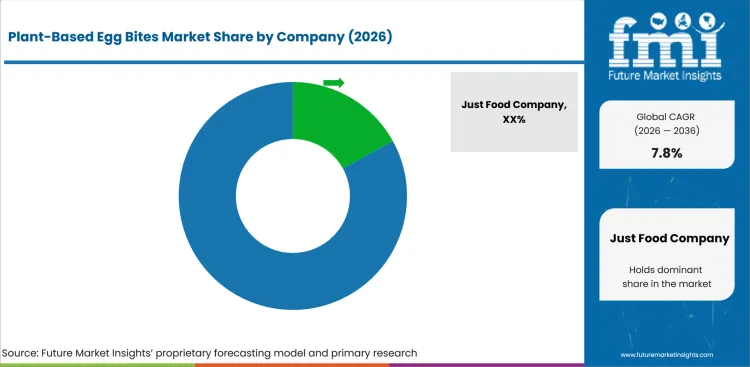
- Plant-Based Egg Format Leaders: Just Food Company and Yo Egg Inc. support egg-style breakfast use through folded, sunny-side, and poached formats.
- Frozen Breakfast and Retail Specialists: Crafty Counter and AcreMade support egg-free product adoption through retail-ready egg alternatives.
- Egg Function Ingredient Developers: Onego Bio and Proeon support future bite texture through animal-free egg protein and plant protein systems.
- United Kingdom Egg-Free Brands: Plant Heads Ltd. and OGGS Ltd. support egg-free cooking familiarity in retail and foodservice.
- Japan Egg-Style Developers: Kewpie Corporation and UMAMI UNITED JAPAN Ltd. support local egg alternative product learning.
Company Benchmarking Table
| Company | Egg-Style Format Strength | Frozen Breakfast Fit | Ingredient Function Depth |
|---|---|---|---|
| Just Food Company | High | High | Medium |
| Yo Egg Inc. | High | Medium | Medium |
| Crafty Counter | High | High | Medium |
| AcreMade | Medium | Medium | High |
| Onego Bio | Medium | Low | High |
| Proeon | Medium | Low | High |
| Plant Heads Ltd. | Medium | Medium | Medium |
Recent Industry Developments
- In January 2025, Just Food Company stated that JUST Egg grew 5.0x faster compared with the same month in the previous year. The company also stated that 56.0% of JUST Egg buyers returned for a second purchase or more.
- In March 2025, Onego Bio chose Jefferson County, Wisconsin for its flagship Bioalbumen® manufacturing facility. The company stated that the site covers 25.9 acres and is planned to produce egg protein equal to the output of 6.0 million laying hens.
Key Players in the Plant-Based Egg Bites Market
- Just Food Company
- Yo Egg Inc.
- Crafty Counter
- AcreMade
- Onego Bio
- Proeon
- Plant Heads Ltd.
- OGGS Ltd.
- Kewpie Corporation
- UMAMI UNITED JAPAN Ltd.
Plant-Based Egg Bites Market - Report Scope
| Parameter | Details |
|---|---|
| Market size by 2036 | USD 508.9 million |
| Growth rate | 7.8% CAGR from 2026 to 2036 |
| Forecast period | 2026 to 2036 |
| Base year value in 2025 | USD 222.6 million |
| By product format | Frozen bites, chilled bites, egg patties, breakfast cups, foodservice pucks |
| By protein base | Mung bean, lupin, pea, chickpea, soy blend |
| By sales channel | Retail freezer, club stores, online grocery, foodservice, meal kits |
| By pack size | Four pack, family pack, single serve, bulk case, mixed kit |
| By buyer type | Retail brands, private label, foodservice operators, meal kit brands, co-manufacturers |
| Regions covered | North America, Europe, GCC, East Asia, Oceania |
| Countries covered | United States, Canada, United Kingdom, Germany, Saudi Arabia, Japan, Australia |
| Key companies profiled | Just Food Company, Yo Egg Inc., Crafty Counter, AcreMade, Onego Bio, Proeon, Plant Heads Ltd., OGGS Ltd., Kewpie Corporation, UMAMI UNITED JAPAN Ltd. |
| Approach | Bottom-up product-boundary approach using eligible SKU revenue, pack format, channel presence, protein source, and country-level adoption |
| Source | Future Market Insights, 2026. |
Plant-Based Egg Bites Market Breakdown by Product Format, Protein Base, Sales Channel, Pack Size, Buyer Type, and Region
By Product Format:
- Frozen Bites
- Chilled Bites
- Egg Patties
- Breakfast Cups
- Foodservice Pucks
By Protein Base:
- Mung Bean
- Lupin
- Pea
- Chickpea
- Soy Blend
By Sales Channel:
- Retail Freezer
- Club Stores
- Online Grocery
- Foodservice
- Meal Kits
By Pack Size:
- Four Pack
- Family Pack
- Single Serve
- Bulk Case
- Mixed Kit
By Buyer Type:
- Retail Brands
- Private Label
- Foodservice Operators
- Meal Kit Brands
- Co-Manufacturers
By Region:
- North America
- Europe
- GCC
- East Asia
- Oceania
This Report Answers
- How large is plant-based egg bites market in 2026?
- What value is expected for plant-based egg bites market by 2036?
- Which product format is expected to lead in 2026?
- Which sales channel is expected to hold the leading share in 2026?
- Which protein base is expected to hold the leading parent-segment share in 2026?
- Which countries are expected to grow faster than the global average?
- Which companies are most active across plant-based egg bite supply?
- Which raw materials shape plant-based egg bite cost and supply planning?
- Which applications create repeat demand for plant-based egg bite formats?
Research Sources & Bibliography
- AcreMade. (2026). AcreMade: Really good plant-based eggs. AcreMade.
- Agriculture and Agri-Food Canada. (2025, July 2). Sector trend analysis: Plant-based protein food and drink trends in Japan. Government of Canada.
- Australian Government Department of Agriculture, Fisheries and Forestry. (2026, January 30). Plant-based alternative product labelling. Australian Government.
- Canadian Grain Commission. (2026, February 11). Quality of western Canadian peas 2025. Government of Canada.
- Canadian Grain Commission. (2026). Quality of western Canadian lentils 2025. Government of Canada.
- Crafty Counter. (2024, December 30). WunderEggs soars: Expanding into 1,600 new stores after winning Albertsons Companies Innovation Launchpad Competition. Crafty Counter.
- Crafty Counter. (2025, November 12). Crafty Counter launches high protein egg & cheese buns. Crafty Counter.
- Food Standards Australia New Zealand. (2025, September 25). Overview of egg industry in Australia. FSANZ.
- Good Food Institute. (2026). U.S. retail market insights for the plant-based industry. Good Food Institute.
- Good Food Institute Europe. (2026). European plant-based sales data. GFI Europe.
- Just Food Company. (2025). Delicious eggs without all that bird flu. Just Food Company.
- Onego Bio. (2025, March 12). Onego Bio chooses Jefferson County, Wisconsin for flagship egg protein manufacturing facility. Onego Bio.
- Onego Bio. (2025, September 22). Onego Bio receives FDA “no questions” letter on GRAS status of Bioalbumen®. Onego Bio.
- Proeon. (2025, April 14). Proeon secures €1 million grant to lead development of sustainable egg alternative for baking industry. Proeon.
- Statistics Canada. (2026, January 19). Consumer Price Index: Annual review, 2025. Statistics Canada.
- U.S. Department of Agriculture Economic Research Service. (2025, June 3). Retail egg prices fall, following declining wholesale prices. USDA ERS.
- U.S. Department of Agriculture Foreign Agricultural Service. (2025, September 24). Retail foods annual: Saudi Arabia. USDA FAS.
- U.S. Department of Agriculture Foreign Agricultural Service. (2025, December 30). Food service - hotel restaurant institutional annual: Saudi Arabia. USDA FAS.
- U.S. Department of Agriculture Foreign Agricultural Service. (2025, November 19). Retail foods annual: Australia. USDA FAS.
- U.S. Department of Agriculture Foreign Agricultural Service. (2025, November 19). Retail foods annual: Japan. USDA FAS.
- U.S. Department of Health and Human Services. (2025, March 10). HHS Secretary Kennedy directs FDA to explore rulemaking to eliminate pathway for companies to self-affirm food ingredients are safe. HHS.
- Yo Egg. (2026). Our eggs. Yo Egg.
- Crackd. (2026). The No-Egg Egg. Crackd.
This bibliography is provided for reader reference and is not exhaustive. The full report contains the complete reference list and detailed citations.
Plant-Based Egg Bites Market - Scope & Definition
| Attribute | Detail |
|---|---|
| Market Definition | Plant-based egg bites are ready-to-eat or heat-and-eat egg alternative products made without chicken eggs. They are used as breakfast, snack, or meal add-on formats across retail freezer, foodservice, online grocery, and meal kit channels. |
| Product Formats Covered | Frozen bites · Chilled bites · Egg patties · Breakfast cups · Foodservice pucks |
| Protein Bases Covered | Mung bean · Lupin · Pea · Chickpea · Soy blend |
| Sales Channels Covered | Retail freezer · Club stores · Online grocery · Foodservice · Meal kits |
| Pack Sizes Covered | Four pack · Family pack · Single serve · Bulk case · Mixed kit |
| Buyer Types Covered | Retail brands · Private label · Foodservice operators · Meal kit brands · Co-manufacturers |
| Forecast Period | 2026 to 2036 |
| Inclusions | All commercially available plant-based egg bite products across the product formats, protein bases, sales channels, pack sizes, and buyer types listed above. |
| Exclusions | Shell eggs · Liquid chicken eggs · Egg powders · Liquid plant-based egg substitutes · Bakery-only egg replacers · Mayonnaise replacers · Plain plant protein powders · Finished breakfast sandwiches unless egg bite revenue is separately identified |
Plant-Based Egg Bites Market - Research Methodology
| Method | Description |
|---|---|
| Primary Research | FMI analyst reviews covered plant-based egg brands, frozen breakfast makers, co-manufacturers, foodservice operators, protein ingredient suppliers, and retail channel participants in key markets. |
| Desk Research | Official company product pages, product launch releases, retail expansion notes, food safety sources, government food reports, and ingredient supplier updates were reviewed. |
| Market Sizing & Forecasting | Bottom-up aggregation was used across eligible plant-based egg bite SKUs, pack formats, protein bases, sales channels, buyer types, and country-level adoption patterns. |
| Data Validation | Cross-checks compared SKU availability, freezer placement, retail pricing, ingredient positioning, country-level grocery structure, and company product updates. |
Frequently Asked Questions
How large is plant-based egg bites market in 2026?
The plant-based egg bites market is expected to reach USD 240.0 million in 2026.
What will plant-based egg bites market be worth by 2036?
The market is forecast to reach USD 508.9 million by 2036.
What CAGR is expected for plant-based egg bites market from 2026 to 2036?
The market is projected to expand at 7.8% CAGR from 2026 to 2036.
Which product format is expected to lead in 2026?
Frozen bites are forecast to hold 58.4% share in 2026 due to freezer durability and fast reheating.
Which sales channel is expected to lead in 2026?
Retail freezer is forecast to account for 64.2% share in 2026 as shoppers compare egg alternatives near breakfast meals.
Which protein base is expected to lead in 2026?
Mung bean is expected to hold 41.7% share in 2026 due to proven texture in commercial egg alternatives.
Which country is expected to grow fastest by 2036?
Saudi Arabia is expected to expand at 8.8% CAGR by 2036 due to premium grocery access and foodservice trial.
Who are the leading companies in plant-based egg bites market?
Eat Just, Yo Egg, AcreMade, Crackd, Oggs, Onego Bio, and Proeon are active across egg alternative formats and ingredients.
What is driving plant-based egg bites adoption?
Egg-price volatility, freezer breakfast use, and demand for cholesterol-free portions support plant-based egg bite adoption.
What is the key restraint for plant-based egg bites suppliers?
Taste quality, protein cost, and reheating texture are the main barriers for wider retail and foodservice rollout.
Preview the report firsthand - request a free sample
Get SampleGet the brochure for pricing and purchase details.
Get PDFTable of Content
- Executive Summary
- Global Market Outlook
- Demand to side Trends
- Supply to side Trends
- Technology Roadmap Analysis
- Analysis and Recommendations
- Market Overview
- Market Coverage / Taxonomy
- Market Definition / Scope / Limitations
- Research Methodology
- Chapter Orientation
- Analytical Lens and Working Hypotheses
- Market Structure, Signals, and Trend Drivers
- Benchmarking and Cross-market Comparability
- Market Sizing, Forecasting, and Opportunity Mapping
- Research Design and Evidence Framework
- Desk Research Programme (Secondary Evidence)
- Company Annual and Sustainability Reports
- Peer-reviewed Journals and Academic Literature
- Corporate Websites, Product Literature, and Technical Notes
- Earnings Decks and Investor Briefings
- Statutory Filings and Regulatory Disclosures
- Technical White Papers and Standards Notes
- Trade Journals, Industry Magazines, and Analyst Briefs
- Conference Proceedings, Webinars, and Seminar Materials
- Government Statistics Portals and Public Data Releases
- Press Releases and Reputable Media Coverage
- Specialist Newsletters and Curated Briefings
- Sector Databases and Reference Repositories
- FMI Internal Proprietary Databases and Historical Market Datasets
- Subscription Datasets and Paid Sources
- Social Channels, Communities, and Digital Listening Inputs
- Additional Desk Sources
- Expert Input and Fieldwork (Primary Evidence)
- Primary Modes
- Qualitative Interviews and Expert Elicitation
- Quantitative Surveys and Structured Data Capture
- Blended Approach
- Why Primary Evidence is Used
- Field Techniques
- Interviews
- Surveys
- Focus Groups
- Observational and In-context Research
- Social and Community Interactions
- Stakeholder Universe Engaged
- C-suite Leaders
- Board Members
- Presidents and Vice Presidents
- R&D and Innovation Heads
- Technical Specialists
- Domain Subject-matter Experts
- Scientists
- Physicians and Other Healthcare Professionals
- Governance, Ethics, and Data Stewardship
- Research Ethics
- Data Integrity and Handling
- Primary Modes
- Tooling, Models, and Reference Databases
- Desk Research Programme (Secondary Evidence)
- Data Engineering and Model Build
- Data Acquisition and Ingestion
- Cleaning, Normalisation, and Verification
- Synthesis, Triangulation, and Analysis
- Quality Assurance and Audit Trail
- Market Background
- Market Dynamics
- Drivers
- Restraints
- Opportunity
- Trends
- Scenario Forecast
- Demand in Optimistic Scenario
- Demand in Likely Scenario
- Demand in Conservative Scenario
- Opportunity Map Analysis
- Product Life Cycle Analysis
- Supply Chain Analysis
- Investment Feasibility Matrix
- Value Chain Analysis
- PESTLE and Porter’s Analysis
- Regulatory Landscape
- Regional Parent Market Outlook
- Production and Consumption Statistics
- Import and Export Statistics
- Market Dynamics
- Global Market Analysis 2021 to 2025 and Forecast, 2026 to 2036
- Historical Market Size Value (USD Million) Analysis, 2021 to 2025
- Current and Future Market Size Value (USD Million) Projections, 2026 to 2036
- Y to o to Y Growth Trend Analysis
- Absolute $ Opportunity Analysis
- Global Market Pricing Analysis 2021 to 2025 and Forecast 2026 to 2036
- Global Market Analysis 2021 to 2025 and Forecast 2026 to 2036, By Product Format
- Introduction / Key Findings
- Historical Market Size Value (USD Million) Analysis By Product Format , 2021 to 2025
- Current and Future Market Size Value (USD Million) Analysis and Forecast By Product Format , 2026 to 2036
- Frozen Entrées
- Chilled Meals
- Meal Bowls
- Pasta Meals
- Rice Meals
- Frozen Entrées
- Y to o to Y Growth Trend Analysis By Product Format , 2021 to 2025
- Absolute $ Opportunity Analysis By Product Format , 2026 to 2036
- Global Market Analysis 2021 to 2025 and Forecast 2026 to 2036, By Protein Source
- Introduction / Key Findings
- Historical Market Size Value (USD Million) Analysis By Protein Source, 2021 to 2025
- Current and Future Market Size Value (USD Million) Analysis and Forecast By Protein Source, 2026 to 2036
- Soy
- Pea
- Wheat
- Lentil
- Chickpea
- Soy
- Y to o to Y Growth Trend Analysis By Protein Source, 2021 to 2025
- Absolute $ Opportunity Analysis By Protein Source, 2026 to 2036
- Global Market Analysis 2021 to 2025 and Forecast 2026 to 2036, By Retail Channel
- Introduction / Key Findings
- Historical Market Size Value (USD Million) Analysis By Retail Channel, 2021 to 2025
- Current and Future Market Size Value (USD Million) Analysis and Forecast By Retail Channel, 2026 to 2036
- Retail Freezer
- Chilled Cases
- Discount Retail
- Online Grocery
- Club Stores
- Retail Freezer
- Y to o to Y Growth Trend Analysis By Retail Channel, 2021 to 2025
- Absolute $ Opportunity Analysis By Retail Channel, 2026 to 2036
- Global Market Analysis 2021 to 2025 and Forecast 2026 to 2036, By Meal Type
- Introduction / Key Findings
- Historical Market Size Value (USD Million) Analysis By Meal Type, 2021 to 2025
- Current and Future Market Size Value (USD Million) Analysis and Forecast By Meal Type, 2026 to 2036
- Dinner Meals
- Lunch Meals
- Global Cuisine Meals
- High-Protein Meals
- Family Meals
- Dinner Meals
- Y to o to Y Growth Trend Analysis By Meal Type, 2021 to 2025
- Absolute $ Opportunity Analysis By Meal Type, 2026 to 2036
- Global Market Analysis 2021 to 2025 and Forecast 2026 to 2036, By Buyer Group
- Introduction / Key Findings
- Historical Market Size Value (USD Million) Analysis By Buyer Group, 2021 to 2025
- Current and Future Market Size Value (USD Million) Analysis and Forecast By Buyer Group, 2026 to 2036
- Retailers
- Private-label Manufacturers
- Frozen Food Processors
- Chilled Meal Makers
- Retail Foodservice Teams
- Retailers
- Y to o to Y Growth Trend Analysis By Buyer Group, 2021 to 2025
- Absolute $ Opportunity Analysis By Buyer Group, 2026 to 2036
- Global Market Analysis 2021 to 2025 and Forecast 2026 to 2036, By Region
- Introduction
- Historical Market Size Value (USD Million) Analysis By Region, 2021 to 2025
- Current Market Size Value (USD Million) Analysis and Forecast By Region, 2026 to 2036
- North America
- Latin America
- Western Europe
- Eastern Europe
- East Asia
- South Asia and Pacific
- Middle East & Africa
- Market Attractiveness Analysis By Region
- North America Market Analysis 2021 to 2025 and Forecast 2026 to 2036, By Country
- Historical Market Size Value (USD Million) Trend Analysis By Market Taxonomy, 2021 to 2025
- Market Size Value (USD Million) Forecast By Market Taxonomy, 2026 to 2036
- By Country
- USA
- Canada
- Mexico
- By Product Format
- By Protein Source
- By Retail Channel
- By Meal Type
- By Buyer Group
- By Country
- Market Attractiveness Analysis
- By Country
- By Product Format
- By Protein Source
- By Retail Channel
- By Meal Type
- By Buyer Group
- Key Takeaways
- Latin America Market Analysis 2021 to 2025 and Forecast 2026 to 2036, By Country
- Historical Market Size Value (USD Million) Trend Analysis By Market Taxonomy, 2021 to 2025
- Market Size Value (USD Million) Forecast By Market Taxonomy, 2026 to 2036
- By Country
- Brazil
- Chile
- Rest of Latin America
- By Product Format
- By Protein Source
- By Retail Channel
- By Meal Type
- By Buyer Group
- By Country
- Market Attractiveness Analysis
- By Country
- By Product Format
- By Protein Source
- By Retail Channel
- By Meal Type
- By Buyer Group
- Key Takeaways
- Western Europe Market Analysis 2021 to 2025 and Forecast 2026 to 2036, By Country
- Historical Market Size Value (USD Million) Trend Analysis By Market Taxonomy, 2021 to 2025
- Market Size Value (USD Million) Forecast By Market Taxonomy, 2026 to 2036
- By Country
- Germany
- UK
- Italy
- Spain
- France
- Nordic
- BENELUX
- Rest of Western Europe
- By Product Format
- By Protein Source
- By Retail Channel
- By Meal Type
- By Buyer Group
- By Country
- Market Attractiveness Analysis
- By Country
- By Product Format
- By Protein Source
- By Retail Channel
- By Meal Type
- By Buyer Group
- Key Takeaways
- Eastern Europe Market Analysis 2021 to 2025 and Forecast 2026 to 2036, By Country
- Historical Market Size Value (USD Million) Trend Analysis By Market Taxonomy, 2021 to 2025
- Market Size Value (USD Million) Forecast By Market Taxonomy, 2026 to 2036
- By Country
- Russia
- Poland
- Hungary
- Balkan & Baltic
- Rest of Eastern Europe
- By Product Format
- By Protein Source
- By Retail Channel
- By Meal Type
- By Buyer Group
- By Country
- Market Attractiveness Analysis
- By Country
- By Product Format
- By Protein Source
- By Retail Channel
- By Meal Type
- By Buyer Group
- Key Takeaways
- East Asia Market Analysis 2021 to 2025 and Forecast 2026 to 2036, By Country
- Historical Market Size Value (USD Million) Trend Analysis By Market Taxonomy, 2021 to 2025
- Market Size Value (USD Million) Forecast By Market Taxonomy, 2026 to 2036
- By Country
- China
- Japan
- South Korea
- By Product Format
- By Protein Source
- By Retail Channel
- By Meal Type
- By Buyer Group
- By Country
- Market Attractiveness Analysis
- By Country
- By Product Format
- By Protein Source
- By Retail Channel
- By Meal Type
- By Buyer Group
- Key Takeaways
- South Asia and Pacific Market Analysis 2021 to 2025 and Forecast 2026 to 2036, By Country
- Historical Market Size Value (USD Million) Trend Analysis By Market Taxonomy, 2021 to 2025
- Market Size Value (USD Million) Forecast By Market Taxonomy, 2026 to 2036
- By Country
- India
- ASEAN
- Australia & New Zealand
- Rest of South Asia and Pacific
- By Product Format
- By Protein Source
- By Retail Channel
- By Meal Type
- By Buyer Group
- By Country
- Market Attractiveness Analysis
- By Country
- By Product Format
- By Protein Source
- By Retail Channel
- By Meal Type
- By Buyer Group
- Key Takeaways
- Middle East & Africa Market Analysis 2021 to 2025 and Forecast 2026 to 2036, By Country
- Historical Market Size Value (USD Million) Trend Analysis By Market Taxonomy, 2021 to 2025
- Market Size Value (USD Million) Forecast By Market Taxonomy, 2026 to 2036
- By Country
- Kingdom of Saudi Arabia
- Other GCC Countries
- Turkiye
- South Africa
- Other African Union
- Rest of Middle East & Africa
- By Product Format
- By Protein Source
- By Retail Channel
- By Meal Type
- By Buyer Group
- By Country
- Market Attractiveness Analysis
- By Country
- By Product Format
- By Protein Source
- By Retail Channel
- By Meal Type
- By Buyer Group
- Key Takeaways
- Key Countries Market Analysis
- USA
- Pricing Analysis
- Market Share Analysis, 2025
- By Product Format
- By Protein Source
- By Retail Channel
- By Meal Type
- By Buyer Group
- Canada
- Pricing Analysis
- Market Share Analysis, 2025
- By Product Format
- By Protein Source
- By Retail Channel
- By Meal Type
- By Buyer Group
- Mexico
- Pricing Analysis
- Market Share Analysis, 2025
- By Product Format
- By Protein Source
- By Retail Channel
- By Meal Type
- By Buyer Group
- Brazil
- Pricing Analysis
- Market Share Analysis, 2025
- By Product Format
- By Protein Source
- By Retail Channel
- By Meal Type
- By Buyer Group
- Chile
- Pricing Analysis
- Market Share Analysis, 2025
- By Product Format
- By Protein Source
- By Retail Channel
- By Meal Type
- By Buyer Group
- Germany
- Pricing Analysis
- Market Share Analysis, 2025
- By Product Format
- By Protein Source
- By Retail Channel
- By Meal Type
- By Buyer Group
- UK
- Pricing Analysis
- Market Share Analysis, 2025
- By Product Format
- By Protein Source
- By Retail Channel
- By Meal Type
- By Buyer Group
- Italy
- Pricing Analysis
- Market Share Analysis, 2025
- By Product Format
- By Protein Source
- By Retail Channel
- By Meal Type
- By Buyer Group
- Spain
- Pricing Analysis
- Market Share Analysis, 2025
- By Product Format
- By Protein Source
- By Retail Channel
- By Meal Type
- By Buyer Group
- France
- Pricing Analysis
- Market Share Analysis, 2025
- By Product Format
- By Protein Source
- By Retail Channel
- By Meal Type
- By Buyer Group
- India
- Pricing Analysis
- Market Share Analysis, 2025
- By Product Format
- By Protein Source
- By Retail Channel
- By Meal Type
- By Buyer Group
- ASEAN
- Pricing Analysis
- Market Share Analysis, 2025
- By Product Format
- By Protein Source
- By Retail Channel
- By Meal Type
- By Buyer Group
- Australia & New Zealand
- Pricing Analysis
- Market Share Analysis, 2025
- By Product Format
- By Protein Source
- By Retail Channel
- By Meal Type
- By Buyer Group
- China
- Pricing Analysis
- Market Share Analysis, 2025
- By Product Format
- By Protein Source
- By Retail Channel
- By Meal Type
- By Buyer Group
- Japan
- Pricing Analysis
- Market Share Analysis, 2025
- By Product Format
- By Protein Source
- By Retail Channel
- By Meal Type
- By Buyer Group
- South Korea
- Pricing Analysis
- Market Share Analysis, 2025
- By Product Format
- By Protein Source
- By Retail Channel
- By Meal Type
- By Buyer Group
- Russia
- Pricing Analysis
- Market Share Analysis, 2025
- By Product Format
- By Protein Source
- By Retail Channel
- By Meal Type
- By Buyer Group
- Poland
- Pricing Analysis
- Market Share Analysis, 2025
- By Product Format
- By Protein Source
- By Retail Channel
- By Meal Type
- By Buyer Group
- Hungary
- Pricing Analysis
- Market Share Analysis, 2025
- By Product Format
- By Protein Source
- By Retail Channel
- By Meal Type
- By Buyer Group
- Kingdom of Saudi Arabia
- Pricing Analysis
- Market Share Analysis, 2025
- By Product Format
- By Protein Source
- By Retail Channel
- By Meal Type
- By Buyer Group
- Turkiye
- Pricing Analysis
- Market Share Analysis, 2025
- By Product Format
- By Protein Source
- By Retail Channel
- By Meal Type
- By Buyer Group
- South Africa
- Pricing Analysis
- Market Share Analysis, 2025
- By Product Format
- By Protein Source
- By Retail Channel
- By Meal Type
- By Buyer Group
- USA
- Market Structure Analysis
- Competition Dashboard
- Competition Benchmarking
- Market Share Analysis of Top Players
- By Regional
- By Product Format
- By Protein Source
- By Retail Channel
- By Meal Type
- By Buyer Group
- Competition Analysis
- Competition Deep Dive
- Walmart Inc.
- Overview
- Product Portfolio
- Profitability by Market Segments (Product/Age /Sales Channel/Region)
- Sales Footprint
- Strategy Overview
- Marketing Strategy
- Product Strategy
- Channel Strategy
- The Kroger Co.
- Tesco PLC
- Aldi
- Lidl Stiftung & Co. KG
- Woolworths Group Limited
- AEON Co., Ltd.
- Walmart Inc.
- Competition Deep Dive
- Assumptions & Acronyms Used


