

- Market Size (2026)
- USD 28.4 Mn
- Forecast (2036)
- USD 152.5 Mn
- CAGR (2026 to 2036)
- 18.3%
How big is Pongamia Food Oils Market in 2026?
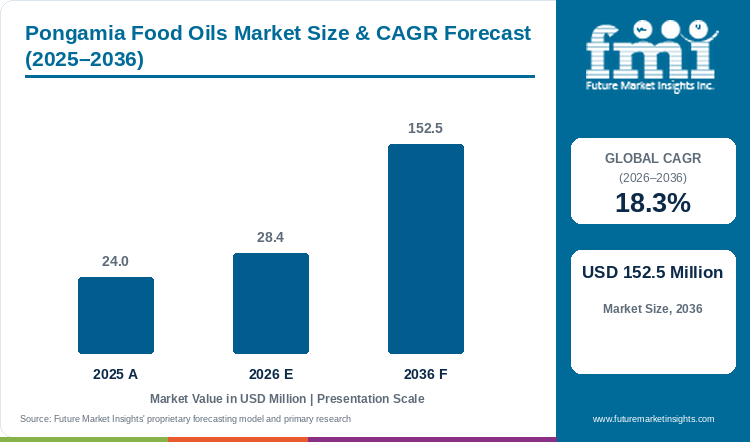
Registering a value of USD 24.0 million in 2025, the global pongamia food oils market expanded to USD 28.4 million in 2026 and is anticipated to achieve USD 152.5 million by 2036, driven by an 18.3% CAGR.
Food manufacturers and plant-based brands searching for deforestation-free alternatives to tropical palm oil are driving rapid commercial adoption of debittered pongamia culinary oils. Regulatory filings in the U.S. Food and Drug Administration's GRAS Notification inventory, including Notice GRN 1324 for pongamia oil in food applications, have given bakery, snack, and alternative-meat formulators a clear pathway to test the tree-borne oil in commercial recipes [1]. Because continuous solvent and clay filtering reliably removes natural bitter compounds below taste thresholds, Solvent & Adsorbent Debittering is projected to command 72.4% of technology demand in 2026, allowing the category to expand far faster than conventional edible oils and fats. From a baseline of USD 24.0 million in 2025, the global pongamia food oils market reaches an estimated USD 28.4 million in 2026 and is projected by FMI to climb to USD 152.5 million by 2036 at an 18.3% CAGR. However, multi-year tree maturation timelines and novel-food regulatory review processes in Europe and Asia remain key supply hurdles moderating near-term volume availability.
Key Market Trends & Insights
- By debittering technology: Solvent & Adsorbent Debittering claims an estimated 72.4% technology share in 2026 because food-grade solvent and clay beds strip bitter karanjin without degrading natural tocopherols.
- By lipid fraction: High-Oleic Culinary Oil holds a projected 54.8% lipid-fraction share in 2026 due to its 50% to 55% oleic acid profile and high smoke point.
- By end-use food application: Plant-Based Meat Fat secures an anticipated 39.6% application share in 2026 since structured pongamia emulsions replicate beef-tallow mouthfeel without tropical palm oil.
- By regulatory certification: GRAS & Novel-Food Grades represent an expected 64.0% certification share in 2026 as commercial CPG buyers require sub-ppm karanjin toxicology dossiers and active regulatory notifications.
- By distribution channel: Direct Formulator Supply accounts for a forecast 71.8% channel share in 2026 through multi-year tanker and tote agreements between orchard processors and food brands.
Regional Highlights
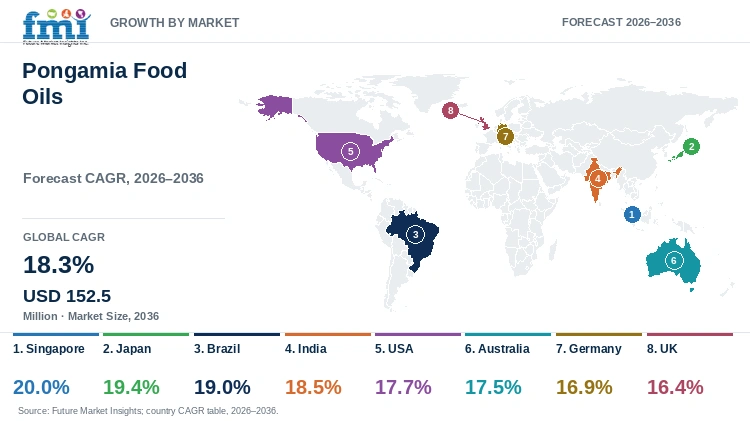
- Asian & Latin America velocity: Singapore alt-protein formulation hubs lead the eight evaluated countries with a 20.0% CAGR to 2036, trailed by specialty lipid refiners in Japan at 19.4%, Brazil at 19.0%, and India at 18.5%.
- North America, Oceania & Europe scale: USA market value compounds at a projected 17.7% CAGR to 2036 ahead of Australia at 17.5%, Germany at 16.9%, and the UK at 16.4%.
Market Size & Forecast
Table 1: Market Size and Forecast for the Pongamia Food Oils Market (USD million and CAGR percentage), 2025 to 2036
| Metric | Value |
|---|---|
| 2025 Baseline Market Value | USD 24.0 million |
| Estimated 2026 Market Size | USD 28.4 million |
| Projected 2036 Industry Valuation | USD 152.5 million |
| CAGR (2026 to 2036) | 18.3% |
| 10-Year Increase in Annual Market Value (2026 to 2036) | USD 124.1 million |
Commercial snack-bar and plant-dairy formulators are evaluating leguminous tree oils because perennial pongamia orchards fix atmospheric nitrogen on degraded pastureland without tropical rainforest clearing. Acute and subacute oral toxicity assays published in December 2025 confirmed that Pongamia pinnata seeds contain 33% to 36% oil and require selective karanjin removal to meet safe dietary intake thresholds [2]. Also Terviva's sustainability benchmarks document that grafted pongamia trees sequester roughly 100 metric tons of carbon per acre over twenty years and yield 1.5 metric tons of oil per acre compared with 0.25 metric tons for soybeans. Driven by these carbon-negative agronomy metrics, food companies pair debittered pongamia oil with plant-based protein concentrates in regenerative snack bars and dairy-free spreads.
Orchard Bean Crushing and Debittered Oil Tonnage Sizing
Table 2: Harvested Pod Crushing Throughput and Refined Oil Tonnage with B2B Price Realization for Pongamia Food Oils, 2025 to 2036
| Metric | 2025 | 2026 | 2036 |
|---|---|---|---|
| Global market valuation (USD million) | 24.0 | 28.4 | 152.5 |
| Food-grade debittered pongamia oil volume (thousand metric tons) | 5.2 to 5.8 | 6.2 to 6.9 | 36.5 to 41.0 |
| Raw dry pongamia bean crushing input (thousand metric tons) | 16.5 to 18.5 | 19.5 to 22.0 | 112.0 to 126.0 |
| Average B2B contract price for debittered food oil (USD per metric ton) | 4,150 to 4,600 | 4,100 to 4,580 | 3,720 to 4,180 |
Seed crushing balance note: Physical mass balances reflect dry pongamia beans holding 32% to 36% crude expeller oil before an 8% to 11% refining mass loss during solvent-adsorbent furanoflavonoid removal and vacuum steam deodorization.
Orchard operators monetize both the debittered golden culinary oil and the co-product 85%-plus protein isolate extracted from the defatted cake, which offsets solvent recovery overheads across Florida and Hawaii crushing facilities. Food ingredient blenders also combine liquid pongamia fractions with sunflower lecithin emulsifiers to stabilize clean-label bakery shortenings.
Per Capita & Regenerative Orchard Productivity Sizing
Table 3: Per-Acre Orchard Yield and Formulator Contract Allocation Indicators for Pongamia Food Oils, 2025 to 2036
| Metric | 2025 | 2026 | 2036 |
|---|---|---|---|
| Bearing commercial grafted pongamia acreage (thousand acres) | 4.2 to 4.8 | 5.0 to 5.7 | 26.0 to 30.5 |
| Average refined food oil yield per bearing acre (metric tons/acre) | 1.20 to 1.35 | 1.22 to 1.38 | 1.38 to 1.50 |
| Annual valuation per commercial food formulator account (USD thousand) | 185.0 to 220.0 | 195.0 to 235.0 | 380.0 to 450.0 |
| Direct B2B formulator supply share of total volume (%) | 71.0% to 71.5% | 71.5% to 72.1% | 74.0% to 76.5% |
Table 4: Segment & Certification Allocation Benchmarks for the Pongamia Food Oils Market, 2026
| Metric | Value | Institutional Reference Basis |
|---|---|---|
| Global pongamia food oils market value | USD 28.4 million | 2026 commercial food-grade lipid baseline |
| Solvent & adsorbent debittering share | 72.4% (USD 20.6 million allocation) | Sub-ppm karanjin & pongamol extraction lines |
| High-oleic culinary oil share | 54.8% (USD 15.6 million allocation) | Mid-oleic omega-9 culinary & snack oil shipments |
| GRAS & Novel-Food dossier share | 64.0% (USD 18.2 million allocation) | Sub-ppm karanjin toxicology & pending GRN 1324 grades |
Long-term supply agreements between agroforestry developers and global oilseed crushers allow food manufacturers to lock in multi-year regenerative oil pricing. Several culinary innovation teams blend liquid pongamia oil into vegan margarine formulations to lower saturated fat content on front-of-pack nutrition labels.
Analyst Perspective
"Pongamia food oil is advancing from a wild-harvested biofuel feedstock into a debittered culinary lipid supported by self-affirmed toxicology dossiers and active FDA GRN 1324 review with a 75% lower greenhouse gas footprint than conventional seed oils. Refiners that pair sub-ppm furanoflavonoid adsorption with enzymatic structuring for palm-free shortenings will win high-margin supply agreements across plant-based meat and bakery brands."
- Nandini Roy Choudhury, Principal Consultant, Future Market Insights.
How is the pongamia food oils market segmented?
The pongamia food oils market is segmented by debittering & refining technology, lipid fraction, end-use food application, regulatory certification, distribution channel, and region. In 2026, Solvent & Adsorbent Debittering holds an estimated 72.4% share, High-Oleic Culinary Oil accounts for a projected 54.8%, Plant-Based Meat Fat represents an anticipated 39.6%, GRAS & Novel-Food Grades capture an expected 64.0%, and Direct Formulator Supply claims a forecast 71.8%.
By debittering technology: Solvent & Adsorbent Debittering and Supercritical & Enzymatic Refining.
By lipid fraction: High-Oleic Culinary Oil, Palm-Free Structured Shortening, and Emulsified Plant-Butter Base.
By end-use food application: Plant-Based Meat Fat, Bakery & Confectionery Shortening, Dairy-Free Creamers & Spreads, and Snack Roasting & Frying.
By regulatory certification: GRAS & Novel-Food Grades and Pilot & Supplement Grades.
By distribution channel: Direct Formulator Supply and Contract Nutraceutical Toll Blenders.
Why does Solvent & Adsorbent Debittering lead technology?
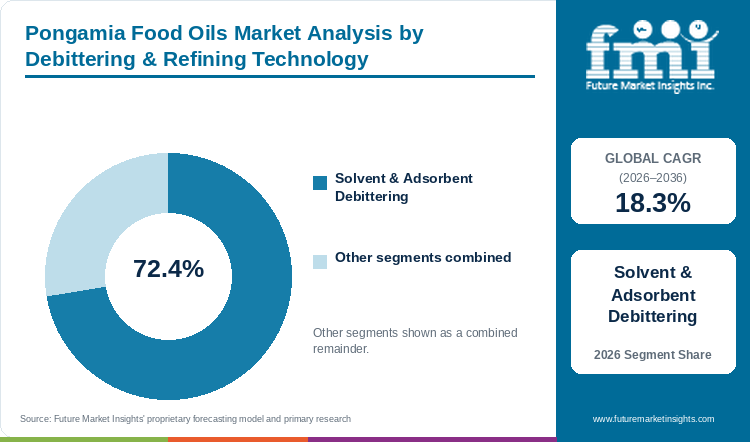
Solvent & Adsorbent Debittering holds an estimated 72.4% share of debittering technologies in 2026 via sub-ppm phytochemical extraction.
Table 5: Debittering & Refining Technology Share for the Pongamia Food Oils Market (percentage share), 2026
| Debittering & Refining Technology | Share (2026) |
|---|---|
| Solvent & Adsorbent Debittering | 72.4% |
| Supercritical & Enzymatic Refining | 27.6% |
| Total | 100.0% |
Note: Debittering technology categories sum to 100.0% of the category in 2026.
Table 6: Debittering & Refining Technology Leadership and Market Growth for the Pongamia Food Oils Market (segment and CAGR percentage), 2026 to 2036
| Metric | Value |
|---|---|
| Global 10-Year CAGR (2026 to 2036) | 18.3% |
| Primary Technology Category | Solvent & Adsorbent Debittering |
Crude expeller oil pressed from Pongamia pinnata seeds contains roughly 1% to 2% bitter furanoflavonoids and chalcones that cause astringency and gastrointestinal irritation if left unrefined. Multi-column polar solvent partitioning paired with selective silica-alumina adsorption strips karanjin and pongamol while allowing refiners to retrofit existing fats and oils solvent recovery skids at commercial scale.
- Solvent & Adsorbent Debittering claims an estimated 72.4% share among debittering technologies in 2026 because continuous adsorption columns process multi-ton batches at lower capital cost than high-pressure CO2 vessels.
- During June 2026, FAO commodity analysts in Rome reported in the biannual Food Outlook that global vegetable oil consumption will outpace production in 2025/26 with ending stocks declining for a third consecutive season [4].
What places High-Oleic Culinary Oil first among lipid fractions?
High-Oleic Culinary Oil accounts for a projected 54.8% share among lipid fractions in 2026 through natural omega-9 frying stability.
Refined pongamia oil naturally contains over 50% monounsaturated oleic acid (C18:1) along with moderate linoleic and palmitic levels, giving it an oxidative induction time and high smoke point well suited for rotary snack roasting and pan frying. Unlike winterized soybean oil that requires partial hydrogenation or heavy antioxidant dosing, liquid Ponova oil delivers a clean buttery finish in savory plant-based snacks and salad dressings.
- High-Oleic Culinary Oil secures a projected 54.8% share within lipid fractions in 2026 as snack and protein-bar manufacturers adopt unfractionated liquid totes before investing in enzymatic hardstock structuring.
- In October 2026, commodity analysts at the USDA Economic Research Service documented in report OCS-26j of the Oil Crops Outlook series that tight domestic supplies and firm industrial demand across North America vegetable oil markets continue to support high-oleic specialty oil premiums [5].
Why does Plant-Based Meat Fat lead end-use food applications?
Plant-Based Meat Fat represents an anticipated 39.6% share of food applications in 2026 as burger brands reformulate without palm oil.
Alt-meat formulators face consumer pushback when plant burgers rely on high-lauric coconut oil or imported palm stearin that raises saturated fat levels to match beef patties. When structured into an oleogel or protein-lipid emulsion, pongamia oil provides slow melt release and savory juiciness inside meatless burger patties while cutting saturated fatty acids by nearly half compared with coconut fat.
- Plant-Based Meat Fat captures an anticipated 39.6% share across food applications in 2026 because meat-alternative brands pay a premium for deforestation-free lipids that improve sear and bite.
- In August 2024, researchers in Scientific Reports demonstrated that refined Pongamia pinnata seed oil exhibits high thermal stability and low moisture absorption compared with conventional vegetable oils, supporting its formulation into structured plant-based meat fats and culinary emulsions [6].
How do GRAS & Novel-Food Grades anchor certification share?
GRAS & Novel-Food Grades represent an expected 64.0% certification share in 2026.
Commercial bakery and snack corporations require toxicology dossiers verifying sub-ppm residual karanjin and 90-day subchronic feeding safety before onboarding new tree oils. Self-affirmed GRAS safety determinations paired with active regulatory submissions such as Terviva's pending U.S. FDA GRN 1324 notification (following earlier notice GRN 1153, which ceased evaluation at the notifier's request) allow suppliers to qualify lots for clean-label ingredients trials while formal agency reviews proceed.
- GRAS & Novel-Food Grades hold an expected 64.0% share among certification tiers in 2026 because food brands require batch LC-MS karanjin certificates and formal toxicology filings prior to retail launch.
- In December 2025, the European Food Safety Authority reviewed its centralized Novel Food risk assessment requirements under Regulation (EU) 2015/2283 to mandate compositional and toxicological verification for new botanical lipids entering the European Union [7].
Why does Direct Formulator Supply lead distribution channels?
Direct Formulator Supply claims a forecast 71.8% share of distribution channels in 2026 via direct R&D co-development contracts.
Because edible pongamia oil is an emerging regenerative ingredient with limited annual crushing tonnage, orchard developers allocate most of their output directly to partnered CPG manufacturers and oilseed joint-venture refiners. Direct application engineering teams work with customer food scientists to calibrate frying stability and emulsion viscosity in liquid and powdered non-dairy creamers and nutrition bars.
- Direct Formulator Supply accounts for a forecast 71.8% share across distribution channels in 2026 due to multi-year offtake agreements linking Hawaii and Florida orchards with Queensland groves directly to food brands.
- In March 2026, PMMI documented in its 2026 The Formulation Effect report that recipe reformulation toward clean-label and sustainable plant oils is driving direct co-engineering between ingredient suppliers and food processors across North America [8].
What are the drivers, restraints, and opportunities in the pongamia food oils market?
Corporate Scope 3 decarbonization commitments and palm-free lipid reformulation accelerate global pongamia food oils demand through 2036, whereas multi-year orchard maturation timelines limit near-term bean supply and enzymatic plant-butter structuring opens high-margin bakery business.
- Driver: Nitrogen-fixing perennial pongamia orchards sequester carbon on degraded land while producing 1.5 metric tons of oil per acre, helping food brands cut Scope 3 ingredient emissions.
- Restraint: Newly planted grafted pongamia trees require four to five years to reach commercial pod bearing, which limits short-term crude bean availability and keeps unit refining costs above commodity soy oil.
- Opportunity: Enzymatic interesterification and oleogel structuring of debittered pongamia oil into semi-solid shortenings allow brioche bakeries and plant-butter brands to replace tropical palm oil.
Growth Analysis and Future Potential: Qualitative Demand Catalysts
Major food multinationals have pledged to eliminate deforestation and cut agricultural Scope 3 greenhouse gas emissions by 30% to 50% by 2030, creating strong commercial pull for perennial tree oils grown on Marginal citrus groves and degraded cattle pastures. Because leguminous pongamia trees fix their own soil nitrogen and require up to 75% less irrigation water than annual row crops, switching from conventional seed oils to Ponova oil immediately lowers a food product's lifecycle carbon intensity. During September 2026, U.S. Agricultural economists noted in report OCS-26i of the Oil Crops Outlook series that shifting biofuel and food processing demand across the Americas is reshaping oilseed crushing margins and encouraging specialty oilseed diversification [9]. Enabled by these sustainability targets, food formulators pair debittered pongamia oil with specialty bakery fats to market carbon-negative snacks and baked goods.
Risk Assessment of the Pongamia Food Oils Market: Operational and Formulation Friction
Agronomic gestation time and multi-region novel food dossier lead times represent the primary operational bottlenecks slowing mass-market pongamia oil adoption. Even with high-yielding clonal rootstocks, newly planted groves in Florida and Hawaii or Queensland require four to five years before mechanical shakers can harvest commercial bean volumes. Wild-collected India seeds also exhibit wide variability in moisture and furanoflavonoid levels. In October 2026, Food Standards Australia New Zealand noted in its Novel Foods regulatory guidance under Standards 1.1.1 and 1.5.1 that non-traditional botanical foods must complete a statutory pre-market public health and toxicological assessment before retail sale in Australia and New Zealand [10]. So refiners must finance multi-year orchard establishment and parallel toxicological submissions before achieving full multinational grocery distribution.
Commercial Opportunity Analysis: Formulation Differentiation and Value-Add Formats
While first-generation commercial launches focused on liquid culinary and snack-bar oil, higher margin potential lies in structuring debittered pongamia oil into zero-trans semi-solid shortenings and emulsified plant-butter bases. By blending mid-oleic pongamia oil with botanical stearins or enzymatic interesterification drivers, lipid engineers create plastic shortenings that laminate croissant doughs and marble plant-based steaks without palm oil. In December 2025, phytochemical extraction researchers demonstrated in Industrial Crops and Products (PMC12684878) that scalable solvent-adsorbent separation cleanly isolates polyphenolic pongamol and furanoflavonoids from Pongamia pinnata seed oil [11]. This clean fractionation enables specialty fat refiners to capture USD 4,500-plus per metric ton across clean-label bakery and dairy-alternative accounts.
Pongamia Food Oils Market by Country (2026 to 2036)
As per FMI, Singapore is projected to lead pongamia food oils expansion across evaluated national markets at a 20.0% CAGR through 2036, whereas the UK is forecast to advance at a 16.4% CAGR. Commercial adoption across Asia-Pacific, the Americas, and Western Europe tracks front-of-pack saturated-fat labeling mandates, clonal orchard harvests, and palm-free lipid reformulation.
Table 7: Country CAGR and Primary Growth Levers for the Pongamia Food Oils Market (CAGR percentage and operational drivers), 2026 to 2036
| Country | CAGR (2026 to 2036) | Primary Growth Lever |
|---|---|---|
| Singapore | 20.0% | 2028 Nutri-Grade saturated-fat cooking oil extension and Biopolis alt-meat & dairy-free R&D centers |
| Japan | 19.4% | Industrial bakery shortening and plant-butter formulation led by Fuji Oil and Nisshin OilliO refineries |
| Brazil | 19.0% | Cerrado degraded pastureland agroforestry intercropping and South America oilseed crushing integration |
| India | 18.5% | Native Millettia pinnata seed corridors and continuous solvent-adsorbent debittering plant upgrades |
| USA | 17.7% | Pending FDA GRN 1324 and self-affirmed GRAS Ponova oil commercialization across Hawaii and Florida orchards |
| Australia | 17.5% | Subtropical Queensland and Northern Territory clonal pongamia plantations and clean-label food manufacturing |
| Germany | 16.9% | EU deforestation-free Scope 3 mandates and palm-free structured shortening adoption in vegan foods |
| UK | 16.4% | Supermarket traffic-light saturated-fat reduction and plant-based pastry and ready-meal reformulation |
Source: Future Market Insights analysis
USA Pongamia Food Oils Market Outlook (2026 to 2036)
Commercialization of edible pongamia oil began in the USA, where Terviva established clonal orchards across former Florida citrus groves and Oahu agricultural lands while submitting FDA GRAS Notice GRN 1324 (currently pending following earlier notice GRN 1153). Plant-based protein bar makers in the USA such as Aloha and regenerative bakery brands use self-affirmed GRAS omega-9 Ponova oil as a sustainability differentiator. During August 2026, U.S. Oilseed economists reported in bulletin OCS-26h of the Oil Crops Outlook series that strong domestic food and biofuel demand continues to tighten vegetable oil balance sheets in the USA [12]. Direct B2B offtake partnerships with multinational oilseed crushers lift USA pongamia food oils valuation by a projected a 17.7% CAGR through 2036.
Key takeaway: In the USA, sub-ppm furanoflavonoid debittering under pending FDA GRN 1324 review and Florida citrus-grove conversion propel commercial culinary oil offtake.
Australia Pongamia Food Oils Market Outlook (2026 to 2036)
Subtropical rangelands across Queensland and the Northern Territory provide ideal solar radiation and drought-tolerant growing conditions for large-scale mechanical pongamia plantations in Australia. Domestic agronomy researchers and commercial plantation developers have bred high-oil clonal varieties originally selected for aviation biofuel that are now being routed into food-grade expeller crushing and solvent-adsorbent debittering. Plant-meat and clean-label snack manufacturers in Australia seek locally grown non-GMO tree oils to replace imported Southeast Asian palm oil on supermarket ingredient decks. As domestic refiners complete Food Standards Australia New Zealand novel-food safety dossiers for culinary and bakery fat fractions, Pongamia food oils demand in Australia is slated to compound at a 17.5% CAGR between 2026 and 2036 across Brisbane and Melbourne food plants [3].
Key takeaway: In Australia, subtropical Queensland orchard harvests paired with palm-free bakery reformulation underpin steady B2B adoption through 2036.
Japan Pongamia Food Oils Market Outlook (2026 to 2036)
Specialty lipid refiners and artisan bakery suppliers in Japan lead East Asia in enzymatic fat structuring and dairy-free creamer emulsification and clean-label brioche shortening development. Because Japan imports nearly all of its edible oilseeds, food manufacturers in Tokyo and Osaka actively invest in Hawaii and Indo-Pacific pongamia supply chains to diversify away from volatile soybean and palm oil cargoes. Biochemical characterization studies published in December 2025 (PMC12756030) confirmed that symbiotic root-nodulating bacteria enable Pongamia pinnata groves to grow on marginal soils while sustaining high seed lipid output [13]. High-stability pastry shortenings and plant-butter formulation trials advance pongamia food oils demand in Japan at a projected 19.4% CAGR through 2036.
Key takeaway: In Japan, plant-butter pastry lines and specialty fat fractionation expertise accelerate high-margin culinary pongamia oil imports.
Singapore Pongamia Food Oils Market Outlook (2026 to 2036)
Singapore works as Southeast Asia's precision food-tech and alternative-protein formulation capital, hosting regional R&D kitchens for global lipid refiners and plant-meat startups in Biopolis and Jurong. In October 2026, Singapore's Health Promotion Board announced in its updated Nutri-Grade policy that mandatory A-to-D grading and Grade D advertising prohibitions will extend to retail cooking oils and sauces in 2028 to curb saturated fat intake after national survey data showed raised blood cholesterol in one-third of residents [14]. Because mid-oleic pongamia oil offers lower saturated fat than palm olein while delivering rich mouthfeel in alt-meat and Asian culinary sauces, pongamia food oils valuation in Singapore expands at a 20.0% CAGR to 2036 across Jurong and Biopolis kitchens.
Key takeaway: In Singapore, saturated-fat cooking oil grading under the 2028 Nutri-Grade extension and Biopolis alt-protein kitchens drive rapid formulator uptake.
Brazil Pongamia Food Oils Market Outlook (2026 to 2036)
Vast tracts of degraded cattle pasture across Brazil's Cerrado and Minas Gerais biomes offer millions of hectares for silvopastoral pongamia intercropping without encroaching on Amazonian forest reserves. Multinational oilseed crushers operating in Brazil can process harvested pongamia beans through existing solvent-extraction and vegetable-oil refining complexes during the soybean off-season. During February 2026, Bunge's annual earnings release noted that South America processing and refining volumes expanded after its Viterra merger to total 41.0 million metric tons of soybeans and 2.47 million metric tons of specialty oilseeds [15]. Fueled by domestic crushing integration and South America plant-based food manufacturing, pongamia food oils valuation in Brazil rises at a 19.0% CAGR through 2036 across Sao Paulo food plants.
Key takeaway: In Brazil, Cerrado silvopastoral intercropping and multi-oilseed refinery integration position domestic crushers for export-scale food oil output.
India Pongamia Food Oils Market Outlook (2026 to 2036)
India is projected to expand at an 18.5% CAGR from 2026 through 2036 because native Millettia pinnata seed collection networks across Maharashtra, Karnataka, and Tamil Nadu provide the world's largest wild and plantation bean base [21]. Domestic solvent-extraction plants are upgrading from technical expeller pressing to food-grade polar-solvent and adsorbent debittering columns that strip karanjin and pongamol below 1 ppm for commercial snack frying and bakery shortening. Multinational and domestic edible oil refiners pair nitrogen-fixing agroforestry contracts with high-oleic culinary oil fractionation to reduce reliance on imported palm olein. Food Safety and Standards Authority of India (FSSAI) novel-ingredient clearance timelines remain the primary domestic pacing factor.
Key takeaway: In India, native pongamia seed collection corridors and continuous solvent-adsorbent debittering upgrades anchor an 18.5% CAGR through 2036.
Germany Pongamia Food Oils Market Outlook (2026 to 2036)
Germany is forecast to advance at a 16.9% CAGR between 2026 and 2036 as retail private-label bakery and meat-alternative brands enforce strict European Union deforestation-free supply chain rules and Scope 3 carbon reductions [22]. Vegan burger and pastry formulators in Hamburg, Munich, and Berlin are replacing imported palm stearin and coconut fat with structured high-oleic pongamia shortenings and emulsified plant-butter bases. European Food Safety Authority (EFSA) centralized Novel Food toxicology dossier evaluation under Regulation (EU) 2015/2283 governs commercial rollout across continental grocery channels. Premium B2B contract pricing relative to domestic rapeseed oil moderates mass-market substitution.
Key takeaway: In Germany, palm-free alt-meat and pastry reformulation under EU deforestation-free sourcing mandates supports a 16.9% CAGR through 2036.
UK Pongamia Food Oils Market Outlook (2026 to 2036)
The UK is expected to record a 16.4% CAGR over the 2026 to 2036 assessment period, propelled by retail supermarket clean-label commitments and high-frequency plant-based ready-meal product launches [23]. Contract food manufacturers across the Midlands and Yorkshire evaluate debittered pongamia culinary oil and enzymatic oleogels to lower saturated fatty acid scores under UK front-of-pack traffic-light nutrition labeling while preserving biscuit and savoury pastry lamination. Direct B2B supply partnerships with specialty fat refiners enable pilot kitchen trials ahead of Food Standards Agency (FSA) novel food authorization. Cold-chain and bulk-tote import logistics from U.S. And Asia-Pacific crushing hubs remain the primary cost constraint.
Key takeaway: In the UK, supermarket traffic-light saturated-fat reduction targets and plant-based ready-meal reformulation drive a 16.4% CAGR through 2036.
Full report country CAGRs cover: North America; Latin America; Western Europe; Eastern Europe; East Asia; South Asia and Pacific; Middle East and Africa.
Who are the notable companies in the pongamia food oils market?
Terviva, Inc. (Ponova Oil), Bunge Global SA, Danone Manifesto Ventures / Formulation Partners, Fuji Oil Holdings Inc., AAK AB, Cargill, Incorporated, The Nisshin OilliO Group, Ltd., and Ciranda, Inc. Are the notable companies in the pongamia food oils market.
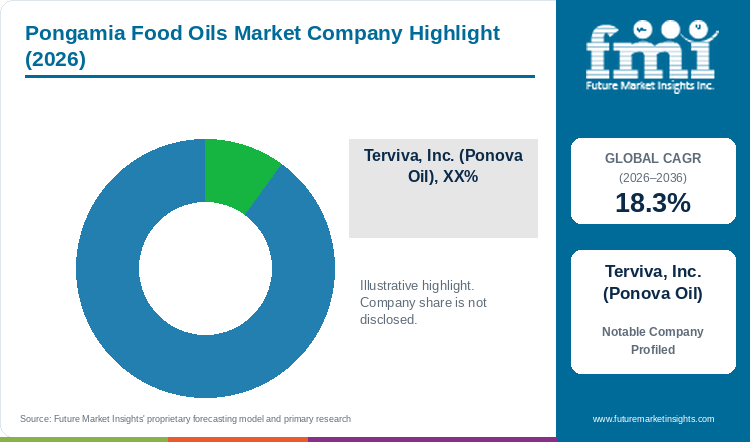
Commercial participation in pongamia food oils spans proprietary agroforestry and debittering pioneers, global oilseed crushing and specialty fat refiners, and downstream CPG formulation and organic distribution partners. Agroforestry pioneers control grafted high-yield tree genetics and patented karanjin removal, whereas global lipid refiners scale enzymatic structuring and multinational food delivery.
- Agroforestry & Patented Debittering Pioneers: Terviva Inc. (Ponova Oil) controls elite grafted Millettia pinnata orchard genetics and proprietary solvent-adsorbent furanoflavonoid removal.
- Global Oilseed Crushers & Specialty Fat Refiners: Bunge Global SA and AAK AB along with Cargill Incorporated and Fuji Oil Group plus Nisshin OilliO scale vegetable oil refining and plant-meat fat structuring.
- CPG Formulation & Specialty Organic Ingredient Partners: Danone Manifesto Ventures / Formulation Partners and Ciranda Inc. Accelerate plant-based dairy and clean-label snack-bar B2B ingredient adoption.
Competitive Benchmarking: Pongamia Food Oils Market
Table 8: Competitive Benchmarking for the Pongamia Food Oils Market (qualitative capability ratings), 2026
| Company | Debittering & Refining IP | Structured Fat & Emulsion Breadth | B2B Food Formulator Access | Orchard & Geographic Reach |
|---|---|---|---|---|
| Terviva, Inc. (Ponova Oil) | High | Medium | High | High |
| Bunge Global SA | High | High | High | High |
| Danone Manifesto Ventures / Formulation Partners | Medium | High | High | High |
| Fuji Oil Holdings Inc. | Medium | High | High | High |
| AAK AB | Medium | High | High | High |
| Cargill, Incorporated | Medium | High | High | High |
| The Nisshin OilliO Group, Ltd. | Medium | High | Medium | Medium |
| Ciranda, Inc. | Medium | Medium | High | Medium |
Scoring methodology note: Table 8 tiers assess verified furanoflavonoid removal IP and sub-ppm karanjin analytical control as well as structured shortening and emulsion engineering. Formulator access and orchard reach reflect documented supply agreements across North America and Indo-Pacific food processing corridors.
Key Developments in the Pongamia Food Oils Market
- During March 2026, Bunge Global SA outlined its 'Origins to Opportunities' strategic growth plan at its 2026 Investor Day after its Viterra merger, establishing a USD 13 to USD 15 mid-cycle EPS baseline and a USD 3,000.0 million share repurchase program while expanding specialty oilseed processing [16].
- In April 2026, Danone SA reported EUR 6,708 million in first-quarter 2026 turnover (+2.7% like-for-like) supported by positive volume and mix across critical Dairy and Plant-Based products in North America and Europe plus continued regenerative agriculture investments [17].
- During July 2026, AAK AB posted second-quarter 2026 operating profit of SEK 491 million (+9% year-on-year) in Chocolate & Confectionery Fats and SEK 658 million in Food Ingredients while advancing co-development of AkoPlanet plant-based meat and dairy fat systems [18].
Key Players in the Pongamia Food Oils Market
Agroforestry, Oilseed Crushing & Debittering Leaders
- Terviva, Inc. (Ponova Oil)
- Bunge Global SA
- Cargill, Incorporated
Global Specialty Fat & Plant-Butter Refiners
- Fuji Oil Holdings Inc.
- AAK AB
- The Nisshin OilliO Group, Ltd.
CPG Formulation & Specialty Organic Ingredient Partners
- Danone Manifesto Ventures / Formulation Partners
- Ciranda, Inc.
Pongamia Food Oils Market - Report Scope
Table 9: Report Scope for the Pongamia Food Oils Market (coverage fields and definitions), 2026 to 2036
| Coverage field | Report scope |
|---|---|
| Market Breakdown | Debittering & Refining Technology; Lipid Fraction; End-Use Food Application; Regulatory Certification; Distribution Channel; Region |
| Quantitative Units | USD Million |
| Market Definition | Covers commercial B2B and food-processor valuation of debittered, refined edible pongamia seed oil (Millettia pinnata / Pongamia pinnata) across liquid high-oleic culinary oils, structured palm-replacement shortenings, and emulsified plant-butter fat bases. Scope Boundary Note: Excludes unrefined high-karanjin crude pongamia expeller oil routed into hydrotreated aviation biofuel or biodiesel, biopesticide karanjin concentrates, and defatted pongamia protein meal or cattle feed cakes. |
| Regions Covered | North America; Latin America; Western Europe; Eastern Europe; East Asia; South Asia and Pacific; Middle East and Africa |
| Countries evaluated | Singapore, Japan, Brazil, India, USA, Australia, Germany, UK, and additional national markets in the full dataset |
| Notable Companies | Terviva, Inc. (Ponova Oil), Bunge Global SA, Danone Manifesto Ventures / Formulation Partners, Fuji Oil Holdings Inc., AAK AB, Cargill, Incorporated, The Nisshin OilliO Group, Ltd., Ciranda, Inc. |
| Forecast Horizon | 2026 to 2036 (with 2025 historical baseline) |
| Research Triangulation | Primary interviews with orchard agronomists and lipid refiners reconciled against FDA GRAS Notice Inventory filings (pending GRN 1324 and ceased GRN 1153) and seed-crushing balances. |
Pongamia Food Oils Market - Research Methodology
Table 10: Research Methodology for the Pongamia Food Oils Market (research methods and approach), 2026 edition
| Method | Approach |
|---|---|
| Primary Interviews | Structured interviews with agroforestry plantation managers in Hawaii and Florida plus Queensland and solvent-adsorbent refinery process engineers and plant-based food R&D directors. |
| Secondary Regulatory & Trade Sources | Cross-verification against U.S. FDA GRAS Notice Inventory records (pending GRN 1324 and ceased GRN 1153 for pongamia bean oil; verifying that GRN 1092 applies to Bifidobacterium animalis subsp. Lactis IDCC 4301), USDA ERS Oil Crops Outlook bulletins, FAO Food Outlook reports, FSANZ Novel Food standards, and Singapore HPB Nutri-Grade cooking oil regulations. |
| Top-Down & Bottom-Up Sizing | Bottom-up bearing grafted pongamia orchard acreage and expeller crushing yields (1.2 to 1.5 MT oil/acre) triangulated against B2B food formulator contract prices (USD 3,720 to USD 4,600/MT). |
| Country Forecasting Model | National growth rates weight domestic orchard expansion, pending GRAS and Novel Food toxicology dossier progress, saturated-fat front-of-pack labeling rules, and alt-protein manufacturing density. |
| Operational Benchmark Traceability | Acreage, bean crushing input, and debittered oil tonnage metrics in Tables 2, 3, and 4 trace to Terviva Ponova technical disclosures, USDA ERS oilseed crushing ratios, and NIST net-content standards. |
| Financial Reconciliation | Excludes non-edible biofuel feedstock sales and co-product protein isolate revenues to isolate pure food-grade pongamia lipid market valuation. |
Pongamia Food Oils Market by Segments
Pongamia Food Oils Market segmented by Debittering & Refining Technology:
- Solvent & Adsorbent Debittering
- Supercritical & Enzymatic Refining
- Membrane Micelle Deacidification
Pongamia Food Oils Market segmented by Lipid Fraction:
- High-Oleic Culinary Oil
- Palm-Free Structured Shortening
- Emulsified Plant-Butter Base
- Fractionated Pongamia Stearin
Pongamia Food Oils Market segmented by End-Use Food Application:
- Plant-Based Meat Fat
- Bakery & Confectionery Shortening
- Dairy-Free Creamers & Spreads
- Snack Roasting & Frying
Pongamia Food Oils Market segmented by Regulatory Certification:
- GRAS & Novel-Food Grades
- Pilot & Supplement Grades
- Organic Agroforestry Certified
- Non-GMO Project Verified
Pongamia Food Oils Market segmented by Distribution Channel:
- Direct Formulator Supply
- Contract Nutraceutical Blenders
- Specialty B2B Distributors
- Foodservice Commissary Supply
Pongamia Food Oils Market by Region
- North America
- United States
- Canada
- Latin America
- Brazil
- Mexico
- Argentina
- Chile
- Western Europe
- Germany
- France
- United Kingdom
- Italy
- Spain
- Benelux
- Nordics
- Eastern Europe
- Poland
- Czech Republic
- Romania
- Hungary
- East Asia
- China
- Japan
- South Korea
- South Asia and Pacific
- India
- ASEAN
- Australia and New Zealand
- Middle East and Africa
- GCC Countries
- South Africa
- Türkiye
- Israel
Research Sources and Bibliography
- [1] U.S. Food and Drug Administration (FDA). (2026, October 15). GRAS Notices: GRN No. 1324 Pongamia (Millettia pinnata (L.)) bean oil (Pending; following GRN No. 1153 Ceased Evaluation, distinct from GRN No. 1092 Bifidobacterium animalis subsp. Lactis IDCC 4301). U.S. Department of Health and Human Services.
- [2] Aly, S. H., El-Hassab, M. A., El-Shazly, A. M., & Eldahshan, O. A. (2025, December 10). Acute and subacute oral toxicity assessment of Karanjin in Sprague Dawley rats. Toxicology Reports, 14, 101842 (PubMed Central PMC12857176).
- [3] Terviva, Inc. (2025, October 20). Sustainability — Terviva.com. Terviva Agroforestry & Lifecycle Carbon Benchmarks.
- [4] Food and Agriculture Organization of the United Nations (FAO). (2026, June 18). FAO Food Outlook: Global food commodity market trends face rising geopolitical and weather risks. FAO Markets and Trade Portal.
- [5] U.S. Department of Agriculture, Economic Research Service (USDA ERS). (2026, October 14). Oil Crops Outlook: October 2026 (OCS-26j). USDA Economic Research Service.
- [6] European Commission, Directorate-General for Health and Food Safety. (2026, July 20). Union list of novel foods. European Commission Food Safety Portal.
- [7] European Food Safety Authority (EFSA). (2025, December 17). Novel food. EFSA Scientific Risk Assessment Portal.
- [8] PMMI, The Association for Packaging and Processing Technologies. (2026, March 18). 2026 The Formulation Effect: Impacts on F&B Production, Equipment and Investment. PMMI Business Intelligence.
- [9] U.S. Department of Agriculture, Economic Research Service (USDA ERS). (2026, September 15). Oil Crops Outlook: September 2026 (OCS-26i). USDA Economic Research Service.
- [10] Food Standards Australia New Zealand (FSANZ). (2026, October 16). Novel foods . Australia New Zealand Food Standards Code Guidance.
- [11] Cui, R., et al. (2025). Scalable extraction of pongamol from Pongamia pinnata for synthesis and application of colloidally stable iron nanoparticles.. RSC advances, 15(56), 48666-48677 (PMC12684878).
- [12] U.S. Department of Agriculture, Economic Research Service (USDA ERS). (2026, August 14). Oil Crops Outlook: August 2026 (OCS-26h). USDA Economic Research Service.
- [13] Singh, R., & Sharma, P. (2025, December 18). Pheno-morphological and biochemical characterization of root nodules and associated Rhizobium spp. In Pongamia pinnata. Frontiers in Plant Science (PubMed Central PMC12756030).
- [14] Health Promotion Board, Singapore (HPB). (2026, October 3). Measures for Nutri-Grade . Singapore Ministry of Health & HPB Regulatory Guidance.
- [15] Bunge Global SA. (2026, February 4). Bunge Reports Fourth Quarter and Full-Year 2025 Results – Bunge. Bunge Global SA Investor Relations.
- [16] Bunge Global SA. (2026, March 10). Bunge Outlines Strategic Growth and Value Creation Plan at 2026 Investor Day – Bunge. Bunge Global SA Investor Relations.
- [17] Danone SA. (2026, April 22). 2026 First Quarter Sales: Solid Q1 performance amid a challenging context. Danone Investor Relations Official Press Release PDF.
- [18] AAK AB. (2026, July 17). AAK's Interim report for the second quarter 2026 . AAK AB Press & Investor Releases.
- [19] Cargill, Incorporated. (2026, March 31). Cargill Expands Specialty Fats Facility in Port Klang, Malaysia . Cargill Global Food & Specialty Fats Newsroom.
- [20] National Institute of Standards and Technology (NIST). (2025, December 18). NIST Handbook 133: Checking the Net Contents of Packaged Goods (2026 Ed.). U.S. Department of Commerce.
- [21] U.S. Department of Agriculture, Foreign Agricultural Service (USDA FAS). (2026, October 12). Oilseeds: World Markets and Trade (October 2026). U.S. Department of Agriculture.
- [22] Organisation for Economic Co-operation and Development & Food and Agriculture Organization (OECD-FAO). (2026, June 25). OECD-FAO Agricultural Outlook 2026-2035: Vegetable Oils and Oilseeds. OECD Publishing.
- [23] U.S. Food and Drug Administration (FDA). (2026, February 14). Generally Recognized as Safe (GRAS) Notification Program and Food Ingredient Inventory. U.S. Department of Health and Human Services.
This bibliography is provided for reader reference and is not exhaustive. The full report contains the complete reference list and detailed citations.
This Report Answers
- What is the 2026 market size and 2036 valuation forecast for the pongamia food oils market?
- How does furanoflavonoid and karanjin removal enable edible food applications for Millettia pinnata oil?
- Why does Solvent & Adsorbent Debittering lead technology share in 2026?
- What makes Plant-Based Meat Fat the largest end-use food application?
- How do national growth rates compare across Singapore and Japan as well as Brazil and the USA plus Australia?
- Which agroforestry innovators and global oilseed refiners supply debittered pongamia food oils?
- How do four-to-five-year tree maturation timelines affect short-term bean crushing supply?
- What certification and residual-karanjin specifications do CPG food buyers require?
Frequently Asked Questions
How large is the pongamia food oils market in 2026, and what is the 2036 projection?
For calendar year 2026, global pongamia food oils market value totals an estimated USD 28.4 million compared with USD 24.0 million in 2025. By 2036, sector valuation hits a projected USD 152.5 million as regenerative orchard harvests scale in Hawaii and Florida plus Queensland.
What is the 10-year CAGR and added valuation for the pongamia food oils market?
From 2026 through 2036, the pongamia food oils sector compounds at an 18.3% CAGR to add USD 124.1 million in decade-long category value.
Which debittering technology segment leads the pongamia food oils market?
Solvent & Adsorbent Debittering holds an estimated 72.4% share among debittering technologies in 2026 because continuous polar-solvent and clay adsorption columns strip bitter karanjin below 1 ppm while preserving oleic glycerides.
Which lipid fraction and food application segments hold the largest shares?
High-Oleic Culinary Oil accounts for a projected 54.8% share among lipid fractions in 2026 due to its omega-9 frying stability, while Plant-Based Meat Fat leads end-use food applications at an anticipated 39.6% share.
Which country records the highest CAGR through 2036?
Singapore tops the five evaluated national markets with a 20.0% CAGR through 2036 due to the 2028 Nutri-Grade cooking oil saturated-fat grading extension and Biopolis alternative-protein formulation hubs.
Which companies are the key participants in the pongamia food oils market?
Key market participants include Terviva, Inc. (Ponova Oil) and Bunge Global SA along with Danone Manifesto Ventures / Formulation Partners and Fuji Oil Holdings Inc. Plus AAK AB and Cargill, Incorporated as well as The Nisshin OilliO Group, Ltd. And Ciranda, Inc.
Preview the report firsthand - request a free sample
Get SampleGet the brochure for pricing and purchase details.
Get PDFTable of Content
- Key Takeaways
- Market Size and CAGR
- Top Growth Driver
- Fastest Growing Segment
- Leading Region
- Key Companies
- Emerging Opportunities
- Executive Summary
- Global Market Outlook
- Demand-side Trends
- Supply-side Trends
- Technology Roadmap Analysis
- Analysis and Recommendations
- Analyst Perspective (What is happening? Why now? What should investors know?)
- Key Questions Answered
- How large is the market?
- What is the CAGR?
- What are key trends?
- Which region dominates?
- Who are the leaders?
- Market Overview
- Market Coverage / Taxonomy
- Market Definition / Scope / Limitations
- Research Methodology
- Chapter Orientation
- Analytical Lens and Working Hypotheses
- Market Structure, Signals, and Trend Drivers
- Benchmarking and Cross-market Comparability
- Market Sizing, Forecasting, and Opportunity Mapping
- Research Design and Evidence Framework
- Desk Research Programme (Secondary Evidence)
- Expert Input and Fieldwork (Primary Evidence)
- Tooling, Models, and Reference Databases
- Data Engineering and Model Build
- Quality Assurance and Audit Trail
- Market Background
- Market Dynamics (Drivers, Restraints, Opportunity, Trends)
- Scenario Forecast (Optimistic, Likely, Conservative)
- Impact Analysis
- AI Impact
- Sustainability Impact
- Regulatory Impact
- Technology Impact
- Consumer / Buyer Analysis
- Purchase Drivers
- Adoption Barriers
- Buyer Journey
- Opportunity Map Analysis
- Product Life Cycle Analysis
- Supply Chain Analysis
- Investment Feasibility Matrix
- Value Chain Analysis
- PESTLE and Porter's Analysis
- Regulatory Landscape
- Regional Parent Market Outlook
- Production and Consumption Statistics
- Import and Export Statistics
- Global Market Analysis and Forecast, 2021 to 2036
- Historical Market Size Value (USD Million) Analysis, 2021 to 2025
- Current and Future Market Size Value (USD Million) Projections, 2026 to 2036
- Y-o-Y Growth Trend Analysis
- Absolute $ Opportunity Analysis
- Global Market Pricing Analysis, 2021 to 2036
- Global Market Analysis and Forecast, By Debittering & Refining Technology, 2021 to 2036
- Introduction / Key Findings
- Historical Market Size Value (USD Million) Analysis By Debittering & Refining Technology, 2021 to 2025
- Current and Future Market Size Value (USD Million) Analysis and Forecast By Debittering & Refining Technology, 2026 to 2036
- Solvent & Adsorbent Debittering
- Supercritical & Enzymatic Refining
- Membrane Micelle Deacidification
- Y-o-Y Growth Trend Analysis By Debittering & Refining Technology, 2021 to 2025
- Absolute $ Opportunity Analysis By Debittering & Refining Technology, 2026 to 2036
- Global Market Analysis and Forecast, By Lipid Fraction, 2021 to 2036
- Introduction / Key Findings
- Historical Market Size Value (USD Million) Analysis By Lipid Fraction, 2021 to 2025
- Current and Future Market Size Value (USD Million) Analysis and Forecast By Lipid Fraction, 2026 to 2036
- High-Oleic Culinary Oil
- Palm-Free Structured Shortening
- Emulsified Plant-Butter Base
- Fractionated Pongamia Stearin
- Y-o-Y Growth Trend Analysis By Lipid Fraction, 2021 to 2025
- Absolute $ Opportunity Analysis By Lipid Fraction, 2026 to 2036
- Global Market Analysis and Forecast, By End-Use Food Application, 2021 to 2036
- Introduction / Key Findings
- Historical Market Size Value (USD Million) Analysis By End-Use Food Application, 2021 to 2025
- Current and Future Market Size Value (USD Million) Analysis and Forecast By End-Use Food Application, 2026 to 2036
- Plant-Based Meat Fat
- Bakery & Confectionery Shortening
- Dairy-Free Creamers & Spreads
- Snack Roasting & Frying
- Y-o-Y Growth Trend Analysis By End-Use Food Application, 2021 to 2025
- Absolute $ Opportunity Analysis By End-Use Food Application, 2026 to 2036
- Global Market Analysis and Forecast, By Regulatory Certification, 2021 to 2036
- Introduction / Key Findings
- Historical Market Size Value (USD Million) Analysis By Regulatory Certification, 2021 to 2025
- Current and Future Market Size Value (USD Million) Analysis and Forecast By Regulatory Certification, 2026 to 2036
- GRAS & Novel-Food Grades
- Pilot & Supplement Grades
- Organic Agroforestry Certified
- Non-GMO Project Verified
- Y-o-Y Growth Trend Analysis By Regulatory Certification, 2021 to 2025
- Absolute $ Opportunity Analysis By Regulatory Certification, 2026 to 2036
- Global Market Analysis and Forecast, By Distribution Channel, 2021 to 2036
- Introduction / Key Findings
- Historical Market Size Value (USD Million) Analysis By Distribution Channel, 2021 to 2025
- Current and Future Market Size Value (USD Million) Analysis and Forecast By Distribution Channel, 2026 to 2036
- Direct Formulator Supply
- Contract Nutraceutical Blenders
- Specialty B2B Distributors
- Foodservice Commissary Supply
- Y-o-Y Growth Trend Analysis By Distribution Channel, 2021 to 2025
- Absolute $ Opportunity Analysis By Distribution Channel, 2026 to 2036
- Global Market Analysis and Forecast, By Region, 2021 to 2036
- Introduction
- Historical Market Size Value (USD Million) Analysis By Region, 2021 to 2025
- Current Market Size Value (USD Million) Analysis and Forecast By Region, 2026 to 2036
- North America
- Latin America
- Western Europe
- Eastern Europe
- East Asia
- South Asia and Pacific
- Middle East and Africa
- Market Attractiveness Analysis By Region
- North America Market Analysis and Forecast, By Country, 2021 to 2036
- Historical Market Size Value (USD Million) Trend Analysis By Market Taxonomy, 2021 to 2025
- Market Size Value (USD Million) Forecast By Market Taxonomy, 2026 to 2036
- By Country
- United States
- Canada
- By Debittering & Refining Technology
- By Lipid Fraction
- By End-Use Food Application
- By Regulatory Certification
- By Distribution Channel
- By Country
- Market Attractiveness Analysis
- By Country
- By Debittering & Refining Technology
- By Lipid Fraction
- By End-Use Food Application
- By Regulatory Certification
- By Distribution Channel
- Key Takeaways
- Latin America Market Analysis and Forecast, By Country
- Historical Market Size Value (USD Million) Trend Analysis By Market Taxonomy, 2021 to 2025
- Market Size Value (USD Million) Forecast By Market Taxonomy, 2026 to 2036
- By Country
- Brazil
- Mexico
- Argentina
- Chile
- By Debittering & Refining Technology
- By Lipid Fraction
- By End-Use Food Application
- By Regulatory Certification
- By Distribution Channel
- By Country
- Market Attractiveness Analysis
- By Country
- By Debittering & Refining Technology
- By Lipid Fraction
- By End-Use Food Application
- By Regulatory Certification
- By Distribution Channel
- Key Takeaways
- Western Europe Market Analysis and Forecast, By Country
- Historical Market Size Value (USD Million) Trend Analysis By Market Taxonomy, 2021 to 2025
- Market Size Value (USD Million) Forecast By Market Taxonomy, 2026 to 2036
- By Country
- Germany
- France
- United Kingdom
- Italy
- Spain
- Benelux
- Nordics
- By Debittering & Refining Technology
- By Lipid Fraction
- By End-Use Food Application
- By Regulatory Certification
- By Distribution Channel
- By Country
- Market Attractiveness Analysis
- By Country
- By Debittering & Refining Technology
- By Lipid Fraction
- By End-Use Food Application
- By Regulatory Certification
- By Distribution Channel
- Key Takeaways
- Eastern Europe Market Analysis and Forecast, By Country
- Historical Market Size Value (USD Million) Trend Analysis By Market Taxonomy, 2021 to 2025
- Market Size Value (USD Million) Forecast By Market Taxonomy, 2026 to 2036
- By Country
- Poland
- Czech Republic
- Romania
- Hungary
- By Debittering & Refining Technology
- By Lipid Fraction
- By End-Use Food Application
- By Regulatory Certification
- By Distribution Channel
- By Country
- Market Attractiveness Analysis
- By Country
- By Debittering & Refining Technology
- By Lipid Fraction
- By End-Use Food Application
- By Regulatory Certification
- By Distribution Channel
- Key Takeaways
- East Asia Market Analysis and Forecast, By Country
- Historical Market Size Value (USD Million) Trend Analysis By Market Taxonomy, 2021 to 2025
- Market Size Value (USD Million) Forecast By Market Taxonomy, 2026 to 2036
- By Country
- China
- Japan
- South Korea
- By Debittering & Refining Technology
- By Lipid Fraction
- By End-Use Food Application
- By Regulatory Certification
- By Distribution Channel
- By Country
- Market Attractiveness Analysis
- By Country
- By Debittering & Refining Technology
- By Lipid Fraction
- By End-Use Food Application
- By Regulatory Certification
- By Distribution Channel
- Key Takeaways
- South Asia and Pacific Market Analysis and Forecast, By Country
- Historical Market Size Value (USD Million) Trend Analysis By Market Taxonomy, 2021 to 2025
- Market Size Value (USD Million) Forecast By Market Taxonomy, 2026 to 2036
- By Country
- India
- ASEAN
- Australia and New Zealand
- By Debittering & Refining Technology
- By Lipid Fraction
- By End-Use Food Application
- By Regulatory Certification
- By Distribution Channel
- By Country
- Market Attractiveness Analysis
- By Country
- By Debittering & Refining Technology
- By Lipid Fraction
- By End-Use Food Application
- By Regulatory Certification
- By Distribution Channel
- Key Takeaways
- Middle East and Africa Market Analysis and Forecast, By Country
- Historical Market Size Value (USD Million) Trend Analysis By Market Taxonomy, 2021 to 2025
- Market Size Value (USD Million) Forecast By Market Taxonomy, 2026 to 2036
- By Country
- GCC Countries
- South Africa
- Türkiye
- Israel
- By Debittering & Refining Technology
- By Lipid Fraction
- By End-Use Food Application
- By Regulatory Certification
- By Distribution Channel
- By Country
- Market Attractiveness Analysis
- By Country
- By Debittering & Refining Technology
- By Lipid Fraction
- By End-Use Food Application
- By Regulatory Certification
- By Distribution Channel
- Key Takeaways
- Key Countries Market Analysis
- United States
- Pricing Analysis
- Market Share Analysis, 2025
- By Debittering & Refining Technology
- By Lipid Fraction
- By End-Use Food Application
- By Regulatory Certification
- By Distribution Channel
- Canada
- Pricing Analysis
- Market Share Analysis, 2025
- By Debittering & Refining Technology
- By Lipid Fraction
- By End-Use Food Application
- By Regulatory Certification
- By Distribution Channel
- Mexico
- Pricing Analysis
- Market Share Analysis, 2025
- By Debittering & Refining Technology
- By Lipid Fraction
- By End-Use Food Application
- By Regulatory Certification
- By Distribution Channel
- Brazil
- Pricing Analysis
- Market Share Analysis, 2025
- By Debittering & Refining Technology
- By Lipid Fraction
- By End-Use Food Application
- By Regulatory Certification
- By Distribution Channel
- Chile
- Pricing Analysis
- Market Share Analysis, 2025
- By Debittering & Refining Technology
- By Lipid Fraction
- By End-Use Food Application
- By Regulatory Certification
- By Distribution Channel
- Germany
- Pricing Analysis
- Market Share Analysis, 2025
- By Debittering & Refining Technology
- By Lipid Fraction
- By End-Use Food Application
- By Regulatory Certification
- By Distribution Channel
- United Kingdom
- Pricing Analysis
- Market Share Analysis, 2025
- By Debittering & Refining Technology
- By Lipid Fraction
- By End-Use Food Application
- By Regulatory Certification
- By Distribution Channel
- Italy
- Pricing Analysis
- Market Share Analysis, 2025
- By Debittering & Refining Technology
- By Lipid Fraction
- By End-Use Food Application
- By Regulatory Certification
- By Distribution Channel
- Spain
- Pricing Analysis
- Market Share Analysis, 2025
- By Debittering & Refining Technology
- By Lipid Fraction
- By End-Use Food Application
- By Regulatory Certification
- By Distribution Channel
- France
- Pricing Analysis
- Market Share Analysis, 2025
- By Debittering & Refining Technology
- By Lipid Fraction
- By End-Use Food Application
- By Regulatory Certification
- By Distribution Channel
- India
- Pricing Analysis
- Market Share Analysis, 2025
- By Debittering & Refining Technology
- By Lipid Fraction
- By End-Use Food Application
- By Regulatory Certification
- By Distribution Channel
- ASEAN
- Pricing Analysis
- Market Share Analysis, 2025
- By Debittering & Refining Technology
- By Lipid Fraction
- By End-Use Food Application
- By Regulatory Certification
- By Distribution Channel
- Australia and New Zealand
- Pricing Analysis
- Market Share Analysis, 2025
- By Debittering & Refining Technology
- By Lipid Fraction
- By End-Use Food Application
- By Regulatory Certification
- By Distribution Channel
- China
- Pricing Analysis
- Market Share Analysis, 2025
- By Debittering & Refining Technology
- By Lipid Fraction
- By End-Use Food Application
- By Regulatory Certification
- By Distribution Channel
- Japan
- Pricing Analysis
- Market Share Analysis, 2025
- By Debittering & Refining Technology
- By Lipid Fraction
- By End-Use Food Application
- By Regulatory Certification
- By Distribution Channel
- South Korea
- Pricing Analysis
- Market Share Analysis, 2025
- By Debittering & Refining Technology
- By Lipid Fraction
- By End-Use Food Application
- By Regulatory Certification
- By Distribution Channel
- Poland
- Pricing Analysis
- Market Share Analysis, 2025
- By Debittering & Refining Technology
- By Lipid Fraction
- By End-Use Food Application
- By Regulatory Certification
- By Distribution Channel
- Hungary
- Pricing Analysis
- Market Share Analysis, 2025
- By Debittering & Refining Technology
- By Lipid Fraction
- By End-Use Food Application
- By Regulatory Certification
- By Distribution Channel
- Türkiye
- Pricing Analysis
- Market Share Analysis, 2025
- By Debittering & Refining Technology
- By Lipid Fraction
- By End-Use Food Application
- By Regulatory Certification
- By Distribution Channel
- South Africa
- Pricing Analysis
- Market Share Analysis, 2025
- By Debittering & Refining Technology
- By Lipid Fraction
- By End-Use Food Application
- By Regulatory Certification
- By Distribution Channel
- Singapore
- Pricing Analysis
- Market Share Analysis, 2025
- By Debittering & Refining Technology
- By Lipid Fraction
- By End-Use Food Application
- By Regulatory Certification
- By Distribution Channel
- Australia
- Pricing Analysis
- Market Share Analysis, 2025
- By Debittering & Refining Technology
- By Lipid Fraction
- By End-Use Food Application
- By Regulatory Certification
- By Distribution Channel
- United States
- Market Structure Analysis
- Competition Dashboard
- Competition Benchmarking
- Market Share Analysis of Top Players
- By Regional
- By Debittering & Refining Technology
- By Lipid Fraction
- By End-Use Food Application
- By Regulatory Certification
- By Distribution Channel
- Emerging Startups
- Innovation Benchmarking
- Competition Analysis
- Competition Deep Dive
- Terviva, Inc. (Ponova Oil)
- Overview
- Product Portfolio
- Profitability by Market Segments
- Sales Footprint
- Strategy Overview
- Marketing Strategy
- Product Strategy
- Channel Strategy
- Bunge Global SA
- Danone Manifesto Ventures / Formulation Partners
- Fuji Oil Holdings Inc.
- AAK AB
- Cargill, Incorporated
- The Nisshin OilliO Group, Ltd.
- Ciranda, Inc.
- Terviva, Inc. (Ponova Oil)
- Case Studies
- Success Stories
- Recent Developments
- Competition Deep Dive
- Assumptions & Acronyms Used


