

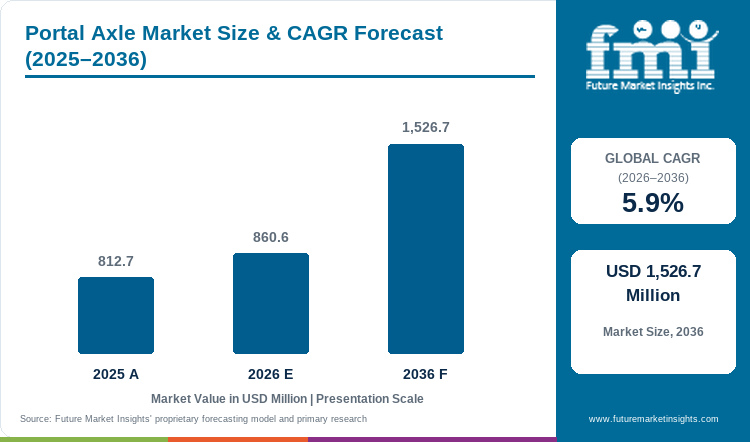
- Market Size (2026)
- USD 860.6 Mn
- Forecast (2036)
- USD 1526.7 Mn
- CAGR (2026 to 2036)
- 5.9%
How big is Portal Axle Market in 2026?
USD 860.6 million in 2026 and USD 1,526.7 million by 2036 at a 5.9% CAGR.
Demand for portal axle systems is projected to expand at 5.9% CAGR through 2036 as engineers protect under-axle clearance without losing wheel-end torque. In June 2026 ZF presented AxTrax 2 LF with remote health monitoring, showing how suppliers pair portal geometry with service data before repeat vehicle orders.
Public fleet specifications show why hub-reduction hardware faces different approval work from one jurisdiction to another. A March 2025 South Dakota Department of Transportation RFP listed ten cutaway configurations and required hub-reduction plus final axle ratios whenever hub reduction was used. Portal axle manufacturers entering public fleets therefore need ratio data and service documentation that fit the vehicle specification before an award moves into delivery.
Key Takeaways
- Portal axle demand rises where engineers need under-axle clearance and wheel-end reduction without redesigning the complete driveline.
- Driven portal axles are projected to account for 32.0% of axle type demand in 2026 because propulsion and portal reduction share one engineered torque path.
- Military vehicles are estimated to represent 29.0% of vehicle type demand in 2026 owing to platform-level mobility testing and long service obligations.
- Heavy duty is anticipated to hold 34.0% of load rating demand in 2026 as payload raises gear and bearing loads at the wheel end.
- Portal integration can delay orders when altered ratios require fresh steering and braking validation before production.
- Key players in the portal axle market include Cummins Drivetrain and Braking Systems, Allison Off-Highway Drive & Motion Systems, ZF Friedrichshafen AG, TIBUS Offroad GmbH & Co. KG, Volvo Defense, Oshkosh Defense, AM General, Daimler Truck Defence, and Sisu Axles Inc.
Analyst Perspective
"Portal axle value is earned before series production because the design changes clearance and wheel-end ratio inside one vehicle package. Vehicle programs should compare integration support with parts coverage because both determine whether a suitable axle becomes a repeat production choice."
- Nikhil Kaitwade, Principal Consultant, Future Market Insights
How is the portal axle market segmented?
The portal axle market is segmented by axle type, vehicle type, load rating, sales channel, application, and region.
Axle type covers driven, heavy-duty, independent, conversion, and non-driven portal designs used in severe-service vehicles. Vehicle type spans military vehicles, off-road SUVs, agricultural vehicles, utility vehicles, and specialty commercial vehicles with distinct integration needs. Load rating, sales channel, and application categories separate duty level from purchase route and the operating reason for portal geometry.
Why do driven portal axles hold 32.0% of the axle type category?
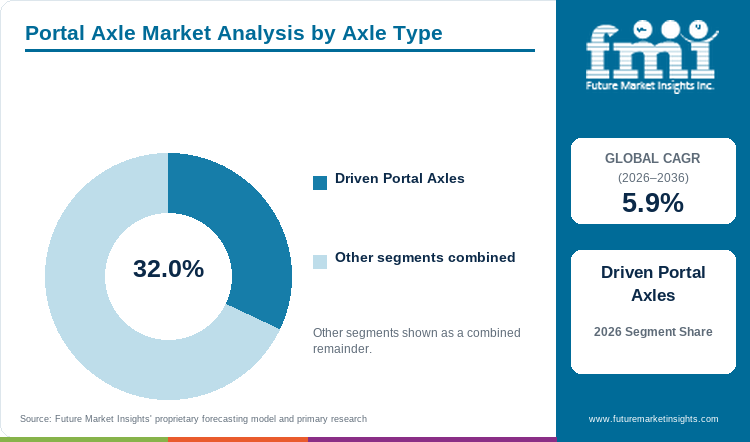
Driven portal axles place reduction directly in the powered torque path and suit automotive axle architectures that must balance clearance with final-drive ratio. In April 2026 ZF added health monitoring to AxTrax 2 LF so fleet teams could identify driveline anomalies before unscheduled service removes a vehicle from operation.
- Driven portal axles account for 32.0% of axle type demand in 2026 because powered wheel-end reduction also preserves clearance.
- Condition data lets fleet teams schedule wheel-end inspection before developing faults remove vehicles from service unexpectedly.
Why do military vehicles hold 29.0% of the vehicle type category?
Military programs validate portal geometry at complete-platform level because clearance gains must survive payload and terrain testing in armored vehicle platforms. Daimler Truck presented its FGA 14.8 military chassis in June 2026 with portal axles and coil springs for protected-body integration. The chassis also uses central tire inflation so the portal system is validated inside a complete military mobility package.
- Military vehicles represent 29.0% of vehicle type demand in 2026 because mobility qualification favors integrated portal systems.
- Portal access depends on specifications requiring additional clearance or wheel-end reduction during complete-platform engineering work.
Why does heavy duty hold 34.0% of the load rating category?
Heavy-duty portal engineering must absorb payload and braking loads while preserving service access to heavy-duty steer axle components. Cummins announced the RT-160 HE tandem drive axle in April 2026 for heavy linehaul duty with lower mechanical losses and reduced vehicle weight.
- By load rating, heavy duty holds 34.0% in 2026 because payload raises wheel-end gear and bearing loads.
- High-load programs compare reduction architecture with brake capacity because extra clearance cannot offset shortened wheel-end service intervals.
Why does OEM direct hold 39.0% of the sales channel category?
Factory specification lets engineers reconcile portal ratio and wheel position with automotive axle and propeller shaft systems before steering or brake interfaces are frozen. ZF announced a February 2026 multi-year OEM agreement covering several thousand AxTrax 2 LF electric portal axles with deliveries starting that year.
- OEM direct accounts for 39.0% of 2026 demand because factory integration occurs before vehicle interface freeze.
- Series orders align axle software and service planning with each vehicle program before regular production begins.
Why does ground clearance improvement hold 29.0% of the application category?
Ground clearance improvement is the direct physical reason for selecting portal geometry in off-road vehicle platforms because the axle housing can sit above wheel center. INEOS Automotive documented that use in November 2025 when a Mülheim fire-and-rescue Grenadier received portal axles that raised clearance from 264 to 450 millimeters.
- Ground clearance improvement represents 29.0% of 2026 application demand because portal geometry raises the axle housing.
- Emergency and utility fleets require braking and stability validation before taller portal packages enter routine field service.
What are the drivers, restraints and opportunities in the Portal Axle Market?
High-mobility vehicle requirements support demand, interface validation slows adoption, and serviceable portal modules widen conversion routes where vehicle redesign can be contained.
- Driver: Vehicle programs value portal geometry where rough-terrain clearance and wheel-end torque must fit inside one qualified mobility package.
- Restraint: Portal reduction can extend production approval because wheel-end geometry changes steering response and brake loading at the same time.
- Opportunity: Modular portal systems can widen adoption where documented interfaces preserve donor-vehicle electronics and reduce the chassis re-engineering required for each installation.
Series Portal Conversions Reduce the Gap Between Prototype and Repeat Orders
Series conversion demand rises once a portal package moves from workshop fabrication into a repeatable vehicle specification. LETECH records a June 2025 launch of the Trialmaster X LETECH as its first INEOS Grenadier variant with portal axles. A defined conversion package lets dealers quote known geometry and service work instead of treating every order as a bespoke axle experiment.
Interface Changes Extend Portal-Axle Qualification
Portal reduction can force new suspension and steering decisions because moving the wheel-end center changes loads that automotive differential systems were not designed to absorb. Audi documented the integration burden in January 2025 when its Q6 e-tron offroad concept used new portal axles and required partial suspension-link changes. Conversion programs therefore need fresh geometry and durability testing before a novel portal layout reaches production.
Serviceable Modules Widen Specialist Conversion Routes
Specialist portal manufacturers gain a clearer sales route where owners want more clearance without replacing every donor interface. ZF documented flexible AxTrax 2 LF installation for solo and articulated buses in May 2025 with portal architecture that preserves vehicle-specific packaging options. Fleet teams also compare low-friction wheel hub bearings during wheel-end service planning, so fitment data and parts availability affect whether a modular axle can enter regular maintenance.
Which country CAGRs are profiled in the Portal Axle Market?
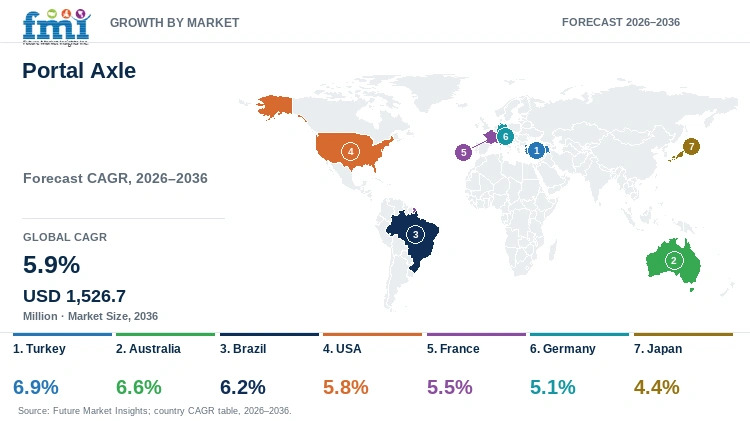
| Country | CAGR |
|---|---|
| Turkey | 6.9% |
| Australia | 6.6% |
| Brazil | 6.2% |
| USA | 5.8% |
| France | 5.5% |
| Germany | 5.1% |
| Japan | 4.4% |
How do country-level CAGRs compare in the Portal Axle Market?
The seven forecasts span 2.5 percentage points from Turkey at 6.9% to Japan at 4.4% CAGR. Turkey and Australia form the upper group because tactical programs generate repeated axle-specification work. Brazil and the USA form the middle where program access separates similar growth rates.
- Turkey's domestic tactical-vehicle base gives axle manufacturers earlier access to locally engineered platform programs.
- Australia's remote fleet geography raises the value of field repair capacity and locally stocked service parts.
- Brazil's armored programs require axle offers that pair terrain performance with domestic repair support.
- USA tactical programs offer upgrades while formal acquisition rules separate prototypes from production awards.
- France's prime-led armored programs make early subsystem alignment more valuable than stand-alone component selling.
- Germany's special-vehicle base expects portal designs to preserve road use and routine service access.
- Japan's standardized vehicle families require compact interfaces before foreign axle systems enter domestic production programs.
The full report provides country-level CAGR analysis across North America, Latin America, Western Europe, Eastern Europe, East Asia, South Asia and Pacific, and Middle East and Africa.
Country-wise Analysis
- Subsystem selection in Turkish tactical-vehicle programs requires local engineering participation during wheeled-platform development and support planning. In January 2025 the Presidency of Defence Industries documented a ceremony covering 100 domestically engined tactical wheeled armored vehicles produced by BMC. Portal axle demand in Turkey is projected to expand at 6.9% CAGR through 2036, driven by domestic vehicle activity and mobility support. Foreign axle manufacturers need a Turkish integration partner because portal gearing must fit vehicle interfaces and field-support responsibilities. Local partners carrying interface testing and parts support reduce program risk for wheel-end hardware.
- Australian protected-mobility fleets operate over long distances, making repair capacity and parts availability part of axle acceptance. Portal axle demand in Australia is forecast to grow at 6.6% CAGR through 2036 because remote service conditions raise the value of wheel-end hardware. Local technicians must diagnose interface faults without removing vehicles from service for extended periods. Australia’s Defence Minister stated in January 2025 that a permanent Hawkei fix had been identified and was being rolled out through the fleet. The fleet experience makes automotive wheel bearing aftermarket coverage relevant where portal wheel ends need specialist parts far from central workshops.
- Keeping Brazilian armored fleets serviceable over varied terrain requires parts availability and repair capacity inside the country. Brazil’s Ministry of Defence recorded 63 armored-vehicle deliveries during 2025 including 60 Guarani 6x6 vehicles and two Centauro 8x8 vehicles. Imported axle manufacturers face local-content and repair requirements that can narrow access even if wheel-end systems meet mobility targets. Portal axle demand in Brazil is anticipated to record 6.2% CAGR through 2036, attributable to wheeled-vehicle modernization and serviceable heavy driveline hardware. Brazilian partners reduce that friction by holding parts locally and carrying service responsibility after delivery.
- For USA tactical fleets, defined interfaces and long support commitments govern whether new wheel-end hardware can enter service. Formal program controls separate retrofit access from production approval because braking and steering interfaces must preserve fleet availability. Portal axle demand in the USA is predicted to advance at 5.8% CAGR through 2036 as mobility upgrades keep truck wheel hubs and hub bearings relevant to severe-service engineering. The Army's June 2025 FY2026 budget schedules 5,112 electrical-center retrofit kits for the Joint Light Tactical Vehicle fleet. Service coverage reduces support risk once a new axle configuration enters formal qualification and field sustainment.
- Prime-led armored contracts in France establish subsystem access early because vehicle integrators retain responsibility for platform interfaces. Portal axle manufacturers therefore need an integrator relationship before clearance or wheel-end reduction enters a serial program. The Direction générale de l’armement reported in January 2026 that the first 30 Serval Appui Scorpion vehicles had been delivered from a 530-vehicle order. Portal axle demand in France is expected to maintain 5.5% CAGR through 2036, supported by wheeled-platform deliveries and qualified mobility hardware. Long-term axle support must fit the prime contractor’s service structure after vehicle delivery.
- Military logistics and Germany’s special-vehicle engineering base sustain portal geometry expertise through severe-service platform development. Portal axle demand in Germany is positioned to record 5.1% CAGR over the forecast period as mobility and electric vehicle e-axle programs widen wheel-end engineering work. The Bundeswehr reported in May 2025 that the first reference vehicle had been delivered under a program covering 123 heavy infantry weapon carriers. Road-use rules and service expectations limit portal designs that gain clearance at the cost of routine maintenance access. German engineering teams can integrate reduction hardware with electronic controls during factory development.
- Standardized national vehicle families leave Japanese programs little tolerance for wheel-end interfaces requiring downstream adaptation. Japan’s Ministry of Defense FY2026 budget lists eight Type-24 maneuver mortar vehicles and 18 Type-25 reconnaissance combat vehicles. Foreign axle manufacturers need detailed interface records because steering and brake requirements are resolved inside domestic vehicle programs. Portal axle demand in Japan is set to post 4.4% CAGR during the assessment period, owing to continued wheeled-defense investment and selective foreign subsystem access. Local vehicle partners can shorten adaptation work if portal geometry meets the required clearance and reduction ratio without extensive downstream redesign.
Who are the notable companies in the Portal Axle Market?
Cummins Drivetrain and Braking Systems, Allison Off-Highway Drive & Motion Systems, ZF Friedrichshafen AG, TIBUS Offroad GmbH & Co. KG, Volvo Defense, Oshkosh Defense, AM General, Daimler Truck Defence, and Sisu Axles Inc. are notable companies serving the portal axle market.
Portal axle competition separates direct axle engineering from specialist conversion work and complete-vehicle integration programs. Cummins and Allison cover severe-duty axle systems alongside ZF Friedrichshafen AG and Sisu Axles Inc. TIBUS handles specialist conversions while the four military vehicle manufacturers influence portal specification inside complete platforms.
- Axle engineering: Cummins and Allison cover severe-duty axle roles alongside ZF and Sisu for commercial or military vehicles.
- Portal conversion: TIBUS Offroad GmbH & Co. KG handles donor-vehicle conversions that require additional ground clearance.
- Vehicle integration: Volvo Defense and Oshkosh Defense influence axle specifications alongside AM General and Daimler Truck Defence inside military programs.
Competitive Benchmarking: Portal Axle Market
| Company | Portal / Wheel-End Architecture | Severe-Duty Qualification Evidence | Integration & Lifecycle Support | Geographic Reach |
|---|---|---|---|---|
| Cummins Drivetrain and Braking Systems | High | High | High | Global |
| Allison Off-Highway Drive & Motion Systems | Medium | High | High | Global |
| ZF Friedrichshafen AG | High | Medium | High | Global |
| TIBUS Offroad GmbH & Co. KG | High | Low | Medium | Europe and selected dealer markets |
| Volvo Defense | Medium | High | High | Europe and international defense programs |
| Oshkosh Defense | Medium | High | High | United States and allied markets |
| AM General | Medium | High | High | United States and international military customers |
| Daimler Truck Defence | High | High | High | Europe and international defense customers |
| Sisu Axles Inc. | High | High | Medium | Europe, North America, and selected international heavy-vehicle programs |
Scoring basis: High architecture requires a documented portal or wheel-end reduction platform, Medium records adjacent drivetrain participation and Low records vehicle-level influence. High severe-duty means current military or heavy-service use while lower ratings indicate narrower duty evidence. High lifecycle support requires integration plus service infrastructure while lower ratings indicate narrower support coverage.
Key Developments in the Portal Axle Market
- In May 2026, Daimler Truck received a 66-vehicle Unimog U 5025 order for Germany’s Federal Agency for Technical Relief.
- In October 2025, ZF Friedrichshafen AG premiered the AV134 portal axle with 20% more torque capacity and series production planned for 2027.
- In July 2025, INEOS Automotive approved series production of the Trialmaster X LETECH with a portal-axle conversion that adds 186 millimeters of ground clearance.
Key Players in the Portal Axle Market
Axle and Wheel-End Engineering
- Cummins Drivetrain and Braking Systems
- Allison Off-Highway Drive & Motion Systems
- ZF Friedrichshafen AG
- Sisu Axles Inc.
Portal Conversion Specialists
- TIBUS Offroad GmbH & Co. KG
Military and Special-Vehicle Integrators
- Volvo Defense
- Oshkosh Defense
- AM General
- Daimler Truck Defence
Portal Axle Market - Report Scope
| Coverage field | Report scope |
|---|---|
| Market breakdown | By axle type, vehicle type, load rating, sales channel, application and region. |
| Quantitative Units | USD million. |
| Market Definition | Portal and hub-reduction axle systems, specialist portal conversion modules and complete vehicle architectures where portal geometry governs ground clearance and wheel-end reduction. |
| Regions Covered | North America, Latin America, Western Europe, Eastern Europe, East Asia, South Asia and Pacific, and Middle East and Africa. |
| Countries Covered | Turkey, Australia, Brazil, United States, France, Germany, Japan, and 20+ countries included in the full report. |
| Key Companies Profiled | Cummins Drivetrain and Braking Systems; Allison Off-Highway Drive & Motion Systems; ZF Friedrichshafen AG; TIBUS Offroad GmbH & Co. KG; Volvo Defense; Oshkosh Defense; AM General; Daimler Truck Defence; Sisu Axles Inc. |
| Forecast Period | 2026 to 2036. |
| Approach | Primary and secondary research with market triangulation. |
Portal Axle Market - Research Methodology
| Method | Approach |
|---|---|
| Primary Research | FMI analysts gathered input from manufacturers, service providers, technology developers, distributors, end users, procurement teams, and subject-matter experts. Interviews examined purchasing decisions, product or service evaluation, adoption barriers, approval requirements, pricing considerations, and expectations for technical or commercial support. Respondents were also asked what evidence is required before a trial, pilot, or initial order develops into regular purchasing. |
| Desk Research | Desk research covered government statistics, regulatory publications, trade data, industry associations, technical literature, standards, company filings, product information, and official corporate announcements. Sources were reviewed for relevance, publication date, geographic coverage, and consistency with the defined market scope. Claims relating to performance, applications, approvals, capacity, investment, and commercial activity were retained only when supported by credible public evidence. |
| Market Sizing and Forecasting | The market model combined the baseline value with historical performance, segment structure, pricing and volume indicators, adoption levels, company participation, and country-level demand conditions. Forecast assumptions considered economic activity, investment trends, regulatory developments, technology adoption, purchasing cycles, supply availability, and barriers to wider market use. Segment and regional estimates were reconciled before the final market total was calculated. |
| Data Validation | Estimates were checked against multiple independent indicators, including public data, company activity, trade patterns, industry developments, and findings from primary interviews. Validation also tested whether products, services, applications, and company revenues fell within the defined market boundaries. Adjacent categories, unsupported claims, overlapping revenues, and activities without direct market relevance were excluded to reduce double counting and maintain consistency across segments and countries. |
Portal Axle Market by Segments
Portal Axle Market segmented by Axle Type:
- Driven Portal Axles
- Heavy-Duty Portal Axles
- Independent Portal Axle Modules
- Off-Road Conversion Axles
- Non-Driven Portal Axles
Portal Axle Market segmented by Vehicle Type:
- Military Vehicles
- Off-Road SUVs
- Agricultural Vehicles
- Utility Vehicles
- Specialty Commercial Vehicles
Portal Axle Market segmented by Load Rating:
- Heavy Duty
- Medium Duty
- Light Duty
- Extreme Off-Road
Portal Axle Market segmented by Sales Channel:
- OEM Direct
- Defense Programs
- Aftermarket Conversion
- Specialty Drivetrain Integrators
Portal Axle Market segmented by Application:
- Ground Clearance Improvement
- Military Mobility
- Torque Multiplication
- Off-Road Performance
Portal Axle Market by Region:
- North America
- United States
- Canada
- Latin America
- Brazil
- Mexico
- Argentina
- Chile
- Western Europe
- Germany
- France
- United Kingdom
- Italy
- Spain
- Benelux
- Nordics
- Eastern Europe
- Poland
- Czech Republic
- Romania
- Hungary
- East Asia
- China
- Japan
- South Korea
- South Asia and Pacific
- India
- ASEAN
- Australia and New Zealand
- Middle East and Africa
- GCC Countries
- South Africa
- Türkiye
- Israel
Research Sources and Bibliography
- ZF Friedrichshafen AG. (2026, June 8). Driving Sustainable Mobility: ZF Presents Its Latest Technologies at busworld Türkiye.
- South Dakota Department of Transportation, Office of Air, Rail, and Transit. (2025, March 26). Cutaway Vehicle Amended Procurement 25RFP13980.
- ZF Friedrichshafen AG. (2026, April 13). AxTrax 2 LF electric portal axle with new health check software.
- Daimler Truck AG. (2026, June 11). Daimler Truck Showcases Comprehensive Portfolio of Defence Mobility Solutions at Eurosatory 2026.
- Cummins Inc. (2026, April 15). Cummins launches new RT-160 HE high-efficiency tandem drive axle at Truck World 2026.
- ZF Friedrichshafen AG. (2026, February 16). AxTrax 2 LF: ZF Secures Major India City Bus Order.
- INEOS Automotive. (2025, November 19). INEOS Grenadier reports for duty with Mülheim Fire and Rescue.
- LETECH GmbH & Co. KG. (n.d.). History.
- Audi AG. (2025, January 24). Ready to blaze new trails: Audi unveils Q6 e-tron offroad concept.
- ZF Friedrichshafen AG. (2025, May 13). AxTrax 2 LF: High performance, utmost flexibility for city buses.
- Presidency of Defence Industries. (2025, January 23). Türk Savunma Sanayiinde Bu Hafta Neler Oldu?.
- Australian Government, Department of Defence. (2025, January 8). Press Conference - Thales, Bendigo.
- Brazilian Ministry of Defence. (2026, April 24). Entrega: 0157 - Forças Blindadas - Desenvolvimento e aquisição de 442 Viaturas Blindadas Sobre Rodas e Sobre Lagartas.
- USA Department of the Army. (2025, June). Other Procurement, Army - BA1 - Tactical & Support Vehicles, FY 2026 Budget Estimates.
- Direction générale de l’armement. (2026, January 21). La DGA livre les 30 premiers véhicules blindés Serval Appui Scorpion à l’armée de Terre.
- Bundeswehr. (2025, May 13). Beschaffung Schwerer Waffenträger Infanterie.
- Japan Ministry of Defense. (2025, December 26). FY2026 Budget - Major Projects.
- Daimler Truck AG. (2026, May 19). Strong fleet for demanding missions: major Unimog order for THW.
- ZF Friedrichshafen AG. (2025, October 3). busworld 2025: ZF Outpaces Market Growth with Smart Mobility Solutions.
- INEOS Automotive. (2025, July 8). INEOS Grenadier ups its game with portal axle collaboration.
- AM General. (2026, June 17). Marshall Land Systems to Become Authorised Service Provider for HUMVEE - Strengthening Partnership with AM General.
- Daimler Truck AG. (2026, June 16). Daimler Truck and Roshel Sign Strategic Partnership Agreement at Eurosatory 2026.
- Oshkosh Defense. (2026, August 12). Oshkosh Defense and Marine Depot Maintenance Command Demonstrate Point-of-Need Manufacturing to Accelerate Readiness.
- AM General. (2026, June 18). Kalyani Strategic Systems Ltd and AM General Sign Strategic Partnership to Offer Distinct Mounted Artillery Gun Systems for World Armies.
- Daimler Truck AG. (2026, September 9). Daimler Truck Defence and Mercedes-Benz Powertrain to Market Truck Engines for Local Assembly in Poland.
- Cummins Inc. (2026, April 16). Cummins brings disc brakes for single rear-drive axles at FDIC International 2026.
- Allison Transmission. (2026, January 2). Allison Transmission Completes Acquisition of Dana Incorporated’s Off-Highway Drive & Motion Systems Business, Creating a Premier, Global Industrial Leader.
- ZF Friedrichshafen AG. (2026, June 17). Innovations that Drive Market Success: ZF with New Technologies at busworld Türkiye 2026.
- TIBUS Offroad GmbH & Co. KG. (n.d.). TIBUS Portal Axles for Ineos Grenadier.
- FMV. (2026, January 16). Ny flaklastbil till Försvarsmakten.
- Oshkosh Defense. (2026, June 1). USA Marine Corps Expands Autonomous Fires Capability with Oshkosh Defense ROGUE-Fires Block 2 Award.
- AM General. (2025, October 14). AM General Announces Collaboration with Carnegie Robotics and Textron Systems to Develop Modular Unmanned Ground Vehicle for USA Army Modernization.
- Daimler Truck AG. (2026, July 20). Daimler Truck, Lambert Defence and Soframe join forces for Belgian Defence Tender.
- USA Patent and Trademark Office. (2026, June 22). Trademark Status & Document Retrieval: SISU AXLES, Serial No. 85810925.
- Marmon Holdings, Inc. (2026). Transportation Products.
This bibliography is provided for reader reference and is not exhaustive. The full report contains the complete reference list and detailed citations
This Report Answers
- What is the portal axle market size in 2026 and 2036?
- Which conditions turn portal geometry into repeat production?
- Why do driven portal axles hold 32.0% share?
- How do military programs change portal axle qualification?
- Why does heavy duty hold 34.0% share?
- Which interfaces delay portal axle approval?
- How do country forecasts differ?
- Which companies compete in portal axles?
Frequently Asked Questions
How big is the portal axle market in 2026?
The portal axle market is valued at USD 860.6 million in 2026 and is projected to reach USD 1,526.7 million by 2036. The market was valued at USD 812.7 million in 2025. Clearance and wheel-end reduction requirements sustain purchases where vehicle interfaces remain serviceable during field operation.
What is the portal axle market CAGR from 2026 to 2036?
The portal axle market is projected to grow at a CAGR of 5.9% between 2026 and 2036. Severe-service programs expand demand where portal geometry solves verified clearance and wheel-end reduction requirements.
Which axle type leads the portal axle market?
The driven portal axle segment is expected to hold 32.0% of the portal axle market in 2026, attributable to powered wheel-end reduction. Factory engineers must validate braking and steering interfaces before the axle architecture can enter repeat vehicle production.
Which vehicle type holds the stated 29.0% share of the portal axle market?
The military vehicle segment is expected to hold 29.0% of the portal axle market in 2026, driven by platform-level mobility qualification. Portal systems enter military programs only where specifications require extra clearance or wheel-end reduction during complete-vehicle integration.
Which countries form the upper portal axle growth group?
Turkey is projected to grow at 6.9% CAGR followed by Australia at 6.6% and Brazil at 6.2% through 2036. Program access and local service requirements give each country a different commercial entry condition.
Which companies are active in the portal axle market?
Key companies include Cummins Drivetrain and Braking Systems, Allison Off-Highway Drive & Motion Systems, ZF Friedrichshafen AG, Sisu Axles Inc., and TIBUS Offroad GmbH & Co. KG. Volvo Defense, Oshkosh Defense, AM General, and Daimler Truck Defence participate through complete-vehicle integration.
Preview the report firsthand - request a free sample
Get SampleGet the brochure for pricing and purchase details.
Get PDFTable of Content
- Key Takeaways
- Market Size and CAGR
- Top Growth Driver
- Fastest Growing Segment
- Leading Region
- Key Companies
- Emerging Opportunities
- Executive Summary
- Global Market Outlook
- Demand-side Trends
- Supply-side Trends
- Technology Roadmap Analysis
- Analysis and Recommendations
- Analyst Perspective (What is happening? Why now? What should investors know?)
- Key Questions Answered
- How large is the market?
- What is the CAGR?
- What are key trends?
- Which region dominates?
- Who are the leaders?
- Market Overview
- Market Coverage / Taxonomy
- Market Definition / Scope / Limitations
- Research Methodology
- Chapter Orientation
- Analytical Lens and Working Hypotheses
- Market Structure, Signals, and Trend Drivers
- Benchmarking and Cross-market Comparability
- Market Sizing, Forecasting, and Opportunity Mapping
- Research Design and Evidence Framework
- Desk Research Programme (Secondary Evidence)
- Expert Input and Fieldwork (Primary Evidence)
- Tooling, Models, and Reference Databases
- Data Engineering and Model Build
- Quality Assurance and Audit Trail
- Market Background
- Market Dynamics (Drivers, Restraints, Opportunity, Trends)
- Scenario Forecast (Optimistic, Likely, Conservative)
- Impact Analysis
- AI Impact
- Sustainability Impact
- Regulatory Impact
- Technology Impact
- Consumer / Buyer Analysis
- Purchase Drivers
- Adoption Barriers
- Buyer Journey
- Opportunity Map Analysis
- Product Life Cycle Analysis
- Supply Chain Analysis
- Investment Feasibility Matrix
- Value Chain Analysis
- PESTLE and Porter's Analysis
- Regulatory Landscape
- Regional Parent Market Outlook
- Production and Consumption Statistics
- Import and Export Statistics
- Global Market Analysis and Forecast, 2021 to 2036
- Historical Market Size Value (USD Million) Analysis, 2021 to 2025
- Current and Future Market Size Value (USD Million) Projections, 2026 to 2036
- Y-o-Y Growth Trend Analysis
- Absolute $ Opportunity Analysis
- Global Market Pricing Analysis, 2021 to 2036
- Global Market Analysis and Forecast, By Axle Type, 2021 to 2036
- Introduction / Key Findings
- Historical Market Size Value (USD Million) Analysis By Axle Type, 2021 to 2025
- Current and Future Market Size Value (USD Million) Analysis and Forecast By Axle Type, 2026 to 2036
- Driven Portal Axles
- Heavy-Duty Portal Axles
- Independent Portal Axle Modules
- Off-Road Conversion Axles
- Non-Driven Portal Axles
- Y-o-Y Growth Trend Analysis By Axle Type, 2021 to 2025
- Absolute $ Opportunity Analysis By Axle Type, 2026 to 2036
- Global Market Analysis and Forecast, By Vehicle Type, 2021 to 2036
- Introduction / Key Findings
- Historical Market Size Value (USD Million) Analysis By Vehicle Type, 2021 to 2025
- Current and Future Market Size Value (USD Million) Analysis and Forecast By Vehicle Type, 2026 to 2036
- Military Vehicles
- Off-Road SUVs
- Agricultural Vehicles
- Utility Vehicles
- Specialty Commercial Vehicles
- Y-o-Y Growth Trend Analysis By Vehicle Type, 2021 to 2025
- Absolute $ Opportunity Analysis By Vehicle Type, 2026 to 2036
- Global Market Analysis and Forecast, By Load Rating, 2021 to 2036
- Introduction / Key Findings
- Historical Market Size Value (USD Million) Analysis By Load Rating, 2021 to 2025
- Current and Future Market Size Value (USD Million) Analysis and Forecast By Load Rating, 2026 to 2036
- Heavy Duty
- Medium Duty
- Light Duty
- Extreme Off-Road
- Y-o-Y Growth Trend Analysis By Load Rating, 2021 to 2025
- Absolute $ Opportunity Analysis By Load Rating, 2026 to 2036
- Global Market Analysis and Forecast, By Sales Channel, 2021 to 2036
- Introduction / Key Findings
- Historical Market Size Value (USD Million) Analysis By Sales Channel, 2021 to 2025
- Current and Future Market Size Value (USD Million) Analysis and Forecast By Sales Channel, 2026 to 2036
- OEM Direct
- Defense Programs
- Aftermarket Conversion
- Specialty Drivetrain Integrators
- Y-o-Y Growth Trend Analysis By Sales Channel, 2021 to 2025
- Absolute $ Opportunity Analysis By Sales Channel, 2026 to 2036
- Global Market Analysis and Forecast, By Application, 2021 to 2036
- Introduction / Key Findings
- Historical Market Size Value (USD Million) Analysis By Application, 2021 to 2025
- Current and Future Market Size Value (USD Million) Analysis and Forecast By Application, 2026 to 2036
- Ground Clearance Improvement
- Military Mobility
- Torque Multiplication
- Off-Road Performance
- Y-o-Y Growth Trend Analysis By Application, 2021 to 2025
- Absolute $ Opportunity Analysis By Application, 2026 to 2036
- Global Market Analysis and Forecast, By Region, 2021 to 2036
- Introduction
- Historical Market Size Value (USD Million) Analysis By Region, 2021 to 2025
- Current Market Size Value (USD Million) Analysis and Forecast By Region, 2026 to 2036
- North America
- Latin America
- Western Europe
- Eastern Europe
- East Asia
- South Asia and Pacific
- Middle East and Africa
- Market Attractiveness Analysis By Region
- North America Market Analysis and Forecast, By Country, 2021 to 2036
- Historical Market Size Value (USD Million) Trend Analysis By Market Taxonomy, 2021 to 2025
- Market Size Value (USD Million) Forecast By Market Taxonomy, 2026 to 2036
- By Country
- United States
- Canada
- By Axle Type
- By Vehicle Type
- By Load Rating
- By Sales Channel
- By Application
- By Country
- Market Attractiveness Analysis
- By Country
- By Axle Type
- By Vehicle Type
- By Load Rating
- By Sales Channel
- By Application
- Key Takeaways
- Latin America Market Analysis and Forecast, By Country
- Historical Market Size Value (USD Million) Trend Analysis By Market Taxonomy, 2021 to 2025
- Market Size Value (USD Million) Forecast By Market Taxonomy, 2026 to 2036
- By Country
- Brazil
- Mexico
- Argentina
- Chile
- By Axle Type
- By Vehicle Type
- By Load Rating
- By Sales Channel
- By Application
- By Country
- Market Attractiveness Analysis
- By Country
- By Axle Type
- By Vehicle Type
- By Load Rating
- By Sales Channel
- By Application
- Key Takeaways
- Western Europe Market Analysis and Forecast, By Country
- Historical Market Size Value (USD Million) Trend Analysis By Market Taxonomy, 2021 to 2025
- Market Size Value (USD Million) Forecast By Market Taxonomy, 2026 to 2036
- By Country
- Germany
- France
- United Kingdom
- Italy
- Spain
- Benelux
- Nordics
- By Axle Type
- By Vehicle Type
- By Load Rating
- By Sales Channel
- By Application
- By Country
- Market Attractiveness Analysis
- By Country
- By Axle Type
- By Vehicle Type
- By Load Rating
- By Sales Channel
- By Application
- Key Takeaways
- Eastern Europe Market Analysis and Forecast, By Country
- Historical Market Size Value (USD Million) Trend Analysis By Market Taxonomy, 2021 to 2025
- Market Size Value (USD Million) Forecast By Market Taxonomy, 2026 to 2036
- By Country
- Poland
- Czech Republic
- Romania
- Hungary
- By Axle Type
- By Vehicle Type
- By Load Rating
- By Sales Channel
- By Application
- By Country
- Market Attractiveness Analysis
- By Country
- By Axle Type
- By Vehicle Type
- By Load Rating
- By Sales Channel
- By Application
- Key Takeaways
- East Asia Market Analysis and Forecast, By Country
- Historical Market Size Value (USD Million) Trend Analysis By Market Taxonomy, 2021 to 2025
- Market Size Value (USD Million) Forecast By Market Taxonomy, 2026 to 2036
- By Country
- China
- Japan
- South Korea
- By Axle Type
- By Vehicle Type
- By Load Rating
- By Sales Channel
- By Application
- By Country
- Market Attractiveness Analysis
- By Country
- By Axle Type
- By Vehicle Type
- By Load Rating
- By Sales Channel
- By Application
- Key Takeaways
- South Asia and Pacific Market Analysis and Forecast, By Country
- Historical Market Size Value (USD Million) Trend Analysis By Market Taxonomy, 2021 to 2025
- Market Size Value (USD Million) Forecast By Market Taxonomy, 2026 to 2036
- By Country
- India
- ASEAN
- Australia and New Zealand
- By Axle Type
- By Vehicle Type
- By Load Rating
- By Sales Channel
- By Application
- By Country
- Market Attractiveness Analysis
- By Country
- By Axle Type
- By Vehicle Type
- By Load Rating
- By Sales Channel
- By Application
- Key Takeaways
- Middle East and Africa Market Analysis and Forecast, By Country
- Historical Market Size Value (USD Million) Trend Analysis By Market Taxonomy, 2021 to 2025
- Market Size Value (USD Million) Forecast By Market Taxonomy, 2026 to 2036
- By Country
- GCC Countries
- South Africa
- Türkiye
- Israel
- By Axle Type
- By Vehicle Type
- By Load Rating
- By Sales Channel
- By Application
- By Country
- Market Attractiveness Analysis
- By Country
- By Axle Type
- By Vehicle Type
- By Load Rating
- By Sales Channel
- By Application
- Key Takeaways
- Key Countries Market Analysis
- United States
- Pricing Analysis
- Market Share Analysis, 2025
- By Axle Type
- By Vehicle Type
- By Load Rating
- By Sales Channel
- By Application
- Canada
- Pricing Analysis
- Market Share Analysis, 2025
- By Axle Type
- By Vehicle Type
- By Load Rating
- By Sales Channel
- By Application
- Mexico
- Pricing Analysis
- Market Share Analysis, 2025
- By Axle Type
- By Vehicle Type
- By Load Rating
- By Sales Channel
- By Application
- Brazil
- Pricing Analysis
- Market Share Analysis, 2025
- By Axle Type
- By Vehicle Type
- By Load Rating
- By Sales Channel
- By Application
- Chile
- Pricing Analysis
- Market Share Analysis, 2025
- By Axle Type
- By Vehicle Type
- By Load Rating
- By Sales Channel
- By Application
- Germany
- Pricing Analysis
- Market Share Analysis, 2025
- By Axle Type
- By Vehicle Type
- By Load Rating
- By Sales Channel
- By Application
- United Kingdom
- Pricing Analysis
- Market Share Analysis, 2025
- By Axle Type
- By Vehicle Type
- By Load Rating
- By Sales Channel
- By Application
- Italy
- Pricing Analysis
- Market Share Analysis, 2025
- By Axle Type
- By Vehicle Type
- By Load Rating
- By Sales Channel
- By Application
- Spain
- Pricing Analysis
- Market Share Analysis, 2025
- By Axle Type
- By Vehicle Type
- By Load Rating
- By Sales Channel
- By Application
- France
- Pricing Analysis
- Market Share Analysis, 2025
- By Axle Type
- By Vehicle Type
- By Load Rating
- By Sales Channel
- By Application
- India
- Pricing Analysis
- Market Share Analysis, 2025
- By Axle Type
- By Vehicle Type
- By Load Rating
- By Sales Channel
- By Application
- ASEAN
- Pricing Analysis
- Market Share Analysis, 2025
- By Axle Type
- By Vehicle Type
- By Load Rating
- By Sales Channel
- By Application
- Australia and New Zealand
- Pricing Analysis
- Market Share Analysis, 2025
- By Axle Type
- By Vehicle Type
- By Load Rating
- By Sales Channel
- By Application
- China
- Pricing Analysis
- Market Share Analysis, 2025
- By Axle Type
- By Vehicle Type
- By Load Rating
- By Sales Channel
- By Application
- Japan
- Pricing Analysis
- Market Share Analysis, 2025
- By Axle Type
- By Vehicle Type
- By Load Rating
- By Sales Channel
- By Application
- South Korea
- Pricing Analysis
- Market Share Analysis, 2025
- By Axle Type
- By Vehicle Type
- By Load Rating
- By Sales Channel
- By Application
- Poland
- Pricing Analysis
- Market Share Analysis, 2025
- By Axle Type
- By Vehicle Type
- By Load Rating
- By Sales Channel
- By Application
- Hungary
- Pricing Analysis
- Market Share Analysis, 2025
- By Axle Type
- By Vehicle Type
- By Load Rating
- By Sales Channel
- By Application
- Türkiye
- Pricing Analysis
- Market Share Analysis, 2025
- By Axle Type
- By Vehicle Type
- By Load Rating
- By Sales Channel
- By Application
- South Africa
- Pricing Analysis
- Market Share Analysis, 2025
- By Axle Type
- By Vehicle Type
- By Load Rating
- By Sales Channel
- By Application
- Turkey
- Pricing Analysis
- Market Share Analysis, 2025
- By Axle Type
- By Vehicle Type
- By Load Rating
- By Sales Channel
- By Application
- Australia
- Pricing Analysis
- Market Share Analysis, 2025
- By Axle Type
- By Vehicle Type
- By Load Rating
- By Sales Channel
- By Application
- United States
- Market Structure Analysis
- Competition Dashboard
- Competition Benchmarking
- Market Share Analysis of Top Players
- By Regional
- By Axle Type
- By Vehicle Type
- By Load Rating
- By Sales Channel
- By Application
- Emerging Startups
- Innovation Benchmarking
- Competition Analysis
- Competition Deep Dive
- Cummins Drivetrain and Braking Systems
- Overview
- Product Portfolio
- Profitability by Market Segments
- Sales Footprint
- Strategy Overview
- Marketing Strategy
- Product Strategy
- Channel Strategy
- Allison Off-Highway Drive & Motion Systems
- ZF Friedrichshafen AG
- TIBUS Offroad GmbH & Co. KG
- Volvo Defense
- Oshkosh Defense
- AM General
- Daimler Truck Defence
- Sisu Axles Inc.
- Cummins Drivetrain and Braking Systems
- Case Studies
- Success Stories
- Recent Developments
- Competition Deep Dive
- Assumptions & Acronyms Used


