

- Market Size (2026)
- USD 98.2 Mn
- Forecast (2036)
- USD 250.0 Mn
- CAGR (2026 to 2036)
- 9.8%
How big is the post-harvest sanitizers market in 2026?
Sales in the post-harvest sanitizers market are projected to grow at 9.8% CAGR through 2036. Market size rises from USD 89.4 million in 2025 to USD 98.2 million in 2026 and is expected to reach USD 250.0 million by 2036.
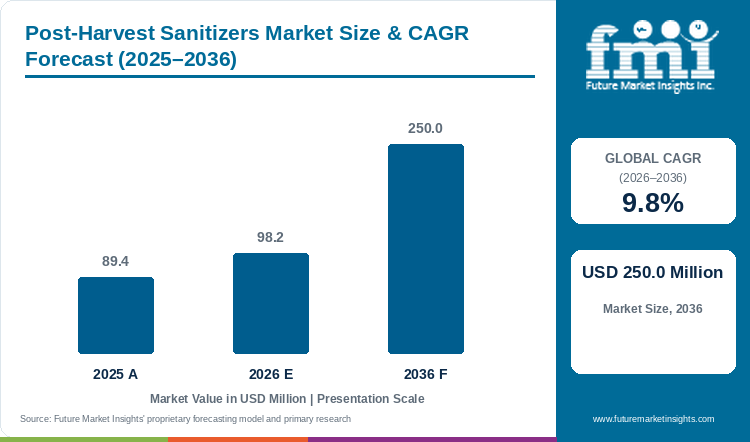
FMI notes that global post-harvest sanitizers market was valued at USD 89.4 million in 2025 and is estimated at USD 98.2 million in 2026 before reaching USD 250.0 million by 2036, at 9.8% CAGR from 2026 to 2036. edible coatings led product type with 42.3% share in 2026, as coatings are directly applied after washing and helps in controlling moisture during storage. USDA forecast the 2025 USA apple crop 6% higher from 2024, with Washington expected to produce a record 8 billion pounds.[4] Germany harvested about 1.138 million tonnes of apples in 2025.[2] South Korea also reported around 230,000 tonnes of apples in storage for shipment from December 2025 through July 2026.[15] Large fruit volume and longer release period increases the number of bins, coating lines, cold rooms, and quality checks, which is anticipated to support recurring demand for post-harvest sanitizers.
Key Market Trends & Insights
- By Product Type, edible coatings held 42.3% of demand in 2026, owing to direct produce application and moisture-control requirement during storage.
- By Commodity, pome and stone fruit accounted for 40.9% in 2026, as concentrated harvesting and later market release creates repeated washing, coating, and storage treatment.
- By Application Point, packhouse represented the leading 49.5% share in 2026, where washing, drenching, coating, sorting, and drying are carried out at one location.
- By Technology Base, biological or microbial systems held 45.9% in 2026, attributed to lower-residue preservation and compatibility with crop-based storage programs.
- By Sales Channel, packhouse suppliers generated 42.4% of sales in 2026, as seasonal inventory and application support remains important during short harvesting windows.
Regional Highlights
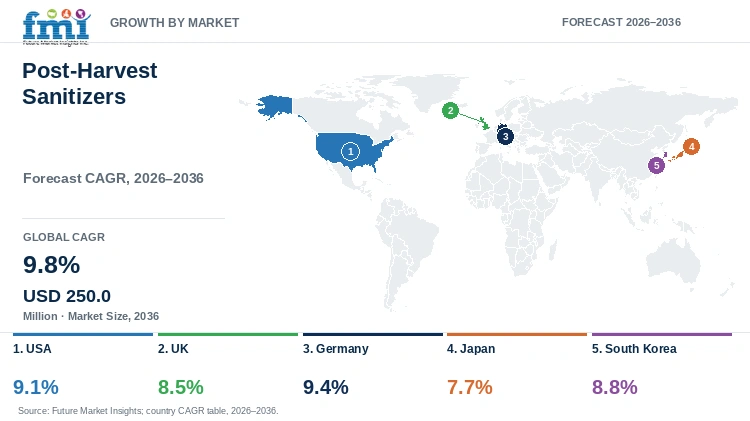
- Fastest-growing profiled country: Germany (9.4% CAGR, 2026 to 2036), supported by large apple throughput and controlled storage.
- By country: The USA (9.1%) and South Korea (8.8%) follow, while Japan records the lowest profiled CAGR at 7.7% during 2026 to 2036.
Market Size & Forecast
Table 1: Market Size and Forecast for the Post-Harvest Sanitizers Market (USD million), 2025 to 2036
| Metric | Market Value |
|---|---|
| 2025 Market Size | USD 89.4 million |
| Estimated Market Size in 2026 | USD 98.2 million |
| Projected Market Size by 2036 | USD 250.0 million |
| CAGR, 2026 to 2036 | 9.8% |
| Added Revenue, 2026 to 2036 | USD 151.8 million |
| Market Expansion Multiple | 2.55x |
Added revenue is calculated as the 2036 value less the 2026 value. Market expands 2.55 times as USD 250.0 million is divided by USD 98.2 million.
Recurring sanitizer demand is determined by water reuse, organic load, produce throughput, and number of contact surfaces inside a packhouse. In January 2025, the European Food Safety Authority advised disinfection, water replenishment, and monitoring for maintaining microbiological quality of process water.[8] Citrosol reported the first French installation of its Citrocide hygienic-washing system for peeled garlic in June 2025, extending monitored washing into another produce line.[5] Xeda described natural bioprotection with water-free thermal fogging in May 2026.[6] StePac opened a Hermosillo office in March 2026 with local inventory and technical support.[7] These developments are moving demand from basic chemical supply towards measured application, lower-residue treatment, seasonal stock, and documented commodity performance.
Process-Water Control and Packhouse Demand Indicators
Table 2: Process-Water and Produce-Handling Indicators for the Post-Harvest Sanitizers Market (dates, tonnes, pounds, shares, and locations), mixed reporting years from 2025 to 2026
| Indicator | Data Point | Why It Matters | Source |
|---|---|---|---|
| USA apple production outlook | 2025 crop forecast 6% above 2024; Washington at 8 billion pounds | Higher seasonal throughput increases washing and storage cycles | [4] |
| Germany apple harvest | 1.138 million tonnes in 2025 | Large pome volume supports bin, coating, and cold-room treatment | [2] |
| South Korea stored apples | About 230,000 tonnes for December 2025 to July 2026 shipment | Longer release periods support repeated preservation checks | [15] |
| Edible coatings | 42.3% of product type demand in 2026 | Direct produce application links treatment with moisture control | FMI estimate |
| Packhouse application | 49.5% of application point demand in 2026 | Several sanitation and preservation steps occur at one site | FMI estimate |
| Biological systems | 45.9% of technology base demand in 2026 | Lower-residue programs widen treatment choices | FMI estimate |
| Packhouse suppliers | 42.4% of sales in 2026 | Seasonal stock and dosing support affect product availability | FMI estimate |
| Process-water guidance | EFSA advice published January 2025 | Monitoring and replenishment supports measured sanitizer use | [8] |
| Hygienic-washing deployment | First French peeled-garlic installation reported June 2025 | Shows monitored washing moving into another commodity | [5] |
Market shares are proprietary analytical estimates. External indicators use mixed reporting years and are not combined to calculate global market size.
Analyst Perspective
“Packhouses will prefer sanitizers that remains effective when water load and produce volume changes during harvesting season. Lower-residue treatment, correct dosing, and commodity evidence will create stronger opportunities among export-oriented fruit packers.”
- Nandini Roy Choudhury, Principal Consultant, Future Market Insights.
How is the post-harvest sanitizers market segmented?
Post-harvest sanitizers market is divided into product type, commodity, application point, technology base, sales channel, and region. Edible coatings, pome and stone fruit, packhouse use, biological systems, and packhouse suppliers lead their respective categories in 2026.
As per the analysis from FMI, product type is divided into edible coatings, active sachets and liners, wash and drench treatments, storage-room treatments, and others.
By commodity: pome and stone fruit, citrus, berries and grapes, tropical fruit, vegetables, and others.
By application point: packhouse, storage facility, transit and retail, and others.
By technology base: biological or microbial, plant-extract-based, mineral and wax-based, and others.
By sales channel: packhouse suppliers, post-harvest service providers, direct sales, and others.
By region: North America, Latin America, Western Europe, Eastern Europe, East Asia, South Asia and Pacific, and Middle East and Africa.
Why do edible coatings remain preferred within product type demand?
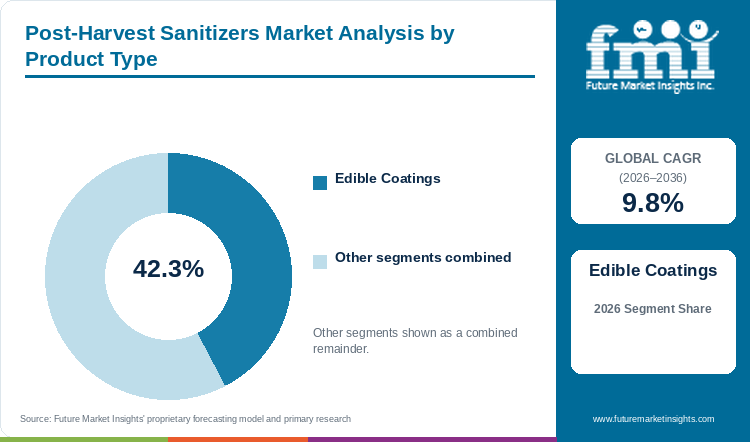
Based on product type, edible coatings are projected to account for 42.3% in 2026, driven by direct produce protection.
Table 3: Product Type Share for the Post-Harvest Sanitizers Market (percentage share), 2026
| Product Type | Share (2026) |
|---|---|
| Edible Coatings | 42.3% |
| Other Segments Combined | 57.7%* |
| Total | 100.0% |
*Calculated as the balance remaining after deducting the leading segment's reported share from 100.0%.
Table 4: Product Type Leadership and Market Growth for the Post-Harvest Sanitizers Market (segment and CAGR percentage), 2026 to 2036
| Metric | Value |
|---|---|
| Global CAGR (2026 to 2036) | 9.8% |
| Leading Segment | Edible Coatings |
Edible coatings are directly applied on fruits and vegetables after washing and creates a thin layer on the produce surface. The coating reduces moisture movement and controls gas exchange, due to which appearance and firmness can be maintained during storage. Edible coatings can also carry antimicrobial ingredients and are gaining use on apples and other fruits stored for a longer period. A 2025 review reported that edible coatings and active films can maintain apple quality and reduce moisture loss during storage.[3] Owing to moisture control, direct application, and wider use after washing, edible coatings are expected to remain preferred within product type demand.
- Edible coatings are projected to hold 42.3% of product type demand in 2026, owing to direct produce protection after washing.
- Easy application on existing coating lines and ability to carry preservation ingredients is anticipated to support segment growth.
What supports pome and stone fruit as the main commodity?
By commodity, pome and stone fruit are estimated to hold 40.9% in 2026, owing to repeated storage treatment cycles.
Seasonal harvesting of pome and stone fruit creates a large volume of produce that cannot be supplied to the market at one time. Apples, pears, peaches, and related fruits and vegetables are moved through bin handling, washing, coating, controlled storage, and later market release. USDA reported that the 2025 USA apple crop was forecast 6% higher from 2024, while Washington was expected to produce a record 8 billion pounds.[4] Higher crop volume within a shorter season expands the number of washing and storage cycles. These factors are expected to support demand for post-harvest sanitizers in pome and stone fruit.
- Pome and stone fruit are estimated to account for 40.9% of commodity demand in 2026, owing to concentrated harvest and longer storage requirement.
- Repeated quality checking and later market release keeps preservation treatment active beyond the harvesting period.
How does packhouse use shape the application point category?
In 2026, packhouse is expected to lead application point with 49.5% share, supported by concentrated treatment steps.
Several post-harvest activities are carried out within packhouses, including washing, drenching, coating, sorting, drying, and quality checking. Conducting these operations at one location increases the use of wash-water treatment and produce-contact surface sanitizers. In June 2025, Citrosol reported the first French installation of its Citrocide hygienic-washing system for peeled garlic.[5] The installation moves monitored washing beyond traditional citrus operations and into another fresh produce line. Expansion of controlled washing across fruits, vegetables, and fresh-cut products is likely to drive the packhouse segment growth.
- Packhouse use is expected to represent 49.5% of application point demand in 2026, due to several treatment steps carried out at one site.
- High produce throughput and repeated contact with water, bins, belts, and drying lines supports regular sanitizer consumption.
Why are biological systems gaining use within technology base?
Biological or microbial systems are likely to capture 45.9% share in 2026, reflecting lower-residue preservation needs.
Lower-residue preservation requirement is shifting some storage programs towards biological or microbial treatment. These systems are selected according to crop, storage-room condition, and the period for which produce is held. In May 2026, Xeda International described natural bioprotection and water-free thermal fogging as complementary approaches for post-harvest storage.[6] Water-free fogging avoids adding further moisture inside the room, whereas bioprotection provides another route for controlling decay. Availability of these treatment options is expected to support biological or microbial systems segment growth.
- Biological or microbial systems are projected to hold 45.9% of technology base demand in 2026, owing to lower-residue preservation needs.
- Use across different crops and compatibility with room-treatment programs is creating wider application for biological systems.
Which conditions keep packhouse suppliers relevant in sales channels?
Packhouse suppliers are set to lead sales channel with 42.4% share in 2026, underpinned by local technical support.
Produce packers requires treatment supply, crop-based dosing support, and product availability during a short harvesting season. This gives packhouse suppliers a direct role in maintaining stock and helping operators apply products under changing line conditions. In March 2026, StePac opened a regional office in Hermosillo, Mexico, with local inventory, logistics, and technical support for produce operations.[7] Nearby stock can reduce delivery time when fruit volume is high and treatment requirement changes quickly. Presence of local service and seasonal inventory is anticipated to support sales through packhouse suppliers.
- Packhouse suppliers are projected to hold 42.4% of sales in 2026, owing to local inventory, seasonal supply, and application support.
- Direct contact with produce operations helps suppliers respond to crop changes and urgent product replenishment during peak handling.
What are the drivers, restraints, and opportunities in the post-harvest sanitizers market?
Process-water control is a primary factor driving post-harvest sanitizers demand. Different authorization and residue requirements may restrict adoption, while lower-residue coatings and monitored treatment systems are creating new growth avenues.
- Driver: Increasing need to control cross-contamination in recurring wash water and produce-contact surfaces is driving demand for post-harvest sanitizers.
- Restraint: Product authorization, residue limits, and different packhouse conditions can extend the time required for adoption of a new treatment.
- Opportunity: Lower-residue coatings, biological treatments, and monitored dosing systems are expected to create growth opportunities in post-harvest sanitizers market.
Process Water Requires Measured Control
Recurring use of water in fruit and vegetable washing allows soil, plant debris, and organic matter to collect inside the system. Higher organic load can reduce sanitizer performance, due to which packhouses needs measured dosing, water replenishment, and frequent checking. In January 2025, the European Food Safety Authority advised disinfection, replenishment, and monitoring for maintaining microbiological quality of process water.[8] Sanitizers that performs under changing water condition are therefore gaining importance across high-throughput lines. Adoption of controlled process-water treatment is expected to boost post-harvest sanitizers market growth.
Qualification Extends Switching Timelines
A treatment used after harvest must be authorized for the commodity and should meet residue requirement of the destination market. Performance on one fruit or packing line does not always support direct use on another crop, water condition, or storage program. In 2025, Germany maintained public information covering authorized plant-protection products, restrictions, and directions for use.[9] Packers reviews these conditions before changing an existing treatment, which can increase the time required for product trials and approval. Different authorization and residue requirement may limiting the adoption of new post-harvest sanitizers.
Lower-Residue Systems Add Operating Choice
New application opportunity is emerging from coatings and storage treatments having lower residue and lower water requirement. Such products are useful where suppliers needs to maintain produce quality without adding excessive moisture inside storage rooms. In 2026, European Union restrictions on bisphenol A in certain food-contact materials started applying to products placed on the EU and Northern Ireland markets.[10] This is increasing attention towards compliant coatings and material used near food. Approved treatment, biological preservation, and complete application records are expected to create new avenues in post-harvest sanitizers market.
Which country CAGRs are profiled in the post-harvest sanitizers market?
Table 5: Country CAGR Comparison for the Post-Harvest Sanitizers Market (CAGR percentage), 2026 to 2036
| Country | CAGR |
|---|---|
| USA | 9.1% |
| UK | 8.5% |
| Germany | 9.4% |
| Japan | 7.7% |
| South Korea | 8.8% |
How do country-level CAGRs compare in the post-harvest sanitizers market?
Country-level demand develops differently as fruit production, packhouse washing, storage duration, export movement, and authorization of post-harvest treatments vary across regions.
According to FMI, Germany at 9.4% and the USA at 9.1% CAGR are projected to expand faster, while South Korea, the UK, and Japan follows separate storage, food-contact, and export-quality requirement.
- USA demand is supported by large produce packing operations and increasing control of harvest and post-harvest agricultural water.
- UK demand is influenced by food-contact requirement, coating review, and quality specifications followed by retailers.
- Germany combines large pome fruit production with controlled storage and authorized product use.
- Japan demand is linked with appearance retention and destination-market requirement for exported fruits and vegetables.
- South Korea demand is supported by seasonal apple storage and gradual release of fruit after harvesting.
Full report country CAGRs cover: North America; Latin America; Western Europe; Eastern Europe; East Asia; South Asia and Pacific; Middle East and Africa.
Country-wise Analysis
- Demand for post-harvest sanitizers in the USA is forecast to rise at 9.1% CAGR through 2036. The USA handles large volume of fruits and vegetables through packing and distribution operations, which increases the requirement for wash-water and surface sanitation. In September 2025, the U.S. Food and Drug Administration added agricultural-water FAQs and stated that compliance dates for harvest and post-harvest agricultural water had passed for all covered farms.[1] Produce packers therefore requires treatment and monitoring where water contacts fruits, vegetables, and food-contact surfaces. Increasing adoption of wash chemistries that can be used on existing packing lines is expected to support the USA post-harvest sanitizers market growth.
- The UK post-harvest sanitizers market is anticipated to advance at 8.5% CAGR through 2036. Fresh produce coatings and active materials supplied in the UK are reviewed according to their composition, intended use, and destination-market requirement. In June 2026, UK guidance stated that the first main compliance date for the EU bisphenol A food-contact rule was July 20, 2026 for relevant products placed on the EU and Northern Ireland markets.[12] Suppliers therefore requires clear product information for coatings and other food-contact treatment. Availability of compliant post-harvest products is anticipated to support the UK market growth.
- Sales of post-harvest sanitizers in Germany are forecast to expand at 9.4% CAGR through 2036. Germany has a large apple handling base and the harvested fruit is moved through washing, sorting, coating, and controlled storage. In December 2025, Destatis reported that German apple harvest reached about 1.138 million tonnes and was the second-highest harvest of the previous ten years.[2] Higher apple volume increases the number of bins and storage rooms requiring post-harvest treatment. Increasing pome fruit preservation is expected to drive post-harvest sanitizers market revenue growth in Germany.
- Adoption of post-harvest sanitizers in Japan is estimated to expand at 7.7% CAGR through 2036. Fruit supplied for premium domestic and export markets requires appearance retention during refrigerated distribution. Japan’s 2025 Basic Plan for Food, Agriculture and Rural Areas included food and agricultural export objectives and alignment with destination-market demand.[14] Post-harvest coatings and lower-residue treatments helps in maintaining moisture and surface quality during storage and transport. Increasing export-quality requirement is expected to support demand for post-harvest sanitizers in Japan.
- South Korea is estimated to post 8.8% CAGR through 2036. Apples harvested during the season are stored and released over several months, due to which moisture control and decay treatment remains important. In December 2025, the Ministry of Agriculture, Food and Rural Affairs reported about 230,000 tonnes of apples in storage for shipment from December through July.[15] Longer storage increases the number of quality checks and preservation steps before fruit reaches the market. These factors are anticipated to propel demand for post-harvest sanitizers in South Korea.
Who are the notable companies in the post-harvest sanitizers market?
Pace International, Xeda International, Citrosol, Fomesa Fruitech, JBT Corporation, StePac, Janssen PMP, and Syngenta are notable companies profiled in this market.
FMI research indicates that post-harvest sanitizers market remains moderately fragmented as companies supplies products for washing, coating, disease control, storage-room treatment, and freshness preservation. Pace International, Citrosol, and Fomesa Fruitech offers coatings and wash treatment used near packhouse operations. Xeda International, Janssen PMP, and Syngenta provides disease-control and storage products, whereas JBT Corporation and StePac supports coating and active-preservation applications. Some of the prominent players are expanding product range, including peracetic acid formulations and regional support in order to cater the growing demand from produce packers.
- Packhouse treatment platforms: Pace International, Citrosol, and Fomesa Fruitech offers coatings, wash products, and application support for packing operations.
- Disease-control and storage specialists: Xeda International, Janssen PMP, and Syngenta provides decay control, fogging, and storage treatment.
- Barrier and active-preservation platforms: JBT Corporation and StePac supports moisture control and freshness preservation after packing.
Competitive Benchmarking: Post-Harvest Sanitizers Market
Table 6: Competitive Benchmarking for the Post-Harvest Sanitizers Market (qualitative capability ratings), 2026
| Company | Treatment breadth | Lower-residue options | Storage and transit | Geographic reach |
|---|---|---|---|---|
| Pace International | High | High | High | High |
| Xeda International | High | High | High | Medium |
| Citrosol | High | High | Medium | High |
| Fomesa Fruitech | High | Medium | Medium | Medium |
| JBT Corporation | Medium | High | Medium | High |
| StePac | Medium | High | High | High |
| Janssen PMP | Medium | Medium | High | Medium |
| Syngenta | Medium | Medium | High | High |
High indicates wider publicly documented treatment capability, whereas Medium indicates a comparatively narrower documented product range. These ratings covers treatment availability and does not represent product quality, company revenue, or market-share ranking.
Key Developments in the Post-Harvest Sanitizers Market
- In May 2026, Xeda International described natural bioprotection and water-free thermal fogging as complementary approaches for post-harvest storage.
- In March 2026, StePac opened a regional office in Hermosillo, Mexico, with local inventory, logistics, and technical support for produce operations.
- In June 2025, Citrosol reported the first French installation of its Citrocide hygienic-washing system for peeled garlic.
- In 2025, Syngenta maintained current Scholar post-harvest label information to support crop-specific use review.
Key Players in the Post-Harvest Sanitizers Market
Packhouse Treatment Platforms
- Pace International
- Citrosol
- Fomesa Fruitech
Disease-Control and Storage Specialists
- Xeda International
- Janssen PMP
- Syngenta
Barrier and Active-Preservation Platforms
- JBT Corporation
- StePac
Post-Harvest Sanitizers Market - Report Scope
Table 7: Report Scope for the Post-Harvest Sanitizers Market (coverage fields and definitions), 2026 to 2036
| Coverage field | Report scope |
|---|---|
| Market breakdown | Post-harvest sanitizers market is segmented by product type, commodity, application point, technology base, sales channel, and region. |
| Quantitative units | USD million. |
| Market definition | Supplier revenue generated from sanitation and preservation consumables used on fresh horticultural commodities after harvesting. |
| Exclusions | Downstream produce value, stand-alone equipment, pre-harvest crop protection, passive packaging, and products not used for post-harvest sanitation or preservation. |
| Regions covered | North America; Latin America; Western Europe; Eastern Europe; East Asia; South Asia and Pacific; Middle East and Africa. |
| Countries covered | USA, UK, Germany, Japan, South Korea, and additional countries in the full report. |
| Forecast period | 2026 to 2036. |
| Approach | The report covers treatment demand, segment performance, company activity, and country adoption within the defined post-harvest sanitizers market. |
Post-Harvest Sanitizers Market - Research Methodology
Table 8: Research Methodology for the Post-Harvest Sanitizers Market (research methods and approach), 2026 edition
| Method | Approach |
|---|---|
| Primary Research | The research study includes primary interviews with manufacturers, service providers, distributors, end users, purchasing teams, and industry experts. Interviews covers purchasing decision, product evaluation, pricing, adoption barrier, approval requirement, and technical support. |
| Desk Research | Desk research covers government statistics, regulatory publications, trade data, industry associations, technical literature, standards, product information, and official company announcements. Each source is checked according to date, geography, and relevance to post-harvest sanitizers market. |
| Market Sizing and Forecasting | Market sizing combines the base value with historical performance, segment share, price, volume, adoption, company participation, and country demand. Forecast considers regulation, technology use, purchasing cycle, supply availability, and barriers affecting wider adoption. |
| Data Validation | Market estimates are checked with public information, company activity, trade pattern, industry development, and primary interviews. Products outside the market definition are excluded in order to avoid double counting. |
Post-Harvest Sanitizers Market by Segments
Post-Harvest Sanitizers Market segmented by Product Type:
- Edible Coatings
- Active Sachets and Liners
- Wash and Drench Treatments
- Storage-Room Treatments
- Others
Post-Harvest Sanitizers Market segmented by Commodity:
- Pome and Stone Fruit
- Citrus
- Berries and Grapes
- Tropical Fruit
- Vegetables
- Others
Post-Harvest Sanitizers Market segmented by Application Point:
- Packhouse
- Storage Facility
- Transit and Retail
- Others
Post-Harvest Sanitizers Market segmented by Technology Base:
- Biological or Microbial
- Plant-Extract-Based
- Mineral and Wax-Based
- Others
Post-Harvest Sanitizers Market segmented by Sales Channel:
- Packhouse Suppliers
- Post-Harvest Service Providers
- Direct Sales
- Others
Post-Harvest Sanitizers Market by Region
- North America
- United States
- Canada
- Latin America
- Brazil
- Mexico
- Argentina
- Chile
- Western Europe
- Germany
- France
- United Kingdom
- Italy
- Spain
- Benelux
- Nordics
- Eastern Europe
- Poland
- Czech Republic
- Romania
- Hungary
- East Asia
- China
- Japan
- South Korea
- South Asia and Pacific
- India
- ASEAN
- Australia and New Zealand
- Middle East and Africa
- GCC Countries
- South Africa
- Türkiye
- Israel
Research Sources and Bibliography
- [1] U.S. Food and Drug Administration. (2025, September 30). FDA publishes agricultural water FAQs and information on implementation of the Produce Safety Rule.
- [2] German Federal Statistical Office. (2025, December 19). Apple harvest 2025: 1,138,000 tonnes, second-highest harvest of the past ten years.
- [3] Mikus, M., & Galus, S. (2025, January 14). Extending the shelf life of apples after harvest using edible coatings as active packaging: A review. Applied Sciences, 15(2), 767.
- [4] U.S. Department of Agriculture, Economic Research Service. (2025, September 25). Fruit and tree nuts outlook: September 2025.
- [5] Citrosol. (2025, June). CitroPost June 2025: Citrocide systems for hygienic washing of produce.
- [6] Xeda International. (2026, May 18). Thermal fogging and bioprotection for more sustainable postharvest management.
- [7] StePac PPC. (2026, March 6). StePacPPC opens new regional office in Hermosillo, Mexico.
- [8] European Food Safety Authority. (2025, January 30). New advice and app to manage process water for fruit, vegetables and herbs.
- [9] Federal Office of Consumer Protection and Food Safety, Germany. (2025). Information on authorised plant protection products.
- [10] Department for Business and Trade. (2026, June 25). BPA in food contact materials: EU rules and UK implications.
- [11] U.S. Food and Drug Administration. (2025). Requirements for harvest and post-harvest agricultural water in Subpart E for covered produce other than sprouts.
- [12] Food Standards Agency. (2025). Regulated products application guidance.
- [13] German Federal Statistical Office. (2025, December 19). Apple harvest 2025 production statistics.
- [14] Ministry of Agriculture, Forestry and Fisheries, Japan. (2025, April 11). Basic Plan for Food, Agriculture and Rural Areas 2025: Reference material.
- [15] Ministry of Agriculture, Food and Rural Affairs, Republic of Korea. (2025, December 3). Minister visits apple storage and intake site.
This bibliography is provided for reader reference. The full report contains the complete reference list and detailed citations.
This Report Answers
- What is the post-harvest sanitizers market worth during 2026?
- What value is the post-harvest sanitizers market projected by 2036?
- Which product type holds notable post-harvest sanitizers market share?
- Which commodity holds notable post-harvest sanitizers market share?
- Which countries have notable post-harvest sanitizers market growth?
- Which companies are notable in the post-harvest sanitizers market today?
Frequently Asked Questions
How big is the post-harvest sanitizers market in 2026?
Future Market Insights estimates that the post-harvest sanitizers market is valued at USD 98.2 million in 2026, up from USD 89.4 million in 2025.
What CAGR is projected for the market through 2036?
The post-harvest sanitizers market is projected to grow at 9.8% CAGR from 2026 to 2036 and reach USD 250.0 million by 2036.
Which product type holds a notable share in 2026?
Edible coatings are projected to hold 42.3% of product type demand in 2026 owing to moisture control and direct produce protection.
Which commodity holds a notable share in 2026?
Pome and stone fruit are estimated to account for 40.9% of commodity demand in 2026 owing to concentrated harvest and longer storage.
Which country has a notable expansion outlook through 2036?
As per FMI analysis, Germany is projected to expand at 9.4% CAGR through 2036, supported by large apple handling and controlled storage.
Which companies are active in the market during 2026?
Notable companies include Pace International, Xeda International, Citrosol, Fomesa Fruitech, JBT Corporation, StePac, Janssen PMP, and Syngenta in 2026.
Preview the report firsthand - request a free sample
Get SampleGet the brochure for pricing and purchase details.
Get PDFTable of Content
- Key Takeaways
- Market Size and CAGR
- Top Growth Driver
- Fastest Growing Segment
- Leading Region
- Key Companies
- Emerging Opportunities
- Executive Summary
- Global Market Outlook
- Demand-side Trends
- Supply-side Trends
- Technology Roadmap Analysis
- Analysis and Recommendations
- Analyst Perspective (What is happening? Why now? What should investors know?)
- Key Questions Answered
- How large is the market?
- What is the CAGR?
- What are key trends?
- Which region dominates?
- Who are the leaders?
- Market Overview
- Market Coverage / Taxonomy
- Market Definition / Scope / Limitations
- Research Methodology
- Chapter Orientation
- Analytical Lens and Working Hypotheses
- Market Structure, Signals, and Trend Drivers
- Benchmarking and Cross-market Comparability
- Market Sizing, Forecasting, and Opportunity Mapping
- Research Design and Evidence Framework
- Desk Research Programme (Secondary Evidence)
- Expert Input and Fieldwork (Primary Evidence)
- Tooling, Models, and Reference Databases
- Data Engineering and Model Build
- Quality Assurance and Audit Trail
- Market Background
- Market Dynamics (Drivers, Restraints, Opportunity, Trends)
- Scenario Forecast (Optimistic, Likely, Conservative)
- Impact Analysis
- AI Impact
- Sustainability Impact
- Regulatory Impact
- Technology Impact
- Consumer / Buyer Analysis
- Purchase Drivers
- Adoption Barriers
- Buyer Journey
- Opportunity Map Analysis
- Product Life Cycle Analysis
- Supply Chain Analysis
- Investment Feasibility Matrix
- Value Chain Analysis
- PESTLE and Porter's Analysis
- Regulatory Landscape
- Regional Parent Market Outlook
- Production and Consumption Statistics
- Import and Export Statistics
- Global Market Analysis and Forecast, 2021 to 2036
- Historical Market Size Value (USD Million) Analysis, 2021 to 2025
- Current and Future Market Size Value (USD Million) Projections, 2026 to 2036
- Y-o-Y Growth Trend Analysis
- Absolute $ Opportunity Analysis
- Global Market Pricing Analysis, 2021 to 2036
- Global Market Analysis and Forecast, By Product Type, 2021 to 2036
- Introduction / Key Findings
- Historical Market Size Value (USD Million) Analysis By Product Type, 2021 to 2025
- Current and Future Market Size Value (USD Million) Analysis and Forecast By Product Type, 2026 to 2036
- Edible Coatings
- Active Sachets and Liners
- Wash and Drench Treatments
- Storage-Room Treatments
- Others
- Y-o-Y Growth Trend Analysis By Product Type, 2021 to 2025
- Absolute $ Opportunity Analysis By Product Type, 2026 to 2036
- Global Market Analysis and Forecast, By Commodity, 2021 to 2036
- Introduction / Key Findings
- Historical Market Size Value (USD Million) Analysis By Commodity, 2021 to 2025
- Current and Future Market Size Value (USD Million) Analysis and Forecast By Commodity, 2026 to 2036
- Pome and Stone Fruit
- Citrus
- Berries and Grapes
- Tropical Fruit
- Vegetables
- Others
- Y-o-Y Growth Trend Analysis By Commodity, 2021 to 2025
- Absolute $ Opportunity Analysis By Commodity, 2026 to 2036
- Global Market Analysis and Forecast, By Application Point, 2021 to 2036
- Introduction / Key Findings
- Historical Market Size Value (USD Million) Analysis By Application Point, 2021 to 2025
- Current and Future Market Size Value (USD Million) Analysis and Forecast By Application Point, 2026 to 2036
- Packhouse
- Storage Facility
- Transit and Retail
- Others
- Y-o-Y Growth Trend Analysis By Application Point, 2021 to 2025
- Absolute $ Opportunity Analysis By Application Point, 2026 to 2036
- Global Market Analysis and Forecast, By Technology Base, 2021 to 2036
- Introduction / Key Findings
- Historical Market Size Value (USD Million) Analysis By Technology Base, 2021 to 2025
- Current and Future Market Size Value (USD Million) Analysis and Forecast By Technology Base, 2026 to 2036
- Biological or Microbial
- Plant-Extract-Based
- Mineral and Wax-Based
- Others
- Y-o-Y Growth Trend Analysis By Technology Base, 2021 to 2025
- Absolute $ Opportunity Analysis By Technology Base, 2026 to 2036
- Global Market Analysis and Forecast, By Sales Channel, 2021 to 2036
- Introduction / Key Findings
- Historical Market Size Value (USD Million) Analysis By Sales Channel, 2021 to 2025
- Current and Future Market Size Value (USD Million) Analysis and Forecast By Sales Channel, 2026 to 2036
- Packhouse Suppliers
- Post-Harvest Service Providers
- Direct Sales
- Others
- Y-o-Y Growth Trend Analysis By Sales Channel, 2021 to 2025
- Absolute $ Opportunity Analysis By Sales Channel, 2026 to 2036
- Global Market Analysis and Forecast, By Region, 2021 to 2036
- Introduction
- Historical Market Size Value (USD Million) Analysis By Region, 2021 to 2025
- Current Market Size Value (USD Million) Analysis and Forecast By Region, 2026 to 2036
- North America
- Latin America
- Western Europe
- Eastern Europe
- East Asia
- South Asia and Pacific
- Middle East and Africa
- Market Attractiveness Analysis By Region
- North America Market Analysis and Forecast, By Country, 2021 to 2036
- Historical Market Size Value (USD Million) Trend Analysis By Market Taxonomy, 2021 to 2025
- Market Size Value (USD Million) Forecast By Market Taxonomy, 2026 to 2036
- By Country
- United States
- Canada
- By Product Type
- By Commodity
- By Application Point
- By Technology Base
- By Sales Channel
- By Country
- Market Attractiveness Analysis
- By Country
- By Product Type
- By Commodity
- By Application Point
- By Technology Base
- By Sales Channel
- Key Takeaways
- Latin America Market Analysis and Forecast, By Country
- Historical Market Size Value (USD Million) Trend Analysis By Market Taxonomy, 2021 to 2025
- Market Size Value (USD Million) Forecast By Market Taxonomy, 2026 to 2036
- By Country
- Brazil
- Mexico
- Argentina
- Chile
- By Product Type
- By Commodity
- By Application Point
- By Technology Base
- By Sales Channel
- By Country
- Market Attractiveness Analysis
- By Country
- By Product Type
- By Commodity
- By Application Point
- By Technology Base
- By Sales Channel
- Key Takeaways
- Western Europe Market Analysis and Forecast, By Country
- Historical Market Size Value (USD Million) Trend Analysis By Market Taxonomy, 2021 to 2025
- Market Size Value (USD Million) Forecast By Market Taxonomy, 2026 to 2036
- By Country
- Germany
- France
- United Kingdom
- Italy
- Spain
- Benelux
- Nordics
- By Product Type
- By Commodity
- By Application Point
- By Technology Base
- By Sales Channel
- By Country
- Market Attractiveness Analysis
- By Country
- By Product Type
- By Commodity
- By Application Point
- By Technology Base
- By Sales Channel
- Key Takeaways
- Eastern Europe Market Analysis and Forecast, By Country
- Historical Market Size Value (USD Million) Trend Analysis By Market Taxonomy, 2021 to 2025
- Market Size Value (USD Million) Forecast By Market Taxonomy, 2026 to 2036
- By Country
- Poland
- Czech Republic
- Romania
- Hungary
- By Product Type
- By Commodity
- By Application Point
- By Technology Base
- By Sales Channel
- By Country
- Market Attractiveness Analysis
- By Country
- By Product Type
- By Commodity
- By Application Point
- By Technology Base
- By Sales Channel
- Key Takeaways
- East Asia Market Analysis and Forecast, By Country
- Historical Market Size Value (USD Million) Trend Analysis By Market Taxonomy, 2021 to 2025
- Market Size Value (USD Million) Forecast By Market Taxonomy, 2026 to 2036
- By Country
- China
- Japan
- South Korea
- By Product Type
- By Commodity
- By Application Point
- By Technology Base
- By Sales Channel
- By Country
- Market Attractiveness Analysis
- By Country
- By Product Type
- By Commodity
- By Application Point
- By Technology Base
- By Sales Channel
- Key Takeaways
- South Asia and Pacific Market Analysis and Forecast, By Country
- Historical Market Size Value (USD Million) Trend Analysis By Market Taxonomy, 2021 to 2025
- Market Size Value (USD Million) Forecast By Market Taxonomy, 2026 to 2036
- By Country
- India
- ASEAN
- Australia and New Zealand
- By Product Type
- By Commodity
- By Application Point
- By Technology Base
- By Sales Channel
- By Country
- Market Attractiveness Analysis
- By Country
- By Product Type
- By Commodity
- By Application Point
- By Technology Base
- By Sales Channel
- Key Takeaways
- Middle East and Africa Market Analysis and Forecast, By Country
- Historical Market Size Value (USD Million) Trend Analysis By Market Taxonomy, 2021 to 2025
- Market Size Value (USD Million) Forecast By Market Taxonomy, 2026 to 2036
- By Country
- GCC Countries
- South Africa
- Türkiye
- Israel
- By Product Type
- By Commodity
- By Application Point
- By Technology Base
- By Sales Channel
- By Country
- Market Attractiveness Analysis
- By Country
- By Product Type
- By Commodity
- By Application Point
- By Technology Base
- By Sales Channel
- Key Takeaways
- Key Countries Market Analysis
- United States
- Pricing Analysis
- Market Share Analysis, 2025
- By Product Type
- By Commodity
- By Application Point
- By Technology Base
- By Sales Channel
- Canada
- Pricing Analysis
- Market Share Analysis, 2025
- By Product Type
- By Commodity
- By Application Point
- By Technology Base
- By Sales Channel
- Mexico
- Pricing Analysis
- Market Share Analysis, 2025
- By Product Type
- By Commodity
- By Application Point
- By Technology Base
- By Sales Channel
- Brazil
- Pricing Analysis
- Market Share Analysis, 2025
- By Product Type
- By Commodity
- By Application Point
- By Technology Base
- By Sales Channel
- Chile
- Pricing Analysis
- Market Share Analysis, 2025
- By Product Type
- By Commodity
- By Application Point
- By Technology Base
- By Sales Channel
- Germany
- Pricing Analysis
- Market Share Analysis, 2025
- By Product Type
- By Commodity
- By Application Point
- By Technology Base
- By Sales Channel
- United Kingdom
- Pricing Analysis
- Market Share Analysis, 2025
- By Product Type
- By Commodity
- By Application Point
- By Technology Base
- By Sales Channel
- Italy
- Pricing Analysis
- Market Share Analysis, 2025
- By Product Type
- By Commodity
- By Application Point
- By Technology Base
- By Sales Channel
- Spain
- Pricing Analysis
- Market Share Analysis, 2025
- By Product Type
- By Commodity
- By Application Point
- By Technology Base
- By Sales Channel
- France
- Pricing Analysis
- Market Share Analysis, 2025
- By Product Type
- By Commodity
- By Application Point
- By Technology Base
- By Sales Channel
- India
- Pricing Analysis
- Market Share Analysis, 2025
- By Product Type
- By Commodity
- By Application Point
- By Technology Base
- By Sales Channel
- ASEAN
- Pricing Analysis
- Market Share Analysis, 2025
- By Product Type
- By Commodity
- By Application Point
- By Technology Base
- By Sales Channel
- Australia and New Zealand
- Pricing Analysis
- Market Share Analysis, 2025
- By Product Type
- By Commodity
- By Application Point
- By Technology Base
- By Sales Channel
- China
- Pricing Analysis
- Market Share Analysis, 2025
- By Product Type
- By Commodity
- By Application Point
- By Technology Base
- By Sales Channel
- Japan
- Pricing Analysis
- Market Share Analysis, 2025
- By Product Type
- By Commodity
- By Application Point
- By Technology Base
- By Sales Channel
- South Korea
- Pricing Analysis
- Market Share Analysis, 2025
- By Product Type
- By Commodity
- By Application Point
- By Technology Base
- By Sales Channel
- Poland
- Pricing Analysis
- Market Share Analysis, 2025
- By Product Type
- By Commodity
- By Application Point
- By Technology Base
- By Sales Channel
- Hungary
- Pricing Analysis
- Market Share Analysis, 2025
- By Product Type
- By Commodity
- By Application Point
- By Technology Base
- By Sales Channel
- Türkiye
- Pricing Analysis
- Market Share Analysis, 2025
- By Product Type
- By Commodity
- By Application Point
- By Technology Base
- By Sales Channel
- South Africa
- Pricing Analysis
- Market Share Analysis, 2025
- By Product Type
- By Commodity
- By Application Point
- By Technology Base
- By Sales Channel
- United States
- Market Structure Analysis
- Competition Dashboard
- Competition Benchmarking
- Market Share Analysis of Top Players
- By Regional
- By Product Type
- By Commodity
- By Application Point
- By Technology Base
- By Sales Channel
- Emerging Startups
- Innovation Benchmarking
- Competition Analysis
- Competition Deep Dive
- Pace International
- Overview
- Product Portfolio
- Profitability by Market Segments
- Sales Footprint
- Strategy Overview
- Marketing Strategy
- Product Strategy
- Channel Strategy
- Xeda International
- Citrosol
- Fomesa Fruitech
- JBT Corporation
- StePac
- Janssen PMP
- Syngenta
- Pace International
- Case Studies
- Success Stories
- Recent Developments
- Competition Deep Dive
- Assumptions & Acronyms Used


