

- Market Size (2026)
- USD 433.0 Mn
- Forecast (2036)
- USD 1577.3 Mn
- CAGR (2026 to 2036)
- 13.8%
How big is Post-Weight-Loss Muscle Recovery Nutrition Market in 2026?
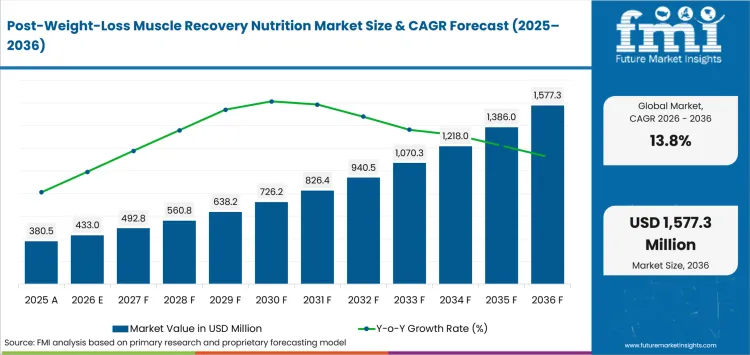
USD 433.0 million in 2026 and USD 1,577.3 million by 2036 at a 13.8% CAGR.
Demand for post-weight-loss muscle recovery nutrition is projected to expand at 13.8% CAGR between 2026 and 2036, increasing valuation from USD 433.0 million in 2026 to USD 1,577.3 million by 2036. Major weight loss reduces meal volume while lean-mass needs persist. The Obesity Society reported in May 2025 that GLP-1 trials produced 5% to 18% placebo-adjusted weight reductions. Its advisory paired adequate protein with strength training to limit lean-mass loss. Lower intake favors concentrated nutrition that users can tolerate repeatedly.
Access routes diverge between the UK and the United States. The UK is moving weight-management delivery into community care. USA treatment access is payer-fragmented. In August 2025 the UK government said 23 integrated care board projects were testing personalized models in local communities. Those projects bring dietetic advice closer to treatment. USA nutrition brands still depend on retail and subscription channels outside the medical benefit.
Key Takeaways
- Lower food intake after major weight loss raises the commercial need for compact protein and recovery nutrition that protects lean mass.
- By product type, high-protein shakes are estimated to hold 37.4% in 2026 owing to concentrated protein delivery for lower-appetite routines.
- Based on weight-loss context, GLP-1 pharmacotherapy is projected to account for 40.5% in 2026 driven by a clear treatment trigger for nutrition review.
- In 2026, RTD is expected to lead product form with 47.1% share attributable to pre-portioned protein that removes mixing from daily use.
- Gastrointestinal symptoms and uneven access to weight-loss treatment can reduce repeat use despite a clear protein need.
- Some of the key players in this market include Abbott (Protality), Nestle Health Science, Premier Protein (BellRing Brands), Optimum Nutrition (Glanbia), OWYN, Orgain (Nestle Health Science), Momentous, and Medifast (OPTAVIA).
Analyst Perspective
"Protein density has the most commercial value during active loss because smaller meals leave little room to correct missed intake later. Formats that stay tolerable during treatment and still fit resistance training in maintenance are better positioned for repeat use."
- Nandini Roy Choudhury, Principal Consultant, Future Market Insights
How is the post-weight-loss muscle recovery nutrition market segmented?
The market is segmented by product type, weight-loss context, product form, end user, sales channel and region.
Product type covers high-protein shakes (GLP-1 companion), leucine - HMB muscle-preservation blends, protein + fiber satiety products, creatine & resistance-training support and others. Weight-loss context covers GLP-1 pharmacotherapy, post-bariatric surgery, lifestyle - diet-led loss and others. Product form includes RTD, powders, bars & snacks and others. End users include home - self-care, obesity clinics, gyms & coaching programs and others. Sales channels include online - DTC, retail pharmacy, supermarkets & hypermarkets, specialty & health stores and others.
Why do High-Protein Shakes (GLP-1 Companion) lead the product type category?
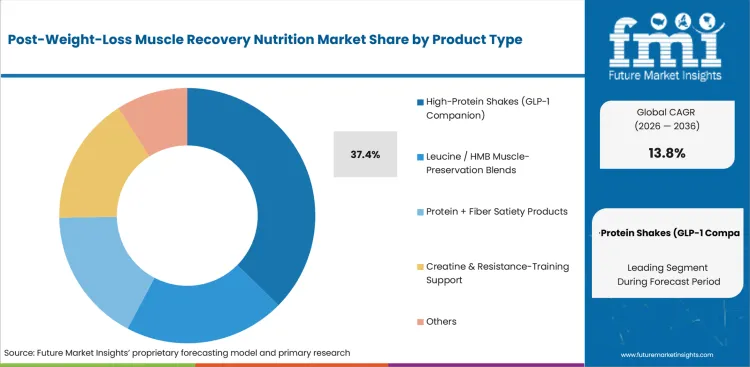
High-protein shakes deliver a useful protein serving in less volume after appetite falls. They also follow the familiar use pattern of protein supplements and need less explanation at purchase. A sealed bottle makes each serving easier to count than an improvised meal.
- High-protein shakes (GLP-1 companion) are projected to hold 37.4% share in 2026 owing to compact protein delivery for portion-constrained routines.
- Nestlé announced in April 2025 that Boost Advanced would launch in the USA with 35 grams of protein for weight-management consumers including GLP-1 users.
Why does GLP-1 Pharmacotherapy lead the weight-loss context category?
Medication gives nutrition brands a clear point at which appetite and meal size change. Treatment initiation also places weight-management programs closer to the nutrition decision than general sports supplementation does.
- The weight-loss context category is forecast to be led by GLP-1 pharmacotherapy at 40.5% share in 2026 driven by an identifiable treatment stage for lean-mass protection.
- KFF found in November 2025 that 12% of USA adults were currently taking a GLP-1 drug and 18% had used one at some point.
How does RTD lead the product form category?
RTD removes scooping and mixing from a routine that may already include medication timing and exercise. High-protein functional beverages fit workdays and travel more easily than powders. Sealed servings make protein intake easier to count.
- RTD is likely to capture 47.1% share in 2026 supported by sealed servings that make protein intake easier to count and repeat.
- Premier Protein launched its Indulgence high-protein shake line in January 2025 with 30 grams of protein per bottle and retail plus online availability.
What supports Home - Self-Care within the end user category?
People consume most servings between clinical visits and manage the routine at home. Meal replacement products already occupy similar daily occasions because compact nutrition fits scheduled intake. Home use also separates daily intake from clinic capacity.
- By end user, home - self-care is forecast to represent 49.3% in 2026 attributable to repeated purchasing and consumption outside clinical settings.
- Orgain introduced a digital Protein Calculator in June 2025 that generates personalized intake estimates for consumers and healthcare professionals using age and activity inputs.
Why does Online - DTC lead the sales channel category?
Online channels can explain protein level and format before a user commits to a repeat order. They also let customers compare weight-management supplements without relying on a limited physical shelf.
- Online - DTC is set to lead the sales channel with 36.3% share in 2026 influenced by education and replenishment in the same purchase path.
- Optimum Nutrition launched Coach Optimum in June 2025 as a virtual coach in five European markets with personalized product suggestions and performance guidance.
What are the drivers, restraints and opportunities in the Post-Weight-Loss Muscle Recovery Nutrition Market?
Medication-led weight loss expands the lean-mass nutrition need while tolerance limits product-only use and integrated support extends purchasing into maintenance.
- Driver: Rapid growth in pharmacotherapy expands the number of people who need more protein from fewer eating occasions.
- Restraint: Gastrointestinal adverse effects can make serving volume and ingredient tolerance more important than headline protein content.
- Opportunity: Programs that align nutrition with exercise and payment support can extend purchasing from active loss into maintenance.
Medication-Led Weight Loss Expands the Muscle-Preservation Need
Obesity treatment now triggers the nutrition need before many users return to gym-based recovery. In May 2026 the American Society for Metabolic and Bariatric Surgery reported that GLP-1 prescriptions among nearly 20 million patients with severe obesity rose from fewer than 4,600 in 2018 to more than 1.4 million in 2025. That larger treated population increases demand for compact clinical nutrition that fits lower appetite and lean-mass preservation.
Tolerance and Exercise Dependence Limit Product-Only Solutions
Poor gastrointestinal tolerance can make a high-protein serving unusable even when its nutrition profile is suitable. The FDA said in March 2026 that gastrointestinal reactions were the most common adverse events with the higher Wegovy dose including nausea and vomiting. Formulators therefore need adjustable serving sizes and dietary fiber products that users can tolerate without presenting supplementation as a substitute for resistance exercise.
Integrated Support Extends Purchasing into Maintenance
Programs that stay useful after active weight loss can keep nutrition purchases tied to maintenance instead of a short treatment cycle. In February 2026 Medifast said qualified OPTAVIA clients could use HSA or FSA funds on select plans that included lean-mass preservation within its metabolic-health system. Payment support reduces enrollment friction and leaves room for sports nutrition products as resistance training returns.
Which country CAGRs are profiled in the Post-Weight-Loss Muscle Recovery Nutrition Market?
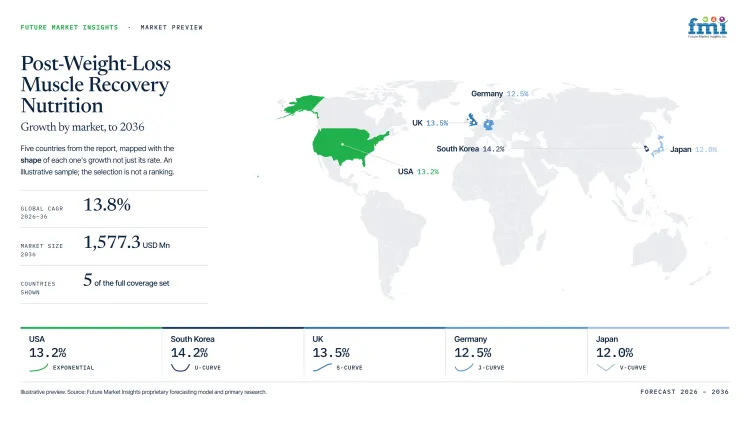
| Country | CAGR |
|---|---|
| South Korea | 14.2% |
| UK | 13.5% |
| USA | 13.2% |
| Germany | 12.5% |
| Japan | 12.0% |
How do country-level CAGRs compare in the Post-Weight-Loss Muscle Recovery Nutrition Market?
The profiled forecasts span 2.2 percentage points from South Korea to Japan. South Korea forms the upper edge. The UK and USA cluster near the middle with Germany and Japan below them. The narrow spread means access rules and channel economics separate commercial conditions more clearly than the CAGR ranking.
- South Korea's online retail model shortens replenishment cycles for consumer protein products.
- UK community weight-management pilots broaden product discovery beyond specialist clinics.
- USA retail reach makes companion nutrition less dependent on medical benefit design.
- German pharmacies provide a familiar health channel for premium protein formats.
- Japan keeps retail protein discovery separate from medicine-linked nutrition advice.
Similar CAGRs can produce different repeat-purchase patterns under different care and payment models. The full report provides country-level CAGR analysis across North America, Latin America, Western Europe, Eastern Europe, East Asia, South Asia and Pacific and Middle East and Africa.
Country-wise Analysis
- South Korea separates consumer nutrition sales from tightly supervised prescription care. Post-weight-loss muscle recovery nutrition demand in South Korea is forecast to rise at 14.2% CAGR over the forecast period, driven by strong digital product discovery and careful separation of nutrition claims from medicine promotion. In May 2026 the Ministry of Food and Drug Safety said 2025 inspections found 74 violations in 934 field checks plus 5,053 online advertising violations involving high-interest items such as obesity treatments. The enforcement record raises the cost of careless medical claims for protein brands. Consumer channels still support replenishment but medicine-adjacent campaigns need tighter legal review.
- NHS weight-management services make the UK a clinician-mediated market even though companion products remain consumer purchases. NHS England published its tirzepatide commissioning guidance in March 2025 and set primary-care funding from June 23 on a phased cohort basis. The UK post-weight-loss muscle recovery nutrition sector is projected to record 13.5% CAGR during the assessment period, supported by treatment pathways that include diet and behavior support. Local commissioners must provide wraparound care for at least nine months when they do not use the central service. Strong dietetic fit improves recommendation access through clinician-supported weight-management programs and pathways. Primary-care capacity controls how quickly the eligible treated pool expands.
- USA consumers can buy high-protein products through broad retail channels even as obesity-medicine coverage changes by payer. Post-weight-loss muscle recovery nutrition sales in the USA are forecast to expand at 13.2% CAGR by 2036, influenced by prescription access and deep retail availability. CMS launched the Medicare GLP-1 Bridge in July 2026 for eligible Part D beneficiaries through December 2027. The bridge operates outside the standard Part D payment flow and does not cover companion nutrition. Retail brands therefore own the nutrition transaction and must retain consumers through taste plus tolerance and convenient formats without relying on drug-benefit coverage.
- Germany has a large obesity population but companion nutrition still competes for household spending. Germany's post-weight-loss muscle recovery nutrition outlook is anticipated to advance at 12.5% CAGR over the assessment period, attributable to persistent weight-management need and broad access to protein products. Destatis reported in June 2026 that 53.4% of adults were overweight in 2025 and 17.9% were obese. Those figures define a large addressable pool without proving willingness to pay for premium recovery products. Retailers can compare dense shakes with lighter protein water formats so premium products need clear protein-per-serving value at smaller eating occasions during active loss.
- Japan routes obesity pharmacotherapy through stricter clinical eligibility than mass consumer wellness channels. In June 2026 the Ministry of Health, Labour and Welfare reiterated that GLP-1 medicines must stay within approved obesity indications and optimal-use guidance. Adoption of post-weight-loss muscle recovery nutrition in Japan is estimated to expand at 12.0% CAGR through 2036, shaped by a defined clinical pathway and demand for compact nutrition at smaller eating occasions. The regulatory boundary gives health professionals more influence at product discovery. Protein drinks fit early intake needs and creatine supplements become more relevant during resistance-training maintenance, so medicine-adjacent promotion requires conservative professional education.
Who are the notable companies in the Post-Weight-Loss Muscle Recovery Nutrition Market?
Abbott (Protality), Nestle Health Science, Premier Protein (BellRing Brands), Optimum Nutrition (Glanbia), OWYN, Orgain (Nestle Health Science), Momentous, and Medifast (OPTAVIA) are the notable companies profiled in this market.
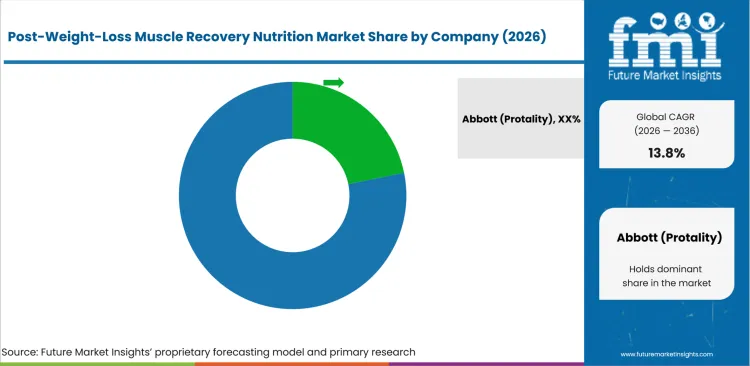
Competition separates by the problem each company can solve. Abbott and Nestle Health Science address nutrition during active weight loss with treatment-linked positioning. Medifast pairs guided programs with high-protein products. Orgain gives healthcare professionals tools for weight-management nutrition. Premier Protein and OWYN compete on broad retail access. Optimum Nutrition and Momentous become more relevant as resistance training returns during maintenance.
- Weight-management nutrition systems include Abbott (Protality) and Nestle Health Science. Orgain (Nestle Health Science) and Medifast (OPTAVIA) also serve this role.
- Broad high-protein access: Premier Protein (BellRing Brands) and OWYN.
- Sports-recovery specialists: Optimum Nutrition (Glanbia) and Momentous.
Competitive Benchmarking: Post-Weight-Loss Muscle Recovery Nutrition Market
| Company | Weight-Loss-Specific Nutrition Offer | Muscle-Recovery Ingredient Range | Professional Program Integration | Geographic Reach |
|---|---|---|---|---|
| Abbott (Protality) | High | Medium | Low | United States |
| Nestle Health Science | High | Medium | Medium | United States |
| Premier Protein (BellRing Brands) | Low | Medium | Low | United States and Canada |
| Optimum Nutrition (Glanbia) | Low | High | Medium | 100+ countries |
| OWYN | Low | Medium | Low | United States |
| Orgain (Nestle Health Science) | Medium | Medium | Medium | United States |
| Momentous | Low | High | Medium | United States |
| Medifast (OPTAVIA) | High | Medium | High | United States |
Scoring basis: High weight-loss-specific nutrition requires a dedicated GLP-1 or weight-management system. Medium requires documented weight-management use within a broader nutrition offer. Low identifies a verified general protein or recovery offer without weight-loss-specific positioning. High muscle-recovery range requires protein plus a separate recovery active such as creatine. Medium is protein-led and Low applies to a verified offer without a distinct recovery active. High professional integration requires a clinician or coach program. Medium uses a documented guided tool or professional partnership. Low identifies a retail or DTC route without a guided program.
Key Developments in the Post-Weight-Loss Muscle Recovery Nutrition Market
- In July 2026, Premier Protein launched Ultimate protein shakes with 42 grams of protein in a 14-ounce ready-to-drink format available through national retailers.
- In July 2026, Orgain announced a 35-gram dairy-free protein shake as a ready-to-drink product available through Costco.
- In February 2026, Momentous announced a partnership with The Vitamin Shoppe that widened retail access to its third-party-tested performance nutrition products.
Key Players in the Post-Weight-Loss Muscle Recovery Nutrition Market
Weight-Management Nutrition Systems
- Abbott (Protality)
- Nestle Health Science
- Orgain (Nestle Health Science)
- Medifast (OPTAVIA)
Broad High-Protein Brands
- Premier Protein (BellRing Brands)
- OWYN
Sports-Recovery Specialists
- Optimum Nutrition (Glanbia)
- Momentous
Post-Weight-Loss Muscle Recovery Nutrition Market - Report Scope
| Coverage field | Report scope |
|---|---|
| Market breakdown | By product type, weight-loss context, product form, end user, sales channel and region. |
| Quantitative Units | USD million. |
| Market Definition | Nutrition products used after or during substantial weight loss to support protein intake, lean-mass preservation and resistance-training recovery within medication, surgical and lifestyle pathways. |
| Regions Covered | North America, Latin America, Western Europe, Eastern Europe, East Asia, South Asia and Pacific and Middle East and Africa. |
| Countries Covered | South Korea, UK, USA, Germany, Japan and 20+ countries included in the full report. |
| Key Companies Profiled | Abbott (Protality), Nestle Health Science, Premier Protein (BellRing Brands), Optimum Nutrition (Glanbia), OWYN, Orgain (Nestle Health Science), Momentous, Medifast (OPTAVIA). |
| Forecast Period | 2026 to 2036. |
| Approach | Primary and secondary research with market triangulation. |
Post-Weight-Loss Muscle Recovery Nutrition Market - Research Methodology
| Method | Approach |
|---|---|
| Primary Research | FMI analysts gathered input from manufacturers, service providers, technology developers, distributors, end users, procurement teams, and subject-matter experts. Interviews examined purchasing decisions, product or service evaluation, adoption barriers, approval requirements, pricing considerations, and expectations for technical or commercial support. Respondents were also asked what evidence is required before a trial, pilot, or initial order develops into regular purchasing. |
| Desk Research | Desk research covered government statistics, regulatory publications, trade data, industry associations, technical literature, standards, company filings, product information, and official corporate announcements. Sources were reviewed for relevance, publication date, geographic coverage, and consistency with the defined market scope. Claims relating to performance, applications, approvals, capacity, investment, and commercial activity were retained only when supported by credible public evidence. |
| Market Sizing and Forecasting | The market model combined the baseline value with historical performance, segment structure, pricing and volume indicators, adoption levels, company participation, and country-level demand conditions. Forecast assumptions considered economic activity, investment trends, regulatory developments, technology adoption, purchasing cycles, supply availability, and barriers to wider market use. Segment and regional estimates were reconciled before the final market total was calculated. |
| Data Validation | Estimates were checked against multiple independent indicators, including public data, company activity, trade patterns, industry developments, and findings from primary interviews. Validation also tested whether products, services, applications, and company revenues fell within the defined market boundaries. Adjacent categories, unsupported claims, overlapping revenues, and activities without direct market relevance were excluded to reduce double counting and maintain consistency across segments and countries. |
Post-Weight-Loss Muscle Recovery Nutrition Market by Segments
Post-Weight-Loss Muscle Recovery Nutrition Market segmented by Product Type:
- High-Protein Shakes (GLP-1 Companion)
- Leucine - HMB Muscle-Preservation Blends
- Protein + Fiber Satiety Products
- Creatine & Resistance-Training Support
- Others
Post-Weight-Loss Muscle Recovery Nutrition Market segmented by Weight-Loss Context:
- GLP-1 Pharmacotherapy
- Post-Bariatric Surgery
- Lifestyle - Diet-Led Loss
- Others
Post-Weight-Loss Muscle Recovery Nutrition Market segmented by Product Form:
- RTD
- Powders
- Bars & Snacks
- Others
Post-Weight-Loss Muscle Recovery Nutrition Market segmented by End User:
- Home - Self-Care
- Obesity Clinics
- Gyms & Coaching Programs
- Others
Post-Weight-Loss Muscle Recovery Nutrition Market segmented by Sales Channel:
- Online - DTC
- Retail Pharmacy
- Supermarkets & Hypermarkets
- Specialty & Health Stores
- Others
Post-Weight-Loss Muscle Recovery Nutrition Market by Region:
- North America
- USA
- Canada
- Latin America
- Brazil
- Mexico
- Argentina
- Chile
- Western Europe
- Germany
- France
- UK
- Italy
- Spain
- Benelux
- Nordics
- Eastern Europe
- Poland
- Czech Republic
- Romania
- Hungary
- East Asia
- China
- Japan
- South Korea
- South Asia and Pacific
- India
- ASEAN
- Australia and New Zealand
- Middle East and Africa
- GCC Countries
- South Africa
- Türkiye
- Israel
Research Sources and Bibliography
- The Obesity Society. (2025, May 30). Nutritional Priorities to Support GLP-1 Therapy for Obesity. Global clinical guidance.
- Department of Health and Social Care, Innovate UK, and NHS England. (2025, August 12). New help for patients battling obesity through pharmacies and community access. United Kingdom.
- KFF. (2025, November 14). Poll: 1 in 8 Adults Say They Are Currently Taking a GLP-1 Drug for Weight Loss, Diabetes or Another Condition, Even as Half Say the Drugs Are Difficult to Afford. United States.
- Nestlé. (2025, April 15). Nestlé’s protein expertise delivers weight management innovation. Global and United States.
- Premier Protein. (2025, January 15). Premier Protein Launches New Line of Indulgent High Protein Shakes. United States.
- Orgain Healthcare. (2025, June 9). Healthcare Professional Newsletter, June 2025. United States.
- Glanbia. (2025, June 20). Introducing Coach Optimum: A personal guide to performance nutrition. Europe.
- American Society for Metabolic and Bariatric Surgery. (2026, May 5). As GLP-1 Use Skyrockets and Bariatric Surgery Slows, Most Obesity Goes Untreated. United States.
- USA Food and Drug Administration. (2026, March 19). FDA Approves Fourth Product Under National Priority Voucher Program, Higher Dose Semaglutide. United States.
- Medifast, Inc. (2026, February 20). Scientific Evidence Demonstrates OPTAVIA’s Metabolic Health Benefits, Opening the Door to Qualified HSA/FSA Clients. United States.
- Centers for Medicare & Medicaid Services. (2026, July 1). CMS Launches Medicare GLP-1 Bridge, Expanding Access to GLP-1 Medications. United States.
- NHS England. (2025, March 27). Interim commissioning guidance: implementation of NICE TA1026 and the funding variation for tirzepatide for the management of obesity. England, United Kingdom.
- Statistisches Bundesamt. (2026, June 2). Der Durchschnittsmensch in Deutschland ist 1,73 Meter groß und wiegt 78,3 Kilo. Germany.
- Ministry of Health, Labour and Welfare. (2026, June 16). GLP―1受容体作動薬及びGIP/GLP―1受容体作動薬の適正使用について. Japan.
- Ministry of Food and Drug Safety. (2026, May 18). 비만, ADHD치료제 등 사회적 관심품목 부당광고 피해 예방. South Korea.
- Premier Protein. (2026, July 17). Ready For More? New Premier Protein Ultimate Protein Shakes Pack 42g of Protein in Every Bottle. United States.
- Orgain Healthcare. (2026, July 13). Healthcare Professional Newsletter, July 2026. United States.
- Momentous. (2026, February 12). Momentous x The Vitamin Shoppe: Partners with Purpose. United States.
- Nestlé. (2025, November 3). Nestlé accelerates open innovation in nutrition and health through academic collaborations and startups. Global.
- Glanbia. (2025, October 22). Optimum Nutrition partners with IRFU. Ireland and global sports nutrition.
- Medifast, Inc. (2026, July 17). Medifast Enters a New Era: Introducing Trilivy, a Science-Backed Metabolic Health System. United States.
- Momentous. (2025, October 16). The Story Behind Momentous Creatine Chews: Innovation That Lives Up To The Momentous Standard. United States.
- Orgain Healthcare. (2025, September 8). Organic Protein Powder + Metabolism Blend. United States.
- Momentous. (2025, December 23). The Momentous Standard™: Another Year of Setting the Bar in the Supplement Industry. United States.
- Premier Protein. (2026, August 3). Premier Protein Introduces Sparkling Protein Soda, Where Refreshing Fizz Meets 15g of Protein. United States.
- Glanbia. (2026, June 9). Optimum Nutrition expands its protein portfolio with the launch of new Clear Whey Protein. United Kingdom.
- Orgain Healthcare. (2026, June 8). Healthcare Professional Newsletter, June 2026. United States.
- Medifast, Inc. (2026, August 27). Medifast Announces the Launch of the Medifast Metabolic Health Institute. United States.
- The Simply Good Foods Company. (2025, July 10). The Simply Good Foods Company Reports Fiscal Third Quarter 2025 Financial Results and Updates Fiscal Year Outlook. United States.
- Abbott. (n.d.). Nutrition. Retrieved September 8, 2026. Global.
- Glanbia plc. (2026, March 11). Glanbia Annual Report 2025. Global sports nutrition.
- Abbott. (2024, January 31). Abbott Launches New PROTALITY Brand to Support Adults on Their Weight Loss Journey.
- The Simply Good Foods Company. (2024, June 13). The Simply Good Foods Company Completes Acquisition of Only What You Need (OWYN).
This bibliography is provided for reader reference and is not exhaustive. The full report contains the complete reference list and detailed citations.
This Report Answers
- What are the 2026 and 2036 market values?
- Why does weight loss raise lean-mass nutrition needs?
- Why do high-protein shakes hold 37.4% share in 2026?
- Why does GLP-1 pharmacotherapy hold 40.5% context share?
- Why does RTD hold 47.1% of product form demand?
- How do home - self-care and online - DTC shape repeat purchasing?
- Which profiled countries grow fastest through 2036?
- How do access and tolerance change country-level purchasing?
- Which companies compete in weight-management nutrition and recovery?
Frequently Asked Questions
How big is the Post-Weight-Loss Muscle Recovery Nutrition Market in 2026?
The post-weight-loss muscle recovery nutrition market is valued at USD 433.0 million in 2026 and is projected to reach USD 1,577.3 million by 2036. Lower meal volume raises demand for concentrated protein that supports lean-mass preservation.
What is the CAGR of the Post-Weight-Loss Muscle Recovery Nutrition Market from 2026 to 2036?
The post-weight-loss muscle recovery nutrition market is projected to grow at 13.8% CAGR between 2026 and 2036. Wider pharmacotherapy use increases treatment stages for compact protein during weight loss and maintenance.
Which product type leads the Post-Weight-Loss Muscle Recovery Nutrition Market?
The high-protein shakes (GLP-1 companion) segment is expected to hold 37.4% of the post-weight-loss muscle recovery nutrition market in 2026, driven by concentrated protein delivery. Smaller servings fit lower-appetite routines without preparation.
Which countries are projected to record the highest growth in the Post-Weight-Loss Muscle Recovery Nutrition Market?
South Korea is projected to grow at 14.2% CAGR, followed by the UK at 13.5% and the USA at 13.2% through 2036. Different prescription pathways and nutrition channels separate the three rates.
Which companies are active in the Post-Weight-Loss Muscle Recovery Nutrition Market?
Key companies operating in the post-weight-loss muscle recovery nutrition market include Abbott (Protality), Nestle Health Science, Premier Protein (BellRing Brands), Optimum Nutrition (Glanbia), OWYN, Orgain (Nestle Health Science), Momentous, and Medifast (OPTAVIA). Competition differs by treatment fit and recovery.
Preview the report firsthand - request a free sample
Get SampleGet the brochure for pricing and purchase details.
Get PDFTable of Content
- Key Takeaways
- Market Size and CAGR
- Top Growth Driver
- Fastest Growing Segment
- Leading Region
- Key Companies
- Emerging Opportunities
- Executive Summary
- Global Market Outlook
- Demand-side Trends
- Supply-side Trends
- Technology Roadmap Analysis
- Analysis and Recommendations
- Analyst Perspective (What is happening? Why now? What should investors know?)
- Key Questions Answered
- How large is the market?
- What is the CAGR?
- What are key trends?
- Which region dominates?
- Who are the leaders?
- Market Overview
- Market Coverage / Taxonomy
- Market Definition / Scope / Limitations
- Research Methodology
- Chapter Orientation
- Analytical Lens and Working Hypotheses
- Market Structure, Signals, and Trend Drivers
- Benchmarking and Cross-market Comparability
- Market Sizing, Forecasting, and Opportunity Mapping
- Research Design and Evidence Framework
- Desk Research Programme (Secondary Evidence)
- Expert Input and Fieldwork (Primary Evidence)
- Tooling, Models, and Reference Databases
- Data Engineering and Model Build
- Quality Assurance and Audit Trail
- Market Background
- Market Dynamics (Drivers, Restraints, Opportunity, Trends)
- Scenario Forecast (Optimistic, Likely, Conservative)
- Impact Analysis
- AI Impact
- Sustainability Impact
- Regulatory Impact
- Technology Impact
- Consumer / Buyer Analysis
- Purchase Drivers
- Adoption Barriers
- Buyer Journey
- Opportunity Map Analysis
- Product Life Cycle Analysis
- Supply Chain Analysis
- Investment Feasibility Matrix
- Value Chain Analysis
- PESTLE and Porter's Analysis
- Regulatory Landscape
- Regional Parent Market Outlook
- Production and Consumption Statistics
- Import and Export Statistics
- Global Market Analysis and Forecast, 2021 to 2036
- Historical Market Size Value (USD Million) Analysis, 2021 to 2025
- Current and Future Market Size Value (USD Million) Projections, 2026 to 2036
- Y-o-Y Growth Trend Analysis
- Absolute $ Opportunity Analysis
- Global Market Pricing Analysis, 2021 to 2036
- Global Market Analysis and Forecast, By Product Type, 2021 to 2036
- Introduction / Key Findings
- Historical Market Size Value (USD Million) Analysis By Product Type, 2021 to 2025
- Current and Future Market Size Value (USD Million) Analysis and Forecast By Product Type, 2026 to 2036
- High-Protein Shakes (GLP-1 Companion)
- Leucine / HMB Muscle-Preservation Blends
- Protein + Fiber Satiety Products
- Creatine & Resistance-Training Support
- Others
- High-Protein Shakes (GLP-1 Companion)
- Y-o-Y Growth Trend Analysis By Product Type, 2021 to 2025
- Absolute $ Opportunity Analysis By Product Type, 2026 to 2036
- Global Market Analysis and Forecast, By Weight-Loss Context, 2021 to 2036
- Introduction / Key Findings
- Historical Market Size Value (USD Million) Analysis By Weight-Loss Context, 2021 to 2025
- Current and Future Market Size Value (USD Million) Analysis and Forecast By Weight-Loss Context, 2026 to 2036
- GLP-1 Pharmacotherapy
- Post-Bariatric Surgery
- Lifestyle / Diet-Led Loss
- Others
- GLP-1 Pharmacotherapy
- Y-o-Y Growth Trend Analysis By Weight-Loss Context, 2021 to 2025
- Absolute $ Opportunity Analysis By Weight-Loss Context, 2026 to 2036
- Global Market Analysis and Forecast, By Product Form, 2021 to 2036
- Introduction / Key Findings
- Historical Market Size Value (USD Million) Analysis By Product Form, 2021 to 2025
- Current and Future Market Size Value (USD Million) Analysis and Forecast By Product Form, 2026 to 2036
- RTD
- Powders
- Bars & Snacks
- Others
- RTD
- Y-o-Y Growth Trend Analysis By Product Form, 2021 to 2025
- Absolute $ Opportunity Analysis By Product Form, 2026 to 2036
- Global Market Analysis and Forecast, By End User, 2021 to 2036
- Introduction / Key Findings
- Historical Market Size Value (USD Million) Analysis By End User, 2021 to 2025
- Current and Future Market Size Value (USD Million) Analysis and Forecast By End User, 2026 to 2036
- Home / Self-Care
- Obesity Clinics
- Gyms & Coaching Programs
- Others
- Home / Self-Care
- Y-o-Y Growth Trend Analysis By End User, 2021 to 2025
- Absolute $ Opportunity Analysis By End User, 2026 to 2036
- Global Market Analysis and Forecast, By Sales Channel, 2021 to 2036
- Introduction / Key Findings
- Historical Market Size Value (USD Million) Analysis By Sales Channel, 2021 to 2025
- Current and Future Market Size Value (USD Million) Analysis and Forecast By Sales Channel, 2026 to 2036
- Online / DTC
- Retail Pharmacy
- Supermarkets & Hypermarkets
- Specialty & Health Stores
- Others
- Online / DTC
- Y-o-Y Growth Trend Analysis By Sales Channel, 2021 to 2025
- Absolute $ Opportunity Analysis By Sales Channel, 2026 to 2036
- Global Market Analysis and Forecast, By Region, 2021 to 2036
- Introduction
- Historical Market Size Value (USD Million) Analysis By Region, 2021 to 2025
- Current Market Size Value (USD Million) Analysis and Forecast By Region, 2026 to 2036
- North America
- Latin America
- Western Europe
- Eastern Europe
- East Asia
- South Asia and Pacific
- Middle East & Africa
- Market Attractiveness Analysis By Region
- North America Market Analysis and Forecast, By Country, 2021 to 2036
- Historical Market Size Value (USD Million) Trend Analysis By Market Taxonomy, 2021 to 2025
- Market Size Value (USD Million) Forecast By Market Taxonomy, 2026 to 2036
- By Country
- USA
- Canada
- By Product Type
- By Weight-Loss Context
- By Product Form
- By End User
- By Sales Channel
- By Country
- Market Attractiveness Analysis
- By Country
- By Product Type
- By Weight-Loss Context
- By Product Form
- By End User
- By Sales Channel
- Key Takeaways
- Latin America Market Analysis and Forecast, By Country
- Historical Market Size Value (USD Million) Trend Analysis By Market Taxonomy, 2021 to 2025
- Market Size Value (USD Million) Forecast By Market Taxonomy, 2026 to 2036
- By Country
- Brazil
- Mexico
- Chile
- Rest of Latin America
- By Product Type
- By Weight-Loss Context
- By Product Form
- By End User
- By Sales Channel
- By Country
- Market Attractiveness Analysis
- By Country
- By Product Type
- By Weight-Loss Context
- By Product Form
- By End User
- By Sales Channel
- Key Takeaways
- Western Europe Market Analysis and Forecast, By Country
- Historical Market Size Value (USD Million) Trend Analysis By Market Taxonomy, 2021 to 2025
- Market Size Value (USD Million) Forecast By Market Taxonomy, 2026 to 2036
- By Country
- Germany
- UK
- Italy
- Spain
- France
- Nordic
- BENELUX
- Rest of Western Europe
- By Product Type
- By Weight-Loss Context
- By Product Form
- By End User
- By Sales Channel
- By Country
- Market Attractiveness Analysis
- By Country
- By Product Type
- By Weight-Loss Context
- By Product Form
- By End User
- By Sales Channel
- Key Takeaways
- Eastern Europe Market Analysis and Forecast, By Country
- Historical Market Size Value (USD Million) Trend Analysis By Market Taxonomy, 2021 to 2025
- Market Size Value (USD Million) Forecast By Market Taxonomy, 2026 to 2036
- By Country
- Russia
- Poland
- Hungary
- Balkan & Baltic
- Rest of Eastern Europe
- By Product Type
- By Weight-Loss Context
- By Product Form
- By End User
- By Sales Channel
- By Country
- Market Attractiveness Analysis
- By Country
- By Product Type
- By Weight-Loss Context
- By Product Form
- By End User
- By Sales Channel
- Key Takeaways
- East Asia Market Analysis and Forecast, By Country
- Historical Market Size Value (USD Million) Trend Analysis By Market Taxonomy, 2021 to 2025
- Market Size Value (USD Million) Forecast By Market Taxonomy, 2026 to 2036
- By Country
- China
- Japan
- South Korea
- By Product Type
- By Weight-Loss Context
- By Product Form
- By End User
- By Sales Channel
- By Country
- Market Attractiveness Analysis
- By Country
- By Product Type
- By Weight-Loss Context
- By Product Form
- By End User
- By Sales Channel
- Key Takeaways
- South Asia and Pacific Market Analysis and Forecast, By Country
- Historical Market Size Value (USD Million) Trend Analysis By Market Taxonomy, 2021 to 2025
- Market Size Value (USD Million) Forecast By Market Taxonomy, 2026 to 2036
- By Country
- India
- ASEAN
- Australia & New Zealand
- Rest of South Asia and Pacific
- By Product Type
- By Weight-Loss Context
- By Product Form
- By End User
- By Sales Channel
- By Country
- Market Attractiveness Analysis
- By Country
- By Product Type
- By Weight-Loss Context
- By Product Form
- By End User
- By Sales Channel
- Key Takeaways
- Middle East & Africa Market Analysis and Forecast, By Country
- Historical Market Size Value (USD Million) Trend Analysis By Market Taxonomy, 2021 to 2025
- Market Size Value (USD Million) Forecast By Market Taxonomy, 2026 to 2036
- By Country
- Kingdom of Saudi Arabia
- Other GCC Countries
- Türkiye
- South Africa
- Other African Union
- Rest of Middle East & Africa
- By Product Type
- By Weight-Loss Context
- By Product Form
- By End User
- By Sales Channel
- By Country
- Market Attractiveness Analysis
- By Country
- By Product Type
- By Weight-Loss Context
- By Product Form
- By End User
- By Sales Channel
- Key Takeaways
- Key Countries Market Analysis
- USA
- Pricing Analysis
- Market Share Analysis, 2025
- By Product Type
- By Weight-Loss Context
- By Product Form
- By End User
- By Sales Channel
- Canada
- Pricing Analysis
- Market Share Analysis, 2025
- By Product Type
- By Weight-Loss Context
- By Product Form
- By End User
- By Sales Channel
- Mexico
- Pricing Analysis
- Market Share Analysis, 2025
- By Product Type
- By Weight-Loss Context
- By Product Form
- By End User
- By Sales Channel
- Brazil
- Pricing Analysis
- Market Share Analysis, 2025
- By Product Type
- By Weight-Loss Context
- By Product Form
- By End User
- By Sales Channel
- Chile
- Pricing Analysis
- Market Share Analysis, 2025
- By Product Type
- By Weight-Loss Context
- By Product Form
- By End User
- By Sales Channel
- Germany
- Pricing Analysis
- Market Share Analysis, 2025
- By Product Type
- By Weight-Loss Context
- By Product Form
- By End User
- By Sales Channel
- UK
- Pricing Analysis
- Market Share Analysis, 2025
- By Product Type
- By Weight-Loss Context
- By Product Form
- By End User
- By Sales Channel
- Italy
- Pricing Analysis
- Market Share Analysis, 2025
- By Product Type
- By Weight-Loss Context
- By Product Form
- By End User
- By Sales Channel
- Spain
- Pricing Analysis
- Market Share Analysis, 2025
- By Product Type
- By Weight-Loss Context
- By Product Form
- By End User
- By Sales Channel
- France
- Pricing Analysis
- Market Share Analysis, 2025
- By Product Type
- By Weight-Loss Context
- By Product Form
- By End User
- By Sales Channel
- India
- Pricing Analysis
- Market Share Analysis, 2025
- By Product Type
- By Weight-Loss Context
- By Product Form
- By End User
- By Sales Channel
- ASEAN
- Pricing Analysis
- Market Share Analysis, 2025
- By Product Type
- By Weight-Loss Context
- By Product Form
- By End User
- By Sales Channel
- Australia & New Zealand
- Pricing Analysis
- Market Share Analysis, 2025
- By Product Type
- By Weight-Loss Context
- By Product Form
- By End User
- By Sales Channel
- China
- Pricing Analysis
- Market Share Analysis, 2025
- By Product Type
- By Weight-Loss Context
- By Product Form
- By End User
- By Sales Channel
- Japan
- Pricing Analysis
- Market Share Analysis, 2025
- By Product Type
- By Weight-Loss Context
- By Product Form
- By End User
- By Sales Channel
- South Korea
- Pricing Analysis
- Market Share Analysis, 2025
- By Product Type
- By Weight-Loss Context
- By Product Form
- By End User
- By Sales Channel
- Russia
- Pricing Analysis
- Market Share Analysis, 2025
- By Product Type
- By Weight-Loss Context
- By Product Form
- By End User
- By Sales Channel
- Poland
- Pricing Analysis
- Market Share Analysis, 2025
- By Product Type
- By Weight-Loss Context
- By Product Form
- By End User
- By Sales Channel
- Hungary
- Pricing Analysis
- Market Share Analysis, 2025
- By Product Type
- By Weight-Loss Context
- By Product Form
- By End User
- By Sales Channel
- Kingdom of Saudi Arabia
- Pricing Analysis
- Market Share Analysis, 2025
- By Product Type
- By Weight-Loss Context
- By Product Form
- By End User
- By Sales Channel
- Türkiye
- Pricing Analysis
- Market Share Analysis, 2025
- By Product Type
- By Weight-Loss Context
- By Product Form
- By End User
- By Sales Channel
- South Africa
- Pricing Analysis
- Market Share Analysis, 2025
- By Product Type
- By Weight-Loss Context
- By Product Form
- By End User
- By Sales Channel
- USA
- Market Structure Analysis
- Competition Dashboard
- Competition Benchmarking
- Market Share Analysis of Top Players
- By Regional
- By Product Type
- By Weight-Loss Context
- By Product Form
- By End User
- By Sales Channel
- Emerging Startups
- Innovation Benchmarking
- Competition Analysis
- Competition Deep Dive
- Abbott (Protality)
- Overview
- Product Portfolio
- Profitability by Market Segments
- Sales Footprint
- Strategy Overview
- Marketing Strategy
- Product Strategy
- Channel Strategy
- Nestle Health Science
- Premier Protein (BellRing Brands)
- Optimum Nutrition (Glanbia)
- OWYN
- Orgain (Nestle Health Science)
- Momentous
- Medifast (OPTAVIA)
- Abbott (Protality)
- Case Studies
- Success Stories
- Recent Developments
- Competition Deep Dive
- Assumptions & Acronyms Used


