

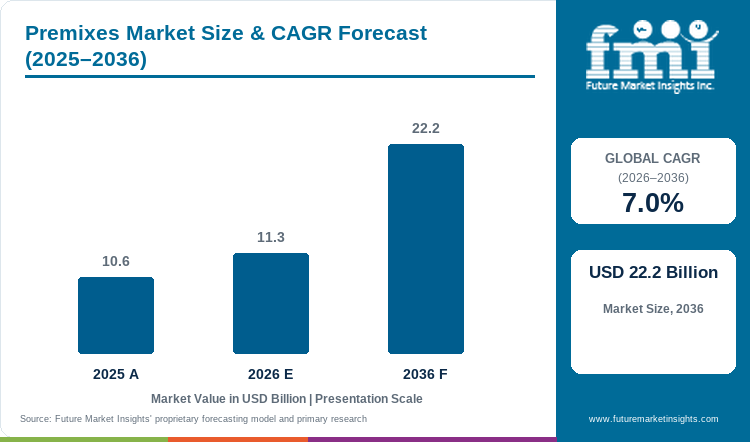
- Market Size (2026)
- USD 11.3 Bn
- Forecast (2036)
- USD 22.2 Bn
- CAGR (2026 to 2036)
- 7.0%
How big is Premixes Market in 2026?
USD 11.3 billion in 2026 and USD 22.2 billion by 2036 at a 7.0% CAGR.
Sales of premixes are estimated to rise at 7.0% CAGR through 2036, increasing valuation from USD 10.6 billion in 2025 to USD 11.3 billion in 2026, and reaching USD 22.2 billion by 2036. Manufacturers are using controlled blends because separate micronutrient additions increase weighing work and traceability requirements during regular production. The World Health Organization treats large-scale food fortification as an evidence-informed intervention for preventing micronutrient deficiencies. Controlled premixes support that production route by keeping blend composition and dosing records consistent through repeated manufacturing.
National demand paths differ because supplement and staple-food rules create different qualification work for the same nutrient blend. The German Federal Institute for Risk Assessment reported in July 2025 that more than two thirds of surveyed adults had used food supplements during the prior year. US rules for dietary supplements separately require manufacturing controls for ingredient identity and finished-product composition. Premix suppliers are preparing formulation records that match each application and regulatory route before a blend enters repeat production.
Key Takeaways
- Controlled multi-ingredient dosing is supporting premix demand because manufacturers need repeatable nutrient delivery without weighing every low-dose component separately.
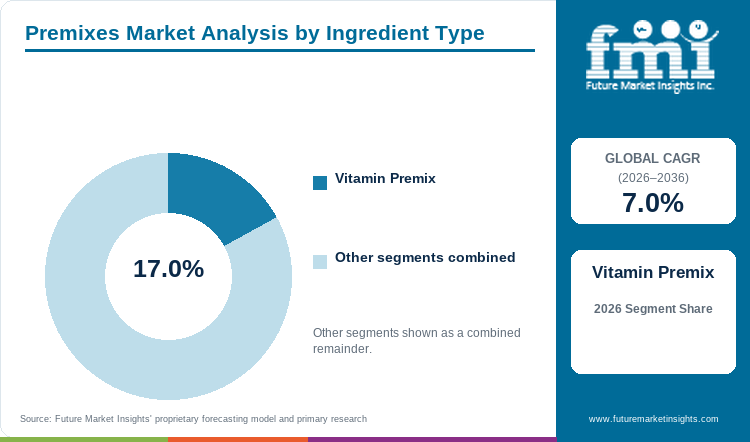
- By ingredient type, vitamin premix is projected to account for 17.0% in 2026, supported by use in supplements and fortified nutrition products.
- By application, dietary supplements are estimated to hold 18.0% in 2026, influenced by label-strength requirements and multi-active formulation complexity.
- Form is divided into powder and liquid because handling systems and finished-product processing determine how a premix enters commercial production.
- Supplier switching remains constrained because compatibility and stability reviews require change-control records before an approved finished formulation can move to another blend.
- Some of the key players in this market include Cargill, Incorporated, Archer-Daniels-Midland Company, Kerry Group plc, Ingredion Incorporated, dsm-firmenich, BASF SE, Tate & Lyle PLC, International Flavors & Fragrances Inc., Givaudan SA, and Corbion N.V.
Analyst Perspective
"Premix suppliers earn repeat business when blend uniformity and documentation survive the customer’s full production process. Formulation teams also need sensory and stability support because nutrient accuracy alone does not secure an approved finished product."
- Nandini Roy Choudhury, Principal Consultant, Future Market Insights
How is the premixes market segmented?
Premixes Market is segmented by Ingredient Type, Application, Form, and Region. Forecast period from 2026 to 2036.
The premixes market is segmented by ingredient type, application, form and region for the 2026 to 2036 period. Ingredient type covers vitamin, mineral, nucleotide, amino-acid, enzyme, coccidiostat, probiotic, prebiotic, multigrain, omega-3, excipient, gum, botanical, sweetener, flavor, protein and color premixes. Application covers dietary supplements, medical nutrition, sports nutrition, energy drinks, dairy, bakery and confectionery, cereals and snacks, plant-based alternatives, fortified staples, early-life nutrition and pharma OTC drugs. Form separates powder and liquid premixes according to handling requirements and finished-product processing conditions.
What supports Vitamin Premix demand within the ingredient type category?
Vitamin premixes combine several micronutrients in one controlled addition for supplements and fortified foods that use low inclusion rates. Formulation teams are managing oxidation and processing losses because either condition can move finished products outside declared nutrient strength. In March 2026 dsm-firmenich completed a USD 10 million Schenectady upgrade for human-food and supplement premixes. The project added segregated material flow and powder-handling controls that are supporting repeatable commercial manufacturing. Customers are reviewing blend uniformity and stability records before approving vitamin systems for recurring production. Low-dose nutrients require careful distribution because small mixing errors can change finished-product composition during normal production.
- Based on ingredient type, vitamin premix is projected to account for 17.0% in 2026, supported by repeated use of vitamin combinations in regulated nutrition products.
- Infant-formula production also raises the value of controlled blends because infant formula ingredients must remain consistent through manufacturing and shelf life.
How do formulation teams evaluate Dietary Supplements within the application category?
Dietary supplement manufacturers are combining vitamins and minerals with botanicals or probiotics in several commercial dose forms. Customized premixes reduce separate weighing steps and preserve dose uniformity together with release documentation during production. Kerry reported in January 2026 that gummies and chews plus powders and stick packs represent more than 60% of global supplement sales. Flavor becomes part of formulation work because minerals and botanicals can change the sensory profile of a finished dose.
- By application, dietary supplements are estimated to hold 18.0% in 2026, shaped by multi-active formulations and precise label-strength requirements.
- Probiotic strains add another formulation constraint because viable cultures need compatible carriers and processing conditions before they enter a combined supplement blend.
What are the drivers, restraints and opportunities in the Premixes Market?
Fortification programs support repeat demand, qualification work slows switching and application-specific formulation services can expand supplier value.
- Driver: National fortification programs create recurring micronutrient specifications that industrial food manufacturers must reproduce during normal production.
- Restraint: A replacement premix must pass compatibility and quality review before manufacturers can change an established blend inside regulated products.
- Opportunity: Suppliers can extend revenue by combining nutrient design with sensory and stability support for specialized nutrition formats.
Fortification programs turn nutrient specifications into recurring industrial blending requirements
National fortification programs are creating recurring premix demand by defining nutrients that mills or food manufacturers must add at controlled levels. The Pan American Health Organization describes food premix operations as a practical component of flour and staple-food fortification programs in the Americas. Mill operators are using premixes to handle small nutrient quantities without weighing every micronutrient separately during each production run. Mineral premixes gain a repeat ordering role as manufacturers reproduce low-dose additions with documented composition under routine processing conditions.
Qualification work can delay supplier changes after a blend enters regular production
Premix substitutions can alter flow behavior and active distribution even if the ingredient list appears unchanged. FDA dietary-supplement manufacturing rules require identity and composition controls for finished products together with documented quality systems. A replacement blend can therefore trigger new compatibility work before a manufacturer changes an established formulation inside a regulated product. Manufacturers are reviewing change-control records and stability evidence before moving an approved formulation to another blend source. The validation burden extends the commercial conversion period because formulation teams must protect declared strength and finished-product performance.
Application support can extend premix suppliers into higher-value formulation work
Medical nutrition formulations often combine nutrition targets with taste problems that affect patient acceptance during regular use. In September 2026 dsm-firmenich described medical-nutrition development that integrates flavor and taste modulation with optimized premix capabilities. Formulation teams are evaluating nutrient delivery together with sensory performance because an acceptable composition still has to work in the intended product format. Integrated taste and premix support extends the supplier role beyond ingredient delivery by resolving sensory issues without weakening nutrient control.
Which country CAGRs are profiled in the Premixes Market?
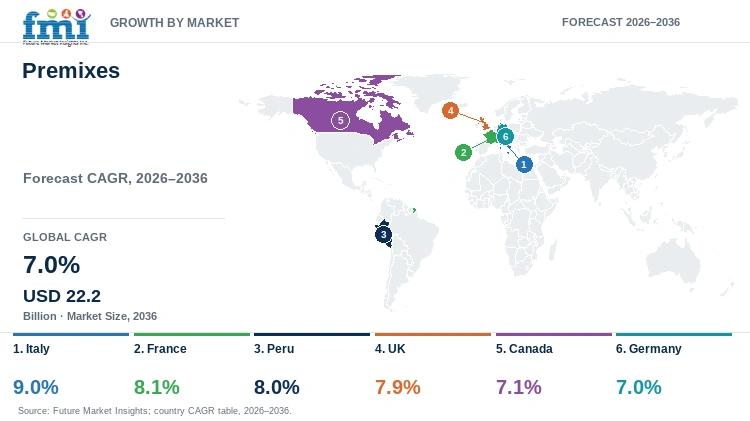
| Country | CAGR |
|---|---|
| Italy | 9.0% |
| France | 8.1% |
| Peru | 8.0% |
| UK | 7.9% |
| Canada | 7.1% |
| Germany | 7.0% |
How do country-level CAGRs compare in the Premixes Market?
The six-country comparison ranges from 7.0% to 9.0% CAGR, with each market assigned a distinct forecast rate. The figures compare forecast pace rather than current market size or the absolute scale of supplier revenue.
- Italy requires front-loaded supplement notification work, which makes formulation dossiers important before a premix reaches routine commercial ordering.
- France places strong weight on traceability and withdrawal readiness, raising documentation expectations for brands using multi-ingredient supplement systems.
- Peru has an industrial flour-milling route that gives micronutrient blends a recurring institutional use case beyond discretionary wellness products.
- UK supplement demand spans several dose forms, making taste and format compatibility relevant when the same actives move between capsules and powders.
- Canadian manufacturers balance mandatory and voluntary fortification routes, which can place different nutrient limits on otherwise similar finished foods.
- German supplement demand operates beside cautious national intake guidance, so brands need formulations that pair consumer use with disciplined dose design.
Comparable CAGRs can still produce different purchasing conditions because qualification work and application mix vary by geography. The full report provides country-level CAGR analysis across North America, Latin America, Western Europe, Eastern Europe, East Asia, South Asia and Pacific, and the Middle East and Africa.
Country-wise Analysis
- Italian supplement operators submit a product label through the national NSIS notification route before first commercialization. Premix sales in Italy are forecast to expand at 9.0% CAGR by 2036, supported by a national notification system that makes formula and label records part of market entry. The Ministry of Health updated its NSIS guidance in February 2025 and requires electronic label submission for covered supplements and vitamin-added foods. Premix suppliers therefore need ingredient forms and declared amounts that remain consistent with the product submitted for Italian sale.
- French supplement operators work under national consumer-protection rules alongside the EU framework that governs food supplements. Premix demand in France is forecast to rise at 8.1% CAGR over the forecast period, shaped by traceability and product-withdrawal expectations. French authorities updated consumer guidance in July 2025 and reinforced composition controls for supplements containing nutrients or plant substances. Brand owners therefore require ingredient records that support the finished-product safety file used during commercial review. Formulation teams are checking source documentation before replacing an established active or changing a blend specification.
- Peruvian wheat flour sold for domestic consumption carries a national micronutrient fortification requirement for industrial millers. Adoption of premixes in Peru is estimated to expand at 8.0% CAGR through 2036, attributable to recurring industrial use of iron and B-vitamin additions. The Ministry of Health law requires iron and folic acid together with niacin and thiamine plus riboflavin in wheat flour. Mills need homogeneous low-dose blending that stays stable during normal storage and transport conditions. Quality teams are checking dosing records because fortified flour must remain inside the mandated nutrient specification at release.
- UK food-supplement manufacturers sell concentrated dose forms ranging from tablets and capsules to powders and liquids under national guidance. The UK premixes sector is projected to record 7.9% CAGR during the assessment period, reinforced by formulation diversity and regulated composition. Government guidance updated in June 2026 defines supplements as concentrated sources of nutrients or other substances sold in dose form. Premix suppliers must manage active compatibility and label-strength targets for these commercial delivery formats. The same nutrient system can require different sensory or processing work as manufacturers move between capsules and powders. Repeat orders depend on documented compatibility with the intended format plus records that remain usable during retailer and regulatory review.
- Canadian food manufacturers use both mandatory and voluntary nutrient-addition pathways depending on the finished product. Canada is estimated to post 7.1% CAGR over the forecast period, linked to regulated fortification and reformulation work. Health Canada specifies which foods may or must be fortified and which nutrients can be added under national rules. A premix therefore has to match the legal route of the final food instead of relying on one standard composition. Formulation teams are reviewing nutrient limits before changing a blend used in an established product. Suppliers with local regulatory support can reduce reformulation risk as manufacturers adapt recipes and documentation for Canadian distribution.
- German supplement use provides a broad application base for vitamin and mineral blends under cautious national intake guidance. Germany's premixes outlook is anticipated to advance at 7.0% CAGR over the assessment period, tied to established supplement use and disciplined dose management. BfR published results from a representative population survey in April 2026 covering supplement behavior in Germany. Formulators must balance consumer use with dose decisions and documentation for vitamins or minerals in finished products. Brands serving sports nutrition and general wellness applications are reviewing claims alongside ingredient strength before changing a blend. Suppliers need consistent specifications that simplify product review without encouraging unsupported health positioning or unnecessary reformulation.
Who are the notable companies in the Premixes Market?
Cargill, Incorporated, Archer-Daniels-Midland Company, Kerry Group plc, Ingredion Incorporated, dsm-firmenich, BASF SE, Tate & Lyle PLC, International Flavors & Fragrances Inc., Givaudan SA, Corbion N.V.
Premix competition includes dedicated blending operations and diversified ingredient groups that support formulation work. Customers raise entry requirements by requiring repeatable homogeneity and quality documentation before they approve a blend.
- dsm-firmenich, Cargill, Incorporated, and Archer-Daniels-Midland Company provide direct premix or multi-component nutrition-system capabilities for commercial formulation programs.
- Kerry Group plc, Ingredion Incorporated, Tate & Lyle PLC, International Flavors & Fragrances Inc., and Givaudan SA contribute taste, nutrition, texture, and health-active systems used beside premix formulation.
- BASF SE and Corbion N.V. supply specialized nutrition or food ingredients that can support defined vitamin, lipid, bakery, and functional formulation requirements.
Competitive Benchmarking: Premixes Market
| Company | Premix / System Integration | Nutrition-active Breadth | Application Support | Geographic Reach |
|---|---|---|---|---|
| Cargill, Incorporated | High | Medium | High | Global |
| Archer-Daniels-Midland Company | Medium | High | High | Global |
| Kerry Group plc | Medium | High | High | Global |
| Ingredion Incorporated | Medium | Medium | High | Global |
| dsm-firmenich | High | High | High | Global |
| BASF SE | Medium | Medium | Medium | Global |
| Tate & Lyle PLC | Medium | Medium | High | Global |
| International Flavors & Fragrances Inc. | Medium | High | High | Global |
| Givaudan SA | Medium | High | High | Global |
| Corbion N.V. | Low | Medium | High | Global |
Scoring basis: High system integration requires dedicated premix production or documented multi-component functional systems. Medium integration requires documented nutrition-system formulation capability and Low integration reflects narrower ingredient-system evidence. High active breadth requires public evidence covering at least four ingredient families used in premix formulations. Medium active breadth covers two or three ingredient families and Low active breadth covers one documented family. Application support follows the same three-level logic using documented formulation work in target applications.
Key Developments in the Premixes Market
- In September 2026, Cargill presented tailored functional systems and co-development support for food manufacturers at Foodist Istanbul 2026.
- In August 2026, Ingredion announced European Union authorization for Benicaros soluble carrot fiber in foods and beverages plus dietary supplements.
- In June 2026, Tate & Lyle PLC received NutraStrong Prebiotic Verified certification for four fiber product lines used in food and supplement applications.
Key Players in the Premixes Market
Dedicated premix and nutrition-system providers
- dsm-firmenich
- Cargill, Incorporated
- Archer-Daniels-Midland Company
Formulation and taste-nutrition platforms
- Kerry Group plc
- Ingredion Incorporated
- Tate & Lyle PLC
- International Flavors & Fragrances Inc.
- Givaudan SA
Specialized nutrition and food-ingredient suppliers
- BASF SE
- Corbion N.V.
Premixes Market - Report Scope
| Coverage field | Report scope |
|---|---|
| Market breakdown | By ingredient type, application, form, and region. |
| Quantitative Units | USD billion. |
| Market Definition | Commercial premixes combining two or more functional ingredients for controlled addition into supplements, foods, beverages, medical nutrition, early-life nutrition, and pharma OTC products. |
| Regions Covered | North America, Latin America, Western Europe, Eastern Europe, East Asia, South Asia and Pacific, and Middle East and Africa. |
| Countries Covered | Italy, France, Peru, UK, Canada, and Germany; 20+ countries are included in the full report. |
| Key Companies Profiled | Cargill, Incorporated, Archer-Daniels-Midland Company, Kerry Group plc, Ingredion Incorporated, dsm-firmenich, BASF SE, Tate & Lyle PLC, International Flavors & Fragrances Inc., Givaudan SA, Corbion N.V. |
| Forecast Period | 2026 to 2036. |
| Approach | Primary and secondary research with market triangulation. |
Premixes Market - Research Methodology
| Method | Approach |
|---|---|
| Primary Research | FMI analysts gathered input from manufacturers, service providers, technology developers, distributors, end users, procurement teams, and subject-matter experts. Interviews examined purchasing decisions, product or service evaluation, adoption barriers, approval requirements, pricing considerations, and expectations for technical or commercial support. Respondents were also asked what evidence is required before a trial, pilot, or initial order develops into regular purchasing. |
| Desk Research | Desk research covered government statistics, regulatory publications, trade data, industry associations, technical literature, standards, company filings, product information, and official corporate announcements. Sources were reviewed for relevance, publication date, geographic coverage, and consistency with the defined market scope. Claims relating to performance, applications, approvals, capacity, investment, and commercial activity were retained only when supported by credible public evidence. |
| Market Sizing and Forecasting | The market model combined the baseline value with historical performance, segment structure, pricing and volume indicators, adoption levels, company participation, and country-level demand conditions. Forecast assumptions considered economic activity, investment trends, regulatory developments, technology adoption, purchasing cycles, supply availability, and barriers to wider market use. Segment and regional estimates were reconciled before the final market total was calculated. |
| Data Validation | Estimates were checked against multiple independent indicators, including public data, company activity, trade patterns, industry developments, and findings from primary interviews. Validation also tested whether products, services, applications, and company revenues fell within the defined market boundaries. Adjacent categories, unsupported claims, overlapping revenues, and activities without direct market relevance were excluded to reduce double counting and maintain consistency across segments and countries. |
Premixes Market by Segments
Premixes Market segmented by Ingredient Type:
- Vitamin Premix
- Mineral Premix
- Nucleotides Premixes
- Amino Acids Premixes
- Enzymes
- Coccidiostats
- Probiotics
- Prebiotics
- Multigrain Premix
- Omega 3 Fatty Acids
- Excipients
- Gums
- Botanicals
- Sweeteners
- Flavors
- Proteins
- Color
Premixes Market segmented by Application:
- Dietary Supplements
- Medical Nutrition
- Sports Nutrition
- Energy Drinks
- Milk & Milk Products
- Bakery & Confectionery Products
- Cereals & Snacks
- Plant Based Alternatives
- Staple Foods (Flour, Salt, and Rice)
- Early Life Nutrition/Baby Food
- Pharma OTC Drugs
Premixes Market segmented by Form:
- Powder
- Liquid
Premixes Market by Region:
- North America
- United States
- Canada
- Latin America
- Brazil
- Mexico
- Chile
- Western Europe
- Germany
- United Kingdom
- Italy
- Spain
- France
- Nordics
- Benelux
- Rest of Western Europe
- Eastern Europe
- Russia
- Poland
- Hungary
- Balkan and Baltic States
- Rest of Eastern Europe
- East Asia
- China
- Japan
- South Korea
- South Asia and Pacific
- India
- ASEAN
- Australia and New Zealand
- Rest of South Asia and Pacific
- Middle East and Africa
- Kingdom of Saudi Arabia
- Other GCC Countries
- Türkiye
- South Africa
- Other African Union Countries
- Rest of Middle East and Africa
Research Sources and Bibliography
- World Health Organization (n.d.). Food fortification.
- German Federal Institute for Risk Assessment. (2025, July 18). Between hype and misconception: common misunderstandings about food supplements.
- dsm-firmenich. (2026, March 11). dsm-firmenich completes $10m upgrade on Schenectady (US) site.
- Kerry Group. (2026, January 22). Balancing Flavour with Function: Kerry's 2026 Supplements Taste Charts Reveal the Winning Formula.
- Pan American Health Organization. (n.d.). Code of Practice for Food Premix Operations.
- USA Food and Drug Administration. (n.d.). Current Good Manufacturing Practices (CGMPs) for Food and Dietary Supplements.
- dsm-firmenich. (2026, September 3). dsm-firmenich advances patient-centric medical nutrition solutions with focus on taste and enjoyment.
- dsm-firmenich. (2026, September 16). dsm-firmenich strengthens commitment to Indonesia with new Jakarta office and Karawang manufacturing expansion.
- Italian Ministry of Health. (2025, February 27). FAQ - Alimenti soggetti a notifica attraverso NSIS (nuovo sistema informativo sanitario).
- Pan American Health Organization. (2026). Latin America and the Caribbean Regional Overview of Food Security and Nutrition 2025: Statistics and trends.
- French Ministry for the Economy. (2025, July 15). Compléments alimentaires : ce qu’il faut savoir.
- Ministerio de Salud del Perú. (2004, August 4). Emiten ley que dispone fortificación de harina de trigo con micronutrientes.
- UK Government. (2026, June 25). Food supplements guidance.
- Health Canada. (2025, September 3). Fortified foods: About fortification.
- Biblioteca del Congreso Nacional de Chile. (2024, June 18). Decreto 29: Modifica el Reglamento Sanitario de los Alimentos.
- German Federal Institute for Risk Assessment. (2026, April 17). Nahrungsergänzungsmittel: Ergebnisse einer Bevölkerungsbefragung 2024.
- ANMAT. (n.d.). ¿Qué son los suplementos dietarios?.
- COFEPRIS. (2025, September 23). Programa de Fortificación de Sal y Harinas.
- USA Food and Drug Administration. (n.d.). Questions & Answers for Consumers Concerning Infant Formula.
- ANVISA. (2026, February 11). Monitoramento da Fortificação das Farinhas de Trigo e Milho com Ferro e Ácido Fólico.
- Cargill. (2026, September 7). Cargill helps food manufacturers accelerate product development processes with tailored functional systems.
- Ingredion Incorporated. (2026, August 25). Ingredion’s Benicaros soluble carrot fiber earns novel food authorization in the European Union.
- Tate & Lyle PLC. (2026, June 3). Tate & Lyle fibre portfolio receives NutraStrong Prebiotic Verified certification.
- Kerry Group. (2026, January 14). Kerry Releases 2026 Global Taste Charts: Defining the Future of Flavour with Data-Rich Insights.
- Tate & Lyle PLC. (2026, June 15). New tool for measuring synbiotic synergy potential could shape the next wave of food and drink innovation supporting gut health.
- Givaudan. (2026, February 12). Givaudan launches the House of Lime in Mexico, offering customers new opportunities for co-creation, inspiration, and innovation.
- Cargill. (2026, January 28). Cargill invests to expand Beijing plant.
- ADM. (2026, May 20). ADM Advances Protein Innovation with New Ingredient Solutions.
- Kerry Group. (2026, April 20). Kerry Opens Expanded Biotechnology Manufacturing Hub in Ireland to Meet Growing Global Demand for Lactase Enzymes.
- International Flavors & Fragrances Inc. (2026, June 23). IFF launches first-of-its-kind stabilizer system in Europe, the Middle East and Africa.
- Givaudan. (2026, July 3). Givaudan inaugurates new production facility in Indonesia.
- Corbion. (2026, June 15). Corbion launches LUMI Set to help bakers reformulate away from titanium dioxide without sacrificing visual appeal.
- BASF. (2026, May 28). Nutrition & Health factbook overview.
- Tate & Lyle PLC. (2026, February 23). Introducing Yume™: A new standard for sweetness.
- BASF. (2026, April 28). BASF invests and commissions world-scale facilities for menthol and linalool in Ludwigshafen and citral plant in Zhanjiang.
- Ingredion Incorporated. (2026, June 2). Ingredion acquires Benicaros® -- a prebiotic fiber that supports immune health at extremely low daily dosage/intake.
This bibliography is provided for reader reference and is not exhaustive. The full report contains the complete reference list and detailed citations
This Report Answers
- How large is the premixes market in 2026 and 2036?
- Which operating conditions support repeat demand for controlled premix systems?
- Why does vitamin premix hold the largest ingredient-type share in 2026?
- Why do dietary supplements hold the largest application share in 2026?
- How do powder and liquid forms change handling requirements for premixes?
- Which barriers slow supplier switching after a blend has been qualified?
- How do listed country growth rates differ through 2036?
- Which companies are active in premix and formulation-system roles?
- What evidence should buyers review before approving a replacement premix?
Frequently Asked Questions
How big is the premixes market in 2026?
The premixes market is valued at USD 11.3 billion in 2026 and is forecast to reach USD 22.2 billion by 2036. Manufacturers sustain repeat demand because controlled blends reduce separate dosing steps and preserve documented composition during regular production.
What is the CAGR of the premixes market from 2026 to 2036?
The premixes market is projected to grow at 7.0% CAGR between 2026 and 2036. Fortification and specialized nutrition applications require controlled low-dose ingredient delivery plus documentation that supports repeat commercial manufacturing.
Which ingredient type leads the premixes market?
Vitamin premix is projected to account for 17.0% of ingredient type revenue in 2026. The segment supports fortified nutrition products that need several vitamins delivered through one controlled addition step.
Which application leads the premixes market?
Dietary supplements are estimated to hold 18.0% of application revenue in 2026 within the premixes market. Multi-active products require dose uniformity and release documentation in capsules and gummies as well as powder and liquid supplement formats.
Which listed geographies record the highest premix growth?
Italy records the highest listed premix growth at 9.0% CAGR through 2036, followed by France at 8.1% and Peru at 8.0%. The six profiled countries have distinct forecast rates.
Which companies are active in the premixes market?
Key companies in the premixes market include Cargill, Incorporated, Archer-Daniels-Midland Company, Kerry Group plc, Ingredion Incorporated, dsm-firmenich, BASF SE, Tate & Lyle PLC, International Flavors & Fragrances Inc., Givaudan SA, and Corbion N.V. Their roles cover premix production and nutrition actives together with taste systems and application-specific formulation support.
Preview the report firsthand - request a free sample
Get SampleGet the brochure for pricing and purchase details.
Get PDFTable of Content
- Key Takeaways
- Market Size and CAGR
- Top Growth Driver
- Fastest Growing Segment
- Leading Region
- Key Companies
- Emerging Opportunities
- Executive Summary
- Global Market Outlook
- Demand-side Trends
- Supply-side Trends
- Technology Roadmap Analysis
- Analysis and Recommendations
- Analyst Perspective (What is happening? Why now? What should investors know?)
- Key Questions Answered
- How large is the market?
- What is the CAGR?
- What are key trends?
- Which region dominates?
- Who are the leaders?
- Market Overview
- Market Coverage / Taxonomy
- Market Definition / Scope / Limitations
- Research Methodology
- Chapter Orientation
- Analytical Lens and Working Hypotheses
- Market Structure, Signals, and Trend Drivers
- Benchmarking and Cross-market Comparability
- Market Sizing, Forecasting, and Opportunity Mapping
- Research Design and Evidence Framework
- Desk Research Programme (Secondary Evidence)
- Expert Input and Fieldwork (Primary Evidence)
- Tooling, Models, and Reference Databases
- Data Engineering and Model Build
- Quality Assurance and Audit Trail
- Market Background
- Market Dynamics (Drivers, Restraints, Opportunity, Trends)
- Scenario Forecast (Optimistic, Likely, Conservative)
- Impact Analysis
- AI Impact
- Sustainability Impact
- Regulatory Impact
- Technology Impact
- Consumer / Buyer Analysis
- Purchase Drivers
- Adoption Barriers
- Buyer Journey
- Opportunity Map Analysis
- Product Life Cycle Analysis
- Supply Chain Analysis
- Investment Feasibility Matrix
- Value Chain Analysis
- PESTLE and Porter's Analysis
- Regulatory Landscape
- Regional Parent Market Outlook
- Production and Consumption Statistics
- Import and Export Statistics
- Global Market Analysis and Forecast, 2021 to 2036
- Historical Market Size Value (USD Billion) Analysis, 2021 to 2025
- Current and Future Market Size Value (USD Billion) Projections, 2026 to 2036
- Y-o-Y Growth Trend Analysis
- Absolute $ Opportunity Analysis
- Global Market Pricing Analysis, 2021 to 2036
- Global Market Analysis and Forecast, By Ingredient Type, 2021 to 2036
- Introduction / Key Findings
- Historical Market Size Value (USD Billion) Analysis By Ingredient Type, 2021 to 2025
- Current and Future Market Size Value (USD Billion) Analysis and Forecast By Ingredient Type, 2026 to 2036
- Vitamin Premix
- Mineral Premix
- Nucleotides Premixes
- Amino Acids Premixes
- Enzymes
- Coccidiostats
- Probiotics
- Prebiotics
- Multigrain Premix
- Omega 3 Fatty Acids
- Excipients
- Gums
- Botanicals
- Sweeteners
- Flavors
- Proteins
- Color
- Y-o-Y Growth Trend Analysis By Ingredient Type, 2021 to 2025
- Absolute $ Opportunity Analysis By Ingredient Type, 2026 to 2036
- Global Market Analysis and Forecast, By Application, 2021 to 2036
- Introduction / Key Findings
- Historical Market Size Value (USD Billion) Analysis By Application, 2021 to 2025
- Current and Future Market Size Value (USD Billion) Analysis and Forecast By Application, 2026 to 2036
- Dietary Supplements
- Medical Nutrition
- Sports Nutrition
- Energy Drinks
- Milk & Milk Products
- Bakery & Confectionery Products
- Cereals & Snacks
- Plant Based Alternatives
- Staple Foods (Flour, Salt, and Rice)
- Early Life Nutrition/Baby Food
- Pharma OTC Drugs
- Y-o-Y Growth Trend Analysis By Application, 2021 to 2025
- Absolute $ Opportunity Analysis By Application, 2026 to 2036
- Global Market Analysis and Forecast, By Form, 2021 to 2036
- Introduction / Key Findings
- Historical Market Size Value (USD Billion) Analysis By Form, 2021 to 2025
- Current and Future Market Size Value (USD Billion) Analysis and Forecast By Form, 2026 to 2036
- Powder
- Liquid
- Y-o-Y Growth Trend Analysis By Form, 2021 to 2025
- Absolute $ Opportunity Analysis By Form, 2026 to 2036
- Global Market Analysis and Forecast, By Region, 2021 to 2036
- Introduction
- Historical Market Size Value (USD Billion) Analysis By Region, 2021 to 2025
- Current Market Size Value (USD Billion) Analysis and Forecast By Region, 2026 to 2036
- North America
- Latin America
- Western Europe
- Eastern Europe
- East Asia
- South Asia and Pacific
- Middle East and Africa
- Market Attractiveness Analysis By Region
- North America Market Analysis and Forecast, By Country, 2021 to 2036
- Historical Market Size Value (USD Billion) Trend Analysis By Market Taxonomy, 2021 to 2025
- Market Size Value (USD Billion) Forecast By Market Taxonomy, 2026 to 2036
- By Country
- United States
- Canada
- By Ingredient Type
- By Application
- By Form
- By Country
- Market Attractiveness Analysis
- By Country
- By Ingredient Type
- By Application
- By Form
- Key Takeaways
- Latin America Market Analysis and Forecast, By Country
- Historical Market Size Value (USD Billion) Trend Analysis By Market Taxonomy, 2021 to 2025
- Market Size Value (USD Billion) Forecast By Market Taxonomy, 2026 to 2036
- By Country
- Brazil
- Mexico
- Chile
- By Ingredient Type
- By Application
- By Form
- By Country
- Market Attractiveness Analysis
- By Country
- By Ingredient Type
- By Application
- By Form
- Key Takeaways
- Western Europe Market Analysis and Forecast, By Country
- Historical Market Size Value (USD Billion) Trend Analysis By Market Taxonomy, 2021 to 2025
- Market Size Value (USD Billion) Forecast By Market Taxonomy, 2026 to 2036
- By Country
- Germany
- United Kingdom
- Italy
- Spain
- France
- Nordics
- Benelux
- Rest of Western Europe
- By Ingredient Type
- By Application
- By Form
- By Country
- Market Attractiveness Analysis
- By Country
- By Ingredient Type
- By Application
- By Form
- Key Takeaways
- Eastern Europe Market Analysis and Forecast, By Country
- Historical Market Size Value (USD Billion) Trend Analysis By Market Taxonomy, 2021 to 2025
- Market Size Value (USD Billion) Forecast By Market Taxonomy, 2026 to 2036
- By Country
- Russia
- Poland
- Hungary
- Balkan and Baltic States
- Rest of Eastern Europe
- By Ingredient Type
- By Application
- By Form
- By Country
- Market Attractiveness Analysis
- By Country
- By Ingredient Type
- By Application
- By Form
- Key Takeaways
- East Asia Market Analysis and Forecast, By Country
- Historical Market Size Value (USD Billion) Trend Analysis By Market Taxonomy, 2021 to 2025
- Market Size Value (USD Billion) Forecast By Market Taxonomy, 2026 to 2036
- By Country
- China
- Japan
- South Korea
- By Ingredient Type
- By Application
- By Form
- By Country
- Market Attractiveness Analysis
- By Country
- By Ingredient Type
- By Application
- By Form
- Key Takeaways
- South Asia and Pacific Market Analysis and Forecast, By Country
- Historical Market Size Value (USD Billion) Trend Analysis By Market Taxonomy, 2021 to 2025
- Market Size Value (USD Billion) Forecast By Market Taxonomy, 2026 to 2036
- By Country
- India
- ASEAN
- Australia and New Zealand
- Rest of South Asia and Pacific
- By Ingredient Type
- By Application
- By Form
- By Country
- Market Attractiveness Analysis
- By Country
- By Ingredient Type
- By Application
- By Form
- Key Takeaways
- Middle East and Africa Market Analysis and Forecast, By Country
- Historical Market Size Value (USD Billion) Trend Analysis By Market Taxonomy, 2021 to 2025
- Market Size Value (USD Billion) Forecast By Market Taxonomy, 2026 to 2036
- By Country
- Kingdom of Saudi Arabia
- Other GCC Countries
- Türkiye
- South Africa
- Other African Union Countries
- Rest of Middle East and Africa
- By Ingredient Type
- By Application
- By Form
- By Country
- Market Attractiveness Analysis
- By Country
- By Ingredient Type
- By Application
- By Form
- Key Takeaways
- Key Countries Market Analysis
- United States
- Pricing Analysis
- Market Share Analysis, 2025
- By Ingredient Type
- By Application
- By Form
- Canada
- Pricing Analysis
- Market Share Analysis, 2025
- By Ingredient Type
- By Application
- By Form
- Mexico
- Pricing Analysis
- Market Share Analysis, 2025
- By Ingredient Type
- By Application
- By Form
- Brazil
- Pricing Analysis
- Market Share Analysis, 2025
- By Ingredient Type
- By Application
- By Form
- Chile
- Pricing Analysis
- Market Share Analysis, 2025
- By Ingredient Type
- By Application
- By Form
- Germany
- Pricing Analysis
- Market Share Analysis, 2025
- By Ingredient Type
- By Application
- By Form
- United Kingdom
- Pricing Analysis
- Market Share Analysis, 2025
- By Ingredient Type
- By Application
- By Form
- Italy
- Pricing Analysis
- Market Share Analysis, 2025
- By Ingredient Type
- By Application
- By Form
- Spain
- Pricing Analysis
- Market Share Analysis, 2025
- By Ingredient Type
- By Application
- By Form
- France
- Pricing Analysis
- Market Share Analysis, 2025
- By Ingredient Type
- By Application
- By Form
- India
- Pricing Analysis
- Market Share Analysis, 2025
- By Ingredient Type
- By Application
- By Form
- ASEAN
- Pricing Analysis
- Market Share Analysis, 2025
- By Ingredient Type
- By Application
- By Form
- Australia and New Zealand
- Pricing Analysis
- Market Share Analysis, 2025
- By Ingredient Type
- By Application
- By Form
- China
- Pricing Analysis
- Market Share Analysis, 2025
- By Ingredient Type
- By Application
- By Form
- Japan
- Pricing Analysis
- Market Share Analysis, 2025
- By Ingredient Type
- By Application
- By Form
- South Korea
- Pricing Analysis
- Market Share Analysis, 2025
- By Ingredient Type
- By Application
- By Form
- Russia
- Pricing Analysis
- Market Share Analysis, 2025
- By Ingredient Type
- By Application
- By Form
- Poland
- Pricing Analysis
- Market Share Analysis, 2025
- By Ingredient Type
- By Application
- By Form
- Hungary
- Pricing Analysis
- Market Share Analysis, 2025
- By Ingredient Type
- By Application
- By Form
- Kingdom of Saudi Arabia
- Pricing Analysis
- Market Share Analysis, 2025
- By Ingredient Type
- By Application
- By Form
- Türkiye
- Pricing Analysis
- Market Share Analysis, 2025
- By Ingredient Type
- By Application
- By Form
- South Africa
- Pricing Analysis
- Market Share Analysis, 2025
- By Ingredient Type
- By Application
- By Form
- Peru
- Pricing Analysis
- Market Share Analysis, 2025
- By Ingredient Type
- By Application
- By Form
- United States
- Market Structure Analysis
- Competition Dashboard
- Competition Benchmarking
- Market Share Analysis of Top Players
- By Regional
- By Ingredient Type
- By Application
- By Form
- Emerging Startups
- Innovation Benchmarking
- Competition Analysis
- Competition Deep Dive
- Cargill, Incorporated
- Overview
- Product Portfolio
- Profitability by Market Segments
- Sales Footprint
- Strategy Overview
- Marketing Strategy
- Product Strategy
- Channel Strategy
- Archer-Daniels-Midland Company
- Kerry Group plc
- Ingredion Incorporated
- dsm-firmenich
- BASF SE
- Tate & Lyle PLC
- International Flavors & Fragrances Inc.
- Givaudan SA
- Corbion N.V.
- Cargill, Incorporated
- Case Studies
- Success Stories
- Recent Developments
- Competition Deep Dive
- Assumptions & Acronyms Used


