

- Market Size (2026)
- USD 1647.8 Mn
- Forecast (2036)
- USD 3241.5 Mn
- CAGR (2026 to 2036)
- 7.0%
How big is Recyclable Frozen Food Packaging Market in 2026?
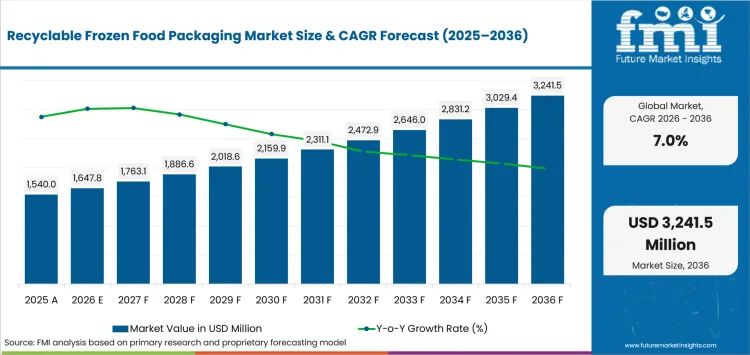
USD 1647.8 million in 2026 and USD 3241.5 million by 2036 at a 7.0% CAGR.
Demand for recyclable frozen food packaging is projected to expand at 7.0% CAGR between 2026 and 2036, increasing valuation from USD 1647.8 million in 2026 to USD 3241.5 million by 2036. Packaging specifications are increasingly shaped by recyclability requirements alongside traditional performance criteria such as barrier protection and freezer durability. The European Commission put the Packaging and Packaging Waste Regulation into force in February 2025, making recyclable packaging a formal EU packaging requirement. Frozen-food processors must therefore qualify recyclable packaging structures against shelf protection and production efficiency before approving recurring volume.
The pace of adoption varies according to the maturity of local recovery systems and the evidence required to support recyclability claims. Brazil is forecast to expand at a 7.4% CAGR compared with 5.6% CAGR for Japan through 2036. Japan's Ministry of the Environment reported in March 2026 that paper packaging collection covered 38.1% of municipalities in fiscal 2024, while plastic packaging collection reached 77.5%. Differences in collection coverage can influence how packaging formats are evaluated during qualification programs. Fiber-based frozen-food packaging often requires additional local recovery validation where collection access is less established, making disposal infrastructure an important factor alongside technical performance and regulatory compliance.
Key Takeaways of Recyclable Frozen Food Packaging Market
- Packaging rules and frozen-product specifications are increasing demand for recyclable formats that retain protection during routine production.
- By product type, dispersion-coated cartons are estimated to hold 32.0% in 2026 owing to freezer protection and printable fiber surfaces.
- Virgin paperboard is projected to hold 36.0% of material demand in 2026, supported by predictable strength during high-speed converting.
- In 2026, dispersion coating is expected to lead barrier technology with 40.0% share because thin layers preserve fiber recovery potential.
- Qualification slows adoption because seals and barriers must remain reliable across cold storage and high-speed filling conditions.
- Stora Enso Oyj, Graphic Packaging, Smurfit Westrock, Billerud, Mondi, Huhtamaki, ProAmpac and Coveris are some notable players.
Analyst Perspective
“Frozen-food processors should compare recovery evidence with freezer durability and line behavior before approving a new structure. Commercial advantage favors companies that shorten trials and document recycling acceptance without forcing costly equipment changes.”
- Nandini Roy Choudhury, Principal Consultant, Future Market Insights
How is the Recyclable Frozen Food Packaging Market segmented?
Product type, material, barrier technology, application, end use, sales channel and region.
Product type covers dispersion-coated cartons, uncoated recyclable cartons, mono-material film packs, recyclable paper bags, others. Material includes virgin paperboard, recycled board, mono PE - PP film and others. Barrier technology includes dispersion coating, mono-polymer barrier, uncoated and bio-coating. Application covers frozen ready meals, frozen meat and seafood, frozen pizza and bakery, frozen vegetables, others. End use covers food processors, grocery private label, foodservice and others. Sales channel includes direct - OEM supply, packaging distributors, others and online - e-commerce.
What makes dispersion-coated cartons central to the product type category?
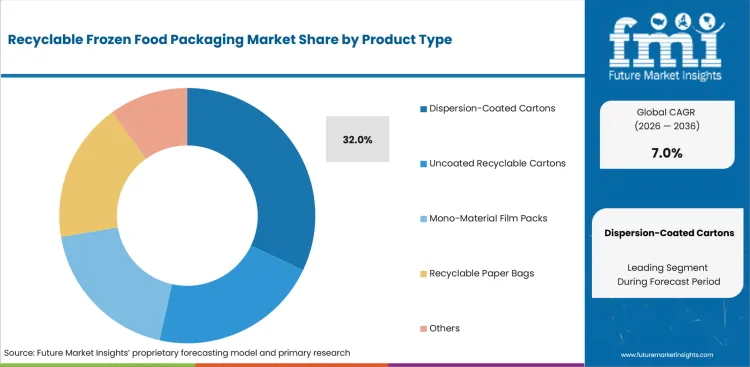
Dispersion-coated cartons combine carton stiffness with a thin barrier that limits grease and moisture exposure during routine frozen distribution. Stora Enso launched Performa Nova in April 2025 for frozen and chilled food uses, giving paperboard packaging converters a current folding-boxboard route for cold-chain formats.
- Based on product type, dispersion-coated cartons are projected to account for 32.0% in 2026 due to printable fiber surfaces and freezer strength.
- Packaging engineers can use established folding lines, although coating integrity must survive condensation without blocking the intended paper recovery route.
Why does virgin paperboard lead demand within the material category?
Virgin paperboard uses long clean fibers that preserve stiffness at lower caliper and support stable folds under cold distribution loads. Its consistent surface also reduces print variation during repeated commercial runs on high-speed carton converting equipment.
- By material, virgin paperboard is estimated to hold 36.0% in 2026 owing to predictable fiber strength during high-speed converting.
- Billerud introduced CrownBoard Light in September 2025 for cold and moist environments including commercial freezers. The recyclable fresh-fiber board gives packaging engineers another food packaging route for packs that need moisture resistance without wet-strength additives.
How does dispersion coating influence selection within the barrier technology category?
Dispersion coating adds a thin water-based barrier to paperboard and controls grease or moisture without relying on a heavy laminate. Packaging engineers can tune barrier-coated papers around product exposure while retaining more fiber for established paper recovery systems.
- In 2026, dispersion coating is expected to lead barrier technology with 40.0% share because targeted protection can preserve a fiber-led recovery route.
- Stora Enso launched Performa Natura Aqua in April 2026 for selected frozen-food packaging uses. Its dispersion-coated reverse side combines grease protection with existing converting and faster repulping during recycling.
What supports direct - OEM supply within the sales channel category?
Direct - OEM supply links packaging engineering with filling-line trials and repeat-volume planning for frozen programs that require controlled qualification. The relationship keeps film or paper changes aligned with seals and artwork plus machine settings during commercial scale-up.
- The sales channel is forecast to be led by direct - OEM supply at 52.0% share in 2026 due to coordinated trials and change control.
- ProAmpac's March 2026 frozen food packaging update lists recyclable paper and film formats alongside direct sales contact. The portfolio gives processors a current route for discussing freezer performance across flexible and fiber-based alternatives.
What are the drivers, restraints and opportunities in the Recyclable Frozen Food Packaging Market?
Packaging regulation raises the cost of weak recyclability, freezer qualification slows switching and line-ready fiber or mono-polymer structures offer the clearest route to recurring production.
- Driver: Regulatory recyclability requirements now influence material selection and packaging economics as frozen-food processors assess replacement structures for recurring production.
- Restraint: New structures must preserve seal integrity and barrier performance across cold storage while maintaining commercial packing speeds during repeated production.
- Opportunity: Packaging companies can win programs by pairing recyclable formats with application tests and documentation that fit existing frozen-food filling equipment.
Recyclability Rules Reshape Package Specification
European rules now turn recyclability and recycled content into package-design requirements that can alter material economics for frozen-food programs. Regulation (EU) 2025/40 sets a 10% recycled-content requirement by 2030 for specified contact-sensitive non-PET plastic packaging. Processors therefore compare mono-material packaging and fiber alternatives against the legal recovery route before committing repeat volume.
Cold-Chain Qualification Extends Conversion Cycles
Frozen packages must protect seals and barriers at low temperature without cutting filling-line efficiency or raising failure risk. Coveris completed its Hartlepool wicketted-bag center in November 2025 and reported frozen-compatible MonoFlex Lite films proven on fast packing lines. Commercial qualification therefore stays focused on seal behavior plus cold handling and machine speed across repeated production runs.
Line-Ready Structures Reduce Implementation Friction
Line-ready replacements shorten the path from flexible plastic packaging trials to recurring orders because food plants can retain established equipment settings. ProAmpac expanded curbside-recyclable fiber formats into frozen foods in February 2025 and paired RP-1000 with moisture plus grease barriers. Film specialists can serve applications that still require a flexible freezer barrier and dependable line speed.
Which country CAGRs are profiled in the Recyclable Frozen Food Packaging Market?
| Country | CAGR |
|---|---|
| Brazil | 7.4% |
| United Kingdom | 6.9% |
| Germany | 6.8% |
| United States | 6.4% |
| Japan | 5.6% |
How do country-level CAGRs compare in the Recyclable Frozen Food Packaging Market?
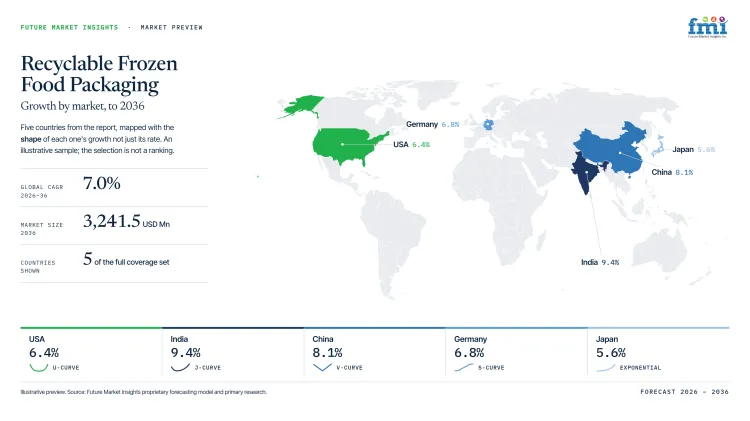
The profiled countries form a tight middle cluster around the growth rate, with Brazil separated at the upper end and Japan forming the slower transition case across the assessment period. The 1.8-point spread reflects different recycling rules and qualification routes rather than a measure of current market size.
- Brazil links reverse-logistics targets to recyclable plastic formats across national food-processing programs.
- United Kingdom EPR reporting ties package ratings directly to documented curbside collection coverage.
- Germany tests complete package construction against formal recyclability criteria during technical and commercial qualification.
- United States state rules complicate one national packaging specification across large processor networks.
- Japan combines strict material approval with uneven collection across paper and plastic packaging classes.
Comparable CAGRs can produce different market entry conditions. The full report provides country-level CAGR analysis across North America, Latin America, Europe, East Asia, South Asia, Oceania and the Middle East and Africa.
Country-wise Analysis
- Brazilian frozen-food programs operate under a national reverse-logistics system that assigns plastic-packaging recovery duties to manufacturers and importers, with Decree 12.688 setting a 32.0% national recovery target for 2026 across regulated packaging sold domestically. Recyclable frozen food packaging demand in Brazil is forecast to rise at 7.4% CAGR over the forecast period, supported by a defined compliance route for mono-polymer formats serving large food processors and national retailers. Regional collection and sorting capacity remains uneven across states, so packaging companies need traceable recovery partners and local documentation before a technically recyclable structure can support dependable repeat orders across Brazilian sales channels.
- United Kingdom packaging reporting now links recyclability assessment to actual curbside collection coverage, with PackUK stating in July 2026 that packaging collected by at least 75% of local authorities qualifies as commonly collected under EPR reporting. National retailer programs gain a clearer basis for comparing paper and film disposal claims, although frozen-food processors must validate freezer durability and line performance across plants serving varied private-label specifications. Recyclable frozen food packaging sales in the United Kingdom are forecast to expand at 6.9% CAGR by 2036, aided by formal reporting rules that make collection access part of commercial package qualification and annual reporting.
- German food companies evaluate package construction against a national recyclability standard that connects design details with recognized sorting and recovery systems, with ZSVR stating in August 2025 that PPWR targets require packaging to reach at least 70% recyclability by 2030. The German recyclable frozen food packaging sector is projected to record 6.8% CAGR during the assessment period, supported by clear design criteria for fiber and plastic structures entering formal qualification. Coatings and closures are evaluated within the complete pack, so packaging engineers need material data and recycling evidence before processors can approve repeat frozen-food orders across national retail programs at commercial scale.
- United States frozen-food processors often run national production networks under different state packaging rules, with CalRecycle stating in May 2026 that California requires all covered packaging to become recyclable or compostable by 2032. By 2036, the United States is projected to grow at 6.4% CAGR, supported by state mandates that pull recyclable films and fiber formats into qualification across large processor networks and retail programs. Shared packaging designs can reduce conversion cost across multiple plants, but companies still need state-specific compliance records and recovery evidence before one frozen-food structure can support dependable orders across several regulatory regimes and distribution channels.
- Japanese packaging conversion depends on municipal collection systems that differ materially by packaging class, with the environment ministry reporting in March 2026 that all 1,740 municipalities had prepared five-year collection plans covering at least one packaging category. Japan's recyclable frozen food packaging outlook is anticipated to advance at 5.6% CAGR over the assessment period, reinforced by detailed local planning that gives processors clearer disposal pathways during material qualification and labeling review. Collection coverage still differs between paper and plastic categories, so packaging companies must pair freezer performance with disposal evidence that remains valid across the national sales areas served by each format.
Who are the notable companies in the Recyclable Frozen Food Packaging Market?
Stora Enso Oyj, Graphic Packaging, Smurfit Westrock, Billerud, Mondi, Huhtamaki, ProAmpac and Coveris are the notable companies profiled in this market.
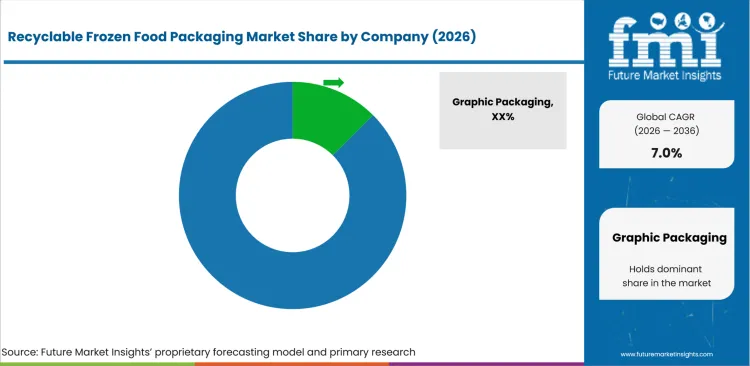
Competition spans fiber-board and recyclable flexible-film platforms that require different converting assets and qualification records. Stora Enso Oyj and Billerud focus on fiber substrates while Graphic Packaging and Smurfit Westrock add converted formats with customer implementation support. Mondi and Huhtamaki span fiber and flexible technologies while ProAmpac and Coveris concentrate on mono-material pouches for cold-chain food applications. Entry barriers depend on freezer performance plus documented recyclability and dependable converting support during customer qualification.
- Stora Enso Oyj and Billerud emphasize fiber substrates while Graphic Packaging and Smurfit Westrock add structures for frozen applications.
- Mondi and Huhtamaki combine fiber and flexible technologies that support recyclable format choices across cold-chain food applications.
- ProAmpac and Coveris focus on recyclable flexible formats that preserve barriers across established high-speed packing equipment.
Competitive Benchmarking: Recyclable Frozen Food Packaging Market
| Company | Frozen Application Evidence | Recyclable Route Breadth | Conversion Support Depth | Geographic Reach |
|---|---|---|---|---|
| Stora Enso Oyj | Medium | Medium | Medium | Europe and China |
| Graphic Packaging | Medium | Medium | High | Americas, Europe and Asia-Pacific |
| Smurfit Westrock | Medium | Medium | High | Global |
| Billerud | Medium | Medium | Medium | Europe and North America |
| Mondi | Medium | High | High | Europe and international sales |
| Huhtamaki | Medium | High | Medium | Global |
| ProAmpac | High | High | High | North America, Europe and Asia |
| Coveris | Medium | Medium | High | Europe |
Key Developments in the Recyclable Frozen Food Packaging Market
- In November 2025, Mondi launched an expanded food-packaging portfolio that added solid board boxes for deep-freeze applications across Europe.
- In July 2025, Huhtamaki launched recyclable and compostable ice cream cups made from certified paperboard with a bio-based coating and less than 10% plastic.
- In March 2025, ProAmpac received USA patents covering R-2000 and R-2050 mono-material laminated technologies for frozen foods and other applications.
Key Players in the Recyclable Frozen Food Packaging Market
Fiber Board and Carton Platforms
- Stora Enso Oyj
- Graphic Packaging
- Billerud
Integrated Fiber Conversion Platforms
- Smurfit Westrock
- Mondi
- Huhtamaki
Recyclable Flexible Packaging Platforms
- ProAmpac
- Coveris
Recyclable Frozen Food Packaging Market - Report Scope
| Coverage field | Report scope |
|---|---|
| Market breakdown | By product type, material, barrier technology, application, end use, sales channel and region. |
| Quantitative Units | Revenue in USD million and CAGR in %. |
| Market Definition | Commercial revenue from recyclable packaging sold for frozen-food use across the stated format, material, barrier, application, end-use and channel categories. |
| Regions Covered | North America, Latin America, Europe, East Asia, South Asia and Pacific and Middle East and Africa. |
| Countries Covered | Brazil, United Kingdom, Germany, United States, Japan, and 20+ countries included in the full report. |
| Key Companies Profiled | Stora Enso Oyj, Graphic Packaging, Smurfit Westrock, Billerud, Mondi, Huhtamaki, ProAmpac and Coveris. |
| Forecast Period | 2026 to 2036. |
| Approach | Primary and secondary research with market triangulation. |
Recyclable Frozen Food Packaging Market - Research Methodology
| Method | Approach |
|---|---|
| Primary Research | FMI analysts gathered input from manufacturers, service providers, technology developers, distributors, end users, procurement teams, and subject-matter experts. Interviews examined purchasing decisions, product or service evaluation, adoption barriers, approval requirements, pricing considerations, and expectations for technical or commercial support. Respondents were also asked what evidence is required before a trial, pilot, or initial order develops into regular purchasing. |
| Desk Research | Desk research covered government statistics, regulatory publications, trade data, industry associations, technical literature, standards, company filings, product information, and official corporate announcements. Sources were reviewed for relevance, publication date, geographic coverage, and consistency with the defined market scope. Claims relating to performance, applications, approvals, capacity, investment, and commercial activity were retained only when supported by credible public evidence. |
| Market Sizing and Forecasting | The market model combined the baseline value with historical performance, segment structure, pricing and volume indicators, adoption levels, company participation, and country-level demand conditions. Forecast assumptions considered economic activity, investment trends, regulatory developments, technology adoption, purchasing cycles, supply availability, and barriers to wider market use. Segment and regional estimates were reconciled before the final market total was calculated. |
| Data Validation | Estimates were checked against multiple independent indicators, including public data, company activity, trade patterns, industry developments, and findings from primary interviews. Validation also tested whether products, services, applications, and company revenues fell within the defined market boundaries. Adjacent categories, unsupported claims, overlapping revenues, and activities without direct market relevance were excluded to reduce double counting and maintain consistency across segments and countries. |
Recyclable Frozen Food Packaging Market by Segments
Recyclable Frozen Food Packaging Market segmented by Product Type:
- Dispersion-Coated Cartons
- Uncoated Recyclable Cartons
- Mono-Material Film Packs
- Recyclable Paper Bags
- Others
Recyclable Frozen Food Packaging Market segmented by Material:
- Virgin Paperboard
- Recycled Board
- Mono PE - PP Film
- Others
Recyclable Frozen Food Packaging Market segmented by Barrier Technology:
- Dispersion Coating
- Mono-Polymer Barrier
- Uncoated
- Bio-Coating
Recyclable Frozen Food Packaging Market segmented by Application:
- Frozen Ready Meals
- Frozen Meat & Seafood
- Frozen Pizza & Bakery
- Frozen Vegetables
- Others
Recyclable Frozen Food Packaging Market segmented by End Use:
- Food Processors
- Grocery Private Label
- Foodservice
- Others
Recyclable Frozen Food Packaging Market segmented by Sales Channel:
- Direct - OEM Supply
- Packaging Distributors
- Others
- Online - E-commerce
Recyclable Frozen Food Packaging Market by Region:
- North America
- United States
- Canada
- Latin America
- Brazil
- Mexico
- Chile
- Rest of Latin America
- Western Europe
- Germany
- United Kingdom
- Italy
- Spain
- France
- Nordics
- Benelux
- Rest of Western Europe
- Eastern Europe
- Russia
- Poland
- Hungary
- Balkan and Baltic States
- Rest of Eastern Europe
- East Asia
- China
- Japan
- South Korea
- South Asia and Pacific
- India
- ASEAN
- Australia and New Zealand
- Rest of South Asia and Pacific
- Middle East and Africa
- Kingdom of Saudi Arabia
- Other GCC Countries
- Türkiye
- South Africa
- Other African Union Countries
- Rest of Middle East and Africa
Research Sources and Bibliography
- European Commission, Directorate-General for Environment. (2025, February 11). New rules enter into force for a more sustainable and competitive packaging economy.
- Ministry of the Environment, Japan. (2026, March 31). 令和6年度容器包装リサイクル法に基づく市町村の分別収集等の実績について.
- Stora Enso. (2025, April 29). Stora Enso launches Performa Nova, a high-yield folding boxboard for consumer packaging.
- Billerud. (2025, September 8). Billerud launches recyclable cartonboards built for strength and moisture resistance.
- Stora Enso. (2026, April 30). Stora Enso launches Performa Natura Aqua.
- ProAmpac. (2026, March 24). Frozen Food Packaging.
- European Parliament and Council of the European Union. (2025, January 22). Regulation (EU) 2025/40 of the European Parliament and of the Council of 19 December 2024 on packaging and packaging waste.
- Coveris. (2025, November 20). Coveris Announces Centre of Excellence for Wicketted Bags.
- ProAmpac. (2025, February 11). ProAmpac Advances Recyclable Flexible and Fibre-Based Packaging at Packaging Innovations 2025.
- Presidency of the Republic of Brazil. (2025, October 21). Decreto nº 12.688, de 21 de outubro de 2025.
- PackUK and Department for Environment, Food & Rural Affairs. (2026, July 1). Packaging collected at kerbside for recycling by UK local authorities.
- Zentrale Stelle Verpackungsregister. (2025, August 29). 2025 minimum standard published - initial touchstone for companies preparing for the EU Packaging and Packaging Waste Regulation.
- California Department of Resources Recycling and Recovery. (2026, May 1). California approves new plastic and packaging rules that put consumers first.
- Ministry of the Environment, Japan. (2026, March 31).
- Stora Enso. (2026, June 30). Summer treat in the summer heat - unpacking ice cream packaging with Maria Adolfsson.
- Graphic Packaging. (2025, June 25). Graphic Packaging Secures Dual Honors at the Environmental Packaging Awards 2025.
- Graphic Packaging Holding Company. (2026, March 2). March 2, 2026 - 10-K: Annual report [Section 13 and 15(d), not S-K Item 405].
- Smurfit Westrock. Closing the loop: Smurfit Westrock and Sivafrost build a sustainable future. Retrieved from smurfitwestrock.com/stories/planet/sivafrost.
- Smurfit Westrock. (2026, February 11). Smurfit Westrock Reports Fourth Quarter and Full Year 2025 Results.
- Billerud. (2025, October 23). Interim report January-September 2025.
- Billerud. (2026, January 30). Year-end report January-December 2025.
- Mondi. (2026, March 16). Sustainable packaging for meat, poultry and fish: balancing safety, efficiency and environmental impact.
- Mondi. (2026, March 5). Mondi launches its 2025 Integrated and Sustainable Development reporting suite.
- Huhtamaki. (2026, March 3). Huhtamaki's 2025 Annual Report published.
- ProAmpac. (2026, July 17). Global Reach. Local Expertise.
- Coveris. (2025, September 10). Coveris combines freshness and sustainability with new monomaterial pack for refrigerated goods.
- Mondi. (2025, November 18). Mondi launches extended corrugated and solid board portfolio for the food packaging industry.
- Huhtamaki. (2025, July 16). Huhtamaki launches new compostable ice cream cups.
- ProAmpac. (2025, March 11). Securing Patents for Sustainable Packaging Innovations.
This bibliography is provided for reader reference and is not exhaustive. The full report contains the complete reference list and detailed citations
This Report Answers
- Which regulatory and operating conditions shape frozen-food packaging conversion across major markets?
- Which recyclable structures fit established frozen-food filling and converting equipment?
- Why do dispersion-coated cartons hold the leading product type share in 2026?
- How does virgin paperboard reduce qualification variation during high-speed converting?
- Why does dispersion coating retain the largest barrier technology share in 2026?
- How do recovery rules alter market-entry conditions across the five profiled countries?
- Which companies combine fiber-board and recyclable flexible-film capabilities?
- What technical frictions delay repeat orders for recyclable frozen-food formats?
Frequently Asked Questions
How big is the Recyclable Frozen Food Packaging Market in 2026?
The market is estimated to be valued at USD 1647.8 million in 2026 and is forecast to reach USD 3241.5 million by 2036.
What is the CAGR of the Recyclable Frozen Food Packaging Market from 2026 to 2036?
The market is projected to expand at a 7.0% CAGR from 2026 to 2036. The outlook reflects processor demand for recyclable fiber and mono-polymer formats that maintain freezer protection on existing filling lines.
Which sales channel is projected to account for 52.0% of the Recyclable Frozen Food Packaging Market?
Direct - OEM supply is projected to account for 52.0% of the market in 2026. Large processors favor this route because line trials and change control require direct technical coordination.
How are mono-material film packs positioned in the Recyclable Frozen Food Packaging Market?
Mono-material film packs remain a distinct recyclable format for flexible applications. Adoption depends on seal strength and barrier performance that remain compatible with cold storage and high-speed filling equipment.
Which companies are active in the Recyclable Frozen Food Packaging Market?
Key companies operating in the market include Stora Enso Oyj, Graphic Packaging, Smurfit Westrock, Billerud, Mondi, Huhtamaki, ProAmpac, and Coveris.
Preview the report firsthand - request a free sample
Get SampleGet the brochure for pricing and purchase details.
Get PDFTable of Content
- Key Takeaways
- Market Size and CAGR
- Top Growth Driver
- Fastest Growing Segment
- Leading Region
- Key Companies
- Emerging Opportunities
- Executive Summary
- Global Market Outlook
- Demand-side Trends
- Supply-side Trends
- Technology Roadmap Analysis
- Analysis and Recommendations
- Analyst Perspective (What is happening? Why now? What should investors know?)
- Key Questions Answered
- How large is the market?
- What is the CAGR?
- What are key trends?
- Which region dominates?
- Who are the leaders?
- Market Overview
- Market Coverage / Taxonomy
- Market Definition / Scope / Limitations
- Research Methodology
- Chapter Orientation
- Analytical Lens and Working Hypotheses
- Market Structure, Signals, and Trend Drivers
- Benchmarking and Cross-market Comparability
- Market Sizing, Forecasting, and Opportunity Mapping
- Research Design and Evidence Framework
- Desk Research Programme (Secondary Evidence)
- Expert Input and Fieldwork (Primary Evidence)
- Tooling, Models, and Reference Databases
- Data Engineering and Model Build
- Quality Assurance and Audit Trail
- Market Background
- Market Dynamics (Drivers, Restraints, Opportunity, Trends)
- Scenario Forecast (Optimistic, Likely, Conservative)
- Impact Analysis
- AI Impact
- Sustainability Impact
- Regulatory Impact
- Technology Impact
- Consumer / Buyer Analysis
- Purchase Drivers
- Adoption Barriers
- Buyer Journey
- Opportunity Map Analysis
- Product Life Cycle Analysis
- Supply Chain Analysis
- Investment Feasibility Matrix
- Value Chain Analysis
- PESTLE and Porter's Analysis
- Regulatory Landscape
- Regional Parent Market Outlook
- Production and Consumption Statistics
- Import and Export Statistics
- Global Market Analysis and Forecast, 2021 to 2036
- Historical Market Size Value (USD Million) Analysis, 2021 to 2025
- Current and Future Market Size Value (USD Million) Projections, 2026 to 2036
- Y-o-Y Growth Trend Analysis
- Absolute $ Opportunity Analysis
- Global Market Pricing Analysis, 2021 to 2036
- Global Market Analysis and Forecast, By Product Type, 2021 to 2036
- Introduction / Key Findings
- Historical Market Size Value (USD Million) Analysis By Product Type, 2021 to 2025
- Current and Future Market Size Value (USD Million) Analysis and Forecast By Product Type, 2026 to 2036
- Dispersion-Coated Cartons
- Uncoated Recyclable Cartons
- Mono-Material Film Packs
- Recyclable Paper Bags
- Others
- Dispersion-Coated Cartons
- Y-o-Y Growth Trend Analysis By Product Type, 2021 to 2025
- Absolute $ Opportunity Analysis By Product Type, 2026 to 2036
- Global Market Analysis and Forecast, By Material, 2021 to 2036
- Introduction / Key Findings
- Historical Market Size Value (USD Million) Analysis By Material, 2021 to 2025
- Current and Future Market Size Value (USD Million) Analysis and Forecast By Material, 2026 to 2036
- Virgin Paperboard
- Recycled Board
- Mono PE - PP Film
- Others
- Virgin Paperboard
- Y-o-Y Growth Trend Analysis By Material, 2021 to 2025
- Absolute $ Opportunity Analysis By Material, 2026 to 2036
- Global Market Analysis and Forecast, By Barrier Technology, 2021 to 2036
- Introduction / Key Findings
- Historical Market Size Value (USD Million) Analysis By Barrier Technology, 2021 to 2025
- Current and Future Market Size Value (USD Million) Analysis and Forecast By Barrier Technology, 2026 to 2036
- Dispersion Coating
- Mono-Polymer Barrier
- Uncoated
- Bio-Coating
- Dispersion Coating
- Y-o-Y Growth Trend Analysis By Barrier Technology, 2021 to 2025
- Absolute $ Opportunity Analysis By Barrier Technology, 2026 to 2036
- Global Market Analysis and Forecast, By Application, 2021 to 2036
- Introduction / Key Findings
- Historical Market Size Value (USD Million) Analysis By Application, 2021 to 2025
- Current and Future Market Size Value (USD Million) Analysis and Forecast By Application, 2026 to 2036
- Frozen Ready Meals
- Frozen Meat & Seafood
- Frozen Pizza & Bakery
- Frozen Vegetables
- Others
- Frozen Ready Meals
- Y-o-Y Growth Trend Analysis By Application, 2021 to 2025
- Absolute $ Opportunity Analysis By Application, 2026 to 2036
- Global Market Analysis and Forecast, By End Use, 2021 to 2036
- Introduction / Key Findings
- Historical Market Size Value (USD Million) Analysis By End Use, 2021 to 2025
- Current and Future Market Size Value (USD Million) Analysis and Forecast By End Use, 2026 to 2036
- Food Processors
- Grocery Private Label
- Foodservice
- Others
- Food Processors
- Y-o-Y Growth Trend Analysis By End Use, 2021 to 2025
- Absolute $ Opportunity Analysis By End Use, 2026 to 2036
- Global Market Analysis and Forecast, By Sales Channel
- Introduction / Key Findings
- Historical Market Size Value (USD Million) Analysis By Sales Channel, 2021 to 2025
- Current and Future Market Size Value (USD Million) Analysis and Forecast By Sales Channel, 2026 to 2036
- Direct - OEM Supply
- Packaging Distributors
- Others
- Online - E-commerce
- Direct - OEM Supply
- Y-o-Y Growth Trend Analysis By Sales Channel, 2021 to 2025
- Absolute $ Opportunity Analysis By Sales Channel, 2026 to 2036
- Global Market Analysis and Forecast, By Region, 2021 to 2036
- Introduction
- Historical Market Size Value (USD Million) Analysis By Region, 2021 to 2025
- Current Market Size Value (USD Million) Analysis and Forecast By Region, 2026 to 2036
- North America
- Latin America
- Western Europe
- Eastern Europe
- East Asia
- South Asia and Pacific
- Middle East & Africa
- Market Attractiveness Analysis By Region
- North America Market Analysis and Forecast, By Country, 2021 to 2036
- Historical Market Size Value (USD Million) Trend Analysis By Market Taxonomy, 2021 to 2025
- Market Size Value (USD Million) Forecast By Market Taxonomy, 2026 to 2036
- By Country
- USA
- Canada
- By Product Type
- By Material
- By Barrier Technology
- By Application
- By End Use
- By Sales Channel
- By Country
- Market Attractiveness Analysis
- By Country
- By Product Type
- By Material
- By Barrier Technology
- By Application
- By End Use
- By Sales Channel
- Key Takeaways
- Latin America Market Analysis and Forecast, By Country
- Historical Market Size Value (USD Million) Trend Analysis By Market Taxonomy, 2021 to 2025
- Market Size Value (USD Million) Forecast By Market Taxonomy, 2026 to 2036
- By Country
- Brazil
- Mexico
- Chile
- Rest of Latin America
- By Product Type
- By Material
- By Barrier Technology
- By Application
- By End Use
- By Sales Channel
- By Country
- Market Attractiveness Analysis
- By Country
- By Product Type
- By Material
- By Barrier Technology
- By Application
- By End Use
- By Sales Channel
- Key Takeaways
- Western Europe Market Analysis and Forecast, By Country
- Historical Market Size Value (USD Million) Trend Analysis By Market Taxonomy, 2021 to 2025
- Market Size Value (USD Million) Forecast By Market Taxonomy, 2026 to 2036
- By Country
- Germany
- UK
- Italy
- Spain
- France
- Nordic
- BENELUX
- Rest of Western Europe
- By Product Type
- By Material
- By Barrier Technology
- By Application
- By End Use
- By Sales Channel
- By Country
- Market Attractiveness Analysis
- By Country
- By Product Type
- By Material
- By Barrier Technology
- By Application
- By End Use
- By Sales Channel
- Key Takeaways
- Eastern Europe Market Analysis and Forecast, By Country
- Historical Market Size Value (USD Million) Trend Analysis By Market Taxonomy, 2021 to 2025
- Market Size Value (USD Million) Forecast By Market Taxonomy, 2026 to 2036
- By Country
- Russia
- Poland
- Hungary
- Balkan & Baltic
- Rest of Eastern Europe
- By Product Type
- By Material
- By Barrier Technology
- By Application
- By End Use
- By Sales Channel
- By Country
- Market Attractiveness Analysis
- By Country
- By Product Type
- By Material
- By Barrier Technology
- By Application
- By End Use
- By Sales Channel
- Key Takeaways
- East Asia Market Analysis and Forecast, By Country
- Historical Market Size Value (USD Million) Trend Analysis By Market Taxonomy, 2021 to 2025
- Market Size Value (USD Million) Forecast By Market Taxonomy, 2026 to 2036
- By Country
- China
- Japan
- South Korea
- By Product Type
- By Material
- By Barrier Technology
- By Application
- By End Use
- By Sales Channel
- By Country
- Market Attractiveness Analysis
- By Country
- By Product Type
- By Material
- By Barrier Technology
- By Application
- By End Use
- By Sales Channel
- Key Takeaways
- South Asia and Pacific Market Analysis and Forecast, By Country
- Historical Market Size Value (USD Million) Trend Analysis By Market Taxonomy, 2021 to 2025
- Market Size Value (USD Million) Forecast By Market Taxonomy, 2026 to 2036
- By Country
- India
- ASEAN
- Australia & New Zealand
- Rest of South Asia and Pacific
- By Product Type
- By Material
- By Barrier Technology
- By Application
- By End Use
- By Sales Channel
- By Country
- Market Attractiveness Analysis
- By Country
- By Product Type
- By Material
- By Barrier Technology
- By Application
- By End Use
- By Sales Channel
- Key Takeaways
- Middle East & Africa Market Analysis and Forecast, By Country
- Historical Market Size Value (USD Million) Trend Analysis By Market Taxonomy, 2021 to 2025
- Market Size Value (USD Million) Forecast By Market Taxonomy, 2026 to 2036
- By Country
- Kingdom of Saudi Arabia
- Other GCC Countries
- Türkiye
- South Africa
- Other African Union
- Rest of Middle East & Africa
- By Product Type
- By Material
- By Barrier Technology
- By Application
- By End Use
- By Sales Channel
- By Country
- Market Attractiveness Analysis
- By Country
- By Product Type
- By Material
- By Barrier Technology
- By Application
- By End Use
- By Sales Channel
- Key Takeaways
- Key Countries Market Analysis
- USA
- Pricing Analysis
- Market Share Analysis, 2025
- By Product Type
- By Material
- By Barrier Technology
- By Application
- By End Use
- By Sales Channel
- Canada
- Pricing Analysis
- Market Share Analysis, 2025
- By Product Type
- By Material
- By Barrier Technology
- By Application
- By End Use
- By Sales Channel
- Mexico
- Pricing Analysis
- Market Share Analysis, 2025
- By Product Type
- By Material
- By Barrier Technology
- By Application
- By End Use
- By Sales Channel
- Brazil
- Pricing Analysis
- Market Share Analysis, 2025
- By Product Type
- By Material
- By Barrier Technology
- By Application
- By End Use
- By Sales Channel
- Chile
- Pricing Analysis
- Market Share Analysis, 2025
- By Product Type
- By Material
- By Barrier Technology
- By Application
- By End Use
- By Sales Channel
- Germany
- Pricing Analysis
- Market Share Analysis, 2025
- By Product Type
- By Material
- By Barrier Technology
- By Application
- By End Use
- By Sales Channel
- UK
- Pricing Analysis
- Market Share Analysis, 2025
- By Product Type
- By Material
- By Barrier Technology
- By Application
- By End Use
- By Sales Channel
- Italy
- Pricing Analysis
- Market Share Analysis, 2025
- By Product Type
- By Material
- By Barrier Technology
- By Application
- By End Use
- By Sales Channel
- Spain
- Pricing Analysis
- Market Share Analysis, 2025
- By Product Type
- By Material
- By Barrier Technology
- By Application
- By End Use
- By Sales Channel
- France
- Pricing Analysis
- Market Share Analysis, 2025
- By Product Type
- By Material
- By Barrier Technology
- By Application
- By End Use
- By Sales Channel
- India
- Pricing Analysis
- Market Share Analysis, 2025
- By Product Type
- By Material
- By Barrier Technology
- By Application
- By End Use
- By Sales Channel
- ASEAN
- Pricing Analysis
- Market Share Analysis, 2025
- By Product Type
- By Material
- By Barrier Technology
- By Application
- By End Use
- By Sales Channel
- Australia & New Zealand
- Pricing Analysis
- Market Share Analysis, 2025
- By Product Type
- By Material
- By Barrier Technology
- By Application
- By End Use
- By Sales Channel
- China
- Pricing Analysis
- Market Share Analysis, 2025
- By Product Type
- By Material
- By Barrier Technology
- By Application
- By End Use
- By Sales Channel
- Japan
- Pricing Analysis
- Market Share Analysis, 2025
- By Product Type
- By Material
- By Barrier Technology
- By Application
- By End Use
- By Sales Channel
- South Korea
- Pricing Analysis
- Market Share Analysis, 2025
- By Product Type
- By Material
- By Barrier Technology
- By Application
- By End Use
- By Sales Channel
- Russia
- Pricing Analysis
- Market Share Analysis, 2025
- By Product Type
- By Material
- By Barrier Technology
- By Application
- By End Use
- By Sales Channel
- Poland
- Pricing Analysis
- Market Share Analysis, 2025
- By Product Type
- By Material
- By Barrier Technology
- By Application
- By End Use
- By Sales Channel
- Hungary
- Pricing Analysis
- Market Share Analysis, 2025
- By Product Type
- By Material
- By Barrier Technology
- By Application
- By End Use
- By Sales Channel
- Kingdom of Saudi Arabia
- Pricing Analysis
- Market Share Analysis, 2025
- By Product Type
- By Material
- By Barrier Technology
- By Application
- By End Use
- By Sales Channel
- Türkiye
- Pricing Analysis
- Market Share Analysis, 2025
- By Product Type
- By Material
- By Barrier Technology
- By Application
- By End Use
- By Sales Channel
- South Africa
- Pricing Analysis
- Market Share Analysis, 2025
- By Product Type
- By Material
- By Barrier Technology
- By Application
- By End Use
- By Sales Channel
- USA
- Market Structure Analysis
- Competition Dashboard
- Competition Benchmarking
- Market Share Analysis of Top Players
- By Regional
- By Product Type
- By Material
- By Barrier Technology
- By Application
- By End Use
- By Sales Channel
- Emerging Startups
- Innovation Benchmarking
- Competition Analysis
- Competition Deep Dive
- Graphic Packaging
- Overview
- Product Portfolio
- Profitability by Market Segments
- Sales Footprint
- Strategy Overview
- Marketing Strategy
- Product Strategy
- Channel Strategy
- Smurfit Westrock
- Mondi
- International Paper
- Billerud
- Amcor
- Berry Global
- Sonoco
- Huhtamaki
- ProAmpac
- Graphic Packaging
- Case Studies
- Success Stories
- Recent Developments
- Competition Deep Dive
- Assumptions & Acronyms Used


