

- Market Size (2026)
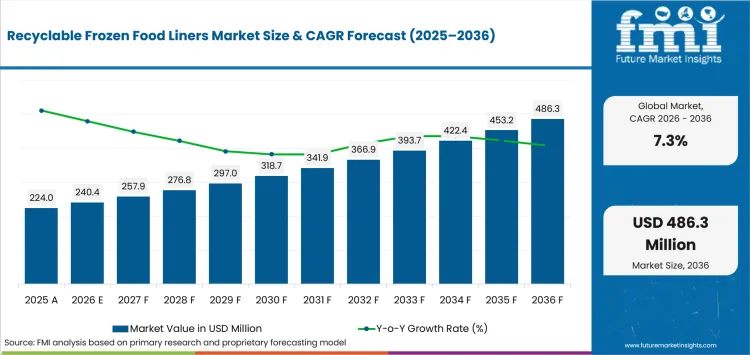
- USD 240.4 Mn
- Forecast (2036)
- USD 486.3 Mn
- CAGR (2026 to 2036)
- 7.3%
How big is Recyclable Frozen Food Liners Market in 2026?
USD 240.4 million in 2026 and USD 486.3 million by 2036 at a 7.3% CAGR.
Demand for recyclable frozen food liners is projected to expand at 7.3% CAGR between 2026 and 2036, increasing valuation from USD 240.4 million in 2026 to USD 486.3 million by 2036. Packaging regulations are placing greater emphasis on material recoverability across frozen food applications. The European Commission’s February 2025 packaging regulation increased pressure to design recyclable structures, pulling frozen food packaging programs toward paper-led coatings and mono-material films that can pass subzero line trials.
Industry analysis in United States and Japan show how mature frozen-food systems can convert recyclable liner demand at different speeds as compliance pressure and material approval practices diverge. CalRecycle’s May 2026 rules require covered California packaging to become recyclable or compostable by 2032, giving US recyclable packaging programs a stronger near-term regulatory trigger than Japan’s measured material qualification route.
Key Takeaways of Recyclable Frozen Food Liners Market
- Food processors are replacing difficult-to-recycle liner structures once new materials preserve moisture control, seal integrity and freezer durability on installed packaging lines.
- By product type, dispersion-coated repulpable liners are estimated to hold 32.0% in 2026 owing to their combination of barrier performance and paper-recovery compatibility.
- In 2026, virgin fiber is expected to lead material with 38.0% share supported by consistent strength and coating response during direct-food-contact conversion.
- The temperature rating category is forecast to be led by to -18 C at 44.0% share in 2026 driven by mainstream frozen storage requirements.
- Qualification can delay switching as recyclability claims do not replace food-contact review, cold-flex testing or machine validation under the processor’s operating conditions.
- Billerud, UPM Specialty Papers, Sappi, Ahlstrom, Koehler Paper, Stora Enso, Mondi and ProAmpac are the eight profiled companies serving this market.
Analyst Perspective
"A frozen-food liner earns approval by holding barrier performance under subzero handling and running reliably on installed equipment with a credible recovery route. The strongest offers reduce trial cycles by combining food-contact files with cold-flex data and recyclability evidence in one qualification package."
- Nandini Roy Choudhury, Principal Consultant, Future Market Insights
How is the Recyclable Frozen Food Liners Market segmented?
The recyclable frozen food liners market is segmented by product type, material, temperature rating, application, end use and sales channel.
The recyclable frozen food liners market is segmented by product type (dispersion-coated repulpable liners, uncoated wet-strength liners, mono-material film liners, recycled-content liners, others), material (virgin fiber, recycled fiber, others, mono PE), temperature rating (to -18 C, to -30 C, below -30 C), application (frozen meat and seafood, frozen ready meals, frozen fruits and vegetables, frozen bakery, others), end use (food processors, grocery retail, foodservice, others) and sales channel (direct OEM supply, packaging distributors, online e-commerce, others).
How does frozen meat and seafood shape demand within the application category?
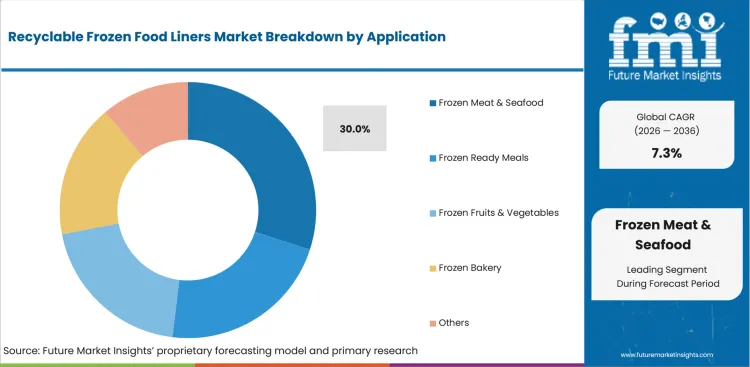
Frozen meat and seafood expose liners to purge and grease alongside sharp edges that can damage weaker structures during packing. ProAmpac reported in July 2025 that its seafood films and tote liners combine cold-temperature resistance with puncture resistance for seafood handling across food packaging films.
- Frozen meat and seafood is projected to hold 30.0% share in 2026 owing to the operational cost of leakage and puncture failure in these packs.
- Processors therefore evaluate grease control alongside freezer flex and puncture resistance during plant line qualification trials. Approval depends on stable performance across rollstock or pouch equipment used for repeated production and distribution.
What makes dispersion-coated repulpable liners central to the product type category?
Dispersion-coated repulpable liners pair a fiber web with a functional coating that must retain moisture and grease control during freezing and thaw-related handling. At FACHPACK in September 2025, Sappi presented Guard Pro OHS and OMH as recyclable mono-material barrier papers for frozen goods.
- By product type, dispersion-coated repulpable liners are estimated to hold 32.0% in 2026 owing to balanced barrier performance and paper recovery.
- Packaging engineers qualify these structures by testing crease durability and seal behavior at freezer temperatures. Coating damage can expose fiber and weaken pack protection alongside recyclability during commercial filling and distribution.
How do food-packaging engineers evaluate virgin fiber within the material category?
Virgin fiber gives coated liner webs a consistent surface and tensile base for printing plus barrier treatment during repeated converting. Ahlstrom launched LamiBak Flex in March 2025 as a 100% wood-pulp base paper for flexible food packaging with EN 13430 and CEPI recyclability certification.
- In 2026, virgin fiber is expected to lead material with 38.0% share supported by predictable strength and coating response during high-speed conversion.
- Food processors value that consistency in direct-contact formats as surface variation can increase trial work across long production runs. Stable fiber quality also preserves the sealing and coating window used for recurring frozen-food orders.
What role does the to -18 C rating play within the temperature rating category?
The to -18 C rating covers mainstream retail and distribution freezers where liner performance must remain stable during routine storage and handling. USDA guidance updated in February 2025 recommends 0 F or -17.8 C for maintaining the best quality of frozen foods.
- The temperature rating category is forecast to be led by to -18 C at 44.0% share in 2026 driven by mainstream frozen storage conditions.
- Liners at this threshold need dependable flex and moisture resistance without the extra material margin used for deeper freezing conditions. More standardized operating temperatures can reduce material variants across cold chain packaging programs serving routine frozen foods.
What are the drivers, restraints and opportunities in the Recyclable Frozen Food Liners Market?
Packaging-policy costs increase redesign activity, qualification risk slows conversion and co-engineered barrier structures offer the clearest route to recurring frozen-food orders.
- Driver: Producer-responsibility rules reward liner structures that can pass formal recyclability assessment without weakening freezer protection.
- Restraint: Food-contact and low-temperature qualification can delay scale-up even if a material already fits a recycling pathway.
- Opportunity: Material developers can shorten approval cycles by combining barrier data, food-contact files and recovery evidence in one application-specific package.
Packaging Fees Pull Recyclability Into Material Selection
UK producer-responsibility fees now make recyclability a direct packaging-cost variable for obligated companies. PackUK stated in June 2025 that 2026-27 disposal fees will be modulated by recyclability assessments, giving food grade packaging programs a financial reason to replace red-rated structures with formats that protect frozen products and score better under the national method.
Food-Contact Controls Extend Qualification
Food-contact compliance can remove coating chemistries that previously solved grease or moisture problems and force developers to repeat material validation. In January 2025, the FDA made 35 PFAS-related food-contact notifications ineffective for grease-proofing paper packaging. Paper-led liner programs must therefore pair acceptable barrier chemistry with migration and freezer-performance evidence prior to commercial release.
Co-Engineered Barrier Systems Reduce Trial Work
The strongest commercial route is a co-engineered structure that lets packaging engineers adjust barrier level without rebuilding the entire recovery concept.
Which country CAGRs are profiled in the Recyclable Frozen Food Liners Market?
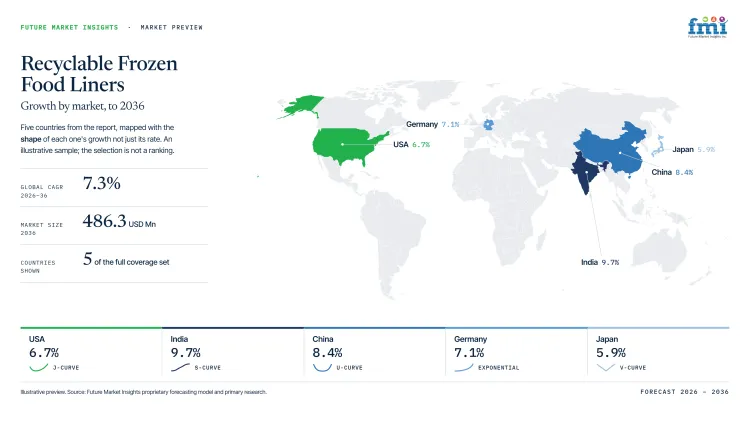
| Country | CAGR |
|---|---|
| Brazil | 7.7% |
| United Kingdom | 7.2% |
| Germany | 7.1% |
| United States | 6.7% |
| Japan | 5.9% |
How do country-level CAGRs compare in the Recyclable Frozen Food Liners Market?
Country outlook shows that Brazil leads a compact upper group with the United Kingdom and Germany. The United States and Japan form a slower qualification-led pair. The 1.8-point spread reflects different recycling rules, food-contact approval paths and conversion conditions instead of current market size. Brazil acts as the transition market as recovery obligations rise faster than collection consistency.
- Brazil pairs new plastic recovery targets with uneven local collection capability.
- The United Kingdom links recyclability scores directly to producer-responsibility fee exposure.
- Germany rewards documented component separability within mature paper-recovery infrastructure.
- United States programs combine federal food-contact review with differing state packaging rules.
- Japan emphasizes material consistency and product quality during unfamiliar-structure trials.
Similar CAGRs therefore mask different qualification costs and supplier entry conditions. The full report provides country-level CAGR analysis across North America, Latin America, Europe, East Asia, South Asia, Oceania and the Middle East and Africa.
Country-wise Analysis
- Brazilian packaging producers now operate under a national plastic reverse-logistics system covering primary, secondary and tertiary packaging with documented mass flows across commercial programs serving frozen foods and other packaged products throughout the country. Brazil is estimated to post 7.7% CAGR over the forecast period supported by a 32.0% national plastic-packaging recovery target for 2026 under Decree 12.688 issued in October 2025. The rule gives mono-PE liners a clearer recovery framework, but paper-plastic combinations require separate collection and processing evidence for food processors to accept recyclability as an order-ready commercial claim across national supply programs serving large frozen-food processing accounts.
- UK food manufacturers now report household packaging against a formal recyclability methodology that links material design with producer-responsibility fees across national retail and frozen-food production programs serving major processors and grocery brands across large accounts. Defra's July 2025 statistics recorded a 74.3% paper-and-cardboard recycling rate, and recyclable frozen food liner sales in the United Kingdom are forecast to expand at 7.2% CAGR by 2036. Established paper recovery favors fiber-based structures, but frozen-food specifications still demand grease and moisture control plus reliable sealing performance that can push heavily coated formats into harder assessments and longer qualification cycles for commercial programs serving national retail accounts.
- German food-packaging programs rely on mature collection and sorting systems, with UBA and ZSVR reporting in January 2026 that about 5.5 million tonnes of dual-system packaging waste were recycled during 2024 nationwide. Adoption of recyclable frozen food liners in Germany is estimated to expand at 7.1% CAGR through 2036 supported by established recovery capacity and formal design assessment across major food-processing and retail accounts. Coatings and inseparable layers can alter whole-pack recyclability, so developers must document component weights and separability to secure processor tooling approval or recurring orders across national retail channels plus distributor and major processor programs serving large accounts.
- US food-contact qualification remains manufacturer-specific for certain notified substances, making material identity and regulatory documentation part of liner programs serving national food processors and packaging engineers across multiple states and production sites nationally. FDA FCN 2409 became effective in February 2025 for Stora Enso microfibrillated cellulose used in polymer-coated food-contact paper, and the United States sector is projected to record 6.7% CAGR during the assessment period. That pathway supports new fiber coating systems, but competing formulations need their own compliant basis and performance evidence for national processors to approve scale across frozen-food packaging lines and recurring supply programs across major national accounts.
- Japanese food-packaging programs balance resource-circulation goals with strict quality protection for products held at subzero temperatures across long domestic retail and logistics networks serving frozen foods nationwide and export channels and regional distribution hubs. Japan's recyclable frozen food liners outlook is anticipated to advance at 5.9% CAGR over the assessment period supported by steady demand for reliable materials across established processor and retail accounts. MAFF's June 2026 task-force material states that plastic food containers and packaging exceed one-quarter of domestic plastic-product consumption, but unresolved quality challenges for recycled plastic keep qualification evidence and material consistency central to repeat orders across national retail programs.
Who are the notable companies in the Recyclable Frozen Food Liners Market?
Billerud, UPM Specialty Papers, Sappi, Ahlstrom, Koehler Paper, Stora Enso, Mondi and ProAmpac are the notable companies serving the recyclable frozen food liners market.
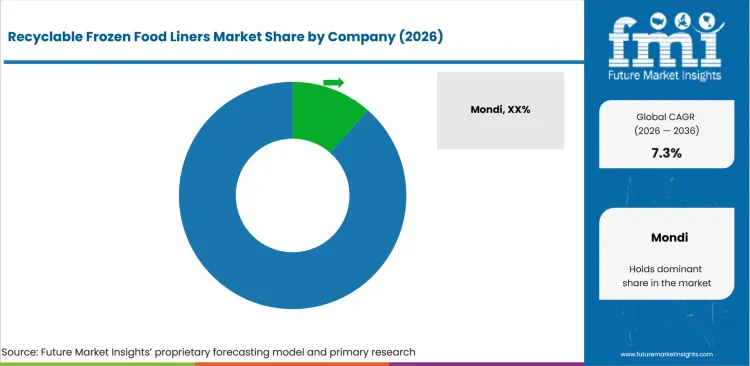
Competition depends on joining barrier performance with food-contact suitability, recovery evidence and converting support inside one qualification route. Paper specialists compete on coatings and fiber properties. Integrated groups add application testing, while flexible converters bring barrier packaging formats for packs needing stronger seals or puncture resistance. Entry barriers rise as liners must satisfy freezer performance and recycling rules across several countries.
- Billerud, UPM Specialty Papers, Sappi, Ahlstrom and Koehler Paper compete primarily with paper-led structures that combine sealing or barrier functions with fiber recovery.
- Stora Enso and Mondi add broader paperboard and flexible-packaging platforms that connect barrier materials with food-contact documentation and converting support.
- ProAmpac supplies recyclable fiber and polyethylene frozen-food formats, including cold-resistant films and liners that fit automated packaging lines.
Competitive Benchmarking: Recyclable Frozen Food Liners Market
| Company | Frozen-Barrier Breadth | Recovery Evidence | Conversion Support | Geographic Reach |
|---|---|---|---|---|
| Billerud | Medium | Medium | High | Europe and North America |
| UPM Specialty Papers | High | High | High | Europe, Asia and the Americas |
| Sappi | High | High | High | Europe, North America and Asia |
| Ahlstrom | Medium | High | Medium | Europe, North America and Asia |
| Koehler Paper | High | High | High | Europe with international flexible-paper sales |
| Stora Enso | High | High | High | Europe, North America and Asia |
| Mondi | High | High | High | Europe, North America and selected global food markets |
| ProAmpac | High | High | High | North America, Europe and Asia |
Key Developments in the Recyclable Frozen Food Liners Market
- In March 2025, ProAmpac received USA patents covering recyclable R-2000 and R-2050 mono-material structures used for dry and frozen foods in rollstock and pouch formats.
- In February 2025, ProAmpac expanded curbside-recyclable fiber packaging into frozen foods with RP-1000 while presenting R-2000 recyclable film for demanding filling lines.
Key Players in the Recyclable Frozen Food Liners Market
Barrier-Paper and Specialty-Fiber Platforms
- Billerud
- UPM Specialty Papers
- Sappi
- Ahlstrom
- Koehler Paper
- Stora Enso
Integrated Packaging Platform
- Mondi
Recyclable Flexible Packaging Specialist
- ProAmpac
Recyclable Frozen Food Liners Market - Report Scope
| Coverage field | Report scope |
|---|---|
| Market breakdown | By product type, material, temperature rating, application, end use, sales channel and region. |
| Quantitative Units | Revenue USD million and CAGR in %. |
| Market Definition | Revenue from recyclable liner materials and liner products sold for frozen-food packaging, including coated or uncoated fiber liners, recycled-content liners and mono-material PE liners. |
| Regions Covered | North America, Latin America, Europe, East Asia, South Asia and Pacific, and Middle East and Africa. |
| Countries Covered | Brazil, United Kingdom, Germany, United States, Japan, and 20+ countries included in the full report. |
| Key Companies Profiled | Billerud, UPM Specialty Papers, Sappi, Ahlstrom, Koehler Paper, Stora Enso, Mondi and ProAmpac. |
| Forecast Period | 2026 to 2036. |
| Approach | Primary and secondary research with market triangulation. |
Recyclable Frozen Food Liners Market - Research Methodology
| Method | Approach |
|---|---|
| Primary Research | FMI analysts gathered input from manufacturers, service providers, technology developers, distributors, end users, procurement teams, and subject-matter experts. Interviews examined purchasing decisions, product or service evaluation, adoption barriers, approval requirements, pricing considerations, and expectations for technical or commercial support. Respondents were also asked what evidence is required before a trial, pilot, or initial order develops into regular purchasing. |
| Desk Research | Desk research covered government statistics, regulatory publications, trade data, industry associations, technical literature, standards, company filings, product information, and official corporate announcements. Sources were reviewed for relevance, publication date, geographic coverage, and consistency with the defined market scope. Claims relating to performance, applications, approvals, capacity, investment, and commercial activity were retained only when supported by credible public evidence. |
| Market Sizing and Forecasting | The market model combined the baseline value with historical performance, segment structure, pricing and volume indicators, adoption levels, company participation, and country-level demand conditions. Forecast assumptions considered economic activity, investment trends, regulatory developments, technology adoption, purchasing cycles, supply availability, and barriers to wider market use. Segment and regional estimates were reconciled before the final market total was calculated. |
| Data Validation | Estimates were checked against multiple independent indicators, including public data, company activity, trade patterns, industry developments, and findings from primary interviews. Validation also tested whether products, services, applications, and company revenues fell within the defined market boundaries. Adjacent categories, unsupported claims, overlapping revenues, and activities without direct market relevance were excluded to reduce double counting and maintain consistency across segments and countries. |
Recyclable Frozen Food Liners Market by Segments
Recyclable Frozen Food Liners Market segmented by Product Type:
- Dispersion-Coated Repulpable Liners
- Uncoated Wet-Strength Liners
- Mono-Material Film Liners
- Recycled-Content Liners
- Others
Recyclable Frozen Food Liners Market segmented by Material:
- Virgin Fiber
- Recycled Fiber
- Others
- Mono PE
Recyclable Frozen Food Liners Market segmented by Temperature Rating:
- To -18 C
- To -30 C
- Below -30 C
Recyclable Frozen Food Liners Market segmented by Application:
- Frozen Meat & Seafood
- Frozen Ready Meals
- Frozen Fruits & Vegetables
- Frozen Bakery
- Others
Recyclable Frozen Food Liners Market segmented by End Use:
- Food Processors
- Grocery Retail
- Foodservice
- Others
Recyclable Frozen Food Liners Market segmented by Sales Channel:
- Direct - OEM Supply
- Packaging Distributors
- Online - E-commerce
- Others
Recyclable Frozen Food Liners Market by Region:
- North America
- United States
- Canada
- Latin America
- Brazil
- Mexico
- Chile
- Rest of Latin America
- Western Europe
- Germany
- United Kingdom
- Italy
- Spain
- France
- Nordics
- Benelux
- Rest of Western Europe
- Eastern Europe
- Russia
- Poland
- Hungary
- Balkan and Baltic States
- Rest of Eastern Europe
- East Asia
- China
- Japan
- South Korea
- South Asia and Pacific
- India
- ASEAN
- Australia and New Zealand
- Rest of South Asia and Pacific
- Middle East and Africa
- Kingdom of Saudi Arabia
- Other GCC Countries
- Türkiye
- South Africa
- Other African Union Countries
- Rest of Middle East and Africa
Research Sources and Bibliography
- European Commission, Directorate-General for Environment. (2025, February 11). New rules enter into force for a more sustainable and competitive packaging economy.
- California Department of Resources Recycling and Recovery. (2026, May 1). California approves new plastic and packaging rules that put consumers first.
- Sappi. (2025, September 4). Sappi expands recyclable, high-barrier paper portfolio for primary packaging.
- Ahlstrom. (2025, March 17). Ahlstrom expands LamiBak™ portfolio with a new base paper for flexible food packaging.
- USA Department of Agriculture, Food Safety and Inspection Service. (2025, February 4). What is the right temperature for the freezer?
- ProAmpac. (2025, July 15). Sealing in Freshness for Every Catch.
- PackUK. (2025, June 28). PackUK extended producer responsibility (EPR) for packaging: producer disposal fees modulation statement.
- USA Food and Drug Administration. (2025, January 3). FDA Determines Authorization for 35 Food Contact Notifications Related to PFAS Are No Longer Effective.
- UPM Specialty Papers. (2025, September 4). UPM and Royal Vaassen have developed a fibre-based alternative to plastic and aluminum packaging solutions.
- Presidency of the Republic of Brazil. (2025, October 21). Decreto nº 12.688, de 21 de outubro de 2025.
- Department for Environment, Food & Rural Affairs. (2025, July 23). UK statistics on waste.
- German Environment Agency & Central Agency Packaging Register. (2026, January 27). Facts against myths: Packaging waste recycling in Germany is working.
- USA Food and Drug Administration. (2026, May 31). Inventory of Effective Food Contact Substance (FCS) Notifications: FCN No. 2409.
- Ministry of Agriculture, Forestry and Fisheries, Japan. (2026, June 25).
- Koehler Paper. (2025, February 20). pack&satt Organic Ready-to-Eat Meals Packed in Koehler Paper Material.
- Mondi. (2026, February 18). How Prymat improved spice preservation with Mondi’s recyclable ultra-high barrier paper solution.
- Stora Enso. (2026, April 30). Stora Enso launches Performa Natura Aqua, a dispersion-coated board for foodservice and bakery packaging.
- Billerud. (2025, March 12). Billerud launches ConFlex® HeatSeal a recyclable, heat-sealable paper packaging material.
- ProAmpac. (2025, March 11). Securing Patents for Sustainable Packaging Innovations.
- ProAmpac. (2025, February 11). ProAmpac Advances Recyclable Flexible and Fibre-Based Packaging at Packaging Innovations 2025.
This bibliography is provided for reader reference and is not exhaustive. The full report contains the complete reference list and detailed citations
This Report Answers
- Which packaging regulations change the economics of recyclable frozen food liner conversion?
- How do paper-led liners balance barrier performance with recovery-route requirements?
- Why does virgin fiber remain important in direct-food-contact frozen liner qualification?
- How does the to -18 C rating shape material and coating requirements across standard freezer programs?
- Which technical failures most often slow recyclable liner qualification on installed packaging lines?
- How do Brazil, the United Kingdom, Germany, the United States and Japan differ as supplier entry markets?
- Which capabilities separate barrier-paper specialists from integrated packaging and flexible-film competitors?
- What should food processors compare beyond unit price before approving a recyclable frozen food liner?
Frequently Asked Questions
How big is the recyclable frozen food liners market in 2026?
The recyclable frozen food liners market is valued at USD 240.4 million in 2026 and is projected to reach USD 486.3 million by 2036. Growth is driven by packaging redesign initiatives that improve recyclability while maintaining moisture resistance, seal integrity, and freezer performance.
What is the CAGR of the recyclable frozen food liners market from 2026 to 2036?
The recyclable frozen food liners market is projected to grow at a CAGR of 7.3% between 2026 and 2036. Expansion is supported by evolving recyclability requirements and increasing demand for sustainable frozen food packaging solutions.
Which product type is projected to account for 32.0% of the recyclable frozen food liners market?
Dispersion-coated repulpable liners are projected to account for 32.0% of the market in 2026. Their leading share is supported by a recyclable paper-based structure that delivers the moisture and grease resistance required for frozen food applications.
Which material segment is projected to grow fastest through 2036?
No material segment has been identified as the fastest-growing category through 2036. Available market data provides segment share estimates but does not include material-specific CAGR forecasts.
Which companies are active in the recyclable frozen food liners market?
Key companies operating in the market include Billerud, UPM Specialty Papers, Sappi, Ahlstrom, Koehler Paper, Stora Enso, Mondi, and ProAmpac. These companies compete through barrier paper technologies, recyclability expertise, and packaging conversion capabilities.
Preview the report firsthand - request a free sample
Get SampleGet the brochure for pricing and purchase details.
Get PDFTable of Content
- Key Takeaways
- Market Size and CAGR
- Top Growth Driver
- Fastest Growing Segment
- Leading Region
- Key Companies
- Emerging Opportunities
- Executive Summary
- Global Market Outlook
- Demand-side Trends
- Supply-side Trends
- Technology Roadmap Analysis
- Analysis and Recommendations
- Analyst Perspective (What is happening? Why now? What should investors know?)
- Key Questions Answered
- How large is the market?
- What is the CAGR?
- What are key trends?
- Which region dominates?
- Who are the leaders?
- Market Overview
- Market Coverage / Taxonomy
- Market Definition / Scope / Limitations
- Research Methodology
- Chapter Orientation
- Analytical Lens and Working Hypotheses
- Market Structure, Signals, and Trend Drivers
- Benchmarking and Cross-market Comparability
- Market Sizing, Forecasting, and Opportunity Mapping
- Research Design and Evidence Framework
- Desk Research Programme (Secondary Evidence)
- Expert Input and Fieldwork (Primary Evidence)
- Tooling, Models, and Reference Databases
- Data Engineering and Model Build
- Quality Assurance and Audit Trail
- Market Background
- Market Dynamics (Drivers, Restraints, Opportunity, Trends)
- Scenario Forecast (Optimistic, Likely, Conservative)
- Impact Analysis
- AI Impact
- Sustainability Impact
- Regulatory Impact
- Technology Impact
- Consumer / Buyer Analysis
- Purchase Drivers
- Adoption Barriers
- Buyer Journey
- Opportunity Map Analysis
- Product Life Cycle Analysis
- Supply Chain Analysis
- Investment Feasibility Matrix
- Value Chain Analysis
- PESTLE and Porter's Analysis
- Regulatory Landscape
- Regional Parent Market Outlook
- Production and Consumption Statistics
- Import and Export Statistics
- Global Market Analysis and Forecast, 2021 to 2036
- Historical Market Size Value (USD Million) Analysis, 2021 to 2025
- Current and Future Market Size Value (USD Million) Projections, 2026 to 2036
- Y-o-Y Growth Trend Analysis
- Absolute $ Opportunity Analysis
- Global Market Pricing Analysis, 2021 to 2036
- Global Market Analysis and Forecast, By Product Type, 2021 to 2036
- Introduction / Key Findings
- Historical Market Size Value (USD Million) Analysis By Product Type, 2021 to 2025
- Current and Future Market Size Value (USD Million) Analysis and Forecast By Product Type, 2026 to 2036
- Dispersion-Coated Repulpable Liners
- Uncoated Wet-Strength Liners
- Mono-Material Film Liners
- Recycled-Content Liners
- Others
- Dispersion-Coated Repulpable Liners
- Y-o-Y Growth Trend Analysis By Product Type, 2021 to 2025
- Absolute $ Opportunity Analysis By Product Type, 2026 to 2036
- Global Market Analysis and Forecast, By Material, 2021 to 2036
- Introduction / Key Findings
- Historical Market Size Value (USD Million) Analysis By Material, 2021 to 2025
- Current and Future Market Size Value (USD Million) Analysis and Forecast By Material, 2026 to 2036
- Virgin Fiber
- Recycled Fiber
- Others
- Mono PE
- Virgin Fiber
- Y-o-Y Growth Trend Analysis By Material, 2021 to 2025
- Absolute $ Opportunity Analysis By Material, 2026 to 2036
- Global Market Analysis and Forecast, By Temperature Rating, 2021 to 2036
- Introduction / Key Findings
- Historical Market Size Value (USD Million) Analysis By Temperature Rating, 2021 to 2025
- Current and Future Market Size Value (USD Million) Analysis and Forecast By Temperature Rating, 2026 to 2036
- To -18 C
- To -30 C
- Below -30 C
- To -18 C
- Y-o-Y Growth Trend Analysis By Temperature Rating, 2021 to 2025
- Absolute $ Opportunity Analysis By Temperature Rating, 2026 to 2036
- Global Market Analysis and Forecast, By Application, 2021 to 2036
- Introduction / Key Findings
- Historical Market Size Value (USD Million) Analysis By Application, 2021 to 2025
- Current and Future Market Size Value (USD Million) Analysis and Forecast By Application, 2026 to 2036
- Frozen Meat & Seafood
- Frozen Ready Meals
- Frozen Fruits & Vegetables
- Frozen Bakery
- Others
- Frozen Meat & Seafood
- Y-o-Y Growth Trend Analysis By Application, 2021 to 2025
- Absolute $ Opportunity Analysis By Application, 2026 to 2036
- Global Market Analysis and Forecast, By End Use, 2021 to 2036
- Introduction / Key Findings
- Historical Market Size Value (USD Million) Analysis By End Use, 2021 to 2025
- Current and Future Market Size Value (USD Million) Analysis and Forecast By End Use, 2026 to 2036
- Food Processors
- Grocery Retail
- Foodservice
- Others
- Food Processors
- Y-o-Y Growth Trend Analysis By End Use, 2021 to 2025
- Absolute $ Opportunity Analysis By End Use, 2026 to 2036
- Global Market Analysis and Forecast, By Sales Channel
- Introduction / Key Findings
- Historical Market Size Value (USD Million) Analysis By Sales Channel, 2021 to 2025
- Current and Future Market Size Value (USD Million) Analysis and Forecast By Sales Channel, 2026 to 2036
- Direct - OEM Supply
- Packaging Distributors
- Online - E-commerce
- Others
- Direct - OEM Supply
- Y-o-Y Growth Trend Analysis By Sales Channel, 2021 to 2025
- Absolute $ Opportunity Analysis By Sales Channel, 2026 to 2036
- Global Market Analysis and Forecast, By Region, 2021 to 2036
- Introduction
- Historical Market Size Value (USD Million) Analysis By Region, 2021 to 2025
- Current Market Size Value (USD Million) Analysis and Forecast By Region, 2026 to 2036
- North America
- Latin America
- Western Europe
- Eastern Europe
- East Asia
- South Asia and Pacific
- Middle East & Africa
- Market Attractiveness Analysis By Region
- North America Market Analysis and Forecast, By Country, 2021 to 2036
- Historical Market Size Value (USD Million) Trend Analysis By Market Taxonomy, 2021 to 2025
- Market Size Value (USD Million) Forecast By Market Taxonomy, 2026 to 2036
- By Country
- USA
- Canada
- By Product Type
- By Material
- By Temperature Rating
- By Application
- By End Use
- By Sales Channel
- By Country
- Market Attractiveness Analysis
- By Country
- By Product Type
- By Material
- By Temperature Rating
- By Application
- By End Use
- By Sales Channel
- Key Takeaways
- Latin America Market Analysis and Forecast, By Country
- Historical Market Size Value (USD Million) Trend Analysis By Market Taxonomy, 2021 to 2025
- Market Size Value (USD Million) Forecast By Market Taxonomy, 2026 to 2036
- By Country
- Brazil
- Mexico
- Chile
- Rest of Latin America
- By Product Type
- By Material
- By Temperature Rating
- By Application
- By End Use
- By Sales Channel
- By Country
- Market Attractiveness Analysis
- By Country
- By Product Type
- By Material
- By Temperature Rating
- By Application
- By End Use
- By Sales Channel
- Key Takeaways
- Western Europe Market Analysis and Forecast, By Country
- Historical Market Size Value (USD Million) Trend Analysis By Market Taxonomy, 2021 to 2025
- Market Size Value (USD Million) Forecast By Market Taxonomy, 2026 to 2036
- By Country
- Germany
- UK
- Italy
- Spain
- France
- Nordic
- BENELUX
- Rest of Western Europe
- By Product Type
- By Material
- By Temperature Rating
- By Application
- By End Use
- By Sales Channel
- By Country
- Market Attractiveness Analysis
- By Country
- By Product Type
- By Material
- By Temperature Rating
- By Application
- By End Use
- By Sales Channel
- Key Takeaways
- Eastern Europe Market Analysis and Forecast, By Country
- Historical Market Size Value (USD Million) Trend Analysis By Market Taxonomy, 2021 to 2025
- Market Size Value (USD Million) Forecast By Market Taxonomy, 2026 to 2036
- By Country
- Russia
- Poland
- Hungary
- Balkan & Baltic
- Rest of Eastern Europe
- By Product Type
- By Material
- By Temperature Rating
- By Application
- By End Use
- By Sales Channel
- By Country
- Market Attractiveness Analysis
- By Country
- By Product Type
- By Material
- By Temperature Rating
- By Application
- By End Use
- By Sales Channel
- Key Takeaways
- East Asia Market Analysis and Forecast, By Country
- Historical Market Size Value (USD Million) Trend Analysis By Market Taxonomy, 2021 to 2025
- Market Size Value (USD Million) Forecast By Market Taxonomy, 2026 to 2036
- By Country
- China
- Japan
- South Korea
- By Product Type
- By Material
- By Temperature Rating
- By Application
- By End Use
- By Sales Channel
- By Country
- Market Attractiveness Analysis
- By Country
- By Product Type
- By Material
- By Temperature Rating
- By Application
- By End Use
- By Sales Channel
- Key Takeaways
- South Asia and Pacific Market Analysis and Forecast, By Country
- Historical Market Size Value (USD Million) Trend Analysis By Market Taxonomy, 2021 to 2025
- Market Size Value (USD Million) Forecast By Market Taxonomy, 2026 to 2036
- By Country
- India
- ASEAN
- Australia & New Zealand
- Rest of South Asia and Pacific
- By Product Type
- By Material
- By Temperature Rating
- By Application
- By End Use
- By Sales Channel
- By Country
- Market Attractiveness Analysis
- By Country
- By Product Type
- By Material
- By Temperature Rating
- By Application
- By End Use
- By Sales Channel
- Key Takeaways
- Middle East & Africa Market Analysis and Forecast, By Country
- Historical Market Size Value (USD Million) Trend Analysis By Market Taxonomy, 2021 to 2025
- Market Size Value (USD Million) Forecast By Market Taxonomy, 2026 to 2036
- By Country
- Kingdom of Saudi Arabia
- Other GCC Countries
- Türkiye
- South Africa
- Other African Union
- Rest of Middle East & Africa
- By Product Type
- By Material
- By Temperature Rating
- By Application
- By End Use
- By Sales Channel
- By Country
- Market Attractiveness Analysis
- By Country
- By Product Type
- By Material
- By Temperature Rating
- By Application
- By End Use
- By Sales Channel
- Key Takeaways
- Key Countries Market Analysis
- USA
- Pricing Analysis
- Market Share Analysis, 2025
- By Product Type
- By Material
- By Temperature Rating
- By Application
- By End Use
- By Sales Channel
- Canada
- Pricing Analysis
- Market Share Analysis, 2025
- By Product Type
- By Material
- By Temperature Rating
- By Application
- By End Use
- By Sales Channel
- Mexico
- Pricing Analysis
- Market Share Analysis, 2025
- By Product Type
- By Material
- By Temperature Rating
- By Application
- By End Use
- By Sales Channel
- Brazil
- Pricing Analysis
- Market Share Analysis, 2025
- By Product Type
- By Material
- By Temperature Rating
- By Application
- By End Use
- By Sales Channel
- Chile
- Pricing Analysis
- Market Share Analysis, 2025
- By Product Type
- By Material
- By Temperature Rating
- By Application
- By End Use
- By Sales Channel
- Germany
- Pricing Analysis
- Market Share Analysis, 2025
- By Product Type
- By Material
- By Temperature Rating
- By Application
- By End Use
- By Sales Channel
- UK
- Pricing Analysis
- Market Share Analysis, 2025
- By Product Type
- By Material
- By Temperature Rating
- By Application
- By End Use
- By Sales Channel
- Italy
- Pricing Analysis
- Market Share Analysis, 2025
- By Product Type
- By Material
- By Temperature Rating
- By Application
- By End Use
- By Sales Channel
- Spain
- Pricing Analysis
- Market Share Analysis, 2025
- By Product Type
- By Material
- By Temperature Rating
- By Application
- By End Use
- By Sales Channel
- France
- Pricing Analysis
- Market Share Analysis, 2025
- By Product Type
- By Material
- By Temperature Rating
- By Application
- By End Use
- By Sales Channel
- India
- Pricing Analysis
- Market Share Analysis, 2025
- By Product Type
- By Material
- By Temperature Rating
- By Application
- By End Use
- By Sales Channel
- ASEAN
- Pricing Analysis
- Market Share Analysis, 2025
- By Product Type
- By Material
- By Temperature Rating
- By Application
- By End Use
- By Sales Channel
- Australia & New Zealand
- Pricing Analysis
- Market Share Analysis, 2025
- By Product Type
- By Material
- By Temperature Rating
- By Application
- By End Use
- By Sales Channel
- China
- Pricing Analysis
- Market Share Analysis, 2025
- By Product Type
- By Material
- By Temperature Rating
- By Application
- By End Use
- By Sales Channel
- Japan
- Pricing Analysis
- Market Share Analysis, 2025
- By Product Type
- By Material
- By Temperature Rating
- By Application
- By End Use
- By Sales Channel
- South Korea
- Pricing Analysis
- Market Share Analysis, 2025
- By Product Type
- By Material
- By Temperature Rating
- By Application
- By End Use
- By Sales Channel
- Russia
- Pricing Analysis
- Market Share Analysis, 2025
- By Product Type
- By Material
- By Temperature Rating
- By Application
- By End Use
- By Sales Channel
- Poland
- Pricing Analysis
- Market Share Analysis, 2025
- By Product Type
- By Material
- By Temperature Rating
- By Application
- By End Use
- By Sales Channel
- Hungary
- Pricing Analysis
- Market Share Analysis, 2025
- By Product Type
- By Material
- By Temperature Rating
- By Application
- By End Use
- By Sales Channel
- Kingdom of Saudi Arabia
- Pricing Analysis
- Market Share Analysis, 2025
- By Product Type
- By Material
- By Temperature Rating
- By Application
- By End Use
- By Sales Channel
- Türkiye
- Pricing Analysis
- Market Share Analysis, 2025
- By Product Type
- By Material
- By Temperature Rating
- By Application
- By End Use
- By Sales Channel
- South Africa
- Pricing Analysis
- Market Share Analysis, 2025
- By Product Type
- By Material
- By Temperature Rating
- By Application
- By End Use
- By Sales Channel
- USA
- Market Structure Analysis
- Competition Dashboard
- Competition Benchmarking
- Market Share Analysis of Top Players
- By Regional
- By Product Type
- By Material
- By Temperature Rating
- By Application
- By End Use
- By Sales Channel
- Emerging Startups
- Innovation Benchmarking
- Competition Analysis
- Competition Deep Dive
- Mondi
- Overview
- Product Portfolio
- Profitability by Market Segments
- Sales Footprint
- Strategy Overview
- Marketing Strategy
- Product Strategy
- Channel Strategy
- Sappi
- Billerud
- Smurfit Westrock
- Georgia-Pacific
- Cascades
- UPM Specialty Papers
- Koehler Paper
- Ahlstrom
- ProAmpac
- Mondi
- Case Studies
- Success Stories
- Recent Developments
- Competition Deep Dive
- Assumptions & Acronyms Used


