

- Market Size (2026)
- USD 244.4 Mn
- Forecast (2036)
- USD 489.8 Mn
- CAGR (2026 to 2036)
- 7.2%
How big is Recyclable Meat Liners Market in 2026?
USD 244.4 million in 2026 and USD 489.8 million by 2036 at a 7.2% CAGR.
Demand for recyclable meat liners is projected to expand at 7.2% CAGR between 2026 and 2036, increasing valuation from USD 244.4 million to USD 489.8 million. Packaging compliance costs are becoming a more visible consideration in procurement decisions across the meat-processing industry. PackUK published packaging base fees in June 2025 for material placed on the United Kingdom market during the first reporting year. Those fees give obligated producers a measurable cost signal that brings minor meat packaging components into formal material reviews. Meat processors therefore approve a liner once trials confirm purge control and documented material classification on the intended packing line.
Protein output changes the scale and operating conditions under which recyclable packaging liners must earn approval across national meat programs. FAO reported in November 2025 that world meat production was forecast to reach 384 million tonnes carcass weight equivalent in 2025, up 1.4% on 2024. Brazil expanded production across its major meat categories and requires liners suited to export-scale chilled distribution. Germany and the United Kingdom apply clearer recyclability tests while Japan combines cautious specification changes with varied municipal collection routes. Commercial entry depends on local recovery evidence that remains credible without weakening leak control during chilled distribution.
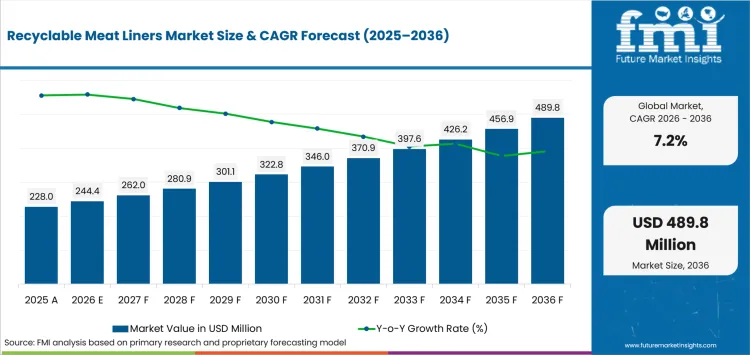
Key Takeaways of Recyclable Meat Liners Market
- Producer fees and retailer packaging standards are increasing demand for liners that combine purge control with a documented end-of-life route.
- Uncoated paper liners are projected to account for 32.0% of product type demand in 2026 due to their simpler fiber construction.
- Virgin fiber is estimated to represent 34.0% of material demand in 2026 owing to controlled formation during food-contact qualification.
- Leak control is forecast to hold 36.0% of function demand in 2026 because retained liquid reduces measurable packaging rejects.
- Food contamination and incompatible coatings can prevent a technically recyclable liner from entering the intended collection and recovery system.
- Cellcomb AB, McAirlaid's Vliesstoffe GmbH, Coppice Alupack Ltd T/A Sirane, Novipax LLC, Elliott Absorbent Products Ltd., POMONA Company Ltd., Wuhu Qicheng New Material Co., Ltd., and MAGIC S.p.A. serve the market.
Analyst Perspective
"Recyclable meat liners earn approval at the packing line because purge retention and disposal evidence must pass together. Manufacturers should prioritize compression testing and local recovery documentation before extending one construction across several processor sites."
- Nandini Roy Choudhury, Principal Consultant, Future Market Insights
How is the Recyclable Meat Liners Market segmented?
The recyclable meat liners market is segmented by product type, material, function, application, end use, sales channel and region.
The recyclable meat liners market covers product type, material, function, application, end use, sales channel, and region. Product types include uncoated paper, dispersion-coated repulpable, mono-material film, recyclable absorbent liners, and other formats. Materials cover virgin fiber, recycled fiber, mono PE - PP, and airlaid cellulose alongside functions such as leak control, interleaving, display support, and others. Applications cover fresh red meat, poultry, seafood, processed meats, and others alongside end uses and sales channels for processors, retailers, foodservice, direct supply, distributors, online routes, and other channels.
What makes uncoated paper liners central to the product type category?
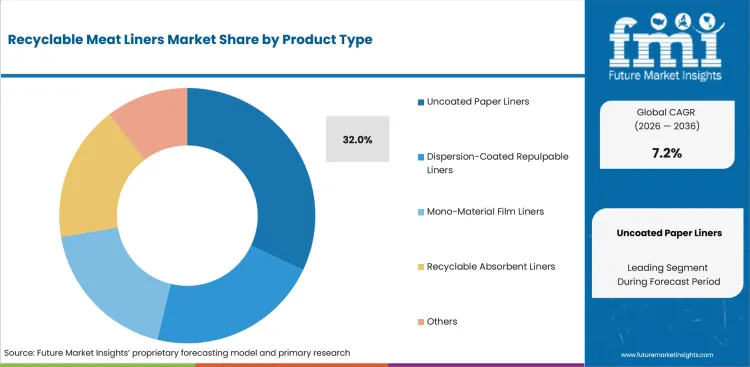
Uncoated paper suits interleaving and moderate purge loads across standardized fresh food packaging formats that avoid sustained free-liquid exposure during chilled distribution. Its familiar paper packaging route simplifies material classification but longer dwell times and tray pressure can reduce wet strength during handling and removal.
- Based on product type, uncoated paper liners are projected to account for 32.0% in 2026 due to structures that avoid unnecessary barrier layers.
- Processors qualify each basis weight against pack pressure and dwell time as recurring orders depend on stable sheet handling without tearing across high-volume commercial packing lines.
How does virgin fiber influence selection within the material category?
Virgin fiber provides controlled formation and cleanliness for direct food packaging contact during repeated processor qualification programs across several high-volume production sites with varied tray programs. Its consistent furnish lets packaging engineers adjust capillary uptake without relying on a heavier synthetic superabsorbent core during production on approved converting equipment.
- By material, virgin fiber is estimated to hold 34.0% in 2026 owing to predictable absorption and lower contaminant variability during food-contact review at scale.
- Plant teams reduce fiber weight once compression tests confirm stable retention across the intended purge load and approved equipment during several consecutive production shifts.
How do meat processors evaluate leak control?
Leak control protects seal areas and retail presentation during chilled distribution as free liquid increases rework and label failures across repeated high-volume retail programs. Dry absorbency cannot establish suitability since a pad may release captured liquid under tray pressure during commercial handling and pack opening across repeated distribution cycles.
- In 2026, leak control is expected to lead the function category with 36.0% share owing to lower packaging rejects and product loss.
- Processors compare uptake speed with rewetting under compression as repeat use depends on measurable performance within the selected tray system during routine commercial production.
What supports demand from meat processors within the end use category?
Meat processors control the stage at which a liner enters the pack and contacts product during routine production within case-ready operations across several product lines. They also carry immediate costs from leakage and line interruption while retailers influence broader packaging specifications and store presentation requirements during retailer approval.
- By end use, meat processors are forecast to represent 40.0% in 2026 driven by responsibility for line speed and reject performance.
- Plant teams test dimensions and retained capacity against specific cuts since every pack format requires separate food-contact and recovery checks across multiple lines prior to approval.
What are the drivers, restraints and opportunities in the Recyclable Meat Liners Market?
Packaging fees and formal recyclability tests support liner redesign but food contamination delays approval while co-developed constructions provide the clearest commercial route.
- Driver: Producer fees and recyclability rules place liner construction inside formal packaging qualification and recurring material-cost reviews.
- Restraint: Purge and fat can lower practical recyclability even though the unused liner has a technically compatible material base.
- Opportunity: Processor trials can pair compression retention with verified paper or mono-material recovery evidence for each intended pack.
The EU Packaging and Packaging Waste Regulation entered into force in February 2025 and generally applies from August 2026. Recyclability becomes a design requirement for barrier packaging components instead of a voluntary material preference. Processors need liner composition records that support recovery claims without weakening purge control during normal production.
Food contamination remains the main restraint since compatible construction does not guarantee collection following contact with purge. The USA Food and Drug Administration stated in May 2025 that authorizations apply to defined uses and migration conditions. Changed coatings or cores extend qualification by altering exposure conditions and disposal claims on finished packs.
Commercial opportunity centers on constructions tested for retention and local recovery within the complete sustainable packaging format. Paper liners need wet strength without repulping losses while mono PE - PP requires an accepted collection route. Joint development connects material evidence with production trials and disposal guidance for specific processor programs.
Which country CAGRs are profiled in the Recyclable Meat Liners Market?
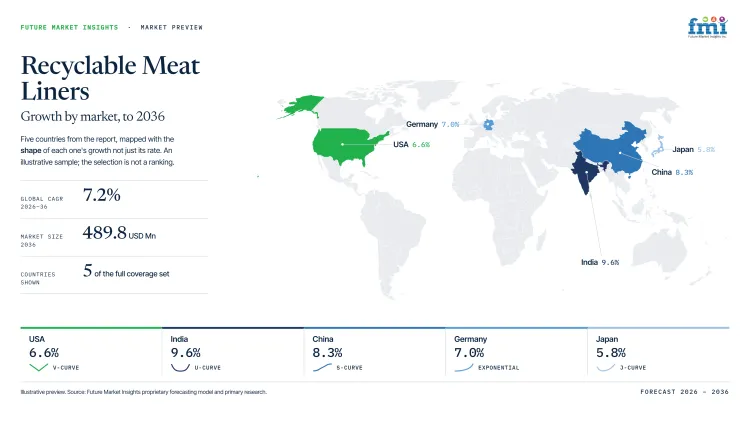
| Country | CAGR |
|---|---|
| Brazil | 7.6% |
| United Kingdom | 7.1% |
| Germany | 7.0% |
| United States | 6.6% |
| Japan | 5.8% |
How do country-level CAGRs compare in the Recyclable Meat Liners Market?
The five profiled countries span 1.8 percentage points between Brazil at 7.6% CAGR and Japan at 5.8% but do not establish current market size. Their forecasts remain close while processing scale and recovery rules produce different routes from material approval to recurring orders across national processor and retailer programs.
- Brazil and the United Kingdom are separated by 0.5 percentage point as large protein flows support localized conversion and nearby technical service.
- The United Kingdom and Germany differ by 0.1 percentage point because producer fees bring recovery evidence into packaging cost reviews.
- Germany and the United States are separated by 0.4 percentage point as earlier documentation shifts liner decisions toward package development.
- The United States and Japan differ by 0.8 percentage point as centralized processor networks scale approved formats more quickly than controlled local programs.
- Japan's forecast reflects cautious specification changes that can support durable programs once material performance and municipal collection routes receive approval.
Comparable CAGRs may still reflect different market conditions because processing scale, packaging rules, collection systems, and technical support vary across countries. The full report provides country-level CAGR analysis across North America, Latin America, Europe, East Asia, South Asia and Pacific, and the Middle East and Africa.
Country-wise Analysis
- Brazilian meat processors operate export-scale beef and poultry plants near regional converting hubs that shorten replenishment times across long chilled routes and varied case-ready tray formats during seasonal production peaks in major export regions. Recyclable meat liner sales in Brazil are forecast to expand at 7.6% CAGR by 2036, supported by local conversion and technical service for processor-specific dimensions across recurring retailer and export programs at scale. IBGE reported in March 2026 that inspected cattle slaughter reached 42.94 million head during 2025. Uneven municipal collection limits national disposal claims and requires application-specific recovery guidance across different states.
- United Kingdom retailers link private-label pack design with producer fee exposure and disposal wording during processor trials for chilled meat programs distributed across national grocery networks and high-volume regional packing sites throughout the country. The United Kingdom's recyclable meat liners outlook is anticipated to advance at 7.1% CAGR over the assessment period, reinforced by formal recyclability scoring and retailer-led material approval across private-label packaging programs at scale. PackUK confirmed in June 2025 that disposal fees become modulated by recyclability during 2026 to 2027. Food-soiled liners require defensible classifications and retailer-aligned trials before recurring commercial orders across national grocery accounts.
- German packaging teams assess liner composition near the start of tray development and request component records during processor trials for national fresh-meat and poultry programs across retailer-controlled packaging specifications and regional production sites. The German recyclable meat liners sector is projected to record 7.0% CAGR during the assessment period, shaped by early documentation requirements for recyclable barrier packaging. The Central Agency Packaging Register published its 2025 minimum standard in August 2025, although coatings and food contamination can reduce assessed recyclability and require application-specific evidence before commercial processor approval across national programs.
- Large United States processors apply centralized specifications across several case-ready facilities and use established packaging teams to coordinate dimensions and line performance for national retail programs with recurring high-volume orders across multiple plants. Recyclable meat liners demand in the United States is forecast to rise at 6.6% CAGR over the forecast period, aided by extensive inspected slaughter operations and multi-plant purchasing structures across major processing regions. Coverage across the United States is broad, reflecting a NASS Livestock Slaughter Survey that spans roughly 946 federally inspected plants and about 900 state-inspected plants, while varied recovery rules still require regional disposal guidance before broader commercial rollouts.
- Uptake in Japan is shaped by recyclability and material-classification reviews that processors run alongside gradual specification changes across established retail programs, which require consistent dimensions, local-language disposal evidence and dependable supply across national distribution networks and convenience-store channels. Adoption of recyclable meat liners in Japan is estimated to expand at 5.8% CAGR through 2036, influenced by material-specific collection routes and cautious commercial change procedures across retailer approval programs nationwide and regionally. Japan's Environment Ministry reported in March 2026 that 664 municipalities collected paper packaging and 1349 collected plastic packaging during fiscal 2024, while different collection coverage limits uniform disposal instructions for mixed-format liners nationally.
Who are the notable companies in the Recyclable Meat Liners Market?
Cellcomb AB, McAirlaid's Vliesstoffe GmbH, Coppice Alupack Ltd T/A Sirane, Novipax LLC, Elliott Absorbent Products Ltd., POMONA Company Ltd., Wuhu Qicheng New Material Co., Ltd., and MAGIC S.p.A. are the notable companies serving this market.
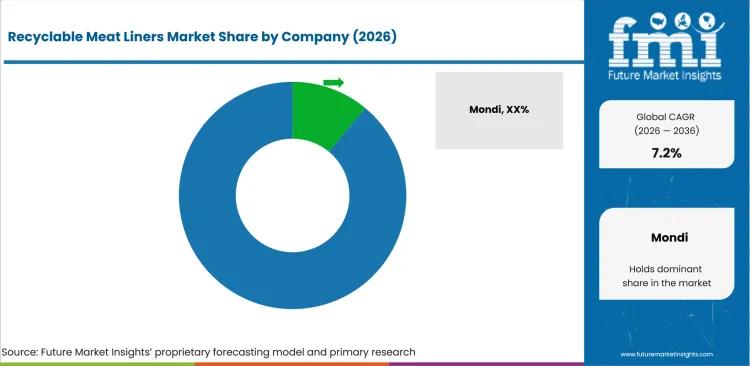
The competitive field remains fragmented across food liner paper specialists, airlaid engineers and food-pad converters with different regional manufacturing footprints. Entry depends on food-contact qualification plus pressure-retention evidence and a recovery claim that remains valid for each finished meat pack.
- Cellcomb AB, McAirlaid's Vliesstoffe GmbH, Coppice Alupack Ltd T/A Sirane, and MAGIC S.p.A. combine cellulose or airlaid engineering with dedicated absorbent production.
- Novipax LLC, Elliott Absorbent Products Ltd., POMONA Company Ltd., and Wuhu Qicheng New Material Co., Ltd. compete with protein-pad conversion and regional supply routes.
Competitive Benchmarking: Recyclable Meat Liners Market
| Company | Recyclable Pad Route | Absorbency Engineering | Food-Packaging Qualification | Geographic Reach |
|---|---|---|---|---|
| Cellcomb AB | High | High | High | Europe and international sales |
| McAirlaid's Vliesstoffe GmbH | Medium | High | High | Europe and North America |
| Coppice Alupack Ltd T/A Sirane | High | High | High | Europe, North America and international sales |
| Novipax LLC | Medium | High | High | North America |
| Elliott Absorbent Products Ltd. | Medium | High | High | Europe and international sales |
| POMONA Company Ltd. | High | Medium | High | Europe |
| Wuhu Qicheng New Material Co., Ltd. | High | High | High | East Asia and export markets |
| MAGIC S.p.A. | High | High | High | Europe and international sales |
Scoring basis: Recyclable-pad route scores High with two documented recovery constructions or one certified route for commercial use. Medium requires one verified construction and Low identifies a verified conventional format without a documented recovery route. Absorbency engineering scores High with three documented pad formats and recorded retention ranges for food-pad applications. Medium requires one or two verified formats and Low identifies one verified format without a recorded retention range. Qualification scores High with independent food-contact approval plus active pad manufacturing at a named site. Medium requires one documented quality system and Low identifies basic registration without additional site-level approvals.
Key Developments in the Recyclable Meat Liners Market
- In 15 July 2026, ANDRITZ announced that MAGIC S.p.A. had ordered a food pad eXcelle line with integrated airlaid forming technology for its Oleggio site, with commissioning scheduled for the first quarter of 2027 and the order booked in ANDRITZ's third-quarter 2025 order intake.
- In June 2025, Cellcomb AB acquired Fatex and combined Swedish and Finnish production for a wider cellulose-based range serving food-industry and healthcare qualification programs.
- In March 2025, Cellcomb AB announced home-and-garden compost certification for Cellsorb CIRCULAR, its sealed-edge all-cellulose food pad, adding to the industrial compostable certification the product already held.
Key Players in the Recyclable Meat Liners Market
Cellulose and Airlaid Specialists
- Cellcomb AB
- McAirlaid's Vliesstoffe GmbH
- MAGIC S.p.A.
Food-Pad Converters
- Coppice Alupack Ltd T/A Sirane
- Elliott Absorbent Products Ltd.
- POMONA Company Ltd.
Regional Protein-Pad Manufacturers
- Novipax LLC
- Wuhu Qicheng New Material Co., Ltd.
Recyclable Meat Liners Market - Report Scope
| Coverage field | Report scope |
|---|---|
| Market breakdown | By product type, material, function, application, end use, sales channel and region. |
| Quantitative Units | USD million. |
| Market Definition | Recyclable absorbent and interleaving liners used in meat packaging to control purge or separate products across qualified paper, cellulose, and compatible polymer routes. |
| Regions Covered | North America, Latin America, Europe, East Asia, South Asia and Pacific, and Middle East and Africa. |
| Countries Covered | United States, United Kingdom, Germany, Japan, Brazil, and 20+ countries included in the full report. |
| Key Companies Profiled | Cellcomb AB, McAirlaid's Vliesstoffe GmbH, Coppice Alupack Ltd T/A Sirane, Novipax LLC, Elliott Absorbent Products Ltd., POMONA Company Ltd., Wuhu Qicheng New Material Co., Ltd., and MAGIC S.p.A. |
| Forecast Period | 2026 to 2036. |
| Approach | Primary and secondary research with market triangulation. |
Recyclable Meat Liners Market - Research Methodology
| Method | Approach |
|---|---|
| Primary Research | FMI analysts gathered input from manufacturers, service providers, technology developers, distributors, end users, procurement teams, and subject-matter experts. Interviews examined purchasing decisions, product or service evaluation, adoption barriers, approval requirements, pricing considerations, and expectations for technical or commercial support. Respondents were also asked what evidence is required before a trial, pilot, or initial order develops into regular purchasing. |
| Desk Research | Desk research covered government statistics, regulatory publications, trade data, industry associations, technical literature, standards, company filings, product information, and official corporate announcements. Sources were reviewed for relevance, publication date, geographic coverage, and consistency with the defined market scope. Claims relating to performance, applications, approvals, capacity, investment, and commercial activity were retained only when supported by credible public evidence. |
| Market Sizing and Forecasting | The market model combined the baseline value with historical performance, segment structure, pricing and volume indicators, adoption levels, company participation, and country-level demand conditions. Forecast assumptions considered economic activity, investment trends, regulatory developments, technology adoption, purchasing cycles, supply availability, and barriers to wider market use. Segment and regional estimates were reconciled before the final market total was calculated. |
| Data Validation | Estimates were checked against multiple independent indicators, including public data, company activity, trade patterns, industry developments, and findings from primary interviews. Validation also tested whether products, services, applications, and company revenues fell within the defined market boundaries. Adjacent categories, unsupported claims, overlapping revenues, and activities without direct market relevance were excluded to reduce double counting and maintain consistency across segments and countries. |
Recyclable Meat Liners Market by Segments
Recyclable Meat Liners Market segmented by Product Type:
- Uncoated Paper Liners
- Dispersion-Coated Repulpable Liners
- Mono-Material Film Liners
- Recyclable Absorbent Liners
- Others
Recyclable Meat Liners Market segmented by Material:
- Virgin Fiber
- Recycled Fiber
- Mono PE - PP
- Airlaid Cellulose
- Others
Recyclable Meat Liners Market segmented by Function:
- Leak Control
- Interleaving
- Display & Presentation
- Others
Recyclable Meat Liners Market segmented by Application:
- Fresh Red Meat
- Poultry
- Seafood
- Processed Meats
- Others
Recyclable Meat Liners Market segmented by End Use:
- Meat Processors
- Grocery Retail
- Foodservice
- Others
Recyclable Meat Liners Market segmented by Sales Channel:
- Direct - OEM Supply
- Packaging Distributors
- Online - E-commerce
- Others
Recyclable Meat Liners Market by Region
- North America
- United States
- Canada
- Latin America
- Brazil
- Mexico
- Argentina
- Chile
- Western Europe
- Germany
- France
- United Kingdom
- Italy
- Spain
- Benelux
- Nordics
- Eastern Europe
- Poland
- Czech Republic
- Romania
- Hungary
- East Asia
- China
- Japan
- South Korea
- South Asia and Pacific
- India
- ASEAN
- Australia and New Zealand
- Middle East and Africa
- GCC Countries
- South Africa
- Türkiye
- Israel
Research Sources and Bibliography
- PackUK. (2025, June 30). Extended Producer Responsibility for Packaging: 2025 base fees.
- Food and Agriculture Organization of the United Nations. (2025, November). Food Outlook - Biannual Report on Global Food Markets, November 2025.
- European Commission. (n.d.). Packaging waste. Retrieved August 7, 2026.
- USA Food and Drug Administration. (2025, May 8). Food Packaging & Other Substances that Come in Contact with Food - Information for Consumers.
- Brazilian Institute of Geography and Statistics. (2026, March 18). In 2025, Brazil registers the highest production of milk, leather and eggs in history; slaughter of cattle, chickens and pigs also hits record.
- PackUK. (2025, June 27). Extended producer responsibility for packaging: modulated disposal fees.
- Central Agency Packaging Register. (2025, August 28). Minimum standard for determining the recyclability of packaging.
- USA Department of Agriculture, National Agricultural Statistics Service. (2025, November 20). Livestock Slaughter.
- Ministry of the Environment, Government of Japan. (2026, March 31). Results of municipal separate collection and recycling under the Containers and Packaging Recycling Act, FY2024.
- Cellcomb AB. (2026). Cellcomb - solutions for health care, hygiene and food industry. Retrieved August 7, 2026.
- McAirlaid's Vliesstoffe GmbH. (2026). McAirlaid’s: Unique since 1997. Retrieved August 7, 2026.
- McAirlaid's Vliesstoffe GmbH. (2026). Certifications: awarded! Retrieved August 7, 2026.
- USA Food and Drug Administration. (2025, September 8). Inventory of Effective Food Contact Substance (FCS) Notifications: FCN No. 1533.
- Coppice Alupack Ltd T/A Sirane. (2026). Who We Are - Sirane (Coppice Alupack Ltd). Retrieved August 7, 2026.
- Novipax LLC. (2026). Home Page - Novipax. Retrieved August 7, 2026.
- Elliott Absorbent Products Ltd. (2026). Food Packaging Absorbent Pads | Elliott Absorbent Products. Retrieved August 7, 2026.
- POMONA Company Ltd. (2026). Home - POMONA COMPANY. Retrieved August 7, 2026.
- Wuhu Qicheng New Material Co., Ltd. (2026). Absorbent pads manufacturer from China - Wuhu Qicheng. Retrieved August 7, 2026.
- MAGIC S.p.A. (2026). The Company | MAGIC Spa I Sustainable absorbent materials. Retrieved August 7, 2026.
- ANDRITZ AG. (2026, July 15). MAGIC S.p.A., Oleggio, Italy, orders a new food pad production line, including airlaid technology from ANDRITZ.
- Cellcomb AB. (2025, June 4). Cellcomb acquires Fatex.
- Cellcomb AB. (2025, March 12). Cellsorb Circular - now certified for your home-and garden compost!
- MAGIC S.p.A. (2025, October 29). Quality control in food packaging: protecting safety and reputation.
- Cellcomb AB. (2025, October 24). Cellsorb® ECO becomes Cellsorb® CORE.
This bibliography is provided for reader reference and is not exhaustive. The full report contains the complete reference list and detailed citations
This Report Answers
- What is the Recyclable Meat Liners Market size in 2026 and what value is forecast for 2036?
- How do packaging fees and recyclability rules change liner qualification for commercial meat processors?
- Why do uncoated paper liners account for the largest product type share during 2026?
- How does virgin fiber support consistent absorption and food-contact review across approved processor programs?
- Why does leak control hold the largest function share within the Recyclable Meat Liners Market?
- How do Brazil, the United Kingdom, Germany, the United States, and Japan differ in commercial entry conditions?
- Which companies compete using cellulose, airlaid, food-pad converting, and regional manufacturing routes?
- How do purge contamination and local collection rules limit practical recyclability across finished meat packs?
- What operating evidence should processors require before a recyclable liner enters repeat production?
Frequently Asked Questions
How big is the Recyclable Meat Liners Market in 2026?
The recyclable meat liners market is valued at USD 244.4 million in 2026 and is forecast to reach USD 489.8 million by 2036. The projected expansion reflects recurring liner use in protein packs plus stricter qualification of purge control and end-of-life claims.
What is the forecast CAGR for the Recyclable Meat Liners Market?
The recyclable meat liners market is projected to expand at 7.2% CAGR between 2026 and 2036. Growth depends on processors approving liners that retain liquid under pressure and reliably fit the recovery route accepted for each finished meat pack.
Which product type leads the Recyclable Meat Liners Market?
Uncoated paper liners are projected to account for 32.0% of the recyclable meat liners market by product type in 2026. Their position reflects simple fiber construction for moderate moisture exposure but higher purge loads require stronger retention or added barrier control.
Which sales channel holds the dominant share of the Recyclable Meat Liners Market?
Direct - OEM supply is estimated to hold 44.0% of the recyclable meat liners market by sales channel in 2026. Direct programs support custom dimensions and line trials plus continuity planning for processors operating several high-volume packing sites at commercial scale.
Which companies are profiled in the Recyclable Meat Liners Market?
The recyclable meat liners market profiles Cellcomb AB, McAirlaid's Vliesstoffe GmbH, Coppice Alupack Ltd T/A Sirane, Novipax Buyer LLC, Elliott Absorbent Products Ltd., POMONA Company Ltd., Wuhu Qicheng New Material Co., Ltd., and MAGIC S.p.A. These companies represent cellulose, airlaid, converting, and regional supply routes used in fresh-protein packaging programs.
Preview the report firsthand - request a free sample
Get SampleGet the brochure for pricing and purchase details.
Get PDFTable of Content
- Key Takeaways
- Market Size and CAGR
- Top Growth Driver
- Fastest Growing Segment
- Leading Region
- Key Companies
- Emerging Opportunities
- Executive Summary
- Global Market Outlook
- Demand-side Trends
- Supply-side Trends
- Technology Roadmap Analysis
- Analysis and Recommendations
- Analyst Perspective (What is happening? Why now? What should investors know?)
- Key Questions Answered
- How large is the market?
- What is the CAGR?
- What are key trends?
- Which region dominates?
- Who are the leaders?
- Market Overview
- Market Coverage / Taxonomy
- Market Definition / Scope / Limitations
- Research Methodology
- Chapter Orientation
- Analytical Lens and Working Hypotheses
- Market Structure, Signals, and Trend Drivers
- Benchmarking and Cross-market Comparability
- Market Sizing, Forecasting, and Opportunity Mapping
- Research Design and Evidence Framework
- Desk Research Programme (Secondary Evidence)
- Expert Input and Fieldwork (Primary Evidence)
- Tooling, Models, and Reference Databases
- Data Engineering and Model Build
- Quality Assurance and Audit Trail
- Market Background
- Market Dynamics (Drivers, Restraints, Opportunity, Trends)
- Scenario Forecast (Optimistic, Likely, Conservative)
- Impact Analysis
- AI Impact
- Sustainability Impact
- Regulatory Impact
- Technology Impact
- Consumer / Buyer Analysis
- Purchase Drivers
- Adoption Barriers
- Buyer Journey
- Opportunity Map Analysis
- Product Life Cycle Analysis
- Supply Chain Analysis
- Investment Feasibility Matrix
- Value Chain Analysis
- PESTLE and Porter's Analysis
- Regulatory Landscape
- Regional Parent Market Outlook
- Production and Consumption Statistics
- Import and Export Statistics
- Global Market Analysis and Forecast, 2021 to 2036
- Historical Market Size Value (USD Million) Analysis, 2021 to 2025
- Current and Future Market Size Value (USD Million) Projections, 2026 to 2036
- Y-o-Y Growth Trend Analysis
- Absolute $ Opportunity Analysis
- Global Market Pricing Analysis, 2021 to 2036
- Global Market Analysis and Forecast, By Product Type, 2021 to 2036
- Introduction / Key Findings
- Historical Market Size Value (USD Million) Analysis By Product Type, 2021 to 2025
- Current and Future Market Size Value (USD Million) Analysis and Forecast By Product Type, 2026 to 2036
- Uncoated Paper Liners
- Dispersion-Coated Repulpable Liners
- Mono-Material Film Liners
- Recyclable Absorbent Liners
- Others
- Uncoated Paper Liners
- Y-o-Y Growth Trend Analysis By Product Type, 2021 to 2025
- Absolute $ Opportunity Analysis By Product Type, 2026 to 2036
- Global Market Analysis and Forecast, By Material, 2021 to 2036
- Introduction / Key Findings
- Historical Market Size Value (USD Million) Analysis By Material, 2021 to 2025
- Current and Future Market Size Value (USD Million) Analysis and Forecast By Material, 2026 to 2036
- Virgin Fiber
- Recycled Fiber
- Mono PE - PP
- Airlaid Cellulose
- Others
- Virgin Fiber
- Y-o-Y Growth Trend Analysis By Material, 2021 to 2025
- Absolute $ Opportunity Analysis By Material, 2026 to 2036
- Global Market Analysis and Forecast, By Function, 2021 to 2036
- Introduction / Key Findings
- Historical Market Size Value (USD Million) Analysis By Function, 2021 to 2025
- Current and Future Market Size Value (USD Million) Analysis and Forecast By Function, 2026 to 2036
- Leak Control
- Interleaving
- Display & Presentation
- Others
- Leak Control
- Y-o-Y Growth Trend Analysis By Function, 2021 to 2025
- Absolute $ Opportunity Analysis By Function, 2026 to 2036
- Global Market Analysis and Forecast, By Application, 2021 to 2036
- Introduction / Key Findings
- Historical Market Size Value (USD Million) Analysis By Application, 2021 to 2025
- Current and Future Market Size Value (USD Million) Analysis and Forecast By Application, 2026 to 2036
- Fresh Red Meat
- Poultry
- Seafood
- Processed Meats
- Others
- Fresh Red Meat
- Y-o-Y Growth Trend Analysis By Application, 2021 to 2025
- Absolute $ Opportunity Analysis By Application, 2026 to 2036
- Global Market Analysis and Forecast, By End Use, 2021 to 2036
- Introduction / Key Findings
- Historical Market Size Value (USD Million) Analysis By End Use, 2021 to 2025
- Current and Future Market Size Value (USD Million) Analysis and Forecast By End Use, 2026 to 2036
- Meat Processors
- Grocery Retail
- Foodservice
- Others
- Meat Processors
- Y-o-Y Growth Trend Analysis By End Use, 2021 to 2025
- Absolute $ Opportunity Analysis By End Use, 2026 to 2036
- Global Market Analysis and Forecast, By Sales Channel
- Introduction / Key Findings
- Historical Market Size Value (USD Million) Analysis By Sales Channel, 2021 to 2025
- Current and Future Market Size Value (USD Million) Analysis and Forecast By Sales Channel, 2026 to 2036
- Direct - OEM Supply
- Packaging Distributors
- Online - E-commerce
- Others
- Direct - OEM Supply
- Y-o-Y Growth Trend Analysis By Sales Channel, 2021 to 2025
- Absolute $ Opportunity Analysis By Sales Channel, 2026 to 2036
- Global Market Analysis and Forecast, By Region, 2021 to 2036
- Introduction
- Historical Market Size Value (USD Million) Analysis By Region, 2021 to 2025
- Current Market Size Value (USD Million) Analysis and Forecast By Region, 2026 to 2036
- North America
- Latin America
- Western Europe
- Eastern Europe
- East Asia
- South Asia and Pacific
- Middle East & Africa
- Market Attractiveness Analysis By Region
- North America Market Analysis and Forecast, By Country, 2021 to 2036
- Historical Market Size Value (USD Million) Trend Analysis By Market Taxonomy, 2021 to 2025
- Market Size Value (USD Million) Forecast By Market Taxonomy, 2026 to 2036
- By Country
- USA
- Canada
- By Product Type
- By Material
- By Function
- By Application
- By End Use
- By Sales Channel
- By Country
- Market Attractiveness Analysis
- By Country
- By Product Type
- By Material
- By Function
- By Application
- By End Use
- By Sales Channel
- Key Takeaways
- Latin America Market Analysis and Forecast, By Country
- Historical Market Size Value (USD Million) Trend Analysis By Market Taxonomy, 2021 to 2025
- Market Size Value (USD Million) Forecast By Market Taxonomy, 2026 to 2036
- By Country
- Brazil
- Mexico
- Chile
- Rest of Latin America
- By Product Type
- By Material
- By Function
- By Application
- By End Use
- By Sales Channel
- By Country
- Market Attractiveness Analysis
- By Country
- By Product Type
- By Material
- By Function
- By Application
- By End Use
- By Sales Channel
- Key Takeaways
- Western Europe Market Analysis and Forecast, By Country
- Historical Market Size Value (USD Million) Trend Analysis By Market Taxonomy, 2021 to 2025
- Market Size Value (USD Million) Forecast By Market Taxonomy, 2026 to 2036
- By Country
- Germany
- UK
- Italy
- Spain
- France
- Nordic
- BENELUX
- Rest of Western Europe
- By Product Type
- By Material
- By Function
- By Application
- By End Use
- By Sales Channel
- By Country
- Market Attractiveness Analysis
- By Country
- By Product Type
- By Material
- By Function
- By Application
- By End Use
- By Sales Channel
- Key Takeaways
- Eastern Europe Market Analysis and Forecast, By Country
- Historical Market Size Value (USD Million) Trend Analysis By Market Taxonomy, 2021 to 2025
- Market Size Value (USD Million) Forecast By Market Taxonomy, 2026 to 2036
- By Country
- Russia
- Poland
- Hungary
- Balkan & Baltic
- Rest of Eastern Europe
- By Product Type
- By Material
- By Function
- By Application
- By End Use
- By Sales Channel
- By Country
- Market Attractiveness Analysis
- By Country
- By Product Type
- By Material
- By Function
- By Application
- By End Use
- By Sales Channel
- Key Takeaways
- East Asia Market Analysis and Forecast, By Country
- Historical Market Size Value (USD Million) Trend Analysis By Market Taxonomy, 2021 to 2025
- Market Size Value (USD Million) Forecast By Market Taxonomy, 2026 to 2036
- By Country
- China
- Japan
- South Korea
- By Product Type
- By Material
- By Function
- By Application
- By End Use
- By Sales Channel
- By Country
- Market Attractiveness Analysis
- By Country
- By Product Type
- By Material
- By Function
- By Application
- By End Use
- By Sales Channel
- Key Takeaways
- South Asia and Pacific Market Analysis and Forecast, By Country
- Historical Market Size Value (USD Million) Trend Analysis By Market Taxonomy, 2021 to 2025
- Market Size Value (USD Million) Forecast By Market Taxonomy, 2026 to 2036
- By Country
- India
- ASEAN
- Australia & New Zealand
- Rest of South Asia and Pacific
- By Product Type
- By Material
- By Function
- By Application
- By End Use
- By Sales Channel
- By Country
- Market Attractiveness Analysis
- By Country
- By Product Type
- By Material
- By Function
- By Application
- By End Use
- By Sales Channel
- Key Takeaways
- Middle East & Africa Market Analysis and Forecast, By Country
- Historical Market Size Value (USD Million) Trend Analysis By Market Taxonomy, 2021 to 2025
- Market Size Value (USD Million) Forecast By Market Taxonomy, 2026 to 2036
- By Country
- Kingdom of Saudi Arabia
- Other GCC Countries
- Türkiye
- South Africa
- Other African Union
- Rest of Middle East & Africa
- By Product Type
- By Material
- By Function
- By Application
- By End Use
- By Sales Channel
- By Country
- Market Attractiveness Analysis
- By Country
- By Product Type
- By Material
- By Function
- By Application
- By End Use
- By Sales Channel
- Key Takeaways
- Key Countries Market Analysis
- USA
- Pricing Analysis
- Market Share Analysis, 2025
- By Product Type
- By Material
- By Function
- By Application
- By End Use
- By Sales Channel
- Canada
- Pricing Analysis
- Market Share Analysis, 2025
- By Product Type
- By Material
- By Function
- By Application
- By End Use
- By Sales Channel
- Mexico
- Pricing Analysis
- Market Share Analysis, 2025
- By Product Type
- By Material
- By Function
- By Application
- By End Use
- By Sales Channel
- Brazil
- Pricing Analysis
- Market Share Analysis, 2025
- By Product Type
- By Material
- By Function
- By Application
- By End Use
- By Sales Channel
- Chile
- Pricing Analysis
- Market Share Analysis, 2025
- By Product Type
- By Material
- By Function
- By Application
- By End Use
- By Sales Channel
- Germany
- Pricing Analysis
- Market Share Analysis, 2025
- By Product Type
- By Material
- By Function
- By Application
- By End Use
- By Sales Channel
- UK
- Pricing Analysis
- Market Share Analysis, 2025
- By Product Type
- By Material
- By Function
- By Application
- By End Use
- By Sales Channel
- Italy
- Pricing Analysis
- Market Share Analysis, 2025
- By Product Type
- By Material
- By Function
- By Application
- By End Use
- By Sales Channel
- Spain
- Pricing Analysis
- Market Share Analysis, 2025
- By Product Type
- By Material
- By Function
- By Application
- By End Use
- By Sales Channel
- France
- Pricing Analysis
- Market Share Analysis, 2025
- By Product Type
- By Material
- By Function
- By Application
- By End Use
- By Sales Channel
- India
- Pricing Analysis
- Market Share Analysis, 2025
- By Product Type
- By Material
- By Function
- By Application
- By End Use
- By Sales Channel
- ASEAN
- Pricing Analysis
- Market Share Analysis, 2025
- By Product Type
- By Material
- By Function
- By Application
- By End Use
- By Sales Channel
- Australia & New Zealand
- Pricing Analysis
- Market Share Analysis, 2025
- By Product Type
- By Material
- By Function
- By Application
- By End Use
- By Sales Channel
- China
- Pricing Analysis
- Market Share Analysis, 2025
- By Product Type
- By Material
- By Function
- By Application
- By End Use
- By Sales Channel
- Japan
- Pricing Analysis
- Market Share Analysis, 2025
- By Product Type
- By Material
- By Function
- By Application
- By End Use
- By Sales Channel
- South Korea
- Pricing Analysis
- Market Share Analysis, 2025
- By Product Type
- By Material
- By Function
- By Application
- By End Use
- By Sales Channel
- Russia
- Pricing Analysis
- Market Share Analysis, 2025
- By Product Type
- By Material
- By Function
- By Application
- By End Use
- By Sales Channel
- Poland
- Pricing Analysis
- Market Share Analysis, 2025
- By Product Type
- By Material
- By Function
- By Application
- By End Use
- By Sales Channel
- Hungary
- Pricing Analysis
- Market Share Analysis, 2025
- By Product Type
- By Material
- By Function
- By Application
- By End Use
- By Sales Channel
- Kingdom of Saudi Arabia
- Pricing Analysis
- Market Share Analysis, 2025
- By Product Type
- By Material
- By Function
- By Application
- By End Use
- By Sales Channel
- Türkiye
- Pricing Analysis
- Market Share Analysis, 2025
- By Product Type
- By Material
- By Function
- By Application
- By End Use
- By Sales Channel
- South Africa
- Pricing Analysis
- Market Share Analysis, 2025
- By Product Type
- By Material
- By Function
- By Application
- By End Use
- By Sales Channel
- USA
- Market Structure Analysis
- Competition Dashboard
- Competition Benchmarking
- Market Share Analysis of Top Players
- By Regional
- By Product Type
- By Material
- By Function
- By Application
- By End Use
- By Sales Channel
- Emerging Startups
- Innovation Benchmarking
- Competition Analysis
- Competition Deep Dive
- Mondi
- Overview
- Product Portfolio
- Profitability by Market Segments
- Sales Footprint
- Strategy Overview
- Marketing Strategy
- Product Strategy
- Channel Strategy
- Sirane
- Cellcomb
- McAirlaid's
- Sealed Air
- Cascades
- Smurfit Westrock
- McNairn Packaging
- Nordic Paper
- Novipax
- Mondi
- Case Studies
- Success Stories
- Recent Developments
- Competition Deep Dive
- Assumptions & Acronyms Used


