

- Market Size (2026)
- USD 1120.6 Mn
- Forecast (2036)
- USD 2288.2 Mn
- CAGR (2026 to 2036)
- 7.4%
How big is the Ride Height Sensors Market in 2026?
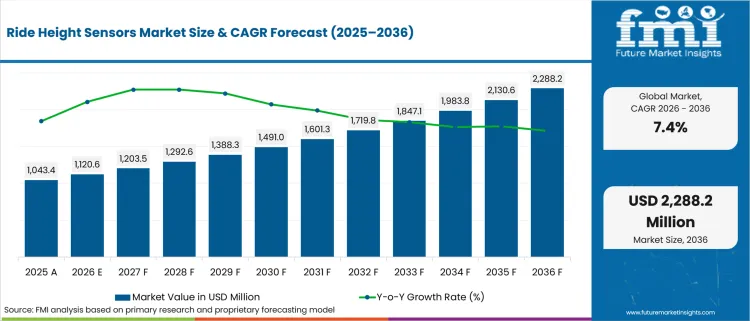
USD 1,120.6 million in 2026 and USD 2,288.2 million by 2036 at a 7.4% CAGR.
Vehicle platform engineering is shifting toward controlled suspension, lamp leveling and chassis software that need stable body-position feedback. OEMs and Tier-1 suppliers use these sensors to measure axle movement against the vehicle body. The market is tied to wider automotive sensors adoption due to the role of height data in suspension control and lamp aim. A May 2026 IEA assessment reported almost 22 million electric cars produced globally in 2025. That base is important due to battery packaging and underbody clearance needs.
Vehicle manufacturers, Tier-1 chassis suppliers approach the product from separate buying problems. OEM platform teams need validated height signals before launch. Chassis suppliers need sealed modules that continue to work during vibration and temperature exposure. Aftermarket specialists need replacement parts that match connector geometry and diagnostic rules. The product creates value by turning axle movement into a trusted input for posture control, lamp alignment and repair calibration. That value is practical for buyers who want fewer validation gaps between suspension hardware and the software controlling it.
Regional adoption patterns are expected to split by platform mix and service maturity. Established vehicle markets use ride height sensors mainly for premium replacement, lighting compliance and calibration work across dealer channels. High-growth markets scale demand from EV launches and SUV localization. The component becomes more valuable once it connects suspension modules, headlamp logic and diagnostic workflows. Strategic buyers should treat ride height sensing as a small data point that protects larger investments in chassis electronics and customer comfort during new model planning.
| Metric | Value |
|---|---|
| 2025 Market Size | USD 1,043.4 million |
| 2026 Market Size | USD 1,120.6 million |
| 2036 Market Size | USD 2,288.2 million |
| Forecast CAGR (2026-2036) | 7.4% |
| Sensor Type Focus | Rotary Position Sensors |
| Rotary Position Sensors Share (2026) | 42.0% |
| Application Focus | Air Suspension |
| Air Suspension Share (2026) | 38.5% |
| Vehicle Type Focus | Passenger Cars |
| Passenger Cars Share (2026) | 58.0% |
| Fastest-growing Country | China |
| China CAGR by 2036 | 8.8% |
Summary of the Ride Height Sensors Market
| Market Signal | Commercial Impact |
|---|---|
| Demand and Growth Drivers | Demand for ride height sensors is expected to expand steadily through 2036 as EV platforms, advanced suspension technologies, and vehicle safety systems increase the need for accurate chassis position sensing.
|
| Product and Segment View | Rotary position sensors, air suspension applications, and OEM sales channels continue to dominate their respective market segments.
|
| Geography and Growth Outlook | Asia continues to lead market growth through rapid EV adoption, SUV production, and expansion of advanced automotive manufacturing.
|
| Competitive Landscape | Competition increasingly focuses on sensor reliability, OEM validation, and diagnostics-ready vehicle integration.
|
| Analyst Perspective | Ride height sensors are becoming an increasingly important component of modern vehicle dynamics as electrification, adaptive suspension, and advanced safety systems continue to evolve.
- Nikhil Kaitwade, Principal Consultant at Future Market Insights |
How is the ride height sensors market segmented?
The Ride Height Sensors industry is segmented by sensor type, application, vehicle type, sales channel, signal output, and region.
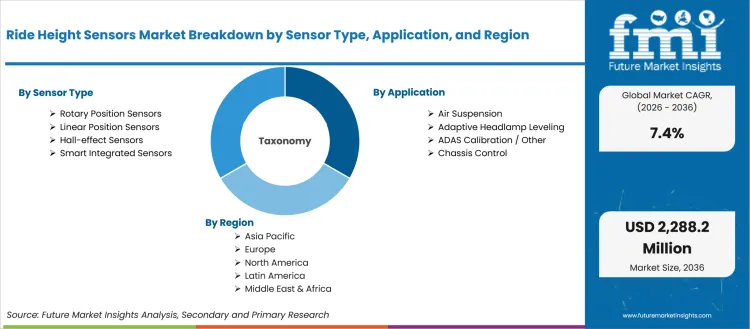
The Ride Height Sensors Market is segmented by sensor type, application, vehicle type, sales channel, signal output and region. Sensor type covers rotary position sensors, linear position sensors, Hall-effect sensors and smart integrated sensors. Application includes air suspension, adaptive headlamp leveling, chassis control and ADAS calibration or other uses. Vehicle type spans passenger cars, premium SUVs, commercial vehicles and EVs. Sales channel covers OEM and aftermarket routes. Signal output includes analog, digital and LIN / CAN enabled outputs. The segmentation scope excludes general chassis parts and keeps analysis focused on height measurement hardware. Regional coverage extends across North America, Latin America, Europe, East Asia, South Asia and Pacific and the Middle East and Africa.
Why do rotary position sensors remain central within sensor type?
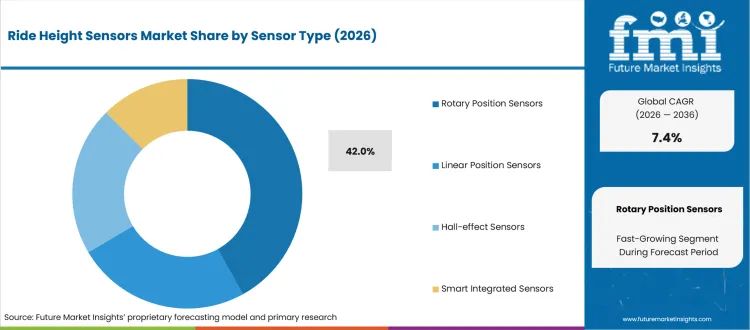
Chassis engineers need a compact way to convert axle movement into a reliable electrical signal. Rotary layouts solve that packaging problem without forcing major suspension changes. The segment is relevant for platform teams that need angle sensing under the vehicle and service buyers that need a part matching the original geometry. This makes rotary designs practical for programs balancing sensor cost, sealing needs and consistent travel measurement.
- In 2026, Rotary Position Sensors are anticipated to hold 42.0% of sensor type demand driven by lever-arm movement that suits axle travel measurement on passenger cars and premium SUVs. The format is practical due to the sensor ability to translate suspension angle into a stable signal without changing the full chassis layout.
- Buyer preference is expected to stay focused on compact packaging and underbody durability. HELLA Tech World says vehicle level sensors are devices installed directly on the chassis for angle and height measurement. That role explains why rotary layouts remain relevant for lamp leveling and adaptive chassis functions. This supports sourcing decisions that need engineering continuity across production and service.
What makes air suspension the notable application area?
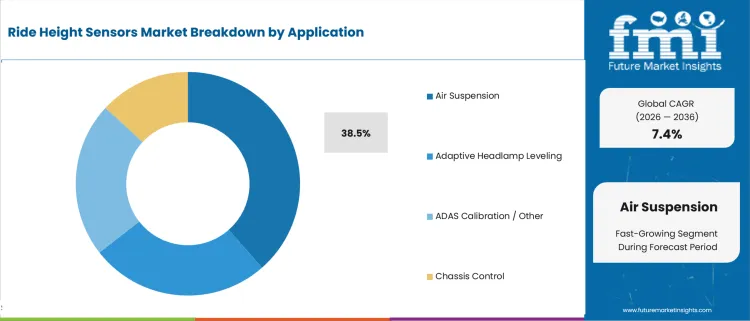
Air suspension systems need constant posture feedback before the control module can adjust height. The buyer concern is broader than ride comfort and extends into towing stability, cargo load changes and access-height control. This makes the sensor part of a closed-loop system instead of a standalone measurement part. Suppliers must prove that the height signal stays stable once the compressor and valve block begin correcting vehicle posture.
- Air Suspension is expected to account for 38.5% of application demand in 2026 supported by load-leveling needs during towing, cargo changes and access-height operation. The application depends on repeated feedback due to control-module needed for posture correction before ride comfort or lamp aim is affected. That keeps the sensor close to core suspension control budgets during platform planning.
- Air suspension buyers are expected to evaluate the sensor inside a control system. Sensata states that pressure and temperature information helps suspension modules adjust vehicle height for every load condition. That makes signal stability valuable for air suspension height control valve components and related air-control modules. The result is a buying case tied to system reliability during daily vehicle use.
How do passenger cars shape vehicle-type demand?
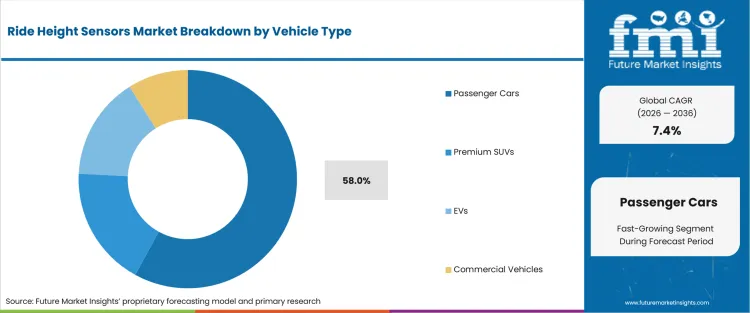
Passenger-car platforms give suppliers the volume base needed to spread validation cost across repeated programs. The segment is relevant due to headlamp leveling and chassis control use beyond high-priced vehicles. Broader trim coverage gives OEMs a way to add safety and comfort functions without redesigning the full suspension architecture.
- Passenger Cars are forecast to represent 58.0% of vehicle-type demand in 2026 led by high-volume platforms that carry headlamp leveling and chassis control into broader trim ranges. NHTSA’s April 2024 AEB rule applies to passenger cars and light trucks by September 2029. That makes volume planning important for sensor suppliers and toolmakers.
- Passenger-car OEMs can spread sensor validation cost across larger production programs and repeated trim updates. That makes selective height sensing practical if automotive ADAS functions and lighting systems need reliable posture data across repeated model-year updates. The buyer value is therefore production scale rather than luxury positioning alone. The same logic supports broader trim adoption without making the sensor a premium-only part.
Why does OEM sourcing carry most sales-channel value?
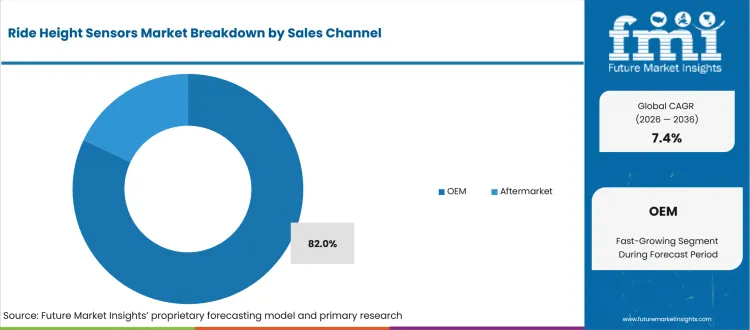
Ride height sensor sourcing starts early due to the signal need to match suspension geometry and control software. Late substitution can create calibration risk for OEMs and service channels. The segment is witnessing expansion due to stable output requirements for comfort and safety-linked functions despite limited driver visibility. Buyers therefore favor suppliers that can document fitment, sealing performance and diagnostic behavior before production release.
- OEM is projected to account for 82.0% of sales-channel demand in 2026 attributable to validation that occurs before vehicle launch across suspension geometry and ECU diagnostics. Ride height sensors are difficult to substitute later due to small signal differences that can trigger warning lights or calibration delays. That validation step helps protect warranty exposure and service accuracy before vehicles reach dealer networks.
- OEM buyers are expected to prefer suppliers that support program engineering and service documentation. TE Connectivity lists position sensors for chassis and brake applications that can be configured for analog or PWM output. That evidence supports sourcing logic for platform-specific validation and repair traceability across service channels. This lowers program risk for parts that remain difficult to substitute later.
What keeps analog output relevant within signal output?
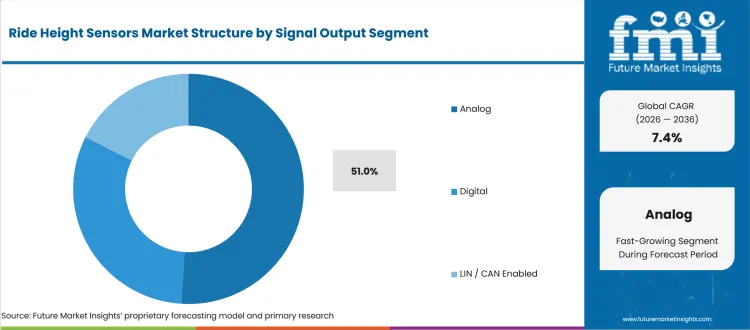
Installed vehicle platforms still use electrical architectures that were validated before broader digital migration. Replacement channels must match those interfaces before service teams can close a repair. Analog output remains relevant for existing suspension and lamp-leveling systems. Digital output gains importance only once new platform electronics can use richer diagnostics, lower wiring burden and cleaner fault reporting. This creates a phased transition across OEM and service channels.
- Analog is expected to account for 51.0% of signal-output demand in 2026 shaped by legacy suspension and headlamp-leveling platforms that still use voltage-based feedback. This share remains meaningful due to replacement sensors that must match installed electrical architecture before digital migration can affect the full vehicle parc. This creates steady replacement demand across older vehicle platforms.
- Digital output is expected to gain relevance if OEMs need richer diagnostics and simpler wiring architecture. Bosch’s Vehicle Motion Management links suspension control to braking and steering inside one vehicle-motion domain. That architecture makes cleaner signals relevant for ADAS sensors and centralized chassis control. The buyer value is clearer fault tracing during service and calibration work.
What are the drivers, restraints, and opportunities in the ride height sensors market?
Near-term purchases are being shaped by the closed-loop height control requirement, underbody durability constraint, and digital chassis expansion route outlined below.
- Driver: Closed-loop suspension and lamp-leveling control is driving spending due to OEM need for stable height feedback before posture correction can be trusted.
- Restraint: Underbody exposure restrains adoption of lower-grade replacements owing to failure risk from water and salt plus vibration and connector damage.
- Opportunity: Digital chassis integration opens supplier access due to OEM need for sensors that support diagnostics-ready outputs and platform-level calibration.
OEM purchasing activity is expected to rise once height feedback becomes part of the control loop for suspension and lighting systems. Air suspension programs need repeated body-position inputs before compressor and valve actions can correct vehicle posture. ACEA reported in January 2026 that 1.88 million new battery-electric cars were registered in the European Union during 2025. That evidence matters for ride height sensors due to platform electrification that changes underbody packaging and suspension tuning. Suppliers that show signal stability during vibration and temperature exposure can defend program access against lower-cost replacement parts.
Replacement demand is constrained by harsh underbody exposure and exact fitment needs. That restraint is expected to turn into a growth route for suppliers that combine sealed housings, correct connectors and repair guidance. The Department for Transport reported in April 2026 that licensed vehicles in the United Kingdom reached 41.4 million at the end of 2025. A larger vehicle parc raises service variation and fitment risk for workshops. Suppliers that can map part numbers to vehicle geometry can reduce callbacks and protect aftermarket trust.
Digital chassis programs create an opportunity for sensor suppliers and smaller specialists that can prove signal quality inside software-led vehicle control. The IEA said in May 2026 that electric car sales could reach 23 million in 2026. That forecast supports platform renewal across regions and gives suppliers a wider base for diagnostics-ready height sensing. The opportunity is not only new vehicle fitment. It also covers validation support, repair data and digital output migration for OEMs trying to simplify chassis electronics.
Which country CAGRs are profiled in the ride height sensors market?
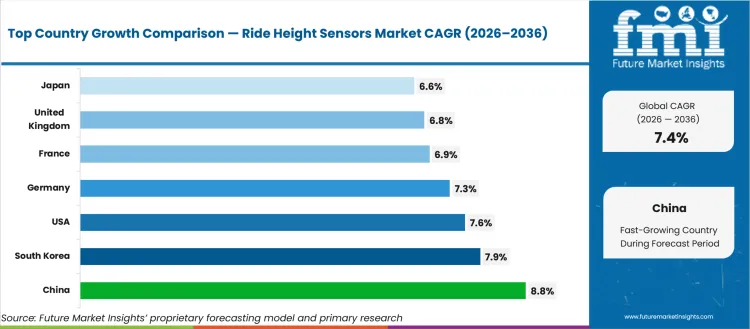
| Country | CAGR |
|---|---|
| United States | 7.6% |
| United Kingdom | 6.8% |
| Germany | 7.3% |
| France | 6.9% |
| Japan | 6.6% |
| China | 8.8% |
| South Korea | 7.9% |
| India | 8.2% |
How do country-level CAGRs compare in the ride height sensors market?
Country CAGR profiles should be read against the operating pressure behind suspension, lamp leveling and calibration readiness. In established markets, the case is tied to premium repair channels and safety-linked service processes. Supplier validation depth matters more in these markets due to longer vehicle parc life. In high-growth markets, the same component sits closer to EV launches and localized chassis electronics sourcing. SUV scale shapes the outlook due to platform expansion across premium and mid-range trims. The United States and Germany show more service and engineering-led demand. China and India show more platform renewal and localized sourcing influence. For senior buyers, country variation shows which markets need replacement depth and which need platform access before model programs scale.
- By 2036, the United States is projected to record 7.6% CAGR driven by premium SUV demand and ADAS repair workflows. Argonne National Laboratory reported that plug-in electric vehicles reached 9.1% of annual USA passenger vehicle sales in 2025. This supports demand for electronics-rich platforms and calibrated service parts in premium repair channels. The country differs from Europe due to heavier light-truck use and wider dealer calibration networks. That profile supports replacement depth beyond new-vehicle fitment. It also makes service documentation important for suppliers.
- The United Kingdom is expected to grow at 6.8% CAGR during the forecast period supported by a premium vehicle parc and dealer-led repair behavior. The Department for Transport reported 2012000 licensed zero-emission vehicles at the end of 2025. The country grows below China due to narrower local vehicle production scale and higher import dependence. The country differs from the United States due to denser repair networks and a smaller new-vehicle base. That makes fitment accuracy more important than platform scale for suppliers. Dealer support remains important for replacement coverage.
- Over the assessment period, Germany is forecast to advance at 7.3% CAGR reinforced by premium OEM engineering and validation-heavy chassis programs. ACEA reported in January 2026 that German battery-electric registrations grew 43.2% in 2025. This helps suppliers due to German platform requirements for exact durability and diagnostic behavior during sourcing approval. Germany differs from France and the United Kingdom due to deeper OEM engineering influence and export-platform validation. Suppliers gain access once sensor evidence can support repeated chassis architectures. This favors companies with program documentation.
- Through 2036, France is anticipated to post 6.9% CAGR shaped by adaptive lighting needs and cost-sensitive electrified model renewals. ACEA reported in January 2026 that French battery-electric registrations grew 12.5% in 2025. France differs from Germany due to demand tied more closely to automotive lighting and modular sensor packaging. France differs from Germany due to a more cost-sensitive electrification path and wider lighting replacement logic. Suppliers gain relevance if one sensor design can support several trim and service needs. That profile favors modular packaging and clear repair documentation for workshops.
- Japan is likely to expand at 6.6% CAGR by 2036 influenced by comfort expectations and reliability-focused domestic OEM selection. The USA International Trade Administration reported in November 2025 that EVs represented 1.35% of new vehicles sold in Japan in 2024. This keeps growth more refinement-led than EV-led across controlled chassis applications. Japan differs from China due to reliability-focused purchasing and careful component qualification. The growth case is narrower but more specification-led, which favors suppliers that can prove service life and stability.
- China is estimated to rise at 8.8% CAGR between 2026 and 2036 propelled by premium EV scale and rapid domestic platform refresh. IEA reported in May 2026 that more than 13 million electric cars were sold in China in 2025. The large platform pool supports faster sensor fitment across premium EV and SUV programs. China differs from India due to deeper premium EV scale and quicker platform refresh. Suppliers gain relevance once compact sensors support air suspension, lamp leveling and diagnostics across repeated domestic models.
- South Korea is forecast to record 7.9% CAGR by 2036 supported by Hyundai and Kia platform concentration across EVs and premium SUVs. Invest Korea reported in December 2025 that domestic electric vehicle sales reached 169712 units from January to September 2025. Sourcing is concentrated around fewer OEM programs and requires close engineering access. South Korea differs from Japan due to concentrated OEM platform control and export-driven specification work. Sensor suppliers need regional engineering access plus global program support to remain relevant. This favors clear validation evidence.
- India is expected to advance at 8.2% CAGR over the forecast period due to SUV demand and selective movement into higher chassis electronics. SIAM reported in April 2025 that passenger vehicles recorded 4.3 million unit sales in FY 2024-25. India differs due to cost-aware OEM need for clear function-based fitment across automotive electronics programs. India differs from China due to cost-aware fitment decisions and wider value-focused SUV demand. Suppliers gain relevance if they can provide reliable function without forcing premium-only pricing. That keeps localization important for buyers.
Who are the notable companies in the ride height sensors market?
AUMOVIO, Bosch, FORVIA HELLA, ZF, Denso, TE Connectivity, Sensata Technologies, Hitachi Astemo, HL Mando, and Arnott Suspension Products are the notable companies shaping this market.
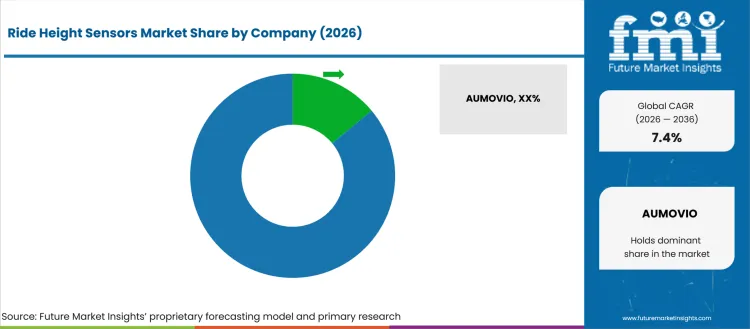
Supplier selection in ride height sensors depends on the layer of the vehicle program that the buyer wants to protect. AUMOVIO and FORVIA HELLA are more relevant for validated level sensing and OEM electronics access. Bosch and ZF become important once height data must feed wider vehicle-motion control. Denso, Hitachi Astemo and HL Mando suit Asian platform sourcing. Sensata, TE Connectivity and Arnott matter for focused sensor inputs and replacement coverage. The practical buyer question is whether sourcing needs a platform partner, a chassis-control partner or a service-channel specialist.
- AUMOVIO and FORVIA HELLA are relevant for OEMs that need validated electronics and chassis-position sensing. Continental’s spin-off documentation says AUMOVIO is an automotive electronics company that covers sensor solutions and comfort systems. FORVIA HELLA adds level-sensor and rotary-angle sensing depth for lighting and chassis applications. This keeps them relevant before platform drawings and validation packages are finalized.
- Bosch and ZF focus on vehicle motion control environments that use ride height information beyond a single component. Bosch describes Vehicle Motion Management across braking and steering. ZF supports chassis software and aftermarket reach for passenger cars and light commercial vehicles. That focus matters for OEMs coordinating body posture with broader movement software.
- Denso, Hitachi Astemo and HL Mando gain preference in Asian OEM programs due to platform relationships and chassis integration knowledge. HL Mando’s SDC Suspension system supports real-time ride comfort and handling control. That role makes local engineering access useful for ride-height sensor programs tied to Korean OEMs. This supports sourcing plans that depend on regional engineering access.
- Sensata Technologies, TE Connectivity and Arnott Suspension Products serve focused sensing and replacement needs. Sensata supports suspension pressure inputs for vehicle-height adjustment in control modules. TE Connectivity lists chassis-ready position sensing for travel or angle measurement. Arnott sells aftermarket ride height sensors for ECU and valve-block repair needs. This makes them useful across both OEM and service-channel decisions.
Competitive Benchmarking: Ride Height Sensors Market
| Company | Chassis Sensor Depth | OEM Validation Access | Diagnostic Output Readiness | Service Reach |
|---|---|---|---|---|
| AUMOVIO | High | High | Strong | Global |
| Bosch | High | High | Strong | Global |
| FORVIA HELLA | High | High | Strong | Global |
| ZF | Medium | High | Strong | Global |
| Denso | Medium | High | Medium | Global |
| TE Connectivity | Medium | Strong | Medium | Global |
| Sensata Technologies | Medium | Medium | Medium | Global |
| Hitachi Astemo | Medium | Strong | Medium | Japan and global |
| HL Mando | Medium | Strong | Medium | South Korea and global |
| Arnott Suspension Products | Regional | Medium | Strong | North America and Europe |
Source: Future Market Insights competitive analysis, 2026. Ratings reflect relative portfolio relevance, workflow or project fit, service capability, and geographic reach.
Key Developments in the Ride Height Sensors Market
- In March 2025, FORVIA HELLA introduced the Universal Angular Sensor using CIPOS technology for vehicle and industrial position measurement. Series production planned for 2026 supports future platform evaluation by OEM and special-vehicle buyers.
- In September 2025, AUMOVIO became an independent company following Continental’s separation of its automotive group sector. That portfolio fit improves relevance in chassis electronics sourcing discussions across comfort and safety systems.
- In September 2025, Bosch presented Vehicle Motion Management during its IAA Mobility 2025 portfolio showcase. Ride height signals gain value once OEMs use body-position data inside broader vehicle movement control. That shift supports new software-led sourcing discussions for chassis sensors.
- In July 2024, ZF expanded its cubiX vehicle motion control platform for ready-to-automate vehicle control. This is important due to cubiX coordination of chassis actuation across steering, braking and suspension domains. The market implication is clearer demand for reliable ride height inputs inside software-defined chassis programs. This reinforces the need for sensor inputs that software can trust.
Key Players in the Ride Height Sensors Market
Automotive Sensor and Electronics Suppliers
- AUMOVIO
- Bosch
- FORVIA HELLA
- TE Connectivity
Chassis System Suppliers
- ZF
- Denso
- Hitachi Astemo
- HL Mando
Suspension and Aftermarket Specialists
- Sensata Technologies
- Arnott Suspension Products
Ride Height Sensors Market - Report Scope
| Coverage field | Report scope |
|---|---|
| Market breakdown | Ride Height Sensors Market Breakdown By Sensor Type, Application, Vehicle Type, Sales Channel, Signal Output, and Region |
| Market Definition | Axle, suspension or chassis-mounted sensors that measure relative height between the vehicle body and wheel assembly for suspension, lighting and calibration functions |
| Regions Covered | North America, Latin America, Europe, East Asia, South Asia and Pacific, Middle East and Africa |
| Countries Covered | United States, United Kingdom, Germany, France, Japan, China, South Korea, India and 30+ countries |
| Key Companies Profiled | AUMOVIO, Bosch, FORVIA HELLA, ZF, Denso, TE Connectivity, Sensata Technologies, Hitachi Astemo, HL Mando, Arnott Suspension Products |
| Forecast Period | 2026 to 2036 |
| Approach | Hybrid bottom-up and top-down methodology using vehicle production, platform fitment, application use, sensor content and country-level vehicle electronics indicators |
Ride Height Sensors Market - Research Methodology
| Method | Approach |
|---|---|
| Primary Research | FMI analysts reviewed input from OEM platform teams, Tier-1 chassis suppliers, sensor distributors and aftermarket service specialists. Discussions focused on fitment rates, validation cycles, replacement risk and migration from analog output to diagnostics-ready digital signals. |
| Desk Research | Desk research covered regulator safety rules, official vehicle statistics, EV production data, trade-body releases and official company product pages. Sources were limited to government bodies, trade associations, standards-relevant company disclosures and supplier pressrooms used in the article. |
| Market Sizing and Forecasting | The model combined vehicle production, air suspension penetration, headlamp-leveling fitment, average sensors per vehicle and platform pricing bands. Forecasts were adjusted for premium SUV demand, EV chassis needs, regional OEM sourcing and replacement-channel visibility. |
| Data Validation | Forecasts were checked against vehicle electronics portfolios, safety-rule timing, EV production indicators and chassis-sensor product evidence. External statistics were allocated once before drafting, which avoided duplicate evidence across analytical sections and country comparisons. |
Ride Height Sensors Market by Segments
Ride Height Sensors Market segmented by Sensor Type:
- Rotary Position Sensors
- Linear Position Sensors
- Hall-effect Sensors
- Smart Integrated Sensors
Ride Height Sensors Market segmented by Application:
- Air Suspension
- Adaptive Headlamp Leveling
- Chassis Control
- ADAS Calibration / Other
Ride Height Sensors Market segmented by Vehicle Type:
- Passenger Cars
- Premium SUVs
- Commercial Vehicles
- EVs
Ride Height Sensors Market segmented by Sales Channel:
- OEM
- Aftermarket
Ride Height Sensors Market segmented by Signal Output:
- Analog
- Digital
- LIN / CAN Enabled
Ride Height Sensors Market by Region:
- North America
- United States
- Canada
- Mexico
- Latin America
- Brazil
- Chile
- Rest of Latin America
- Western Europe
- Germany
- UK
- Italy
- Spain
- France
- Nordic
- BENELUX
- Rest of Western Europe
- Eastern Europe
- Russia
- Poland
- Hungary
- Balkan & Baltic
- Rest of Eastern Europe
- East Asia
- China
- Japan
- South Korea
- South Asia and Pacific
- India
- ASEAN
- Australia & New Zealand
- Rest of South Asia and Pacific
- Middle East & Africa
- Kingdom of Saudi Arabia
- Other GCC Countries
- Turkiye
- South Africa
- Other African Union
- Rest of Middle East & Africa
Research Sources and Bibliography
- National Highway Traffic Safety Administration. (2024, April 29). NHTSA finalizes key safety rule to reduce crashes and save lives. USA Department of Transportation.
- International Energy Agency. (2026, May). Manufacturing and trade. Global EV Outlook 2026.
- International Energy Agency. (2026, May). Trends in electric cars. Global EV Outlook 2026.
- European Automobile Manufacturers’ Association. (2026, January 27). New car registrations: +1.8% in 2025; battery-electric 17.4% market share. ACEA.
- Department for Transport. (2026, April 29). Vehicle licensing statistics, United Kingdom: 2025. GOV.UK.
- Argonne National Laboratory. (2026). Light Duty Electric Drive Vehicles Monthly Sales Updates. Argonne National Laboratory.
- Society of Indian Automobile Manufacturers. (2025, April 15). Performance of auto industry in 2024-25. SIAM.
- Society of Indian Automobile Manufacturers. (2026, January 14). Auto industry performance of December 2025 and Q3 October-December 2025. SIAM.
- Invest Korea. (2025, December 5). Korea’s future mobility industry: Advancing through ecosystem development and global competitiveness. Invest Korea.
- USA International Trade Administration. (2025, November 20). Japan - Automotive. USA Department of Commerce.
- FORVIA HELLA. (2025, March 12). Precision and versatility: FORVIA HELLA introduces universal angular sensor with CIPOS technology. FORVIA HELLA.
- HELLA Tech World. (2025). HELLA vehicle level sensor - precision for driving comfort and safety. FORVIA HELLA.
- Sensata Technologies. (2026). Suspension pressure sensors SPS. Sensata Technologies.
- Continental. (2026). Spin-off Automotive Group Sector. Continental.
- AUMOVIO. (2025, September 18). AUMOVIO makes successful stock market debut. AUMOVIO.
- Bosch Mobility. (2025, September 8). IAA Mobility 2025: Bosch is shaping the new vehicle world with intelligent hardware and software solutions. Bosch.
- Bosch Mobility. (2026). Vehicle Motion Management. Bosch Mobility.
- TE Connectivity. (2026). List of sensors products for powertrain and chassis. TE Connectivity.
- TE Connectivity. (2026). Linear platform position sensor Hall. TE Connectivity.
- Arnott Suspension Products. (2026). Ride height sensors. Arnott Suspension Products.
- HL Mando. (2026). SDC Suspension. HL Mando.
- ZF Aftermarket. (2026). Passenger Cars and LCV. ZF.
- ZF. (2024, July 2). The new nerve center: ZF expands its cubiX vehicle motion control platform. ZF.
- International Energy Agency. (2026, May 20). Close to 30% of cars sold this year are set to be electric as countries and consumers respond to energy crisis. IEA.
This bibliography is provided for reader reference and uses primary government, standards-body, official trade body, and company sources.
This Report Answers
- What is the expected global value of the Ride Height Sensors Market in 2026 and 2036?
- What CAGR is forecast for ride height sensors during the 2026 to 2036 period?
- Which sensor type is expected to show notable share in Ride Height Sensors Market demand in 2026?
- Why do OEMs and Tier-1 chassis suppliers buy ride height sensors for suspension and lighting systems?
- How do air suspension and adaptive headlamp leveling support ride height sensor use?
- Which countries are compared in the ride height sensors forecast?
- Which companies compete across chassis electronics, position sensing and aftermarket replacement channels?
- What sensor types and applications are included within the Ride Height Sensors Market scope?
- How does FMI size and forecast ride height sensor demand across segments and countries?
- What buyer-selection factors should executives assess before sourcing ride height sensors?
Frequently Asked Questions
Why should executives track the Ride Height Sensors Market?
Executives should track this market because ride height sensors support suspension control, headlamp leveling, chassis software, and vehicle calibration workflows.
What business problem does the Ride Height Sensors Market address?
It helps OEMs, Tier-1 suppliers, and service networks measure vehicle body position accurately for suspension adjustment, lamp alignment, and repair calibration.
What should procurement leaders evaluate before selecting suppliers?
Procurement leaders should compare sealing performance, signal stability, ECU compatibility, diagnostic-output capability, OEM validation experience, connector fitment, global service support, and documentation for calibration and aftermarket servicing.
What can limit return on investment for buyers?
Return on investment can be delayed when sensor validation requirements differ across vehicle platforms, regional architectures, and legacy electrical systems.
How can suppliers build executive confidence?
Suppliers build confidence by demonstrating long-term durability under vibration and harsh environmental conditions.
Preview the report firsthand - request a free sample
Get SampleGet the brochure for pricing and purchase details.
Get PDFTable of Content
- Key Takeaways
- Market Size and CAGR
- Top Growth Driver
- Fastest Growing Segment
- Leading Region
- Key Companies
- Emerging Opportunities
- Executive Summary
- Global Market Outlook
- Demand-side Trends
- Supply-side Trends
- Technology Roadmap Analysis
- Analysis and Recommendations
- Analyst Perspective (What is happening? Why now? What should investors know?)
- Key Questions Answered
- How large is the market?
- What is the CAGR?
- What are key trends?
- Which region dominates?
- Who are the leaders?
- Market Overview
- Market Coverage / Taxonomy
- Market Definition / Scope / Limitations
- Research Methodology
- Chapter Orientation
- Analytical Lens and Working Hypotheses
- Market Structure, Signals, and Trend Drivers
- Benchmarking and Cross-market Comparability
- Market Sizing, Forecasting, and Opportunity Mapping
- Research Design and Evidence Framework
- Desk Research Programme (Secondary Evidence)
- Expert Input and Fieldwork (Primary Evidence)
- Tooling, Models, and Reference Databases
- Data Engineering and Model Build
- Quality Assurance and Audit Trail
- Market Background
- Market Dynamics (Drivers, Restraints, Opportunity, Trends)
- Scenario Forecast (Optimistic, Likely, Conservative)
- Impact Analysis
- AI Impact
- Sustainability Impact
- Regulatory Impact
- Technology Impact
- Consumer / Buyer Analysis
- Purchase Drivers
- Adoption Barriers
- Buyer Journey
- Opportunity Map Analysis
- Product Life Cycle Analysis
- Supply Chain Analysis
- Investment Feasibility Matrix
- Value Chain Analysis
- PESTLE and Porter's Analysis
- Regulatory Landscape
- Regional Parent Market Outlook
- Production and Consumption Statistics
- Import and Export Statistics
- Global Market Analysis and Forecast, 2021 to 2036
- Historical Market Size Value (USD Million) & Volume (Unit) Analysis, 2021 to 2025
- Current and Future Market Size Value (USD Million) & Volume (Unit) Projections, 2026 to 2036
- Y-o-Y Growth Trend Analysis
- Absolute $ Opportunity Analysis
- Global Market Pricing Analysis, 2021 to 2036
- Global Market Analysis and Forecast, By Sensor Type, 2021 to 2036
- Introduction / Key Findings
- Historical Market Size Value (USD Million) & Volume (Unit) Analysis By Sensor Type, 2021 to 2025
- Current and Future Market Size Value (USD Million) & Volume (Unit) Analysis and Forecast By Sensor Type, 2026 to 2036
- Rotary Position Sensors
- Linear Position Sensors
- Hall-effect Sensors
- Smart Integrated Sensors
- Rotary Position Sensors
- Y-o-Y Growth Trend Analysis By Sensor Type, 2021 to 2025
- Absolute $ Opportunity Analysis By Sensor Type, 2026 to 2036
- Global Market Analysis and Forecast, By Application, 2021 to 2036
- Introduction / Key Findings
- Historical Market Size Value (USD Million) & Volume (Unit) Analysis By Application, 2021 to 2025
- Current and Future Market Size Value (USD Million) & Volume (Unit) Analysis and Forecast By Application, 2026 to 2036
- Air Suspension
- Adaptive Headlamp Leveling
- ADAS Calibration / Other
- Chassis Control
- Air Suspension
- Y-o-Y Growth Trend Analysis By Application, 2021 to 2025
- Absolute $ Opportunity Analysis By Application, 2026 to 2036
- Global Market Analysis and Forecast, By Vehicle Type, 2021 to 2036
- Introduction / Key Findings
- Historical Market Size Value (USD Million) & Volume (Unit) Analysis By Vehicle Type, 2021 to 2025
- Current and Future Market Size Value (USD Million) & Volume (Unit) Analysis and Forecast By Vehicle Type, 2026 to 2036
- Passenger Cars
- Premium SUVs
- EVs
- Commercial Vehicles
- Passenger Cars
- Y-o-Y Growth Trend Analysis By Vehicle Type, 2021 to 2025
- Absolute $ Opportunity Analysis By Vehicle Type, 2026 to 2036
- Global Market Analysis and Forecast, By Sales Channel, 2021 to 2036
- Introduction / Key Findings
- Historical Market Size Value (USD Million) & Volume (Unit) Analysis By Sales Channel, 2021 to 2025
- Current and Future Market Size Value (USD Million) & Volume (Unit) Analysis and Forecast By Sales Channel, 2026 to 2036
- OEM
- Aftermarket
- OEM
- Y-o-Y Growth Trend Analysis By Sales Channel, 2021 to 2025
- Absolute $ Opportunity Analysis By Sales Channel, 2026 to 2036
- Global Market Analysis and Forecast, By Signal Output, 2021 to 2036
- Introduction / Key Findings
- Historical Market Size Value (USD Million) & Volume (Unit) Analysis By Signal Output, 2021 to 2025
- Current and Future Market Size Value (USD Million) & Volume (Unit) Analysis and Forecast By Signal Output, 2026 to 2036
- Analog
- Digital
- LIN / CAN Enabled
- Analog
- Y-o-Y Growth Trend Analysis By Signal Output, 2021 to 2025
- Absolute $ Opportunity Analysis By Signal Output, 2026 to 2036
- Global Market Analysis and Forecast, By Region, 2021 to 2036
- Introduction
- Historical Market Size Value (USD Million) & Volume (Unit) Analysis By Region, 2021 to 2025
- Current Market Size Value (USD Million) & Volume (Unit) Analysis and Forecast By Region, 2026 to 2036
- North America
- Latin America
- Western Europe
- Eastern Europe
- East Asia
- South Asia and Pacific
- Middle East & Africa
- Market Attractiveness Analysis By Region
- North America Market Analysis and Forecast, By Country, 2021 to 2036
- Historical Market Size Value (USD Million) & Volume (Unit) Trend Analysis By Market Taxonomy, 2021 to 2025
- Market Size Value (USD Million) & Volume (Unit) Forecast By Market Taxonomy, 2026 to 2036
- By Country
- USA
- Canada
- Mexico
- By Sensor Type
- By Application
- By Vehicle Type
- By Sales Channel
- By Signal Output
- By Country
- Market Attractiveness Analysis
- By Country
- By Sensor Type
- By Application
- By Vehicle Type
- By Sales Channel
- By Signal Output
- Key Takeaways
- Latin America Market Analysis and Forecast, By Country
- Historical Market Size Value (USD Million) & Volume (Unit) Trend Analysis By Market Taxonomy, 2021 to 2025
- Market Size Value (USD Million) & Volume (Unit) Forecast By Market Taxonomy, 2026 to 2036
- By Country
- Brazil
- Chile
- Rest of Latin America
- By Sensor Type
- By Application
- By Vehicle Type
- By Sales Channel
- By Signal Output
- By Country
- Market Attractiveness Analysis
- By Country
- By Sensor Type
- By Application
- By Vehicle Type
- By Sales Channel
- By Signal Output
- Key Takeaways
- Western Europe Market Analysis and Forecast, By Country
- Historical Market Size Value (USD Million) & Volume (Unit) Trend Analysis By Market Taxonomy, 2021 to 2025
- Market Size Value (USD Million) & Volume (Unit) Forecast By Market Taxonomy, 2026 to 2036
- By Country
- Germany
- UK
- Italy
- Spain
- France
- Nordic
- BENELUX
- Rest of Western Europe
- By Sensor Type
- By Application
- By Vehicle Type
- By Sales Channel
- By Signal Output
- By Country
- Market Attractiveness Analysis
- By Country
- By Sensor Type
- By Application
- By Vehicle Type
- By Sales Channel
- By Signal Output
- Key Takeaways
- Eastern Europe Market Analysis and Forecast, By Country
- Historical Market Size Value (USD Million) & Volume (Unit) Trend Analysis By Market Taxonomy, 2021 to 2025
- Market Size Value (USD Million) & Volume (Unit) Forecast By Market Taxonomy, 2026 to 2036
- By Country
- Russia
- Poland
- Hungary
- Balkan & Baltic
- Rest of Eastern Europe
- By Sensor Type
- By Application
- By Vehicle Type
- By Sales Channel
- By Signal Output
- By Country
- Market Attractiveness Analysis
- By Country
- By Sensor Type
- By Application
- By Vehicle Type
- By Sales Channel
- By Signal Output
- Key Takeaways
- East Asia Market Analysis and Forecast, By Country
- Historical Market Size Value (USD Million) & Volume (Unit) Trend Analysis By Market Taxonomy, 2021 to 2025
- Market Size Value (USD Million) & Volume (Unit) Forecast By Market Taxonomy, 2026 to 2036
- By Country
- China
- Japan
- South Korea
- By Sensor Type
- By Application
- By Vehicle Type
- By Sales Channel
- By Signal Output
- By Country
- Market Attractiveness Analysis
- By Country
- By Sensor Type
- By Application
- By Vehicle Type
- By Sales Channel
- By Signal Output
- Key Takeaways
- South Asia and Pacific Market Analysis and Forecast, By Country
- Historical Market Size Value (USD Million) & Volume (Unit) Trend Analysis By Market Taxonomy, 2021 to 2025
- Market Size Value (USD Million) & Volume (Unit) Forecast By Market Taxonomy, 2026 to 2036
- By Country
- India
- ASEAN
- Australia & New Zealand
- Rest of South Asia and Pacific
- By Sensor Type
- By Application
- By Vehicle Type
- By Sales Channel
- By Signal Output
- By Country
- Market Attractiveness Analysis
- By Country
- By Sensor Type
- By Application
- By Vehicle Type
- By Sales Channel
- By Signal Output
- Key Takeaways
- Middle East & Africa Market Analysis and Forecast, By Country
- Historical Market Size Value (USD Million) & Volume (Unit) Trend Analysis By Market Taxonomy, 2021 to 2025
- Market Size Value (USD Million) & Volume (Unit) Forecast By Market Taxonomy, 2026 to 2036
- By Country
- Kingdom of Saudi Arabia
- Other GCC Countries
- Türkiye
- South Africa
- Other African Union
- Rest of Middle East & Africa
- By Sensor Type
- By Application
- By Vehicle Type
- By Sales Channel
- By Signal Output
- By Country
- Market Attractiveness Analysis
- By Country
- By Sensor Type
- By Application
- By Vehicle Type
- By Sales Channel
- By Signal Output
- Key Takeaways
- Key Countries Market Analysis
- USA
- Pricing Analysis
- Market Share Analysis, 2025
- By Sensor Type
- By Application
- By Vehicle Type
- By Sales Channel
- By Signal Output
- Canada
- Pricing Analysis
- Market Share Analysis, 2025
- By Sensor Type
- By Application
- By Vehicle Type
- By Sales Channel
- By Signal Output
- Mexico
- Pricing Analysis
- Market Share Analysis, 2025
- By Sensor Type
- By Application
- By Vehicle Type
- By Sales Channel
- By Signal Output
- Brazil
- Pricing Analysis
- Market Share Analysis, 2025
- By Sensor Type
- By Application
- By Vehicle Type
- By Sales Channel
- By Signal Output
- Chile
- Pricing Analysis
- Market Share Analysis, 2025
- By Sensor Type
- By Application
- By Vehicle Type
- By Sales Channel
- By Signal Output
- Germany
- Pricing Analysis
- Market Share Analysis, 2025
- By Sensor Type
- By Application
- By Vehicle Type
- By Sales Channel
- By Signal Output
- UK
- Pricing Analysis
- Market Share Analysis, 2025
- By Sensor Type
- By Application
- By Vehicle Type
- By Sales Channel
- By Signal Output
- Italy
- Pricing Analysis
- Market Share Analysis, 2025
- By Sensor Type
- By Application
- By Vehicle Type
- By Sales Channel
- By Signal Output
- Spain
- Pricing Analysis
- Market Share Analysis, 2025
- By Sensor Type
- By Application
- By Vehicle Type
- By Sales Channel
- By Signal Output
- France
- Pricing Analysis
- Market Share Analysis, 2025
- By Sensor Type
- By Application
- By Vehicle Type
- By Sales Channel
- By Signal Output
- India
- Pricing Analysis
- Market Share Analysis, 2025
- By Sensor Type
- By Application
- By Vehicle Type
- By Sales Channel
- By Signal Output
- ASEAN
- Pricing Analysis
- Market Share Analysis, 2025
- By Sensor Type
- By Application
- By Vehicle Type
- By Sales Channel
- By Signal Output
- Australia & New Zealand
- Pricing Analysis
- Market Share Analysis, 2025
- By Sensor Type
- By Application
- By Vehicle Type
- By Sales Channel
- By Signal Output
- China
- Pricing Analysis
- Market Share Analysis, 2025
- By Sensor Type
- By Application
- By Vehicle Type
- By Sales Channel
- By Signal Output
- Japan
- Pricing Analysis
- Market Share Analysis, 2025
- By Sensor Type
- By Application
- By Vehicle Type
- By Sales Channel
- By Signal Output
- South Korea
- Pricing Analysis
- Market Share Analysis, 2025
- By Sensor Type
- By Application
- By Vehicle Type
- By Sales Channel
- By Signal Output
- Russia
- Pricing Analysis
- Market Share Analysis, 2025
- By Sensor Type
- By Application
- By Vehicle Type
- By Sales Channel
- By Signal Output
- Poland
- Pricing Analysis
- Market Share Analysis, 2025
- By Sensor Type
- By Application
- By Vehicle Type
- By Sales Channel
- By Signal Output
- Hungary
- Pricing Analysis
- Market Share Analysis, 2025
- By Sensor Type
- By Application
- By Vehicle Type
- By Sales Channel
- By Signal Output
- Kingdom of Saudi Arabia
- Pricing Analysis
- Market Share Analysis, 2025
- By Sensor Type
- By Application
- By Vehicle Type
- By Sales Channel
- By Signal Output
- Türkiye
- Pricing Analysis
- Market Share Analysis, 2025
- By Sensor Type
- By Application
- By Vehicle Type
- By Sales Channel
- By Signal Output
- South Africa
- Pricing Analysis
- Market Share Analysis, 2025
- By Sensor Type
- By Application
- By Vehicle Type
- By Sales Channel
- By Signal Output
- USA
- Market Structure Analysis
- Competition Dashboard
- Competition Benchmarking
- Market Share Analysis of Top Players
- By Regional
- By Sensor Type
- By Application
- By Vehicle Type
- By Sales Channel
- By Signal Output
- Emerging Startups
- Innovation Benchmarking
- Competition Analysis
- Competition Deep Dive
- AUMOVIO
- Overview
- Product Portfolio
- Profitability by Market Segments (Product/Region/Sales Channel)
- Sales Footprint
- Strategy Overview
- Marketing Strategy
- Product Strategy
- Channel Strategy
- Bosch
- FORVIA HELLA
- TE Connectivity
- ZF
- Denso
- AUMOVIO
- Case Studies
- Success Stories
- Recent Developments
- Competition Deep Dive
- Assumptions & Acronyms Used


