

- Market Size (2026)
- USD 350.3 Mn
- Forecast (2036)
- USD 523.5 Mn
- CAGR (2026 to 2036)
- 4.1%
How big is Rotisserie Chicken Bags Market in 2026?
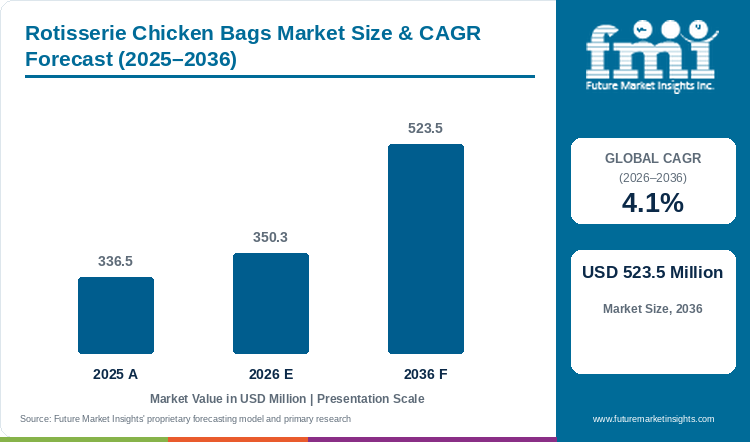
Tracking from USD 336.5 million in 2025 to USD 350.3 million in 2026, the global rotisserie chicken bags market valuation is projected to hit USD 523.5 million by 2036, backed by a 4.1% CAGR.
Grocery chains and warehouse clubs are replacing bulky two-piece rigid plastic clamshell domes with flexible rotisserie chicken bags to reduce packaging resin weight by up to 75% and reclaim scarce back-room storage space. Strong consumer appetite for ready-to-eat hot poultry meals underpins this format conversion; for instance, July 2026 data from the U.S. Department of Agriculture Economic Research Service confirms elevated prepared-meal and away-from-home food demand across the USA in 2025 [1]. Because deli staff need pouches that stand upright on slanted warming shelves while venting steam, the zippered stand-up handle pouches with anti-fog windows segment is projected to capture 46.8% of 2026 demand share across stand up zipper pouches converters, taking global rotisserie chicken bags market size beyond USD 336.5 million in 2025 so 2026 reaches USD 350.3 million and 2036 totals USD 523.5 million on a 4.1% CAGR that adds USD 173.2 million in cumulative market growth. Even so, hot rendered chicken fat at 85 to 105 degrees Celsius can weaken conventional laminating adhesives and restrain rapid adoption of uncertified mono-material films.
Key Market Trends & Insights
- By format type: Zippered stand-up handle pouches with anti-fog windows are projected to capture 46.8% in 2026, supported by upright hot-island display stability and reclosable carry security.
- By material: Bi-axially oriented & cast polypropylene (BOPP / CPP laminates) are expected to secure 41.4% in 2026, driven by microwave reheating compatibility and high hot-tack seal strength.
- By format size: Standard whole-bird pouches (2.5 lb to 4.0 lb) are estimated to hold 55.6% of bird sizes in 2026, supported by uniform retail roast-chicken carcass weights and bottom-gusset cradle geometry.
- By end use: Supermarket & hypermarket hot delis are forecast to register 54.2% across end-use counters in 2026, driven by daily loss-leader rotisserie poultry programs across grocery chains.
- By sales channel: Broadline foodservice & grocery supply distributors are anticipated to garner 44.8% within grocery channels in 2026, linked to routine weekly store-door replenishment of deli consumables.
Regional Highlights
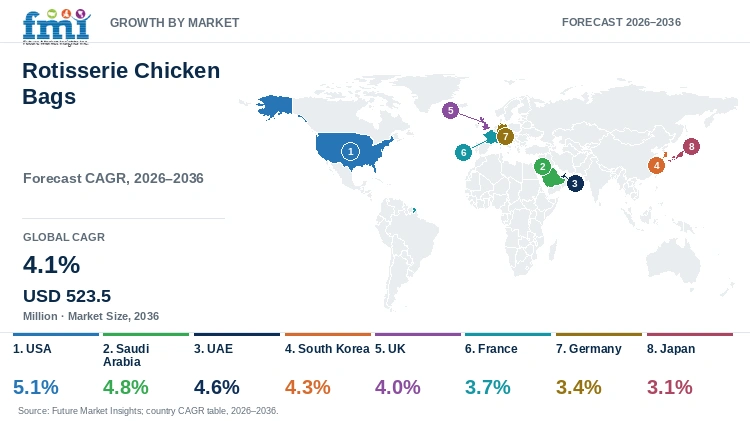
- Top national growth: Supermarket dome-to-pouch conversions place the USA at a leading 5.1% CAGR through 2036, trailed by Saudi Arabia (4.8%).
- Regional deli progression: Hot-deli pouch orders in the UAE post a 4.6% CAGR and South Korea records 4.3%, while the UK registers 4.0% and France logs 3.7% above Germany at 3.4% and Japan at 3.1%.
Market Size & Forecast
Table 1: Market Size and Forecast for the Rotisserie Chicken Bags Market (USD million and CAGR percentage), 2025 to 2036
| Metric | Value |
|---|---|
| 2025 Market Size | USD 336.5 million |
| Estimated Market Size in 2026 | USD 350.3 million |
| Projected Market Size by 2036 | USD 523.5 million |
| CAGR, 2026 to 2036 | 4.1% |
| Added Revenue, 2026 to 2036 | USD 173.2 million |
Inflation-conscious households are substituting expensive restaurant dining with ready-to-eat supermarket rotisserie chickens that serve as an affordable weekday family entrée. Expenditure records released in June 2026 by the U.S. Department of Agriculture Economic Research Service show that prepared meal and away-from-home food spending in the USA reached USD 1.41 trillion in 2025 within a USD 2.51 trillion total food market [2]. To handle peak evening commuter volume without crowding deli storage rooms with nested plastic trays, grocery chains are converting to flat-packed premade pouch packaging that reduces inbound warehouse pallet freight by more than 80%.
Hot-Pouch Converting Throughput and Film Web Tonnage Sizing
Table 2: Hot-Pouch Converting Throughput and Film Web Tonnage Sizing for the Rotisserie Chicken Bags Market (USD million and operational ranges), 2025 to 2036
| Metric | 2025 | 2026 | 2036 |
|---|---|---|---|
| Market size (USD million) | 336.5 | 350.3 | 523.5 |
| Converted rotisserie chicken bags shipped (billion units) | 4.45 to 4.75 | 4.65 to 4.95 | 6.55 to 7.05 |
| Flexible polymer film and foil-kraft web input (thousand metric tons) | 64.5 to 69.0 | 67.0 to 71.8 | 92.0 to 99.5 |
| Average wholesale converter price per 1,000 hot-chicken bags (USD) | 70.8 to 75.6 | 71.0 to 75.5 | 74.5 to 79.8 |
Operational note: Unit and web tonnage ranges reflect 13.5-to-15.5-gram stand-up zippered BOPP/CPP or PET-PE pouches and foil-lined greaseproof paper bags running on high-speed pouch-making lines at 110 to 160 cycles per minute.
Clear window visibility on heated retail islands on heated retail islands is a primary commercial priority for supermarket deli managers because unsold birds must be marked down after four hours. To keep viewing panels crystal clear while preventing hot poultry juices from splitting the bottom gusset, converters apply internal anti-fog coatings and laminate heat-resistant webs across polypropylene packaging films with reinforced K-seal geometry.
Per Capita & Supermarket Hot-Deli Counter Sizing
Table 3: Per Capita and Supermarket Hot-Deli Spending Indicators for the Rotisserie Chicken Bags Market (USD), 2025 to 2036
| Metric | 2025 | 2026 | 2036 |
|---|---|---|---|
| Global population (billion) | 8.2 | 8.3 | 9.0 |
| Market value per 1,000 people (USD) | 41.0 | 42.2 | 58.2 |
| Annual rotisserie bag procurement per supermarket hot deli (USD) | 1,420 to 1,680 | 1,460 to 1,730 | 1,980 to 2,340 |
| Mono-material recyclable polyolefin and paper-foil share (%) | 48.0% to 51.5% | 51.0% to 54.5% | 74.0% to 78.5% |
Table 4: Deli Channel & Segment Allocation Indicators for the Rotisserie Chicken Bags Market (USD and percentages), 2026
| Metric | Value | Institutional Reference Basis |
|---|---|---|
| Market size, 2026 | USD 350.3 million | 2026 global rotisserie chicken bags baseline |
| Supermarket, club, and roaster counters globally | 215,000 counters | Global retail hot-deli and rotisserie counter footprint |
| Zippered stand-up anti-fog pouch allocation, 2026 | USD 163.9 million | 46.8% format type segment allocation |
| Supermarket & hypermarket hot-deli allocation, 2026 | USD 189.9 million | 54.2% end-use segment allocation |
Counter labor speed during late-afternoon oven unloads directly impacts store deli profitability because slow manual bagging creates bottlenecks and cools the product before sealing. By pairing wide-mouth wicketed openings with dual-track reclosable zipper packaging closures, converters allow deli staff to slide hot chickens off the spit in seconds while giving households a leak-tight resealable bag for refrigerator storage.
Analyst Perspective
"Supermarket and warehouse-club deli buyers convert from rigid plastic domes to rotisserie chicken bags because flexible stand-up pouches cut resin weight by three-quarters and free up scarce back-of-house storage space. Converters that pair 110-degree-Celsius hot-fat seal integrity with crystal-clear anti-fog windows and mono-polyolefin recyclability will win national grocery contracts."
- Nandini Roy Choudhury, Principal Consultant, Future Market Insights.
How is the rotisserie chicken bags market segmented?
The rotisserie chicken bags market is segmented by format type, material, format size, end use, and sales channel. In 2026, zippered stand-up handle pouches with anti-fog windows are projected at 46.8%, BOPP / CPP laminates at 41.4%, standard whole-bird pouches at 55.6%, supermarket & hypermarket hot delis at 54.2%, and broadline foodservice & grocery supply distributors at 44.8%.
By format type: Zippered stand-up handle pouches with anti-fog windows, foil-lined & metallized grease-barrier kraft bags, flat & side-gusseted vented hot-food bags, and tamper-evident & heat-sealable delivery pouches.
By material: Bi-axially oriented & cast polypropylene (BOPP / CPP laminates), polyester & polyethylene co-extruded films (PET / rPET-PE), greaseproof kraft paper & aluminum-foil laminates, and compostable & bio-based barrier films.
By format size: Standard whole-bird pouch (2.5 lb to 4.0 lb), half-bird, wing & quarter-portion bag (under 2.5 lb), and jumbo roaster & family combo pouch (above 4.0 lb).
By end use: Supermarket & hypermarket hot delis, warehouse clubs & discount supercenters, quick-service & rotisserie chicken restaurants, and independent butcheries, specialty roasters & meal-delivery kitchens.
By sales channel: Broadline foodservice & grocery supply distributors and direct supermarket chain contracts as well as specialty flexible bag wholesalers and B2B e-commerce portals.
Why do Zippered stand-up handle pouches with anti-fog windows lead Format Type?
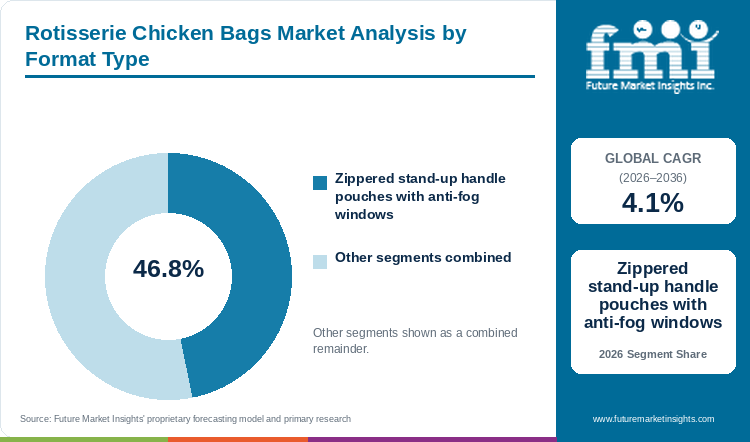
Upright hot-case visibility puts the zippered stand-up handle pouches with anti-fog windows segment at 46.8% projected format share in 2026.
Table 5: Format Type Share for the Rotisserie Chicken Bags Market (percentage share), 2026
| Format Type | Share (2026) |
|---|---|
| Zippered stand-up handle pouches with anti-fog windows | 46.8% |
| Other Segments Combined | 53.2%* |
| Total | 100.0% |
*Calculated as the balance remaining after deducting the leading segment's reported share from 100.0%.
Table 6: Format Type Leadership and Market Growth for the Rotisserie Chicken Bags Market (segment and CAGR percentage), 2026 to 2036
| Metric | Value |
|---|---|
| Global CAGR (2026 to 2036) | 4.1% |
| Leading Segment | Zippered stand-up handle pouches with anti-fog windows |
Deli merchandisers require a package that stands upright on slanted heated displays like a rigid dome tray while cutting plastic weight per bird by three-quarters, driving grocery buyers toward gusseted stand-up zipper pouches on pouch packaging wicketed racks. At the same time, traditional butcher counters and European grocers seeking fiber-forward alternatives sustain parallel demand for foil-lined and greaseproof paper roast bags; September 2026 AF&PA industry data shows August 2026 packaging papers and specialty packaging output climbed 4% from a year earlier while unbleached bag and sack deliveries hit a record 119,000 short tons [3].
- Rapid wicketed counter loading and spill-resistant carry handles give the zippered stand-up handle pouches with anti-fog windows sub-segment a projected 46.8% format share in 2026 over foil-lined paper bags.
- Competition between flexible stand-up pouches and rigid hot-case containers pushes packaging suppliers to upgrade heat-lamp durability and grease resistance; in August 2026, Institute of Packaging Professionals judges honored Sabert Corporation with dual 2026 AmeriStar Awards covering its heat-lamp-safe r-PRO recycled polypropylene line and Pulp Ultra fiber [4].
How do Bi-axially oriented & cast polypropylene laminates lead the Material category?
Microwave reheating safety places the bi-axially oriented & cast polypropylene (BOPP / CPP laminates) segment at 41.4% expected substrate share in 2026.
Four-hour display of whole roasted chickens under 105-degree-Celsius heat lamps and reheating in household microwaves requires film laminations that resist seal creep and odor migration when exposed to hot rendered fat. Because strict food-contact inspection rules penalize unverified recycled resins in high-temperature fatty applications, grocery buyers continue to specify virgin-interior BOPP/CPP laminates across packaging barrier films programs. Updated January 2026 FDA compliance guidance reinforces strict biennial facility registration and safety inspection standards under Section 415 of the FD&C Act for food-packing operations in the USA [5].
- High optical gloss and wing-bone puncture resistance secure an expected 41.4% share of 2026 material volume for the bi-axially oriented & cast polypropylene laminates sub-segment.
- Retailers seeking lower polymer content in protein departments are also evaluating barrier-lined paperboard and foil-paper structures, illustrated in August 2025 when Graphic Packaging International expanded its barrier-lined PaperSeal Pressed protein portfolio [6].
What sustains Standard whole-bird pouches as the principal Format Size?
Uniform supermarket broiler weights put the standard whole-bird pouch (2.5 lb to 4.0 lb) segment at an estimated 55.6% share in 2026.
Retail grocery rotisserie programs overwhelmingly roast whole 2.5-pound to 4.0-pound broiler chickens that require a 10-inch by 12-inch pouch with a 4-inch bottom gusset to prevent the bird from tipping and pooling hot juice against the zipper. Standardizing on one whole-bird pouch size simplifies wicketed bag-rack hardware across thousands of supermarket delis and reduces film trim waste on packaging films slitting lines.
- Standardized wicketed rack dimensions enable the standard whole-bird pouch sub-segment to hold an estimated 55.6% capacity share in 2026.
- To help high-volume commissaries and grocery delis pack standardized poultry portions faster with less manual labor, packaging suppliers are integrating automated sealing equipment; in June 2025, Duni Group acquired a majority stake in Finland-based machinery specialist LinePack Oy [7].
Why are Supermarket & hypermarket hot delis the largest End Use?
Daily evening roast-chicken programs lift the supermarket & hypermarket hot delis segment to 54.2% forecast demand share in 2026.
Supermarket and hypermarket chains price hot rotisserie chickens as evening meal magnets and pack tens of thousands of whole birds per banner every day. Switching from two-piece rigid polypropylene domes to flexible stand-up pouches cuts per-bird packaging cost by 25% to 35% while allowing a single grocery store to store an entire month's pouch supply under the preparation counter with flexible plastic packaging consumables.
- High daily whole-bird volume and corporate plastic-weight reduction targets enable the supermarket & hypermarket hot delis sub-segment to capture 54.2% forecast end-use share in 2026.
- Strong grocery takeaway demand for both flexible film pouches and thermal foil-lined kraft bags keeps converting substrate mills running near capacity; in July 2026, the American Forest & Paper Association reported that June 2026 bleached packaging paper operating rates reached 91.3% as unbleached bag and sack shipments rose nearly 15% year-over-year [8].
How do Broadline foodservice & grocery supply distributors shape Sales Channel demand?
Store-door replenishment across multi-banner grocers secures an anticipated 44.8% channel share in 2026 for the broadline foodservice & grocery supply distributors segment.
Regional grocery chains and independent supermarkets along with takeaway chicken roasters procure hot-chicken bags through broadline foodservice and grocery supply distributors that bundle pouches with foil wraps and thermal labels. Broadline warehousing protects store delis from stockouts during holiday and weekend demand spikes while providing audited food-contact compliance documentation.
- Multi-site grocery fulfillment and low minimum case quantities position the broadline foodservice & grocery supply distributors sub-segment for an anticipated 44.8% channel share in 2026.
- Global bag converters are building regional manufacturing plants near major grocery distribution centers to shorten replenishment lead times; in July 2026, Detmold Group's Detpak division commissioned its Spartanburg plant in South Carolina to serve accounts across the USA [9].
What are the drivers, restraints, and opportunities in the rotisserie chicken bags market?
Across the rotisserie chicken bags market, supermarket conversions from rigid plastic domes to space-saving pouches fuel volume growth whereas hot-fat seal validation and EPR fees restrain unverified substrates and recyclable mono-polyolefin structures create redesign opportunities.
- Driver: Grocery chain and warehouse-club transitions from bulky rigid plastic clamshells to lightweight anti-fog stand-up pouches cut resin weight by up to 75% and reduce warehouse freight.
- Restraint: High hot-case holding temperatures (85°C to 105°C) and purging poultry fat challenge seal integrity and recycled-resin migration limits plus post-consumer municipal recycling.
- Opportunity: All-polypropylene mono-material pouches and fluorochemical-free foil-lined kraft roast bags capture retailer sustainability tenders under European and UK EPR fee regimes.
Growth Analysis and Future Potential: Qualitative Demand Catalysts
Supermarket hot delis and warehouse clubs convert from two-piece rigid plastic domes to flexible rotisserie chicken bags because one truckload of flat wicketed pouches replaces roughly six truckloads of nested thermoformed bases and lids. Beyond logistics savings, comfort-grip carry handles and dual-track zippers prevent hot chicken jus from spilling inside shopper grocery bags or courier delivery totes. In April 2026, Sabert Corporation released its 2025 Sustainability Report setting a 2030 target of 85% recyclable or compostable packaging after launching 481 new products in 2025 [10]. Retailers consolidating procurement across flexible packaging paper and polymer pouches increasingly award multi-year contracts to converters offering both film and paper-foil bag options.
Risk Assessment of the Rotisserie Chicken Bags Market: Operational and Formulation Friction
Qualification of a flexible pouch for hot whole poultry is far more demanding than ambient dry-food bagging because hot rendered chicken fat attacks solvent-based laminating adhesives and weakens heat seals during four-hour warming-cabinet holds. Simultaneously, regulatory rules are tightening across Europe and North America. Implementation guidance from Brussels covering Regulation (EU) 2025/40 packaging rules confirms strict design-for-recycling and PFAS food-contact rules applying from August 2026 [11]. When multi-layer PET-PE or aluminum-foil-paper laminates incur higher extended producer responsibility fees due to non-recyclability, grocery buyers pressure converters to prove mono-material performance without raising unit bag prices.
Commercial Opportunity Analysis: Formulation Differentiation and Value-Add Formats
Flexible packaging converters can capture premium grocery contracts by engineering mono-material BOPP/CPP stand-up pouches and PFAS-free greaseproof paper-window bags that pass both 105-degree-Celsius leak testing and national recyclability audits. In October 2026, Huhtamaki Oyj extended its EUR 450 million sustainability-linked syndicated credit facility supporting its EUR 4.0 billion global foodservice and flexible packaging network across 35 countries [12], while Dart Container Corporation scaled its Pennsylvania molded-fiber plant in October 2026 [13]. To keep flexible bags competitive against fiber trays, film converters are deploying micro-perforated films for packaging and high-clarity mono-PP webs that qualify for lower EPR fee tiers.
Rotisserie Chicken Bags Market by Country (2026 to 2036)
Grocery hot-counter models rank the USA first in national rotisserie chicken bag expansion with a 5.1% CAGR to 2036, trailed by Saudi Arabia (4.8%) and the UAE (4.6%) plus South Korea (4.3%). Across European and East Asian grocery delis, demand in the UK rises at a 4.0% CAGR and France at 3.7%, while Germany posts 3.4% and Japan logs 3.1% under extended producer responsibility fee modulation.
Table 7: Country CAGR and Primary Growth Levers for the Rotisserie Chicken Bags Market (CAGR percentage and operational drivers), 2026 to 2036
| Country | CAGR (2026 to 2036) | Primary Growth Lever |
|---|---|---|
| USA | 5.1% | Warehouse-club and supermarket transitions from rigid PET domes to wicketed anti-fog stand-up pouches |
| Saudi Arabia | 4.8% | Hypermarket hot-deli expansion and SFDA.FD/GSO 839 high-temperature food-contact compliance |
| UAE | 4.6% | Dubai 2026 final-phase single-use plastic restrictions and grocery delivery pouch standardization |
| South Korea | 4.3% | Hypermarket and convenience-store hot poultry packs aligned with 2025 plastic-reduction policies |
| UK | 4.0% | Defra 2025 EPR packaging base fees incentivizing lightweight flexible pouches over rigid clamshells |
| France | 3.7% | Traditional butcher and hypermarket poulet rôti counters adopting EU PPWR-compliant greaseproof bags |
| Germany | 3.4% | ZSVR LUCID service-packaging registration compliance and mono-polyolefin pouch adoption |
| Japan | 3.1% | MAFF food-industry plastic circulation guidelines and anti-fog souzai deli pouch optimization |
Source: Future Market Insights analysis
USA Rotisserie Chicken Bags Market Outlook (2026 to 2036)
Warehouse clubs and national supermarket chains across the USA use hot rotisserie chicken as a high-volume evening traffic builder, creating intense pressure to cut per-bird packaging cost and back-room storage space. Conversion from bulky two-piece rigid plastic domes with flat wicketed stand-up zipper pouches reduces resin weight by three-quarters and propels turnover in the USA at a 5.1% compound annual rate over 2026 to 2036. Reinforced by USD 1.41 trillion in 2025 prepared-meal spending tracked by USDA Economic Research Service economists during June 2026, retail deli buyers in the USA prioritize wide-mouth pouches that speed manual spit unloading. However, strict FDA food-contact migration rules in the USA for 105-degree-Celsius holding cabinets limit the use of mechanically recycled resins in inner sealant layers.
Key takeaway: In the USA, large-scale supermarket and warehouse-club conversions from rigid domes to wicketed anti-fog pouches are projected to anchor national volume growth.
Saudi Arabia Rotisserie Chicken Bags Market Outlook (2026 to 2036)
Unlike western markets where shoppers carry cold leftovers home, consumers in Saudi Arabia purchase hot whole charcoal-grilled and rotisserie chickens from hypermarket hot islands and poultry chains for immediate family dining via home delivery. Thermal retention for whole roasted birds without grease leakage inside courier bags requires heavy-gauge gusseted pouches and foil-lined thermal bags, lifting demand in Saudi Arabia at 4.8% anticipated annual growth to 2036. Second-quarter 2026 compliance records issued in July 2026 by SFDA food-safety inspectors documented 17,096 food-establishment audits across Saudi Arabia and intercepted over 301 tons of non-compliant products [14]. Strict municipal hygiene inspections reward converters that supply certified high-temperature food-contact migration documentation to multi-branch hypermarkets in Riyadh and Jeddah.
Key takeaway: In Saudi Arabia, modern hypermarket hot-deli expansion and active SFDA inspection enforcement are anticipated to sustain demand for certified rotisserie pouches.
UAE Rotisserie Chicken Bags Market Outlook (2026 to 2036)
High expatriate household reliance on hypermarket prepared-food counters and rapid grocery delivery apps makes the UAE a fast-moving market for leak-proof rotisserie chicken pouches. Municipal bans on conventional single-use plastics are forcing multi-emirate supermarket groups in Dubai and Abu Dhabi to standardize on compliant heavy-gauge recyclable mono-polyolefin stand-up pouches and foil-lined kraft roast bags. As a matter of fact, Dubai Municipality verified in December 2025 that its January 2026 enforcement stage prohibits designated single-use plastic mealware and thin carrier film bags across the UAE [15]. Driven by these retail deli conversions and high delivery frequency, pouch volume in the UAE is forecast to gain at a 4.6% rate until 2036, though converters face price pressure on imported barrier films.
Key takeaway: In the UAE, municipal 2026 single-use plastic enforcement in Dubai and high hypermarket delivery volumes are forecast to drive adoption of compliant thermal chicken pouches.
South Korea Rotisserie Chicken Bags Market Outlook (2026 to 2036)
Evening commuter purchases at urban discount hypermarkets and convenience stores across South Korea require compact anti-fog carry pouches that prevent condensation from softening glazed and roasted poultry skin. Because national waste-reduction policies target excess plastic weight per retail item, grocery delis in Seoul and Gyeonggi are shifting from rigid trays to down-gauged mono-polypropylene zippered pouches. In December 2025, for example, climate and environment ministry officials in South Korea hosted a public policy hearing on plastic-waste reduction across foodservice and takeaway delivery packaging [16]. Supported by supermarket upgrades to laser-scored pouch micro-venting and corporate plastic-reduction targets, rotisserie bag volume in South Korea is estimated to post a 4.3% CAGR until 2036.
Key takeaway: In South Korea, hypermarket hot-deli merchandising and December 2025 national plastic-reduction policies are estimated to favor down-gauged mono-polypropylene rotisserie pouches.
UK Rotisserie Chicken Bags Market Outlook (2026 to 2036)
Supermarket chains in the UK were early adopters of windowed hot-chicken bags and paper-foil roast bags, and current procurement decisions are heavily driven by extended producer responsibility weight and recyclability fee bands. Because a 14-gram flexible pouch incurs a fraction of the per-tonne disposal fee charged on a 55-gram rigid plastic dome, grocery finance teams are locking in flexible bag formats across national store estates. June 2025 extended-producer-responsibility fee schedules issued by Defra environment regulators in the UK levy higher per-tonne charges on heavy rigid plastic trays than on lightweight flexible polyolefin mono-films [17]. Weight-based disposal fee savings help UK grocery orders for rotisserie chicken bags achieve an expected 4.0% CAGR to 2036.
Key takeaway: In the UK, Defra packaging extended producer responsibility base fees are expected to reinforce supermarket use of lightweight flexible rotisserie bags over rigid trays.
France Rotisserie Chicken Bags Market Outlook (2026 to 2036)
Traditional open-spit rôtisseries and neighborhood street markets plus hypermarket traiteur counters make hot poulet rôti a weekend staple in France, where shoppers strongly prefer greaseproof paper-foil and paper-window roast bags over all-plastic clamshells. However, European chemical and circularity rules are forcing converters serving France to eliminate fluorinated grease barriers and redesign multi-layer laminates. In October 2026, European Commission regulators opened a stakeholder review under Article 8 of the European packaging regulation examining bio-based resin content and circular plastic design criteria [18]. Enduring butcher and hypermarket hot-table takeaway demand keeps France grocery purchases of rotisserie chicken bags expanding at 3.7% projected annual growth to 2036 while chains qualify aqueous-barrier kraft and recyclable mono-PP pouches.
Key takeaway: In France, enduring butcher and hypermarket poulet rôti takeaway traditions paired with 2026 European packaging rules are projected to sustain PFAS-free thermal bag demand.
Germany Rotisserie Chicken Bags Market Outlook (2026 to 2036)
Supermarket hot counters and mobile outdoor grill vans plus butcher shops across Germany rely on thermal foil-lined paper bags and vented stand-up pouches to keep whole and half roasted chickens hot for takeaway shoppers. Unlike markets where converters handle compliance alone, new European rules make grocery chains in Germany directly accountable for the recyclability and dual-system licensing of store-brand service bags filled at deli counters. In April 2026, packaging registry officials at the Zentrale Stelle Verpackungsregister notified retail grocers in Germany that August 2026 European packaging rules assign direct LUCID registration duties for store-brand service packaging [19]. Retail alignment with national dual-system recovery standards puts Germany rotisserie bag demand at an anticipated 3.4% CAGR to 2036.
Key takeaway: In Germany, April 2026 ZSVR retailer system-participation rules and dual-system recyclability criteria are anticipated to shift deli buyers toward mono-material rotisserie bags.
Japan Rotisserie Chicken Bags Market Outlook (2026 to 2036)
Supermarket souzai prepared-food departments and urban department-store food halls across Japan demand ultra-clear anti-fog pouches that display glossy roasted poultry skin while preventing tare sauce or oil leaks inside commuter bags. Because households in Japan frequently buy half-bird and boneless roast portions along with whole holiday chickens, converters supply thin-gauge BOPP/CPP pouches with precision easy-tear notches that minimize plastic weight per pack. March 2025 food-sector plastic circulation briefings from agriculture and fisheries ministry officials in Japan [20] and their April 2025 food-packaging waste working group [21] encourage lighter film structures. Strict retail presentation standards and corporate plastic-reduction pledges guide Japan rotisserie chicken bag shipments at a forecast 3.1% CAGR through 2036.
Key takeaway: In Japan, March 2025 agricultural ministry plastic-reduction briefings and strict souzai counter presentation standards are forecast to support down-gauged anti-fog poultry pouches.
Full report country CAGRs cover: North America; Latin America; Western Europe; Eastern Europe; East Asia; South Asia and Pacific; Middle East and Africa.
Who are the notable companies in the rotisserie chicken bags market?
Novolex (incorporating Pactiv Evergreen & Shields), Amcor plc (incorporating Berry Global), Detmold Group (Detpak), Huhtamaki Oyj, Graphic Packaging International, Sabert Corporation, Duni Group, Genpak LLC, and Dart Container Corporation are the notable companies in the rotisserie chicken bags market.
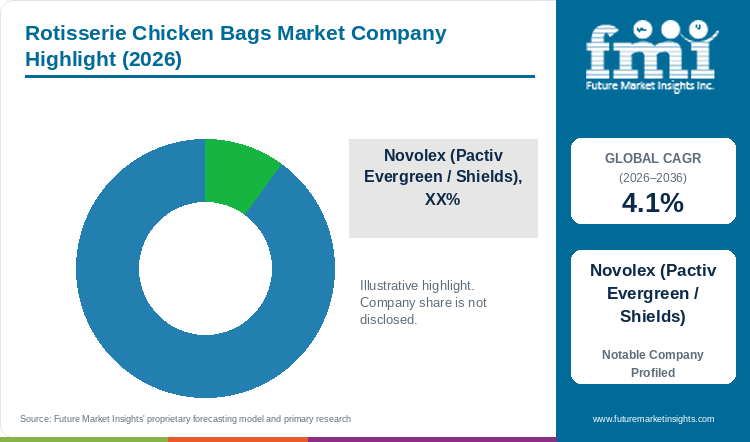
Vendor rivalry across the rotisserie chicken bags market encompasses specialized flexible hot-pouch converters, greaseproof paper-foil bag manufacturers, and broadline supermarket hot-deli packaging suppliers. Novolex (through its Shields and Bagcraft brands, now combined with Pactiv Evergreen) supplies engineered PET-poly and polypropylene hot-chicken pouches with anti-fog windows and carry handles plus foil-lined paper bags. Amcor plc (following its April 2025 combination with Berry Global) provides co-extruded barrier films and flexible foodservice converting scale, while Detmold Group and Huhtamaki Oyj supply grease-resistant paper-foil and fiber-based hot-food bags. Sabert Corporation and Graphic Packaging International along with Duni Group and Genpak LLC plus Dart Container Corporation compete across supermarket hot-case packaging systems and automated deli pack-out solutions.
- Flexible Hot-Pouch & Barrier-Bag Converters: Novolex (Shields & Bagcraft) and Amcor plc (with Berry Global) along with Detmold Group (Detpak) manufacture vented anti-fog stand-up chicken pouches and foil-lined greaseproof roast bags.
- Fiber, Paperboard & Automated Packaging Systems Providers: Huhtamaki Oyj and Graphic Packaging International along with Duni Group (including LinePack Oy) engineer greaseproof paper packaging and automated foodservice sealing equipment.
- Supermarket Hot-Deli & Takeout Container Platforms: Sabert Corporation and Genpak LLC along with Dart Container Corporation supply vented hot-food containers and broadline-distributed deli packaging that benchmark against flexible chicken pouches.
Competitive Benchmarking: Rotisserie Chicken Bags Market
Table 8: Competitive Benchmarking for the Rotisserie Chicken Bags Market (qualitative capability ratings), 2026
| Company | Hot-Pouch & Flexible Bag Converting | Steam-Vent & Anti-Fog Engineering | Greaseproof Paper & Barrier Web Depth | Geographic Reach |
|---|---|---|---|---|
| Novolex (Pactiv Evergreen / Shields) | High | High | High | High |
| Amcor plc (Berry Global) | High | High | High | High |
| Detmold Group (Detpak) | High | Medium | High | High |
| Huhtamaki Oyj | Medium | Medium | High | High |
| Graphic Packaging International | Medium | Medium | High | High |
| Sabert Corporation | Low | High | Medium | Medium |
| Duni Group (LinePack Oy) | Medium | Medium | High | Medium |
| Genpak LLC | Low | Medium | Medium | Medium |
| Dart Container Corporation | Low | Medium | High | Medium |
Methodology note: Benchmark tiers assess verified hot-poultry stand-up pouch and foil-paper bag converting lines, engineered micro-vent and anti-fog viewing panel performance at 85°C to 110°C, and grease-barrier web breadth across global supermarket deli channels.
Key Developments in the Rotisserie Chicken Bags Market
- Major film converters are pursuing large-scale mergers to combine co-extruded barrier web production with retail pouch converting scale; for example, Amcor plc in April 2025 closed its Berry Global merger to unite flexible foodservice bag and high-barrier film operations globally [22].
- To help supermarket delis meet recycled-content mandates in hot-food applications, container manufacturers are commercializing certified food-grade PCR resins, as highlighted in September 2026 when Sabert Corporation's innovation leaders were recognized by Plastics News for scaling Nuvida EnviroPrime 400 PCR resin [23].
- Converters are also expanding production footprints in fast-growing Asian foodservice markets to capture regional grocery and quick-service chain demand, exemplified by Detmold Group's August 2026 investment in a new manufacturing plant in India [24].
Key Players in the Rotisserie Chicken Bags Market
Flexible Hot-Pouch and Barrier-Bag Converters
- Novolex (incorporating Pactiv Evergreen & Shields)
- Amcor plc (incorporating Berry Global)
- Detmold Group (Detpak)
Fiber, Paperboard and Automated Packaging Systems Providers
- Huhtamaki Oyj
- Graphic Packaging International
- Duni Group
Supermarket Hot-Deli and Takeout Container Platforms
- Sabert Corporation
- Genpak LLC
- Dart Container Corporation
Rotisserie Chicken Bags Market - Report Scope
Table 9: Report Scope for the Rotisserie Chicken Bags Market (coverage fields and definitions), 2026 to 2036
| Coverage field | Report scope |
|---|---|
| Market breakdown | Format Type; Material; Format Size; End Use; Sales Channel; Region |
| Quantitative Units | USD Million |
| Market Definition | Includes commercial converter revenue from flexible pouches and bags sold expressly for packing, holding, and transporting hot prepared rotisserie chicken and roasted poultry portions (zippered stand-up anti-fog pouches, vented flat/gusseted bags, and foil-lined greaseproof kraft roast bags). Category Scope Note: Excludes retail sales of cooked poultry, rigid two-piece plastic dome clamshells, raw frozen poultry shrink bags, and commercial rotisserie ovens. |
| Regions Covered | North America; Latin America; Western Europe; Eastern Europe; East Asia; South Asia and Pacific; Middle East and Africa |
| Countries Covered | USA, Saudi Arabia, UAE, South Korea, UK, France, Germany, Japan, and additional countries in the full report |
| Key Companies Covered | Novolex (Pactiv Evergreen / Shields), Amcor plc (Berry Global), Detmold Group (Detpak), Huhtamaki Oyj, Graphic Packaging International, Sabert Corporation, Duni Group, Genpak LLC, Dart Container Corporation |
| Forecast Period | 2026 to 2036 |
| Approach | Primary and secondary research with top-down and bottom-up market triangulation. |
Rotisserie Chicken Bags Market - Research Methodology
Table 10: Research Methodology for the Rotisserie Chicken Bags Market (research methods and approach), 2026 edition
| Method | Approach |
|---|---|
| Primary Research | Structured interviews with flexible hot-pouch converting engineers, supermarket and warehouse-club deli packaging buyers, anti-fog film compounders, and broadline grocery supply distributors across North America, Europe, Asia, and the Middle East. |
| Secondary Research | Analysis of Novolex, Amcor, Berry Global, Detmold Group, Huhtamaki, Graphic Packaging, Sabert, and Duni product disclosures, USDA ERS food-away-from-home data, FDA recycled-plastics guidance, and UK/EU EPR fee schedules. |
| Market Sizing and Forecasting | Top-down flexible foodservice pouch revenues reconciled against bottom-up annual converted hot-chicken bag shipments (4.65 to 4.95 billion units in 2026) and wholesale realization per thousand pouches from 2026 to 2036. |
| Country Forecasting Model | Econometric national projections weight supermarket and warehouse-club rotisserie poultry volume, rigid-dome-to-pouch substitution rates, and EPR plastic fee differentials across eight core countries. |
| Operational Benchmark Traceability | Hot-pouch converting throughput, film web tonnage, and per-deli spending indicators in Tables 2, 3, and 4 trace to pouch-machine cycle speeds, BOPP/CPP and foil-paper basis weights, and retail hot-deli counter registries. |
| Data Triangulation and Validation | Demand estimates are cross-checked against co-extruded anti-fog film resin shipments and supermarket rotisserie bird sales while excluding rigid plastic dome trays, raw poultry vacuum bags, and general grocery shopping bags. |
Rotisserie Chicken Bags Market by Segments
Rotisserie Chicken Bags Market segmented by Format Type:
- Zippered stand-up handle pouches with anti-fog windows
- Foil-lined & metallized grease-barrier kraft bags
- Flat & side-gusseted vented hot-food bags
- Tamper-evident & heat-sealable delivery pouches
Rotisserie Chicken Bags Market segmented by Material:
- Bi-axially oriented & cast polypropylene (BOPP / CPP laminates)
- Polyester & polyethylene co-extruded films (PET / rPET-PE)
- Greaseproof kraft paper & aluminum-foil laminates
- Compostable & bio-based barrier films
Rotisserie Chicken Bags Market segmented by Format Size:
- Standard whole-bird pouch (2.5 lb to 4.0 lb)
- Half-bird, wing & quarter-portion bag (under 2.5 lb)
- Jumbo roaster & family combo pouch (above 4.0 lb)
Rotisserie Chicken Bags Market segmented by End Use:
- Supermarket & hypermarket hot delis
- Warehouse clubs & discount supercenters
- Quick-service & rotisserie chicken restaurants
- Independent butcheries, specialty roasters & meal-delivery kitchens
Rotisserie Chicken Bags Market segmented by Sales Channel:
- Broadline foodservice & grocery supply distributors
- Direct supermarket & retail chain contracts
- Specialty flexible packaging distributors
- Online B2B packaging portals
Rotisserie Chicken Bags Market by Region
- North America
- USA
- Canada
- Latin America
- Brazil
- Mexico
- Argentina
- Chile
- Western Europe
- Germany
- France
- UK
- Italy
- Spain
- Benelux
- Nordics
- Eastern Europe
- Poland
- Czech Republic
- Romania
- Hungary
- East Asia
- China
- Japan
- South Korea
- South Asia and Pacific
- India
- ASEAN
- Australia and New Zealand
- Middle East and Africa
- GCC Countries
- South Africa
- Türkiye
- Israel
Research Sources and Bibliography
- [1] U.S. Department of Agriculture, Economic Research Service. (2026, July 8). Per capita food-away-from-home sales by U.S. State, 2025. USDA Economic Research Service.
- [2] U.S. Department of Agriculture, Economic Research Service. (2026, June 1). Total food spending reached $2.51 trillion in 2025. USDA Economic Research Service.
- [3] American Forest & Paper Association. (2026, September 17). AF&PA Releases August 2026 Packaging Papers Monthly Report. American Forest & Paper Association.
- [4] Sabert Corporation. (2026, August 13). Sabert Wins Two 2026 AmeriStar Awards for r-PRO™ and Pulp Ultra®. Sabert Corporation Newsroom.
- [5] U.S. Food and Drug Administration. (2026, January 12). Registration of Food Facilities and Other Submissions. U.S. Food and Drug Administration.
- [6] Graphic Packaging International. (2025, August 20). Graphic Packaging Adds PaperSeal Pressed MAP Tray to Award-Winning Food Packaging Portfolio. Graphic Packaging International.
- [7] Duni Group. (2025, June 3). Duni Group Acquires Majority Stake in LinePack Oy. Duni Group Press Releases.
- [8] American Forest & Paper Association. (2026, July 17). AF&PA Releases June 2026 Packaging Papers Monthly Report. American Forest & Paper Association.
- [9] Detmold Group. (2026, July 20). Detpak Is Now Manufacturing in the United States. Detpak Newsroom.
- [10] Sabert Corporation. (2026, April 30). Sabert Corporation Releases 2025 Sustainability Report and Announces New 2030 Goal, Signaling Shift Toward End-of-Life Outcomes. Sabert Corporation Newsroom.
- [11] European Commission. (2026, August 11). Packaging and Packaging Waste Regulation Implementation. European Commission Green Forum.
- [12] Huhtamaki Oyj. (2026, October 16). Huhtamaki extends the maturity of EUR 450 million sustainability-linked syndicated revolving credit facility for a further period of one year. Huhtamaki Press Releases.
- [13] Dart Container Corporation. (2026, October 13). Dart Expands Molded Fiber Packaging Capacity at Pennsylvania Facility. Dart Container Newsroom.
- [14] Saudi Food and Drug Authority. (2026, July 23). SFDA Intercepts Over 301 Tons of Non-Compliant Food Products in Q2 2026. Saudi Food and Drug Authority.
- [15] Dubai Municipality. (2025, December 24). Dubai to enforce final phase of single-use plastic ban from 2026. Dubai Municipality Newsroom.
- [16] Ministry of Climate, Energy and Environment, Republic of Korea. (2025, December 23). Public Forum for the Formulation of a Comprehensive Plastic Reduction Plan. Ministry of Climate, Energy and Environment.
- [17] UK Department for Environment, Food & Rural Affairs. (2025, June 30). Extended producer responsibility for packaging: 2025 base fees. UK Government.
- [18] European Commission, Directorate-General for Environment. (2026, October 21). Bioeconomy: Commission launches public consultation on bio-based feedstock in plastic packaging. European Commission.
- [19] Zentrale Stelle Verpackungsregister (ZSVR). (2026, April 16). Responsibility shifts to retailers under the PPWR: companies failing to adjust their system participation may face a distribution ban. Stiftung Zentrale Stelle Verpackungsregister.
- [20] Ministry of Agriculture, Forestry and Fisheries, Japan. (2025, March 10). Plastic resource circulation in the food industry. MAFF Japan.
- [21] Ministry of Agriculture, Forestry and Fisheries, Japan. (2025, April 18). 食品分野におけるプラスチック容器包装資源循環タスクフォース (Food-Industry Plastic Packaging Resource Circulation Task Force). MAFF Japan.
- [22] Amcor plc. (2025, April 30). Amcor completes combination with Berry Global. Amcor Newsroom.
- [23] Sabert Corporation. (2026, September 17). Sabert Leaders Named to Plastic News' 2026 Notable Leaders in Sustainability. Sabert Corporation Newsroom.
- [24] Detmold Group. (2026, August 18). Detmold Group Invests in New Manufacturing Facility in India. Detmold Group Newsroom.
- [25] Graphic Packaging International. (2026, July 13). Graphic Packaging Enters Uncoated Recycled Paperboard Market with Launch of PaceSetter Ridgeline. Graphic Packaging International.
- [26] U.S. Food and Drug Administration. (2025, January 3). FDA Determines Authorization for 35 Food Contact Notifications Related to PFAS Are No Longer Effective. U.S. Food and Drug Administration.
This bibliography is provided for reader reference and is not exhaustive. The full report contains the complete reference list and detailed citations.
This Report Answers
- How large is the rotisserie chicken bags market in 2026, and what value is forecast for 2036?
- Which supermarket hot-deli operating pressures drive adoption of rotisserie chicken bags?
- Why do zippered stand-up handle pouches with anti-fog windows lead the format type segmentation?
- Why do BOPP / CPP laminates lead the material segmentation?
- How do national growth rates vary from the USA and Saudi Arabia to Japan?
- Which companies supply flexible hot-chicken pouches and competing hot-deli packaging?
- What thermal seal, fat-barrier, and EPR constraints slow substrate switching?
- Which venting, anti-fog, and total-cost checks should grocery buyers complete before selecting a pouch?
Frequently Asked Questions
How big is the rotisserie chicken bags market in 2026, and what is forecast for 2036?
Supermarket hot-pouch shipments reached USD 336.5 million in 2025 and total USD 350.3 million in 2026, while grocery dome-to-bag conversions lift projected market size to USD 523.5 million by 2036.
What is the market CAGR from 2026 to 2036?
Global demand for rotisserie chicken bags is forecast to progress at a 4.1% CAGR over the ten-year window to 2036, yielding USD 173.2 million in added annual pouch revenue.
Which Format Type segment leads the rotisserie chicken bags market?
Zippered stand-up handle pouches with anti-fog windows are projected to account for 46.8% of format type demand in 2026 because bottom gussets and reclosable handles keep hot whole birds upright on heated shelves.
Which Material segment leads the rotisserie chicken bags market?
Bi-axially oriented & cast polypropylene (BOPP / CPP laminates) are expected to capture 41.4% of the material category in 2026, supported by 110-degree-Celsius heat resistance and microwave reheating safety.
Which countries have the highest growth rates?
Warehouse-club and hypermarket hot-deli conversions place the USA at 5.1% CAGR, Saudi Arabia at 4.8%, and the UAE at 4.6% ahead of other evaluated nations through 2036.
Which companies are profiled in the rotisserie chicken bags market?
Key suppliers serving grocery rotisserie counters include Novolex (with Pactiv Evergreen & Shields), Amcor plc (with Berry Global), Detmold Group (Detpak), Huhtamaki Oyj, Graphic Packaging International, Sabert Corporation, Duni Group, Genpak LLC, and Dart Container Corporation where Novolex provides dedicated vented poultry pouches and peers supply barrier films or foil-paper roast bags.
Preview the report firsthand - request a free sample
Get SampleGet the brochure for pricing and purchase details.
Get PDFTable of Content
- Key Takeaways
- Market Size and CAGR
- Top Growth Driver
- Fastest Growing Segment
- Leading Region
- Key Companies
- Emerging Opportunities
- Executive Summary
- Global Market Outlook
- Demand-side Trends
- Supply-side Trends
- Technology Roadmap Analysis
- Analysis and Recommendations
- Analyst Perspective (What is happening? Why now? What should investors know?)
- Key Questions Answered
- How large is the market?
- What is the CAGR?
- What are key trends?
- Which region dominates?
- Who are the leaders?
- Market Overview
- Market Coverage / Taxonomy
- Market Definition / Scope / Limitations
- Research Methodology
- Chapter Orientation
- Analytical Lens and Working Hypotheses
- Market Structure, Signals, and Trend Drivers
- Benchmarking and Cross-market Comparability
- Market Sizing, Forecasting, and Opportunity Mapping
- Research Design and Evidence Framework
- Desk Research Programme (Secondary Evidence)
- Expert Input and Fieldwork (Primary Evidence)
- Tooling, Models, and Reference Databases
- Data Engineering and Model Build
- Quality Assurance and Audit Trail
- Market Background
- Market Dynamics (Drivers, Restraints, Opportunity, Trends)
- Scenario Forecast (Optimistic, Likely, Conservative)
- Impact Analysis
- AI Impact
- Sustainability Impact
- Regulatory Impact
- Technology Impact
- Consumer / Buyer Analysis
- Purchase Drivers
- Adoption Barriers
- Buyer Journey
- Opportunity Map Analysis
- Product Life Cycle Analysis
- Supply Chain Analysis
- Investment Feasibility Matrix
- Value Chain Analysis
- PESTLE and Porter's Analysis
- Regulatory Landscape
- Regional Parent Market Outlook
- Production and Consumption Statistics
- Import and Export Statistics
- Global Market Analysis and Forecast, 2021 to 2036
- Historical Market Size Value (USD Million) Analysis, 2021 to 2025
- Current and Future Market Size Value (USD Million) Projections, 2026 to 2036
- Y-o-Y Growth Trend Analysis
- Absolute $ Opportunity Analysis
- Global Market Pricing Analysis, 2021 to 2036
- Global Market Analysis and Forecast, By Format Type, 2021 to 2036
- Introduction / Key Findings
- Historical Market Size Value (USD Million) Analysis By Format Type, 2021 to 2025
- Current and Future Market Size Value (USD Million) Analysis and Forecast By Format Type, 2026 to 2036
- Zippered stand-up handle pouches with anti-fog windows
- Foil-lined & metallized grease-barrier kraft bags
- Flat & side-gusseted vented hot-food bags
- Tamper-evident & heat-sealable delivery pouches
- Y-o-Y Growth Trend Analysis By Format Type, 2021 to 2025
- Absolute $ Opportunity Analysis By Format Type, 2026 to 2036
- Global Market Analysis and Forecast, By Material, 2021 to 2036
- Introduction / Key Findings
- Historical Market Size Value (USD Million) Analysis By Material, 2021 to 2025
- Current and Future Market Size Value (USD Million) Analysis and Forecast By Material, 2026 to 2036
- Bi-axially oriented & cast polypropylene (BOPP / CPP laminates)
- Polyester & polyethylene co-extruded films (PET / rPET-PE)
- Greaseproof kraft paper & aluminum-foil laminates
- Compostable & bio-based barrier films
- Y-o-Y Growth Trend Analysis By Material, 2021 to 2025
- Absolute $ Opportunity Analysis By Material, 2026 to 2036
- Global Market Analysis and Forecast, By Format Size, 2021 to 2036
- Introduction / Key Findings
- Historical Market Size Value (USD Million) Analysis By Format Size, 2021 to 2025
- Current and Future Market Size Value (USD Million) Analysis and Forecast By Format Size, 2026 to 2036
- Standard whole-bird pouch (2.5 lb to 4.0 lb)
- Half-bird, wing & quarter-portion bag (under 2.5 lb)
- Jumbo roaster & family combo pouch (above 4.0 lb)
- Y-o-Y Growth Trend Analysis By Format Size, 2021 to 2025
- Absolute $ Opportunity Analysis By Format Size, 2026 to 2036
- Global Market Analysis and Forecast, By End Use, 2021 to 2036
- Introduction / Key Findings
- Historical Market Size Value (USD Million) Analysis By End Use, 2021 to 2025
- Current and Future Market Size Value (USD Million) Analysis and Forecast By End Use, 2026 to 2036
- Supermarket & hypermarket hot delis
- Warehouse clubs & discount supercenters
- Quick-service & rotisserie chicken restaurants
- Independent butcheries, specialty roasters & meal-delivery kitchens
- Y-o-Y Growth Trend Analysis By End Use, 2021 to 2025
- Absolute $ Opportunity Analysis By End Use, 2026 to 2036
- Global Market Analysis and Forecast, By Sales Channel, 2021 to 2036
- Introduction / Key Findings
- Historical Market Size Value (USD Million) Analysis By Sales Channel, 2021 to 2025
- Current and Future Market Size Value (USD Million) Analysis and Forecast By Sales Channel, 2026 to 2036
- Broadline foodservice & grocery supply distributors
- Direct supermarket & retail chain contracts
- Specialty flexible packaging distributors
- Online B2B packaging portals
- Y-o-Y Growth Trend Analysis By Sales Channel, 2021 to 2025
- Absolute $ Opportunity Analysis By Sales Channel, 2026 to 2036
- Global Market Analysis and Forecast, By Region, 2021 to 2036
- Introduction
- Historical Market Size Value (USD Million) Analysis By Region, 2021 to 2025
- Current Market Size Value (USD Million) Analysis and Forecast By Region, 2026 to 2036
- North America
- Latin America
- Western Europe
- Eastern Europe
- East Asia
- South Asia and Pacific
- Middle East and Africa
- Market Attractiveness Analysis By Region
- North America Market Analysis and Forecast, By Country, 2021 to 2036
- Historical Market Size Value (USD Million) Trend Analysis By Market Taxonomy, 2021 to 2025
- Market Size Value (USD Million) Forecast By Market Taxonomy, 2026 to 2036
- By Country
- USA
- Canada
- By Format Type
- By Material
- By Format Size
- By End Use
- By Sales Channel
- By Country
- Market Attractiveness Analysis
- By Country
- By Format Type
- By Material
- By Format Size
- By End Use
- By Sales Channel
- Key Takeaways
- Latin America Market Analysis and Forecast, By Country
- Historical Market Size Value (USD Million) Trend Analysis By Market Taxonomy, 2021 to 2025
- Market Size Value (USD Million) Forecast By Market Taxonomy, 2026 to 2036
- By Country
- Brazil
- Mexico
- Argentina
- Chile
- By Format Type
- By Material
- By Format Size
- By End Use
- By Sales Channel
- By Country
- Market Attractiveness Analysis
- By Country
- By Format Type
- By Material
- By Format Size
- By End Use
- By Sales Channel
- Key Takeaways
- Western Europe Market Analysis and Forecast, By Country
- Historical Market Size Value (USD Million) Trend Analysis By Market Taxonomy, 2021 to 2025
- Market Size Value (USD Million) Forecast By Market Taxonomy, 2026 to 2036
- By Country
- Germany
- France
- UK
- Italy
- Spain
- Benelux
- Nordics
- By Format Type
- By Material
- By Format Size
- By End Use
- By Sales Channel
- By Country
- Market Attractiveness Analysis
- By Country
- By Format Type
- By Material
- By Format Size
- By End Use
- By Sales Channel
- Key Takeaways
- Eastern Europe Market Analysis and Forecast, By Country
- Historical Market Size Value (USD Million) Trend Analysis By Market Taxonomy, 2021 to 2025
- Market Size Value (USD Million) Forecast By Market Taxonomy, 2026 to 2036
- By Country
- Poland
- Czech Republic
- Romania
- Hungary
- By Format Type
- By Material
- By Format Size
- By End Use
- By Sales Channel
- By Country
- Market Attractiveness Analysis
- By Country
- By Format Type
- By Material
- By Format Size
- By End Use
- By Sales Channel
- Key Takeaways
- East Asia Market Analysis and Forecast, By Country
- Historical Market Size Value (USD Million) Trend Analysis By Market Taxonomy, 2021 to 2025
- Market Size Value (USD Million) Forecast By Market Taxonomy, 2026 to 2036
- By Country
- China
- Japan
- South Korea
- By Format Type
- By Material
- By Format Size
- By End Use
- By Sales Channel
- By Country
- Market Attractiveness Analysis
- By Country
- By Format Type
- By Material
- By Format Size
- By End Use
- By Sales Channel
- Key Takeaways
- South Asia and Pacific Market Analysis and Forecast, By Country
- Historical Market Size Value (USD Million) Trend Analysis By Market Taxonomy, 2021 to 2025
- Market Size Value (USD Million) Forecast By Market Taxonomy, 2026 to 2036
- By Country
- India
- ASEAN
- Australia and New Zealand
- By Format Type
- By Material
- By Format Size
- By End Use
- By Sales Channel
- By Country
- Market Attractiveness Analysis
- By Country
- By Format Type
- By Material
- By Format Size
- By End Use
- By Sales Channel
- Key Takeaways
- Middle East and Africa Market Analysis and Forecast, By Country
- Historical Market Size Value (USD Million) Trend Analysis By Market Taxonomy, 2021 to 2025
- Market Size Value (USD Million) Forecast By Market Taxonomy, 2026 to 2036
- By Country
- GCC Countries
- South Africa
- Türkiye
- Israel
- By Format Type
- By Material
- By Format Size
- By End Use
- By Sales Channel
- By Country
- Market Attractiveness Analysis
- By Country
- By Format Type
- By Material
- By Format Size
- By End Use
- By Sales Channel
- Key Takeaways
- Key Countries Market Analysis
- USA
- Pricing Analysis
- Market Share Analysis, 2025
- By Format Type
- By Material
- By Format Size
- By End Use
- By Sales Channel
- Canada
- Pricing Analysis
- Market Share Analysis, 2025
- By Format Type
- By Material
- By Format Size
- By End Use
- By Sales Channel
- Mexico
- Pricing Analysis
- Market Share Analysis, 2025
- By Format Type
- By Material
- By Format Size
- By End Use
- By Sales Channel
- Brazil
- Pricing Analysis
- Market Share Analysis, 2025
- By Format Type
- By Material
- By Format Size
- By End Use
- By Sales Channel
- Chile
- Pricing Analysis
- Market Share Analysis, 2025
- By Format Type
- By Material
- By Format Size
- By End Use
- By Sales Channel
- Germany
- Pricing Analysis
- Market Share Analysis, 2025
- By Format Type
- By Material
- By Format Size
- By End Use
- By Sales Channel
- UK
- Pricing Analysis
- Market Share Analysis, 2025
- By Format Type
- By Material
- By Format Size
- By End Use
- By Sales Channel
- Italy
- Pricing Analysis
- Market Share Analysis, 2025
- By Format Type
- By Material
- By Format Size
- By End Use
- By Sales Channel
- Spain
- Pricing Analysis
- Market Share Analysis, 2025
- By Format Type
- By Material
- By Format Size
- By End Use
- By Sales Channel
- France
- Pricing Analysis
- Market Share Analysis, 2025
- By Format Type
- By Material
- By Format Size
- By End Use
- By Sales Channel
- India
- Pricing Analysis
- Market Share Analysis, 2025
- By Format Type
- By Material
- By Format Size
- By End Use
- By Sales Channel
- ASEAN
- Pricing Analysis
- Market Share Analysis, 2025
- By Format Type
- By Material
- By Format Size
- By End Use
- By Sales Channel
- Australia and New Zealand
- Pricing Analysis
- Market Share Analysis, 2025
- By Format Type
- By Material
- By Format Size
- By End Use
- By Sales Channel
- China
- Pricing Analysis
- Market Share Analysis, 2025
- By Format Type
- By Material
- By Format Size
- By End Use
- By Sales Channel
- Japan
- Pricing Analysis
- Market Share Analysis, 2025
- By Format Type
- By Material
- By Format Size
- By End Use
- By Sales Channel
- South Korea
- Pricing Analysis
- Market Share Analysis, 2025
- By Format Type
- By Material
- By Format Size
- By End Use
- By Sales Channel
- Poland
- Pricing Analysis
- Market Share Analysis, 2025
- By Format Type
- By Material
- By Format Size
- By End Use
- By Sales Channel
- Hungary
- Pricing Analysis
- Market Share Analysis, 2025
- By Format Type
- By Material
- By Format Size
- By End Use
- By Sales Channel
- Türkiye
- Pricing Analysis
- Market Share Analysis, 2025
- By Format Type
- By Material
- By Format Size
- By End Use
- By Sales Channel
- South Africa
- Pricing Analysis
- Market Share Analysis, 2025
- By Format Type
- By Material
- By Format Size
- By End Use
- By Sales Channel
- Saudi Arabia
- Pricing Analysis
- Market Share Analysis, 2025
- By Format Type
- By Material
- By Format Size
- By End Use
- By Sales Channel
- UAE
- Pricing Analysis
- Market Share Analysis, 2025
- By Format Type
- By Material
- By Format Size
- By End Use
- By Sales Channel
- USA
- Market Structure Analysis
- Competition Dashboard
- Competition Benchmarking
- Market Share Analysis of Top Players
- By Regional
- By Format Type
- By Material
- By Format Size
- By End Use
- By Sales Channel
- Emerging Startups
- Innovation Benchmarking
- Competition Analysis
- Competition Deep Dive
- Novolex (Pactiv Evergreen / Shields)
- Overview
- Product Portfolio
- Profitability by Market Segments
- Sales Footprint
- Strategy Overview
- Marketing Strategy
- Product Strategy
- Channel Strategy
- Amcor plc (Berry Global)
- Detmold Group (Detpak)
- Huhtamaki Oyj
- Graphic Packaging International
- Sabert Corporation
- Duni Group (LinePack Oy)
- Genpak LLC
- Dart Container Corporation
- Novolex (incorporating Pactiv Evergreen & Shields)
- Amcor plc (incorporating Berry Global)
- Duni Group
- Novolex (Pactiv Evergreen / Shields)
- Case Studies
- Success Stories
- Recent Developments
- Competition Deep Dive
- Assumptions & Acronyms Used


