

- Industry Size (2026)
- USD 13.50 Bn
- Forecast (2036)
- USD 23.07 Bn
- CAGR (2026 to 2036)
- 5.5%
Rotomoulding Powder Market Size, Market Forecast and Outlook By FMI
The rotomoulding powder market was valued at USD 12.80 billion in 2025, projected to reach USD 13.50 billion in 2026, and is forecast to expand to USD 23.07 billion by 2036 at a 5.5% CAGR. Broadening application coverage across water tanks, automotive under-hood components, and industrial packaging is expanding the addressable volume base for rotomoulding-grade powders. Based on FMI's analysis, the bifurcation between commodity PE grades and specialty formulations with UV stabilization, fire retardancy, and food-contact certifications is creating distinct pricing tiers within the supply chain.
Summary of Rotomoulding Powder Market
- By 2036, the market is projected to be worth USD 23.07 billion.
- A 5.5% compound annual growth rate is anticipated between 2026 and 2036.
- Market size in 2025 was estimated at USD 12.80 billion.
- An absolute dollar opportunity of USD 9.56 billion is anticipated between 2026 and 2036.
- Polyethylene leads by Material with 30.5% share in 2026, reflecting its cost advantage, processing ease, and broad applicability across water tanks, containers, and consumer products.
- Consumer Products leads by Application with 40.7% share in 2026, covering playground equipment, furniture, planters, and recreational goods.
- The market is a specialty material category where particle size consistency, additive compounding capability, and application-specific formulation define competitive positioning among powder suppliers.
- Among key countries, India leads at 7.6% CAGR, followed by China at 6.9%, the USA at 4.8%, Germany at 4.5%, the UK at 4.1%, Canada at 4.4%, and Japan at 3.8%.
The powder supply chain is experiencing a structural shift as compound formulators invest in dedicated micronization lines to guarantee particle size distribution consistency. FMI analysts observe that molders processing powders with coefficient of variation below 15% on particle diameter are achieving wall thickness uniformity improvements that reduce reject rates by 8% to 12% per production run. Resin producers are responding to this quality demand by offering pre-compounded, pre-colored powder grades that eliminate the need for dry blending at the molder level. This vertical integration of color and additive compounding into the powder supply stage is consolidating purchasing volume toward full-service suppliers and away from independent grinders that compete on processing cost alone. The emergence of recycled-content rotomoulding powders formulated from post-consumer polyethylene is creating a new compliance-driven product category, particularly in European markets where Extended Producer Responsibility frameworks mandate minimum recycled content thresholds.
Regional consumption trajectories reflect the distribution of rotational molding capacity and end-use application intensity. India leads at 7.6% CAGR, driven by water storage tank production expansion and agricultural equipment localization. China follows at 6.9% as domestic compounders scale production to meet growing automotive and consumer goods molding demand. Germany advances at 4.5%, anchored by specialty powder formulations for automotive under-hood applications and industrial containers. The United States grows at 4.8%, supported by infrastructure water treatment tank replacement cycles. Canada tracks at 4.4%. The United Kingdom registers 4.1% growth driven by construction and playground equipment production. Japan records a 3.8% trajectory concentrated on specialty nylon and polycarbonate powder grades for electronics housings.

Rotomoulding Powder Market Key Takeaways
| Metric | Details |
|---|---|
| Industry Size (2026) | USD 13.50 billion |
| Industry Value (2036) | USD 23.07 billion |
| CAGR (2026 to 2036) | 5.5% |
Source: Future Market Insights, 2026
Rotomoulding Powder Market Definition
Rotomoulding powder refers to finely ground polymer resins specifically formulated and micronized for use in the rotational molding process. These powders include polyethylene grades, PVC plastisols, polycarbonate, nylon, and polypropylene formulations. The particle size distribution and melt flow characteristics of rotomoulding powder directly determine the wall thickness uniformity, surface finish quality, and mechanical performance of the final molded part.
Rotomoulding Powder Market Inclusions
Market scope covers polyethylene powders across all density grades, PVC plastisols, polycarbonate, nylon, and polypropylene powders formulated for rotational molding. Coverage spans global and regional market sizes for 2026 to 2036, segmented by material and application.
Rotomoulding Powder Market Exclusions
The scope excludes injection molding pellets, extrusion-grade resins, and blow molding compounds. Raw polymer feedstock not processed into rotomoulding-grade powder form is outside the scope. Compounding and grinding equipment used to produce rotomoulding powders is not included in the valuation.
Rotomoulding Powder Market Research Methodology
- Primary Research: Analysts engaged with polymer compounding specialists, rotomolding production managers, and resin procurement directors to map material selection criteria and quality benchmarks across application segments.
- Desk Research: Data collection phases aggregated polymer production statistics, trade flow data for rotomoulding-grade resins, and regulatory compliance requirements for food-contact and fire-retardant formulations across major markets.
- Market-Sizing and Forecasting: Baseline values derive from a bottom-up aggregation of production volumes and trade data, applying region-specific adoption curves to project future demand velocity.
- Data Validation and Update Cycle: Projections are tested against publicly reported capital expenditure guidance and procurement announcements from leading industrial end users and distributor networks.
Why is the Rotomoulding Powder Market Growing?
The Rotomoulding Powder market is witnessing steady growth, driven by the increasing demand for lightweight, durable, and versatile plastic products across industrial and consumer applications. Rising adoption of rotomoulding technology is being fueled by its ability to produce hollow, seamless products with uniform wall thickness, making it ideal for cost-efficient manufacturing and material optimization.
The market is further supported by advancements in polymer formulations, process automation, and energy-efficient production techniques that enhance performance and reduce operational costs. Growing emphasis on sustainability, recycling, and eco-friendly materials is influencing material selection, while manufacturers are increasingly developing powders that offer superior impact resistance, UV stability, and chemical durability.
The expanding demand in consumer goods, industrial containers, automotive components, and water storage applications is contributing to market expansion As industries continue to prioritize design flexibility, customization, and lightweight solutions, the Rotomoulding Powder market is poised for sustained growth, with innovation in polymer types, additive technologies, and processing methods driving adoption over the next decade.
Segmental Analysis
The rotomoulding powder market is segmented by material, application, and geographic regions. By material, rotomoulding powder market is divided into Polyethylene, Low Density Polyethylene (LDPE), Linear Low Density Polyethylene (LLDPE), Medium Density Polyethylene (MDPE), High Density Polyethylene (HDPE), PVC Plastisols, Polycarbonate, Nylon, and Polypropylene. In terms of application, rotomoulding powder market is classified into Consumer Products, Storage Tanks, Automotive Components, and Industrial Packaging. Regionally, the rotomoulding powder industry is classified into North America, Latin America, Western Europe, Eastern Europe, Balkan & Baltic Countries, Russia & Belarus, Central Asia, East Asia, South Asia & Pacific, and the Middle East & Africa.
Insights into the Polyethylene Material Segment

The polyethylene material segment is projected to hold 30.5% of the market revenue in 2026, establishing it as the leading material type. Its dominance is being driven by the polymer’s excellent combination of processability, mechanical strength, and chemical resistance, which makes it ideal for a wide range of rotomoulded products. Polyethylene powders provide uniform melting, easy flow, and reliable performance during processing, ensuring high-quality finished products with consistent dimensions and minimal defects.
Its light weight nature and durability make it particularly suitable for applications requiring impact resistance and long-term performance, including containers, tanks, and industrial components. Additionally, polyethylene’s compatibility with additives and colorants allows manufacturers to offer customized solutions that meet specific customer requirements.
Growing demand from industries such as automotive, consumer goods, and industrial storage has reinforced polyethylene’s market position With continuous research in polymer modification and functionalization, the segment is expected to maintain its leadership, supported by operational efficiency, scalability, and consistent product quality.
Insights into the Consumer Products Application Segment

The consumer products application segment is anticipated to account for 40.7% of the market revenue in 2026, making it the largest application area. Growth is being driven by increasing consumer preference for durable, lightweight, and aesthetically appealing plastic goods produced using rotomoulding technology. Products such as household storage containers, outdoor furniture, toys, and water tanks benefit from the seamless construction, uniform wall thickness, and high impact resistance enabled by rotomoulding powders.
The ability to customize colors, shapes, and surface finishes without additional manufacturing steps enhances the appeal for consumer-focused applications. Rising disposable incomes, urbanization, and the growing e-commerce sector are further fueling demand, as consumers increasingly seek reliable and innovative products.
Sustainability concerns are also driving adoption, as polyethylene-based rotomoulded products can be recycled and manufactured with reduced material waste As manufacturers focus on delivering versatile, high-quality consumer products efficiently, the consumer products application segment is expected to remain a primary growth driver for the Rotomoulding Powder market.
Market Overview
Rotomoulding Powder Market Overview
Rotomoulding, also called as rotational moulding is a process used to manufacture plastic moulds without application of pressure as compared to other moulding processes. It is cost effective method and the end products are used to manufacture hollow articles.
The major difference between rotomoulding and other method is that plastic or resin powders are used to form the moulds. The rotomoulding powder melts in the mould, which is rotated in biaxial direction. Polyethylene rotomoulding powder accounts for major share in terms of consumption in the global rotomoulding powder market. They are available in different grades, each varying in melt flow and density.
Low density polyethylene (LDPE) based rotomoulding powders are used in flexible packaging, moulding, extrusion coating applications. High density polyethylene (HDPE) based rotomoulding powders are used in heavy industrial packaging, telecom ducting, woven sacks, blow moulding etc.
The applications of linear low density polyethylene (LLDPE) include insulated containers, automotive components, tanks etc. DuPont, a leading USA industrial chemicals manufacture’s product portfolio includes high performance resins with trade name Hytrel. Among the different grades, Hytrel 4056P is used in rotomoulding and are available in powdered form.
Analysis of Rotomoulding Powder Market By Key Countries
.webp "Top Country Growth Comparison Rotomoulding Powder Market Cagr (2026 2036)")
| Country | CAGR |
|---|---|
| China | 7.4% |
| India | 6.9% |
| Germany | 6.3% |
| France | 5.8% |
| UK | 5.2% |
| USA | 4.7% |
| Brazil | 4.1% |
Source: FMI analysis based on primary research and proprietary forecasting model

Country-wise Analysis
The Rotomoulding Powder Market is expected to register a CAGR of 5.5% during the forecast period, exhibiting varied country level momentum. China leads with the highest CAGR of 7.4%, followed by India at 6.9%. Developed markets such as Germany, France, and the UK continue to expand steadily, while the USA is likely to grow at consistent rates. Brazil posts the lowest CAGR at 4.1%, yet still underscores a broadly positive trajectory for the global Rotomoulding Powder Market. In 2024, Germany held a dominant revenue in the Western Europe market and is expected to grow with a CAGR of 6.3%. The USA Rotomoulding Powder Market is estimated to be valued at USD 4.7 billion in 2026 and is anticipated to reach a valuation of USD 7.4 billion by 2036. Sales are projected to rise at a CAGR of 4.7% over the forecast period between 2026 and 2036. While Japan and South Korea markets are estimated to be valued at USD 688.2 million and USD 327.0 million respectively in 2026.
Key Players in the Rotomoulding Powder Market

- BASF
- Chevron Phillips
- Clariant
- Dow
- ExxonMobil Chemical
- Global Polymers
- INEOS Group
- LG Chem
- Lotus Polymers
- LyondellBasell
- Matrix Polymers
- Polykemi
- Prime Polymers
- Rakotene
Scope of the Report
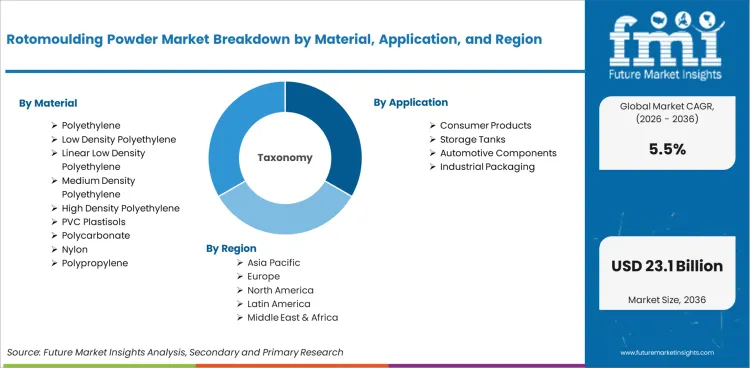
| Metric | Value |
|---|---|
| Quantitative Units | USD 13.50 billion to USD 23.07 billion, at a CAGR of 5.5% |
| Market Definition | Rotomoulding powder refers to finely ground polymer resins specifically formulated and micronized for use in the rotational molding process. These powders include polyethylene grades, PVC plastisols, polycarbonate, nylon, and polypropylene formulations. The particle size distribution and melt flow characteristics of rotomoulding powder directly determine the wall thickness uniformity, surface finish quality, and mechanical performance of the final molded part. |
| Segmentation | Material (Polyethylene, Low Density Polyethylene, Linear Low Density Polyethylene, Medium Density Polyethylene, High Density Polyethylene, PVC Plastisols, Polycarbonate, Nylon, Polypropylene), Application (Consumer Products, Storage Tanks, Automotive Components, Industrial Packaging), and Region |
| Regions Covered | North America, Latin America, Europe, East Asia, South Asia, Oceania, Middle East and Africa |
| Countries Covered | India, China, USA, Canada, UK, Germany, Japan, and 40 plus countries |
| Key Companies Profiled | BASF, Chevron Phillips, Clariant, Dow, ExxonMobil Chemical, Global Polymers, INEOS Group, LG Chem, Lotus Polymers, LyondellBasell, Matrix Polymers, Polykemi, Prime Polymers, Rakotene |
| Forecast Period | 2026 to 2036 |
| Approach | Forecasting models apply a hybrid bottom-up methodology starting with regional production and consumption metrics and cross-validate projections against quarterly industry output volumes. |
Rotomoulding Powder Market by Segments
Material:
- Polyethylene
- Low Density Polyethylene (LDPE)
- Linear Low Density Polyethylene (LLDPE)
- Medium Density Polyethylene (MDPE)
- High Density Polyethylene (HDPE)
- PVC Plastisols
- Polycarbonate
- Nylon
- Polypropylene
Application:
- Consumer Products
- Storage Tanks
- Automotive Components
- Industrial Packaging
Region:
- North America
- USA
- Canada
- Mexico
- Latin America
- Brazil
- Chile
- Rest of Latin America
- Western Europe
- Germany
- UK
- Italy
- Spain
- France
- Nordic
- BENELUX
- Rest of Western Europe
- Eastern Europe
- Russia
- Poland
- Hungary
- Balkan & Baltic
- Rest of Eastern Europe
- East Asia
- China
- Japan
- South Korea
- South Asia and Pacific
- India
- ASEAN
- Australia & New Zealand
- Rest of South Asia and Pacific
- Middle East & Africa
- Kingdom of Saudi Arabia
- Other GCC Countries
- Turkiye
- South Africa
- Other African Union
- Rest of Middle East & Africa
Bibliography
- 1. BASF SE. (2024). Annual report 2024: Performance materials division. BASF.
- 2. European Chemicals Agency. (2024). REACH registration dossier updates for polyethylene grades. ECHA.
- 3. International Organization for Standardization. (2024). ISO 11357: Plastics, differential scanning calorimetry. ISO.
- 4. Organisation for Economic Co-operation and Development. (2024). Extended Producer Responsibility: updated guidance for efficient waste management. OECD.
- 5. Dow Inc. (2024). Annual report 2024. Dow Inc.
- 6. World Health Organization. (2024). Guidelines for drinking water quality: materials in contact with drinking water. WHO.
This bibliography is provided for reader reference. The full Future Market Insights report contains the complete reference list with primary research documentation.
Frequently Asked Questions
How large is the demand for Rotomoulding Powder in the global market in 2026?
Demand for rotomoulding powder in the global market is estimated to be valued at USD 13.50 billion in 2026.
What will be the market size of Rotomoulding Powder in the global market by 2036?
Market size for rotomoulding powder is projected to reach USD 23.07 billion by 2036.
What is the expected demand growth for Rotomoulding Powder between 2026 and 2036?
Demand for rotomoulding powder is expected to grow at a CAGR of 5.5% between 2026 and 2036.
Which Material is poised to lead global sales by 2026?
Polyethylene accounts for 30.5% in 2026, reflecting its cost advantage, processing ease, and broad applicability across water tanks and containers.
How is Consumer Products positioned in the Rotomoulding Powder market in 2026?
Consumer Products represents 40.7% of application share in 2026, covering playground equipment, furniture, planters, and recreational goods.
What is driving demand in India?
India is projected to grow at a CAGR of 7.6% during 2026 to 2036, driven by water storage tank production expansion and agricultural equipment localization.
What is the scope of this Rotomoulding Powder report?
Market scope covers polyethylene powders across all density grades, PVC plastisols, polycarbonate, nylon, and polypropylene powders formulated for rotational molding. Coverage spans global and regional market sizes for 2026 to 2036, segmented by material and application. The scope excludes injection molding pellets, extrusion-grade resins, and blow molding compounds. Raw polymer feedstock not processed into rotomoulding-grade powder form is outside the scope. Compounding and grinding equipment used to produce rotomoulding powders is not included in the valuation.
How does FMI build and validate the Rotomoulding Powder forecast?
Forecasting models apply a hybrid bottom-up methodology starting with regional production and consumption metrics and cross-validate projections against quarterly industry output volumes and capital expenditure guidance from leading end users.
Preview the report firsthand - request a free sample
Get SampleGet the brochure for pricing and purchase details.
Get PDFTable of Content
- Executive Summary
- Global Market Outlook
- Demand-side Trends
- Supply-side Trends
- Technology Roadmap Analysis
- Analysis and Recommendations
- Market Overview
- Market Coverage / Taxonomy
- Market Definition / Scope / Limitations
- Research Methodology
- Chapter Orientation
- Analytical Lens and Working Hypotheses
- Market Structure, Signals, and Trend Drivers
- Company Annual and Sustainability Reports
- Peer-reviewed Journals and Academic Literature
- Corporate Websites, Product Literature, and Technical Notes
- Earnings Decks and Investor Briefings
- Statutory Filings and Regulatory Disclosures
- Technical White Papers and Standards Notes
- Trade Journals, Industry Magazines, and Analyst Briefs
- Conference Proceedings, Webinars, and Seminar Materials
- Government Statistics Portals and Public Data Releases
- Press Releases and Reputable Media Coverage
- Specialist Newsletters and Curated Briefings
- Sector Databases and Reference Repositories
- FMI Internal Proprietary Databases and Historical Market Datasets
- Subscription Datasets and Paid Sources
- Social Channels, Communities, and Digital Listening Inputs
- Additional Desk Sources
- Expert Input and Fieldwork (Primary Evidence)
- Primary Modes
- Qualitative Interviews and Expert Elicitation
- Quantitative Surveys and Structured Data Capture
- Blended Approach
- Why Primary Evidence is Used
- Field Techniques
- Interviews
- Surveys
- Focus Groups
- Observational and In-context Research
- Social and Community Interactions
- Stakeholder Universe Engaged
- C-suite Leaders
- Board Members
- Presidents and Vice Presidents
- R&D and Innovation Heads
- Technical Specialists
- Domain Subject-matter Experts
- Scientists
- Physicians and Other Healthcare Professionals
- Governance, Ethics, and Data Stewardship
- Research Ethics
- Data Integrity and Handling
- Primary Modes
- Tooling, Models, and Reference Databases
- Data Engineering and Model Build
- Data Acquisition and Ingestion
- Cleaning, Normalisation, and Verification
- Synthesis, Triangulation, and Analysis
- Quality Assurance and Audit Trail
- Market Background
- Market Dynamics
- Drivers
- Restraints
- Opportunity
- Trends
- Scenario Forecast
- Demand in Optimistic Scenario
- Demand in Likely Scenario
- Demand in Conservative Scenario
- Opportunity Map Analysis
- Product Life Cycle Analysis
- Supply Chain Analysis
- Investment Feasibility Matrix
- Value Chain Analysis
- PESTLE and Porter’s Analysis
- Regulatory Landscape
- Regional Parent Market Outlook
- Production and Consumption Statistics
- Import and Export Statistics
- Market Dynamics
- Global Market Analysis 2021 to 2025 and Forecast, 2026 to 2036
- Historical Market Size Value (USD Million) Analysis, 2021 to 2025
- Current and Future Market Size Value (USD Million) Projections, 2026 to 2036
- Y-o-Y Growth Trend Analysis
- Absolute $ Opportunity Analysis
- Global Market Pricing Analysis 2021 to 2025 and Forecast 2026 to 2036
- Global Market Analysis 2021 to 2025 and Forecast 2026 to 2036, By Material
- Introduction / Key Findings
- Historical Market Size Value (USD Million) Analysis By Material , 2021 to 2025
- Current and Future Market Size Value (USD Million) Analysis and Forecast By Material , 2026 to 2036
- Polyethylene
- Low Density Polyethylene
- Linear Low Density Polyethylene
- Medium Density Polyethylene
- High Density Polyethylene
- PVC Plastisols
- Polycarbonate
- Nylon
- Polypropylene
- Polyethylene
- Y-o-Y Growth Trend Analysis By Material , 2021 to 2025
- Absolute $ Opportunity Analysis By Material , 2026 to 2036
- Global Market Analysis 2021 to 2025 and Forecast 2026 to 2036, By Application
- Introduction / Key Findings
- Historical Market Size Value (USD Million) Analysis By Application, 2021 to 2025
- Current and Future Market Size Value (USD Million) Analysis and Forecast By Application, 2026 to 2036
- Consumer Products
- Storage Tanks
- Automotive Components
- Industrial Packaging
- Consumer Products
- Y-o-Y Growth Trend Analysis By Application, 2021 to 2025
- Absolute $ Opportunity Analysis By Application, 2026 to 2036
- Global Market Analysis 2021 to 2025 and Forecast 2026 to 2036, By Region
- Introduction
- Historical Market Size Value (USD Million) Analysis By Region, 2021 to 2025
- Current Market Size Value (USD Million) Analysis and Forecast By Region, 2026 to 2036
- North America
- Latin America
- Western Europe
- Eastern Europe
- East Asia
- South Asia and Pacific
- Middle East & Africa
- Market Attractiveness Analysis By Region
- North America Market Analysis 2021 to 2025 and Forecast 2026 to 2036, By Country
- Historical Market Size Value (USD Million) Trend Analysis By Market Taxonomy, 2021 to 2025
- Market Size Value (USD Million) Forecast By Market Taxonomy, 2026 to 2036
- By Country
- USA
- Canada
- Mexico
- By Material
- By Application
- By Country
- Market Attractiveness Analysis
- By Country
- By Material
- By Application
- Key Takeaways
- Latin America Market Analysis 2021 to 2025 and Forecast 2026 to 2036, By Country
- Historical Market Size Value (USD Million) Trend Analysis By Market Taxonomy, 2021 to 2025
- Market Size Value (USD Million) Forecast By Market Taxonomy, 2026 to 2036
- By Country
- Brazil
- Chile
- Rest of Latin America
- By Material
- By Application
- By Country
- Market Attractiveness Analysis
- By Country
- By Material
- By Application
- Key Takeaways
- Western Europe Market Analysis 2021 to 2025 and Forecast 2026 to 2036, By Country
- Historical Market Size Value (USD Million) Trend Analysis By Market Taxonomy, 2021 to 2025
- Market Size Value (USD Million) Forecast By Market Taxonomy, 2026 to 2036
- By Country
- Germany
- UK
- Italy
- Spain
- France
- Nordic
- BENELUX
- Rest of Western Europe
- By Material
- By Application
- By Country
- Market Attractiveness Analysis
- By Country
- By Material
- By Application
- Key Takeaways
- Eastern Europe Market Analysis 2021 to 2025 and Forecast 2026 to 2036, By Country
- Historical Market Size Value (USD Million) Trend Analysis By Market Taxonomy, 2021 to 2025
- Market Size Value (USD Million) Forecast By Market Taxonomy, 2026 to 2036
- By Country
- Russia
- Poland
- Hungary
- Balkan & Baltic
- Rest of Eastern Europe
- By Material
- By Application
- By Country
- Market Attractiveness Analysis
- By Country
- By Material
- By Application
- Key Takeaways
- East Asia Market Analysis 2021 to 2025 and Forecast 2026 to 2036, By Country
- Historical Market Size Value (USD Million) Trend Analysis By Market Taxonomy, 2021 to 2025
- Market Size Value (USD Million) Forecast By Market Taxonomy, 2026 to 2036
- By Country
- China
- Japan
- South Korea
- By Material
- By Application
- By Country
- Market Attractiveness Analysis
- By Country
- By Material
- By Application
- Key Takeaways
- South Asia and Pacific Market Analysis 2021 to 2025 and Forecast 2026 to 2036, By Country
- Historical Market Size Value (USD Million) Trend Analysis By Market Taxonomy, 2021 to 2025
- Market Size Value (USD Million) Forecast By Market Taxonomy, 2026 to 2036
- By Country
- India
- ASEAN
- Australia & New Zealand
- Rest of South Asia and Pacific
- By Material
- By Application
- By Country
- Market Attractiveness Analysis
- By Country
- By Material
- By Application
- Key Takeaways
- Middle East & Africa Market Analysis 2021 to 2025 and Forecast 2026 to 2036, By Country
- Historical Market Size Value (USD Million) Trend Analysis By Market Taxonomy, 2021 to 2025
- Market Size Value (USD Million) Forecast By Market Taxonomy, 2026 to 2036
- By Country
- Kingdom of Saudi Arabia
- Other GCC Countries
- Turkiye
- South Africa
- Other African Union
- Rest of Middle East & Africa
- By Material
- By Application
- By Country
- Market Attractiveness Analysis
- By Country
- By Material
- By Application
- Key Takeaways
- Key Countries Market Analysis
- USA
- Pricing Analysis
- Market Share Analysis, 2025
- By Material
- By Application
- Canada
- Pricing Analysis
- Market Share Analysis, 2025
- By Material
- By Application
- Mexico
- Pricing Analysis
- Market Share Analysis, 2025
- By Material
- By Application
- Brazil
- Pricing Analysis
- Market Share Analysis, 2025
- By Material
- By Application
- Chile
- Pricing Analysis
- Market Share Analysis, 2025
- By Material
- By Application
- Germany
- Pricing Analysis
- Market Share Analysis, 2025
- By Material
- By Application
- UK
- Pricing Analysis
- Market Share Analysis, 2025
- By Material
- By Application
- Italy
- Pricing Analysis
- Market Share Analysis, 2025
- By Material
- By Application
- Spain
- Pricing Analysis
- Market Share Analysis, 2025
- By Material
- By Application
- France
- Pricing Analysis
- Market Share Analysis, 2025
- By Material
- By Application
- India
- Pricing Analysis
- Market Share Analysis, 2025
- By Material
- By Application
- ASEAN
- Pricing Analysis
- Market Share Analysis, 2025
- By Material
- By Application
- Australia & New Zealand
- Pricing Analysis
- Market Share Analysis, 2025
- By Material
- By Application
- China
- Pricing Analysis
- Market Share Analysis, 2025
- By Material
- By Application
- Japan
- Pricing Analysis
- Market Share Analysis, 2025
- By Material
- By Application
- South Korea
- Pricing Analysis
- Market Share Analysis, 2025
- By Material
- By Application
- Russia
- Pricing Analysis
- Market Share Analysis, 2025
- By Material
- By Application
- Poland
- Pricing Analysis
- Market Share Analysis, 2025
- By Material
- By Application
- Hungary
- Pricing Analysis
- Market Share Analysis, 2025
- By Material
- By Application
- Kingdom of Saudi Arabia
- Pricing Analysis
- Market Share Analysis, 2025
- By Material
- By Application
- Turkiye
- Pricing Analysis
- Market Share Analysis, 2025
- By Material
- By Application
- South Africa
- Pricing Analysis
- Market Share Analysis, 2025
- By Material
- By Application
- USA
- Market Structure Analysis
- Competition Dashboard
- Competition Benchmarking
- Market Share Analysis of Top Players
- By Regional
- By Material
- By Application
- Competition Analysis
- Competition Deep Dive
- BASF
- Overview
- Product Portfolio
- Profitability by Market Segments (Product/Age /Sales Channel/Region)
- Sales Footprint
- Strategy Overview
- Marketing Strategy
- Product Strategy
- Channel Strategy
- Chevron Phillips
- Clariant
- Dow
- ExxonMobil Chemical
- Global Polymers
- INEOS Group
- LG Chem
- Lotus Polymers
- LyondellBasell
- Matrix Polymers
- Polykemi
- Prime Polymers
- Rakotene
- BASF
- Competition Deep Dive
- Assumptions & Acronyms Used


