

- Market Size (2026)
- USD 646.4 Mn
- Forecast (2036)
- USD 1954.5 Mn
- CAGR (2026 to 2036)
- 11.7%
How big is Savory Crackers Market in 2026?
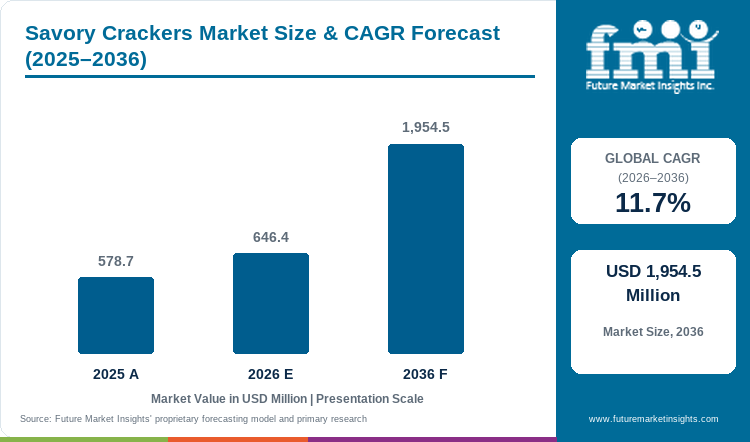
USD 646.4 million in 2026 and USD 1,954.5 million by 2036, expanding at an 11.7% CAGR.
Demand for savory crackers is projected to expand at 11.7% CAGR between 2026 and 2036, growing from USD 578.7 million in 2025 to USD 646.4 million in 2026, and escalating to USD 1,954.5 million by 2036. Manufacturers can add eating occasions by changing crunch or seasoning without asking retailers to reclassify the product. In September 2025 Kellanova introduced Cheez-It Crunch with three flavors and a staged convenience-to-grocery rollout. The launch kept the cracker proposition familiar while adding texture and format choices for new retail occasions.
National retail rules can change how quickly the forecast converts into sales for packaged cracker brands. Germany illustrates the formulation and packaging work created by voluntary front-of-pack nutrition programs used by participating food companies. The Federal Ministry of Food and Agriculture recorded about 960 companies and 1,420 brands registered for Nutri-Score use on April 9 2025. Participating cracker brands must keep formula data and packaging systems aligned with score changes before assortment updates reach retailers. Markets with lighter front-of-pack requirements can move flavor or pack changes to shelf with fewer redesign steps.
Key Takeaways
- Frequent snack occasions support repeat savory cracker purchases because the format works for solo eating, sharing and food pairing.
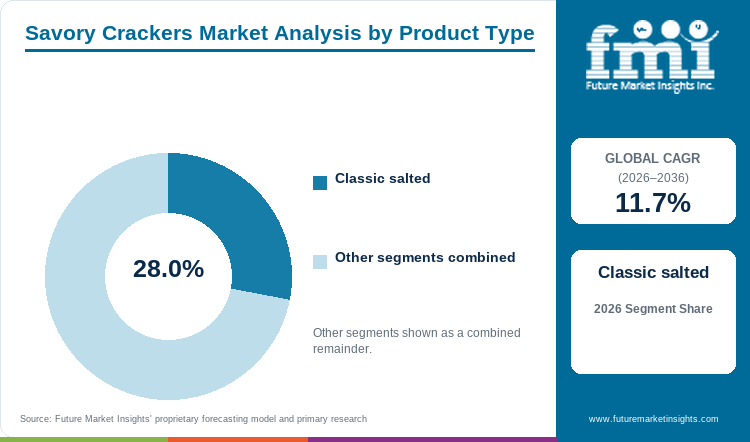
- Based on product type, classic salted is projected to account for 28.0% in 2026, attributable to familiar seasoning that works for pairing and stand-alone occasions.
- By claim - nature, conventional is estimated to hold 48.0% in 2026, supported by established recipes that fit mainstream pricing and high-volume baking.
- The format category is forecast to be led by fresh at 40.0% share in 2026, driven by bakery and prepared-food uses that prioritize immediate texture.
- Nutrition rules and packaging controls can delay launches when reformulation or label changes interrupt normal retail rotation.
- Some of the key players in this market include Mondelēz International, Inc., pladis, Lotus Bakeries NV, Walker’s Shortbread Ltd., Mars, Incorporated, The Arnott’s Group, Grupo Bimbo, S.A.B. de C.V., The Campbell’s Company, Flowers Foods, Inc., and KAMEDA SEIKA CO., LTD.
Analyst Perspective
“Savory crackers earn repeat space when manufacturers protect familiar crunch while giving retailers a clear reason to add another flavor, claim or pack. The practical test is whether formulation and labeling changes preserve taste at the price point expected for the channel.”
- Nandini Roy Choudhury, Principal Consultant, Future Market Insights
How is the savory crackers market segmented?
By Product Type, Claim - Nature, Format, Packaging Format and Sales Channel
The savory crackers market is segmented by product type, claim - nature, format, packaging format and sales channel. Product type covers classic salted, seeded and wholegrain, cheese-flavored and gluten-free products sold for distinct taste requirements. Claim - nature includes conventional, clean label, organic, gluten-free and high-protein - fortified lines with different formulation requirements. Format covers fresh, frozen, ambient packaged, chilled and par-baked - thaw-and-serve products with different handling needs. Packaging and sales channels distinguish serving format from the retail or foodservice route used for purchase.
Why does classic salted lead demand within the product type category?
Classic salted crackers give retailers a familiar base for stand-alone snacks, lunchboxes and food pairings. Mondelēz Japan returned RITZ Black Pepper Crackers in March 2025 with stronger pepper seasoning on the established RITZ platform. The launch shows how a recognized cracker can carry sharper flavor without changing its basic use. Adjacent savory snack formats still compete for the same discretionary occasions where crunch and price influence repeat purchase.
- By product type, classic salted is forecast to represent 28.0% in 2026, supported by familiar flavor and broad pairing use.
- Manufacturers can use the core salted base as a controlled reference for texture and seasoning changes before wider assortment rollout.
What makes conventional the leading claim - nature choice in the savory crackers market?
Conventional crackers retain scale because standard recipes fit high-volume baking and familiar mainstream price points. In July 2025 KAMEDA SEIKA launched a nationwide campaign for three long-running rice-cracker lines. The campaign kept familiar products visible through national retail channels without adding a specialized dietary claim. Gluten-free products follow a separate purchase route because ingredient controls and pack claims add qualification work.
- Conventional is set to lead the claim - nature category with 48.0% share in 2026, attributable to standard formulas that support mainstream distribution.
- Claim-led products need separate ingredient controls and pack communication before they can match conventional shelf coverage.
What operating condition supports fresh demand in the format category?
Fresh formats depend on immediate texture, frequent replenishment and shorter inventory cycles at the selling point. The Campbell’s Company reported in March 2026 that its Snacks segment includes Pepperidge Farm crackers alongside fresh bakery. Baked products with different shelf lives need different production schedules and replenishment frequencies for retailers. Related bakery products compete on perceived recency, so fresh crackers require frequent delivery and dependable service.
- Fresh is projected to hold 40.0% share in 2026, driven by buyers that value immediate crunch and bakery-style presentation.
- Shorter shelf life shifts the commercial test toward production timing, delivery frequency and waste control at the selling point.
How does multipack secure its position within packaging format?
Multipacks protect unopened portions between eating occasions and help households manage serving size without sacrificing texture. Mondelēz International reported in June 2025 that 69% of surveyed consumers look for portion-controlled snacks. Snack food packaging must also protect crispness during storage and repeated household opening cycles. The format earns space when inner packs fit lunchboxes and work breaks without making the household purchase feel uneconomic.
- Based on packaging format, multipack is projected to account for 28.0% in 2026, supported by separated servings that protect convenience and portion control.
- Retailers can compare multipack value against family packs while manufacturers use inner wraps to protect crispness between eating occasions.
Why do supermarkets and hypermarkets lead the sales channel category?
Large grocery stores can place core crackers beside dietary variants and several pack sizes. The Arnott’s Group launched Gluten Free Jatz and Gluten Free Barbecue Shapes in Australian supermarkets during April 2025. Healthy snacks compete for the same planned and impulse baskets where shoppers compare nutrition cues with price. Supermarkets support national launches because shoppers can compare nutrition cues, prices and formats in one category set.
- In 2026, supermarkets and hypermarkets are expected to lead sales channel with 43.0% share, owing to broad assortments that support direct comparison.
- National grocery distribution can scale a new flavor or dietary claim faster once stock, price and shelf placement are coordinated.
What are the drivers, restraints and opportunities in the Savory Crackers Market?
Flavor renewal expands purchase occasions, advertising rules raise commercialization work and claim-led reformulation gives suppliers a practical route into new shopper needs.
- Driver: Manufacturers can extend repeat use by changing flavor and texture on cracker formats buyers already recognize.
- Restraint: Nutrition-based advertising and labeling rules can add reformulation work before a product reaches normal promotion cycles.
- Opportunity: Better-for-you formulas can enter mainstream retail when sensory performance remains close to familiar crackers.
Flavor Renewal Extends Core Cracker Occasions
Flavor change can give shoppers a new purchase reason without replacing the cracker format they already understand. KAMEDA SEIKA launched Usubaki Rich Ume Zarame in March 2025 for supermarkets before later convenience-store distribution in Japan. The launch used a long-running thin rice-cracker platform with the same grocery placement and snack occasions as savory crackers. Its concentrated plum seasoning changed the flavor proposition without changing the familiar eating routine or grocery placement. Manufacturers can use similar renovation logic for oat-based snacks or grain crackers where expected bite and pack function remain recognizable. Retailers gain assortment variety without asking shoppers to learn an unfamiliar product form or eating occasion.
Advertising Rules Raise Commercialization Work
Promotion rules can change launch economics even when the underlying cracker recipe and retail listing remain familiar. UK guidance updated in June 2025 places savory crackers within the product category covered by less-healthy food advertising restrictions effective January 5 2026. The rule affects media planning for qualifying products instead of the legal sale of every cracker. Brand teams must assess recipe classification before committing national television or paid-online budgets for qualifying products. Food packaging decisions can add redesign work when nutrition presentation changes with promotional access. Suppliers that settle classification before campaign booking can protect launch timing and avoid duplicate creative revisions.
Claim-Led Formulation Can Widen Mainstream Retail Reach
Dietary and ingredient claims provide an expansion route when the finished product still performs like a familiar mainstream cracker. The Campbell’s Company completed its transition away from FD&C colors in Lance crackers by August 2026 as part of a wider portfolio change. The action changed a direct cracker ingredient specification without asking buyers to accept an unfamiliar format. Clean-label ingredients can support similar reformulation where suppliers preserve seasoning intensity and structural performance at the required cost. Retailers gain a claim-led line beside mainstream crackers without depending on a specialist merchandising area. Commercial value depends on limiting sensory penalties that weaken repeat purchase after the first reformulated trial.
Which country CAGRs are profiled in the Savory Crackers Market?
| Country | CAGR |
|---|---|
| UAE | 12.8% |
| Saudi Arabia | 12.5% |
| South Korea | 12.2% |
| USA | 11.9% |
| UK | 11.6% |
| Germany | 11.2% |
| France | 10.9% |
| Japan | 10.5% |
How do country-level CAGRs compare in the Savory Crackers Market?
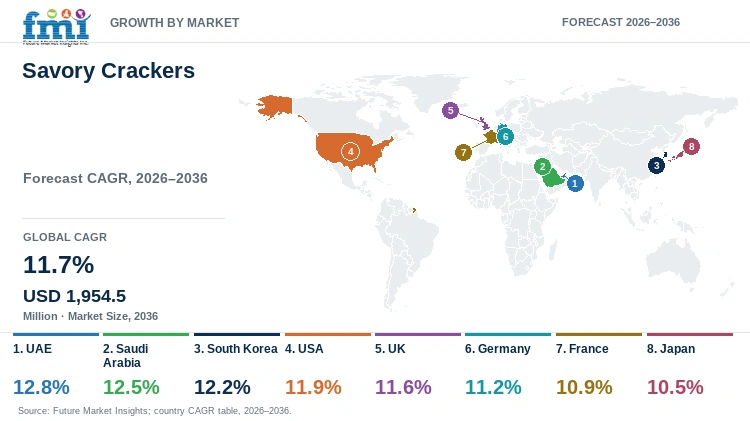
The profiled countries span 2.3 percentage points from Japan at 10.5% to the UAE at 12.8%. Gulf and South Korean forecasts form the upper group, while the USA and UK occupy the middle and Western European markets cluster below them.
- The UAE’s growth outlook is closely tied to import readiness and pre-pack conformity, making regulatory execution a key success factor alongside market demand.
- In Saudi Arabia, food-clearance procedures place early emphasis on compliant packaging documentation and smooth approval processes.
- South Korea’s expanded nutrition-labeling requirements are increasing the importance of locally developed product data and packaging specifications.
- The USA offers broad retail access, but brands must meet stringent allergen, labeling, and packaging standards to compete effectively.
- In the UK, restrictions on the promotion of less-healthy foods add an additional commercialization challenge for savory cracker manufacturers.
- Germany’s evolving Nutri-Score environment requires participating brands to align packaging and nutritional disclosures with updated scoring criteria.
- France continues to see packaging adjustments driven by revised Nutri-Score requirements and associated labeling expectations.
- Japan’s voluntary front-of-pack guidance framework gives manufacturers added flexibility while increasing the importance of thoughtful packaging design and nutrition communication.
Comparable CAGRs can still produce different entry conditions because labeling and promotion rules vary materially between national retail systems. A growth rate alone cannot establish current country size or supplier advantage without the underlying buyer base. The full report provides country-level CAGR analysis across North America, Latin America, Western Europe, Eastern Europe, East Asia, South Asia and Pacific, and the Middle East and Africa.
Country-wise Analysis
- Pack quantity and conformity controls shape how importers prepare savory crackers before retail entry in the UAE. By 2036, the UAE is projected to grow at 12.8% CAGR, supported by import-led assortments that can rotate quickly once national documentation is complete. Cabinet Resolution No. 83 of 2024 became effective on January 27 2025 and applies national quantity-control rules to prepackages. The rule requires importers to verify package declarations before seasonal or promotional assortments enter local distribution channels. Suppliers that complete conformity work before shipment can reduce relabeling and preserve launch timing for distributors.
- Food-clearance requirements make label preparation an early commercial task for savory cracker suppliers entering Saudi Arabia. Saudi Arabia's savory crackers outlook is anticipated to advance at 12.5% CAGR over the assessment period, driven by distributors expanding imported and domestic snack assortments. The SFDA food-clearance requirements published in 2025 list labeling and nutrition standards among specifications checked at national clearance. Translated packs therefore need complete supporting records before new cracker assortments move through ordinary import procedures. Suppliers that prepare Arabic-ready artwork and claim documentation can reduce release delays before distributors commit shelf space.
- Expanded nutrition disclosure is changing package-development work for processed snacks sold in South Korea. Savory cracker demand in South Korea is forecast to rise at 12.2% CAGR over the forecast period, attributable to convenience-oriented packaged foods that remain easy to compare at retail. MFDS amended the Food Labeling Standards on April 21 2025 before expanded mandatory nutrition labeling began on January 1 2026. Cracker suppliers now need complete nutrition data before Korean-language artwork enters final package production. Established local labeling workflows can shorten late-stage corrections and keep assortment changes on schedule for national retail launches.
- National grocery reach gives savory cracker brands broad distribution in the USA but packaging errors can interrupt that reach immediately. Adoption of savory crackers in the USA is estimated to expand at 11.9% CAGR through 2036, supported by recognized brands adding flavors and pack formats through national retail channels. In July 2025 the FDA posted Mondelēz Global's nationwide recall of four RITZ Peanut Butter Cracker Sandwich carton sizes after inner-pack labeling errors. The recall demonstrates why brand owners must verify every inner and outer package before national distribution begins. Disciplined pack governance can protect launches from avoidable withdrawals and replacement costs at retail.
- Savory cracker commercialization in the UK now requires media planning to account for less-healthy food advertising rules. The UK savory crackers sector is projected to record 11.6% CAGR during the assessment period, influenced by broad grocery and convenience assortments despite stricter advertising controls. Government guidance updated in June 2025 explicitly includes savory crackers in restrictions taking effect on January 5 2026 for television and paid online advertising. Qualifying products require recipe classification before brand teams commit national media budgets to a launch. Suppliers that complete classification early can preserve campaign timing after national retailers approve new product listings.
- Nutri-Score gives participating German food brands a visible comparison tool that can influence cracker formulation and packaging. In Germany, savory cracker demand is predicted to advance at 11.2% CAGR through 2036, shaped by retailers balancing familiar salted products with grain and claim-led variants. Federal guidance states that the revised Nutri-Score algorithm became mandatory for participating products after the transition ended on January 1 2026. The revised method treats salt more strictly and requires formula data before updated packaging receives approval. Salt or grain changes still need familiar taste because a better score cannot replace repeat purchase.
- Front-of-pack nutrition policy gives French cracker brands a defined redesign timetable when they participate in Nutri-Score. France is estimated to post 10.9% CAGR over the forecast period, aided by retailers carrying traditional salted lines beside differentiated grain formats. France's health ministry announced the updated Nutri-Score order on March 14 2025 and granted operators a transition period for packaging changes. Participating cracker brands may need scoring work before revised artwork reaches stores after a recipe adjustment. Coordinating salt and fiber changes with packaging updates can limit repeated relabeling without weakening familiar crunch.
- Japanese cracker launches compete on precise flavor execution while packaged-food nutrition information remains tightly managed. Savory cracker sales in Japan are forecast to expand at 10.5% CAGR by 2036, reinforced by local flavors and compact snack formats that support retail variety. The Consumer Affairs Agency published national front-of-package nutrition guidelines on February 26 2026 after ten consultation meetings with consumers and food businesses. The voluntary system gives cracker brands another standardized option for presenting nutrition on visible package areas. Suppliers must decide whether added front-panel information strengthens the proposition without crowding flavor and usage communication.
Who are the notable companies in the Savory Crackers Market?
Mondelēz International, Inc., pladis, Lotus Bakeries NV, Walker’s Shortbread Ltd., Mars, Incorporated, The Arnott’s Group, Grupo Bimbo, S.A.B. de C.V., The Campbell’s Company, Flowers Foods, Inc., and KAMEDA SEIKA CO., LTD.
Competition separates between scaled cracker platforms, specialist baked-cracker brands and broader bakery groups with owned cracker brands. Brand breadth becomes commercially relevant when companies can support the recipe, pack and channel route required for a target line. Organic foods can widen formulation choices for companies serving dietary demand without replacing direct cracker capability.
- Scaled cracker platforms include Mondelēz International, pladis, Mars, The Arnott’s Group and The Campbell’s Company with active branded cracker lines in current retail portfolios.
- Specialist positions include Lotus Bakeries through Peter’s Yard and Walker’s through oatcakes, while Whole-grain foods provide a familiar route for grain-led cracker differentiation.
- Flowers Foods participates through Simple Mills, while Grupo Bimbo serves cracker demand through its Sanissimo brand in several markets.
Competitive Benchmarking: Savory Crackers Market
| Company | Cracker Portfolio Depth | Claim and Format Breadth | Channel Coverage | Geographic Reach |
|---|---|---|---|---|
| Mondelēz International, Inc. | High | High | High | Global |
| pladis | High | Medium | High | Europe and international markets |
| Lotus Bakeries NV | Medium | Medium | Medium | Europe and selected international markets |
| Walker’s Shortbread Ltd. | Low | Low | Medium | United Kingdom and export markets |
| Mars, Incorporated | High | High | High | Global |
| The Arnott’s Group | High | High | High | Australia, New Zealand and export markets |
| Grupo Bimbo, S.A.B. de C.V. | Medium | Medium | High | Americas and selected international markets |
| The Campbell’s Company | High | High | High | North America |
| Flowers Foods, Inc. | Medium | High | High | United States |
| KAMEDA SEIKA CO., LTD. | High | Medium | High | Japan, North America and Asian markets |
Scoring basis: High cracker portfolio depth requires at least three documented cracker families or distinct current formats, Medium requires two and Low identifies one narrow route. High claim and format breadth requires at least three documented formulation or pack routes, Medium requires two and Low identifies one. High channel coverage requires three or more documented selling routes, Medium requires two and Low identifies one.
Key Developments in the Savory Crackers Market
- In August 2026, The Campbell’s Company announced its first Certified Gluten Free Goldfish cheese crackers with a nationwide retail rollout planned for November 2026.
- In October 2025, KAMEDA SEIKA announced a three-stock-flavor Magari Senbei rice cracker for nationwide Japanese supermarkets with an October 6 launch date.
- In February 2025, Flowers Foods, Inc. completed its acquisition of Simple Mills and added a national better-for-you cracker brand to its portfolio.
Key Players in the Savory Crackers Market
Scaled Branded Cracker Platforms
- Mondelēz International, Inc.
- pladis
- Mars, Incorporated
- The Arnott’s Group
- The Campbell’s Company
Specialist and Differentiated Cracker Portfolios
- Lotus Bakeries NV
- Walker’s Shortbread Ltd.
- KAMEDA SEIKA CO., LTD.
Broader Bakery Groups with Direct Cracker Brands
- Grupo Bimbo, S.A.B. de C.V.
- Flowers Foods, Inc.
Savory Crackers Market - Report Scope
| Coverage field | Report scope |
|---|---|
| Market breakdown | By product type, claim - nature, format, packaging format, sales channel and region. |
| Quantitative Units | USD million. |
| Market Definition | Commercial savory crackers sold as fresh, frozen, chilled, par-baked or ambient packaged products through retail and foodservice routes. |
| Regions Covered | North America, Latin America, Western Europe, Eastern Europe, East Asia, South Asia and Pacific, and Middle East and Africa. |
| Countries Covered | USA, Germany, France, UK, Saudi Arabia, UAE, Japan, South Korea, and 30+ countries included in the full report. |
| Key Companies Profiled | Mondelēz International, Inc., pladis, Lotus Bakeries NV, Walker’s Shortbread Ltd., Mars, Incorporated, The Arnott’s Group, Grupo Bimbo, S.A.B. de C.V., The Campbell’s Company, Flowers Foods, Inc., and KAMEDA SEIKA CO., LTD. |
| Forecast Period | 2026 to 2036. |
| Approach | Primary and secondary research with market triangulation. |
Savory Crackers Market - Research Methodology
| Method | Approach |
|---|---|
| Primary Research | FMI analysts gathered input from manufacturers, service providers, technology developers, distributors, end users, procurement teams, and subject-matter experts. Interviews examined purchasing decisions, product or service evaluation, adoption barriers, approval requirements, pricing considerations, and expectations for technical or commercial support. Respondents were also asked what evidence is required before a trial, pilot, or initial order develops into regular purchasing. |
| Desk Research | Desk research covered government statistics, regulatory publications, trade data, industry associations, technical literature, standards, company filings, product information, and official corporate announcements. Sources were reviewed for relevance, publication date, geographic coverage, and consistency with the defined market scope. Claims relating to performance, applications, approvals, capacity, investment, and commercial activity were retained only when supported by credible public evidence. |
| Market Sizing and Forecasting | The market model combined the baseline value with historical performance, segment structure, pricing and volume indicators, adoption levels, company participation, and country-level demand conditions. Forecast assumptions considered economic activity, investment trends, regulatory developments, technology adoption, purchasing cycles, supply availability, and barriers to wider market use. Segment and regional estimates were reconciled before the final market total was calculated. |
| Data Validation | Estimates were checked against multiple independent indicators, including public data, company activity, trade patterns, industry developments, and findings from primary interviews. Validation also tested whether products, services, applications, and company revenues fell within the defined market boundaries. Adjacent categories, unsupported claims, overlapping revenues, and activities without direct market relevance were excluded to reduce double counting and maintain consistency across segments and countries. |
Savory Crackers Market by Segments
Savory Crackers Market segmented by Product Type:
- Classic salted
- Seeded & wholegrain
- Cheese-flavored
- Gluten-free
Savory Crackers Market segmented by Claim - Nature:
- Conventional
- Clean label
- Organic
- Gluten-free
- High-protein - fortified
Savory Crackers Market segmented by Format:
- Fresh
- Frozen
- Ambient packaged
- Chilled
- Par-baked - thaw-and-serve
Savory Crackers Market segmented by Packaging Format:
- Multipack
- Single-serve
- Family - loaf pack
- Bulk foodservice
Savory Crackers Market segmented by Sales Channel:
- Supermarkets & hypermarkets
- Artisan & specialty bakeries
- Convenience & forecourt
- Online & DTC
- Foodservice distributors
Savory Crackers Market by Region:
- North America
- United States
- Canada
- Latin America
- Brazil
- Mexico
- Argentina
- Chile
- Western Europe
- Germany
- France
- United Kingdom
- Italy
- Spain
- Benelux
- Nordics
- Eastern Europe
- Poland
- Czech Republic
- Romania
- Hungary
- East Asia
- China
- Japan
- South Korea
- South Asia and Pacific
- India
- ASEAN
- Australia and New Zealand
- Middle East and Africa
- GCC Countries
- South Africa
- Türkiye
- Israel
Research Sources and Bibliography
- Kellanova. (2025, September 8). CHEEZ-IT® reinvents snacking with all-new CHEEZ-IT Crunch: Delivering max crunch and bold flavor like never before.
- Federal Ministry of Food and Agriculture. (2025, April 9). Hilfestellung für Unternehmen - Verwendung des Nutri-Score.
- Mondelēz International, Inc. (2025, March 24). 「リッツ ブラックペッパー クラッカー」がパワーアップして復活.
- pladis. (2025, July 14). McVitie’s owner pumps £68m into British operations.
- The Campbell’s Company. (2026, March 11). Campbell’s reports second quarter fiscal 2026 results.
- Mondelēz International, Inc. (2025, June 17). Savor each bite: Mindful snacking and prioritizing portions.
- The Arnott’s Group. (2025, April 10). Arnott’s gluten free biscuits and snacks range.
- KAMEDA SEIKA CO., LTD. (2025, March 25). 「亀田のうす焼リッチ 梅ざらめ」発売.
- UK Department of Health and Social Care & Department for Culture, Media and Sport. (2025, June 4). Restricting advertising of less healthy food or drink on TV and online: Products in scope.
- The Campbell’s Company. (2026, August 6). A key milestone in our FD&C colors transition.
- United Arab Emirates Government. (2024, July 8). Cabinet Resolution No. (83) of 2024 on the Technical Regulations for the Control of the Quantity of Product in Pre-packages. Effective January 27, 2025.
- Saudi Food and Drug Authority. (2025). Conditions and requirements for food clearance.
- Ministry of Food and Drug Safety, Republic of Korea. (2025, April 21). Food Labeling Standards, Notice No. 2025-27.
- USA Food and Drug Administration. (2025, July 8). Mondelēz Global LLC conducts USA voluntary recall of four carton sizes of RITZ Peanut Butter Cracker Sandwiches due to labeling error.
- Federal Ministry of Food and Agriculture. (2025). Abgeschlossene und dauerhafte Maßnahmen der Ernährungsstrategie.
- Ministry of Health and Access to Care, France. (2025, March 14). Catherine Vautrin, Annie Genevard, Eric Lombard, Yannick Neuder et Véronique Louwagie signent l’arrêté du Nutri-Score.
- Consumer Affairs Agency, Japan. (2026, February 26). 「日本版包装前面栄養表示ガイドライン」の公表について.
- The Campbell’s Company. (2026, August 11). Goldfish® gives its fans more to smile about with first-ever gluten free cheese crackers.
- KAMEDA SEIKA CO., LTD. (2025, October 1). 『亀田のまがりせんべい 3 種の香るだし味』新発売.
- Flowers Foods, Inc. (2025, February 21). Flowers Foods, Inc. completes acquisition of Simple Mills.
- Walker’s Shortbread Ltd. (2026, May 22). Walker’s Shortbread honoured with prestigious King’s Award for Enterprise in International Trade.
- Lotus Bakeries NV. (2026). 2025 Annual Report of the Lotus Bakeries Group.
- Grupo Bimbo, S.A.B. de C.V. (2026). Central America brand portfolio.
- Mars, Incorporated. (2025, December 11). Mars completes acquisition of Kellanova.
- Mondelēz International, Inc. (2026, August 31). 国内売上No.1クラッカー「リッツ」から待望の新作!「リッツ サラダ クラッカー」が新発売!
- The Arnott’s Group. (n.d.). Shapes Light & Crispy. Retrieved September 16, 2026.
- Food & Drink Business. (2026, March 9). Arnott's launches new Shapes range.
- The Campbell’s Company. (2026, June 30). Pokémon + Goldfish: Celebrating 30 years of Pokémon with limited-edition snacks.
- Flowers Foods, Inc. (2026, May 21). First Quarter 2026 Earnings: Prepared Remarks.
- KAMEDA SEIKA CO., LTD. (2026, March 11). 『技のこだ割り 濃厚梅だれ』定番化.
- Lotus Bakeries NV. (2026, August 7). 2026 Half-Year Results of the Lotus Bakeries Group.
- pladis. (2026, June 8). McVitie’s pushes category boundaries into savoury snacking.
- Walker’s Shortbread Ltd. (2025, June 13). Andy Murray serves up star power to celebrate a Wee Bit of Scotland that’s Come a Long Way with Walker’s Shortbread.
- KAMEDA SEIKA CO., LTD. (2025, July 18). 夏休みは三世代で一緒にサクサク食べよう 「亀田のあられ♪おせんべい♪」新CM放映.
- The Arnott’s Group. (2026, April 1). Bizza Shape Social Media Giveaway.
- KAMEDA SEIKA CO., LTD. (2026, March 10). 『亀田のうす焼 梅』新発売.
- The Campbell’s Company. (2025, September 15). Goldfish gets saucy: The story behind Awesome Sauce.
- Walker’s Shortbread Ltd. (n.d.). Awards and accreditations. Retrieved September 16, 2026.
This bibliography is provided for reader reference and is not exhaustive. The full report contains the complete reference list and detailed citations.
This Report Answers
- How large is the savory crackers market in 2026 and 2036?
- Which operating conditions convert frequent snacking into repeat cracker purchases?
- Why does classic salted hold the approved product type share?
- How do claim requirements change formulation and mainstream retail access?
- Why does fresh format demand require tighter production and replenishment?
- How does multipack packaging balance portion control with texture protection?
- Why do supermarkets and hypermarkets retain the approved channel share?
- How do country growth rates translate into different commercialization requirements?
- Which companies hold current savory cracker or closely related cracker positions?
- Which recent company actions are changing product and portfolio competition?
Frequently Asked Questions
How big is the savory crackers market in 2026?
The savory crackers market is valued at USD 646.4 million in 2026 and is projected to reach USD 1,954.5 million by 2036. Growth depends on repeated snack occasions and product changes that preserve familiar texture and value.
What is the CAGR of the savory crackers market from 2026 to 2036?
The savory crackers market is projected to expand at an 11.7% CAGR between 2026 and 2036. Manufacturers can support that pace by adapting flavors, claims and packs without weakening the familiar cracker eating experience.
Which product type leads the savory crackers market?
The classic salted segment is forecast to represent 28.0% of product type demand in 2026. Familiar seasoning and broad pairing use give retailers a stable core item before they add narrower flavor extensions.
Which sales channel leads the savory crackers market?
Supermarkets and hypermarkets are expected to account for 43.0% of sales channel demand in 2026. Their assortment depth lets shoppers compare mainstream crackers with dietary variants and multiple pack sizes in one visit.
Which countries record the higher profiled growth rates for savory crackers?
The UAE is projected at 12.8% CAGR followed by Saudi Arabia at 12.5% and South Korea at 12.2% through 2036. Each market still requires different packaging, labeling or distribution work before growth converts into sales.
Which companies are active in the savory crackers market?
Key companies include Mondelēz International, Inc., pladis, Lotus Bakeries NV, Walker’s Shortbread Ltd., Mars, Incorporated, The Arnott’s Group, Grupo Bimbo, S.A.B. de C.V., The Campbell’s Company, Flowers Foods, Inc., and KAMEDA SEIKA CO., LTD. Cracker portfolio depth and channel reach differ materially among these companies because each owns a different mix of brands and routes. Corporate size alone does not determine savory-cracker strength when the relevant brand lacks direct category depth or distribution support.
Preview the report firsthand - request a free sample
Get SampleGet the brochure for pricing and purchase details.
Get PDFTable of Content
- Key Takeaways
- Market Size and CAGR
- Top Growth Driver
- Fastest Growing Segment
- Leading Region
- Key Companies
- Emerging Opportunities
- Executive Summary
- Global Market Outlook
- Demand-side Trends
- Supply-side Trends
- Technology Roadmap Analysis
- Analysis and Recommendations
- Analyst Perspective (What is happening? Why now? What should investors know?)
- Key Questions Answered
- How large is the market?
- What is the CAGR?
- What are key trends?
- Which region dominates?
- Who are the leaders?
- Market Overview
- Market Coverage / Taxonomy
- Market Definition / Scope / Limitations
- Research Methodology
- Chapter Orientation
- Analytical Lens and Working Hypotheses
- Market Structure, Signals, and Trend Drivers
- Benchmarking and Cross-market Comparability
- Market Sizing, Forecasting, and Opportunity Mapping
- Research Design and Evidence Framework
- Desk Research Programme (Secondary Evidence)
- Expert Input and Fieldwork (Primary Evidence)
- Tooling, Models, and Reference Databases
- Data Engineering and Model Build
- Quality Assurance and Audit Trail
- Market Background
- Market Dynamics (Drivers, Restraints, Opportunity, Trends)
- Scenario Forecast (Optimistic, Likely, Conservative)
- Impact Analysis
- AI Impact
- Sustainability Impact
- Regulatory Impact
- Technology Impact
- Consumer / Buyer Analysis
- Purchase Drivers
- Adoption Barriers
- Buyer Journey
- Opportunity Map Analysis
- Product Life Cycle Analysis
- Supply Chain Analysis
- Investment Feasibility Matrix
- Value Chain Analysis
- PESTLE and Porter's Analysis
- Regulatory Landscape
- Regional Parent Market Outlook
- Production and Consumption Statistics
- Import and Export Statistics
- Global Market Analysis and Forecast, 2021 to 2036
- Historical Market Size Value (USD Million) Analysis, 2021 to 2025
- Current and Future Market Size Value (USD Million) Projections, 2026 to 2036
- Y-o-Y Growth Trend Analysis
- Absolute $ Opportunity Analysis
- Global Market Pricing Analysis, 2021 to 2036
- Global Market Analysis and Forecast, By Product Type, 2021 to 2036
- Introduction / Key Findings
- Historical Market Size Value (USD Million) Analysis By Product Type, 2021 to 2025
- Current and Future Market Size Value (USD Million) Analysis and Forecast By Product Type, 2026 to 2036
- Classic salted
- Seeded & wholegrain
- Cheese-flavored
- Gluten-free
- Y-o-Y Growth Trend Analysis By Product Type, 2021 to 2025
- Absolute $ Opportunity Analysis By Product Type, 2026 to 2036
- Global Market Analysis and Forecast, By Claim - Nature, 2021 to 2036
- Introduction / Key Findings
- Historical Market Size Value (USD Million) Analysis By Claim - Nature, 2021 to 2025
- Current and Future Market Size Value (USD Million) Analysis and Forecast By Claim - Nature, 2026 to 2036
- Conventional
- Clean label
- Organic
- Gluten-free
- High-protein - fortified
- Y-o-Y Growth Trend Analysis By Claim - Nature, 2021 to 2025
- Absolute $ Opportunity Analysis By Claim - Nature, 2026 to 2036
- Global Market Analysis and Forecast, By Format, 2021 to 2036
- Introduction / Key Findings
- Historical Market Size Value (USD Million) Analysis By Format, 2021 to 2025
- Current and Future Market Size Value (USD Million) Analysis and Forecast By Format, 2026 to 2036
- Fresh
- Frozen
- Ambient packaged
- Chilled
- Par-baked - thaw-and-serve
- Y-o-Y Growth Trend Analysis By Format, 2021 to 2025
- Absolute $ Opportunity Analysis By Format, 2026 to 2036
- Global Market Analysis and Forecast, By Packaging Format, 2021 to 2036
- Introduction / Key Findings
- Historical Market Size Value (USD Million) Analysis By Packaging Format, 2021 to 2025
- Current and Future Market Size Value (USD Million) Analysis and Forecast By Packaging Format, 2026 to 2036
- Multipack
- Single-serve
- Family - loaf pack
- Bulk foodservice
- Y-o-Y Growth Trend Analysis By Packaging Format, 2021 to 2025
- Absolute $ Opportunity Analysis By Packaging Format, 2026 to 2036
- Global Market Analysis and Forecast, By Sales Channel, 2021 to 2036
- Introduction / Key Findings
- Historical Market Size Value (USD Million) Analysis By Sales Channel, 2021 to 2025
- Current and Future Market Size Value (USD Million) Analysis and Forecast By Sales Channel, 2026 to 2036
- Supermarkets & hypermarkets
- Artisan & specialty bakeries
- Convenience & forecourt
- Online & DTC
- Foodservice distributors
- Y-o-Y Growth Trend Analysis By Sales Channel, 2021 to 2025
- Absolute $ Opportunity Analysis By Sales Channel, 2026 to 2036
- Global Market Analysis and Forecast, By Region, 2021 to 2036
- Introduction
- Historical Market Size Value (USD Million) Analysis By Region, 2021 to 2025
- Current Market Size Value (USD Million) Analysis and Forecast By Region, 2026 to 2036
- North America
- Latin America
- Western Europe
- Eastern Europe
- East Asia
- South Asia and Pacific
- Middle East and Africa
- Market Attractiveness Analysis By Region
- North America Market Analysis and Forecast, By Country, 2021 to 2036
- Historical Market Size Value (USD Million) Trend Analysis By Market Taxonomy, 2021 to 2025
- Market Size Value (USD Million) Forecast By Market Taxonomy, 2026 to 2036
- By Country
- United States
- Canada
- By Product Type
- By Claim - Nature
- By Format
- By Packaging Format
- By Sales Channel
- By Country
- Market Attractiveness Analysis
- By Country
- By Product Type
- By Claim - Nature
- By Format
- By Packaging Format
- By Sales Channel
- Key Takeaways
- Latin America Market Analysis and Forecast, By Country
- Historical Market Size Value (USD Million) Trend Analysis By Market Taxonomy, 2021 to 2025
- Market Size Value (USD Million) Forecast By Market Taxonomy, 2026 to 2036
- By Country
- Brazil
- Mexico
- Argentina
- Chile
- By Product Type
- By Claim - Nature
- By Format
- By Packaging Format
- By Sales Channel
- By Country
- Market Attractiveness Analysis
- By Country
- By Product Type
- By Claim - Nature
- By Format
- By Packaging Format
- By Sales Channel
- Key Takeaways
- Western Europe Market Analysis and Forecast, By Country
- Historical Market Size Value (USD Million) Trend Analysis By Market Taxonomy, 2021 to 2025
- Market Size Value (USD Million) Forecast By Market Taxonomy, 2026 to 2036
- By Country
- Germany
- France
- United Kingdom
- Italy
- Spain
- Benelux
- Nordics
- By Product Type
- By Claim - Nature
- By Format
- By Packaging Format
- By Sales Channel
- By Country
- Market Attractiveness Analysis
- By Country
- By Product Type
- By Claim - Nature
- By Format
- By Packaging Format
- By Sales Channel
- Key Takeaways
- Eastern Europe Market Analysis and Forecast, By Country
- Historical Market Size Value (USD Million) Trend Analysis By Market Taxonomy, 2021 to 2025
- Market Size Value (USD Million) Forecast By Market Taxonomy, 2026 to 2036
- By Country
- Poland
- Czech Republic
- Romania
- Hungary
- By Product Type
- By Claim - Nature
- By Format
- By Packaging Format
- By Sales Channel
- By Country
- Market Attractiveness Analysis
- By Country
- By Product Type
- By Claim - Nature
- By Format
- By Packaging Format
- By Sales Channel
- Key Takeaways
- East Asia Market Analysis and Forecast, By Country
- Historical Market Size Value (USD Million) Trend Analysis By Market Taxonomy, 2021 to 2025
- Market Size Value (USD Million) Forecast By Market Taxonomy, 2026 to 2036
- By Country
- China
- Japan
- South Korea
- By Product Type
- By Claim - Nature
- By Format
- By Packaging Format
- By Sales Channel
- By Country
- Market Attractiveness Analysis
- By Country
- By Product Type
- By Claim - Nature
- By Format
- By Packaging Format
- By Sales Channel
- Key Takeaways
- South Asia and Pacific Market Analysis and Forecast, By Country
- Historical Market Size Value (USD Million) Trend Analysis By Market Taxonomy, 2021 to 2025
- Market Size Value (USD Million) Forecast By Market Taxonomy, 2026 to 2036
- By Country
- India
- ASEAN
- Australia and New Zealand
- By Product Type
- By Claim - Nature
- By Format
- By Packaging Format
- By Sales Channel
- By Country
- Market Attractiveness Analysis
- By Country
- By Product Type
- By Claim - Nature
- By Format
- By Packaging Format
- By Sales Channel
- Key Takeaways
- Middle East and Africa Market Analysis and Forecast, By Country
- Historical Market Size Value (USD Million) Trend Analysis By Market Taxonomy, 2021 to 2025
- Market Size Value (USD Million) Forecast By Market Taxonomy, 2026 to 2036
- By Country
- GCC Countries
- South Africa
- Türkiye
- Israel
- By Product Type
- By Claim - Nature
- By Format
- By Packaging Format
- By Sales Channel
- By Country
- Market Attractiveness Analysis
- By Country
- By Product Type
- By Claim - Nature
- By Format
- By Packaging Format
- By Sales Channel
- Key Takeaways
- Key Countries Market Analysis
- United States
- Pricing Analysis
- Market Share Analysis, 2025
- By Product Type
- By Claim - Nature
- By Format
- By Packaging Format
- By Sales Channel
- Canada
- Pricing Analysis
- Market Share Analysis, 2025
- By Product Type
- By Claim - Nature
- By Format
- By Packaging Format
- By Sales Channel
- Mexico
- Pricing Analysis
- Market Share Analysis, 2025
- By Product Type
- By Claim - Nature
- By Format
- By Packaging Format
- By Sales Channel
- Brazil
- Pricing Analysis
- Market Share Analysis, 2025
- By Product Type
- By Claim - Nature
- By Format
- By Packaging Format
- By Sales Channel
- Chile
- Pricing Analysis
- Market Share Analysis, 2025
- By Product Type
- By Claim - Nature
- By Format
- By Packaging Format
- By Sales Channel
- Germany
- Pricing Analysis
- Market Share Analysis, 2025
- By Product Type
- By Claim - Nature
- By Format
- By Packaging Format
- By Sales Channel
- United Kingdom
- Pricing Analysis
- Market Share Analysis, 2025
- By Product Type
- By Claim - Nature
- By Format
- By Packaging Format
- By Sales Channel
- Italy
- Pricing Analysis
- Market Share Analysis, 2025
- By Product Type
- By Claim - Nature
- By Format
- By Packaging Format
- By Sales Channel
- Spain
- Pricing Analysis
- Market Share Analysis, 2025
- By Product Type
- By Claim - Nature
- By Format
- By Packaging Format
- By Sales Channel
- France
- Pricing Analysis
- Market Share Analysis, 2025
- By Product Type
- By Claim - Nature
- By Format
- By Packaging Format
- By Sales Channel
- India
- Pricing Analysis
- Market Share Analysis, 2025
- By Product Type
- By Claim - Nature
- By Format
- By Packaging Format
- By Sales Channel
- ASEAN
- Pricing Analysis
- Market Share Analysis, 2025
- By Product Type
- By Claim - Nature
- By Format
- By Packaging Format
- By Sales Channel
- Australia and New Zealand
- Pricing Analysis
- Market Share Analysis, 2025
- By Product Type
- By Claim - Nature
- By Format
- By Packaging Format
- By Sales Channel
- China
- Pricing Analysis
- Market Share Analysis, 2025
- By Product Type
- By Claim - Nature
- By Format
- By Packaging Format
- By Sales Channel
- Japan
- Pricing Analysis
- Market Share Analysis, 2025
- By Product Type
- By Claim - Nature
- By Format
- By Packaging Format
- By Sales Channel
- South Korea
- Pricing Analysis
- Market Share Analysis, 2025
- By Product Type
- By Claim - Nature
- By Format
- By Packaging Format
- By Sales Channel
- Poland
- Pricing Analysis
- Market Share Analysis, 2025
- By Product Type
- By Claim - Nature
- By Format
- By Packaging Format
- By Sales Channel
- Hungary
- Pricing Analysis
- Market Share Analysis, 2025
- By Product Type
- By Claim - Nature
- By Format
- By Packaging Format
- By Sales Channel
- Türkiye
- Pricing Analysis
- Market Share Analysis, 2025
- By Product Type
- By Claim - Nature
- By Format
- By Packaging Format
- By Sales Channel
- South Africa
- Pricing Analysis
- Market Share Analysis, 2025
- By Product Type
- By Claim - Nature
- By Format
- By Packaging Format
- By Sales Channel
- UAE
- Pricing Analysis
- Market Share Analysis, 2025
- By Product Type
- By Claim - Nature
- By Format
- By Packaging Format
- By Sales Channel
- Saudi Arabia
- Pricing Analysis
- Market Share Analysis, 2025
- By Product Type
- By Claim - Nature
- By Format
- By Packaging Format
- By Sales Channel
- United States
- Market Structure Analysis
- Competition Dashboard
- Competition Benchmarking
- Market Share Analysis of Top Players
- By Regional
- By Product Type
- By Claim - Nature
- By Format
- By Packaging Format
- By Sales Channel
- Emerging Startups
- Innovation Benchmarking
- Competition Analysis
- Competition Deep Dive
- Mondelēz International, Inc.
- Overview
- Product Portfolio
- Profitability by Market Segments
- Sales Footprint
- Strategy Overview
- Marketing Strategy
- Product Strategy
- Channel Strategy
- pladis
- Lotus Bakeries NV
- Walker’s Shortbread Ltd.
- Mars, Incorporated
- The Arnott’s Group
- Grupo Bimbo, S.A.B. de C.V.
- The Campbell’s Company
- Flowers Foods, Inc.
- KAMEDA SEIKA CO., LTD.
- Mondelēz International, Inc.
- Case Studies
- Success Stories
- Recent Developments
- Competition Deep Dive
- Assumptions & Acronyms Used


