

- Market Size (2026)
- USD 520.7 Mn
- Forecast (2036)
- USD 1033.9 Mn
- CAGR (2026 to 2036)
- 7.1%
How big is Scrubber Water Testers Market in 2026?
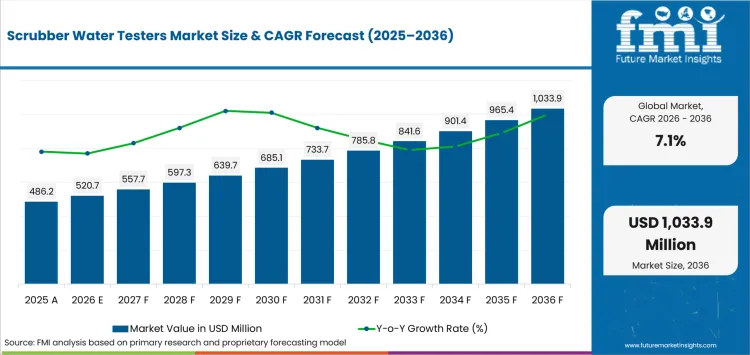
USD 520.7 million in 2026 and USD 1,033.9 million by 2036 at a 7.1% CAGR.
Demand for scrubber water testers is projected to expand at a 7.1% CAGR between 2026 and 2036, increasing market valuation from USD 520.7 million in 2026 to USD 1033.9 million by 2036. Compliance requirements continue to shape purchasing decisions for exhaust gas cleaning system operators. IMO's PPR 13 maintained discharge-water restrictions under active review in February 2026. Ongoing regulatory review keeps water analysis instrumentation inside fleet maintenance plans as existing EGCS equipment remains exposed to evolving discharge controls.
Country rules change whether recurring tester demand converts into fixed monitoring or portable verification orders during ordinary vessel trade. DNV reported in July 2025 that OSPAR parties would phase out open-loop EGCS discharge in specified North-East Atlantic port and inland waters from July 2027. Regional restrictions make mode-flexible monitoring more valuable for fleets that alternate between scrubber operation and compliant fuel across different ports.
Key Takeaways of Scrubber Water Testers Market
- Scrubber operation produces recurring tester demand as crews must preserve reliable washwater records across changing port and flag-state requirements.
- Based on tester type, pH testers are projected to account for 24.0% in 2026 due to direct discharge criteria and familiar calibration practice.
- Fixed online analyzers are set to lead the installation category with 44.0% share in 2026 due to continuous washwater monitoring onboard.
- By scrubber type, open-loop scrubbers are forecast to represent 39.0% in 2026 driven by direct discharge monitoring requirements.
- Qualification cost and sensor maintenance can delay replacement as marine installations need accurate readings despite fouling and corrosive washwater samples.
- Hach, Endress+Hauser, Datalink Instruments, Green Instruments, Rivertrace, HORIBA Advanced Techno Co., Ltd., Wärtsilä and Thomas Safety make up the controlled company register.
Analyst Perspective
"A scrubber water tester earns its place onboard when crews can verify a suspect channel without losing compliant operating time. Fleet managers should compare marine approval and calibration effort with spare availability plus service reach across the vessel’s actual trading pattern."
- Nikhil Kaitwade, Principal Consultant, Future Market Insights
How is the Scrubber Water Testers Market segmented?
The scrubber water testers market is segmented by tester type, installation, scrubber type, application, buyer type and region.
Market taxonomy covers tester type, installation, scrubber type, application, buyer type, and region. Tester types include pH testers, PAH or oil-in-water testers, turbidity meters, temperature sensors, and multiparameter kits. Installations include portable kits, fixed analyzers, and sampling panels. Scrubber types cover open-loop, closed-loop, and hybrid systems. Applications include washwater compliance, discharge monitoring, commissioning tests, and inspection support. Buyer types include shipowners, scrubber OEMs, marine service firms, and testing laboratories or surveyors. Shipowners lead the buyer type category at 34.0% in 2026 because they directly manage onboard scrubber operation, maintenance and compliance documentation.
Why does washwater compliance lead demand within the application category?
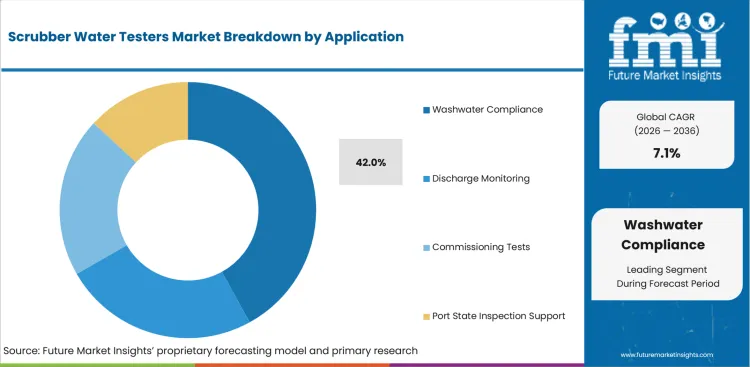
Washwater compliance makes measurement quality an operating condition instead of a laboratory preference. Shipboard records must remain credible whenever an EGCS provides the vessel’s sulfur-compliance route during normal trade.
- The washwater compliance segment is likely to capture 42.0% share in 2026 attributable to ship operators needing auditable readings during permitted discharge.
- Regulatory review also keeps documentation requirements visible to fleet managers and class surveyors. IMO’s MEPC 83 re-established the GESAMP task team on EGCS discharge water in April 2025. The review keeps water testing and analysis linked to records that must survive inspection plus maintenance changes.
Why do pH testers lead demand within the tester type category?
pH measurement sits closest to the discharge decision as crews compare readings with washwater limits. Germany’s Environment Agency reported in September 2025 that more than 5,000 ships used scrubbers and listed pH among regulated washwater parameters. Germany’s scrubber base gives pH probes recurring calibration demand without proving the modelled share.
- By tester type, pH testers are estimated to hold 24.0% in 2026 owing to direct discharge criteria and familiar onboard buffer checks.
- Crews use pH meter verification to challenge drift before a fixed channel weakens the vessel’s discharge record. Buffer checks also let service engineers isolate a failing probe without replacing unrelated monitoring hardware.
Why do fixed online analyzers lead demand within the installation category?
Fixed online analyzers provide continuous washwater readings while an exhaust gas cleaning system operates. Their installed configuration supports recurring recordkeeping across vessel routes and port calls.
- In 2026, fixed online analyzers are expected to lead installation with 44.0% share because continuous measurements support washwater compliance records.
- Fixed monitoring gains value when records must remain available during normal scrubber operation and routine vessel trading. Portable kits remain useful as independent verification tools during commissioning, troubleshooting or suspected sensor drift.
Why do open-loop scrubbers lead demand within the scrubber type category?
Open-loop scrubbers tie operating mode directly to overboard washwater measurement. OSPAR adopted Decision 2025/01 in 2025 to restrict EGCS discharge water in internal waters and port areas across the North-East Atlantic. Route restrictions matter because one vessel can change fuel or scrubber mode during a single voyage.
- The scrubber type category is forecast to be led by open-loop scrubbers at 39.0% share in 2026 due to direct discharge monitoring requirements.
- Service planning for marine emission control must preserve records across mode changes without forcing crews to manage unrelated instruments. Systems that remain useful in hybrid or closed-loop operation protect more of the original monitoring investment.
What are the drivers, restraints and opportunities in the Scrubber Water Testers Market?
Compliance records sustain recurring demand while discharge restrictions raise retrofit cost and faster field recovery provides a practical service opportunity.
- Driver: Required washwater records turn scrubber operation into recurring demand for pH and PAH plus turbidity and temperature measurement.
- Restraint: Discharge restrictions and marine re-approval requirements can raise retrofit cost or shift vessels away from open-loop operation.
- Opportunity: Portable checks and replaceable measurement channels can shorten recovery when a failed monitor threatens continued scrubber operation.
Washwater Records Tie Tester Demand to Scrubber Operation
Scrubber tester demand begins with records required whenever an EGCS discharges washwater, since failed turbidity meters can interrupt the vessel’s documented sulfur-compliance route during routine international commercial vessel operations worldwide. IMO’s PPR 12 continued work on EGCS discharge-water restrictions in January 2025 and invited further control proposals, keeping monitoring hardware inside planned maintenance budgets for active fleets that use scrubbers.
Regional Discharge Rules Raise Retrofit and Qualification Cost
Regional discharge restrictions are increasing the compliance burden for vessels operating exhaust gas cleaning systems. DNV reported in June 2026 that tighter OSPAR restrictions increasingly limit open-loop EGCS use across northern European coastal waters. Regional discharge rules raise retrofit cost as ships lose permission to use open-loop scrubbers across part of a scheduled route. Fleet managers may then need fuel-switching plans or scrubber modifications before a replacement monitor can restore the preferred scrubber compliance route.
Faster Field Recovery Rewards Serviceable Measurement Channels
A failed washwater monitor can force a vessel onto another compliance route until technicians restore reliable measurement. AMSA’s 2025/04 marine notice requires EGCS monitoring devices to remain fully functional and directs vessels toward compliant fuel if a malfunction persists beyond one hour. Portable on-site water testing and replaceable sensor channels give marine service teams a practical recovery route without rebuilding the complete control cabinet.
Which country CAGRs are profiled in the Scrubber Water Testers Market?
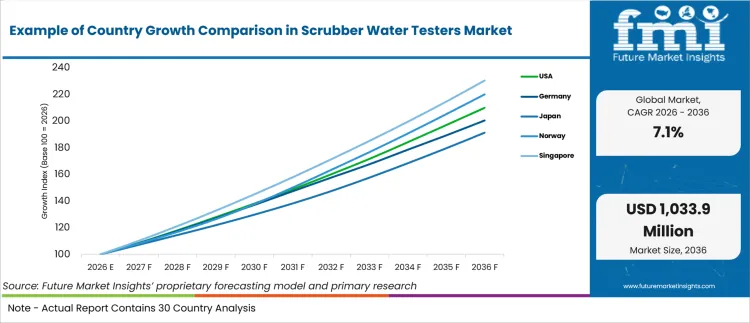
| Country | CAGR |
|---|---|
| Singapore | 6.7% |
| Norway | 6.5% |
| USA | 6.0% |
| Germany | 5.6% |
| Japan | 5.3% |
How do country-level CAGRs compare in the Scrubber Water Testers Market?
The countries span 1.4 percentage points from Singapore at 6.7% CAGR to Japan at 5.3% over the assessment period. Singapore and Norway form a tight upper cluster shaped by port and fjord operating limits. The USA marks the transition toward Germany and Japan as mature service conditions temper forecast pace.
- Singapore combines dense port calls with a local ban on open-loop washwater discharge.
- Norway combines broader emission-control waters with separate operating limits across protected fjords.
- The USA adds federal sampling duties across a dispersed port and service network.
- Germany pairs OSPAR restrictions with domestic liquid-analysis expertise and marine engineering capacity.
- Japan keeps IMO-aligned sulfur rules while ocean-going routes cross newer emission-control areas.
Similar CAGRs mask different operating permissions and service routes that shape order patterns. The full report provides country-level CAGR analysis across North America, Latin America, Europe, East Asia, South Asia, Oceania and the Middle East and Africa.
Country-wise Analysis
- Singapore’s port handled 3.22 billion gross tonnage of vessel arrivals during 2025 according to the Maritime and Port Authority in January 2026, concentrating compliance work around frequent vessel calls and short scheduled service windows. Singapore is estimated to post 6.7% CAGR over the forecast period, supported by dense marine service coverage that provides rapid calibration and replacement support between scheduled voyages. The port’s open-loop washwater restriction forces some vessels to change fuel or scrubber mode near arrival, so portable verification and fast local service become more useful than fixed hardware that cannot follow those operating changes across busy regional sailing schedules.
- Norwegian operators plan scrubber use around protected fjords and expanding sulfur-control waters, making route-specific operating mode changes part of normal technical planning for passenger and cargo fleets. The Norwegian scrubber water testers sector is projected to record 6.5% CAGR during the assessment period, reinforced by established maritime engineering and classification support for onboard service at major coastal hubs. The Norwegian Maritime Authority confirmed in February 2026 that the Norwegian Sea ECA would apply from March 1, and separate fjord restrictions keep closed-loop compatibility plus dependable calibration central to fleet qualification during coastal voyages and seasonal traffic changes in domestic waters.
- American vessel operators work across widely separated ports under a federal discharge framework that keeps sampling records and equipment condition visible during inspections and scheduled compliance reviews. EPA’s current commercial-vessel guidance states that national discharge requirements apply to approximately 85,000 international and domestic vessels and assigns implementation plus enforcement responsibilities to the Coast Guard. Scrubber water tester demand in the USA is forecast to rise at 6.0% CAGR over the forecast period, although long service distances can delay corrective work after a failed channel and make regional spare access commercially important for vessels on fixed international commercial sailing schedules.
- Tighter North-East Atlantic discharge limits meet a mature liquid-analysis base in Germany, giving fleets experienced instrument engineering and service near major North Sea ports. Scrubber water tester sales in Germany are forecast to expand at 5.6% CAGR by 2036, shaped by greater emphasis on closed-loop or hybrid compatibility across affected routes and port calls. Germany’s Environment Agency published an April 2026 scrubber fact sheet covering discharge-water impacts and reduction measures, so retrofit decisions increasingly weigh sensor replacement against wider modification work and documentation needed for compliant operating modes across complex European coastal routes and international vessel trading patterns around Europe.
- Japan’s transport ministry approved a November 2025 legal amendment adding the Norwegian Sea and Canadian Arctic ECAs to domestic MARPOL Annex VI implementation, extending compliance planning for vessels that trade beyond East Asia during voyages. Adoption of scrubber water testers in Japan is estimated to expand at 5.3% CAGR through 2036, supported by reliable calibration practice across established marine engineering networks. High expectations for instrument uptime remain the commercial friction because ocean-going ships may face long intervals between specialist service calls, which increases the value of replaceable sensors and monitoring packages that can be checked onboard without repeated shore intervention.
Who are the notable companies in the Scrubber Water Testers Market?
Hach, Endress+Hauser, Datalink Instruments, Green Instruments, Rivertrace, HORIBA Advanced Techno Co., Ltd., Wärtsilä and Thomas Safety are the notable companies serving this market.
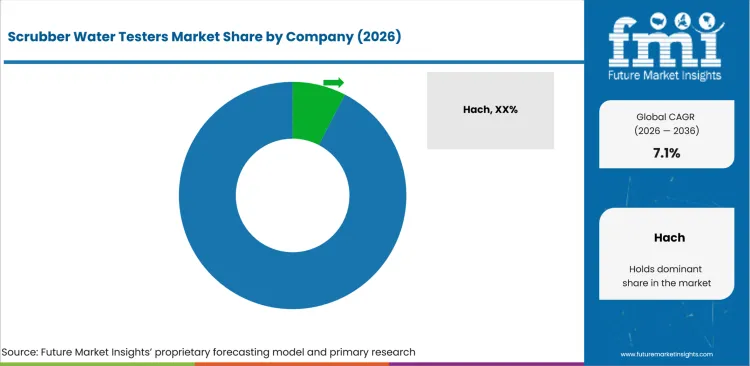
Competition is fragmented among dedicated washwater monitor manufacturers and broader scrubber-service groups. Entry requires more than general water analysis because marine environmental sensors must tolerate saline samples and fouling while preserving class-ready records. Fleet operators compare calibration workload plus spare availability with service reach before treating two monitoring packages as direct substitutes.
- Dedicated washwater monitoring: Hach, Endress+Hauser, Datalink Instruments, Green Instruments, Rivertrace and HORIBA document integrated EGCS monitoring across core washwater parameters.
- Scrubber lifecycle support: Wärtsilä services water monitoring units and offers PAH plus turbidity sensor exchange across operating exhaust gas cleaning systems.
- Marine monitoring integration: Thomas Safety combines type-approved PAH, turbidity, pH and temperature monitoring with global technical support for environmental test equipment.
Competitive Benchmarking: Scrubber Water Testers Market
| Company | Dedicated EGCS Washwater Integration | Relevant Parameter Breadth | Marine Support and Approval Depth | Geographic Reach |
|---|---|---|---|---|
| Hach | High | High | High | Global maritime sales and service |
| Endress+Hauser | High | High | High | Global marine service network |
| Datalink Instruments | High | Medium | Medium | More than 25 countries through international partners |
| Green Instruments | High | High | High | Global marine service network with USA and Singapore offices |
| Rivertrace | High | High | High | Europe, Asia and North America |
| HORIBA Advanced Techno Co., Ltd. | High | High | Medium | Global analytical network with marine application coverage |
| Wärtsilä | Medium | Medium | High | Global scrubber lifecycle and field-service network |
| Thomas Safety | High | High | High | Global marine technical support through Thomas Safety and Modcon |
Key Developments in the Scrubber Water Testers Market
- In June 2026, Endress+Hauser opened facilities in Indiana and Pennsylvania that expand regional measurement support. The additions improve USA service access but do not independently establish higher scrubber-water tester installations.
- In January 2026, Rivertrace partnered with Viam to digitize shipboard environmental-compliance records. The agreement covers oil-in-water monitoring and signals digital record integration without establishing a new SMART ESM washwater deployment.
- In July 2025, Rivertrace appointed Hitek Marine Services as its Houston representative. The appointment improves local access to Rivertrace support without independently proving additional scrubber-water tester installations.
Key Players in the Scrubber Water Testers Market
Integrated EGCS Washwater Monitoring Specialists
- Hach
- Endress+Hauser
- Datalink Instruments
- Green Instruments
- Rivertrace
- HORIBA Advanced Techno Co., Ltd.
Scrubber Lifecycle Service Providers
- Wärtsilä
Marine Monitoring Integrators
- Thomas Safety
Scrubber Water Testers Market - Report Scope
| Coverage field | Report scope |
|---|---|
| Market breakdown | By tester type, installation, scrubber type, application, buyer type and region. |
| Quantitative Units | Revenue in USD million and CAGR in %. |
| Market Definition | Marine instruments and supporting test systems used to measure exhaust gas cleaning system washwater parameters for compliance, verification, commissioning and inspection support. |
| Regions Covered | North America, Latin America, Europe, East Asia, South Asia and Pacific and Middle East and Africa. |
| Countries Covered | Singapore, Norway, USA, Germany, Japan, and 20+ countries included in the full report. |
| Key Companies Profiled | Hach, Endress+Hauser, Datalink Instruments, Green Instruments, Rivertrace, HORIBA Advanced Techno Co., Ltd., Wärtsilä, Thomas Safety. |
| Forecast Period | 2026 to 2036. |
| Approach | Primary and secondary research with market triangulation. |
Scrubber Water Testers Market - Research Methodology
| Method | Approach |
|---|---|
| Primary Research | FMI analysts gathered input from manufacturers, service providers, technology developers, distributors, end users, procurement teams, and subject-matter experts. Interviews examined purchasing decisions, product or service evaluation, adoption barriers, approval requirements, pricing considerations, and expectations for technical or commercial support. Respondents were also asked what evidence is required before a trial, pilot, or initial order develops into regular purchasing. |
| Desk Research | Desk research covered government statistics, regulatory publications, trade data, industry associations, technical literature, standards, company filings, product information, and official corporate announcements. Sources were reviewed for relevance, publication date, geographic coverage, and consistency with the defined market scope. Claims relating to performance, applications, approvals, capacity, investment, and commercial activity were retained only when supported by credible public evidence. |
| Market Sizing and Forecasting | The market model combined the baseline value with historical performance, segment structure, pricing and volume indicators, adoption levels, company participation, and country-level demand conditions. Forecast assumptions considered economic activity, investment trends, regulatory developments, technology adoption, purchasing cycles, supply availability, and barriers to wider market use. Segment and regional estimates were reconciled before the final market total was calculated. |
| Data Validation | Estimates were checked against multiple independent indicators, including public data, company activity, trade patterns, industry developments, and findings from primary interviews. Validation also tested whether products, services, applications, and company revenues fell within the defined market boundaries. Adjacent categories, unsupported claims, overlapping revenues, and activities without direct market relevance were excluded to reduce double counting and maintain consistency across segments and countries. |
Scrubber Water Testers Market by Segments
Scrubber Water Testers Market segmented by Tester Type:
- pH Testers
- PAH / Oil-in-water Testers
- Turbidity Meters
- Temperature Sensors
- Multi-parameter Washwater Kits
Scrubber Water Testers Market segmented by Installation:
- Fixed Online Analyzers
- Portable Test Kits
- Sampling Panel Systems
Scrubber Water Testers Market segmented by Scrubber Type:
- Open-loop Scrubbers
- Closed-loop Scrubbers
- Hybrid Scrubbers
Scrubber Water Testers Market segmented by Application:
- Washwater Compliance
- Discharge Monitoring
- Commissioning Tests
- Port State Inspection Support
Scrubber Water Testers Market segmented by Buyer Type:
- Shipowners
- Scrubber OEMs
- Marine Service Firms
- Testing Labs / Surveyors
Scrubber Water Testers Market by Region:
- North America
- United States
- Canada
- Latin America
- Brazil
- Mexico
- Chile
- Rest of Latin America
- Western Europe
- Germany
- United Kingdom
- Italy
- Spain
- France
- Nordics
- Benelux
- Rest of Western Europe
- Eastern Europe
- Russia
- Poland
- Hungary
- Balkan and Baltic States
- Rest of Eastern Europe
- East Asia
- China
- Japan
- South Korea
- South Asia and Pacific
- India
- ASEAN
- Australia and New Zealand
- Rest of South Asia and Pacific
- Middle East and Africa
- Kingdom of Saudi Arabia
- Other GCC Countries
- Türkiye
- South Africa
- Other African Union Countries
- Rest of Middle East and Africa
Research Sources and Bibliography
- International Maritime Organization. (2026, February 13). Sub-Committee on Pollution Prevention and Response (PPR 13), 9-13 February 2026.
- DNV. (2025, July 24). Ban on discharge of water from open loop EGCSs in coastal waters of the north-west Europe from 1 July 2027.
- Umweltbundesamt. (2025, September 24). Scrubberabwasser hat schädliche Auswirkungen auf die Meeresumwelt.
- USA Environmental Protection Agency. (n.d.). Commercial Vessel Discharge Standards: Frequently Asked Questions. Retrieved August 11, 2026.
- OSPAR Commission. (2025). Pollution from shipping activities.
- International Maritime Organization. (2025, April 11). Marine Environment Protection Committee (MEPC 83), 7 to 11 April 2025.
- International Maritime Organization. (2025, January 31). Sub-Committee on Pollution Prevention and Response (PPR 12), 27-31 January 2025.
- DNV. (2026, June 17). North-east Atlantic joins the expanding network of ECAs.
- Australian Maritime Safety Authority. (2025, August 1). Exhaust Gas Cleaning Systems.
- Endress+Hauser. (2025, November 5). Endress+Hauser expands footprint in Waldheim.
- Maritime and Port Authority of Singapore. (2026, January 13). Singapore Posts Record Port Performance in 2025 and Develops Future Readiness through Industry Collaborations for 2026.
- Norwegian Maritime Authority. (2026, February 27). Regulations concerning amendments to the Regulations on environmental safety for ships and mobile offshore units to implement Resolution MEPC.392(82) on the establishment of new Emission Control Areas in the Norwegian Sea and the Canadian Arctic into Norwegian legislation.
- USA Environmental Protection Agency. (n.d.). Commercial Vessel Discharge Standards. Retrieved August 11, 2026.
- Koppe, K., & Pirntke, U. (2026, April). Scrubber on Ships - Impact on the marine environment.
- Ministry of Land, Infrastructure, Transport and Tourism. (2025, November 21).
- Hach. (n.d.). Water Analysis Solutions for the Maritime Industry. Retrieved August 11, 2026.
- Endress+Hauser. (n.d.). Wash water monitoring for ship exhaust gas scrubbers. Retrieved August 11, 2026.
- Datalink Instruments. (n.d.). Reliable and sustainable water analyzers - Datalink Instruments. Retrieved August 11, 2026.
- Green Instruments. (n.d.). Value Maritime CO2 Capture. Retrieved August 11, 2026.
- Rivertrace. (n.d.). Exhaust Scrubber Wash Water Discharge. Retrieved August 11, 2026.
- HORIBA. (n.d.). Marine Emissions Testing, Fuel Efficiency Solutions & Pollution Control. Retrieved August 11, 2026.
- Wärtsilä. (n.d.). Championing EGCS lifecycle services for safe and efficient shipping. Retrieved August 11, 2026.
- Thomas Safety. (n.d.). Environment. Retrieved August 11, 2026.
- Endress+Hauser. (2026, June 25). Endress+Hauser expands its presence in the USA
- Rivertrace. (2026, January 13). Viam and Rivertrace partner to advance maritime environmental compliance.
- Rivertrace. (2025, July 3). Rivertrace Expands US Presence with New Houston Representative.
This bibliography is provided for reader reference and is not exhaustive. The full report contains the complete reference list and detailed citations
This Report Answers
- How large is the scrubber water testers market in 2026 and 2036?
- Which compliance duties produce recurring tester and calibration demand?
- Why do pH testers account for 24.0% of tester type demand in 2026?
-
Why do fixed online analyzers account for 44.0% of installation demand in 2026?
- How do open-loop discharge restrictions change tester selection and retrofit planning?
- How do growth conditions differ across the five profiled countries?
- Which operating frictions raise fixed washwater monitoring lifetime costs?
- How do the eight profiled companies differ in integration, parameter breadth and onboard support?
Frequently Asked Questions
How big is the Scrubber Water Testers Market in 2026?
The scrubber water testers market is valued at USD 520.7 million in 2026 and is projected to reach USD 1,033.9 million by 2036. Replacement and calibration demand supports spending across operating exhaust gas cleaning systems.
What is the CAGR of the Scrubber Water Testers Market from 2026 to 2036?
The scrubber water testers market is projected to grow at a CAGR of 7.1% between 2026 and 2036. Growth reflects recurring monitoring requirements across vessels using exhaust gas cleaning systems.
Which tester type leads the Scrubber Water Testers Market?
pH testers are projected to account for 24.0% of the market in 2026. Their use follows direct washwater criteria and familiar onboard calibration practice.
Which installation type holds the largest share of the Scrubber Water Testers Market?
Fixed online analyzers are projected to account for 44.0% of the market in 2026. Continuous readings support compliance records during normal scrubber operation and vessel trade.
Which companies are active in the Scrubber Water Testers Market?
Key companies include Hach, Endress+Hauser, Datalink Instruments, Green Instruments, Rivertrace, HORIBA Advanced Techno Co., Ltd., Wärtsilä and Thomas Safety. They compete through washwater monitoring, sensor service and marine calibration support.
Preview the report firsthand - request a free sample
Get SampleGet the brochure for pricing and purchase details.
Get PDFTable of Content
- Key Takeaways
- Market Size and CAGR
- Top Growth Driver
- Fastest Growing Segment
- Leading Region
- Key Companies
- Emerging Opportunities
- Executive Summary
- Global Market Outlook
- Demand-side Trends
- Supply-side Trends
- Technology Roadmap Analysis
- Analysis and Recommendations
- Analyst Perspective (What is happening? Why now? What should investors know?)
- Key Questions Answered
- How large is the market?
- What is the CAGR?
- What are key trends?
- Which region dominates?
- Who are the leaders?
- Market Overview
- Market Coverage / Taxonomy
- Market Definition / Scope / Limitations
- Research Methodology
- Chapter Orientation
- Analytical Lens and Working Hypotheses
- Market Structure, Signals, and Trend Drivers
- Benchmarking and Cross-market Comparability
- Market Sizing, Forecasting, and Opportunity Mapping
- Research Design and Evidence Framework
- Desk Research Programme (Secondary Evidence)
- Expert Input and Fieldwork (Primary Evidence)
- Tooling, Models, and Reference Databases
- Data Engineering and Model Build
- Quality Assurance and Audit Trail
- Market Background
- Market Dynamics (Drivers, Restraints, Opportunity, Trends)
- Scenario Forecast (Optimistic, Likely, Conservative)
- Impact Analysis
- AI Impact
- Sustainability Impact
- Regulatory Impact
- Technology Impact
- Consumer / Buyer Analysis
- Purchase Drivers
- Adoption Barriers
- Buyer Journey
- Opportunity Map Analysis
- Product Life Cycle Analysis
- Supply Chain Analysis
- Investment Feasibility Matrix
- Value Chain Analysis
- PESTLE and Porter's Analysis
- Regulatory Landscape
- Regional Parent Market Outlook
- Production and Consumption Statistics
- Import and Export Statistics
- Global Market Analysis and Forecast, 2021 to 2036
- Historical Market Size Value (USD Million) Analysis, 2021 to 2025
- Current and Future Market Size Value (USD Million) Projections, 2026 to 2036
- Y-o-Y Growth Trend Analysis
- Absolute $ Opportunity Analysis
- Global Market Pricing Analysis, 2021 to 2036
- Global Market Analysis and Forecast, By Tester Type, 2021 to 2036
- Introduction / Key Findings
- Historical Market Size Value (USD Million) Analysis By Tester Type, 2021 to 2025
- Current and Future Market Size Value (USD Million) Analysis and Forecast By Tester Type, 2026 to 2036
- pH Testers
- PAH / Oil-in-water Testers
- Turbidity Meters
- Temperature Sensors
- Multi-parameter Washwater Kits
- pH Testers
- Y-o-Y Growth Trend Analysis By Tester Type, 2021 to 2025
- Absolute $ Opportunity Analysis By Tester Type, 2026 to 2036
- Global Market Analysis and Forecast, By Installation, 2021 to 2036
- Introduction / Key Findings
- Historical Market Size Value (USD Million) Analysis By Installation, 2021 to 2025
- Current and Future Market Size Value (USD Million) Analysis and Forecast By Installation, 2026 to 2036
- Fixed Online Analyzers
- Portable Test Kits
- Sampling Panel Systems
- Fixed Online Analyzers
- Y-o-Y Growth Trend Analysis By Installation, 2021 to 2025
- Absolute $ Opportunity Analysis By Installation, 2026 to 2036
- Global Market Analysis and Forecast, By Scrubber Type, 2021 to 2036
- Introduction / Key Findings
- Historical Market Size Value (USD Million) Analysis By Scrubber Type, 2021 to 2025
- Current and Future Market Size Value (USD Million) Analysis and Forecast By Scrubber Type, 2026 to 2036
- Open-loop Scrubbers
- Closed-loop Scrubbers
- Hybrid Scrubbers
- Open-loop Scrubbers
- Y-o-Y Growth Trend Analysis By Scrubber Type, 2021 to 2025
- Absolute $ Opportunity Analysis By Scrubber Type, 2026 to 2036
- Global Market Analysis and Forecast, By Application, 2021 to 2036
- Introduction / Key Findings
- Historical Market Size Value (USD Million) Analysis By Application, 2021 to 2025
- Current and Future Market Size Value (USD Million) Analysis and Forecast By Application, 2026 to 2036
- Washwater Compliance
- Discharge Monitoring
- Commissioning Tests
- Port State Inspection Support
- Washwater Compliance
- Y-o-Y Growth Trend Analysis By Application, 2021 to 2025
- Absolute $ Opportunity Analysis By Application, 2026 to 2036
- Global Market Analysis and Forecast, By Buyer Type, 2021 to 2036
- Introduction / Key Findings
- Historical Market Size Value (USD Million) Analysis By Buyer Type, 2021 to 2025
- Current and Future Market Size Value (USD Million) Analysis and Forecast By Buyer Type, 2026 to 2036
- Shipowners
- Scrubber OEMs
- Marine Service Firms
- Testing Labs / Surveyors
- Shipowners
- Y-o-Y Growth Trend Analysis By Buyer Type, 2021 to 2025
- Absolute $ Opportunity Analysis By Buyer Type, 2026 to 2036
- Global Market Analysis and Forecast, By Region, 2021 to 2036
- Introduction
- Historical Market Size Value (USD Million) Analysis By Region, 2021 to 2025
- Current Market Size Value (USD Million) Analysis and Forecast By Region, 2026 to 2036
- North America
- Latin America
- Western Europe
- Eastern Europe
- East Asia
- South Asia and Pacific
- Middle East & Africa
- Market Attractiveness Analysis By Region
- North America Market Analysis and Forecast, By Country, 2021 to 2036
- Historical Market Size Value (USD Million) Trend Analysis By Market Taxonomy, 2021 to 2025
- Market Size Value (USD Million) Forecast By Market Taxonomy, 2026 to 2036
- By Country
- USA
- Canada
- By Tester Type
- By Installation
- By Scrubber Type
- By Application
- By Buyer Type
- By Country
- Market Attractiveness Analysis
- By Country
- By Tester Type
- By Installation
- By Scrubber Type
- By Application
- By Buyer Type
- Key Takeaways
- Latin America Market Analysis and Forecast, By Country
- Historical Market Size Value (USD Million) Trend Analysis By Market Taxonomy, 2021 to 2025
- Market Size Value (USD Million) Forecast By Market Taxonomy, 2026 to 2036
- By Country
- Brazil
- Mexico
- Chile
- Rest of Latin America
- By Tester Type
- By Installation
- By Scrubber Type
- By Application
- By Buyer Type
- By Country
- Market Attractiveness Analysis
- By Country
- By Tester Type
- By Installation
- By Scrubber Type
- By Application
- By Buyer Type
- Key Takeaways
- Western Europe Market Analysis and Forecast, By Country
- Historical Market Size Value (USD Million) Trend Analysis By Market Taxonomy, 2021 to 2025
- Market Size Value (USD Million) Forecast By Market Taxonomy, 2026 to 2036
- By Country
- Germany
- UK
- Italy
- Spain
- France
- Nordic
- BENELUX
- Rest of Western Europe
- By Tester Type
- By Installation
- By Scrubber Type
- By Application
- By Buyer Type
- By Country
- Market Attractiveness Analysis
- By Country
- By Tester Type
- By Installation
- By Scrubber Type
- By Application
- By Buyer Type
- Key Takeaways
- Eastern Europe Market Analysis and Forecast, By Country
- Historical Market Size Value (USD Million) Trend Analysis By Market Taxonomy, 2021 to 2025
- Market Size Value (USD Million) Forecast By Market Taxonomy, 2026 to 2036
- By Country
- Russia
- Poland
- Hungary
- Balkan & Baltic
- Rest of Eastern Europe
- By Tester Type
- By Installation
- By Scrubber Type
- By Application
- By Buyer Type
- By Country
- Market Attractiveness Analysis
- By Country
- By Tester Type
- By Installation
- By Scrubber Type
- By Application
- By Buyer Type
- Key Takeaways
- East Asia Market Analysis and Forecast, By Country
- Historical Market Size Value (USD Million) Trend Analysis By Market Taxonomy, 2021 to 2025
- Market Size Value (USD Million) Forecast By Market Taxonomy, 2026 to 2036
- By Country
- China
- Japan
- South Korea
- By Tester Type
- By Installation
- By Scrubber Type
- By Application
- By Buyer Type
- By Country
- Market Attractiveness Analysis
- By Country
- By Tester Type
- By Installation
- By Scrubber Type
- By Application
- By Buyer Type
- Key Takeaways
- South Asia and Pacific Market Analysis and Forecast, By Country
- Historical Market Size Value (USD Million) Trend Analysis By Market Taxonomy, 2021 to 2025
- Market Size Value (USD Million) Forecast By Market Taxonomy, 2026 to 2036
- By Country
- India
- ASEAN
- Australia & New Zealand
- Rest of South Asia and Pacific
- By Tester Type
- By Installation
- By Scrubber Type
- By Application
- By Buyer Type
- By Country
- Market Attractiveness Analysis
- By Country
- By Tester Type
- By Installation
- By Scrubber Type
- By Application
- By Buyer Type
- Key Takeaways
- Middle East & Africa Market Analysis and Forecast, By Country
- Historical Market Size Value (USD Million) Trend Analysis By Market Taxonomy, 2021 to 2025
- Market Size Value (USD Million) Forecast By Market Taxonomy, 2026 to 2036
- By Country
- Kingdom of Saudi Arabia
- Other GCC Countries
- Türkiye
- South Africa
- Other African Union
- Rest of Middle East & Africa
- By Tester Type
- By Installation
- By Scrubber Type
- By Application
- By Buyer Type
- By Country
- Market Attractiveness Analysis
- By Country
- By Tester Type
- By Installation
- By Scrubber Type
- By Application
- By Buyer Type
- Key Takeaways
- Key Countries Market Analysis
- USA
- Pricing Analysis
- Market Share Analysis, 2025
- By Tester Type
- By Installation
- By Scrubber Type
- By Application
- By Buyer Type
- Canada
- Pricing Analysis
- Market Share Analysis, 2025
- By Tester Type
- By Installation
- By Scrubber Type
- By Application
- By Buyer Type
- Mexico
- Pricing Analysis
- Market Share Analysis, 2025
- By Tester Type
- By Installation
- By Scrubber Type
- By Application
- By Buyer Type
- Brazil
- Pricing Analysis
- Market Share Analysis, 2025
- By Tester Type
- By Installation
- By Scrubber Type
- By Application
- By Buyer Type
- Chile
- Pricing Analysis
- Market Share Analysis, 2025
- By Tester Type
- By Installation
- By Scrubber Type
- By Application
- By Buyer Type
- Germany
- Pricing Analysis
- Market Share Analysis, 2025
- By Tester Type
- By Installation
- By Scrubber Type
- By Application
- By Buyer Type
- UK
- Pricing Analysis
- Market Share Analysis, 2025
- By Tester Type
- By Installation
- By Scrubber Type
- By Application
- By Buyer Type
- Italy
- Pricing Analysis
- Market Share Analysis, 2025
- By Tester Type
- By Installation
- By Scrubber Type
- By Application
- By Buyer Type
- Spain
- Pricing Analysis
- Market Share Analysis, 2025
- By Tester Type
- By Installation
- By Scrubber Type
- By Application
- By Buyer Type
- France
- Pricing Analysis
- Market Share Analysis, 2025
- By Tester Type
- By Installation
- By Scrubber Type
- By Application
- By Buyer Type
- India
- Pricing Analysis
- Market Share Analysis, 2025
- By Tester Type
- By Installation
- By Scrubber Type
- By Application
- By Buyer Type
- ASEAN
- Pricing Analysis
- Market Share Analysis, 2025
- By Tester Type
- By Installation
- By Scrubber Type
- By Application
- By Buyer Type
- Australia & New Zealand
- Pricing Analysis
- Market Share Analysis, 2025
- By Tester Type
- By Installation
- By Scrubber Type
- By Application
- By Buyer Type
- China
- Pricing Analysis
- Market Share Analysis, 2025
- By Tester Type
- By Installation
- By Scrubber Type
- By Application
- By Buyer Type
- Japan
- Pricing Analysis
- Market Share Analysis, 2025
- By Tester Type
- By Installation
- By Scrubber Type
- By Application
- By Buyer Type
- South Korea
- Pricing Analysis
- Market Share Analysis, 2025
- By Tester Type
- By Installation
- By Scrubber Type
- By Application
- By Buyer Type
- Russia
- Pricing Analysis
- Market Share Analysis, 2025
- By Tester Type
- By Installation
- By Scrubber Type
- By Application
- By Buyer Type
- Poland
- Pricing Analysis
- Market Share Analysis, 2025
- By Tester Type
- By Installation
- By Scrubber Type
- By Application
- By Buyer Type
- Hungary
- Pricing Analysis
- Market Share Analysis, 2025
- By Tester Type
- By Installation
- By Scrubber Type
- By Application
- By Buyer Type
- Kingdom of Saudi Arabia
- Pricing Analysis
- Market Share Analysis, 2025
- By Tester Type
- By Installation
- By Scrubber Type
- By Application
- By Buyer Type
- Türkiye
- Pricing Analysis
- Market Share Analysis, 2025
- By Tester Type
- By Installation
- By Scrubber Type
- By Application
- By Buyer Type
- South Africa
- Pricing Analysis
- Market Share Analysis, 2025
- By Tester Type
- By Installation
- By Scrubber Type
- By Application
- By Buyer Type
- USA
- Market Structure Analysis
- Competition Dashboard
- Competition Benchmarking
- Market Share Analysis of Top Players
- By Regional
- By Tester Type
- By Installation
- By Scrubber Type
- By Application
- By Buyer Type
- Emerging Startups
- Innovation Benchmarking
- Competition Analysis
- Competition Deep Dive
- Hach
- Overview
- Product Portfolio
- Profitability by Market Segments
- Sales Footprint
- Strategy Overview
- Marketing Strategy
- Product Strategy
- Channel Strategy
- Xylem Analytics
- Thermo Fisher Scientific
- KROHNE Marine
- Emerson
- Endress+Hauser
- Chelsea Technologies
- Turner Designs
- AquaRead
- Tintometer
- Hach
- Case Studies
- Success Stories
- Recent Developments
- Competition Deep Dive
- Assumptions & Acronyms Used


