

- Industry Size (2026)
- USD 2.9 Bn
- Forecast (2036)
- USD 14.2 Bn
- CAGR (2026 to 2036)
- 17.1%
Self Balancing Scooter Market Forecast and Outlook 2026 to 2036
The global self balancing scooter sector is on track to achieve a valuation of USD 14.2 billion by 2036, accelerating from USD 2.9 billion in 2026 at a CAGR of 17.1%. As per Future Market Insights, expansion is structurally underpinned by the global adoption of micromobility for last-mile urban transport, the integration of AI stability systems that eliminate user-error accidents, and the entry of traditional automotive manufacturers bringing engineering credibility to the category.
The International Energy Agency (IEA) reported in its 2024 Global EV Outlook that electric two- and three-wheeler sales exceeded 50 million units globally, validating the consumer shift toward electric personal mobility. The broader electric scooters market is growing at 9.1% CAGR through 2035, with self balancing variants capturing the premium performance tier. This electric micromobility adoption compels self balancing scooter manufacturers to invest in AI-driven stability, battery range optimisation, and safety certification. Simultaneously the regulatory landscape is evolving as cities implement micromobility speed limits, insurance requirements, and safety standards.
In February 2026, Segway-Ninebot announced that all 2026 models will come standard with its proprietary Nimble OS and an intelligent autonomous driving system that uses AI to adjust centre-of-gravity compensation in real-time, aiming to eliminate tip-over accidents. FMI is of the opinion that AI-driven stability systems will become mandatory safety features on all premium self balancing scooters by 2028, effectively creating a regulatory barrier to entry that consolidates market share among technology-invested manufacturers. The parallel growth of e-scooter sharing platforms at a 17.9% CAGR is further validating the urban micromobility thesis and expanding consumer familiarity with electric personal transport.
The competitive landscape in 2025 and 2026 is defined by AI stability and dual-brand strategies. Segway debuted its dual-brand global strategy in January 2026, with Ninebot focusing on mass-market safety and Segway pivoting toward high-performance exploration-grade mobility. Segway launched the GT3 Pro and GT3 SuperScooters in Spring 2025 with 0-30 mph acceleration in 3.9 seconds and 11-inch self-healing tyres. Yamaha Motor launched two electric models in November 2025 with River Mobility utilising gyroscopic sensors from stability-control R&D.
Gogoro and Hero MotoCorp partnered to co-develop battery-swapping infrastructure and launched the CrossOver GX250 in India. The broader micro mobility market projected to reach USD 287.8 billion by 2035 provides the macroeconomic tailwind. The adjacent electric kick scooter segment is growing at 11.8% CAGR, with self balancing gyroscopic variants commanding a price premium of 40 to 60% over standard kick scooters. As per FMI, this convergence of AI autonomous stability, dual-brand segmentation, and automotive manufacturer entry confirms that the self balancing scooter market is transitioning from a recreational novelty into a technology-certified urban micromobility platform.
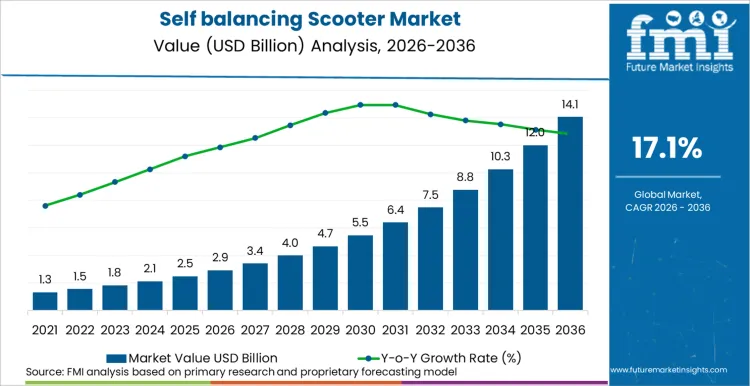
Summary of Self Balancing Scooter Market
What Is Growth Outlook for Self Balancing Scooter Market as per Future Market Insights Projection?
Future Market Insights projects the self balancing scooter industry to expand at a CAGR of 17.1% from 2026 to 2036, increasing from USD 2.9 Billion in 2026 to USD 14.2 Billion by 2036.
FMI Research Approach: FMI proprietary forecasting model based on IEA electric two-wheeler data, micromobility adoption rates, and AI stability system penetration tracking.
How Do FMI Analysts Perceive Self Balancing Scooter Market to Evolve?
FMI analysts perceive the market evolving toward AI-native, safety-certified micromobility platforms where autonomous stability systems eliminate user-error accidents and dual-brand strategies segment premium exploration-grade from mass-market commuter devices.
FMI Research Approach: Segway-Ninebot Nimble OS AI stability analysis and dual-brand strategy tracking.
Which Country Holds Largest Share in Global Self Balancing Scooter Market?
China holds a significant share of the global self balancing scooter market by volume which is supported by Segway-Ninebot's manufacturing base, the scale of domestic micromobility adoption, and the concentration of battery and motor component supply chains.
FMI Research Approach: FMI country-level revenue modeling by Segway-Ninebot shipment data and micromobility registration tracking.
How Large Will Self Balancing Scooter Market Be by 2036?
The global self balancing scooter market is projected to reach USD 14.2 Billion by 2036.
FMI Research Approach: FMI long-term revenue forecast derived from urban micromobility adoption projections and AI stability system penetration analysis.
What Is Definition of Self Balancing Scooter Market?
The self balancing scooter market includes hoverboards, self balancing unicycles, electric kick scooters with gyroscopic stabilisation, and AI-enabled personal transport devices that use inertial measurement and motor control to maintain rider balance during operation.
FMI Research Approach: FMI market taxonomy aligned with IEC personal mobility device safety standards and micromobility classification.
What Are Globally Unique Trends Shaping Self Balancing Scooter Market?
Globally unique trends include AI autonomous stability with real-time centre-of-gravity compensation (Segway Nimble OS), dual-brand premium-versus-mass segmentation (Segway/Ninebot split), and automotive manufacturer entry with gyroscopic stability R&D (Yamaha-River Mobility).
FMI Research Approach: Segway 2026 User Conference announcements and Yamaha-River Mobility partnership tracking.
Self Balancing Scooter Market Key Takeaways
| Metric | Details |
|---|---|
| Industry Size (2026) | USD 2.9 Billion |
| Industry Value (2036) | USD 14.2 Billion |
| CAGR (2026 to 2036) | 17.1% |
Source: Future Market Insights (FMI) analysis, based on proprietary forecasting model and primary research
Key Drivers in the Self-Balancing Scooter Market
Growing Demand for Personal Transportation Solutions
Self balancing scooters are convenient for daily commuters as they are compact and easy to ride. Also, these scooters can prove as an alternative for commuting short distances, which eventually helps reduce traffic congestion. These scooters are eco-friendly, noise-free, emit zero pollution, and do not need fuel, making them attractive to environmentally conscious consumers.
Technological Advancements
Innovations in batteries, motors, and gyro sensors have led the way for even better performance range and stability among self balancing scooters. The lithium-ion batteries and smart sensors allow scooters to travel very long distances on improved speed with efficiency. Bluetooth connectivity and the integration of mobile apps for tracking speed, battery life, and location enhance the user experience, making these scooters more appealing.
Shift Toward Eco-friendly and Green Transportation
Rising concerns over air pollution and the environmental impact of conventional vehicles have increased the demand for green mobility solutions. Self balancing scooters are a part of the broader trend toward sustainable transportation, offering energy-efficient alternative to gas-powered vehicles.
Cost-Effective and Convenient Mobility
As cities become more congested, self balancing scooters provide a cost-effective and efficient way to navigate short distances. They are often more affordable than traditional personal vehicles for example cars, and motorcycles, specifically for younger and urban consumers.
They are lightweight, compact, and easy to store, providing high convenience for daily commuters, especially in metropolitan areas with limited parking spaces.
Challenges in the Self-Balancing Scooter Market
Safety Concerns and Regulatory Issues
Safety is still one of the main issues in the self balancing scooter market. There have been safety concerns regarding balance stability, sudden accelerations, and falling, which often results in injuries.
As a response, most regions have enacted more stringent regulations regarding the use of self balancing scooters such as speed limits, age restrictions, and requirements for safety gear to ensure the safety of users. This will raise manufacturing costs and pose market entry barriers.
Battery and Charging Infrastructure
While improvements have been made in battery efficiency, issues such as battery life, charging time, and overheating remain challenges. Additionally, the lack of widespread charging infrastructure in public areas limits the usability of self balancing scooters for longer commutes or tips. Lithium-ion battery safety has also been a concern due to potential fire hazards, leading to the need for better manufacturing standards and safety protocols.
Impractical for Long-distance Travel
The growth of electric bikes, e-scooters, and electric skateboards has emerged as an option for self-balancing scooters. The industry is in its nascent stages, and the products have limited accountability for long-distance travel. The impracticality of self-balancing scooters for long-distance commutes confines the demand.
Unlocking New Opportunities in the Self-Balancing Scooter Market
Expanding Market for Last-Mile Connectivity
Self balancing scooters have a huge potential for last-mile connectivity in the growing shared mobility ecosystem. As a part of urban mobility solutions, they can be used alongside public transportation to cover short distances, providing a solution for commuters who need to travel via train stations or bus stops to their final destinations.
Shared hoverboard services could open up new business models, specifically in the densely populated urban environment, like e-scooter sharing services.
Integration with Smart Cities
With the rise of smart cities, self balancing scooters can integrate into smart transportation networks. This includes coordination with mobility-as-a-service platforms, integrated payment systems, and real-time traffic management. Smart infrastructure such as dedicated scooter lanes, parking stations, and charging facilities improve the uptake and practically self balancing scooters in urban areas.
Innovations Transforming the Self-Balancing Scooter Landscape
Improved Battery Technology
Lithium-ion batteries are a key trend as they provide higher energy density, longer battery life, and faster charging compared to traditional battery technologies.
This enables long riding distances and fast charging times, making the scooters more practical for daily use. Battery management systems allow better performance monitoring, protecting against overcharging, overheating, and maintaining optimal battery performance.
Enhanced Gyroscopic and Balance Sensors
Advanced gyroscopic technology, self balancing scooters work on the principle of maintaining balance through gyroscopic sensors. With the advancements in sensor technology, scooters now provide better balance, responsiveness, and control capabilities, even in high-speed navigation over uneven terrains.
Electronic stability control helps maintain balance by adjusting motor power, providing smoother rides, and reducing the risk of falls. This feature enhances both stability and safety.
Segment-wise Analysis of the Self-Balancing Scooter Market
By Product
| Attributes | Details |
|---|---|
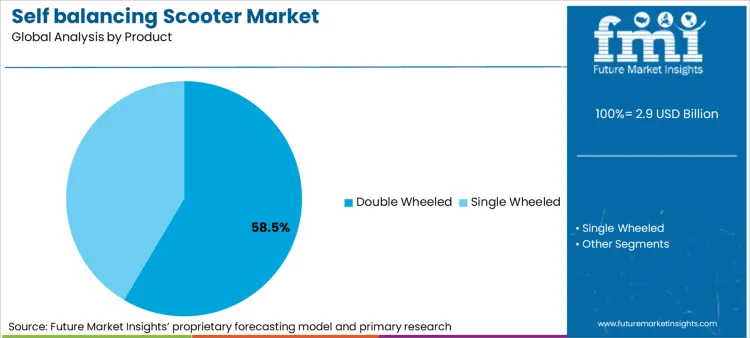
| Top Product | Double wheeled |
| Market Share in 2026 | 58.5 % |
Based on product, the market is divided into single-wheeled and double-wheeled. The double-wheeled segment is expected to account for 58.5% share in 2026. Double-wheeled self balancing scooters, often referred to as hoverboards, have gained immense popularity due to their unique design and user-friendly features. They are widely used in gyroscopic scooters, automatic balancing, compact and portable, and user-friendly interfaces.
In gyroscopic scooters, the scooters are equipped with gyroscopic sensors that constantly monitor the rider’s movements and adjust the speed and direction of the wheels accordingly. Automatic technology allows riders of all skill levels to easily learn and operate the scooter, making it accessible to a wide range of users. Additionally, in compact and portable, many models are designed to be lightweight and foldable, making them easy to carry and store in small spaces.
By End-use Industries
| Attributes | Details |
|---|---|
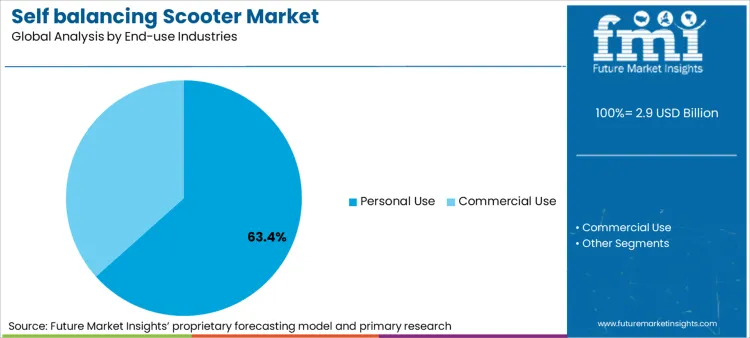
| Top End-use Industries | Personal use |
| Market Share in 2026 | 63.4 % |
Based on end-user industries, the market is divided into personal use and commercial use. The personal use segment is expected to account for 63.4 % share in 2026. The end-users refer to the various sectors that utilize self balancing scooters as part of their operations or services such as tourism and hospitality, warehousing and logistics, security and surveillance, and manufacturing and industrial facilities.
Self balancing scooters are fun yet efficient to navigate tourist attractions, such as theme parks, museums, and historical sites. Moreover, they streamline staff mobility within large properties, allowing for quicker response times and improved service delivery. Self balancing scooters enable faster and more efficient movement within warehouses, improving productivity and reducing labor costs.
Analysis of Top Countries, Producing, Using, and Distributing Self-Balancing Scooter Market
USA
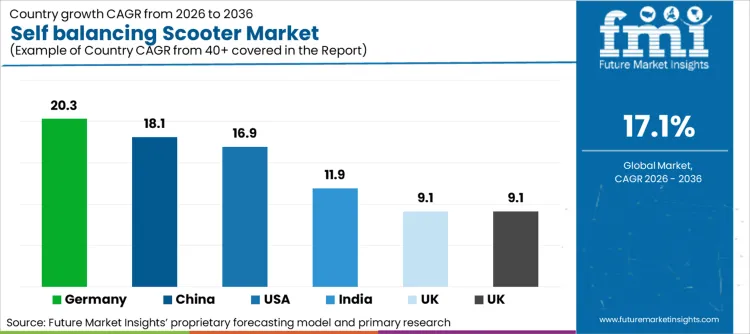
The USA self balancing scooter market is poised to experience a CAGR of 16.9% from 2026 to 2036. it is one of the leading industry globally. Factors such as increased uptake for recreational use, demand in urban commuting, and growth in technology-driven transportation are contributing to the rise of these products. The rise of eco-friendly transportation solutions and the push for sustainable urban mobility further support this.
UK
The industry in UK is expanding to grow at a CAGR of 9.1% in the forecast period. The rise in number of urban commuters is growing in the UK. They need practical commuting options to travel to local places. In addition, urbanization and a rising preference for an environment-friendly means of transportation enhance the industry growth.
Germany
Germany is set to witness a CAGR of 20.3% from 2026 to 2036. Germany, with its strong automotive industry and focus on green technologies, is seeing increasing demand for electric personal transportation solutions like self balancing scooters. The integration of smart city technologies and eco-friendly mobility trends also supports growth.
France
France is poised to witness a CAGR of 9.1% from 2026 to 2036. France is embracing personal electric vehicles, and self balancing scooters are becoming increasingly popular in cities. Government initiatives to reduce carbon emissions and promote green transport solutions boost the demand for these scooters.
China
China is poised to attain a CAGR of 18.1% from 2026 to 2036. China is the largest market for self balancing scooters due to its dominance in manufacturing, technology uptake, and rapidly growing alternative transportation methods in crowded urban areas. The popularity of electric scooters and bikes has driven growth, and the Chinese government’s push for sustainability further supports expansion.
India
India is expected to achieve a CAGR of 11.9% from 2026 to 2036. The emerging Indian market is proving to be quite promising for self balancing scooters. Factors such as growing urbanization, increasing disposable incomes, and an expanding eco-conscious consumer base are the drivers for demand. With increased urban mobility solutions and electric vehicle infrastructure, this market will only grow.
Leading Suppliers in the Self-Balancing Scooter Market
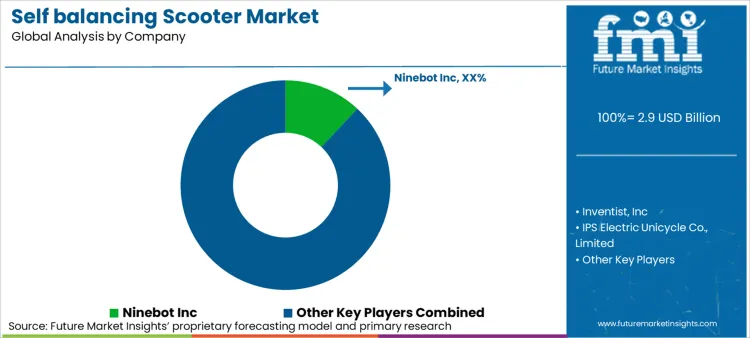
The competitive landscape of the self balancing scooter market is dynamic, with a variety of established players, emerging startups, and new entrants in the market. Innovation helps in getting a differentiation in their product so will be price competitive along with environment-friendly and transport efficient products.
Ninebot Inc.
It boasted features such as AI, smartphone integration, and long battery life. It is leading in cutting-edge electric vehicle technology. Also the focus on global presence, with extensive distribution networks and partnership example with Xiaomi.
Inventist, Inc.
Product Innovation & Technology: Low primarily focused on providing functional, affordable products, but not as advanced in terms of technological features compared to others.
Market Presence & Geographic Focus: Low- A more regional focus, with a niche market mainly within North America.
IPS Electric Unicycle Co., Limited
Product Innovation & Technology: High - Focus on innovative electric unicycles and self balancing personal transport, with cutting-edge design and performance.
Market Presence & Geographic Focus: Medium - Strong presence in the unicycle market, but less widespread than Segway or Xiaomi.
Robstep GB
Product Innovation & Technology: Low- Mainly on giving inexpensive products, although innovation may not be as strong as that of the leading brands.
Market Presence & Geographic Focus: Low - Primarily limited to regional markets with less global exposure compared to top-tier competitors.
Hangzhou Chic Intelligent Technology Co., Ltd.
Product Innovation & Technology: Low - Offers self balancing scooters but tends to focus on basic functionality rather than advanced features.
Market Presence & Geographic Focus: Medium - Primarily based in Asia, with some level of international expansion but not as widespread as major global players.
Recent Developments:
- In February 2026, Segway-Ninebot announced all 2026 models will include Nimble OS with AI autonomous driving system for real-time centre-of-gravity compensation.
- In January 2026, Segway debuted its dual-brand global strategy with Ninebot for mass-market and Segway for premium exploration-grade mobility.
- In November 2025, Yamaha Motor launched two electric models with River Mobility using gyroscopic sensors from automotive stability-control R&D.
Pioneering Startups & Innovations in the Self-Balancing Scooter Market
The industry has witnessed the emergence of several innovative startups with differentiated growth strategies.
Segway-Ninebot
Segway has a much stronger brand, but its partnership with Ninebot allowed it to branch out and introduce more products under the umbrella of self balancing and electric scooters. It is heavily investing in new technologies such as AI and improved battery systems for enhanced stability, and speed.
Tianjin Airwheel Technology
Airwheel focuses on self balancing scooters, electric unicycles, and personal transportation devices. They are known for developing products with a high emphasis on innovation, and they have expanded globally with several product lines.
Hoverboard Tech
A newer player focusing primarily on hoverboards and personal electric transportation devices. They are differentiating with affordable options and developing models with high-tech features like Bluetooth speakers and better safety standards.
Inmotion Technologies
Inmotion concentrates its activities on supplying smart-technology-driven, safe, and comfortable rides electric scooters, and self balancing vehicles, whose offerings are represented by such types of devices as compact two-wheeled scooters, and unicycles, among others.
Unicycle Motors
A startup specializing in electric unicycles, which are gaining popularity for their portability and unique form factor. Their products are designed with cutting-edge stabilization technology, making them a good competitor.
Leading Players Shaping the Market Landscape
- Ninebot Inc.
- Inventist, Inc.
- IPS Electric Unicycle Co., Limited
- Robstep GB
- Hangzhou Chic Intelligent Technology Co., Ltd.
- ESWING TECH.
- Airwheel
- Shenzhen Counterbalance Technology Co., Ltd.
- Esway
- Solowheel
Market Definition
The self balancing scooter market represents revenue generated from the manufacture and sale of personal mobility devices that use gyroscopic stabilisation, inertial measurement, and motor control systems to maintain rider balance. The market measures the value of hoverboards, self balancing unicycles, gyroscopic kick scooters, and AI-enabled personal transport platforms.
Inclusions cover two-wheel hoverboards, self balancing unicycles (monowheels), gyroscopic electric kick scooters, AI-enabled personal transport devices with autonomous stability, performance-grade self balancing scooters (GT series), and battery-swappable self balancing platforms.
Exclusions include conventional electric kick scooters without self balancing gyroscopic capability, electric bicycles and mopeds, Segway-type standing personal transporters marketed as industrial/commercial (warehouse, security patrol), and children's toy scooters without gyroscopic stabilisation.
Scope of Report
| Items | Values |
|---|---|
| Quantitative Units (2026) | USD 2.9 Billion |
| Product Type | Hoverboards, Self Balancing Unicycles, Gyroscopic Kick Scooters, AI-Enabled Personal Transport |
| End User | Urban Commuters, Recreational/Adventure, Last-Mile Delivery, Commercial/Patrol |
| Regions Covered | North America, Europe, Asia Pacific, Latin America, Middle East and Africa |
| Countries Covered | China, USA, Germany, India, Japan, UK, and 30+ countries |
| Key Companies Profiled | Segway-Ninebot, Yamaha, Gogoro, Hero MotoCorp, River Mobility |
Self-Balancing Scooter Market Analyzed by Top Industry Segments
By Product:
In terms of product, the market is segmented into single-wheeled and double-wheeled.
By End-use Industries:
In terms of end-use industries, the market is segmented into personal use and commercial use.
By Region:
In terms of region, the market is segmented into North America, Europe, Asia Pacific, and Middle-East and Africa.
Bibliography
- International Energy Agency. (2024). Global EV Outlook: Electric Two- and Three-Wheeler Sales Exceed 50 Million. IEA.
- Segway-Ninebot. (2026, February). Nimble OS AI stability system standard on all 2026 models. Segway Newsroom.
- Segway-Ninebot. (2026, January). Dual-brand global strategy: Segway premium, Ninebot mass-market. Segway User Conference.
- Yamaha Motor Co. (2025, November). Electric models with River Mobility gyroscopic stability technology. Yamaha Newsroom.
Frequently Asked Questions
What is the current global market size for Self Balancing Scooters?
The global market is valued at USD 2.9 Billion in 2026, driven by AI autonomous stability systems, dual-brand segmentation, and automotive manufacturer entry into micromobility.
What is the projected CAGR for the market over the next 10 years?
The market is projected to grow at a CAGR of 17.1% from 2026 to 2036.
Which regions are experiencing the fastest expansion?
Asia Pacific leads by volume through Chinese manufacturing and Indian battery-swap expansion, while North America is the fastest-growing premium segment driven by Segway GT series demand.
What are the primary market drivers?
AI autonomous stability, urban micromobility adoption, last-mile transport demand, and automotive manufacturer credibility entry are the primary growth catalysts.
Who are the leading suppliers in the industry?
Segway-Ninebot, Yamaha, and Gogoro are key players, differentiating through AI stability OS, dual-brand strategy, and battery-swapping infrastructure partnerships.
Preview the report firsthand - request a free sample
Get SampleGet the brochure for pricing and purchase details.
Get PDFTable of Content
- Executive Summary
- Global Market Outlook
- Demand-side Trends
- Supply-side Trends
- Technology Roadmap Analysis
- Analysis and Recommendations
- Market Overview
- Market Coverage / Taxonomy
- Market Definition / Scope / Limitations
- Research Methodology
- Chapter Orientation
- Analytical Lens and Working Hypotheses
- Market Structure, Signals, and Trend Drivers
- Benchmarking and Cross-market Comparability
- Market Sizing, Forecasting, and Opportunity Mapping
- Research Design and Evidence Framework
- Desk Research Programme (Secondary Evidence)
- Company Annual and Sustainability Reports
- Peer-reviewed Journals and Academic Literature
- Corporate Websites, Product Literature, and Technical Notes
- Earnings Decks and Investor Briefings
- Statutory Filings and Regulatory Disclosures
- Technical White Papers and Standards Notes
- Trade Journals, Industry Magazines, and Analyst Briefs
- Conference Proceedings, Webinars, and Seminar Materials
- Government Statistics Portals and Public Data Releases
- Press Releases and Reputable Media Coverage
- Specialist Newsletters and Curated Briefings
- Sector Databases and Reference Repositories
- FMI Internal Proprietary Databases and Historical Market Datasets
- Subscription Datasets and Paid Sources
- Social Channels, Communities, and Digital Listening Inputs
- Additional Desk Sources
- Expert Input and Fieldwork (Primary Evidence)
- Primary Modes
- Qualitative Interviews and Expert Elicitation
- Quantitative Surveys and Structured Data Capture
- Blended Approach
- Why Primary Evidence is Used
- Field Techniques
- Interviews
- Surveys
- Focus Groups
- Observational and In-context Research
- Social and Community Interactions
- Stakeholder Universe Engaged
- C-suite Leaders
- Board Members
- Presidents and Vice Presidents
- R&D and Innovation Heads
- Technical Specialists
- Domain Subject-matter Experts
- Scientists
- Physicians and Other Healthcare Professionals
- Governance, Ethics, and Data Stewardship
- Research Ethics
- Data Integrity and Handling
- Primary Modes
- Tooling, Models, and Reference Databases
- Desk Research Programme (Secondary Evidence)
- Data Engineering and Model Build
- Data Acquisition and Ingestion
- Cleaning, Normalisation, and Verification
- Synthesis, Triangulation, and Analysis
- Quality Assurance and Audit Trail
- Market Background
- Market Dynamics
- Drivers
- Restraints
- Opportunity
- Trends
- Scenario Forecast
- Demand in Optimistic Scenario
- Demand in Likely Scenario
- Demand in Conservative Scenario
- Opportunity Map Analysis
- Product Life Cycle Analysis
- Supply Chain Analysis
- Investment Feasibility Matrix
- Value Chain Analysis
- PESTLE and Porter’s Analysis
- Regulatory Landscape
- Regional Parent Market Outlook
- Production and Consumption Statistics
- Import and Export Statistics
- Market Dynamics
- Global Market Analysis 2021 to 2025 and Forecast, 2026 to 2036
- Historical Market Size Value (USD Million) Analysis, 2021 to 2025
- Current and Future Market Size Value (USD Million) Projections, 2026 to 2036
- Y-o-Y Growth Trend Analysis
- Absolute $ Opportunity Analysis
- Global Market Pricing Analysis 2021 to 2025 and Forecast 2026 to 2036
- Global Market Analysis 2021 to 2025 and Forecast 2026 to 2036, By Product
- Introduction / Key Findings
- Historical Market Size Value (USD Million) Analysis By Product , 2021 to 2025
- Current and Future Market Size Value (USD Million) Analysis and Forecast By Product , 2026 to 2036
- Double Wheeled
- Single Wheeled
- Double Wheeled
- Y-o-Y Growth Trend Analysis By Product , 2021 to 2025
- Absolute $ Opportunity Analysis By Product , 2026 to 2036
- Global Market Analysis 2021 to 2025 and Forecast 2026 to 2036, By End-use Industries
- Introduction / Key Findings
- Historical Market Size Value (USD Million) Analysis By End-use Industries, 2021 to 2025
- Current and Future Market Size Value (USD Million) Analysis and Forecast By End-use Industries, 2026 to 2036
- Personal Use
- Commercial Use
- Personal Use
- Y-o-Y Growth Trend Analysis By End-use Industries, 2021 to 2025
- Absolute $ Opportunity Analysis By End-use Industries, 2026 to 2036
- Global Market Analysis 2021 to 2025 and Forecast 2026 to 2036, By Region
- Introduction
- Historical Market Size Value (USD Million) Analysis By Region, 2021 to 2025
- Current Market Size Value (USD Million) Analysis and Forecast By Region, 2026 to 2036
- North America
- Latin America
- Western Europe
- Eastern Europe
- East Asia
- South Asia and Pacific
- Middle East & Africa
- Market Attractiveness Analysis By Region
- North America Market Analysis 2021 to 2025 and Forecast 2026 to 2036, By Country
- Historical Market Size Value (USD Million) Trend Analysis By Market Taxonomy, 2021 to 2025
- Market Size Value (USD Million) Forecast By Market Taxonomy, 2026 to 2036
- By Country
- USA
- Canada
- Mexico
- By Product
- By End-use Industries
- By Country
- Market Attractiveness Analysis
- By Country
- By Product
- By End-use Industries
- Key Takeaways
- Latin America Market Analysis 2021 to 2025 and Forecast 2026 to 2036, By Country
- Historical Market Size Value (USD Million) Trend Analysis By Market Taxonomy, 2021 to 2025
- Market Size Value (USD Million) Forecast By Market Taxonomy, 2026 to 2036
- By Country
- Brazil
- Chile
- Rest of Latin America
- By Product
- By End-use Industries
- By Country
- Market Attractiveness Analysis
- By Country
- By Product
- By End-use Industries
- Key Takeaways
- Western Europe Market Analysis 2021 to 2025 and Forecast 2026 to 2036, By Country
- Historical Market Size Value (USD Million) Trend Analysis By Market Taxonomy, 2021 to 2025
- Market Size Value (USD Million) Forecast By Market Taxonomy, 2026 to 2036
- By Country
- Germany
- UK
- Italy
- Spain
- France
- Nordic
- BENELUX
- Rest of Western Europe
- By Product
- By End-use Industries
- By Country
- Market Attractiveness Analysis
- By Country
- By Product
- By End-use Industries
- Key Takeaways
- Eastern Europe Market Analysis 2021 to 2025 and Forecast 2026 to 2036, By Country
- Historical Market Size Value (USD Million) Trend Analysis By Market Taxonomy, 2021 to 2025
- Market Size Value (USD Million) Forecast By Market Taxonomy, 2026 to 2036
- By Country
- Russia
- Poland
- Hungary
- Balkan & Baltic
- Rest of Eastern Europe
- By Product
- By End-use Industries
- By Country
- Market Attractiveness Analysis
- By Country
- By Product
- By End-use Industries
- Key Takeaways
- East Asia Market Analysis 2021 to 2025 and Forecast 2026 to 2036, By Country
- Historical Market Size Value (USD Million) Trend Analysis By Market Taxonomy, 2021 to 2025
- Market Size Value (USD Million) Forecast By Market Taxonomy, 2026 to 2036
- By Country
- China
- Japan
- South Korea
- By Product
- By End-use Industries
- By Country
- Market Attractiveness Analysis
- By Country
- By Product
- By End-use Industries
- Key Takeaways
- South Asia and Pacific Market Analysis 2021 to 2025 and Forecast 2026 to 2036, By Country
- Historical Market Size Value (USD Million) Trend Analysis By Market Taxonomy, 2021 to 2025
- Market Size Value (USD Million) Forecast By Market Taxonomy, 2026 to 2036
- By Country
- India
- ASEAN
- Australia & New Zealand
- Rest of South Asia and Pacific
- By Product
- By End-use Industries
- By Country
- Market Attractiveness Analysis
- By Country
- By Product
- By End-use Industries
- Key Takeaways
- Middle East & Africa Market Analysis 2021 to 2025 and Forecast 2026 to 2036, By Country
- Historical Market Size Value (USD Million) Trend Analysis By Market Taxonomy, 2021 to 2025
- Market Size Value (USD Million) Forecast By Market Taxonomy, 2026 to 2036
- By Country
- Kingdom of Saudi Arabia
- Other GCC Countries
- Turkiye
- South Africa
- Other African Union
- Rest of Middle East & Africa
- By Product
- By End-use Industries
- By Country
- Market Attractiveness Analysis
- By Country
- By Product
- By End-use Industries
- Key Takeaways
- Key Countries Market Analysis
- USA
- Pricing Analysis
- Market Share Analysis, 2025
- By Product
- By End-use Industries
- Canada
- Pricing Analysis
- Market Share Analysis, 2025
- By Product
- By End-use Industries
- Mexico
- Pricing Analysis
- Market Share Analysis, 2025
- By Product
- By End-use Industries
- Brazil
- Pricing Analysis
- Market Share Analysis, 2025
- By Product
- By End-use Industries
- Chile
- Pricing Analysis
- Market Share Analysis, 2025
- By Product
- By End-use Industries
- Germany
- Pricing Analysis
- Market Share Analysis, 2025
- By Product
- By End-use Industries
- UK
- Pricing Analysis
- Market Share Analysis, 2025
- By Product
- By End-use Industries
- Italy
- Pricing Analysis
- Market Share Analysis, 2025
- By Product
- By End-use Industries
- Spain
- Pricing Analysis
- Market Share Analysis, 2025
- By Product
- By End-use Industries
- France
- Pricing Analysis
- Market Share Analysis, 2025
- By Product
- By End-use Industries
- India
- Pricing Analysis
- Market Share Analysis, 2025
- By Product
- By End-use Industries
- ASEAN
- Pricing Analysis
- Market Share Analysis, 2025
- By Product
- By End-use Industries
- Australia & New Zealand
- Pricing Analysis
- Market Share Analysis, 2025
- By Product
- By End-use Industries
- China
- Pricing Analysis
- Market Share Analysis, 2025
- By Product
- By End-use Industries
- Japan
- Pricing Analysis
- Market Share Analysis, 2025
- By Product
- By End-use Industries
- South Korea
- Pricing Analysis
- Market Share Analysis, 2025
- By Product
- By End-use Industries
- Russia
- Pricing Analysis
- Market Share Analysis, 2025
- By Product
- By End-use Industries
- Poland
- Pricing Analysis
- Market Share Analysis, 2025
- By Product
- By End-use Industries
- Hungary
- Pricing Analysis
- Market Share Analysis, 2025
- By Product
- By End-use Industries
- Kingdom of Saudi Arabia
- Pricing Analysis
- Market Share Analysis, 2025
- By Product
- By End-use Industries
- Turkiye
- Pricing Analysis
- Market Share Analysis, 2025
- By Product
- By End-use Industries
- South Africa
- Pricing Analysis
- Market Share Analysis, 2025
- By Product
- By End-use Industries
- USA
- Market Structure Analysis
- Competition Dashboard
- Competition Benchmarking
- Market Share Analysis of Top Players
- By Regional
- By Product
- By End-use Industries
- Competition Analysis
- Competition Deep Dive
- Ninebot Inc
- Overview
- Product Portfolio
- Profitability by Market Segments (Product/Age /Sales Channel/Region)
- Sales Footprint
- Strategy Overview
- Marketing Strategy
- Product Strategy
- Channel Strategy
- Inventist, Inc
- IPS Electric Unicycle Co., Limited
- Robstep GB
- Hangzhou Chic Intelligent Technology Co., Ltd.
- Ninebot Inc
- Competition Deep Dive
- Assumptions & Acronyms Used


