

- Market Size (2026)
- USD 176.4 Mn
- Forecast (2036)
- USD 263.6 Mn
- CAGR (2026 to 2036)
- 4.1%
How big is Silica Texture Powders Market in 2026?
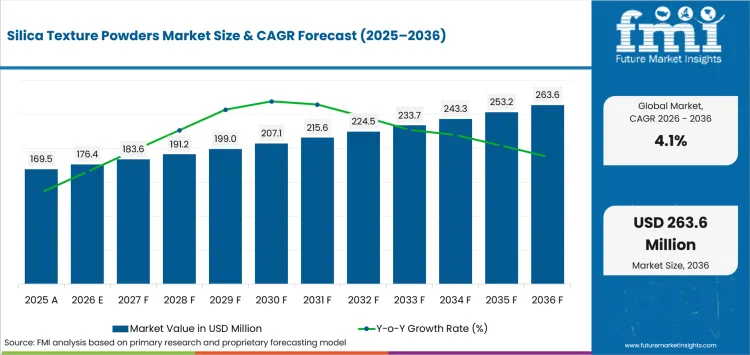
USD 176.4 million in 2026 and USD 263.6 million by 2036 at a 4.1% CAGR.
Demand for silica texture powders is projected to expand at 4.1% CAGR between 2026 and 2036, lifting valuation from USD 176.4 million to USD 263.6 million. European reformulation work gives inorganic particles a clearer screening route because the Commission excludes inorganic materials from its microplastics definition. The July 2025 Commission guidance also keeps staged cosmetics transition dates through 2035, which gives spherical silica powders a defined testing window for dry-touch reformulations.
South Korea has a faster approved growth path than the United Kingdom because export-oriented beauty manufacturers run more destination-specific formulation cycles. In May 2026 the Ministry of Food and Drug Safety stated that the 2025 cosmetics trade surplus first exceeded USD 10 billion. That export scale increases the value of ingredient files that can travel with formulas, while specialty silica grades still require technical approval before repeat orders begin.
Key Takeaways
- Regulatory substitution and demanding sensory briefs are increasing trials of inorganic texture powders in skincare and color cosmetic formulations.
- By product type, standard grade is estimated to hold 35.0% in 2026 owing to its fit with routine cosmetic specifications.
- Hydration & barrier is projected to hold 26.0% of function demand in 2026, attributable to richer formulas requiring a drier after-feel.
- In 2026, facial skincare is expected to lead application with 39.0% share because immediate spread and visible finish shape formulation decisions.
- Qualification slows switching since particle behavior and ingredient documentation must pass formula testing ahead of repeat commercial ordering.
- Some of the key players in this market include Evonik Industries AG, Sunjin Beauty Science Co., Ltd., UNI-POWDER (Shanghai Co-Fun Biotech Co., Ltd.), KCC Silicone Corporation, JGC Catalysts and Chemicals Ltd., Tokuyama Corporation, Fuji Silysia Chemical Ltd., and AGC Si-Tech Co., Ltd.
Analyst Perspective
"Silica texture powders should be judged on finished-formula evidence and qualification speed instead of unit price alone. Commercial value is highest if stable particle behavior arrives with documentation that lets one grade pass several destination-market reviews without repeating the same laboratory work."
- Nikhil Kaitwade, Principal Consultant, Future Market Insights
Why does facial skincare lead the application category?
The market is segmented by product type, function, application, grade and sales channel.
Product type includes standard grade, high-purity / clinical grade, natural & certified grade and customized systems. Function covers hydration & barrier, anti-aging, brightening, soothing & sensitive and UV & protection. Applications include facial skincare, body care, haircare, color cosmetics and suncare. Grade covers standard cosmetic grade, COSMOS / natural certified, pharma & clinical grade and organic certified. Sales channels include direct to brands, specialty distributors, contract manufacturers and online B2B.
Why does direct to brands lead the sales channel category?
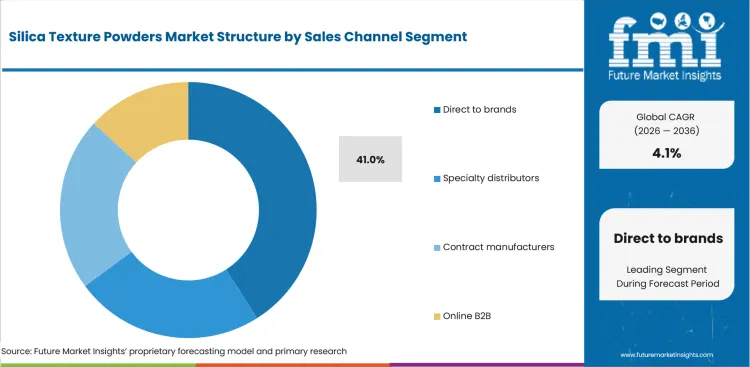
Direct selling fits brands that need samples and dosage guidance during first-pass texture qualification. Sunjin Beauty Science opened its Indonesia subsidiary in May 2026 with technical support and a Jakarta warehouse for cosmetics manufacturers. That local service model shortens sample turnaround for brands testing natural cosmetics formulations for regional launches.
- By sales channel, direct to brands is forecast to represent 41.0% in 2026 driven by first orders that include application support ahead of repeat purchasing.
- Direct contact matters most during early scale-up since dispersion or optical problems require a technical response ahead of routine commercial ordering.
What makes standard grade central to the product type category?
Standard grade fits routine skincare and makeup projects that need controlled particle behavior without clinical-grade controls. Formulators can adjust dosage without rebuilding an emulsion or pigment package, which gives precipitated silica forms a practical role in established cosmetic specifications.
- By product type, standard grade is estimated to hold 35.0% in 2026 owing to its broad fit with conventional beauty specifications.
- Sunjin Beauty Science documented an April 2025 launch of SH305 silica after describing uncoated and surface-treated silica families. The new grade targets soft-focus performance, which gives routine projects another directly qualified sensory option without changing the whole formulation system.
Why does facial skincare lead the application category?
Facial formulas expose changes in tack and optical finish immediately during routine wear testing. Evonik’s May 2026 Suppliers’ Day material placed AEROSIL, SIPERNAT and SPHERILEX in skin care alongside hair, sun and color cosmetics. Formulators can compare those silica families with PMMA microspheres inside the same soft-focus and dry-touch brief.
- In 2026, facial skincare is expected to lead application with 39.0% share because dry-down and surface appearance directly shape routine product evaluation.
- Facial skincare teams screen texture powders early in development since a failed dry-down can disqualify an otherwise acceptable active system during subsequent stability work.
Why does standard cosmetic grade lead the grade category?
Standard cosmetic grade serves formulas that need documented ingredient identity and safety support during qualification. It avoids pharmaceutical controls while leaving organic cosmetic claims to specialist grades that carry separate certification and claim requirements.
- Standard cosmetic grade is set to lead the grade category with 47.0% share in 2026 due to the broad qualification route for conventional beauty formulas.
- FDA data for June 30 2026 listed 1,298,361 active cosmetic product listings under MoCRA. That administrative scale makes stable ingredient records commercially relevant for personal care ingredients entering USA formulas, even though listing volume does not establish demand for one texture-powder grade.
What are the drivers, restraints and opportunities in the Silica Texture Powders Market?
Microplastic reformulation increases screening of inorganic powders, qualification work slows substitution and integrated technical service can shorten commercial approval cycles.
- Driver: Microplastic restrictions are increasing trials of inorganic particles that preserve matte feel and flow without restricted synthetic polymer content.
- Restraint: Surface treatment and finished-product claims can extend technical review since compliance depends on the complete ingredient and product dossier.
- Opportunity: Integrated silica platforms can reduce laboratory handoffs by pairing particle design with application support and destination-specific documentation.
Microplastic rules increase screening of inorganic powders
Regulatory reformulation raises demand when a brand must replace a restricted particle without losing dry touch or optical performance. The European Commission’s March 2025 explanatory guide defines the restriction around synthetic polymer microparticles and explains implementation for affected uses. That distinction gives synthetic amorphous silica a clearer screening route as an inorganic material, although every replacement still needs formulation proof for commercial approval.
Surface chemistry can extend qualification work
Qualification slows substitution when surface treatment changes a finished formula’s compliance position despite acceptable sensory performance. A coated powder can pass sensory testing yet reopen ingredient review for concentrated waterless beauty formats sold in several countries. France’s Economy Ministry stated in January 2026 that cosmetics containing PFAS are prohibited from January 1 under Law 2025-188, making surface-treatment disclosure a more material qualification step.
Integrated silica platforms reduce commercial handoffs
Commercial approval becomes easier if one technical organization owns particle expertise and application support for the same reformulation brief. That structure reduces handoffs between laboratory troubleshooting and destination-market documentation while upcycled cosmetic ingredients and other alternatives compete for the same sensory brief. Evonik formed Smart Effects in January 2025 by merging its Silica and Silanes businesses into a 3,500-person operating unit, giving silica customers a larger route for technical support.
Which country CAGRs are profiled in the Silica Texture Powders Market?
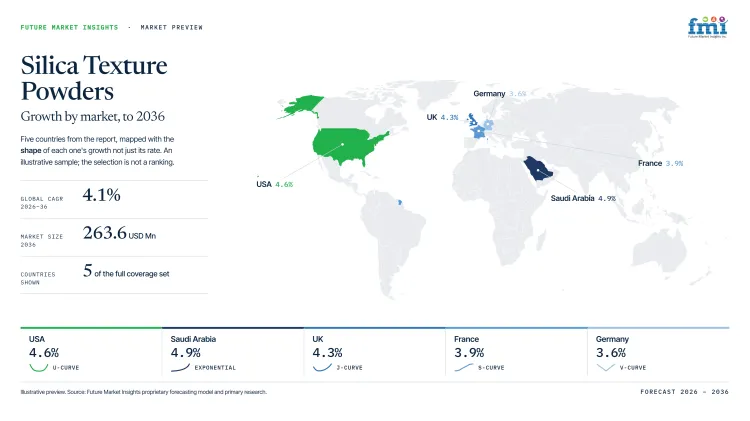
| Country | CAGR |
|---|---|
| UAE | 5.6% |
| South Korea | 5.2% |
| Saudi Arabia | 4.9% |
| USA | 4.6% |
| UK | 4.3% |
How do country-level CAGRs compare in the Silica Texture Powders Market?
The five CAGRs span 1.3 percentage points from UAE at 5.6% to UK at 4.3%. UAE and South Korea form the upper pair as import throughput and export production generate faster formulation turnover. Saudi Arabia and USA occupy the middle range, while UK qualification reflects a separate British product-safety administration.
- Dubai’s import concentration makes registration-ready dossiers valuable during UAE cosmetic ingredient launches.
- South Korean exporters repeat texture trials since formulas often serve destination markets.
- Saudi importers face centralized SFDA controls that tie dossiers to clearance timing.
- MoCRA makes ingredient identity records routine requirements for USA formulators changing texture systems.
- UK brands often maintain separate Great Britain and European Union records for one formula.
Comparable CAGRs therefore produce different entry costs because approval routes vary materially. The full report provides country-level CAGR analysis across North America, Latin America, Europe, East Asia, South Asia, Oceania and the Middle East and Africa.
Country-wise Analysis
- UAE: Dubai Municipality stated in October 2025 that Dubai entry points manage nearly 40,000 product shipments annually, making product-registration timing a routine commercial condition for imported beauty goods. Silica texture powder demand in UAE is forecast to rise at 5.6% CAGR through 2036 because import-heavy launch cycles favor grades with ready composition and safety files. Fast import turnover is the local enabler, but incomplete surface-treatment records can hold a shipment while a distributor waits for registration clearance. Companies with local stock and pre-organized dossiers are better placed to convert formulation trials into orders without extending the regional launch calendar.
- South Korea: Export-oriented beauty manufacturers often adapt one skincare base for several destination markets, which puts texture ingredients under repeated documentation and wear-testing review. The Ministry of Trade Industry and Energy reported in November 2025 that cosmetics exports through October were 11.9% above the prior year, with destination markets becoming more diversified. Silica texture powder demand in South Korea is projected to grow at 5.2% CAGR by 2036 owing to frequent formulation turnover and strong local development capacity. Duplicate qualification work slows export programmes, so local technical teams gain an advantage if one ingredient file can support several destination-market reviews.
- Saudi Arabia: Cosmetics importers work inside a centralized SFDA product-control system that ties ingredient records directly to notification and shipment clearance. In December 2025 SFDA documented preparations for AI tools that analyse cosmetic-product images and verify ingredient compliance, giving complete dossiers a clearer digital review route. Digital screening can shorten routine checks for stable records, but surface-treatment changes still force importers to refresh files ahead of scheduled launches. Saudi Arabia is estimated to post 4.9% CAGR over the forecast period attributable to formal distribution channels and increasingly digital review. Firms with local partners gain an advantage if Gulf compliance statements stay current as formulation records change.
- USA: Contract manufacturers can source texture materials through a broad domestic specialty-chemical base and test grade changes without relying on one import channel. Silica texture powder demand in USA is anticipated to advance at 4.6% CAGR through 2036 supported by a large formulation base and established contract manufacturing. FDA data for June 30 2026 listed 16,398 active cosmetic facility registrations under MoCRA, making ingredient identity records a routine part of formula maintenance. That scale widens the account base but also multiplies quality-review expectations, so technical response time can decide whether a particle change reaches a brand’s approved material list.
- UK: Beauty companies often maintain one formula for Great Britain and European Union channels, which makes particle documentation a dual-market task from the first trial. OPSS published in February 2026 that its risk-based programme tested 184 cosmetics during 2024-2025, keeping finished-product evidence visible during compliance review. Silica texture powder sales in UK are forecast to expand at 4.3% CAGR by 2036 aided by established formulation activity and experienced technical distributors. Separate notification and Responsible Person workflows remain the main friction for a grade change intended for both markets. The next growth step depends on documentation that lets one sensory powder pass both review systems without maintaining separate specifications.
Who are the notable companies in the Silica Texture Powders Market?
Evonik Industries AG, Sunjin Beauty Science Co., Ltd., UNI-POWDER (Shanghai Co-Fun Biotech Co., Ltd.), KCC Silicone Corporation, JGC Catalysts and Chemicals Ltd., Tokuyama Corporation, Fuji Silysia Chemical Ltd., and AGC Si-Tech Co., Ltd. are the notable companies profiled in this market.
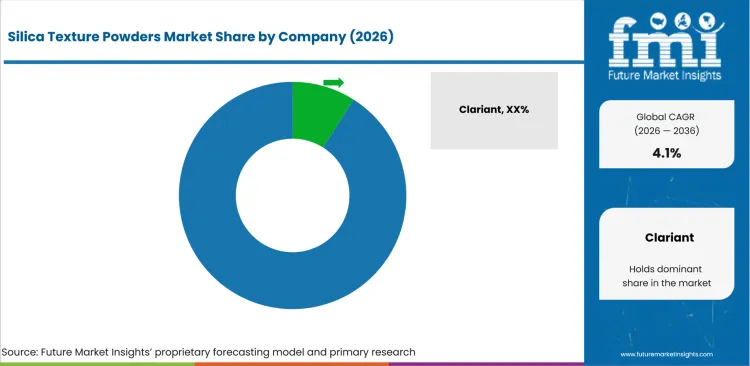
Competition centers on companies that document cosmetic silica activity beyond their broader industrial silica portfolios. Entry barriers come from application data and controlled particle design, while regional sample support shortens laboratory approval.
- Evonik Industries AG, Sunjin Beauty Science Co., Ltd. and UNI-POWDER provide cosmetic silica platforms with formulation support.
- JGC Catalysts and Chemicals Ltd., Tokuyama Corporation, Fuji Silysia Chemical Ltd. and AGC Si-Tech Co., Ltd. provide dedicated silica technologies for cosmetic texture work.
- KCC Silicone Corporation competes at the boundary with a silica-containing sensory gel for beauty formulations.
Competitive Benchmarking: Silica Texture Powders Market
| Company | Cosmetic Silica Portfolio | Beauty Application Breadth | Technical / Commercial Support | Geographic Reach |
|---|---|---|---|---|
| Evonik Industries AG | High | High | High | Global |
| Sunjin Beauty Science Co., Ltd. | High | High | High | Asia and North America |
| UNI-POWDER (Shanghai Co-Fun Biotech Co., Ltd.) | Low | Medium | Medium | China and Asia |
| KCC Silicone Corporation | Low | Low | Medium | South Korea and Europe |
| JGC Catalysts and Chemicals Ltd. | Medium | Low | Medium | Japan |
| Tokuyama Corporation | High | Low | Low | Japan and Europe |
| Fuji Silysia Chemical Ltd. | Low | Low | Low | Japan |
| AGC Si-Tech Co., Ltd. | Medium | Low | Low | Japan |
Scoring basis: High portfolio breadth requires three silica families while Medium requires two and Low one. High application breadth requires three cosmetic groups while Medium requires two and Low one. High support requires formulation assistance plus multi-region access while Medium indicates narrower support and Low one documented channel.
Key Developments in the Silica Texture Powders Market
- In July 2025, UNI-POWDER held its Shanghai new-product launch and presented chip-grade high-purity silica alongside formulation support and custom-development services.
- In April 2025, KCC Silicone Corporation introduced SeraSilk PDA 90 at in-cosmetics Global as a silica-containing microplastic-free sensory gel for beauty formulations.
- In February 2025, Sunjin Beauty Science Co., Ltd. opened its USA subsidiary in New Jersey with local sales coverage and an Edison logistics warehouse.
Key Players in the Silica Texture Powders Market
Broad Cosmetic Silica Platforms
- Evonik Industries AG
- Sunjin Beauty Science Co., Ltd.
- UNI-POWDER (Shanghai Co-Fun Biotech Co., Ltd.)
Silica-Containing Sensory Systems
- KCC Silicone Corporation
Specialist Cosmetic Silica Producers
- JGC Catalysts and Chemicals Ltd.
- Tokuyama Corporation
- Fuji Silysia Chemical Ltd.
- AGC Si-Tech Co., Ltd.
Silica Texture Powders Market - Report Scope
| Coverage field | Report scope |
|---|---|
| Market breakdown | By product type, function, application, grade, sales channel and region. |
| Quantitative Units | USD million. |
| Market Definition | Commercial silica powders and silica-containing texture systems used primarily to modify tactile feel, shine, flow or optical finish in cosmetic and personal-care formulations. |
| Regions Covered | North America, Latin America, Europe, East Asia, South Asia and Pacific and Middle East and Africa. |
| Countries Covered | UAE, South Korea, Saudi Arabia, USA, UK, and 20+ countries included in the full report. |
| Key Companies Profiled | Evonik Industries AG, Sunjin Beauty Science Co., Ltd., UNI-POWDER (Shanghai Co-Fun Biotech Co., Ltd.), KCC Silicone Corporation, JGC Catalysts and Chemicals Ltd., Tokuyama Corporation, Fuji Silysia Chemical Ltd., AGC Si-Tech Co., Ltd. |
| Forecast Period | 2026 to 2036. |
| Approach | Primary and secondary research with market triangulation. |
Silica Texture Powders Market - Research Methodology
| Method | Approach |
|---|---|
| Primary Research | FMI analysts gathered input from manufacturers, service providers, technology developers, distributors, end users, procurement teams, and subject-matter experts. Interviews examined purchasing decisions, product or service evaluation, adoption barriers, approval requirements, pricing considerations, and expectations for technical or commercial support. Respondents were also asked what evidence is required before a trial, pilot, or initial order develops into regular purchasing. |
| Desk Research | Desk research covered government statistics, regulatory publications, trade data, industry associations, technical literature, standards, company filings, product information, and official corporate announcements. Sources were reviewed for relevance, publication date, geographic coverage, and consistency with the defined market scope. Claims relating to performance, applications, approvals, capacity, investment, and commercial activity were retained only when supported by credible public evidence. |
| Market Sizing and Forecasting | The market model combined the baseline value with historical performance, segment structure, pricing and volume indicators, adoption levels, company participation, and country-level demand conditions. Forecast assumptions considered economic activity, investment trends, regulatory developments, technology adoption, purchasing cycles, supply availability, and barriers to wider market use. Segment and regional estimates were reconciled before the final market total was calculated. |
| Data Validation | Estimates were checked against multiple independent indicators, including public data, company activity, trade patterns, industry developments, and findings from primary interviews. Validation also tested whether products, services, applications, and company revenues fell within the defined market boundaries. Adjacent categories, unsupported claims, overlapping revenues, and activities without direct market relevance were excluded to reduce double counting and maintain consistency across segments and countries. |
Silica Texture Powders Market by Segments
Silica Texture Powders Market segmented by Product Type:
- Standard grade
- High-purity / clinical grade
- Natural & certified grade
- Customized systems
Silica Texture Powders Market segmented by Function:
- Hydration & barrier
- Anti-aging
- Brightening
- Soothing & sensitive
- UV & protection
Silica Texture Powders Market segmented by Application:
- Facial skincare
- Body care
- Haircare
- Color cosmetics
- Suncare
Silica Texture Powders Market segmented by Grade:
- Standard cosmetic grade
- COSMOS / natural certified
- Pharma & clinical grade
- Organic certified
Silica Texture Powders Market segmented by Sales Channel:
- Direct to brands
- Specialty distributors
- Contract manufacturers
- Online B2B
Silica Texture Powders Market by Region:
- North America
- United States
- Canada
- Latin America
- Brazil
- Mexico
- Chile
- Rest of Latin America
- Western Europe
- Germany
- United Kingdom
- Italy
- Spain
- France
- Nordics
- Benelux
- Rest of Western Europe
- Eastern Europe
- Russia
- Poland
- Hungary
- Balkan and Baltic States
- Rest of Eastern Europe
- East Asia
- China
- Japan
- South Korea
- South Asia and Pacific
- India
- ASEAN
- Australia and New Zealand
- Rest of South Asia and Pacific
- Middle East and Africa
- Kingdom of Saudi Arabia
- Other GCC Countries
- Türkiye
- South Africa
- Other African Union Countries
- Rest of Middle East and Africa
Research Sources and Bibliography
- European Commission. (2025, July 18). Commission Regulation (EU) 2023/2055 - Restriction of microplastics intentionally added to products.
- Ministry of Food and Drug Safety, Republic of Korea. (2026, May 22). ’25년 화장품 무역수지 흑자 첫 100억 달러 돌파, 세계 2위 화장품 수출국 달성.
- Sunjin Beauty Science Co., Ltd. (2025, April). The Secret Behind Sunjin’s Silica and Its Manufacturing Edge.
- Ministry of Trade, Industry and Resources, Republic of Korea. (2025, November 7). K-Beauty Expands Global Reach with New Export Models.
- USA Food and Drug Administration. (2026, July 2). Registration & Listing of Cosmetic Product Facilities and Products.
- Sunjin Beauty Science Co., Ltd. (2026, May 1). Sunjin Beauty Science Officially Opens Its Indonesia Subsidiary!.
- European Commission. (2025, March 7). REACH restriction of synthetic polymer microparticles: Explanatory Guide.
- Ministry of Economy, Finance and Industrial and Digital Sovereignty, France. (2026, January 12). Tout savoir sur l’interdiction progressive des PFAS.
- Evonik Industries AG. (2025, January 22). Evonik announces Smart Effects as a strategic merger of Silica and Silanes Business Line.
- Dubai Municipality. (2025, October 27). Product safety at Beautyworld Middle East 2025.
- Saudi Food and Drug Authority. (2025, December 14). SFDA Leads Digital Transformation in Drug and Cosmetic Safety Regulation.
- Office for Product Safety and Standards. (2026, February 18). Product Safety Testing Sampling Protocol Programme: April 2024 - March 2025.
- Evonik Industries AG. (2026, May 19). Suppliers’ Day 2026.
- UNI-POWDER. (2025, July 28). Step Into the Spotlight | UNI-POWDER 2025 New Product Launch · Shanghai Edition.
- UNI-POWDER. (2025, November 7). 2025 in-cosmetics Asia|Expanding Formulation Horizons with Ingredient Innovation.
- KCC Silicone Corporation. (2025, April 1). KCC Silicone to Lead Global Trends Through Participation in In-Cosmetics Global 2025.
- Sunjin Beauty Science Co., Ltd. (2025, February). Sunjin Beauty Science Grand Opening in USA!
- JGC Catalysts and Chemicals Ltd. (2025, March 26). Participation in the 12th Cosmetic Ingredients and Technology Exhibition (CITE JAPAN 2025).
- Tokuyama Corporation. (2025, March 17). Tokuyama to Exhibit high-quality silica at the in-cosmetics global 2025 (Finished).
- Fuji Silysia Chemical Ltd. (2025, April 3). 第12回化粧品産業技術展 CITE JAPAN 2025(5/14-16)出展のご案内.
- AGC Inc. (2025, April 25). Exhibiting at CITE JAPAN 2025.
- Elementis plc. (2025, November 26). Elementis acquires personal care specialist Alchemy Ingredients Limited.
- Clariant. (2025, April 7). “Clariant Beauty” launches new solutions for personal care.
- Momentive Performance Materials, Inc. (2025, April 1). Momentive Introduces HARMONIE™ NatuVel Gel: a new 100% naturally derived elastomer gel.
- DKSH. (2026, July 9). DKSH Partners with Granatum to Deliver Innovative Naturally Derived Mineral Ingredients for Personal Care in Canada, the United States, and Italy.
- Givaudan. (2025, November 12). Givaudan extends its PlanetCaps™ range with a new biodegradable fragrance encapsulation breakthrough for personal care.
- Tokuyama Corporation. (2026, March 18). Tokuyama to Exhibit inorganic cosmetic ingredients at the PCHi 2026 (Finished).
- Croda International Plc. (2026, May 21). Croda launches Beauty of Zero™ to advance sustainable innovation in personal care.
- Lubrizol Corporation. (2025, April 8). Lubrizol Introduces Carbopol® BioSense Polymer: Sustainable Innovation for Superior Sensory Experience.
This bibliography is provided for reader reference and is not exhaustive. The full report contains the complete reference list and detailed citations
This Report Answers
- How large is the silica texture powders market in 2026 and 2036?
- Which regulatory changes increase trials of inorganic cosmetic texture powders?
- Why does standard grade lead product type demand in 2026?
- Why does facial skincare hold the largest application share in 2026?
- How does qualification work limit switching between competing texture systems?
- Which five countries have the profiled growth rates through 2036?
- Which companies provide direct cosmetic silica or silica-containing sensory technologies?
- What evidence should formulators review before approving a new texture powder?
Frequently Asked Questions
How big is the silica texture powders market in 2026?
The silica texture powders market is valued at USD 176.4 million in 2026 and is projected to reach USD 263.6 million by 2036. Regulatory substitution and demanding sensory requirements are increasing trials of inorganic texture powders in commercial beauty formulations.
What is the CAGR of the silica texture powders market from 2026 to 2036?
The silica texture powders market is projected to grow at a CAGR of 4.1% between 2026 and 2036. Reformulation activity and continued demand for dry-touch sensory performance support the expected expansion during the forecast period.
Which product type leads the silica texture powders market?
The standard grade segment is expected to hold 35.0% of the silica texture powders market in 2026, driven by routine cosmetic specifications. Common skincare and makeup projects can qualify these grades without the additional controls attached to clinical-grade materials.
Which countries are projected to record the highest growth in the silica texture powders market?
UAE is projected to grow at 5.6% CAGR, followed by South Korea at 5.2% and Saudi Arabia at 4.9% through 2036. Import throughput and export-led formulation cycles increase technical qualification activity in the three faster-growth markets.
Which companies are active in the silica texture powders market?
Key companies operating in the market include Evonik Industries AG, Sunjin Beauty Science Co., Ltd., UNI-POWDER (Shanghai Co-Fun Biotech Co., Ltd.), KCC Silicone Corporation, JGC Catalysts and Chemicals Ltd., Tokuyama Corporation, Fuji Silysia Chemical Ltd., and AGC Si-Tech Co., Ltd. These companies compete through application support.
Preview the report firsthand - request a free sample
Get SampleGet the brochure for pricing and purchase details.
Get PDFTable of Content
- Key Takeaways
- Market Size and CAGR
- Top Growth Driver
- Fastest Growing Segment
- Leading Region
- Key Companies
- Emerging Opportunities
- Executive Summary
- Global Market Outlook
- Demand-side Trends
- Supply-side Trends
- Technology Roadmap Analysis
- Analysis and Recommendations
- Analyst Perspective (What is happening? Why now? What should investors know?)
- Key Questions Answered
- How large is the market?
- What is the CAGR?
- What are key trends?
- Which region dominates?
- Who are the leaders?
- Market Overview
- Market Coverage / Taxonomy
- Market Definition / Scope / Limitations
- Research Methodology
- Chapter Orientation
- Analytical Lens and Working Hypotheses
- Market Structure, Signals, and Trend Drivers
- Benchmarking and Cross-market Comparability
- Market Sizing, Forecasting, and Opportunity Mapping
- Research Design and Evidence Framework
- Desk Research Programme (Secondary Evidence)
- Expert Input and Fieldwork (Primary Evidence)
- Tooling, Models, and Reference Databases
- Data Engineering and Model Build
- Quality Assurance and Audit Trail
- Market Background
- Market Dynamics (Drivers, Restraints, Opportunity, Trends)
- Scenario Forecast (Optimistic, Likely, Conservative)
- Impact Analysis
- AI Impact
- Sustainability Impact
- Regulatory Impact
- Technology Impact
- Consumer / Buyer Analysis
- Purchase Drivers
- Adoption Barriers
- Buyer Journey
- Opportunity Map Analysis
- Product Life Cycle Analysis
- Supply Chain Analysis
- Investment Feasibility Matrix
- Value Chain Analysis
- PESTLE and Porter's Analysis
- Regulatory Landscape
- Regional Parent Market Outlook
- Production and Consumption Statistics
- Import and Export Statistics
- Global Market Analysis and Forecast, 2021 to 2036
- Historical Market Size Value (USD Million) Analysis, 2021 to 2025
- Current and Future Market Size Value (USD Million) Projections, 2026 to 2036
- Y-o-Y Growth Trend Analysis
- Absolute $ Opportunity Analysis
- Global Market Pricing Analysis, 2021 to 2036
- Global Market Analysis and Forecast, By Product Type, 2021 to 2036
- Introduction / Key Findings
- Historical Market Size Value (USD Million) Analysis By Product Type, 2021 to 2025
- Current and Future Market Size Value (USD Million) Analysis and Forecast By Product Type, 2026 to 2036
- Standard grade
- High-purity / clinical grade
- Natural & certified grade
- Customized systems
- Standard grade
- Y-o-Y Growth Trend Analysis By Product Type, 2021 to 2025
- Absolute $ Opportunity Analysis By Product Type, 2026 to 2036
- Global Market Analysis and Forecast, By Function, 2021 to 2036
- Introduction / Key Findings
- Historical Market Size Value (USD Million) Analysis By Function, 2021 to 2025
- Current and Future Market Size Value (USD Million) Analysis and Forecast By Function, 2026 to 2036
- Hydration & barrier
- Anti-aging
- Brightening
- Soothing & sensitive
- UV & protection
- Hydration & barrier
- Y-o-Y Growth Trend Analysis By Function, 2021 to 2025
- Absolute $ Opportunity Analysis By Function, 2026 to 2036
- Global Market Analysis and Forecast, By Application, 2021 to 2036
- Introduction / Key Findings
- Historical Market Size Value (USD Million) Analysis By Application, 2021 to 2025
- Current and Future Market Size Value (USD Million) Analysis and Forecast By Application, 2026 to 2036
- Facial skincare
- Body care
- Haircare
- Color cosmetics
- Suncare
- Facial skincare
- Y-o-Y Growth Trend Analysis By Application, 2021 to 2025
- Absolute $ Opportunity Analysis By Application, 2026 to 2036
- Global Market Analysis and Forecast, By Grade, 2021 to 2036
- Introduction / Key Findings
- Historical Market Size Value (USD Million) Analysis By Grade, 2021 to 2025
- Current and Future Market Size Value (USD Million) Analysis and Forecast By Grade, 2026 to 2036
- Standard cosmetic grade
- COSMOS / natural certified
- Pharma & clinical grade
- Organic certified
- Standard cosmetic grade
- Y-o-Y Growth Trend Analysis By Grade, 2021 to 2025
- Absolute $ Opportunity Analysis By Grade, 2026 to 2036
- Global Market Analysis and Forecast, By Sales Channel, 2021 to 2036
- Introduction / Key Findings
- Historical Market Size Value (USD Million) Analysis By Sales Channel, 2021 to 2025
- Current and Future Market Size Value (USD Million) Analysis and Forecast By Sales Channel, 2026 to 2036
- Direct to brands
- Specialty distributors
- Contract manufacturers
- Online B2B
- Direct to brands
- Y-o-Y Growth Trend Analysis By Sales Channel, 2021 to 2025
- Absolute $ Opportunity Analysis By Sales Channel, 2026 to 2036
- Global Market Analysis and Forecast, By Region, 2021 to 2036
- Introduction
- Historical Market Size Value (USD Million) Analysis By Region, 2021 to 2025
- Current Market Size Value (USD Million) Analysis and Forecast By Region, 2026 to 2036
- North America
- Latin America
- Western Europe
- Eastern Europe
- East Asia
- South Asia and Pacific
- Middle East & Africa
- Market Attractiveness Analysis By Region
- North America Market Analysis and Forecast, By Country, 2021 to 2036
- Historical Market Size Value (USD Million) Trend Analysis By Market Taxonomy, 2021 to 2025
- Market Size Value (USD Million) Forecast By Market Taxonomy, 2026 to 2036
- By Country
- USA
- Canada
- By Product Type
- By Function
- By Application
- By Grade
- By Sales Channel
- By Country
- Market Attractiveness Analysis
- By Country
- By Product Type
- By Function
- By Application
- By Grade
- By Sales Channel
- Key Takeaways
- Latin America Market Analysis and Forecast, By Country
- Historical Market Size Value (USD Million) Trend Analysis By Market Taxonomy, 2021 to 2025
- Market Size Value (USD Million) Forecast By Market Taxonomy, 2026 to 2036
- By Country
- Brazil
- Mexico
- Chile
- Rest of Latin America
- By Product Type
- By Function
- By Application
- By Grade
- By Sales Channel
- By Country
- Market Attractiveness Analysis
- By Country
- By Product Type
- By Function
- By Application
- By Grade
- By Sales Channel
- Key Takeaways
- Western Europe Market Analysis and Forecast, By Country
- Historical Market Size Value (USD Million) Trend Analysis By Market Taxonomy, 2021 to 2025
- Market Size Value (USD Million) Forecast By Market Taxonomy, 2026 to 2036
- By Country
- Germany
- UK
- Italy
- Spain
- France
- Nordic
- BENELUX
- Rest of Western Europe
- By Product Type
- By Function
- By Application
- By Grade
- By Sales Channel
- By Country
- Market Attractiveness Analysis
- By Country
- By Product Type
- By Function
- By Application
- By Grade
- By Sales Channel
- Key Takeaways
- Eastern Europe Market Analysis and Forecast, By Country
- Historical Market Size Value (USD Million) Trend Analysis By Market Taxonomy, 2021 to 2025
- Market Size Value (USD Million) Forecast By Market Taxonomy, 2026 to 2036
- By Country
- Russia
- Poland
- Hungary
- Balkan & Baltic
- Rest of Eastern Europe
- By Product Type
- By Function
- By Application
- By Grade
- By Sales Channel
- By Country
- Market Attractiveness Analysis
- By Country
- By Product Type
- By Function
- By Application
- By Grade
- By Sales Channel
- Key Takeaways
- East Asia Market Analysis and Forecast, By Country
- Historical Market Size Value (USD Million) Trend Analysis By Market Taxonomy, 2021 to 2025
- Market Size Value (USD Million) Forecast By Market Taxonomy, 2026 to 2036
- By Country
- China
- Japan
- South Korea
- By Product Type
- By Function
- By Application
- By Grade
- By Sales Channel
- By Country
- Market Attractiveness Analysis
- By Country
- By Product Type
- By Function
- By Application
- By Grade
- By Sales Channel
- Key Takeaways
- South Asia and Pacific Market Analysis and Forecast, By Country
- Historical Market Size Value (USD Million) Trend Analysis By Market Taxonomy, 2021 to 2025
- Market Size Value (USD Million) Forecast By Market Taxonomy, 2026 to 2036
- By Country
- India
- ASEAN
- Australia & New Zealand
- Rest of South Asia and Pacific
- By Product Type
- By Function
- By Application
- By Grade
- By Sales Channel
- By Country
- Market Attractiveness Analysis
- By Country
- By Product Type
- By Function
- By Application
- By Grade
- By Sales Channel
- Key Takeaways
- Middle East & Africa Market Analysis and Forecast, By Country
- Historical Market Size Value (USD Million) Trend Analysis By Market Taxonomy, 2021 to 2025
- Market Size Value (USD Million) Forecast By Market Taxonomy, 2026 to 2036
- By Country
- Kingdom of Saudi Arabia
- Other GCC Countries
- Türkiye
- South Africa
- Other African Union
- Rest of Middle East & Africa
- By Product Type
- By Function
- By Application
- By Grade
- By Sales Channel
- By Country
- Market Attractiveness Analysis
- By Country
- By Product Type
- By Function
- By Application
- By Grade
- By Sales Channel
- Key Takeaways
- Key Countries Market Analysis
- USA
- Pricing Analysis
- Market Share Analysis, 2025
- By Product Type
- By Function
- By Application
- By Grade
- By Sales Channel
- Canada
- Pricing Analysis
- Market Share Analysis, 2025
- By Product Type
- By Function
- By Application
- By Grade
- By Sales Channel
- Mexico
- Pricing Analysis
- Market Share Analysis, 2025
- By Product Type
- By Function
- By Application
- By Grade
- By Sales Channel
- Brazil
- Pricing Analysis
- Market Share Analysis, 2025
- By Product Type
- By Function
- By Application
- By Grade
- By Sales Channel
- Chile
- Pricing Analysis
- Market Share Analysis, 2025
- By Product Type
- By Function
- By Application
- By Grade
- By Sales Channel
- Germany
- Pricing Analysis
- Market Share Analysis, 2025
- By Product Type
- By Function
- By Application
- By Grade
- By Sales Channel
- UK
- Pricing Analysis
- Market Share Analysis, 2025
- By Product Type
- By Function
- By Application
- By Grade
- By Sales Channel
- Italy
- Pricing Analysis
- Market Share Analysis, 2025
- By Product Type
- By Function
- By Application
- By Grade
- By Sales Channel
- Spain
- Pricing Analysis
- Market Share Analysis, 2025
- By Product Type
- By Function
- By Application
- By Grade
- By Sales Channel
- France
- Pricing Analysis
- Market Share Analysis, 2025
- By Product Type
- By Function
- By Application
- By Grade
- By Sales Channel
- India
- Pricing Analysis
- Market Share Analysis, 2025
- By Product Type
- By Function
- By Application
- By Grade
- By Sales Channel
- ASEAN
- Pricing Analysis
- Market Share Analysis, 2025
- By Product Type
- By Function
- By Application
- By Grade
- By Sales Channel
- Australia & New Zealand
- Pricing Analysis
- Market Share Analysis, 2025
- By Product Type
- By Function
- By Application
- By Grade
- By Sales Channel
- China
- Pricing Analysis
- Market Share Analysis, 2025
- By Product Type
- By Function
- By Application
- By Grade
- By Sales Channel
- Japan
- Pricing Analysis
- Market Share Analysis, 2025
- By Product Type
- By Function
- By Application
- By Grade
- By Sales Channel
- South Korea
- Pricing Analysis
- Market Share Analysis, 2025
- By Product Type
- By Function
- By Application
- By Grade
- By Sales Channel
- Russia
- Pricing Analysis
- Market Share Analysis, 2025
- By Product Type
- By Function
- By Application
- By Grade
- By Sales Channel
- Poland
- Pricing Analysis
- Market Share Analysis, 2025
- By Product Type
- By Function
- By Application
- By Grade
- By Sales Channel
- Hungary
- Pricing Analysis
- Market Share Analysis, 2025
- By Product Type
- By Function
- By Application
- By Grade
- By Sales Channel
- Kingdom of Saudi Arabia
- Pricing Analysis
- Market Share Analysis, 2025
- By Product Type
- By Function
- By Application
- By Grade
- By Sales Channel
- Türkiye
- Pricing Analysis
- Market Share Analysis, 2025
- By Product Type
- By Function
- By Application
- By Grade
- By Sales Channel
- South Africa
- Pricing Analysis
- Market Share Analysis, 2025
- By Product Type
- By Function
- By Application
- By Grade
- By Sales Channel
- USA
- Market Structure Analysis
- Competition Dashboard
- Competition Benchmarking
- Market Share Analysis of Top Players
- By Regional
- By Product Type
- By Function
- By Application
- By Grade
- By Sales Channel
- Emerging Startups
- Innovation Benchmarking
- Competition Analysis
- Competition Deep Dive
- Clariant
- Overview
- Product Portfolio
- Profitability by Market Segments
- Sales Footprint
- Strategy Overview
- Marketing Strategy
- Product Strategy
- Channel Strategy
- Lubrizol
- DSM-Firmenich
- Croda
- BASF
- Ashland
- Symrise
- Evonik
- IFF
- Givaudan
- Clariant
- Case Studies
- Success Stories
- Recent Developments
- Competition Deep Dive
- Assumptions & Acronyms Used


