

- Market Size (2026)
- USD 54.8 Mn
- Forecast (2036)
- USD 325.4 Mn
- CAGR (2026 to 2036)
- 19.5%
How big is Single-Flux-Quantum Logic Circuits Market in 2026?
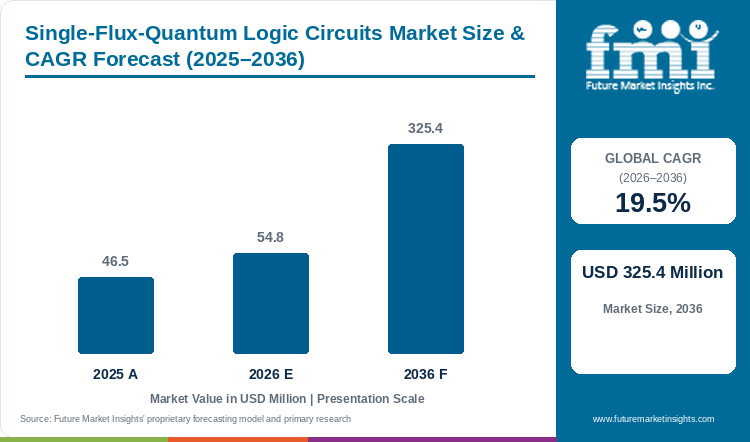
From a 2025 baseline of USD 46.5 million and a projected 2026 valuation of USD 54.8 million, worldwide single-flux-quantum logic circuits turnover is expected to attain USD 325.4 million in 2036 under a 19.5% annual trajectory.
Routing thousands of coaxial microwave cables from room-temperature FPGA racks into millikelvin dilution refrigerators overwhelms cryostat cooling budgets and blocks superconducting quantum computers from scaling past one thousand qubits. Quantum system architects and defense electronic-warfare engineers specify Josephson-junction single-flux-quantum digital circuits because quantized magnetic flux pulses switch at 20 to 100 gigahertz while dissipating less than one attojoule per gate at 4 Kelvin. With 2025 demand at USD 46.5 million and 2026 demand estimated at USD 54.8 million, global single-flux-quantum logic circuits valuation is slated to attain USD 325.4 million by 2036 via a 19.5% CAGR that creates USD 270.6 million in added dollar opportunity. In April 2025, NIST and Superconducting Quantum Materials and Systems Center researchers demonstrated major coherence and cryogenic control breakthroughs for multi-qubit superconducting processors [1]. Energy-Efficient eSFQ & Reciprocal Quantum Logic (RQL) represents a projected 54.6% of 2026 logic family sales alongside superconducting quantum processor chips inside commercial cryostats.
Key Market Trends & Insights
- By superconducting logic family: Energy-Efficient eSFQ & Reciprocal Quantum Logic (RQL) commands an estimated 54.6% of 2026 family expenditure because eliminating DC bias resistors prevents thermal runaway on 4-Kelvin cryocooler stages.
- By Nb/AlOx/Nb foundry process layer count: 8- to 10-Metal-Layer Nb Process (10-20 kA/cm² Jc) secures a projected 63.8% of 2026 foundry revenue since chemical-mechanical planarization across eight niobium routing layers enables million-junction digital syndromic decoders.
- By cryogenic application: In-Dilution-Fridge (4K) Co-Processors for Qubit Readout/Control captures a forecasted 58.2% of 2026 application outlay as quantum hardware builders replace room-temperature microwave arbitrary waveform generators with on-chip flux-pulse controllers.
- By package thermal design: Lidded FCBGA with Integrated Heat Spreader holds an anticipated 69.2% of 2026 packaging turnover by thermally clamping niobium dies to gold-plated oxygen-free copper cold fingers while shielding Josephson junctions from stray magnetic flux.
Regional Highlights
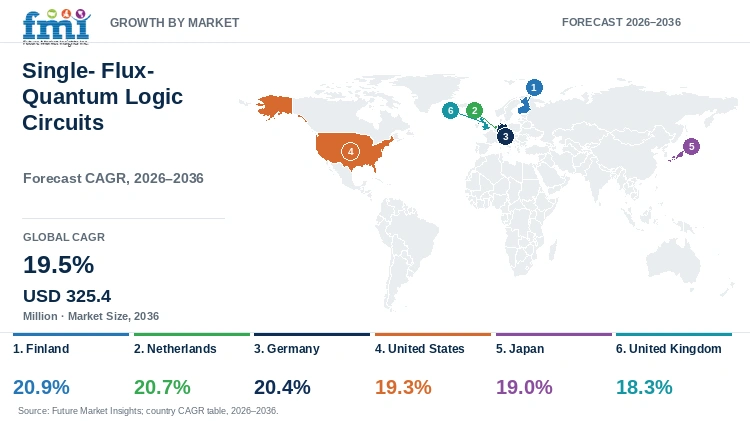
- Fastest national growth rate: Finland leads the six major superconducting electronics countries at a forecasted 20.9% yearly over 2026 to 2036 anchored by VTT's 150-to-300-qubit superconducting quantum computers and Espoo dilution-fridge manufacturing.
- Benelux and German cryo-foundry expansion: Dutch superconducting interconnect and cryo-controller clusters are projected to climb by 20.7% annually while German niobium foundry and metrology institutes advance at a slated 20.4% through 2036.
- Established defense and supercomputing hubs: United States RQL and RSFQ defense foundries expand at an estimated 19.3% annually ahead of Japanese adiabatic AQFP supercomputing consortia (19.0%) and United Kingdom national quantum testbeds (18.3%).
Market Size & Forecast
Table 1: Market Size and Forecast for the Single-Flux-Quantum Logic Circuits Market (USD million and CAGR percentage), 2025 to 2036
| Metric | Value |
|---|---|
| 2025 Market Size | USD 46.5 million |
| Estimated Market Size in 2026 | USD 54.8 million |
| Projected Market Size by 2036 | USD 325.4 million |
| CAGR, 2026 to 2036 | 19.5% |
| Added Revenue, 2026 to 2036 | USD 270.6 million |
Multi-stage utility-scale quantum benchmarking contracts in the United States and European Union are shifting single-flux-quantum fabrication from 4-layer university cleanrooms to planarized 200-millimeter niobium foundries. In October 2026, the Defense Advanced Research Projects Agency announced that four additional hardware teams entered the final validation stage of its Quantum Benchmarking Initiative to prove utility-scale fault-tolerant architectures [2]. Achieving real-time surface-code error correction across thousands of physical qubits requires co-locating SFQ syndrome decoders with closed-cycle cryogenic cooling systems to keep feedback latency below 500 nanoseconds. Foundries that control aluminum-oxide tunnel barrier thickness within half an angstrom secure recurring wafer shuttle contracts from quantum processor and defense electronic-warfare primes.
Nb/AlOx/Nb Wafer Output and Josephson Junction Density Sizing
Table 2: Nb/AlOx/Nb Wafer Output and Josephson Junction Density Indicators for the Single-Flux-Quantum Logic Circuits Market (USD million, wafer units, and junction metrics), mixed historical and forecast years from 2025 to 2036
| Metric | 2025 | 2026 | 2036 |
|---|---|---|---|
| Market size (USD million) | 46.5 | 54.8 | 325.4 |
| Annual 150mm/200mm Nb/AlOx/Nb foundry wafer starts (wafers) | 2,850 to 3,200 | 3,350 to 3,800 | 19,500 to 22,400 |
| Integrated Josephson junctions per cm² on 8-10 layer process (million JJs/cm²) | 1.2 to 2.5 | 1.6 to 3.2 | 12.0 to 25.0 |
| Dynamic switching energy per eSFQ/RQL logic gate at 4K (aJ) | 0.15 to 0.35 | 0.12 to 0.28 | 0.03 to 0.08 |
Operational note: Foundry wafer starts cover 150-millimeter and 200-millimeter planarized niobium-aluminum oxide-niobium trilayer wafers with critical current densities between 10 and 20 kiloamperes per square centimeter.
Scaling single-flux-quantum digital processors past one million Josephson junctions per die requires tightly uniform critical currents (Ic spread below 2% one-sigma) and chemical-mechanical planarization across eight to ten niobium wiring planes. In March 2026, SeeQC, Inc. demonstrated the first quantum computer operating with an integrated superconducting digital qubit-control chip directly at millikelvin temperatures [3]. Integrating these digital SFQ multiplexers inside dilution refrigerators eliminates hundreds of coaxial lines and complements high-speed analog-to-digital converters in cryogenic receiver racks.
Cryogenic Foundry Line Allocation & Dilution-Fridge Program Spend
Table 3: Foundry Line Allocation and Cryogenic Program Spending Indicators for the Single-Flux-Quantum Logic Circuits Market (USD and facility metrics), mixed historical and forecast years from 2025 to 2036
| Metric | 2025 | 2026 | 2036 |
|---|---|---|---|
| Active Nb/AlOx/Nb superconducting logic foundries & pilot lines | 14 | 16 | 38 |
| Average annual SFQ circuit revenue per active foundry line (USD million) | 3.32 | 3.43 | 8.56 |
| Annual SFQ co-processor spend per utility quantum / EW program (USD thousand) | 580 to 690 | 640 to 760 | 1,650 to 2,100 |
| Typical 4K stage thermal budget per 1,000-qubit SFQ controller (mW) | 12 to 25 | 10 to 20 | 2 to 6 |
Table 4: Segment Revenue & Foundry Layer Benchmarks for the Single-Flux-Quantum Logic Circuits Market (USD million and percentages), mixed reporting years from 2025 to 2026
| Benchmark Indicator | Reported / Modeled Value | Institutional Reference Basis |
|---|---|---|
| Market size, 2026 | USD 54.8 million | Report value |
| Energy-efficient eSFQ & RQL circuit revenue, 2026 | USD 29.9 million | 54.6% logic family share |
| 8- to 10-metal-layer Nb process revenue, 2026 | USD 35.0 million | 63.8% foundry layer share |
| In-dilution-fridge (4K) qubit co-processor revenue, 2026 | USD 31.9 million | 58.2% application share |
Military electronic-warfare directorates represent the second foundational customer group for niobium trilayer foundries, deploying rapid single-flux-quantum delta-sigma modulators to digitize X-band and Ka-band radar waveforms directly behind the antenna. Pairing superconducting digital receivers with electronic warfare signal processors provides quantum-limited noise figures and multi-gigahertz instantaneous bandwidth unavailable in room-temperature gallium arsenide ADCs. To prevent ambient geomagnetic fields from trapping parasitic fluxons inside superconducting ground planes, packaging engineers enclose FCBGA substrates within cryoperm and niobium-titanium shields.
Analyst Perspective
"Co-locating eSFQ and RQL syndrome decoders at 4 Kelvin offers a low-power complement to cryo-CMOS for reducing cryostat wiring loads. Foundry operators must still suppress parasitic flux trapping in planarized niobium ground planes and standardize electronic design automation cell libraries."
- Sudip Saha, Co-founder, FMI
How is the single-flux-quantum logic circuits market segmented?
The single-flux-quantum logic circuits market is segmented by superconducting logic family, Nb/AlOx/Nb foundry process layer count, cryogenic application, package thermal design, and region. In 2026, Energy-Efficient eSFQ & Reciprocal Quantum Logic (RQL) is projected at 54.6%, 8- to 10-Metal-Layer Nb Process (10-20 kA/cm² Jc) at 63.8%, In-Dilution-Fridge (4K) Co-Processors for Qubit Readout/Control at 58.2%, and Lidded FCBGA with Integrated Heat Spreader at 69.2%.
By superconducting logic family: Energy-Efficient eSFQ & Reciprocal Quantum Logic (RQL), Rapid Single-Flux-Quantum (RSFQ - 20 to 100 GHz Clock), and Adiabatic Quantum-Flux-Parametron (AQFP) Ultra-Low-Power.
By Nb/AlOx/Nb foundry process layer count: 8- to 10-Metal-Layer Nb Process (10-20 kA/cm² Jc), 4-Layer Planarized Standard Nb Process, and >10-Metal-Layer High-Density 3D Josephson Stack Process.
By cryogenic application: In-Dilution-Fridge (4K) Co-Processors for Qubit Readout/Control, Cryogenic Direct-RF Digital Receivers & EW Radar ADCs, and Exascale Cryogenic Supercomputing Accelerators.
By package thermal design: Lidded FCBGA with Integrated Heat Spreader, Flip-Chip Bare-Die Compact BGA, and Superconducting Multi-Chip Module (SMCM) Cryo-Interposer.
Why Do Energy-Efficient eSFQ and Reciprocal Quantum Logic Lead Superconducting Logic Family Selection?
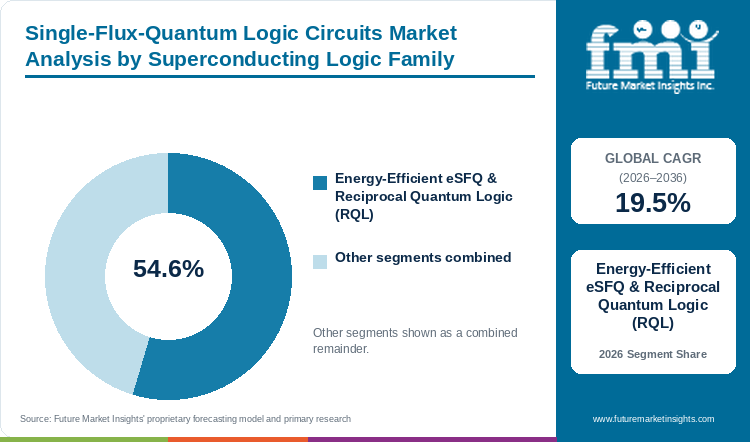
Energy-Efficient eSFQ & Reciprocal Quantum Logic (RQL) holds 54.6% of superconducting logic family demand in 2026, stemming from zero static dissipation.
Table 5: Superconducting Logic Family Share for the Single-Flux-Quantum Logic Circuits Market (percentage share), 2026
| Superconducting Logic Family Segment | Share (2026) |
|---|---|
| Energy-Efficient eSFQ & Reciprocal Quantum Logic (RQL) | 54.6% |
| Rapid Single-Flux-Quantum (RSFQ - 20 to 100 GHz Clock) | 28.4% |
| Adiabatic Quantum-Flux-Parametron (AQFP) Ultra-Low-Power | 17.0%* |
| Total | 100.0% |
*Note: Combined share of remaining superconducting logic family categories totaling 100.0% of 2026 market demand.
Table 6: Superconducting Logic Family Leadership and Market Growth for the Single-Flux-Quantum Logic Circuits Market (segment and CAGR percentage), 2026 to 2036
| Metric | Value |
|---|---|
| Global CAGR (2026 to 2036) | 19.5% |
| Leading Segment | Energy-Efficient eSFQ & Reciprocal Quantum Logic (RQL) |
Classical rapid single-flux-quantum (RSFQ) circuits distribute bias currents through resistive palladium-gold shunt networks whose static ohmic heating quickly exceeds the 1.5-watt cooling limit of a 4-Kelvin pulse-tube cryocooler. Energy-efficient eSFQ replaces bias resistors with superconducting inductive-Josephson current limiters, while Reciprocal Quantum Logic (RQL) uses multiphase AC microwave transmission lines that supply both clock and power with zero static dissipation. Whereas adiabatic quantum-flux-parametron (AQFP) gates operate at lower clock speeds around 5 gigahertz, eSFQ and RQL combine 10-to-40-gigahertz throughput with sub-attojoule switching energy alongside low-loss superconducting materials. This power-performance balance makes eSFQ and RQL the preferred architectures for dilution-fridge co-processors.
- Eliminating static bias-resistor heat dissipation gives Energy-Efficient eSFQ & Reciprocal Quantum Logic (RQL) a projected 54.6% of 2026 logic family revenue.
- In September 2025, Delft Circuits and Bluefors Oy formed a strategic partnership to integrate high-density superconducting Cri/oFlex I/O cabling directly into dilution refrigerators for scalable eSFQ and qubit control [4].
How Does the 8- to 10-Metal-Layer Nb Process Capture nearly Two-Thirds of Foundry Layer Revenue?
8- to 10-Metal-Layer Nb Process (10-20 kA/cm² Jc) holds 63.8% of Nb/AlOx/Nb foundry layer count in 2026, aided by planarization.
Routing multiphase AC clock trees, superconducting microstrip transmission lines, and flux-shielding ground planes across complex digital ALU and syndrome-decoder macros requires at least eight planarized niobium metal layers. Legacy 4-layer niobium processes lack dedicated stripline routing planes, forcing designers to consume valuable die area with passive wire crossovers that limit integration to a few thousand junctions. By elevating Nb/AlOx/Nb tunnel barrier critical current density to 10 to 20 kA/cm² and applying silica chemical-mechanical planarization between every metal level, 8-to-10-layer foundries shrink Josephson junction diameters below 700 nanometers. Foundries pair these dense niobium stacks with precision cryogenic magnet shields to prevent magnetic crosstalk.
- Supporting million-junction routing density places 8- to 10-Metal-Layer Nb Process (10-20 kA/cm² Jc) wafers with a projected 63.8% slice of 2026 foundry layer demand.
- In November 2025, Physics Today highlighted how macroscopic quantum tunneling in multi-layer Josephson-junction superconducting circuits formed the technological foundation recognized by the 2025 Nobel Prize in Physics [5].
What Drives In-Dilution-Fridge (4K) Co-Processors for Qubit Readout and Control to Lead Applications?
In-Dilution-Fridge (4K) Co-Processors for Qubit Readout/Control commands 58.2% of cryogenic application revenue in 2026, benefiting from millikelvin cable elimination.
Controlling each transmon or fluxonium qubit from room-temperature electronics requires dedicated coaxial lines and attenuators plus cryogenic directional couplers that physically crowd the dilution refrigerator shaft above 500 qubits. Mounting SFQ pulse generators and digital-to-analog flux biases alongside dispersive readout discriminators on the 4-Kelvin or 20-millikelvin stage allows a single high-speed optical or superconducting serial link to manage hundreds of qubits locally. While direct-RF defense radar receivers and exascale supercomputing accelerators represent high-value niches, commercial venture and government capital is heavily concentrated on utility-scale quantum computing platforms. Local 4K syndrome decoding also slashes surface-code round-trip latency by 90%.
- Replacing bulky coaxial wiring harnesses gives In-Dilution-Fridge (4K) Co-Processors for Qubit Readout/Control a projected 58.2% of 2026 application sales.
- In September 2025, Rigetti Computing, Inc. secured USD 5.7 million in purchase orders for two upgradable superconducting quantum computing systems featuring modular cryogenic control architectures [6].
Why Does Lidded FCBGA with Integrated Heat Spreader Dominate Package Thermal Design?
Lidded FCBGA with Integrated Heat Spreader secures 69.2% of package thermal design demand in 2026, accompanied by magnetic-flux shielding.
Operating niobium Josephson junctions reliably at 4.2 Kelvin requires both low-resistance thermal anchoring to the cryocooler cold plate and hermetic magnetic shielding against Earth's ambient field. Lidded flip-chip ball grid array packages combine oxygen-free high-thermal-conductivity copper or cryoperm lids with indium-tin or niobium-titanium solder bumps that survive repeated thermal cycling from 300 Kelvin down to 4 Kelvin without shear fracture. Unlidded bare-die flip-chip packages expose superconducting ground planes to radiant infrared photons and trapped magnetic vortices that shift junction critical currents. Cryogenic hardware teams consequently mount lidded FCBGA modules alongside fan-out wafer-level interposer packages to guarantee repeatable cooldown performance.
- Protecting Josephson arrays from infrared radiation and flux trapping gives Lidded FCBGA with Integrated Heat Spreader an anticipated 69.2% of 2026 package demand.
- In September 2025, Delft Circuits unveiled its multi-year cryogenic I/O and packaging roadmap engineered to scale superconducting quantum processors beyond thousands of channels [7].
What are the drivers, restraints, and opportunities in the single-flux-quantum logic circuits market?
Within the Single-Flux-Quantum Logic Circuits Market, fault-tolerant qubit readout co-processors and direct-RF defense radar receivers are anticipated to drive foundry expansion through 2036, even as parasitic magnetic-flux trapping and scarce superconducting EDA cell libraries slow mainstream design onboarding.
- Driver: Scaling fault-tolerant superconducting quantum processors past 1,000 qubits and digitizing wide-band electronic-warfare radar signals mandate ultra-low-power 4-Kelvin SFQ digital co-processors.
- Restraint: Parasitic magnetic-flux trapping during cryostat cooldowns and low-fanout pulse-splitting overhead combined with immature superconducting EDA synthesis tools restrict designer productivity.
- Opportunity: Adiabatic quantum-flux-parametron (AQFP) hybrid supercomputing accelerators and monolithic millikelvin multi-chip modules create high-value commercial growth avenues.
Growth Analysis and Future Potential: Qualitative Demand Catalysts
Real-time quantum error correction requires decoding surface-code parity syndromes within a one-microsecond coherence window, a latency target that room-temperature FPGA racks struggle to meet across two-meter coaxial harnesses. Single-flux-quantum decoders operating at 25 to 50 gigahertz on the 4-Kelvin stage execute minimum-weight perfect matching and union-find decoding right beside the quantum processor while consuming under 10 milliwatts. In May 2026, VTT Technical Research Centre of Finland announced the European SUPREME consortium project to establish industrial fabrication and design standards for stable superconducting quantum and cryogenic control chips [8]. Pairing planarized niobium SFQ controllers with cryogenic wafer-level test systems enables turnkey multi-chip quantum modules.
Risk Assessment of the Single-Flux-Quantum Logic Circuits Market: Operational and Formulation Friction
When a niobium superconducting die cools through its 9.2-Kelvin transition temperature, stray microtesla magnetic fields freeze as Abrikosov vortices inside the ground plane and shift nearby Josephson junction switching thresholds. Furthermore, because SFQ logic encodes binary ones as transient picosecond voltage pulses rather than static CMOS voltage levels, every gate requires explicit clock-tree routing and Josephson transmission line splitters for fanout above one. In March 2026, UK Research and Innovation announced new national quantum technology commercialization initiatives while noting that bridging cryogenic hardware with scalable control stacks remains a key engineering priority [9]. Chip architects must therefore surround active SFQ blocks with dense flux moats and radiation-hardened cryogenic control electronics to verify disturb-free cooldowns.
Commercial Opportunity Analysis: Formulation Differentiation and Value-Add Formats
Combining adiabatic quantum-flux-parametron (AQFP) logic blocks with energy-efficient eSFQ high-speed serial interfaces enables cryogenic supercomputing accelerators that consume 100 times less power than CMOS GPUs even after accounting for 4-Kelvin cryocooler wall-plug overhead. In October 2026, Fujitsu Limited launched a joint quantum and superconducting computing research partnership with the State of New Mexico to accelerate hybrid quantum-HPC hardware commercialization [10]. At the same time, defense primes are packaging multi-gigahertz RSFQ delta-sigma analog-to-digital converters into compact rack-mountable cryocoolers for shipboard and airborne electronic intelligence. Foundries that offer pre-verified PDKs on high-purity silicon wafer substrates capture recurring commercial shuttle revenue.
Single-Flux-Quantum Logic Circuits Market by Country (2026 to 2036)
Finland is anticipated to top the six major single-flux-quantum logic circuits countries at 20.9% per annum across 2026 to 2036, closely trailed by Dutch hubs at 20.7% and German fabs at 20.4% ahead of American foundries (19.3%) plus Japanese consortia (19.0%) and British testbeds (18.3%). European 300-qubit superconducting processor deployments alongside Dutch cryogenic I/O ecosystems, American RQL defense foundries, and Japanese AQFP supercomputing consortia shape these national growth paths.
Table 7: Country CAGR and Primary Growth Levers for the Single-Flux-Quantum Logic Circuits Market (CAGR percentage and operational drivers), 2026 to 2036
| Country | CAGR (2026 to 2036) | Primary Growth Lever |
|---|---|---|
| Finland | 20.9% | VTT 150-to-300-qubit superconducting processor scaling, SUPREME foundry lead, and Bluefors cryostats |
| Netherlands | 20.7% | Quantum Delta NL / QuTech cryo-control architecture and Delft Circuits superconducting I/O |
| Germany | 20.4% | PTB/Fraunhofer Nb/AlOx/Nb junction metrology and European SUPREME superconducting pilot lines |
| United States | 19.3% | Northrop Grumman RQL foundry, SeeQC millikelvin SFQ chips, and DARPA QBI defense contracts |
| Japan | 19.0% | AIST QuFab 10-layer Nb process and Fujitsu/NEDO superconducting quantum control programs |
| United Kingdom | 18.3% | NQCC Harwell superconducting testbeds, SeeQC UK fab operations, and UKRI quantum funding |
Source: Future Market Insights analysis
Finland Single-Flux-Quantum Logic Circuits Market Outlook (2026 to 2036)
Co-locating Europe's largest state-owned superconducting quantum foundry with world-leading dilution refrigerator manufacturing in Espoo makes Finland the fastest-growing market for single-flux-quantum readout and control circuits. In May 2025, VTT Technical Research Centre of Finland contracted IQM Quantum Computers to supply a world-leading 300-qubit superconducting quantum computer integrated with domestic cryogenic electronics [11]. Backed by these high-qubit-count cryostat deployments, Finnish single-flux-quantum logic circuit revenue is slated to expand at a 20.9% yearly rate over the decade to 2036. However, scarce domestic superconducting EDA design engineers force Finnish hardware teams to recruit globally. Finnish research institutes and VTT are actively addressing these design talent bottlenecks through open-access Micronova planarized niobium foundry wafer shuttles.
Key takeaway: In Finland, VTT's 300-qubit superconducting processor roadmap and Espoo dilution-refrigerator leadership drive a slated 20.9% annual rate until 2036.
Netherlands Single-Flux-Quantum Logic Circuits Market Outlook (2026 to 2036)
Specializing in high-density superconducting flex cabling and cryogenic qubit-control co-processors around Delft and Eindhoven places the Netherlands at the center of European quantum I/O scaling. During March 2026, NWO science administrators in the Netherlands advanced the Quantum Delta NL Quantum Technology call providing EUR 10.6 million in National Growth Fund awards for superconducting hardware [12]. Supported by QuTech and TNO open-access testbeds, Dutch single-flux-quantum logic circuit expenditure is forecast to climb 20.7% per year through 2036. Even so, integrating niobium SFQ pulse generators with cryo-CMOS multiplexers inside compact 4-Kelvin cans creates complex thermal-impedance matching challenges. Dutch cryogenic engineers resolve interface losses by embedding superconducting filters into flexible stripline cables.
Key takeaway: In the Netherlands, NWO Quantum Delta NL grants and Delft cryogenic I/O engineering sustain an estimated 20.7% annual pace through 2036.
Germany Single-Flux-Quantum Logic Circuits Market Outlook (2026 to 2036)
Decades of Josephson voltage-standard metrology in Braunschweig combined with 200-millimeter superconducting pilot lines in Dresden and Munich anchor Germany's single-flux-quantum fabrication base. In February 2026, Fraunhofer IZM joined the European Union's SUPREME consortium to industrialize 200-millimeter superconducting quantum chips and cryogenic interposer packaging across European pilot lines [13]. Reinforced by federal quantum computing procurement in Jülich and Garching, German single-flux-quantum logic circuit shipments are slated to grow 20.4% per year until 2036. Nevertheless, strict cleanroom power stability requirements and high liquid-helium recovery costs burden university and mid-sized niobium fabs. German microelectronics institutes mitigate liquid-helium operating expenses by transitioning 4-Kelvin test benches onto automated closed-cycle pulse-tube cryocoolers.
Key takeaway: In Germany, Fraunhofer SUPREME pilot lines and national quantum supercomputing centers support a forecasted 20.4% annual gain until 2036.
United States Single-Flux-Quantum Logic Circuits Market Outlook (2026 to 2036)
Commercial 8-to-10-layer niobium foundries in Maryland and New York paired with Defense Department direct-RF receiver contracts make the United States the largest revenue generator for single-flux-quantum circuits. In June 2026, IBM Corporation committed more than USD 10.0 billion to quantum computing and semiconductor research to fund its fault-tolerant quantum supercomputing roadmap [14]. Anchored by millikelvin SFQ qubit-control chips and electronic-warfare ADCs, United States single-flux-quantum logic circuit revenue is expected to rise 19.3% per annum through 2036. Even so, federal defense export restrictions on above-20-gigahertz superconducting analog-to-digital converters limit overseas commercial shipment volume. American foundries balance defense export limits by licensing eSFQ digital syndrome-decoder macros to commercial cloud quantum providers.
Key takeaway: In the United States, commercial multi-layer niobium foundries and multibillion-dollar quantum R&D commitments drive an anticipated 19.3% yearly clip until 2036.
Japan Single-Flux-Quantum Logic Circuits Market Outlook (2026 to 2036)
Pioneering adiabatic quantum-flux-parametron (AQFP) ultra-low-power gates and operating the open-access AIST QuFab niobium foundry in Tsukuba give Japan a distinct architectural lead in superconducting digital logic. In September 2026, Mitsubishi Electric and Tsukuba's AIST national research institute launched a NEDO-backed R&D project to scale superconducting cryogenic amplifiers and multi-qubit control circuits [15]. Backed by the CRAIQ consortium and hybrid quantum-HPC supercomputing centers, Japanese single-flux-quantum logic circuit turnover is projected to grow 19.0% each year through 2036. However, limited commercial EDA synthesis support for multiphase AC-clocked AQFP logic slows adoption among CMOS chip designers. Japanese engineers are addressing tool gaps by releasing automated Verilog-to-AQFP synthesis compilers.
Key takeaway: In Japan, NEDO superconducting R&D and AIST/Fujitsu adiabatic AQFP programs sustain an expected 19.0% yearly advance through 2036.
United Kingdom Single-Flux-Quantum Logic Circuits Market Outlook (2026 to 2036)
Operating commercial superconducting chip fabrication and test facilities in London and Belfast alongside the National Quantum Computing Centre in Harwell positions the United Kingdom as a key European SFQ hub. In June 2025, the UK government and the National Quantum Computing Centre announced a GBP 670.0 million ten-year sovereign quantum computing funding package under the UK Industrial Strategy [16]. Supported by fault-tolerant qubit readout testbeds, British single-flux-quantum logic circuit demand is forecasted to climb at an 18.3% annual rate over the forecast horizon. Even so, post-Brexit customs delays on specialty niobium sputtering targets and cryogenic multi-chip substrates periodically extend prototyping lead times. British quantum hardware firms counter supply friction by establishing dual-shore wafer shuttles between UK and U.S. foundries.
Key takeaway: In the United Kingdom, the GBP 670 million NQCC industrial strategy commitment and domestic SFQ chip design anchor a slated 18.3% annual trajectory until 2036.
Full report country CAGRs cover: North America; Latin America; Western Europe; Eastern Europe; East Asia; South Asia and Pacific; Middle East and Africa.
Who are the notable companies in the single-flux-quantum logic circuits market?
Northrop Grumman Corporation, SeeQC, Inc., HYPRES, Inc., STAR Cryoelectronics LLC, AIST / Fujitsu Superconducting Logic Consortium (CRAIQ), Equal1 / Delft Circuits Cryo-Interface Ecosystem, Rigetti Computing, Inc., and Bluefors Oy are the notable companies in the single-flux-quantum logic circuits market.
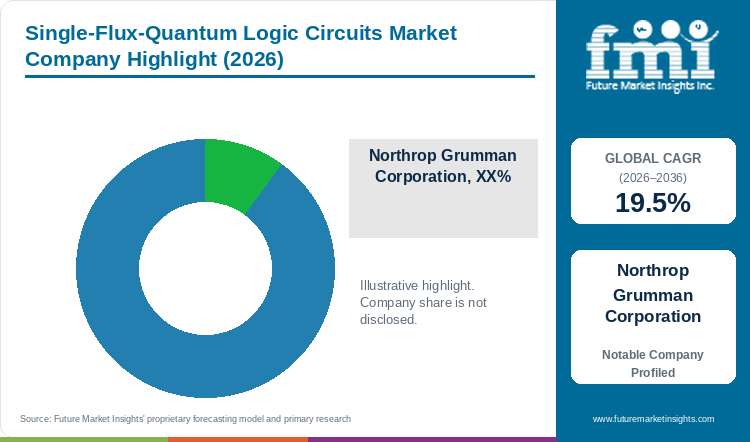
Ecosystem competition across the single-flux-quantum logic circuits market divides into superconducting SFQ and RQL digital logic foundries, adiabatic superconducting compute and quantum foundry consortia, and cryogenic co-processor and dilution-fridge interconnect specialists. Superconducting digital foundries including Northrop Grumman Corporation and SeeQC, Inc. alongside HYPRES, Inc. fabricate planarized multi-layer Nb/AlOx/Nb wafers for millikelvin qubit control and direct-RF defense receivers. Adiabatic compute and custom Josephson foundries such as the AIST / Fujitsu Superconducting Logic Consortium (CRAIQ) and STAR Cryoelectronics LLC together with Rigetti Computing, Inc. develop AQFP accelerators and custom Josephson arrays alongside modular quantum processors. Meanwhile, the Equal1 / Delft Circuits Cryo-Interface Ecosystem and Bluefors Oy deliver the cryogenic co-processors and superconducting Cri/oFlex cabling with 4-Kelvin thermal stages required to deploy SFQ hardware.
- Superconducting SFQ & RQL Digital Logic Foundries: Northrop Grumman Corporation and SeeQC, Inc. alongside HYPRES, Inc. operate multi-layer Nb/AlOx/Nb foundries producing RQL and eSFQ digital qubit controllers alongside direct-RF radar ADCs.
- Adiabatic Superconducting Compute & Quantum Foundry Consortia: The AIST / Fujitsu Superconducting Logic Consortium (CRAIQ) and STAR Cryoelectronics LLC together with Rigetti Computing, Inc. fabricate AQFP ultra-low-power gates and custom Josephson trilayers for integrated superconducting processors.
- Cryogenic Co-Processor & Dilution-Fridge Interconnect Ecosystems: The Equal1 / Delft Circuits Cryo-Interface Ecosystem and Bluefors Oy provide cryogenic silicon-superconducting controllers, superconducting flex I/O cables, and 4K dilution-fridge integration.
Competitive Benchmarking: Single-Flux-Quantum Logic Circuits Market
Table 8: Competitive Benchmarking for the Single-Flux-Quantum Logic Circuits Market (qualitative capability ratings), 2026
| Company | Nb/AlOx/Nb Foundry Depth | eSFQ / RQL / AQFP IP | 4K Qubit & RF Integration | Global Cryo Reach |
|---|---|---|---|---|
| Northrop Grumman Corporation | High | High | High | Medium |
| SeeQC, Inc. | High | High | High | High |
| HYPRES, Inc. | High | High | High | Medium |
| STAR Cryoelectronics LLC | High | Medium | Medium | High |
| AIST / Fujitsu Consortium (CRAIQ) | High | High | High | Medium |
| Equal1 / Delft Circuits Ecosystem | Medium | Medium | High | High |
| Rigetti Computing, Inc. | High | Medium | High | High |
| Bluefors Oy | Medium | Medium | High | High |
Scoring basis: Nb/AlOx/Nb Foundry Depth earns a High rating when an organization operates an in-house 4-to-10-metal-layer planarized niobium trilayer fabrication line, while Medium indicates fabless or interconnect specialization. eSFQ / RQL / AQFP IP evaluates documented multi-gigahertz digital cell libraries and syndrome decoders alongside direct-RF delta-sigma modulators. 4K Qubit & RF Integration reflects live deployment inside millikelvin dilution refrigerators or defense electronic-warfare cryostats.
Key Developments in the Single-Flux-Quantum Logic Circuits Market
- In September 2026, GlobalFoundries finalized a USD 375.0 million federal CHIPS research and development award to scale domestic superconducting and cryogenic quantum foundry capabilities [17].
- In May 2026, Equal1 Laboratories Ireland Limited unveiled the world's first hybrid rack-mounted silicon-spin and cryogenic quantum computer engineered for standard data-center deployment [18].
- In August 2025, Fujitsu Limited started official development of a 10,000-plus-qubit superconducting quantum computer targeting completion in 2030 alongside AIST and RIKEN [19].
Key Players in the Single-Flux-Quantum Logic Circuits Market
Superconducting SFQ & RQL Digital Logic Foundries
- Northrop Grumman Corporation
- SeeQC, Inc.
- HYPRES, Inc.
Adiabatic Superconducting Compute & Quantum Foundry Consortia
- AIST / Fujitsu Superconducting Logic Consortium (CRAIQ)
- STAR Cryoelectronics LLC
- Rigetti Computing, Inc.
Cryogenic Co-Processor & Dilution-Fridge Interconnect Ecosystems
- Equal1 / Delft Circuits Cryo-Interface Ecosystem
- Bluefors Oy
Single-Flux-Quantum Logic Circuits Market - Report Scope
Table 9: Report Scope for the Single-Flux-Quantum Logic Circuits Market (coverage fields and definitions), 2026 to 2036
| Coverage field | Report scope |
|---|---|
| Market breakdown | Superconducting Logic Family; Nb/AlOx/Nb Foundry Process Layer Count; Cryogenic Application; Package Thermal Design; Region |
| Quantitative Units | USD Million |
| Market Definition | Includes merchant foundry, chipmaker, and cryogenic module revenue from single-flux-quantum (RSFQ, eSFQ, RQL, AQFP) digital logic integrated circuits, multi-layer Nb/AlOx/Nb foundry wafer shuttles, in-dilution-fridge 4K/mK qubit readout/control co-processors, cryogenic direct-RF digital receiver ADCs, and lidded cryogenic FCBGA/SMCM packages sold within the listed segmentation. Category Scope Note: The valuation strictly covers Josephson-junction digital SFQ logic circuits and dedicated superconducting foundry wafer services, excluding standalone analog transmon qubit arrays without SFQ digital control, empty dilution refrigerators, and bulk MRI superconducting magnet coils. |
| Regions Covered | North America; Latin America; Western Europe; Eastern Europe; East Asia; South Asia and Pacific; Middle East and Africa |
| Countries Covered | Finland, Netherlands, Germany, United States, Japan, United Kingdom, and additional countries in the full report |
| Key Companies Covered | Northrop Grumman Corporation, SeeQC, Inc., HYPRES, Inc., STAR Cryoelectronics LLC, AIST / Fujitsu Superconducting Logic Consortium (CRAIQ), Equal1 / Delft Circuits Cryo-Interface Ecosystem, Rigetti Computing, Inc., Bluefors Oy |
| Forecast Period | 2026 to 2036 |
| Approach | Primary and secondary research with rigorous market triangulation. |
Single-Flux-Quantum Logic Circuits Market - Research Methodology
Table 10: Research Methodology for the Single-Flux-Quantum Logic Circuits Market (research methods and approach), 2026 edition
| Method | Approach |
|---|---|
| Primary Research | Primary interviews were conducted with Nb/AlOx/Nb trilayer foundry directors, eSFQ/RQL/AQFP circuit architects, dilution-refrigerator thermal engineers, defense direct-RF radar program managers, and national quantum lab directors to validate wafer yields, junction critical-current spreads, and 4K thermal budgets. |
| Secondary Research | Secondary research included company technical whitepapers from SeeQC, Northrop Grumman, HYPRES, Delft Circuits, and Bluefors, NIST/SQMS, DARPA QBI, VTT, NWO/Quantum Delta NL, NEDO/AIST, and UKRI/NQCC disclosures, and verified corporate press releases. |
| Market Sizing and Forecasting | Market sizing and forecasting for 2026 to 2036 were built using top-down and bottom-up models reconciling 150mm/200mm planarized niobium wafer starts, utility-scale quantum cryostat controller attach rates, and defense EW receiver contracts. |
| Data Triangulation and Validation | Estimates are triangulated against global dilution-refrigerator installations, sovereign quantum benchmarking awards, and multi-layer niobium foundry shuttle schedules without double counting analog qubit processor dies. |
| Country Forecasting Model | Country-level CAGRs are projected via FMI's superconducting electronics econometric model, calibrating national expansion rates against the 19.5% global baseline using sovereign quantum hardware grants, planarized Nb foundry layer capacity, and cryostat exports. |
| Operational Benchmark Traceability | Operational benchmarks (150mm/200mm Nb/AlOx/Nb wafer starts, Josephson junction density per cm², and eSFQ/RQL switching energy in attojoules) represent modeled scenario ranges synthesized from NIST, SeeQC, Northrop Grumman, and AIST QuFab process disclosures. |
Single-Flux-Quantum Logic Circuits Market by Segments
Single-Flux-Quantum Logic Circuits Market segmented by Superconducting Logic Family:
- Energy-Efficient eSFQ & Reciprocal Quantum Logic (RQL)
- Rapid Single-Flux-Quantum (RSFQ - 20 to 100 GHz Clock)
- Adiabatic Quantum-Flux-Parametron (AQFP) Ultra-Low-Power
Single-Flux-Quantum Logic Circuits Market segmented by Nb/AlOx/Nb Foundry Process Layer Count:
- 8- to 10-Metal-Layer Nb Process (10-20 kA/cm² Jc)
- 4-Layer Planarized Standard Nb Process
- >10-Metal-Layer High-Density 3D Josephson Stack Process
Single-Flux-Quantum Logic Circuits Market segmented by Cryogenic Application:
- In-Dilution-Fridge (4K) Co-Processors for Qubit Readout/Control
- Cryogenic Direct-RF Digital Receivers & EW Radar ADCs
- Exascale Cryogenic Supercomputing Accelerators
Single-Flux-Quantum Logic Circuits Market segmented by Package Thermal Design:
- Lidded FCBGA with Integrated Heat Spreader
- Flip-Chip Bare-Die Compact BGA
- Superconducting Multi-Chip Module (SMCM) Cryo-Interposer
Single-Flux-Quantum Logic Circuits Market by Region
- North America
- United States
- Canada
- Latin America
- Brazil
- Mexico
- Argentina
- Chile
- Western Europe
- Germany
- France
- United Kingdom
- Italy
- Spain
- Benelux
- Nordics
- Eastern Europe
- Poland
- Czech Republic
- Romania
- Hungary
- East Asia
- China
- Japan
- South Korea
- South Asia and Pacific
- India
- ASEAN
- Australia and New Zealand
- Middle East and Africa
- GCC Countries
- South Africa
- Türkiye
- Israel
Research Sources and Bibliography
- [1] National Institute of Standards and Technology (NIST). (2025, April 04). Quantum Breakthroughs: NIST & SQMS Lead the Way. U.S. Department of Commerce.
- [2] Defense Advanced Research Projects Agency (DARPA). (2026, October 07). Four more teams enter Quantum Benchmarking Initiative's final stage. U.S. Department of Defense.
- [3] SeeQC, Inc. (2026, March 18). SEEQC Reports First Quantum Computer with Integrated Qubit Control on a Chip at Millikelvin Temperatures. SEEQC Resources.
- [4] Bluefors Oy & Delft Circuits B.V. (2025, September 30). Bluefors and Delft Circuits Join Forces on Scalable Quantum I/O for Next-Generation Quantum Computers. Bluefors Press Releases.
- [5] Miller, J. L. (2025, November 25). Superconducting quantum circuits: At the heart of the 2025 Nobel Prize in Physics. Physics Today (American Institute of Physics).
- [6] Rigetti Computing, Inc. (2025, September 30). Rigetti Announces Purchase Orders for Two Quantum Computing Systems Totaling Approximately $5.7 Million. Rigetti Computing Investor Relations.
- [7] Delft Circuits B.V. (2025, September 17). Delft Circuits Presents its I/O Roadmap. Delft Circuits Study & Press Releases.
- [8] VTT Technical Research Centre of Finland Ltd. (2026, May 11). The SUPREME quantum project enforces Finland's leading role in European quantum research. VTT News and Ideas.
- [9] UK Research and Innovation (UKRI). (2026, March 17). UK leads the world into the quantum age. UK Research and Innovation News.
- [10] Fujitsu Limited. (2026, October 09). Fujitsu launches collaboration with State of New Mexico to establish quantum computing research center. Fujitsu Global Press Releases.
- [11] VTT Technical Research Centre of Finland Ltd. (2025, May 20). IQM Quantum Computers to supply Finland with a world-leading superconducting 300-qubit quantum computer. VTT News and Ideas.
- [12] Dutch Research Council (NWO). (2026, March 03). Quantum Delta NL Quantum Technology 2025. Netherlands Organisation for Scientific Research (NWO).
- [13] Fraunhofer Institute for Reliability and Microintegration (IZM). (2026, February 06). EU selects SUPREME consortium to develop the union's superconducting technology for wider industrialization. Fraunhofer IZM Tech News.
- [14] IBM Corporation. (2026, June 02). IBM Commits More Than $10 Billion to Quantum Computing, Funding Its Roadmap from Today's Leading Systems to the World's First Fault-Tolerant Quantum Computers. IBM Newsroom.
- [15] Mitsubishi Electric Corporation. (2026, September 17). Mitsubishi Electric Launching R&D to Scale Up Quantum Computers. Mitsubishi Electric Global News Releases (NEDO Post-5G Superconducting R&D).
- [16] National Quantum Computing Centre (NQCC). (2025, June 23). UK government announces £670 m for quantum computing. National Quantum Computing Centre Updates.
- [17] National Institute of Standards and Technology (NIST). (2026, September 08). Department of Commerce Announces Finalization of CHIPS R&D Award with GlobalFoundries. U.S. Department of Commerce.
- [18] Equal1 Laboratories Ireland Limited. (2026, May 14). Equal1 Unveils World's First Hybrid Rack-Mounted Silicon-Spin Quantum Computer. Equal1 Press Releases.
- [19] Fujitsu Limited. (2025, August 01). Fujitsu starts official development of plus-10,000 qubit superconducting quantum computer targeting completion in 2030. Fujitsu Global Press Releases.
- [20] Bluefors Oy. (2026, March 03). Bluefors' Breakthrough Modular Cryogenic Platform Takes Quantum Computing to Hundreds of Thousands of Qubits. Bluefors Press Releases.
This bibliography is provided for reader reference and is not exhaustive. The full report contains the complete reference list and detailed citations.
This Report Answers
- How large is the single-flux-quantum logic circuits market in 2026 and what is forecast for 2036?
- Which dilution-fridge I/O bottlenecks and defense direct-RF needs drive SFQ circuit adoption?
- Why do Energy-Efficient eSFQ & Reciprocal Quantum Logic (RQL) lead superconducting logic families?
- Why does the 8- to 10-Metal-Layer Nb Process (10-20 kA/cm² Jc) lead foundry layer counts?
- How do national CAGRs compare across Finland, the Netherlands, Germany, the United States, Japan, and the UK?
- Which superconducting foundries, AQFP consortia, and cryo-interconnect firms lead the sector?
- What magnetic-flux trapping and superconducting EDA limitations restrain broader deployment?
- What should quantum processor and EW radar buyers verify before selecting an SFQ foundry?
Frequently Asked Questions
How big is the single-flux-quantum logic circuits market in 2026, and what is forecast for 2036?
Global single-flux-quantum logic circuits demand stands at an estimated USD 54.8 million in 2026 (up from USD 46.5 million in 2025) and is slated to reach USD 325.4 million by 2036 as quantum computer builders deploy millikelvin and 4-Kelvin digital SFQ co-processors.
What is the CAGR for the single-flux-quantum logic circuits market from 2026 to 2036?
As per FMI, worldwide single-flux-quantum logic circuit turnover is expected to expand at a 19.5% compound annual clip between 2026 and 2036, creating USD 270.6 million in added multi-layer niobium foundry and cryogenic controller revenue.
Which superconducting logic family leads the single-flux-quantum logic circuits market?
Energy-Efficient eSFQ & Reciprocal Quantum Logic (RQL) captures a projected 54.6% of 2026 logic family revenue by eliminating static bias-resistor ohmic heating inside 4-Kelvin cryocooler stages.
Which Nb/AlOx/Nb foundry process layer count leads the single-flux-quantum logic circuits market?
8- to 10-Metal-Layer Nb Process (10-20 kA/cm² Jc) accounts for an estimated 63.8% of 2026 foundry process demand because silica chemical-mechanical planarization supports million-junction routing and ground-plane shielding.
Which country posts the fastest growth in the single-flux-quantum logic circuits market?
FMI estimates that Finland leads the six major superconducting nations at a projected 20.9% per year between 2026 and 2036, driven by VTT's 300-qubit superconducting processor program and Espoo dilution-fridge manufacturing.
Who are the key players in the single-flux-quantum logic circuits market?
Major suppliers include Northrop Grumman Corporation, SeeQC, Inc., HYPRES, Inc., STAR Cryoelectronics LLC, AIST / Fujitsu Superconducting Logic Consortium (CRAIQ), Equal1 / Delft Circuits Cryo-Interface Ecosystem, Rigetti Computing, Inc., and Bluefors Oy.
Preview the report firsthand - request a free sample
Get SampleGet the brochure for pricing and purchase details.
Get PDFTable of Content
- Key Takeaways
- Market Size and CAGR
- Top Growth Driver
- Fastest Growing Segment
- Leading Region
- Key Companies
- Emerging Opportunities
- Executive Summary
- Global Market Outlook
- Demand-side Trends
- Supply-side Trends
- Technology Roadmap Analysis
- Analysis and Recommendations
- Analyst Perspective (What is happening? Why now? What should investors know?)
- Key Questions Answered
- How large is the market?
- What is the CAGR?
- What are key trends?
- Which region dominates?
- Who are the leaders?
- Market Overview
- Market Coverage / Taxonomy
- Market Definition / Scope / Limitations
- Research Methodology
- Chapter Orientation
- Analytical Lens and Working Hypotheses
- Market Structure, Signals, and Trend Drivers
- Benchmarking and Cross-market Comparability
- Market Sizing, Forecasting, and Opportunity Mapping
- Research Design and Evidence Framework
- Desk Research Programme (Secondary Evidence)
- Expert Input and Fieldwork (Primary Evidence)
- Tooling, Models, and Reference Databases
- Data Engineering and Model Build
- Quality Assurance and Audit Trail
- Market Background
- Market Dynamics (Drivers, Restraints, Opportunity, Trends)
- Scenario Forecast (Optimistic, Likely, Conservative)
- Impact Analysis
- AI Impact
- Sustainability Impact
- Regulatory Impact
- Technology Impact
- Consumer / Buyer Analysis
- Purchase Drivers
- Adoption Barriers
- Buyer Journey
- Opportunity Map Analysis
- Product Life Cycle Analysis
- Supply Chain Analysis
- Investment Feasibility Matrix
- Value Chain Analysis
- PESTLE and Porter's Analysis
- Regulatory Landscape
- Regional Parent Market Outlook
- Production and Consumption Statistics
- Import and Export Statistics
- Global Market Analysis and Forecast, 2021 to 2036
- Historical Market Size Value (USD Million) Analysis, 2021 to 2025
- Current and Future Market Size Value (USD Million) Projections, 2026 to 2036
- Y-o-Y Growth Trend Analysis
- Absolute $ Opportunity Analysis
- Global Market Pricing Analysis, 2021 to 2036
- Global Market Analysis and Forecast, By Superconducting Logic Family, 2021 to 2036
- Introduction / Key Findings
- Historical Market Size Value (USD Million) Analysis By Superconducting Logic Family, 2021 to 2025
- Current and Future Market Size Value (USD Million) Analysis and Forecast By Superconducting Logic Family, 2026 to 2036
- Energy-Efficient eSFQ & Reciprocal Quantum Logic (RQL)
- Rapid Single-Flux-Quantum (RSFQ - 20 to 100 GHz Clock)
- Adiabatic Quantum-Flux-Parametron (AQFP) Ultra-Low-Power
- Y-o-Y Growth Trend Analysis By Superconducting Logic Family, 2021 to 2025
- Absolute $ Opportunity Analysis By Superconducting Logic Family, 2026 to 2036
- Global Market Analysis and Forecast, By Nb/AlOx/Nb Foundry Process Layer Count, 2021 to 2036
- Introduction / Key Findings
- Historical Market Size Value (USD Million) Analysis By Nb/AlOx/Nb Foundry Process Layer Count, 2021 to 2025
- Current and Future Market Size Value (USD Million) Analysis and Forecast By Nb/AlOx/Nb Foundry Process Layer Count, 2026 to 2036
- 8- to 10-Metal-Layer Nb Process (10-20 kA/cm² Jc)
- 4-Layer Planarized Standard Nb Process
- >10-Metal-Layer High-Density 3D Josephson Stack Process
- Y-o-Y Growth Trend Analysis By Nb/AlOx/Nb Foundry Process Layer Count, 2021 to 2025
- Absolute $ Opportunity Analysis By Nb/AlOx/Nb Foundry Process Layer Count, 2026 to 2036
- Global Market Analysis and Forecast, By Cryogenic Application, 2021 to 2036
- Introduction / Key Findings
- Historical Market Size Value (USD Million) Analysis By Cryogenic Application, 2021 to 2025
- Current and Future Market Size Value (USD Million) Analysis and Forecast By Cryogenic Application, 2026 to 2036
- In-Dilution-Fridge (4K) Co-Processors for Qubit Readout/Control
- Cryogenic Direct-RF Digital Receivers & EW Radar ADCs
- Exascale Cryogenic Supercomputing Accelerators
- Y-o-Y Growth Trend Analysis By Cryogenic Application, 2021 to 2025
- Absolute $ Opportunity Analysis By Cryogenic Application, 2026 to 2036
- Global Market Analysis and Forecast, By Package Thermal Design, 2021 to 2036
- Introduction / Key Findings
- Historical Market Size Value (USD Million) Analysis By Package Thermal Design, 2021 to 2025
- Current and Future Market Size Value (USD Million) Analysis and Forecast By Package Thermal Design, 2026 to 2036
- Lidded FCBGA with Integrated Heat Spreader
- Flip-Chip Bare-Die Compact BGA
- Superconducting Multi-Chip Module (SMCM) Cryo-Interposer
- Y-o-Y Growth Trend Analysis By Package Thermal Design, 2021 to 2025
- Absolute $ Opportunity Analysis By Package Thermal Design, 2026 to 2036
- Global Market Analysis and Forecast, By Region, 2021 to 2036
- Introduction
- Historical Market Size Value (USD Million) Analysis By Region, 2021 to 2025
- Current Market Size Value (USD Million) Analysis and Forecast By Region, 2026 to 2036
- North America
- Latin America
- Western Europe
- Eastern Europe
- East Asia
- South Asia and Pacific
- Middle East and Africa
- Market Attractiveness Analysis By Region
- North America Market Analysis and Forecast, By Country, 2021 to 2036
- Historical Market Size Value (USD Million) Trend Analysis By Market Taxonomy, 2021 to 2025
- Market Size Value (USD Million) Forecast By Market Taxonomy, 2026 to 2036
- By Country
- United States
- Canada
- By Superconducting Logic Family
- By Nb/AlOx/Nb Foundry Process Layer Count
- By Cryogenic Application
- By Package Thermal Design
- By Country
- Market Attractiveness Analysis
- By Country
- By Superconducting Logic Family
- By Nb/AlOx/Nb Foundry Process Layer Count
- By Cryogenic Application
- By Package Thermal Design
- Key Takeaways
- Latin America Market Analysis and Forecast, By Country
- Historical Market Size Value (USD Million) Trend Analysis By Market Taxonomy, 2021 to 2025
- Market Size Value (USD Million) Forecast By Market Taxonomy, 2026 to 2036
- By Country
- Brazil
- Mexico
- Argentina
- Chile
- By Superconducting Logic Family
- By Nb/AlOx/Nb Foundry Process Layer Count
- By Cryogenic Application
- By Package Thermal Design
- By Country
- Market Attractiveness Analysis
- By Country
- By Superconducting Logic Family
- By Nb/AlOx/Nb Foundry Process Layer Count
- By Cryogenic Application
- By Package Thermal Design
- Key Takeaways
- Western Europe Market Analysis and Forecast, By Country
- Historical Market Size Value (USD Million) Trend Analysis By Market Taxonomy, 2021 to 2025
- Market Size Value (USD Million) Forecast By Market Taxonomy, 2026 to 2036
- By Country
- Germany
- France
- United Kingdom
- Italy
- Spain
- Benelux
- Nordics
- By Superconducting Logic Family
- By Nb/AlOx/Nb Foundry Process Layer Count
- By Cryogenic Application
- By Package Thermal Design
- By Country
- Market Attractiveness Analysis
- By Country
- By Superconducting Logic Family
- By Nb/AlOx/Nb Foundry Process Layer Count
- By Cryogenic Application
- By Package Thermal Design
- Key Takeaways
- Eastern Europe Market Analysis and Forecast, By Country
- Historical Market Size Value (USD Million) Trend Analysis By Market Taxonomy, 2021 to 2025
- Market Size Value (USD Million) Forecast By Market Taxonomy, 2026 to 2036
- By Country
- Poland
- Czech Republic
- Romania
- Hungary
- By Superconducting Logic Family
- By Nb/AlOx/Nb Foundry Process Layer Count
- By Cryogenic Application
- By Package Thermal Design
- By Country
- Market Attractiveness Analysis
- By Country
- By Superconducting Logic Family
- By Nb/AlOx/Nb Foundry Process Layer Count
- By Cryogenic Application
- By Package Thermal Design
- Key Takeaways
- East Asia Market Analysis and Forecast, By Country
- Historical Market Size Value (USD Million) Trend Analysis By Market Taxonomy, 2021 to 2025
- Market Size Value (USD Million) Forecast By Market Taxonomy, 2026 to 2036
- By Country
- China
- Japan
- South Korea
- By Superconducting Logic Family
- By Nb/AlOx/Nb Foundry Process Layer Count
- By Cryogenic Application
- By Package Thermal Design
- By Country
- Market Attractiveness Analysis
- By Country
- By Superconducting Logic Family
- By Nb/AlOx/Nb Foundry Process Layer Count
- By Cryogenic Application
- By Package Thermal Design
- Key Takeaways
- South Asia and Pacific Market Analysis and Forecast, By Country
- Historical Market Size Value (USD Million) Trend Analysis By Market Taxonomy, 2021 to 2025
- Market Size Value (USD Million) Forecast By Market Taxonomy, 2026 to 2036
- By Country
- India
- ASEAN
- Australia and New Zealand
- By Superconducting Logic Family
- By Nb/AlOx/Nb Foundry Process Layer Count
- By Cryogenic Application
- By Package Thermal Design
- By Country
- Market Attractiveness Analysis
- By Country
- By Superconducting Logic Family
- By Nb/AlOx/Nb Foundry Process Layer Count
- By Cryogenic Application
- By Package Thermal Design
- Key Takeaways
- Middle East and Africa Market Analysis and Forecast, By Country
- Historical Market Size Value (USD Million) Trend Analysis By Market Taxonomy, 2021 to 2025
- Market Size Value (USD Million) Forecast By Market Taxonomy, 2026 to 2036
- By Country
- GCC Countries
- South Africa
- Türkiye
- Israel
- By Superconducting Logic Family
- By Nb/AlOx/Nb Foundry Process Layer Count
- By Cryogenic Application
- By Package Thermal Design
- By Country
- Market Attractiveness Analysis
- By Country
- By Superconducting Logic Family
- By Nb/AlOx/Nb Foundry Process Layer Count
- By Cryogenic Application
- By Package Thermal Design
- Key Takeaways
- Key Countries Market Analysis
- United States
- Pricing Analysis
- Market Share Analysis, 2025
- By Superconducting Logic Family
- By Nb/AlOx/Nb Foundry Process Layer Count
- By Cryogenic Application
- By Package Thermal Design
- Canada
- Pricing Analysis
- Market Share Analysis, 2025
- By Superconducting Logic Family
- By Nb/AlOx/Nb Foundry Process Layer Count
- By Cryogenic Application
- By Package Thermal Design
- Mexico
- Pricing Analysis
- Market Share Analysis, 2025
- By Superconducting Logic Family
- By Nb/AlOx/Nb Foundry Process Layer Count
- By Cryogenic Application
- By Package Thermal Design
- Brazil
- Pricing Analysis
- Market Share Analysis, 2025
- By Superconducting Logic Family
- By Nb/AlOx/Nb Foundry Process Layer Count
- By Cryogenic Application
- By Package Thermal Design
- Chile
- Pricing Analysis
- Market Share Analysis, 2025
- By Superconducting Logic Family
- By Nb/AlOx/Nb Foundry Process Layer Count
- By Cryogenic Application
- By Package Thermal Design
- Germany
- Pricing Analysis
- Market Share Analysis, 2025
- By Superconducting Logic Family
- By Nb/AlOx/Nb Foundry Process Layer Count
- By Cryogenic Application
- By Package Thermal Design
- United Kingdom
- Pricing Analysis
- Market Share Analysis, 2025
- By Superconducting Logic Family
- By Nb/AlOx/Nb Foundry Process Layer Count
- By Cryogenic Application
- By Package Thermal Design
- Italy
- Pricing Analysis
- Market Share Analysis, 2025
- By Superconducting Logic Family
- By Nb/AlOx/Nb Foundry Process Layer Count
- By Cryogenic Application
- By Package Thermal Design
- Spain
- Pricing Analysis
- Market Share Analysis, 2025
- By Superconducting Logic Family
- By Nb/AlOx/Nb Foundry Process Layer Count
- By Cryogenic Application
- By Package Thermal Design
- France
- Pricing Analysis
- Market Share Analysis, 2025
- By Superconducting Logic Family
- By Nb/AlOx/Nb Foundry Process Layer Count
- By Cryogenic Application
- By Package Thermal Design
- India
- Pricing Analysis
- Market Share Analysis, 2025
- By Superconducting Logic Family
- By Nb/AlOx/Nb Foundry Process Layer Count
- By Cryogenic Application
- By Package Thermal Design
- ASEAN
- Pricing Analysis
- Market Share Analysis, 2025
- By Superconducting Logic Family
- By Nb/AlOx/Nb Foundry Process Layer Count
- By Cryogenic Application
- By Package Thermal Design
- Australia and New Zealand
- Pricing Analysis
- Market Share Analysis, 2025
- By Superconducting Logic Family
- By Nb/AlOx/Nb Foundry Process Layer Count
- By Cryogenic Application
- By Package Thermal Design
- China
- Pricing Analysis
- Market Share Analysis, 2025
- By Superconducting Logic Family
- By Nb/AlOx/Nb Foundry Process Layer Count
- By Cryogenic Application
- By Package Thermal Design
- Japan
- Pricing Analysis
- Market Share Analysis, 2025
- By Superconducting Logic Family
- By Nb/AlOx/Nb Foundry Process Layer Count
- By Cryogenic Application
- By Package Thermal Design
- South Korea
- Pricing Analysis
- Market Share Analysis, 2025
- By Superconducting Logic Family
- By Nb/AlOx/Nb Foundry Process Layer Count
- By Cryogenic Application
- By Package Thermal Design
- Poland
- Pricing Analysis
- Market Share Analysis, 2025
- By Superconducting Logic Family
- By Nb/AlOx/Nb Foundry Process Layer Count
- By Cryogenic Application
- By Package Thermal Design
- Hungary
- Pricing Analysis
- Market Share Analysis, 2025
- By Superconducting Logic Family
- By Nb/AlOx/Nb Foundry Process Layer Count
- By Cryogenic Application
- By Package Thermal Design
- Türkiye
- Pricing Analysis
- Market Share Analysis, 2025
- By Superconducting Logic Family
- By Nb/AlOx/Nb Foundry Process Layer Count
- By Cryogenic Application
- By Package Thermal Design
- South Africa
- Pricing Analysis
- Market Share Analysis, 2025
- By Superconducting Logic Family
- By Nb/AlOx/Nb Foundry Process Layer Count
- By Cryogenic Application
- By Package Thermal Design
- Finland
- Pricing Analysis
- Market Share Analysis, 2025
- By Superconducting Logic Family
- By Nb/AlOx/Nb Foundry Process Layer Count
- By Cryogenic Application
- By Package Thermal Design
- Netherlands
- Pricing Analysis
- Market Share Analysis, 2025
- By Superconducting Logic Family
- By Nb/AlOx/Nb Foundry Process Layer Count
- By Cryogenic Application
- By Package Thermal Design
- United States
- Market Structure Analysis
- Competition Dashboard
- Competition Benchmarking
- Market Share Analysis of Top Players
- By Regional
- By Superconducting Logic Family
- By Nb/AlOx/Nb Foundry Process Layer Count
- By Cryogenic Application
- By Package Thermal Design
- Emerging Startups
- Innovation Benchmarking
- Competition Analysis
- Competition Deep Dive
- Northrop Grumman Corporation
- Overview
- Product Portfolio
- Profitability by Market Segments
- Sales Footprint
- Strategy Overview
- Marketing Strategy
- Product Strategy
- Channel Strategy
- SeeQC, Inc.
- HYPRES, Inc.
- STAR Cryoelectronics LLC
- AIST / Fujitsu Consortium (CRAIQ)
- Equal1 / Delft Circuits Ecosystem
- Rigetti Computing, Inc.
- Bluefors Oy
- AIST / Fujitsu Superconducting Logic Consortium (CRAIQ)
- Equal1 / Delft Circuits Cryo-Interface Ecosystem
- Northrop Grumman Corporation
- Case Studies
- Success Stories
- Recent Developments
- Competition Deep Dive
- Assumptions & Acronyms Used


