

- Market Size (2026)
- USD 325.7 Mn
- Forecast (2036)
- USD 750.1 Mn
- CAGR (2026 to 2036)
- 8.7%
How big is Soda Bread Market in 2026?
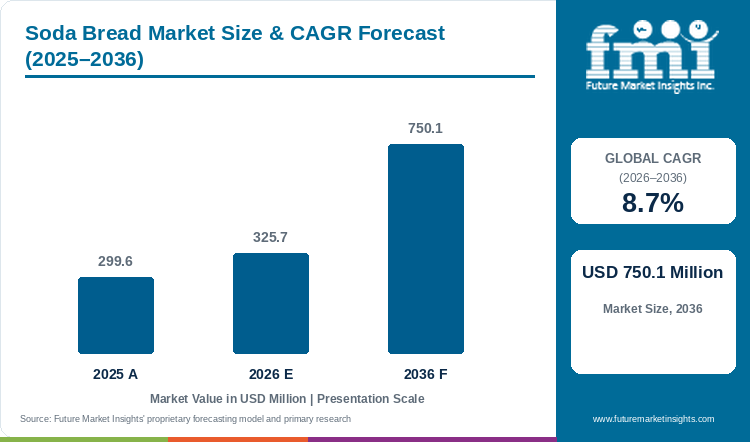
USD 325.7 Million in 2026 and USD 750.1 Million by 2036 at an 8.7% CAGR.
The Soda Bread Market was valued at USD 299.6 Million in 2025. It is estimated at USD 325.7 Million in 2026 and is forecast to reach USD 750.1 Million by 2036 at an 8.7% CAGR. Buyers recognize the traditional buttermilk bread, while brown and mini versions give retailers more than one reason to stock it. Repeat sales depend on a consistent crumb and a shelf life that fits the delivery schedule.
Whole wheat bread has a place in nutrition-led shopping, and German and French guidance favors whole-grain cereal foods. Australia and New Zealand also apply fortification rules to wheat flour used for bread making. The UK Competition and Markets Authority reported higher energy and wheat costs for bread suppliers in June 2026. Distribution costs also rose. Soda bread can stand apart from standard loaves, but its price must still cover fresh delivery and waste.
Key Takeaways
- Classic / original is likely to account for 33.0% of Product Type demand in 2026.
- Conventional is likely to account for 54.0% of Claim / Nature demand in 2026.
- Fresh is set to account for 37.0% of Format demand in 2026.
- Short shelf life and delivery costs make wider distribution harder, especially for fresh soda bread.
- Some of the notable companies include Irwin's Bakery and Brennans Bread, McCambridge of Galway, Pat The Baker, Warburtons and Allied Bakeries.
Analyst Perspective
“Freshness and price will decide whether soda bread reaches more households. A familiar buttermilk loaf can win the first sale, but repeat buyers need the same texture each time.”
- Nandini Roy Choudhury, Principal Analyst at Future Market Insights
How is the soda bread market segmented?
The market is segmented by Product Type, Claim / Nature, Format, Packaging Format and Sales Channel.
Product Type covers Classic / original, Whole grain & seeded, Flavored & filled, Mini & snacking formats, and Premium / artisan. Claim / Nature includes Conventional, Clean label, Organic, Gluten-free, and High-protein / fortified. Format covers Fresh, Frozen, Ambient packaged, Chilled, and Par-baked / thaw-and-serve. Packaging Format includes Multipack, Single-serve, Family / loaf pack, and Bulk foodservice. Sales Channel includes Supermarkets & hypermarkets, Artisan & specialty bakeries, Convenience & forecourt, Online & DTC, and Foodservice distributors.
Why does Classic / original lead the Product Type category?
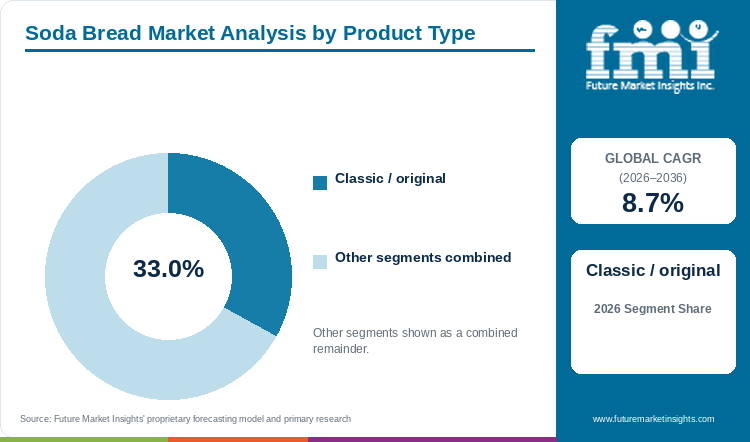
Classic / original gives shoppers the dense crumb and mild cultured-dairy note they expect from soda bread. It needs no yeast and little explanation at the shelf. Bakers can add seeds or change the pack size without losing that familiar base.
- Classic / original holds 33.0% in 2026. Its advantage comes from direct alignment with the traditional recipe cues that define soda bread for mainstream buyers.
- Irwin's current Brown Soda Bread uses Irish buttermilk and soda rather than yeast. Brennans positions its Signature Soda around locally sourced buttermilk and a time-honored bake. These examples show why authenticity remains a practical merchandising cue.
Why does Conventional remain central to the Claim / Nature category?
Conventional soda bread reaches the most buyers because its wheat-and-buttermilk recipe fits established bakery lines. Organic and gluten-free food serves narrower needs and demands different sourcing or production controls. Those added steps make mainstream pricing harder to match.
- Conventional holds 54.0% in 2026. The segment benefits from broad recipe flexibility and the absence of specialist claim validation for the majority of purchases.
- Pat The Baker currently lists both Buttermilk Soda and Traditional Brown Soda alongside wider breakfast goods. The range illustrates how conventional soda bread can sit within a high-frequency everyday bakery portfolio.
What keeps Fresh ahead within the Format category?
Fresh soda bread offers the texture shoppers expect from a traditional bakery loaf. It works best where delivery routes can replenish stores often enough to limit waste. Frozen baked goods travel farther and can wait longer before sale, but thawing must protect the crumb.
- Fresh holds 37.0% in 2026. Buyers value immediate texture and bakery cues, while suppliers with frequent delivery routes can better protect product quality at shelf.
- Pat The Baker states that its Irish distribution system delivers oven-fresh bread every day of the week. That model shows why route density and early-day replenishment can be part of the product proposition rather than a back-end logistics issue.
Why does Multipack lead the Packaging Format category?
Multipacks give soda bread a practical route into breakfast and snacking occasions while lowering the commitment of a full family loaf. They can also support portion control and reduce handling for retailers. The format is particularly useful for mini breads and farls because units can be consumed over several occasions while the outer pack carries nutrition, allergen and storage information.
- Multipack holds 34.0% in 2026. Its strength comes from portion flexibility and the ability to package smaller soda-bread formats for planned household use.
- Irwin's current range includes 4 Mini Soda Breads alongside soda farls and a 400 g brown soda loaf. The assortment shows how one producer can use packaging format to cover sharing, breakfast and smaller-portion missions.
Why do Supermarkets & hypermarkets lead the Sales Channel category?
Supermarkets put soda bread beside the bakery products shoppers already buy. Buyers can compare traditional loaves with whole-grain and specialty options in one trip. A supplier still needs reliable deliveries and clear pack information to hold that shelf space.
- Supermarkets & hypermarkets hold 38.0% in 2026. Their advantage comes from high household reach and the ability to merchandise soda bread beside mainstream and specialty bakery choices.
- Irwin's lists major retailers such as Asda and Tesco. Its range also reaches Sainsbury's, Waitrose, SuperValu and SPAR. That access takes regional bread into more routine grocery trips.
What are the drivers, restraints and opportunities in the soda bread market?
Demand is driven by differentiated traditional bread and nutrition-led variants, while freshness economics and claim compliance constrain scale and specialty formats create room for premiumization and wider channel reach.
- Driver: Heritage identity combines with whole-grain, fibre and portion-format demand to support differentiated bakery purchases.
- Restraint: Fresh distribution costs, short shelf-life exposure and gluten-free or nutrition-claim controls can slow expansion.
- Opportunity: Gluten-free, seeded, clean-label and portioned soda breads can broaden the buyer base when production controls and pricing remain credible.
Tradition alone will not drive every purchase. Public guidance in Ireland, Germany and France encourages whole-grain cereal foods. Interest in whole grain foods gives brown and seeded soda bread a clearer everyday use. Retailers can offer that choice without asking shoppers to switch to an unfamiliar bread format.
Freshness becomes harder to protect as delivery distances grow. The UK CMA described higher energy, wheat and distribution costs in its 2026 bread review. Gluten-free claims add production controls. Canada's regulator expects manufacturers to limit cross-contamination and uses 20 ppm as an important enforcement threshold. These costs can narrow the area a bakery serves profitably.
Smaller packs can open breakfast and snacking occasions without asking a household to finish a full loaf. Irwin's mini breads show how portioning works in practice. McCambridge's gluten-free line offers another route for buyers with dietary needs. Each format must still deliver the expected crumb and credible pack information.
Which country CAGRs are profiled in the soda bread market?
The profiled country CAGRs cover 2026 to 2036.
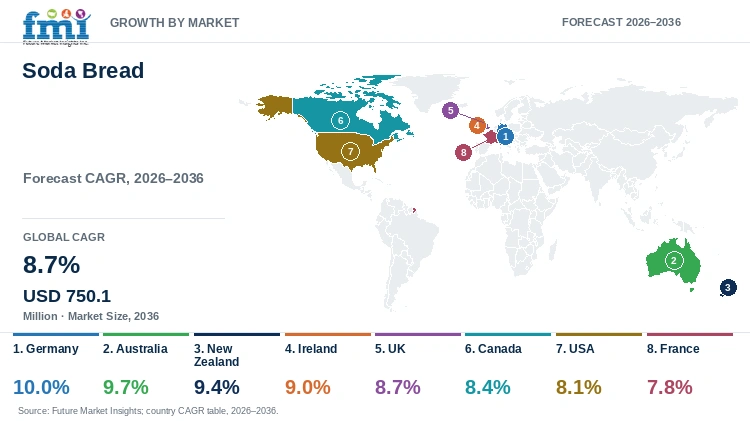
| Country | CAGR |
|---|---|
| Germany | 10.0% |
| Australia | 9.7% |
| New Zealand | 9.4% |
| Ireland | 9.0% |
| UK | 8.7% |
| Canada | 8.4% |
| USA | 8.1% |
| France | 7.8% |
How do country-level CAGRs compare in the soda bread market?
Germany at 10.0%, Australia at 9.7% and New Zealand at 9.4% lead the profiled growth rates. Ireland and the UK follow. Canada and the USA grow more slowly, with France at 7.8%. Germany's rate is 2.2 percentage points above France's. These are growth rates rather than national market sizes.
- Germany: whole-grain dietary guidance supports a health-oriented route for seeded and premium soda breads.
- Australia: bread-making flour fortification and allergen rules make formulation and labeling part of supplier qualification.
- New Zealand: mandatory folic-acid fortification for non-organic wheat flour used in bread creates a clear compliance baseline.
- Ireland: category familiarity supports authenticity, but established fresh-bread competition raises the execution threshold.
- UK: mature bread networks face cost and demand pressure, as the 2026 CMA review described.
- Canada: whole-grain guidance supports nutrition positioning, while gluten-free claims require disciplined cross-contamination controls.
- USA: specialty and diaspora channels can support Irish-style products, but gluten-free labeling has a defined federal threshold.
- France: public guidance favors whole-grain cereal foods, creating a nutrition-led route for a product that lacks Ireland’s heritage advantage.
Country growth depends on local bread habits and distribution costs. The eight profiles below show how these conditions affect soda-bread sales.
Country-wise Analysis
- Germany: The market is forecast to grow at 10.0% CAGR from 2026 to 2036. German nutrition guidance favors whole-grain bread. Seeded soda bread can fit that preference, though buyers need a clear reason to choose it over familiar local loaves. Grain content and taste will carry more weight than Irish heritage alone.
- Australia: The market is forecast to grow at 9.7% CAGR from 2026 to 2036. Wheat flour for bread making is subject to folic-acid fortification rules, with an organic exception. Australian dietary guidance also favors wholegrain cereals. Brown and seeded soda breads can use that nutrition context if pack labels meet local requirements and the crumb suits mainstream shoppers.
- New Zealand: The market is forecast to grow at 9.4% CAGR from 2026 to 2036. Non-organic wheat flour used for bread making has required folic-acid fortification since August 2023. That rule shapes recipe choices and makes the organic distinction visible on packs. Longer distances between stores favor frozen or ambient formats when a local fresh route is impractical.
- Ireland: The market is forecast to grow at 9.0% CAGR from 2026 to 2036. Soda bread is already familiar and competes beside pan bread in local shops. The Department of Health's Food Pyramid also includes wholemeal breads in routine healthy eating. Bakers need reliable freshness and a distinct format to win repeat purchases in this established category.
- UK: The market is forecast to grow at 8.7% CAGR from 2026 to 2036. The Competition and Markets Authority reported weaker demand for parts of packaged bread in June 2026. It also cited higher energy, wheat and distribution costs. Soda bread can offer a distinct texture beside sliced loaves, but fresh routes must cover those costs. Producers also need to meet bread composition and labelling rules.
- Canada: The market is forecast to grow at 8.4% CAGR from 2026 to 2036. Health Canada encourages whole-grain foods such as bread. That supports brown and seeded soda bread. Gluten-free versions face a different test: producers must limit cross-contamination, and the Canadian regulator uses 20 ppm as an important threshold. Long delivery distances make shelf life equally important.
- USA: The market is forecast to grow at 8.1% CAGR from 2026 to 2036. Irish-style bakery occasions and specialty grocery give soda bread an entry point. Pat The Baker documents bread availability in New York. Gluten-free claims must meet the FDA threshold below 20 parts per million. Fresh imported loaves also face longer journeys than locally baked products.
- France: The market is forecast to grow at 7.8% CAGR from 2026 to 2036. Public guidance recommends wholegrain or cereal bread at least once a day. Seeded soda bread can enter through that nutrition cue, but it has less cultural recognition than in Ireland. Specialty bakeries and premium grocers offer places to test taste and pack size before broader distribution.
Who are the notable companies in the soda bread market?
The profiled companies are Irwin's Bakery and Brennans Bread. They also include McCambridge of Galway, Pat The Baker, Warburtons and Allied Bakeries.
Irwin's Bakery and McCambridge of Galway sell several soda-bread formats. Brennans Bread and Pat The Baker offer soda lines through established Irish bakery ranges. Warburtons and Allied Bakeries bring wider UK production and distribution capabilities. Buyers will compare recipe and pack size alongside freshness and delivery reliability.
- Broad soda-bread assortment specialists: Irwin's Bakery and McCambridge of Galway, supported by multiple formats or specialty variants.
- Irish fresh-bread producers with visible soda lines: Brennans Bread and Pat The Baker, supported by current product listings and established domestic bakery routes.
- Scaled UK bakery networks: Warburtons and Allied Bakeries have broad production and distribution capability.
Competitive Benchmarking: Soda Bread Market
| Company | Verified Soda Bread Assortment | Fresh Distribution Capability | Specialty & Dietary Bread Capability | Geographic Reach |
|---|---|---|---|---|
| Irwin's Bakery | High | Medium | Medium | Northern Ireland and Great Britain retail channels |
| Brennans Bread | Medium | Medium | Medium | Ireland |
| McCambridge of Galway | High | Medium | High | Ireland with documented export activity |
| Pat The Baker | Medium | High | Medium | Ireland, with documented availability in New York |
| Warburtons | Low | High | High | United Kingdom bakery and depot network |
| Allied Bakeries | Low | High | Low | United Kingdom major-retail distribution network |
Scoring basis: High indicates a broad soda-bread range, frequent distribution or dedicated specialty production. Medium indicates a narrower range or capability. Low indicates a limited presence against the listed metric.
Key Developments in the Soda Bread Market
- In July 2026, Associated British Foods completed its acquisition of Hovis Group and combined it with Allied Bakeries. The resulting UK bakery network has greater production and delivery scale. That scale matters when specialist breads need dependable retail replenishment.
- In April 2026, Warburtons announced an investment program worth more than £100 million. It included a new bakery site, a distribution center and three production lines. The company also planned to redevelop its gluten-free bakery. The investment expands the capacity available for specialty bread formats.
- In September 2026, McCambridge's brown soda bread was promoted to Dutch hotels and pubs as a frozen wholesale case. The 12-loaf pack gives foodservice buyers a way to serve Irish bread without daily fresh deliveries.
Key Players in the Soda Bread Market
Broad Soda Bread Assortment Specialists
- Irwin's Bakery
- McCambridge of Galway
Irish Fresh-Bread Producers with Soda Lines
- Brennans Bread
- Pat The Baker
Scaled UK Bakery Network Participants
- Warburtons
- Allied Bakeries
Soda Bread Market - Report Scope
| Coverage field | Report scope |
|---|---|
| Market breakdown | Product Type; Claim / Nature; Format; Packaging Format; Sales Channel |
| Quantitative Units | USD Million |
| Market Definition | Revenue from finished soda bread sold within the defined segmentation universe. The scope includes fresh, frozen, ambient packaged, chilled and par-baked / thaw-and-serve soda bread. It excludes flour and ingredient sales, bake-at-home mixes, sandwiches or meals using soda bread, adjacent bread types not sold as soda bread, and standalone service or logistics revenue unless embedded in product price. |
| Regions Covered | North America; Latin America; Western Europe; Eastern Europe; East Asia; South Asia and Pacific; Middle East and Africa |
| Countries Covered | Ireland; UK; USA; Canada; Australia; Germany; France; New Zealand |
| Key Companies Profiled | Irwin's Bakery; Brennans Bread; McCambridge of Galway; Pat The Baker; Warburtons; Allied Bakeries |
| Forecast Period | 2026 to 2036 |
| Approach | Primary and secondary research with market triangulation. |
Soda Bread Market - Research Methodology
| Method | Approach |
|---|---|
| Primary Research | FMI analysts interviewed bakery manufacturers and distributors. Discussions covered retail purchasing, recipe choices and the difficulty of keeping soda bread fresh across delivery routes. |
| Desk Research | Desk research reviewed food guidance and bread regulations. It also covered company product ranges, distribution information and dated announcements. |
| Market Sizing and Forecasting | The market model combined the 2026 value with segment structure and country demand conditions. Forecast assumptions considered pricing, bread consumption and the reach of fresh or frozen formats. |
| Data Validation | Estimates were checked against public guidance and company activity. Validation also tested whether each product fell within the report's soda-bread definition. |
Soda Bread Market by Segments
Soda Bread Market segmented by Product Type:
- Classic / original
- Whole grain & seeded
- Flavored & filled
- Mini & snacking formats
- Premium / artisan
Soda Bread Market segmented by Claim / Nature:
- Conventional
- Clean label
- Organic
- Gluten-free
- High-protein / fortified
Soda Bread Market segmented by Format:
- Fresh
- Frozen
- Ambient packaged
- Chilled
- Par-baked / thaw-and-serve
Soda Bread Market segmented by Packaging Format:
- Multipack
- Single-serve
- Family / loaf pack
- Bulk foodservice
Soda Bread Market segmented by Sales Channel:
- Supermarkets & hypermarkets
- Artisan & specialty bakeries
- Convenience & forecourt
- Online & DTC
- Foodservice distributors
Soda Bread Market by Region:
- North America
- United States
- Canada
- Latin America
- Brazil
- Mexico
- Argentina
- Chile
- Western Europe
- Germany
- France
- United Kingdom
- Italy
- Spain
- Benelux
- Nordics
- Eastern Europe
- Poland
- Czech Republic
- Romania
- Hungary
- East Asia
- China
- Japan
- South Korea
- South Asia and Pacific
- India
- ASEAN
- Australia and New Zealand
- Middle East and Africa
- GCC Countries
- South Africa
- Türkiye
- Israel
Research Sources and Bibliography
- Department of Health, Ireland (2019, May 27). The Food Pyramid.
- Department for Environment, Food & Rural Affairs and Food Standards Agency (2025, April 23). Bread and flour: labelling and composition.
- Competition and Markets Authority (2026, June 16). CMA clears ABF’s deal to buy bread maker Hovis.
- U.S. Food and Drug Administration (n.d.). Questions and Answers on the Gluten-Free Food Labeling Final Rule.
- Canadian Food Inspection Agency (2024, March 22). Compliance and enforcement of gluten-free claims.
- Health Canada (n.d.). Eat whole grain foods.
- Food Standards Australia New Zealand (2025, February 25). Folic acid fortification.
- Australian Government, Eat for Health (n.d.). Grain (cereal) foods, mostly wholegrain and/or high cereal fibre varieties.
- German Nutrition Society (2024). Food-Based Dietary Guidelines for Germany.
- Santé publique France (n.d.). Aller vers les féculents complets.
- New Zealand Ministry for Primary Industries (2023, August 14). Fortifying bread-making flour to protect babies is mandatory from today.
- Irwin's Bakery (n.d.). Brown Soda Bread 400g.
- Irwin's Bakery (n.d.). Irwin’s Breads | Traditional Northern Irish Baked Goods.
- Brennans Bread (n.d.). Brennans Signature Soda.
- Brennans Bread (n.d.). Products.
- McCambridge of Galway (n.d.). Products.
- Pat The Baker (n.d.). Breakfast Goods.
- Pat The Baker (n.d.). Our Story.
- Competition and Consumer Protection Commission (2024, December 23). Mayfair Equity Partners/Pat the Baker and Irish Pride.
- Associated British Foods (2025, August 15). ABF to Acquire Hovis Group.
- Financial Conduct Authority National Storage Mechanism (2026, July 8). ABF completes acquisition of Hovis Group Limited.
- Food Manufacture (2026, April 17). Warburtons invests £100M and acquires new site.
- Warburtons (n.d.). Our Bakeries & Depots.
- Warburtons (n.d.). Gluten, Wheat and Milk Free.
- Food Manufacture (2024, April 17). NPD: Warburtons, I.T.S and Wall’s announce product launches.
- The Irish Times (2019, January 15). What's really in gluten-free bread?.
- Buy NI Food (2016, November 7). Irwin's launches new low sugar range.
- The Irish News (2024, January 24). Entrepreneur Rusk takes slice of Portadown family bakery Irwin’s.
- Food and Drink Network (2026, August 26). Warburtons bakes up a fresh batch of new products this August.
- Irwin's Bakery (2025). Rolling into 2025 with a Fresh New Look!
- Green Acres (2026, September 18). Irish soda bread for hotels and pubs: serving McCambridge's.
These sources support the market context, company activity and regulatory points discussed in this article.
This Report Answers
- How large is the Soda Bread Market in 2026 and what value is forecast for 2036?
- Which industry pressures are supporting demand for differentiated soda bread?
- Why does Classic / original hold the leading position within Product Type?
- Why does Conventional hold the leading position within Claim / Nature?
- How do growth rates differ across the eight profiled countries?
- Which profiled companies supply soda bread or relevant bakery capabilities?
- What limits adoption, geographic expansion or supplier switching?
- What should buyers evaluate before purchasing soda bread at retail or foodservice scale?
Frequently Asked Questions
How big is the Soda Bread Market in 2026, and what is forecast for 2036?
FMI says the market is valued at USD 325.7 Million in 2026 and will reach USD 750.1 Million by 2036.
What is the CAGR for the Soda Bread Market from 2026 to 2036?
The market is forecast to grow at an 8.7% CAGR from 2026 to 2036.
Which Product Type segment leads the Soda Bread Market?
Classic / original leads Product Type with a 33.0% share in 2026. Its position reflects the strong category identity attached to traditional buttermilk-and-soda recipes.
Which Claim / Nature segment leads the Soda Bread Market?
Conventional leads Claim / Nature with a 54.0% share in 2026. It remains the broadest route to mainstream buyers because specialist certification or segregated production is not required for most conventional recipes.
Which profiled countries have the highest Soda Bread Market growth rates?
FMI is of the opinion that Germany will lead the profiled growth rates at 10.0% CAGR. Australia follows at 9.7% and New Zealand at 9.4%.
Which companies are active in the Soda Bread Market?
The profiled companies include Irwin's Bakery and Brennans Bread. McCambridge of Galway, Pat The Baker, Warburtons and Allied Bakeries are also covered.
Preview the report firsthand - request a free sample
Get SampleGet the brochure for pricing and purchase details.
Get PDFTable of Content
- Key Takeaways
- Market Size and CAGR
- Top Growth Driver
- Fastest Growing Segment
- Leading Region
- Key Companies
- Emerging Opportunities
- Executive Summary
- Global Market Outlook
- Demand-side Trends
- Supply-side Trends
- Technology Roadmap Analysis
- Analysis and Recommendations
- Analyst Perspective (What is happening? Why now? What should investors know?)
- Key Questions Answered
- How large is the market?
- What is the CAGR?
- What are key trends?
- Which region dominates?
- Who are the leaders?
- Market Overview
- Market Coverage / Taxonomy
- Market Definition / Scope / Limitations
- Research Methodology
- Chapter Orientation
- Analytical Lens and Working Hypotheses
- Market Structure, Signals, and Trend Drivers
- Benchmarking and Cross-market Comparability
- Market Sizing, Forecasting, and Opportunity Mapping
- Research Design and Evidence Framework
- Desk Research Programme (Secondary Evidence)
- Expert Input and Fieldwork (Primary Evidence)
- Tooling, Models, and Reference Databases
- Data Engineering and Model Build
- Quality Assurance and Audit Trail
- Market Background
- Market Dynamics (Drivers, Restraints, Opportunity, Trends)
- Scenario Forecast (Optimistic, Likely, Conservative)
- Impact Analysis
- AI Impact
- Sustainability Impact
- Regulatory Impact
- Technology Impact
- Consumer / Buyer Analysis
- Purchase Drivers
- Adoption Barriers
- Buyer Journey
- Opportunity Map Analysis
- Product Life Cycle Analysis
- Supply Chain Analysis
- Investment Feasibility Matrix
- Value Chain Analysis
- PESTLE and Porter's Analysis
- Regulatory Landscape
- Regional Parent Market Outlook
- Production and Consumption Statistics
- Import and Export Statistics
- Global Market Analysis and Forecast, 2021 to 2036
- Historical Market Size Value (USD Million) Analysis, 2021 to 2025
- Current and Future Market Size Value (USD Million) Projections, 2026 to 2036
- Y-o-Y Growth Trend Analysis
- Absolute $ Opportunity Analysis
- Global Market Pricing Analysis, 2021 to 2036
- Global Market Analysis and Forecast, By Product Type, 2021 to 2036
- Introduction / Key Findings
- Historical Market Size Value (USD Million) Analysis By Product Type, 2021 to 2025
- Current and Future Market Size Value (USD Million) Analysis and Forecast By Product Type, 2026 to 2036
- Classic / original
- Whole grain & seeded
- Flavored & filled
- Mini & snacking formats
- Premium / artisan
- Y-o-Y Growth Trend Analysis By Product Type, 2021 to 2025
- Absolute $ Opportunity Analysis By Product Type, 2026 to 2036
- Global Market Analysis and Forecast, By Claim / Nature, 2021 to 2036
- Introduction / Key Findings
- Historical Market Size Value (USD Million) Analysis By Claim / Nature, 2021 to 2025
- Current and Future Market Size Value (USD Million) Analysis and Forecast By Claim / Nature, 2026 to 2036
- Conventional
- Clean label
- Organic
- Gluten-free
- High-protein / fortified
- Y-o-Y Growth Trend Analysis By Claim / Nature, 2021 to 2025
- Absolute $ Opportunity Analysis By Claim / Nature, 2026 to 2036
- Global Market Analysis and Forecast, By Format, 2021 to 2036
- Introduction / Key Findings
- Historical Market Size Value (USD Million) Analysis By Format, 2021 to 2025
- Current and Future Market Size Value (USD Million) Analysis and Forecast By Format, 2026 to 2036
- Fresh
- Frozen
- Ambient packaged
- Chilled
- Par-baked / thaw-and-serve
- Y-o-Y Growth Trend Analysis By Format, 2021 to 2025
- Absolute $ Opportunity Analysis By Format, 2026 to 2036
- Global Market Analysis and Forecast, By Packaging Format, 2021 to 2036
- Introduction / Key Findings
- Historical Market Size Value (USD Million) Analysis By Packaging Format, 2021 to 2025
- Current and Future Market Size Value (USD Million) Analysis and Forecast By Packaging Format, 2026 to 2036
- Multipack
- Single-serve
- Family / loaf pack
- Bulk foodservice
- Y-o-Y Growth Trend Analysis By Packaging Format, 2021 to 2025
- Absolute $ Opportunity Analysis By Packaging Format, 2026 to 2036
- Global Market Analysis and Forecast, By Sales Channel, 2021 to 2036
- Introduction / Key Findings
- Historical Market Size Value (USD Million) Analysis By Sales Channel, 2021 to 2025
- Current and Future Market Size Value (USD Million) Analysis and Forecast By Sales Channel, 2026 to 2036
- Supermarkets & hypermarkets
- Artisan & specialty bakeries
- Convenience & forecourt
- Online & DTC
- Foodservice distributors
- Y-o-Y Growth Trend Analysis By Sales Channel, 2021 to 2025
- Absolute $ Opportunity Analysis By Sales Channel, 2026 to 2036
- Global Market Analysis and Forecast, By Region, 2021 to 2036
- Introduction
- Historical Market Size Value (USD Million) Analysis By Region, 2021 to 2025
- Current Market Size Value (USD Million) Analysis and Forecast By Region, 2026 to 2036
- North America
- Latin America
- Western Europe
- Eastern Europe
- East Asia
- South Asia and Pacific
- Middle East and Africa
- Market Attractiveness Analysis By Region
- North America Market Analysis and Forecast, By Country, 2021 to 2036
- Historical Market Size Value (USD Million) Trend Analysis By Market Taxonomy, 2021 to 2025
- Market Size Value (USD Million) Forecast By Market Taxonomy, 2026 to 2036
- By Country
- United States
- Canada
- By Product Type
- By Claim / Nature
- By Format
- By Packaging Format
- By Sales Channel
- By Country
- Market Attractiveness Analysis
- By Country
- By Product Type
- By Claim / Nature
- By Format
- By Packaging Format
- By Sales Channel
- Key Takeaways
- Latin America Market Analysis and Forecast, By Country
- Historical Market Size Value (USD Million) Trend Analysis By Market Taxonomy, 2021 to 2025
- Market Size Value (USD Million) Forecast By Market Taxonomy, 2026 to 2036
- By Country
- Brazil
- Mexico
- Argentina
- Chile
- By Product Type
- By Claim / Nature
- By Format
- By Packaging Format
- By Sales Channel
- By Country
- Market Attractiveness Analysis
- By Country
- By Product Type
- By Claim / Nature
- By Format
- By Packaging Format
- By Sales Channel
- Key Takeaways
- Western Europe Market Analysis and Forecast, By Country
- Historical Market Size Value (USD Million) Trend Analysis By Market Taxonomy, 2021 to 2025
- Market Size Value (USD Million) Forecast By Market Taxonomy, 2026 to 2036
- By Country
- Germany
- France
- United Kingdom
- Italy
- Spain
- Benelux
- Nordics
- By Product Type
- By Claim / Nature
- By Format
- By Packaging Format
- By Sales Channel
- By Country
- Market Attractiveness Analysis
- By Country
- By Product Type
- By Claim / Nature
- By Format
- By Packaging Format
- By Sales Channel
- Key Takeaways
- Eastern Europe Market Analysis and Forecast, By Country
- Historical Market Size Value (USD Million) Trend Analysis By Market Taxonomy, 2021 to 2025
- Market Size Value (USD Million) Forecast By Market Taxonomy, 2026 to 2036
- By Country
- Poland
- Czech Republic
- Romania
- Hungary
- By Product Type
- By Claim / Nature
- By Format
- By Packaging Format
- By Sales Channel
- By Country
- Market Attractiveness Analysis
- By Country
- By Product Type
- By Claim / Nature
- By Format
- By Packaging Format
- By Sales Channel
- Key Takeaways
- East Asia Market Analysis and Forecast, By Country
- Historical Market Size Value (USD Million) Trend Analysis By Market Taxonomy, 2021 to 2025
- Market Size Value (USD Million) Forecast By Market Taxonomy, 2026 to 2036
- By Country
- China
- Japan
- South Korea
- By Product Type
- By Claim / Nature
- By Format
- By Packaging Format
- By Sales Channel
- By Country
- Market Attractiveness Analysis
- By Country
- By Product Type
- By Claim / Nature
- By Format
- By Packaging Format
- By Sales Channel
- Key Takeaways
- South Asia and Pacific Market Analysis and Forecast, By Country
- Historical Market Size Value (USD Million) Trend Analysis By Market Taxonomy, 2021 to 2025
- Market Size Value (USD Million) Forecast By Market Taxonomy, 2026 to 2036
- By Country
- India
- ASEAN
- Australia and New Zealand
- By Product Type
- By Claim / Nature
- By Format
- By Packaging Format
- By Sales Channel
- By Country
- Market Attractiveness Analysis
- By Country
- By Product Type
- By Claim / Nature
- By Format
- By Packaging Format
- By Sales Channel
- Key Takeaways
- Middle East and Africa Market Analysis and Forecast, By Country
- Historical Market Size Value (USD Million) Trend Analysis By Market Taxonomy, 2021 to 2025
- Market Size Value (USD Million) Forecast By Market Taxonomy, 2026 to 2036
- By Country
- GCC Countries
- South Africa
- Türkiye
- Israel
- By Product Type
- By Claim / Nature
- By Format
- By Packaging Format
- By Sales Channel
- By Country
- Market Attractiveness Analysis
- By Country
- By Product Type
- By Claim / Nature
- By Format
- By Packaging Format
- By Sales Channel
- Key Takeaways
- Key Countries Market Analysis
- United States
- Pricing Analysis
- Market Share Analysis, 2025
- By Product Type
- By Claim / Nature
- By Format
- By Packaging Format
- By Sales Channel
- Canada
- Pricing Analysis
- Market Share Analysis, 2025
- By Product Type
- By Claim / Nature
- By Format
- By Packaging Format
- By Sales Channel
- Mexico
- Pricing Analysis
- Market Share Analysis, 2025
- By Product Type
- By Claim / Nature
- By Format
- By Packaging Format
- By Sales Channel
- Brazil
- Pricing Analysis
- Market Share Analysis, 2025
- By Product Type
- By Claim / Nature
- By Format
- By Packaging Format
- By Sales Channel
- Chile
- Pricing Analysis
- Market Share Analysis, 2025
- By Product Type
- By Claim / Nature
- By Format
- By Packaging Format
- By Sales Channel
- Germany
- Pricing Analysis
- Market Share Analysis, 2025
- By Product Type
- By Claim / Nature
- By Format
- By Packaging Format
- By Sales Channel
- United Kingdom
- Pricing Analysis
- Market Share Analysis, 2025
- By Product Type
- By Claim / Nature
- By Format
- By Packaging Format
- By Sales Channel
- Italy
- Pricing Analysis
- Market Share Analysis, 2025
- By Product Type
- By Claim / Nature
- By Format
- By Packaging Format
- By Sales Channel
- Spain
- Pricing Analysis
- Market Share Analysis, 2025
- By Product Type
- By Claim / Nature
- By Format
- By Packaging Format
- By Sales Channel
- France
- Pricing Analysis
- Market Share Analysis, 2025
- By Product Type
- By Claim / Nature
- By Format
- By Packaging Format
- By Sales Channel
- India
- Pricing Analysis
- Market Share Analysis, 2025
- By Product Type
- By Claim / Nature
- By Format
- By Packaging Format
- By Sales Channel
- ASEAN
- Pricing Analysis
- Market Share Analysis, 2025
- By Product Type
- By Claim / Nature
- By Format
- By Packaging Format
- By Sales Channel
- Australia and New Zealand
- Pricing Analysis
- Market Share Analysis, 2025
- By Product Type
- By Claim / Nature
- By Format
- By Packaging Format
- By Sales Channel
- China
- Pricing Analysis
- Market Share Analysis, 2025
- By Product Type
- By Claim / Nature
- By Format
- By Packaging Format
- By Sales Channel
- Japan
- Pricing Analysis
- Market Share Analysis, 2025
- By Product Type
- By Claim / Nature
- By Format
- By Packaging Format
- By Sales Channel
- South Korea
- Pricing Analysis
- Market Share Analysis, 2025
- By Product Type
- By Claim / Nature
- By Format
- By Packaging Format
- By Sales Channel
- Poland
- Pricing Analysis
- Market Share Analysis, 2025
- By Product Type
- By Claim / Nature
- By Format
- By Packaging Format
- By Sales Channel
- Hungary
- Pricing Analysis
- Market Share Analysis, 2025
- By Product Type
- By Claim / Nature
- By Format
- By Packaging Format
- By Sales Channel
- Türkiye
- Pricing Analysis
- Market Share Analysis, 2025
- By Product Type
- By Claim / Nature
- By Format
- By Packaging Format
- By Sales Channel
- South Africa
- Pricing Analysis
- Market Share Analysis, 2025
- By Product Type
- By Claim / Nature
- By Format
- By Packaging Format
- By Sales Channel
- Australia
- Pricing Analysis
- Market Share Analysis, 2025
- By Product Type
- By Claim / Nature
- By Format
- By Packaging Format
- By Sales Channel
- New Zealand
- Pricing Analysis
- Market Share Analysis, 2025
- By Product Type
- By Claim / Nature
- By Format
- By Packaging Format
- By Sales Channel
- Ireland
- Pricing Analysis
- Market Share Analysis, 2025
- By Product Type
- By Claim / Nature
- By Format
- By Packaging Format
- By Sales Channel
- United States
- Market Structure Analysis
- Competition Dashboard
- Competition Benchmarking
- Market Share Analysis of Top Players
- By Regional
- By Product Type
- By Claim / Nature
- By Format
- By Packaging Format
- By Sales Channel
- Emerging Startups
- Innovation Benchmarking
- Competition Analysis
- Competition Deep Dive
- Irwin's Bakery
- Overview
- Product Portfolio
- Profitability by Market Segments
- Sales Footprint
- Strategy Overview
- Marketing Strategy
- Product Strategy
- Channel Strategy
- Brennans Bread
- McCambridge of Galway
- Pat The Baker
- Warburtons
- Allied Bakeries
- Irwin's Bakery
- Case Studies
- Success Stories
- Recent Developments
- Competition Deep Dive
- Assumptions & Acronyms Used


