

- Market Size (2026)
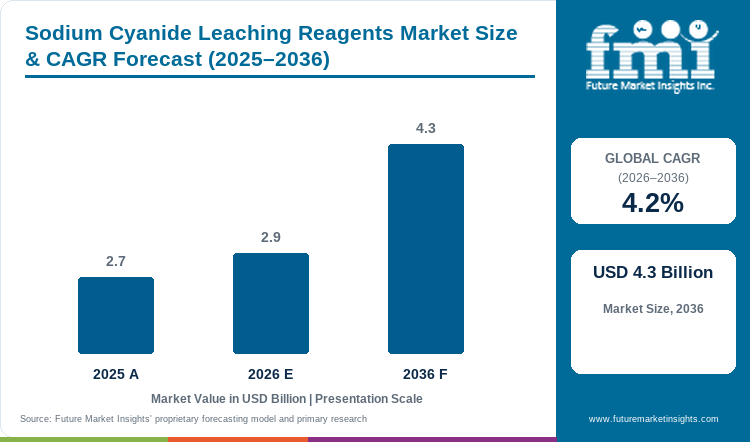
- USD 2.9 Bn
- Forecast (2036)
- USD 4.3 Bn
- CAGR (2026 to 2036)
- 4.2%
How big is Sodium Cyanide Leaching Reagents Market in 2026?
USD 2.9 billion in 2026 and USD 4.3 billion by 2036 at a 4.2% CAGR.
Sales of sodium cyanide leaching reagents are projected to rise from USD 2.9 billion in 2026 to USD 4.3 billion by 2036 at a 4.2% CAGR. The market was valued at USD 2.7 billion in 2025. Operating gold leach plants consume reagent throughout ore treatment and therefore require repeat deliveries. Orica reported in May 2026 that sodium cyanide demand remained strong within a strong gold sector. Mine contracts therefore place delivered continuity beside reagent price and handling support during commercial evaluations.
Mine supply routes differ because imported sodium cyanide must clear national hazardous-material controls before inland delivery. A September 2025 SEMARNAT permit authorized Covoro Mining Solutions Mexicana to import 9.5 million kilograms of sodium cyanide from the United States. That extra stage can extend replenishment lead times when mines depend on imported reagent.
Key Takeaways
- Operating gold and silver leach circuits replenish sodium cyanide as treated ore converts processing hours into repeat reagent orders.
- By grade, solid briquettes are estimated to hold 42.0% in 2026 owing to dry transport economics before controlled dissolution.
- In 2026, CIL/CIP gold leaching is expected to lead application demand with 39.0% share because continuous tank circuits require routine dosing.
- By packaging, ISO tanks are forecast to represent 35.0% in 2026 driven by enclosed bulk transfer during mine replenishment.
- Transport certification and mine-site storage requirements slow switching because every replacement route must fit approved hazardous-material procedures.
- Some of the key players in this market include Orica, Cyanco (an Orica company), Australian Gold Reagents, Draslovka, Sasol, TaeKwang Industrial, CyPlus GmbH (Röhm Group), Tongsuh Petrochemical, Anhui Anqing Shuguang Chemical, and Hebei Chengxin.
Analyst Perspective
"Mine operators compare sodium cyanide contracts on delivered continuity because a missed reagent shipment can stop an active leach circuit. Production backup and qualified route coverage protect operating hours that reagent price alone cannot secure."
- Nikhil Kaitwade, Principal Consultant, Future Market Insights
How is the sodium cyanide leaching reagents market segmented?
The market is segmented by grade, application, packaging, end use and sales channel.
The sodium cyanide leaching reagents market is segmented by grade, application, packaging, end use and sales channel. Grade covers solid briquettes, liquid sodium cyanide, high-purity mining grade and low-dust briquettes. Applications cover CIL/CIP gold leaching, heap leaching, vat leaching, elution support and silver leaching. Packaging includes ISO tanks, intermediate bulk containers, drums and bulk briquette containers. End use covers gold mines, silver mines, toll leaching plants and reagent distributors. Sales channels include direct mine contracts, distributor supply, long-term reagent contracts and regional depots.
What makes solid briquettes central to the grade category?
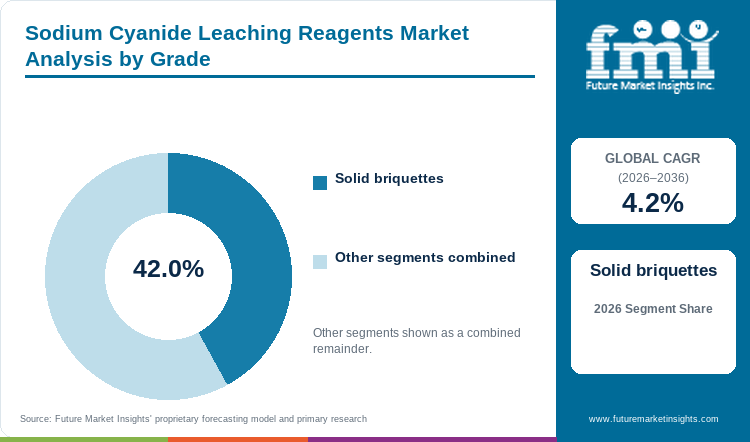
Solid briquettes suit mines that haul reagent over long routes before controlled on-site dissolution at remote mines. The format reduces shipped water and fits mineral processing equipment used beside large leach circuits.
- By grade, solid briquettes are estimated to hold 42.0% in 2026 owing to high active-content transport economics and controlled on-site dissolution.
- ICMI recertified Australian Gold Reagents’ Australian Supply Chain in April 2026 after an independent transport audit. The certified route moves sodium cyanide from Kwinana by rail and road to mine sites and Fremantle Port.
Why does CIL/CIP gold leaching anchor the application category?
CIL and CIP circuits dose sodium cyanide inside agitated tanks during continuous ore treatment at commercial scale. Regular throughput ties repeated purchasing of beneficiation reagents directly to each leach circuit's operating schedule.
- CIL/CIP gold leaching is projected to account for 39.0% of application demand in 2026, driven by routine dosing inside established recovery circuits.
- Nevada regulators documented in 2025 that Jerritt Canyon routes liquid cyanide storage into CIL Tank No. 1 under containment and process-water controls.
How do ISO tanks support the packaging category?
ISO tanks reduce manual transfer during bulk replenishment at mines with dedicated unloading and solution-making systems. Standardized ISO tank container formats also fit hazardous chemical transport into controlled receiving infrastructure at mines.
- ISO tanks are forecast to represent 35.0% of packaging demand in 2026, attributable to enclosed bulk movement and controlled unloading at high-consumption sites.
- A 2025 ICMI audit of Wharf Mine documents ISO tank delivery of sodium cyanide briquettes into a closed dissolution and mine-site transfer arrangement.
What supports gold mines within the end use category?
Gold mines consume sodium cyanide in leach circuits and control storage, process use and emergency response. Mining flotation chemicals serve different recovery steps but require similarly disciplined mine-site handling during routine use.
- The end use category is forecast to be led by gold mines at 72.0% share in 2026 due to repeated cyanide dosing during precious-metal ore processing.
- Gold Fields’ 2026 Salares Norte audit documents a contracted Draslovka sodium cyanide chain with certified warehousing and transport into the operating mine.
What drives direct mine contracts within the sales channel category?
Direct contracts align volume planning with reagent consumption and assign route responsibility to one producer. Chemical logistics becomes more important where mine contracts require certified carriers and defined terminal control.
- Direct mine contracts are set to lead the sales channel category with 52.0% share in 2026, supported by volume assurance and direct accountability.
- A 2025 Canadian Malartic audit records a Cyanco contract requiring Cyanide Code compliance and certified transporters, placing qualification requirements inside the supply agreement.
What are the drivers, restraints and opportunities in the Sodium Cyanide Leaching Reagents Market?
Gold-mine throughput expands repeat reagent use, transport qualification raises switching costs and certified regional handling capacity can shorten replenishment routes to remote operations.
- Driver: Sustained ore treatment increases sodium cyanide consumption because operating leach circuits require repeated dosing during processing.
- Restraint: Certified transport and storage obligations slow route changes because mines must preserve documented hazardous-material controls.
- Opportunity: Regional terminals and certified multimodal routes can shorten delivery distance without breaking existing mine qualification requirements.
Operating leach circuits turn ore treatment directly into repeat sodium cyanide purchasing because leaching circuit chemistry is consumed during each processing campaign. An ICMI audit dated March 2025 records Yanacocha's Orica purchase-and-transport agreement through December 2026 and confirms review of purchase orders and receipts. Active mines therefore reorder as processing continues, linking leach-circuit schedules to reagent consumption more directly than broad national gold-output statistics.
Transport qualification restricts switching because a mine cannot treat a new route as interchangeable with an approved hazardous-material chain. ICMI recertified Africa Global Logistics’ Ghana transport operation in January 2026 after an independent audit against its Transportation Verification Protocol. A replacement route therefore needs documented operating and emergency procedures before it can support regular cyanide deliveries.
Regional handling capacity shortens replenishment distance without changing the reagent chemistry already used at mine sites. ICMI recertified Orica’s North America rail and truck supply chain in September 2026 with rail and interim storage components in the United States and Canada. Certified cross-border trucking into Mexico gives contracted remote mines a documented route beyond one domestic production site during regular mine operating cycles.
Which country CAGRs are profiled in the Sodium Cyanide Leaching Reagents Market?
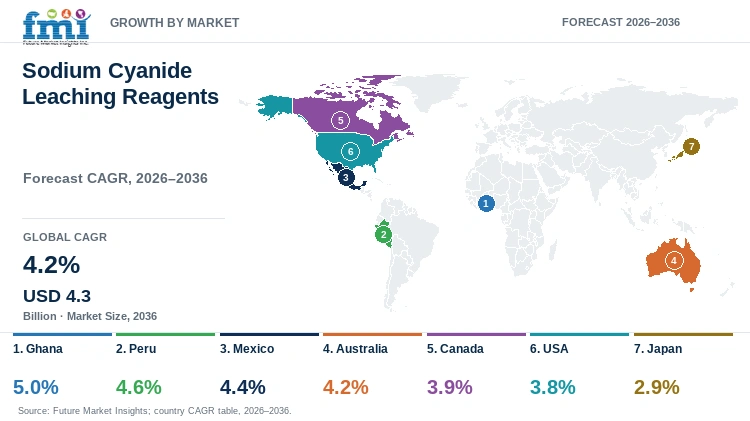
| Country | CAGR |
|---|---|
| Ghana | 5.0% |
| Peru | 4.6% |
| Mexico | 4.4% |
| Australia | 4.2% |
| Canada | 3.9% |
| USA | 3.8% |
| Japan | 2.9% |
How do country-level CAGRs compare in the Sodium Cyanide Leaching Reagents Market?
The 2.1-point spread places Ghana and Peru above a middle group led by Mexico and Australia. Canada and the United States follow closely, while Japan forms the lower end of the profiled range. The spacing reflects mine concentration, delivery distance and domestic supply access instead of current market size alone.
- Ghana's upper CAGR pairs an active gold sector with higher delivery exposure outside coastal terminals.
- Peru's position reflects active Andean mine demand where long routes raise working inventory needs.
- Mexico follows closely as dispersed gold districts require several regional stock points and service routes.
- Australia's domestic production base offsets freight exposure created by remote gold-mine locations and long inland delivery routes.
- Canada's winter logistics and mine geography keep regional inventory important despite steady processing demand.
- United States mine demand concentrates in western operations served by domestic production and Nevada infrastructure.
- Japan's narrower mine account base limits reagent scale despite specialist handling and qualified distribution.
Comparable CAGRs produce different contract economics because mine concentration and delivery distance change inventory requirements. The full report provides country-level CAGR analysis across North America, Latin America, Western Europe, Eastern Europe, East Asia, South Asia and Pacific, and Middle East and Africa.
Country-wise Analysis
- Ghanaian gold mines remain exposed to imported sodium cyanide and long inland transport from coastal entry points. Ghana's sodium cyanide leaching reagents demand is projected to grow at 5.0% CAGR through 2036 as operating mines sustain repeat reagent use. The 24-Hour Economy Authority said in June 2026 that Ghana was pursuing a domestic sodium cyanide complex to reduce import dependence and meet national consumption. A local plant would shorten the route for precious-metal beneficiation reagents if the project secures final investment and regulatory approval. Until final approvals arrive qualified carriers and buffer stock remain important for inland mine replenishment.
- Peruvian sodium cyanide deliveries cross long Andean routes under a national control system for mining chemical inputs. SUNAT’s July 2026 rules require controlled-input users to record transactions and report losses or spills through the national registry. Sodium cyanide leaching reagent sales in Peru are forecast to expand at 4.6% CAGR by 2036 as formal mine supply remains tied to documented distribution channels. High-altitude routes increase buffer-stock needs where alternate hazardous-material deliveries remain limited during seasonal disruptions. Mine inventories therefore protect leach schedules during road disruptions without changing the chemistry used at operating plants.
- Mexican sodium cyanide imports pass through federal toxic-material authorization before distributors move reagent to mine accounts. Mexico is projected to expand at 4.4% CAGR during the assessment period as dispersed gold operations sustain repeat mine deliveries. A May 2025 SEMARNAT authorization allowed Orion Productos Industriales to import 10 million kilograms of sodium cyanide for mining. The permit shows how one large shipment enters the federal control route used for hazardous imports. Regional stock points can shorten final delivery distance but importers still carry permitting and emergency-response obligations.
- Australian gold mines operate across long inland routes that make delivery planning part of reagent contracts. DCCEEW’s May 2026 national cyanide profile lists sodium cyanide among salts used to extract gold and silver from ore. Demand is estimated to expand at 4.2% CAGR through 2036 as active leach plants continue routine dosing. ISO container systems support controlled bulk transfer on remote supply corridors serving inland gold mines. Mine sites still need route redundancy and buffer stock because a delayed hazardous-material shipment can interrupt scheduled replenishment.
- Canadian mines operate across long distances where winter conditions and regional storage affect sodium cyanide replenishment. Canada's sodium cyanide leaching reagents outlook is anticipated to advance at 3.9% CAGR over the assessment period. Environment and Climate Change Canada reported in May 2026 that sodium cyanide represents more imported volume than other cyanides and is used mainly for mining. Regional stocks keep flotation reagents and leach chemicals available when winter transport lengthens delivery lead times. Qualified carriers and nearby inventory become more important before scheduled processing campaigns at remote sites.
- United States mine demand concentrates in western operations where federal hazardous-material rules govern sodium cyanide packaging and transport. The current federal hazardous materials table lists solid sodium cyanide as UN1689 and sodium cyanide solution as UN3414 under Division 6.1 controls. Demand for sodium cyanide leaching reagents in the USA is forecast to rise at 3.8% CAGR over the forecast period. Domestic mine service therefore depends on qualified transfers for sodium cyanide beside other consumables such as mining lubricants. Producers with established transfer points can respond faster when continuous operations require unscheduled replenishment.
- Japan has a narrow mine-scale gold processing base and therefore supports more selective sodium cyanide distribution than larger mining countries. In Japan sodium cyanide leaching reagent demand is predicted to advance at 2.9% CAGR through 2036. NITE’s April 2026 J-CHECK record lists 3,606 tons of sodium cyanide manufactured or imported during fiscal 2024. The smaller exact-product base favors targeted distribution instead of a wide national mine-service network. Qualified industrial users still need controlled handling because sodium cyanide remains subject to national chemical risk assessment.
Who are the notable companies in the Sodium Cyanide Leaching Reagents Market?
Orica, Cyanco (an Orica company), Australian Gold Reagents, Draslovka, Sasol, TaeKwang Industrial, CyPlus GmbH (Röhm Group), Tongsuh Petrochemical, Anhui Anqing Shuguang Chemical, and Hebei Chengxin are notable companies serving this market.
Competition depends on certified sodium cyanide production and qualified transport into remote mines, with Orica owning Cyanco and CyPlus GmbH operating within Röhm Group.
- Orica and Cyanco pair production with mine-supply logistics alongside Australian Gold Reagents and Draslovka.
- Sasol and TaeKwang Industrial serve regional demand through certified production bases and export logistics for mining customers.
- CyPlus GmbH and Tongsuh Petrochemical join Anhui Anqing Shuguang Chemical and Hebei Chengxin in certified regional production.
Competitive Benchmarking: Sodium Cyanide Leaching Reagents Market
| Company | Mining NaCN Production | Certified Logistics Coverage | 2026 Market Activity | Geographic Reach |
|---|---|---|---|---|
| Orica | High | High | High | Global mining regions |
| Cyanco (an Orica company) | High | High | Medium | North America |
| Australian Gold Reagents | High | High | High | Australia and export markets |
| Draslovka | High | High | Medium | North America, Latin America and Europe |
| Sasol | High | Medium | Medium | Southern Africa and export markets |
| TaeKwang Industrial | Medium | Low | Medium | South Korea and export markets |
| CyPlus GmbH (Röhm Group) | High | High | High | Europe and Mexico |
| Tongsuh Petrochemical | High | Medium | High | South Korea and export markets |
| Anhui Anqing Shuguang Chemical | High | Medium | Medium | China and export markets |
| Hebei Chengxin | High | Medium | High | China and export markets |
Production scores High for current certified sodium cyanide output and Medium for active output supported by an older certification cycle. Logistics scores High for several certified route components and Medium for one certified route. A Low logistics score denotes plant-focused dispatch without broader certified route coverage beyond the production site. Recent activity scores High for two qualifying 2026 actions and Medium for one qualifying 2026 action.
Key Developments in the Sodium Cyanide Leaching Reagents Market
- In March 2026, Orica reported that upgrades at its Winnemucca sodium cyanide solids plant had been completed and the site was operating reliably.
- In April 2026, Tongsuh Petrochemical’s sodium cyanide production plant achieved its seventh Cyanide Code certification after an independent compliance audit.
- In July 2026, Hebei Chengxin Transport Co. achieved its fifth Cyanide Code certification for road transport of cyanide within China.
Key Players in the Sodium Cyanide Leaching Reagents Market
Integrated production and multi-region logistics
- Orica
- Cyanco (an Orica company)
- Australian Gold Reagents
- Draslovka
Certified regional producers
- Sasol
- TaeKwang Industrial
- Tongsuh Petrochemical
European and China-based cyanide producers
- CyPlus GmbH (Röhm Group)
- Anhui Anqing Shuguang Chemical
- Hebei Chengxin
Sodium Cyanide Leaching Reagents Market - Report Scope
| Coverage field | Report scope |
|---|---|
| Market breakdown | By grade, application, packaging, end use, sales channel and region. |
| Quantitative Units | USD billion. |
| Market Definition | Commercial sodium cyanide sold for precious-metal leaching within the stated grade, application, packaging, end-use and sales-channel boundary. |
| Regions Covered | North America, Latin America, Western Europe, Eastern Europe, East Asia, South Asia and Pacific, and Middle East and Africa. |
| Countries Covered | Ghana, Peru, Mexico, Australia, Canada, USA, Japan, and 20+ countries included in the full report. |
| Key Companies Profiled | Orica, Cyanco (an Orica company), Australian Gold Reagents, Draslovka, Sasol, TaeKwang Industrial, CyPlus GmbH (Röhm Group), Tongsuh Petrochemical, Anhui Anqing Shuguang Chemical, and Hebei Chengxin. |
| Forecast Period | 2026 to 2036. |
| Approach | Primary and secondary research with market triangulation. |
Sodium Cyanide Leaching Reagents Market - Research Methodology
| Method | Approach |
|---|---|
| Primary Research | FMI analysts gathered input from manufacturers, service providers, technology developers, distributors, end users, procurement teams, and subject-matter experts. Interviews examined purchasing decisions, product or service evaluation, adoption barriers, approval requirements, pricing considerations, and expectations for technical or commercial support. Respondents were also asked what evidence is required before a trial, pilot, or initial order develops into regular purchasing. |
| Desk Research | Desk research covered government statistics, regulatory publications, trade data, industry associations, technical literature, standards, company filings, product information, and official corporate announcements. Sources were reviewed for relevance, publication date, geographic coverage, and consistency with the defined market scope. Claims relating to performance, applications, approvals, capacity, investment, and commercial activity were retained only when supported by credible public evidence. |
| Market Sizing and Forecasting | The market model combined the baseline value with historical performance, segment structure, pricing and volume indicators, adoption levels, company participation, and country-level demand conditions. Forecast assumptions considered economic activity, investment trends, regulatory developments, technology adoption, purchasing cycles, supply availability, and barriers to wider market use. Segment and regional estimates were reconciled before the final market total was calculated. |
| Data Validation | Estimates were checked against multiple independent indicators, including public data, company activity, trade patterns, industry developments, and findings from primary interviews. Validation also tested whether products, services, applications, and company revenues fell within the defined market boundaries. Adjacent categories, unsupported claims, overlapping revenues, and activities without direct market relevance were excluded to reduce double counting and maintain consistency across segments and countries. |
Sodium Cyanide Leaching Reagents Market by Segments
Sodium Cyanide Leaching Reagents Market segmented by Grade:
- Solid briquettes
- Liquid sodium cyanide
- High-purity mining grade
- Low-dust briquettes
Sodium Cyanide Leaching Reagents Market segmented by Application:
- CIL/CIP gold leaching
- Heap leaching
- Vat leaching
- Elution support
- Silver leaching
Sodium Cyanide Leaching Reagents Market segmented by Packaging:
- ISO tanks
- Intermediate bulk containers
- Drums
- Bulk briquette containers
Sodium Cyanide Leaching Reagents Market segmented by End Use:
- Gold mines
- Silver mines
- Toll leaching plants
- Reagent distributors
Sodium Cyanide Leaching Reagents Market segmented by Sales Channel:
- Direct mine contracts
- Distributor supply
- Long-term reagent contracts
- Regional depots
Sodium Cyanide Leaching Reagents Market by Region:
- North America
- United States
- Canada
- Latin America
- Brazil
- Mexico
- Argentina
- Chile
- Western Europe
- Germany
- France
- United Kingdom
- Italy
- Spain
- Benelux
- Nordics
- Eastern Europe
- Poland
- Czech Republic
- Romania
- Hungary
- East Asia
- China
- Japan
- South Korea
- South Asia and Pacific
- India
- ASEAN
- Australia and New Zealand
- Middle East and Africa
- GCC Countries
- South Africa
- Türkiye
- Israel
Research Sources and Bibliography
- Orica. (2026, May 7). Record performance and strategic acquisitions in the half.
- Secretaría de Medio Ambiente y Recursos Naturales. (2025, September 15). Autorización para importación de sustancias y materiales tóxicos o peligrosos, folio 0502300400120255093003213.
- International Cyanide Management Institute. (2026, July 7). Hebei Chengxin Transport Co. achieves fifth certification under the International Cyanide Management Code.
- Nevada Division of Environmental Protection. (2025). Jerritt Canyon Mine: Renewal 2025 fact sheet, Revision 00.
- International Cyanide Management Institute. (2025, February 24). Wharf Mine ICMC recertification summary audit report.
- International Cyanide Management Institute. (2026, April 16). Gold Fields - Salares Norte summary audit report.
- International Cyanide Management Institute. (2025). Agnico Eagle Mines - Canadian Malartic Mine ICMC recertification summary audit report.
- International Cyanide Management Institute. (2025, March 14). Yanacocha Mine summary audit report.
- International Cyanide Management Institute. (2026, January 27). Africa Global Logistics’ Ghana transport operation recertified under the International Cyanide Management Code.
- International Cyanide Management Institute. (2026, September 4). Orica’s North America Rail & Truck Supply Chain achieves fifth certification under the International Cyanide Management Code.
- 24-Hour Economy and Accelerated Export Development Authority. (2026, June 29). 24-Hour Economy Authority and Petrochemical Holdings GmbH Partner to Establish Two Strategic Industrial Projects in Ghana.
- Superintendencia Nacional de Aduanas y de Administración Tributaria. (2026, July 20). Resolución de Superintendencia N.º 000135-2026/SUNAT.
- Secretaría de Medio Ambiente y Recursos Naturales. (2025, May 26). Autorización para la importación de sustancias y materiales tóxicos o peligrosos, folio 0502300400120255093001687.
- Department of Climate Change, Energy, the Environment and Water. (2026, May 26). Cyanide (inorganic) compounds.
- Environment and Climate Change Canada. (2026, May 8). Cyanides guidance for reporting to the National Pollutant Release Inventory.
- Office of the Federal Register. (2026, August 6). 49 CFR § 172.101: Purpose and use of the hazardous materials table.
- National Institute of Technology and Evaluation. (2026, April 1). J-CHECK: Sodium cyanide.
- Orica. (2026, March 10). First half business update.
- Draslovka. (2026, March 11). Draslovka to supply sodium cyanide to Barrick Mining’s Nevada Gold Mines.
- International Cyanide Management Institute. (2026, April 8). Tongsuh Petrochemical Corp., Ltd.’s sodium cyanide production plant achieves seventh certification under the International Cyanide Management Code.
- International Cyanide Management Institute. (2026, March 2). Orica's Winnemucca cyanide production plant achieves seventh certification under International Cyanide Management Code.
- Sasol Limited. (2026, September 1). Annual report on Form 20-F for the fiscal year ended June 30, 2026.
- International Cyanide Management Institute. (2026, September 4). Orica’s Global Ocean Supply Chain achieves fifth certification under the International Cyanide Management Code.
- International Cyanide Management Institute. (2026, September 8). CyPlus Idesa achieves fifth certification under the International Cyanide Management Code.
- International Cyanide Management Institute. (2026, April 23). Australian Gold Reagents’ Australian Supply Chain achieves seventh certification under the International Cyanide Management Code.
- International Cyanide Management Institute. (2026, May 27). Orica’s Houston cyanide production plant achieves fifth certification under the International Cyanide Management Code.
- International Cyanide Management Institute. (2026, January 21). CyPlus Idesa’s transloading terminal and warehouse facility and Mexican Supply Chain certified under the International Cyanide Management Code.
- International Cyanide Management Institute. (2026, July 17). AGR Ocean Freight Supply Chain.
- International Cyanide Management Institute. (2025, October 24). Draslovka Holdings signatory operations: Draslovka Chile Warehouse.
- International Cyanide Management Institute. (2025, April 22). Sasolburg Operations production plants 1 & 2.
- TaeKwang Industrial Co., Ltd. (2026, March 23). 2025 business report.
- International Cyanide Management Institute. (2025, January 23). CyPlus GmbH’s Wesseling cyanide production plant achieves seventh certification under the International Cyanide Management Code.
- Tongsuh Petrochemical Corporation. (2026, April 29). Certifications.
- International Cyanide Management Institute. (2026, August 24). Anhui Anqing Shuguang Chemical Co., Ltd. achieves sixth certification under the International Cyanide Management Code.
- International Cyanide Management Institute. (2026, July 7). Hebei Chengxin Production Co. achieves fifth certification under the International Cyanide Management Code.
- Röhm GmbH. (2026). ESG Report 2024.
- International Cyanide Management Institute. (2026, August 24). Anqing Shuguang Supply, Sales and Transportation Co., Ltd. achieves fifth certification under the International Cyanide Management Code.
This bibliography is provided for reader reference and is not exhaustive. The full report contains the complete reference list and detailed citations
This Report Answers
- How does treated ore volume affect repeat sodium cyanide purchasing?
- Why do solid briquettes hold 42.0% of grade demand in 2026?
- How do CIL/CIP circuits affect sodium cyanide dosing requirements?
- Why do ISO tanks hold 35.0% of packaging demand in 2026?
- How do transport and storage controls affect supplier switching?
- Why do Ghana, Peru and Mexico form the upper growth group?
- Which companies pair sodium cyanide production with certified logistics?
- What should mine operators compare beyond sodium cyanide reagent price?
Frequently Asked Questions
How big is the sodium cyanide leaching reagents market in 2026?
The sodium cyanide leaching reagents market is valued at USD 2.9 billion in 2026 and is projected to reach USD 4.3 billion by 2036. Active leach circuits require repeat sodium cyanide dosing as treated ore moves through recovery stages.
What is the CAGR of the sodium cyanide leaching reagents market from 2026 to 2036?
The sodium cyanide leaching reagents market is projected to grow at a CAGR of 4.2% between 2026 and 2036. Expansion depends on sustained leach-plant throughput and qualified supply routes that replenish hazardous reagent safely.
Which grade leads the sodium cyanide leaching reagents market?
The solid briquettes segment is expected to hold 42.0% of the sodium cyanide leaching reagents market in 2026, attributable to efficient dry transport. Mine operators use dry briquettes for high active content and controlled dissolution inside receiving systems.
Which application holds the stated current share in the sodium cyanide leaching reagents market?
The CIL/CIP gold leaching segment is expected to hold 39.0% of the sodium cyanide leaching reagents market in 2026, driven by routine tank dosing. Operating circuits require regular sodium cyanide replenishment during continuous tank leaching and carbon recovery.
Which companies are active in the sodium cyanide leaching reagents market?
Key companies operating in the market include Orica, Cyanco (an Orica company), Australian Gold Reagents, Draslovka, Sasol, TaeKwang Industrial, CyPlus GmbH (Röhm Group), Tongsuh Petrochemical, Anhui Anqing Shuguang Chemical and Hebei Chengxin. They compete on certified production, logistics coverage and technical support for safe sodium cyanide handling.
Preview the report firsthand - request a free sample
Get SampleGet the brochure for pricing and purchase details.
Get PDFTable of Content
- Key Takeaways
- Market Size and CAGR
- Top Growth Driver
- Fastest Growing Segment
- Leading Region
- Key Companies
- Emerging Opportunities
- Executive Summary
- Global Market Outlook
- Demand-side Trends
- Supply-side Trends
- Technology Roadmap Analysis
- Analysis and Recommendations
- Analyst Perspective (What is happening? Why now? What should investors know?)
- Key Questions Answered
- How large is the market?
- What is the CAGR?
- What are key trends?
- Which region dominates?
- Who are the leaders?
- Market Overview
- Market Coverage / Taxonomy
- Market Definition / Scope / Limitations
- Research Methodology
- Chapter Orientation
- Analytical Lens and Working Hypotheses
- Market Structure, Signals, and Trend Drivers
- Benchmarking and Cross-market Comparability
- Market Sizing, Forecasting, and Opportunity Mapping
- Research Design and Evidence Framework
- Desk Research Programme (Secondary Evidence)
- Expert Input and Fieldwork (Primary Evidence)
- Tooling, Models, and Reference Databases
- Data Engineering and Model Build
- Quality Assurance and Audit Trail
- Market Background
- Market Dynamics (Drivers, Restraints, Opportunity, Trends)
- Scenario Forecast (Optimistic, Likely, Conservative)
- Impact Analysis
- AI Impact
- Sustainability Impact
- Regulatory Impact
- Technology Impact
- Consumer / Buyer Analysis
- Purchase Drivers
- Adoption Barriers
- Buyer Journey
- Opportunity Map Analysis
- Product Life Cycle Analysis
- Supply Chain Analysis
- Investment Feasibility Matrix
- Value Chain Analysis
- PESTLE and Porter's Analysis
- Regulatory Landscape
- Regional Parent Market Outlook
- Production and Consumption Statistics
- Import and Export Statistics
- Global Market Analysis and Forecast, 2021 to 2036
- Historical Market Size Value (USD Billion) Analysis, 2021 to 2025
- Current and Future Market Size Value (USD Billion) Projections, 2026 to 2036
- Y-o-Y Growth Trend Analysis
- Absolute $ Opportunity Analysis
- Global Market Pricing Analysis, 2021 to 2036
- Global Market Analysis and Forecast, By Grade, 2021 to 2036
- Introduction / Key Findings
- Historical Market Size Value (USD Billion) Analysis By Grade, 2021 to 2025
- Current and Future Market Size Value (USD Billion) Analysis and Forecast By Grade, 2026 to 2036
- Solid briquettes
- Liquid sodium cyanide
- High-purity mining grade
- Low-dust briquettes
- Y-o-Y Growth Trend Analysis By Grade, 2021 to 2025
- Absolute $ Opportunity Analysis By Grade, 2026 to 2036
- Global Market Analysis and Forecast, By Application, 2021 to 2036
- Introduction / Key Findings
- Historical Market Size Value (USD Billion) Analysis By Application, 2021 to 2025
- Current and Future Market Size Value (USD Billion) Analysis and Forecast By Application, 2026 to 2036
- CIL/CIP gold leaching
- Heap leaching
- Vat leaching
- Elution support
- Silver leaching
- Y-o-Y Growth Trend Analysis By Application, 2021 to 2025
- Absolute $ Opportunity Analysis By Application, 2026 to 2036
- Global Market Analysis and Forecast, By Packaging, 2021 to 2036
- Introduction / Key Findings
- Historical Market Size Value (USD Billion) Analysis By Packaging, 2021 to 2025
- Current and Future Market Size Value (USD Billion) Analysis and Forecast By Packaging, 2026 to 2036
- ISO tanks
- Intermediate bulk containers
- Drums
- Bulk briquette containers
- Y-o-Y Growth Trend Analysis By Packaging, 2021 to 2025
- Absolute $ Opportunity Analysis By Packaging, 2026 to 2036
- Global Market Analysis and Forecast, By End Use, 2021 to 2036
- Introduction / Key Findings
- Historical Market Size Value (USD Billion) Analysis By End Use, 2021 to 2025
- Current and Future Market Size Value (USD Billion) Analysis and Forecast By End Use, 2026 to 2036
- Gold mines
- Silver mines
- Toll leaching plants
- Reagent distributors
- Y-o-Y Growth Trend Analysis By End Use, 2021 to 2025
- Absolute $ Opportunity Analysis By End Use, 2026 to 2036
- Global Market Analysis and Forecast, By Sales Channel, 2021 to 2036
- Introduction / Key Findings
- Historical Market Size Value (USD Billion) Analysis By Sales Channel, 2021 to 2025
- Current and Future Market Size Value (USD Billion) Analysis and Forecast By Sales Channel, 2026 to 2036
- Direct mine contracts
- Distributor supply
- Long-term reagent contracts
- Regional depots
- Y-o-Y Growth Trend Analysis By Sales Channel, 2021 to 2025
- Absolute $ Opportunity Analysis By Sales Channel, 2026 to 2036
- Global Market Analysis and Forecast, By Region, 2021 to 2036
- Introduction
- Historical Market Size Value (USD Billion) Analysis By Region, 2021 to 2025
- Current Market Size Value (USD Billion) Analysis and Forecast By Region, 2026 to 2036
- North America
- Latin America
- Western Europe
- Eastern Europe
- East Asia
- South Asia and Pacific
- Middle East and Africa
- Market Attractiveness Analysis By Region
- North America Market Analysis and Forecast, By Country, 2021 to 2036
- Historical Market Size Value (USD Billion) Trend Analysis By Market Taxonomy, 2021 to 2025
- Market Size Value (USD Billion) Forecast By Market Taxonomy, 2026 to 2036
- By Country
- United States
- Canada
- By Grade
- By Application
- By Packaging
- By End Use
- By Sales Channel
- By Country
- Market Attractiveness Analysis
- By Country
- By Grade
- By Application
- By Packaging
- By End Use
- By Sales Channel
- Key Takeaways
- Latin America Market Analysis and Forecast, By Country
- Historical Market Size Value (USD Billion) Trend Analysis By Market Taxonomy, 2021 to 2025
- Market Size Value (USD Billion) Forecast By Market Taxonomy, 2026 to 2036
- By Country
- Brazil
- Mexico
- Argentina
- Chile
- By Grade
- By Application
- By Packaging
- By End Use
- By Sales Channel
- By Country
- Market Attractiveness Analysis
- By Country
- By Grade
- By Application
- By Packaging
- By End Use
- By Sales Channel
- Key Takeaways
- Western Europe Market Analysis and Forecast, By Country
- Historical Market Size Value (USD Billion) Trend Analysis By Market Taxonomy, 2021 to 2025
- Market Size Value (USD Billion) Forecast By Market Taxonomy, 2026 to 2036
- By Country
- Germany
- France
- United Kingdom
- Italy
- Spain
- Benelux
- Nordics
- By Grade
- By Application
- By Packaging
- By End Use
- By Sales Channel
- By Country
- Market Attractiveness Analysis
- By Country
- By Grade
- By Application
- By Packaging
- By End Use
- By Sales Channel
- Key Takeaways
- Eastern Europe Market Analysis and Forecast, By Country
- Historical Market Size Value (USD Billion) Trend Analysis By Market Taxonomy, 2021 to 2025
- Market Size Value (USD Billion) Forecast By Market Taxonomy, 2026 to 2036
- By Country
- Poland
- Czech Republic
- Romania
- Hungary
- By Grade
- By Application
- By Packaging
- By End Use
- By Sales Channel
- By Country
- Market Attractiveness Analysis
- By Country
- By Grade
- By Application
- By Packaging
- By End Use
- By Sales Channel
- Key Takeaways
- East Asia Market Analysis and Forecast, By Country
- Historical Market Size Value (USD Billion) Trend Analysis By Market Taxonomy, 2021 to 2025
- Market Size Value (USD Billion) Forecast By Market Taxonomy, 2026 to 2036
- By Country
- China
- Japan
- South Korea
- By Grade
- By Application
- By Packaging
- By End Use
- By Sales Channel
- By Country
- Market Attractiveness Analysis
- By Country
- By Grade
- By Application
- By Packaging
- By End Use
- By Sales Channel
- Key Takeaways
- South Asia and Pacific Market Analysis and Forecast, By Country
- Historical Market Size Value (USD Billion) Trend Analysis By Market Taxonomy, 2021 to 2025
- Market Size Value (USD Billion) Forecast By Market Taxonomy, 2026 to 2036
- By Country
- India
- ASEAN
- Australia and New Zealand
- By Grade
- By Application
- By Packaging
- By End Use
- By Sales Channel
- By Country
- Market Attractiveness Analysis
- By Country
- By Grade
- By Application
- By Packaging
- By End Use
- By Sales Channel
- Key Takeaways
- Middle East and Africa Market Analysis and Forecast, By Country
- Historical Market Size Value (USD Billion) Trend Analysis By Market Taxonomy, 2021 to 2025
- Market Size Value (USD Billion) Forecast By Market Taxonomy, 2026 to 2036
- By Country
- GCC Countries
- South Africa
- Türkiye
- Israel
- By Grade
- By Application
- By Packaging
- By End Use
- By Sales Channel
- By Country
- Market Attractiveness Analysis
- By Country
- By Grade
- By Application
- By Packaging
- By End Use
- By Sales Channel
- Key Takeaways
- Key Countries Market Analysis
- United States
- Pricing Analysis
- Market Share Analysis, 2025
- By Grade
- By Application
- By Packaging
- By End Use
- By Sales Channel
- Canada
- Pricing Analysis
- Market Share Analysis, 2025
- By Grade
- By Application
- By Packaging
- By End Use
- By Sales Channel
- Mexico
- Pricing Analysis
- Market Share Analysis, 2025
- By Grade
- By Application
- By Packaging
- By End Use
- By Sales Channel
- Brazil
- Pricing Analysis
- Market Share Analysis, 2025
- By Grade
- By Application
- By Packaging
- By End Use
- By Sales Channel
- Chile
- Pricing Analysis
- Market Share Analysis, 2025
- By Grade
- By Application
- By Packaging
- By End Use
- By Sales Channel
- Germany
- Pricing Analysis
- Market Share Analysis, 2025
- By Grade
- By Application
- By Packaging
- By End Use
- By Sales Channel
- United Kingdom
- Pricing Analysis
- Market Share Analysis, 2025
- By Grade
- By Application
- By Packaging
- By End Use
- By Sales Channel
- Italy
- Pricing Analysis
- Market Share Analysis, 2025
- By Grade
- By Application
- By Packaging
- By End Use
- By Sales Channel
- Spain
- Pricing Analysis
- Market Share Analysis, 2025
- By Grade
- By Application
- By Packaging
- By End Use
- By Sales Channel
- France
- Pricing Analysis
- Market Share Analysis, 2025
- By Grade
- By Application
- By Packaging
- By End Use
- By Sales Channel
- India
- Pricing Analysis
- Market Share Analysis, 2025
- By Grade
- By Application
- By Packaging
- By End Use
- By Sales Channel
- ASEAN
- Pricing Analysis
- Market Share Analysis, 2025
- By Grade
- By Application
- By Packaging
- By End Use
- By Sales Channel
- Australia and New Zealand
- Pricing Analysis
- Market Share Analysis, 2025
- By Grade
- By Application
- By Packaging
- By End Use
- By Sales Channel
- China
- Pricing Analysis
- Market Share Analysis, 2025
- By Grade
- By Application
- By Packaging
- By End Use
- By Sales Channel
- Japan
- Pricing Analysis
- Market Share Analysis, 2025
- By Grade
- By Application
- By Packaging
- By End Use
- By Sales Channel
- South Korea
- Pricing Analysis
- Market Share Analysis, 2025
- By Grade
- By Application
- By Packaging
- By End Use
- By Sales Channel
- Poland
- Pricing Analysis
- Market Share Analysis, 2025
- By Grade
- By Application
- By Packaging
- By End Use
- By Sales Channel
- Hungary
- Pricing Analysis
- Market Share Analysis, 2025
- By Grade
- By Application
- By Packaging
- By End Use
- By Sales Channel
- Türkiye
- Pricing Analysis
- Market Share Analysis, 2025
- By Grade
- By Application
- By Packaging
- By End Use
- By Sales Channel
- South Africa
- Pricing Analysis
- Market Share Analysis, 2025
- By Grade
- By Application
- By Packaging
- By End Use
- By Sales Channel
- Ghana
- Pricing Analysis
- Market Share Analysis, 2025
- By Grade
- By Application
- By Packaging
- By End Use
- By Sales Channel
- Peru
- Pricing Analysis
- Market Share Analysis, 2025
- By Grade
- By Application
- By Packaging
- By End Use
- By Sales Channel
- Australia
- Pricing Analysis
- Market Share Analysis, 2025
- By Grade
- By Application
- By Packaging
- By End Use
- By Sales Channel
- United States
- Market Structure Analysis
- Competition Dashboard
- Competition Benchmarking
- Market Share Analysis of Top Players
- By Regional
- By Grade
- By Application
- By Packaging
- By End Use
- By Sales Channel
- Emerging Startups
- Innovation Benchmarking
- Competition Analysis
- Competition Deep Dive
- Orica
- Overview
- Product Portfolio
- Profitability by Market Segments
- Sales Footprint
- Strategy Overview
- Marketing Strategy
- Product Strategy
- Channel Strategy
- Cyanco (an Orica company)
- Australian Gold Reagents
- Draslovka
- Sasol
- TaeKwang Industrial
- CyPlus GmbH (Röhm Group)
- Tongsuh Petrochemical
- Anhui Anqing Shuguang Chemical
- Hebei Chengxin
- Orica
- Case Studies
- Success Stories
- Recent Developments
- Competition Deep Dive
- Assumptions & Acronyms Used


