

- Market Size (2026)
- USD 2.9 Bn
- Forecast (2036)
- USD 5.8 Bn
- CAGR (2026 to 2036)
- 7.4%
How big is Solar Junction Box Market in 2026?
USD 2.9 billion in 2026 and USD 5.8 billion by 2036 at a 7.4% CAGR.
Demand for solar junction boxes is projected to expand at 7.4% CAGR between 2026 and 2036, increasing valuation from USD 2.9 billion in 2026 to USD 5.8 billion by 2036. Commercial demand follows PV module output because every module requires a protected electrical transition from cell strings to external DC cabling, with thermal control and sealing determining long-term field reliability.
Global solar PV module manufacturing provides the recurring volume base for junction-box procurement. IEA PVPS estimated that nearly 3 TW of photovoltaic capacity was installed worldwide by the end of 2025 and that around 698 GW of new PV systems were added during that year. At this scale, component qualification, current handling and automated module-line integration become recurring purchasing requirements rather than occasional design choices.
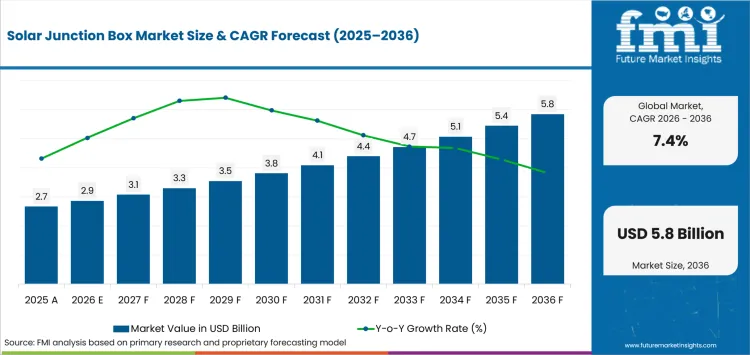
Key Takeaways of Solar Junction Box Market
- PV module production supports recurring junction-box demand as manufacturers qualify sealed electrical interfaces for higher-current modules and automated assembly.
- Standard junction boxes are projected at 31.0% by product type, while the 15-25 A range is estimated at 39.0% by rated current in 2026.
- Schottky diode boxes are forecast at 38.0% by diode type, with monocrystalline modules estimated at 36.0% by module type in 2026.
- PV module OEM supply is projected at 58.0% of sales-channel demand in 2026 because the junction box is integrated during module assembly and qualification.
- Thermal stress, moisture ingress and bypass-diode failure can raise qualification burden if enclosure design or assembly quality is inconsistent.
- TE Connectivity Ltd., Stäubli Electrical Connectors AG, QC Solar, Zhejiang Renhe Photovoltaic Technology Co., Ltd., Shoals Technologies Group, Inc., Amphenol Corporation, DhaSh PV Technologies Ltd. and Raychem RPG (P) Ltd. serve module-junction-box or adjacent PV interconnect requirements.
Analyst Perspective
"A solar junction box is a small module component with a direct role in current transfer and fault protection. Procurement teams should test thermal performance, sealing and diode behavior against the module design before approving a supplier because a low-cost enclosure can become an expensive field failure when current levels or environmental stress move beyond the qualified condition."
- Nikhil Kaitwade, Principal Consultant, Future Market Insights
How is the Solar Junction Box Market segmented?
The solar junction box market is segmented by product type, rated current, diode type, module type, sales channel and region.
Solar junction boxes are segmented by product type, rated current, diode type, module type, sales channel and region across PV module manufacturing and replacement demand. Product type covers standard junction boxes, smart junction boxes, split junction boxes, bifacial module boxes and high-current junction boxes. Rated current ranges from below 15 A through above 35 A. Diode type includes Schottky diode boxes, bypass diode boxes, module-level electronics integrated and diode-free advanced boxes. Module type covers monocrystalline modules, bifacial modules, thin-film modules, utility-scale modules and rooftop modules. Sales channel covers PV module OEM supply, component distributors, EMS / contract assembly and replacement / service.
Why do standard junction boxes lead the product type category?
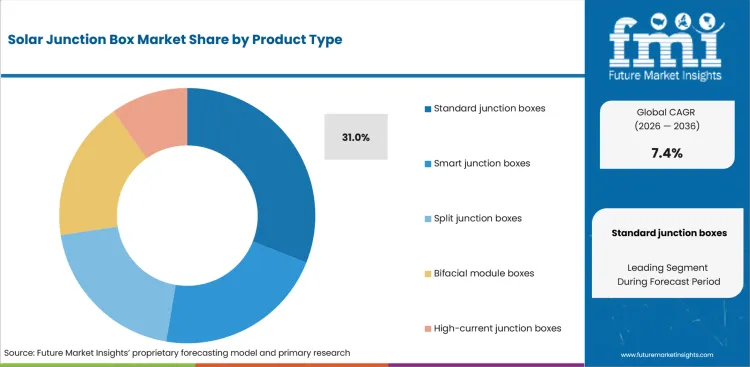
Standard junction boxes fit established crystalline-silicon module designs where manufacturers need a sealed electrical termination and bypass protection without adding module-level electronics. IEC 62790 defines safety requirements and tests for photovoltaic module junction boxes up to 1,500 V DC, creating a common qualification basis for conventional module production.
- Based on product type, standard junction boxes are projected to account for 31.0% in 2026 as module producers continue to use qualified rear-mounted enclosures across mature manufacturing lines.
- Standardized designs can be integrated through soldering, welding or clamping processes while retaining familiar sealing and diode layouts, which lowers redesign work when module electrical architecture remains conventional.
Why does 15-25 A lead the rated current category?
The 15-25 A range aligns with a broad band of current module-junction-box designs used on mainstream crystalline modules. DhaSh PV Technologies lists 15 A, 20 A and 24 A ratings across several 1,500 V DC junction-box models, while Amphenol offers Saguaro configurations around the same operating band for automated module assembly.
- In 2026, 15-25 A is expected to account for 39.0% of rated-current demand because it covers widely deployed module electrical designs without requiring the additional thermal margin associated with higher-current boxes.
- Higher module output is moving some new designs toward 25-35 A and above, but the 15-25 A range retains a broad installed manufacturing base and established qualification history.
Why do Schottky diode boxes lead the diode type category?
Bypass protection is built into many module junction boxes so current can avoid shaded or mismatched cell sections that could otherwise develop hot spots. NREL reliability work has examined field-failed Schottky bypass diodes and shows why diode thermal behavior remains a qualification issue rather than a minor component choice.
- Schottky diode boxes are forecast to account for 38.0% of diode-type demand in 2026 because the architecture is established across conventional module bypass circuits and can be integrated into compact junction-box assemblies.
- As currents rise, suppliers are increasing conductor area, changing diode packages or using module-level diode assemblies to manage temperature while preserving the protective bypass function.
Why do monocrystalline modules lead the module type category?
Monocrystalline silicon modules provide a large, standardized demand base for junction boxes because they are produced at scale across rooftop and ground-mounted PV applications. IEA PVPS published updated life-cycle inventory work for monocrystalline silicon PV in July 2026 using recent factory-level information, reflecting the depth of current crystalline-silicon manufacturing activity.
- The monocrystalline modules segment is estimated to account for 36.0% of module-type demand in 2026 as conventional crystalline module assembly continues to require rear-side junction-box integration.
- Manufacturers can use the same supplier qualification route across conventional and higher-output solar photovoltaic (PV) module families, while bifacial and thin-film formats place different constraints on box geometry, rear-side shading and sealing.
Why does PV module OEM supply lead the sales channel category?
PV module OEM supply places the junction box inside the manufacturing process rather than treating it as a downstream field accessory. Shoals describes its module-attached junction boxes as components developed for solar OEM requirements, while Stäubli assembly instructions define the junction box connection directly at the PV module.
- PV module OEM supply is projected to account for 58.0% of sales-channel demand in 2026 because junction boxes are normally attached, electrically connected and sealed before a finished module leaves the factory.
- Direct OEM relationships also allow suppliers to coordinate cable length, connector choice, diode configuration and automated assembly with the module bill of materials before certification and volume ramp-up.
What are the drivers, restraints and opportunities in the Solar Junction Box Market?
Rising PV module output expands junction-box demand while thermal reliability and sealing requirements raise qualification costs as higher-current and new-format modules create room for redesigned junction-box architectures.
- Driver: Global PV additions increase the number of modules requiring factory-integrated junction boxes and qualified DC interconnects.
- Restraint: Thermal stress, moisture ingress and bypass-diode failure can disrupt module reliability when enclosure design or assembly quality does not match operating conditions.
- Opportunity: Higher-current, bifacial and new-format modules create demand for split boxes, revised diode packages and junction boxes designed for automated assembly.
IEA PVPS estimated around 698 GW of new photovoltaic systems in 2025, taking cumulative global capacity close to 3 TW. Each additional module creates a corresponding need for a qualified rear-side electrical termination, so module production volume transfers directly into junction-box demand across OEM supply chains.
Reliability is constrained by heat and environmental exposure at the module rear. IEC 62790 sets safety tests for photovoltaic junction boxes, while NREL field-failure work on bypass diodes identifies thermal and interface failure mechanisms that can reduce protection under real operating stress. Suppliers therefore face qualification pressure around sealing, conductor temperature and diode durability.
Module designs are also moving toward higher current and more varied rear-side architectures. Suppliers that coordinate junction boxes with connector systems and automated module assembly can support split-box, bifacial and specialized thin-film or perovskite formats without forcing module makers to redesign the complete external DC interface.
Which country CAGRs are profiled in the Solar Junction Box Market?
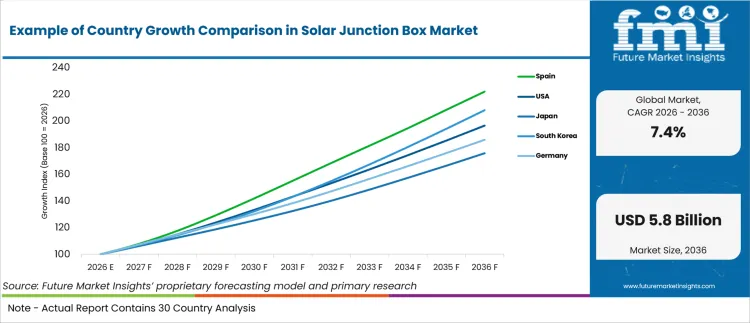
| Country | CAGR |
|---|---|
| Spain | 8.3% |
| USA | 7.0% |
| Japan | 5.8% |
| South Korea | 7.6% |
| Germany | 6.4% |
| Brazil | 7.3% |
| UAE | 7.9% |
How do country-level CAGRs compare in the Solar Junction Box Market?
The seven profiled CAGRs span 2.5 percentage points across markets with different module manufacturing footprints, deployment mixes and procurement structures. These rates describe expected junction-box demand expansion rather than installed PV capacity or present market value in each country.
- Spain is projected to grow at 8.3% CAGR as utility-scale and distributed PV additions sustain recurring module procurement and associated junction-box demand.
- The USA is expected to expand at 7.0% CAGR, supported by continued module additions and regional manufacturing programs that increase demand for certified PV components.
- Japan is forecast to grow at 5.8% CAGR as a mature installed base combines replacement activity with new module demand under space-constrained rooftop and distributed projects.
- South Korea is projected to expand at 7.6% CAGR as domestic PV policy and industrial capability support continued demand for module components across new projects.
- Germany is anticipated to grow at 6.4% CAGR as rooftop and ground-mounted additions sustain a diversified module market with strong component qualification requirements.
- Brazil is forecast to expand at 7.3% CAGR as distributed and utility-scale PV deployment expands module volumes across a large geographic market.
- The UAE is projected to grow at 7.9% CAGR as large solar projects and high-temperature operating conditions increase demand for qualified junction boxes with stable thermal and sealing performance.
Comparable CAGRs can produce different commercial entry conditions. The full report provides country-level CAGR analysis across North America, Latin America, Europe, East Asia, South Asia and Pacific, and the Middle East and Africa.
Country-wise Analysis
- Spain continues to add photovoltaic capacity through a mix of utility projects and distributed systems, creating a recurring route for module and component procurement. IEA PVPS placed Spain among Europe's significant annual installation markets in its 2025 trends report and its 2026 snapshot continued to show substantial additions. The Spanish solar junction box sector is projected to record 8.3% CAGR through 2036, with supplier selection shaped by module-line compatibility and field reliability across hot, high-irradiance operating conditions.
- The USA combines large annual PV additions with domestic manufacturing incentives and project-level certification requirements that influence junction-box sourcing. IEA PVPS estimated 47.1 GW of new photovoltaic capacity in 2024 and continued strong additions in 2025. USA solar junction box demand is projected to expand at 7.0% CAGR through 2036 as module output supports OEM procurement while UL and IEC qualification requirements shape supplier acceptance.
- Japan has a mature PV base in which new installations coexist with long service lives and strict quality expectations for rooftop modules. IEA PVPS estimated that cumulative photovoltaic capacity exceeded 100 GW in 2025, with about 5.7 GW added during the year. Japan's solar junction box market is forecast to advance at 5.8% CAGR through 2036 as module suppliers prioritize compact, reliable components that fit established production and installation practices.
- South Korea is adjusting its renewable-energy policy while maintaining domestic electronics and manufacturing capability relevant to photovoltaic component supply. IEA PVPS notes that the policy framework is being redefined following the 2025 political transition and that a new long-term resource plan is scheduled for 2026. South Korea's solar junction box sector is projected to record 7.6% CAGR through 2036 as component suppliers respond to domestic module demand and changing project pipelines.
- Germany combines rooftop deployment with ground-mounted PV, creating demand across more than one module format and procurement channel. The Federal Network Agency reports that Germany added about 16.4 GW in 2025 and reached approximately 117 GW of installed solar capacity. Germany's solar junction box market is projected to expand at 6.4% CAGR through 2036, with reliability, certification and automated OEM integration influencing supplier decisions.
- Brazil maintains strong distributed PV activity alongside utility-scale projects, which spreads module demand across residential, commercial and large-project channels. IEA PVPS reported 14.3 GW of new capacity in 2024 and identified distributed PV as a strong part of the Brazilian market. Brazil's solar junction box sector is forecast to advance at 7.3% CAGR through 2036 as suppliers serve high-volume module procurement across varied climatic conditions.
- The UAE provides a concentrated utility-scale route for junction-box demand because new solar capacity is built through large projects operating under high ambient temperatures. DEWA reported 3,860 MW of operating capacity at the Mohammed bin Rashid Al Maktoum Solar Park in June 2025, with the seventh phase under development and additional capacity phases continuing to progress. The UAE solar junction box market is projected to grow at 7.9% CAGR through 2036, with thermal control, sealing and high-current capability carrying particular weight in module-component qualification.
Who are the notable companies in the Solar Junction Box Market?
TE Connectivity Ltd., Stäubli Electrical Connectors AG, QC Solar, Zhejiang Renhe Photovoltaic Technology Co., Ltd., Shoals Technologies Group, Inc., Amphenol Corporation, DhaSh PV Technologies Ltd. and Raychem RPG (P) Ltd. are notable companies serving module-junction-box and related PV interconnect requirements.
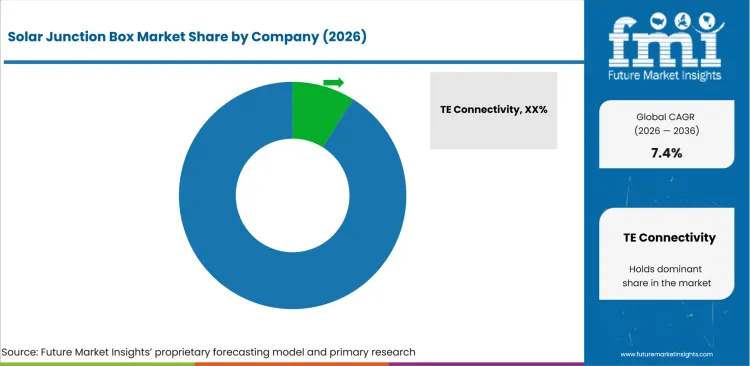
Competition in solar junction boxes spans global interconnect suppliers and specialized PV component manufacturers. Supplier choice depends on module electrical architecture, rated current, sealing method, diode configuration and the ability to support automated OEM assembly. Current product evidence is more useful than broad corporate presence because some electrical suppliers sell system-level combiner boxes without offering the module-attached junction boxes covered here.
- TE Connectivity Ltd., Stäubli Electrical Connectors AG and Amphenol Corporation connect junction-box requirements with broader PV connector and interconnect portfolios.
- QC Solar, Zhejiang Renhe Photovoltaic Technology Co., Ltd. and DhaSh PV Technologies Ltd. focus directly on module-level junction boxes, connectors or related DC components.
- Shoals Technologies Group, Inc. and Raychem RPG (P) Ltd. serve solar OEM or project channels with module junction boxes and complementary electrical products.
Competitive Benchmarking: Solar Junction Box Market
| Company | Module junction-box portfolio | High-current readiness | OEM integration | Geographic Reach |
|---|---|---|---|---|
| TE Connectivity Ltd. | Medium | Medium | High | Global industrial markets |
| Stäubli Electrical Connectors AG | Medium | Medium | High | Global PV markets |
| QC Solar | High | High | High | 60+ countries and regions |
| Zhejiang Renhe Photovoltaic Technology Co., Ltd. | High | Medium | High | China and export module supply |
| Shoals Technologies Group, Inc. | Medium | Medium | High | North America and selected export projects |
| Amphenol Corporation | Medium | Medium | High | Global industrial and solar markets |
| DhaSh PV Technologies Ltd. | High | High | High | India and export markets |
| Raychem RPG (P) Ltd. | Medium | Medium | Medium | India and selected international markets |
Key Developments in the Solar Junction Box Market
- In 2025, Amphenol Industrial Operations introduced the Saguaro Junction Box for solar panel integration, using a three-box modular configuration and diode customization for automated production.
- In December 2024, QC Solar introduced junction-box designs for perovskite modules, including configurations compatible with traditional Schottky diodes from 18 A to 35 A.
- In 2025, Raychem RPG introduced split-type photovoltaic junction boxes rated at 25 A and 30 A at 1,500 V DC, designed for bifacial and half-cut module applications, providing a current commercial example of higher-current split-box designs.
Key Players in the Solar Junction Box Market
Global PV Interconnect Suppliers
- TE Connectivity Ltd.
- Stäubli Electrical Connectors AG
- Amphenol Corporation
PV Junction Box Specialists
- QC Solar
- Zhejiang Renhe Photovoltaic Technology Co., Ltd.
- DhaSh PV Technologies Ltd.
Solar OEM and Electrical Component Suppliers
- Shoals Technologies Group, Inc.
- Raychem RPG (P) Ltd.
Solar Junction Box Market - Report Scope
| Coverage field | Report scope |
|---|---|
| Market breakdown | By product type, rated current, diode type, module type, sales channel and region. |
| Quantitative Units | Revenue in USD billion and CAGR in %. |
| Market Definition | Module-attached photovoltaic junction boxes that provide protected electrical termination, bypass-diode housing and cable or connector interfaces for solar PV modules. |
| Regions Covered | North America, Latin America, Europe, East Asia, South Asia and Pacific, and Middle East and Africa. |
| Countries Covered | Spain, USA, Japan, South Korea, Germany, Brazil, UAE, and 20+ countries included in the full report. |
| Key Companies Profiled | TE Connectivity Ltd., Stäubli Electrical Connectors AG, QC Solar, Zhejiang Renhe Photovoltaic Technology Co., Ltd., Shoals Technologies Group, Inc., Amphenol Corporation, DhaSh PV Technologies Ltd., Raychem RPG (P) Ltd. |
| Forecast Period | 2026 to 2036. |
| Approach | Primary and secondary research with market triangulation. |
Solar Junction Box Market - Research Methodology
| Method | Approach |
|---|---|
| Primary Research | FMI analysts gathered input from module manufacturers, junction-box suppliers, connector producers, distributors, project developers, procurement teams and subject-matter experts. Interviews examined supplier qualification, current-rating requirements, sealing choices, diode configurations, automated assembly, pricing considerations and evidence required before a component moves from testing into recurring production. |
| Desk Research | Desk research covered government and intergovernmental PV statistics, standards publications, technical literature, company filings, product information, certification documents and official corporate announcements. Sources were reviewed for relevance, publication date, geographic coverage and consistency with the defined module-junction-box market scope. |
| Market Sizing and Forecasting | The market model combined the 2026 value with historical PV-module activity, segment structure, component pricing, module production, company participation and country-level demand conditions. Forecast assumptions considered PV additions, module technology shifts, current ratings, certification cycles, manufacturing investment and replacement demand. |
| Data Validation | Estimates were checked against independent indicators including PV deployment, company product activity, component qualification evidence and findings from primary interviews. Validation also tested whether products were attached to photovoltaic modules and excluded system-level combiner boxes or unrelated electrical enclosures from the market boundary. |
Solar Junction Box Market by Segments
Solar Junction Box Market segmented by Product Type:
- Standard junction boxes
- Smart junction boxes
- Split junction boxes
- Bifacial module boxes
- High-current junction boxes
Solar Junction Box Market segmented by Rated Current:
- 15-25 A
- Below 15 A
- 25-35 A
- Above 35 A
Solar Junction Box Market segmented by Diode Type:
- Schottky diode boxes
- Bypass diode boxes
- Module-level electronics integrated
- Diode-free advanced boxes
Solar Junction Box Market segmented by Module Type:
- Monocrystalline modules
- Bifacial modules
- Thin-film modules
- Utility-scale modules
- Rooftop modules
Solar Junction Box Market segmented by Sales Channel:
- PV module OEM supply
- Component distributors
- EMS / contract assembly
- Replacement / service
Solar Junction Box Market by Region:
- North America
- United States
- Canada
- Latin America
- Brazil
- Chile
- Mexico
- Rest of Latin America
- Western Europe
- Germany
- United Kingdom
- Italy
- Spain
- France
- Nordics
- Benelux
- Rest of Western Europe
- Eastern Europe
- Russia
- Poland
- Hungary
- Balkan and Baltic States
- Rest of Eastern Europe
- East Asia
- China
- Japan
- South Korea
- South Asia and Pacific
- India
- ASEAN
- Australia and New Zealand
- Rest of South Asia and Pacific
- Middle East and Africa
- Kingdom of Saudi Arabia
- Other GCC Countries
- Türkiye
- South Africa
- Other African Union Countries
- Rest of Middle East and Africa
Research Sources and Bibliography
- IEA Photovoltaic Power Systems Programme. (2026). Snapshot of Global PV Markets 2026.
- IEA Photovoltaic Power Systems Programme. (2025). Trends in Photovoltaic Applications 2025.
- IEA Photovoltaic Power Systems Programme. (2026, July). Life Cycle Inventories of Photovoltaic Systems.
- IEA Photovoltaic Power Systems Programme. (2026). Germany: 2025 Country Update.
- IEA Photovoltaic Power Systems Programme. (2026). Japan: 2025 Country Update.
- IEA Photovoltaic Power Systems Programme. (2026). Korea: 2025 Country Update.
- International Electrotechnical Commission. (2020). IEC 62790:2020, Junction boxes for photovoltaic modules - Safety requirements and tests.
- International Electrotechnical Commission. (2023). IEC 61730-1:2023, Photovoltaic module safety qualification - Part 1: Requirements for construction.
- National Renewable Energy Laboratory. Failure Analysis of Field-Failed Bypass Diodes.
- Dubai Electricity and Water Authority. (2026, January). 7th Phase of the Mohammed bin Rashid Al Maktoum Solar Park.
- TE Connectivity. (2017, January 25). SOLARLOK PV Bar Junction Box.
- Stäubli Electrical Connectors. (2025). MA263 - TwinBox Junction Box Set.
- QC Solar. (2024, May 16). Cable Free Solar PV Junction Box Released.
- QC Solar. (2024, December 26). Junction Boxes for Perovskite Modules.
- Shoals Technologies Group. Solar Junction Boxes Solutions.
- Amphenol Industrial Operations. (2025). Saguaro Junction Box and H4 PRO Solar Interconnects.
- DhaSh PV Technologies. PV Junction Box Product Range.
- Raychem RPG. Split Type Solar Junction Box.
This bibliography is provided for reader reference and is not exhaustive. The full report contains the complete reference list and detailed citations.
This Report Answers
- How large is the Solar Junction Box Market in 2026 and 2036?
- Which operating conditions support recurring solar junction box demand across PV module manufacturing?
- Which product type segment accounts for the approved 2026 share?
- How does rated current shape junction-box selection across module designs?
- Which diode type supports established bypass-protection architectures?
- Which module type supports recurring junction-box demand?
- Which sales channel accounts for the approved 2026 share?
- How do profiled country growth rates affect commercial entry conditions?
- Which companies serve module-junction-box and related PV interconnect requirements?
Frequently Asked Questions
How big is the Solar Junction Box Market in 2026?
USD 2.9 billion represents the solar junction box market value in 2026 across module-attached PV junction boxes used in commercial solar module production and replacement channels. Demand is projected to reach USD 5.8 billion by 2036 as global module output increases and higher-current designs require qualified electrical terminations.
What is the CAGR of the Solar Junction Box Market from 2026 to 2036?
A 7.4% CAGR is projected for the solar junction box market between 2026 and 2036. Growth reflects continued PV module production, rising component qualification requirements and adoption of higher-current or specialized junction-box architectures across module manufacturers.
Which product type segment is projected to account for 31.0% of the Solar Junction Box Market?
Standard junction boxes are projected to account for 31.0% of product-type demand in 2026. Established module designs support continued use of conventional rear-mounted boxes where manufacturers prioritize familiar qualification, sealing and bypass-protection approaches.
How much will the Solar Junction Box Market add between 2026 and 2036?
USD 3.0 billion is expected to be added to the solar junction box market between 2026 and 2036. The increase is tied to additional PV module output and supplier qualification for current handling, sealing and new module architectures.
Which companies are active in the Solar Junction Box Market?
Eight companies active in the solar junction box market include TE Connectivity Ltd., Stäubli Electrical Connectors AG, QC Solar, Zhejiang Renhe Photovoltaic Technology Co., Ltd., Shoals Technologies Group, Inc., Amphenol Corporation, DhaSh PV Technologies Ltd. and Raychem RPG (P) Ltd. The group covers PV interconnect suppliers, module-junction-box specialists and solar OEM component providers.
Preview the report firsthand - request a free sample
Get SampleGet the brochure for pricing and purchase details.
Get PDFTable of Content
- Key Takeaways
- Market Size and CAGR
- Top Growth Driver
- Fastest Growing Segment
- Leading Region
- Key Companies
- Emerging Opportunities
- Executive Summary
- Global Market Outlook
- Demand-side Trends
- Supply-side Trends
- Technology Roadmap Analysis
- Analysis and Recommendations
- Analyst Perspective (What is happening? Why now? What should investors know?)
- Key Questions Answered
- How large is the market?
- What is the CAGR?
- What are key trends?
- Which region dominates?
- Who are the leaders?
- Market Overview
- Market Coverage / Taxonomy
- Market Definition / Scope / Limitations
- Research Methodology
- Chapter Orientation
- Analytical Lens and Working Hypotheses
- Market Structure, Signals, and Trend Drivers
- Benchmarking and Cross-market Comparability
- Market Sizing, Forecasting, and Opportunity Mapping
- Research Design and Evidence Framework
- Desk Research Programme (Secondary Evidence)
- Expert Input and Fieldwork (Primary Evidence)
- Tooling, Models, and Reference Databases
- Data Engineering and Model Build
- Quality Assurance and Audit Trail
- Market Background
- Market Dynamics (Drivers, Restraints, Opportunity, Trends)
- Scenario Forecast (Optimistic, Likely, Conservative)
- Impact Analysis
- AI Impact
- Sustainability Impact
- Regulatory Impact
- Technology Impact
- Consumer / Buyer Analysis
- Purchase Drivers
- Adoption Barriers
- Buyer Journey
- Opportunity Map Analysis
- Product Life Cycle Analysis
- Supply Chain Analysis
- Investment Feasibility Matrix
- Value Chain Analysis
- PESTLE and Porter's Analysis
- Regulatory Landscape
- Regional Parent Market Outlook
- Production and Consumption Statistics
- Import and Export Statistics
- Global Market Analysis and Forecast, 2021 to 2036
- Historical Market Size Value (USD Billion) Analysis, 2021 to 2025
- Current and Future Market Size Value (USD Billion) Projections, 2026 to 2036
- Y-o-Y Growth Trend Analysis
- Absolute $ Opportunity Analysis
- Global Market Pricing Analysis, 2021 to 2036
- Global Market Analysis and Forecast, By Product Type, 2021 to 2036
- Introduction / Key Findings
- Historical Market Size Value (USD Billion) Analysis By Product Type, 2021 to 2025
- Current and Future Market Size Value (USD Billion) Analysis and Forecast By Product Type, 2026 to 2036
- Standard junction boxes
- Smart junction boxes
- Split junction boxes
- Bifacial module boxes
- High-current junction boxes
- Standard junction boxes
- Y-o-Y Growth Trend Analysis By Product Type, 2021 to 2025
- Absolute $ Opportunity Analysis By Product Type, 2026 to 2036
- Global Market Analysis and Forecast, By Rated Current, 2021 to 2036
- Introduction / Key Findings
- Historical Market Size Value (USD Billion) Analysis By Rated Current, 2021 to 2025
- Current and Future Market Size Value (USD Billion) Analysis and Forecast By Rated Current, 2026 to 2036
- 15-25 A
- Below 15 A
- 25-35 A
- Above 35 A
- 15-25 A
- Y-o-Y Growth Trend Analysis By Rated Current, 2021 to 2025
- Absolute $ Opportunity Analysis By Rated Current, 2026 to 2036
- Global Market Analysis and Forecast, By Diode Type, 2021 to 2036
- Introduction / Key Findings
- Historical Market Size Value (USD Billion) Analysis By Diode Type, 2021 to 2025
- Current and Future Market Size Value (USD Billion) Analysis and Forecast By Diode Type, 2026 to 2036
- Schottky diode boxes
- Bypass diode boxes
- Module-level electronics integrated
- Diode-free advanced boxes
- Schottky diode boxes
- Y-o-Y Growth Trend Analysis By Diode Type, 2021 to 2025
- Absolute $ Opportunity Analysis By Diode Type, 2026 to 2036
- Global Market Analysis and Forecast, By Module Type, 2021 to 2036
- Introduction / Key Findings
- Historical Market Size Value (USD Billion) Analysis By Module Type, 2021 to 2025
- Current and Future Market Size Value (USD Billion) Analysis and Forecast By Module Type, 2026 to 2036
- Monocrystalline modules
- Bifacial modules
- Thin-film modules
- Utility-scale modules
- Rooftop modules
- Monocrystalline modules
- Y-o-Y Growth Trend Analysis By Module Type, 2021 to 2025
- Absolute $ Opportunity Analysis By Module Type, 2026 to 2036
- Global Market Analysis and Forecast, By Sales Channel, 2021 to 2036
- Introduction / Key Findings
- Historical Market Size Value (USD Billion) Analysis By Sales Channel, 2021 to 2025
- Current and Future Market Size Value (USD Billion) Analysis and Forecast By Sales Channel, 2026 to 2036
- PV module OEM supply
- Component distributors
- EMS / contract assembly
- Replacement / service
- PV module OEM supply
- Y-o-Y Growth Trend Analysis By Sales Channel, 2021 to 2025
- Absolute $ Opportunity Analysis By Sales Channel, 2026 to 2036
- Global Market Analysis and Forecast, By Region, 2021 to 2036
- Introduction
- Historical Market Size Value (USD Billion) Analysis By Region, 2021 to 2025
- Current Market Size Value (USD Billion) Analysis and Forecast By Region, 2026 to 2036
- North America
- Latin America
- Western Europe
- Eastern Europe
- East Asia
- South Asia and Pacific
- Middle East & Africa
- Market Attractiveness Analysis By Region
- North America Market Analysis and Forecast, By Country, 2021 to 2036
- Historical Market Size Value (USD Billion) Trend Analysis By Market Taxonomy, 2021 to 2025
- Market Size Value (USD Billion) Forecast By Market Taxonomy, 2026 to 2036
- By Country
- USA
- Canada
- By Product Type
- By Rated Current
- By Diode Type
- By Module Type
- By Sales Channel
- By Country
- Market Attractiveness Analysis
- By Country
- By Product Type
- By Rated Current
- By Diode Type
- By Module Type
- By Sales Channel
- Key Takeaways
- Latin America Market Analysis and Forecast, By Country
- Historical Market Size Value (USD Billion) Trend Analysis By Market Taxonomy, 2021 to 2025
- Market Size Value (USD Billion) Forecast By Market Taxonomy, 2026 to 2036
- By Country
- Brazil
- Mexico
- Chile
- Rest of Latin America
- By Product Type
- By Rated Current
- By Diode Type
- By Module Type
- By Sales Channel
- By Country
- Market Attractiveness Analysis
- By Country
- By Product Type
- By Rated Current
- By Diode Type
- By Module Type
- By Sales Channel
- Key Takeaways
- Western Europe Market Analysis and Forecast, By Country
- Historical Market Size Value (USD Billion) Trend Analysis By Market Taxonomy, 2021 to 2025
- Market Size Value (USD Billion) Forecast By Market Taxonomy, 2026 to 2036
- By Country
- Germany
- UK
- Italy
- Spain
- France
- Nordic
- BENELUX
- Rest of Western Europe
- By Product Type
- By Rated Current
- By Diode Type
- By Module Type
- By Sales Channel
- By Country
- Market Attractiveness Analysis
- By Country
- By Product Type
- By Rated Current
- By Diode Type
- By Module Type
- By Sales Channel
- Key Takeaways
- Eastern Europe Market Analysis and Forecast, By Country
- Historical Market Size Value (USD Billion) Trend Analysis By Market Taxonomy, 2021 to 2025
- Market Size Value (USD Billion) Forecast By Market Taxonomy, 2026 to 2036
- By Country
- Russia
- Poland
- Hungary
- Balkan & Baltic
- Rest of Eastern Europe
- By Product Type
- By Rated Current
- By Diode Type
- By Module Type
- By Sales Channel
- By Country
- Market Attractiveness Analysis
- By Country
- By Product Type
- By Rated Current
- By Diode Type
- By Module Type
- By Sales Channel
- Key Takeaways
- East Asia Market Analysis and Forecast, By Country
- Historical Market Size Value (USD Billion) Trend Analysis By Market Taxonomy, 2021 to 2025
- Market Size Value (USD Billion) Forecast By Market Taxonomy, 2026 to 2036
- By Country
- China
- Japan
- South Korea
- By Product Type
- By Rated Current
- By Diode Type
- By Module Type
- By Sales Channel
- By Country
- Market Attractiveness Analysis
- By Country
- By Product Type
- By Rated Current
- By Diode Type
- By Module Type
- By Sales Channel
- Key Takeaways
- South Asia and Pacific Market Analysis and Forecast, By Country
- Historical Market Size Value (USD Billion) Trend Analysis By Market Taxonomy, 2021 to 2025
- Market Size Value (USD Billion) Forecast By Market Taxonomy, 2026 to 2036
- By Country
- India
- ASEAN
- Australia & New Zealand
- Rest of South Asia and Pacific
- By Product Type
- By Rated Current
- By Diode Type
- By Module Type
- By Sales Channel
- By Country
- Market Attractiveness Analysis
- By Country
- By Product Type
- By Rated Current
- By Diode Type
- By Module Type
- By Sales Channel
- Key Takeaways
- Middle East & Africa Market Analysis and Forecast, By Country
- Historical Market Size Value (USD Billion) Trend Analysis By Market Taxonomy, 2021 to 2025
- Market Size Value (USD Billion) Forecast By Market Taxonomy, 2026 to 2036
- By Country
- Kingdom of Saudi Arabia
- Other GCC Countries
- Türkiye
- South Africa
- Other African Union
- Rest of Middle East & Africa
- By Product Type
- By Rated Current
- By Diode Type
- By Module Type
- By Sales Channel
- By Country
- Market Attractiveness Analysis
- By Country
- By Product Type
- By Rated Current
- By Diode Type
- By Module Type
- By Sales Channel
- Key Takeaways
- Key Countries Market Analysis
- USA
- Pricing Analysis
- Market Share Analysis, 2025
- By Product Type
- By Rated Current
- By Diode Type
- By Module Type
- By Sales Channel
- Canada
- Pricing Analysis
- Market Share Analysis, 2025
- By Product Type
- By Rated Current
- By Diode Type
- By Module Type
- By Sales Channel
- Mexico
- Pricing Analysis
- Market Share Analysis, 2025
- By Product Type
- By Rated Current
- By Diode Type
- By Module Type
- By Sales Channel
- Brazil
- Pricing Analysis
- Market Share Analysis, 2025
- By Product Type
- By Rated Current
- By Diode Type
- By Module Type
- By Sales Channel
- Chile
- Pricing Analysis
- Market Share Analysis, 2025
- By Product Type
- By Rated Current
- By Diode Type
- By Module Type
- By Sales Channel
- Germany
- Pricing Analysis
- Market Share Analysis, 2025
- By Product Type
- By Rated Current
- By Diode Type
- By Module Type
- By Sales Channel
- UK
- Pricing Analysis
- Market Share Analysis, 2025
- By Product Type
- By Rated Current
- By Diode Type
- By Module Type
- By Sales Channel
- Italy
- Pricing Analysis
- Market Share Analysis, 2025
- By Product Type
- By Rated Current
- By Diode Type
- By Module Type
- By Sales Channel
- Spain
- Pricing Analysis
- Market Share Analysis, 2025
- By Product Type
- By Rated Current
- By Diode Type
- By Module Type
- By Sales Channel
- France
- Pricing Analysis
- Market Share Analysis, 2025
- By Product Type
- By Rated Current
- By Diode Type
- By Module Type
- By Sales Channel
- India
- Pricing Analysis
- Market Share Analysis, 2025
- By Product Type
- By Rated Current
- By Diode Type
- By Module Type
- By Sales Channel
- ASEAN
- Pricing Analysis
- Market Share Analysis, 2025
- By Product Type
- By Rated Current
- By Diode Type
- By Module Type
- By Sales Channel
- Australia & New Zealand
- Pricing Analysis
- Market Share Analysis, 2025
- By Product Type
- By Rated Current
- By Diode Type
- By Module Type
- By Sales Channel
- China
- Pricing Analysis
- Market Share Analysis, 2025
- By Product Type
- By Rated Current
- By Diode Type
- By Module Type
- By Sales Channel
- Japan
- Pricing Analysis
- Market Share Analysis, 2025
- By Product Type
- By Rated Current
- By Diode Type
- By Module Type
- By Sales Channel
- South Korea
- Pricing Analysis
- Market Share Analysis, 2025
- By Product Type
- By Rated Current
- By Diode Type
- By Module Type
- By Sales Channel
- Russia
- Pricing Analysis
- Market Share Analysis, 2025
- By Product Type
- By Rated Current
- By Diode Type
- By Module Type
- By Sales Channel
- Poland
- Pricing Analysis
- Market Share Analysis, 2025
- By Product Type
- By Rated Current
- By Diode Type
- By Module Type
- By Sales Channel
- Hungary
- Pricing Analysis
- Market Share Analysis, 2025
- By Product Type
- By Rated Current
- By Diode Type
- By Module Type
- By Sales Channel
- Kingdom of Saudi Arabia
- Pricing Analysis
- Market Share Analysis, 2025
- By Product Type
- By Rated Current
- By Diode Type
- By Module Type
- By Sales Channel
- Türkiye
- Pricing Analysis
- Market Share Analysis, 2025
- By Product Type
- By Rated Current
- By Diode Type
- By Module Type
- By Sales Channel
- South Africa
- Pricing Analysis
- Market Share Analysis, 2025
- By Product Type
- By Rated Current
- By Diode Type
- By Module Type
- By Sales Channel
- USA
- Market Structure Analysis
- Competition Dashboard
- Competition Benchmarking
- Market Share Analysis of Top Players
- By Regional
- By Product Type
- By Rated Current
- By Diode Type
- By Module Type
- By Sales Channel
- Emerging Startups
- Innovation Benchmarking
- Competition Analysis
- Competition Deep Dive
- TE Connectivity
- Overview
- Product Portfolio
- Profitability by Market Segments
- Sales Footprint
- Strategy Overview
- Marketing Strategy
- Product Strategy
- Channel Strategy
- Stäubli
- JinkoSolar Components
- QC Solar
- Zhejiang Renhe
- Shoals Technologies
- Amphenol
- Lumberg Connect
- Hosiden
- GEESYS Technologies
- TE Connectivity
- Case Studies
- Success Stories
- Recent Developments
- Competition Deep Dive
- Assumptions & Acronyms Used


