

- Industry Size (2026)
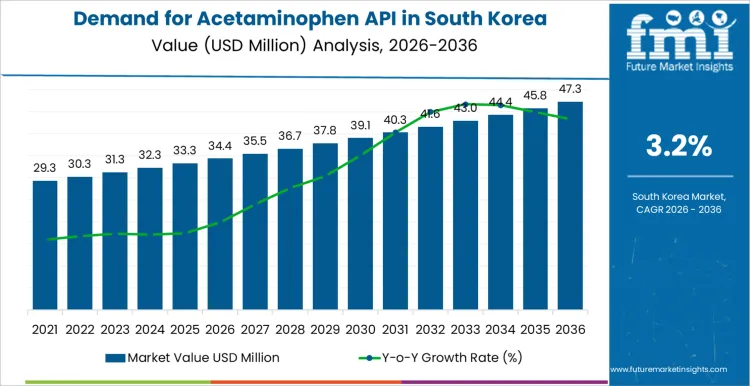
- USD 34.4 Mn
- Forecast (2036)
- USD 47.3 Mn
- CAGR (2026 to 2036)
- 3.2%
Acetaminophen API Demand in South Korea Forecast and Outlook 2026 to 2036
The acetaminophen API ecosystem in South Korea is projected to reach a valuation of USD 34.4 million in 2026. This sector is anticipated to achieve a size of USD 47.3 million by 2036, advancing at a steady CAGR of 3.2%. This stable progression is anchored in the compound's entrenched position as a therapeutic cornerstone, serving as the foundation for a vast array of pain and fever management products. Demand is sustained by its essential role in both prescription and self-medication protocols, supported by an aging population, high healthcare accessibility, and consistent consumption patterns. The ongoing need for reliable, high-quality API supplies to feed domestic pharmaceutical production lines underscores the strategic importance of this segment within the nation's robust healthcare and pharmaceutical manufacturing ecosystem.
Quick Stats for the Acetaminophen API Arena in South Korea
- Acetaminophin API Valuation in South Korea (2026): USD 34.4 million
- Acetaminophin API Forecast Valuation in South Korea (2036): USD 47.3 million
- Acetaminophin API Landscape Forecast CAGR in South Korea: 3.2%
- Leading Regional Growth: Jeju (CAGR 3.9%)
- Leading Drug Class: Acetaminophen API with Opioids (55.1%)
- Leading Distribution Channel: Retail Stores (48.5%)
- Leading Sales Type: Over-the-Counter (OTC) (60.0%)
- Leading Route of Administration: Oral (70.0%)
- Key Industry Participants: Pfizer, Inc., Johnson & Johnson, Bayer AG, Sanofi S.A., GlaxoSmithKline plc.
Why Does Acetaminophen API Maintain a Foundational Role in South Korea's Pharma Sector?
The consistent demand for acetaminophen API is a direct reflection of its unparalleled safety profile, efficacy, and versatility as a first-line analgesic and antipyretic. Its widespread incorporation into both monotherapy and combination drug formulations ensures a permanent baseline of demand from pharmaceutical manufacturers. The significant and growing consumer preference for over-the-counter (OTC) analgesics for self-managing minor ailments drives substantial volume through retail channels.
Its combination with opioids for moderate to severe pain management in prescription therapies anchors its importance in clinical settings. This dual utility across OTC and prescription spectrums, governed by stringent pharmaceutical quality and regulatory standards, guarantees its status as an irreplaceable commodity within the national drug supply chain.
How is the Acetaminophen API Arena Segmented by Formulation, Channel, and Use?
The sector is categorized by the type of drug formulation it enables, the primary channel for the finished product, its regulatory sales status, and its method of delivery. This multi-dimensional segmentation highlights the diverse pathways through which this API reaches end-users, from self-selection in a supermarket aisle to clinical administration in a hospital. Understanding this flow is crucial to comprehending the supply chain dynamics and regulatory touchpoints that define the landscape.
Which Drug Class Formulation is Most Prevalent?
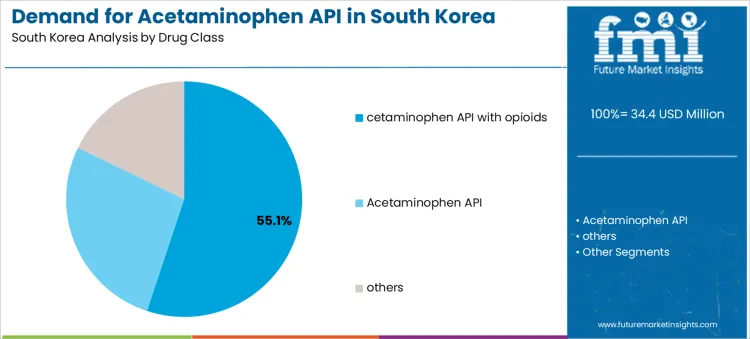
Acetaminophen API combined with opioids represents the dominant drug class, accounting for an estimated 55.1% share. This prevalence is driven by the critical role of combination analgesics in managed pain relief protocols within hospitals and for chronic pain patients. These formulations leverage acetaminophen's efficacy to allow for lower opioid doses, mitigating side-effect profiles while maintaining therapeutic effect, making them a mainstay in prescribed pain management strategies.
Which Distribution Channel Facilitates the Greatest Volume?

Retail stores, including pharmacies, supermarkets, and convenience stores, constitute the leading channel with a 48.5% share. This dominance is directly tied to the high volume of OTC acetaminophen sales, as consumers readily access these products for immediate relief without a prescription.The extensive, convenient retail network across South Korea ensures ubiquitous availability, making it the primary outlet for monotherapy products. The complementary role of hospital pharmacies is critical for inpatient care and dispensing prescription combinations.
Which Sales Type Defines the Consumer Experience?
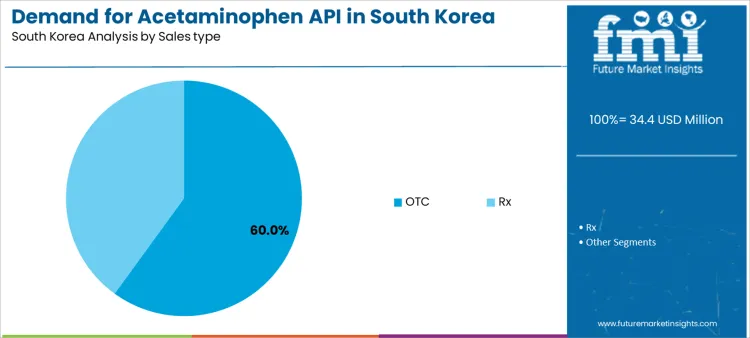
Over-the-counter (OTC) sales hold a commanding 60.0% share. This underscores the deeply ingrained culture of self-medication for common ailments like headaches, colds, and minor musculoskeletal pain. The regulatory status of acetaminophen as an OTC medication enables easy access, driving high-frequency, volume-based demand for the API used in these products.The prescription (Rx) segment, while smaller in volume, often involves higher-value combination drugs and is essential within the hospital and acute care therapeutics landscape.
Which Route of Administration is Overwhelmingly Preferred?
The oral route of administration is paramount, representing 70.0% of the sector. This strong preference is due to the convenience, patient compliance, and well-established pharmacokinetics of oral acetaminophen in tablets, capsules, and liquid suspensions. It is the default for both OTC and many prescription formulations. Injectable forms, while niche, are vital in hospital settings for patients unable to take oral medication, representing a specialized but critical segment of API demand.
What are the Dynamics, Restraints, Opportunities, and Threats Shaping the Sector?
How are Demographic and Consumption Trends Driving Steady Demand?
The primary growth driver is the demographic reality of an aging population, which experiences a higher prevalence of chronic conditions requiring ongoing pain management. The entrenched cultural acceptance of OTC medication for minor health issues sustains consistent baseline demand.The expansion of the general wellness and self-care trend encourages proactive health management, often involving staple analgesics like acetaminophen. ongoing pharmaceutical innovation in fixed-dose combination drugs also provides a stable demand stream for API manufacturers.
Do Price Sensitivity and Regulatory Scrutiny Restrain Margins?
A significant restraint is the high price sensitivity and intense competition within the OTC analgesic market, which creates downward pressure on API pricing and manufacturer margins.The API sector is also subject to relentless regulatory scrutiny regarding manufacturing practices (cGMP), purity standards, and supply chain traceability, which elevates operational compliance costs. The commodity-like nature of bulk acetaminophen API can limit differentiation and pricing power for suppliers.
How can Novel Formulations and Digital Integration Unlock Value?
Opportunities exist in the development of novel, value-added formulations such as fast-dissolving tablets, sustained-release versions, or combination therapies for specific conditions. Integrating digital supply chain solutions for enhanced pharmaceutical supply chain dynamics and inventory forecasting can provide a competitive edge. There is also potential in catering to the growing demand for high-purity, certified APIs for pediatric and geriatric-specific formulations, where quality thresholds are exceptionally high.
What External Factors Could Disrupt Stable Supply?
The sector faces threats from global supply chain vulnerabilities, where reliance on key starting materials or intermediates from a concentrated geographic region can lead to disruptive shortages.The emergence of alternative analgesic molecules or non-pharmacological pain management trends could gradually erode long-term demand. Furthermore, stringent environmental regulations governing chemical API manufacturing could increase production costs for all players, impacting overall sector economics.
How is the Acetaminophen API Sector Evolving Across Key Regions in South Korea?
Demand growth, while nationwide, exhibits regional variations influenced by healthcare infrastructure density, demographic profiles, and industrial activity. The projected compound annual growth rates from 2026 to 2036 illustrate these geographic nuances.

| Region | CAGR (2026 to 2036) |
|---|---|
| Jeju | 3.9% |
| South Gyeongsang | 3.4% |
| South Jeolla | 3.1% |
| North Jeolla | 2.6% |
What Supports the Highest Growth Rate on Jeju Island?
Jeju Island leads with a projected CAGR of 3.9%. This elevated growth is attributed to its dual role as a major domestic tourist destination and a region with a significant resident population. High tourist influx drives demand for OTC analgesics in retail outlets, while ongoing investments in healthcare facilities to serve both residents and visitors bolster demand for prescription-grade formulations. Its status supports pharmaceutical logistics and distribution networks relevant to the broader Healthcare and Medical Tourism sector.
Why is South Gyeongsang a Consistent Demand Center?
South Gyeongsang shows a steady CAGR of 3.4%, reinforced by its large population base, major industrial cities like Ulsan and Busan, and a high concentration of manufacturing and blue-collar workers. This demographic profile is associated with a higher incidence of minor occupational aches and pains, supporting strong OTC consumption. The presence of large hospital networks also drives consistent demand for prescription formulations within clinical settings.
What Underpins Demand in the Jeolla Provinces?
The Jeolla provinces exhibit stable, organic growth. South Jeolla, with a 3.1% CAGR, benefits from a balanced mix of agricultural and emerging industrial activity, coupled with a gradually aging population, sustaining predictable demand. North Jeolla, with a CAGR of 2.6%, reflects a slightly more moderate growth trajectory, with demand driven by essential healthcare needs in provincial cities and towns, aligning with stable regional healthcare consumption patterns and an established retail pharmacy network.
What Defines the Competitive Landscape of the Acetaminophen API Industry?

The competitive environment is characterized by a focus on scale, cost efficiency, and impeccable regulatory compliance. Large multinational pharmaceutical corporations with vertically integrated operations compete alongside specialized API manufacturers. Competition hinges on the ability to produce at a massive scale while guaranteeing unwavering quality, consistency, and supply chain reliability.
Key differentiators include certifications from stringent regulatory authorities such as MFDS, FDA, and EMA, the cost-competitiveness of manufacturing processes, and the security of long-term supply contracts with major finished-dose manufacturers. Strategic partnerships with generic drug producers are essential for sustained volume.
Key Industry Participants
- Pfizer, Inc.
- Johnson & Johnson
- Bayer AG
- Sanofi S.A.
- GlaxoSmithKline plc.
Scope of Analysis
| Items | Values |
|---|---|
| Quantitative Units | USD Million |
| Drug Class | Acetaminophen API with Opioids, Acetaminophen API (alone), Others |
| Distribution Channel | Retail Stores, Drug Stores, Hospital Pharmacies, E-commerce, Others |
| Sales Type | Over-the-Counter (OTC), Prescription (Rx) |
| Route of Administration | Oral, Injectable, Others |
| Regions Covered | South Gyeongsang, North Jeolla, South Jeolla, Jeju |
Acetaminophen API Sector in South Korea by Segment
By Drug Class
- Acetaminophen API with Opioids
- Acetaminophen API (Monotherapy)
- Others
By Distribution Channel
- Retail Stores
- Drug Stores/Pharmacies
- Hospital Pharmacies
- E-commerce
- Others
By Sales Type
- Over-the-Counter (OTC)
- Prescription (Rx)
By Route of Administration
- Oral
- Injectable
- Others
By Region
- Jeju
- South Gyeongsang
- South Jeolla
- North Jeolla
Bibliography
- Ministry of Food and Drug Safety (MFDS), South Korea. (2023). Korean Pharmacopoeia and API Quality Standards.
- Korea Pharmaceutical Manufacturers Association (KPMA). (2024). Annual Report on Domestic Pharmaceutical Production and API Sourcing.
- World Health Organization (WHO). (2023). WHO Model List of Essential Medicines - Application of Analgesics.
Frequently Asked Questions
How big is the demand for acetaminophen api in south korea in 2026?
The demand for acetaminophen api in south korea is estimated to be valued at USD 34.4 million in 2026.
What will be the size of acetaminophen api in south korea in 2036?
The market size for the acetaminophen api in south korea is projected to reach USD 47.3 million by 2036.
How much will be the demand for acetaminophen api in south korea growth between 2026 and 2036?
The demand for acetaminophen api in south korea is expected to grow at a 3.2% CAGR between 2026 and 2036.
What are the key product types in the acetaminophen api in south korea?
The key product types in acetaminophen api in south korea are cetaminophen api with opioids, acetaminophen api and others.
Which distribution channel segment is expected to contribute significant share in the acetaminophen api in south korea in 2026?
In terms of distribution channel, retail stores segment is expected to command 48.5% share in the acetaminophen api in south korea in 2026.
Preview the report firsthand - request a free sample
Get SampleGet the brochure for pricing and purchase details.
Get PDFTable of Content
- Executive Summary
- South Korea Market Outlook
- Demand-side Trends
- Supply-side Trends
- Technology Roadmap Analysis
- Analysis and Recommendations
- Market Overview
- Market Coverage / Taxonomy
- Market Definition / Scope / Limitations
- Market Background
- Market Dynamics
- Drivers
- Restraints
- Opportunity
- Trends
- Scenario Forecast
- Demand in Optimistic Scenario
- Demand in Likely Scenario
- Demand in Conservative Scenario
- Opportunity Map Analysis
- Product Life Cycle Analysis
- Supply Chain Analysis
- Investment Feasibility Matrix
- Value Chain Analysis
- PESTLE and Porter’s Analysis
- Regulatory Landscape
- Regional Parent Market Outlook
- Production and Consumption Statistics
- Import and Export Statistics
- Market Dynamics
- South Korea Market Analysis 2021 to 2025 and Forecast, 2026 to 2036
- Historical Market Size Value (USD Million) Analysis, 2021 to 2025
- Current and Future Market Size Value (USD Million) Projections, 2026 to 2036
- Y-o-Y Growth Trend Analysis
- Absolute $ Opportunity Analysis
- South Korea Market Pricing Analysis 2021 to 2025 and Forecast 2026 to 2036
- South Korea Market Analysis 2021 to 2025 and Forecast 2026 to 2036, By Drug Class
- Introduction / Key Findings
- Historical Market Size Value (USD Million) Analysis By Drug Class, 2021 to 2025
- Current and Future Market Size Value (USD Million) Analysis and Forecast By Drug Class, 2026 to 2036
- cetaminophen API with opioids
- Acetaminophen API
- others
- cetaminophen API with opioids
- Y-o-Y Growth Trend Analysis By Drug Class, 2021 to 2025
- Absolute $ Opportunity Analysis By Drug Class, 2026 to 2036
- South Korea Market Analysis 2021 to 2025 and Forecast 2026 to 2036, By Distribution Channel
- Introduction / Key Findings
- Historical Market Size Value (USD Million) Analysis By Distribution Channel, 2021 to 2025
- Current and Future Market Size Value (USD Million) Analysis and Forecast By Distribution Channel, 2026 to 2036
- Retail Stores
- Drug Stores
- Hospital Pharmacies
- E-commerce
- Others
- Retail Stores
- Y-o-Y Growth Trend Analysis By Distribution Channel, 2021 to 2025
- Absolute $ Opportunity Analysis By Distribution Channel, 2026 to 2036
- South Korea Market Analysis 2021 to 2025 and Forecast 2026 to 2036, By Sales type
- Introduction / Key Findings
- Historical Market Size Value (USD Million) Analysis By Sales type, 2021 to 2025
- Current and Future Market Size Value (USD Million) Analysis and Forecast By Sales type, 2026 to 2036
- OTC
- Rx
- OTC
- Y-o-Y Growth Trend Analysis By Sales type, 2021 to 2025
- Absolute $ Opportunity Analysis By Sales type, 2026 to 2036
- South Korea Market Analysis 2021 to 2025 and Forecast 2026 to 2036, By Route of Administration
- Introduction / Key Findings
- Historical Market Size Value (USD Million) Analysis By Route of Administration, 2021 to 2025
- Current and Future Market Size Value (USD Million) Analysis and Forecast By Route of Administration, 2026 to 2036
- Oral
- Injectable
- Others
- Oral
- Y-o-Y Growth Trend Analysis By Route of Administration, 2021 to 2025
- Absolute $ Opportunity Analysis By Route of Administration, 2026 to 2036
- Market Structure Analysis
- Competition Dashboard
- Competition Benchmarking
- Market Share Analysis of Top Players
- By Regional
- By Drug Class
- By Distribution Channel
- By Sales type
- By Route of Administration
- Competition Analysis
- Competition Deep Dive
- Pfizer, Inc.
- Overview
- Product Portfolio
- Profitability by Market Segments (Product/Age /Sales Channel/Region)
- Sales Footprint
- Strategy Overview
- Marketing Strategy
- Product Strategy
- Channel Strategy
- Johnson & Johnson
- Bayer AG
- Sanofi S.A.
- GlaxoSmithKline plc.
- Pfizer, Inc.
- Competition Deep Dive
- Assumptions & Acronyms Used
- Research Methodology


