

- Industry Size (2026)
- USD 679.9 Mn
- Forecast (2036)
- USD 892.2 Mn
- CAGR (2026 to 2036)
- 2.8%
Demand for Coronary Artery Bypass Graft in South Korea Forecast and Outlook 2026 to 2036
The demand for coronary artery bypass graft procedures in South Korea is projected to reach USD 892.2 million by 2036, growing at a CAGR of 2.8% from USD 679.9 million in 2026. The quality of demand in this market is characterized by stability, driven by the ongoing prevalence of cardiovascular diseases and the established role of bypass surgeries in treatment protocols. Repeat usage is an important factor, as patients undergoing these procedures often require follow-up care or reintervention, contributing to steady demand over time. Buyer commitment levels are high, as hospitals and healthcare providers are likely to maintain long-term relationships with suppliers due to the critical and routine nature of these procedures. However, the pace of growth reflects the mature nature of this segment, with demand fluctuations more closely tied to healthcare policy changes, evolving treatment guidelines, and population health trends rather than speculative shifts in patient preferences.
Quick Stats for the Demand for Coronary Artery Bypass Graft in South Korea
- Coronary Artery Bypass Graft in South Korea Value (2026): USD 679.9 million
- Coronary Artery Bypass Graft in South Korea Forecast Value (2036): USD 892.2 million
- Coronary Artery Bypass Graft in South Korea Forecast CAGR (2026 to 2036): 2.8%
- Coronary Artery Bypass Graft in South Korea Leading Segment: Hospitals (70%)
- Key Growth Regions of Coronary Artery Bypass Graft in South Korea: Jeju (leading CAGR ~3.3%)
- Top Players of Coronary Artery Bypass Graft in South Korea: Medtronic plc, Terumo Corp., Guidant Group, Getinge AB
What is the Growth Forecast for the Coronary Artery Bypass Graft Market in South Korea through 2036?
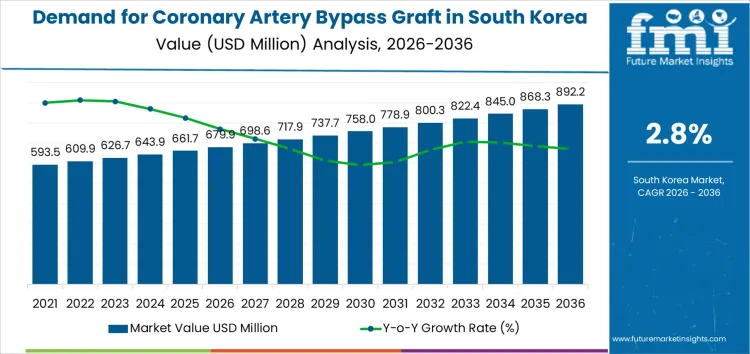
The CABG market in South Korea is projected to experience steady growth from 2026 to 2036. Starting at USD 679.9 million in 2026, the industry is expected to rise to USD 698.6 million in 2027. By 2028, the industry value will reach USD 717.9 million, followed by USD 737.7 million in 2029. The industry will continue its growth, reaching USD 758.0 million in 2030 and USD 778.9 million in 2031.
In the following years, the demand for CABG procedures will persist, with the industry expected to reach USD 800.3 million in 2032 and USD 822.4 million in 2033. By 2034, the industry value will grow to USD 845.0 million, reaching USD 868.3 million in 2035. By 2036, the industry is projected to reach USD 892.2 million. The growth rate volatility index reflects a consistent but gradual increase in demand, with smaller fluctuations observed throughout the forecast period. The overall trend shows steady growth driven by the rising need for cardiovascular interventions in South Korea.
Key Takeaways for Demand for Coronary Artery Bypass Graft in South Korea
| Metric | Value |
|---|---|
| Industry Sales Value (2026) | USD 679.9 million |
| Industry Forecast Value (2036) | USD 892.2 million |
| Industry Forecast CAGR (2026 to 2036) | 2.8% |
Why is the Demand for Coronary Artery Bypass Graft Growing in South Korea?
Demand for coronary artery bypass graft (CABG) procedures in South Korea has been rising in the context of increasing cardiovascular risk factors and shifts in clinical practice patterns. Rates of coronary artery disease have grown alongside population ageing and lifestyle changes that include reduced physical activity and dietary factors associated with urban living. Patients with advanced or complex coronary lesions that cannot be managed by angioplasty or stenting are typically referred for CABG, sustaining demand for these surgical interventions. Cardiac care units in tertiary hospitals have expanded capabilities for open coronary surgery to meet this need, with an emphasis on multidisciplinary coordination among cardiologists, cardiac surgeons, and perioperative care teams. The integration of diagnostic modalities, such as coronary computed tomography angiography and functional perfusion imaging, has improved identification of candidates for bypass surgery, helping clinicians make evidence-based decisions about revascularisation strategies. South Korea’s universal health coverage under the National Health Insurance Service also supports procedural access by covering a significant portion of surgical costs, thereby reducing financial barriers that might otherwise delay or limit treatment.
Looking forward, several factors are likely to influence future demand for CABG in South Korea, presenting strategic insights for manufacturers, device suppliers, and healthcare providers. Clinical guidelines that delineate indications for surgical versus percutaneous revascularisation continue to evolve, affecting procedure volumes and device preferences. For companies in the cardiovascular device segment, opportunities may arise in supplying conduits such as saphenous vein and arterial graft materials, advanced stabilisation systems, and intraoperative imaging and monitoring technologies that improve surgical precision. Care pathways that emphasise enhanced recovery after surgery (ERAS) protocols may drive interest in technologies and consumables that reduce operative time and postoperative complications. Cardiac care providers increasingly seek devices that support long-term graft patency and patient outcomes. Engagement with clinical communities to validate product performance and align with local surgeon practices can strengthen market positioning. Predictive analytics and patient selection tools that integrate with hospital information systems may also shape how CABG procedures are planned and executed, influencing demand for complementary digital and device solutions in the South Korean healthcare environment.
What Are the Key Segments in Coronary Artery Bypass Graft (CABG) Sector in South Korea?
The demand for coronary artery bypass graft (CABG) procedures in South Korea is segmented by technology and end user. On-pump CABG leads the technology segment, holding a 60% market share, followed by off-pump CABG and other technologies. In terms of end users, hospitals dominate the industry, accounting for 70%, with cardiology clinics, research institutes, and other healthcare providers also contributing to the demand. The growing prevalence of cardiovascular diseases and the aging population are key factors driving demand for CABG procedures.
How Does Technology Impact the Demand for CABG in South Korea?
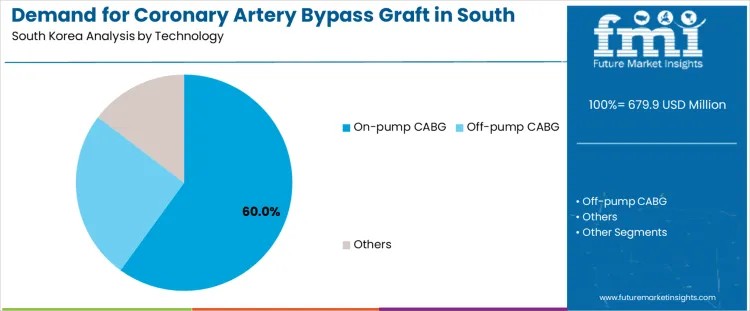
The demand for CABG procedures in South Korea is significantly influenced by the technology used, with on-pump CABG accounting for 60% of the industry. On-pump CABG involves the use of a heart-lung machine to divert blood flow while the heart is temporarily stopped during surgery. This method is widely used due to its effectiveness in ensuring that the heart receives adequate oxygen and blood during the procedure. On-pump CABG is considered the gold standard for bypass surgeries in many cases, particularly in patients with multiple coronary blockages, as it allows surgeons to work on a still heart, offering greater precision. The larger share of on-pump CABG in South Korea is indicative of the preference for this well-established and widely available procedure, supported by advances in surgical technology and medical infrastructure. Off-pump CABG, although less common, is gaining traction due to its potential benefits, such as a lower risk of complications related to the heart-lung machine, and faster recovery times. Off-pump CABG is often preferred for patients with less severe coronary artery disease, where bypasses can be performed without halting the heart. The "others" category includes alternative approaches and emerging technologies in CABG surgery, though these methods are still relatively niche compared to on-pump and off-pump CABG.
What Is the Demand for CABG by End User in South Korea?
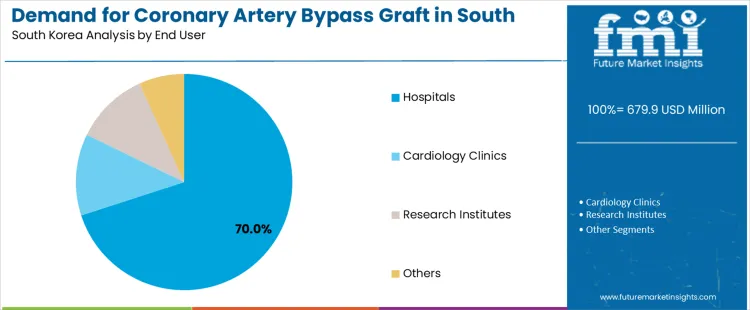
In South Korea, hospitals are the leading end users of CABG procedures, accounting for 70% of the industry. Hospitals are the primary settings for cardiac surgeries, providing the necessary infrastructure, medical teams, and specialized equipment required for complex procedures like CABG. The majority of coronary artery bypass graft surgeries are performed in hospitals, particularly large medical centers and tertiary hospitals that offer advanced surgical care and post-operative support. Cardiology clinics, while contributing to the overall demand, play a more limited role, focusing mainly on preoperative assessments, diagnostics, and less invasive treatments. However, they may refer patients to hospitals for the actual surgery. Research institutes also contribute to the demand by driving innovations in CABG technology and surgical techniques. These institutions often focus on improving surgical outcomes and exploring new methods to reduce recovery times and complications. As cardiovascular diseases continue to rise in South Korea, particularly among the aging population, hospitals will remain the primary setting for CABG surgeries, though cardiology clinics and research institutes will play important roles in the advancement of CABG techniques and patient care. The trend toward specialized care and technological advancements suggests that demand for CABG will continue to grow, particularly in hospitals that are equipped with the latest surgical technologies.
What are the Key Dynamics in the Demand for Coronary Artery Bypass Graft in South Korea?
Demand for coronary artery bypass graft (CABG) procedures in South Korea is influenced by cardiovascular disease prevalence, healthcare infrastructure capacity, and patterns in clinical practice. Coronary artery disease (CAD) remains a significant contributor to morbidity among adults, particularly in older age groups with multiple risk factors. Tertiary hospitals and specialized cardiac surgery centers serve as primary delivery points for CABG, supported by referral networks from cardiology clinics. Public and private insurance schemes shape patient access to surgical care. Procurement of graft materials, surgical instruments, and intraoperative support systems reflects both procedural volume and surgeon preference for specific technologies. Uptake of CABG is assessed against alternative revascularization options, including percutaneous coronary intervention (PCI), in clinical decision-making.
What are the Drivers Pushing Sales of Coronary Artery Bypass Graft in South Korea?
A principal driver of CABG demand is the aging demographic, which correlates with higher incidence of advanced CAD requiring surgical intervention. Epidemiological trends showing persistent rates of hypertension, hyperlipidemia, and diabetes contribute to the pool of candidates for revascularization surgery. Clinical guidelines that recommend CABG for multivessel disease and left main coronary artery involvement support surgical case volumes. Investment in cardiac surgery capacity, including advanced operating suites and post-operative intensive care units, enables providers to manage complex cases. Patient awareness of improved outcomes with timely revascularization and referrals from cardiologists also sustain demand. Domestic training programs for cardiothoracic surgeons help maintain skilled workforce availability, which is essential for procedural throughput.
What are the Restraints on Demand for Coronary Artery Bypass Graft in South Korea?
Restraints include competition from minimally invasive and catheter-based revascularization alternatives, particularly drug-eluting stents used in PCI, which may be preferred for select patient profiles due to shorter recovery times. High procedural costs and extended hospital stays associated with CABG can impact patient and insurer decision-making, especially among working-age populations concerned about indirect costs. Variations in referral patterns and risk-averse clinical preferences among cardiologists may divert potential cases toward less invasive options. Geographic disparities in access to specialized cardiac surgery centers can limit uptake among patients in rural areas. Requirements for pre-operative risk stratification and optimization of comorbid conditions can extend lead times between diagnosis and surgery, affecting scheduling and resource utilization.
What Key Trends Affect Demand for Coronary Artery Bypass Graft in South Korea?
Emerging trends include greater integration of hybrid revascularization strategies that combine CABG with PCI within a single care pathway, aimed at optimizing clinical outcomes for complex lesions. Adoption of enhanced recovery after surgery (ERAS) protocols and minimally invasive CABG techniques is expanding, which may broaden patient eligibility and reduce length of stay. Health systems are increasingly emphasizing data-driven quality metrics, such as graft patency and long-term survival, which inform hospital rankings and influence referral patterns. Use of advanced graft materials and intraoperative imaging technologies is evolving, enabling surgeons to refine procedural precision. Collaboration between cardiac centers on outcomes research and clinical registries supports evidence-based practice and helps suppliers tailor product development to local needs.
What is the Regional Demand Trend for Coronary Artery Bypass Graft (CABG) in South Korea?
The demand for coronary artery bypass graft (CABG) procedures in South Korea is shaped by regional healthcare infrastructure, population health trends, and the prevalence of cardiovascular diseases. South Gyeongsang, with a CAGR of 2.9%, shows a steady demand for CABG, driven by the region’s advanced medical facilities and aging population. North Jeolla, with a growth rate of 2.2%, demonstrates more moderate demand, as the region continues to enhance its healthcare services while managing a relatively smaller cardiovascular patient base. South Jeolla, with a projected CAGR of 2.6%, is seeing consistent demand, supported by its expanding healthcare sector. Jeju, with the highest projected demand growth of 3.3%, reflects increasing demand for heart surgeries driven by the region’s growing focus on health services and an aging demographic. These regional differences indicate significant opportunities for suppliers of medical devices, pharmaceuticals, and healthcare services catering to cardiovascular treatment.
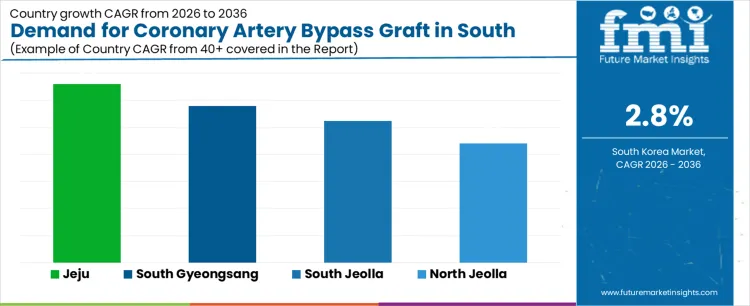
| Region | CAGR (2026 to 2036) |
|---|---|
| South Gyeongsang | 2.9% |
| North Jeolla | 2.2% |
| South Jeolla | 2.6% |
| Jeju | 3.3% |
How Can Medical Device Manufacturers Target the South Gyeongsang Market?
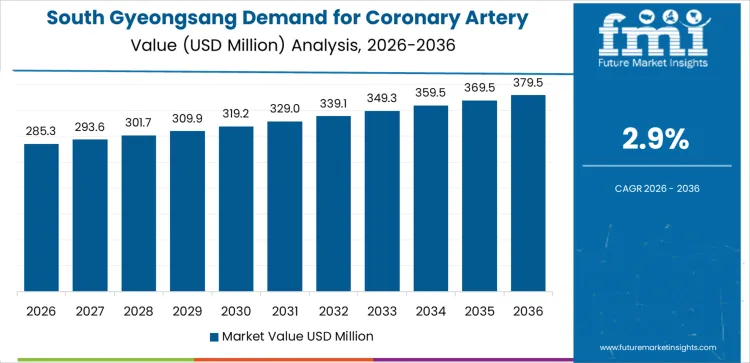
South Gyeongsang, with a projected CAGR of 2.9%, represents a steady market for suppliers of coronary artery bypass graft (CABG) medical devices and related equipment. The region has a well-established healthcare infrastructure, including several advanced medical centers that specialize in cardiovascular treatments. Manufacturers should focus on providing high-quality, durable medical devices such as grafts, surgical instruments, and heart-lung machines used in CABG surgeries. Furthermore, partnering with local hospitals and cardiovascular centers to offer training and after-sales support could enhance market penetration. As the population ages and the incidence of cardiovascular diseases increases, South Gyeongsang is expected to maintain a stable demand for CABG-related products, making it a key region for long-term growth.
What Drives CABG Demand in North Jeolla?
North Jeolla, with a CAGR of 2.2%, is witnessing moderate demand for coronary artery bypass graft surgeries, largely due to a growing emphasis on improving regional healthcare services and access to cardiovascular treatments. While the region is less industrialized compared to South Gyeongsang, there is increasing recognition of the need for specialized cardiovascular care. Manufacturers targeting North Jeolla should focus on cost-effective, efficient CABG solutions that meet the demands of local hospitals and medical institutions, which are expanding their cardiovascular care offerings. Partnerships with local healthcare providers, coupled with awareness campaigns regarding cardiovascular health, can help raise demand for CABG procedures and related medical products in the region.
What Opportunities Exist for CABG Suppliers in South Jeolla?
South Jeolla, with a CAGR of 2.6%, presents opportunities for CABG suppliers as the region expands its healthcare infrastructure and cardiovascular services. The growing awareness of heart disease, along with a rising elderly population, is expected to increase the demand for coronary artery bypass graft surgeries. Suppliers can seize this opportunity by offering advanced CABG products such as minimally invasive surgical tools, high-quality grafts, and comprehensive cardiovascular treatment solutions. As the region continues to develop its medical facilities and enhance its healthcare system, the demand for CABG surgeries and related medical equipment is expected to rise steadily, providing suppliers with a steady market.
Why is Jeju Seeing Increased Demand for CABG Procedures?
Jeju, with the highest projected CAGR of 3.3%, is witnessing robust growth in the demand for coronary artery bypass graft surgeries. The region’s increasing healthcare focus, paired with an aging population, is driving this rise in demand. Jeju’s health sector is improving rapidly, with greater investment in medical infrastructure, which supports cardiovascular care, including CABG surgeries. Suppliers of medical devices and pharmaceuticals targeting Jeju should focus on providing solutions that cater to the region’s increasing number of heart disease patients. Additionally, Jeju’s growing medical tourism industry may also contribute to an influx of patients seeking CABG procedures, further driving demand. As the region continues to prioritize healthcare development, suppliers can expect long-term growth opportunities in the CABG market.
What is the Competitive Landscape for Coronary Artery Bypass Graft Demand in South Korea?
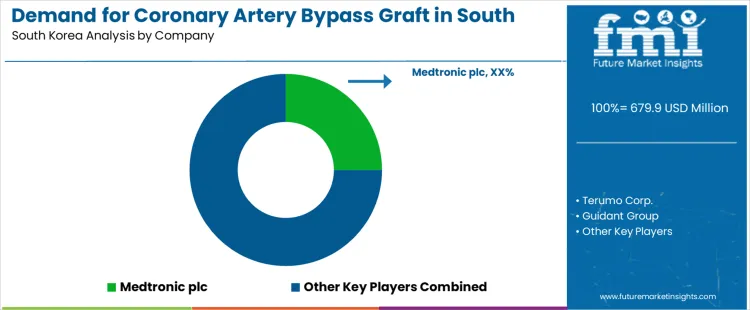
Demand for coronary artery bypass graft (CABG) procedures in South Korea is supported by the prevalence of cardiovascular disease, an ageing demographic profile, and expanding access to advanced cardiac care. Hospital cardiac surgery departments and specialized heart centers are primary buyers of CABG-related devices, including graft conduits, stabilization systems, and ancillary disposables used in operating theatres. Clinical procurement decisions emphasize product performance, documented clinical outcomes, and regulatory compliance with Korean medical device standards. Requirements in tenders and hospital contracts typically include evidence of patency rates, biocompatibility data, and ease of surgical handling. Facility investments in hybrid operating rooms and minimally invasive cardiac surgery platforms have influenced demand for CABG devices compatible with newer procedural approaches. Health insurers and government policies that support cardiovascular care have also shaped procedure volumes and equipment acquisition strategies. Surgeons and procurement committees in major South Korean hospitals priorities solutions that demonstrate reliable long-term outcomes and integration with established surgical workflows.
Competition among key suppliers of CABG devices in the South Korean market is defined by product specifications, clinical support frameworks, and documented safety and efficacy profiles. Medtronic plc is positioned as a leading supplier, with product brochures detailing graft options including arterial and venous conduits, fixation systems, and stabilization tools. Materials include specification tables for graft diameters, lengths, and biocompatibility characteristics that support clinical selection. Terumo Corp. documentation focuses on cardiovascular surgical systems and graft materials with associated handling guidelines and performance benchmarks used by surgical teams and procurement specialists. Guidant Group product literature describes cardiac surgery solutions including stabilization and imaging adjuncts, with technical data on integration with operating room systems and procedural workflows. Getinge AB brochures outline cardiovascular support technologies that complement CABG procedures, including perfusion systems and surgical instruments, with specification sheets that highlight reliability metrics and maintenance schedules relevant to hospital biomedical engineers. These brochures typically include clinical performance indicators, material properties, and procedural compatibility information that assist South Korean hospital administrators, cardiac surgeons, and procurement professionals when comparing supplier offerings against clinical and operational criteria.
Key Players of the Coronary Artery Bypass Graft Demand in South Korea
- Medtronic plc
- Terumo Corp.
- Guidant Group
- Getinge AB
Scope of the Report
| Items | Values |
|---|---|
| Quantitative Units (2026) | USD Million |
| Technology | Off-pump CABG, On-pump CABG, Others |
| Procedure | Single CABG Surgery, Double CABG Surgery, Triple CABG Surgery, Quadruple CABG Surgery, Others |
| End User | Hospitals, Cardiology Clinics, Research Institutes, Others |
| Companies | Medtronic plc, Terumo Corp., Guidant Group, Getinge AB |
| Region Covered | South Korea |
| Provinces Covered | South Gyeongsang, North Jeolla, South Jeolla, Jeju |
| Additional Attributes | Dollar sales by technology, procedure, and end user. Growth reflects rising prevalence of cardiovascular diseases, adoption of advanced grafting techniques, and greater preference for minimally invasive and off-pump CABG procedures in major hospitals and cardiac centers. |
Key Segments of Coronary Artery Bypass Graft Sector in South Korea
Technology
- Off-pump CABG
- On-pump CABG
- Other
Procedure
- Single CABG Surgery
- Double CABG Surgery
- Triple CABG Surgery
- Quadruple CABG Surgery
- Other
End User
- Hospitals
- Cardiology Clinics
- Research Institutes
- Other
Provinces
- South Gyeongsang
- North Jeolla
- South Jeolla
- Jeju
Bibliography
- Korean Society of Cardiology. (2024). Clinical statistics and trends in cardiovascular care and coronary revascularization in South Korea. Korean Society of Cardiology.
- Medtronic. (2024). Coronary artery bypass surgery technologies and clinical evidence in Asia-Pacific markets. Medtronic plc.
- Terumo Corporation. (2024). Cardiovascular grafts and perfusion systems for coronary artery bypass surgery. Terumo Corporation.
- Korean National Health Insurance Service. (2024). National health insurance statistics on cardiovascular surgery and coronary artery bypass procedures. National Health Insurance Service (NHIS), Republic of Korea.
- Health Insurance Review and Assessment Service. (2024). Utilization, reimbursement, and outcomes of coronary artery bypass graft surgery in South Korea. Health Insurance Review and Assessment Service (HIRA).
Frequently Asked Questions
How big is the demand for coronary artery bypass graft in south korea in 2026?
The demand for coronary artery bypass graft in south korea is estimated to be valued at USD 679.9 million in 2026.
What will be the size of coronary artery bypass graft in south korea in 2036?
The market size for the coronary artery bypass graft in south korea is projected to reach USD 892.2 million by 2036.
How much will be the demand for coronary artery bypass graft in south korea growth between 2026 and 2036?
The demand for coronary artery bypass graft in south korea is expected to grow at a 2.8% CAGR between 2026 and 2036.
What are the key product types in the coronary artery bypass graft in south korea?
The key product types in coronary artery bypass graft in south korea are on-pump cabg, off-pump cabg and others.
Which procedure segment is expected to contribute significant share in the coronary artery bypass graft in south korea in 2026?
In terms of procedure, double cabg surgery segment is expected to command 30.0% share in the coronary artery bypass graft in south korea in 2026.
Preview the report firsthand - request a free sample
Get SampleGet the brochure for pricing and purchase details.
Get PDFTable of Content
- Executive Summary
- South Korea Market Outlook
- Demand-side Trends
- Supply-side Trends
- Technology Roadmap Analysis
- Analysis and Recommendations
- Market Overview
- Market Coverage / Taxonomy
- Market Definition / Scope / Limitations
- Market Background
- Market Dynamics
- Drivers
- Restraints
- Opportunity
- Trends
- Scenario Forecast
- Demand in Optimistic Scenario
- Demand in Likely Scenario
- Demand in Conservative Scenario
- Opportunity Map Analysis
- Product Life Cycle Analysis
- Supply Chain Analysis
- Investment Feasibility Matrix
- Value Chain Analysis
- PESTLE and Porter’s Analysis
- Regulatory Landscape
- Regional Parent Market Outlook
- Production and Consumption Statistics
- Import and Export Statistics
- Market Dynamics
- South Korea Market Analysis 2021 to 2025 and Forecast, 2026 to 2036
- Historical Market Size Value (USD Million) Analysis, 2021 to 2025
- Current and Future Market Size Value (USD Million) Projections, 2026 to 2036
- Y-o-Y Growth Trend Analysis
- Absolute $ Opportunity Analysis
- South Korea Market Pricing Analysis 2021 to 2025 and Forecast 2026 to 2036
- South Korea Market Analysis 2021 to 2025 and Forecast 2026 to 2036, By Technology
- Introduction / Key Findings
- Historical Market Size Value (USD Million) Analysis By Technology, 2021 to 2025
- Current and Future Market Size Value (USD Million) Analysis and Forecast By Technology, 2026 to 2036
- On-pump CABG
- Off-pump CABG
- Others
- On-pump CABG
- Y-o-Y Growth Trend Analysis By Technology, 2021 to 2025
- Absolute $ Opportunity Analysis By Technology, 2026 to 2036
- South Korea Market Analysis 2021 to 2025 and Forecast 2026 to 2036, By Procedure
- Introduction / Key Findings
- Historical Market Size Value (USD Million) Analysis By Procedure, 2021 to 2025
- Current and Future Market Size Value (USD Million) Analysis and Forecast By Procedure, 2026 to 2036
- Double CABG surgery
- Single CABG surgery
- Triple CABG surgery
- Quadruple CABG surgery
- Others
- Double CABG surgery
- Y-o-Y Growth Trend Analysis By Procedure, 2021 to 2025
- Absolute $ Opportunity Analysis By Procedure, 2026 to 2036
- South Korea Market Analysis 2021 to 2025 and Forecast 2026 to 2036, By End User
- Introduction / Key Findings
- Historical Market Size Value (USD Million) Analysis By End User, 2021 to 2025
- Current and Future Market Size Value (USD Million) Analysis and Forecast By End User, 2026 to 2036
- Hospitals
- Cardiology Clinics
- Research Institutes
- Others
- Hospitals
- Y-o-Y Growth Trend Analysis By End User, 2021 to 2025
- Absolute $ Opportunity Analysis By End User, 2026 to 2036
- Market Structure Analysis
- Competition Dashboard
- Competition Benchmarking
- Market Share Analysis of Top Players
- By Regional
- By Technology
- By Procedure
- By End User
- Competition Analysis
- Competition Deep Dive
- Medtronic plc
- Overview
- Product Portfolio
- Profitability by Market Segments (Product/Age /Sales Channel/Region)
- Sales Footprint
- Strategy Overview
- Marketing Strategy
- Product Strategy
- Channel Strategy
- Terumo Corp.
- Guidant Group
- Getinge AB
- Medtronic plc
- Competition Deep Dive
- Assumptions & Acronyms Used
- Research Methodology


