

- Industry Size (2026)
- USD 631.9 Mn
- Forecast (2036)
- USD 1061.0 Mn
- CAGR (2026 to 2036)
- 5.3%
Demand for Welding Consumables in South Korea Forecast and Outlook 2026 to 2036
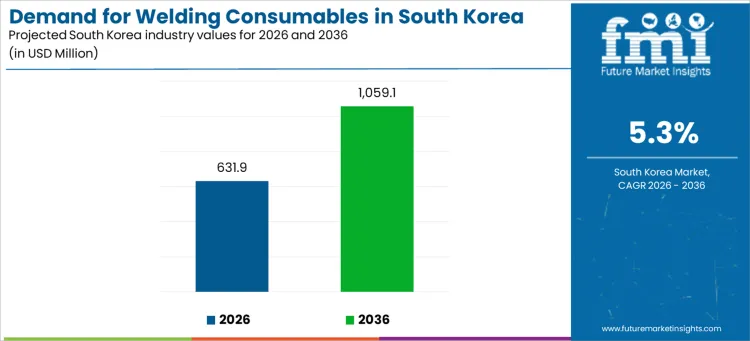
Sales of welding consumables in South Korea are projected to be valued at USD 631.9 million in 2026. The sector is predicted to reach USD 1,061.0 million by 2036, advancing at a compound annual growth rate of 5.3%. South Korea's economy is heavily anchored in heavy manufacturing, particularly shipbuilding and automotive production, which creates a sustained requirement for high-quality joining materials. The "K-Shipbuilding" resurgence, driven by global orders for LNG carriers and eco-friendly vessels, directly correlates with increased consumption of flux-cored wires and high-tensile electrodes essential for hull fabrication.
Expansion is fueled by the rapid evolution of the automotive sector towards electric vehicles (EVs). Car manufacturers like Hyundai and Kia are transitioning to lighter chassis materials, necessitating advanced welding materials capable of joining dissimilar metals such as aluminum and high-strength steel. This shift demands specialized filler metals that ensure structural integrity without adding weight. Concurrently, the robust construction sector, engaged in massive infrastructure projects and urban redevelopment, ensures a steady baseline demand for stick electrodes used in on-site structural repairs and fabrication.
Quick Stats for Demand for Welding Consumables in South Korea
- Industry Value (2026): USD 631.9 million
- Industry Forecast Value (2036): USD 1,061.0 million
- Industry Forecast CAGR: 5.3%
- Leading Consumables: Wires (38.5%)
- Leading Welding Type: Arc Welding (62.0%)
- Leading End Use: Marine (42.0%)
- Key Growth Regions: Jeju, South Gyeongsang, South Jeolla, North Jeolla
- Key Players: Lincoln Electric Holdings, Inc., ESAB, Voestalpine Böhler Welding, ITW Welding, Kobe Steel, Ltd.
Technological adoption is pivoting toward automation-ready consumables. With labor shortages affecting the welding workforce, shipyards and factories are increasingly deploying robotic welding cells. This transition drives demand for precision-wound solid wires and seamless flux-cored wires designed for high-speed, continuous welding equipment and consumables systems. Domestic chemical and power generation industries are also upgrading facilities, requiring specialized alloy consumables for maintenance and repair operations in high-temperature environments.
Demand for Welding Consumables in South Korea Key Takeaways
| Metric | Value |
|---|---|
| Industry Size (2026) | USD 631.9 million |
| Industry Value (2036) | USD 1,061.0 million |
| CAGR (2026 to 2036) | 5.3% |
What Industrial Forces Are Shaping Consumption?
A primary catalyst for growth is the global imperative for decarbonization, which has filled the order books of South Korean shipbuilders with contracts for dual-fuel and ammonia-powered vessels. Constructing these advanced ships requires vast quantities of specialized welding filler metal products capable of withstanding cryogenic temperatures. Safety regulations in the construction industry are becoming stricter, mandating the use of low-hydrogen consumables to prevent delayed cracking in high-rise structures. The expansion of the domestic offshore wind power sector creates a new niche for corrosion-resistant consumables used in the fabrication of massive substructures and turbine towers.
How is the Sector Structured Across Key Segments?
The sector is segmented to address the specific metallurgical requirements of diverse heavy industries. It is primarily categorized by consumables, reflecting the physical form of the filler material. The welding type segment distinguishes between manual and automated processes. The end use segment highlights the industrial verticals driving consumption. Each segment plays a vital role, where wires drive efficiency in automated lines and marine applications drive the sheer tonnage of material used.
Why Do Welding Wires Command the Largest Share?
Wires command a 38.5% share of the industry. This dominance is attributed to the widespread adoption of Gas Metal Arc Welding (GMAW) and Flux-Cored Arc Welding (FCAW) in high-production environments like shipyards and auto plants. Continuous wire feeding allows for higher deposition rates and fewer stops compared to stick electrodes, significantly improving productivity. The shift towards robotic automation further solidifies the position of solid and cored wires as the default choice for manufacturing efficiency, pushing demand for stainless steel submerged arc welding wire.
How Does Arc Welding Retain Its Primacy?
Arc Welding holds the majority share of 62.0% within the welding type segment. The versatility of electric arc processes makes them suitable for everything from precision automotive assembly to heavy structural steelwork. South Korean industries rely heavily on Submerged Arc Welding (SAW) for joining thick plates in ship hulls and pressure vessels. Innovations in inverter technology are making arc welding power sources more energy-efficient, ensuring that this traditional method remains cost-effective and adaptable to modern materials.
Why is the Marine Sector the Primary Consumer?
Marine application segment accounts for 42.0% of the sector's volume. South Korea is home to the world's largest shipbuilders, including Hyundai Heavy Industries and Samsung Heavy Industries. Constructing a single commercial vessel requires hundreds of tons of consumables. The current boom in high-value LNG carriers, which require specialized underwater welding consumable solutions and cryogenic-grade fillers, creates a massive and high-value revenue stream. This dependence ensures that the health of the welding sector is inextricably linked to the global shipping cycle.
Is the Automotive Sector Driving Material Innovation?
Automotive manufacturing remains a critical driver for advanced joining technologies. As the industry shifts to EVs, there is a growing need to weld aluminum battery trays and high-strength steel safety cages. This drives the development of low-spatter, low-heat input consumables that minimize distortion on thin-gauge sheets. Suppliers are formulating specialized silicon bronze welding wire and other alloys to enable the joining of multi-material bodies, essential for lightweighting strategies.
Will Fume Regulations Impact Product Formulation?
A significant trend is the increasing focus on welder health and safety. Stricter occupational health standards regarding manganese and hexavalent chromium exposure are pushing manufacturers to develop "low-fume" consumables. South Korean shipyards and factories are investing in welding fume extraction equipment and prioritizing fillers that generate fewer particulates at the source. This regulatory pressure drives innovation in flux chemistry and coating technologies to ensure compliance without compromising weld quality.
Do Raw Material Costs Fluctuate Margins?
The most significant restraint is the volatility of steel and alloy prices. Welding consumables are essentially processed metals; fluctuations in the global price of steel rod, nickel, and molybdenum directly impact production costs. South Korean manufacturers, reliant on raw material imports, face margin pressure during periods of commodity inflation. Overcoming this requires strategic hedging and the development of lean manufacturing processes, along with potential shifts to wire mesh welding machine efficiencies to reduce waste.
How Can Automation Unlock New Value?
The emerging field of collaborative robotics (cobots) presents a frontier of opportunity. Unlike traditional industrial robots, cobots can work alongside humans in smaller workshops. Suppliers who package consumables specifically for cobot applications, such as bulk wire drums tailored for light-duty automation, stand to capture revenue from small and medium enterprises (SMEs). This transitional landscape allows smaller fabrication shops to modernize their operations, increasing their consumption of high-quality wires over traditional welding electrodes and rods.
How is the Welding Landscape Evolving Across South Korea's Regions?
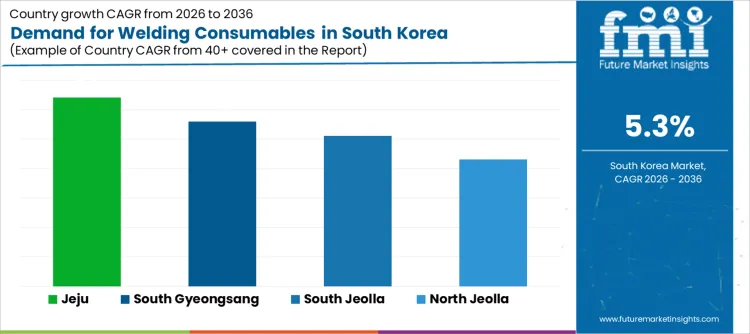
The regional analysis shows a distinct pattern where coastal industrial belts drive massive volume, while inland areas focus on specialized manufacturing. High-growth areas are characterizing their development by upgrading shipyard facilities and automotive lines. As distinct provinces implement industrial revitalization projects, the utilization of joining materials is becoming tailored to local heavy industry specializations.
| Region | CAGR (2026 to 2036) |
|---|---|
| Jeju | 6.4% |
| South Gyeongsang | 5.6% |
| South Jeolla | 5.1% |
| North Jeolla | 4.3% |
Why is Infrastructure Development Driving Demand in Jeju?
Adoption of welding materials in Jeju is projected to expand at a CAGR of 6.4%. While not a heavy industry hub, Jeju is undergoing significant infrastructure expansion, including the development of a second airport and renewable energy facilities. The demand is driven by the construction sector requiring stick electrodes and flux-cored wires for on-site fabrication of steel structures and reinforcements. Maintenance of marine tourism infrastructure, such as ports and ferries, also contributes to a steady aftermarket demand for repair consumables.
How is Shipbuilding Dominance Shaping South Gyeongsang?
Sales of industrial consumables in South Gyeongsang are likely to reach a CAGR of 5.6%. This region is the undisputed heart of global shipbuilding, hosting the Geoje and Ulsan shipyards. The demand is fueled by the continuous fabrication of mega-vessels, offshore platforms, and floating production units. The concentration of tier-1 suppliers in this belt ensures a relentless appetite for high-efficiency wires and submerged arc fluxes, making it the most critical revenue generator for the national sector.
What Role Does Energy Infrastructure Play in South Jeolla?
The welding sector in South Jeolla is anticipated to rise at a CAGR of 5.1%. Anchored by the Yeosu petrochemical complex and Mokpo's shipbuilding clusters, this region sees diverse industrial demand. Petrochemical plants require specialized stainless steel and nickel-alloy consumables for pipe fabrication and maintenance. Simultaneously, the region's focus on offshore wind farm development drives the need for heavy-duty structural welding solutions capable of withstanding harsh marine environments.
How is Automotive Revitalization Influencing North Jeolla?
Deployment of joining technologies in North Jeolla is expected to increase at a CAGR of 4.3%. The region, particularly Gunsan, is working to revitalize its automotive manufacturing base with a focus on commercial and electric vehicles. The demand is driven by the retooling of factories which requires advanced arc welding supplies for chassis and body assembly. Additionally, the Saemangeum development project attracts investments in renewable energy manufacturing, creating new opportunities for specialized welding applications.
What Strategies Define Leadership in the Welding Sector?
The competitive landscape is firmly anchored by Lincoln Electric Holdings, Inc., which commands a dominant 40.0% share of the sector. Their strategy focuses on total welding solutions, integrating power sources, automation, and consumables to lock in large enterprise customers like shipyards and heavy equipment manufacturers. By offering proprietary "CheckPoint" production monitoring software, they provide value beyond the consumable itself. Competitors like ESAB and Kobelco are countering by specializing in high-alloy fillers for cryogenic applications, targeting the lucrative LNG carrier segment where material performance is non-negotiable.
How Are Companies Addressing the Automation Shift?
Leading players are aggressively pivoting their product portfolios to support robotic welding. ITW Welding and Voestalpine Böhler Welding are developing wires with enhanced feedability and consistent arc characteristics to minimize downtime in automated cells. A key trend is the acquisition of local distributors to strengthen supply chain responsiveness in the key industrial hubs of Ulsan and Busan. Furthermore, domestic companies like Kiswel are focusing on cost leadership in the flux-cored wire segment, leveraging their proximity to major end-users to offer just-in-time delivery and technical support that rivals global giants.
Key Companies
- Lincoln Electric Holdings, Inc.
- ESAB (part of Colfax Corporation)
- Voestalpine Böhler Welding
- ITW Welding (Illinois Tool Works Inc.)
- Kobe Steel, Ltd.
- Kiswel Ltd.
- Hyundai Welding Co., Ltd.
- Chosun Welding
- Golden Bridge Welding Materials
Scope of Report
| Items | Values |
|---|---|
| Quantitative Units | USD Million |
| Consumables | Stick Electrodes, Gases, Strip Cladding Electrodes, Submerged Arc Wires and Fluxes, Wires, Others |
| Welding Type | Arc Welding, Energy Beam Welding, Plasma Arc Welding, Submerged Arc Welding, Electro Slag Welding |
| End Use | Automotive, Construction, Oil and Gas, Marine, Power Generation |
| Regions Covered | Jeju, South Gyeongsang, South Jeolla, North Jeolla |
| Key Companies Profiled | Lincoln Electric, ESAB, Voestalpine, ITW, Kobe Steel, and others. |
Demand for Welding Consumables in South Korea by Segments
By Consumables:
- Stick Electrodes
- Gases
- Strip Cladding Electrodes
- Submerged Arc Wires and Fluxes
- Wires
- Others
By Welding Type:
- Arc Welding
- Energy Beam Welding
- Plasma Arc Welding
- Submerged Arc Welding
- Electro Slag Welding
By End Use:
- Automotive
- Construction
- Oil and Gas
- Marine
- Power Generation
Bibliography
- Ministry of Trade, Industry and Energy. (2025, July 13). Measures to strengthen competitiveness for the shipbuilding and marine equipment ecosystem. Ministry of Trade, Industry and Energy, Republic of Korea.
- Ministry of Trade, Industry and Energy. (2024, July 2). K-Shipbuilding super gap vision 2040 and public-private joint technology roadmap announcement. Ministry of Trade, Industry and Energy, Republic of Korea.
- Korea Iron and Steel Association. (2025, April). Steel data monthly statistics. Korea Iron and Steel Association, Republic of Korea.
- Korea Iron and Steel Association. (2025). Steel report statistics portal. Korea Iron and Steel Association, Republic of Korea.
- Korea Automotive Technology Institute. (2025, March 10). 2024 automobile parts industry survey report. Korea Automotive Technology Institute, Republic of Korea.
Frequently Asked Questions
How big is the demand for welding consumables in south korea in 2026?
The demand for welding consumables in south korea is estimated to be valued at USD 631.9 million in 2026.
What will be the size of welding consumables in south korea in 2036?
The market size for the welding consumables in south korea is projected to reach USD 1,059.1 million by 2036.
How much will be the demand for welding consumables in south korea growth between 2026 and 2036?
The demand for welding consumables in south korea is expected to grow at a 5.3% CAGR between 2026 and 2036.
What are the key product types in the welding consumables in south korea?
The key product types in welding consumables in south korea are 0.25, 0.15, 0.12 and 0.095.
Which 0.62 segment is expected to contribute significant share in the welding consumables in south korea in 2026?
In terms of 0.62, 0.15 segment is expected to command 0.0% share in the welding consumables in south korea in 2026.
Preview the report firsthand - request a free sample
Get SampleGet the brochure for pricing and purchase details.
Get PDFTable of Content
- Executive Summary
- South Korea Market Outlook
- Demand-side Trends
- Supply-side Trends
- Technology Roadmap Analysis
- Analysis and Recommendations
- Market Overview
- Market Coverage / Taxonomy
- Market Definition / Scope / Limitations
- Market Background
- Market Dynamics
- Drivers
- Restraints
- Opportunity
- Trends
- Scenario Forecast
- Demand in Optimistic Scenario
- Demand in Likely Scenario
- Demand in Conservative Scenario
- Opportunity Map Analysis
- Product Life Cycle Analysis
- Supply Chain Analysis
- Investment Feasibility Matrix
- Value Chain Analysis
- PESTLE and Porter’s Analysis
- Regulatory Landscape
- Regional Parent Market Outlook
- Production and Consumption Statistics
- Import and Export Statistics
- Market Dynamics
- South Korea Market Analysis 2021 to 2025 and Forecast, 2026 to 2036
- Historical Market Size Value (USD Million) Analysis, 2021 to 2025
- Current and Future Market Size Value (USD Million) Projections, 2026 to 2036
- Y-o-Y Growth Trend Analysis
- Absolute $ Opportunity Analysis
- South Korea Market Pricing Analysis 2021 to 2025 and Forecast 2026 to 2036
- South Korea Market Analysis 2021 to 2025 and Forecast 2026 to 2036, By 0.385
- Introduction / Key Findings
- Historical Market Size Value (USD Million) Analysis By 0.385 , 2021 to 2025
- Current and Future Market Size Value (USD Million) Analysis and Forecast By 0.385 , 2026 to 2036
- 0.25
- 0.15
- 0.12
- 0.095
- 0.25
- Y-o-Y Growth Trend Analysis By 0.385 , 2021 to 2025
- Absolute $ Opportunity Analysis By 0.385 , 2026 to 2036
- South Korea Market Analysis 2021 to 2025 and Forecast 2026 to 2036, By 0.62
- Introduction / Key Findings
- Historical Market Size Value (USD Million) Analysis By 0.62, 2021 to 2025
- Current and Future Market Size Value (USD Million) Analysis and Forecast By 0.62, 2026 to 2036
- 0.15
- 0.1
- 0.08
- 0.05
- 0.15
- Y-o-Y Growth Trend Analysis By 0.62, 2021 to 2025
- Absolute $ Opportunity Analysis By 0.62, 2026 to 2036
- South Korea Market Analysis 2021 to 2025 and Forecast 2026 to 2036, By 0.42
- Introduction / Key Findings
- Historical Market Size Value (USD Million) Analysis By 0.42, 2021 to 2025
- Current and Future Market Size Value (USD Million) Analysis and Forecast By 0.42, 2026 to 2036
- 0.2
- 0.18
- 0.12
- 0.08
- 0.2
- Y-o-Y Growth Trend Analysis By 0.42, 2021 to 2025
- Absolute $ Opportunity Analysis By 0.42, 2026 to 2036
- Market Structure Analysis
- Competition Dashboard
- Competition Benchmarking
- Market Share Analysis of Top Players
- By Regional
- By 0.385
- By 0.62
- By 0.42
- Competition Analysis
- Competition Deep Dive
- Competition Deep Dive
- Assumptions & Acronyms Used
- Research Methodology


