

- Industry Size (2026)
- USD 1.91 Bn
- Forecast (2036)
- USD 3.39 Bn
- CAGR (2026 to 2036)
- 5.9%
Welding Consumables Industry Outlook in the UK 2026 to 2036
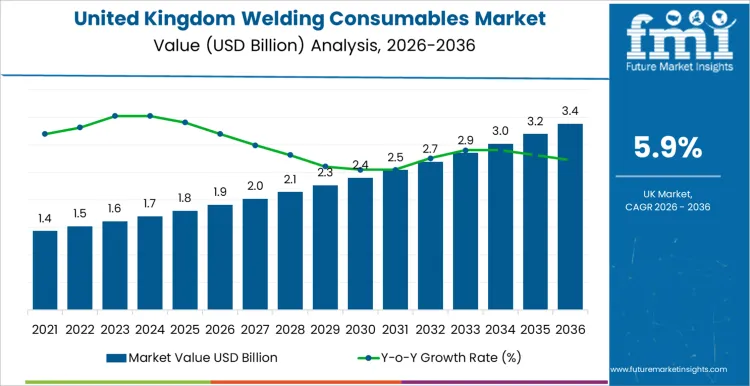
The welding consumables industry in the UK is projected to total USD 1.91 billion in 2026, with demand expected to rise to USD 3.39 billion by 2036 at a 5.9% CAGR. This increase is powered by one core reality: manufacturing and infrastructure assets still depend on strong joints that stay reliable under vibration, heat cycling, corrosion exposure, and long duty cycles.
Welding consumables sit at the centre of this reliability story. They influence bead quality, penetration consistency, defect rates, rework volume, and overall project speed. For CEOs and operations leaders, performance in this category shows up as fewer shutdowns, tighter warranties, and stronger throughput. For procurement teams, the focus sits on quality stability, supply continuity, and predictable performance across different base metals and working environments.
Demand is expanding across automotive production, construction activity, oil and gas maintenance, marine fabrication, and power-generation component work. These end uses are shifting toward higher accountability on traceability, weld quality documentation, worker safety, and process discipline. That combination pushes buyers toward suppliers that can deliver product consistency and strong technical support rather than only competitive pricing.
Quick Stats for the Welding Consumables Industry in the UK
- Welding Consumables Valuation in the UK (2026): USD 1.91 billion
- Welding Consumables Forecast Valuation in the UK (2036): USD 3.39 billion
- Welding Consumables Forecast CAGR (2026 to 2036): 5.9%
- Leading Regional Growth: England (6.5%)
- Leading Consumables: Stick Electrodes (37.6% share)
- Leading Welding Type: Arc Welding (43.0% share)
- Leading End Use: Automotive (38.5% share)
- Key Companies Profiled: Lincoln Electric Holdings, Inc.; ESAB (part of Colfax Corporation); Voestalpine Böhler Welding; ITW Welding (Illinois Tool Works Inc.); Kobe Steel, Ltd.
Why is the UK a High-Value Hub for Welding Consumables Adoption?
The UK is a high-value hub because welding remains a foundation capability for production lines, fabrication yards, maintenance operations, and energy infrastructure. Demand is supported by three practical drivers: industrial output requirements, asset integrity needs, and stricter safety expectations for welding work.
Automotive remains a major demand anchor. UK production volumes still require consistent joining solutions across body structures, chassis components, battery enclosures, and exhaust systems. SMMT notes that in 2024 the UK produced 779,584 cars and 125,649 commercial vehicles, reinforcing ongoing manufacturing activity that depends on predictable joining performance. As vehicle architectures evolve, welding operations increasingly need stable wire feed behaviour, controlled spatter, and repeatable weld profiles that reduce downstream defects.
Construction activity is another demand engine. Even during periods of uneven output, structural steelwork, repair work, and infrastructure upgrades continue to require joining consumables. ONS reports that total construction output fell 0.3% in the three months to October 2025, with new work rising 0.1% over the same period, showing mixed activity across segments. This type of pattern supports steady demand for consumables used in site fabrication, structural reinforcement, and ongoing repair programmes.
Quality discipline also supports demand. In many regulated fabrication environments, welding is treated as a controlled process with quality system expectations. ISO outlines the ISO 3834 series as quality requirements for fusion welding of metallic materials, used across workshops and field installation sites. Buyers align procurement to reduce non-conformance risk, particularly where welding quality failures create expensive rework or safety exposure.
Strategic planning in this space often runs alongside the broader welding materials outlook, while capital planning for production upgrades frequently aligns with the welding equipment and consumables outlook.
How is Welding Consumables Demand Segmented by Consumables, Welding Type, and End Use?
UK demand is segmented by what fabricators need to achieve in the real world: strong joints, stable productivity, reduced defect rates, and safer working environments.
Why are Stick Electrodes still the workhorse choice for many Fabrication and Repair Jobs?
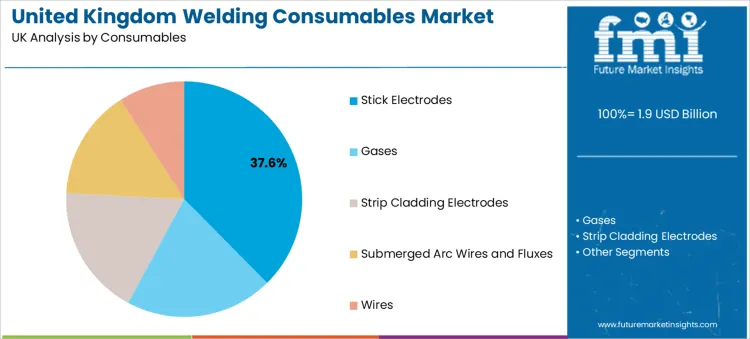
Stick electrodes hold a 37.6% share, making them the leading consumables category. Their strength sits in practicality. Stick electrodes perform well in maintenance work, outdoor conditions, constrained access situations, and repair tasks where setup simplicity matters. Many operations value stick electrodes because they support quick deployment and reliable results across different job types, including fieldwork where controlled environments are not guaranteed.
For stakeholders managing uptime targets, this segment reduces operational friction. A maintenance manager can deploy stick electrodes quickly for repairs, reinforcement, and patching jobs without complex equipment requirements. This is a meaningful reason the segment remains strong even as automation adoption grows across high-volume manufacturing lines.
Procurement decisions around filler selection often link with performance expectations seen in welding filler metals, especially when buyers need dependable mechanical strength and acceptable weld appearance with minimal rework.
What makes Arc Welding the dominant Process Route across high-volume Welding Requirements?
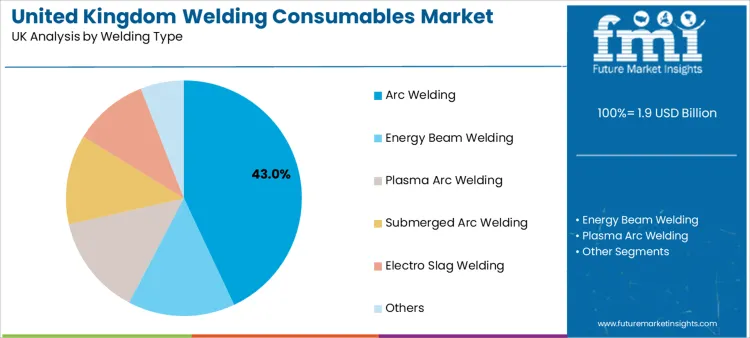
Arc welding accounts for a 43.0% share, reflecting its broad relevance across manufacturing, fabrication, and industrial maintenance. Arc welding supports strong penetration, durable joints, and scalable operations across multiple metal thicknesses. It fits both manual work and automated cells, which makes it versatile across automotive plants, structural fabrication shops, and energy-component suppliers.
Arc welding’s dominance creates a direct demand pull for compatible consumables, stable wire feed products, and flux systems that support consistent bead geometry and controlled spatter. This segment’s performance requirements often align with the process intensity captured in the robotics welding outlook, where manufacturers prioritise repeatability, cycle-time control, and production stability.
Why does automotive create the strongest pull for consistent consumables performance in the UK?
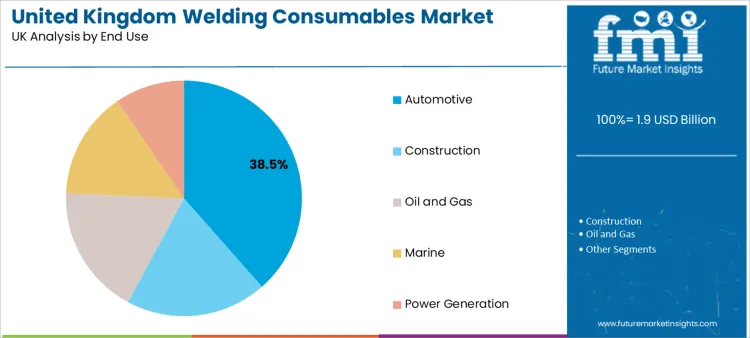
Automotive represents 38.5% share, placing it as the most influential end-use segment. Automotive welding requirements emphasise repeatability, speed, and defect control. A small inconsistency in consumables can trigger scrap, line stoppages, or downstream failure risk. That is why automotive plants prioritise consumables that maintain arc stability, predictable metal transfer, and dependable quality across high throughput.
This segment rewards suppliers that provide technical support and stable batch quality, especially for lines that run tight cycle times and demand clean weld appearance. The end-use requirements for repeatability and long-term joint integrity often align with demand patterns within welding electrodes and rods, particularly where manufacturers depend on consistent mechanical performance under repetitive duty cycles.
What are the Dynamics, Restraints, Opportunities, and Threats Shaping this Sector?
How do Industrial Output Requirements and Reliability Expectations drive Demand?
The strongest driver is the requirement for durable joints across critical assets. Automotive output remains meaningful, supported by ongoing production volumes reported by SMMT. Construction and repair work sustain demand, even during uneven output periods reported by ONS. These sectors rely on consumables that reduce defect rates and support fast completion without compromising quality.
Quality requirements are another driver. ISO 3834 provides a quality requirements framework for fusion welding of metallic materials. This pushes buyers toward documented product consistency and process discipline, especially in regulated fabrication environments.
What restraints limit adoption speed or shift purchasing patterns?
Workforce safety expectations are a decisive restraint and a major design constraint. HSE states that all welding fume can cause lung cancer, and employers must put controls in place to protect workers. This raises the bar for fume management, ventilation controls, and safe process planning, shaping which consumables and process settings are chosen on shop floors.
Cost volatility is another restraint. Consumables pricing can move with raw material costs, alloying inputs, and supply conditions. Buyers often respond by dual sourcing, shifting toward standardised specifications, and negotiating supply stability commitments.
Where do the Strongest Opportunities exist for Suppliers and Service Partners?
| Opportunity | Expected Impact |
|---|---|
| Automation-led quality improvement | Robotic welding cells increase demand for stable-feed, low-spatter consumables that improve first-pass yield. Manufacturers often align consumable selection with welding guns to maintain consistent deposition and arc stability. |
| Higher-integrity heavy fabrication | Thick-section builds and corrosion-resistant overlays strengthen demand for submerged arc wires, fluxes, and cladding electrodes. Buyers prioritise performance-aligned inputs such as stainless steel submerged arc welding wire for durable joint integrity. |
| Process gas optimisation | Shielding gas selection remains critical for weld quality, oxidation control, and appearance consistency. Procurement teams often standardise supply strategies around argon gas to stabilise shielding performance. |
What Threats can disrupt Growth Trajectories and Supplier Positioning?
Operational disruption is a key threat. If fabrication sites experience production slowdowns, consumables demand can soften quickly. Safety compliance failures create another threat. HSE guidance requires controls for welding fume exposure across welding tasks, including small amounts of welding. This increases enforcement risk for employers, which can shift operations toward different processes, enhanced ventilation investments, or revised work practices.
Supply-side risk also matters. Semiconductor constraints can affect automation equipment expansion, while raw material volatility influences consumables pricing. Suppliers that can provide stable quality and dependable lead times gain trust in this environment.
How is Welding Consumables Demand Evolving across Key Regions in the UK?
Regional demand is shaped by concentration of manufacturing plants, fabrication clusters, construction activity, and energy infrastructure needs.
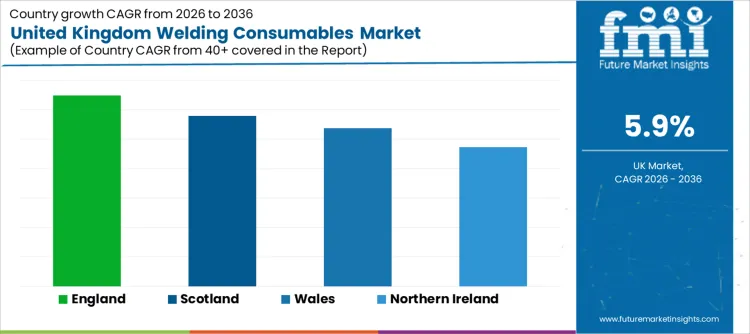
| Region | CAGR (2026-2036) |
|---|---|
| England | 6.5% |
| Scotland | 5.8% |
| Wales | 5.4% |
| Northern Ireland | 4.7% |
Why is England leading consumption growth through production density and fabrication throughput?
The welding consumables ecosystem in England is likely to pivot at a 6.5% CAGR. A higher concentration of automotive and industrial manufacturing sites, construction activity, and integrated supply chains will act as key growth accelerators from 2026 to 2036.
Fabrication throughput is typically higher, which supports steady consumption of stick electrodes, welding wires, submerged arc inputs, and shielding gases. England’s scale advantage also supports faster adoption of automation and quality-monitoring practices.
How is Scotland sustaining demand through heavy engineering and maintenance-led welding needs?
Scotland’s welding consumables landscape is anticipated to advance at a 5.8% CAGR until 2036. The scope for welding consumables uptake in Scotland supported by ongoing maintenance work, fabrication requirements, and industrial asset support. Consumables demand is reinforced by repair cycles, integrity-based maintenance, and welding tasks tied to industrial equipment servicing where reliability remains central.
What is shaping Wales as it expands demand through construction-linked fabrication and manufacturing requirements?
Expected to rise at a CAGR of 5.4%, the welding consumables sector in Wales is reflecting steady growth tied to structural work, local manufacturing requirements, and planned refurbishment activities. End users of welding consumables in Wales prioritise products delivering predictable results with minimal rework, especially in project environments where schedule discipline matters.
Why is Northern Ireland progressing through focused fabrication needs and disciplined procurement behaviour?
Welding consumables demand in Norther Ireland is expected to advance at a 4.7% CAGR from 2026 to 2036. This expansion is likely to be shaped by measured adoption across fabrication and maintenance use cases.
Procurement teams often focus on standardised specifications, predictable supply, and quality assurance support to keep operations stable across smaller-scale but consistent demand pockets.
What Defines the Competitive Landscape for Welding Consumables in the UK?
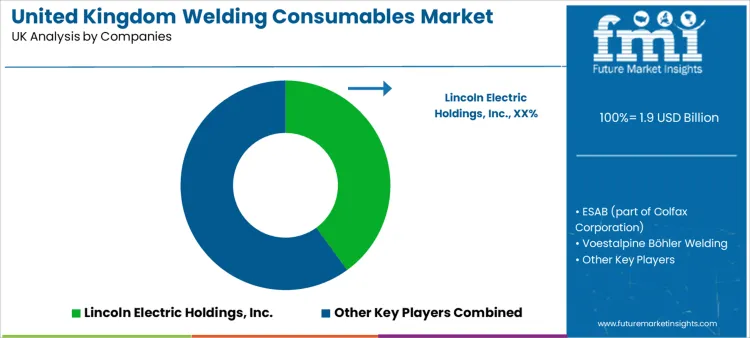
Competition is shaped by performance consistency, technical support strength, and supply reliability. Buyers evaluate suppliers on how well consumables perform across different base metals, thickness ranges, and operating environments. They also look for stable batch quality, reduced defect risk, and reliable documentation that supports inspection readiness.
Lincoln Electric competes strongly through broad consumables portfolios and practical application support. ESAB holds strong positioning through recognised product breadth and welding solutions. Voestalpine Böhler Welding is known for high-performance consumables used in demanding fabrication environments. ITW Welding supports process stability and industrial customer needs through product and technology depth.
Kobe Steel contributes recognised welding consumables capabilities, especially in heavy fabrication and industrial applications. Winning suppliers tend to pair consumables with technical partnership. That includes procedure guidance, training support, and troubleshooting capability that reduces downtime and improves first-pass yield.
Key Industry Participants
- Lincoln Electric Holdings, Inc.
- ESAB (part of Colfax Corporation)
- Voestalpine Böhler Welding
- ITW Welding (Illinois Tool Works Inc.)
- Kobe Steel, Ltd.
Scope of Report
| Items | Values |
|---|---|
| Quantitative Units | USD Billion |
| Consumables | Stick Electrodes; Gases; Strip Cladding Electrodes; Submerged Arc Wires and Fluxes; Wires; Others |
| Welding Type | Arc Welding; Energy Beam Welding; Plasma Arc Welding; Submerged Arc Welding; Electro Slag Welding; Others |
| End Use | Automotive; Construction; Oil and Gas; Marine; Power Generation |
| Regions Covered | England; Scotland; Wales; Northern Ireland |
| Key Companies Profiled | Lincoln Electric Holdings, Inc.; ESAB (part of Colfax Corporation); Voestalpine Böhler Welding; ITW Welding (Illinois Tool Works Inc.); Kobe Steel, Ltd. |
Welding Consumables Demand in the UK by Segment
By Consumables
- Stick Electrodes
- Gases
- Strip Cladding Electrodes
- Submerged Arc Wires and Fluxes
- Wires
- Others
By Welding Type
- Arc Welding
- Energy Beam Welding
- Plasma Arc Welding
- Submerged Arc Welding
- Electro Slag Welding
- Others
By End Use
- Automotive
- Construction
- Oil and Gas
- Marine
- Power Generation
By Region
- England
- Scotland
- Wales
- Northern Ireland
Bibliography
- Health and Safety Executive. (2025). Welding fume: Protect your workers.
- International Organization for Standardization. (2021). ISO 3834-1: Quality requirements for fusion welding of metallic materials Part 1: Criteria for the selection of the appropriate level of quality requirements.
- Office for National Statistics. (2025). Construction output in Great Britain: October 2025.
- Society of Motor Manufacturers and Traders. (2025). SMMT motor industry facts 2025.
Frequently Asked Questions
How big is the demand for welding consumables in uk in 2026?
The demand for welding consumables in uk is estimated to be valued at USD 1.9 billion in 2026.
What will be the size of welding consumables in uk in 2036?
The market size for the welding consumables in uk is projected to reach USD 3.4 billion by 2036.
How much will be the demand for welding consumables in uk growth between 2026 and 2036?
The demand for welding consumables in uk is expected to grow at a 5.9% CAGR between 2026 and 2036.
What are the key product types in the welding consumables in uk?
The key product types in welding consumables in uk are stick electrodes, gases, strip cladding electrodes, submerged arc wires and fluxes and wires.
Which welding type segment is expected to contribute significant share in the welding consumables in uk in 2026?
In terms of welding type, arc welding segment is expected to command 43.0% share in the welding consumables in uk in 2026.
Preview the report firsthand - request a free sample
Get SampleGet the brochure for pricing and purchase details.
Get PDFTable of Content
- Executive Summary
- UK Market Outlook
- Demand-side Trends
- Supply-side Trends
- Technology Roadmap Analysis
- Analysis and Recommendations
- Market Overview
- Market Coverage / Taxonomy
- Market Definition / Scope / Limitations
- Market Background
- Market Dynamics
- Drivers
- Restraints
- Opportunity
- Trends
- Scenario Forecast
- Demand in Optimistic Scenario
- Demand in Likely Scenario
- Demand in Conservative Scenario
- Opportunity Map Analysis
- Product Life Cycle Analysis
- Supply Chain Analysis
- Investment Feasibility Matrix
- Value Chain Analysis
- PESTLE and Porter’s Analysis
- Regulatory Landscape
- Regional Parent Market Outlook
- Production and Consumption Statistics
- Import and Export Statistics
- Market Dynamics
- UK Market Analysis 2021 to 2025 and Forecast, 2026 to 2036
- Historical Market Size Value (USD Million) Analysis, 2021 to 2025
- Current and Future Market Size Value (USD Million) Projections, 2026 to 2036
- Y-o-Y Growth Trend Analysis
- Absolute $ Opportunity Analysis
- UK Market Pricing Analysis 2021 to 2025 and Forecast 2026 to 2036
- UK Market Analysis 2021 to 2025 and Forecast 2026 to 2036, By Consumables
- Introduction / Key Findings
- Historical Market Size Value (USD Million) Analysis By Consumables , 2021 to 2025
- Current and Future Market Size Value (USD Million) Analysis and Forecast By Consumables , 2026 to 2036
- Stick Electrodes
- Gases
- Strip Cladding Electrodes
- Submerged Arc Wires and Fluxes
- Wires
- Stick Electrodes
- Y-o-Y Growth Trend Analysis By Consumables , 2021 to 2025
- Absolute $ Opportunity Analysis By Consumables , 2026 to 2036
- UK Market Analysis 2021 to 2025 and Forecast 2026 to 2036, By Welding Type
- Introduction / Key Findings
- Historical Market Size Value (USD Million) Analysis By Welding Type, 2021 to 2025
- Current and Future Market Size Value (USD Million) Analysis and Forecast By Welding Type, 2026 to 2036
- Arc Welding
- Energy Beam Welding
- Plasma Arc Welding
- Submerged Arc Welding
- Electro Slag Welding
- Others
- Arc Welding
- Y-o-Y Growth Trend Analysis By Welding Type, 2021 to 2025
- Absolute $ Opportunity Analysis By Welding Type, 2026 to 2036
- UK Market Analysis 2021 to 2025 and Forecast 2026 to 2036, By End Use
- Introduction / Key Findings
- Historical Market Size Value (USD Million) Analysis By End Use, 2021 to 2025
- Current and Future Market Size Value (USD Million) Analysis and Forecast By End Use, 2026 to 2036
- Automotive
- Construction
- Oil and Gas
- Marine
- Power Generation
- Automotive
- Y-o-Y Growth Trend Analysis By End Use, 2021 to 2025
- Absolute $ Opportunity Analysis By End Use, 2026 to 2036
- Market Structure Analysis
- Competition Dashboard
- Competition Benchmarking
- Market Share Analysis of Top Players
- By Regional
- By Consumables
- By Welding Type
- By End Use
- Competition Analysis
- Competition Deep Dive
- Lincoln Electric Holdings, Inc.
- Overview
- Product Portfolio
- Profitability by Market Segments (Product/Age /Sales Channel/Region)
- Sales Footprint
- Strategy Overview
- Marketing Strategy
- Product Strategy
- Channel Strategy
- ESAB (part of Colfax Corporation)
- Voestalpine Böhler Welding
- ITW Welding (Illinois Tool Works Inc.)
- Kobe Steel, Ltd.
- Lincoln Electric Holdings, Inc.
- Competition Deep Dive
- Assumptions & Acronyms Used
- Research Methodology


