

- Market Size (2026)
- USD 714.5 Mn
- Forecast (2036)
- USD 2672.1 Mn
- CAGR (2026 to 2036)
- 14.1%
How big is Sputum Based Lung Cancer Biomarker Market in 2026?
USD 714.5 million in 2026 and USD 2672.1 million by 2036 at a 14.1% CAGR.
Sales in the sputum based lung cancer biomarker market are projected to advance at 14.1% CAGR from 2026 to 2036, driven by demand for noninvasive risk clarification. The forecast expands valuation from USD 714.5 million in 2026 to USD 2672.1 million by 2036. Sputum tests can complement established lung cancer diagnostics without immediate invasive sampling across selected nodule-management pathways. In March 2026, bioAffinity reported that CyPath Lung test volumes increased 99% during 2025 and ordering offices increased 67%. The utilization data confirm routine central-laboratory use but do not establish consistent payer coverage across health plans. Commercial adoption depends on reliable collection and timely reporting that changes the next physician decision. Diagnostic programs also need clear rules for inadequate samples and discordant results to support routine nodule management.
Commercialization follows distinct operating models across national health systems and laboratory networks with different approval and service routes. United States physicians can order CyPath Lung through a central laboratory that manages specimen processing and reporting. Chinese hospitals can use Creative Biosciences' Lunsafe methylation kit through a laboratory-owned clinical testing model. Both models require validated extraction controls and dependable specimen transport to support a clinical decision. Laboratories selecting molecular diagnostic platforms also need compatible instruments and technician training for the approved specimen claim. Liquid biopsy workflows must account for sputum cellularity, with collection quality determining whether molecular or cellular analysis remains interpretable. Each commercial model needs transparent service ownership from specimen dispatch through the final physician report.
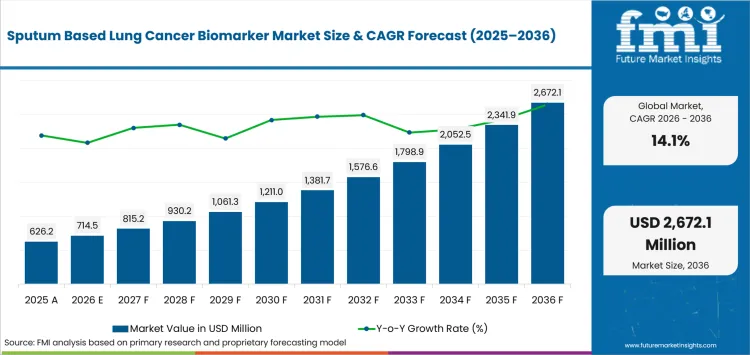
Key Takeaways of the Sputum Based Lung Cancer Biomarker Market
- DNA methylation biomarkers are projected to hold 31.1% of biomarker type demand in 2026, capturing stable epigenetic changes from exfoliated respiratory cells without invasive procedures, with Creative Biosciences' Lunsafe kit offering a direct commercial example of methylation detection in routine practice.
- PCR-based assays are forecast to represent 40.4% of technology demand in 2026, driven by established amplification hardware and laboratory familiarity with targeted analytical designs across controlled molecular workflows.
- Early lung cancer screening is estimated to account for 39.4% of application demand in 2026, positioned as complementary to low-dose CT imaging for noninvasive risk clarification rather than a replacement for mortality-based screening programs.
- NSCLC is anticipated to capture 56.5% of cancer type demand in 2026, reflecting its broad histologic composition and the larger diagnostic workload it generates across pulmonary referral pathways.
- Japan leads country growth at a 17.4% CAGR through 2036, followed by South Korea at 16.4% CAGR supported by an established national LDCT screening pathway.
- Creative Biosciences and bioAffinity Technologies lead test development, while VisionGate, Thermo Fisher Scientific, and Roche Diagnostics compete through cellular imaging platforms and compatible PCR amplification systems.
Analyst Perspective
"The sputum-based lung cancer biomarker market is increasingly shaped by clinical utility rather than biomarker performance alone. Healthcare providers are assessing whether testing improves defined diagnostic decisions while maintaining sample adequacy, workflow efficiency, and manageable interpretation requirements. Companies that establish strong clinical validation, reliable sample-to-result processes, and clear service responsibilities will be better positioned to support broader adoption."
— Anurag Sharma, Principal Analyst at Future Market Insights
Source: FMI's proprietary forecasting model and primary research
How is the Sputum-Based Lung Cancer Biomarker Market segmented?
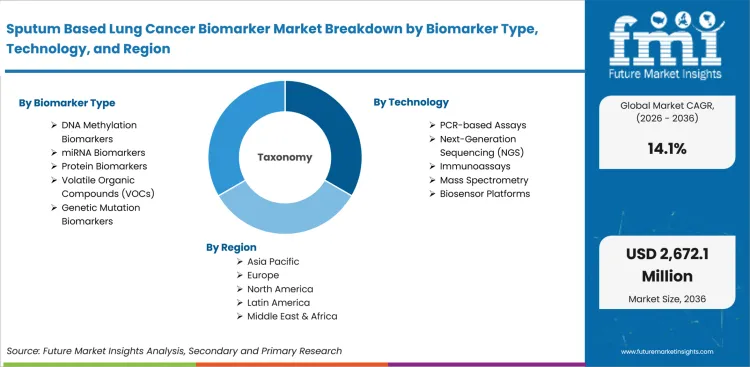
The sputum based lung cancer biomarker industry is segmented by biomarker type, technology, application, cancer type, and region.
The segmentation framework separates biological targets from laboratory methods and clinical decisions across the complete diagnostic pathway. Biomarker type covers DNA methylation and miRNA signals that laboratories recover from sputum during controlled molecular testing. Protein biomarkers and volatile organic compounds form separate categories alongside genetic mutation markers used in respiratory analysis. Technology analysis compares PCR-based assays with next-generation sequencing and immunoassays that specialist laboratories use during diagnostic testing. Mass spectrometry and biosensor platforms provide additional routes for targeted or pattern-based detection within controlled workflows. Application categories distinguish early screening from high-risk screening and disease prognosis across separate clinical decisions. Treatment response monitoring forms another use case that requires repeated collection and interpretable longitudinal results. Cancer type analysis separates NSCLC from SCLC through different prevalence profiles and diagnostic pathways across routine pulmonary care. Regional analysis places these categories within cancer diagnostic pathways that have different screening rules and laboratory access.
What supports demand for DNA methylation biomarkers within the biomarker type category?
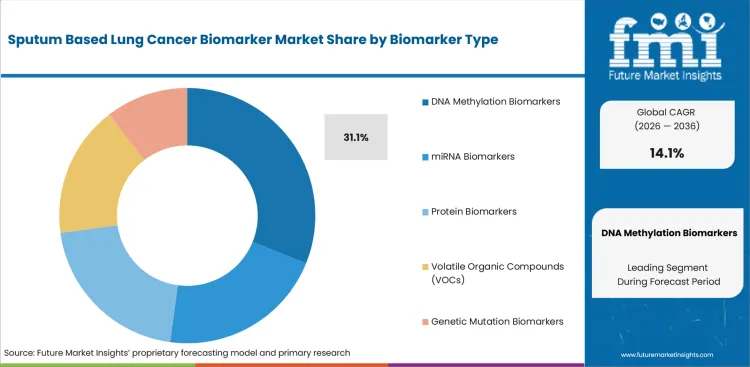
Methylation markers capture stable epigenetic changes from exfoliated respiratory cells without requiring an invasive tissue procedure. Creative Biosciences currently lists Lunsafe for HOXB4 and SRCIN1 methylation detection in sputum through fluorescent PCR. The commercial kit gives clinical laboratories a direct commercial example of DNA methylation analysis in routine practice. Routine use also requires reliable methylation conversion kits and documented sample-adequacy controls throughout bisulfite preparation and analysis.
- DNA methylation biomarkers are set to lead the biomarker type category with 31.1% share in 2026, underpinned by stable molecular targets that fit established real-time PCR workflows. Their share position reflects direct relevance to early risk clarification rather than a universal advantage across every clinical setting.
- Hospitals favor methylation assays that combine noninvasive collection with defined positivity thresholds and compatible instruments. Poor sputum cellularity can weaken adoption by increasing recollection needs and delaying clinical interpretation across routine workflows. Developers therefore need stable controls that clearly separate assay failure from a genuinely negative clinical result.
How do PCR-based assays shape demand within the technology category?
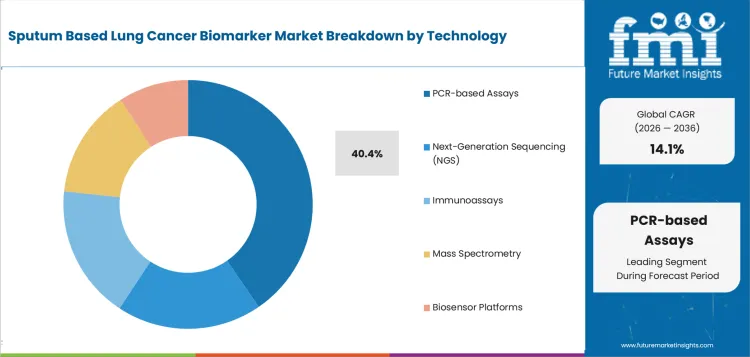
Real-time PCR gives molecular laboratories a familiar method for measuring targeted methylation or mutation signals from prepared respiratory samples. Existing amplification systems reduce training needs across laboratories that already use standardized extraction and quality controls. Tellgen lists a SHOX2 and RASSF1A methylation assay for bronchoalveolar lavage on several real-time PCR instruments. The lavage-fluid assay helps compare platform requirements but does not prove a commercial sputum claim. Broader point-of-care molecular testing provides workflow comparisons although current sputum cancer assays generally require controlled laboratory processing.
- PCR-based assays are forecast to represent 40.4% of the technology category in 2026, attributable to established amplification hardware and targeted analytical designs. Their position reflects laboratory familiarity and controlled assay economics across molecular workflows with established quality assurance procedures.
- Diagnostic laboratories select PCR systems with validated extraction controls and contamination safeguards alongside reproducible thresholds and stable reagents. Clinical adoption requires specimen-specific performance, validation for lavage fluid does not establish a valid sputum claim. Laboratory directors also need proficiency controls that identify contamination without delaying routine reports for patient testing.
Why is early lung cancer screening important within the application category?
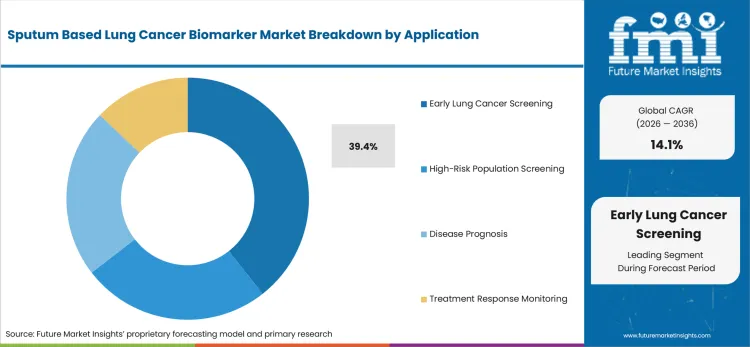
Early screening programs need tests that identify elevated risk without replacing the mortality evidence supporting low-dose computed tomography. Accessible sputum collection can support triage around imaging findings through carefully defined validation and referral rules. The UK National Screening Committee reported in January 2025 that more than one million invitations had been accepted through England's targeted program. The January 2025 update reported over 5,500 lung cancers and stated that more than three quarters were diagnosed at stages one or two.
- The application category is forecast to be led by early lung cancer screening at 39.4% share in 2026, supported by accessible collection for risk clarification around imaging. The application remains complementary to established imaging rather than replacing mortality-based screening across defined high-risk populations.
- Screening services need a clear target population plus rapid referral routes and collection support through community pathways outside specialist hospitals. Programs also require payer approval and clinician education, public screening pathways rarely include new sputum assays without local effectiveness evidence.
How does non-small cell lung cancer shape the cancer type category?
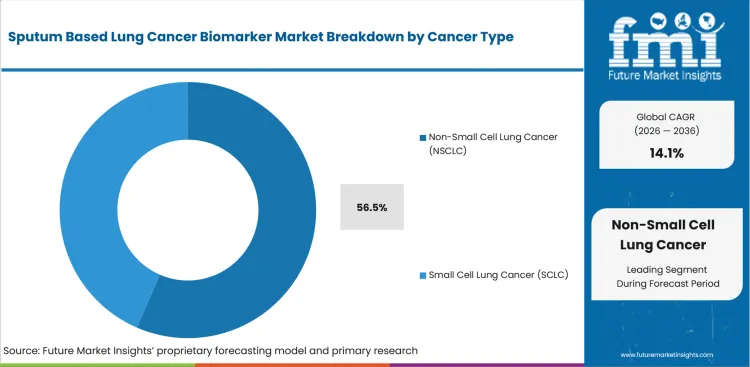
NSCLC includes several histologic groups that create a larger diagnostic population than small cell lung cancer across routine care. The National Cancer Institute reported in May 2025 that adenocarcinoma represents about 40% of lung cancers and squamous carcinoma represents about 25%. The reported proportions explain why NSCLC creates a broad testing workload across pulmonary nodule and suspected-cancer pathways. Laboratories comparing biomarker immunoassays need disease-specific performance data rather than pooled validation across unrelated tumor types.
- NSCLC is likely to capture 56.5% share within the cancer type category in 2026, associated with its broad histologic composition and diagnostic workload. The category supports assay development across several common lung cancer presentations and routine hospital pulmonary referral routes.
- Pulmonologists need results that distinguish malignant risk from benign inflammatory conditions across common NSCLC presentations. Adoption depends on stage-specific sensitivity and specificity, supported by reports that explain decision impact across histologic subtypes. Laboratories also need reference ranges that account for smoking history and inflammatory respiratory disease during routine assessment.
What are the drivers, restraints, and opportunities in the Sputum-Based Lung Cancer Biomarker Market?
Demand grows through noninvasive risk clarification, adoption slows through uncertain clinical placement, and commercial opportunity concentrates in governed pathways that connect collection with a documented next action.
- Driver: Imaging programs create a large pool of indeterminate findings that need accurate and accessible risk clarification.
- Restraint: Variable sputum quality and uncertain payer coverage can interrupt routine testing across decentralized clinical pathways.
- Opportunity: Integrated collection and interpretation services can reduce implementation burden for pulmonology and screening programs.
Indeterminate imaging findings is one of the notable growth driver for tests that can refine malignancy risk without immediate invasive sampling. The CDC reported in May 2026 that about 18% of eligible United States adults had received recommended lung cancer screening. Greater screening participation would place more CT findings into radiology and pulmonary follow-up pathways that require risk clarification. Sputum biomarker developers gain commercial relevance through evidence that their results change surveillance intensity or biopsy referral.
Specimen variability creates a material restraint through insufficient cellular content and inconsistent samples across collection days. Home collection therefore needs clear instructions and transport controls that protect cellular material throughout a multiday process. VisionGate describes a three-day morning sputum collection process followed by shipment for standardized Cell-CT preparation. Standardized collection materials and clear rejection criteria can reduce uncertainty without hiding the remaining biological variation. Clinics may avoid adoption if recollection rates or result timing disrupt scheduled nodule-management decisions across pulmonary care.
An integrated service model creates opportunity by coordinating collection and logistics with laboratory processing across the diagnostic pathway. The same service can cover interpretation and clinician support for complex results that require specialist review. Clear service ownership reduces fragmentation across multistep diagnostic processes and improves accountability for failed specimens. Laboratories offering clinical diagnostic services can combine technical processing with structured clinician support under one service agreement. bioAffinity's CyPath Lung pathway uses home collection and central testing through a CAP-accredited CLIA laboratory. Commercial contracts should define sample failure handling and report turnaround alongside benefit verification and escalation routes for uncertain findings.
Which country CAGRs are profiled in the Sputum-Based Lung Cancer Biomarker Market?
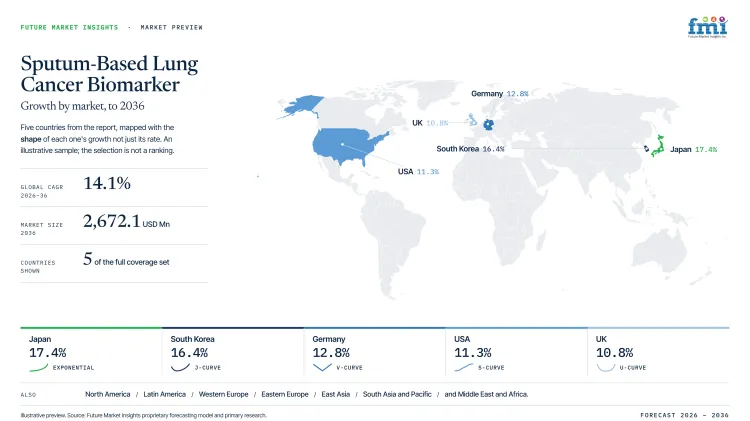
| Country | CAGR |
|---|---|
| USA | 11.3% |
| UK | 10.8% |
| Germany | 12.8% |
| Japan | 17.4% |
| South Korea | 16.4% |
How do country-level CAGRs compare in the Sputum-Based Lung Cancer Biomarker Market?
Country growth rates separate into three groups rather than one uniform pattern across the five profiled markets. Japan and South Korea occupy the upper band with a one-point difference between their approved CAGRs. Germany sits 3.6 percentage points below South Korea and 1.5 points above the USA within this comparison. The USA and UK form a lower pair separated by half a percentage point across the approved forecasts. The complete 6.6-point range reflects different screening rules and reimbursement controls together with laboratory access rather than a simple ranking of clinical need.
- Japan combines a structured high-risk imaging pathway with strong specialist capacity, although restrictive screening guidance creates a demanding evidence threshold for adjunct sputum tests.
- South Korea remains close to Japan through national screening and tertiary-hospital capacity, sputum biomarkers remain outside the standard reimbursed screening program.
- Germany occupies the middle position through its statutory LDCT service and accredited laboratories, yet adjunct tests require proof of decision impact within governed pathways.
- The USA combines mature imaging infrastructure with fragmented payer decisions and an uncleared commercial sputum test, which creates a longer route from ordering interest to routine coverage.
- The UK has a national screening pathway and public laboratory networks, but procurement requires local effectiveness evidence and a defined place beside established imaging services.
Similar forecast rates can produce different launch sequences across health systems with different approval rules and service responsibilities. Commercial planning should compare regulatory access and reimbursement routes alongside distributor or laboratory coverage in each country. The full report provides country-level CAGR analysis across North America, Latin America, Europe, East Asia, South Asia, Oceania and the Middle East and Africa.
Country-wise Analysis
- Pulmonology practices can order CyPath Lung through a central laboratory that supplies home collection materials and receives returned specimens. The United States sputum based lung cancer biomarker market outlook is anticipated to advance at 11.3% CAGR over the assessment period, enabled by established nodule-management pathways and covered imaging. CMS began national coverage in February 2022 for eligible Medicare beneficiaries aged 50 through 77 who meet smoking criteria. Precision Pathology Laboratory Services performs testing, and Cardinal Health manages kit delivery plus sample return through the commercial workflow. CyPath Lung lacks FDA clearance, and its ordering process includes benefit verification plus prior authorization support. Developers need laboratory access and payer contracts alongside evidence that links results with surveillance or biopsy decisions.
- England operates a lung cancer screening program that identifies eligible smokers through primary-care records and targeted invitations. In the UK, the sputum based lung cancer biomarker category is predicted to advance at 10.8% CAGR through 2036, shaped by public procurement and formal clinical pathway evaluation. The UK National Screening Committee confirmed in January 2025 that the targeted program became the NHS Lung Cancer Screening Programme. Commercial entry depends on prospective validation through NHS laboratories and formal commissioning across regional care pathways. Public commissioning requires a defined role beside established screening services, which creates a separate evidence and budget review. Successful entry requires local clinical evidence and health-economic analysis alongside laboratory governance and a credible service route across NHS regions.
- Germany now provides annual low-dose CT screening to eligible heavy smokers through a nationally governed statutory pathway. The sputum based lung cancer biomarker sector in the country is projected to record 12.8% CAGR during the assessment period, facilitated by specialist laboratories and a growing nodule-assessment workload. The G-BA states that the service became available in April 2026 for insured adults aged 50 through 75 who meet smoking criteria. Molecular laboratories can conduct controlled assay validation across referral centers that already follow established quality systems. A sputum biomarker service would need a separate coverage decision beside the defined LDCT pathway, creating material commercial friction. German insurers need local clinical evidence and defined sample-transport controls before they assess coverage within the current pathway.
- Japan's population screening system centers on chest imaging and applies a demanding evidence threshold to added sputum-based tests. Sputum based lung cancer biomarker sales in Japan are forecast to expand at 17.4% CAGR by 2036, associated with demand for less invasive risk clarification around imaging. The National Cancer Center Japan assigned a grade D recommendation in April 2025 to chest x-ray plus sputum cytology for population screening. The guidance creates material friction for companies presenting new sputum assays as replacements for established screening methods. Developers need local regulatory review and prospective evidence that a molecular test improves nodule management without weakening LDCT participation.
- South Korea operates a national lung cancer screening program for defined high-risk adults through biennial low-dose CT. Tertiary hospitals can provide controlled validation and physician education for tests placed beside the national imaging pathway. Sputum based lung cancer biomarker demand in South Korea is forecast to rise at 16.4% CAGR over the forecast period, enabled by organized screening and strong tertiary-care capacity. The Ministry of Health and Welfare reported in September 2025 that the program covers high-risk adults aged 54 through 74. A sputum biomarker service therefore needs separate Korean regulatory and payment evaluation before routine use beside the national program. Local developers must also establish a dependable collection route and Korean performance data across participating tertiary hospitals.
Who are the notable companies in the Sputum-Based Lung Cancer Biomarker Market?
Creative Biosciences (Guangzhou) Co., Ltd., bioAffinity Technologies, Inc., Precision Pathology Laboratory Services, LLC, VisionGate, Inc., Tellgen Corporation, XK Biotec, Thermo Fisher Scientific Inc., Roche Diagnostics, Cardinal Health, Inc., and ICU Medical, Inc. are reviewed across direct sputum tests and supporting laboratory, instrument, logistics, registration, and collection roles.
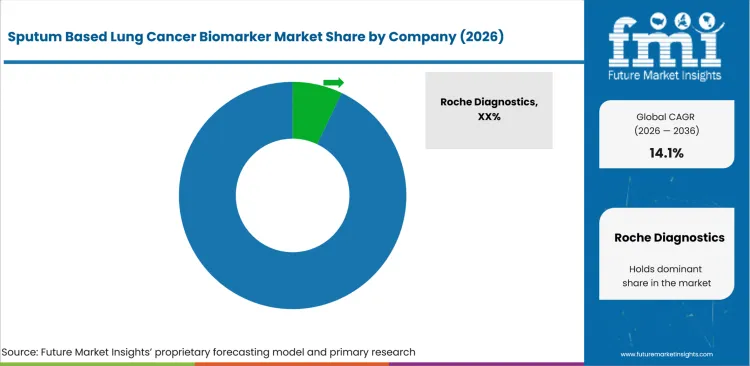
The competitive field separates direct sputum test developers from laboratories and companies responsible for defined testing steps. Creative Biosciences supplies a methylation kit in China, while bioAffinity Technologies delivers CyPath Lung through a United States central laboratory. VisionGate develops a cellular-imaging workflow using home-collected sputum and standardized Cell-CT sample preparation for ongoing clinical evaluation. Tellgen provides an adjacent lavage-fluid assay that identifies Roche and legacy Thermo Fisher real-time PCR systems within broader in vitro diagnostics portfolios. Precision Pathology Laboratory Services handles central testing, while XK Biotec supports regulated clinical programs and Cardinal Health manages CyPath Lung logistics. ICU Medical supplies the Acapella device used during assisted collection, showing how competition depends on exact workflow responsibility rather than corporate scale.
- Creative Biosciences and bioAffinity Technologies provide direct sputum tests through different regulatory and delivery models. VisionGate remains in clinical development with a cellular imaging platform designed around collected sputum samples.
- Precision Pathology Laboratory Services performs centralized sputum testing and reporting for bioAffinity's commercial diagnostic service. Tellgen provides an adjacent lavage-fluid methylation assay, and XK Biotec supports clinical trials and registration for regulated diagnostic programs.
- Roche Diagnostics provides the LightCycler 480 platform that Tellgen names as compatible with its adjacent lavage-fluid methylation assay. Thermo Fisher documents the legacy ABI 7500 platform that Tellgen lists for the same adjacent assay. Cardinal Health manages CyPath Lung kit logistics across the order-to-return service used for centralized laboratory testing. ICU Medical supplies the Acapella device used to help patients produce sputum during assisted collection.
Competitive Benchmarking: Sputum Based Lung Cancer Biomarker Market
| Company | Direct Sputum Offering | Molecular or Cellular Platform | Clinical Workflow Support | Geographic Reach |
|---|---|---|---|---|
| Creative Biosciences (Guangzhou) Co., Ltd. | High | High | High | China with a United States branch |
| bioAffinity Technologies, Inc. | High | High | High | United States |
| Precision Pathology Laboratory Services, LLC | High | Medium | High | United States |
| VisionGate, Inc. | Medium | High | Medium | United States development network |
| Tellgen Corporation | Low | Medium | Medium | China and export channels |
| XK Biotec | Low | Low | High | China |
| Thermo Fisher Scientific Inc. | Low | Medium | Low | Global |
| Roche Diagnostics | Low | Medium | Low | Global |
Key Developments in the Sputum Based Lung Cancer Biomarker Market
- In May 2025, Creative Biosciences received approval from China's National Medical Products Administration for the Lunsafe human HOXB4 and SRCIN1 gene methylation detection kit. The fluorescent PCR assay uses sputum for early lung cancer detection and nodule risk assessment. The approval provides a regulated commercial route for methylation testing in Chinese hospitals. Laboratories evaluating the kit require compatible amplification systems and validated sputum preparation under routine operating conditions.
- In April 2025, bioAffinity Technologies announced workflow changes for CyPath Lung that reduced sample data-acquisition time by nearly 50%. The announcement also reported more than 10% higher overall throughput and more than 25% lower unit cost. The changes support central laboratory scalability without altering home collection or the validated analytical method. Commercial benefit depends on maintaining analytical consistency at higher routine testing volumes.
- In June 2025, XK Biotec reported full-process clinical trial support for Creative Biosciences' Lunsafe registration. Its activities covered clinical design, site management, data handling, and registration support. The development illustrates a specialist service pathway for sputum biomarker companies entering regulated diagnostic markets. Commercial value depends on trial execution that matches the intended specimen type and clinical claim across participating sites.
- In February 2026, bioAffinity Technologies announced a validation study with Brooke Army Medical Center using CyPath Lung on sputum obtained through tracheal and bronchial suction. The study evaluates an additional collection route for patients already undergoing airway procedures within hospital pulmonary workflows. Validation of this collection route could broaden specimen access while retaining the existing analytical platform. Practical adoption depends on integration with bronchoscopy scheduling and laboratory transport.
Key Players in the Sputum Based Lung Cancer Biomarker Market
Direct Sputum Test Developers
- Creative Biosciences (Guangzhou) Co., Ltd.
- bioAffinity Technologies, Inc.
- VisionGate, Inc.
Laboratory, Assay, and Registration Specialists
- Precision Pathology Laboratory Services, LLC
- Tellgen Corporation
- XK Biotec
Instrument, Logistics, and Collection Providers
- Thermo Fisher Scientific Inc.
- Roche Diagnostics
- Cardinal Health, Inc.
- ICU Medical, Inc.
Sputum Based Lung Cancer Biomarker Market - Report Scope
| Coverage field | Report scope |
|---|---|
| Market breakdown | Biomarker type, technology, application, cancer type, and region. |
| Quantitative Units | Revenue in USD Million, CAGR in %. |
| Market Definition | Products and services used directly across sputum collection and transport together with biomarker analysis for clinical interpretation and reporting. |
| Regions Covered | North America, Latin America, Western Europe, Eastern Europe, East Asia, South Asia and Pacific, and Middle East and Africa. |
| Countries Covered | USA, UK, Germany, Japan, and South Korea. |
| Key Companies Profiled | Creative Biosciences (Guangzhou) Co., Ltd., bioAffinity Technologies, Inc., Precision Pathology Laboratory Services, LLC, VisionGate, Inc., Tellgen Corporation, XK Biotec, Thermo Fisher Scientific Inc., Roche Diagnostics, Cardinal Health, Inc., and ICU Medical, Inc. |
| Forecast Period | 2026 to 2036. |
| Approach | Hybrid bottom-up and top-down market sizing supported by primary interviews and official desk research sources. |
Sputum Based Lung Cancer Biomarker Market - Research Methodology
| Method | Approach |
|---|---|
| Primary Research | FMI analysts gathered input from manufacturers, service providers, technology developers, distributors, end users, sourcing teams, and subject-matter experts. Interviews examined purchasing decisions, product or service evaluation, adoption barriers, approval requirements, pricing considerations, and expectations for technical or commercial support. Respondents were also asked what evidence is required before a trial, pilot, or initial order develops into regular purchasing. |
| Desk Research | Desk research covered government statistics, regulatory publications, trade data, industry associations, technical literature, standards, company filings, product information, and official corporate announcements. Sources were reviewed for relevance, publication date, geographic coverage, and consistency with the defined market scope. Claims relating to performance, applications, approvals, capacity, investment, and commercial activity were retained only when supported by credible public evidence. |
| Market Sizing and Forecasting | The market model combined the baseline value with historical performance, segment structure, pricing and volume indicators, adoption levels, company participation, and country-level demand conditions. Forecast assumptions considered economic activity, investment trends, regulatory developments, technology adoption, purchasing cycles, supply availability, and barriers to wider market use. Segment and regional estimates were reconciled before the final market total was calculated. |
| Data Validation | Estimates were checked against multiple independent indicators, including public data, company activity, trade patterns, industry developments, and findings from primary interviews. Validation also tested whether products, services, applications, and company revenues fell within the defined market boundaries. Adjacent categories, unsupported claims, overlapping revenues, and activities without direct market relevance were excluded to reduce double counting and maintain consistency across segments and countries. |
Sputum Based Lung Cancer Biomarker Market by Segments
Sputum Based Lung Cancer Biomarker Market segmented by Biomarker Type:
- DNA Methylation Biomarkers
- miRNA Biomarkers
- Protein Biomarkers
- Volatile Organic Compounds (VOCs)
- Genetic Mutation Biomarkers
Sputum Based Lung Cancer Biomarker Market segmented by Technology:
- PCR-based Assays
- Next-Generation Sequencing (NGS)
- Immunoassays
- Mass Spectrometry
- Biosensor Platforms
Sputum Based Lung Cancer Biomarker Market segmented by Application:
- Early Lung Cancer Screening
- High-Risk Population Screening
- Disease Prognosis
- Treatment Response Monitoring
Sputum Based Lung Cancer Biomarker Market segmented by Cancer Type:
- Non-Small Cell Lung Cancer (NSCLC)
- Small Cell Lung Cancer (SCLC)
Sputum Based Lung Cancer Biomarker Market by Region:
- North America
- United States
- Canada
- Latin America
- Brazil
- Mexico
- Argentina
- Chile
- Western Europe
- Germany
- France
- United Kingdom
- Italy
- Spain
- Benelux
- Nordics
- Eastern Europe
- Poland
- Czech Republic
- Romania
- Hungary
- East Asia
- China
- Japan
- South Korea
- South Asia and Pacific
- India
- ASEAN
- Australia and New Zealand
- Middle East and Africa
- GCC Countries
- South Africa
- Türkiye
- Israel
Research Sources and Bibliography
- Centers for Disease Control and Prevention. (2026, May 12). Screening for Lung Cancer.
- PDQ Adult Treatment Editorial Board. (2025, May 15). Non-Small Cell Lung Cancer Treatment (PDQ®)-Health Professional Version.
- UK National Screening Committee. (2025, January 31). Targeted Lung Health Check Programme renamed the NHS Lung Cancer Screening Programme.
- National Cancer Center Japan. (2025, April 25).
- Gemeinsamer Bundesausschuss. (n.d.). Lungenkrebs-Früherkennung für Raucherinnen und Raucher.
- Ministry of Health and Welfare, Republic of Korea. (2025, September 30).
- Centers for Medicare & Medicaid Services. (2022, February 10). NCD - Lung Cancer Screening with Low Dose Computed Tomography (LDCT) (210.14).
- Creative Biosciences (Guangzhou) Co., Ltd. (2025, June 1). Lunsafe® Wins NMPA Approval, Pioneering Noninvasive Early Detection of Lung Cancer in China.
- Tellgen Corporation. (n.d.). LungMe: SHOX2 And RASSF1A DNA Methylation PCR Kit.
- bioAffinity Technologies, Inc. (2026, March 13). bioAffinity Technologies Announces Record 2025 Revenue and Unit Sales for Flagship Lung Cancer Diagnostic CyPath® Lung.
- bioAffinity Technologies, Inc. (2026, March 16). 10-K: Annual report [Section 13 and 15(d), not S-K Item 405].
- bioAffinity Technologies, Inc. (2025, April 17). bioAffinity Technologies Increases Efficiency of CyPath® Lung Test by Boosting Data Acquisition Throughput by 50% and Reducing Unit Cost.
- bioAffinity Technologies, Inc. (2026, February 25). bioAffinity Technologies Announces Validation Study with Brooke Army Medical Center to Expand Sample Collection Options for the CyPath® Lung Noninvasive Early Detection Lung Cancer Test.
- XK Biotec. (2025, June 3).
This bibliography is provided for reader reference and is not exhaustive. The full report contains the complete reference list and detailed citations supporting the market analysis.
This Report Answers
- How large is the sputum based lung cancer biomarker market in 2026 and 2036?
- Which clinical pressures support demand for noninvasive sputum biomarker testing?
- Why do DNA methylation biomarkers hold the leading biomarker type share in 2026?
- How do PCR-based assays support laboratory adoption across existing molecular infrastructure?
- Why does early lung cancer screening represent the leading application share in 2026?
- How do country growth rates differ across the USA, UK, Germany, Japan, and South Korea?
- Which companies provide direct tests, laboratory services, instruments, logistics, or collection support?
- What limits routine adoption across sample collection, reimbursement, and clinical interpretation?
- How can integrated service models support reliable sputum biomarker deployment?
Frequently Asked Questions
How big is the Sputum-Based Lung Cancer Biomarker Market in 2026?
The sputum-based lung cancer biomarker market is valued at USD 714.5 million in 2026 and is forecast to reach USD 2,672.1 million by 2036.
What is the CAGR of the Sputum-Based Lung Cancer Biomarker Market from 2026 to 2036?
The sputum-based lung cancer biomarker market is projected to grow at a CAGR of 14.1% between 2026 and 2036, supported by imaging programs creating a large pool of indeterminate findings that need accurate and accessible risk clarification without immediate invasive sampling.
Which technology leads the Sputum-Based Lung Cancer Biomarker Market?
PCR-based assays account for 40.4% of the sputum-based lung cancer biomarker market by technology in 2026, driven by established amplification hardware and targeted analytical designs across laboratories with existing real-time amplification systems and controlled quality assurance procedures.
Which country is growing fastest in the Sputum-Based Lung Cancer Biomarker Market?
Japan is the fastest-growing country in the sputum-based lung cancer biomarker market, expanding at a 17.4% CAGR through 2036, ahead of the market average of 14.1%, associated with strong demand for less invasive risk clarification around imaging within a structured specialist care environment.
Who are the leading companies in the Sputum-Based Lung Cancer Biomarker Market?
Leading companies in the sputum-based lung cancer biomarker market include Creative Biosciences, bioAffinity Technologies, Precision Pathology Laboratory Services, VisionGate, Tellgen Corporation, XK Biotec, Thermo Fisher Scientific, Roche Diagnostics, Cardinal Health, and ICU Medical, competing across direct sputum test development, laboratory and registration services, and instrument, logistics, and collection support roles.
Preview the report firsthand - request a free sample
Get SampleGet the brochure for pricing and purchase details.
Get PDFTable of Content
- Key Takeaways
- Market Size and CAGR
- Top Growth Driver
- Fastest Growing Segment
- Leading Region
- Key Companies
- Emerging Opportunities
- Executive Summary
- Global Market Outlook
- Demand-side Trends
- Supply-side Trends
- Technology Roadmap Analysis
- Analysis and Recommendations
- Analyst Perspective (What is happening? Why now? What should investors know?)
- Key Questions Answered
- How large is the market?
- What is the CAGR?
- What are key trends?
- Which region dominates?
- Who are the leaders?
- Market Overview
- Market Coverage / Taxonomy
- Market Definition / Scope / Limitations
- Research Methodology
- Chapter Orientation
- Analytical Lens and Working Hypotheses
- Market Structure, Signals, and Trend Drivers
- Benchmarking and Cross-market Comparability
- Market Sizing, Forecasting, and Opportunity Mapping
- Research Design and Evidence Framework
- Desk Research Programme (Secondary Evidence)
- Expert Input and Fieldwork (Primary Evidence)
- Tooling, Models, and Reference Databases
- Data Engineering and Model Build
- Quality Assurance and Audit Trail
- Market Background
- Market Dynamics (Drivers, Restraints, Opportunity, Trends)
- Scenario Forecast (Optimistic, Likely, Conservative)
- Impact Analysis
- AI Impact
- Sustainability Impact
- Regulatory Impact
- Technology Impact
- Consumer / Buyer Analysis
- Purchase Drivers
- Adoption Barriers
- Buyer Journey
- Opportunity Map Analysis
- Product Life Cycle Analysis
- Supply Chain Analysis
- Investment Feasibility Matrix
- Value Chain Analysis
- PESTLE and Porter's Analysis
- Regulatory Landscape
- Regional Parent Market Outlook
- Production and Consumption Statistics
- Import and Export Statistics
- Global Market Analysis and Forecast, 2021 to 2036
- Historical Market Size Value (USD Million) Analysis, 2021 to 2025
- Current and Future Market Size Value (USD Million) Projections, 2026 to 2036
- Y-o-Y Growth Trend Analysis
- Absolute $ Opportunity Analysis
- Global Market Pricing Analysis, 2021 to 2036
- Global Market Analysis and Forecast, By Biomarker Type, 2021 to 2036
- Introduction / Key Findings
- Historical Market Size Value (USD Million) Analysis By Biomarker Type, 2021 to 2025
- Current and Future Market Size Value (USD Million) Analysis and Forecast By Biomarker Type, 2026 to 2036
- DNA Methylation Biomarkers
- miRNA Biomarkers
- Protein Biomarkers
- Volatile Organic Compounds (VOCs)
- Genetic Mutation Biomarkers
- DNA Methylation Biomarkers
- Y-o-Y Growth Trend Analysis By Biomarker Type, 2021 to 2025
- Absolute $ Opportunity Analysis By Biomarker Type, 2026 to 2036
- Global Market Analysis and Forecast, By Technology, 2021 to 2036
- Introduction / Key Findings
- Historical Market Size Value (USD Million) Analysis By Technology, 2021 to 2025
- Current and Future Market Size Value (USD Million) Analysis and Forecast By Technology, 2026 to 2036
- PCR-based Assays
- Next-Generation Sequencing (NGS)
- Immunoassays
- Mass Spectrometry
- Biosensor Platforms
- PCR-based Assays
- Y-o-Y Growth Trend Analysis By Technology, 2021 to 2025
- Absolute $ Opportunity Analysis By Technology, 2026 to 2036
- Global Market Analysis and Forecast, By Application, 2021 to 2036
- Introduction / Key Findings
- Historical Market Size Value (USD Million) Analysis By Application, 2021 to 2025
- Current and Future Market Size Value (USD Million) Analysis and Forecast By Application, 2026 to 2036
- Early Lung Cancer Screening
- High-Risk Population Screening
- Disease Prognosis
- Treatment Response Monitoring
- Early Lung Cancer Screening
- Y-o-Y Growth Trend Analysis By Application, 2021 to 2025
- Absolute $ Opportunity Analysis By Application, 2026 to 2036
- Global Market Analysis and Forecast, By Cancer Type, 2021 to 2036
- Introduction / Key Findings
- Historical Market Size Value (USD Million) Analysis By Cancer Type, 2021 to 2025
- Current and Future Market Size Value (USD Million) Analysis and Forecast By Cancer Type, 2026 to 2036
- Non-Small Cell Lung Cancer (NSCLC)
- Small Cell Lung Cancer (SCLC)
- Non-Small Cell Lung Cancer (NSCLC)
- Y-o-Y Growth Trend Analysis By Cancer Type, 2021 to 2025
- Absolute $ Opportunity Analysis By Cancer Type, 2026 to 2036
- Global Market Analysis and Forecast, By Region, 2021 to 2036
- Introduction
- Historical Market Size Value (USD Million) Analysis By Region, 2021 to 2025
- Current Market Size Value (USD Million) Analysis and Forecast By Region, 2026 to 2036
- North America
- Latin America
- Western Europe
- Eastern Europe
- East Asia
- South Asia and Pacific
- Middle East & Africa
- Market Attractiveness Analysis By Region
- North America Market Analysis and Forecast, By Country, 2021 to 2036
- Historical Market Size Value (USD Million) Trend Analysis By Market Taxonomy, 2021 to 2025
- Market Size Value (USD Million) Forecast By Market Taxonomy, 2026 to 2036
- By Country
- USA
- Canada
- By Biomarker Type
- By Technology
- By Application
- By Cancer Type
- By Country
- Market Attractiveness Analysis
- By Country
- By Biomarker Type
- By Technology
- By Application
- By Cancer Type
- Key Takeaways
- Latin America Market Analysis and Forecast, By Country
- Historical Market Size Value (USD Million) Trend Analysis By Market Taxonomy, 2021 to 2025
- Market Size Value (USD Million) Forecast By Market Taxonomy, 2026 to 2036
- By Country
- Brazil
- Mexico
- Chile
- Rest of Latin America
- By Biomarker Type
- By Technology
- By Application
- By Cancer Type
- By Country
- Market Attractiveness Analysis
- By Country
- By Biomarker Type
- By Technology
- By Application
- By Cancer Type
- Key Takeaways
- Western Europe Market Analysis and Forecast, By Country
- Historical Market Size Value (USD Million) Trend Analysis By Market Taxonomy, 2021 to 2025
- Market Size Value (USD Million) Forecast By Market Taxonomy, 2026 to 2036
- By Country
- Germany
- UK
- Italy
- Spain
- France
- Nordic
- BENELUX
- Rest of Western Europe
- By Biomarker Type
- By Technology
- By Application
- By Cancer Type
- By Country
- Market Attractiveness Analysis
- By Country
- By Biomarker Type
- By Technology
- By Application
- By Cancer Type
- Key Takeaways
- Eastern Europe Market Analysis and Forecast, By Country
- Historical Market Size Value (USD Million) Trend Analysis By Market Taxonomy, 2021 to 2025
- Market Size Value (USD Million) Forecast By Market Taxonomy, 2026 to 2036
- By Country
- Russia
- Poland
- Hungary
- Balkan & Baltic
- Rest of Eastern Europe
- By Biomarker Type
- By Technology
- By Application
- By Cancer Type
- By Country
- Market Attractiveness Analysis
- By Country
- By Biomarker Type
- By Technology
- By Application
- By Cancer Type
- Key Takeaways
- East Asia Market Analysis and Forecast, By Country
- Historical Market Size Value (USD Million) Trend Analysis By Market Taxonomy, 2021 to 2025
- Market Size Value (USD Million) Forecast By Market Taxonomy, 2026 to 2036
- By Country
- China
- Japan
- South Korea
- By Biomarker Type
- By Technology
- By Application
- By Cancer Type
- By Country
- Market Attractiveness Analysis
- By Country
- By Biomarker Type
- By Technology
- By Application
- By Cancer Type
- Key Takeaways
- South Asia and Pacific Market Analysis and Forecast, By Country
- Historical Market Size Value (USD Million) Trend Analysis By Market Taxonomy, 2021 to 2025
- Market Size Value (USD Million) Forecast By Market Taxonomy, 2026 to 2036
- By Country
- India
- ASEAN
- Australia & New Zealand
- Rest of South Asia and Pacific
- By Biomarker Type
- By Technology
- By Application
- By Cancer Type
- By Country
- Market Attractiveness Analysis
- By Country
- By Biomarker Type
- By Technology
- By Application
- By Cancer Type
- Key Takeaways
- Middle East & Africa Market Analysis and Forecast, By Country
- Historical Market Size Value (USD Million) Trend Analysis By Market Taxonomy, 2021 to 2025
- Market Size Value (USD Million) Forecast By Market Taxonomy, 2026 to 2036
- By Country
- Kingdom of Saudi Arabia
- Other GCC Countries
- Türkiye
- South Africa
- Other African Union
- Rest of Middle East & Africa
- By Biomarker Type
- By Technology
- By Application
- By Cancer Type
- By Country
- Market Attractiveness Analysis
- By Country
- By Biomarker Type
- By Technology
- By Application
- By Cancer Type
- Key Takeaways
- Key Countries Market Analysis
- USA
- Pricing Analysis
- Market Share Analysis, 2025
- By Biomarker Type
- By Technology
- By Application
- By Cancer Type
- Canada
- Pricing Analysis
- Market Share Analysis, 2025
- By Biomarker Type
- By Technology
- By Application
- By Cancer Type
- Mexico
- Pricing Analysis
- Market Share Analysis, 2025
- By Biomarker Type
- By Technology
- By Application
- By Cancer Type
- Brazil
- Pricing Analysis
- Market Share Analysis, 2025
- By Biomarker Type
- By Technology
- By Application
- By Cancer Type
- Chile
- Pricing Analysis
- Market Share Analysis, 2025
- By Biomarker Type
- By Technology
- By Application
- By Cancer Type
- Germany
- Pricing Analysis
- Market Share Analysis, 2025
- By Biomarker Type
- By Technology
- By Application
- By Cancer Type
- UK
- Pricing Analysis
- Market Share Analysis, 2025
- By Biomarker Type
- By Technology
- By Application
- By Cancer Type
- Italy
- Pricing Analysis
- Market Share Analysis, 2025
- By Biomarker Type
- By Technology
- By Application
- By Cancer Type
- Spain
- Pricing Analysis
- Market Share Analysis, 2025
- By Biomarker Type
- By Technology
- By Application
- By Cancer Type
- France
- Pricing Analysis
- Market Share Analysis, 2025
- By Biomarker Type
- By Technology
- By Application
- By Cancer Type
- India
- Pricing Analysis
- Market Share Analysis, 2025
- By Biomarker Type
- By Technology
- By Application
- By Cancer Type
- ASEAN
- Pricing Analysis
- Market Share Analysis, 2025
- By Biomarker Type
- By Technology
- By Application
- By Cancer Type
- Australia & New Zealand
- Pricing Analysis
- Market Share Analysis, 2025
- By Biomarker Type
- By Technology
- By Application
- By Cancer Type
- China
- Pricing Analysis
- Market Share Analysis, 2025
- By Biomarker Type
- By Technology
- By Application
- By Cancer Type
- Japan
- Pricing Analysis
- Market Share Analysis, 2025
- By Biomarker Type
- By Technology
- By Application
- By Cancer Type
- South Korea
- Pricing Analysis
- Market Share Analysis, 2025
- By Biomarker Type
- By Technology
- By Application
- By Cancer Type
- Russia
- Pricing Analysis
- Market Share Analysis, 2025
- By Biomarker Type
- By Technology
- By Application
- By Cancer Type
- Poland
- Pricing Analysis
- Market Share Analysis, 2025
- By Biomarker Type
- By Technology
- By Application
- By Cancer Type
- Hungary
- Pricing Analysis
- Market Share Analysis, 2025
- By Biomarker Type
- By Technology
- By Application
- By Cancer Type
- Kingdom of Saudi Arabia
- Pricing Analysis
- Market Share Analysis, 2025
- By Biomarker Type
- By Technology
- By Application
- By Cancer Type
- Türkiye
- Pricing Analysis
- Market Share Analysis, 2025
- By Biomarker Type
- By Technology
- By Application
- By Cancer Type
- South Africa
- Pricing Analysis
- Market Share Analysis, 2025
- By Biomarker Type
- By Technology
- By Application
- By Cancer Type
- USA
- Market Structure Analysis
- Competition Dashboard
- Competition Benchmarking
- Market Share Analysis of Top Players
- By Regional
- By Biomarker Type
- By Technology
- By Application
- By Cancer Type
- Emerging Startups
- Innovation Benchmarking
- Competition Analysis
- Competition Deep Dive
- Roche Diagnostics
- Overview
- Product Portfolio
- Profitability by Market Segments
- Sales Footprint
- Strategy Overview
- Marketing Strategy
- Product Strategy
- Channel Strategy
- Exact Sciences Corporation
- Thermo Fisher Scientific Inc.
- Illumina, Inc.
- QIAGEN N.V.
- BioMérieux SA
- Abbott Laboratories
- Guardant Health, Inc.
- Sysmex Corporation
- Epigenomics AG
- Roche Diagnostics
- Case Studies
- Success Stories
- Recent Developments
- Competition Deep Dive
- Assumptions & Acronyms Used


