

- Industry Size (2026)
- USD 6.2 Bn
- Forecast (2036)
- USD 17.3 Bn
- CAGR (2026 to 2036)
- 10.8%
Lung Cancer Molecular Biomarker Market Forecast and Outlook 2026 to 2036
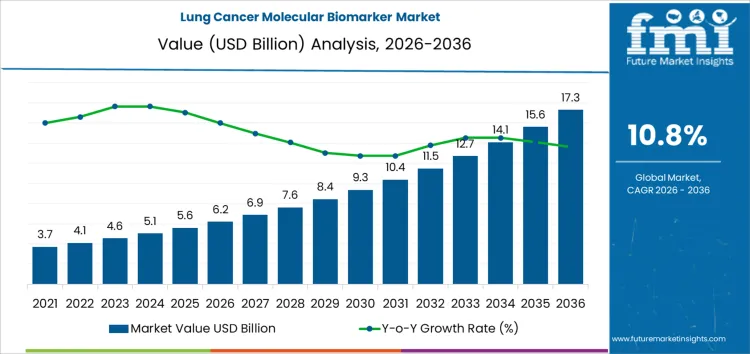
The lung cancer molecular biomarker market is forecasted to expand from USD 6.2 billion in 2026 to USD 17.3 billion by 2036, at a CAGR of 10.8%. Value creation is closely linked to the structural shift in lung cancer management toward molecularly guided therapy selection rather than histology-led treatment. Biomarker testing has moved from an adjunct diagnostic step to a gating requirement for therapy access, directly influencing prescribing eligibility for targeted and immune-based regimens. Testing volumes rise in parallel with the growing number of actionable mutations and therapy lines that require confirmation at diagnosis and again at progression. Spending intensity concentrates in settings where multi-gene profiling shortens treatment decision timelines and reduces ineffective therapy exposure, creating measurable clinical and economic justification for routine use.
Adoption momentum is sustained by workflow integration rather than incremental increases in cancer incidence. Laboratories prioritize platforms that consolidate multiple biomarkers into single assays to manage tissue scarcity and turnaround constraints. Oncology providers increasingly depend on longitudinal molecular monitoring to track resistance emergence, extending testing beyond initial diagnosis into later disease stages. Reimbursement alignment, companion diagnostic requirements, and protocol standardization reinforce recurring test utilization across care episodes. Expansion is further supported by automation and centralized testing models that improve throughput without proportional labor growth. Market durability reflects dependence of modern lung cancer treatment algorithms on verified molecular status, positioning biomarker testing as an embedded clinical infrastructure component rather than a discretionary diagnostic service.
Quick Stats for Lung Cancer Molecular Biomarker Market
- Lung Cancer Molecular Biomarker Market Value (2026): USD 6.2 billion
- Lung Cancer Molecular Biomarker Market Forecast Value (2036): USD 17.3 billion
- Lung Cancer Molecular Biomarker Market Forecast CAGR 2026 to 2036: 10.8%
- Leading Product Type by Utilization: EGFR biomarkers
- Fastest-Growing Countries: India, China, Brazil, USA, UK
- Top Players in Global Demand: Roche Diagnostics, Thermo Fisher Scientific, Qiagen, Agilent Technologies, Illumina
Lung Cancer Molecular Biomarker Market Key Takeaways
| Metric | Value |
|---|---|
| Market Value (2026) | USD 6.2 billion |
| Market Forecast Value (2036) | USD 17.3 billion |
| Forecast CAGR 2026 to 2036 | 10.8% |
Why is the Demand for Lung Cancer Molecular Biomarker Growing?
The lung cancer molecular biomarker industry is rising as oncologists and clinical laboratories adopt precision diagnostics that reveal specific genetic and molecular alterations driving tumor behavior. Molecular biomarkers such as EGFR mutations, ALK rearrangements, ROS1 fusions, and PD-L1 expression guide therapeutic selection and enable stratification of patients to targeted therapies and immune checkpoint inhibitors with greater likelihood of clinical benefit. Diagnostic labs are investing in next generation sequencing panels, PCR platforms, and immunohistochemistry assays to support comprehensive profiling of lung tumors at initial diagnosis and at progression, which influences treatment planning and monitoring. Procurement teams evaluate assay sensitivity, turnaround time, and platform interoperability to ensure results integrate with electronic medical records and multidisciplinary tumor board workflows. Growth in clinical evidence associating biomarker status with response and survival outcomes reinforces adoption of molecular testing as a standard component of lung cancer care pathways.
Expansion of lung cancer screening programs and increased detection of early and advanced stage disease contribute to sustained demand for molecular biomarkers that support personalized treatment decisions. Health systems and payers are adjusting coverage policies in recognition that biomarker-driven therapy selection improves therapeutic efficiency and may reduce unnecessary exposure to ineffective treatments. Research initiatives are further expanding the catalog of actionable biomarkers through large cohort studies and real-world data analyses, creating demand for assays that accommodate evolving panels without redundant infrastructure. Laboratories and oncology clinics also emphasize quality assurance, proficiency testing, and regulatory compliance as part of diagnostic service delivery. These clinical and operational drivers are contributing to sustained demand growth in the lung cancer molecular biomarker market.
How Is the Lung Cancer Molecular Biomarker Market Segmented?
Sales of lung cancer molecular biomarkers is driven by precision oncology adoption, therapy stratification requirements, and expanding molecular testing mandates. Clinical workflows emphasize actionable mutation detection, response prediction, and longitudinal disease assessment. Adoption reflects guideline alignment, reimbursement coverage, and availability of multiplex testing platforms. Test selection considers biomarker prevalence, analytical sensitivity, and turnaround time within diagnostic pathways. Segmentation clarifies how biomarker class, clinical use case, and institutional setting shape testing volume, procurement focus, and integration within lung cancer care delivery.
Which Product Type Concentrates Testing Utilization in Lung Cancer Biomarkers?
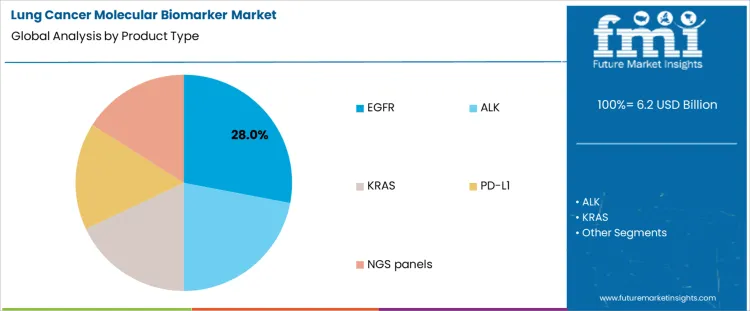
Testing utilization centers on EGFR at 28.0%, reflecting its role as a primary actionable target in non-small cell lung cancer. Routine assessment guides first-line therapy decisions and sequencing strategies. ALK at 22.0% supports identification of fusion-driven disease subsets requiring targeted inhibitors. KRAS at 18.0% informs prognosis and emerging targeted options. PD-L1 at 16.0% guides immunotherapy eligibility through expression thresholds. NGS panels at 16.0% enable simultaneous multi-gene profiling where tissue availability is limited. Product segmentation reflects prioritization of biomarkers with direct therapeutic implications and standardized testing algorithms.
Key Points
- EGFR testing anchors initial molecular stratification.
- ALK and KRAS support targeted pathway identification.
- NGS panels expand coverage through multiplex profiling.
How Do Clinical Use Cases Shape Application-Level Biomarker Demand?
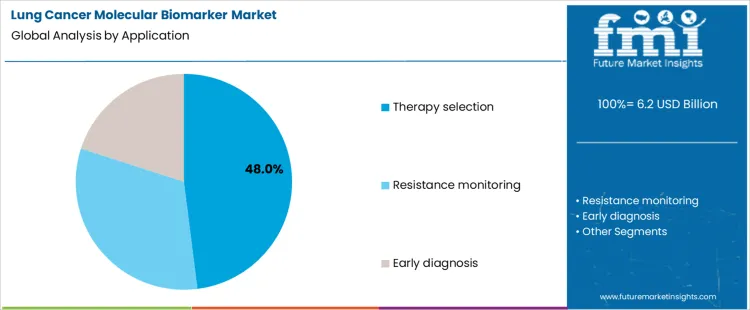
Application demand is weighted toward therapy selection at 48.0%, reflecting dependence on molecular results to guide targeted and immune-based treatment choices. Accurate biomarker identification determines eligibility and sequencing. Resistance monitoring at 32.0% supports detection of acquired mutations during disease progression, enabling therapy adjustment. Early diagnosis at 20.0% focuses on risk stratification and research-driven screening initiatives. Application segmentation highlights higher testing intensity where treatment decisions, response durability, and adaptation to resistance directly influence clinical outcomes.
Key Points
- Therapy selection drives the majority of testing volume.
- Resistance monitoring supports longitudinal disease management.
- Early diagnosis remains a developing testing application.
Which End User Settings Drive Molecular Biomarker Testing Volumes?
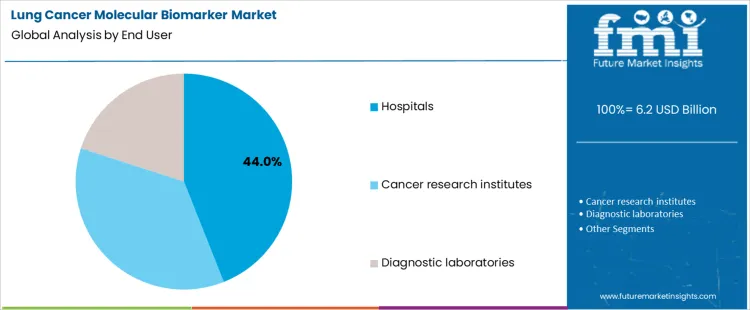
Hospitals account for 44.0% of biomarker testing activity due to their role in diagnosis, treatment initiation, and integrated oncology services. In-house pathology and molecular laboratories support timely decision-making. Cancer research institutes at 36.0% conduct advanced profiling for clinical trials and translational studies. Diagnostic laboratories at 20.0% provide centralized testing services supporting multiple care sites. End-user segmentation reflects concentration where clinical decision authority, research intensity, and testing infrastructure determine molecular biomarker utilization patterns.
Key Points
- Hospitals integrate testing within treatment workflows.
- Research institutes drive advanced and exploratory profiling.
- Diagnostic laboratories provide centralized testing capacity.
What are the Key Dynamics in the Lung Cancer Molecular Biomarker Market?
Demand for lung cancer molecular biomarkers reflects diagnostic and treatment selection requirements for precision oncology in non-small cell and small cell lung cancer. Adoption concentrates in hospital pathology laboratories, reference diagnostic centers, and integrated cancer networks. Global scope aligns with guideline-driven biomarker testing and expanding targeted therapy availability. Usage centers on tissue and liquid biopsy assays detecting genetic alterations, protein expression, and resistance mechanisms relevant to therapy selection.
How do treatment stratification requirements and diagnostic accuracy expectations shape adoption?
Therapy selection in lung cancer depends on identifying actionable molecular alterations prior to treatment initiation. Demand increases as targeted therapies and immunotherapies require validated biomarker confirmation to demonstrate clinical benefit. Testing panels assess driver mutations, gene rearrangements, and expression markers to guide first-line and subsequent treatment decisions. Liquid biopsy adoption expands where tissue availability is limited or disease progression requires rapid reassessment. Turnaround time influences clinical workflow, particularly in advanced disease with rapid deterioration risk. Multigene panels reduce sequential testing delays and tissue exhaustion. Integration with multidisciplinary tumor boards supports interpretation and treatment alignment. Adoption reflects clinical reliance on precise molecular characterization to optimize outcomes and avoid ineffective therapy exposure.
How do testing complexity, reimbursement variability, and standardization gaps influence market scalability?
Biomarker testing requires specialized laboratory infrastructure, trained personnel, and stringent quality control. Demand sensitivity rises where reimbursement policies limit coverage for broad testing panels. Tissue scarcity and pre-analytical variability affect test success rates. Assay standardization challenges persist across platforms and laboratories, complicating result comparability. Rapid evolution of actionable targets increases update burden for test menus. Data interpretation complexity raises dependency on molecular pathology expertise. Regulatory requirements differ by region for companion diagnostics. Scalability remains constrained by infrastructure cost, payer alignment, and need for consistent analytical validity across expanding biomarker portfolios.
How Is Demand for Lung Cancer Molecular Biomarkers Evolving Globally?
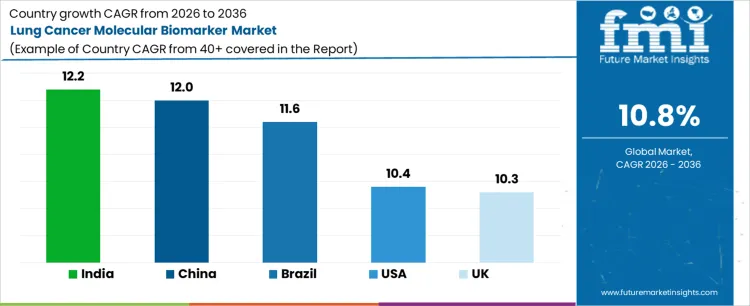
Demand for lung cancer molecular biomarkers is rising globally as precision oncology becomes central to diagnosis and treatment selection. Expanded use of targeted therapies and immuno-oncology agents increases reliance on genomic and protein-based testing. Clinical guidelines increasingly mandate biomarker confirmation before therapy initiation. Laboratory automation and reimbursement alignment support testing volumes. Growth rates in India at 12.2%, China at 12.0%, Brazil at 11.6%, USA at 10.4%, and the UK at 10.3% indicate sustained expansion driven by therapy stratification requirements, diagnostic infrastructure growth, and guideline-led adoption rather than generalized cancer screening activity.
| Country | CAGR (%) |
|---|---|
| India | 12.2% |
| China | 12.0% |
| Brazil | 11.6% |
| USA | 10.4% |
| UK | 10.3% |
What Is Driving Strong Expansion of Lung Cancer Molecular Biomarker Demand in India?
Demand for lung cancer molecular biomarkers in India is growing at a CAGR of 12.2%, reflecting rapid integration of targeted therapies within oncology practice. Private cancer centers expand in-house molecular diagnostics to reduce turnaround time. Rising non-small cell lung cancer incidence among non-smokers increases reliance on genetic profiling. Medical oncologists increasingly require EGFR, ALK, and PD-L1 testing before therapy selection. Improved affordability through domestic laboratory services supports testing uptake. Growth reflects therapy-driven diagnostic necessity and infrastructure expansion rather than population-wide screening initiatives.
- Expansion of private oncology diagnostic laboratories
- Therapy-mandated EGFR, ALK, and PD-L1 testing
- Rising non-smoker lung cancer incidence
- Improved affordability through domestic testing
Why Is China Showing Accelerated Uptake of Lung Cancer Biomarker Testing?
Lung cancer molecular biomarker demand in China is expanding at a CAGR of 12.0%, supported by large patient volumes and standardized oncology protocols. Tertiary hospitals integrate next-generation sequencing into routine lung cancer workups. National reimbursement inclusion for selected biomarker tests improves access. Domestic development of targeted drugs increases testing alignment. Centralized laboratory networks support high-throughput analysis. Growth reflects protocol-driven testing adoption and scale efficiencies rather than experimental diagnostic use.
- Standardized oncology protocols mandating testing
- Reimbursement inclusion for key biomarkers
- Domestic targeted drug pipeline alignment
- Centralized high-throughput laboratory networks
How Is Brazil Supporting Growth in Lung Cancer Molecular Biomarker Utilization?
Demand for lung cancer molecular biomarkers in Brazil is growing at a CAGR of 11.6%, influenced by expansion of comprehensive cancer centers. Public and private oncology networks adopt biomarker-guided treatment pathways. Increased access to immunotherapy drives PD-L1 testing demand. Judicialization mechanisms occasionally expand testing access. Laboratory partnerships improve diagnostic reach beyond major cities. Growth reflects therapy access expansion and institutional adoption rather than broad-based screening programs.
- Expansion of comprehensive cancer centers
- Immunotherapy access driving PD-L1 testing
- Legal pathways expanding diagnostic access
- Laboratory partnerships improving regional reach
What Factors Are Driving Lung Cancer Biomarker Growth in United States?
Lung cancer molecular biomarker demand in the United States is expanding at a CAGR of 10.4%, driven by guideline-mandated precision oncology. Broad payer coverage supports multi-gene panel testing. High availability of next-generation sequencing platforms enables comprehensive profiling. Rapid therapy innovation sustains testing complexity and frequency. Clinical trial participation reinforces biomarker adoption. Growth reflects protocol standardization and innovation pace rather than increased lung cancer incidence.
- Guideline-mandated multi-gene panel testing
- Broad payer reimbursement coverage
- High penetration of NGS platforms
- Clinical trial-driven biomarker utilization
Why Is the UK Experiencing Sustained Growth in Lung Cancer Molecular Biomarkers?
Demand for lung cancer molecular biomarkers in United Kingdom is growing at a CAGR of 10.3%, shaped by NHS precision medicine frameworks. National genomic testing services standardize biomarker access across regions. Treatment pathways require confirmed molecular status prior to targeted therapy use. Centralized laboratories ensure consistency and quality control. Cost-effectiveness assessments influence test selection. Growth remains sustained, reflecting structured adoption and service scale-up rather than rapid decentralization of diagnostics.
- NHS genomic testing service standardization
- Therapy-linked molecular confirmation requirements
- Centralized laboratory quality control
- Cost-effectiveness guided test selection
What is the competitive landscape of lung cancer molecular biomarker market globally?
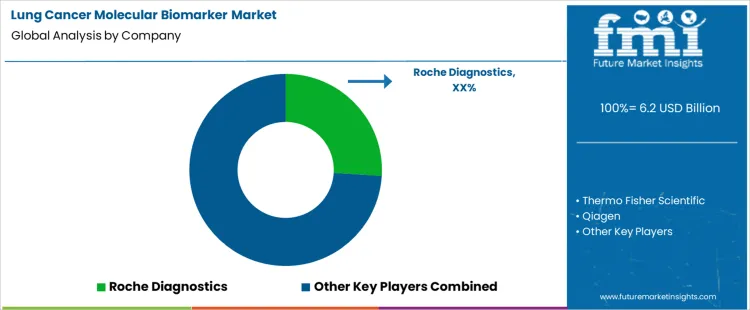
Demand for lung cancer molecular biomarkers is shaped by precision oncology adoption, therapy stratification needs, and reimbursement-linked testing requirements. Oncology laboratories and hospitals evaluate assay sensitivity, mutation coverage breadth, turnaround time, sample input tolerance, and concordance with approved therapies. Buyer assessment includes platform scalability, automation compatibility, regulatory clearance, and integration with pathology workflows. Procurement behavior reflects centralized laboratory consolidation, long-term reagent contracts, and preference for vendors supporting companion diagnostics. Purchasing decisions emphasize clinical validity, reproducibility across laboratories, and service reliability. Trend in the lung cancer molecular biomarker market shows expanding multigene panel use across initial diagnosis and disease progression monitoring.
Roche Diagnostics leads competitive positioning through companion diagnostic assays closely aligned with targeted therapy adoption pathways. Thermo Fisher Scientific competes via flexible molecular platforms supporting high-throughput testing and laboratory-developed workflows. Qiagen supports demand with sample-to-answer solutions optimized for clinical laboratories and decentralized testing environments. Agilent Technologies maintains relevance through high-precision reagents and quality systems supporting research-to-clinic translation. Illumina participates by enabling next-generation sequencing platforms underpinning comprehensive lung cancer biomarker profiling. Competitive differentiation centers on regulatory alignment, mutation detection accuracy, workflow efficiency, and depth of clinical partnership with oncology centers.
Key Players in the Lung Cancer Molecular Biomarker Market
- Roche Diagnostics
- Thermo Fisher Scientific
- Qiagen
- Agilent Technologies
- Illumina
- Others
Scope of the Report
| Items | Values |
|---|---|
| Quantitative Units | USD billion |
| Product Type | EGFR; ALK; KRAS; PD-L1; NGS panels |
| Application | Therapy selection; Resistance monitoring; Early diagnosis |
| End User | Hospitals; Cancer research institutes; Diagnostic laboratories |
| Regions Covered | Asia Pacific, Europe, North America, Latin America, Middle East & Africa |
| Countries Covered | India, China, Brazil, USA, UK, and 40+ countries |
| Key Companies Profiled | Roche Diagnostics; Thermo Fisher Scientific; Qiagen; Agilent Technologies; Illumina; Others |
| Additional Attributes | Dollar sales by product type, application, end user, and sales channel; analytical sensitivity and specificity of single-gene assays and NGS panels in lung cancer profiling; turnaround time and workflow integration in hospital and reference laboratories; role of biomarkers in precision therapy selection and resistance tracking; regulatory approvals and companion diagnostic alignment; procurement dynamics driven by oncology testing volumes, research funding, and centralized laboratory networks. |
Lung Cancer Molecular Biomarker Market by Segment
Product Type:
- EGFR
- ALK
- KRAS
- PD-L1
- NGS panels
Application:
- Therapy selection
- Resistance monitoring
- Early diagnosis
End User:
- Hospitals
- Cancer research institutes
- Diagnostic laboratories
Region:
- Asia Pacific
- China
- Japan
- South Korea
- India
- Australia & New Zealand
- ASEAN
- Rest of Asia Pacific
- Europe
- Germany
- United Kingdom
- France
- Italy
- Spain
- Nordic
- BENELUX
- Rest of Europe
- North America
- United States
- Canada
- Mexico
- Latin America
- Brazil
- Chile
- Rest of Latin America
- Middle East & Africa
- Kingdom of Saudi Arabia
- Other GCC Countries
- Turkey
- South Africa
- Other African Union
- Rest of Middle East & Africa
Bibliography
- European Society for Medical Oncology. (2024). ESMO clinical practice guidelines for diagnosis, treatment, and follow-up of non-small-cell lung cancer. Annals of Oncology.
- European Medicines Agency. (2024). Companion diagnostics and biomarker-driven medicines in oncology. European Medicines Agency.
- Organisation for Economic Co-operation and Development. (2024). Precision oncology diagnostics: Health system adoption and reimbursement considerations. OECD Publishing.
- U.S. Food and Drug Administration, Center for Devices and Radiological Health. (2024). In vitro companion diagnostic devices for oncology: Cleared and approved tests. U.S. Food and Drug Administration.
- World Health Organization. (2024). WHO classification of tumours of the lung, pleura, thymus and heart (5th edition): Molecular pathology and biomarker integration. World Health Organization.
Frequently Asked Questions
How big is the lung cancer molecular biomarker market in 2026?
The global lung cancer molecular biomarker market is estimated to be valued at USD 6.2 billion in 2026.
What will be the size of lung cancer molecular biomarker market in 2036?
The market size for the lung cancer molecular biomarker market is projected to reach USD 17.3 billion by 2036.
How much will be the lung cancer molecular biomarker market growth between 2026 and 2036?
The lung cancer molecular biomarker market is expected to grow at a 10.8% CAGR between 2026 and 2036.
What are the key product types in the lung cancer molecular biomarker market?
The key product types in lung cancer molecular biomarker market are egfr, alk, kras, pd-l1 and ngs panels.
Which application segment to contribute significant share in the lung cancer molecular biomarker market in 2026?
In terms of application, therapy selection segment to command 48.0% share in the lung cancer molecular biomarker market in 2026.
Preview the report firsthand - request a free sample
Get SampleGet the brochure for pricing and purchase details.
Get PDFTable of Content
- Executive Summary
- Global Market Outlook
- Demand-side Trends
- Supply-side Trends
- Technology Roadmap Analysis
- Analysis and Recommendations
- Market Overview
- Market Coverage / Taxonomy
- Market Definition / Scope / Limitations
- Market Background
- Market Dynamics
- Drivers
- Restraints
- Opportunity
- Trends
- Scenario Forecast
- Demand in Optimistic Scenario
- Demand in Likely Scenario
- Demand in Conservative Scenario
- Opportunity Map Analysis
- Product Life Cycle Analysis
- Supply Chain Analysis
- Investment Feasibility Matrix
- Value Chain Analysis
- PESTLE and Porter’s Analysis
- Regulatory Landscape
- Regional Parent Market Outlook
- Production and Consumption Statistics
- Import and Export Statistics
- Market Dynamics
- Global Market Analysis 2021 to 2025 and Forecast, 2026 to 2036
- Historical Market Size Value (USD Million) Analysis, 2021 to 2025
- Current and Future Market Size Value (USD Million) Projections, 2026 to 2036
- Y-o-Y Growth Trend Analysis
- Absolute $ Opportunity Analysis
- Global Market Pricing Analysis 2021 to 2025 and Forecast 2026 to 2036
- Global Market Analysis 2021 to 2025 and Forecast 2026 to 2036, By Product Type
- Introduction / Key Findings
- Historical Market Size Value (USD Million) Analysis By Product Type , 2021 to 2025
- Current and Future Market Size Value (USD Million) Analysis and Forecast By Product Type , 2026 to 2036
- EGFR
- ALK
- KRAS
- PD-L1
- NGS panels
- EGFR
- Y-o-Y Growth Trend Analysis By Product Type , 2021 to 2025
- Absolute $ Opportunity Analysis By Product Type , 2026 to 2036
- Global Market Analysis 2021 to 2025 and Forecast 2026 to 2036, By Application
- Introduction / Key Findings
- Historical Market Size Value (USD Million) Analysis By Application, 2021 to 2025
- Current and Future Market Size Value (USD Million) Analysis and Forecast By Application, 2026 to 2036
- Therapy selection
- Resistance monitoring
- Early diagnosis
- Therapy selection
- Y-o-Y Growth Trend Analysis By Application, 2021 to 2025
- Absolute $ Opportunity Analysis By Application, 2026 to 2036
- Global Market Analysis 2021 to 2025 and Forecast 2026 to 2036, By End User
- Introduction / Key Findings
- Historical Market Size Value (USD Million) Analysis By End User, 2021 to 2025
- Current and Future Market Size Value (USD Million) Analysis and Forecast By End User, 2026 to 2036
- Hospitals
- Cancer research institutes
- Diagnostic laboratories
- Hospitals
- Y-o-Y Growth Trend Analysis By End User, 2021 to 2025
- Absolute $ Opportunity Analysis By End User, 2026 to 2036
- Global Market Analysis 2021 to 2025 and Forecast 2026 to 2036, By Region
- Introduction
- Historical Market Size Value (USD Million) Analysis By Region, 2021 to 2025
- Current Market Size Value (USD Million) Analysis and Forecast By Region, 2026 to 2036
- North America
- Latin America
- Western Europe
- Eastern Europe
- East Asia
- South Asia and Pacific
- Middle East & Africa
- Market Attractiveness Analysis By Region
- North America Market Analysis 2021 to 2025 and Forecast 2026 to 2036, By Country
- Historical Market Size Value (USD Million) Trend Analysis By Market Taxonomy, 2021 to 2025
- Market Size Value (USD Million) Forecast By Market Taxonomy, 2026 to 2036
- By Country
- USA
- Canada
- Mexico
- By Product Type
- By Application
- By End User
- By Country
- Market Attractiveness Analysis
- By Country
- By Product Type
- By Application
- By End User
- Key Takeaways
- Latin America Market Analysis 2021 to 2025 and Forecast 2026 to 2036, By Country
- Historical Market Size Value (USD Million) Trend Analysis By Market Taxonomy, 2021 to 2025
- Market Size Value (USD Million) Forecast By Market Taxonomy, 2026 to 2036
- By Country
- Brazil
- Chile
- Rest of Latin America
- By Product Type
- By Application
- By End User
- By Country
- Market Attractiveness Analysis
- By Country
- By Product Type
- By Application
- By End User
- Key Takeaways
- Western Europe Market Analysis 2021 to 2025 and Forecast 2026 to 2036, By Country
- Historical Market Size Value (USD Million) Trend Analysis By Market Taxonomy, 2021 to 2025
- Market Size Value (USD Million) Forecast By Market Taxonomy, 2026 to 2036
- By Country
- Germany
- UK
- Italy
- Spain
- France
- Nordic
- BENELUX
- Rest of Western Europe
- By Product Type
- By Application
- By End User
- By Country
- Market Attractiveness Analysis
- By Country
- By Product Type
- By Application
- By End User
- Key Takeaways
- Eastern Europe Market Analysis 2021 to 2025 and Forecast 2026 to 2036, By Country
- Historical Market Size Value (USD Million) Trend Analysis By Market Taxonomy, 2021 to 2025
- Market Size Value (USD Million) Forecast By Market Taxonomy, 2026 to 2036
- By Country
- Russia
- Poland
- Hungary
- Balkan & Baltic
- Rest of Eastern Europe
- By Product Type
- By Application
- By End User
- By Country
- Market Attractiveness Analysis
- By Country
- By Product Type
- By Application
- By End User
- Key Takeaways
- East Asia Market Analysis 2021 to 2025 and Forecast 2026 to 2036, By Country
- Historical Market Size Value (USD Million) Trend Analysis By Market Taxonomy, 2021 to 2025
- Market Size Value (USD Million) Forecast By Market Taxonomy, 2026 to 2036
- By Country
- China
- Japan
- South Korea
- By Product Type
- By Application
- By End User
- By Country
- Market Attractiveness Analysis
- By Country
- By Product Type
- By Application
- By End User
- Key Takeaways
- South Asia and Pacific Market Analysis 2021 to 2025 and Forecast 2026 to 2036, By Country
- Historical Market Size Value (USD Million) Trend Analysis By Market Taxonomy, 2021 to 2025
- Market Size Value (USD Million) Forecast By Market Taxonomy, 2026 to 2036
- By Country
- India
- ASEAN
- Australia & New Zealand
- Rest of South Asia and Pacific
- By Product Type
- By Application
- By End User
- By Country
- Market Attractiveness Analysis
- By Country
- By Product Type
- By Application
- By End User
- Key Takeaways
- Middle East & Africa Market Analysis 2021 to 2025 and Forecast 2026 to 2036, By Country
- Historical Market Size Value (USD Million) Trend Analysis By Market Taxonomy, 2021 to 2025
- Market Size Value (USD Million) Forecast By Market Taxonomy, 2026 to 2036
- By Country
- Kingdom of Saudi Arabia
- Other GCC Countries
- Turkiye
- South Africa
- Other African Union
- Rest of Middle East & Africa
- By Product Type
- By Application
- By End User
- By Country
- Market Attractiveness Analysis
- By Country
- By Product Type
- By Application
- By End User
- Key Takeaways
- Key Countries Market Analysis
- USA
- Pricing Analysis
- Market Share Analysis, 2025
- By Product Type
- By Application
- By End User
- Canada
- Pricing Analysis
- Market Share Analysis, 2025
- By Product Type
- By Application
- By End User
- Mexico
- Pricing Analysis
- Market Share Analysis, 2025
- By Product Type
- By Application
- By End User
- Brazil
- Pricing Analysis
- Market Share Analysis, 2025
- By Product Type
- By Application
- By End User
- Chile
- Pricing Analysis
- Market Share Analysis, 2025
- By Product Type
- By Application
- By End User
- Germany
- Pricing Analysis
- Market Share Analysis, 2025
- By Product Type
- By Application
- By End User
- UK
- Pricing Analysis
- Market Share Analysis, 2025
- By Product Type
- By Application
- By End User
- Italy
- Pricing Analysis
- Market Share Analysis, 2025
- By Product Type
- By Application
- By End User
- Spain
- Pricing Analysis
- Market Share Analysis, 2025
- By Product Type
- By Application
- By End User
- France
- Pricing Analysis
- Market Share Analysis, 2025
- By Product Type
- By Application
- By End User
- India
- Pricing Analysis
- Market Share Analysis, 2025
- By Product Type
- By Application
- By End User
- ASEAN
- Pricing Analysis
- Market Share Analysis, 2025
- By Product Type
- By Application
- By End User
- Australia & New Zealand
- Pricing Analysis
- Market Share Analysis, 2025
- By Product Type
- By Application
- By End User
- China
- Pricing Analysis
- Market Share Analysis, 2025
- By Product Type
- By Application
- By End User
- Japan
- Pricing Analysis
- Market Share Analysis, 2025
- By Product Type
- By Application
- By End User
- South Korea
- Pricing Analysis
- Market Share Analysis, 2025
- By Product Type
- By Application
- By End User
- Russia
- Pricing Analysis
- Market Share Analysis, 2025
- By Product Type
- By Application
- By End User
- Poland
- Pricing Analysis
- Market Share Analysis, 2025
- By Product Type
- By Application
- By End User
- Hungary
- Pricing Analysis
- Market Share Analysis, 2025
- By Product Type
- By Application
- By End User
- Kingdom of Saudi Arabia
- Pricing Analysis
- Market Share Analysis, 2025
- By Product Type
- By Application
- By End User
- Turkiye
- Pricing Analysis
- Market Share Analysis, 2025
- By Product Type
- By Application
- By End User
- South Africa
- Pricing Analysis
- Market Share Analysis, 2025
- By Product Type
- By Application
- By End User
- USA
- Market Structure Analysis
- Competition Dashboard
- Competition Benchmarking
- Market Share Analysis of Top Players
- By Regional
- By Product Type
- By Application
- By End User
- Competition Analysis
- Competition Deep Dive
- Roche Diagnostics
- Overview
- Product Portfolio
- Profitability by Market Segments (Product/Age /Sales Channel/Region)
- Sales Footprint
- Strategy Overview
- Marketing Strategy
- Product Strategy
- Channel Strategy
- Thermo Fisher Scientific
- Qiagen
- Agilent Technologies
- Illumina
- Others
- Roche Diagnostics
- Competition Deep Dive
- Assumptions & Acronyms Used
- Research Methodology


