

- Market Size (2026)
- USD 84.1 Mn
- Forecast (2036)
- USD 263.5 Mn
- CAGR (2026 to 2036)
- 12.1%
How big is Substrate Microbe Additives Market in 2026?
Sales in the substrate microbe additives market are projected to grow at 12.1% CAGR through 2036. Market size rises from USD 75.0 million in 2025 to USD 84.1 million in 2026 and is expected to reach USD 263.5 million by 2036.
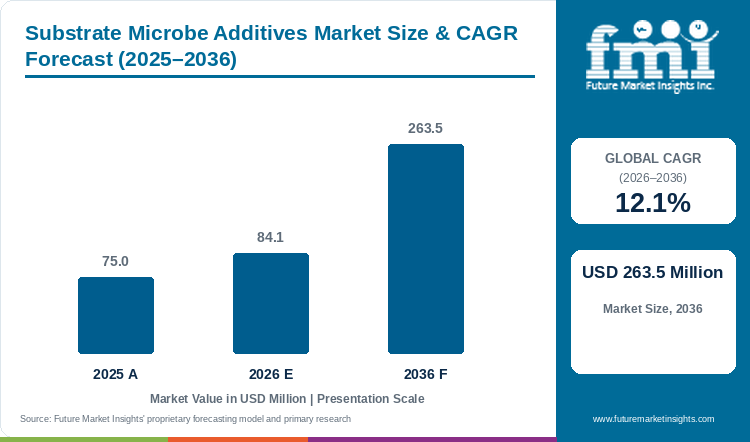
The substrate microbe additives market increased from USD 75.0 million in 2025 to an estimated USD 84.1 million in 2026 and is projected to reach USD 263.5 million by 2036, registering a CAGR of 12.1% from 2026 to 2036. Complete A/B nutrient systems accounted for the leading 42.1% share of product type revenue in 2026, as growers keep calcium away from concentrated phosphate and sulfate before dilution. Substrate microbe additives are increasingly integrated alongside soluble fertilizers to support root-zone biological activity and mineral availability throughout recurring crop cycles. In October 2026, the U.S. Department of Agriculture ARS established research priorities for protected culture crops focusing on mineral inputs, substrate dynamics, and water management.[1] This transition toward controlled root-zone management reinforces demand for compatible biological additives that support nutrient availability without disrupting commercial fertigation equipment.
Key Market Trends & Insights
- By Product Type, complete A/B nutrient systems led with 42.1% of revenue in 2026, as two-part concentrates reduce precipitation risk before final dilution.
- By Crop, leafy greens and herbs represented 46.2% of demand in 2026, owing to short crop cycles and repeated preparation of nutrient solution.
- By System, drip substrate systems accounted for 40.7% of demand in 2026, because growers can change feed concentration and irrigation frequency by crop stage.
- By Grower Type, commercial greenhouses held 45.1% of revenue in 2026, with larger crop blocks supporting bulk purchase, water testing and recurring nutrient use.
- By Sales Channel, greenhouse suppliers captured 41.7% of revenue in 2026, as source-water testing and mixing support reduces the difficulty of changing nutrient programs.
Regional Highlights
- Fastest-growing profiled country: South Korea at 11.7% CAGR from 2026 to 2036.
- By country: The USA and Germany follow at 11.4% and 11.1%, respectively, while Japan records the lowest profiled CAGR at 9.8% through 2036.
Market Size & Forecast
Table 1: Market Size and Forecast for the Substrate Microbe Additives Market (USD million and CAGR), 2025 to 2036
| Forecast Measure | Value |
|---|---|
| 2025 Market Size | USD 75.0 million |
| Estimated Market Size in 2026 | USD 84.1 million |
| Projected Market Size by 2036 | USD 263.5 million |
| CAGR, 2026 to 2036 | 12.1% |
| Added Revenue, 2026 to 2036 | USD 179.4 million |
| Market Expansion Multiple, 2026 to 2036 | 3.13x |
Country demand is being shaped by protected crop area, vegetable output and the level of automation used in nutrient delivery, according to FMI. European greenhouse production centers heavily on tomatoes and cucumbers, while Asian cultivation footprints emphasize intensive multi-cycle vegetable cropping. These mature production systems require products that can be applied through existing injectors and sanitation practices. Netafim stated in August 2026 that GrowSphere served more than 100,000 hectares in dozens of countries before GrowSphere FLEX was launched.[2] Expansion of connected dosing into diverse farm operations is expected to support additives that offer stable dilution and straightforward crop-stage instructions.
Protected-Crop Demand Readiness
Table 2: Protected-Crop Demand Readiness for the Substrate Microbe Additives Market (hectares, tonnes, pounds per person, and CAGR), mixed reporting years from 2024 to 2036
| Country | CAGR | Demand or Supply Indicator | Commercial Meaning | Source |
|---|---|---|---|---|
| South Korea | 11.7% | 2027 smart-greenhouse program announced in 2026 for ICT-enabled greenhouse construction. | Monitored nutrient solution expands the setting for controller-compatible additives. | Official program[11] |
| USA | 11.4% | 148 pounds of fresh-market vegetables per person in 2025; domestic production supplied 93% of lettuce availability. | Large domestic crop flow supports repeated greenhouse and hydroponic nutrition. | USDA ERS[12] |
| Germany | 11.1% | 1,250 hectares and 219,200 tonnes of protected vegetables in 2025. | Established greenhouse output supports regular fertigation and documented biological use. | Destatis[13] |
| UK | 10.7% | 866 hectares and 258 thousand tonnes of protected vegetables in 2025. | Crop scale supports bulk soluble inputs, while water and input economics affect trials. | Defra[14] |
| Japan | 9.8% | 37 thousand hectares of installed facilities and 38 thousand hectare-cycles of vegetable cultivation in 2024. | Mature infrastructure favors products compatible with existing dosing and sanitation. | MAFF Japan[15] |
Basis: Country CAGRs are report estimates for 2026 to 2036. Supporting indicators use the latest cited official reporting year available and are not market-size measurements.
Analyst Perspective
“Commercial growers will repeat an additive only when mixing remains simple and crop response becomes visible within the production cycle. Products compatible with present dosing and sanitation practices will enter larger greenhouse blocks faster than complex biological programs.”
- Nandini Roy Choudhury, Principal Consultant, Future Market Insights.
How is the substrate microbe additives market segmented?
Substrate microbe additives market is segmented by product type, crop, system, grower type, sales channel, and region. In 2026, complete A/B nutrient systems are projected at 42.1%, leafy greens and herbs at 46.2%, and drip substrate systems at 40.7%.
The market is segmented six ways, and region carries the geographic split for the 2026 to 2036 forecast. Product type covers complete A/B nutrient systems, single-element additives, biological additives, pH and compatibility aids, and others. Crop splits the market across leafy greens and herbs, tomatoes and vine crops, berries, ornamentals, and others. System describes the irrigation setup, covering drip substrate systems, NFT or DWC recirculating systems, aeroponics, and others. Grower type names the producer, from commercial greenhouses and vertical farms to small commercial and hobby growers. Sales channel covers greenhouse suppliers, hydro specialty retail, online or direct, distributors, and others.
Why do complete A/B nutrient systems remain preferred by commercial growers?
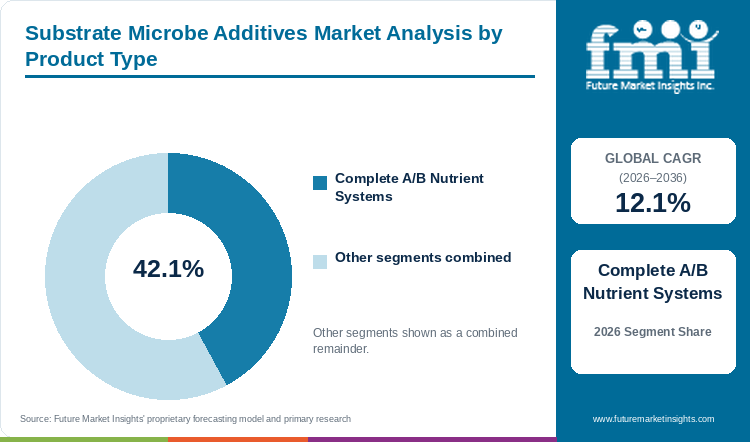
Based on product type, complete A/B nutrient systems are projected to account for 42.1% in 2026, supported by concentrate compatibility.
Table 3: Product Type Share for the Substrate Microbe Additives Market (percentage share), 2026
| Product Type | Share (2026) |
|---|---|
| Complete A/B Nutrient Systems | 42.1% |
| Other Segments Combined | 57.9%* |
| Total | 100.0% |
*Calculated as the balance remaining after deducting the leading segment's reported share from 100.0%.
Table 4: Product Type Leadership and Market Growth for the Substrate Microbe Additives Market (segment and CAGR percentage), 2026 to 2036
| Metric | Value |
|---|---|
| Global CAGR (2026 to 2036) | 12.1% |
| Leading Segment | Complete A/B Nutrient Systems |
Complete A/B nutrient systems are supplied through two separate concentrated parts. Calcium is kept away from concentrated phosphate or sulfate before dilution, due to which precipitation and clogging can be reduced during preparation. Commercial growers are also able to change electrical conductivity according to crop stage without replacing the complete nutrient program. Canna states that Coco A and B are separated because some elements can clog together when added at the same time.[3] These application advantages are supporting complete A/B nutrient systems, which are projected to account for 42.1% of product type revenue in 2026.
- Complete A/B nutrient systems are projected to hold 42.1% of product type revenue in 2026, supported by separate stock preservation and dosing flexibility.
- Source-water alkalinity and stock concentration can determine whether the two-part program remains stable during application.
What supports leafy greens and herbs as the preferred crop category?
By crop, leafy greens and herbs are estimated to hold 46.2% in 2026, owing to short production cycles.
Leafy greens and herbs are produced through short crop cycles and requires new nutrient solution for repeated harvests. Any change in nutrient availability becomes visible quickly in root and leaf growth, which makes these crops suitable for comparing additive response. A 2025 hydroponic study applied bacterial inoculants through nutrient solution and recorded changes in lettuce and arugula growth, nutrient acquisition and nitrogen metabolism.[4] Wider trials in frequently harvested crops are expected to support leafy greens and herbs, estimated to hold 46.2% of crop demand in 2026. However, sanitation compatibility may limit the use of living additives in commercial systems.
- Leafy greens and herbs are estimated to hold 46.2% of crop demand in 2026, reflecting how repeated cycles reward stable nutrient recipes.
- Short crop cycles allow growers to compare root and leaf response before using the additive across a larger crop block.
How do drip substrate systems meet controlled root-zone dosing needs?
In 2026, drip substrate systems are expected to lead system demand with 40.7% share, driven by direct metering.
Drip substrate systems are used to deliver soluble nutrients into cocopeat, rockwool and other defined root zones. Growers can change the concentration and irrigation frequency according to crop stage, due to which these systems are widely used for greenhouse vegetables, berries and ornamentals. Haifa Group provides water-soluble fertilizers for greenhouse and soilless fertigation, supporting the need for complete solubility and uniform movement through drip lines.[5] Direct root-zone feeding and flexible dose adjustment are expected to support drip substrate systems, accounting for 40.7% of system demand in 2026.
- Drip substrate systems are expected to account for 40.7% of system demand in 2026, driven by individual feed event metering and emitter control.
- Uniform flow through emitters remains important because blocked lines can create uneven nutrient supply across the crop.
Why do commercial greenhouses retain a notable grower-type share?
Commercial greenhouses are set to lead grower type with 45.1% share in 2026, underpinned by repeat purchasing.
Commercial greenhouses purchase soluble inputs in larger volume as nutrient solution is required throughout the crop cycle. A formulation or injector error can affect a complete production block, which has increased the use of water testing and crop-stage nutrient programs. RaboResearch reported in March 2025 that European greenhouse vegetable cultivation spans extensive commercial acreage, with Spain dedicating over 61,000 hectares to intensive greenhouse production.[6] Presence of large-scale protected vegetable operations creates recurring demand for nutrient systems and root-zone additives. Commercial greenhouses are projected to hold 45.1% of grower-type revenue in 2026, owing to larger crop area and regular purchasing.
- Commercial greenhouses are projected to hold 45.1% of grower-type revenue in 2026, underpinned by bulk purchasing and lower tolerance for formulation errors.
- Larger crop blocks support bulk purchasing, but also raise the loss caused by incorrect concentration or injector setting.
Which conditions keep greenhouse suppliers relevant in sales channels?
Greenhouse suppliers are likely to capture 41.7% share in 2026, enabled by local formulation and troubleshooting support.
Greenhouse suppliers provide soluble nutrients and additives along with support for source water, substrate, injector ratio and target electrical conductivity. The same formulation can perform differently where water alkalinity and dosing equipment changes, due to which local assistance remains important. JR Peters offers source-water and nutrient-solution testing with consultation and mixing advice.[7] Availability of products, testing and troubleshooting from one channel is reducing the difficulty of changing nutrient programs. Greenhouse suppliers are likely to capture 41.7% of sales-channel revenue in 2026 on account of this application support.
- Greenhouse suppliers are likely to capture 41.7% of sales-channel revenue in 2026, enabled by local product availability and mixing advice.
- Local product availability and mixing support helps small and commercial growers use the same channel for repeat supply.
What are the drivers, restraints, and opportunities in the substrate microbe additives market?
In the substrate microbe additives market, the key driver is repeatable fertigation, the key restraint is biological compatibility, and the key opportunity is validated root-zone integration.
- Driver: Controlled production expands recurring demand for products that fit measured nutrient delivery.
- Restraint: Water chemistry, sanitation, and living-organism stability can extend qualification before routine purchase.
- Opportunity: Hydroponic-specific biological formulations can gain use where dose, crop response, and process fit are documented.
Measured Fertigation Expands Repeat Use
Controlled crop production has increased the requirement for measured fertigation and repeated preparation of nutrient solution. Products having complete solubility and stable dosing are preferred as the solution passes through tanks, injectors and drip lines during every crop cycle. In April 2025, Netafim partnered with Treetoscope to add direct plant-water sensing into GrowSphere and provide real-time irrigation recommendations.[8] An FMI analyst notes that earlier identification of root-zone moisture dynamics can accelerate grower adoption of automated fertigation programs. Integration of crop sensing with fertigation is increasing measured delivery of water and fertilizer, driving repeat demand for compatible substrate microbe additives.
Sanitation Can Disrupt Living Inputs
Recirculating systems move nutrient solution through a common water path, which can distribute useful microbes as well as unwanted organisms. A 2025 study reported that UV-C treatment reduced E. coli by 1.4 to 1.5 log CFU per millilitre in hydroponic nutrient solution.[9] Such treatment supports crop hygiene; however, it can also affect living microbial inputs depending on organism and exposure routine. Manufacturers need to test microbial viability with UV-C, sanitation chemicals and source-water conditions. Longer compatibility testing and uncertain survival may constrain the routine deployment of microbial additives in closed recirculating loops.
Hydroponic Evidence Opens Product Space
Hydroponic production is creating new application space for microbial biostimulants used for root growth, nutrient uptake and crop stress. An April 2026 review noted limited hydroponic dose guidance and high commercialization costs, even as evidence related to microbial application continues to increase.[10] This allows manufacturers to introduce stable products with crop-specific rates, application timing and sanitation instructions. Additives showing repeated crop response through nutrient solution can be integrated into existing soilless regimes. Development of hydroponic-specific biological additives is expected to expand commercial opportunities in the substrate microbe additives market.
Which country CAGRs are profiled in the substrate microbe additives market?
Table 5: Country CAGR Comparison for the Substrate Microbe Additives Market (CAGR percentage), 2026 to 2036
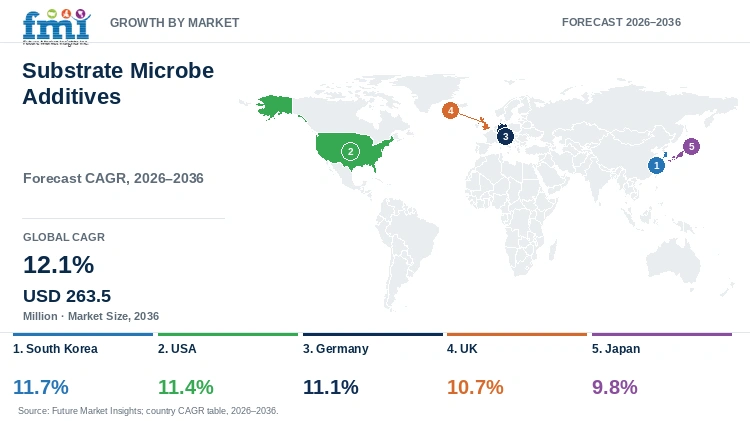
| Country | CAGR |
|---|---|
| South Korea | 11.7% |
| USA | 11.4% |
| Germany | 11.1% |
| UK | 10.7% |
| Japan | 9.8% |
How do country-level CAGRs compare in the substrate microbe additives market?
Protected cultivation, automated nutrient delivery and repeated use of soluble inputs are expected to support country demand through 2036. In the FMI report, adoption develops differently across countries because greenhouse area, crop production, public support and installed dosing practices vary across the profiled markets.
- South Korea uses public smart-greenhouse programs to extend nutrient monitoring and automated environmental control.
- The USA combines a broad controlled-production base with established specialty-input and testing channels.
- Germany links protected-vegetable production with formal European requirements for microbial plant biostimulants.
- The UK retains a commercial protected-vegetable base where input economics and water use shape new-product trials.
- Japan has a mature protected-horticulture footprint that favors products compatible with established injectors and crop protocols.
Country-wise Analysis
- By 2036, South Korea is projected to grow at 11.7% CAGR, which represents the highest rate among the profiled countries. In 2026, the Ministry of Agriculture, Food and Rural Affairs announced the 2027 ICT greenhouse construction program covering monitored nutrient solution and environmental control.[11] Increasing installation of smart greenhouse equipment will raise the use of products that can be applied through automated nutrient tanks and dosing lines. Apart from that, microbial additives requires clear sanitation and mixing instruction before being added into these systems. FMI data suggests the higher outlook will depend on integrating living additives into controller-managed smart greenhouses without disrupting automated sensor lines.
- FMI research indicates that substrate microbe additive sales in the USA are forecast to expand at 11.4% CAGR through 2036, supported by a large fresh vegetable production and consumption base. USDA reported fresh-market vegetable availability of 148 pounds per person in 2025, increasing by almost 3 pounds from 2024, while lettuce remained 93% supplied by domestic production.[12] Presence of domestic lettuce and vegetable production creates repeated requirement for greenhouse and hydroponic crop nutrition. Moreover, availability of water testing, specialty suppliers and fertigation systems is increasing product trials among commercial growers. Better continuity between technical consultation and on-farm supply can turn an initial trial into routine purchasing.
- As per the analysis from FMI, Germany substrate microbe additives market is anticipated to advance at 11.1% CAGR over the assessment period. Destatis reported that protected vegetable area reached 1,250 hectares in 2025 and output increased by 4.3% to 219,200 tonnes.[13] Tomatoes and cucumbers accounted for a major portion of greenhouse harvest, which supports repeated demand for soluble nutrient programs. Biological additives also requires product documentation and application instruction under the European fertilising-products framework. Expansion of protected vegetable output along with formal use requirement is projected to support demand for substrate microbe additives in Germany.
- Demand for substrate microbe additives in the UK is predicted to advance at 10.7% CAGR through 2036. The UK protected vegetable sector covered 866 hectares and produced 258 thousand tonnes in 2025.[14] Protected area increased while output softened, due to which growers are focusing on crop response, water use and input cost. Products having simple dose guidance and measurable benefit can be included more easily in established greenhouse schedules. Increasing need for efficient nutrient use is expected to support the UK substrate microbe additives market over the forecast period.
- The outlook for substrate microbe additives in Japan remains positive, with sales projected to increase at 9.8% CAGR through 2036. Japan reported about 37 thousand hectares of installed glasshouse and house area, while vegetable cropping covered near 38 thousand hectare-cycles.[15] Presence of mature protected horticulture facilities supports demand for products that can be used with existing injectors and crop protocols. New additives requires stable mixing, crop-specific rates and compatibility with routine sanitation before wider adoption. These requirements are expected to support gradual growth of substrate microbe additives in Japan during the assessment period.
Who are the notable companies in the substrate microbe additives market?
Canna, JR Peters, Masterblend, Netafim, Compo Expert, Haifa Group, Yara International, and ICL Group are notable companies profiled in this market.
Substrate microbe additives market is moderately fragmented with soilless nutrient specialists, fertigation companies and biological-input manufacturers operating in the market. Canna, JR Peters and Masterblend are focusing on concentrated and crop-specific soluble programs. Netafim provides irrigation and fertigation control, whereas Compo Expert, Haifa Group, Yara International and ICL Group offer specialty nutrition and biological capabilities. Some of the prominent players are launching products, expanding biological portfolios and adding application support in order to cater the growing demand. Such developments are expected to intensify competition during the forecast period.
- Soilless nutrient specialists: Canna, JR Peters, and Masterblend provide concentrated or crop-specific soluble programs.
- Fertigation and specialty nutrition platforms: Netafim, Haifa Group, and Yara International connect products with measured delivery or broad soluble portfolios.
- Biological-enabled suppliers: Compo Expert and ICL Group document biological or biostimulant capabilities alongside specialty nutrition.
Competitive Benchmarking: Substrate Microbe Additives Market
Table 6: Competitive Benchmarking for the Substrate Microbe Additives Market (qualitative capability ratings), 2026
| Company | Soilless nutrient depth | Biological integration | Fertigation support | Reach |
|---|---|---|---|---|
| Canna | High | Low | High | Medium |
| JR Peters | High | Low | High | Medium |
| Masterblend | High | Low | High | Medium |
| Netafim | Low | Low | High | High |
| Compo Expert | High | High | High | High |
| Haifa Group | High | Medium | High | High |
| Yara International | High | High | High | High |
| ICL Group | High | High | High | High |
High represents wider documented capability for the stated area, whereas Medium represents limited product breadth and Low represents lower direct evidence. These ratings are based on public product and company information and does not indicate product quality or revenue share.
Key Developments in the Substrate Microbe Additives Market
- In March 2026, Yara International expanded research capabilities at its Hanninghof Research Centre in Germany, adding laboratory facilities to develop and validate biological crop-nutrition and root-health formulations.[16]
- In July 2025, ICL completed the acquisition of most Lavie Bio activities and assets from Evogene. The transaction added a microbial bank and biological discovery platform.[17]
- In February 2025, Haifa Group introduced Haifa Soluble DUO for fertigation. The formulas support calcium adjustment with lower accompanying nitrogen, chloride or sulfate.[18]
Key Players in the Substrate Microbe Additives Market
Soilless Nutrient-System Specialists
- Canna
- JR Peters
- Masterblend
Fertigation and Specialty Nutrition Platforms
- Netafim
- Haifa Group
- Yara International
Biological-Enabled Specialty Nutrition Suppliers
- Compo Expert
- ICL Group
Substrate Microbe Additives Market - Report Scope
Table 7: Report Scope for the Substrate Microbe Additives Market (coverage fields and definitions), 2026 to 2036
| Coverage field | Report scope |
|---|---|
| Market breakdown | Product type, crop, system, grower type, sales channel, and region. |
| Quantitative units | USD million. |
| Market definition | Revenue from complete A/B nutrient systems, single-element additives, biological additives, and pH or compatibility aids sold for defined soilless and substrate cultivation. Hardware, software, downstream crop value, substrates, pesticides, and general field fertilizers are excluded. |
| Regions covered | North America; Latin America; Western Europe; Eastern Europe; East Asia; South Asia and Pacific; Middle East and Africa. |
| Countries covered | USA, UK, Germany, Japan, South Korea, and additional countries in the full report. |
| Key companies profiled | Canna, JR Peters, Masterblend, Netafim, Compo Expert, Haifa Group, Yara International, ICL Group. |
| Forecast period | 2026 to 2036. |
| Approach | The report covers supplier activity, segment structure, application use and country demand within the defined market boundary. |
Substrate Microbe Additives Market - Research Methodology
Table 8: Research Methodology for the Substrate Microbe Additives Market (research methods and approach), 2026 edition
| Method | Approach |
|---|---|
| Primary Research | The research study includes primary interviews with manufacturers, distributors, growers, procurement teams and industry experts. Interviews covers product use, purchasing decision, pricing, adoption barriers and application requirement. |
| Desk Research | Desk research covers government statistics, regulatory publications, technical literature, company product information and official announcements. Sources are checked according to date, country and direct relevance with substrate microbe additives market. |
| Market Sizing and Forecasting | Market sizing combines baseline value with segment share, pricing, product adoption, company participation and country demand. Segment and regional estimates are checked with the final market value. |
| Data Validation | Market estimates are checked with public data, company activity and primary interviews. Products outside the stated market definition are excluded in order to avoid overlap. |
Substrate Microbe Additives Market by Segments
Substrate Microbe Additives Market segmented by Product Type:
- Complete A/B Nutrient Systems
- Single-Element Additives
- Biological Additives
- pH and Compatibility Aids
- Others
Substrate Microbe Additives Market segmented by Crop:
- Leafy Greens and Herbs
- Tomatoes and Vine Crops
- Berries
- Ornamentals
- Others
Substrate Microbe Additives Market segmented by System:
- Drip Substrate Systems
- NFT or DWC Recirculating
- Aeroponics
- Others
Substrate Microbe Additives Market segmented by Grower Type:
- Commercial Greenhouses
- Vertical Farms
- Small Commercial and Hobby
- Others
Substrate Microbe Additives Market segmented by Sales Channel:
- Greenhouse Suppliers
- Hydro Specialty Retail
- Online or Direct
- Distributors
- Others
Substrate Microbe Additives Market by Region
- North America
- United States
- Canada
- Latin America
- Brazil
- Mexico
- Argentina
- Chile
- Western Europe
- Germany
- France
- United Kingdom
- Italy
- Spain
- Benelux
- Nordics
- Eastern Europe
- Poland
- Czech Republic
- Romania
- Hungary
- East Asia
- China
- Japan
- South Korea
- South Asia and Pacific
- India
- ASEAN
- Australia and New Zealand
- Middle East and Africa
- GCC Countries
- South Africa
- Türkiye
- Israel
Research Sources and Bibliography
- [1] U.S. Department of Agriculture, Agricultural Research Service. (2026, October 6). Climate-smart, adaptive, and resilient production and pest management practices for nursery, greenhouse, and protected culture crops.
- [2] Netafim. (2026, August 13). Orbia Netafim launches GrowSphere FLEX to scale digital farming.
- [3] Canna. (n.d.). CANNA Coco nutrients for the best absorption.
- [4] Oliveira, C. E. S., et al. (2025, April 15). Inoculation and co-inoculation of lettuce and arugula hydroponically influence nitrogen metabolism, plant growth, nutrient acquisition and photosynthesis. Frontiers in Plant Science, 16.
- [5] Haifa Group. (n.d.). Water soluble fertilizers.
- [6] RaboResearch Food & Agribusiness. (2025, March). Global greenhouse update 2025.
- [7] JR Peters. (n.d.). Support services: JRP Lab Services.
- [8] Netafim. (2025, April 15). Orbia Netafim expands digital farming capabilities with Treetoscope plant sensing technology.
- [9] Moore, M., et al. (2025, July 2). Effect of ultraviolet water treatment on survival and growth of Escherichia coli in recirculating hydroponic systems. Journal of Food Protection.
- [10] Wu, G., et al. (2026, April 17). How novel biostimulants enhance resilience and quality in hydroponic crop production: A review. Agronomy, 16(8), 827.
- [11] Republic of Korea Ministry of Agriculture, Food and Rural Affairs. (2026). Smart farm ICT greenhouse construction: 2027 operator recruitment plan.
- [12] U.S. Department of Agriculture, Economic Research Service. (2026, April 30). Vegetables and pulses outlook: April 2026.
- [13] Statistisches Bundesamt. (2026, February 26). Gemüseernte erreicht 2025 neuen Höchststand.
- [14] Department for Environment, Food & Rural Affairs. (2026, June 25). Horticulture statistics 2025.
- [15] Ministry of Agriculture, Forestry and Fisheries of Japan. (2025). (R6).
- [16] Yara International. (2026, March 23). Yara expands research capabilities in biological crop solutions.
- [17] Evogene. (2025, July 8). Evogene announces completion of transaction for the sale of Lavie Bio’s activity to ICL.
- [18] Haifa Group. (2025, February 17). Haifa North West Europe launches water-soluble fertilizer Haifa Soluble DUO.
- [19] COMPO EXPERT. (2025, April 2). Introducing the Basfoliar Premium SL line: Powered by Leaf Care Technology.
- [20] ICL Growing Solutions. (2026, April 12). ICL launches Bioz Kellus.
This bibliography is provided for reader reference. The full report contains the complete reference list and detailed citations.
This Report Answers
- What is Substrate Microbe Additives Market worth during 2026?
- What value is Substrate Microbe Additives Market projected by 2036?
- Which product type holds notable Substrate Microbe Additives Market share?
- Which crop holds notable Substrate Microbe Additives Market share?
- Which countries have notable Substrate Microbe Additives Market growth?
- Which companies are notable in Substrate Microbe Additives Market today?
Frequently Asked Questions
How large is the Substrate Microbe Additives Market in 2026?
The substrate microbe additives market is valued at USD 84.1 million in 2026 and is projected to reach USD 263.5 million by 2036.
What CAGR is forecast for Substrate Microbe Additives Market through 2036?
As per FMI, the substrate microbe additives market is projected to grow at 12.1% CAGR from 2026 to 2036. Increasing adoption of automated fertigation and measured root-zone feeding are expected to support demand.
Which product type holds a notable market share in 2026?
In the FMI report, complete A/B nutrient systems are projected to hold 42.1% of product type revenue in 2026. Two-part concentrates prevent premature mineral precipitation before final dilution.
Which crop category holds a notable market share in 2026?
Leafy greens and herbs are expected to hold 46.2% of crop demand in 2026. Rapid production turnover and recurring nutrient preparation support steady additive use.
Which country has a notable substrate microbe additive growth outlook?
South Korea is projected to register 11.7% CAGR from 2026 to 2036. Government-supported ICT greenhouse expansion is driving adoption of automated root-zone dosing.
Which companies are active in Substrate Microbe Additives Market?
Key participants include Canna, JR Peters, Masterblend, Netafim, Compo Expert, Haifa Group, Yara International, and ICL Group. These companies are focusing on soluble nutrient compatibility, digital fertigation integration, and biological input discovery.
Preview the report firsthand - request a free sample
Get SampleGet the brochure for pricing and purchase details.
Get PDFTable of Content
- Key Takeaways
- Market Size and CAGR
- Top Growth Driver
- Fastest Growing Segment
- Leading Region
- Key Companies
- Emerging Opportunities
- Executive Summary
- Global Market Outlook
- Demand-side Trends
- Supply-side Trends
- Technology Roadmap Analysis
- Analysis and Recommendations
- Analyst Perspective (What is happening? Why now? What should investors know?)
- Key Questions Answered
- How large is the market?
- What is the CAGR?
- What are key trends?
- Which region dominates?
- Who are the leaders?
- Market Overview
- Market Coverage / Taxonomy
- Market Definition / Scope / Limitations
- Research Methodology
- Chapter Orientation
- Analytical Lens and Working Hypotheses
- Market Structure, Signals, and Trend Drivers
- Benchmarking and Cross-market Comparability
- Market Sizing, Forecasting, and Opportunity Mapping
- Research Design and Evidence Framework
- Desk Research Programme (Secondary Evidence)
- Expert Input and Fieldwork (Primary Evidence)
- Tooling, Models, and Reference Databases
- Data Engineering and Model Build
- Quality Assurance and Audit Trail
- Market Background
- Market Dynamics (Drivers, Restraints, Opportunity, Trends)
- Scenario Forecast (Optimistic, Likely, Conservative)
- Impact Analysis
- AI Impact
- Sustainability Impact
- Regulatory Impact
- Technology Impact
- Consumer / Buyer Analysis
- Purchase Drivers
- Adoption Barriers
- Buyer Journey
- Opportunity Map Analysis
- Product Life Cycle Analysis
- Supply Chain Analysis
- Investment Feasibility Matrix
- Value Chain Analysis
- PESTLE and Porter's Analysis
- Regulatory Landscape
- Regional Parent Market Outlook
- Production and Consumption Statistics
- Import and Export Statistics
- Global Market Analysis and Forecast, 2021 to 2036
- Historical Market Size Value (USD Million) Analysis, 2021 to 2025
- Current and Future Market Size Value (USD Million) Projections, 2026 to 2036
- Y-o-Y Growth Trend Analysis
- Absolute $ Opportunity Analysis
- Global Market Pricing Analysis, 2021 to 2036
- Global Market Analysis and Forecast, By Product Type, 2021 to 2036
- Introduction / Key Findings
- Historical Market Size Value (USD Million) Analysis By Product Type, 2021 to 2025
- Current and Future Market Size Value (USD Million) Analysis and Forecast By Product Type, 2026 to 2036
- Complete A/B Nutrient Systems
- Single-Element Additives
- Biological Additives
- pH and Compatibility Aids
- Others
- Y-o-Y Growth Trend Analysis By Product Type, 2021 to 2025
- Absolute $ Opportunity Analysis By Product Type, 2026 to 2036
- Global Market Analysis and Forecast, By Crop, 2021 to 2036
- Introduction / Key Findings
- Historical Market Size Value (USD Million) Analysis By Crop, 2021 to 2025
- Current and Future Market Size Value (USD Million) Analysis and Forecast By Crop, 2026 to 2036
- Leafy Greens and Herbs
- Tomatoes and Vine Crops
- Berries
- Ornamentals
- Others
- Y-o-Y Growth Trend Analysis By Crop, 2021 to 2025
- Absolute $ Opportunity Analysis By Crop, 2026 to 2036
- Global Market Analysis and Forecast, By System, 2021 to 2036
- Introduction / Key Findings
- Historical Market Size Value (USD Million) Analysis By System, 2021 to 2025
- Current and Future Market Size Value (USD Million) Analysis and Forecast By System, 2026 to 2036
- Drip Substrate Systems
- NFT or DWC Recirculating
- Aeroponics
- Others
- Y-o-Y Growth Trend Analysis By System, 2021 to 2025
- Absolute $ Opportunity Analysis By System, 2026 to 2036
- Global Market Analysis and Forecast, By Grower Type, 2021 to 2036
- Introduction / Key Findings
- Historical Market Size Value (USD Million) Analysis By Grower Type, 2021 to 2025
- Current and Future Market Size Value (USD Million) Analysis and Forecast By Grower Type, 2026 to 2036
- Commercial Greenhouses
- Vertical Farms
- Small Commercial and Hobby
- Others
- Y-o-Y Growth Trend Analysis By Grower Type, 2021 to 2025
- Absolute $ Opportunity Analysis By Grower Type, 2026 to 2036
- Global Market Analysis and Forecast, By Sales Channel, 2021 to 2036
- Introduction / Key Findings
- Historical Market Size Value (USD Million) Analysis By Sales Channel, 2021 to 2025
- Current and Future Market Size Value (USD Million) Analysis and Forecast By Sales Channel, 2026 to 2036
- Greenhouse Suppliers
- Hydro Specialty Retail
- Online or Direct
- Distributors
- Others
- Y-o-Y Growth Trend Analysis By Sales Channel, 2021 to 2025
- Absolute $ Opportunity Analysis By Sales Channel, 2026 to 2036
- Global Market Analysis and Forecast, By Region, 2021 to 2036
- Introduction
- Historical Market Size Value (USD Million) Analysis By Region, 2021 to 2025
- Current Market Size Value (USD Million) Analysis and Forecast By Region, 2026 to 2036
- North America
- Latin America
- Western Europe
- Eastern Europe
- East Asia
- South Asia and Pacific
- Middle East and Africa
- Market Attractiveness Analysis By Region
- North America Market Analysis and Forecast, By Country, 2021 to 2036
- Historical Market Size Value (USD Million) Trend Analysis By Market Taxonomy, 2021 to 2025
- Market Size Value (USD Million) Forecast By Market Taxonomy, 2026 to 2036
- By Country
- United States
- Canada
- By Product Type
- By Crop
- By System
- By Grower Type
- By Sales Channel
- By Country
- Market Attractiveness Analysis
- By Country
- By Product Type
- By Crop
- By System
- By Grower Type
- By Sales Channel
- Key Takeaways
- Latin America Market Analysis and Forecast, By Country
- Historical Market Size Value (USD Million) Trend Analysis By Market Taxonomy, 2021 to 2025
- Market Size Value (USD Million) Forecast By Market Taxonomy, 2026 to 2036
- By Country
- Brazil
- Mexico
- Argentina
- Chile
- By Product Type
- By Crop
- By System
- By Grower Type
- By Sales Channel
- By Country
- Market Attractiveness Analysis
- By Country
- By Product Type
- By Crop
- By System
- By Grower Type
- By Sales Channel
- Key Takeaways
- Western Europe Market Analysis and Forecast, By Country
- Historical Market Size Value (USD Million) Trend Analysis By Market Taxonomy, 2021 to 2025
- Market Size Value (USD Million) Forecast By Market Taxonomy, 2026 to 2036
- By Country
- Germany
- France
- United Kingdom
- Italy
- Spain
- Benelux
- Nordics
- By Product Type
- By Crop
- By System
- By Grower Type
- By Sales Channel
- By Country
- Market Attractiveness Analysis
- By Country
- By Product Type
- By Crop
- By System
- By Grower Type
- By Sales Channel
- Key Takeaways
- Eastern Europe Market Analysis and Forecast, By Country
- Historical Market Size Value (USD Million) Trend Analysis By Market Taxonomy, 2021 to 2025
- Market Size Value (USD Million) Forecast By Market Taxonomy, 2026 to 2036
- By Country
- Poland
- Czech Republic
- Romania
- Hungary
- By Product Type
- By Crop
- By System
- By Grower Type
- By Sales Channel
- By Country
- Market Attractiveness Analysis
- By Country
- By Product Type
- By Crop
- By System
- By Grower Type
- By Sales Channel
- Key Takeaways
- East Asia Market Analysis and Forecast, By Country
- Historical Market Size Value (USD Million) Trend Analysis By Market Taxonomy, 2021 to 2025
- Market Size Value (USD Million) Forecast By Market Taxonomy, 2026 to 2036
- By Country
- China
- Japan
- South Korea
- By Product Type
- By Crop
- By System
- By Grower Type
- By Sales Channel
- By Country
- Market Attractiveness Analysis
- By Country
- By Product Type
- By Crop
- By System
- By Grower Type
- By Sales Channel
- Key Takeaways
- South Asia and Pacific Market Analysis and Forecast, By Country
- Historical Market Size Value (USD Million) Trend Analysis By Market Taxonomy, 2021 to 2025
- Market Size Value (USD Million) Forecast By Market Taxonomy, 2026 to 2036
- By Country
- India
- ASEAN
- Australia and New Zealand
- By Product Type
- By Crop
- By System
- By Grower Type
- By Sales Channel
- By Country
- Market Attractiveness Analysis
- By Country
- By Product Type
- By Crop
- By System
- By Grower Type
- By Sales Channel
- Key Takeaways
- Middle East and Africa Market Analysis and Forecast, By Country
- Historical Market Size Value (USD Million) Trend Analysis By Market Taxonomy, 2021 to 2025
- Market Size Value (USD Million) Forecast By Market Taxonomy, 2026 to 2036
- By Country
- GCC Countries
- South Africa
- Türkiye
- Israel
- By Product Type
- By Crop
- By System
- By Grower Type
- By Sales Channel
- By Country
- Market Attractiveness Analysis
- By Country
- By Product Type
- By Crop
- By System
- By Grower Type
- By Sales Channel
- Key Takeaways
- Key Countries Market Analysis
- United States
- Pricing Analysis
- Market Share Analysis, 2025
- By Product Type
- By Crop
- By System
- By Grower Type
- By Sales Channel
- Canada
- Pricing Analysis
- Market Share Analysis, 2025
- By Product Type
- By Crop
- By System
- By Grower Type
- By Sales Channel
- Mexico
- Pricing Analysis
- Market Share Analysis, 2025
- By Product Type
- By Crop
- By System
- By Grower Type
- By Sales Channel
- Brazil
- Pricing Analysis
- Market Share Analysis, 2025
- By Product Type
- By Crop
- By System
- By Grower Type
- By Sales Channel
- Chile
- Pricing Analysis
- Market Share Analysis, 2025
- By Product Type
- By Crop
- By System
- By Grower Type
- By Sales Channel
- Germany
- Pricing Analysis
- Market Share Analysis, 2025
- By Product Type
- By Crop
- By System
- By Grower Type
- By Sales Channel
- United Kingdom
- Pricing Analysis
- Market Share Analysis, 2025
- By Product Type
- By Crop
- By System
- By Grower Type
- By Sales Channel
- Italy
- Pricing Analysis
- Market Share Analysis, 2025
- By Product Type
- By Crop
- By System
- By Grower Type
- By Sales Channel
- Spain
- Pricing Analysis
- Market Share Analysis, 2025
- By Product Type
- By Crop
- By System
- By Grower Type
- By Sales Channel
- France
- Pricing Analysis
- Market Share Analysis, 2025
- By Product Type
- By Crop
- By System
- By Grower Type
- By Sales Channel
- India
- Pricing Analysis
- Market Share Analysis, 2025
- By Product Type
- By Crop
- By System
- By Grower Type
- By Sales Channel
- ASEAN
- Pricing Analysis
- Market Share Analysis, 2025
- By Product Type
- By Crop
- By System
- By Grower Type
- By Sales Channel
- Australia and New Zealand
- Pricing Analysis
- Market Share Analysis, 2025
- By Product Type
- By Crop
- By System
- By Grower Type
- By Sales Channel
- China
- Pricing Analysis
- Market Share Analysis, 2025
- By Product Type
- By Crop
- By System
- By Grower Type
- By Sales Channel
- Japan
- Pricing Analysis
- Market Share Analysis, 2025
- By Product Type
- By Crop
- By System
- By Grower Type
- By Sales Channel
- South Korea
- Pricing Analysis
- Market Share Analysis, 2025
- By Product Type
- By Crop
- By System
- By Grower Type
- By Sales Channel
- Poland
- Pricing Analysis
- Market Share Analysis, 2025
- By Product Type
- By Crop
- By System
- By Grower Type
- By Sales Channel
- Hungary
- Pricing Analysis
- Market Share Analysis, 2025
- By Product Type
- By Crop
- By System
- By Grower Type
- By Sales Channel
- Türkiye
- Pricing Analysis
- Market Share Analysis, 2025
- By Product Type
- By Crop
- By System
- By Grower Type
- By Sales Channel
- South Africa
- Pricing Analysis
- Market Share Analysis, 2025
- By Product Type
- By Crop
- By System
- By Grower Type
- By Sales Channel
- United States
- Market Structure Analysis
- Competition Dashboard
- Competition Benchmarking
- Market Share Analysis of Top Players
- By Regional
- By Product Type
- By Crop
- By System
- By Grower Type
- By Sales Channel
- Emerging Startups
- Innovation Benchmarking
- Competition Analysis
- Competition Deep Dive
- Canna
- Overview
- Product Portfolio
- Profitability by Market Segments
- Sales Footprint
- Strategy Overview
- Marketing Strategy
- Product Strategy
- Channel Strategy
- JR Peters
- Masterblend
- Netafim
- Compo Expert
- Haifa Group
- Yara International
- ICL Group
- Canna
- Case Studies
- Success Stories
- Recent Developments
- Competition Deep Dive
- Assumptions & Acronyms Used


