

- Market Size (2026)
- USD 318.5 Mn
- Forecast (2036)
- USD 962.9 Mn
- CAGR (2026 to 2036)
- 11.7%
How big is Hydroponic Root Enhancers Market in 2026?
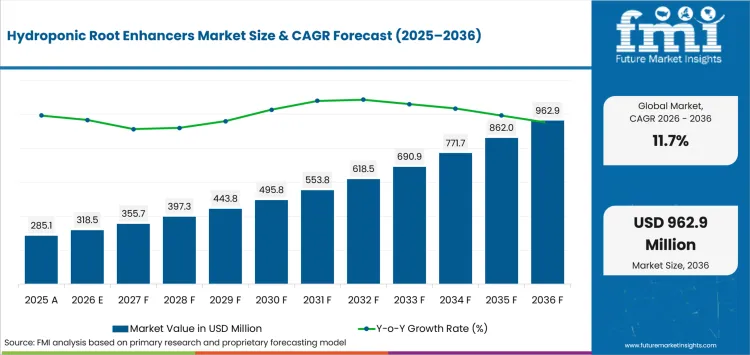
USD 318.5 million in 2026 and USD 962.9 million by 2036 at an 11.7% CAGR.
The hydroponic root enhancers market is projected to rise from USD 318.5 million in 2026 to USD 962.9 million by 2036 at 11.7% CAGR. Controlled-environment production turns nutrient preparation into a recurring operating purchase because crops depend on managed solution chemistry throughout each cycle. USDA Agricultural Research Service reported in January 2025 that vertical farming uses artificial growing systems such as hydroponics and includes national research on hydroponic nutrient solutions. That production route expands the operating base that must maintain repeatable root-zone inputs across continuous crop cycles.
Country conversion depends on production economics and monitoring intensity instead of the global forecast alone. The UK Food Standards Agency classified controlled environment agriculture as a high-impact and near-term technology in June 2026. It noted that precise nutrient administration supports indoor crops such as leafy greens and herbs. That operating model increases the value of water-soluble nutrition, yet energy cost and local qualification conditions determine how quickly growers change formulations.
Key Takeaways of Hydroponic Root Enhancers Market
- Recurring nutrient preparation supports demand as commercial hydroponic operations standardize root-zone recipes across repeated production cycles.
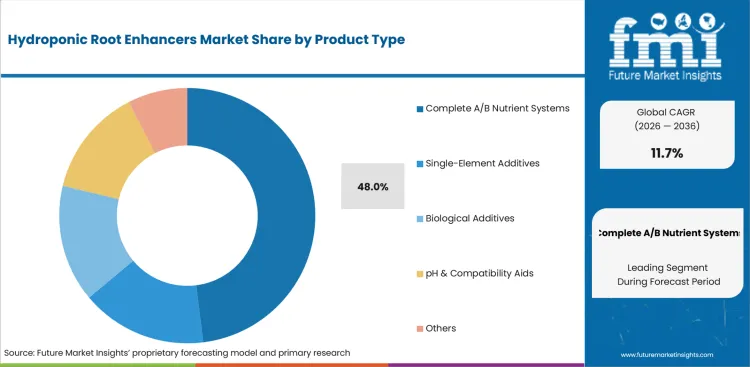
- Complete A/B nutrient systems are projected to hold 48.0% share in 2026 owing to separated concentrates that reduce compatibility risk during stock preparation.
- In 2026, leafy greens & herbs are expected to lead crop with 37.7% share because short crop cycles increase nutrient reset frequency.
- By system, drip substrate systems are forecast to represent 45.2% in 2026 driven by buffered root zones that fit precise commercial fertigation schedules.
- Source-water chemistry and concentrate handling can slow product switching because a formulation must perform inside the grower's existing injector and crop protocol.
- Some of the key players in this market include Athena Ag, Canna, JR Peters (Jack's), Masterblend, Advanced Nutrients, Haifa Group, ICL Group, and Yara International.
Analyst Perspective
"Hydroponic growers should compare root-zone programs first on EC stability and solubility in their own source water instead of unit price. Formulations earn repeat orders by shortening mixing work and giving greenhouse crews a repeatable correction path across successive crop cycles."
- Nandini Roy Choudhury, Principal Consultant, Future Market Insights
How is the Hydroponic Root Enhancers Market segmented?
The hydroponic root enhancers market is segmented by product type, crop, system, grower type, sales channel and region.
Product type covers complete A/B nutrient systems, single-element additives, biological additives, pH and compatibility aids, and others. Crop groups include leafy greens and herbs, tomatoes and vine crops, berries, ornamentals, and others. Systems include drip substrate, NFT or DWC recirculating, aeroponics, and others. Grower type and sales channel separate commercial greenhouses, vertical farms and smaller operations from greenhouse suppliers, specialty retail, direct sales and distributors.
Why do complete A/B nutrient systems lead the Product type category?
Hydroponic teams need stock solutions that remain soluble before dilution and repeat reliably across shifts. March 2026 USDA Agricultural Research Service guidance states incorrect hydroponic nutrient mixing can form solids or make nutrients unavailable. That operating risk favors separated concentrates and documented mixing order within a complete nutrient dosing program.
- By product type, complete A/B nutrient systems are estimated to hold 48.0% in 2026 owing to separated concentrates that protect compatibility during stock preparation.
- Adoption is strongest where greenhouse crews can standardize dilution steps and adjust the base recipe without rebuilding nutrient sources.
Why do leafy greens & herbs lead the crop category?
Leafy-green operations turn roots quickly and expose nutrient or disease problems within short commercial cycles. USDA Agricultural Research Service identified Pythium root rot as the most important disease in hydroponic leafy-green production in July 2025. Its guidance emphasizes sanitation and water treatment, increasing root-zone program value within disciplined recirculation practices.
- In 2026, leafy greens & herbs are expected to lead crop with 37.7% share because rapid turns create frequent nutrient preparation and system-reset events.
- Growers also compare root-support inputs with growing media systems and sanitation routines before expanding a program across lettuce or herb rooms.
Why do Drip substrate systems lead the System category?
Drip substrate systems let operators tune irrigation while cocopeat or rockwool buffers roots between events. Ridder announced Fertimix Go in June 2026 as an automated dosing system that applies water and nutrients with controlled mixing. Such infrastructure rewards soluble concentrates that pass reliably through emitters and reproduce the intended EC response.
- Drip substrate is set to lead the system category with 45.2% share in 2026 due to scalable control across repeated irrigation schedules.
- The purchasing test extends beyond solubility because fertigation control systems must deliver the recipe consistently across pressure changes and crop-stage adjustments.
Why do Commercial greenhouses lead the Grower type category?
Commercial greenhouses concentrate crop value inside managed blocks where nutrient mistakes can affect plants. USDA NASS reported in February 2026 that food crops grown under protection generated USD 1.01 billion in 2024 sales, up 44% from 2019. That scale rewards repeatable nutrition programs and root-zone practices documented across crop cycles.
- Based on grower type, commercial greenhouses are projected to account for 50.6% in 2026 due to recurring feed schedules and dedicated mixing infrastructure.
- Larger facilities can also qualify biostimulant programs against established crop records before making them standard purchases across repeated greenhouse cycles.
What are the drivers, restraints and opportunities in the Hydroponic Root Enhancers Market?
Controlled-environment expansion supports recurring nutrient demand and chemistry-related qualification can slow switching, while sensor-linked dosing raises retention for verified programs.
- Driver: More indoor and greenhouse production increases the number of crop cycles that require managed nutrient solution and root-zone maintenance.
- Restraint: pH and source-water chemistry can change nutrient availability or create deposits that weaken crop performance and injector reliability.
- Opportunity: Sensor-linked nutrient control lets formulators package soluble nutrition with diagnostics and repeatable dosing guidance for commercial operations.
Measured Root-Zone Control Increases Recurring Input Demand
Commercial greenhouse operators increasingly judge nutrient programs against measured root-zone conditions across repeated crop cycles. Grodan and Hoogendoorn partnered in July 2025 to place GroSens root-zone sensor data inside the IIVO climate computer for irrigation decisions. The integration lets operators compare nutrient response with substrate conditions during routine production, raising repeat-order value across specialty fertilizer programs that behave consistently under measured control.
Chemistry and Qualification Can Delay Program Changes
Source-water chemistry can change solubility enough to make a proven nutrient recipe fail at another greenhouse. USDA Agricultural Research Service reported in March 2025 that most floricultural species in soilless substrates perform within an optimum pH range of 5.6 to 6.2. Commercial crews must then retest stock preparation and root-zone response before replacing an established recipe, which increases switching cost even when the formulation is agronomically suitable.
Sensor-Linked Dosing Supports a Higher-Retention Offer
Automation rewards formulas that behave predictably inside measured nutrient loops during repeated greenhouse crop cycles. Germany's BLE reported that the Nutrient_Ctrl_IVF project ended in September 2025 after integrating ion-sensitive sensors with an automated fertilization unit. The project gives nutrient manufacturers a route for adjusting phosphate nutrition against measured solution conditions, so recipes and diagnostics can be sold around repeatable control instead of isolated product bags.
Which country CAGRs are profiled in the Hydroponic Root Enhancers Market?
| Country | CAGR |
|---|---|
| South Korea | 11.1% |
| USA | 10.8% |
| Germany | 10.5% |
| UK | 10.2% |
| Japan | 9.7% |
How do country-level CAGRs compare in the Hydroponic Root Enhancers Market?
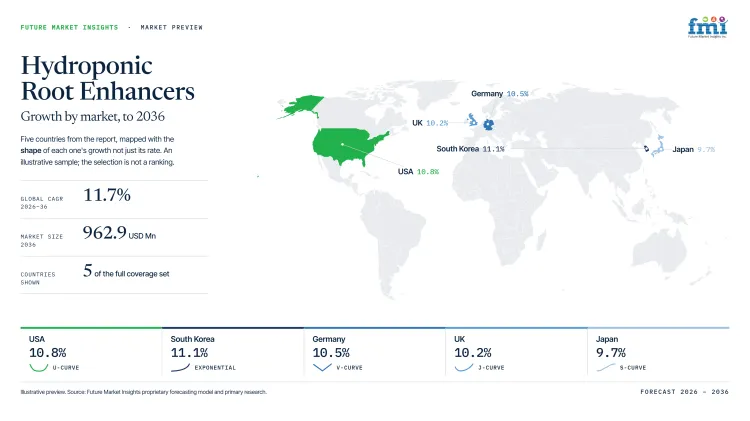
A 1.4-percentage-point range separates South Korea at 11.1% CAGR from Japan at 9.7%. South Korea and USA form the upper band, while Germany and UK cluster close behind. Japan's 9.7% rate stays near the group because greenhouse qualification conditions can outweigh modest forecast differences.
- South Korea's smart-farm financing accelerates automated greenhouse investment across regional production zones.
- Mature USA controlled-environment channels shorten technical-service deployment across established commercial greenhouse sites.
- Germany rewards formulations fitting measured greenhouse routines across technically managed protected-crop operations.
- UK adoption faces energy-intensive protected-production economics that raise operating costs for commercial greenhouses.
- Japan favors precise dosing protocols that coordinate root-zone media with controlled greenhouse environments.
Forecast rank matters less than qualification cost across these closely grouped national markets.
The full report provides country-level CAGR analysis across North America, Latin America, Europe, East Asia, South Asia, Oceania and the Middle East and Africa.
Country-wise Analysis
- USA hydroponic operators range from multi-bay greenhouses to vertical farms that rely on specialist channels for nutrient replenishment and crop-specific technical service across commercial crop programs. Hydroponic root enhancer demand in USA is forecast to rise at 10.8% CAGR over the forecast period, supported by repeated crop cycles that reward standardized feed recipes. USDA Agricultural Research Service published greenhouse basil nutrient standards in September 2025 from automatic recirculating hydroponic systems, defining deficient through excessive ranges for 12 essential elements. Source-water variation and crop-specific nutrient targets raise qualification work, so brands need local testing and reliable replenishment before established feed recipes are replaced.
- English greenhouse operators increasingly use substrate sensors to manage moisture and electrical conductivity while protecting year-round crop economics under high energy costs. The Rural Payments Agency listed remote substrate sensors at an expected average cost of GBP 798 in its 2025 equipment fund with a 40% contribution rate. That financing lowers the cost of measured root-zone management, although capital pressure still makes growers cautious about formulations that add labor or crop risk. Adoption of hydroponic root enhancers in the UK is estimated to expand at 10.2% CAGR through 2036, driven by monitored production that rewards dependable mixing and local technical support.
- German greenhouse operators increasingly assess nutrient programs inside automated crop-management routines that link irrigation records with growth forecasts and expected harvest timing throughout protected production blocks. BLE's KIbOG project began in May 2025 to develop computer-vision tools for daily crop-growth and yield prediction in protected cultivation across commercial greenhouse operations. Germany is estimated to post 10.5% CAGR over the forecast period, attributable to measured production that favors formulations with documented water and substrate compatibility. Established irrigation protocols make formulation changes costly to qualify, so nutrient brands need technical support that translates crop data into repeatable adjustments without disrupting production at each greenhouse site.
- Japanese protected-horticulture operators use tightly specified crop recipes that coordinate root-zone media conditions with greenhouse climate data and labor planning across managed production sites. Hydroponic root enhancer sales in Japan are forecast to expand at 9.7% CAGR by 2036, owing to data-based cultivation that rewards stable dosing and documented media compatibility. Japan's Ministry of Agriculture reported in October 2025 that smart-agriculture demonstrations had reached 217 districts and included certified greenhouse plans using ultra-low-volume media with complex environmental control. Technology cost and specialist knowledge remain practical barriers, which favors companies able to provide precise mixing guidance alongside local service for monitored greenhouse routines.
- South Korean growers are moving toward larger smart-farm clusters that concentrate equipment support and training around shared technology infrastructure with established regional service routes and financing programs. MAFRA reported in February 2025 that its 2025-2029 plan targets smart-farm conversion across 35% of the nation's 55 thousand hectares of greenhouses across provincial programs. The same plan identifies shortages of specialist companies and technical personnel, making local advisory capacity a material constraint on dependable nutrient-water integration in practice. The South Korean hydroponic root enhancer sector is projected to record 11.1% CAGR during the assessment period, supported by smart-farm investment that expands automated root-zone management across greenhouse clusters.
Who are the notable companies in the Hydroponic Root Enhancers Market?
Athena Ag, Canna, JR Peters (Jack's), Masterblend, Advanced Nutrients, Haifa Group, ICL Group, and Yara International are the notable companies serving this market.
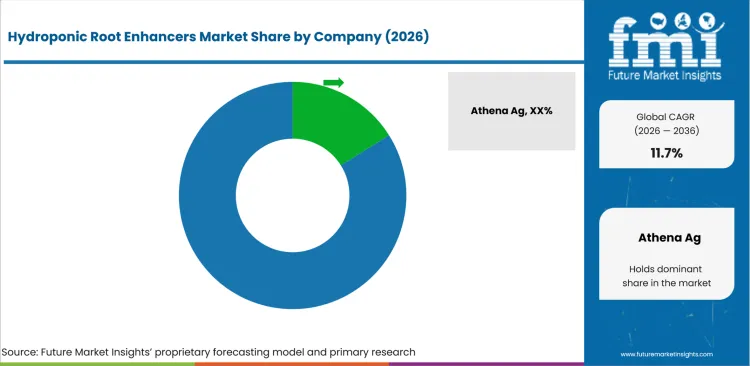
Competition spans specialist hydroponic nutrient programs and global crop-nutrition portfolios with different levels of root-zone support. Entry barriers come from formulation consistency and practical application records instead of corporate scale alone. Greenhouse operators also require reliable replenishment and guidance that fits existing water chemistry and dosing equipment.
- Athena Ag, Canna, JR Peters (Jack's), and Masterblend focus on soluble feeding programs for recurring greenhouse schedules alongside root-zone supplements.
- Advanced Nutrients supplies hydroponic additives and biological root-zone inputs with commercial feeding guidance across international cultivation channels.
- Haifa Group, ICL Group, and Yara International supply specialty nutrition and potassium-based inputs for crop-specific adjustment beyond base feeding programs.
Competitive Benchmarking: Hydroponic Root Enhancers Market
| Company | Hydroponic Nutrition Breadth | Root-Zone Program Depth | Commercial Application Support | Geographic Reach |
|---|---|---|---|---|
| Athena Ag | High | Medium | High | North America and international markets |
| Canna | High | Medium | Medium | Europe and international markets |
| JR Peters (Jack's) | Medium | Low | High | North America and international markets |
| Masterblend | Medium | Low | Medium | North America and international markets |
| Advanced Nutrients | High | High | High | International markets |
| Haifa Group | High | Medium | High | Global |
| ICL Group | High | Medium | High | Global |
| Yara International | High | High | Medium | Global |
Key Developments in the Hydroponic Root Enhancers Market
- In March 2026, Yara International expanded laboratory facilities at its Hanninghof Research Centre in Germany to develop and validate biological crop-nutrition formulations that include root-health applications.
- In March 2026, Advanced Nutrients launched RSA in the United States as its new silica additive for hydroponic and soilless cultivation with a wider international rollout planned during 2026.
- In February 2025, Haifa Group introduced Haifa Soluble DUO in North West Europe as a water-soluble fertigation fertilizer with two calcium-and-potassium formulas for controlled nutrient delivery.
Key Players in the Hydroponic Root Enhancers Market
Program-Led Hydroponic Nutrient Specialists
- Athena Ag
- Canna
- JR Peters (Jack's)
- Masterblend
- Advanced Nutrients
Specialty Nutrition and Root-Support Providers
- Haifa Group
- ICL Group
- Yara International
Hydroponic Root Enhancers Market - Report Scope
| Coverage field | Report scope |
|---|---|
| Market breakdown | By product type, crop, system, grower type, sales channel and region. |
| Quantitative Units | Revenue in USD million and CAGR in %. |
| Market Definition | Commercial nutrient, biological and compatibility inputs used to manage root-zone nutrition and performance in hydroponic production systems. |
| Regions Covered | North America, Latin America, Europe, East Asia, South Asia and Pacific and Middle East and Africa. |
| Countries Covered | USA, UK, Germany, Japan, South Korea, and 25+ countries included in the full report. |
| Key Companies Profiled | Athena Ag, Canna, JR Peters (Jack's), Masterblend, Advanced Nutrients, Haifa Group, ICL Group, Yara International. |
| Forecast Period | 2026 to 2036. |
| Approach | Primary and secondary research with market triangulation. |
Hydroponic Root Enhancers Market - Research Methodology
| Method | Approach |
|---|---|
| Primary Research | FMI analysts gathered input from manufacturers, service providers, technology developers, distributors, end users, procurement teams, and subject-matter experts. Interviews examined purchasing decisions, product or service evaluation, adoption barriers, approval requirements, pricing considerations, and expectations for technical or commercial support. Respondents were also asked what evidence is required before a trial, pilot, or initial order develops into regular purchasing. |
| Desk Research | Desk research covered government statistics, regulatory publications, trade data, industry associations, technical literature, standards, company filings, product information, and official corporate announcements. Sources were reviewed for relevance, publication date, geographic coverage, and consistency with the defined market scope. Claims relating to performance, applications, approvals, capacity, investment, and commercial activity were retained only when supported by credible public evidence. |
| Market Sizing and Forecasting | The market model combined the baseline value with historical performance, segment structure, pricing and volume indicators, adoption levels, company participation, and country-level demand conditions. Forecast assumptions considered economic activity, investment trends, regulatory developments, technology adoption, purchasing cycles, supply availability, and barriers to wider market use. Segment and regional estimates were reconciled before the final market total was calculated. |
| Data Validation | Estimates were checked against multiple independent indicators, including public data, company activity, trade patterns, industry developments, and findings from primary interviews. Validation also tested whether products, services, applications, and company revenues fell within the defined market boundaries. Adjacent categories, unsupported claims, overlapping revenues, and activities without direct market relevance were excluded to reduce double counting and maintain consistency across segments and countries. |
Hydroponic Root Enhancers Market by Segments
Hydroponic Root Enhancers Market segmented by Product Type:
- Complete A/B Nutrient Systems
- Single-Element Additives
- Biological Additives
- pH & Compatibility Aids
- Others
Hydroponic Root Enhancers Market segmented by Crop:
- Leafy Greens & Herbs
- Tomatoes & Vine Crops
- Berries
- Ornamentals
- Others
Hydroponic Root Enhancers Market segmented by System:
- Drip Substrate (Cocopeat / Rockwool)
- NFT / DWC Recirculating
- Aeroponics
- Others
Hydroponic Root Enhancers Market segmented by Grower Type:
- Commercial Greenhouses
- Vertical Farms
- Small Commercial & Hobby
- Others
Hydroponic Root Enhancers Market segmented by Sales Channel:
- Greenhouse Suppliers
- Hydro Specialty Retail
- Online / Direct
- Distributors
- Others
Hydroponic Root Enhancers Market by Region:
- North America
- United States
- Canada
- Latin America
- Brazil
- Mexico
- Argentina
- Chile
- Western Europe
- Germany
- France
- United Kingdom
- Italy
- Spain
- Benelux
- Nordics
- Eastern Europe
- Poland
- Czech Republic
- Romania
- Hungary
- East Asia
- China
- Japan
- South Korea
- South Asia and Pacific
- India
- ASEAN
- Australia and New Zealand
- Middle East and Africa
- GCC Countries
- South Africa
- Türkiye
- Israel
Research Sources and Bibliography
- USA Department of Agriculture, Agricultural Research Service. (2025, January 10). Vertical Farming - No Longer A Futuristic Concept.
- Food Standards Agency and Food Standards Scotland. (2026, June 25). Thematic report on emerging food innovations in the UK.
- USA Department of Agriculture, Agricultural Research Service. (2026, March 3). Making Hoagland's complete nutrient solution for hydroponics.
- USA Department of Agriculture, Agricultural Research Service. (2025, July 29). Managing root disease in hydroponic lettuce.
- Ridder. (2026, June 3). Hortimax Plus takes center stage in the Ridder portfolio at GreenTech.
- USA Department of Agriculture, National Agricultural Statistics Service. (2026, February 26). USA Horticulture Operations Report $18.3 Billion in Sales.
- Grodan. (2025, July 23). Grodan and Hoogendoorn announce partnership to integrate GroSens rootzone data into IIVO climate computer.
- USA Department of Agriculture, Agricultural Research Service. (2025, March 6). Macronutrient solubility in response to the pH of soilless container substrates.
- Bundesanstalt für Landwirtschaft und Ernährung. (2025, September 30). Nutrient_Ctrl_IVF: ion-selective nutrient control in recirculating hydroponic indoor vertical farms.
- USA Department of Agriculture, Agricultural Research Service. (2025, September 18). Nutrient disorder symptomology and refining leaf tissue nutrient standards of basil (Ocimum basilicum L.).
- Rural Payments Agency. (2026, March 2). Productivity items and specifications - Farming Equipment and Technology Fund 2025.
- Bundesanstalt für Landwirtschaft und Ernährung. (2025, May 1). KIbOG: artificial intelligence-based plant growth prediction for greenhouse business optimization.
- Ministry of Agriculture, Forestry and Fisheries of Japan. (2025, October). Promotion of smart agriculture.
- Ministry of Agriculture, Food and Rural Affairs of the Republic of Korea. (2025, February 27). S. Korea's first master plan for promotion of the growth of the smart-farming industry for the years 2025-2029.
- Athena Ag. (2026, March 24). Cannabis Growing Media: Substrates Guide for Cultivators.
- Athena Ag. (n.d.). ISO Certified. Retrieved August 18, 2026.
- JR Peters, Inc. (n.d.). Fertilizer Products | Allentown, PA | JR Peters, Inc. Retrieved August 18, 2026.
- Masterblend International. (n.d.). Masterblend International • Premium Fertilizer for Commercial Growing & Turf Care. Retrieved August 18, 2026.
- Advanced Nutrients. (2026, March 31). 2026 Grower Intelligence Report | Nutrients for Growing Cannabis.
- Advanced Nutrients. (2026, March 6). Meet RSA - The New and Improved Advanced Nutrients Silica Formula.
- Haifa Group. (2025, February 17). Haifa North West Europe launches innovative water-soluble fertilizer Haifa Soluble DUO.
- Haifa Group. (n.d.). Year of Innovation: Haifa Group Showcases Its Commitment to Smarter Crop Production. Retrieved August 18, 2026.
- ICL Group. (n.d.). Unequivalent Producer of Fertilizers for All Applications. Retrieved August 18, 2026.
- Yara International. (2026, March 23). Yara expands research capabilities in biological crop solutions.
- Syngenta. (2025, June 30). Syngenta to become global leader in biologicals; expanding nature inspired solutions for farmers.
- Koppert. (2025, February 20). Koppert launches Stingray 25 in France: a booster of crop growth and productivity.
- Priva. (2025, September). HortiConnect India 2025.
- Priva. (2025, February 3). Priva achieves re-certifications for ISO 27001 and ISO 9001.
- Acadian Plant Health. (2025, August 13). Acadian expands CE-marked biostimulant portfolio across Europe.
- Grodan. (2026, May 26). Grodan and Priva announce partnership to integrate GroSens rootzone data into Priva One.
- Orbia Netafim. (2025, February 11). Orbia's Precision Agriculture Business Netafim unveils the world's first Hybrid Dripline.
- Yara International. (2026, January 9). Yara Capital Markets Day presentation 2026.
- Sumitomo Biorational. (2025, November 18). Sumitomo Biorational and Seipasa form strategic partnership to bring novel biostimulant products to the USA market.
This bibliography is provided for reader reference and is not exhaustive. The full report contains the complete reference list and detailed citations
This Report Answers
- What are hydroponic root enhancers market values?
- What sustains recurring root-zone demand?
- Why do complete A/B nutrient systems lead?
- Why do leafy greens & herbs lead?
- How do country CAGRs compare?
- What slows nutrient-program qualification?
- Which companies supply root-zone programs?
- How does sensor-linked dosing change purchasing?
Frequently Asked Questions
How big is the Hydroponic Root Enhancers Market in 2026?
The hydroponic root enhancers market is valued at USD 318.5 million in 2026 and is projected to reach USD 962.9 million by 2036. Recurring crop cycles sustain nutrient-program purchases.
What is the CAGR of the Hydroponic Root Enhancers Market from 2026 to 2036?
The hydroponic root enhancers market is projected to grow at a CAGR of 11.7% between 2026 and 2036. Greenhouse expansion and measured fertigation support recurring purchases.
Which product type leads the Hydroponic Root Enhancers Market?
The complete A/B nutrient systems segment is expected to hold 48.0% of the hydroponic root enhancers market in 2026, driven by separated concentrates that reduce stock-preparation compatibility risk. Two-part feeding standardizes repeated crop cycles.
Which system leads the Hydroponic Root Enhancers Market?
The drip substrate segment is expected to hold 45.2% of the hydroponic root enhancers market in 2026, supported by buffered root zones suited to precise fertigation. Cocopeat and rockwool allow repeatable dosing.
How much value will the Hydroponic Root Enhancers Market add between 2026 and 2036?
The hydroponic root enhancers market is expected to add USD 644.4 million in value between 2026 and 2036. Recurring nutrient purchases and measured fertigation broaden commercial revenue.
Which countries are projected to record the highest growth in the Hydroponic Root Enhancers Market?
South Korea is projected to grow at 11.1% CAGR, followed by USA at 10.8% and Germany at 10.5% through 2036. Smart-farm investment and controlled-environment production support growth.
Which companies are active in the Hydroponic Root Enhancers Market?
Key companies operating in the hydroponic root enhancers market include Athena Ag, Canna, JR Peters (Jack's), Masterblend, Advanced Nutrients, Haifa Group, ICL Group, and Yara International. They differ by nutrient breadth, root-zone support and distribution.
Preview the report firsthand - request a free sample
Get SampleGet the brochure for pricing and purchase details.
Get PDFTable of Content
- Key Takeaways
- Market Size and CAGR
- Top Growth Driver
- Fastest Growing Segment
- Leading Region
- Key Companies
- Emerging Opportunities
- Executive Summary
- Global Market Outlook
- Demand-side Trends
- Supply-side Trends
- Technology Roadmap Analysis
- Analysis and Recommendations
- Analyst Perspective (What is happening? Why now? What should investors know?)
- Key Questions Answered
- How large is the market?
- What is the CAGR?
- What are key trends?
- Which region dominates?
- Who are the leaders?
- Market Overview
- Market Coverage / Taxonomy
- Market Definition / Scope / Limitations
- Research Methodology
- Chapter Orientation
- Analytical Lens and Working Hypotheses
- Market Structure, Signals, and Trend Drivers
- Benchmarking and Cross-market Comparability
- Market Sizing, Forecasting, and Opportunity Mapping
- Research Design and Evidence Framework
- Desk Research Programme (Secondary Evidence)
- Expert Input and Fieldwork (Primary Evidence)
- Tooling, Models, and Reference Databases
- Data Engineering and Model Build
- Quality Assurance and Audit Trail
- Market Background
- Market Dynamics (Drivers, Restraints, Opportunity, Trends)
- Scenario Forecast (Optimistic, Likely, Conservative)
- Impact Analysis
- AI Impact
- Sustainability Impact
- Regulatory Impact
- Technology Impact
- Consumer / Buyer Analysis
- Purchase Drivers
- Adoption Barriers
- Buyer Journey
- Opportunity Map Analysis
- Product Life Cycle Analysis
- Supply Chain Analysis
- Investment Feasibility Matrix
- Value Chain Analysis
- PESTLE and Porter's Analysis
- Regulatory Landscape
- Regional Parent Market Outlook
- Production and Consumption Statistics
- Import and Export Statistics
- Global Market Analysis and Forecast, 2021 to 2036
- Historical Market Size Value (USD Million) Analysis, 2021 to 2025
- Current and Future Market Size Value (USD Million) Projections, 2026 to 2036
- Y-o-Y Growth Trend Analysis
- Absolute $ Opportunity Analysis
- Global Market Pricing Analysis, 2021 to 2036
- Global Market Analysis and Forecast, By Product Type, 2021 to 2036
- Introduction / Key Findings
- Historical Market Size Value (USD Million) Analysis By Product Type, 2021 to 2025
- Current and Future Market Size Value (USD Million) Analysis and Forecast By Product Type, 2026 to 2036
- Complete A/B Nutrient Systems
- Single-Element Additives
- Biological Additives
- pH & Compatibility Aids
- Others
- Complete A/B Nutrient Systems
- Y-o-Y Growth Trend Analysis By Product Type, 2021 to 2025
- Absolute $ Opportunity Analysis By Product Type, 2026 to 2036
- Global Market Analysis and Forecast, By Crop, 2021 to 2036
- Introduction / Key Findings
- Historical Market Size Value (USD Million) Analysis By Crop, 2021 to 2025
- Current and Future Market Size Value (USD Million) Analysis and Forecast By Crop, 2026 to 2036
- Leafy Greens & Herbs
- Tomatoes & Vine Crops
- Berries
- Ornamentals
- Others
- Leafy Greens & Herbs
- Y-o-Y Growth Trend Analysis By Crop, 2021 to 2025
- Absolute $ Opportunity Analysis By Crop, 2026 to 2036
- Global Market Analysis and Forecast, By System, 2021 to 2036
- Introduction / Key Findings
- Historical Market Size Value (USD Million) Analysis By System, 2021 to 2025
- Current and Future Market Size Value (USD Million) Analysis and Forecast By System, 2026 to 2036
- Drip Substrate (Cocopeat / Rockwool)
- NFT / DWC Recirculating
- Aeroponics
- Others
- Drip Substrate (Cocopeat / Rockwool)
- Y-o-Y Growth Trend Analysis By System, 2021 to 2025
- Absolute $ Opportunity Analysis By System, 2026 to 2036
- Global Market Analysis and Forecast, By Grower Type, 2021 to 2036
- Introduction / Key Findings
- Historical Market Size Value (USD Million) Analysis By Grower Type, 2021 to 2025
- Current and Future Market Size Value (USD Million) Analysis and Forecast By Grower Type, 2026 to 2036
- Commercial Greenhouses
- Vertical Farms
- Small Commercial & Hobby
- Others
- Commercial Greenhouses
- Y-o-Y Growth Trend Analysis By Grower Type, 2021 to 2025
- Absolute $ Opportunity Analysis By Grower Type, 2026 to 2036
- Global Market Analysis and Forecast, By Sales Channel, 2021 to 2036
- Introduction / Key Findings
- Historical Market Size Value (USD Million) Analysis By Sales Channel, 2021 to 2025
- Current and Future Market Size Value (USD Million) Analysis and Forecast By Sales Channel, 2026 to 2036
- Greenhouse Suppliers
- Hydro Specialty Retail
- Online / Direct
- Distributors
- Others
- Greenhouse Suppliers
- Y-o-Y Growth Trend Analysis By Sales Channel, 2021 to 2025
- Absolute $ Opportunity Analysis By Sales Channel, 2026 to 2036
- Global Market Analysis and Forecast, By Region, 2021 to 2036
- Introduction
- Historical Market Size Value (USD Million) Analysis By Region, 2021 to 2025
- Current Market Size Value (USD Million) Analysis and Forecast By Region, 2026 to 2036
- North America
- Latin America
- Western Europe
- Eastern Europe
- East Asia
- South Asia and Pacific
- Middle East & Africa
- Market Attractiveness Analysis By Region
- North America Market Analysis and Forecast, By Country, 2021 to 2036
- Historical Market Size Value (USD Million) Trend Analysis By Market Taxonomy, 2021 to 2025
- Market Size Value (USD Million) Forecast By Market Taxonomy, 2026 to 2036
- By Country
- USA
- Canada
- By Product Type
- By Crop
- By System
- By Grower Type
- By Sales Channel
- By Country
- Market Attractiveness Analysis
- By Country
- By Product Type
- By Crop
- By System
- By Grower Type
- By Sales Channel
- Key Takeaways
- Latin America Market Analysis and Forecast, By Country
- Historical Market Size Value (USD Million) Trend Analysis By Market Taxonomy, 2021 to 2025
- Market Size Value (USD Million) Forecast By Market Taxonomy, 2026 to 2036
- By Country
- Brazil
- Mexico
- Chile
- Rest of Latin America
- By Product Type
- By Crop
- By System
- By Grower Type
- By Sales Channel
- By Country
- Market Attractiveness Analysis
- By Country
- By Product Type
- By Crop
- By System
- By Grower Type
- By Sales Channel
- Key Takeaways
- Western Europe Market Analysis and Forecast, By Country
- Historical Market Size Value (USD Million) Trend Analysis By Market Taxonomy, 2021 to 2025
- Market Size Value (USD Million) Forecast By Market Taxonomy, 2026 to 2036
- By Country
- Germany
- UK
- Italy
- Spain
- France
- Nordic
- BENELUX
- Rest of Western Europe
- By Product Type
- By Crop
- By System
- By Grower Type
- By Sales Channel
- By Country
- Market Attractiveness Analysis
- By Country
- By Product Type
- By Crop
- By System
- By Grower Type
- By Sales Channel
- Key Takeaways
- Eastern Europe Market Analysis and Forecast, By Country
- Historical Market Size Value (USD Million) Trend Analysis By Market Taxonomy, 2021 to 2025
- Market Size Value (USD Million) Forecast By Market Taxonomy, 2026 to 2036
- By Country
- Russia
- Poland
- Hungary
- Balkan & Baltic
- Rest of Eastern Europe
- By Product Type
- By Crop
- By System
- By Grower Type
- By Sales Channel
- By Country
- Market Attractiveness Analysis
- By Country
- By Product Type
- By Crop
- By System
- By Grower Type
- By Sales Channel
- Key Takeaways
- East Asia Market Analysis and Forecast, By Country
- Historical Market Size Value (USD Million) Trend Analysis By Market Taxonomy, 2021 to 2025
- Market Size Value (USD Million) Forecast By Market Taxonomy, 2026 to 2036
- By Country
- China
- Japan
- South Korea
- By Product Type
- By Crop
- By System
- By Grower Type
- By Sales Channel
- By Country
- Market Attractiveness Analysis
- By Country
- By Product Type
- By Crop
- By System
- By Grower Type
- By Sales Channel
- Key Takeaways
- South Asia and Pacific Market Analysis and Forecast, By Country
- Historical Market Size Value (USD Million) Trend Analysis By Market Taxonomy, 2021 to 2025
- Market Size Value (USD Million) Forecast By Market Taxonomy, 2026 to 2036
- By Country
- India
- ASEAN
- Australia & New Zealand
- Rest of South Asia and Pacific
- By Product Type
- By Crop
- By System
- By Grower Type
- By Sales Channel
- By Country
- Market Attractiveness Analysis
- By Country
- By Product Type
- By Crop
- By System
- By Grower Type
- By Sales Channel
- Key Takeaways
- Middle East & Africa Market Analysis and Forecast, By Country
- Historical Market Size Value (USD Million) Trend Analysis By Market Taxonomy, 2021 to 2025
- Market Size Value (USD Million) Forecast By Market Taxonomy, 2026 to 2036
- By Country
- Kingdom of Saudi Arabia
- Other GCC Countries
- Türkiye
- South Africa
- Other African Union
- Rest of Middle East & Africa
- By Product Type
- By Crop
- By System
- By Grower Type
- By Sales Channel
- By Country
- Market Attractiveness Analysis
- By Country
- By Product Type
- By Crop
- By System
- By Grower Type
- By Sales Channel
- Key Takeaways
- Key Countries Market Analysis
- USA
- Pricing Analysis
- Market Share Analysis, 2025
- By Product Type
- By Crop
- By System
- By Grower Type
- By Sales Channel
- Canada
- Pricing Analysis
- Market Share Analysis, 2025
- By Product Type
- By Crop
- By System
- By Grower Type
- By Sales Channel
- Mexico
- Pricing Analysis
- Market Share Analysis, 2025
- By Product Type
- By Crop
- By System
- By Grower Type
- By Sales Channel
- Brazil
- Pricing Analysis
- Market Share Analysis, 2025
- By Product Type
- By Crop
- By System
- By Grower Type
- By Sales Channel
- Chile
- Pricing Analysis
- Market Share Analysis, 2025
- By Product Type
- By Crop
- By System
- By Grower Type
- By Sales Channel
- Germany
- Pricing Analysis
- Market Share Analysis, 2025
- By Product Type
- By Crop
- By System
- By Grower Type
- By Sales Channel
- UK
- Pricing Analysis
- Market Share Analysis, 2025
- By Product Type
- By Crop
- By System
- By Grower Type
- By Sales Channel
- Italy
- Pricing Analysis
- Market Share Analysis, 2025
- By Product Type
- By Crop
- By System
- By Grower Type
- By Sales Channel
- Spain
- Pricing Analysis
- Market Share Analysis, 2025
- By Product Type
- By Crop
- By System
- By Grower Type
- By Sales Channel
- France
- Pricing Analysis
- Market Share Analysis, 2025
- By Product Type
- By Crop
- By System
- By Grower Type
- By Sales Channel
- India
- Pricing Analysis
- Market Share Analysis, 2025
- By Product Type
- By Crop
- By System
- By Grower Type
- By Sales Channel
- ASEAN
- Pricing Analysis
- Market Share Analysis, 2025
- By Product Type
- By Crop
- By System
- By Grower Type
- By Sales Channel
- Australia & New Zealand
- Pricing Analysis
- Market Share Analysis, 2025
- By Product Type
- By Crop
- By System
- By Grower Type
- By Sales Channel
- China
- Pricing Analysis
- Market Share Analysis, 2025
- By Product Type
- By Crop
- By System
- By Grower Type
- By Sales Channel
- Japan
- Pricing Analysis
- Market Share Analysis, 2025
- By Product Type
- By Crop
- By System
- By Grower Type
- By Sales Channel
- South Korea
- Pricing Analysis
- Market Share Analysis, 2025
- By Product Type
- By Crop
- By System
- By Grower Type
- By Sales Channel
- Russia
- Pricing Analysis
- Market Share Analysis, 2025
- By Product Type
- By Crop
- By System
- By Grower Type
- By Sales Channel
- Poland
- Pricing Analysis
- Market Share Analysis, 2025
- By Product Type
- By Crop
- By System
- By Grower Type
- By Sales Channel
- Hungary
- Pricing Analysis
- Market Share Analysis, 2025
- By Product Type
- By Crop
- By System
- By Grower Type
- By Sales Channel
- Kingdom of Saudi Arabia
- Pricing Analysis
- Market Share Analysis, 2025
- By Product Type
- By Crop
- By System
- By Grower Type
- By Sales Channel
- Türkiye
- Pricing Analysis
- Market Share Analysis, 2025
- By Product Type
- By Crop
- By System
- By Grower Type
- By Sales Channel
- South Africa
- Pricing Analysis
- Market Share Analysis, 2025
- By Product Type
- By Crop
- By System
- By Grower Type
- By Sales Channel
- USA
- Market Structure Analysis
- Competition Dashboard
- Competition Benchmarking
- Market Share Analysis of Top Players
- By Regional
- By Product Type
- By Crop
- By System
- By Grower Type
- By Sales Channel
- Emerging Startups
- Innovation Benchmarking
- Competition Analysis
- Competition Deep Dive
- Athena Ag
- Overview
- Product Portfolio
- Profitability by Market Segments
- Sales Footprint
- Strategy Overview
- Marketing Strategy
- Product Strategy
- Channel Strategy
- Canna
- JR Peters (Jack's)
- Masterblend
- Netafim (Orbia)
- Compo Expert
- Haifa Group
- Yara International
- Athena Ag
- Case Studies
- Success Stories
- Recent Developments
- Competition Deep Dive
- Assumptions & Acronyms Used


