

- Market Size (2026)
- USD 287.1 Mn
- Forecast (2036)
- USD 544.0 Mn
- CAGR (2026 to 2036)
- 6.6%
How big is Sunscreen Filter Boosters Market in 2026?
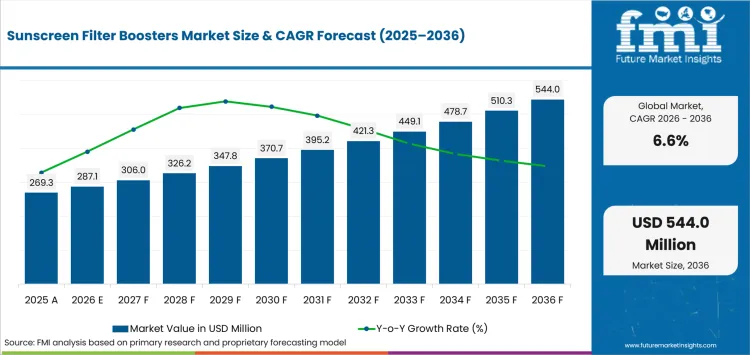
USD 287.1 million in 2026 and USD 544.0 million by 2036 at a 6.6% CAGR.
Sunscreen filter booster demand is projected to expand from USD 287.1 million in 2026 to USD 544.0 million by 2036 at a 6.6% CAGR. Daily facial protection increases formulation work since sun care products must preserve verified protection without heavier sensory profiles. Croda disclosed in November 2025 that Crodabond CSN raised SPF and UVA performance by up to 111% in tested formulations. Croda’s result makes filter distribution and film quality commercially relevant for brands seeking lower active loading with comparable protection.
National rules change commercialization for the same booster system between major sunscreen markets as active permissions differ by jurisdiction. Australia regulates therapeutic sunscreens under a permitted-ingredient framework that directly affects personal care ingredients used in finished formulas. In July 2025, the TGA recommended added controls for homosalate and oxybenzone while proposing safeguards for benzophenone as a degradant. Formulators therefore need region-specific technical files ahead of claim substantiation or transfer of one booster package between markets.
Key Takeaways
- Daily-use photoprotection is increasing demand for boosters that improve SPF efficiency while protecting texture and stability in facial formulations.
- Based on product type, chemical filters are projected to account for 38.0% in 2026 due to transparent systems fitting lightweight daily protection.
- By function, anti-aging is estimated to hold 32.0% in 2026 owing to routine photoprotection moving into prevention-oriented skincare.
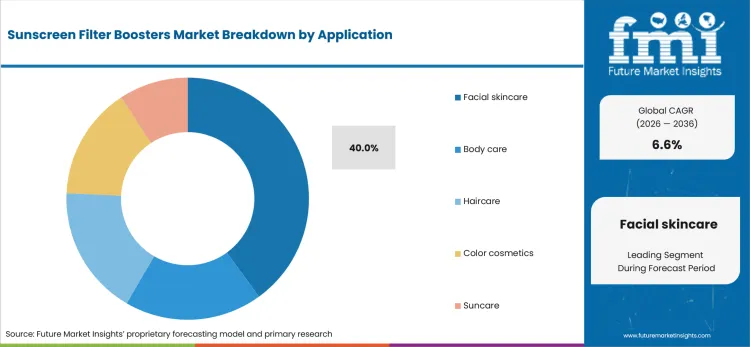
- In 2026, facial skincare is expected to lead application with 40.0% share because frequent facial use makes residue and pilling commercially costly.
- National filter permissions and SPF substantiation rules can force reformulation or retesting despite strong booster performance during development.
- Some of the key players in this market include Symrise, DSM-Firmenich, BASF, Croda, Evonik, Ashland, Clariant, and Lubrizol.
Analyst Perspective
“Formulators should compare boosters by the SPF gain they preserve after stability testing inside the intended vehicle rather than by ingredient claims alone. Commercial value is highest when a booster lowers filter burden or improves film quality without forcing another regional reformulation cycle.”
- Nikhil Kaitwade, Principal Consultant, Future Market Insights
How is the sunscreen filter boosters market segmented?
The market is segmented by product type, function, application, grade, and sales channel.
Product types include chemical filters, mineral filters, hybrid filters, and tinted formats. Functions cover anti-aging, hydration and barrier support, brightening, soothing and sensitive-skin, and UV protection. Applications include facial skincare, body care, haircare, color cosmetics, and suncare. Grades include standard cosmetic, COSMOS or natural certified, pharma and clinical, and organic certified. Sales channels cover direct to brands, specialty distributors, contract manufacturers, and online B2B.
How does facial skincare anchor the application category?
Facial products face the tightest combined threshold for protection and feel since users layer them with moisturizers or makeup. Clariant launched Aristoflex SUN in April 2025 to stabilize UV filters while preserving light daily textures. The launch gives functional cosmetic ingredients a clear role where pilling or residue can stop repeat use.
- In 2026, facial skincare is expected to lead application with 40.0% share because frequent use makes visible residue and tackiness direct barriers to brand acceptance.
- Facial brands qualify boosters inside serums and creams to confirm layering behavior, since an SPF gain loses value if the vehicle pills after moisturizer or makeup.
What makes chemical filters central to the product type category?
Chemical-filter systems fit transparent daily formats as formulators balance oil-phase solubility with broad-spectrum protection and lightweight sensory targets. In December 2025 South Korea's MFDS added second quantitative methods for eleven functional-cosmetic ingredients, raising the value of UV-protecting polymers that support uniform film behavior during compatibility work.
- Based on product type, chemical filters are projected to account for 38.0% in 2026 due to soluble systems fitting lightweight facial protection without visible mineral residue.
- Formulators use chemical systems to vary UVA and UVB coverage without loading one active heavily, but each adjustment changes solubility and the compatibility work needed before a formula reaches specification.
Why does anti-aging lead the function category?
Anti-aging briefs increasingly treat UV protection as part of a daily prevention routine, so formulators compare boosters by finish and compatibility with actives used in serums or creams.
- By function, anti-aging is estimated to hold 32.0% in 2026 owing to prevention-led facial products requiring photoprotection without sacrificing everyday skincare texture.
- Ashland highlighted Antaron soja glyceride at in-cosmetics Global in April 2025 as a biodegradable film former with SPF-boosting and water-resistance benefits. The development gives cosmetic film formers a practical role in prevention-led sun care since the same polymer must preserve wear under makeup and repeated application.
What drives direct to brands in the sales channel category?
Booster performance depends on the complete vehicle as filter ratios and emollient choices can change the final SPF result. Direct engagement lets ingredient companies test those interactions with brand formulators during the work that fixes a commercial specification.
- The direct to brands segment is likely to capture 50.0% share in 2026 attributable to formula-specific trials that require technical exchange during specification approval.
- BASF upgraded its Sunscreen Simulator in April 2025 with new calculations and access to tested prototype formulations. The tool narrows feasible cosmetic chemical portfolios ahead of laboratory validation and cuts early screening work during direct formulation support for regional sunscreen briefs.
What are the drivers, restraints and opportunities in the Sunscreen Filter Boosters Market?
Daily-use SPF raises demand for lighter formulas, regulatory divergence increases validation cost, and lower-filter-load systems create the clearest commercial opening.
- Driver: Routine facial photoprotection raises demand for boosters that improve protection efficiency without making daily formulas heavier or harder to layer.
- Restraint: Divergent active-ingredient rules and inconsistent SPF evidence can require reformulation or retesting ahead of commercialization in another country.
- Opportunity: Better film formation and dispersion can reduce the formulation penalties associated with high zinc oxide or hybrid filter loading.
Daily use increases the value of lighter filter architecture
Daily facial SPF has moved booster evaluation toward formulas that behave like ordinary skincare under repeated application. DSM-Firmenich reported in July 2025 that PARSOL SLX improved sunscreen performance by up to 50% with pigmentary filters while maintaining the intended sensory profile. The measured gain makes film-former systems commercially relevant since brands can pursue higher protection without automatically increasing filter load or accepting a heavier vehicle.
SPF evidence can become a commercial bottleneck
SPF evidence becomes a commercial bottleneck when the same base formula produces materially different test results. The Australian TGA documented preliminary results as low as SPF 4 for a base formulation linked to recalled Lean Screen SPF 50+ sunscreen in 2025. Such variation raises rework risk and makes independent laboratory reliability part of ingredient qualification before a brand commits to a regional launch.
Mineral and hybrid formulas leave room for better dispersion
Mineral and hybrid formulas lose consumer acceptance quickly when particle distribution leaves white cast or uneven film coverage. Evonik presented TEGO FILMSTAR BST1 in April 2026 as a biobased film former designed to raise SPF performance. The launch gives dispersion additives and related film technologies a clear revenue route as brands improve film continuity without increasing mineral load in lightweight daily sunscreen formats.
Which country CAGRs are profiled in the Sunscreen Filter Boosters Market?
| Country | CAGR |
|---|---|
| Brazil | 8.3% |
| South Korea | 7.9% |
| Thailand | 7.6% |
| USA | 7.3% |
| Australia | 7.0% |
How do country-level CAGRs compare in the Sunscreen Filter Boosters Market?
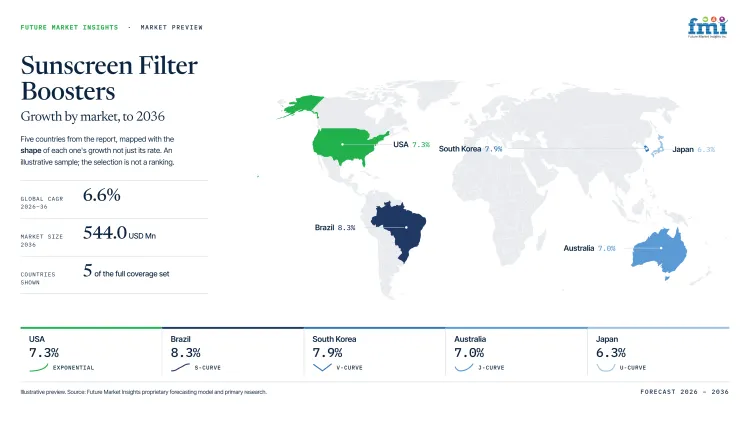
The forecasts span 1.3 percentage points from Brazil at 8.3% to Australia at 7.0%. Brazil and South Korea form the upper growth band while Thailand follows closely at 7.6%. The USA and Australia grow more slowly since claim substantiation and therapeutic-goods controls add work ahead of routine commercial use for brands.
- Anvisa enforcement makes Portuguese technical files routine requirements for Brazilian sunscreen launches.
- MFDS method changes force Korean formulators to refresh analytical packages during cycles.
- Thai import surveillance makes local SPF claim control central to distributor-led launches.
- US bemotrizinol approval widens filter choices without removing OTC monograph obligations for brands.
- Australia’s therapeutic-goods rules reward evidence under recall exposure from weak SPF claims.
Comparable CAGRs can produce different returns as national qualification costs vary materially. The full report provides country-level CAGR analysis across North America, Latin America, Europe, East Asia, South Asia, Oceania and the Middle East and Africa.
Country-wise Analysis
- Brazil: Brazilian sunscreen manufacturers must keep marketed formulas aligned with the composition authorized by Anvisa during prelaunch work, making regulatory documentation a routine part of product preparation for pharmacy and beauty channels in large coastal cities. Brazil is projected to grow at 8.3% CAGR through 2036 because frequent high-protection launches give local laboratories room to qualify film and dispersion support while warm-weather textures raise the penalty for tackiness and visible residue. In April 2026 Anvisa prohibited several sunscreens when inspections found formulas different from those authorized, so Portuguese technical files and locally tested prototypes give ingredient companies a clearer entry route despite regularization costs and distributor coordination.
- South Korea: Korean beauty manufacturers run short formulation cycles and expect ingredient companies to answer quickly as functional-cosmetic rules change, especially for daily SPF products developed for domestic launch and later transfer into export brand programs. In January 2026 MFDS proposed adding phenylene bis-diphenyltriazine as a UV-protection ingredient following its review, widening future filter choices while increasing compatibility work for formulas expected to satisfy both Korean and overseas specifications. Sunscreen filter booster demand in South Korea is forecast to expand at 7.9% CAGR through 2036 owing to rapid product iteration and strong laboratory capacity, although export files can slow commercialization if domestic evidence does not transfer cleanly.
- Thailand: Imported sunscreens share Thai retail channels with locally registered products, requiring distributors to manage notification records and SPF claims for pharmacies and beauty retailers as well as online channels under hot regional storage conditions. Sunscreen filter booster demand in Thailand is projected to rise at 7.6% CAGR through 2036 given frequent product turnover and demand for lightweight protection. Local claim control requires extra review for imported formulas during distributor registration. The Thai FDA ordered suspension and recall of two Australian sunscreens in October 2025 following SPF concerns, which makes ASEAN-ready documentation and regional stability testing a structural requirement for brands entering via import-led commercial routes.
- USA: American sunscreen brands formulate within the OTC monograph at the start of booster evaluation, so active eligibility shapes technical screening for national retail launches and daily-care products well ahead of stability and claim testing. The FDA added bemotrizinol to permitted OTC sunscreen actives in June 2026 as the first new active in more than two decades, giving formulators another broad-spectrum architecture while preserving finished-product monograph obligations. The USA is estimated to post 7.3% CAGR through 2036 tied to renewed work around newer filter combinations, and companies that document compatibility inside US-compliant vehicles should convert that interest into routine development briefs faster.
- Australia: Primary sunscreens operate under Australian therapeutic-goods rules during prelaunch work, so manufacturers treat permitted ingredients and finished-product testing as routine requirements for pharmacy and mass-market programs in a country with high sunscreen use. Australia is anticipated to advance at 7.0% CAGR through 2036 helped by an established therapeutic-sunscreen sector. The evidence burden makes weak film robustness expensive to correct during late-stage claim testing. In May 2026, the TGA stated that SPF 50+ products must test at least SPF 60 under the current standard, leaving ingredient companies with reproducible local application evidence better placed than peers relying on overseas prototypes.
Who are the notable companies in the Sunscreen Filter Boosters Market?
Symrise, DSM-Firmenich, BASF, Croda, Evonik, Ashland, Clariant, and Lubrizol are the notable companies serving this market.
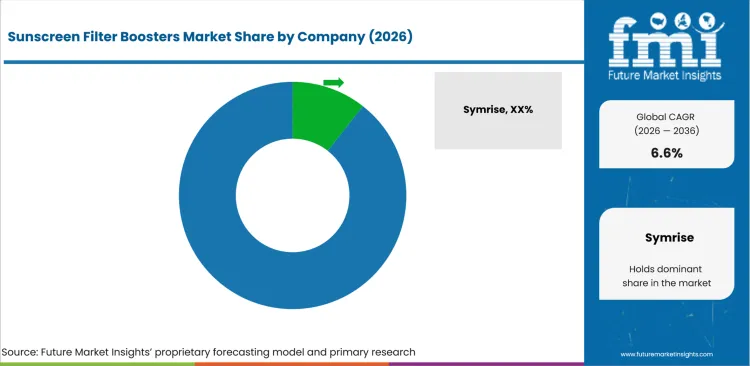
Competition separates into direct UV-filter platforms and specialists in film behavior or dispersion for sunscreen vehicles. Symrise and DSM-Firmenich sell filter technology with formulation support while BASF provides a digital sunscreen-development environment. Croda and Evonik focus on dispersion while Ashland and Clariant emphasize film formation or rheology and Lubrizol supplies polymers for emulsion stability or water resistance.
- UV-filter platforms: Symrise and DSM-Firmenich address protection architecture while BASF supplies digital formulation support for regional sunscreen work.
- Film and dispersion specialists: Croda and Evonik focus on film continuity while Ashland supplies film-forming tools for broader mineral sunscreen programs.
- Rheology and formulation specialists: Clariant and Lubrizol focus on vehicle stability and processing choices that affect UV-system performance in finished products.
Competitive Benchmarking: Sunscreen Filter Boosters Market
| Company | In-Scope Route Breadth | Film / Dispersion Engineering | Formulation Support Depth | Geographic Reach |
|---|---|---|---|---|
| Symrise | High | Medium | High | Global |
| DSM-Firmenich | High | High | High | Global |
| BASF | High | High | High | Global |
| Croda | Medium | High | High | Global |
| Evonik | Medium | High | High | Global |
| Ashland | High | High | High | Global |
| Clariant | High | High | High | Global |
| Lubrizol | Low | Medium | Medium | Global |
Scoring basis: High route breadth requires at least three documented in-scope routes while Medium requires two and Low identifies one verified route. In-scope routes include UV filters and film formers plus dispersion aids, solubilizers and rheology or water-resistance technologies that improve sunscreen performance. High engineering requires at least three documented film or dispersion capabilities while Medium requires two and Low identifies one verified capability. High support requires global formulation resources with market-specific evidence while Medium reflects narrower support and Low identifies one limited documented route. Geographic reach records documented operating coverage and is not scored against these three capability thresholds.
Key Developments in the Sunscreen Filter Boosters Market
- In August 2026, BASF launched Tinosorb S in the United States following FDA approval that allowed bemotrizinol to enter OTC sunscreen formulations under BASF’s license agreement.
- In January 2026, DSM-Firmenich and ASTech completed a UV-filter cooperation memorandum plus investment closing covering stable supply and new component development with technical exchange.
- In June 2025, Symrise introduced Neo Heliopan 310 as an organic crystalline UVB filter for sunscreen and skincare formulations with documented solubility and regional-use approvals.
Key Players in the Sunscreen Filter Boosters Market
UV Filter and Integrated Sun-Protection Platforms
- Symrise
- DSM-Firmenich
- BASF
Film and Dispersion Engineering Specialists
- Croda
- Evonik
- Ashland
Rheology and Formulation Support Specialists
- Clariant
- Lubrizol
Sunscreen Filter Boosters Market - Report Scope
| Coverage field | Report scope |
|---|---|
| Market breakdown | By product type, function, application, grade, sales channel and region. |
| Quantitative Units | USD million. |
| Market Definition | Commercial specialty ingredients that improve sunscreen-filter efficiency or finished-formula performance through film formation, dispersion, photostabilization, solubilization, rheology, water resistance or complementary photoprotection. Finished sunscreen revenue is excluded. |
| Regions Covered | North America, Latin America, Western Europe, Eastern Europe, East Asia, South Asia and Pacific, Middle East and Africa. |
| Countries Covered | Brazil, South Korea, Thailand, USA, Australia, and 25+ additional countries in the full report. |
| Key Companies Profiled | Symrise, DSM-Firmenich, BASF, Croda, Evonik, Ashland, Clariant, Lubrizol. |
| Forecast Period | 2026 to 2036. |
| Approach | Primary and secondary research with bottom-up supplier checks, demand-side validation and market triangulation. |
Sunscreen Filter Boosters Market - Research Methodology
| Method | Approach |
|---|---|
| Primary Research | FMI analysts gathered input from manufacturers, service providers, technology developers, distributors, end users, procurement teams, and subject-matter experts. Interviews examined purchasing decisions, product or service evaluation, adoption barriers, approval requirements, pricing considerations, and expectations for technical or commercial support. Respondents were also asked what evidence is required before a trial, pilot, or initial order develops into regular purchasing. |
| Desk Research | Desk research covered government statistics, regulatory publications, trade data, industry associations, technical literature, standards, company filings, product information, and official corporate announcements. Sources were reviewed for relevance, publication date, geographic coverage, and consistency with the defined market scope. Claims relating to performance, applications, approvals, capacity, investment, and commercial activity were retained only when supported by credible public evidence. |
| Market Sizing and Forecasting | The market model combined the baseline value with historical performance, segment structure, pricing and volume indicators, adoption levels, company participation, and country-level demand conditions. Forecast assumptions considered economic activity, investment trends, regulatory developments, technology adoption, purchasing cycles, supply availability, and barriers to wider market use. Segment and regional estimates were reconciled before the final market total was calculated. |
| Data Validation | Estimates were checked against multiple independent indicators, including public data, company activity, trade patterns, industry developments, and findings from primary interviews. Validation also tested whether products, services, applications, and company revenues fell within the defined market boundaries. Adjacent categories, unsupported claims, overlapping revenues, and activities without direct market relevance were excluded to reduce double counting and maintain consistency across segments and countries. |
Sunscreen Filter Boosters Market by Segments
Sunscreen Filter Boosters Market segmented by Product Type:
- Chemical filters
- Mineral filters
- Hybrid filters
- Tinted formats
Sunscreen Filter Boosters Market segmented by Function:
- Anti-aging
- Hydration & barrier
- Brightening
- Soothing & sensitive
- UV & protection
Sunscreen Filter Boosters Market segmented by Application:
- Facial skincare
- Body care
- Haircare
- Color cosmetics
- Suncare
Sunscreen Filter Boosters Market segmented by Grade:
- Standard cosmetic grade
- COSMOS / natural certified
- Pharma & clinical grade
- Organic certified
Sunscreen Filter Boosters Market segmented by Sales Channel:
- Direct to brands
- Specialty distributors
- Contract manufacturers
- Online B2B
Sunscreen Filter Boosters Market by Region:
- North America
- United States
- Canada
- Latin America
- Brazil
- Mexico
- Argentina
- Chile
- Western Europe
- Germany
- France
- United Kingdom
- Italy
- Spain
- Benelux
- Nordics
- Eastern Europe
- Poland
- Czech Republic
- Romania
- Hungary
- East Asia
- China
- Japan
- South Korea
- South Asia and Pacific
- India
- ASEAN
- Australia and New Zealand
- Middle East and Africa
- GCC Countries
- South Africa
- Türkiye
- Israel
Research Sources and Bibliography
- Croda (2025, November 3). Croda unveils new data for Crodabond™ CSN: effective SPF boosting for high performance sun care.
- Therapeutic Goods Administration. (2025, July 8). TGA to consult on additional controls for some sunscreen ingredients.
- Ministry of Food and Drug Safety. (2026, January 12). 「화장품 안전기준 등에 관한 규정」 일부개정고시(안) 행정예고(공고 제2026-012호, 2026.1.12.).
- Ashland. (2025, April 1). Ashland innovative platform technologies and personal care ingredients demonstrate meaningful growth opportunities for customers at in-cosmetics Global, Amsterdam.
- Clariant (2025, April 23). Clariant's new Aristoflex™ SUN for elevated suncare formulations.
- BASF (2025, April 7). BASF upgrades its Sunscreen Simulator with new features.
- DSM-Firmenich (2025, July 10). PARSOL® SLX: An award-winning, multi-talented UVB filter for sun, skin and hair care.
- Therapeutic Goods Administration. (2026, April 17). Sunscreens using the same base formulation as Ultra Violette Lean Screen SPF 50+ sunscreen.
- Evonik (2026, April 8). in-cosmetics® Global 2026: Evonik brings new beauty identity to life with fairy tale innovation world.
- Agência Nacional de Vigilância Sanitária (2026, April 29). Anvisa proíbe protetores solares e repelentes.
- Thai Food and Drug Administration. (2025, October 4). อย. สั่งระงับจำหน่าย-เรียกคืนกันแดด 2 รายการนำเข้าจากออสเตรเลีย หลังพบปัญหาค่า SPF ไม่ตรงตามจริง.
- USA Food and Drug Administration (2026, June 9). FDA expands sunscreen options for the first time in 20 years.
- Therapeutic Goods Administration (2026, May 4). Sunscreen SPF testing - information for consumers.
- Symrise (2025, June 12). Symrise AG introduces Neo Heliopan® 310 UVB filter for powerful and convenient sun protection.
- DSM-Firmenich. (2026, January 13). dsm-firmenich and ASTech Complete UV Filter Business Cooperation MOU and Investment Closing, Accelerating Global Market Expansion.
- BASF. (2026, August 10). BASF launches Tinosorb S in the United States.
- Clariant (2025, March 6). Clariant decodes concept of beauty through ingredients for skin-mind harmony at PCHi 2025.
- Lubrizol. (2025, April 10). Lubrizol Introduces PemuPur VISTA polymer.
- DSM-Firmenich. (2026, February 25). PARSOL® Shield now approved for all sunscreen products by Health Canada, a new era of sun protection.
- BASF. (2025, September 9). BASF showcases sunscreen solutions under the “Beyond Beauty: Enduring Vitality” campaign at FLSCC’s 2025 Sunscreen Symposium.
- Croda. (2026, June 26). Croda commissions Guangzhou Hub to strengthen strategic growth and innovation in China.
- Ashland Inc. (2026, April 29). Form 10-Q for Ashland INC filed 04/29/2026.
- Momentive Performance Materials, Inc. (2025, April 1). Momentive Introduces HARMONIE™ NatuVel Gel: a new 100% naturally derived elastomer gel.
- Ministry of Food and Drug Safety. (2025, December 16). 「기능성화장품 기준 및 시험방법」 일부개정고시.
- Elementis. (2025, October 10). Elementis Personal Care to debut cutting-edge technologies at In-Cosmetics Asia 2025.
- Inolex. (2026, June 17). Inolex Introduces LexFeel® Enhance MB for Elegant, Stable, High-SPF Sunscreens with Bemotrizinol.
- Lubrizol. (2025, April 8). Lubrizol Introduces Carbopol® BioSense Polymer: Sustainable Innovation for Superior Sensory Experience.
- Elementis. (2026, March 23). Elementis unveils cutting-edge innovations in Beauty and Personal Care at In-Cosmetics Global 2026.
- DSM-Firmenich. (2026, August 10). August 9th FDA Effective Date Reached: PARSOL® Shield Now Available for USA Sunscreen Formulations.
- BASF. (2025, October 7). BASF showcases inspiring textures and new cosmetic ingredients at SEPAWA Congress 2025.
This bibliography is provided for reader reference and is not exhaustive. The full report contains the complete reference list and detailed citations.
This Report Answers
- What are the 2026 and 2036 sunscreen filter booster values?
- Which formulation conditions support demand for sunscreen filter boosters?
- Why do chemical filters lead the product type category?
- Why does facial skincare lead the application category?
- How do the five profiled country CAGRs compare?
- Which companies compete in sunscreen filter boosters?
- What raises qualification costs for sunscreen filter boosters?
- Which formulation routes offer the clearest commercial opening?
Frequently Asked Questions
How big is the Sunscreen Filter Boosters Market in 2026?
The sunscreen filter boosters market is valued at USD 287.1 million in 2026 and is projected to reach USD 544.0 million by 2036. Daily SPF formulations raise demand for lighter protection systems that improve filter efficiency without heavier sensory profiles.
What is the CAGR of the Sunscreen Filter Boosters Market from 2026 to 2036?
The sunscreen filter boosters market is projected to grow at a CAGR of 6.6% between 2026 and 2036. Daily photoprotection and better film or dispersion performance support expansion in facial skincare and other frequent-use formats.
Which product type leads the Sunscreen Filter Boosters Market?
The chemical filters segment is expected to hold 38.0% of the sunscreen filter boosters market in 2026, driven by transparent systems suited to lightweight facial products. High solubility and low visible residue help formulators reach stronger protection targets without sacrificing daily-wear aesthetics.
Which application leads the Sunscreen Filter Boosters Market?
The facial skincare segment is expected to hold 40.0% of the sunscreen filter boosters market in 2026, attributable to frequent use that makes pilling and visible residue costly. Lightweight films improve compatibility with moisturizers and makeup while preserving a finish consumers can wear every day.
How much value will the Sunscreen Filter Boosters Market add between 2026 and 2036?
The sunscreen filter boosters market is expected to add USD 256.9 million in value between 2026 and 2036. Film formers and dispersion technologies support that increase by improving protection efficiency without automatically raising UV-filter load.
Which countries are projected to record notablegrowth in the Sunscreen Filter Boosters Market?
Brazil is projected to grow at 8.3% CAGR, followed by South Korea at 7.9% and Thailand at 7.6% through 2036. Frequent product turnover and active sunscreen oversight increase formulation work in the three faster-growth profiled markets.
Which companies are active in the Sunscreen Filter Boosters Market?
Key companies operating in the sunscreen filter boosters market include Symrise, DSM-Firmenich, BASF, Croda, Evonik, Ashland, Clariant, and Lubrizol. They compete on UV-filter breadth, film engineering and formulation support needed to adapt sunscreen systems for regional requirements.
Preview the report firsthand - request a free sample
Get SampleGet the brochure for pricing and purchase details.
Get PDFTable of Content
- Key Takeaways
- Market Size and CAGR
- Top Growth Driver
- Fastest Growing Segment
- Leading Region
- Key Companies
- Emerging Opportunities
- Executive Summary
- Global Market Outlook
- Demand-side Trends
- Supply-side Trends
- Technology Roadmap Analysis
- Analysis and Recommendations
- Analyst Perspective (What is happening? Why now? What should investors know?)
- Key Questions Answered
- How large is the market?
- What is the CAGR?
- What are key trends?
- Which region dominates?
- Who are the leaders?
- Market Overview
- Market Coverage / Taxonomy
- Market Definition / Scope / Limitations
- Research Methodology
- Chapter Orientation
- Analytical Lens and Working Hypotheses
- Market Structure, Signals, and Trend Drivers
- Benchmarking and Cross-market Comparability
- Market Sizing, Forecasting, and Opportunity Mapping
- Research Design and Evidence Framework
- Desk Research Programme (Secondary Evidence)
- Expert Input and Fieldwork (Primary Evidence)
- Tooling, Models, and Reference Databases
- Data Engineering and Model Build
- Quality Assurance and Audit Trail
- Market Background
- Market Dynamics (Drivers, Restraints, Opportunity, Trends)
- Scenario Forecast (Optimistic, Likely, Conservative)
- Impact Analysis
- AI Impact
- Sustainability Impact
- Regulatory Impact
- Technology Impact
- Consumer / Buyer Analysis
- Purchase Drivers
- Adoption Barriers
- Buyer Journey
- Opportunity Map Analysis
- Product Life Cycle Analysis
- Supply Chain Analysis
- Investment Feasibility Matrix
- Value Chain Analysis
- PESTLE and Porter's Analysis
- Regulatory Landscape
- Regional Parent Market Outlook
- Production and Consumption Statistics
- Import and Export Statistics
- Global Market Analysis and Forecast, 2021 to 2036
- Historical Market Size Value (USD Million) Analysis, 2021 to 2025
- Current and Future Market Size Value (USD Million) Projections, 2026 to 2036
- Y-o-Y Growth Trend Analysis
- Absolute $ Opportunity Analysis
- Global Market Pricing Analysis, 2021 to 2036
- Global Market Analysis and Forecast, By Product Type, 2021 to 2036
- Introduction / Key Findings
- Historical Market Size Value (USD Million) Analysis By Product Type, 2021 to 2025
- Current and Future Market Size Value (USD Million) Analysis and Forecast By Product Type, 2026 to 2036
- Chemical filters
- Mineral filters
- Hybrid filters
- Tinted formats
- Chemical filters
- Y-o-Y Growth Trend Analysis By Product Type, 2021 to 2025
- Absolute $ Opportunity Analysis By Product Type, 2026 to 2036
- Global Market Analysis and Forecast, By Function, 2021 to 2036
- Introduction / Key Findings
- Historical Market Size Value (USD Million) Analysis By Function, 2021 to 2025
- Current and Future Market Size Value (USD Million) Analysis and Forecast By Function, 2026 to 2036
- Anti-aging
- Hydration & barrier
- Brightening
- Soothing & sensitive
- UV & protection
- Anti-aging
- Y-o-Y Growth Trend Analysis By Function, 2021 to 2025
- Absolute $ Opportunity Analysis By Function, 2026 to 2036
- Global Market Analysis and Forecast, By Application, 2021 to 2036
- Introduction / Key Findings
- Historical Market Size Value (USD Million) Analysis By Application, 2021 to 2025
- Current and Future Market Size Value (USD Million) Analysis and Forecast By Application, 2026 to 2036
- Facial skincare
- Body care
- Haircare
- Color cosmetics
- Suncare
- Facial skincare
- Y-o-Y Growth Trend Analysis By Application, 2021 to 2025
- Absolute $ Opportunity Analysis By Application, 2026 to 2036
- Global Market Analysis and Forecast, By Grade, 2021 to 2036
- Introduction / Key Findings
- Historical Market Size Value (USD Million) Analysis By Grade, 2021 to 2025
- Current and Future Market Size Value (USD Million) Analysis and Forecast By Grade, 2026 to 2036
- Standard cosmetic grade
- COSMOS / natural certified
- Pharma & clinical grade
- Organic certified
- Standard cosmetic grade
- Y-o-Y Growth Trend Analysis By Grade, 2021 to 2025
- Absolute $ Opportunity Analysis By Grade, 2026 to 2036
- Global Market Analysis and Forecast, By Sales Channel, 2021 to 2036
- Introduction / Key Findings
- Historical Market Size Value (USD Million) Analysis By Sales Channel, 2021 to 2025
- Current and Future Market Size Value (USD Million) Analysis and Forecast By Sales Channel, 2026 to 2036
- Direct to brands
- Specialty distributors
- Contract manufacturers
- Online B2B
- Direct to brands
- Y-o-Y Growth Trend Analysis By Sales Channel, 2021 to 2025
- Absolute $ Opportunity Analysis By Sales Channel, 2026 to 2036
- Global Market Analysis and Forecast, By Region, 2021 to 2036
- Introduction
- Historical Market Size Value (USD Million) Analysis By Region, 2021 to 2025
- Current Market Size Value (USD Million) Analysis and Forecast By Region, 2026 to 2036
- North America
- Latin America
- Western Europe
- Eastern Europe
- East Asia
- South Asia and Pacific
- Middle East & Africa
- Market Attractiveness Analysis By Region
- North America Market Analysis and Forecast, By Country, 2021 to 2036
- Historical Market Size Value (USD Million) Trend Analysis By Market Taxonomy, 2021 to 2025
- Market Size Value (USD Million) Forecast By Market Taxonomy, 2026 to 2036
- By Country
- USA
- Canada
- By Product Type
- By Function
- By Application
- By Grade
- By Sales Channel
- By Country
- Market Attractiveness Analysis
- By Country
- By Product Type
- By Function
- By Application
- By Grade
- By Sales Channel
- Key Takeaways
- Latin America Market Analysis and Forecast, By Country
- Historical Market Size Value (USD Million) Trend Analysis By Market Taxonomy, 2021 to 2025
- Market Size Value (USD Million) Forecast By Market Taxonomy, 2026 to 2036
- By Country
- Brazil
- Mexico
- Chile
- Rest of Latin America
- By Product Type
- By Function
- By Application
- By Grade
- By Sales Channel
- By Country
- Market Attractiveness Analysis
- By Country
- By Product Type
- By Function
- By Application
- By Grade
- By Sales Channel
- Key Takeaways
- Western Europe Market Analysis and Forecast, By Country
- Historical Market Size Value (USD Million) Trend Analysis By Market Taxonomy, 2021 to 2025
- Market Size Value (USD Million) Forecast By Market Taxonomy, 2026 to 2036
- By Country
- Germany
- UK
- Italy
- Spain
- France
- Nordic
- BENELUX
- Rest of Western Europe
- By Product Type
- By Function
- By Application
- By Grade
- By Sales Channel
- By Country
- Market Attractiveness Analysis
- By Country
- By Product Type
- By Function
- By Application
- By Grade
- By Sales Channel
- Key Takeaways
- Eastern Europe Market Analysis and Forecast, By Country
- Historical Market Size Value (USD Million) Trend Analysis By Market Taxonomy, 2021 to 2025
- Market Size Value (USD Million) Forecast By Market Taxonomy, 2026 to 2036
- By Country
- Russia
- Poland
- Hungary
- Balkan & Baltic
- Rest of Eastern Europe
- By Product Type
- By Function
- By Application
- By Grade
- By Sales Channel
- By Country
- Market Attractiveness Analysis
- By Country
- By Product Type
- By Function
- By Application
- By Grade
- By Sales Channel
- Key Takeaways
- East Asia Market Analysis and Forecast, By Country
- Historical Market Size Value (USD Million) Trend Analysis By Market Taxonomy, 2021 to 2025
- Market Size Value (USD Million) Forecast By Market Taxonomy, 2026 to 2036
- By Country
- China
- Japan
- South Korea
- By Product Type
- By Function
- By Application
- By Grade
- By Sales Channel
- By Country
- Market Attractiveness Analysis
- By Country
- By Product Type
- By Function
- By Application
- By Grade
- By Sales Channel
- Key Takeaways
- South Asia and Pacific Market Analysis and Forecast, By Country
- Historical Market Size Value (USD Million) Trend Analysis By Market Taxonomy, 2021 to 2025
- Market Size Value (USD Million) Forecast By Market Taxonomy, 2026 to 2036
- By Country
- India
- ASEAN
- Australia & New Zealand
- Rest of South Asia and Pacific
- By Product Type
- By Function
- By Application
- By Grade
- By Sales Channel
- By Country
- Market Attractiveness Analysis
- By Country
- By Product Type
- By Function
- By Application
- By Grade
- By Sales Channel
- Key Takeaways
- Middle East & Africa Market Analysis and Forecast, By Country
- Historical Market Size Value (USD Million) Trend Analysis By Market Taxonomy, 2021 to 2025
- Market Size Value (USD Million) Forecast By Market Taxonomy, 2026 to 2036
- By Country
- Kingdom of Saudi Arabia
- Other GCC Countries
- Türkiye
- South Africa
- Other African Union
- Rest of Middle East & Africa
- By Product Type
- By Function
- By Application
- By Grade
- By Sales Channel
- By Country
- Market Attractiveness Analysis
- By Country
- By Product Type
- By Function
- By Application
- By Grade
- By Sales Channel
- Key Takeaways
- Key Countries Market Analysis
- USA
- Pricing Analysis
- Market Share Analysis, 2025
- By Product Type
- By Function
- By Application
- By Grade
- By Sales Channel
- Canada
- Pricing Analysis
- Market Share Analysis, 2025
- By Product Type
- By Function
- By Application
- By Grade
- By Sales Channel
- Mexico
- Pricing Analysis
- Market Share Analysis, 2025
- By Product Type
- By Function
- By Application
- By Grade
- By Sales Channel
- Brazil
- Pricing Analysis
- Market Share Analysis, 2025
- By Product Type
- By Function
- By Application
- By Grade
- By Sales Channel
- Chile
- Pricing Analysis
- Market Share Analysis, 2025
- By Product Type
- By Function
- By Application
- By Grade
- By Sales Channel
- Germany
- Pricing Analysis
- Market Share Analysis, 2025
- By Product Type
- By Function
- By Application
- By Grade
- By Sales Channel
- UK
- Pricing Analysis
- Market Share Analysis, 2025
- By Product Type
- By Function
- By Application
- By Grade
- By Sales Channel
- Italy
- Pricing Analysis
- Market Share Analysis, 2025
- By Product Type
- By Function
- By Application
- By Grade
- By Sales Channel
- Spain
- Pricing Analysis
- Market Share Analysis, 2025
- By Product Type
- By Function
- By Application
- By Grade
- By Sales Channel
- France
- Pricing Analysis
- Market Share Analysis, 2025
- By Product Type
- By Function
- By Application
- By Grade
- By Sales Channel
- India
- Pricing Analysis
- Market Share Analysis, 2025
- By Product Type
- By Function
- By Application
- By Grade
- By Sales Channel
- ASEAN
- Pricing Analysis
- Market Share Analysis, 2025
- By Product Type
- By Function
- By Application
- By Grade
- By Sales Channel
- Australia & New Zealand
- Pricing Analysis
- Market Share Analysis, 2025
- By Product Type
- By Function
- By Application
- By Grade
- By Sales Channel
- China
- Pricing Analysis
- Market Share Analysis, 2025
- By Product Type
- By Function
- By Application
- By Grade
- By Sales Channel
- Japan
- Pricing Analysis
- Market Share Analysis, 2025
- By Product Type
- By Function
- By Application
- By Grade
- By Sales Channel
- South Korea
- Pricing Analysis
- Market Share Analysis, 2025
- By Product Type
- By Function
- By Application
- By Grade
- By Sales Channel
- Russia
- Pricing Analysis
- Market Share Analysis, 2025
- By Product Type
- By Function
- By Application
- By Grade
- By Sales Channel
- Poland
- Pricing Analysis
- Market Share Analysis, 2025
- By Product Type
- By Function
- By Application
- By Grade
- By Sales Channel
- Hungary
- Pricing Analysis
- Market Share Analysis, 2025
- By Product Type
- By Function
- By Application
- By Grade
- By Sales Channel
- Kingdom of Saudi Arabia
- Pricing Analysis
- Market Share Analysis, 2025
- By Product Type
- By Function
- By Application
- By Grade
- By Sales Channel
- Türkiye
- Pricing Analysis
- Market Share Analysis, 2025
- By Product Type
- By Function
- By Application
- By Grade
- By Sales Channel
- South Africa
- Pricing Analysis
- Market Share Analysis, 2025
- By Product Type
- By Function
- By Application
- By Grade
- By Sales Channel
- USA
- Market Structure Analysis
- Competition Dashboard
- Competition Benchmarking
- Market Share Analysis of Top Players
- By Regional
- By Product Type
- By Function
- By Application
- By Grade
- By Sales Channel
- Emerging Startups
- Innovation Benchmarking
- Competition Analysis
- Competition Deep Dive
- Symrise
- Overview
- Product Portfolio
- Profitability by Market Segments
- Sales Footprint
- Strategy Overview
- Marketing Strategy
- Product Strategy
- Channel Strategy
- IFF
- Evonik
- Ashland
- DSM-Firmenich
- Croda
- Givaudan
- BASF
- Clariant
- Lubrizol
- Symrise
- Case Studies
- Success Stories
- Recent Developments
- Competition Deep Dive
- Assumptions & Acronyms Used


