

- Market Size (2026)
- USD 3.8 Bn
- Forecast (2036)
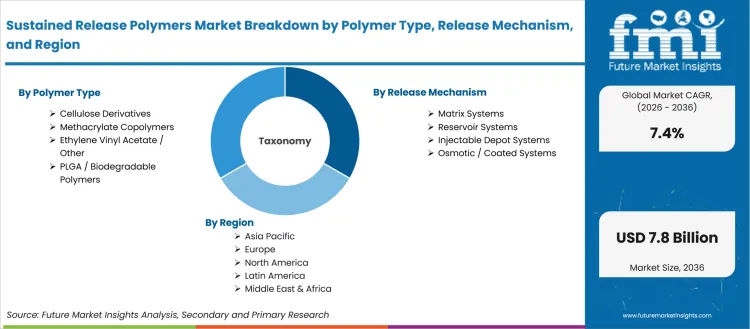
- USD 7.8 Bn
- CAGR (2026 to 2036)
- 7.4%
How big is the Sustained Release Polymers Market in 2026?
USD 3.8 billion in 2026 and USD 7.8 billion by 2036 at a 7.4% CAGR.
Chronic therapy design is shifting toward dosage forms that hold drug exposure steadier across longer dosing intervals. This shift is reinforced by long-term disease burden and tighter expectations for release evidence. WHO reported in September 2025 that noncommunicable diseases killed at least 43 million people in 2021. That burden makes adherence and dosing convenience a commercial reason for using release-control polymers in oral tablets and depot injections. The related controlled-release drug delivery technology category shows how release performance has become a product-design question instead of a simple excipient choice.
Pharma manufacturers and CDMOs buy these polymers to manage dissolution behavior before scale-up in regulated dosage programs. Nutraceutical producers and research institutes use them more selectively in product work that needs slower release claims. Their pressure is operational and regulatory at the same time, due to late substitutions triggering new stability work. Fresh dissolution data and supplier requalification can also delay a project after formulation work starts. Sustained-release polymers create value by helping formulators align viscosity grade and particle morphology before pilot batches. That early discipline gives quality teams cleaner documentation for filings and validation batches during commercial transfer decisions.
Adoption differs by region due to different buying problems across formulation countries and approval systems. The United States and Japan place more weight on documentation history and change control. Western Europe follows similar quality logic under stricter cost control and reimbursement discipline in buyer decisions. China and India place more weight on generic scale-up and formulation capacity for export programs. The market becomes more valuable if polymer choice connects active ingredient behavior and excipient precedent. It gains further value if the same decision connects manufacturing route and regulatory evidence. This strategic buyer logic also connects the market to broader pharmaceutical drug delivery decisions across oral and injectable dosage forms and implantable systems.
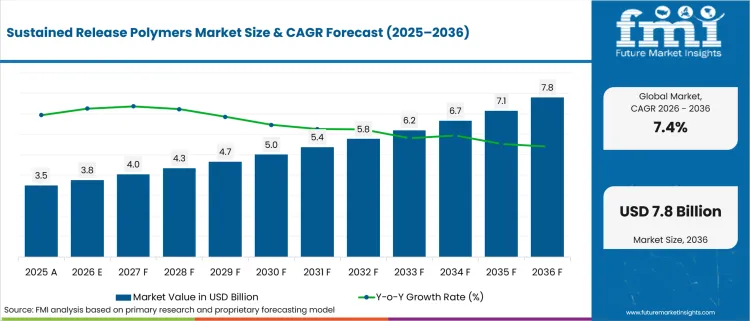
| Metric | Value |
|---|---|
| 2025 Market Size | USD 3.5 billion |
| 2026 Market Size | USD 3.8 billion |
| 2036 Market Size | USD 7.8 billion |
| Forecast CAGR (2026-2036) | 7.4% |
| Leading Polymer Type | Cellulose Derivatives |
| Cellulose Derivatives Share (2026) | 42.8% |
| Leading Release Mechanism | Matrix Systems |
| Matrix Systems Share (2026) | 46.5% |
| Leading Application | Oral Solid Dosage |
| Oral Solid Dosage Share (2026) | 53.4% |
| Fastest-growing Country | China |
| China CAGR by 2036 | 8.4% |
Summary of the Sustained Release Polymers Market
| Market Signal | Commercial Impact |
|---|---|
| Demand and Growth Drivers | Demand for sustained release polymers is increasing as pharmaceutical companies seek advanced drug delivery solutions that improve patient adherence, regulatory compliance, and formulation performance.
|
| Product and Segment View | Cellulose derivatives, matrix systems, and oral solid dosage formulations continue to represent the leading commercial opportunities across the market.
|
| Geography and Growth Outlook | Asia continues to lead market expansion through pharmaceutical manufacturing growth, increasing formulation activity, and expanding drug development programs.
|
| Competitive Landscape | Competition increasingly focuses on polymer innovation, regulatory documentation, formulation support, and global supply reliability.
|
| Analyst Perspective | Sustained release polymers are evolving from standard excipients into strategic formulation components that improve drug performance, regulatory success, and commercial differentiation.
- Nikhil Kaitwade, Principal Consultant at Future Market Insights |
How is the sustained release polymers market segmented?
The Sustained Release Polymers industry is segmented by polymer type, release mechanism, application, end use, sales channel, and region.
The Sustained Release Polymers Market is segmented by polymer type, release mechanism, application, end use, sales channel, and region. Polymer type covers cellulose derivatives, methacrylate copolymers, PLGA or biodegradable polymers, and ethylene vinyl acetate or other materials. Release mechanism includes matrix systems, reservoir systems, osmotic or coated systems, and injectable depot systems. Application spans oral solid dosage, injectables, implants, and transdermal or other formats. End use covers pharma manufacturers, CDMOs, nutraceuticals, and research institutes. Sales channel includes direct contracts and distributors. Regional coverage extends across North America, Latin America, Europe, East Asia, South Asia and Pacific, and the Middle East and Africa.
Why are Cellulose Derivatives important within the polymer type category?
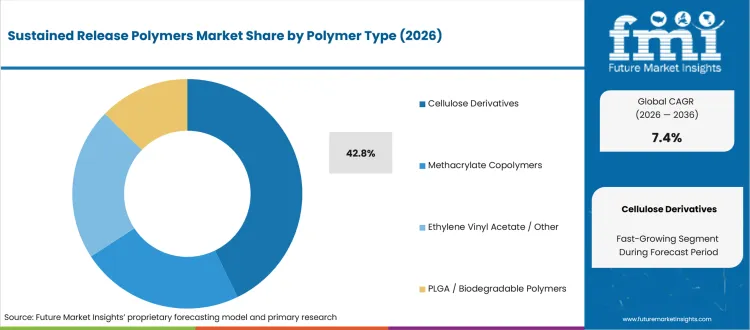
Formulation teams need a polymer that can form a predictable gel layer under changing tablet conditions. Cellulose derivatives fit that need due to HPMC grades supporting familiar compression routes and water-driven release control. Buyers still compare viscosity grade, particle size and nitrite profile before they qualify a supplier. The segment is therefore tied to process reliability instead of simple chemistry preference.
- In 2026, Cellulose Derivatives are anticipated to hold 42.8% of polymer type demand, driven by established HPMC use in hydrophilic matrix tablets. Ashland states that Benecel XR and XRF grades are designed for controlled-release matrix systems. That product fit supports repeat use on oral solid lines.
- Formulation teams using Cellulose Derivatives can tune gel strength and release curve shape before commercial scale-up. This buyer value is reinforced by impurity and change-control expectations. The related pharmaceutical excipient category shows why excipient identity and documentation now affect development risk.
What supports demand for Matrix Systems platforms?
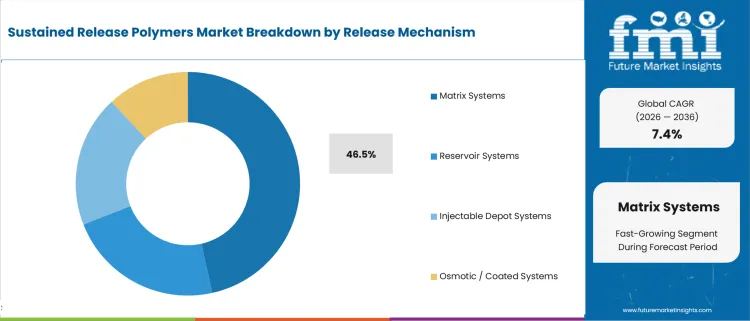
Release-mechanism decisions start with the manufacturing route that a buyer can validate and repeat. Matrix systems remain relevant due to release control inside the tablet body without separate reservoir construction. The operating need is clear for generic and lifecycle-extension teams. They need release control that fits current compression lines and avoids avoidable coating complexity. This makes matrix systems easier to qualify than multilayer designs in many oral programs.
- Matrix Systems are predicted to represent 46.5% of release mechanism demand in 2026, supported by familiar process design and lower equipment disruption. EMA guidance for modified-release dosage forms defines studies for release behavior and performance. That framework supports polymer choices that can be defended in formulation files.
- The executive case for Matrix Systems is process confidence. Buyers can adjust polymer level, viscosity and tablet hardness before shifting to more complex platforms. This helps teams control early burst risk and maintain a practical route from trial batches to commercial scale.
How do buyers evaluate Oral Solid Dosage within the application category?
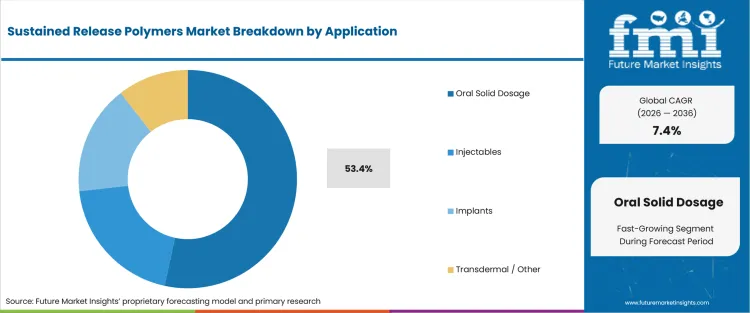
Oral dosage buyers work under a practical constraint that favors release control inside familiar patient-use formats. They need controlled release but often prefer dosage forms that fit existing manufacturing patterns. Tablets and multiparticulates give them a familiar route for chronic therapies and lifecycle extension. The segment remains relevant due to development teams being able to test release behavior without redesigning the full product platform. This keeps investment closer to validated equipment and familiar stability protocols.
- Oral Solid Dosage accounts for an estimated 53.4% share of application demand in 2026, attributable to tablet reformulation and chronic therapy use. FDA approvals data show a steady flow of new therapies in 2025. That activity keeps oral formulation work active across branded and generic programs.
- For pharma sponsors, Oral Solid Dosage reduces project risk by keeping release-control work close to known tablet processes. Buyers evaluating gastro-retentive drug delivery systems often make similar choices around retention, release timing and manufacturability.
What market factors influence demand from Pharma Manufacturers?
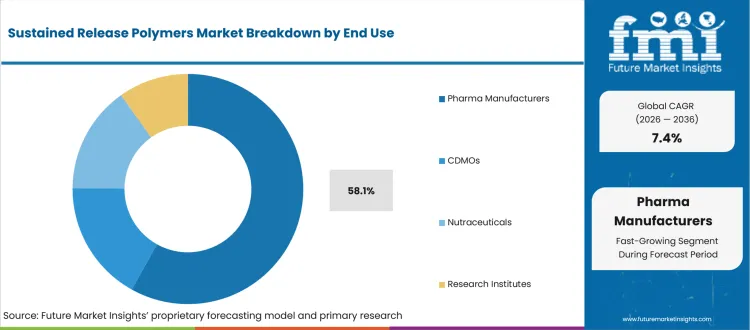
Product owners keep direct control over polymer qualification due to the filing and post-approval impact of excipient decisions. Pharma manufacturers therefore evaluate supplier files, route precedent and change notices before they approve a sustained-release grade. CDMOs can run development work, but the sponsor often owns final quality responsibility. This makes manufacturer demand closely tied to regulatory control. It also makes direct technical access valuable during validation batches and post-approval supplier reviews.
- Pharma Manufacturers are expected to account for 58.1% of end-use demand in 2026, shaped by direct ownership of formulation files and supplier qualification. EMA recommended 104 human medicines in 2025. That approval activity reinforces the need for consistent excipient documentation.
- The strategic value for manufacturers is control over late-stage risk. A polymer change can affect dissolution, stability and impurity profiles. Direct oversight helps product teams prevent avoidable filing amendments and protects the commercial pathway for modified-release products.
How are Direct Contracts positioned within the sales channel category?
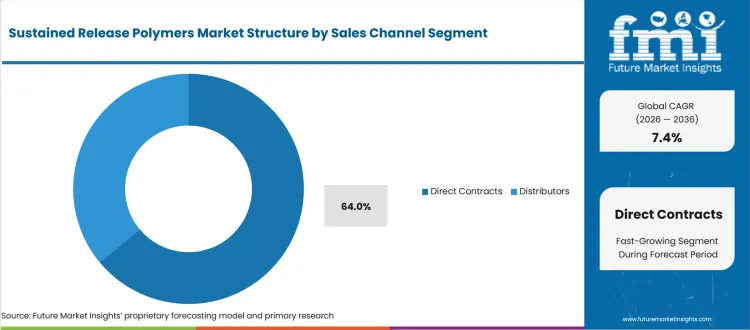
Regulated buyers use direct contracts if the supplier relationship must cover more than material delivery. Sustained-release polymers often require grade continuity and change notices alongside technical files and application support. Distributors still support small trial volumes, but commercial products usually need a direct channel for issue resolution. This route gives quality teams a clearer path for documentation requests. It also helps procurement teams manage supplier changes before they affect a validated formula.
- Direct Contracts are projected to hold 64.0% of sales channel demand in 2026, led by regulated buyers that need documented supply continuity. Roquette completed the IFF Pharma Solutions acquisition in May 2025. That move shows why direct technical support and excipient portfolio depth are important to commercial accounts.
- Procurement teams using Direct Contracts gain clearer accountability for change control and technical support. The model is reinforced by supplier qualification requirements. It reduces handoff risk for formulation teams that must trace polymer grade history across development and production batches.
What are the drivers, restraints, and opportunities in the sustained release polymers market?
Near-term purchases are being shaped by the release-control requirement, qualification constraint and depot-formulation expansion route outlined below.
- Driver: Chronic therapy dosing requirements are driving polymer purchases by pushing formulators toward tablets and depots that release active ingredients over longer intervals.
- Restraint: Excipient substitution risk is limiting faster switching due to fresh dissolution work, impurity reviews and supplier requalification requirements.
- Opportunity: Injectable depot and implant programs are opening a higher-value route supported by specialized PLGA and bioresorbable polymer expertise.
Pharma sponsors buying release-control polymers need materials that can survive development and commercial transfer. Buying activity gains relevance from chronic therapy dosing needs and payer pressure around long-term medicine use. OECD reported in November 2025 that per capita retail pharmaceutical expenditure averaged USD 766 across OECD countries in 2023. That spending base makes once-daily tablets and long-acting depots commercially relevant if they help product teams improve use patterns without creating fresh affordability pressure. Suppliers that connect application labs and grade documentation can convert technical trust into longer supply contracts. Change-control support then becomes part of the purchase decision instead of a post-sale service.
Qualification risk slows switching, but it also creates an opening for suppliers that solve documentation problems early. Buyers resist changing a polymer after dissolution and stability work has already started in development programs. FDA's April 2026 Quarterly IID Change Log identifies three change types: corrected records, deleted records and maximum daily exposure replacements. That formal change trail shows why excipient precedent is not static for procurement and quality teams. A supplier that manages route evidence and change notices can reduce requalification friction for regulated buyers. This turns restraint pressure into a qualification advantage for firms that can document every polymer-grade change clearly.
Depot and implant programs create opportunity for polymer suppliers that can support release tuning instead of simple material delivery. The same technical gap appears in long-acting implant and ocular drug-delivery polymer systems that depend on release duration and route evidence. Evonik's RESOMER RG portfolio lists PLGA mole ratios of 50:50, 65:35, 75:25 and 85:15 for parenteral controlled release. That grade range is important because release duration and burst behavior depend on polymer ratio and molecular weight. Stabilizer excipients can also be relevant in complex formulation work if startups and specialist suppliers offer application testing and practical scale-up support.
Which country CAGRs are profiled in the sustained release polymers market?
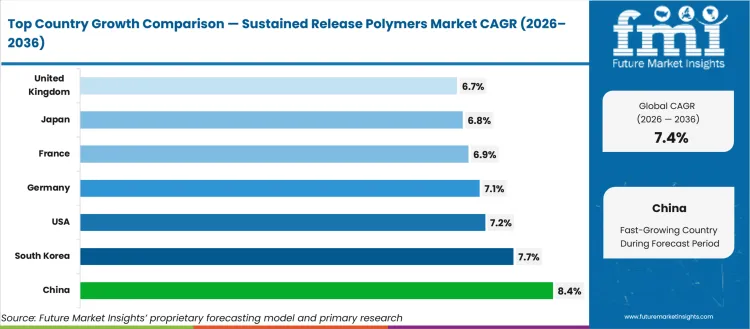
| Country | CAGR |
|---|---|
| United States | 7.2% |
| United Kingdom | 6.7% |
| Germany | 7.1% |
| France | 6.9% |
| Japan | 6.8% |
| China | 8.4% |
| South Korea | 7.7% |
| India | 8.2% |
How do country-level CAGRs compare in the sustained release polymers market?
Country CAGR profiles should be read by the role each market plays in formulation and approval activity. The United States and Japan are tied to quality files, regulatory review and supplier change control. Western Europe follows the same discipline but adds reimbursement pressure and cost review for buyers. China and India sit closer to capacity expansion and export-facing formulation work. South Korea reflects a middle position due to manufacturing depth and quality expectations. The comparison is important for buyers because sustained-release polymer demand depends on documentation depth, manufacturing scale or product-development speed. It also helps suppliers decide which countries need application support, filing evidence or local technical access before price becomes the main discussion.
- By 2036, the United States is projected to record 7.2% CAGR, supported by approval activity and strict formulation documentation. FDA reported in 2026 that CDER approved 46 novel drugs in 2025. New product work and formulation changes can require excipient precedent and release evidence. The country grows below China and India due to demand that is more quality-led than capacity-led.
- The United Kingdom is expected to grow at 6.7% CAGR during the forecast period, shaped by specialized life sciences manufacturing. GOV.UK reported in October 2025 that life sciences manufacturing companies generated GBP 46.5 billion in turnover during 2023/2024. This supports validated polymer use. The country trails faster Asian markets due to pricing pressure that keeps reformulation decisions selective.
- Over the assessment period, Germany is forecast to advance at 7.1% CAGR, reinforced by European filing quality and local manufacturing discipline. Destatis reported in May 2025 that pharmaceutical industry orders rose 17.3% month over month in March 2025. The order rebound supports excipient qualification activity. Germany differs from the United Kingdom due to stronger links between industrial chemistry and pharma production.
- Through 2036, France is anticipated to post 6.9% CAGR, influenced by domestic formulation activity and reimbursement discipline. OECD reported in November 2025 that public or statutory schemes exceeded 80% of outpatient medicine funding in France and Germany during 2023. This funding structure can slow broad reformulation. France therefore shows a measured profile compared with China and India.
- Japan is likely to expand at 6.8% CAGR by 2036, owing to careful review practice and conservative supplier qualification. PMDA Updates reported in July 2025 that the standard review time is 12 months for new drug applications. This clarity supports planned polymer selection. Japan compares below China due to buyer emphasis on validation depth over rapid product turnover.
- China is estimated to rise at 8.4% CAGR between 2026 and 2036, propelled by domestic drug approvals and local formulation capacity. DIA Global Forum reported in March 2026 that small molecules represented 60% of new NMPA approvals in 2025. This supports matrix and coating work. China differs from European countries due to development scale that creates faster polymer qualification cycles.
- Demand in South Korea is projected to grow at 7.7% CAGR by 2036, supported by domestic drug development and contract manufacturing strength. Invest Korea stated in June 2026 that 41 new drugs had been approved by MFDS by 2025. That pipeline depth raises demand for specialized excipients and release testing. South Korea sits between Japan and India due to high quality expectations and visible capacity growth.
- India is expected to grow at 8.2% CAGR during the forecast period, attributable to export-facing generic manufacturing and wider CDMO work. PIB reported in March 2026 that pharmaceutical exports reached USD 30.5 billion in 2024-25. Regulated export markets require consistent excipient documentation. India stands near China due to scale but reflects generic production more than novel approvals.
Who are the notable companies in the sustained release polymers market?
Evonik, Ashland, Colorcon, Roquette, BASF, Shin-Etsu Chemical, Lubrizol, and JRS Pharma are the notable companies shaping this market.
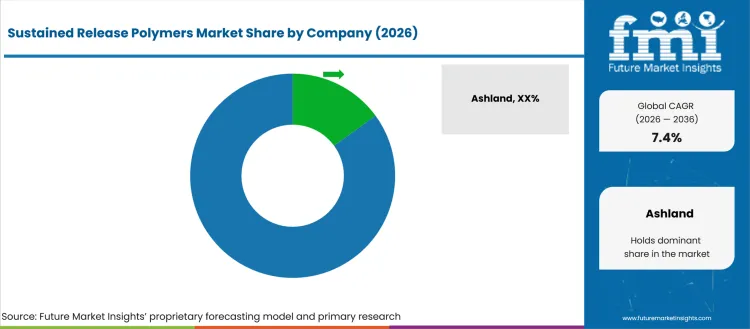
Supplier selection in sustained-release polymers is structured around the dosage problem that buyers need to solve. Ashland, Roquette, Shin-Etsu Chemical and JRS Pharma are more relevant for buyers focused on cellulose matrix behavior and oral solid scale-up. Evonik and Lubrizol become important for depot and implant programs that need polymer degradation know-how. Colorcon gains relevance for tablet programs that require coating design and practical release support near commercialization. BASF remains relevant for broader excipient and polymer chemistry needs in regulated formulation environments.
- Ashland, Roquette and Shin-Etsu Chemical are some companies that are focusing on oral matrix programs that need cellulose grade depth. Buyers choosing these suppliers usually need viscosity control, hydration behavior and documentation that can support tablet scale-up without adding avoidable regulatory rework.
- Depot formulation buyers typically evaluate Evonik and Lubrizol for specialized polymer behavior and application support. Their relevance is tied to specialized excipient routes that depend on degradation profile, burst control and route-specific evidence.
- Colorcon gains preference in tablet programs that need coating design and release support near commercial production. Its role is connected to process assistance and film performance. Buyers also evaluate pharma moisture barrier film coating if moisture control can affect finished tablet quality.
- BASF and JRS Pharma are important in broader excipient supply environments that require polymer chemistry experience and regulated supply channels. Their relevance is strong for buyers seeking dependable sourcing, technical documentation and support across adjacent formulation needs.
Competitive Benchmarking: Sustained Release Polymers Market
| Company | Polymer Portfolio Fit | Formulation Support | Regulatory Documentation | Geographic Reach |
|---|---|---|---|---|
| Evonik | High | Strong | High | Global |
| Ashland | High | Strong | High | Global |
| Roquette | High | Strong | High | Global |
| Colorcon | Medium | Strong | Medium | Global |
| BASF | Medium | Medium | Strong | Global |
| Shin-Etsu Chemical | High | Medium | Strong | Global |
| Lubrizol | Medium | Strong | Medium | Global |
| JRS Pharma | Medium | Medium | Medium | Regional |
Source: Future Market Insights competitive analysis, 2026. Ratings reflect relative portfolio relevance, workflow or project fit, service capability, and geographic reach.
Key Developments in the Sustained Release Polymers Market
- In May 2025, Roquette completed the acquisition of IFF Pharma Solutions. The action expanded Roquette’s health and pharma excipient portfolio. It is significant for sustained-release polymers due to the added cellulose-based technologies and drug delivery capabilities that support oral dosage buyers.
- In May 2025, Roquette announced a new organization following the IFF Pharma Solutions acquisition. The company created renewed business groups and named new leaders. This is important due to sustained-release buyers needing clear technical ownership, stable documentation pathways and long-term change-control support.
- In January 2024, Colorcon launched a titanium dioxide-free high-opacity PVA-based coating for pharmaceutical tablets. The action points to continuing coating portfolio work for regulated solid dosage forms. It is relevant because controlled-release tablet programs evaluate coating compatibility, appearance and commercial quality together.
- In June 2026, Lubrizol said Apisolex polymer won Silver at CPhI China’s Pharma Excipients Awards. The recognition is relevant to polymer-enabled drug delivery due to solubility and formulation support influencing injectable and specialty dosage decisions. It also signals buyer attention to polymer excipient performance.
Key Players in the Sustained Release Polymers Market
Cellulose and Matrix Former Suppliers
- Ashland
- Roquette
- Shin-Etsu Chemical
- JRS Pharma
Depot and Bioresorbable Polymer Suppliers
- Evonik
- Lubrizol
Coating and Specialty Excipient Suppliers
- Colorcon
- BASF
Sustained Release Polymers Market - Report Scope
| Coverage field | Report scope |
|---|---|
| Market breakdown | Sustained Release Polymers Market Breakdown By Polymer Type, Release Mechanism, Application, End Use, Sales Channel, and Region |
| Market Definition | Pharmaceutical-grade polymers used to slow, control, delay, or extend active ingredient release across selected dosage forms |
| Regions Covered | North America, Latin America, Europe, East Asia, South Asia and Pacific, Middle East and Africa |
| Countries Covered | United States, United Kingdom, Germany, France, Japan, China, South Korea, India and 30+ countries |
| Key Companies Profiled | Evonik, Ashland, Colorcon, Roquette, BASF, Shin-Etsu Chemical, Lubrizol, JRS Pharma |
| Forecast Period | 2026 to 2036 |
| Approach | Hybrid bottom-up and top-down methodology using polymer grade demand, dosage form mix, supplier qualification, and country-level formulation activity |
Sustained Release Polymers Market - Research Methodology
| Method | Approach |
|---|---|
| Primary Research | FMI analysts reviewed inputs from pharmaceutical formulators, CDMO technical teams, excipient distributors and quality professionals. Interviews focused on polymer grade selection, release testing, change-control expectations and supplier qualification across oral solid dosage and depot injection programs. |
| Desk Research | Desk research covered regulator guidance, inactive ingredient listings, company product information, pharmacopeial references, public approval signals and official country data. Source relevance was checked against sustained-release use rather than adjacent excipient demand alone. |
| Market Sizing and Forecasting | The model combined polymer grade demand, dosage form use rates, release mechanism mix, end-use purchasing behavior and country-level formulation activity. Forecast assumptions were adjusted for oral matrix use, injectable depot adoption and direct supplier qualification. |
| Data Validation | Forecasts were checked against regulatory precedent, supplier portfolios, country pharmaceutical indicators and company development evidence. External statistics were assigned once through a duplicate-statistic ledger to avoid repeating the same evidence across sections. |
Sustained Release Polymers Market by Segments
Sustained Release Polymers Market segmented by Polymer Type:
- Cellulose Derivatives
- Methacrylate Copolymers
- PLGA / Biodegradable Polymers
- Ethylene Vinyl Acetate / Other
Sustained Release Polymers Market segmented by Release Mechanism:
- Matrix Systems
- Reservoir Systems
- Osmotic / Coated Systems
- Injectable Depot Systems
Sustained Release Polymers Market segmented by Application:
- Oral Solid Dosage
- Injectables
- Implants
- Transdermal / Other
Sustained Release Polymers Market segmented by End Use:
- Pharma Manufacturers
- CDMOs
- Nutraceuticals
- Research Institutes
Sustained Release Polymers Market segmented by Sales Channel:
- Direct Contracts
- Distributors
Sustained Release Polymers Market by Region:
- North America
- United States
- Canada
- Mexico
- Latin America
- Brazil
- Chile
- Rest of Latin America
- Western Europe
- Germany
- UK
- Italy
- Spain
- France
- Nordic
- BENELUX
- Rest of Western Europe
- Eastern Europe
- Russia
- Poland
- Hungary
- Balkan & Baltic
- Rest of Eastern Europe
- East Asia
- China
- Japan
- South Korea
- South Asia and Pacific
- India
- ASEAN
- Australia & New Zealand
- Rest of South Asia and Pacific
- Middle East & Africa
- Kingdom of Saudi Arabia
- Other GCC Countries
- Turkiye
- South Africa
- Other African Union
- Rest of Middle East & Africa
Research Sources and Bibliography
- USA Food and Drug Administration. (2026, April 13). Inactive Ingredients Database Download. USA Food and Drug Administration.
- USA Food and Drug Administration. (2026). FDA Novel Drug Therapy Approvals for 2025. USA Food and Drug Administration.
- European Medicines Agency. (2026, June 11). EMA’s 2025 annual report shows strong approval numbers for human and veterinary medicines. European Medicines Agency.
- European Medicines Agency. (2013, March 15). Pharmacokinetic and clinical evaluation of modified-release dosage forms. European Medicines Agency.
- GOV.UK. (2025, October 2). Bioscience and health technology sector statistics 2023 to 2024. GOV.UK.
- Press Information Bureau. (2026, March 21). India’s Pharmaceuticals in Global Healthcare. Government of India.
- National Medical Products Administration. (2025, March 21). Measures facilitate approval of 48 first-in-class innovative drugs. National Medical Products Administration.
- German Federal Statistical Office. (2025, May 7). New orders in manufacturing in March 2025: +3.6% on the previous month. Destatis.
- Pharmaceuticals and Medical Devices Agency. (2025, July 22). PMDA Updates 2025 Summer. Pharmaceuticals and Medical Devices Agency.
- Invest Korea. (2026, June 16). Current Status of Korea’s Pharmaceutical & Biotechnology Industry Competitiveness and Industry Policy. Invest Korea.
- DIA Global Forum. (2026, March). 2025 NMPA Approvals: China Clears Record Number of New Drugs. Drug Information Association.
- Association for Accessible Medicines. (2025). 2025 USA Generic & Biosimilar Medicines Savings Report. Association for Accessible Medicines.
- OECD. (2025, November 13). Pharmaceutical expenditure. OECD.
- Roquette. (2025, May 1). Roquette Completes the Acquisition of IFF Pharma Solutions. Roquette.
- Roquette. (2025, May 5). Roquette Announces a New Organization following the Acquisition of IFF Pharma Solutions. Roquette.
- Ashland. (2026). Benecel XR and XRF HPMC controlled release matrix formers. Ashland.
- Colorcon. (2024, January 23). Colorcon, Inc. Launches a New Titanium Dioxide-Free, High-Opacity PVA-Based Coating for Pharmaceutical Tablets. Colorcon.
- Lubrizol. (2026, June). Lubrizol Apisolex Polymer Wins Silver at CPhI China’s 2026 Pharma Excipients Awards. Lubrizol.
- Evonik. (2025). RESOMER and LACTEL bioresorbable polymers for parenteral controlled release. Evonik.
- USA Food and Drug Administration. (2026, April 13). Quarterly Inactive Ingredient Database (IID) Change Log. USA Food and Drug Administration.
This bibliography is provided for reader reference and uses primary government, standards-body, official trade body, and company sources.
This Report Answers
- What is the expected global value of the Sustained Release Polymers Market in 2026 and 2036?
- What CAGR is forecast for sustained release polymers during the 2026 to 2036 period?
- Which polymer type category is used to assess cellulose derivative demand in 2026?
- Why do pharma manufacturers and CDMOs buy sustained-release polymers for formulation programs?
- How do matrix systems and oral solid dosage formats shape product demand?
- Which countries are compared in the sustained release polymers forecast?
- Which companies compete across cellulose materials, methacrylate systems and depot polymer supply?
- What capabilities are included within the sustained release polymers definition?
- How does FMI size and forecast sustained release polymer demand across segments and countries?
- What supplier-selection factors should executives assess before qualifying a polymer supplier?
Frequently Asked Questions
Why should executives track the Sustained Release Polymers Market?
Executives should track this market because sustained release formulations directly affect patient adherence product differentiation and regulatory risk in chronic therapy portfolios.
What business problem does the Sustained Release Polymers Market address?
It enables controlled drug release over longer periods which reduces dosing frequency and helps maintain stable therapeutic exposure.
What should procurement leaders evaluate before selecting suppliers?
Procurement leaders should evaluate polymer grade history release consistency impurity control regulatory precedent and formulation support capability.
What can limit return on investment for buyers?
Return on investment can be limited by excipient substitution risk late formulation changes and additional dissolution or stability studies.
How can suppliers build executive confidence?
Suppliers build confidence by providing documented grade continuity predictable release performance strong change control and application level technical support.
Preview the report firsthand - request a free sample
Get SampleGet the brochure for pricing and purchase details.
Get PDFTable of Content
- Key Takeaways
- Market Size and CAGR
- Top Growth Driver
- Fastest Growing Segment
- Leading Region
- Key Companies
- Emerging Opportunities
- Executive Summary
- Global Market Outlook
- Demand-side Trends
- Supply-side Trends
- Technology Roadmap Analysis
- Analysis and Recommendations
- Analyst Perspective (What is happening? Why now? What should investors know?)
- Key Questions Answered
- How large is the market?
- What is the CAGR?
- What are key trends?
- Which region dominates?
- Who are the leaders?
- Market Overview
- Market Coverage / Taxonomy
- Market Definition / Scope / Limitations
- Research Methodology
- Chapter Orientation
- Analytical Lens and Working Hypotheses
- Market Structure, Signals, and Trend Drivers
- Benchmarking and Cross-market Comparability
- Market Sizing, Forecasting, and Opportunity Mapping
- Research Design and Evidence Framework
- Desk Research Programme (Secondary Evidence)
- Expert Input and Fieldwork (Primary Evidence)
- Tooling, Models, and Reference Databases
- Data Engineering and Model Build
- Quality Assurance and Audit Trail
- Market Background
- Market Dynamics (Drivers, Restraints, Opportunity, Trends)
- Scenario Forecast (Optimistic, Likely, Conservative)
- Impact Analysis
- AI Impact
- Sustainability Impact
- Regulatory Impact
- Technology Impact
- Consumer / Buyer Analysis
- Purchase Drivers
- Adoption Barriers
- Buyer Journey
- Opportunity Map Analysis
- Product Life Cycle Analysis
- Supply Chain Analysis
- Investment Feasibility Matrix
- Value Chain Analysis
- PESTLE and Porter's Analysis
- Regulatory Landscape
- Regional Parent Market Outlook
- Production and Consumption Statistics
- Import and Export Statistics
- Global Market Analysis and Forecast, 2021 to 2036
- Historical Market Size Value (USD Billion) & Volume (Unit) Analysis, 2021 to 2025
- Current and Future Market Size Value (USD Billion) & Volume (Unit) Projections, 2026 to 2036
- Y-o-Y Growth Trend Analysis
- Absolute $ Opportunity Analysis
- Global Market Pricing Analysis, 2021 to 2036
- Global Market Analysis and Forecast, By Polymer Type, 2021 to 2036
- Introduction / Key Findings
- Historical Market Size Value (USD Billion) & Volume (Unit) Analysis By Polymer Type, 2021 to 2025
- Current and Future Market Size Value (USD Billion) & Volume (Unit) Analysis and Forecast By Polymer Type, 2026 to 2036
- Cellulose Derivatives
- Methacrylate Copolymers
- Ethylene Vinyl Acetate / Other
- PLGA / Biodegradable Polymers
- Cellulose Derivatives
- Y-o-Y Growth Trend Analysis By Polymer Type, 2021 to 2025
- Absolute $ Opportunity Analysis By Polymer Type, 2026 to 2036
- Global Market Analysis and Forecast, By Release Mechanism, 2021 to 2036
- Introduction / Key Findings
- Historical Market Size Value (USD Billion) & Volume (Unit) Analysis By Release Mechanism, 2021 to 2025
- Current and Future Market Size Value (USD Billion) & Volume (Unit) Analysis and Forecast By Release Mechanism, 2026 to 2036
- Matrix Systems
- Reservoir Systems
- Injectable Depot Systems
- Osmotic / Coated Systems
- Matrix Systems
- Y-o-Y Growth Trend Analysis By Release Mechanism, 2021 to 2025
- Absolute $ Opportunity Analysis By Release Mechanism, 2026 to 2036
- Global Market Analysis and Forecast, By Application, 2021 to 2036
- Introduction / Key Findings
- Historical Market Size Value (USD Billion) & Volume (Unit) Analysis By Application, 2021 to 2025
- Current and Future Market Size Value (USD Billion) & Volume (Unit) Analysis and Forecast By Application, 2026 to 2036
- Oral Solid Dosage
- Injectables
- Implants
- Transdermal / Other
- Oral Solid Dosage
- Y-o-Y Growth Trend Analysis By Application, 2021 to 2025
- Absolute $ Opportunity Analysis By Application, 2026 to 2036
- Global Market Analysis and Forecast, By End Use, 2021 to 2036
- Introduction / Key Findings
- Historical Market Size Value (USD Billion) & Volume (Unit) Analysis By End Use, 2021 to 2025
- Current and Future Market Size Value (USD Billion) & Volume (Unit) Analysis and Forecast By End Use, 2026 to 2036
- Pharma Manufacturers
- CDMOs
- Nutraceuticals
- Research Institutes
- Pharma Manufacturers
- Y-o-Y Growth Trend Analysis By End Use, 2021 to 2025
- Absolute $ Opportunity Analysis By End Use, 2026 to 2036
- Global Market Analysis and Forecast, By Sales Channel, 2021 to 2036
- Introduction / Key Findings
- Historical Market Size Value (USD Billion) & Volume (Unit) Analysis By Sales Channel, 2021 to 2025
- Current and Future Market Size Value (USD Billion) & Volume (Unit) Analysis and Forecast By Sales Channel, 2026 to 2036
- Direct Contracts
- Distributors
- Direct Contracts
- Y-o-Y Growth Trend Analysis By Sales Channel, 2021 to 2025
- Absolute $ Opportunity Analysis By Sales Channel, 2026 to 2036
- Global Market Analysis and Forecast, By Region, 2021 to 2036
- Introduction
- Historical Market Size Value (USD Billion) & Volume (Unit) Analysis By Region, 2021 to 2025
- Current Market Size Value (USD Billion) & Volume (Unit) Analysis and Forecast By Region, 2026 to 2036
- North America
- Latin America
- Western Europe
- Eastern Europe
- East Asia
- South Asia and Pacific
- Middle East & Africa
- Market Attractiveness Analysis By Region
- North America Market Analysis and Forecast, By Country, 2021 to 2036
- Historical Market Size Value (USD Billion) & Volume (Unit) Trend Analysis By Market Taxonomy, 2021 to 2025
- Market Size Value (USD Billion) & Volume (Unit) Forecast By Market Taxonomy, 2026 to 2036
- By Country
- USA
- Canada
- Mexico
- By Polymer Type
- By Release Mechanism
- By Application
- By End Use
- By Sales Channel
- By Country
- Market Attractiveness Analysis
- By Country
- By Polymer Type
- By Release Mechanism
- By Application
- By End Use
- By Sales Channel
- Key Takeaways
- Latin America Market Analysis and Forecast, By Country
- Historical Market Size Value (USD Billion) & Volume (Unit) Trend Analysis By Market Taxonomy, 2021 to 2025
- Market Size Value (USD Billion) & Volume (Unit) Forecast By Market Taxonomy, 2026 to 2036
- By Country
- Brazil
- Chile
- Rest of Latin America
- By Polymer Type
- By Release Mechanism
- By Application
- By End Use
- By Sales Channel
- By Country
- Market Attractiveness Analysis
- By Country
- By Polymer Type
- By Release Mechanism
- By Application
- By End Use
- By Sales Channel
- Key Takeaways
- Western Europe Market Analysis and Forecast, By Country
- Historical Market Size Value (USD Billion) & Volume (Unit) Trend Analysis By Market Taxonomy, 2021 to 2025
- Market Size Value (USD Billion) & Volume (Unit) Forecast By Market Taxonomy, 2026 to 2036
- By Country
- Germany
- UK
- Italy
- Spain
- France
- Nordic
- BENELUX
- Rest of Western Europe
- By Polymer Type
- By Release Mechanism
- By Application
- By End Use
- By Sales Channel
- By Country
- Market Attractiveness Analysis
- By Country
- By Polymer Type
- By Release Mechanism
- By Application
- By End Use
- By Sales Channel
- Key Takeaways
- Eastern Europe Market Analysis and Forecast, By Country
- Historical Market Size Value (USD Billion) & Volume (Unit) Trend Analysis By Market Taxonomy, 2021 to 2025
- Market Size Value (USD Billion) & Volume (Unit) Forecast By Market Taxonomy, 2026 to 2036
- By Country
- Russia
- Poland
- Hungary
- Balkan & Baltic
- Rest of Eastern Europe
- By Polymer Type
- By Release Mechanism
- By Application
- By End Use
- By Sales Channel
- By Country
- Market Attractiveness Analysis
- By Country
- By Polymer Type
- By Release Mechanism
- By Application
- By End Use
- By Sales Channel
- Key Takeaways
- East Asia Market Analysis and Forecast, By Country
- Historical Market Size Value (USD Billion) & Volume (Unit) Trend Analysis By Market Taxonomy, 2021 to 2025
- Market Size Value (USD Billion) & Volume (Unit) Forecast By Market Taxonomy, 2026 to 2036
- By Country
- China
- Japan
- South Korea
- By Polymer Type
- By Release Mechanism
- By Application
- By End Use
- By Sales Channel
- By Country
- Market Attractiveness Analysis
- By Country
- By Polymer Type
- By Release Mechanism
- By Application
- By End Use
- By Sales Channel
- Key Takeaways
- South Asia and Pacific Market Analysis and Forecast, By Country
- Historical Market Size Value (USD Billion) & Volume (Unit) Trend Analysis By Market Taxonomy, 2021 to 2025
- Market Size Value (USD Billion) & Volume (Unit) Forecast By Market Taxonomy, 2026 to 2036
- By Country
- India
- ASEAN
- Australia & New Zealand
- Rest of South Asia and Pacific
- By Polymer Type
- By Release Mechanism
- By Application
- By End Use
- By Sales Channel
- By Country
- Market Attractiveness Analysis
- By Country
- By Polymer Type
- By Release Mechanism
- By Application
- By End Use
- By Sales Channel
- Key Takeaways
- Middle East & Africa Market Analysis and Forecast, By Country
- Historical Market Size Value (USD Billion) & Volume (Unit) Trend Analysis By Market Taxonomy, 2021 to 2025
- Market Size Value (USD Billion) & Volume (Unit) Forecast By Market Taxonomy, 2026 to 2036
- By Country
- Kingdom of Saudi Arabia
- Other GCC Countries
- Türkiye
- South Africa
- Other African Union
- Rest of Middle East & Africa
- By Polymer Type
- By Release Mechanism
- By Application
- By End Use
- By Sales Channel
- By Country
- Market Attractiveness Analysis
- By Country
- By Polymer Type
- By Release Mechanism
- By Application
- By End Use
- By Sales Channel
- Key Takeaways
- Key Countries Market Analysis
- USA
- Pricing Analysis
- Market Share Analysis, 2025
- By Polymer Type
- By Release Mechanism
- By Application
- By End Use
- By Sales Channel
- Canada
- Pricing Analysis
- Market Share Analysis, 2025
- By Polymer Type
- By Release Mechanism
- By Application
- By End Use
- By Sales Channel
- Mexico
- Pricing Analysis
- Market Share Analysis, 2025
- By Polymer Type
- By Release Mechanism
- By Application
- By End Use
- By Sales Channel
- Brazil
- Pricing Analysis
- Market Share Analysis, 2025
- By Polymer Type
- By Release Mechanism
- By Application
- By End Use
- By Sales Channel
- Chile
- Pricing Analysis
- Market Share Analysis, 2025
- By Polymer Type
- By Release Mechanism
- By Application
- By End Use
- By Sales Channel
- Germany
- Pricing Analysis
- Market Share Analysis, 2025
- By Polymer Type
- By Release Mechanism
- By Application
- By End Use
- By Sales Channel
- UK
- Pricing Analysis
- Market Share Analysis, 2025
- By Polymer Type
- By Release Mechanism
- By Application
- By End Use
- By Sales Channel
- Italy
- Pricing Analysis
- Market Share Analysis, 2025
- By Polymer Type
- By Release Mechanism
- By Application
- By End Use
- By Sales Channel
- Spain
- Pricing Analysis
- Market Share Analysis, 2025
- By Polymer Type
- By Release Mechanism
- By Application
- By End Use
- By Sales Channel
- France
- Pricing Analysis
- Market Share Analysis, 2025
- By Polymer Type
- By Release Mechanism
- By Application
- By End Use
- By Sales Channel
- India
- Pricing Analysis
- Market Share Analysis, 2025
- By Polymer Type
- By Release Mechanism
- By Application
- By End Use
- By Sales Channel
- ASEAN
- Pricing Analysis
- Market Share Analysis, 2025
- By Polymer Type
- By Release Mechanism
- By Application
- By End Use
- By Sales Channel
- Australia & New Zealand
- Pricing Analysis
- Market Share Analysis, 2025
- By Polymer Type
- By Release Mechanism
- By Application
- By End Use
- By Sales Channel
- China
- Pricing Analysis
- Market Share Analysis, 2025
- By Polymer Type
- By Release Mechanism
- By Application
- By End Use
- By Sales Channel
- Japan
- Pricing Analysis
- Market Share Analysis, 2025
- By Polymer Type
- By Release Mechanism
- By Application
- By End Use
- By Sales Channel
- South Korea
- Pricing Analysis
- Market Share Analysis, 2025
- By Polymer Type
- By Release Mechanism
- By Application
- By End Use
- By Sales Channel
- Russia
- Pricing Analysis
- Market Share Analysis, 2025
- By Polymer Type
- By Release Mechanism
- By Application
- By End Use
- By Sales Channel
- Poland
- Pricing Analysis
- Market Share Analysis, 2025
- By Polymer Type
- By Release Mechanism
- By Application
- By End Use
- By Sales Channel
- Hungary
- Pricing Analysis
- Market Share Analysis, 2025
- By Polymer Type
- By Release Mechanism
- By Application
- By End Use
- By Sales Channel
- Kingdom of Saudi Arabia
- Pricing Analysis
- Market Share Analysis, 2025
- By Polymer Type
- By Release Mechanism
- By Application
- By End Use
- By Sales Channel
- Türkiye
- Pricing Analysis
- Market Share Analysis, 2025
- By Polymer Type
- By Release Mechanism
- By Application
- By End Use
- By Sales Channel
- South Africa
- Pricing Analysis
- Market Share Analysis, 2025
- By Polymer Type
- By Release Mechanism
- By Application
- By End Use
- By Sales Channel
- USA
- Market Structure Analysis
- Competition Dashboard
- Competition Benchmarking
- Market Share Analysis of Top Players
- By Regional
- By Polymer Type
- By Release Mechanism
- By Application
- By End Use
- By Sales Channel
- Emerging Startups
- Innovation Benchmarking
- Competition Analysis
- Competition Deep Dive
- Ashland
- Overview
- Product Portfolio
- Profitability by Market Segments (Product/Region/Sales Channel)
- Sales Footprint
- Strategy Overview
- Marketing Strategy
- Product Strategy
- Channel Strategy
- Roquette
- Shin-Etsu Chemical
- JRS Pharma
- Evonik
- Lubrizol
- Ashland
- Case Studies
- Success Stories
- Recent Developments
- Competition Deep Dive
- Assumptions & Acronyms Used


