

- Market Size (2026)
- USD 1.1 Bn
- Forecast (2036)
- USD 6.5 Bn
- CAGR (2026 to 2036)
- 19.4%
Tactical Sensor Fusion Software Market Size, Market Forecast and Outlook By FMI
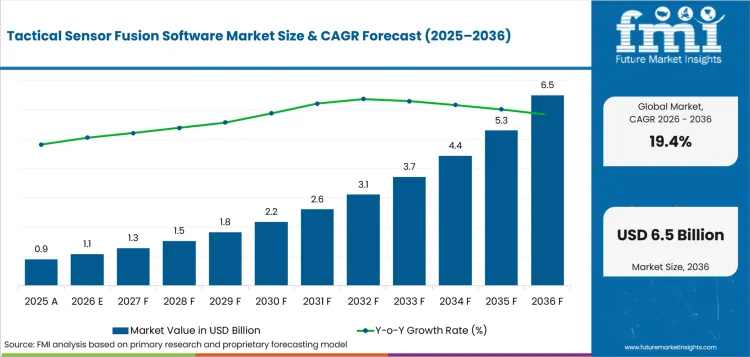
The tactical sensor fusion software market is anticipated to rise from USD 0.9 billion in 2025 to USD 6.5 billion by 2036 at 19.4% CAGR, supported by multi-domain command programs and mission data integration. Defense forces are projected to represent 72.4% share in 2026 as armed forces remain the main buyers for classified mission software. On-premise integration is likely to secure 58.7% share in 2026 due to local hosting and accredited network requirements.
Key Takeaways, Market Size, and Forecast
- 2026 Market Size: USD 1.1 billion
- 2036 Market Size: USD 6.5 billion
- Forecast CAGR: 19.4% from 2026 to 2036
- Leading End User: Defense Forces
- Defense Forces Share in 2026: 72.4%
- Leading Deployment Mode: On-Premise Integration
- On-Premise Integration Share in 2026: 58.7%
- Leading Function: Multi-Sensor Correlation
- Multi-Sensor Correlation Share in 2026: 41.3%
- Fastest-growing Country: United States
- United States CAGR: 21.2% by 2036
Summary of Tactical Sensor Fusion Software Market
- Demand and Growth Drivers
- Mission teams are shifting from sensor-by-sensor monitoring toward shared operating pictures for faster tactical interpretation.
- Air defense planners are prioritizing software layers combining radar and unmanned feeds.
- Classified network operators are favoring locally hosted fusion tools with cyber review and audit control.
- Product and Segment View
- Defense forces are forecast to hold 72.4% share in 2026, driven by mission command and joint fires software spending.
- On-premise integration is projected to represent 58.7% share in 2026, supported by classified network rules and local hosting needs.
- Multi-sensor correlation is expected to capture 41.3% share in 2026, led by track management across radar and unmanned feeds.
- Geography and Competitive Outlook
- United States is projected to record 21.2% CAGR by 2036, reflected by joint fires and deep-sensing programs.
- Israel is forecast to expand at 20.8% CAGR by 2036, backed by air defense software and defense-technology funding.
- Palantir, Anduril, and Northrop Grumman compete based on defense software integration and mission data handling.
- Saab, Elbit Systems, Thales, and Lockheed Martin compete depending on command software and sensor integration depth.
- Analyst Opinion
- Anurag Sharma, Principal Consultant for Technology at FMI, observes, “Tactical sensor fusion software is now more than a display add-on. Mission teams now compare track quality and mission network compatibility before platform cost. Vendors able to integrate classified feeds and support live updates should retain repeat defense programs.”
- Tactical Sensor Fusion Software Market Value Analysis
- Market value is driven by eligible tactical fusion software licenses, while integration and support work adds recurring revenue.
- Supplier pricing reflects mission complexity before hosting environment and accreditation work raise contract value.
- Revenue improves as defense buyers shift from hardware-only sensor upgrades into software-defined mission layers.
- Buyer trust rises as field tests prove latency and interoperability across mixed sensor fleets.
Mission teams are under pressure to turn mixed sensor inputs into firing decisions and command and control systems actions without adding operator workload. CNALT now links Tactical Assault Kit workflows with fire control and visualization. Project Flytrap 4.0 reporting stated that soldiers needed 15 minutes of new equipment training for CNALT operations. Naval mission software is also moving into packaged unmanned systems deployment models. The first Mine Countermeasures Mission Package embarked aboard USS Canberra LCS 30 on April 18 2024. Navy planning pointed to the first MCM Mission Package deployment in fiscal year 2025. Integrated air-defense software is gaining commercial proof through production funding. Northrop Grumman stated the USA Army awarded an IBCS Full Rate Production contract in May 2024. The fiscal year 2024 award was valued at USD 145.0 million. API governance is becoming a buying filter for C4ISR systems. MVCR-2 added guidance for SDKs and libraries.
Tactical Sensor Fusion Software Market Definition
Tactical sensor fusion software covers mission-grade software used to combine multiple tactical sensor inputs into a shared operating picture. Scope includes track correlation, command integration, targeting support, air defense fusion, maritime awareness, border surveillance, and unmanned system coordination. Revenue includes licensed software, configured deployment, integration services, upgrade packages, and recurring support sold to defense forces and authorized integrators.
Tactical Sensor Fusion Software Market Inclusions
Market scope covers all commercially traded tactical sensor fusion software products categorized by deployment mode including on-premise integration; edge-deployed modules; cloud-assisted fusion; hybrid fusion layer; and embedded mission software; applications including command-and-control; targeting support; air defense fusion; maritime domain picture; and border surveillance; platforms including land systems; airborne systems; naval systems; space linked nodes; and dismounted units; functions including multi-sensor correlation; threat classification; target handoff; common operating picture; and mission replay; end users including defense forces; homeland security; naval command; air defense units; and border agencies; and sales channels including direct defense programs; systems integrators; prime contractors; software vendors; and upgrade services. Revenue scope covers 2026 to 2036. The key stakeholders include tactical software vendors, defense electronic systems suppliers, sensor manufacturers, radar and electro-optical payload providers, defense agencies, homeland security units, naval command centers, air defense operators, border agencies, prime contractors, cybersecurity reviewers, simulation teams, mission system test labs and regulatory bodies. Tactical sensor fusion software also connects with tactical communications and unmanned systems as defense buyers integrate sensor feeds across connected field networks and unmanned mission platforms.
Tactical Sensor Fusion Software Market Exclusions
Scope excludes basic video dashboards, civilian surveillance tools, generic analytics platforms, and hardware-only radar or electro-optical sensors without tactical fusion software.
Tactical Sensor Fusion Software Market Research Methodology
- Primary Research: FMI analysts reviewed defense software programs, command system specifications, integrator checks, and buyer criteria across land, air, naval, and border security channels.
- Desk Research: Public data from defense budget sources, government program documents, official company releases, and defense technology disclosures were checked against tactical fusion evidence.
- Market Sizing and Forecasting: Estimated using a bottom-up product-boundary approach based on eligible software modules, channel presence, contract pricing, mission positioning, and country-level adoption.
- Data Validation: Forecast checks compared defense spending direction, C4ISR software demand, air defense upgrades, unmanned system deployment, and active supplier portfolios across leading countries.
Why is the Tactical Sensor Fusion Software Market Growing?
- Mission teams are moving toward unified operating pictures that reduce tactical interpretation delay.
- Air defense units are adding fused software layers to connect radar and command feeds.
- Tactical software buyers are asking for open interfaces that support upgrades without replacing full command systems.
Demand is rising as defense agencies fund targeting and mission data systems. United Kingdom announced more than GBP 1.0 billion for Digital Targeting Web in May 2025. United States Department of Defense requested USD 20.3 billion for science and technology in FY 2026. The C4ISR systems show how command and reconnaissance spending creates a parent pool for fusion modules.
Market Segmentation Analysis
- On-premise integration is forecast to capture 58.7% share in 2026 owing to classified network needs and local data handling rules.
- Command and control is anticipated to secure 35.6% share in 2026, reflected by battlefield planning and joint fires execution.
- Land systems are expected to represent 32.9% share in 2026 led by vehicle-based mission command and mobile sensor networking.
- Multi-sensor correlation is projected to account for 41.3% share in 2026 since fused tracks remain central to targeting and threat ranking.
- Defense forces are predicted to hold 72.4% share in 2026 due to direct budget authority and mission software control.
- Direct defense programs are forecast to represent 61.8% share in 2026 as accreditation and integration work favor prime-led channels.
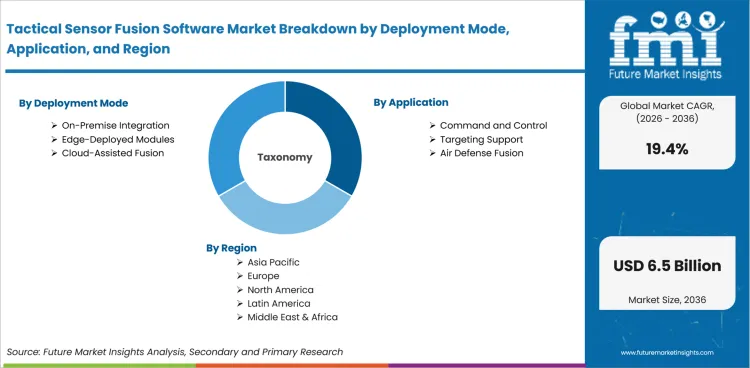
The tactical sensor fusion software market is divided into six primary segment groups based on deployment mode and application. Platform, function, end user, and sales channel complete coverage. Deployment mode covers on-premise integration and edge-deployed modules. Cloud-assisted fusion, hybrid fusion layer, and embedded mission software complete deployment coverage. Application covers command and control and targeting support. Air defense fusion, maritime domain picture, and border surveillance complete application scope.
Insights into Tactical Sensor Fusion Software Market by Deployment Mode
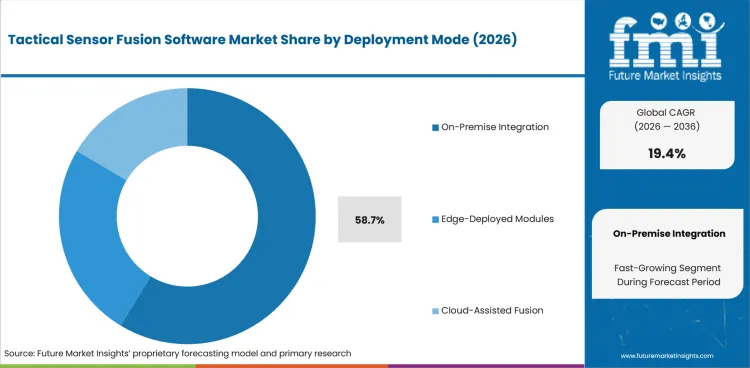
- On-premise integration is projected to hold 58.7% share in 2026, guided by classified mission networks and sovereign data handling.
- Edge-deployed modules gain use as unmanned systems and forward units need lower-latency fusion outside central command sites.
Insights into Tactical Sensor Fusion Software Market by Application
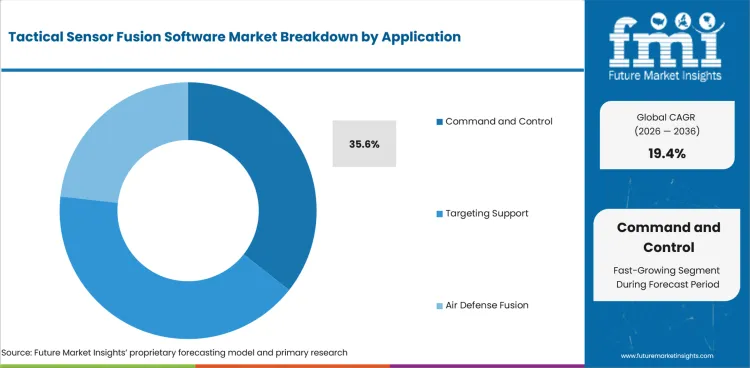
- Command and control are forecast to account for 35.6% share in 2026, supported by joint fires planning and mission command modernization.
- Air defense fusion adds value as radar and acoustic sensors need track continuity across layered defense networks.
Insights into Tactical Sensor Fusion Software Market by Platform
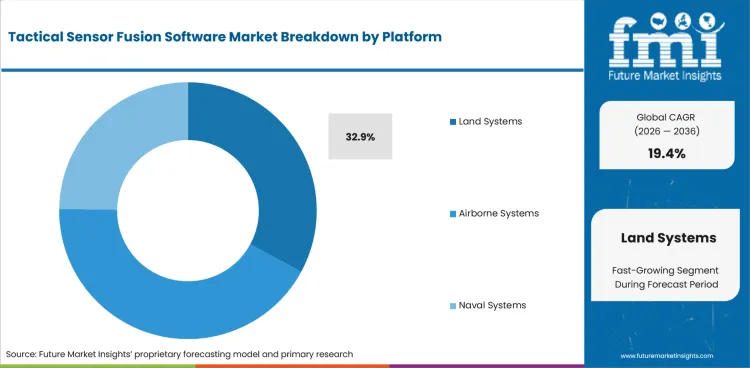
- Land systems are expected to secure 32.9% share in 2026, shaped by armored vehicle upgrades and mobile command posts.
- Naval systems gain share as maritime commanders need fused coastal and unmanned sensor pictures.
Insights into Tactical Sensor Fusion Software Market by Function
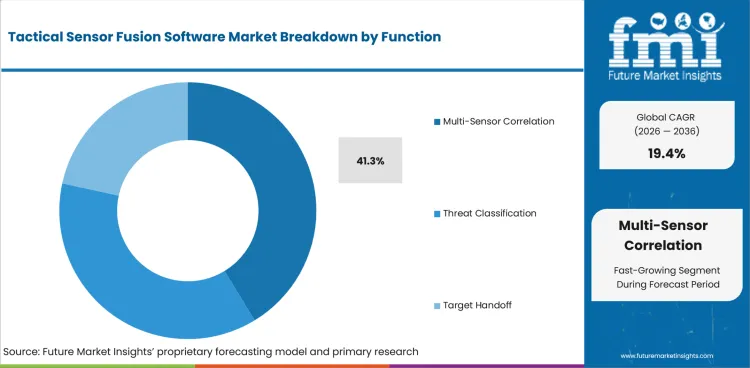
- Multi-sensor correlation is anticipated to hold 41.3% share in 2026, led by target track creation across mixed sensor feeds.
- Target handoff gains importance as tactical teams require faster transfer from detection to engagement planning.
Insights into Tactical Sensor Fusion Software Market by End User
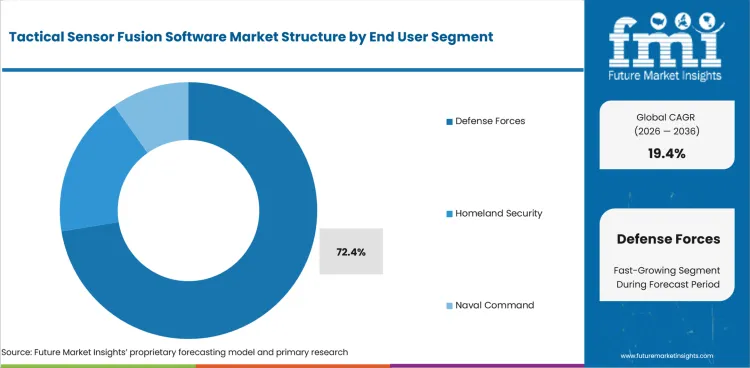
- Defense forces are projected to represent 72.4% share in 2026, driven by mission-grade accreditation and operational control needs.
- Homeland security units add value through border monitoring and counter-unmanned system coordination.
Insights into Tactical Sensor Fusion Software Market by Sales Channel
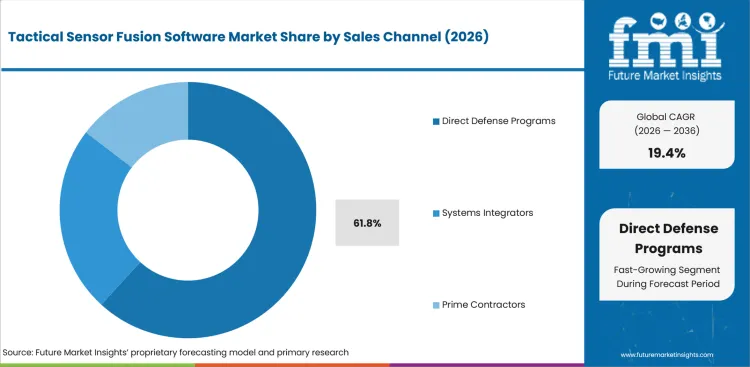
- Direct defense programs are forecast to account for 61.8% share in 2026, led by classified integrations and long qualification cycles.
- Systems integrators support vehicle and command-post upgrade programs requiring fusion middleware.
Tactical Sensor Fusion Software Market Drivers, Restraints and Opportunities
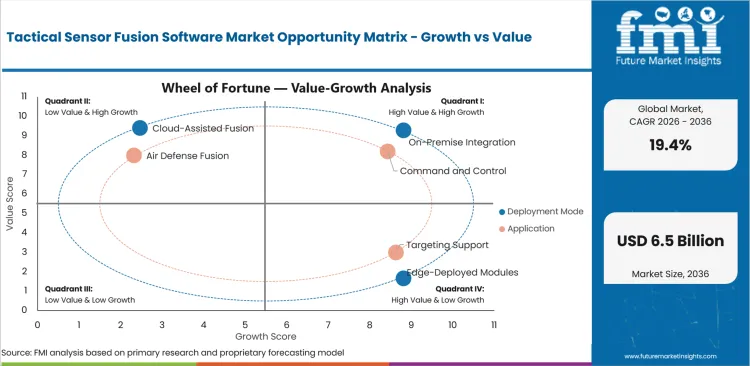
- Multi-domain command programs are turning sensor fusion software into a mission planning requirement for connected forces.
- Legacy data formats can delay deployment as older radars and radios need interface translation before fusion use.
- Open architecture mission software creates service revenue through integration and recurring upgrade work.
Multi-Domain C2 Raises Software Need
Defense agencies are funding systems that shorten sensor-to-decision timelines across land and cyber operations. United States FY 2026 defense request includes USD 848.3 billion in discretionary funding and USD 113.3 billion in mandatory funding. United Kingdom Digital Targeting Web funding adds another signal for battlefield software used to connect sensors and fires assets. Adjacent sector of digital battlefield systems reflects how software-defined command environments are expanding beyond hardware platforms.
Legacy Interface Costs Slow Deployment
Older tactical networks often use different message formats, security rules, and sensor data structures. Such variation can raise integration time before fused tracks become operationally trusted. Certification work can also delay field release after software passes lab testing. Buyers should evaluate full integration cost before comparing license price. Suppliers with adapters for radar, imagery, and tactical data links should reduce delay risk.
Open Architecture Upgrades Create Service Revenue
Open systems create recurring work beyond initial software sale. Defense buyers need new sensor adapters after adding unmanned platforms or space-linked feeds. Air defense units need updated threat libraries as target profiles change. Naval users need new interfaces after combat system refresh cycles. Suppliers able to maintain certified baselines can retain customers across linked tactical communications and command software programs.
Technology Adoption and Automation Penetration Analysis
Tactical sensor fusion software adoption is moving toward live experimentation environments combining unmanned assets and tactical network testing under operational constraints. In April 2025, the USA Army reported that Project Convergence Capstone 5 involved more than 6,000 personnel from joint and multinational forces plus defense industry teams. It also stated that participants used drones and concealment equipment across experiments aimed at a data-centric fighting force. This supports software demand for fusion tools able to process field inputs and stay usable during large-force trials.
Competitive Benchmarking and Technology Positioning Analysis
Competitive benchmarking in tactical sensor fusion software is shifting toward funded software-license scale and direct defense program access. In May 2025, the USA Department of War stated that Palantir USG Inc. received a USD 795.0 million modification for Maven Smart System software licenses under contract W911QX-24-D-0012. The same notice lists an estimated completion date of May 28, 2029. This supports a positioning framework that ranks vendors by mission software contract depth and defense user access rather than product breadth alone.
Competitive Landscape and Strategic Positioning
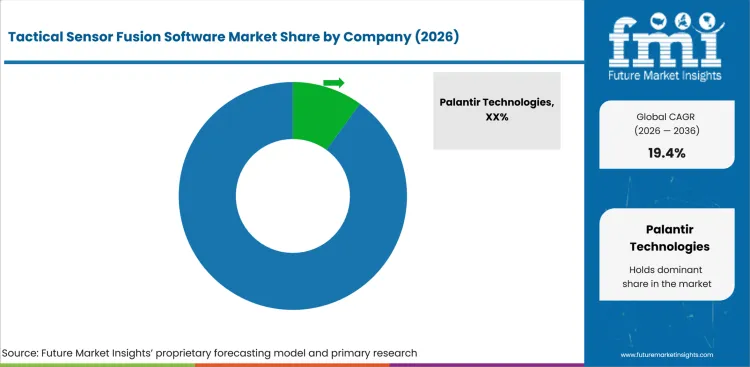
- Mission software leaders compete on data fusion accuracy and classified deployment experience.
- Defense primes retain access through platform programs and system accreditation depth.
- Specialist software firms gain share through faster adapters and mission-specific data processing.
- Entry barriers remain high due to security clearance and classified integration requirements.
Competition is shaped by defense software providers and sensor integrators competing on interoperability and accreditation. Buyers compare whether software can ingest mixed sensor feeds and maintain track identity under field conditions. Palantir’s TITAN contract shows how deep-sensing software is entering Army modernization. Anduril’s Numerica acquisition adds radar tracking and theater fusion assets to Lattice. Suppliers with live mission references and certified deployment teams should win more repeat programs.
Capability depth separates larger firms from smaller vendors. Northrop Grumman’s IBCS role shows the advantage of software connected to integrated air and missile defense networks. Saab’s TDFE gives the company a product-specific position in multi-sensor tracking across air and sub-surface domains. Elbit Systems’ Torch-X Maritime shows how open C5ISR applications combine sensors and tactical elements. Vendors with reusable adapters across military communications systems can shorten deployment work.
Buyer criteria are moving toward open architecture and controlled software updates. Defense agencies want to add sensors without replacing full command systems. Smaller companies can win specialized roles by solving specific data fusion gaps for drones or edge nodes. Scale still favors firms able to support cyber review and long-term software configuration control.
Barriers remain high for new entrants. Classified data access and security-cleared engineers limit quick entry. Long sales cycles also push smaller suppliers toward subcontract positions under prime contractors. Companies best placed to win combine mission software and support across land and border security channels.
Key Companies in the Tactical Sensor Fusion Software Market
Competitive structure is grouped by defense software leaders, mission system primes, and sensor-C2 integration specialists.
- Defense Software Leaders: Palantir Technologies and Anduril Industries compete based on mission data platforms and defense software upgrade speed.
- Mission System Primes: Northrop Grumman and Lockheed Martin compete through air defense and platform-linked integration programs.
- Sensor-C2 Specialists: Saab, Elbit Systems, and Thales Group compete depending on multi-sensor trackers and domain-specific command tools.
Competitive Benchmarking: Tactical Sensor Fusion Software Market
|
Company |
Fusion Engine Depth |
C2 Integration |
Classified Deployment |
Sensor Interface Breadth |
Geographic Footprint |
|
Palantir Technologies |
Very Strong |
Very Strong |
Very Strong |
Strong |
United States and allies |
|
Anduril Industries |
Very Strong |
Strong |
Strong |
Very Strong |
United States and NATO markets |
|
Northrop Grumman |
Very Strong |
Very Strong |
Very Strong |
Very Strong |
Global defense programs |
|
Lockheed Martin |
Strong |
Very Strong |
Very Strong |
Strong |
Global defense programs |
|
Saab |
Very Strong |
Strong |
Strong |
Very Strong |
Europe and allied markets |
|
Elbit Systems |
Strong |
Very Strong |
Strong |
Strong |
Israel and export markets |
|
Thales Group |
Strong |
Strong |
Strong |
Strong |
Europe, Middle East, and Asia |
Source: Future Market Insights competitive analysis, 2026.
Key Developments in Tactical Sensor Fusion Software Market
- In February 2025, Elbit Systems stated it won contracts totaling approximately USD 100.0 million to provide a Joint National Digital Fires Command Center.
- In August 2025, Lockheed Martin established a Command and Control Prototyping Hub for Golden Dome for America.
- In October 2025, Northrop Grumman stated Integrated Battle Command System had executed 32 of 32 flight tests since 2015.
Key Players in the Tactical Sensor Fusion Software Market
- Palantir Technologies
- Anduril Industries
- Northrop Grumman
- Lockheed Martin
- Saab
- Elbit Systems
- Thales Group
- BAE Systems
- Leidos
- CACI International
Analysis of Tactical Sensor Fusion Software Market by Key Countries
.webp "Top Country Growth Comparison Tactical Sensor Fusion Software Market Cagr (2026 2036)")
|
Country |
CAGR |
|
United States |
21.2% |
|
Israel |
20.8% |
|
South Korea |
20.3% |
|
India |
19.8% |
|
United Kingdom |
18.9% |
|
Germany |
18.4% |
|
China |
17.9% |
Source: Future Market Insights, 2026.
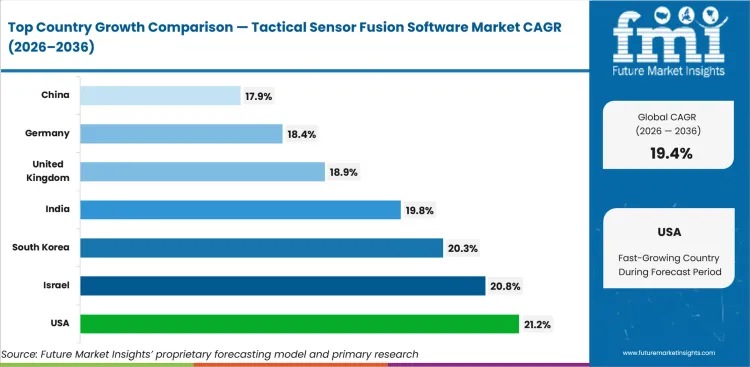
Tactical Sensor Fusion Software Market CAGR Analysis by Country
- United States is projected to record 21.2% CAGR by 2036, supported by joint fires and deep-sensing programs.
- Israel is expected to expand at 20.8% CAGR by 2036, shaped by air defense software and defense-technology funding.
- South Korea is forecast to grow at 20.3% CAGR by 2036, guided by self-reliant defense spending and border surveillance needs.
- India is expected to advance at 19.8% CAGR by 2036, influenced by capital acquisition growth and domestic electronics production.
- United Kingdom is projected to rise at 18.9% CAGR by 2036, guided by Digital Targeting Web and integrated force planning.
- Germany is forecast at 18.4% CAGR by 2036, backed by Bundeswehr modernization and cyber-information force structure.
- China is expected to post 17.9% CAGR by 2036, driven by defense spending and high-tech manufacturing capacity.
Demand Outlook for Tactical Sensor Fusion Software Market in United States
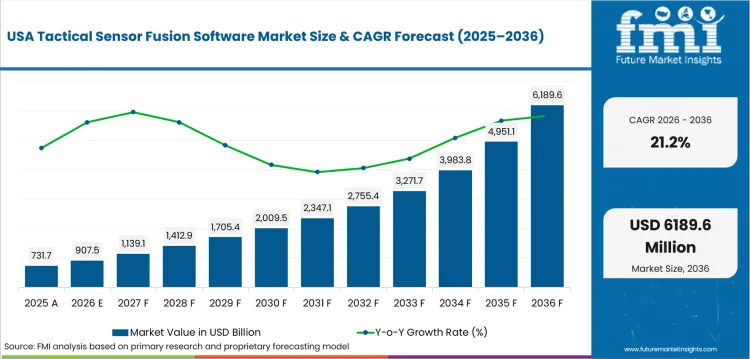
Joint fires and deep-sensing software center · 2026 to 2036
Country Market Snapshot Table
|
Parameter |
Value |
|
Market Size in 2025 (Value) |
USD 297.0 million |
|
Market Size in 2026 (Value) |
USD 360.0 million |
|
Market Forecast in 2036 (Value) |
USD 2,462.2 million |
|
CAGR (2026-2036) |
21.2% |
|
Years Considered |
2021-2036 |
|
Base Year |
2025 |
|
Forecast Period |
2026-2036 |
|
Units Considered |
Value (USD million) |
|
Leading Sub-Region |
Virginia and Maryland defense software corridor |
United States Tactical Sensor Fusion Software Market Outlook
The United States tactical sensor fusion software market is shaped by joint fires modernization and deep-sensing programs. Defense buyers compare interoperability and mission data handling before selecting software vendors.
Washington D.C. and Colorado support large program activity through defense agencies and space-linked mission software teams. Local supplier access should help direct defense programs retain the largest channel share.
Key Growth Drivers
- Joint fires programs support fusion software use across tactical command posts, and FY 2026 defense funding included USD 848.3 billion in discretionary budget authority.
- Science and technology spending strengthens mission software experimentation, and FY 2026 S&T request reached USD 20.3 billion for defense technical work.
- Army deep-sensing programs in Maryland and Virginia create need for software converting sensor feeds into actionable operating pictures.
- Counter-unmanned defense trials across Marine Corps and Army sites support fusion layers combining radar and command feeds.
Key Restraints
- Classified network accreditation can delay fielding for software providers lacking cleared integration teams near major defense hubs.
- Legacy tactical radios and older command posts can raise adapter work before fused tracks move across joint networks.
- Funding tradeoffs can affect software refresh pace, and FY 2026 budget materials noted a 13.4% total increase from FY 2025 across combined funding lines.
What makes United States unique
United States is unique due to deep-sensing programs and defense software funding scale.
Key Companies
- Palantir Technologies
- Anduril Industries
- Northrop Grumman
- Lockheed Martin
- RTX Corporation
- Leidos
- CACI International
Sales & Marketing Channels
- Direct defense programs
- Prime contractor integration
- Mission software contracts
- Classified test events
- Systems integrators
- Defense technology units
Country Segment Breakdown Table
|
Segment |
Sub-Segments |
|
By Deployment Mode |
On-Premise Integration · Edge-Deployed Modules · Cloud-Assisted Fusion · Hybrid Fusion Layer · Embedded Mission Software |
|
By Application |
Command and Control · Targeting Support · Air Defense Fusion · Maritime Domain Picture · Border Surveillance |
|
By Platform |
Land Systems · Airborne Systems · Naval Systems · Space Linked Nodes · Dismounted Units |
|
By Function |
Multi-Sensor Correlation · Threat Classification · Target Handoff · Common Operating Picture · Mission Replay |
|
By End User |
Defense Forces · Homeland Security · Naval Command · Air Defense Units · Border Agencies |
|
By Sales Channel |
Direct Defense Programs · Systems Integrators · Prime Contractors · Software Vendors · Upgrade Services |
| Key Sub-Regions Covered, Defense Software Corridors | Virginia · Maryland · California · Colorado · Texas · Alabama · Massachusetts · Florida |
Frequently Asked Questions
How fast is United States tactical sensor fusion software market growing?
The market in United States is forecast at 21.2% CAGR from 2026 to 2036, led by joint fires and deep-sensing programs.
Who leads United States tactical sensor fusion software market?
Palantir Technologies, Anduril Industries, Northrop Grumman, and Lockheed Martin lead through defense software integration and mission systems access.
What is driving adoption in United States tactical sensor fusion software market?
Joint fires modernization and counter-unmanned operations are increasing use of fused tactical operating pictures.
Growth Outlook for Tactical Sensor Fusion Software Market in Israel
Air defense and defense-tech software center · 2026 to 2036
Country Market Snapshot Table
|
Parameter |
Value |
|
Market Size in 2025 (Value) |
USD 61.3 million |
|
Market Size in 2026 (Value) |
USD 74.0 million |
|
Market Forecast in 2036 (Value) |
USD 489.7 million |
|
CAGR (2026-2036) |
20.8% |
|
Years Considered |
2021-2036 |
|
Base Year |
2025 |
|
Forecast Period |
2026-2036 |
|
Units Considered |
Value (USD million) |
|
Leading Sub-Region |
Tel Aviv and Haifa defense technology corridor |
Israel Tactical Sensor Fusion Software Market Outlook
Israel tactical sensor fusion software sales are influenced by air defense and dense defense-technology activity. Buyers require rapid sensor-to-responder workflows across command rooms and air defense batteries.
Tel Aviv and central Israel concentrate software talent and defense electronics suppliers. Export-ready mission software gives local vendors a route into allied defense and homeland security programs.
Key Growth Drivers
- Air defense operations support fusion tools for rapid threat ranking, and Israel’s Ministry of Defense budget stood near NIS 109.8 billion in the 2025 budget proposal.
- Defense-technology funding strengthens local software pipelines, and DDR&D-linked companies raised over USD 1.0 billion in exits and funding during 2025.
- Border security programs support Torch-X type systems combining command posts and response teams.
- Haifa and Tel Aviv software clusters help vendors shorten integration cycles for mission command upgrades.
Key Restraints
- Small domestic volume can keep export approvals and overseas partnerships central to scale.
- Wartime budget pressure can redirect funds toward immediate munitions and platform needs before software lifecycle upgrades.
- Fiscal balancing can affect program timing, and Israel’s 2026 state budget proposal carried a deficit ceiling of 3.9% of GDP.
What makes Israel unique
Israel is unique due to active air defense requirements and dense defense software supplier capacity.
Key Companies
- Elbit Systems
- Rafael Advanced Defense Systems
- Israel Aerospace Industries
- mPrest
- Sentrycs
- Axon Vision
- ThirdEye Systems
Sales & Marketing Channels
- Defense ministry programs
- Air defense integrators
- Border security agencies
- Export-led defense channels
- Prime contractor partnerships
- Homeland security programs
Country Segment Breakdown Table
|
Segment |
Sub-Segments |
|
By Deployment Mode |
On-Premise Integration · Edge-Deployed Modules · Cloud-Assisted Fusion · Hybrid Fusion Layer · Embedded Mission Software |
|
By Application |
Command and Control · Targeting Support · Air Defense Fusion · Maritime Domain Picture · Border Surveillance |
|
By Platform |
Land Systems · Airborne Systems · Naval Systems · Space Linked Nodes · Dismounted Units |
|
By Function |
Multi-Sensor Correlation · Threat Classification · Target Handoff · Common Operating Picture · Mission Replay |
|
By End User |
Defense Forces · Homeland Security · Naval Command · Air Defense Units · Border Agencies |
|
By Sales Channel |
Direct Defense Programs · Systems Integrators · Prime Contractors · Software Vendors · Upgrade Services |
| Key Sub-Regions Covered, Defense Technology Corridors | Tel Aviv · Haifa · Beersheba · Ashdod · Jerusalem · Netanya · Ramat Gan · Rehovot |
Frequently Asked Questions
How fast is Israel tactical sensor fusion software market growing?
Sector in Israel is projected at 20.8% CAGR by 2036, supported by air defense and border surveillance software needs.
Who leads Israel tactical sensor fusion software market?
Elbit Systems, Rafael Advanced Defense Systems, and Israel Aerospace Industries compete through defense software and systems integration.
What is driving adoption in Israel tactical sensor fusion software market?
Persistent surveillance and air defense command needs are raising demand for tactical sensor fusion software.
Sales Outlook for Tactical Sensor Fusion Software Market in South Korea
Self-reliant defense and border surveillance center · 2026 to 2036
Country Market Snapshot Table
|
Parameter |
Value |
|
Market Size in 2025 (Value) |
USD 57.4 million |
|
Market Size in 2026 (Value) |
USD 69.0 million |
|
Market Forecast in 2036 (Value) |
USD 438.0 million |
|
CAGR (2026-2036) |
20.3% |
|
Years Considered |
2021-2036 |
|
Base Year |
2025 |
|
Forecast Period |
2026-2036 |
|
Units Considered |
Value (USD million) |
|
Leading Sub-Region |
Seoul and Daejeon defense technology corridor |
South Korea Tactical Sensor Fusion Software Market Outlook
South Korea tactical sensor fusion software demand is shaped by peninsula surveillance and self-reliant defense planning. Buyers value local integration and rapid threat classification for air and border monitoring.
Seoul and Gumi support defense electronics and command software activity. Domestic delivery capability should help local suppliers compete for systems connected to border monitoring and air defense.
Key Growth Drivers
- National defense spending supports new command software, and 2026 defense outlays were increased to KRW 65.9 trillion.
- Total government expenditure planning provides room for strategic programs, and 2025 expenditure was set at KRW 677.4 trillion.
- Daejeon research institutions support local software testing for command and unmanned systems.
- Demilitarized Zone monitoring needs favor fused pictures across mobile units and aerial assets.
Key Restraints
- Export-control coordination with allied systems can extend approval cycles for software tied to sensitive sensor interfaces.
- Local programs may require high domestic content before overseas software vendors enter direct defense channels.
- Budget sequencing can affect field upgrades, and total revenue planning for 2025 was projected at KRW 651.8 trillion.
What makes South Korea unique
South Korea is unique due to dense border surveillance needs and local electronics manufacturing depth.
Key Companies
- Hanwha Systems
- LIG Nex1
- Korea Aerospace Industries
- Hanwha Aerospace
- Hyundai Rotem
- Satrec Initiative
- Huneed Technologies
Sales & Marketing Channels
- Defense agency contracts
- Prime contractor integration
- Electronics integrators
- Border surveillance programs
- Air defense programs
- Local software suppliers
Country Segment Breakdown Table
|
Segment |
Sub-Segments |
|
By Deployment Mode |
On-Premise Integration · Edge-Deployed Modules · Cloud-Assisted Fusion · Hybrid Fusion Layer · Embedded Mission Software |
|
By Application |
Command and Control · Targeting Support · Air Defense Fusion · Maritime Domain Picture · Border Surveillance |
|
By Platform |
Land Systems · Airborne Systems · Naval Systems · Space Linked Nodes · Dismounted Units |
|
By Function |
Multi-Sensor Correlation · Threat Classification · Target Handoff · Common Operating Picture · Mission Replay |
|
By End User |
Defense Forces · Homeland Security · Naval Command · Air Defense Units · Border Agencies |
|
By Sales Channel |
Direct Defense Programs · Systems Integrators · Prime Contractors · Software Vendors · Upgrade Services |
| Key Sub-Regions Covered, Defense Technology Corridors | Seoul · Daejeon · Changwon · Gumi · Busan · Incheon · Seongnam · Daegu |
Frequently Asked Questions
How fast is South Korea tactical sensor fusion software market growing?
Sales in South Korea are predicted to grow at 20.3% CAGR through 2036, guided by defense software modernization.
Who leads South Korea tactical sensor fusion software market?
Hanwha Systems and LIG Nex1 compete with domestic defense electronics firms across command software programs.
What is driving adoption in South Korea tactical sensor fusion software market?
Border monitoring and air defense modernization are supporting sensor fusion deployment across local defense networks.
Growth Outlook for Tactical Sensor Fusion Software Market in India
Defense capital acquisition and electronics manufacturing center · 2026 to 2036
Country Market Snapshot Table
|
Parameter |
Value |
|
Market Size in 2025 (Value) |
USD 47.6 million |
|
Market Size in 2026 (Value) |
USD 57.0 million |
|
Market Forecast in 2036 (Value) |
USD 347.1 million |
|
CAGR (2026-2036) |
19.8% |
|
Years Considered |
2021-2036 |
|
Base Year |
2025 |
|
Forecast Period |
2026-2036 |
|
Units Considered |
Value (USD million) |
|
Leading Sub-Region |
Bengaluru and Hyderabad defense electronics corridors |
India Tactical Sensor Fusion Software Market Outlook
India tactical sensor fusion software sector is influenced by domestic defense acquisition and electronics manufacturing. Buyers focus on local integration and compatibility with mixed imported and indigenous platforms.
Bengaluru and Chennai support defense electronics and systems engineering capacity. Local software integration is likely to become more useful as indigenous mission systems enter field use.
Key Growth Drivers
- Capital allocation supports tactical software upgrades, and FY 2026-27 capital head for defense forces exceeded INR 2.19 lakh crore.
- Electronics manufacturing deepens local integration capacity, and production reached INR 11.3 lakh crore in 2024-25.
- Bengaluru and Hyderabad defense clusters support mission software development for radar and unmanned inputs.
- Indigenous command systems promote demand for battlefield management systems that can host fusion modules.
Key Restraints
- Mixed platform fleets can extend adapter development for imported radars and legacy command systems.
- Vendor qualification can take longer for classified systems needing field trials across varied terrain.
- Research funding supports prototype flow, and DRDO allocation rose to INR 29,100.25 crore in FY 2026-27 from INR 26,816.82 crore in FY 2025-26.
What makes India unique
India is unique due to indigenous defense software programs and a large electronics manufacturing base.
Key Companies
- Bharat Electronics Limited
- Tata Advanced Systems
- Larsen & Toubro
- Data Patterns
- Alpha Design Technologies
- Astra Microwave Products
- Tonbo Imaging
Sales & Marketing Channels
- Defense ministry programs
- Public sector integrators
- Private defense primes
- Electronics manufacturing clusters
- Radar system suppliers
- Systems upgrade channels
Country Segment Breakdown Table
|
Segment |
Sub-Segments |
|
By Deployment Mode |
On-Premise Integration · Edge-Deployed Modules · Cloud-Assisted Fusion · Hybrid Fusion Layer · Embedded Mission Software |
|
By Application |
Command and Control · Targeting Support · Air Defense Fusion · Maritime Domain Picture · Border Surveillance |
|
By Platform |
Land Systems · Airborne Systems · Naval Systems · Space Linked Nodes · Dismounted Units |
|
By Function |
Multi-Sensor Correlation · Threat Classification · Target Handoff · Common Operating Picture · Mission Replay |
|
By End User |
Defense Forces · Homeland Security · Naval Command · Air Defense Units · Border Agencies |
|
By Sales Channel |
Direct Defense Programs · Systems Integrators · Prime Contractors · Software Vendors · Upgrade Services |
| Key Sub-Regions Covered, Defense Electronics Corridors | Bengaluru · Hyderabad · Pune · Delhi NCR · Chennai · Mumbai · Kochi · Coimbator |
Frequently Asked Questions
How fast is India tactical sensor fusion software market growing?
The market in India is projected at 19.8% CAGR from 2026 to 2036, led by local defense electronics and capital acquisition.
Who leads India tactical sensor fusion software market?
Bharat Electronics Limited, Tata Advanced Systems, and Larsen & Toubro compete through defense integration depth.
What is driving adoption in India tactical sensor fusion software market?
Indigenous mission systems and mixed sensor fleets are increasing demand for tactical sensor fusion software.
Industry Outlook for Tactical Sensor Fusion Software Market in United Kingdom
Digital targeting and integrated force center · 2026 to 2036
Country Market Snapshot Table
|
Parameter |
Value |
|
Market Size in 2025 (Value) |
USD 72.3 million |
|
Market Size in 2026 (Value) |
USD 86.0 million |
|
Market Forecast in 2036 (Value) |
USD 485.6 million |
|
CAGR (2026-2036) |
18.9% |
|
Years Considered |
2021-2036 |
|
Base Year |
2025 |
|
Forecast Period |
2026-2036 |
|
Units Considered |
Value (USD million) |
|
Leading Sub-Region |
Bristol, Corsham, and Farnborough defense digital corridor |
United Kingdom Tactical Sensor Fusion Software Market Outlook
United Kingdom tactical sensor fusion software industry is shaped by integrated force planning and digital targeting. Buyers emphasize software assurance and rapid field delivery for mission command upgrades.
Corsham and London support defense digital and command software activity. Local suppliers should gain from programs that connect targeting and cyber-electromagnetic functions.
Key Growth Drivers
- Digital Targeting Web supports sensor-to-shooter software, and UK committed more than GBP 1.0 billion to battlefield system investment.
- Research funding supports mission software, and MOD research and development budget is planned above GBP 2.0 billion in 2026-27.
- Corsham defense digital activity supports mission data networks and cyber-electromagnetic command planning.
- Naval and land modernization create demand for command and control systems with fusion-ready interfaces.
Key Restraints
- Coalition interoperability requirements can extend testing across NATO data standards and classified networks.
- Software suppliers may face skills pressure in Bristol and London due to defense digital hiring needs.
- Near-term fiscal pressure can affect phasing, and Spring Statement 2025 added a GBP 2.2 billion uplift to MOD budget.
What makes United Kingdom unique
United Kingdom is unique due to Digital Targeting Web funding and defense digital integration capacity.
Key Companies
- BAE Systems
- QinetiQ
- Thales UK
- Leonardo UK
- Roke
- Ultra Maritime
- Systematic UK
Sales & Marketing Channels
- MOD digital programs
- Prime contractor delivery
- Naval systems integrators
- Land command upgrades
- Cyber-electromagnetic units
- Defense innovation routes
Country Segment Breakdown Table
|
Segment |
Sub-Segments |
|
By Deployment Mode |
On-Premise Integration · Edge-Deployed Modules · Cloud-Assisted Fusion · Hybrid Fusion Layer · Embedded Mission Software |
|
By Application |
Command and Control · Targeting Support · Air Defense Fusion · Maritime Domain Picture · Border Surveillance |
|
By Platform |
Land Systems · Airborne Systems · Naval Systems · Space Linked Nodes · Dismounted Units |
|
By Function |
Multi-Sensor Correlation · Threat Classification · Target Handoff · Common Operating Picture · Mission Replay |
|
By End User |
Defense Forces · Homeland Security · Naval Command · Air Defense Units · Border Agencies |
|
By Sales Channel |
Direct Defense Programs · Systems Integrators · Prime Contractors · Software Vendors · Upgrade Services |
| Key Sub-Regions Covered, Defense Digital Corridors | Corsham · Bristol · Farnborough · Portsmouth · London · Glasgow · Warton · Stevenage |
Frequently Asked Questions
How fast is United Kingdom tactical sensor fusion software market growing?
The market in United Kingdom is expected to grow at 18.9% CAGR through 2036, guided by digital targeting and integrated force plans.
Who leads United Kingdom tactical sensor fusion software market?
BAE Systems, QinetiQ, Thales UK, and Roke compete across defense software and command integration programs.
What is driving adoption in United Kingdom tactical sensor fusion software market?
Digital Targeting Web and coalition mission command needs are supporting tactical sensor fusion software spending.
Opportunity Outlook for Tactical Sensor Fusion Software Market in Germany
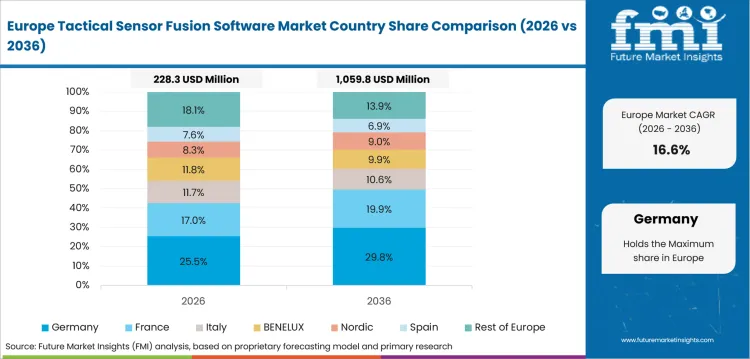
Bundeswehr modernization and cyber-information center · 2026 to 2036
Country Market Snapshot Table
|
Parameter |
Value |
|
Market Size in 2025 (Value) |
USD 67.6 million |
|
Market Size in 2026 (Value) |
USD 80.0 million |
|
Market Forecast in 2036 (Value) |
USD 433.1 million |
|
CAGR (2026-2036) |
18.4% |
|
Years Considered |
2021-2036 |
|
Base Year |
2025 |
|
Forecast Period |
2026-2036 |
|
Units Considered |
Value (USD million) |
|
Leading Sub-Region |
Bavaria and North Rhine-Westphalia defense corridors |
Germany Tactical Sensor Fusion Software Market Outlook
Germany tactical sensor fusion software sales are guided by Bundeswehr modernization and European air defense coordination. Buyers require documentation and integration with NATO-compatible command systems.
Bavaria and Berlin support defense electronics and software activity. German qualification standards should favor suppliers with strong documentation and long-cycle support capability.
Key Growth Drivers
- Bundeswehr modernization supports software and equipment upgrades, and 2025 defense budget funding reached around EUR 62.4 billion.
- Special modernization funding improves system refresh capacity, and Sondervermögen Bundeswehr was created at EUR 100.0 billion.
- Bonn-based cyber-information structures support data handling and software integration across communications and reconnaissance units.
- German air defense programs raise demand for air-based C4ISR systems coordinating sensor feeds and command software.
Key Restraints
- Documentation and certification requirements can extend supplier qualification for software touching mission networks.
- Cross-border European program governance can slow-release timing across shared defense systems.
- Talent availability can constrain specialized delivery, and Bundeswehr cyber-information domain service lists about 16,000 personnel across 19 locations.
What makes Germany unique
Germany is unique due to Bundeswehr special funding and high documentation standards for defense software.
Key Companies
- HENSOLDT
- Rheinmetall
- Airbus Defence and Space
- ESG Elektroniksystem
- Rohde & Schwarz
- Diehl Defence
- Atos Germany
Sales & Marketing Channels
- Bundeswehr programs
- European defense projects
- Prime contractor integration
- Air defense modernization
- Cyber-information units
- Specialist software vendors
Country Segment Breakdown Table
|
Segment |
Sub-Segments |
|
By Deployment Mode |
On-Premise Integration · Edge-Deployed Modules · Cloud-Assisted Fusion · Hybrid Fusion Layer · Embedded Mission Software |
|
By Application |
Command and Control · Targeting Support · Air Defense Fusion · Maritime Domain Picture · Border Surveillance |
|
By Platform |
Land Systems · Airborne Systems · Naval Systems · Space Linked Nodes · Dismounted Units |
|
By Function |
Multi-Sensor Correlation · Threat Classification · Target Handoff · Common Operating Picture · Mission Replay |
|
By End User |
Defense Forces · Homeland Security · Naval Command · Air Defense Units · Border Agencies |
|
By Sales Channel |
Direct Defense Programs · Systems Integrators · Prime Contractors · Software Vendors · Upgrade Services |
| Key Sub-Regions Covered, Defense Technology Corridors | Bavaria · North Rhine-Westphalia · Baden-Württemberg · Berlin · Hamburg · Bremen · Lower Saxony · Saxony |
Frequently Asked Questions
How fast is Germany tactical sensor fusion software market growing?
Germany tactical sensor fusion software sector is projected at 18.4% CAGR through 2036, backed by defense modernization.
Who leads Germany tactical sensor fusion software market?
HENSOLDT, Rheinmetall, Airbus Defence and Space, and ESG compete across sensor and mission software programs.
What is driving adoption in Germany tactical sensor fusion software market?
Bundeswehr modernization and European air defense needs are supporting tactical sensor fusion software revenue.
Sales Analysis for Tactical Sensor Fusion Software Market in China
Defense spending and high-tech manufacturing center · 2026 to 2036
Country Market Snapshot Table
|
Parameter |
Value |
|
Market Size in 2025 (Value) |
USD 112.0 million |
|
Market Size in 2026 (Value) |
USD 132.0 million |
|
Market Forecast in 2036 (Value) |
USD 685.0 million |
|
CAGR (2026-2036) |
17.9% |
|
Years Considered |
2021-2036 |
|
Base Year |
2025 |
|
Forecast Period |
2026-2036 |
|
Units Considered |
Value (USD million) |
|
Leading Sub-Region |
Beijing and Yangtze River Delta defense software corridors |
China Tactical Sensor Fusion Software Market Outlook
China tactical sensor fusion software demand is influenced by defense spending, electronics manufacturing, and local command system development. Buyers prioritize domestic software control and secure deployment across mission networks.
Beijing and Guangdong support defense electronics and software engineering capacity. State-linked mission programs should keep domestic suppliers central to major command system upgrades.
Key Growth Drivers
- Defense budget expansion supports mission system upgrades, and 2025 planned defense expenditure reached CNY 1.784665 trillion.
- High-tech manufacturing supports local software and electronics supply, and Q1 2026 high-tech manufacturing value added rose 12.5% year on year.
- Beijing and Shaanxi defense research clusters support local development of radar and command fusion systems.
- Domestic C4ISR activity strengthens demand for defense electronic systems aligned with mission software.
Key Restraints
- Export controls can restrict access to foreign components and development tools used in mission software workflows.
- Domestic-only sourcing can limit interoperability with coalition platforms outside aligned export channels.
- Manufacturing cycles can create quality pressure, and June 2025 manufacturing PMI stood at 49.7%.
What makes China unique
China is unique due to domestic defense electronics depth and large state-led mission system programs.
Key Companies
- China Electronics Technology Group Corporation
- China Aerospace Science and Industry Corporation
- China North Industries Group
- China Aerospace Science and Technology Corporation
- Hikvision Defense Solutions
- Inspur
- Huawei Cloud Defense Solutions
Sales & Marketing Channels
- State defense programs
- State-owned integrators
- Electronics contractors
- Local software vendors
- Research institutes
- Defense export channels
Country Segment Breakdown Table
|
Segment |
Sub-Segments |
|
By Deployment Mode |
On-Premise Integration · Edge-Deployed Modules · Cloud-Assisted Fusion · Hybrid Fusion Layer · Embedded Mission Software |
|
By Application |
Command and Control · Targeting Support · Air Defense Fusion · Maritime Domain Picture · Border Surveillance |
|
By Platform |
Land Systems · Airborne Systems · Naval Systems · Space Linked Nodes · Dismounted Units |
|
By Function |
Multi-Sensor Correlation · Threat Classification · Target Handoff · Common Operating Picture · Mission Replay |
|
By End User |
Defense Forces · Homeland Security · Naval Command · Air Defense Units · Border Agencies |
|
By Sales Channel |
Direct Defense Programs · Systems Integrators · Prime Contractors · Software Vendors · Upgrade Services |
| Key Sub-Regions Covered, Defense Software Corridors | Beijing · Shanghai · Jiangsu · Sichuan · Shaanxi · Guangdong · Hubei · Zhejiang |
Frequently Asked Questions
How fast is China tactical sensor fusion software market growing?
Growth for the sector in China is expected to post 17.9% CAGR through 2036, supported by defense spending and local electronics capacity.
Who leads China tactical sensor fusion software market?
CETC, CASIC, NORINCO, and CASC compete through state-linked mission systems and defense electronics programs.
What is driving adoption in China tactical sensor fusion software market?
Local command system development and sensor manufacturing depth are raising tactical sensor fusion software use.
Tactical Sensor Fusion Software Market - Report Scope
|
Parameter |
Details |
|
Market size by 2036 |
USD 6.5 billion |
|
Growth rate |
19.4% CAGR (2026-2036) |
|
Forecast period |
2026 to 2036 |
|
Base year value (2025) |
USD 0.9 billion |
|
By deployment mode |
On-premise integration, edge-deployed modules, cloud-assisted fusion, hybrid fusion layer, embedded mission software |
|
By application |
Command and control, targeting support, air defense fusion, maritime domain picture, border surveillance |
|
By platform |
Land systems, airborne systems, naval systems, space linked nodes, dismounted units |
|
By function |
Multi-sensor correlation, threat classification, target handoff, common operating picture, mission replay |
|
By end user |
Defense forces, homeland security, naval command, air defense units, border agencies |
|
By sales channel |
Direct defense programs, systems integrators, prime contractors, software vendors, upgrade services |
|
Regions covered |
North America, Latin America, Europe, East Asia, South Asia and Pacific, Middle East and Africa |
|
Countries covered |
United States, Israel, South Korea, India, United Kingdom, Germany, China |
|
Key companies profiled |
Palantir Technologies, Anduril Industries, Northrop Grumman, Lockheed Martin, Saab, Elbit Systems, Thales Group, BAE Systems, Leidos, CACI International. |
|
Approach |
Bottom-up product-boundary approach using eligible software module revenue, deployment mode, contract pricing, mission positioning, integration depth, and country-level adoption |
Source: Future Market Insights, 2026.
Tactical Sensor Fusion Software Market Breakdown by Deployment Mode, Application, Platform, Function, End User, Sales Channel, and Region
By Deployment Mode
- On-Premise Integration
- Edge-Deployed Modules
- Cloud-Assisted Fusion
- Hybrid Fusion Layer
- Embedded Mission Software
By Application
- Command and Control
- Targeting Support
- Air Defense Fusion
- Maritime Domain Picture
- Border Surveillance
By Platform
- Land Systems
- Airborne Systems
- Naval Systems
- Space Linked Nodes
- Dismounted Units
By Function
- Multi-Sensor Correlation
- Threat Classification
- Target Handoff
- Common Operating Picture
- Mission Replay
By End User
- Defense Forces
- Homeland Security
- Naval Command
- Air Defense Units
- Border Agencies
By Sales Channel
- Direct Defense Programs
- Systems Integrators
- Prime Contractors
- Software Vendors
- Upgrade Services
By Region
- North America
- Latin America
- Europe
- East Asia
- South Asia
- Oceania
- Middle East and Africa
Research Sources and Bibliography
- Anduril Industries. (2025, January 9). Anduril acquires radar and command-and-control businesses of Numerica Corporation.
- Enoch, J., & Miller, D. (2025, April 3). Project Convergence Capstone 5 experiments at NTC. USA Army.
- Elbit Systems. (2025, February 10). Elbit Systems awarded contracts totaling approximately $100 million to provide Joint National Digital Fires Command Center.
- Federal Ministry of Finance. (2025, June 24). Fiscal foundations for the coming years: German government adopts 2025 federal budget, benchmark figures to 2029 and implementation of the €500bn investment package.
- Israel Ministry of Defense. (2025, December 1). Defense-tech companies working with the DDR&D raised over $1 billion in exits and funding in past year.
- Ministry of Defence. (2025, May 29). UK to deliver pioneering battlefield system and bolster cyber warfare capabilities under Strategic Defence Review. GOV.UK.
- Northrop Grumman. (2024, June 17). Northrop Grumman delivers first full set of Integrated Battle Command System equipment to the USA Army.
- Northrop Grumman. (2025, July 30). Northrop Grumman completes delivery under low-rate initial production contract for Integrated Battle Command System.
- Office of Systems Engineering and Architecture. (2025, April). Application Programming Interface (API) technical guidance: Minimum Viable Capability Release (MVCR) 2. Office of the Under Secretary of Defense for Research and Engineering.
- Palantir Technologies. (2024, March 4). Army selects Palantir to deliver TITAN next generation deep-sensing capability in prototype maturation phase.
- Press Information Bureau. (2025, October 11). India’s electronics leap. Government of India.
- Press Information Bureau. (2026, February 3). Defence in Union Budget 2026-27. Government of India.
- Program Executive Office Unmanned and Small Combatants Public Affairs. (2024, April 25). USA Navy announces first Mine Countermeasures Mission Package embarked on USS Canberra. Naval Sea Systems Command.
- Rider, T. (2025, September 3). BLADE cuts down drones during Project Flytrap 4.0. USA Department of War.
- Saab AB. (2025, February 6). Saab receives order for air command and control system.
- State Council of the People’s Republic of China. (2025, March 5). China to increase defense budget by 7.2% in 2025.
- The Knesset. (2025, March 25). Budget Bill for 2025 approved in final readings.
- USA Department of War. (2025, May 21). Contracts for May 21, 2025.
- Lockheed Martin. (2025, August 5). Lockheed Martin establishes command and control prototyping hub for Golden Dome for America.
- Northrop Grumman. (2025, October 16). Integrated Battle Command System proves performance in flight test.
This bibliography is provided for reader reference and is not exhaustive. The full report contains the complete reference list and detailed citations.
This Report Answers
- What is the 2026 value and 2036 forecast for tactical sensor fusion software market?
- Which deployment mode is projected to hold the leading share during the forecast period?
- Which end user is expected to account for the leading 2026 share?
- How do classified networks and sensor interface depth affect tactical software buying?
- Which countries show the strongest tactical sensor fusion software growth outlook?
- Which companies compete in tactical sensor fusion software?
- How do command-and-control upgrades shape sensor fusion software revenue?
- What methodology was used to size tactical sensor fusion software revenue?
Frequently Asked Questions
What is the tactical sensor fusion software market size in 2026?
The tactical sensor fusion software market size is estimated at USD 1.1 billion in 2026 across defense and homeland security channels.
What is the tactical sensor fusion software market forecast for 2036?
The tactical sensor fusion software revenue is predicted to reach USD 6.5 billion by 2036 as mission command software expands.
What is the tactical sensor fusion software market CAGR?
The tactical sensor fusion software sector is projected to expand at 19.4% CAGR from 2026 to 2036.
What segment leads the tactical sensor fusion software market?
Defense forces are likely to capture 72.4% share in 2026 due to mission command and air defense software use.
Which deployment mode leads the tactical sensor fusion software market?
On-premise integration is forecast to hold 58.7% share in 2026 through classified hosting and local data control.
What country grows fastest in the tactical sensor fusion software market?
The United States is forecast to record 21.2% CAGR by 2036, driven by joint fires and deep-sensing software programs.
Which companies compete in tactical sensor fusion software market?
Palantir Technologies, Anduril Industries, Northrop Grumman, Lockheed Martin, Saab, Elbit Systems, and Thales Group compete across tactical sensor fusion software.
What does tactical sensor fusion software market include?
Scope includes multi-sensor correlation, target handoff, command integration, threat classification, common operating picture, and mission replay software.
How was tactical sensor fusion software forecast prepared?
Forecast was prepared using a bottom-up product-boundary approach based on eligible software modules and country adoption.
Preview the report firsthand - request a free sample
Get SampleGet the brochure for pricing and purchase details.
Get PDFTable of Content
- Key Takeaways
- Market Size and CAGR
- Top Growth Driver
- Fastest Growing Segment
- Leading Region
- Key Companies
- Emerging Opportunities
- Executive Summary
- Global Market Outlook
- Demand-side Trends
- Supply-side Trends
- Technology Roadmap Analysis
- Analysis and Recommendations
- Analyst Perspective (What is happening? Why now? What should investors know?)
- Key Questions Answered
- How large is the market?
- What is the CAGR?
- What are key trends?
- Which region dominates?
- Who are the leaders?
- Market Overview
- Market Coverage / Taxonomy
- Market Definition / Scope / Limitations
- Research Methodology
- Chapter Orientation
- Analytical Lens and Working Hypotheses
- Market Structure, Signals, and Trend Drivers
- Benchmarking and Cross-market Comparability
- Market Sizing, Forecasting, and Opportunity Mapping
- Research Design and Evidence Framework
- Desk Research Programme (Secondary Evidence)
- Expert Input and Fieldwork (Primary Evidence)
- Tooling, Models, and Reference Databases
- Data Engineering and Model Build
- Quality Assurance and Audit Trail
- Market Background
- Market Dynamics (Drivers, Restraints, Opportunity, Trends)
- Scenario Forecast (Optimistic, Likely, Conservative)
- Impact Analysis
- AI Impact
- Sustainability Impact
- Regulatory Impact
- Technology Impact
- Consumer / Buyer Analysis
- Purchase Drivers
- Adoption Barriers
- Buyer Journey
- Opportunity Map Analysis
- Product Life Cycle Analysis
- Supply Chain Analysis
- Investment Feasibility Matrix
- Value Chain Analysis
- PESTLE and Porter's Analysis
- Regulatory Landscape
- Regional Parent Market Outlook
- Production and Consumption Statistics
- Import and Export Statistics
- Global Market Analysis and Forecast, 2021 to 2036
- Historical Market Size Value (USD Billion) & Volume (Unit) Analysis, 2021 to 2025
- Current and Future Market Size Value (USD Billion) & Volume (Unit) Projections, 2026 to 2036
- Y-o-Y Growth Trend Analysis
- Absolute $ Opportunity Analysis
- Global Market Pricing Analysis, 2021 to 2036
- Global Market Analysis and Forecast, By Deployment Mode, 2021 to 2036
- Introduction / Key Findings
- Historical Market Size Value (USD Billion) & Volume (Unit) Analysis By Deployment Mode, 2021 to 2025
- Current and Future Market Size Value (USD Billion) & Volume (Unit) Analysis and Forecast By Deployment Mode, 2026 to 2036
- On-Premise Integration
- Edge-Deployed Modules
- Cloud-Assisted Fusion
- Hybrid Fusion Layer
- Embedded Mission Software
- On-Premise Integration
- Y-o-Y Growth Trend Analysis By Deployment Mode, 2021 to 2025
- Absolute $ Opportunity Analysis By Deployment Mode, 2026 to 2036
- Global Market Analysis and Forecast, By Application, 2021 to 2036
- Introduction / Key Findings
- Historical Market Size Value (USD Billion) & Volume (Unit) Analysis By Application, 2021 to 2025
- Current and Future Market Size Value (USD Billion) & Volume (Unit) Analysis and Forecast By Application, 2026 to 2036
- Command and Control
- Targeting Support
- Air Defense Fusion
- Maritime Domain Picture
- Border Surveillance
- Command and Control
- Y-o-Y Growth Trend Analysis By Application, 2021 to 2025
- Absolute $ Opportunity Analysis By Application, 2026 to 2036
- Global Market Analysis and Forecast, By Platform, 2021 to 2036
- Introduction / Key Findings
- Historical Market Size Value (USD Billion) & Volume (Unit) Analysis By Platform, 2021 to 2025
- Current and Future Market Size Value (USD Billion) & Volume (Unit) Analysis and Forecast By Platform, 2026 to 2036
- Land Systems
- Airborne Systems
- Naval Systems
- Space Linked Nodes
- Dismounted Value (USD Billion) & Volume (Unit)s
- Land Systems
- Y-o-Y Growth Trend Analysis By Platform, 2021 to 2025
- Absolute $ Opportunity Analysis By Platform, 2026 to 2036
- Global Market Analysis and Forecast, By Function, 2021 to 2036
- Introduction / Key Findings
- Historical Market Size Value (USD Billion) & Volume (Unit) Analysis By Function, 2021 to 2025
- Current and Future Market Size Value (USD Billion) & Volume (Unit) Analysis and Forecast By Function, 2026 to 2036
- Multi-Sensor Correlation
- Threat Classification
- Target Handoff
- Common Operating Picture
- Mission Replay
- Multi-Sensor Correlation
- Y-o-Y Growth Trend Analysis By Function, 2021 to 2025
- Absolute $ Opportunity Analysis By Function, 2026 to 2036
- Global Market Analysis and Forecast, By End User, 2021 to 2036
- Introduction / Key Findings
- Historical Market Size Value (USD Billion) & Volume (Unit) Analysis By End User, 2021 to 2025
- Current and Future Market Size Value (USD Billion) & Volume (Unit) Analysis and Forecast By End User, 2026 to 2036
- Defense Forces
- Homeland Security
- Naval Command
- Air Defense Value (USD Billion) & Volume (Unit)s
- Border Agencies
- Defense Forces
- Y-o-Y Growth Trend Analysis By End User, 2021 to 2025
- Absolute $ Opportunity Analysis By End User, 2026 to 2036
- Global Market Analysis and Forecast, By Sales Channel
- Introduction / Key Findings
- Historical Market Size Value (USD Billion) & Volume (Unit) Analysis By Sales Channel, 2021 to 2025
- Current and Future Market Size Value (USD Billion) & Volume (Unit) Analysis and Forecast By Sales Channel, 2026 to 2036
- Direct Defense Programs
- Systems Integrators
- Prime Contractors
- Software Vendors
- Upgrade Services
- Direct Defense Programs
- Y-o-Y Growth Trend Analysis By Sales Channel, 2021 to 2025
- Absolute $ Opportunity Analysis By Sales Channel, 2026 to 2036
- Global Market Analysis and Forecast, By Region, 2021 to 2036
- Introduction
- Historical Market Size Value (USD Billion) & Volume (Unit) Analysis By Region, 2021 to 2025
- Current Market Size Value (USD Billion) & Volume (Unit) Analysis and Forecast By Region, 2026 to 2036
- North America
- Latin America
- Western Europe
- Eastern Europe
- East Asia
- South Asia and Pacific
- Middle East & Africa
- Market Attractiveness Analysis By Region
- North America Market Analysis and Forecast, By Country, 2021 to 2036
- Historical Market Size Value (USD Billion) & Volume (Unit) Trend Analysis By Market Taxonomy, 2021 to 2025
- Market Size Value (USD Billion) & Volume (Unit) Forecast By Market Taxonomy, 2026 to 2036
- By Country
- USA
- Canada
- Mexico
- By Deployment Mode
- By Application
- By Platform
- By Function
- By End User
- By Sales Channel
- By Country
- Market Attractiveness Analysis
- By Country
- By Deployment Mode
- By Application
- By Platform
- By Function
- By End User
- By Sales Channel
- Key Takeaways
- Latin America Market Analysis and Forecast, By Country
- Historical Market Size Value (USD Billion) & Volume (Unit) Trend Analysis By Market Taxonomy, 2021 to 2025
- Market Size Value (USD Billion) & Volume (Unit) Forecast By Market Taxonomy, 2026 to 2036
- By Country
- Brazil
- Chile
- Rest of Latin America
- By Deployment Mode
- By Application
- By Platform
- By Function
- By End User
- By Sales Channel
- By Country
- Market Attractiveness Analysis
- By Country
- By Deployment Mode
- By Application
- By Platform
- By Function
- By End User
- By Sales Channel
- Key Takeaways
- Western Europe Market Analysis and Forecast, By Country
- Historical Market Size Value (USD Billion) & Volume (Unit) Trend Analysis By Market Taxonomy, 2021 to 2025
- Market Size Value (USD Billion) & Volume (Unit) Forecast By Market Taxonomy, 2026 to 2036
- By Country
- Germany
- UK
- Italy
- Spain
- France
- Nordic
- BENELUX
- Rest of Western Europe
- By Deployment Mode
- By Application
- By Platform
- By Function
- By End User
- By Sales Channel
- By Country
- Market Attractiveness Analysis
- By Country
- By Deployment Mode
- By Application
- By Platform
- By Function
- By End User
- By Sales Channel
- Key Takeaways
- Eastern Europe Market Analysis and Forecast, By Country
- Historical Market Size Value (USD Billion) & Volume (Unit) Trend Analysis By Market Taxonomy, 2021 to 2025
- Market Size Value (USD Billion) & Volume (Unit) Forecast By Market Taxonomy, 2026 to 2036
- By Country
- Russia
- Poland
- Hungary
- Balkan & Baltic
- Rest of Eastern Europe
- By Deployment Mode
- By Application
- By Platform
- By Function
- By End User
- By Sales Channel
- By Country
- Market Attractiveness Analysis
- By Country
- By Deployment Mode
- By Application
- By Platform
- By Function
- By End User
- By Sales Channel
- Key Takeaways
- East Asia Market Analysis and Forecast, By Country
- Historical Market Size Value (USD Billion) & Volume (Unit) Trend Analysis By Market Taxonomy, 2021 to 2025
- Market Size Value (USD Billion) & Volume (Unit) Forecast By Market Taxonomy, 2026 to 2036
- By Country
- China
- Japan
- South Korea
- By Deployment Mode
- By Application
- By Platform
- By Function
- By End User
- By Sales Channel
- By Country
- Market Attractiveness Analysis
- By Country
- By Deployment Mode
- By Application
- By Platform
- By Function
- By End User
- By Sales Channel
- Key Takeaways
- South Asia and Pacific Market Analysis and Forecast, By Country
- Historical Market Size Value (USD Billion) & Volume (Unit) Trend Analysis By Market Taxonomy, 2021 to 2025
- Market Size Value (USD Billion) & Volume (Unit) Forecast By Market Taxonomy, 2026 to 2036
- By Country
- India
- ASEAN
- Australia & New Zealand
- Rest of South Asia and Pacific
- By Deployment Mode
- By Application
- By Platform
- By Function
- By End User
- By Sales Channel
- By Country
- Market Attractiveness Analysis
- By Country
- By Deployment Mode
- By Application
- By Platform
- By Function
- By End User
- By Sales Channel
- Key Takeaways
- Middle East & Africa Market Analysis and Forecast, By Country
- Historical Market Size Value (USD Billion) & Volume (Unit) Trend Analysis By Market Taxonomy, 2021 to 2025
- Market Size Value (USD Billion) & Volume (Unit) Forecast By Market Taxonomy, 2026 to 2036
- By Country
- Kingdom of Saudi Arabia
- Other GCC Countries
- Türkiye
- South Africa
- Other African Union
- Rest of Middle East & Africa
- By Deployment Mode
- By Application
- By Platform
- By Function
- By End User
- By Sales Channel
- By Country
- Market Attractiveness Analysis
- By Country
- By Deployment Mode
- By Application
- By Platform
- By Function
- By End User
- By Sales Channel
- Key Takeaways
- Key Countries Market Analysis
- USA
- Pricing Analysis
- Market Share Analysis, 2025
- By Deployment Mode
- By Application
- By Platform
- By Function
- By End User
- By Sales Channel
- Canada
- Pricing Analysis
- Market Share Analysis, 2025
- By Deployment Mode
- By Application
- By Platform
- By Function
- By End User
- By Sales Channel
- Mexico
- Pricing Analysis
- Market Share Analysis, 2025
- By Deployment Mode
- By Application
- By Platform
- By Function
- By End User
- By Sales Channel
- Brazil
- Pricing Analysis
- Market Share Analysis, 2025
- By Deployment Mode
- By Application
- By Platform
- By Function
- By End User
- By Sales Channel
- Chile
- Pricing Analysis
- Market Share Analysis, 2025
- By Deployment Mode
- By Application
- By Platform
- By Function
- By End User
- By Sales Channel
- Germany
- Pricing Analysis
- Market Share Analysis, 2025
- By Deployment Mode
- By Application
- By Platform
- By Function
- By End User
- By Sales Channel
- UK
- Pricing Analysis
- Market Share Analysis, 2025
- By Deployment Mode
- By Application
- By Platform
- By Function
- By End User
- By Sales Channel
- Italy
- Pricing Analysis
- Market Share Analysis, 2025
- By Deployment Mode
- By Application
- By Platform
- By Function
- By End User
- By Sales Channel
- Spain
- Pricing Analysis
- Market Share Analysis, 2025
- By Deployment Mode
- By Application
- By Platform
- By Function
- By End User
- By Sales Channel
- France
- Pricing Analysis
- Market Share Analysis, 2025
- By Deployment Mode
- By Application
- By Platform
- By Function
- By End User
- By Sales Channel
- India
- Pricing Analysis
- Market Share Analysis, 2025
- By Deployment Mode
- By Application
- By Platform
- By Function
- By End User
- By Sales Channel
- ASEAN
- Pricing Analysis
- Market Share Analysis, 2025
- By Deployment Mode
- By Application
- By Platform
- By Function
- By End User
- By Sales Channel
- Australia & New Zealand
- Pricing Analysis
- Market Share Analysis, 2025
- By Deployment Mode
- By Application
- By Platform
- By Function
- By End User
- By Sales Channel
- China
- Pricing Analysis
- Market Share Analysis, 2025
- By Deployment Mode
- By Application
- By Platform
- By Function
- By End User
- By Sales Channel
- Japan
- Pricing Analysis
- Market Share Analysis, 2025
- By Deployment Mode
- By Application
- By Platform
- By Function
- By End User
- By Sales Channel
- South Korea
- Pricing Analysis
- Market Share Analysis, 2025
- By Deployment Mode
- By Application
- By Platform
- By Function
- By End User
- By Sales Channel
- Russia
- Pricing Analysis
- Market Share Analysis, 2025
- By Deployment Mode
- By Application
- By Platform
- By Function
- By End User
- By Sales Channel
- Poland
- Pricing Analysis
- Market Share Analysis, 2025
- By Deployment Mode
- By Application
- By Platform
- By Function
- By End User
- By Sales Channel
- Hungary
- Pricing Analysis
- Market Share Analysis, 2025
- By Deployment Mode
- By Application
- By Platform
- By Function
- By End User
- By Sales Channel
- Kingdom of Saudi Arabia
- Pricing Analysis
- Market Share Analysis, 2025
- By Deployment Mode
- By Application
- By Platform
- By Function
- By End User
- By Sales Channel
- Türkiye
- Pricing Analysis
- Market Share Analysis, 2025
- By Deployment Mode
- By Application
- By Platform
- By Function
- By End User
- By Sales Channel
- South Africa
- Pricing Analysis
- Market Share Analysis, 2025
- By Deployment Mode
- By Application
- By Platform
- By Function
- By End User
- By Sales Channel
- USA
- Market Structure Analysis
- Competition Dashboard
- Competition Benchmarking
- Market Share Analysis of Top Players
- By Regional
- By Deployment Mode
- By Application
- By Platform
- By Function
- By End User
- By Sales Channel
- Emerging Startups
- Innovation Benchmarking
- Competition Analysis
- Competition Deep Dive
- Palantir Technologies
- Overview
- Product Portfolio
- Profitability by Market Segments (Product/Region/Sales Channel)
- Sales Footprint
- Strategy Overview
- Marketing Strategy
- Product Strategy
- Channel Strategy
- Anduril Industries
- Northrop Grumman
- Lockheed Martin
- RTX Corporation
- Leidos
- CACI International
- Palantir Technologies
- Case Studies
- Success Stories
- Recent Developments
- Competition Deep Dive
- Assumptions & Acronyms Used


