


Thermal Insulation Material Market
The thermal insulation material market is segmented by Material Type (Plastic Foam, Mineral Wool, Fiberglass, Aerogels, Vacuum Insulation Panels, Cork, Cellulose), Temperature Range, End Use or Application (Building and Construction, Industrial and OEM, HVAC and Refrigeration, Transportation, Other Specialized Uses), and Region. Forecast for 2026 to 2036.
Thermal Insulation Material Market Size, Market Forecast and Outlook By FMI
The thermal insulation material market is valued at USD 83.3 billion in 2026. The market is projected to expand at a CAGR of 5.6% to reach USD 143.7 billion by 2036. Plastic foam is expected to lead material type with around 36.0% share, while building and construction is projected to account for 58.0% share.
Summary of the Thermal Insulation Material Market
- Demand and Growth Drivers
- Energy efficiency requirements are supporting insulation use across residential and industrial buildings.
- Retrofit activity is increasing as existing buildings need better thermal control and lower operating costs.
- Cold storage and battery systems are expanding specialized insulation demand.
- Product and Segment View
- Plastic foam leads material type because high thermal resistance and low weight suit space-efficient installations.
- Building and construction leads end use because insulation is used across walls and envelopes.
- Mineral wool and fiberglass remain important where fire behavior and acoustic performance guide material selection.
- Advanced materials serve specialized applications requiring thinner profiles and higher thermal control.
- Geography and Competitive Outlook
- Asia Pacific remains important because housing and industrial investment support volume demand.
- Europe and North America retain value through building performance standards and retrofit activity.
- Companies with certified products and installation-ready formats are better positioned.
- Analyst Opinion
- Nikhil Kaitwade, Principal Consultant at FMI, indicates that insulation demand is tied to energy control and construction performance. Supplier advantage depends more on thermal rating certification and installation efficiency than on material supply alone.
- Thermal Insulation Material Market Value Analysis
- The market is moving from basic building material use toward energy management and performance compliance.
- Demand is likely to rise as buildings and industrial systems require stable temperature control.
- Adoption is expected to gain support from energy costs and building efficiency rules.
- Spending is anticipated to be backed by construction activity and specialized thermal applications.
Thermal Insulation Material Market Key Takeaways
| Metric | Value |
|---|---|
| Market Value (2026) | USD 83.3 billion |
| Market Forecast Value (2036) | USD 143.7 billion |
| Forecast CAGR (2026 to 2036) | 5.6% |
How Is The Thermal Insulation Material Market Segmented?
The thermal insulation material market is segmented by material type, temperature range, end use or application, and region, reflecting diverse performance requirements across construction and industrial environments. Material type includes plastic foam, mineral wool, fiberglass, and advanced materials such as aerogels, vacuum insulation panels, cork, and cellulose. Temperature range segmentation spans applications from cryogenic conditions below minus 160°C through high-temperature industrial environments up to 650°C.
use includes building and construction, industrial and OEM applications, HVAC and refrigeration systems, transportation platforms covering automotive, rail, marine, and battery thermal management, along with other specialized uses. Regional segmentation includes North America, Europe, East Asia, South Asia and Pacific, Latin America, and the Middle East and Africa. This structure reflects how insulation demand is shaped by thermal performance needs, installation conditions, regulatory frameworks, and regional construction and industrial activity intensity.
Why Does Plastic Foam Lead The Thermal Insulation Material Market By Material Type?
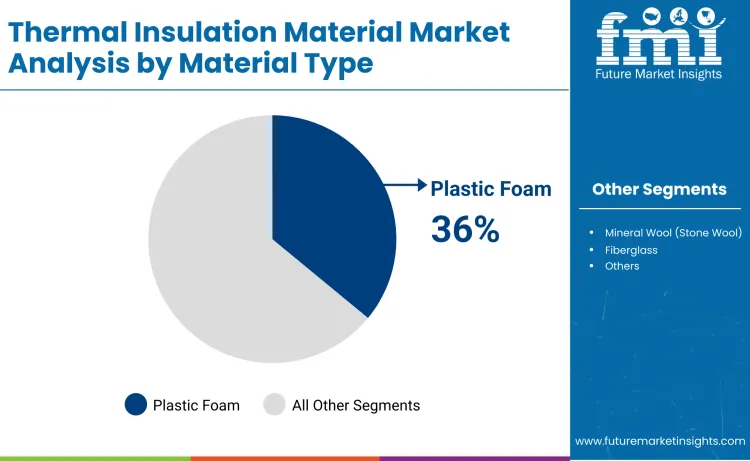
Plastic foam accounts for about 36.0% of total market share due to high thermal resistance, low weight, and adaptability across building and industrial applications. Contractors and engineers favor plastic foam insulation for strong insulating performance per unit thickness, enabling space-efficient wall assemblies, roof systems, and cold storage installations. Moisture resistance supports long-term performance in below-grade and high-humidity environments.
Expanded polystyrene supports cost-sensitive residential and foundation uses. Extruded polystyrene addresses load-bearing and moisture-exposed conditions. Polyurethane and polyisocyanurate foams deliver high R-values for thin-profile designs used in building envelopes and industrial equipment. Manufacturing scalability and broad format availability support widespread adoption. Continuous formulation improvements strengthen durability and safety performance, reinforcing plastic foam leadership within the thermal insulation material market.
Why Does Building And Construction Dominate End Use Demand?
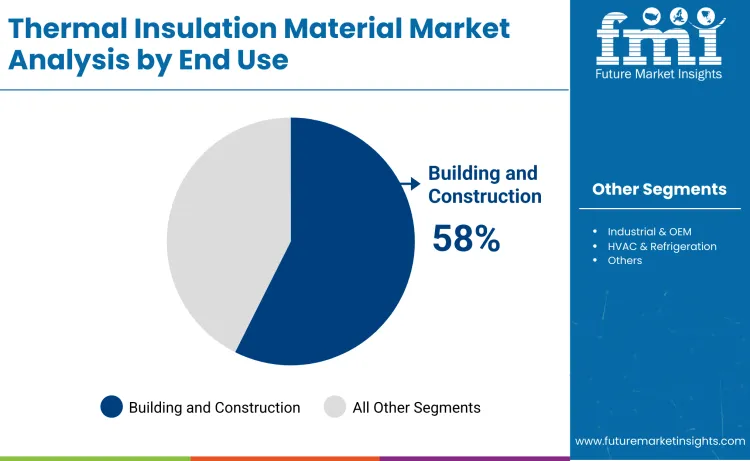
Building and construction applications represent about 58.0% of total insulation demand due to extensive use across building envelopes, roofing systems, foundations, and interior assemblies. Residential new construction drives steady volume through energy-efficient housing development. Retrofit activity contributes significant demand as existing buildings undergo insulation upgrades to improve thermal control and operating cost efficiency.
Commercial buildings rely on insulation to manage heating and cooling loads while maintaining occupant comfort. Public and institutional facilities adopt insulation to meet strict performance requirements. Building designers prioritize insulation systems offering reliable thermal control and long service life. Utility incentive programs and regulatory mandates support insulation deployment. Continuous construction activity and renovation investment reinforce building and construction as the dominant end-use segment in the thermal insulation material market.
What Are The Key Drivers In The Thermal Insulation Material Market?
The thermal insulation material market is driven by rising energy costs and stricter building performance requirements across residential, commercial, and industrial sectors. Building owners seek insulation solutions that reduce heating and cooling demand while improving indoor comfort. Industrial operators require thermal control to protect equipment and improve process efficiency. Growth in cold storage facilities, data centers, and battery systems increases demand for reliable insulation.
Infrastructure development supports insulation use in transportation and public facilities. Utility programs encourage insulation upgrades through financial incentives. Manufacturers focus on materials that balance thermal performance, durability, and installation efficiency. These drivers reinforce insulation as a critical component of energy management strategies across construction and industrial value chains.
What Restraints Affect The Thermal Insulation Material Market?
Market expansion faces challenges linked to raw material price volatility, installation complexity, and regulatory constraints. Petrochemical input costs influence pricing stability for foam-based insulation products. Fire safety requirements restrict material selection in certain building types, increasing specification complexity.
Skilled labor availability affects retrofit project timelines and installation quality. Advanced insulation systems require precise handling and training, increasing project costs. Transportation and storage considerations influence logistics for bulky insulation materials. Performance testing and certification requirements extend product approval cycles. These factors influence adoption rates and procurement decisions, particularly in cost-sensitive markets or regions with limited installer capacity.
What Trends Are Shaping The Thermal Insulation Material Market?
Key trends include growing demand for high-performance insulation systems designed for space-constrained applications. Materials offering high thermal resistance with reduced thickness gain wider acceptance. Fire-resistant insulation solutions receive increased attention due to tighter safety codes.
Advanced coatings and composite structures improve durability and moisture resistance. Building retrofit programs increase adoption of exterior continuous insulation systems. Transportation electrification drives insulation demand for battery thermal management. Manufacturers invest in processing technology to improve product consistency and application flexibility. Digital building design tools influence insulation selection through performance modeling. These trends guide innovation and differentiation across the thermal insulation material market.
How Is the Thermal Insulation Material Market Developing from 2026 to 2036?
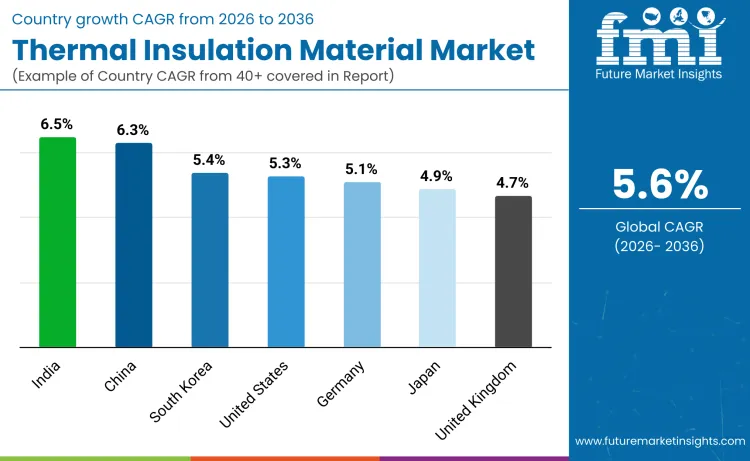
The thermal insulation material market from 2026 to 2036 is shaped by rising construction activity, stricter building performance requirements, and growing demand for controlled indoor environments. Insulation materials are widely used across residential buildings, commercial complexes, industrial facilities, and infrastructure projects to manage heat transfer and improve building performance. Growth patterns vary by country depending on construction intensity, climate conditions, building regulations, and renovation activity.
Emerging economies show stronger volume expansion due to new housing and infrastructure development, while developed regions focus on retrofit projects and building envelope upgrades. Demand spans mineral wool, plastic foams, fiberglass, and rigid insulation boards applied in walls, roofs, floors, HVAC systems, and industrial equipment. Processing capacity, installation standards, and material performance consistency strongly influence adoption trends across regions.
| Country | CAGR |
|---|---|
| India | 6.5% |
| China | 6.3% |
| South Korea | 5.4% |
| United States | 5.3% |
| Germany | 5.1% |
| Japan | 4.9% |
| United Kingdom | 4.7% |
Why Is India Leading Growth in the Thermal Insulation Material Market?
India is projected to grow at a CAGR of 6.5% from 2026 to 2036, supported by rapid urban development and expanding construction activity. Residential housing projects across metropolitan and tier-two cities are increasing demand for wall and roof insulation. Commercial real estate growth drives adoption of insulation in offices, malls, and institutional buildings. Rising preference for air-conditioned indoor environments strengthens material usage across building envelopes. Implementation of Energy Conservation Building Code requirements increases specification of insulation materials in commercial construction. Infrastructure projects such as metros, airports, cold storage facilities, and logistics parks contribute to industrial insulation demand. Growth of domestic insulation manufacturing improves regional availability. Contractors and developers increasingly adopt standardized insulation solutions to meet building performance expectations across residential and commercial segments.
How Is China Supporting Thermal Insulation Material Demand?
China is expected to record a CAGR of 6.3% during 2026 to 2036, driven by continued construction activity and industrial development. Large-scale residential and commercial building projects across urban regions sustain strong insulation consumption. Building energy performance standards influence insulation thickness and material selection across façades and roofing systems. Industrial facilities apply insulation for process equipment, pipelines, and controlled production environments. Expansion of district heating and cooling networks increases usage of insulation materials in infrastructure applications. Urban redevelopment projects add further demand across public buildings and mixed-use developments. Domestic producers benefit from integrated supply chains and high-volume manufacturing capacity. Consistent investment in construction and industrial facilities maintains steady demand across building and industrial insulation applications.
What Drives Growth of Thermal Insulation Materials in South Korea?
South Korea is projected to grow at a CAGR of 5.4% from 2026 to 2036, supported by high-rise residential construction and advanced building standards. Urban housing projects rely on insulation to improve thermal performance of tall residential towers. Zero-energy building targets influence material selection and installation quality. Commercial buildings adopt continuous insulation systems to enhance envelope efficiency. Modular construction practices increase demand for precision insulation components. Government-backed building performance programs reinforce material usage across new construction and renovation projects. Residential developers focus on indoor comfort and energy performance as key selling factors. Strong construction quality expectations support adoption of high-performance insulation materials across walls, roofs, and façades.
Why Does the United States Show Stable Growth in Thermal Insulation Materials?
The United States is projected to expand at a CAGR of 5.3% from 2026 to 2036, supported by a large building renovation market. Existing residential buildings drive demand through attic, wall, and basement insulation upgrades. Commercial properties adopt insulation improvements during reroofing and façade refurbishment. Building energy codes influence insulation specifications across multiple states. New housing construction in southern regions supports steady material consumption. Industrial sectors such as cold storage, data centers, and logistics facilities apply insulation to maintain temperature control. Well-developed distribution networks ensure material availability across regions. Contractors and building owners increasingly focus on envelope performance improvements, supporting consistent demand across residential, commercial, and industrial applications.
How Is Germany Advancing Thermal Insulation Material Adoption?
Germany is expected to grow at a CAGR of 5.1% from 2026 to 2036, driven by extensive building renovation activity. Residential housing stock upgrades increase demand for wall, roof, and floor insulation. Commercial buildings integrate high-performance insulation to improve thermal efficiency. Engineering expertise supports precise installation and material selection. Industrial insulation demand grows across automotive manufacturing and process industries requiring temperature stability. Financial incentives for building upgrades encourage insulation adoption across private and public properties. Dense urban areas maintain continuous renovation cycles. Material suppliers focus on performance consistency and compliance with building standards. These factors support steady growth across residential, commercial, and industrial insulation applications.
What Supports Steady Growth of Thermal Insulation Materials in Japan?
Japan is projected to record a CAGR of 4.9% from 2026 to 2036, shaped by construction quality standards and industrial requirements. Residential buildings adopt insulation to manage seasonal temperature variation and improve indoor comfort. Fire-resistant insulation materials play an important role in building design. Renovation of aging housing stock sustains demand across urban areas. Industrial facilities apply insulation to equipment, piping, and controlled production zones. Manufacturing sectors such as electronics and pharmaceuticals require precise thermal control. Urban redevelopment projects maintain steady construction activity. Focus on durability and long-term performance supports consistent adoption of insulation materials across residential, commercial, and industrial applications.
Why Is the United Kingdom Maintaining Moderate Growth in Thermal Insulation Materials?
The United Kingdom is expected to grow at a CAGR of 4.7% from 2026 to 2036, driven by building refurbishment activity and regulatory requirements. Residential upgrades focus on loft, cavity wall, and external wall insulation. Multi-storey buildings adopt insulation materials aligned with fire safety specifications. Social housing improvement programs support large-scale installation projects. Commercial buildings integrate insulation within façades and roofing systems. Property owners seek improved thermal comfort and lower operational costs. Dense urban construction and renovation cycles sustain ongoing material demand. Established supplier networks and installer expertise support steady growth across residential and commercial insulation segments.
What Is the Competitive Landscape of the Thermal Insulation Material Market?
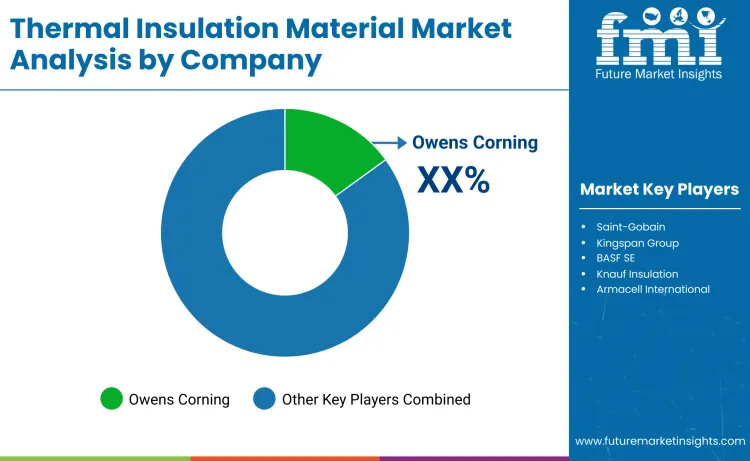
The thermal insulation material market is defined by strong competition among global building material manufacturers, specialist insulation producers, and chemical companies supplying products for residential buildings, commercial infrastructure, and industrial facilities. Competitive positioning is shaped by thermal performance, fire resistance, acoustic control, mechanical strength, and compliance with building and safety standards. Manufacturers compete through broad product portfolios that include fiberglass, mineral wool, rigid foam boards, spray foams, elastomeric insulation, and advanced materials designed for demanding temperature environments. Production scale, supply reliability, and strong relationships with contractors, architects, and OEMs play a major role in maintaining long-term demand.
Owens Corning maintains a leading position due to its extensive range of fiberglass and foam-based insulation products used across housing and commercial construction. Saint-Gobain holds a strong global footprint through mineral wool and glass wool solutions serving both building envelopes and industrial systems. Kingspan Group is recognized for rigid insulation boards and insulated panels designed for high-performance building shells and temperature-controlled facilities. Rockwool International focuses on stone wool insulation with emphasis on fire safety, durability, and acoustic performance across construction and industrial segments.
Chemical and specialty material suppliers add further competitive depth. BASF SE and Dow Inc. supply polyurethane, polystyrene, and specialty foam insulation materials widely used in construction and industrial equipment. Knauf Insulation and Johns Manville compete through mineral wool and fiberglass products supported by strong distribution networks. Armacell International specializes in flexible insulation for HVAC and piping systems, while Aspen Aerogels serves high-temperature and space-constrained applications in energy and industrial operations. Competition remains centered on performance consistency, regulatory compliance, and application-specific insulation solutions.
Key Players in the Thermal Insulation Material Market
- Owens Corning
- Saint-Gobain
- Kingspan Group
- Rockwool International
- BASF SE
- Knauf Insulation
- Johns Manville
- Dow Inc.
- Armacell International
- Aspen Aerogels
Scope of Report
Items
| Values | |
|---|---|
| Market Value 2026 | USD 83.3 billion |
| Projected Market Value 2036 | USD 143.7 billion |
| CAGR 2026 to 2036 | 5.6% |
| Quantitative Units | USD billion |
| Material Types Analyzed | Plastic Foam including EPS, XPS, PUR and PIR; Mineral Wool including Stone Wool; Fiberglass; Other Materials including Aerogels, Vacuum Insulation Panels, Cork, Cellulose |
| Temperature Ranges Analyzed | Minus 160°C to Minus 50°C, Minus 49°C to 0°C, 1°C to 100°C, 101°C to 650°C |
| End-use and Application Segments Analyzed | Building and Construction including Residential New Build, Residential Retrofit, Commercial, Public and Institutional; Industrial and OEM; HVAC and Refrigeration; Transportation including Automotive, Rail, Ship, Battery Thermal Management; Other Applications |
| Regions Covered | North America, Europe, East Asia, South Asia and Pacific, Latin America, Middle East and Africa |
| Countries Covered | United States, Germany, United Kingdom, France, China, Japan, India, Italy, Spain, South Korea, and more than 40 additional countries |
| Key Companies Profiled | Owens Corning, Saint-Gobain, Kingspan Group, Rockwool International, BASF SE, Knauf Insulation |
| Additional Attributes | Dollar sales by material type, temperature range, and end-use category; regional demand trends; competitive landscape analysis; technology developments in advanced insulation systems, fire-safe formulations, and high-performance thermal materials |
Thermal Insulation Material Market by Segments
Material Type:
- Plastic Foam
- EPS
- XPS
- PUR/PIR
- Mineral Wool (Stone Wool)
- Fiberglass
- Others
- Aerogels
- Vacuum Insulation Panels
- Cork
- Cellulose
Temperature Range:
- 1°C to 100°C
- 101°C to 650°C
- 49°C to 0°C
- 160°C to -50°C
End Use/Application:
- Building & Construction
- Residential New Build
- Residential Retrofit
- Commercial
- Public/Institutional
- Industrial & OEM
- HVAC & Refrigeration
- Transportation (Automotive/Rail/Ship including Battery Thermal Management)
- Others
Region:
- North America
- United States
- Canada
- Mexico
- Europe
- Germany
- United Kingdom
- France
- Italy
- Spain
- Netherlands
- Nordic
- Poland
- Turkey
- Rest of Eastern Europe
- East Asia
- China
- Japan
- South Korea
- South Asia & Pacific
- India
- ASEAN
- Australia & New Zealand
- Rest of South Asia & Pacific
- Latin America
- Brazil
- Argentina
- Rest of Latin America
- Middle East & Africa
- Kingdom of Saudi Arabia
- Other GCC Countries
- Turkiye
- South Africa
- Other African Union
- Rest of Middle East & Africa
Bibliography
- USA Department of Energy. (2023). Building insulation materials, thermal performance requirements, and energy efficiency applications in residential and commercial buildings. Office of Energy Efficiency and Renewable Energy.
- International Energy Agency. (2023). Energy efficiency in buildings and the role of thermal insulation materials in reducing heating and cooling demand. IEA Publications.
- National Institute of Building Sciences. (2022). Whole building design guidance on thermal insulation systems for buildings and infrastructure. National Institute of Building Sciences.
- European Commission Joint Research Centre. (2023). Technical assessment of thermal insulation materials used in construction and industrial applications. European Union Publications.
- National Renewable Energy Laboratory. (2022). Thermal insulation materials performance, durability, and application in buildings and industrial systems. USA Department of Energy.
Frequently Asked Questions
How big is the thermal insulation material market in 2025?
The global thermal insulation material market is estimated to be valued at USD 78.9 billion in 2025.
What will be the size of thermal insulation material market in 2035?
The market size for the thermal insulation material market is projected to reach USD 136.1 billion by 2035.
How much will be the thermal insulation material market growth between 2025 and 2035?
The thermal insulation material market is expected to grow at a 5.6% CAGR between 2025 and 2035.
What are the key product types in the thermal insulation material market?
The key product types in thermal insulation material market are plastic foam, mineral wool (stone wool), fiberglass and others.
Which end use/application segment to contribute significant share in the thermal insulation material market in 2025?
In terms of end use/application, building & construction segment to command 58.0% share in the thermal insulation material market in 2025.
Table of Content
- Thermal Insulation Material Market Analysis Size And Share Forecast Outlook 2026 To 2036
- Thermal Insulation Material Market Forecast And Outlook (2026–2036)
- Quick Stats For Thermal Insulation Material Market
- Thermal Insulation Material Market Key Takeaways
- How Is The Thermal Insulation Material Market Segmented?
- Why Does Plastic Foam Lead The Thermal Insulation Material Market By Material Type?
- Why Does Building And Construction Dominate End Use Demand?
- What Are The Key Drivers In The Thermal Insulation Material Market?
- What Restraints Affect The Thermal Insulation Material Market?
- What Trends Are Shaping The Thermal Insulation Material Market?
- How Is The Thermal Insulation Material Market Developing From 2026 To 2036?
- Country-Level Thermal Insulation Material Market Analysis
- India Thermal Insulation Material Market Outlook
- China Thermal Insulation Material Market Outlook
- South Korea Thermal Insulation Material Market Outlook
- United States Thermal Insulation Material Market Outlook
- Germany Thermal Insulation Material Market Outlook
- Japan Thermal Insulation Material Market Outlook
- United Kingdom Thermal Insulation Material Market Outlook
- What Is The Competitive Landscape Of The Thermal Insulation Material Market?
- Key Players In The Thermal Insulation Material Market
- Scope Of Report
- Thermal Insulation Material Market By Segments
- By Material Type
- By Temperature Range
- By End Use And Application
- By Region
- Frequently Asked Questions
- Bibliography
List of Tables
- Table 1: Thermal Insulation Material Market Value And Forecast (USD Billion), 2026-2036
- Table 2: Thermal Insulation Material Market CAGR (%), 2026-2036
- Table 3: Thermal Insulation Material Market Share By Material Type (%), 2026
- Table 4: Thermal Insulation Material Market Share By End Use (%), 2026
- Table 5: Thermal Insulation Material Market Segmentation By Material Type
- Table 6: Thermal Insulation Material Market Segmentation By Temperature Range
- Table 7: Thermal Insulation Material Market Segmentation By End Use And Application
- Table 8: Thermal Insulation Material Market Drivers Impact Assessment
- Table 9: Thermal Insulation Material Market Restraints Impact Assessment
- Table 10: Thermal Insulation Material Market Trends Mapping
- Table 11: Thermal Insulation Material Market Regional Distribution (%), 2026
- Table 12: Country-Level Thermal Insulation Material Market CAGR Comparison, 2026-2036
- Table 13: India Thermal Insulation Material Market Metrics
- Table 14: China Thermal Insulation Material Market Metrics
- Table 15: South Korea Thermal Insulation Material Market Metrics
- Table 16: United States Thermal Insulation Material Market Metrics
- Table 17: Germany Thermal Insulation Material Market Metrics
- Table 18: Japan Thermal Insulation Material Market Metrics
- Table 19: United Kingdom Thermal Insulation Material Market Metrics
- Table 20: Thermal Insulation Material Market Competitive Landscape Overview
- Table 21: Material Portfolio And Application Coverage Of Key Players
- Table 22: Scope Of Report Summary
List of Figures
- Figure 1: Thermal Insulation Material Market Overview And Forecast Snapshot (2026 And 2036)
- Figure 2: Thermal Insulation Material Market Growth Outlook (CAGR %), 2026-2036
- Figure 3: Thermal Insulation Material Market Structure By Material Type, Temperature Range, And End Use
- Figure 4: Thermal Insulation Material Market Share By Material Type (%), 2026
- Figure 5: Thermal Insulation Material Market Share By End-use Application (%), 2026
- Figure 6: Plastic Foam Insulation Demand Distribution Across Building And Industrial Applications
- Figure 7: Mineral Wool And Fiberglass Usage Comparison Across Construction Segments
- Figure 8: Thermal Insulation Performance Mapping Across Temperature Ranges
- Figure 9: Application Matrix Linking Temperature Range With End-use Industries
- Figure 10: Key Drivers Influencing Thermal Insulation Material Demand Across Sectors
- Figure 11: Market Restraints Impact Map Covering Cost, Regulation, And Installation Factors
- Figure 12: Key Trends Shaping Product Development In Thermal Insulation Materials
- Figure 13: Regional Demand Distribution For Thermal Insulation Materials, 2026
- Figure 14: Country-Level CAGR Comparison For Thermal Insulation Material Market, 2026-2036
- Figure 15: India Thermal Insulation Material Market Growth Drivers And Application Focus
- Figure 16: China Thermal Insulation Material Market Growth Drivers And Application Focus
- Figure 17: South Korea Thermal Insulation Material Market Growth Drivers And Application Focus
- Figure 18: United States Thermal Insulation Material Market Growth Drivers And Application Focus
- Figure 19: Germany Thermal Insulation Material Market Growth Drivers And Application Focus
- Figure 20: Japan Thermal Insulation Material Market Growth Drivers And Application Focus
- Figure 21: United Kingdom Thermal Insulation Material Market Growth Drivers And Application Focus
- Figure 22: Competitive Landscape Map Of Thermal Insulation Material Manufacturers
- Figure 23: Positioning Matrix Of Key Players By Material Portfolio And End-use Coverage
- Figure 24: Thermal Insulation Material Market Value Chain And Application Flow
Full Research Suite comprises of:

Market outlook & trends analysis
Interviews & case studies
Strategic recommendations
Vendor profiles & capabilities analysis
5-year forecasts
8 regions and 60+ country-level data splits
Market segment data splits
12 months of continuous data updates
DELIVERED AS:
PDF EXCEL ONLINE


