

- Market Size (2026)
- USD 38.4 Mn
- Forecast (2036)
- USD 112.0 Mn
- CAGR (2026 to 2036)
- 11.3%
How big is Thermometric Sap Flow Sensors Market in 2026?
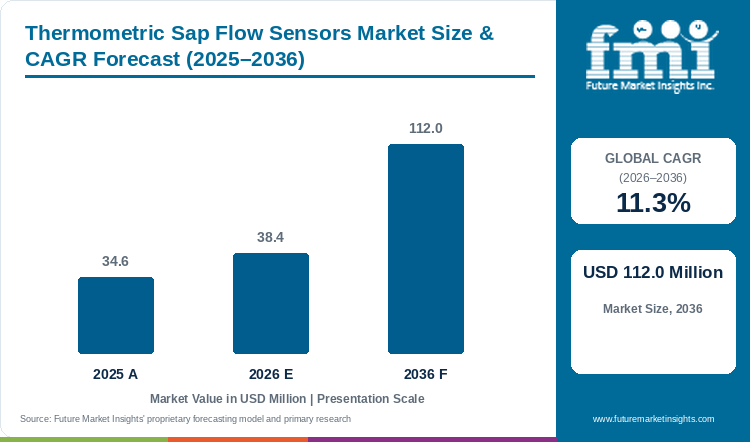
Global thermometric sap flow sensors market size is projected to rise from USD 34.6 million in 2025 to USD 38.4 million in 2026, advancing at an anticipated 11.3% CAGR to reach USD 112.0 million by 2036.
Woody perennial crops release over 90% of root-absorbed water through leaf stomata while mature trees draw up to 33% of peak daytime transpiration from internal stem reserves that refill overnight, according to an August 2026 Michigan State University scoping review in Frontiers in Agronomy [1]. Because of this physiological lag between soil drying and canopy stress, Heat Ratio Method (HRM) Bidirectional & Zero-Flow Capable systems are projected to capture 48.5% of thermometric measurement principle market value in 2026 across drip and micro-sprinkler orchard blocks. Global demand for thermometric sap flow sensors totals an estimated USD 38.4 million in 2026 after standing at USD 34.6 million in 2025, while an 11.3% ten-year compound growth rate brings 2036 industry valuation to USD 112.0 million and adds USD 73.6 million in new annual value. Even so, cambial wounding around drilled trunk needles still requires annual probe repositioning across commercial tree blocks.
Key Market Trends & Insights
- By thermometric measurement principle: Heat Ratio Method (HRM) Bidirectional & Zero-Flow Capable units are projected to capture 48.5% in 2026 owing to short 20-joule heat pulses that track both slow daytime transpiration and reverse night redistribution.
- By stem installation type: Invasive Radial Drill-Needle Woody Trunk Probes are estimated to command 64.2% in 2026 driven by multi-depth thermistor spacing that profiles sapwood flux across thick bark.
- By telemetry & power: Solar-Powered LoRaWAN / NB-IoT Irrigation Feedback Nodes represent 68.0% of expected 2026 telemetry demand backed by direct wireless links to automated drip-valve controllers.
- By end-use sector: Deficit-Irrigated Wine Vineyards & Nut or Avocado Orchards are forecast to generate 56.4% in 2026 attributed to groundwater pumping caps across arid fruit basins.
Regional Highlights
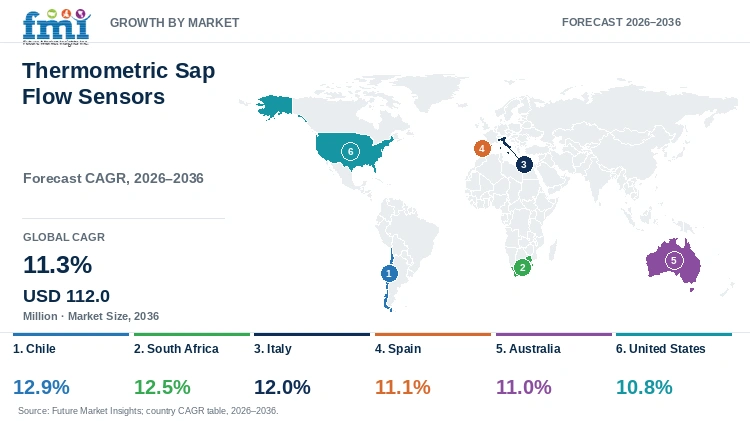
- Southern Hemisphere irrigation expansion: Chilean orchards lead national sap-sensor adoption with 12.9% compound annual expansion through 2036 ahead of South African estates at 12.5% fueled by export vineyard and avocado drought telemetry.
- Mediterranean and OECD basin modernization: Italian wine and olive estates post a 12.0% compound rate and Spanish river basins log 11.1%, whereas Australian orchards (11.0% rate) and United States nut ranches (10.8% rate) automate perennial irrigation scheduling.
Market Size & Forecast
Table 1: Global Xylem Transpiration Sensor Valuation Trajectory (USD million and CAGR), 2025 to 2036
| Metric | Value |
|---|---|
| 2025 Market Size | USD 34.6 million |
| Estimated Market Size in 2026 | USD 38.4 million |
| Projected Market Size by 2036 | USD 112.0 million |
| CAGR, 2026 to 2036 | 11.3% |
| Added Market Value, 2026 to 2036 | USD 73.6 million |
Fixed-calendar watering and standalone soil-tension readings often miss midday stomatal closure when hot dry winds raise atmospheric vapor pressure deficit. In its 2025 technical specifications for the SFM1x Sap Flow Meter, ICT International Pty Ltd documented 1.3-millimeter needles with dual thermistor spacings at 7.5 and 22.5 millimeters that measure sap velocity from -100 to +100 centimeters per hour via LoRaWAN or Cat-M1/NB-IoT links [2]. Consequently, orchard agronomists pair trunk heat-pulse meters with dielectric soil moisture probes so irrigation valves open only when active xylem transport drops below target transpiration curves.
Sapwood Probe Deployment and Orchard Telemetry Sizing
Table 2: Installed Sapwood Probe Nodes and Replacement Needle Shipments (USD million and unit ranges), 2025 to 2036
| Metric | 2025 | 2026 | 2036 |
|---|---|---|---|
| Market size (USD million) | 34.6 | 38.4 | 112.0 |
| Active thermometric sap flow sensor nodes deployed (thousand units) | 26.5 to 30.2 | 29.4 to 33.6 | 88.0 to 101.5 |
| Replacement needle & collar probe kits shipped (thousand sets) | 41.0 to 46.5 | 45.8 to 52.0 | 138.0 to 156.0 |
| Average hardware valuation per complete node (USD) | 1,120 to 1,310 | 1,140 to 1,325 | 1,090 to 1,260 |
Operational note: Node deployment ranges reconcile commercial HRM and Granier TDM probe shipments as well as stem heat-balance collars against average 18-to-36-month needle replacement intervals across instrumented orchard plots.
High-value perennial estates instrument sentinel trees across each micro-topographic irrigation zone to convert raw heat-pulse ratios into liters of water transpired per hour. In addition to this, viticulturists managing commercial still and sparkling wine estates use stem heat-balance collars to hold mild veraison water deficits that concentrate berry anthocyanins without scorching canopy foliage.
Per Capita & Irrigated Orchard Sizing
Table 3: Irrigated Perennial Estate and Demographic Intensity Metrics for Sap Flow Hardware (USD), 2025 to 2036
| Metric | 2025 | 2026 | 2036 |
|---|---|---|---|
| World population (billion) | 8.2 | 8.3 | 9.0 |
| Market value per 1,000 people (USD) | 4.2 | 4.6 | 12.4 |
| Annual sensor valuation per instrumented orchard estate (USD) | 3,850 to 4,600 | 4,100 to 4,850 | 6,900 to 8,200 |
| Wireless LoRaWAN & NB-IoT feedback node share (%) | 65.5% to 67.5% | 67.0% to 69.0% | 76.0% to 79.5% |
Table 4: Instrumented Vineyard, Orchard and FluxNet Tower Benchmarks (2026 Baseline)
| Metric | Value | Institutional Reference Basis |
|---|---|---|
| Market size, 2026 | USD 38.4 million | 2026 global thermometric sap flow valuation baseline |
| Instrumented commercial orchards & flux towers worldwide | 8,900 sites | Global precision horticulture & FluxNet station registry |
| HRM bidirectional probe market value, 2026 | USD 18.6 million | 48.5% measurement principle segment allocation |
| Wine vineyard & nut/avocado orchard market value, 2026 | USD 21.7 million | 56.4% end-use sector segment allocation |
Multi-depth radial thermistors measure velocity gradients between outer conducting xylem and inner heartwood so whole-tree water budgets remain accurate across aging trunks. Estate irrigation managers link these sap flux density streams into connected precision farming networks to audit seasonal water-use efficiency per harvested ton.
Analyst Perspective
"Bidirectional heat-ratio probes and non-invasive stem heat-balance collars allow irrigation managers to quantify exact hourly tree transpiration in liters rather than relying on indirect soil moisture proxies. Suppliers that pair multi-depth radial temperature needles with solar LoRaWAN valve automation will capture multi-season orchard modernization tenders."
- Nikhil Kaitwade, Principal Consultant, Future Market Insights.
How is the thermometric sap flow sensors market segmented?
The thermometric sap flow sensors market is segmented by thermometric measurement principle, stem installation type, telemetry & power, end-use sector, and region. In 2026, Heat Ratio Method (HRM) Bidirectional & Zero-Flow Capable is projected at 48.5%, Invasive Radial Drill-Needle Woody Trunk Probes at 64.2%, Solar-Powered LoRaWAN / NB-IoT Irrigation Feedback Nodes at 68.0%, and Deficit-Irrigated Wine Vineyards, Almond & Avocado Orchards at 56.4%.
By thermometric measurement principle: Heat Ratio Method (HRM) Bidirectional & Zero-Flow Capable, Granier Thermal Dissipation (TDM) Continuous Heater Probes, Stem Heat Balance (SHB) Non-Invasive Collar Gauges, and Compensation Heat Pulse Velocity (CHPV) Needles.
By stem installation type: Invasive Radial Drill-Needle Woody Trunk Probes, and Wrap-Around Flexible Herbaceous & Vine Collars.
By telemetry & power: Solar-Powered LoRaWAN / NB-IoT Irrigation Feedback Nodes, and Standalone SDI-12 / Research Data-Logger Probes.
By end-use sector: Deficit-Irrigated Wine Vineyards & Nut or Avocado Orchards, Forestry Drought Mortality & Carbon-Flux Ecohydrology, and Controlled-Environment Greenhouse Tomato & Berry Crops.
Why does the Heat Ratio Method (HRM) lead the thermometric measurement principle category?
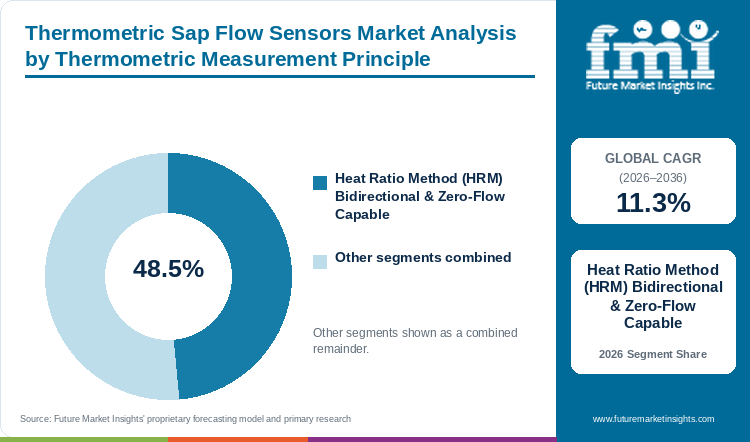
Heat Ratio Method (HRM) Bidirectional & Zero-Flow Capable probes are projected to capture 48.5% of measurement principle market value in 2026, enabled by low-flow sensitivity.
Table 5: Revenue-Free Market Value Split by Thermometric Measurement Principle (2026 Share %)
| Thermometric Measurement Principle | Share (2026) |
|---|---|
| Heat Ratio Method (HRM) Bidirectional & Zero-Flow Capable | 48.5% |
| Other Segments Combined | 51.5%* |
| Total | 100.0% |
*Note: Aggregate allocation covering Granier TDM, Stem Heat Balance collars, and CHPV needle architectures to reach 100.0%.
Table 6: Primary Heat-Pulse Architecture Benchmark and Ten-Year Expansion Rate (2026 to 2036)
| Metric | Value |
|---|---|
| Global CAGR (2026 to 2036) | 11.3% |
| Leading Segment | Heat Ratio Method (HRM) Bidirectional & Zero-Flow Capable |
Heat Ratio Method instruments fire a 2.5-second heat pulse between symmetrically spaced upstream and downstream temperature needles to resolve zero flow and reverse nocturnal sap movement. Continuous Granier thermal dissipation probes draw constant battery current and underestimate flux by up to 37% without species calibration, whereas pulsed HRM needles preserve solar battery life across long-range LoRaWAN gateway modules.
- Heat Ratio Method (HRM) Bidirectional & Zero-Flow Capable units hold 48.5% of projected 2026 measurement principle valuation attributable to 20-joule pulse efficiency and reverse-flow accuracy.
- In 2026, Dynamax Inc. expanded commercial deployment of its EXO-Skin Sap Flow Sensor series (models SGEX-9 through SGEX-25) operating at 0.15 to 0.60 watts for 8-to-29-millimeter stems [3].
Why do Invasive Radial Drill-Needle Woody Trunk Probes dominate by stem installation type?
Invasive Radial Drill-Needle Woody Trunk Probes are estimated to secure 64.2% of stem installation type valuation in 2026, supported by radial sapwood profiling.
Mature almond and avocado trunks feature thick insulating bark and steep velocity gradients across outer and inner sapwood rings that external surface collars cannot penetrate. Stainless-steel drill needles inserted through anodized drill guides position thermistors at exact radial depths inside conducting xylem while feeding digital readings into field-installed telemetry receivers.
- Invasive Radial Drill-Needle Woody Trunk Probes are estimated to command 64.2% of stem installation type market value in 2026 aided by multi-depth thermistor arrays that eliminate bark-thickness distortion.
- In 2026, Implexx Sense commercialized its Gen 2 SDI-12 Implexx Sap Flow Sensor in 30-millimeter and 60-millimeter probe lengths capturing 30 physiological parameters including stem water content across five sapwood depths [4].
What keeps Solar-Powered LoRaWAN / NB-IoT Irrigation Feedback Nodes ahead in telemetry and power?
Solar-Powered LoRaWAN / NB-IoT Irrigation Feedback Nodes are expected to command 68.0% of telemetry and power market value in 2026, driven by autonomous valve control.
Commercial orchards spanning hundreds of hectares cannot rely on manual USB cable downloads from standalone research loggers during summer heatwaves. Solar-charged nodes equipped with low-power wide-area wireless transceivers and crystalline-silicon solar micro-panels compute sap velocity onboard every 10 minutes and trigger drip-irrigation solenoids automatically when canopy transpiration dips.
- Solar-Powered LoRaWAN / NB-IoT Irrigation Feedback Nodes are expected to hold 68.0% of telemetry and power valuation in 2026 since autonomous radio nodes remove manual field readout labor.
- In its 2025 project design guide, ICT International Pty Ltd detailed how combining solar-powered SFM1x sap flow meters with automated weather and soil stations enables continuous remote transpiration logging across multi-valve orchard blocks [5].
Why do Deficit-Irrigated Wine Vineyards, Almond & Avocado Orchards lead by end-use sector?
Deficit-Irrigated Wine Vineyards & Nut or Avocado Orchards are forecast to generate 56.4% of end-use sector valuation in 2026, owing to regulated deficit irrigation.
Winegrape estates and evergreen avocado or almond orchards operate under strict groundwater extraction quotas where over-watering dilutes berry phenolics and leaches costly nitrate fertilizers. Meanwhile, protected tomato and berry growers integrate stem heat-balance collars into hydroponic greenhouse biostimulant programs to match drip-fertigation pulses with hourly solar radiation.
- Deficit-Irrigated Wine Vineyards & Nut or Avocado Orchards are forecast to account for 56.4% of end-use sector market value in 2026 backed by high per-hectare crop values and pumping limits.
- In March 2025, Implexx Sense published technical profiles showing how multi-depth radial sap flux density measurements across outer and inner xylem rings prevent whole-tree water-use errors in deep-rooted orchard trees [6].
What are the drivers, restraints, and opportunities in the thermometric sap flow sensors market?
Across the thermometric sap flow sensors market, perennial orchard groundwater caps and forest drought-mortality monitoring are projected to expand probe deployments whereas xylem wounding responses restrain multi-year needle accuracy and flexible stem collars create greenhouse opportunities.
- Driver: Mandatory groundwater pumping reductions and forest drought-mortality research convert direct xylem transpiration meters into essential irrigation and ecohydrology hardware.
- Restraint: Tyloses formation and resin accumulation around drilled trunk needles distort thermal diffusivity over multi-month installations and require species-specific wound correction.
- Opportunity: Non-invasive flexible exo-skin heat-balance collars and combined sap-flux plus stem-water-content SDI-12 probes open high-density greenhouse and carbon-flux markets.
Growth Analysis and Future Potential: Qualitative Demand Catalysts
Severe drought cycles across Mediterranean and Western North American river basins are forcing perennial fruit growers and forestry agencies to quantify exact tree water deficits. In November 2025, the U.S. Department of Agriculture Forest Service Rocky Mountain Research Station published research confirming that prefire drought stress significantly elevates postfire tree mortality even at identical fire-damage levels [7]. At the same time, commercial managers operating California and Iberian almond orchards install heat-ratio probes to verify 15% to 25% irrigation water reductions without hull-split yield penalties.
Risk Assessment of the Thermometric Sap Flow Sensors Market: Operational and Formulation Friction
Radial borehole insertion into living sapwood triggers wound callusing and resin secretion that insulate heater needles and underestimate true xylem flow velocity over time. Furthermore, single-method heat-pulse probes often fail when xylem velocities exceed 60 centimeters per hour unless dual heat-ratio and Tmax algorithms are combined across low and high transpiration regimes [8]. Because of these anatomical sensitivities, field technicians must extract and reinstall invasive needle sets each growing season.
Commercial Opportunity Analysis: Formulation Differentiation and Value-Add Formats
Sensor engineers are overcoming wounding drift and high power draw by developing cyclic transient thermal dissipation protocols and flexible wrap-around stem heat-balance skins. In December 2025, plant physiologists published experimental findings in MDPI Plants demonstrating reverse sap flow backflow from ripening fruit into shoots under high evaporative demand [9]. Instrument suppliers that combine bidirectional heat-ratio accuracy with simultaneous dielectric stem-moisture sensing can capture both commercial berry greenhouses and academic ecohydrology networks.
Thermometric Sap Flow Sensors Market by Country (2026 to 2036)
Chile is projected to lead national thermometric sap flow sensor growth at a 12.9% CAGR through 2036, ahead of South Africa at 12.5%.
Across profiled horticultural countries, Chilean orchards set the pace for thermometric sap flow sensor adoption with 12.9% compound annual expansion through 2036 ahead of South African estates (12.5%) and Italian vineyards (12.0%). Meanwhile, Spanish olive districts post 11.1% growth above Australian riverlands (11.0%) and United States valleys (10.8%) as aquifer depletion and statutory Mediterranean basin metering rules govern national procurement.
Table 7: National Sap Flow Telemetry Growth Rates and Horticultural Catalysts (2026 to 2036)
| Country | CAGR (2026 to 2036) | Primary Growth Lever |
|---|---|---|
| Chile | 12.9% | Andean snowpack deficits and hillside avocado/winegrape drip automation across Valparaiso and Maule |
| South Africa | 12.5% | Western Cape vineyard and Limpopo macadamia/citrus transpiration scheduling under water-use licenses |
| Italy | 12.0% | Po Valley and Apulian olive/vineyard regulated deficit irrigation upgrades under drought resilience funds |
| Spain | 11.1% | Guadalquivir and Segura hydrographic confederation telemetry rules across super-high-density olive and almond estates |
| Australia | 11.0% | Murray-Darling Basin water-allocation trading and indigenous heat-ratio sensor manufacturing in New South Wales |
| United States | 10.8% | California SGMA groundwater pumping caps and USDA-ARS woodland ecohydrology flux networks |
Source: Future Market Insights analysis
United States Thermometric Sap Flow Sensors Market Outlook (2026 to 2036)
Strict groundwater pumping allocations under California's Sustainable Groundwater Management Act and federal woodland transpiration networks anchor demand across the United States. In July 2026, the USDA Agricultural Research Service and National Agricultural Library published a five-year Great Basin woodland dataset tracking 29 single-leaf pinyon and 16 Utah juniper trees instrumented with dual 2-centimeter Granier thermal dissipation probes [10]. Across United States almond and winegrape valleys, thermometric sap flow sensors market value progresses at a projected 10.8% CAGR through 2036 as Central Valley almond ranches and Napa winegrape estates automate drip valves. Whilst custom research loggers face academic grant cycles, solar LoRaWAN orchard nodes sustain recurring commercial replacements.
Key takeaway: In the United States, California groundwater extraction caps and federal ecohydrology networks are projected to sustain demand for wireless heat-pulse and thermal-dissipation probes.
Spain Thermometric Sap Flow Sensors Market Outlook (2026 to 2036)
Chronic reservoir shortages across the Guadalquivir and Segura river basins compel Spanish olive and almond estates to replace volume-based watering with direct xylem transpiration telemetry. During July 2025, soil and plant scientists from the University of Granada and Olivarum in Jaén published findings from the Savia Olivar Project across five irrigated Picual and Hojiblanca olive farms in Andalusia demonstrating how severe drought reduces vascular sap recovery [11]. Spain's thermometric sap flow sensors industry valuation is forecast to rise at an 11.1% annual rate through 2036 as Andalusia and Murcia hedgerow orchards integrate heat-ratio probes with solar NB-IoT drip controllers. Extreme summer bark temperatures still require reflective radiant heat shields around installed trunk needles.
Key takeaway: In Spain, chronic southern river-basin water scarcity and hedgerow olive and almond modernization are forecast to drive adoption of shielded heat-pulse probes.
Australia Thermometric Sap Flow Sensors Market Outlook (2026 to 2036)
Domestic sensor engineering led by Armidale-based ICT International Pty Ltd and Melbourne-based Implexx Sense makes Australia a premier hub for bidirectional heat-ratio and SDI-12 sap flux instrumentation. In 2025, Melbourne-based Implexx Sense published grower application guidelines demonstrating how continuous SDI-12 sap flow sensors optimize irrigation scheduling and prevent root-zone leaching across Australian almond and citrus orchards [12]. Across Australia, the thermometric sap flow sensors market size is expected to advance at an 11.0% yearly pace through 2036 as commercial fruit growers trade temporary water allocations during dry El Niño seasons. Although remote outback forestry sites require long-range LoRaWAN gateways, domestic engineering support accelerates commercial orchard sensor rollouts across Victoria and South Australia.
Key takeaway: In Australia, Murray-Darling water-market pricing and domestic heat-ratio instrument manufacturing are expected to anchor steady orchard and woodland sensor installations.
Chile Thermometric Sap Flow Sensors Market Outlook (2026 to 2036)
Steep hillside avocado plantations in Valparaíso and export wine vineyards across the Maule and Maipo valleys make Chile the fastest-growing national market for thermometric sap flow telemetry. During May 2025, Australian engineers at ICT International Pty Ltd detailed commercial orchard sap flow measurement protocols for quantifying hourly tree and vine water consumption across drought-exposed Andean horticultural valleys and hillside plantations [13]. Chile's thermometric sap flow sensors market valuation is anticipated to climb at a pace-setting 12.9% CAGR through 2036 as export fruit packers verify sustainable water footprints for European supermarket buyers. Because steep Andean valley topography can obstruct cellular signals, estates deploy solar LoRaWAN mesh repeaters along elevated ridge tops.
Key takeaway: In Chile, snowpack deficits across hillside avocado and Maipo winegrape valleys sustain the highest national adoption rate for wireless sap flow telemetry.
Italy Thermometric Sap Flow Sensors Market Outlook (2026 to 2036)
Summer heatwaves across Apulia and Sicily together with precision viticulture in Tuscany and Veneto are accelerating Italian adoption of regulated deficit irrigation sensors. In August 2025, Implexx Sense published technical documentation on partitioning crop evapotranspiration into soil evaporation and direct xylem sap flow to guide regulated deficit irrigation across high-value winegrape and olive estates [14]. Italy's thermometric sap flow sensors market size is slated to grow at a 12.0% annual clip over the 2026 to 2036 decade as regional wine consortia and olive cooperatives upgrade drip-fertigation lines. Fragmented smallholdings in southern provinces still rely on regional agronomy service cooperatives to install and calibrate trunk heat-pulse needles each spring.
Key takeaway: In Italy, regulated deficit irrigation across high-value winegrape and olive regions is slated to sustain strong cooperative procurement of xylem sap sensors.
South Africa Thermometric Sap Flow Sensors Market Outlook (2026 to 2036)
Export-oriented citrus and macadamia estates in Limpopo and Mpumalanga as well as Western Cape table-grape and wine farms drive strong demand for plant-water sensors across South Africa. Technical application records for the Sap Flow Tool software suite from ICT International Pty Ltd highlight how 3D radial sapwood visualization converts raw heat-pulse velocities into whole-tree daily water consumption across subtropical orchards [15]. South Africa's thermometric sap flow sensors market valuation is predicted to expand at a 12.5% CAGR through 2036 as commercial fruit growers comply with catchment water-use license audits. Rural electrical grid load-shedding makes autonomous solar-charged LoRaWAN sap flow nodes mandatory for uninterrupted orchard pump scheduling.
Key takeaway: In South Africa, catchment water-use auditing and grid power interruptions are predicted to favor solar-powered wireless sap flow nodes across export orchards.
Full report country CAGRs cover: North America; Latin America; Western Europe; Eastern Europe; East Asia; South Asia and Pacific; Middle East and Africa.
Who are the notable companies in the thermometric sap flow sensors market?
ICT International Pty Ltd, Dynamax Inc., Phytech Ltd., Implexx Sense, Ecomatik GmbH, UP GmbH Umweltanalytische Produkte, Tranzflo NZ Ltd., and EMS Brno are the notable companies in the thermometric sap flow sensors market.
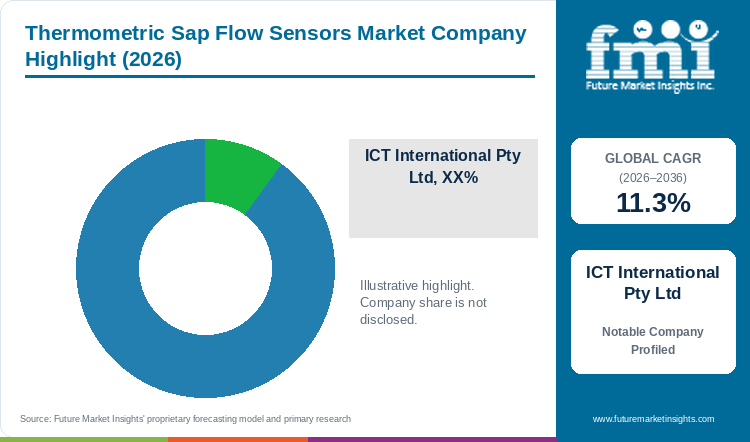
FMI analysis indicates that competitive positioning in the thermometric sap flow sector centers on bidirectional low-flow pulse resolution and plug-and-play SDI-12 or LoRaWAN irrigation integration. Australian and North American instrument leaders such as ICT International Pty Ltd and Implexx Sense as well as Dynamax Inc. supply multi-depth heat-ratio needles and non-invasive stem heat-balance collars across global orchard networks. German and Central European ecophysiology specialists led by Ecomatik GmbH and UP GmbH Umweltanalytische Produkte together with EMS Brno engineer precision Granier thermal-dissipation and trunk heat-balance systems for forestry flux towers. Meanwhile, Phytech Ltd. and Tranzflo NZ Ltd. focus on commercial orchard irrigation feedback.
- Heat-Ratio & Multi-Depth SDI-12 Probe Innovators: ICT International Pty Ltd and Implexx Sense together with Tranzflo NZ Ltd. manufacture bidirectional heat-pulse needles and radial sap-flux sensors across Oceania and international horticulture.
- Stem Heat-Balance & Orchard IoT Automation Platforms: Dynamax Inc. and Phytech Ltd. deliver wrap-around Dynagage and EXO-Skin energy-balance collars as well as cloud-connected orchard irrigation automation networks.
- European Forest Ecophysiology & Thermal-Dissipation Specialists: Ecomatik GmbH and UP GmbH Umweltanalytische Produkte along with EMS Brno supply Granier TDP needles and large-trunk tissue heat-balance systems for forest hydrology.
Competitive Benchmarking: Thermometric Sap Flow Sensors Market
Table 8: Supplier Capability Comparison Across Sap Flow Probe Architectures (2026 Assessment)
| Company | Thermometric Principle Breadth | Multi-Depth Radial Profiling | Wireless IoT & Valve Integration | Geographic Reach |
|---|---|---|---|---|
| ICT International Pty Ltd | High | High | High | High |
| Dynamax Inc. | High | Medium | High | High |
| Phytech Ltd. | Medium | Medium | High | High |
| Implexx Sense | High | High | High | Medium |
| Ecomatik GmbH | High | High | Medium | High |
| UP GmbH Umweltanalytische Produkte | Medium | High | Medium | Medium |
| Tranzflo NZ Ltd. | Medium | Medium | Medium | Medium |
| EMS Brno | High | High | Medium | Medium |
Evaluation basis: Capability tiers assess documented sensor coverage across Heat Ratio Method and Granier TDM architectures as well as Stem Heat Balance collars and radial thermistor depth points per needle. Wireless integration and geographic ratings reflect native LoRaWAN or SDI-12 telemetry and active distributor networks spanning Western and Southern Hemisphere orchard basins.
Key Developments in the Thermometric Sap Flow Sensors Market
- ICT International Pty Ltd expanded deployment of its SFM1x IoT Sap Flow Meter line in 2025 with user-selectable LoRaWAN (AS923 to US915) and CAT-M1/NB-IoT frequency modules for real-time orchard transpiration dashboards [16].
- Implexx Sense updated its Gen 2 Implexx Sap Flow Sensor technical documentation in 2026 to support five-depth radial sap flux density and dynamic stem water content measurement over SDI-12 networks [17].
- Dynamax Inc. scaled commercial distribution of its Flow10 Sap Flow System and patented EXO-Skin flexible energy-balance collars in 2026 to lower per-stem installation costs in vineyards and greenhouses [18].
Key Players in the Thermometric Sap Flow Sensors Market
Heat-Ratio & Multi-Depth SDI-12 Probe Innovators
- ICT International Pty Ltd (SFM1x)
- Implexx Sense
- Tranzflo NZ Ltd.
Stem Heat-Balance & Orchard IoT Automation Platforms
- Dynamax Inc.
- Phytech Ltd.
European Forest Ecophysiology & Thermal-Dissipation Specialists
- Ecomatik GmbH
- UP GmbH Umweltanalytische Produkte
- EMS Brno (Environmental Measuring Systems s.r.o.)
Thermometric Sap Flow Sensors Market - Report Scope
Table 9: Study Boundaries and Taxonomy Definitions for Thermometric Sap Flow Sensors (2026 to 2036)
| Coverage field | Report scope |
|---|---|
| Market breakdown | Thermometric Measurement Principle; Stem Installation Type; Telemetry & Power; End-Use Sector; Region |
| Quantitative Units | USD Million |
| Market Definition | Includes commercial hardware and embedded node market value from thermometric sap flow sensors (Heat Ratio Method HRM, Granier Thermal Dissipation TDM, Stem Heat Balance SHB collars, Compensation Heat Pulse Velocity CHPV, and Heat Field Deformation HFD probes) and dedicated sap-flux telemetry nodes. Category Scope Note: Excludes standalone soil moisture tensiometers, destructive pressure-chamber leaf bombs, non-thermal trunk band dendrometers sold separately, and chemical biopesticides or crop-protection inputs. |
| Regions Covered | North America; Latin America; Western Europe; Eastern Europe; East Asia; South Asia and Pacific; Middle East and Africa |
| Countries Covered | United States, Spain, Australia, Chile, Italy, South Africa, and additional countries in the full report |
| Key Companies Covered | ICT International Pty Ltd, Dynamax Inc., Phytech Ltd., Implexx Sense, Ecomatik GmbH, UP GmbH Umweltanalytische Produkte, Tranzflo NZ Ltd., EMS Brno |
| Forecast Period | 2026 to 2036 |
| Approach | Primary and secondary research with top-down and bottom-up market triangulation. |
Thermometric Sap Flow Sensors Market - Research Methodology
Table 10: Primary and Secondary Triangulation Protocol for Xylem Sap Flux Hardware (2026 Edition)
| Method | Approach |
|---|---|
| Primary Research | Structured interviews with ecophysiology instrument engineers, vineyard and almond irrigation directors, FluxNet tower investigators, and precision ag-tech dealers across Australia, California, Spain, and Chile to validate probe replacement intervals and node pricing. |
| Secondary Research | Analysis of ICT International, Dynamax, Implexx Sense, Ecomatik, and EMS Brno technical specifications, USDA-ARS Ag Data Commons sap-flux datasets, USFS drought-mortality bulletins, and peer-reviewed agronomy journals. |
| Market Sizing and Forecasting | Top-down precision orchard and forest-hydrology instrumentation budgets reconciled against bottom-up active sensor node deployments and replacement needle shipments from 2026 to 2036. |
| Country Forecasting Model | Econometric country projections weight irrigated perennial orchard acreage, statutory river-basin groundwater pumping caps, and forest carbon-flux tower density across six national agricultural systems. |
| Operational Benchmark Traceability | Probe deployment and orchard valuation indicators in Tables 2, 3, and 4 trace to USDA-ARS Great Basin sap-flux archives, Phytech 2025 irrigation sustainability disclosures, and Michigan State University conifer sap-flow benchmarks. |
| Data Triangulation and Validation | Demand estimates are cross-checked against manufacturer SDI-12 and LoRaWAN node shipments without double counting standalone soil dielectric probes, weather stations, or chemical bio-inputs. |
Thermometric Sap Flow Sensors Market by Segments
Thermometric Sap Flow Sensors Market segmented by Thermometric Measurement Principle:
- Heat Ratio Method (HRM) Bidirectional & Zero-Flow Capable
- Granier Thermal Dissipation (TDM) Continuous Heater Probes
- Stem Heat Balance (SHB) Non-Invasive Collar Gauges
- Compensation Heat Pulse Velocity (CHPV) Needles
Thermometric Sap Flow Sensors Market segmented by Stem Installation Type:
- Invasive Radial Drill-Needle Woody Trunk Probes
- Wrap-Around Flexible Herbaceous & Vine Collars
Thermometric Sap Flow Sensors Market segmented by Telemetry & Power:
- Solar-Powered LoRaWAN / NB-IoT Irrigation Feedback Nodes
- Standalone SDI-12 / Research Data-Logger Probes
Thermometric Sap Flow Sensors Market segmented by End-Use Sector:
- Deficit-Irrigated Wine Vineyards, Almond & Avocado Orchards
- Forestry Drought Mortality & Carbon-Flux Ecohydrology
- Controlled-Environment Greenhouse Tomato & Berry Crops
Thermometric Sap Flow Sensors Market by Region
- North America
- United States
- Canada
- Latin America
- Chile
- Brazil
- Mexico
- Argentina
- Western Europe
- Spain
- Italy
- Germany
- France
- United Kingdom
- Portugal
- Eastern Europe
- Czech Republic
- Poland
- Romania
- Hungary
- East Asia
- China
- Japan
- South Korea
- South Asia and Pacific
- Australia
- New Zealand
- India
- Middle East and Africa
- South Africa
- Israel
- Türkiye
- GCC Countries
Research Sources and Bibliography
- [1] Pandey, M., Yazdanpanah, N., Ali, N., Cregg, B., Johnson, R., Lindberg, B., & Dong, Y. (2026, August 25). Sap flow sensor integration for precision irrigation management in Christmas trees - a scoping review. Frontiers in Agronomy, 8, 1855179.
- [2] ICT International Pty Ltd. (2025, October 15). SFMx Sap Flow Meter with IoT connectivity - ICT International. ICT International.
- [3] Dynamax Inc. (2026, January 20). EXO-Skin Sap Flow Sensor - Dynamax. Dynamax Inc.
- [4] Implexx Sense. (2026, February 10). Implexx Sap Flow Sensor - Implexx. Implexx Sense.
- [5] ICT International Pty Ltd. (2025, June 18). Designing Sap Flow Measurement Projects - ICT International. ICT International.
- [6] Implexx Sense. (2025, March 14). Sap Flux Density Radial Profiles Explained - Implexx. Implexx Sense.
- [7] Thomas, J., Cansler, A., & Hood, S. M. (2025, November 12). Trees in distress: Prefire drought increases postfire mortality | US Forest Service Research and Development. U.S. Department of Agriculture, Forest Service, Rocky Mountain Research Station.
- [8] Implexx Sense. (2025, April 22). Sap Flow Measurement Range - Implexx. Implexx Sense.
- [9] Chai, Y., Zhang, R., Wang, Q., & Pan, J. (2025, December 30). Reverse Sap Flow from Fruit. MDPI Plants, 15(1), 105.
- [10] Snyder, K. A., & Bush, S. E. (2026, July 14). Item - Data from: Five-year timeseries of sap-flux-scaled transpiration reveals inter-annual variation between tree water use and precipitation in a pinyon and juniper woodland. USDA National Agricultural Library Ag Data Commons.
- [11] Aguirre-Arcos, A., Ortiz-Bernad, I., Nieto Carricondo, J., Lallena, A. M., Reyes-Martín, M. P., Ávila-Pérez, Á., & Fernández-Ondoño, E. (2025, July 28). Integrated Vascular Analysis System of Olive Cultivation: Savia Olivar Project. Spanish Journal of Soil Science, 15, 14233.
- [12] Implexx Sense. (2025, July 19). Implexx Sap Flow Sensor for Growers. Implexx Sense.
- [13] ICT International Pty Ltd. (2025, May 22). Sap Flow Measurement: Tree and Plant Water Use - ICT International. ICT International.
- [14] Implexx Sense. (2025, August 11). Evapotranspiration and Sap Flow Explained - Implexx. Implexx Sense.
- [15] ICT International Pty Ltd. (2025, August 28). Sap Flow Tool - ICT International. ICT International.
- [16] ICT International Pty Ltd. (2025, September 10). Sap Flow: Heat Ratio (HRM) and Heat Field Deformation (HFD) Sensors - ICT International. ICT International.
- [17] Implexx Sense. (2026, March 04). A new generation of sap flow sensors - Implexx. Implexx Sense.
- [18] Dynamax Inc. (2026, February 19). Flow10 Sap Flow System - Dynamax. Dynamax Inc.
- [19] EMS Brno (Environmental Measuring Systems s.r.o.). (2026, January 15). Band dendrometer for sap flow system EMS 81 DR26E. EMS Brno.
- [20] Dynamax Inc. (2025, November 08). Dynagage Sap Flow Sensor - Dynamax. Dynamax Inc.
- [21] Implexx Sense. (2026, March 12). Sap Flow Sensors Overview - Implexx. Implexx Sense.
This bibliography is provided for reader reference and is not exhaustive. The full report contains the complete reference list and detailed citations.
This Report Answers
- How large is the thermometric sap flow sensors market in 2026 and what is forecast for 2036?
- Which aquifer and orchard drought pressures support demand for thermometric sap flow sensors?
- Why does the Heat Ratio Method (HRM) lead the thermometric measurement principle category?
- Why do Invasive Radial Drill-Needle Woody Trunk Probes lead the stem installation type category?
- How do growth rates differ across Chile, South Africa, Italy, Spain, Australia, and the United States?
- Which leading instrument manufacturers supply thermometric sap flow probes and IoT nodes today?
- What limits multi-season probe accuracy or supplier switching in the thermometric sap flow sensors market?
- What should vineyard and orchard irrigation managers evaluate before purchasing sap flow sensors?
Frequently Asked Questions
How big is the thermometric sap flow sensors market in 2026, and what is forecast for 2036?
According to FMI, the global thermometric sap flow sensors market size is estimated to reach USD 38.4 million in 2026 from USD 34.6 million in 2025 and is forecast to attain a 2036 valuation of USD 112.0 million while perennial orchards automate deficit irrigation.
What is the CAGR for the thermometric sap flow sensors market from 2026 to 2036?
From 2026 through 2036, global valuation expands at an anticipated 11.3% CAGR, adding USD 73.6 million in annual market size as woody perennial estates replace manual soil checks with direct xylem flux telemetry.
Which measurement principle segment leads the thermometric sap flow sensors market?
Heat Ratio Method (HRM) Bidirectional & Zero-Flow Capable probes are projected to capture 48.5% of measurement principle market value in 2026 owing to short heat pulses that resolve both slow daytime flux and reverse nocturnal root redistribution.
Which stem installation type segment leads the thermometric sap flow sensors market?
Invasive Radial Drill-Needle Woody Trunk Probes are estimated to command 64.2% of the stem installation type category in 2026 driven by multi-depth radial thermistors that profile sapwood velocity across thick orchard bark.
Which country has a notable growth outlook during the assessment period?
Chile is projected to pace national growth at a 12.9% CAGR through 2036, backed by hillside avocado and export winegrape irrigation automation across Valparaíso and Maule.
Who are the key players in the market?
ICT International Pty Ltd, Dynamax Inc., Phytech Ltd., Implexx Sense, Ecomatik GmbH, UP GmbH Umweltanalytische Produkte, Tranzflo NZ Ltd., and EMS Brno anchor commercial supply across precision horticulture and forest ecohydrology networks.
Preview the report firsthand - request a free sample
Get SampleGet the brochure for pricing and purchase details.
Get PDFTable of Content
- Key Takeaways
- Market Size and CAGR
- Top Growth Driver
- Fastest Growing Segment
- Leading Region
- Key Companies
- Emerging Opportunities
- Executive Summary
- Global Market Outlook
- Demand-side Trends
- Supply-side Trends
- Technology Roadmap Analysis
- Analysis and Recommendations
- Analyst Perspective (What is happening? Why now? What should investors know?)
- Key Questions Answered
- How large is the market?
- What is the CAGR?
- What are key trends?
- Which region dominates?
- Who are the leaders?
- Market Overview
- Market Coverage / Taxonomy
- Market Definition / Scope / Limitations
- Research Methodology
- Chapter Orientation
- Analytical Lens and Working Hypotheses
- Market Structure, Signals, and Trend Drivers
- Benchmarking and Cross-market Comparability
- Market Sizing, Forecasting, and Opportunity Mapping
- Research Design and Evidence Framework
- Desk Research Programme (Secondary Evidence)
- Expert Input and Fieldwork (Primary Evidence)
- Tooling, Models, and Reference Databases
- Data Engineering and Model Build
- Quality Assurance and Audit Trail
- Market Background
- Market Dynamics (Drivers, Restraints, Opportunity, Trends)
- Scenario Forecast (Optimistic, Likely, Conservative)
- Impact Analysis
- AI Impact
- Sustainability Impact
- Regulatory Impact
- Technology Impact
- Consumer / Buyer Analysis
- Purchase Drivers
- Adoption Barriers
- Buyer Journey
- Opportunity Map Analysis
- Product Life Cycle Analysis
- Supply Chain Analysis
- Investment Feasibility Matrix
- Value Chain Analysis
- PESTLE and Porter's Analysis
- Regulatory Landscape
- Regional Parent Market Outlook
- Production and Consumption Statistics
- Import and Export Statistics
- Global Market Analysis and Forecast, 2021 to 2036
- Historical Market Size Value (USD Million) Analysis, 2021 to 2025
- Current and Future Market Size Value (USD Million) Projections, 2026 to 2036
- Y-o-Y Growth Trend Analysis
- Absolute $ Opportunity Analysis
- Global Market Pricing Analysis, 2021 to 2036
- Global Market Analysis and Forecast, By Thermometric Measurement Principle, 2021 to 2036
- Introduction / Key Findings
- Historical Market Size Value (USD Million) Analysis By Thermometric Measurement Principle, 2021 to 2025
- Current and Future Market Size Value (USD Million) Analysis and Forecast By Thermometric Measurement Principle, 2026 to 2036
- Heat Ratio Method (HRM) Bidirectional & Zero-Flow Capable
- Granier Thermal Dissipation (TDM) Continuous Heater Probes
- Stem Heat Balance (SHB) Non-Invasive Collar Gauges
- Compensation Heat Pulse Velocity (CHPV) Needles
- Y-o-Y Growth Trend Analysis By Thermometric Measurement Principle, 2021 to 2025
- Absolute $ Opportunity Analysis By Thermometric Measurement Principle, 2026 to 2036
- Global Market Analysis and Forecast, By Stem Installation Type, 2021 to 2036
- Introduction / Key Findings
- Historical Market Size Value (USD Million) Analysis By Stem Installation Type, 2021 to 2025
- Current and Future Market Size Value (USD Million) Analysis and Forecast By Stem Installation Type, 2026 to 2036
- Invasive Radial Drill-Needle Woody Trunk Probes
- Wrap-Around Flexible Herbaceous & Vine Collars
- Y-o-Y Growth Trend Analysis By Stem Installation Type, 2021 to 2025
- Absolute $ Opportunity Analysis By Stem Installation Type, 2026 to 2036
- Global Market Analysis and Forecast, By Telemetry & Power, 2021 to 2036
- Introduction / Key Findings
- Historical Market Size Value (USD Million) Analysis By Telemetry & Power, 2021 to 2025
- Current and Future Market Size Value (USD Million) Analysis and Forecast By Telemetry & Power, 2026 to 2036
- Solar-Powered LoRaWAN / NB-IoT Irrigation Feedback Nodes
- Standalone SDI-12 / Research Data-Logger Probes
- Y-o-Y Growth Trend Analysis By Telemetry & Power, 2021 to 2025
- Absolute $ Opportunity Analysis By Telemetry & Power, 2026 to 2036
- Global Market Analysis and Forecast, By End-Use Sector, 2021 to 2036
- Introduction / Key Findings
- Historical Market Size Value (USD Million) Analysis By End-Use Sector, 2021 to 2025
- Current and Future Market Size Value (USD Million) Analysis and Forecast By End-Use Sector, 2026 to 2036
- Deficit-Irrigated Wine Vineyards, Almond & Avocado Orchards
- Forestry Drought Mortality & Carbon-Flux Ecohydrology
- Controlled-Environment Greenhouse Tomato & Berry Crops
- Y-o-Y Growth Trend Analysis By End-Use Sector, 2021 to 2025
- Absolute $ Opportunity Analysis By End-Use Sector, 2026 to 2036
- Global Market Analysis and Forecast, By Region, 2021 to 2036
- Introduction
- Historical Market Size Value (USD Million) Analysis By Region, 2021 to 2025
- Current Market Size Value (USD Million) Analysis and Forecast By Region, 2026 to 2036
- North America
- Latin America
- Western Europe
- Eastern Europe
- East Asia
- South Asia and Pacific
- Middle East and Africa
- Market Attractiveness Analysis By Region
- North America Market Analysis and Forecast, By Country, 2021 to 2036
- Historical Market Size Value (USD Million) Trend Analysis By Market Taxonomy, 2021 to 2025
- Market Size Value (USD Million) Forecast By Market Taxonomy, 2026 to 2036
- By Country
- United States
- Canada
- By Thermometric Measurement Principle
- By Stem Installation Type
- By Telemetry & Power
- By End-Use Sector
- By Country
- Market Attractiveness Analysis
- By Country
- By Thermometric Measurement Principle
- By Stem Installation Type
- By Telemetry & Power
- By End-Use Sector
- Key Takeaways
- Latin America Market Analysis and Forecast, By Country
- Historical Market Size Value (USD Million) Trend Analysis By Market Taxonomy, 2021 to 2025
- Market Size Value (USD Million) Forecast By Market Taxonomy, 2026 to 2036
- By Country
- Chile
- Brazil
- Mexico
- Argentina
- By Thermometric Measurement Principle
- By Stem Installation Type
- By Telemetry & Power
- By End-Use Sector
- By Country
- Market Attractiveness Analysis
- By Country
- By Thermometric Measurement Principle
- By Stem Installation Type
- By Telemetry & Power
- By End-Use Sector
- Key Takeaways
- Western Europe Market Analysis and Forecast, By Country
- Historical Market Size Value (USD Million) Trend Analysis By Market Taxonomy, 2021 to 2025
- Market Size Value (USD Million) Forecast By Market Taxonomy, 2026 to 2036
- By Country
- Spain
- Italy
- Germany
- France
- United Kingdom
- Portugal
- By Thermometric Measurement Principle
- By Stem Installation Type
- By Telemetry & Power
- By End-Use Sector
- By Country
- Market Attractiveness Analysis
- By Country
- By Thermometric Measurement Principle
- By Stem Installation Type
- By Telemetry & Power
- By End-Use Sector
- Key Takeaways
- Eastern Europe Market Analysis and Forecast, By Country
- Historical Market Size Value (USD Million) Trend Analysis By Market Taxonomy, 2021 to 2025
- Market Size Value (USD Million) Forecast By Market Taxonomy, 2026 to 2036
- By Country
- Czech Republic
- Poland
- Romania
- Hungary
- By Thermometric Measurement Principle
- By Stem Installation Type
- By Telemetry & Power
- By End-Use Sector
- By Country
- Market Attractiveness Analysis
- By Country
- By Thermometric Measurement Principle
- By Stem Installation Type
- By Telemetry & Power
- By End-Use Sector
- Key Takeaways
- East Asia Market Analysis and Forecast, By Country
- Historical Market Size Value (USD Million) Trend Analysis By Market Taxonomy, 2021 to 2025
- Market Size Value (USD Million) Forecast By Market Taxonomy, 2026 to 2036
- By Country
- China
- Japan
- South Korea
- By Thermometric Measurement Principle
- By Stem Installation Type
- By Telemetry & Power
- By End-Use Sector
- By Country
- Market Attractiveness Analysis
- By Country
- By Thermometric Measurement Principle
- By Stem Installation Type
- By Telemetry & Power
- By End-Use Sector
- Key Takeaways
- South Asia and Pacific Market Analysis and Forecast, By Country
- Historical Market Size Value (USD Million) Trend Analysis By Market Taxonomy, 2021 to 2025
- Market Size Value (USD Million) Forecast By Market Taxonomy, 2026 to 2036
- By Country
- Australia
- New Zealand
- India
- By Thermometric Measurement Principle
- By Stem Installation Type
- By Telemetry & Power
- By End-Use Sector
- By Country
- Market Attractiveness Analysis
- By Country
- By Thermometric Measurement Principle
- By Stem Installation Type
- By Telemetry & Power
- By End-Use Sector
- Key Takeaways
- Middle East and Africa Market Analysis and Forecast, By Country
- Historical Market Size Value (USD Million) Trend Analysis By Market Taxonomy, 2021 to 2025
- Market Size Value (USD Million) Forecast By Market Taxonomy, 2026 to 2036
- By Country
- South Africa
- Israel
- Türkiye
- GCC Countries
- By Thermometric Measurement Principle
- By Stem Installation Type
- By Telemetry & Power
- By End-Use Sector
- By Country
- Market Attractiveness Analysis
- By Country
- By Thermometric Measurement Principle
- By Stem Installation Type
- By Telemetry & Power
- By End-Use Sector
- Key Takeaways
- Key Countries Market Analysis
- United States
- Pricing Analysis
- Market Share Analysis, 2025
- By Thermometric Measurement Principle
- By Stem Installation Type
- By Telemetry & Power
- By End-Use Sector
- Canada
- Pricing Analysis
- Market Share Analysis, 2025
- By Thermometric Measurement Principle
- By Stem Installation Type
- By Telemetry & Power
- By End-Use Sector
- Mexico
- Pricing Analysis
- Market Share Analysis, 2025
- By Thermometric Measurement Principle
- By Stem Installation Type
- By Telemetry & Power
- By End-Use Sector
- Brazil
- Pricing Analysis
- Market Share Analysis, 2025
- By Thermometric Measurement Principle
- By Stem Installation Type
- By Telemetry & Power
- By End-Use Sector
- Chile
- Pricing Analysis
- Market Share Analysis, 2025
- By Thermometric Measurement Principle
- By Stem Installation Type
- By Telemetry & Power
- By End-Use Sector
- Germany
- Pricing Analysis
- Market Share Analysis, 2025
- By Thermometric Measurement Principle
- By Stem Installation Type
- By Telemetry & Power
- By End-Use Sector
- United Kingdom
- Pricing Analysis
- Market Share Analysis, 2025
- By Thermometric Measurement Principle
- By Stem Installation Type
- By Telemetry & Power
- By End-Use Sector
- Italy
- Pricing Analysis
- Market Share Analysis, 2025
- By Thermometric Measurement Principle
- By Stem Installation Type
- By Telemetry & Power
- By End-Use Sector
- Spain
- Pricing Analysis
- Market Share Analysis, 2025
- By Thermometric Measurement Principle
- By Stem Installation Type
- By Telemetry & Power
- By End-Use Sector
- France
- Pricing Analysis
- Market Share Analysis, 2025
- By Thermometric Measurement Principle
- By Stem Installation Type
- By Telemetry & Power
- By End-Use Sector
- India
- Pricing Analysis
- Market Share Analysis, 2025
- By Thermometric Measurement Principle
- By Stem Installation Type
- By Telemetry & Power
- By End-Use Sector
- China
- Pricing Analysis
- Market Share Analysis, 2025
- By Thermometric Measurement Principle
- By Stem Installation Type
- By Telemetry & Power
- By End-Use Sector
- Japan
- Pricing Analysis
- Market Share Analysis, 2025
- By Thermometric Measurement Principle
- By Stem Installation Type
- By Telemetry & Power
- By End-Use Sector
- South Korea
- Pricing Analysis
- Market Share Analysis, 2025
- By Thermometric Measurement Principle
- By Stem Installation Type
- By Telemetry & Power
- By End-Use Sector
- Poland
- Pricing Analysis
- Market Share Analysis, 2025
- By Thermometric Measurement Principle
- By Stem Installation Type
- By Telemetry & Power
- By End-Use Sector
- Hungary
- Pricing Analysis
- Market Share Analysis, 2025
- By Thermometric Measurement Principle
- By Stem Installation Type
- By Telemetry & Power
- By End-Use Sector
- Türkiye
- Pricing Analysis
- Market Share Analysis, 2025
- By Thermometric Measurement Principle
- By Stem Installation Type
- By Telemetry & Power
- By End-Use Sector
- South Africa
- Pricing Analysis
- Market Share Analysis, 2025
- By Thermometric Measurement Principle
- By Stem Installation Type
- By Telemetry & Power
- By End-Use Sector
- Australia
- Pricing Analysis
- Market Share Analysis, 2025
- By Thermometric Measurement Principle
- By Stem Installation Type
- By Telemetry & Power
- By End-Use Sector
- United States
- Market Structure Analysis
- Competition Dashboard
- Competition Benchmarking
- Market Share Analysis of Top Players
- By Regional
- By Thermometric Measurement Principle
- By Stem Installation Type
- By Telemetry & Power
- By End-Use Sector
- Emerging Startups
- Innovation Benchmarking
- Competition Analysis
- Competition Deep Dive
- ICT International Pty Ltd
- Overview
- Product Portfolio
- Profitability by Market Segments
- Sales Footprint
- Strategy Overview
- Marketing Strategy
- Product Strategy
- Channel Strategy
- Dynamax Inc.
- Phytech Ltd.
- Implexx Sense
- Ecomatik GmbH
- UP GmbH Umweltanalytische Produkte
- Tranzflo NZ Ltd.
- EMS Brno
- ICT International Pty Ltd (SFM1x)
- EMS Brno (Environmental Measuring Systems s.r.o.)
- ICT International Pty Ltd
- Case Studies
- Success Stories
- Recent Developments
- Competition Deep Dive
- Assumptions & Acronyms Used


