

- Market Size (2026)
- USD 249.1 Mn
- Forecast (2036)
- USD 628.7 Mn
- CAGR (2026 to 2036)
- 9.7%
How big is Tortilla Improvers Market in 2026?
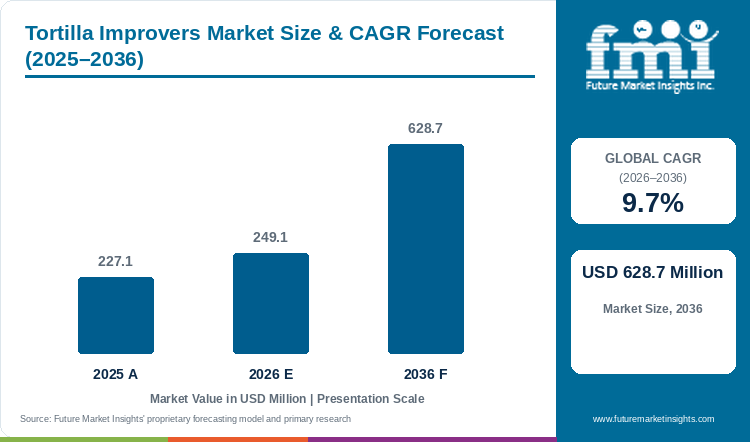
The tortilla improvers market demonstrated steady progress from USD 227.1 million in 2025 to USD 249.1 million in 2026, building toward a targeted valuation of USD 628.7 million by 2036 at a CAGR of 9.7%.
Fold integrity is the qualification gate in tortilla manufacturing, since a wrap that splits on a 180-degree restaurant fold returns the entire case, and improver chemistry is bought against that single test [1]. The global tortilla improvers market was valued at USD 227.1 million in 2025 and is estimated to reach USD 249.1 million in 2026. The market is projected to reach USD 628.7 million by 2036, expanding at a compound annual growth rate (CAGR) of 9.7% between 2026 and 2036. Flour tortilla systems are projected to capture 39.0% of 2026 demand, as wheat burrito and fajita wraps require multifunctional enzyme and emulsifier packages that hold flexibility across 21-day distribution. Demand growth sits well above the tortilla market itself at 5.2% CAGR, because tortilla volume grows slowly while every new clean-label reformulation re-buys the improver system behind it [2]. Shelf-life chemistry is doing the reformulating, as Corbion launched Verdad Essence WH100 cultured wheat in April 2025 to extend tortilla microbial life without preservative labels [5], Kerry published case work in November 2025 on enzyme-emulsifier synergy that eliminates pack sticking and holds 2D fold flexibility [2], and Puratos opened Montreal and Costa Rica innovation hubs in August 2025 for regional flatbread development [7]. QSR chains qualify improvers by fold-test pass rates, and the ingredient houses that document flexibility without ingredient-list clutter hold the wrap contracts through 2036.
Key Market Trends & Insights
- By product type: Flour Tortillas are projected to capture 39.0% in 2026 because wheat-based burrito and fajita wraps require multi-functional enzymes and emulsifiers to maintain foldability.
- By form: Powder & Dry systems are estimated to command 41.0% in 2026 as automated tortilla plants meter free-flowing dry improver premixes directly into continuous dough mixers.
- By application: Packaged Retail Wraps are expected to concentrate 33.0% in 2026 because ambient supermarket multipacks require 45-to-60-day mold inhibition and anti-stick separation.
- By claim: Conventional offerings are forecast to generate 52.0% in 2026 owing to widespread use of distilled monoglycerides and calcium propionate in mainstream lines.
- By sales channel: Direct Industrial Sales are anticipated to account for 49.0% in 2026 through custom plant-level rheology trials and bulk contract supply to multi-line flatbread manufacturers.
Regional Highlights
- Top national expansion: Saudi Arabia is projected to lead national growth at an 11.0% CAGR through 2036 under rapid quick-service restaurant wrap adoption and domestic flatbread line automation.
- Broader country progression: The UAE is expected to expand at 10.7% CAGR ahead of South Korea at 10.4% CAGR and the USA at 10.1% CAGR as high-protein and low-carb wraps scale across retail channels.
Market Size & Forecast
Table 1: Market Size and Forecast for the Tortilla Improvers Market (USD million and CAGR percentage), 2025 to 2036
| Metric | Value |
|---|---|
| 2025 Market Size | USD 227.1 million |
| Estimated Market Size in 2026 | USD 249.1 million |
| Projected Market Size by 2036 | USD 628.7 million |
| CAGR, 2026 to 2036 | 9.7% |
| Added Revenue, 2026 to 2036 | USD 379.6 million |
Automated tortilla lines operating at 25,000 to 35,000 pieces per hour subject dough balls to intense hydraulic platen compression at 200 degrees Celsius followed by rapid triple-pass oven baking. If the gluten network is too elastic, pressed discs spring back into thick ovals; if starch retrogrades too rapidly after cooling, the tortilla splits when folded around QSR fillings. In February 2026, Kerry Group published technical tortilla performance findings confirming that calibrated maltogenic alpha-amylases and xylanases preserve two-dimensional fold flexibility across multi-week ambient storage [2]. As a result, commercial flatbread manufacturers are replacing single-function chemical softeners with integrated dough conditioners that balance platen pressability with long-term hinge strength.
Treated Tortilla Dough Volume and Improver Dosage Sizing
Table 2: Treated Tortilla Dough Volume and Improver Dosage Sizing for the Tortilla Improvers Market (USD million and metric tons), 2025 to 2036
| Metric | 2025 | 2026 | 2036 |
|---|---|---|---|
| Market size (USD million) | 227.1 | 249.1 | 628.7 |
| Improver-treated tortilla & flatbread dough (million MT) | 6.8 to 8.2 | 7.4 to 8.9 | 16.8 to 20.2 |
| Commercial tortilla improver volume (thousand MT) | 68.0 to 82.0 | 74.5 to 89.5 | 172.0 to 206.0 |
| Effective improver spend per MT treated dough (USD) | 27.7 to 33.4 | 28.0 to 33.7 | 30.5 to 37.4 |
Operational note: Treated dough and improver tonnage ranges reflect standard industrial tortilla improver inclusion rates of 0.75% to 1.50% on a flour/masa weight basis across continuous hot-press wheat tortilla and die-cut corn masa wrap lines.
Consumer migration toward high-protein and pulse-fortified low-glycemic wraps is directly increasing functional improver dosage per ton of dough. Partial replacement of wheat flour with chickpea protein or resistant starch dilutes native gluten films and increases water competition during mixing, which leads to brittle edges and chalky mouthfeel. In May 2026, a study in Foods demonstrated that supplementing functional blue corn tortillas with germinated-extruded Desi chickpea flour boosts antioxidant and antidiabetic bioaccessibility while requiring hydrocolloid and water-binding adjustments to maintain rollability [3]. Parallel May 2026 research in Foods on high-resistant-starch flatbreads (bazlama) confirmed similar texture trade-offs [4], prompting bakeries to combine bakery improvers with carboxy-methylcellulose (CMC) and bacterial xylanases.
Per Capita & Industrial Tortilla Line Spending Indicators
Table 3: Per Capita and Industrial Line Spending Indicators for the Tortilla Improvers Market (USD and percentage), 2025 to 2036
| Metric | 2025 | 2026 | 2036 |
|---|---|---|---|
| World population (billion) | 8.2 | 8.3 | 9.0 |
| Spend per 1,000 people (USD) | 27.7 | 30.0 | 69.9 |
| Annual improver spend per industrial tortilla line (USD) | 38,500 to 48,000 | 41,500 to 52,000 | 88,000 to 112,000 |
| Multi-functional premix contract share (%) | 61.0% to 65.0% | 63.0% to 67.0% | 72.0% to 76.0% |
Table 4: Industrial Flatbread Plant & Segment Spending Indicators for the Tortilla Improvers Market (USD million and facility benchmarks), 2026
| Metric | Value | Institutional Reference Basis |
|---|---|---|
| Market size, 2026 | USD 249.1 million | 2026 global tortilla improver revenue baseline |
| Commercial tortilla & flatbread lines | 5,400 lines | Global automated hot-press and die-cut flatbread lines |
| Average annual spend per production line | USD 46,130 | Annualized plant expenditure on tortilla improver systems |
| Direct Industrial Sales revenue, 2026 | USD 122.1 million | 49.0% sales-channel segment allocation |
Ambient mold-free shelf-life extension to 45 or 60 days without triggering artificial preservative warnings or sour acid odors has become a major contract differentiator for retail wrap suppliers. Traditional calcium propionate systems require fumaric or sorbic acid to drop dough pH below 5.5, which often releases a pungent vinegar smell when shoppers open the bag. To resolve this sensory limitation, Corbion unveiled Verdad Essence WH100 in April 2025 as a cultured-wheat natural mold inhibitor engineered specifically for tortillas and flatbreads [5]. so commercial bakeries are blending cultured wheat fermentates with bread emulsifiers in unified improver packs to meet supermarket clean-label mandates.
Analyst Perspective
"High-speed tortilla plants lose more margin to stack sticking and edge cracking during packaging than to raw flour price swings. Improver suppliers that combine thermostable maltogenic alpha-amylases with clean-label cultured-wheat mold inhibitors win national QSR and supermarket wrap contracts because they protect 45-day foldability without synthetic chemical labels."
- Nandini Roy Choudhury, Principal Consultant, Future Market Insights.
How is the tortilla improvers market segmented?
The tortilla improvers market is segmented by product type, form, application, claim, and sales channel. In 2026, Flour Tortillas are projected at 39.0%, Powder & Dry at 41.0%, Packaged Retail Wraps at 33.0%, Conventional at 52.0%, and Direct Industrial Sales at 49.0%.
By product type: Flour Tortillas, Corn Tortillas, Low-Carb & High-Protein, and Flavored Tortillas.
By form: Powder & Dry, Liquid, Paste & Semi-Solid, and Granules & Pieces.
By application: Packaged Retail Wraps, QSR & Foodservice Wraps, Frozen & Par-Baked Tortillas, Tortilla Chips & Tostadas, and Other Flatbreads.
By claim: Conventional, Clean Label, Organic, and Non-GMO.
By sales channel: Direct Industrial Sales, Ingredient Distributors, Foodservice & Artisan, and Online B2B.
Why do Flour Tortillas lead the product type category?
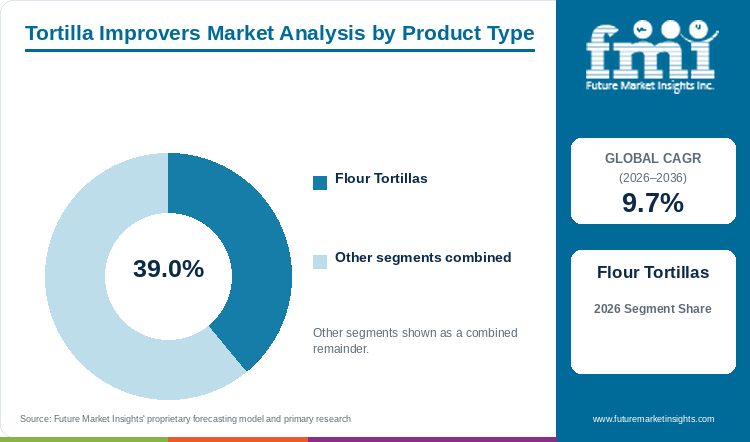
Flour Tortillas are projected to capture 39.0% of product type demand in 2026, supported by high-speed hot-press gluten relaxation and anti-staling enzyme requirements.
Table 5: Product Type Share for the Tortilla Improvers Market (percentage share), 2026
| Product Type | Share (2026) |
|---|---|
| Flour Tortillas | 39.0% |
| Other Segments Combined | 61.0%* |
| Total | 100.0% |
*Note: Remaining product type categories sum to 100.0% of 2026 commercial tortilla improvers market value.
Table 6: Product Type Leadership and Market Growth for the Tortilla Improvers Market (segment and CAGR percentage), 2026 to 2036
| Metric | Value |
|---|---|
| Global CAGR (2026 to 2036) | 9.7% |
| Leading Segment | Flour Tortillas |
Pressed wheat Flour Tortillas require a far more intensive functional improver stack than corn tortillas because wheat gluten naturally resists flattening under heated hydraulic platens. Without enzymatic proteases or reducing agents to relax disulfide bonds during pressing, dough balls shrink back and produce thick, uneven wraps that jam automatic baggers. At the same time, wheat starch retrogrades rapidly after baking, requiring maltogenic amylases and distilled monoglycerides to keep burritos and fajita wraps foldable over 45 days. Due to these dual rheology and shelf-life demands, manufacturers pair Flour Tortillas improvers with baking enzymes across mainstream retail and foodservice lines.
- Flour Tortillas are projected to secure 39.0% of the product type segment in 2026 because burrito and soft-taco wheat wraps demand multi-component conditioning for 30-to-60-day rollability.
- A February 2026 study in the Journal of Food Science demonstrated that commercial bacterial and fungal xylanases modify arabinoxylan structure to reduce dough elasticity and improve extensibility in wheat baking systems [6].
Why does Powder & Dry define the largest form segment?
Powder & Dry formulations are estimated to secure 41.0% of the form category in 2026, driven by automated dry-feeder compatibility and single-bag batch convenience.
Commercial tortilla plants operate continuous or batch horizontal mixers where weighing four or five separate liquid and paste additives per batch introduces operator error and line downtime. Powder & Dry improver concentrates solve this handling bottleneck by combining dry enzymes and powdered monoglycerides with leavening acids and mold inhibitors inside a single free-flowing premix. Plant engineers meter Powder & Dry blends directly from loss-in-weight screw feeders above the mixer bowl without heated holding tanks. In addition to this convenience, suppliers formulate specialized Powder & Dry blends for gluten-free tortillas so bakeries can switch production runs cleanly.
- Powder & Dry options are estimated to command 41.0% of the form segment in 2026 as high-throughput bakeries standardize dry micro-ingredient metering above horizontal dough mixers.
- Puratos Group unveiled its Cubease concentrated solid improver format at iba 2025 in May 2025, illustrating how pre-measured dry blocks simplify batch dosing per 10 kilograms of flour [7].
What keeps Packaged Retail Wraps ahead by application?
Packaged Retail Wraps are expected to command 33.0% of application volume in 2026, reflecting strict supermarket shelf-life and stack-separation standards.
Unlike foodservice tortillas that are consumed within days of delivery, Supermarket Packaged Retail Wraps must survive warm warehouse stacking and 45 to 60 days of ambient grocery display without sticking or molding. Residual surface moisture inside sealed polyethylene multipacks causes adjacent tortillas to weld together unless surface dextrins and lipid crystals are tightly controlled. so Packaged Retail Wraps require the highest dosage of maltogenic alpha-amylases and glyceride anti-stick agents per ton of flour. Formulators also blend emulsifiers and stabilizers with buffered acidulants to prevent edge splitting when consumers open the package at home.
- Packaged Retail Wraps are expected to hold 33.0% of the application segment in 2026 because ambient retail multipacks require the highest loading of anti-staling and antimicrobial agents.
- Kerry Group's October 2026 technical digest on bakery reformulation confirmed that targeted enzyme-emulsifier adjustments eliminate tortilla pack sticking and extend retail freshness without full recipe reconstruction [8].
Why does Conventional lead the claim category?
Conventional formulations are forecast to generate 52.0% of claim demand in 2026, owing to cost efficiency across high-volume foodservice and value retail wraps.
Quick-service restaurant taco and burrito chains as well as supermarket value-tier private labels procure tortillas under multi-year fixed-price contracts that prioritize lowest batch cost. Conventional tortilla improvers built on calcium propionate and fumaric acid paired with sodium stearoyl lactylate (SSL) and L-cysteine achieve dough relaxation in under 60 seconds at a fraction of clean-label enzyme cost. As a result, high-speed foodservice bakeries continue to rely on Conventional food preservatives and chemical conditioners for baseline volume. However, retailer chemical-ban lists in North America and Europe are steadily shifting premium branded wraps toward clean-label enzyme-fermentate systems.
- Conventional products are forecast to account for 52.0% of the claim segment in 2026 because chemical acidulants and traditional emulsifiers provide the lowest unit cost per thousand tortillas.
- A March 2025 study published in Foods evaluating baking conditions and dough matrix stability in flatbreads demonstrated how controlled thermal processing and conventional formulation parameters govern finished flatbread safety and shelf stability [9].
What gives Direct Industrial Sales the leading position in sales channel?
Direct Industrial Sales channels are anticipated to account for 49.0% of sales channel demand in 2026, reinforced by custom hot-press rheology calibration.
Large-scale tortilla manufacturing is concentrated among multi-plant baking groups whose hot-press platen temperatures and vacuum-cooling profiles vary significantly from plant to plant. An off-the-shelf distributor blend that performs well on a slow cooling conveyor often causes severe stack sticking on a high-speed line that bags tortillas at 32 degrees Celsius. Because of these line-specific variables, enterprise bakeries procure through Direct Industrial Sales so supplier technologists can run on-site trials and customize enzyme ratios. Direct partnerships also accelerate qualification of clean-label flour and low-carb wrap improvers.
- Direct Industrial Sales are anticipated to capture 49.0% of the sales channel segment in 2026 as large flatbread groups demand line-specific enzymatic troubleshooting and bulk pricing.
- IFF presented its custom tortilla and flatbread enzyme conditioning solutions directly to industrial baking engineers at the International Baking Industry Exposition (IBIE 2025) in September 2025 [10].
What are the drivers, restraints, and opportunities in the tortilla improvers market?
In the tortilla improvers market, global QSR wrap menu proliferation and keto/high-fiber reformulation are projected to propel demand whereas acidic preservative off-notes restrain conventional dosing and cultured-wheat plus multi-enzyme toolkits create clean-label contract opportunities.
- Driver: Rapid expansion of quick-service Mexican and Mediterranean wrap concepts paired with household tortilla substitution for sandwich bread drives continuous industrial hot-press capacity additions.
- Restraint: Excess fumaric or propionic acid dosing creates pungent sour off-odors upon bag opening, while strict clean-label retail standards force removal of L-cysteine and synthetic preservatives.
- Opportunity: Formulating synergistic enzyme-hydrocolloid-fermentate blends for keto and pulse-fortified high-protein wraps unlocks high-margin specialty contracts.
Growth Analysis and Future Potential: Qualitative Demand Catalysts
Global consumption patterns are shifting from traditional sliced loaf bread toward convenient handheld wraps across quick-service restaurants and household kitchens. In February 2025, the National Restaurant Association projected United States restaurant industry sales to reach USD 1.5 trillion in 2025 across 15.9 million employees [11]. In addition, U.S. Census Bureau data in August 2025 recorded the Hispanic population at 65.2 million [12], which underpins baseline North America tortilla volume. At the same time, industrial bakeries in Europe and Asia are mechanizing traditional flatbreads into packaged retail products. Recent peer-reviewed studies on quinoa-fortified lavash in July 2025 [13] and pumpkin-flour multigrain chapati in May 2025 [14] show how regional flatbreads are being reformulated for packaged distribution, directly boosting demand for commercial improvers.
Risk Assessment of the Tortilla Improvers Market: Operational and Formulation Friction
Formulation trade-offs between microbial mold control and clean sensory aroma represent the primary technical restraint in the tortilla improvers market. Acidic pH reduction below 5.5 with fumaric acid activates calcium propionate against mold, yet high acidity stiffens gluten during hot pressing and creates an unpleasant sour smell when consumers open the bag. Conversely, switching to enzymatic proteases and clean-label fermentates increases per-ton ingredient cost by 20% to 35% and narrows mixer time tolerances. As demonstrated in January 2025 [15] and March 2026 [16] studies on composite teff-maize fermented flatbreads, small shifts in flour blending ratios and fermentation time can rapidly degrade sheet pliability and storage stability.
Commercial Opportunity Analysis: Formulation Differentiation and Value-Add Formats
High-margin growth opportunities center on turnkey improver systems engineered for keto and pulse-supplemented high-protein tortillas [3]. Because low-carb wraps replace native wheat starch with insoluble wheat fiber and resistant starch [4], standard amylase softeners lose effectiveness and wraps turn rubbery or brittle. Ingredient suppliers that combine bacterial xylanases and microbial transglutaminase with natural food preservatives solve these texture defects and command premium contract pricing. Kerry Group's March 2026 analysis of bakery enzyme cost-in-use performance [17] and Corbion's April 2025 launch of Verdad Essence WH100 [5] illustrate how clean-label enzyme-fermentate systems win retail brand reformulations.
Tortilla Improvers Market by Country (2026 to 2036)
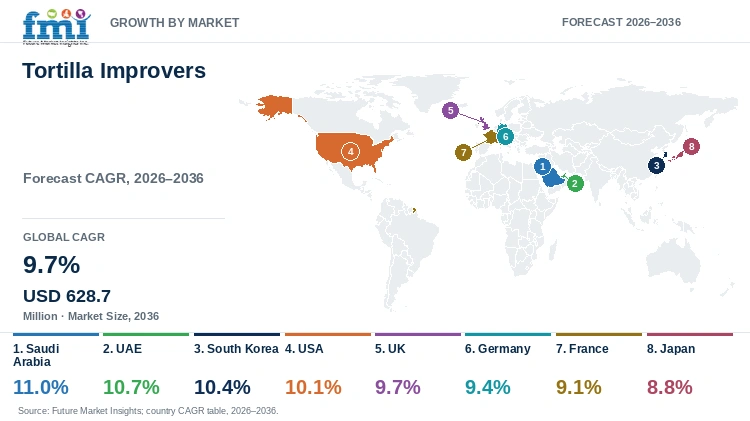
As per FMI, Saudi Arabia is projected to lead tortilla improvers expansion across tracked national markets at an 11.0% CAGR from 2026 to 2036. The UAE follows at 10.7% and South Korea reaches 10.4% ahead of the USA at 10.1% and the UK at 9.7%. Meanwhile, Germany (9.4%) and France (9.1%) as well as Japan (8.8%) post strong commercial gains.
Table 7: Country CAGR and Primary Growth Levers for the Tortilla Improvers Market (CAGR percentage), 2026 to 2036
| Country | CAGR (2026 to 2036) | Primary Growth Lever |
|---|---|---|
| Saudi Arabia | 11.0% | QSR shawarma and burrito wrap expansion and automated flatbread plant commissioning |
| UAE | 10.7% | Hospitality foodservice catering growth and ambient packaged flatbread exports |
| South Korea | 10.4% | Home-meal-replacement wrap popularity and domestic wheat-rice flatbread innovation |
| USA | 10.1% | Keto/high-protein retail wrap proliferation and clean-label hot-press conversion |
| UK | 9.7% | Supermarket private-label wrap merchandising and clean-label preservative reformulation |
| Germany | 9.4% | Discounter ambient wrap private-label growth and industrial dürüm flatbread lines |
| France | 9.1% | Fast-casual grilled wrap chain expansion and packaged retail wheat-wrap adoption |
| Japan | 8.8% | Convenience-store chilled salad-wrap growth and ultra-soft wheat tortilla conditioning |
Source: Future Market Insights analysis
Saudi Arabia Tortilla Improvers Market Outlook (2026 to 2036)
What makes Saudi Arabia the fastest-growing national market is the rapid conversion of traditional artisanal flatbread consumption into packaged wheat tortillas and QSR shawarma wraps across Riyadh and Jeddah. Tortilla improvers market value in Saudi Arabia is projected to climb at an 11.0% CAGR from 2026 to 2036. In January 2026, the General Authority for Statistics documented strong Q3 2025 expansion across licensed hospitality and dining establishments [18], while a February 2026 PeerJ study in Al-Dawadmi addressed drought stress in local wheat genotypes [19]. Because summer ambient transport temperatures exceed 42 degrees Celsius, flatbread plants in Saudi Arabia require potent cultured-wheat and propionate mold inhibitors with anti-sticking monoglycerides.
Key takeaway: In Saudi Arabia, QSR wrap menu proliferation and extreme-heat ambient distribution requirements are projected to drive top-ranked improver growth.
UAE Tortilla Improvers Market Outlook (2026 to 2036)
Commercial tortilla improvers demand in the UAE is forecast to expand at a 10.7% CAGR between 2026 and 2036. Unlike domestic-only baking markets, the UAE works as a high-volume manufacturing and re-export hub supplying ambient retail wraps and frozen foodservice tortillas across the Persian Gulf and East Africa. Gulf foodservice modernization programs continued to widen quick-bread placements across the federation. Central commissary bakeries in Dubai Industrial City rely on multi-enzyme tortilla improvers to prevent wrap edge splitting across hotel buffets and cloud-kitchen delivery networks.
Key takeaway: In the UAE, national food-manufacturing localization and record hospitality catering volumes are forecast to accelerate multi-enzyme wrap conditioning.
South Korea Tortilla Improvers Market Outlook (2026 to 2036)
South Korea's tortilla market diverges from Western ambient grocery models because growth is led by chilled convenience-store lunch wraps and café breakfast burritos sold to single-person urban households. To support domestic grain use in commercial baking, a June 2026 study in BMC Plant Biology detailed South Korea's integrated speed-breeding framework for releasing hexaploid wheat cultivars with stronger dough rheology [22]. Demand for tortilla improvers in South Korea is anticipated to advance at a 10.4% CAGR through 2036. Food processors in Gyeonggi Province dose maltogenic alpha-amylases and hydrocolloid gums into thin wheat-rice wraps so chilled retail wraps do not crack during display at 4 degrees Celsius.
Key takeaway: In South Korea, chilled convenience-store wrap innovation and domestic composite-flour adoption are expected to propel enzymatic improver demand.
USA Tortilla Improvers Market Outlook (2026 to 2036)
Unlike emerging markets still building baseline hot-press capacity, the USA is a mature tortilla market where value growth is propelled by premium keto and clean-label retail reformulations. Supported by USD 1.5 trillion in projected 2025 restaurant sales [11] and a Hispanic population of 65.2 million [12], commercial bakeries in Texas and California are rapidly expanding high-fiber and chickpea-fortified tortillas [3]. Industry valuation in the USA tortilla improvers market is estimated to progress at a 10.1% CAGR from 2026 to 2036. Recent investments—including dsm-firmenich's Princeton Baking Innovation Center in May 2025 [23] and Puratos's North America innovation hub in August 2025 [24]—accelerate clean-label cultured-wheat adoption [5].
Key takeaway: In the USA, high-margin keto wrap reformulation and supermarket clean-label mandates are estimated to drive continuous improver premiumization.
UK Tortilla Improvers Market Outlook (2026 to 2036)
Tortilla improvers demand in the UK is projected to grow at a 9.7% CAGR over the 2026 to 2036 forecast period. What distinguishes the UK is the dominance of supermarket private-label lunchtime meal-deal wraps and home fajita kits, where major grocery chains enforce strict clean-label additive blacklists. UK Office for National Statistics data released in July 2026 confirmed the large scale of domestic bakery and farinaceous manufacturing [25], while July 2025 ONS inflation bulletins tracked persistent grocery price competition [26]. To retain supermarket contracts without raising pack prices, UK flatbread plants in the Midlands replace synthetic E-number emulsifiers and propionates with concentrated enzyme and fermented wheat systems.
Key takeaway: In the UK, grocery meal-deal wrap volumes and strict retailer E-number reduction policies are projected to sustain clean-label improver adoption.
Germany Tortilla Improvers Market Outlook (2026 to 2036)
Germany's flatbread sector is uniquely anchored by two high-throughput channels: extra-large 30-centimeter dürüm wheat wraps supplied to thousands of Döner kebab outlets and private-label ambient multipacks sold in discount supermarkets. Market value for tortilla improvers in Germany is expected to rise at a 9.4% CAGR from 2026 through 2036. Because oversized dürüm wraps must stretch tightly around hot meat and sauces without tearing, industrial bakeries in Germany rely on bacterial xylanases and proteases to maximize two-dimensional extensibility [6]. In addition, a March 2025 study by researchers at the Technical University of Munich in Germany on wax-based bigel oleogels in baked goods [27] reflects domestic innovation in structured lipid softeners.
Key takeaway: In Germany, industrial dürüm foodservice wrap production and discount retail private-label tenders are expected to anchor improver demand.
France Tortilla Improvers Market Outlook (2026 to 2036)
Whereas traditional bread in France is dominated by crusty baguettes, domestic wheat tortilla demand has surged due to fast-casual 'tacos' chains that fold 30-centimeter flour wraps into grilled rectangular panini parcels. A February 2025 INRAE dataset from France characterizing 90 common wheat and flour samples documented wide harvest variance in alveograph extensibility and gluten tenacity [28]. Market value in the France tortilla improvers sector is forecast to increase at a 9.1% CAGR between 2026 and 2036. Flatbread manufacturers in France dose maltogenic alpha-amylases and distilled monoglycerides with cultured-wheat preservatives [5] so wraps endure sharp 90-degree corner folds on commercial heated panini grills without splitting or cracking.
Key takeaway: In France, fast-casual grilled wrap chain expansion and high-extensibility panini-wrap requirements are forecast to drive specialized improver sales.
Japan Tortilla Improvers Market Outlook (2026 to 2036)
Japan's tortilla market is shaped by convenience-store (konbini) chilled salad wraps and café breakfast rolls that must remain pillowy and bite-tender at 4 to 10 degrees Celsius without microwave reheating. Market value for tortilla improvers in Japan is projected to advance at an 8.8% CAGR from 2026 to 2036. In January 2026, the Japan National Tourism Organization reported that annual inbound international visitors reached an all-time high of 42.68 million in 2025 [29] and expanded hotel and theme-park wrap catering across Tokyo and Osaka. Supported by domestic specialty enzyme research from Amano Enzyme [30], bakery formulators in Japan combine cold-active amylases with transglutaminase to prevent chilled starch retrogradation.
Key takeaway: In Japan, chilled convenience-store wrap rheology standards and record inbound tourism dining are projected to support specialty enzyme improvers.
Full report country CAGRs cover: North America; Latin America; Western Europe; Eastern Europe; East Asia; South Asia and Pacific; Middle East and Africa.
Who are the notable companies in the tortilla improvers market?
Novonesis, IFF, Kerry Group, AB Enzymes, Amano Enzyme, Palsgaard, Corbion, Lallemand Inc. (Nutrilife), Puratos, and dsm-firmenich are the notable companies in the tortilla improvers market.
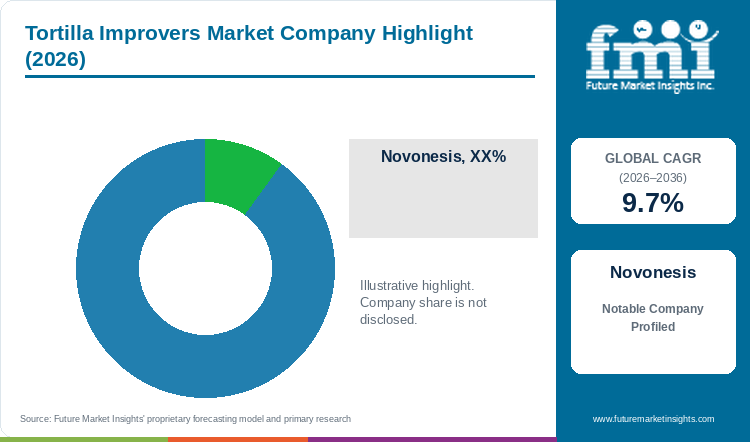
FMI analysis indicates that the competitive arena divides between upstream enzyme fermentation specialists supplying anti-staling and dough-relaxation biocatalysts and integrated preservation and improver platforms offering single-bag tortilla concentrates.
- Enzyme & Biosolutions Innovators: Novonesis and dsm-firmenich as well as AB Enzymes and Amano Enzyme develop thermostable maltogenic alpha-amylases and bacterial xylanases that govern 2D tortilla foldability and hot-press shrink control.
- Integrated Preservation & Clean-Label Conditioning Leaders: Corbion and Kerry Group as well as IFF and Lallemand Inc. (Nutrilife) combine cultured-wheat antimicrobials and distilled monoglycerides with enzymes to eliminate sticky packs and extend ambient shelf life.
- Turnkey Tortilla Premix & Emulsifier Specialists: Puratos and Palsgaard operate global bakery innovation centers that formulate custom dry and compressed improver systems tailored to regional wheat and corn masa lines.
Competitive Benchmarking: Tortilla Improvers Market
Table 8: Competitive Benchmarking for the Tortilla Improvers Market (qualitative capability ratings across key players), 2026
| Company | Tortilla Flexibility Systems | Enzyme-Driven Dough Function | Shelf-Life & Label Reformulation | Geographic Reach |
|---|---|---|---|---|
| Novonesis | High | High | Medium | Global biosolutions network across North America and Europe plus Asia-Pacific |
| IFF | High | High | High | North America and Europe plus global industrial flatbread and bakery accounts |
| Kerry Group | High | High | High | Global taste and nutrition footprint with dedicated tortilla shelf-life toolkits |
| AB Enzymes | Medium | High | Medium | Europe and the Americas plus Asia-Pacific industrial baking enzyme channels |
| Amano Enzyme | Medium | High | Medium | Japan and the USA plus specialty Asian food-enzyme operations |
| Palsgaard | High | Low | Medium | Denmark and India (Navi Mumbai) plus Mexico and global emulsifier application hubs |
| Corbion | High | Medium | High | North America and Latin America plus European tortilla preservation accounts |
| Lallemand Inc. (Nutrilife) | High | High | Medium | North America and Europe plus global yeast and Nutrilife enzyme lines |
| Puratos | High | Medium | High | Global bakery innovation network including Montreal and Costa Rica plus European hubs |
| dsm-firmenich | High | High | Medium | Global baking enzyme platform with dedicated flour-tortilla BakeZyme/Panamore toolkit |
Scoring basis: Capability tiers evaluate documented tortilla-specific anti-staling and hot-press relaxation systems (such as Kerry's tortilla freshness solutions and Corbion's Verdad Essence WH100 and Pristine conditioners) as well as dsm-firmenich's BakeZyme/Panamore tortilla toolkit. Portfolio ratings incorporate post-divestiture ownership (Lallemand Inc.'s acquisition of the former BASF Nutrilife baking enzyme line and July 2025 acquisitions of Solyve and AIT Ingredients) and verified regional application centers.
Key Developments in the Tortilla Improvers Market
- Corbion launched Verdad Essence WH100 in April 2025 as a cultured-wheat natural mold inhibitor engineered for clean-label tortillas and flatbreads to deliver extended microbial shelf life without artificial preservative labels [5].
- Kerry Group published an industrial tortilla freshness case study in November 2025 and a February 2026 technical digest detailing how synergistic enzyme and emulsifier systems eliminate tortilla pack sticking and maintain 2D fold flexibility [1] [2].
- Puratos announced two new food innovation hubs in Montreal, Canada and Costa Rica in August 2025 following its May 2025 Cubease compact improver launch at iba 2025 to expand regional flatbread co-development across the Americas [7] [24].
- Lallemand Inc. acquired France-based enzyme specialist Solyve and baking ingredients supplier AIT Ingredients in July 2025 to broaden its custom enzyme and dough-conditioning portfolio as well as its Nutrilife enzyme line [31].
Key Players in the Tortilla Improvers Market
Enzyme & Biosolutions Innovators
- Novonesis
- dsm-firmenich
- AB Enzymes
- Amano Enzyme
Integrated Preservation & Clean-Label Conditioning Leaders
- Corbion
- Kerry Group
- IFF
- Lallemand Inc. (Nutrilife)
Turnkey Tortilla Premix & Emulsifier Specialists
- Puratos
- Palsgaard
Tortilla Improvers Market - Report Scope
Table 9: Report Scope for the Tortilla Improvers Market (coverage fields and definitions), 2026 to 2036
| Coverage field | Report scope |
|---|---|
| Market breakdown | Product Type; Form; Application; Claim; Sales Channel |
| Quantitative Units | USD Million |
| Market Definition | Includes commercial supplier revenue from functional tortilla and flatbread improver systems—covering anti-staling enzymes and dough relaxers paired with emulsifiers and mold-inhibition blends—sold for flour tortillas and corn tortillas as well as low-carb wraps and commercial flatbreads. Category Scope Note: Excludes finished tortilla retail/foodservice sales and bulk commodity wheat flour or corn masa as well as general bread improvers not sold into tortilla/flatbread lines. |
| Regions Covered | North America; Latin America; Western Europe; Eastern Europe; East Asia; South Asia and Pacific; Middle East and Africa |
| Countries Covered | Saudi Arabia, UAE, South Korea, USA, UK, Germany, France, Japan, and additional countries in the full report |
| Key Companies Covered | Novonesis, IFF, Kerry Group, AB Enzymes, Amano Enzyme, Palsgaard, Corbion, Lallemand Inc. (Nutrilife), Puratos, dsm-firmenich |
| Forecast Period | 2026 to 2036 |
| Approach | Primary and secondary research with top-down tortilla/dough-conditioner parent reconciliation and bottom-up hot-press line dosage triangulation. |
Tortilla Improvers Market - Research Methodology
Table 10: Research Methodology for the Tortilla Improvers Market (research methods and analytical approach), 2026 to 2036
| Method | Approach |
|---|---|
| Primary Research | Structured interviews with hot-press tortilla plant managers and QSR wrap quality-assurance directors as well as cereal chemists and ingredient-house formulators to validate 0.75% to 1.50% improver inclusion rates and stack-sticking return thresholds. |
| Secondary Research | Analysis of U.S. Census Bureau demographic releases and National Restaurant Association foodservice projections paired with UK ONS manufacturing statistics and peer-reviewed flatbread rheology studies in Foods and Journal of Food Science. |
| Market Sizing and Forecasting | Top-down reconciliation against the global tortilla market (USD 50,100.0 million in 2026) and dough conditioners market (USD 1,400.0 million in 2026) cross-checked against bottom-up treated tortilla dough tonnage (7.4 to 8.9 million MT in 2026) and improver spend per ton. |
| Country Forecasting Model | Econometric national projections weight automated hot-press line installations and QSR wrap menu penetration paired with keto/high-fiber retail wrap share and ambient preservative regulations across eight core countries. |
| Operational Benchmark Traceability | Treated dough volumes and per-line improver spend indicators in Tables 2 through 4 trace to industrial tortilla plant throughput benchmarks (5,400 commercial lines) and Kerry/Corbion technical case studies paired with PubMed flatbread formulation trials. |
| Data Triangulation and Validation | Revenues are strictly isolated to functional tortilla/flatbread improver blends and dedicated enzyme-emulsifier-preservative systems while excluding bulk commodity flour and finished baked wrap turnover to eliminate double counting. |
Tortilla Improvers Market by Segments
Tortilla Improvers Market segmented by Product Type:
- Flour Tortillas
- Corn Tortillas
- Low-Carb & High-Protein
- Flavored Tortillas
Tortilla Improvers Market segmented by Form:
- Powder & Dry
- Liquid
- Paste & Semi-Solid
- Granules & Pieces
Tortilla Improvers Market segmented by Application:
- Packaged Retail Wraps
- QSR & Foodservice Wraps
- Frozen & Par-Baked Tortillas
- Tortilla Chips & Tostadas
- Other Flatbreads
Tortilla Improvers Market segmented by Claim:
- Conventional
- Clean Label
- Organic
- Non-GMO
Tortilla Improvers Market segmented by Sales Channel:
- Direct Industrial Sales
- Ingredient Distributors
- Foodservice & Artisan
- Online B2B
Tortilla Improvers Market by Region
- North America
- United States
- Canada
- Latin America
- Brazil
- Mexico
- Argentina
- Chile
- Western Europe
- Germany
- France
- United Kingdom
- Italy
- Spain
- Benelux
- Nordics
- Eastern Europe
- Poland
- Czech Republic
- Romania
- Hungary
- East Asia
- China
- Japan
- South Korea
- South Asia and Pacific
- India
- ASEAN
- Australia and New Zealand
- Middle East and Africa
- GCC Countries
- South Africa
- Türkiye
- Israel
Research Sources and Bibliography
- [1] Kerry Group plc. (2025, November 10). Solving a Manufacturer's Sticky Tortilla Problem: Tools to Keep Production Moving and Returns to a Minimum. Kerry Case Studies.
- [2] Kerry Group plc. (2026, February 16). Tortilla Performance Challenges: How to Improve Shelf-Life and Flexibility. KerryDigest.
- [3] Milán-Noris, E. M., Hernández-Castro, V. M., Antunes-Ricardo, M., Montoya-Rodríguez, A., Sandoval-Sicairos, E. S., Milán-Carillo, J., Reyes-Moreno, C., & Milán-Noris, A. K. (2026, May 19). Role of Germinated-Extruded Desi Chickpea Supplementation on Antioxidant and Antidiabetic Compounds In Vitro Bioaccessibility in Functional Blue Corn Tortillas. Foods, 15(10), 1798 (PubMed PMID 42196002).
- [4] Ozer, C., Yildirim, H., Surek, E., Ozkan, K., Sagdic, O., Palombieri, S., Sestili, F., & Koksel, H. (2026, May 15). Transforming Traditional Flatbread (Bazlama) into a Functional Food with Very High Resistant Starch and Low Glycemic Impact. Foods, 15(10), 1752 (PubMed PMID 42195959).
- [5] Corbion NV. (2025, April 21). Corbion Unveils Verdad® Essence WH100: Redefining Natural Mold Inhibition for Bakers. Corbion Media.
- [6] Souza, P., Quadros, A., Dogan, H., Li, Y., Shi, Y.-C., & Karkle, E. (2026, February 10). Exploring Bread Quality through the Use of Commercial Bacterial and Fungal Xylanases: Effects on Dough Rheology, Loaf Volume, and Arabinoxylan Structure. Journal of Food Science, 91(2), e70940 (PubMed PMID 41709635).
- [7] Puratos Group. (2025, May 7). Puratos brings a trio of transformative innovations to iba 2025. Puratos Press Releases.
- [8] Kerry Group plc. (2026, October 16). Improving Bakery Performance Without Reformulating From Scratch. KerryDigest.
- [9] Kotsiou, K., Terzidis, M. A., & Papageorgiou, M. (2025, March 7). Effect of Baking Conditions on Mycotoxin Levels in Flatbreads Prepared from Artificially Contaminated Doughs. Foods, 14(6), 910 (PubMed PMID 40231926).
- [10] International Flavors & Fragrances Inc. (2025, September 2). IFF tackles top challenges in baking at IBIE 2025. IFF Newsroom.
- [11] National Restaurant Association. (2025, February 6). Restaurant Industry Poised for Growth in 2025: Industry Expected to Employ 15.9 Million People and Reach $1.5 Trillion in Sales. National Restaurant Association.
- [12] U.S. Census Bureau. (2025, August 27). National Hispanic Heritage Month: 2025. U.S. Department of Commerce.
- [13] Akturfan, M., & Yalçın, S. (2025, July 4). Utilizing Quinoa Flour for Functional Lavash Bread Production. Food Science & Nutrition, 13(7), e70533 (PubMed PMID 40621188).
- [14] Chhabra, N., Kaur, A., & Kaur, S. (2025, May 11). Influence of pumpkin (Cucurbita pepo) flour on the physicochemical, functional, and sensory properties of multigrain gluten-free chapati. Food Science and Technology International (PubMed PMID 40350624).
- [15] Abera, B., Duraisamy, R., Birhanu, T., Gurbo, B., & Salelign, K. (2025, January 30). Development of Nutrient-Rich Injera Using Amaranthus Leaf/Grain and Teff Flours: A Study on Nutritional Value, Sensory Characteristics, and Storage Stability. International Journal of Food Science, 2025, 2877941 (PubMed PMID 39949858).
- [16] Cherinet, Y. L., Tenagasahw, M. W., Ambaw, B. A., Asemu, A. M., Hilemeskel, W. H., Mossie, B. B., & Sendekie, Z. B. (2026, March 8). Effect of Blending Ratio and Fermentation Time on the Quality and Acceptability of Injera Produced from a Composite of Teff, Maize, and Potato Flours. Food Science & Nutrition, 14(3), e71606 (PubMed PMID 41804344).
- [17] Kerry Group plc. (2026, March 16). How Enzymes Are Reshaping Bakery Performance. KerryDigest.
- [18] General Authority for Statistics. (2026, January 8). GASTAT: Publishes Tourism Establishments Statistics for Q3 of 2025. Kingdom of Saudi Arabia.
- [19] Alqahtani, M. M. (2026, February 24). Improving drought tolerance in some wheat genotypes with foliar application of silicon nanoparticles in Al-Dawadmi, Saudi Arabia. PeerJ, 14, e20823 (PubMed PMID 41769396).
- [20] Abu Dhabi National Exhibitions Company Group. (2025, May 22). Make it in the Emirates Concludes with New Industrial Projects Valued Over AED 11 Billion. Ministry of Industry and Advanced Technology (MoIAT) / ADNEC Group.
- [21] Dubai Department of Economy and Tourism. (2026, February 9). Dubai welcomes 19.59 million visitors in third record year. Government of Dubai.
- [22] Cha, J.-K., Park, H., Kwon, Y., Lee, S.-M., Kim, W.-J., & Lee, J.-H. (2026, June 8). From lab to field: accelerated cultivar release via integrated speed breeding framework in wheat (Triticum aestivum L.). BMC Plant Biology, 26(1), 1364 (PubMed PMID 42252417).
- [23] dsm-firmenich. (2025, May 20). On the rise: dsm-firmenich opens state-of-the-art Princeton Baking Innovation Center in Princeton, NJ. dsm-firmenich Press Releases.
- [24] Puratos Group. (2025, August 25). Puratos Announces Two New Hubs for Food Innovation: Montreal and Costa Rica. Puratos News.
- [25] Office for National Statistics. (2026, July 24). UK manufacturers' sales by product: 2025. UK Office for National Statistics.
- [26] Office for National Statistics. (2025, July 16). Consumer price inflation, UK: June 2025. UK Office for National Statistics.
- [27] Steinkellner, C., Kroll, L., & Franke, K. (2025, March 25). Bigels containing different wax-based oleogels as laminating fat replacers in croissants. Current Research in Food Science, 10, 101042 (PubMed PMID 40231316).
- [28] Munch, M., Rezette, L., Buche, P., Chambrey, B., Deborde, C., Dervaux, S., et al. (2025, February 7). Dataset for common wheat (Triticum aestivum L.) grain and flour characterization using classical and advanced analyses. Data in Brief, 59, 111375 (PubMed PMID 40034728).
- [29] Japan National Tourism Organization. (2026, January 21). 訪日外客数(2025年12月推計値)12月:3,617,700人、12月過去最高を更新 2025年計:42,683,600人、年間で4,200万人を突破し過去最多. Japan National Tourism Organization (JNTO).
- [30] Amano Enzyme Inc. (2026, February 7). Amano Enzyme USA to Showcase Food, Beverage, and Diagnostic Enzyme Solutions at IFT FIRST and ADLM 2026. Amano Enzyme News.
- [31] Lallemand Inc. (2025, July 4). Lallemand Acquires AIT Ingredients. Lallemand News.
- [32] Palsgaard A/S. (2025, July 8). Palsgaard Inaugurates State-of-the-Art Application Centre in Navi Mumbai to Strengthen Regional Customer Support. Palsgaard News.
- [33] Novonesis. (2025, June 11). Novonesis launches Optiva® LS Prime, helping bakers cut up to 50% added sugar and create more cost-effective baked goods. Novonesis Group.
This bibliography is provided for reader reference and is not exhaustive. The full report contains the complete list of sources and detailed citations.
This Report Answers
- How large is the tortilla improvers market in 2026 and what is forecast for 2036?
- Which hot-press machinability and retail shelf-life pressures support demand for tortilla improvers?
- Why do Flour Tortillas lead the product type category?
- Why does Powder & Dry lead the form category globally?
- How do growth rates differ across Saudi Arabia and the UAE versus South Korea and the USA?
- Which leading companies supply tortilla anti-staling and preservation systems today?
- What limits adoption or supplier switching in the tortilla improvers market?
- What should flatbread manufacturers evaluate before qualifying a tortilla improver system?
Frequently Asked Questions
How big is the tortilla improvers market in 2026, and what is forecast for 2036?
According to FMI, the global tortilla improvers market size is estimated to reach USD 249.1 million in 2026 and is projected to climb to an industry valuation of USD 628.7 million by 2036, up from USD 227.1 million in 2025.
What is the CAGR for the tortilla improvers market from 2026 to 2036?
Future Market Insights projects a 9.7% compound annual growth rate between 2026 and 2036, representing USD 379.6 million in incremental market value over the ten-year period.
Which product type segment leads the tortilla improvers market?
Flour Tortillas are projected to capture 39.0% of product type demand in 2026 because wheat-based wraps require integrated gluten relaxers and maltogenic amylases to prevent cracking.
Which form segment leads the tortilla improvers market?
Powder & Dry formulations are estimated to secure 41.0% of the form category in 2026 owing to direct dry-metering compatibility on continuous tortilla dough mixers.
Which country has a notable growth outlook during the assessment period?
Saudi Arabia is projected to lead national growth at an 11.0% CAGR through 2036, driven by QSR wrap menu proliferation and high-speed flatbread plant investments.
Who are the key players in the market?
Novonesis, IFF, Kerry Group, AB Enzymes, Amano Enzyme, Palsgaard, Corbion, Lallemand Inc. (Nutrilife), Puratos, and dsm-firmenich are the notable companies in the market.
Preview the report firsthand - request a free sample
Get SampleGet the brochure for pricing and purchase details.
Get PDFTable of Content
- Key Takeaways
- Market Size and CAGR
- Top Growth Driver
- Fastest Growing Segment
- Leading Region
- Key Companies
- Emerging Opportunities
- Executive Summary
- Global Market Outlook
- Demand-side Trends
- Supply-side Trends
- Technology Roadmap Analysis
- Analysis and Recommendations
- Analyst Perspective (What is happening? Why now? What should investors know?)
- Key Questions Answered
- How large is the market?
- What is the CAGR?
- What are key trends?
- Which region dominates?
- Who are the leaders?
- Market Overview
- Market Coverage / Taxonomy
- Market Definition / Scope / Limitations
- Research Methodology
- Chapter Orientation
- Analytical Lens and Working Hypotheses
- Market Structure, Signals, and Trend Drivers
- Benchmarking and Cross-market Comparability
- Market Sizing, Forecasting, and Opportunity Mapping
- Research Design and Evidence Framework
- Desk Research Programme (Secondary Evidence)
- Expert Input and Fieldwork (Primary Evidence)
- Tooling, Models, and Reference Databases
- Data Engineering and Model Build
- Quality Assurance and Audit Trail
- Market Background
- Market Dynamics (Drivers, Restraints, Opportunity, Trends)
- Scenario Forecast (Optimistic, Likely, Conservative)
- Impact Analysis
- AI Impact
- Sustainability Impact
- Regulatory Impact
- Technology Impact
- Consumer / Buyer Analysis
- Purchase Drivers
- Adoption Barriers
- Buyer Journey
- Opportunity Map Analysis
- Product Life Cycle Analysis
- Supply Chain Analysis
- Investment Feasibility Matrix
- Value Chain Analysis
- PESTLE and Porter's Analysis
- Regulatory Landscape
- Regional Parent Market Outlook
- Production and Consumption Statistics
- Import and Export Statistics
- Global Market Analysis and Forecast, 2021 to 2036
- Historical Market Size Value (USD Million) Analysis, 2021 to 2025
- Current and Future Market Size Value (USD Million) Projections, 2026 to 2036
- Y-o-Y Growth Trend Analysis
- Absolute $ Opportunity Analysis
- Global Market Pricing Analysis, 2021 to 2036
- Global Market Analysis and Forecast, By Product Type, 2021 to 2036
- Introduction / Key Findings
- Historical Market Size Value (USD Million) Analysis By Product Type, 2021 to 2025
- Current and Future Market Size Value (USD Million) Analysis and Forecast By Product Type, 2026 to 2036
- Flour Tortillas
- Corn Tortillas
- Low-Carb & High-Protein
- Flavored Tortillas
- Y-o-Y Growth Trend Analysis By Product Type, 2021 to 2025
- Absolute $ Opportunity Analysis By Product Type, 2026 to 2036
- Global Market Analysis and Forecast, By Form, 2021 to 2036
- Introduction / Key Findings
- Historical Market Size Value (USD Million) Analysis By Form, 2021 to 2025
- Current and Future Market Size Value (USD Million) Analysis and Forecast By Form, 2026 to 2036
- Powder & Dry
- Liquid
- Paste & Semi-Solid
- Granules & Pieces
- Y-o-Y Growth Trend Analysis By Form, 2021 to 2025
- Absolute $ Opportunity Analysis By Form, 2026 to 2036
- Global Market Analysis and Forecast, By Application, 2021 to 2036
- Introduction / Key Findings
- Historical Market Size Value (USD Million) Analysis By Application, 2021 to 2025
- Current and Future Market Size Value (USD Million) Analysis and Forecast By Application, 2026 to 2036
- Packaged Retail Wraps
- QSR & Foodservice Wraps
- Frozen & Par-Baked Tortillas
- Tortilla Chips & Tostadas
- Other Flatbreads
- Y-o-Y Growth Trend Analysis By Application, 2021 to 2025
- Absolute $ Opportunity Analysis By Application, 2026 to 2036
- Global Market Analysis and Forecast, By Claim, 2021 to 2036
- Introduction / Key Findings
- Historical Market Size Value (USD Million) Analysis By Claim, 2021 to 2025
- Current and Future Market Size Value (USD Million) Analysis and Forecast By Claim, 2026 to 2036
- Conventional
- Clean Label
- Organic
- Non-GMO
- Y-o-Y Growth Trend Analysis By Claim, 2021 to 2025
- Absolute $ Opportunity Analysis By Claim, 2026 to 2036
- Global Market Analysis and Forecast, By Sales Channel, 2021 to 2036
- Introduction / Key Findings
- Historical Market Size Value (USD Million) Analysis By Sales Channel, 2021 to 2025
- Current and Future Market Size Value (USD Million) Analysis and Forecast By Sales Channel, 2026 to 2036
- Direct Industrial Sales
- Ingredient Distributors
- Foodservice & Artisan
- Online B2B
- Y-o-Y Growth Trend Analysis By Sales Channel, 2021 to 2025
- Absolute $ Opportunity Analysis By Sales Channel, 2026 to 2036
- Global Market Analysis and Forecast, By Region, 2021 to 2036
- Introduction
- Historical Market Size Value (USD Million) Analysis By Region, 2021 to 2025
- Current Market Size Value (USD Million) Analysis and Forecast By Region, 2026 to 2036
- North America
- Latin America
- Western Europe
- Eastern Europe
- East Asia
- South Asia and Pacific
- Middle East and Africa
- Market Attractiveness Analysis By Region
- North America Market Analysis and Forecast, By Country, 2021 to 2036
- Historical Market Size Value (USD Million) Trend Analysis By Market Taxonomy, 2021 to 2025
- Market Size Value (USD Million) Forecast By Market Taxonomy, 2026 to 2036
- By Country
- United States
- Canada
- By Product Type
- By Form
- By Application
- By Claim
- By Sales Channel
- By Country
- Market Attractiveness Analysis
- By Country
- By Product Type
- By Form
- By Application
- By Claim
- By Sales Channel
- Key Takeaways
- Latin America Market Analysis and Forecast, By Country
- Historical Market Size Value (USD Million) Trend Analysis By Market Taxonomy, 2021 to 2025
- Market Size Value (USD Million) Forecast By Market Taxonomy, 2026 to 2036
- By Country
- Brazil
- Mexico
- Argentina
- Chile
- By Product Type
- By Form
- By Application
- By Claim
- By Sales Channel
- By Country
- Market Attractiveness Analysis
- By Country
- By Product Type
- By Form
- By Application
- By Claim
- By Sales Channel
- Key Takeaways
- Western Europe Market Analysis and Forecast, By Country
- Historical Market Size Value (USD Million) Trend Analysis By Market Taxonomy, 2021 to 2025
- Market Size Value (USD Million) Forecast By Market Taxonomy, 2026 to 2036
- By Country
- Germany
- France
- United Kingdom
- Italy
- Spain
- Benelux
- Nordics
- By Product Type
- By Form
- By Application
- By Claim
- By Sales Channel
- By Country
- Market Attractiveness Analysis
- By Country
- By Product Type
- By Form
- By Application
- By Claim
- By Sales Channel
- Key Takeaways
- Eastern Europe Market Analysis and Forecast, By Country
- Historical Market Size Value (USD Million) Trend Analysis By Market Taxonomy, 2021 to 2025
- Market Size Value (USD Million) Forecast By Market Taxonomy, 2026 to 2036
- By Country
- Poland
- Czech Republic
- Romania
- Hungary
- By Product Type
- By Form
- By Application
- By Claim
- By Sales Channel
- By Country
- Market Attractiveness Analysis
- By Country
- By Product Type
- By Form
- By Application
- By Claim
- By Sales Channel
- Key Takeaways
- East Asia Market Analysis and Forecast, By Country
- Historical Market Size Value (USD Million) Trend Analysis By Market Taxonomy, 2021 to 2025
- Market Size Value (USD Million) Forecast By Market Taxonomy, 2026 to 2036
- By Country
- China
- Japan
- South Korea
- By Product Type
- By Form
- By Application
- By Claim
- By Sales Channel
- By Country
- Market Attractiveness Analysis
- By Country
- By Product Type
- By Form
- By Application
- By Claim
- By Sales Channel
- Key Takeaways
- South Asia and Pacific Market Analysis and Forecast, By Country
- Historical Market Size Value (USD Million) Trend Analysis By Market Taxonomy, 2021 to 2025
- Market Size Value (USD Million) Forecast By Market Taxonomy, 2026 to 2036
- By Country
- India
- ASEAN
- Australia and New Zealand
- By Product Type
- By Form
- By Application
- By Claim
- By Sales Channel
- By Country
- Market Attractiveness Analysis
- By Country
- By Product Type
- By Form
- By Application
- By Claim
- By Sales Channel
- Key Takeaways
- Middle East and Africa Market Analysis and Forecast, By Country
- Historical Market Size Value (USD Million) Trend Analysis By Market Taxonomy, 2021 to 2025
- Market Size Value (USD Million) Forecast By Market Taxonomy, 2026 to 2036
- By Country
- GCC Countries
- South Africa
- Türkiye
- Israel
- By Product Type
- By Form
- By Application
- By Claim
- By Sales Channel
- By Country
- Market Attractiveness Analysis
- By Country
- By Product Type
- By Form
- By Application
- By Claim
- By Sales Channel
- Key Takeaways
- Key Countries Market Analysis
- United States
- Pricing Analysis
- Market Share Analysis, 2025
- By Product Type
- By Form
- By Application
- By Claim
- By Sales Channel
- Canada
- Pricing Analysis
- Market Share Analysis, 2025
- By Product Type
- By Form
- By Application
- By Claim
- By Sales Channel
- Mexico
- Pricing Analysis
- Market Share Analysis, 2025
- By Product Type
- By Form
- By Application
- By Claim
- By Sales Channel
- Brazil
- Pricing Analysis
- Market Share Analysis, 2025
- By Product Type
- By Form
- By Application
- By Claim
- By Sales Channel
- Chile
- Pricing Analysis
- Market Share Analysis, 2025
- By Product Type
- By Form
- By Application
- By Claim
- By Sales Channel
- Germany
- Pricing Analysis
- Market Share Analysis, 2025
- By Product Type
- By Form
- By Application
- By Claim
- By Sales Channel
- United Kingdom
- Pricing Analysis
- Market Share Analysis, 2025
- By Product Type
- By Form
- By Application
- By Claim
- By Sales Channel
- Italy
- Pricing Analysis
- Market Share Analysis, 2025
- By Product Type
- By Form
- By Application
- By Claim
- By Sales Channel
- Spain
- Pricing Analysis
- Market Share Analysis, 2025
- By Product Type
- By Form
- By Application
- By Claim
- By Sales Channel
- France
- Pricing Analysis
- Market Share Analysis, 2025
- By Product Type
- By Form
- By Application
- By Claim
- By Sales Channel
- India
- Pricing Analysis
- Market Share Analysis, 2025
- By Product Type
- By Form
- By Application
- By Claim
- By Sales Channel
- ASEAN
- Pricing Analysis
- Market Share Analysis, 2025
- By Product Type
- By Form
- By Application
- By Claim
- By Sales Channel
- Australia and New Zealand
- Pricing Analysis
- Market Share Analysis, 2025
- By Product Type
- By Form
- By Application
- By Claim
- By Sales Channel
- China
- Pricing Analysis
- Market Share Analysis, 2025
- By Product Type
- By Form
- By Application
- By Claim
- By Sales Channel
- Japan
- Pricing Analysis
- Market Share Analysis, 2025
- By Product Type
- By Form
- By Application
- By Claim
- By Sales Channel
- South Korea
- Pricing Analysis
- Market Share Analysis, 2025
- By Product Type
- By Form
- By Application
- By Claim
- By Sales Channel
- Poland
- Pricing Analysis
- Market Share Analysis, 2025
- By Product Type
- By Form
- By Application
- By Claim
- By Sales Channel
- Hungary
- Pricing Analysis
- Market Share Analysis, 2025
- By Product Type
- By Form
- By Application
- By Claim
- By Sales Channel
- Türkiye
- Pricing Analysis
- Market Share Analysis, 2025
- By Product Type
- By Form
- By Application
- By Claim
- By Sales Channel
- South Africa
- Pricing Analysis
- Market Share Analysis, 2025
- By Product Type
- By Form
- By Application
- By Claim
- By Sales Channel
- Saudi Arabia
- Pricing Analysis
- Market Share Analysis, 2025
- By Product Type
- By Form
- By Application
- By Claim
- By Sales Channel
- UAE
- Pricing Analysis
- Market Share Analysis, 2025
- By Product Type
- By Form
- By Application
- By Claim
- By Sales Channel
- United States
- Market Structure Analysis
- Competition Dashboard
- Competition Benchmarking
- Market Share Analysis of Top Players
- By Regional
- By Product Type
- By Form
- By Application
- By Claim
- By Sales Channel
- Emerging Startups
- Innovation Benchmarking
- Competition Analysis
- Competition Deep Dive
- Novonesis
- Overview
- Product Portfolio
- Profitability by Market Segments
- Sales Footprint
- Strategy Overview
- Marketing Strategy
- Product Strategy
- Channel Strategy
- IFF
- Kerry Group
- AB Enzymes
- Amano Enzyme
- Palsgaard
- Corbion
- Lallemand Inc. (Nutrilife)
- Puratos
- dsm-firmenich
- Novonesis
- Case Studies
- Success Stories
- Recent Developments
- Competition Deep Dive
- Assumptions & Acronyms Used


