

- Market Size (2026)
- USD 83.6 Mn
- Forecast (2036)
- USD 182.2 Mn
- CAGR (2026 to 2036)
- 8.1%
How big is Triticale Flour Market in 2026?
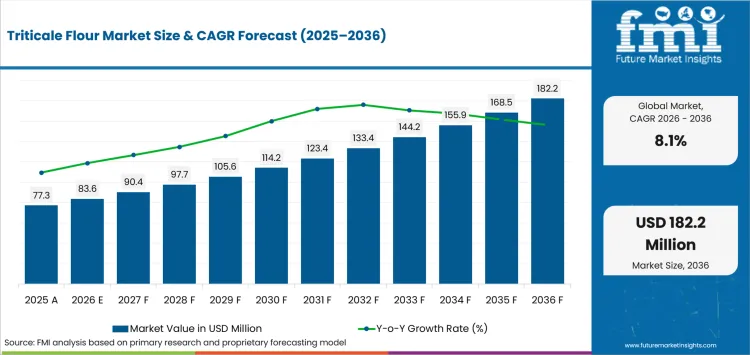
USD 83.6 million in 2026 and USD 182.2 million by 2036 at an 8.1% CAGR.
Sales of triticale flour are projected to rise from USD 83.6 million in 2026 to USD 182.2 million by 2036 at an 8.1% CAGR. Bakery adoption depends on wheat-rye flour that maintains predictable dough handling on commercial production lines. USDA Economic Research Service estimated USA wheat flour use at 126.6 pounds per person in 2025 which sets a performance benchmark for alternative cereals. Related specialty bread flour demand depends on controlled particle size and dough behavior before accounts increase volumes.
Food-grade triticale supply is narrower than raw grain availability because feed channels accept broader specifications than commercial bakeries. Destatis recorded 540,700 tons of triticale on German farms at December 31 2025. Moving that inventory into the cereal flour category still requires segregated lots and repeatable milling behavior for industrial bakery use.
Key Takeaways
- Triticale flour demand depends on millers converting differentiated grain into repeatable specifications for commercial bakery systems.
- By grade, standard milling grade is estimated at 35.0% in 2026 owing to conventional flour compatibility during bakery qualification.
- Powder - dry is set at 45.0% of form demand in 2026 due to existing dry-flour systems.
- Bread & rolls are forecast at 31.0% in 2026 because blending protects commercial dough structure.
- Food-grade segregation raises trial costs because feed-oriented triticale lots may fail commercial bakery specifications.
- Some of the key players in this market include Ardent Mills, ADM, Bay State Milling, Limagrain Ingredients, GoodMills Group, King Arthur Baking, Bob's Red Mill, Doves Farm, Manildra Group, and Scoular.
Analyst Perspective
"Triticale flour earns repeat business after millers prove segregation and milling controls deliver predictable dough behavior. Buyers should compare lot consistency with application support before price because repeated reformulation erases apparent savings."
- Nandini Roy Choudhury, Principal Consultant, Future Market Insights
How is the triticale flour market segmented?
The triticale flour market is segmented by grade, form, application, claim, sales channel, and region.
Market taxonomy covers grade, form, application, claim, sales channel, and region with the target subsegments preserved. Grade includes standard milling, fine - patisserie, organic certified, and identity-preserved specialty options used for different flour specifications. Form covers powder - dry, liquid, paste - semi-solid, and granules - pieces while application spans five bakery groups from bread to snacks. Claim and sales channel distinguish conventional or certified propositions from direct industrial, distributor, foodservice, and online B2B routes.
What makes standard milling grade central to the grade category?
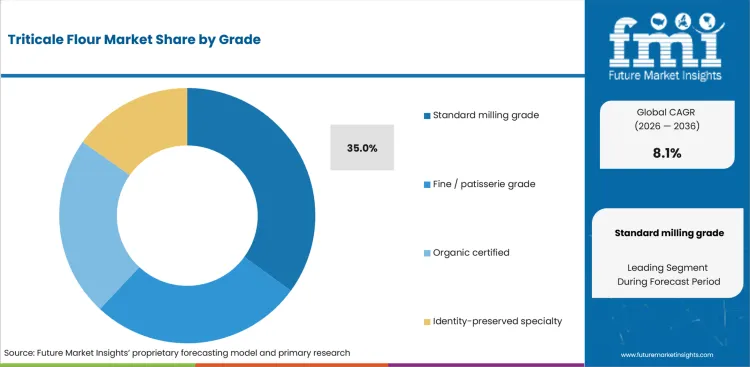
Industrial bakers qualify triticale against familiar flour specifications before paying for narrower certification or identity requirements. Standard milling grade keeps the initial trial close to familiar bakery ingredients handling because millers can control particle size and moisture without adding a separate certified sourcing program.
- By grade, standard milling grade is estimated to hold 35.0% in 2026 owing to compatibility with existing flour specifications.
- Limagrain Ingredients disclosed a new latest-generation extrusion line in June 2026 for functional flours and plant proteins used across bread, biscuits and snacks.
Why does powder - dry lead the form category?
Dry triticale flour fits commercial bakery silos and metering equipment without adding liquid sanitation controls. The same handling route used for prepared flour mixes lets product developers test inclusion rates without changing ingredient storage or dosing equipment.
- Powder - dry is set to lead the form category with 45.0% share in 2026 due to existing dry ingredient systems.
- GoodMills Innovation reported in March 2026 that TIP-TOP process flour cuts airborne flour dust by up to 80% and can extend fryer-cleaning intervals to 13 shifts.
How do bread & rolls anchor the application category?
Bread production exposes flour weakness because mixing tolerance and gas retention determine commercial line performance. Mixed-cereal formulas already give bakers a practical reference through malted rye flour products where machinability must hold before a grain difference can justify routine use.
- Bread & rolls are forecast to represent 31.0% of application demand in 2026 because controlled blending preserves dough structure.
- Bay State Milling explained in May 2026 that HealthSense high-fiber wheat flour can retain familiar taste and texture in bread and pizza formulations while adding fiber.
What supports conventional leadership in the claim category?
Conventional flour lets bakeries qualify dough behavior before certification or identity claims justify tighter segregation. Functional cereal ingredients compete for these accounts only after functional flours prove that a formulation can protect processing performance and finished-product consistency.
- Conventional is anticipated to capture 56.0% of the claim category in 2026 driven by lower certification friction during qualification.
- Bay State Milling reported in March 2026 that HealthSense high-fiber wheat flour enables clean-label positioning through a one-to-one replacement for conventional white flour.
What drives direct to industrial bakeries in the sales channel category?
Large bakery accounts need rapid technical feedback whenever flour absorption changes between routine production lots. Direct mill relationships keep testing and commercial responsibility together for baking ingredients category accounts that cannot wait for several intermediaries to resolve a formulation problem.
- Direct to industrial bakeries is expected to account for 49.0% of 2026 sales channel demand because technical coordination supports repeat orders.
- ADM launched pea flour among eight new protein ingredients in May 2026 for baked goods and cereal applications, giving manufacturers a defined technical formulation route.
What are the drivers, restraints and opportunities in the Triticale Flour Market?
Bakery differentiation supports demand, feed-oriented grain quality restrains conversion, and documented wheat-flour sourcing programs create room for higher-value food-grade supply.
- Driver: Bakery teams can use triticale for cereal differentiation once flour specifications protect repeatable mixing and finished-product quality.
- Restraint: Feed-oriented triticale quality does not guarantee bakery suitability and therefore raises segregation plus application-testing requirements.
- Opportunity: Mills can earn higher-value accounts by pairing traceable grain programs with food-grade cleaning and application-specific flour control.
Bakery Differentiation Converts Grain Interest into Repeat Orders
Commercial demand grows as specialty cereal ingredients protect process reliability on equipment that bakery teams already use. GoodMills Innovation reported in May 2026 that SNACKMAXX masa flours were developed for stable machine processing in commercial snack lines. Triticale suppliers face the same qualification test before buyers expand volumes in whole-wheat flour programs or other differentiated cereal formulations.
Feed Orientation Raises the Food-Grade Qualification Burden
Agriculture Victoria updated its triticale guidance in July 2026 and noted that livestock feed remains the major outlet while only small volumes enter human food, including flour blended with wheat for bread, biscuits and cakes. That split makes food-grade flour a separate qualification route because bakery buyers need controlled lots and dough performance rather than crop availability alone.
Verified Wheat Programs Create a Route to Premium Accounts
Scoular announced an August 2026 food-grade soybean dehuller investment at Covington that builds on existing cleaning and color-sorting equipment for identity-preserved, non-GMO and organic supply. The comparable opportunity for triticale is to pair segregated grain handling with food-grade cleaning and application control before bakery buyers accept a traceable specialty-flour premium.
Which country CAGRs are profiled in the Triticale Flour Market?
| Country | CAGR |
|---|---|
| UAE | 9.2% |
| Saudi Arabia | 8.9% |
| USA | 8.6% |
| South Korea | 8.2% |
| UK | 7.9% |
| Germany | 7.6% |
| Japan | 7.3% |
| France | 7.0% |
How do country-level CAGRs compare in the Triticale Flour Market?
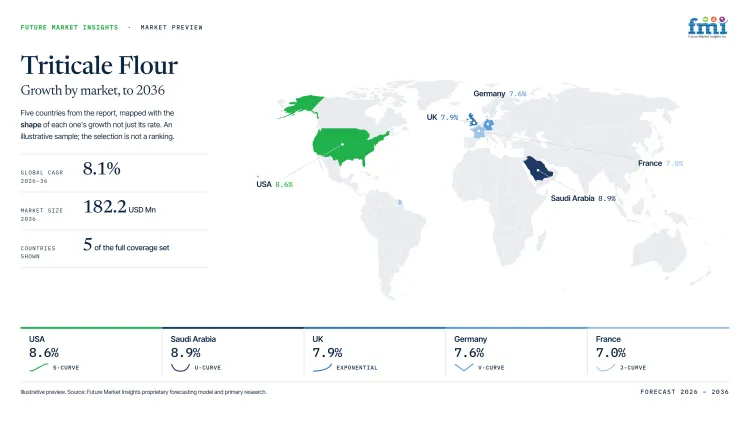
The country CAGRs span 2.2 percentage points from France at 7.0% to the UAE at 9.2% through 2036. Gulf markets form the upper band because imported flour reaches concentrated commercial channels, while the middle group depends more heavily on bakery qualification and milling discipline.
- The UAE’s price-transparent import market gives premium bakery buyers greater visibility into specialty flour sourcing and quality positioning.
- Saudi Arabia’s concentrated milling and grain-procurement structure supports efficient distribution and adoption of alternative cereal flours.
- In the USA, alternative flours must perform reliably within high-throughput bakery operations, making processing compatibility a key requirement.
- South Korean food manufacturers increasingly seek cereal ingredients tailored to specific applications and product-quality targets.
- The UK’s mature milling industry operates within established composition standards, placing a premium on consistent flour performance.
- Despite ample triticale availability, Germany maintains a selective approach to food-grade utilization, emphasizing end-use value and quality differentiation.
- Japan depends on stable import supply chains to support demand for specialty cereal ingredients in niche food applications.
- France’s established soft-wheat market creates a competitive benchmark, requiring triticale flour to demonstrate clear functional or economic advantages.
Comparable CAGRs can therefore produce different qualification costs and account structures before revenue scales. The full report provides country-level CAGR analysis across North America, Latin America, Western Europe, Eastern Europe, East Asia, South Asia and Pacific, and Middle East and Africa.
Country-wise Analysis
- UAE flour distributors work through import-led channels that can introduce unfamiliar cereal ingredients without waiting for domestic grain production. Triticale flour demand in the UAE is forecast to rise at 9.2% CAGR over the forecast period owing to mature import infrastructure. The Ministry of Economy and Tourism maintained its Essential Goods Prices Platform during 2026 with flour prices visible by retailer and emirate. Federal price visibility makes specialty-flour premiums easy for bakery operators to compare against familiar wheat products during purchasing reviews. Importers therefore need reliable replenishment and bakery trial data before customers accept a higher delivered price for routine commercial production.
- Saudi flour supply runs through national import tenders and licensed milling companies that prioritize continuity before unfamiliar grain propositions. Saudi Arabia is projected to grow at 8.9% CAGR during the assessment period owing to large-scale cereal import and milling infrastructure. In July 2026 the General Food Security Authority awarded a 661,000-ton imported wheat shipment under its national supply program. Those volumes give specialty-grain sellers a local enabler because major mills already handle large imported cereal flows. Entry remains difficult without a mill or importer willing to isolate food-grade lots and run bakery trials before routine commercial orders begin.
- USA bakeries operate beside a high-volume flour system where unfamiliar cereal inputs must prove value without slowing mature production lines. Triticale flour sales in the USA are forecast to expand at 8.6% CAGR by 2036 driven by specialty bakery differentiation. USDA Economic Research Service reported in May 2026 that flour and semolina mills processed 222 million bushels of wheat during January through March. That throughput gives triticale a demanding performance benchmark because absorption consistency and line efficiency are closely managed. USA bakery ingredients accounts therefore need repeatable specifications and formulation support before triticale moves from limited trials into scheduled purchasing.
- South Korean cereal policy is shifting domestic wheat programs toward uniform quality tied to intended food uses. Triticale flour demand in South Korea is predicted to expand at 8.2% CAGR through 2036 as ingredient buyers place greater weight on specified cereal performance. MAFRA announced its second Wheat Industry Development Plan in March 2026 with measures for uniform quality, milling-cost support and wider use of domestic wheat products. Triticale suppliers still need local baking trials because the policy improves the qualification framework without making alternative cereal flour interchangeable with established wheat formulations.
- UK millers balance domestic wheat with imports while bakers work under mature composition and labeling rules for flour-based products. Adoption of triticale flour in the UK is estimated to expand at 7.9% CAGR through 2036 attributable to specialty baking channels. Defra reported that home-grown wheat represented 75% of the milling grist during 2025 which establishes a familiar domestic performance reference. That domestic benchmark raises expectations for consistent flour behavior despite the product differentiation offered by an alternative cereal. .
- Germany gives millers direct access to a substantial domestic triticale crop and therefore reduces dependence on imported raw grain. Triticale flour demand in Germany is forecast to rise at 7.6% CAGR over the forecast period driven by domestic cereal availability. The Federal Statistical Office reported a 2025 triticale harvest of 1.8 million tons which was 21% above 2024. Agricultural volume is not automatically food-grade supply because feed outlets accept specifications that commercial bakeries may reject. Millers need contracted food-grade segregation and bakery testing before domestic triticale volume can support dependable repeat flour business with major industrial accounts nationwide.
- Japanese flour buyers operate in an import-dependent wheat system where origin continuity and repeatable specifications receive close commercial attention. Japan is estimated to post 7.3% CAGR over the forecast period supported by specialty bakery interest within controlled flour channels. MAFF published FY2025 food-supply data in August 2026 that place wheat self-sufficiency at 16% by weight. Import dependence favors sellers that can document origin and shipment continuity but smaller cereal streams remain harder to source regularly. Local baking trials therefore need to show where triticale blending preserves finished-product consistency before distributors accept routine volume commitments for domestic commercial bakery production.
- French cereal channels can source triticale domestically but food flour competes against a well-characterized soft-wheat benchmark used by commercial mills. FranceAgriMer completed its national 2025 soft-wheat quality program using samples collected at silo entry before commercial cleaning. Triticale flour demand in France is forecast to expand at 7.0% CAGR over the forecast period attributable to specialty cereal formulations. National quality routines give millers a clear comparison point for protein and milling behavior while food-grade triticale remains less standardized. Sellers need documented lot selection and bakery application data that separate triticale from feed-oriented grain without increasing process variability in regular production.
Who are the notable companies in the Triticale Flour Market?
Ardent Mills, ADM, Bay State Milling, Limagrain Ingredients, GoodMills Group, King Arthur Baking, Bob's Red Mill, Doves Farm, Manildra Group, and Scoular are notable companies in this market.
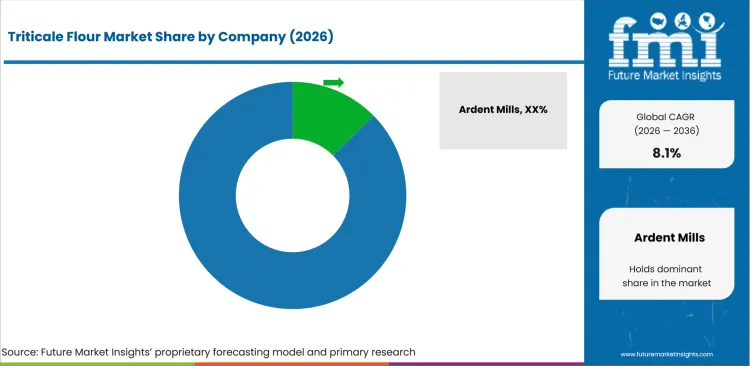
Few companies publish dedicated triticale flour portfolios, so competition centers on grain control and flour consistency plus bakery access and segregation.
- Industrial milling and cereal ingredients: Ardent Mills and ADM join Bay State Milling with Limagrain Ingredients and GoodMills Group in commercial flour accounts.
- Branded specialty baking: King Arthur Baking and Bob's Red Mill join Doves Farm in active flour channels.
- Grain processing and supply networks: Manildra Group and Scoular provide infrastructure supporting segregated specialty cereal programs for commercial accounts.
Competitive Benchmarking: Triticale Flour Market
| Company | Specialty Grain Milling & Blending | Bakery Application Support | Traceability / Certified Sourcing | Geographic Reach |
|---|---|---|---|---|
| Ardent Mills | High | High | High | USA, Canada, and Puerto Rico |
| ADM | High | High | High | North America with global ingredient reach |
| Bay State Milling | High | High | High | USA with national ingredient coverage |
| Limagrain Ingredients | High | High | High | Europe with international food-ingredient sales |
| GoodMills Group | High | Medium | High | Central and Eastern Europe |
| King Arthur Baking | Medium | High | Medium | USA retail, e-commerce, and professional channels |
| Bob's Red Mill | Medium | Medium | Medium | USA retail with international brand distribution |
| Doves Farm | Medium | Medium | High | UK retail and trade channels |
| Manildra Group | High | High | High | Australia with international distribution |
| Scoular | Medium | Medium | High | North America and Asia supply networks |
Scoring basis: High milling breadth requires processing and blending evidence while Medium and Low mark narrower control. High application support requires multiple bakery capabilities while Medium and Low identify narrower support. High traceability requires certified sourcing evidence while Medium and Low reflect limited available documentation.
Key Developments in the Triticale Flour Market
- In August 2026, Scoular agreed to lease three rail-served Kansas grain-handling facilities to Scott Cooperative effective September 2026, changing regional storage and market-access routes.
- In August 2026, Bob's Red Mill introduced a reformulated Gluten Free 1-to-1 Baking Flour with revised taste and texture for familiar substitution-based baking.
- In April 2026, King Arthur Baking announced five new baking mixes including gluten-free roll and bun formats plus a soft golden roll mix kit.
Key Players in the Triticale Flour Market
Industrial Milling and Cereal-Ingredient Platforms
- Ardent Mills
- ADM
- Bay State Milling
- Limagrain Ingredients
- GoodMills Group
Branded Specialty-Flour Channels
- King Arthur Baking
- Bob's Red Mill
- Doves Farm
Grain Processing and Ingredient-Supply Networks
- Manildra Group
- Scoular
Triticale Flour Market - Report Scope
| Coverage field | Report scope |
|---|---|
| Market breakdown | By grade, form, application, claim, sales channel, and region. |
| Quantitative Units | USD million. |
| Market Definition | Commercial revenue from food-grade triticale flour and flour preparations sold into bakery and food ingredient channels within the stated segmentation. |
| Regions Covered | North America, Latin America, Western Europe, Eastern Europe, East Asia, South Asia and Pacific, and Middle East and Africa. |
| Countries Covered | USA, Germany, France, UK, Saudi Arabia, UAE, Japan, South Korea, and 20+ countries included in the full report. |
| Key Companies Profiled | Ardent Mills, ADM, Bay State Milling, Limagrain Ingredients, GoodMills Group, King Arthur Baking, Bob's Red Mill, Doves Farm, Manildra Group, Scoular. |
| Forecast Period | 2026 to 2036. |
| Approach | Primary and secondary research with market triangulation. |
Triticale Flour Market - Research Methodology
| Method | Approach |
|---|---|
| Primary Research | FMI analysts gathered input from manufacturers, service providers, technology developers, distributors, end users, procurement teams, and subject-matter experts. Interviews examined purchasing decisions, product or service evaluation, adoption barriers, approval requirements, pricing considerations, and expectations for technical or commercial support. Respondents were also asked what evidence is required before a trial, pilot, or initial order develops into regular purchasing. |
| Desk Research | Desk research covered government statistics, regulatory publications, trade data, industry associations, technical literature, standards, company filings, product information, and official corporate announcements. Sources were reviewed for relevance, publication date, geographic coverage, and consistency with the defined market scope. Claims relating to performance, applications, approvals, capacity, investment, and commercial activity were retained only when supported by credible public evidence. |
| Market Sizing and Forecasting | The market model combined the baseline value with historical performance, segment structure, pricing and volume indicators, adoption levels, company participation, and country-level demand conditions. Forecast assumptions considered economic activity, investment trends, regulatory developments, technology adoption, purchasing cycles, supply availability, and barriers to wider market use. Segment and regional estimates were reconciled before the final market total was calculated. |
| Data Validation | Estimates were checked against multiple independent indicators, including public data, company activity, trade patterns, industry developments, and findings from primary interviews. Validation also tested whether products, services, applications, and company revenues fell within the defined market boundaries. Adjacent categories, unsupported claims, overlapping revenues, and activities without direct market relevance were excluded to reduce double counting and maintain consistency across segments and countries. |
Triticale Flour Market by Segments
Triticale Flour Market segmented by Grade:
- Standard milling grade
- Fine - patisserie grade
- Organic certified
- Identity-preserved specialty
Triticale Flour Market segmented by Form:
- Powder - dry
- Liquid
- Paste - semi-solid
- Granules - pieces
Triticale Flour Market segmented by Application:
- Bread & rolls
- Cakes & muffins
- Biscuits & cookies
- Viennoiserie & pastry
- Other bakery & snacks
Triticale Flour Market segmented by Claim:
- Conventional
- Clean label
- Organic
- Non-GMO - identity preserved
Triticale Flour Market segmented by Sales Channel:
- Direct to industrial bakeries
- Ingredient distributors
- Foodservice & artisan supply
- Online B2B
Triticale Flour Market by Region:
- North America
- USA
- Canada
- Latin America
- Brazil
- Mexico
- Chile
- Rest of Latin America
- Western Europe
- Germany
- UK
- Italy
- Spain
- France
- Nordics
- Benelux
- Rest of Western Europe
- Eastern Europe
- Russia
- Poland
- Hungary
- Balkan and Baltic States
- Rest of Eastern Europe
- East Asia
- China
- Japan
- South Korea
- South Asia and Pacific
- India
- ASEAN
- Australia and New Zealand
- Rest of South Asia and Pacific
- Middle East and Africa
- Kingdom of Saudi Arabia
- Other GCC Countries
- Türkiye
- South Africa
- Other African Union Countries
- Rest of Middle East and Africa
Research Sources and Bibliography
- USA Department of Agriculture, Economic Research Service. (2026, April 3). USA wheat flour per capita disappearance, 1989-2025.
- German Federal Statistical Office. (2026). Agricultural stocks as at 31 December 2025.
- Limagrain. (2026, June 19). OPERATEUR INDUSTRIEL (F/H)..
- GoodMills Innovation. (2026, March 2). Low-dust process flour from GoodMills Innovation reduces fine particle content, extends cleaning intervals and improves workplace safety..
- Bay State Milling. (2026, May 14). Health Uncensored with Dr. Drew: It’s Time to Wheat Better™..
- Bay State Milling. (2026, March 17). Thinking Cleaner? Consider Flour..
- ADM. (2026, May 20). ADM Advances Protein Innovation with New Ingredient Solutions..
- GoodMills Innovation. (2026, May 22). SNACKMAXX® Masa Flours: Authentic Corn Flavour and Process Reliability for Snack Applications..
- Agriculture Victoria. (2026, July 20). Growing triticale in Victoria..
- Scoular. (2026, August 3). Growing demand drives Scoular soybean dehuller expansion in Ohio..
- Ministry of Economy and Tourism, United Arab Emirates. (2026, June 22). Essential Goods Prices Platform.
- Saudi Press Agency. (2026, July 6). General Food Security Authority Awards Fourth Imported Wheat Shipment of 2026.
- USA Department of Agriculture, Economic Research Service. (2026, May 14). Wheat Outlook: May 2026.
- Ministry of Agriculture, Food and Rural Affairs, Republic of Korea. (2026, March 26). 고품질 밀 생산·유통 체계구축을 목표로 제2차 밀 산업육성 기본계획 수립..
- Department for Environment, Food & Rural Affairs. (2026). Agriculture in the United Kingdom 2025: Chapter 7, Crops.
- German Federal Statistical Office. (2026). 2025 grain and potato harvest: 45 million tons of grain and 14 million tons of potatoes.
- Ministry of Agriculture, Forestry and Fisheries of Japan. (2026, August 7). 令和7年度食料自給率を公表します.
- Ministry of Agriculture, Forestry and Fisheries of Japan. (2026). 食料自給率とは.
- FranceAgriMer. (2025, October 15). Présentation qualité des blés.
- Scoular. (2026, August 25). Scott Cooperative Association to lease three facilities from Scoular..
- Bob's Red Mill Natural Foods. (2026, August 19). Bob’s Red Mill Introduces Perfected Formula for Gluten Free 1-to-1 Baking Flour with Improved Taste and Texture..
- King Arthur Baking. (2026, April 21). King Arthur Baking Taps Celebrations, Gluten-Free Demand, and Everyday Ease with Five New Mixes This Spring..
- GoodMills Innovation. (2026, August 25). Enrichment, naturalness and process efficiency: GoodMills Innovation to present contemporary solutions for the baking trade at südback 2026..
- Ardent Mills. (2026, July 20). Ingredient Powerhouse..
- Ardent Mills. (2026, February 20). Ardent Mills® Dark Cocoa Replace Expands Growing Line of Cocoa Replacers..
- GoodMills Innovation. (2026, April 9). Lighter, finer, milder: wholemeal reimagined..
- ADM. (2026, January 15). ADM’s $26M Investment in Erlanger Facility Strengthens Capabilities for Growing Reformulation Demand..
- Limagrain Ingredients. (2026, June 9). Senior technical application engineer M/W..
- GoodMills Innovation. (2026, July 17). GOOD NatureRelax: Kontrollierte Teigentspannung für stabile Prozesse in der Weizenteig-Verarbeitung..
- Bob's Red Mill Natural Foods. (2026, January 27). Bob's Red Mill Announces New Brown Sugar Blondie Baking Mix..
- Companies House. (2026, June 30). DOVES FARM FOODS LIMITED filing history..
- Scoular. (2026, February 3). Friend of Soy award highlights new Scoular crush facility..
- Bay State Milling. (2026, January 27). Fiber Is the Next Frontier in Better-For-You Formulation..
- Ardent Mills. (2025). Alternative grains portfolio..
- ADM. (2026). Bulk Flours & Milling | Explore Wholesale Commercial Flours..
- GoodMills Group. (2026). Industrial milling..
This bibliography is provided for reader reference and is not exhaustive. The full report contains the complete reference list and detailed citations.
This Report Answers
- What is the 2026 and 2036 triticale flour value?
- Why does standard milling grade hold 35.0%?
- Why does powder - dry hold 45.0%?
- Why do bread & rolls hold 31.0%?
- How do country CAGRs compare through 2036?
- Which companies participate in triticale flour?
- What limits wider triticale flour qualification?
- What capabilities support repeat bakery business?
Frequently Asked Questions
How big is the Triticale Flour Market in 2026?
The triticale flour market is valued at USD 83.6 million in 2026 and is projected to reach USD 182.2 million by 2036. Food-grade segregation and predictable dough performance determine whether commercial bakery trials convert into repeat orders.
What is the CAGR of the Triticale Flour Market from 2026 to 2036?
The triticale flour market is projected to grow at an 8.1% CAGR between 2026 and 2036. Expansion depends on specialty cereal formulations meeting repeatable milling specifications and commercial bakery performance requirements.
Which grade leads the Triticale Flour Market?
Standard milling grade is expected to hold 35.0% of the triticale flour market in 2026 owing to familiar flour-handling requirements. Industrial bakeries can establish process performance before paying for narrower certification or identity-preserved sourcing.
Which form leads the Triticale Flour Market?
Powder - dry is expected to hold 45.0% of the triticale flour market in 2026 because commercial systems already handle dry ingredients. Bakeries can store and meter triticale flour without installing separate liquid or paste handling equipment.
Which companies are active in the Triticale Flour Market?
Key companies in the triticale flour market include Ardent Mills, ADM, Bay State Milling, Limagrain Ingredients, GoodMills Group, King Arthur Baking, Bob's Red Mill, Doves Farm, Manildra Group, and Scoular. Their roles span milling, bakery formulation, specialty-flour channels, grain handling and traceable ingredient supply.
Preview the report firsthand - request a free sample
Get SampleGet the brochure for pricing and purchase details.
Get PDFTable of Content
- Key Takeaways
- Market Size and CAGR
- Top Growth Driver
- Fastest Growing Segment
- Leading Region
- Key Companies
- Emerging Opportunities
- Executive Summary
- Global Market Outlook
- Demand-side Trends
- Supply-side Trends
- Technology Roadmap Analysis
- Analysis and Recommendations
- Analyst Perspective (What is happening? Why now? What should investors know?)
- Key Questions Answered
- How large is the market?
- What is the CAGR?
- What are key trends?
- Which region dominates?
- Who are the leaders?
- Market Overview
- Market Coverage / Taxonomy
- Market Definition / Scope / Limitations
- Research Methodology
- Chapter Orientation
- Analytical Lens and Working Hypotheses
- Market Structure, Signals, and Trend Drivers
- Benchmarking and Cross-market Comparability
- Market Sizing, Forecasting, and Opportunity Mapping
- Research Design and Evidence Framework
- Desk Research Programme (Secondary Evidence)
- Expert Input and Fieldwork (Primary Evidence)
- Tooling, Models, and Reference Databases
- Data Engineering and Model Build
- Quality Assurance and Audit Trail
- Market Background
- Market Dynamics (Drivers, Restraints, Opportunity, Trends)
- Scenario Forecast (Optimistic, Likely, Conservative)
- Impact Analysis
- AI Impact
- Sustainability Impact
- Regulatory Impact
- Technology Impact
- Consumer / Buyer Analysis
- Purchase Drivers
- Adoption Barriers
- Buyer Journey
- Opportunity Map Analysis
- Product Life Cycle Analysis
- Supply Chain Analysis
- Investment Feasibility Matrix
- Value Chain Analysis
- PESTLE and Porter's Analysis
- Regulatory Landscape
- Regional Parent Market Outlook
- Production and Consumption Statistics
- Import and Export Statistics
- Global Market Analysis and Forecast, 2021 to 2036
- Historical Market Size Value (USD Million) Analysis, 2021 to 2025
- Current and Future Market Size Value (USD Million) Projections, 2026 to 2036
- Y-o-Y Growth Trend Analysis
- Absolute $ Opportunity Analysis
- Global Market Pricing Analysis, 2021 to 2036
- Global Market Analysis and Forecast, By Grade, 2021 to 2036
- Introduction / Key Findings
- Historical Market Size Value (USD Million) Analysis By Grade, 2021 to 2025
- Current and Future Market Size Value (USD Million) Analysis and Forecast By Grade, 2026 to 2036
- Standard milling grade
- Fine / patisserie grade
- Organic certified
- Identity-preserved specialty
- Standard milling grade
- Y-o-Y Growth Trend Analysis By Grade, 2021 to 2025
- Absolute $ Opportunity Analysis By Grade, 2026 to 2036
- Global Market Analysis and Forecast, By Form, 2021 to 2036
- Introduction / Key Findings
- Historical Market Size Value (USD Million) Analysis By Form, 2021 to 2025
- Current and Future Market Size Value (USD Million) Analysis and Forecast By Form, 2026 to 2036
- Powder / dry
- Liquid
- Paste / semi-solid
- Granules / pieces
- Powder / dry
- Y-o-Y Growth Trend Analysis By Form, 2021 to 2025
- Absolute $ Opportunity Analysis By Form, 2026 to 2036
- Global Market Analysis and Forecast, By Application, 2021 to 2036
- Introduction / Key Findings
- Historical Market Size Value (USD Million) Analysis By Application, 2021 to 2025
- Current and Future Market Size Value (USD Million) Analysis and Forecast By Application, 2026 to 2036
- Bread & rolls
- Cakes & muffins
- Biscuits & cookies
- Viennoiserie & pastry
- Other bakery & snacks
- Bread & rolls
- Y-o-Y Growth Trend Analysis By Application, 2021 to 2025
- Absolute $ Opportunity Analysis By Application, 2026 to 2036
- Global Market Analysis and Forecast, By Claim, 2021 to 2036
- Introduction / Key Findings
- Historical Market Size Value (USD Million) Analysis By Claim, 2021 to 2025
- Current and Future Market Size Value (USD Million) Analysis and Forecast By Claim, 2026 to 2036
- Conventional
- Clean label
- Organic
- Non-GMO / identity preserved
- Conventional
- Y-o-Y Growth Trend Analysis By Claim, 2021 to 2025
- Absolute $ Opportunity Analysis By Claim, 2026 to 2036
- Global Market Analysis and Forecast, By Sales Channel, 2021 to 2036
- Introduction / Key Findings
- Historical Market Size Value (USD Million) Analysis By Sales Channel, 2021 to 2025
- Current and Future Market Size Value (USD Million) Analysis and Forecast By Sales Channel, 2026 to 2036
- Direct to industrial bakeries
- Ingredient distributors
- Foodservice & artisan supply
- Online B2B
- Direct to industrial bakeries
- Y-o-Y Growth Trend Analysis By Sales Channel, 2021 to 2025
- Absolute $ Opportunity Analysis By Sales Channel, 2026 to 2036
- Global Market Analysis and Forecast, By Region, 2021 to 2036
- Introduction
- Historical Market Size Value (USD Million) Analysis By Region, 2021 to 2025
- Current Market Size Value (USD Million) Analysis and Forecast By Region, 2026 to 2036
- North America
- Latin America
- Western Europe
- Eastern Europe
- East Asia
- South Asia and Pacific
- Middle East & Africa
- Market Attractiveness Analysis By Region
- North America Market Analysis and Forecast, By Country, 2021 to 2036
- Historical Market Size Value (USD Million) Trend Analysis By Market Taxonomy, 2021 to 2025
- Market Size Value (USD Million) Forecast By Market Taxonomy, 2026 to 2036
- By Country
- USA
- Canada
- By Grade
- By Form
- By Application
- By Claim
- By Sales Channel
- By Country
- Market Attractiveness Analysis
- By Country
- By Grade
- By Form
- By Application
- By Claim
- By Sales Channel
- Key Takeaways
- Latin America Market Analysis and Forecast, By Country
- Historical Market Size Value (USD Million) Trend Analysis By Market Taxonomy, 2021 to 2025
- Market Size Value (USD Million) Forecast By Market Taxonomy, 2026 to 2036
- By Country
- Brazil
- Mexico
- Chile
- Rest of Latin America
- By Grade
- By Form
- By Application
- By Claim
- By Sales Channel
- By Country
- Market Attractiveness Analysis
- By Country
- By Grade
- By Form
- By Application
- By Claim
- By Sales Channel
- Key Takeaways
- Western Europe Market Analysis and Forecast, By Country
- Historical Market Size Value (USD Million) Trend Analysis By Market Taxonomy, 2021 to 2025
- Market Size Value (USD Million) Forecast By Market Taxonomy, 2026 to 2036
- By Country
- Germany
- UK
- Italy
- Spain
- France
- Nordic
- BENELUX
- Rest of Western Europe
- By Grade
- By Form
- By Application
- By Claim
- By Sales Channel
- By Country
- Market Attractiveness Analysis
- By Country
- By Grade
- By Form
- By Application
- By Claim
- By Sales Channel
- Key Takeaways
- Eastern Europe Market Analysis and Forecast, By Country
- Historical Market Size Value (USD Million) Trend Analysis By Market Taxonomy, 2021 to 2025
- Market Size Value (USD Million) Forecast By Market Taxonomy, 2026 to 2036
- By Country
- Russia
- Poland
- Hungary
- Balkan & Baltic
- Rest of Eastern Europe
- By Grade
- By Form
- By Application
- By Claim
- By Sales Channel
- By Country
- Market Attractiveness Analysis
- By Country
- By Grade
- By Form
- By Application
- By Claim
- By Sales Channel
- Key Takeaways
- East Asia Market Analysis and Forecast, By Country
- Historical Market Size Value (USD Million) Trend Analysis By Market Taxonomy, 2021 to 2025
- Market Size Value (USD Million) Forecast By Market Taxonomy, 2026 to 2036
- By Country
- China
- Japan
- South Korea
- By Grade
- By Form
- By Application
- By Claim
- By Sales Channel
- By Country
- Market Attractiveness Analysis
- By Country
- By Grade
- By Form
- By Application
- By Claim
- By Sales Channel
- Key Takeaways
- South Asia and Pacific Market Analysis and Forecast, By Country
- Historical Market Size Value (USD Million) Trend Analysis By Market Taxonomy, 2021 to 2025
- Market Size Value (USD Million) Forecast By Market Taxonomy, 2026 to 2036
- By Country
- India
- ASEAN
- Australia & New Zealand
- Rest of South Asia and Pacific
- By Grade
- By Form
- By Application
- By Claim
- By Sales Channel
- By Country
- Market Attractiveness Analysis
- By Country
- By Grade
- By Form
- By Application
- By Claim
- By Sales Channel
- Key Takeaways
- Middle East & Africa Market Analysis and Forecast, By Country
- Historical Market Size Value (USD Million) Trend Analysis By Market Taxonomy, 2021 to 2025
- Market Size Value (USD Million) Forecast By Market Taxonomy, 2026 to 2036
- By Country
- Kingdom of Saudi Arabia
- Other GCC Countries
- Türkiye
- South Africa
- Other African Union
- Rest of Middle East & Africa
- By Grade
- By Form
- By Application
- By Claim
- By Sales Channel
- By Country
- Market Attractiveness Analysis
- By Country
- By Grade
- By Form
- By Application
- By Claim
- By Sales Channel
- Key Takeaways
- Key Countries Market Analysis
- USA
- Pricing Analysis
- Market Share Analysis, 2025
- By Grade
- By Form
- By Application
- By Claim
- By Sales Channel
- Canada
- Pricing Analysis
- Market Share Analysis, 2025
- By Grade
- By Form
- By Application
- By Claim
- By Sales Channel
- Mexico
- Pricing Analysis
- Market Share Analysis, 2025
- By Grade
- By Form
- By Application
- By Claim
- By Sales Channel
- Brazil
- Pricing Analysis
- Market Share Analysis, 2025
- By Grade
- By Form
- By Application
- By Claim
- By Sales Channel
- Chile
- Pricing Analysis
- Market Share Analysis, 2025
- By Grade
- By Form
- By Application
- By Claim
- By Sales Channel
- Germany
- Pricing Analysis
- Market Share Analysis, 2025
- By Grade
- By Form
- By Application
- By Claim
- By Sales Channel
- UK
- Pricing Analysis
- Market Share Analysis, 2025
- By Grade
- By Form
- By Application
- By Claim
- By Sales Channel
- Italy
- Pricing Analysis
- Market Share Analysis, 2025
- By Grade
- By Form
- By Application
- By Claim
- By Sales Channel
- Spain
- Pricing Analysis
- Market Share Analysis, 2025
- By Grade
- By Form
- By Application
- By Claim
- By Sales Channel
- France
- Pricing Analysis
- Market Share Analysis, 2025
- By Grade
- By Form
- By Application
- By Claim
- By Sales Channel
- India
- Pricing Analysis
- Market Share Analysis, 2025
- By Grade
- By Form
- By Application
- By Claim
- By Sales Channel
- ASEAN
- Pricing Analysis
- Market Share Analysis, 2025
- By Grade
- By Form
- By Application
- By Claim
- By Sales Channel
- Australia & New Zealand
- Pricing Analysis
- Market Share Analysis, 2025
- By Grade
- By Form
- By Application
- By Claim
- By Sales Channel
- China
- Pricing Analysis
- Market Share Analysis, 2025
- By Grade
- By Form
- By Application
- By Claim
- By Sales Channel
- Japan
- Pricing Analysis
- Market Share Analysis, 2025
- By Grade
- By Form
- By Application
- By Claim
- By Sales Channel
- South Korea
- Pricing Analysis
- Market Share Analysis, 2025
- By Grade
- By Form
- By Application
- By Claim
- By Sales Channel
- Russia
- Pricing Analysis
- Market Share Analysis, 2025
- By Grade
- By Form
- By Application
- By Claim
- By Sales Channel
- Poland
- Pricing Analysis
- Market Share Analysis, 2025
- By Grade
- By Form
- By Application
- By Claim
- By Sales Channel
- Hungary
- Pricing Analysis
- Market Share Analysis, 2025
- By Grade
- By Form
- By Application
- By Claim
- By Sales Channel
- Kingdom of Saudi Arabia
- Pricing Analysis
- Market Share Analysis, 2025
- By Grade
- By Form
- By Application
- By Claim
- By Sales Channel
- Türkiye
- Pricing Analysis
- Market Share Analysis, 2025
- By Grade
- By Form
- By Application
- By Claim
- By Sales Channel
- South Africa
- Pricing Analysis
- Market Share Analysis, 2025
- By Grade
- By Form
- By Application
- By Claim
- By Sales Channel
- USA
- Market Structure Analysis
- Competition Dashboard
- Competition Benchmarking
- Market Share Analysis of Top Players
- By Regional
- By Grade
- By Form
- By Application
- By Claim
- By Sales Channel
- Emerging Startups
- Innovation Benchmarking
- Competition Analysis
- Competition Deep Dive
- Ardent Mills
- Overview
- Product Portfolio
- Profitability by Market Segments
- Sales Footprint
- Strategy Overview
- Marketing Strategy
- Product Strategy
- Channel Strategy
- ADM
- Bay State Milling
- Limagrain Ingredients
- GoodMills Group
- King Arthur Baking
- Bob's Red Mill
- Doves Farm
- Manildra Group
- Scoular
- Ardent Mills
- Case Studies
- Success Stories
- Recent Developments
- Competition Deep Dive
- Assumptions & Acronyms Used


