

- Market Size (2026)
- USD 324.8 Mn
- Forecast (2036)
- USD 939.0 Mn
- CAGR (2026 to 2036)
- 11.2%
How big is Flour Handling & Silo Systems Market in 2026?
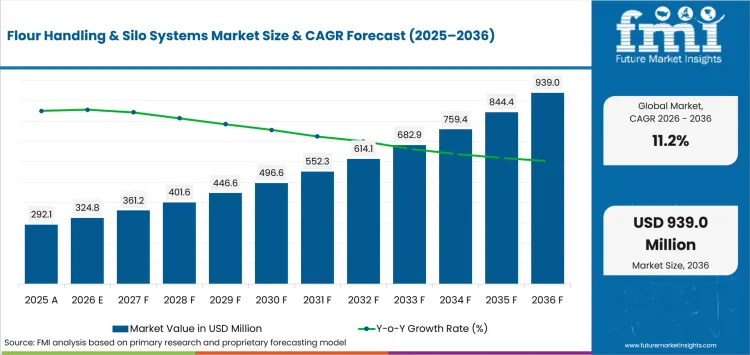
USD 324.8 million in 2026 and USD 939.0 million by 2036 at an 11.2% CAGR.
Demand for flour handling & silo systems is expected to expand from USD 324.8 million in 2026 to USD 939.0 million by 2036 at an 11.2% CAGR as industrial bakeries replace open bag tipping with enclosed storage and automated dosing. The same investment improves the operating fit of bakery processing equipment by stabilizing flour delivery before mixing. AZO demonstrated silo receiving and closed conveying with vacuum weighing for kneader feeding at iba in May 2025. The demonstration matters commercially because one engineered flour route can address dust exposure and recipe accuracy before mixing.
Country conditions change the point at which a flour-room project becomes necessary for each industrial bakery investment. UK bakeries face explicit exposure control while German sites often prioritize retrofit access and Japanese plants place greater weight on grade separation. HSE stated in August 2025 that good flour-dust control can usually achieve less than 2 mg/m³ over eight hours. The exposure benchmark pushes enclosed bulk material handling higher in plant renewal decisions at bakeries where manual transfer remains routine.
Key Takeaways of Flour Handling & Silo Systems Market
- Demand is supported by industrial bakeries replacing repeated bag handling with enclosed flour storage, conveying and recipe-controlled weighing across higher-throughput production rooms.
- By grade, standard milling grade is estimated to hold 36.0% in 2026 owing to repeated bread and bun recipes that justify dedicated bulk storage positions.
- In 2026, 500-2,000 kg/hr is expected to lead capacity with 39.0% share because the band balances industrial mixer demand with practical retrofit space.
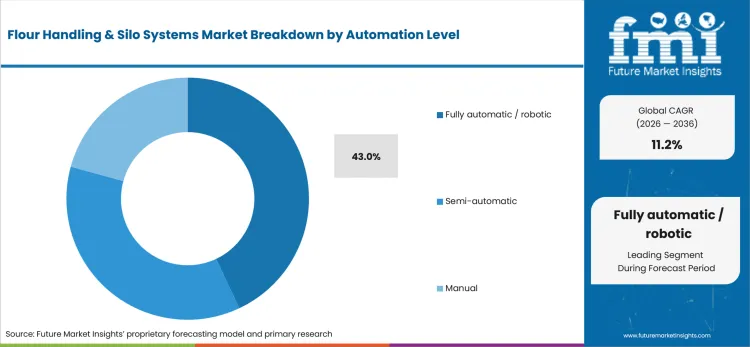
- Fully automatic / robotic systems are projected to hold 43.0% share in 2026 owing to frequent batching that rewards repeatable weighing and controlled conveying routes.
- Brownfield projects face longer approval cycles as silo footprint and filtration requirements increase engineering work, while explosion protection and shutdown planning can extend project approval beyond the core equipment purchase.
- Some of the key players in this market include Bühler Group, Kaak Group, Daxner, AZO GmbH + Co. KG, Reading Bakery Systems, AMF Bakery Systems, Mecatherm, and Midera Food Processing, Inc.
Analyst Perspective
"Flour-room economics depend on stable discharge and accurate weighing across the full route from silo outlet to mixer rather than the quoted silo price. Brownfield value comes from low-dust transfer and service access that protect production continuity during installation and routine maintenance."
- Nandini Roy Choudhury, Principal Consultant, Future Market Insights
How is the Flour Handling & Silo Systems Market segmented?
The market is segmented by grade, capacity, automation level, end user, sales channel and region.
Grade covers standard milling grade, fine / patisserie grade, organic certified and identity-preserved specialty flour. Capacity covers below 500 kg/hr, 500-2,000 kg/hr and above 2,000 kg/hr. Automation level includes manual, semi-automatic and fully automatic / robotic systems. End users comprise industrial bakeries, in-store & retail bakeries, artisan bakeries and foodservice / QSR central kitchens. Sales channels include direct OEM sales, dealers & distributors and aftermarket & refurbished equipment.
How does fully automatic / robotic define the automation level category?
Automatic flour rooms become more valuable as batch frequency rises and manual confirmations create avoidable variation. Route interlocks and recipe controls also reduce dependence on operator memory during mixer charging across repeated shifts.
- In 2026, fully automatic / robotic systems are expected to lead automation level with 43.0% share because frequent batches reward repeatable weighing and closed transfer.
- Mecatherm launched MyMecatherm in May 2025 for real-time industrial bakery line monitoring. The platform illustrates how factory automation is extending beyond machine control toward operating visibility across connected bakery processes and scheduled maintenance across production shifts and planning cycles.
What makes standard milling grade central to the grade category?
Standard milling grade carries the repeated flour volume behind bread and bun production, so dedicated bins reduce changeovers and simplify routine recipe control. The same duty suits pneumatic conveying where one flour grade feeds several mixers and repeated formulations through long production runs.
- Based on grade, standard milling grade is projected to account for 36.0% in 2026 due to repeat-use bread and bun recipes that justify dedicated silos.
- USDA NASS reported 419 million hundredweight of US flour production during 2025, reinforcing the operating need for dependable transfer and weighing wherever industrial flour consumption repeats across shifts.
Why does 500-2,000 kg/hr lead the capacity category?
The 500-2,000 kg/hr band serves bakeries that need bulk flour flow without the civil footprint of the largest installations. The capacity range also leaves room for multiple flour grades and scheduled mixer charging while preserving a practical path for staged expansion.
- By capacity, 500-2,000 kg/hr is estimated to hold 39.0% in 2026 owing to industrial mixer demand that remains compatible with staged brownfield expansion.
- Bühler documented 305,000 tonnes of silo capacity at City Group in its 2025 project story. The installation shows how larger material handling systems are engineered around storage volume and conveying routes rather than equipment nameplate capacity alone.
What supports industrial bakeries in the end user category?
Industrial bakeries have the clearest utilization case because flour moves repeatedly across long daily production schedules. Dedicated storage also reduces forklift traffic and repeated manual lifts around high-throughput mixers at larger production sites.
- The industrial bakeries segment is likely to capture 41.0% share in 2026 attributable to repeated mixer charging across long production schedules.
- Daxner documented the Der Beck bakery deployment in April 2025 with six external flour silos plus automated dosing and weighing. The project shows why dough processing systems depend on dependable ingredient delivery before mixing and downstream bakery assets can run consistently.
What are the drivers, restraints and opportunities in the Flour Handling & Silo Systems Market?
Higher flour throughput favors enclosed automated transfer, while combustible-dust engineering and brownfield space constrain projects. Modular retrofit packages let mid-capacity bakeries adopt controlled storage and dosing in stages.
- Driver: Repeated flour movement raises labor and consistency costs as bakeries increase batch frequency without equivalent growth in flour-room staffing.
- Restraint: Existing plants can require civil work, dust zoning and new filtration before larger silos or conveying routes fit safely.
- Opportunity: Modular day bins and controlled dosing let mid-capacity bakeries replace manual charging in stages without rebuilding the entire production room.
High Flour Throughput Raises the Value of Enclosed Transfer
Repeated mixer charging turns flour intake into a recurring labor and control cost at high-throughput bakeries. USDA NASS recorded 907 million bushels of wheat ground for flour during 2025, showing the scale at which bulk movement repeats across large plants. Enclosed automated material handling reduces bag movement and ties ingredient release to batch schedules. Plants running additional shifts gain the strongest payback because the same transfer work recurs every production day.
Combustible-Dust Controls Extend Brownfield Engineering
Brownfield projects are constrained first by building geometry and existing service routes around the flour room. NFPA consolidated combustible-dust requirements into NFPA 660 in May 2025, increasing the need for one coordinated hazard review across transfer and dust-collection equipment. Limited roof height or congested access can narrow conveying equipment choices inside established bakery production rooms. Filtration and explosion controls can also extend shutdown planning if civil modifications are required before commissioning.
Modular Ingredient Systems Reduce the Threshold for Mid-Capacity Retrofits
Mid-capacity bakeries need a staged route away from bag feeding without rebuilding the entire flour room at once. South Korea’s agriculture ministry reported in April 2025 that about 100 bakeries joined its floury-rice product program, widening the recipe mix that ingredient systems must handle. Modular day bins and controlled weighing let plants separate identities before adding larger storage later. Local industrial automation service remains important because each retrofit must fit existing mixers and maintenance access.
Which country CAGRs are profiled in the Flour Handling & Silo Systems Market?
| Country | CAGR |
|---|---|
| South Korea | 11.9% |
| USA | 11.6% |
| Germany | 11.2% |
| UK | 10.9% |
| Japan | 10.2% |
How do country-level CAGRs compare in the Flour Handling & Silo Systems Market?
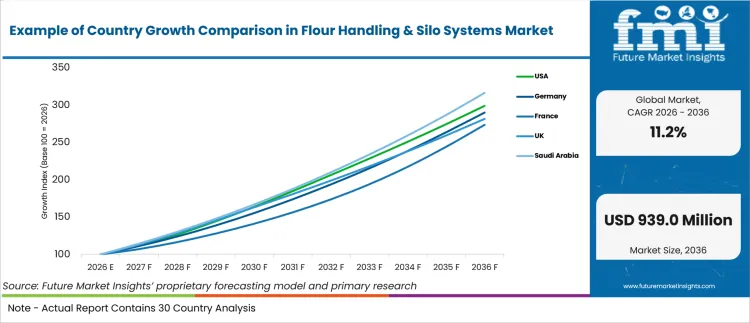
The 1.7 percentage-point spread separates two faster retrofit markets from three mature replacement markets without creating a wide gap. South Korea and USA lead as recipe flexibility and large flour-processing capacity support renewal. Germany and UK form the compliance-led middle group while Japan depends more on carefully timed installed-base replacement.
- South Korea rewards flexible dosing that handles floury-rice recipes beside conventional wheat flour.
- USA retrofits absorb combustible-dust review and difficult shutdown planning at large bakery sites.
- Germany favors compact low-dust retrofits that preserve service access inside mature bakery buildings.
- UK enforcement gives enclosed receipt and effective local extraction greater weight during retrofits.
- Japan prioritizes grade separation and inventory discipline around government-managed imported wheat supply.
CAGR guides timing but does not identify the value of replacement base. The full report provides country-level CAGR analysis across North America, Latin America, Europe, East Asia, South Asia and Pacific and Middle East and Africa.
Country-wise Analysis
- South Korea: Industrial bakeries increasingly run wheat flour beside floury-rice recipes, raising the need for clean changeovers and recipe-controlled weighing inside shared production rooms. South Korea is estimated to post 11.9% CAGR over the forecast period, supported by flexible factory automation that can manage more ingredient identities during busy schedules. MAFRA reported in June 2025 that 102 bakeries presented new floury-rice bread and confection recipes, expanding the range of formulas handled by commercial baking lines. Local engineering firms can win retrofit work with flexible dosing and responsive service, although different ingredient properties increase cleaning work between products during busy production schedules.
- USA: Industrial bakeries operate large mixing lines where bulk flour storage can reduce repeated manual transfer across long multi-shift production schedules and established production rooms. USDA NASS reported in May 2026 that national flour-mill daily capacity reached about 1.6 million hundredweight during 2025, confirming the scale of upstream flour movement. The USA flour handling & silo systems sector is projected to record 11.6% CAGR during the assessment period, supported by replacement projects inside large brownfield bakeries. Combustible-dust review and shutdown planning remain material frictions, so engineering firms need documented ignition controls plus commissioning plans that protect production continuity at operating bakery sites.
- Germany: Bakery operators often modernize mature production buildings where compact conveying routes and accessible filtration matter more than maximum silo volume during retrofit planning. In Germany, flour handling & silo systems demand is predicted to advance at 11.2% CAGR through 2036 supported by a deep bakery engineering and service base. BGN reported in December 2025 that it offers on-site flour-dust measurements at silo scales and kneading equipment, followed by written reports for participating bakeries. Documented dust performance can support investment approval, although avoidable civil work and crowded service corridors remain a material barrier for oversized layouts during phased modernization work locally.
- UK: Flour-room projects are shaped by active occupational-hygiene enforcement because open tipping and dry-ingredient dispensing can leave airborne flour around routine production tasks. HSE began inspections at large bakeries across Great Britain in January 2026 to assess controls for flour and other dusty ingredients during normal operations. Established urban plants can have little space for new silos or ductwork, so phased day-bin layouts and documented commissioning performance are important local enablers. Flour handling & silo systems demand in the UK is forecast to rise at 10.9% CAGR over the forecast period, while limited shutdown windows continue to favor incremental retrofit programs.
- Japan: The mature bakery base operates within a government-managed wheat import system, giving grade separation and inventory discipline greater weight during flour-room modifications. MAFF convened the first meeting under a US-Japan wheat-supply cooperation memorandum in April 2026, placing supply continuity inside an active government coordination process. Flour handling & silo systems sales in Japan are forecast to expand at 10.2% CAGR by 2036, supported by precise dosing around established production lines. Conservative change management and limited tolerance for interruption favor incremental control upgrades over large single-stage conversions across established multi-line bakery sites during upgrades.
Who are the notable companies in the Flour Handling & Silo Systems Market?
Bühler Group, Kaak Group, Daxner, AZO GmbH + Co. KG, Reading Bakery Systems, AMF Bakery Systems, Mecatherm and Midera Food Processing, Inc. are the notable companies serving this market.
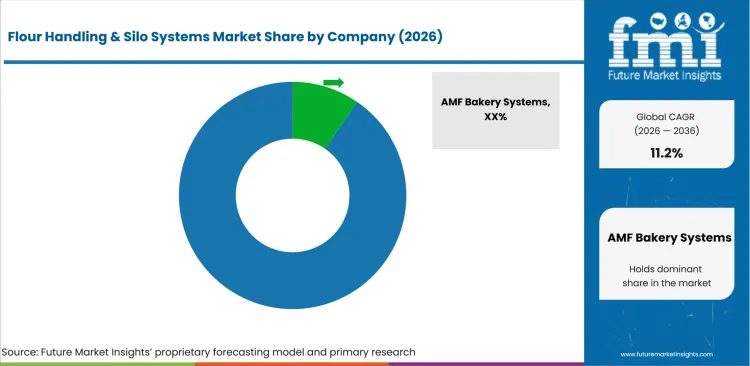
Competition separates specialist raw-material engineering from broader bakery-line integration because flour-room scope overlaps upstream storage and downstream process equipment. Bühler Group, Kaak Group, Daxner and AZO GmbH + Co. KG compete closest to flour storage and dosing. Reading Bakery Systems, AMF Bakery Systems, Mecatherm and Midera Food Processing, Inc. extend the sales discussion into mixing and downstream bakery assets. Bakery engineering teams therefore compare the flour room with the surrounding conveyor system architecture rather than treating the silo as a stand-alone vessel.
- Bühler Group, Daxner and AZO GmbH + Co. KG provide the strongest documented depth across bulk storage, pneumatic transfer and weighing functions.
- Kaak Group bridges silo-to-truck bakery integration, while Reading Bakery Systems and AMF Bakery Systems compete around mixing and broader production-line coordination.
- Mecatherm and Midera Food Processing, Inc. provide industrial bakery automation depth where flour handling must interface with plant-wide controls and process equipment.
Competitive Benchmarking: Flour Handling & Silo Systems Market
| Company | Bulk Storage & Conveying | Weighing & Dosing | Bakery-Line Integration | Geographic Reach |
|---|---|---|---|---|
| Bühler Group | High | High | High | Global |
| Kaak Group | High | High | High | Europe, Americas, Africa and Asia-Pacific |
| Daxner | High | High | Medium | Europe, Americas and Asia |
| AZO GmbH + Co. KG | High | High | Medium | Europe, North America and Asia |
| Reading Bakery Systems | Low | High | High | North America and international installations |
| AMF Bakery Systems | Medium | Medium | High | Americas, Europe and Asia-Pacific |
| Mecatherm | Low | Low | High | Europe and international industrial-bakery markets |
| Midera Food Processing, Inc. | Medium | Medium | High | Global |
Scoring basis: High bulk-storage and conveying requires verified silo plus transfer scope while Medium requires one documented bulk-handling function and Low marks a peripheral documented role. High weighing and dosing requires automated weighing plus ingredient dosing while Medium requires one verified function and Low marks indirect integration. High bakery-line integration requires broad line scope while Medium requires documented mixer or process integration and Low marks a single interface. Geographic reach records documented operating regions or customer coverage and remains descriptive rather than scored as a capability rating.
Key Developments in the Flour Handling & Silo Systems Market
- In July 2026, Midera Food Processing, Inc. began trading as an independent public company after completion of its food-processing spin-off and established a dedicated bakery and snack equipment platform.
- In September 2025, Royal Kaak launched Kaak Africa as a Johannesburg sales and service office that provides regional support and spare parts for industrial bakery projects.
- In June 2025, AMF Bakery Systems and Puratos opened the Puratos Industrial Pilot Bakery, Powered by AMF, at Puratos' U.S. headquarters in Pennsauken, New Jersey, giving commercial bakers a hands-on facility to test equipment, co-create recipes, and run trials under commercial production conditions.
Key Players in the Flour Handling & Silo Systems Market
Bulk Storage, Conveying and Dosing Specialists
- Bühler Group
- Kaak Group
- Daxner
- AZO GmbH + Co. KG
Integrated Bakery-Line Platforms
- Reading Bakery Systems
- AMF Bakery Systems
- Mecatherm
- Midera Food Processing, Inc.
Flour Handling & Silo Systems Market - Report Scope
| Coverage field | Report scope |
|---|---|
| Market breakdown | By grade, capacity, automation level, end user, sales channel and region. |
| Quantitative Units | USD million. |
| Market Definition | Engineered systems for receiving, storing, discharging, conveying, weighing and dosing flour into bakery production. |
| Regions Covered | North America, Latin America, Western Europe, Eastern Europe, East Asia, South Asia and Pacific and Middle East and Africa. |
| Countries Covered | South Korea, USA, Germany, UK, Japan, and 20+ countries included in the full report. |
| Key Companies Profiled | Bühler Group, Kaak Group, Daxner, AZO GmbH + Co. KG, Reading Bakery Systems, AMF Bakery Systems, Mecatherm, Midera Food Processing, Inc. |
| Forecast Period | 2026 to 2036. |
| Approach | Primary and secondary research with market triangulation. |
Flour Handling & Silo Systems Market - Research Methodology
| Method | Approach |
|---|---|
| Primary Research | FMI analysts gathered input from manufacturers, service providers, technology developers, distributors, end users, procurement teams, and subject-matter experts. Interviews examined purchasing decisions, product or service evaluation, adoption barriers, approval requirements, pricing considerations, and expectations for technical or commercial support. Respondents were also asked what evidence is required before a trial, pilot, or initial order develops into regular purchasing. |
| Desk Research | Desk research covered government statistics, regulatory publications, trade data, industry associations, technical literature, standards, company filings, product information, and official corporate announcements. Sources were reviewed for relevance, publication date, geographic coverage, and consistency with the defined market scope. Claims relating to performance, applications, approvals, capacity, investment, and commercial activity were retained only when supported by credible public evidence. |
| Market Sizing and Forecasting | The market model combined the baseline value with historical performance, segment structure, pricing and volume indicators, adoption levels, company participation, and country-level demand conditions. Forecast assumptions considered economic activity, investment trends, regulatory developments, technology adoption, purchasing cycles, supply availability, and barriers to wider market use. Segment and regional estimates were reconciled before the final market total was calculated. |
| Data Validation | Estimates were checked against multiple independent indicators, including public data, company activity, trade patterns, industry developments, and findings from primary interviews. Validation also tested whether products, services, applications, and company revenues fell within the defined market boundaries. Adjacent categories, unsupported claims, overlapping revenues, and activities without direct market relevance were excluded to reduce double counting and maintain consistency across segments and countries. |
Flour Handling & Silo Systems Market by Segments
Flour Handling & Silo Systems Market segmented by Grade:
- Standard milling grade
- Fine / patisserie grade
- Organic certified
- Identity-preserved specialty
Flour Handling & Silo Systems Market segmented by Capacity:
- 500-2,000 kg/hr
- Below 500 kg/hr
- Above 2,000 kg/hr
Flour Handling & Silo Systems Market segmented by Automation Level:
- Fully automatic / robotic
- Semi-automatic
- Manual
Flour Handling & Silo Systems Market segmented by End User:
- Industrial bakeries
- In-store & retail bakeries
- Artisan bakeries
- Foodservice / QSR central kitchens
Flour Handling & Silo Systems Market segmented by Sales Channel:
- Direct OEM sales
- Dealers & distributors
- Aftermarket & refurbished
Flour Handling & Silo Systems Market by Region:
- North America
- United States
- Canada
- Latin America
- Brazil
- Mexico
- Argentina
- Chile
- Western Europe
- Germany
- France
- United Kingdom
- Italy
- Spain
- Benelux
- Nordics
- Eastern Europe
- Poland
- Czech Republic
- Romania
- Hungary
- East Asia
- China
- Japan
- South Korea
- South Asia and Pacific
- India
- ASEAN
- Australia and New Zealand
- Middle East and Africa
- GCC Countries
- South Africa
- Türkiye
- Israel
Research Sources and Bibliography
- AZO GmbH + Co. KG (2025, May). Our trade fair highlights at iba 2025.
- UK Health and Safety Executive (2025, August 22). COSHH and bakers - key messages.
- USA Department of Agriculture, National Agricultural Statistics Service (2026, May 1). Flour Milling Products 2025 Summary.
- Bühler Group (2025). Securing food for the future.
- Mecatherm (2025, May 18). MECATHERM facilitates production line operations with MyMecatherm Digital Platform.
- Daxner. (2025, April). Efficiency that grows with demand: Press release | Project Der Beck.
- National Fire Protection Association (2025, May 2). Consolidated Dust.
- Ministry of Agriculture, Food and Rural Affairs, Republic of Korea (2025, April 2). Invigorating the Floury Rice Industry: a Win-Win Situation for Both Bakeries and Farmers.
- Ministry of Agriculture, Food and Rural Affairs, Republic of Korea (2025, June 19). A Pop-up Space at Seongsu Station Exhibits Floury Rice-based Baked Goods Made with New Recipes by 102 Bakeries.
- Berufsgenossenschaft Nahrungsmittel und Gastgewerbe (2025, December 19). Saubere Luft in der Backstube: BGN misst Mehlstaub vor Ort.
- UK Health and Safety Executive (2026, January 26). HSE inspections tackling exposure to flour dust in bakeries.
- Ministry of Agriculture, Forestry and Fisheries, Japan (2026, April 22). First meeting under the Memorandum of Cooperation on stabilizing wheat supply from the United States to Japan.
- The Middleby Corporation. (2026, July 6). Middleby Completes Spin-off of Midera Food Processing.
- Royal Kaak (2025, September 18). Kaak Africa has officially started!.
- AMF Bakery Systems (2025, June 9). AMF and Puratos launch joint pilot bakery facility to accelerate commercial baking innovation.
- Mecatherm (2026, March 19). Driving sustainability into our Demo Center.
- Royal Kaak (2026, June 8). Royal Kaak introduces new innovations for DrieM sheeting lines.
- The Middleby Corporation (2026, May 11). The Middleby Corporation Announces the Launch of Midera Food Processing.
- GEA Group (2025, June 16). GEA launches new high-speed bake extruder.
- Bühler Group (2025, June 11). Bühler sets new global standard with state-of-the-art Milling Academy.
- Royal Kaak (2025, July 18). Further expanding from the Netherlands to the world.
- AMF Bakery Systems (2026, July). Next Level in Hydrogen-Fired Bread Baking with Cutting Edge Design Direct Hydrogen-Fired Burners.
- Mecatherm (2025, May 13). New M-RT Moulder: cutting-edge equipment for your crusty breads.
- The Middleby Corporation (2026, June 29). Middleby Announces that Midera Food Processing Enters into $1 Billion Credit Agreement.
- Coperion (2025, July 3). Coperion at K 2025.
- Reading Bakery Systems (2026, March 18). Visit RBS at Interpack 2026. New Tech. Live Demos. Better Baking.
This bibliography is provided for reader reference and is not exhaustive. The full report contains the complete reference list and detailed citations.
This Report Answers
- What is the Flour Handling & Silo Systems Market size in 2026 and what value is forecast for 2036?
- Which operating conditions support enclosed flour storage and automated dosing in industrial bakeries?
- Why does standard milling grade hold the leading position in the grade category?
- Why does the 500-2,000 kg/hr band hold the leading capacity position?
- How do fully automatic / robotic systems change flour-room operation and recipe execution?
- How do growth conditions differ across South Korea, USA, Germany, UK and Japan?
- Which companies provide the strongest documented bulk storage, dosing and bakery-line integration capabilities?
- What brownfield and combustible-dust constraints can delay a flour-handling project?
- What should plant engineering teams evaluate before selecting a flour handling & silo system?
Frequently Asked Questions
How big is the Flour Handling & Silo Systems Market in 2026?
The flour handling & silo systems market is expected to be valued at USD 324.8 million in 2026. Demand is supported by enclosed transfer and automated weighing as industrial bakeries reduce repeated manual flour handling.
What is the forecast CAGR for the Flour Handling & Silo Systems Market?
The flour handling & silo systems market is projected to grow at 11.2% CAGR from 2026 to 2036. Higher bakery throughput and stronger dust-control requirements support investment in enclosed storage and controlled dosing.
Which grade leads the Flour Handling & Silo Systems Market?
The standard milling grade segment is expected to hold 36.0% of the flour handling & silo systems market in 2026, driven by repeat-use bread and bun recipes. Dedicated bulk storage keeps discharge settings stable across routine mixer charging and long industrial production schedules.
Which automation level is projected to grow at the fastest pace in the Flour Handling & Silo Systems Market?
The fully automatic / robotic segment is projected to grow at the fastest pace in the flour handling & silo systems market through 2036. Frequent batching supports route interlocks and recipe-controlled weighing that reduce manual intervention across repeated industrial production shifts.
Who are the key companies in the Flour Handling & Silo Systems Market?
The flour handling & silo systems market includes Bühler Group, Kaak Group, Daxner, AZO GmbH + Co. KG, Reading Bakery Systems, AMF Bakery Systems, Mecatherm and Midera Food Processing, Inc. Their roles span bulk storage and dosing plus industrial mixing and bakery-line integration.
Preview the report firsthand - request a free sample
Get SampleGet the brochure for pricing and purchase details.
Get PDFTable of Content
- Key Takeaways
- Market Size and CAGR
- Top Growth Driver
- Fastest Growing Segment
- Leading Region
- Key Companies
- Emerging Opportunities
- Executive Summary
- Global Market Outlook
- Demand-side Trends
- Supply-side Trends
- Technology Roadmap Analysis
- Analysis and Recommendations
- Analyst Perspective (What is happening? Why now? What should investors know?)
- Key Questions Answered
- How large is the market?
- What is the CAGR?
- What are key trends?
- Which region dominates?
- Who are the leaders?
- Market Overview
- Market Coverage / Taxonomy
- Market Definition / Scope / Limitations
- Research Methodology
- Chapter Orientation
- Analytical Lens and Working Hypotheses
- Market Structure, Signals, and Trend Drivers
- Benchmarking and Cross-market Comparability
- Market Sizing, Forecasting, and Opportunity Mapping
- Research Design and Evidence Framework
- Desk Research Programme (Secondary Evidence)
- Expert Input and Fieldwork (Primary Evidence)
- Tooling, Models, and Reference Databases
- Data Engineering and Model Build
- Quality Assurance and Audit Trail
- Market Background
- Market Dynamics (Drivers, Restraints, Opportunity, Trends)
- Scenario Forecast (Optimistic, Likely, Conservative)
- Impact Analysis
- AI Impact
- Sustainability Impact
- Regulatory Impact
- Technology Impact
- Consumer / Buyer Analysis
- Purchase Drivers
- Adoption Barriers
- Buyer Journey
- Opportunity Map Analysis
- Product Life Cycle Analysis
- Supply Chain Analysis
- Investment Feasibility Matrix
- Value Chain Analysis
- PESTLE and Porter's Analysis
- Regulatory Landscape
- Regional Parent Market Outlook
- Production and Consumption Statistics
- Import and Export Statistics
- Global Market Analysis and Forecast, 2021 to 2036
- Historical Market Size Value (USD Million) Analysis, 2021 to 2025
- Current and Future Market Size Value (USD Million) Projections, 2026 to 2036
- Y-o-Y Growth Trend Analysis
- Absolute $ Opportunity Analysis
- Global Market Pricing Analysis, 2021 to 2036
- Global Market Analysis and Forecast, By Grade, 2021 to 2036
- Introduction / Key Findings
- Historical Market Size Value (USD Million) Analysis By Grade, 2021 to 2025
- Current and Future Market Size Value (USD Million) Analysis and Forecast By Grade, 2026 to 2036
- Standard milling grade
- Fine / patisserie grade
- Organic certified
- Identity-preserved specialty
- Standard milling grade
- Y-o-Y Growth Trend Analysis By Grade, 2021 to 2025
- Absolute $ Opportunity Analysis By Grade, 2026 to 2036
- Global Market Analysis and Forecast, By Capacity, 2021 to 2036
- Introduction / Key Findings
- Historical Market Size Value (USD Million) Analysis By Capacity, 2021 to 2025
- Current and Future Market Size Value (USD Million) Analysis and Forecast By Capacity, 2026 to 2036
- 500-2,000 kg/hr
- Below 500 kg/hr
- Above 2,000 kg/hr
- 500-2,000 kg/hr
- Y-o-Y Growth Trend Analysis By Capacity, 2021 to 2025
- Absolute $ Opportunity Analysis By Capacity, 2026 to 2036
- Global Market Analysis and Forecast, By Automation Level, 2021 to 2036
- Introduction / Key Findings
- Historical Market Size Value (USD Million) Analysis By Automation Level, 2021 to 2025
- Current and Future Market Size Value (USD Million) Analysis and Forecast By Automation Level, 2026 to 2036
- Fully automatic / robotic
- Semi-automatic
- Manual
- Fully automatic / robotic
- Y-o-Y Growth Trend Analysis By Automation Level, 2021 to 2025
- Absolute $ Opportunity Analysis By Automation Level, 2026 to 2036
- Global Market Analysis and Forecast, By End User, 2021 to 2036
- Introduction / Key Findings
- Historical Market Size Value (USD Million) Analysis By End User, 2021 to 2025
- Current and Future Market Size Value (USD Million) Analysis and Forecast By End User, 2026 to 2036
- Industrial bakeries
- In-store & retail bakeries
- Artisan bakeries
- Foodservice / QSR central kitchens
- Industrial bakeries
- Y-o-Y Growth Trend Analysis By End User, 2021 to 2025
- Absolute $ Opportunity Analysis By End User, 2026 to 2036
- Global Market Analysis and Forecast, By Sales Channel, 2021 to 2036
- Introduction / Key Findings
- Historical Market Size Value (USD Million) Analysis By Sales Channel, 2021 to 2025
- Current and Future Market Size Value (USD Million) Analysis and Forecast By Sales Channel, 2026 to 2036
- Direct OEM sales
- Dealers & distributors
- Aftermarket & refurbished
- Direct OEM sales
- Y-o-Y Growth Trend Analysis By Sales Channel, 2021 to 2025
- Absolute $ Opportunity Analysis By Sales Channel, 2026 to 2036
- Global Market Analysis and Forecast, By Region, 2021 to 2036
- Introduction
- Historical Market Size Value (USD Million) Analysis By Region, 2021 to 2025
- Current Market Size Value (USD Million) Analysis and Forecast By Region, 2026 to 2036
- North America
- Latin America
- Western Europe
- Eastern Europe
- East Asia
- South Asia and Pacific
- Middle East & Africa
- Market Attractiveness Analysis By Region
- North America Market Analysis and Forecast, By Country, 2021 to 2036
- Historical Market Size Value (USD Million) Trend Analysis By Market Taxonomy, 2021 to 2025
- Market Size Value (USD Million) Forecast By Market Taxonomy, 2026 to 2036
- By Country
- USA
- Canada
- By Grade
- By Capacity
- By Automation Level
- By End User
- By Sales Channel
- By Country
- Market Attractiveness Analysis
- By Country
- By Grade
- By Capacity
- By Automation Level
- By End User
- By Sales Channel
- Key Takeaways
- Latin America Market Analysis and Forecast, By Country
- Historical Market Size Value (USD Million) Trend Analysis By Market Taxonomy, 2021 to 2025
- Market Size Value (USD Million) Forecast By Market Taxonomy, 2026 to 2036
- By Country
- Brazil
- Mexico
- Chile
- Rest of Latin America
- By Grade
- By Capacity
- By Automation Level
- By End User
- By Sales Channel
- By Country
- Market Attractiveness Analysis
- By Country
- By Grade
- By Capacity
- By Automation Level
- By End User
- By Sales Channel
- Key Takeaways
- Western Europe Market Analysis and Forecast, By Country
- Historical Market Size Value (USD Million) Trend Analysis By Market Taxonomy, 2021 to 2025
- Market Size Value (USD Million) Forecast By Market Taxonomy, 2026 to 2036
- By Country
- Germany
- UK
- Italy
- Spain
- France
- Nordic
- BENELUX
- Rest of Western Europe
- By Grade
- By Capacity
- By Automation Level
- By End User
- By Sales Channel
- By Country
- Market Attractiveness Analysis
- By Country
- By Grade
- By Capacity
- By Automation Level
- By End User
- By Sales Channel
- Key Takeaways
- Eastern Europe Market Analysis and Forecast, By Country
- Historical Market Size Value (USD Million) Trend Analysis By Market Taxonomy, 2021 to 2025
- Market Size Value (USD Million) Forecast By Market Taxonomy, 2026 to 2036
- By Country
- Russia
- Poland
- Hungary
- Balkan & Baltic
- Rest of Eastern Europe
- By Grade
- By Capacity
- By Automation Level
- By End User
- By Sales Channel
- By Country
- Market Attractiveness Analysis
- By Country
- By Grade
- By Capacity
- By Automation Level
- By End User
- By Sales Channel
- Key Takeaways
- East Asia Market Analysis and Forecast, By Country
- Historical Market Size Value (USD Million) Trend Analysis By Market Taxonomy, 2021 to 2025
- Market Size Value (USD Million) Forecast By Market Taxonomy, 2026 to 2036
- By Country
- China
- Japan
- South Korea
- By Grade
- By Capacity
- By Automation Level
- By End User
- By Sales Channel
- By Country
- Market Attractiveness Analysis
- By Country
- By Grade
- By Capacity
- By Automation Level
- By End User
- By Sales Channel
- Key Takeaways
- South Asia and Pacific Market Analysis and Forecast, By Country
- Historical Market Size Value (USD Million) Trend Analysis By Market Taxonomy, 2021 to 2025
- Market Size Value (USD Million) Forecast By Market Taxonomy, 2026 to 2036
- By Country
- India
- ASEAN
- Australia & New Zealand
- Rest of South Asia and Pacific
- By Grade
- By Capacity
- By Automation Level
- By End User
- By Sales Channel
- By Country
- Market Attractiveness Analysis
- By Country
- By Grade
- By Capacity
- By Automation Level
- By End User
- By Sales Channel
- Key Takeaways
- Middle East & Africa Market Analysis and Forecast, By Country
- Historical Market Size Value (USD Million) Trend Analysis By Market Taxonomy, 2021 to 2025
- Market Size Value (USD Million) Forecast By Market Taxonomy, 2026 to 2036
- By Country
- Kingdom of Saudi Arabia
- Other GCC Countries
- Türkiye
- South Africa
- Other African Union
- Rest of Middle East & Africa
- By Grade
- By Capacity
- By Automation Level
- By End User
- By Sales Channel
- By Country
- Market Attractiveness Analysis
- By Country
- By Grade
- By Capacity
- By Automation Level
- By End User
- By Sales Channel
- Key Takeaways
- Key Countries Market Analysis
- USA
- Pricing Analysis
- Market Share Analysis, 2025
- By Grade
- By Capacity
- By Automation Level
- By End User
- By Sales Channel
- Canada
- Pricing Analysis
- Market Share Analysis, 2025
- By Grade
- By Capacity
- By Automation Level
- By End User
- By Sales Channel
- Mexico
- Pricing Analysis
- Market Share Analysis, 2025
- By Grade
- By Capacity
- By Automation Level
- By End User
- By Sales Channel
- Brazil
- Pricing Analysis
- Market Share Analysis, 2025
- By Grade
- By Capacity
- By Automation Level
- By End User
- By Sales Channel
- Chile
- Pricing Analysis
- Market Share Analysis, 2025
- By Grade
- By Capacity
- By Automation Level
- By End User
- By Sales Channel
- Germany
- Pricing Analysis
- Market Share Analysis, 2025
- By Grade
- By Capacity
- By Automation Level
- By End User
- By Sales Channel
- UK
- Pricing Analysis
- Market Share Analysis, 2025
- By Grade
- By Capacity
- By Automation Level
- By End User
- By Sales Channel
- Italy
- Pricing Analysis
- Market Share Analysis, 2025
- By Grade
- By Capacity
- By Automation Level
- By End User
- By Sales Channel
- Spain
- Pricing Analysis
- Market Share Analysis, 2025
- By Grade
- By Capacity
- By Automation Level
- By End User
- By Sales Channel
- France
- Pricing Analysis
- Market Share Analysis, 2025
- By Grade
- By Capacity
- By Automation Level
- By End User
- By Sales Channel
- India
- Pricing Analysis
- Market Share Analysis, 2025
- By Grade
- By Capacity
- By Automation Level
- By End User
- By Sales Channel
- ASEAN
- Pricing Analysis
- Market Share Analysis, 2025
- By Grade
- By Capacity
- By Automation Level
- By End User
- By Sales Channel
- Australia & New Zealand
- Pricing Analysis
- Market Share Analysis, 2025
- By Grade
- By Capacity
- By Automation Level
- By End User
- By Sales Channel
- China
- Pricing Analysis
- Market Share Analysis, 2025
- By Grade
- By Capacity
- By Automation Level
- By End User
- By Sales Channel
- Japan
- Pricing Analysis
- Market Share Analysis, 2025
- By Grade
- By Capacity
- By Automation Level
- By End User
- By Sales Channel
- South Korea
- Pricing Analysis
- Market Share Analysis, 2025
- By Grade
- By Capacity
- By Automation Level
- By End User
- By Sales Channel
- Russia
- Pricing Analysis
- Market Share Analysis, 2025
- By Grade
- By Capacity
- By Automation Level
- By End User
- By Sales Channel
- Poland
- Pricing Analysis
- Market Share Analysis, 2025
- By Grade
- By Capacity
- By Automation Level
- By End User
- By Sales Channel
- Hungary
- Pricing Analysis
- Market Share Analysis, 2025
- By Grade
- By Capacity
- By Automation Level
- By End User
- By Sales Channel
- Kingdom of Saudi Arabia
- Pricing Analysis
- Market Share Analysis, 2025
- By Grade
- By Capacity
- By Automation Level
- By End User
- By Sales Channel
- Türkiye
- Pricing Analysis
- Market Share Analysis, 2025
- By Grade
- By Capacity
- By Automation Level
- By End User
- By Sales Channel
- South Africa
- Pricing Analysis
- Market Share Analysis, 2025
- By Grade
- By Capacity
- By Automation Level
- By End User
- By Sales Channel
- USA
- Market Structure Analysis
- Competition Dashboard
- Competition Benchmarking
- Market Share Analysis of Top Players
- By Regional
- By Grade
- By Capacity
- By Automation Level
- By End User
- By Sales Channel
- Emerging Startups
- Innovation Benchmarking
- Competition Analysis
- Competition Deep Dive
- AMF Bakery Systems
- Overview
- Product Portfolio
- Profitability by Market Segments
- Sales Footprint
- Strategy Overview
- Marketing Strategy
- Product Strategy
- Channel Strategy
- Buhler Group
- Baker Perkins
- Rademaker
- FRITSCH Group
- Rheon Automatic Machinery
- Mecatherm
- Middleby
- Reading Bakery Systems
- Kaak Group
- AMF Bakery Systems
- Case Studies
- Success Stories
- Recent Developments
- Competition Deep Dive
- Assumptions & Acronyms Used


