

- Industry Size (2026)
- USD 4.2 Bn
- Forecast (2036)
- USD 9.1 Bn
- CAGR (2026 to 2036)
- 8.0%
Turkey Medical Tourism Market Size, Market Forecast and Outlook By FMI
The Turkey medical tourism market is likely to grow from USD 4.2 billion in 2026 to USD 9.1 billion by 2036. The industry is anticipated to register 8.0% CAGR during the forecast period. Cosmetic surgery is projected to lead with 28.4% share in 2026. Private healthcare is likely to account for 72.6% of service provider demand in 2026.
Summary of the Turkey Medical Tourism Market
- Demand and Growth Drivers
- International patient inflow may lift demand for cosmetic and dental treatment packages.
- Competitive treatment pricing is likely to strengthen Turkey’s appeal among medical travelers.
- Airport connectivity is forecast to improve access to major healthcare hubs.
- Product and Segment View
- Cosmetic surgery is likely to lead treatment demand due to strong aesthetic procedure inflows.
- Private healthcare is projected to stay ahead through advanced facilities and shorter waiting times.
- Hair transplantation may gain steady traction as specialized clinics expand service capacity.
- Geography and Competitive Outlook
- Istanbul is likely to remain the main hub through hospital concentration and specialist availability.
- Antalya is forecast to support demand through wellness travel and aesthetic treatment packages.
- Leading providers are anticipated to focus on international patient support and clinical quality systems.
- Analyst Opinion
- Ronak Shah, Principal Consultant for Travel and Tourism at FMI, suggests, “The Turkey medical tourism market is moving toward integrated treatment travel with stronger patient coordination. Providers with accredited facilities and clear international patient support are likely to gain advantage as medical travelers compare quality with treatment cost.”
- Turkey Medical Tourism Market Value Analysis
- The Turkey medical tourism market is shifting from procedure-based travel toward organized healthcare tourism packages.
- International patients are projected to prefer providers that combine clinical quality with travel support.
- Cosmetic surgery is likely to keep commercial strength as Turkey remains known for aesthetic care.
- Investment across Istanbul and Antalya is forecast to focus on private hospitals and patient service infrastructure.
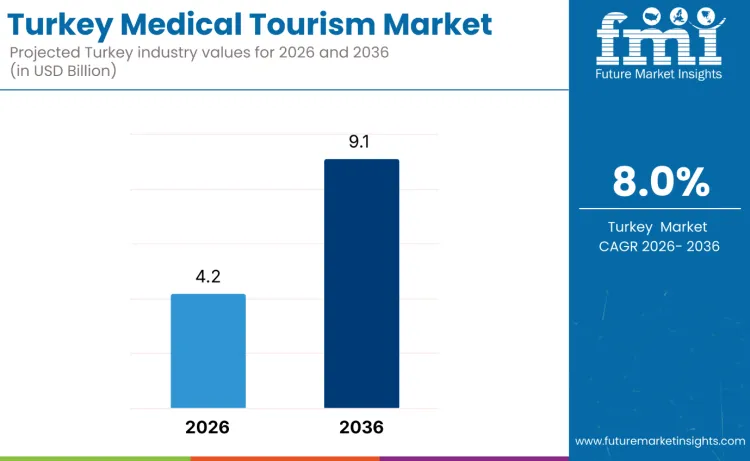
Key Takeaways, Market Size, and Forecast
| Metric | Value |
|---|---|
| Market Size (2026) | USD 4.2 Billion |
| Market Size (2036) | USD 9.1 Billion |
| CAGR (2026–2036) | 8.0% |
| Leading Treatment Type (2026) | Cosmetic Surgery |
| Cosmetic Surgery Share (2026) | 28.4% |
| Leading Service Provider (2026) | Private Healthcare |
| Private Healthcare Share (2026) | 72.6% |
| Fastest-Growing Segment | Istanbul |
| Istanbul CAGR | 9.2% |
Turkey Medical Tourism Market Key Takeaways
| Metric | Value |
|---|---|
| Market Value (2026) | USD 4.2 billion |
| Market Forecast Value (2036) | USD 9.1 billion |
| Forecast CAGR (2026-2036) | 8.0% |
Source: Future Market Insights analysis, supported by a proprietary forecasting model and primary research
Why is the Demand for Turkey Medical Tourism Growing?
Healthcare administrators and medical professionals are integrating comprehensive medical tourism packages to address challenges created by stringent quality requirements in aesthetic surgery, dental procedures, and specialized treatment applications. Medical tourism processes demand consistent clinical standards, controlled treatment protocols, and uniform service delivery to achieve patient satisfaction, treatment efficacy, and procedural safety. Turkey medical tourism helps maintain treatment consistency and reduces cost requirements, improving accessibility and service throughput without compromising clinical quality specifications. High-grade medical facilities enhance patient experience during comprehensive treatment processes, enabling precision healthcare delivery and quality control across diverse medical applications.
Medical tourism teams use specialized treatment protocols to maintain clinical excellence in procedures requiring advanced technology, treatment precision, and patient care performance. Procurement of premium healthcare services is reinforced by growth in cosmetic surgery, dental implant, and hair transplant markets where service quality directly impacts patient outcomes. Service providers refine treatment methods that deliver consistent clinical results, patient safety, and care coordination supporting international patient management systems. Quality evaluation and clinical assessment guide selection to achieve target treatment characteristics, safety properties, and medical effectiveness in diverse procedures. Expansion of medical tourism facilities and specialized treatment centers underpins continuous integration of these critical healthcare services.
How Is the Turkey Medical Tourism Market Structured by Treatment Type and Service Provider?
Turkey medical tourism plays a critical role in delivering clinical excellence, cost efficiency, and service accessibility across cosmetic surgery, dental treatment, and specialized medical applications. Adoption is influenced by quality requirements, treatment specifications, service compatibility, and patient outcome criteria. Segmentation by treatment type, service provider, and provincial distribution highlights how healthcare facilities select specific medical protocols to meet clinical targets, safety properties, and quality standards across diverse treatment processes.
Which Treatment Type Holds the Largest Share in Turkey Medical Tourism?
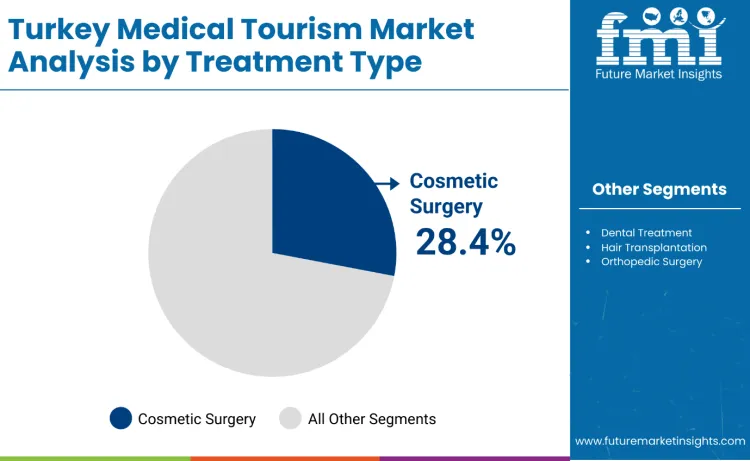
Cosmetic surgery accounts for 28.4%, driven by extensive demand for aesthetic procedures, plastic surgery, and beauty enhancement requiring clinical precision and recovery efficiency. Dental treatment holds 24.7%, supporting implant procedures, oral surgery, and cosmetic dentistry applications. Hair transplantation represents 19.8%, favored for follicular procedures, scalp treatment, and hair restoration applications. Orthopedic surgery contributes 12.3%, used in joint replacement and specialized bone treatment procedures. Other treatments account for 14.8%.
Key Points
- Cosmetic surgery dominates high-volume aesthetic applications
- Dental treatment supports comprehensive oral healthcare markets
- Hair transplantation addresses specialized restoration requirements
How Do Service Provider Requirements Influence Facility Selection?
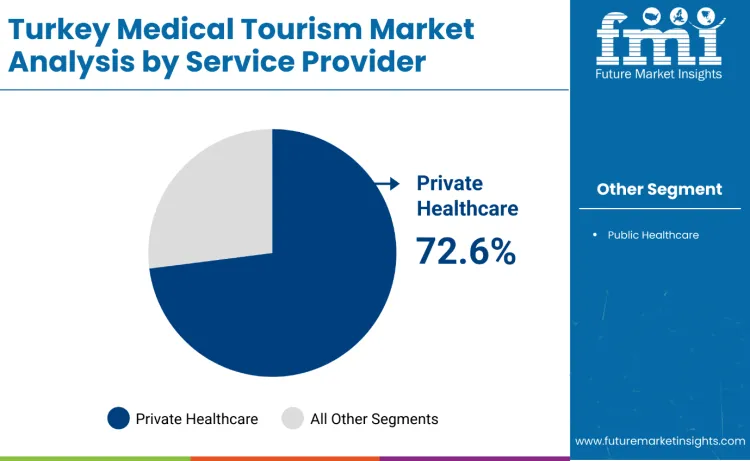
Private healthcare represents 72.6%, reflecting priority on applications requiring advanced technology and personalized service characteristics. Public healthcare accounts for 27.4%, suitable for standard treatment procedures requiring cost-effective delivery and basic medical care.
Key Points
- Private providers remain the primary market segment
- Public providers serve cost-sensitive treatment applications
- Provider selection depends on service quality and technology requirements
What are the Key Dynamics in the Turkey Medical Tourism Market?
Demand in the Turkey medical tourism market arises from patients seeking to improve treatment accessibility, cost efficiency, and service quality in applications where domestic healthcare systems prove insufficient. Activity is notable in private medical facilities, specialized treatment centers, and comprehensive healthcare complexes where international medical tourism addresses accessibility requirements, cost reduction needs, and quality care standards. Service selection centers on clinical expertise, treatment technology, and care coordination that support patient outcomes without compromising medical effectiveness.
How do Quality Requirements In Healthcare Delivery Affect Market Growth?
Market uptake grows where clinical service roles of medical tourism are critical to patient satisfaction. In cosmetic surgery, facilities must maintain consistent treatment protocols and minimal complication rates to achieve procedural effectiveness specifications and aesthetic outcome requirements. Advanced medical procedures use premium healthcare services to ensure clinical safety during treatment operations, preventing complications while maintaining efficient care characteristics. Dental treatment providers depend on consistent service quality to deliver clinical effectiveness, treatment durability, and patient satisfaction properties comparable to established healthcare standards. Providers evaluate performance under clinical protocols and patient feedback to ensure stable outcomes through various treatment processes. Selection reflects how well a service integrates with existing healthcare systems, quality control protocols, and efficiency requirements common to modern medical tourism operations.
What Supply Constraints Influence Turkey Medical Tourism Demand?
Broader deployment is shaped by the geographic concentration of specialized medical facilities, popularity of dental tourism, and healthcare capacity limitations. Some regions experience service constraints due to infrastructure limitations or competing demand from domestic and international applications, requiring careful capacity planning and service diversification. Provincial differences in healthcare quality and transportation infrastructure affect where patients can access premium medical services without triggering complex logistics challenges. Cost considerations arise when travel distances and accommodation requirements are needed to balance service quality, treatment accessibility, and delivered cost outcomes in healthcare operations requiring consistent medical specifications. Resource evaluation processes that assess facility quality and treatment capacity extend service development timelines, influencing decisions about which providers to utilize across diverse medical tourism regions where service availability drives treatment location decisions.
How Is the Turkey Medical Tourism Market Evolving Provincially?
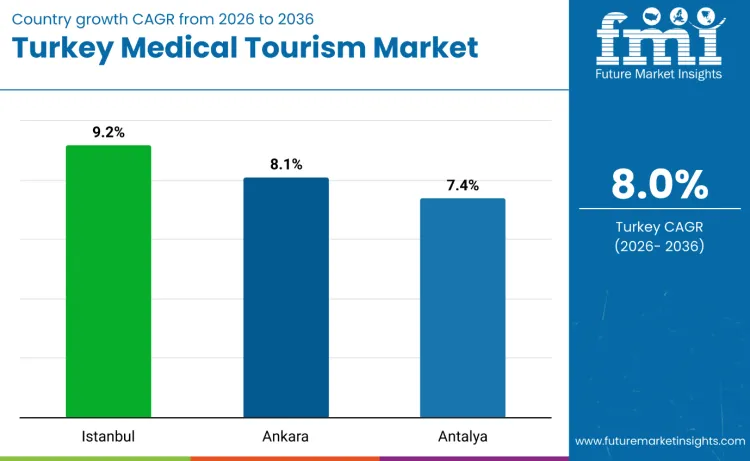
| Province | CAGR (2026-2036) |
|---|---|
| Istanbul | 9.2% |
| Ankara | 8.1% |
| Antalya | 7.4% |
Source: Future Market Insights analysis, supported by a proprietary forecasting model and primary research
Provincial demand for Turkey medical tourism is increasing as healthcare facilities expand treatment capacity while addressing cosmetic surgery, dental treatment, and specialized medical application requirements. Growth reflects rising use of advanced medical protocols, specialized treatment methods, and quality-controlled service delivery across private healthcare facilities, medical centers, and comprehensive treatment systems. Service selection focuses on clinical expertise, facility technology, and treatment effectiveness under various healthcare scenarios. Istanbul records 9.2% CAGR, Ankara records 8.1% CAGR, and Antalya records 7.4% CAGR. Adoption remains driven by clinical quality requirements and treatment effectiveness rather than volume expansion alone.
What is Driving Growth of Turkey Medical Tourism Demand in Istanbul?
Demand for medical tourism in Istanbul is expanding as healthcare facilities develop comprehensive treatment capabilities and quality improvement programs. Growth at 9.2% CAGR reflects rising use of advanced medical protocols, cosmetic surgery applications, and specialized treatment systems addressing international and domestic patient requirements. Service quality improvement under treatment conditions remains critical for patient satisfaction and clinical acceptance. Cost considerations encourage medical services delivering clinical performance and treatment effectiveness at competitive price points. Healthcare providers prioritize services compatible with existing medical infrastructure and treatment capabilities. Demand concentrates within medical tourism clusters, specialized treatment zones, and comprehensive healthcare facilities serving international and domestic markets.
- Expansion of specialized healthcare capabilities
- Need for cosmetic surgery and advanced treatment solutions
- Cost-effective premium medical services
- Growth of international patient treatment capacity
Why is Ankara Seeing Expansion in Medical Tourism Adoption?
Medical tourism demand in Ankara is rising as healthcare systems expand treatment programs and quality enhancement initiatives. Growth at 8.1% CAGR reflects strong activity in specialized medical procedures, dental treatment, and comprehensive healthcare applications. Large-scale medical development is driving demand for services delivering clinical excellence, treatment effectiveness, and procedural efficiency. Healthcare facilities increase utilization of premium medical protocols due to quality requirements and international patient specifications. Provincial healthcare policies support advanced medical delivery and service quality standards. Demand remains centered on major medical districts and integrated healthcare complexes serving national and international patients.
- Expansion of specialized treatment programs
- Healthcare system support for advanced medical delivery
- Growth of comprehensive medical and dental treatment services
- Development of international patient care capabilities
What Factors are Shaping Medical Tourism Services in Antalya?
Medical tourism services in Antalya are increasing as providers expand healthcare facilities and quality improvement capabilities aligned with aesthetic medicine and cosmetic surgery needs. Growth at 7.4% CAGR reflects rising use in cosmetic procedures, dental treatment, and comprehensive medical systems. Service performance under treatment conditions and patient care reliability drives facility selection. Healthcare financing mechanisms increase access to premium medical services for qualifying international patients. Treatment programs focus on clinical excellence and patient satisfaction to demonstrate service value. Demand remains strongest within medical tourism centers and specialized healthcare facilities serving international markets.
- Expansion of specialized healthcare facilities
- Patient access to premium medical services
- Focus on clinical excellence and patient satisfaction
- Growth of comprehensive medical and aesthetic treatment services
What is the Competitive Landscape of the Turkey Medical Tourism Market?
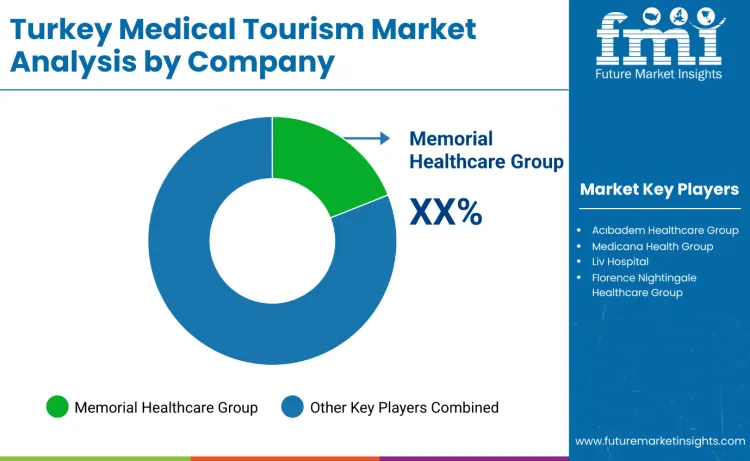
Performance requirements in healthcare delivery, treatment quality, and patient care are shaping demand for medical tourism services. Healthcare providers assess clinical expertise, facility technology, treatment effectiveness, and service reliability during facility selection processes. Quality assessment includes medical accreditation, clinical standards, service compatibility, and integration with existing patient care protocols. Patient behavior reflects extensive quality validation, service reliability requirements, and reliance on providers offering medical expertise and consistent treatment specifications. Trends in the Turkey medical tourism market reflect emphasis on clinical quality and treatment effectiveness in cosmetic surgery, dental procedures, and specialized medical applications.
Memorial Healthcare Group holds leading positioning through integrated medical tourism operations designed to deliver clinical excellence, treatment consistency, and service reliability capabilities. Acıbadem Healthcare Group competes by combining premium medical services with comprehensive quality control systems supporting clinical performance across diverse treatment applications. Medicana Health Group supports demand through specialized treatment protocols aligned with cosmetic surgery and medical procedure requirements. Liv Hospital maintains relevance by supplying advanced medical services enhancing clinical effectiveness and treatment outcome potential. Florence Nightingale Healthcare Group participates with medical tourism services emphasizing clinical expertise and treatment integration. Competitive differentiation centers on service quality, treatment reliability, clinical specifications, and depth of patient care collaboration.
Key Players in the Turkey Medical Tourism Market
- Memorial Healthcare Group
- Acıbadem Healthcare Group
- Medicana Health Group
- Liv Hospital
- Florence Nightingale Healthcare Group
Scope of the Report
| Items | Values |
|---|---|
| Quantitative Units | USD billion |
| Treatment Type | Cosmetic Surgery; Dental Treatment; Hair Transplantation; Orthopedic Surgery; Others |
| Service Provider | Private Healthcare; Public Healthcare |
| End-Use Application | Aesthetic Procedures; Medical Treatment; Dental Care; Specialized Surgery; Others |
| Provinces Covered | Istanbul, Ankara, Antalya |
| Countries Covered | Turkey and 25+ international patient source countries |
| Key Companies Profiled | Memorial Healthcare Group; Acıbadem Healthcare Group; Medicana Health Group; Liv Hospital; Florence Nightingale Healthcare Group; Others |
| Additional Attributes | Dollar revenue by treatment type, service provider, and end-use application; performance in clinical effectiveness and treatment quality across cosmetic surgery, dental treatment, and medical procedure matrices; service quality improvement, treatment efficiency enhancement, and patient benefit under healthcare operations; impact on clinical excellence, treatment reliability, and complication reduction during medical procedures; compatibility with healthcare systems and quality control targets; patient dynamics driven by medical tourism expansion, quality improvement programs, and long-term healthcare service partnerships. |
Turkey Medical Tourism Market by Segment
Treatment Type:
- Cosmetic Surgery
- Dental Treatment
- Hair Transplantation
- Orthopedic Surgery
- Others
Service Provider:
- Private Healthcare
- Public Healthcare
End-Use Application:
- Aesthetic Procedures
- Medical Treatment
- Dental Care
- Specialized Surgery
- Others
Provincial Distribution:
- Istanbul
- Sisli Medical District
- Kadikoy Healthcare Zone
- Besiktas Treatment Center
- Atasehir Medical Complex
- Ankara
- Cankaya Healthcare District
- Kecioren Medical Zone
- Yenimahalle Treatment Area
- Antalya
- Muratpasa Medical Tourism Hub
- Kepez Healthcare Center
- Konyaalti Treatment District
Bibliography
- Turkish Healthcare Quality Council. (2024). Medical Tourism Standards for Healthcare Delivery: Clinical Guidelines. THQC.
- International Medical Tourism Association. (2024). Service Specifications for Medical Tourism: Clinical Excellence and Patient Safety. IMTA.
- Society of Medical Tourism Professionals. (2024). SMTP Guidelines for Medical Tourism Selection in Healthcare Delivery (updated service specifications for clinical and patient care applications). SMTP.
- Ozkan, S. M., et al. (2024). Clinical effectiveness analysis of premium medical tourism on healthcare delivery efficiency: A comprehensive study of cosmetic and dental treatment applications. Journal of Medical Tourism Technology, 28, 45-62.
- Yilmaz, A. K., et al. (2024). Seventh annual medical tourism quality report: Special focus on service reliability and treatment effectiveness in healthcare delivery. International Healthcare Review, 31, 1-18.
Frequently Asked Questions
How big is the Turkey medical tourism market in 2026?
The Turkey medical tourism market is estimated to be valued at USD 4.2 billion in 2026.
What will be the size of the Turkey medical tourism market in 2036?
By 2036, the market is projected to reach USD 9.1 billion.
How fast will the Turkey medical tourism market grow between 2026 and 2036?
The market is expected to expand at an 8.0% CAGR during the 2026 to 2036 forecast period.
Which treatment type holds the largest share in Turkey medical tourism?
Cosmetic surgery leads the market with a 28.4% share, supported by strong international demand for aesthetic and plastic surgery procedures.
Which service provider segment dominates the Turkey medical tourism market?
Private healthcare providers dominate the market, accounting for 72.6% share, driven by advanced technology adoption, personalized care, and shorter treatment waiting times.
Which provinces are driving growth in Turkey medical tourism?
The fastest-growing provinces are Istanbul, Ankara, and Antalya, supported by high concentrations of accredited hospitals, specialized treatment centers, and strong international patient inflows.
Preview the report firsthand - request a free sample
Get SampleGet the brochure for pricing and purchase details.
Get PDFTable of Content
- Executive Summary
- Industry Introduction, including Taxonomy and Market Definition
- Market Trends and Success Factors, including Macro-economic Factors, Market Dynamics, and Recent Industry Developments
- Turkey Medical Tourism Market Demand Analysis 2021 to 2025 and Forecast 2026 to 2036, including Historical Analysis and Future Projections
- Turkey Medical Tourism Market Pricing Analysis 2021 to 2025 and Forecast 2026 to 2036
- Turkey Medical Tourism Market Analysis 2021 to 2025 and Forecast 2026 to 2036, By Treatment Type
- Introduction / Key Findings
- Historical Market Size Value (USD Mn) Analysis By Treatment Type, 2021-2025
- Current and Future Market Size Value (USD Mn) Analysis and Forecast By Treatment Type, 2026-2036
- Cosmetic Surgery
- Dental Treatment
- Cardiovascular Treatment
- Orthopedic Treatment
- Fertility Treatment
- Oncology Treatment
- Neurological Treatment
- Eye Surgery
- Others
- Y-o-Y Growth Trend Analysis By Treatment Type, 2021-2025
- Absolute $ Opportunity Analysis By Treatment Type, 2026-2036
- Turkey Medical Tourism Market Analysis 2021 to 2025 and Forecast 2026 to 2036, By Service Provider
- Introduction / Key Findings
- Historical Market Size Value (USD Mn) Analysis By Service Provider, 2021-2025
- Current and Future Market Size Value (USD Mn) Analysis and Forecast By Service Provider, 2026-2036
- Public Healthcare
- Private Healthcare
- Y-o-Y Growth Trend Analysis By Service Provider, 2021-2025
- Absolute $ Opportunity Analysis By Service Provider, 2026-2036
- Turkey Medical Tourism Market Analysis 2021 to 2025 and Forecast 2026 to 2036, By Booking Channel
- Introduction / Key Findings
- Historical Market Size Value (USD Mn) Analysis By Booking Channel, 2021-2025
- Current and Future Market Size Value (USD Mn) Analysis and Forecast By Booking Channel, 2026-2036
- Phone Booking
- Online Booking
- In Person Booking
- Y-o-Y Growth Trend Analysis By Booking Channel, 2021-2025
- Absolute $ Opportunity Analysis By Booking Channel, 2026-2036
- Turkey Medical Tourism Market Analysis 2021 to 2025 and Forecast 2026 to 2036, By Tour Type
- Introduction / Key Findings
- Historical Market Size Value (USD Mn) Analysis By Tour Type, 2021-2025
- Current and Future Market Size Value (USD Mn) Analysis and Forecast By Tour Type, 2026-2036
- Independent Tour
- Tour Group
- Package Tour
- Y-o-Y Growth Trend Analysis By Tour Type, 2021-2025
- Absolute $ Opportunity Analysis By Tour Type, 2026-2036
- Turkey Medical Tourism Market Analysis 2021 to 2025 and Forecast 2026 to 2036, By Tourist Type
- Introduction / Key Findings
- Historical Market Size Value (USD Mn) Analysis By Tourist Type, 2021-2025
- Current and Future Market Size Value (USD Mn) Analysis and Forecast By Tourist Type, 2026-2036
- Domestic Tourist
- International Tourist
- Y-o-Y Growth Trend Analysis By Tourist Type, 2021-2025
- Absolute $ Opportunity Analysis By Tourist Type, 2026-2036
- Turkey Medical Tourism Market Analysis 2021 to 2025 and Forecast 2026 to 2036, By Age Group
- Introduction / Key Findings
- Historical Market Size Value (USD Mn) Analysis By Age Group, 2021-2025
- Current and Future Market Size Value (USD Mn) Analysis and Forecast By Age Group, 2026-2036
- 15 to 25 Years
- 26 to 35 Years
- 36 to 45 Years
- 46 to 55 Years
- 56 to 65 Years
- 66 to 75 Years
- Above 75 Years
- Y-o-Y Growth Trend Analysis By Age Group, 2021-2025
- Absolute $ Opportunity Analysis By Age Group, 2026-2036
- Turkey Medical Tourism Market Analysis 2021 to 2025 and Forecast 2026 to 2036, By Region
- Introduction
- Historical Market Size Value (USD Mn) Analysis By Region, 2021-2025
- Current Market Size Value (USD Mn) Analysis and Forecast By Region, 2026-2036
- Marmara Region
- Mediterranean Region
- Aegean Region
- Anatolia Region
- Black Sea Region
- Eastern Turkey
- Market Attractiveness Analysis By Region
- Marmara Region Medical Tourism Market Analysis 2021 to 2025 and Forecast 2026 to 2036
- Historical Market Size Value (USD Mn) Trend Analysis By Market Taxonomy, 2021-2025
- Market Size Value (USD Mn) Forecast By Market Taxonomy, 2026-2036
- By Treatment Type
- By Service Provider
- By Booking Channel
- By Tour Type
- By Tourist Type
- By Age Group
- Market Attractiveness Analysis
- By Treatment Type
- By Service Provider
- By Booking Channel
- By Tour Type
- By Tourist Type
- By Age Group
- Key Takeaways
- Mediterranean Region Medical Tourism Market Analysis 2021 to 2025 and Forecast 2026 to 2036
- Historical Market Size Value (USD Mn) Trend Analysis By Market Taxonomy, 2021-2025
- Market Size Value (USD Mn) Forecast By Market Taxonomy, 2026-2036
- By Treatment Type
- By Service Provider
- By Booking Channel
- By Tour Type
- By Tourist Type
- By Age Group
- Market Attractiveness Analysis
- By Treatment Type
- By Service Provider
- By Booking Channel
- By Tour Type
- By Tourist Type
- By Age Group
- Key Takeaways
- Aegean Region Medical Tourism Market Analysis 2021 to 2025 and Forecast 2026 to 2036
- Historical Market Size Value (USD Mn) Trend Analysis By Market Taxonomy, 2021-2025
- Market Size Value (USD Mn) Forecast By Market Taxonomy, 2026-2036
- By Treatment Type
- By Service Provider
- By Booking Channel
- By Tour Type
- By Tourist Type
- By Age Group
- Market Attractiveness Analysis
- By Treatment Type
- By Service Provider
- By Booking Channel
- By Tour Type
- By Tourist Type
- By Age Group
- Key Takeaways
- Anatolia Region Medical Tourism Market Analysis 2021 to 2025 and Forecast 2026 to 2036
- Historical Market Size Value (USD Mn) Trend Analysis By Market Taxonomy, 2021-2025
- Market Size Value (USD Mn) Forecast By Market Taxonomy, 2026-2036
- By Treatment Type
- By Service Provider
- By Booking Channel
- By Tour Type
- By Tourist Type
- By Age Group
- Market Attractiveness Analysis
- By Treatment Type
- By Service Provider
- By Booking Channel
- By Tour Type
- By Tourist Type
- By Age Group
- Key Takeaways
- Black Sea Region Medical Tourism Market Analysis 2021 to 2025 and Forecast 2026 to 2036
- Historical Market Size Value (USD Mn) Trend Analysis By Market Taxonomy, 2021-2025
- Market Size Value (USD Mn) Forecast By Market Taxonomy, 2026-2036
- By Treatment Type
- By Service Provider
- By Booking Channel
- By Tour Type
- By Tourist Type
- By Age Group
- Market Attractiveness Analysis
- By Treatment Type
- By Service Provider
- By Booking Channel
- By Tour Type
- By Tourist Type
- By Age Group
- Key Takeaways
- Eastern Turkey Medical Tourism Market Analysis 2021 to 2025 and Forecast 2026 to 2036
- Historical Market Size Value (USD Mn) Trend Analysis By Market Taxonomy, 2021-2025
- Market Size Value (USD Mn) Forecast By Market Taxonomy, 2026-2036
- By Treatment Type
- By Service Provider
- By Booking Channel
- By Tour Type
- By Tourist Type
- By Age Group
- Market Attractiveness Analysis
- By Treatment Type
- By Service Provider
- By Booking Channel
- By Tour Type
- By Tourist Type
- By Age Group
- Key Takeaways
- Market Structure Analysis
- Competition Dashboard
- Competition Benchmarking
- Market Share Analysis of Top Players
- By Region
- By Treatment Type
- By Service Provider
- By Booking Channel
- By Tour Type
- By Tourist Type
- By Age Group
- Competition Analysis
- Competition Deep Dive
- Acibadem Hospitals Group
- Overview
- Product Portfolio
- Profitability by Market Segments (Treatment Type/Service Provider/Region)
- Sales Footprint
- Strategy Overview
- Marketing Strategy
- Product Strategy
- Channel Strategy
- Memorial Hospital Group
- Florence Nightingale Hospitals
- Medicana International Hospital
- American Hospital
- Liv Hospital
- Hisar Intercontinental Hospital
- Medical Park Hospitals Group
- Baskent University Hospitals
- Anadolu Medical Center
- Acibadem Hospitals Group
- Competition Deep Dive
- Assumptions & Acronyms Used
- Research Methodology


