

- Market Size (2026)
- USD 379.1 Mn
- Forecast (2036)
- USD 1136.1 Mn
- CAGR (2026 to 2036)
- 11.6%
How big is Ultra-Endurance Nutrition Market in 2026?
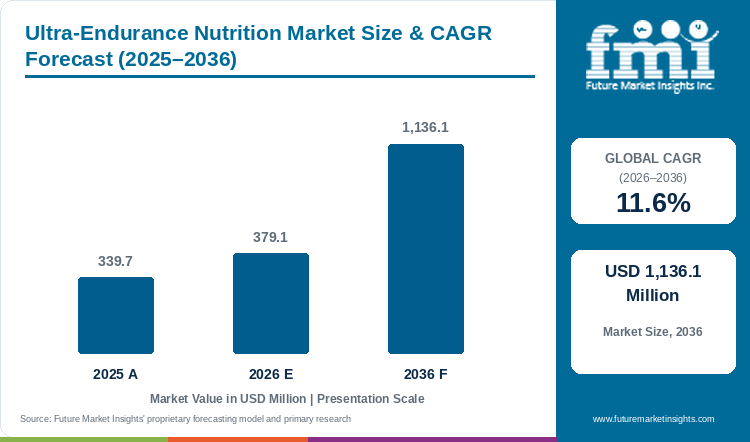
Demand for ultra-endurance nutrition is projected to expand at 11.6% CAGR between 2026 and 2036. Industry value grows from USD 339.7 million in 2025 to USD 379.1 million in 2026 and is projected to reach USD 1,136.1 million by 2036.
The global ultra-endurance nutrition market was valued at USD 339.7 million in 2025 and is projected to grow from USD 379.1 million in 2026 to USD 1,136.1 million by 2036, at 11.6% CAGR from 2026 to 2036. High-Carb Drink Mixes accounted for the leading 46.7% share of Product Type demand in 2026, as one bottle can carry a larger part of the hourly fueling plan. Outdoor Industry Association reported 17.2 million trail runners in the USA during 2025, up 6.6% in one year and 57% since 2019.[1] This expands the number of athletes using sports nutrition products during training and events. UTMB World Series brought together 146,933 runners across 55 events and 266 races in 28 countries during 2025.[4] Such event activity creates repeated use over several training weeks instead of one race-day purchase. Tailwind Nutrition launched High Carb Fuel in April 2025 with 90 g of carbohydrate, 660 mg sodium and 90 mg potassium per serving.[3] The product shows how suppliers are combining dense carbohydrate delivery with hydration in order to reduce the number of separate packs carried during longer efforts.
Key Market Trends & Insights
- By product type: High-Carb Drink Mixes led with 46.7% share in 2026, while Tailwind Nutrition introduced a 90 g carbohydrate serving for high-intensity endurance efforts.
- By event type: Ultramarathon & Trail represented 45.5% in 2026, aligned with 146,933 runners taking part across the 2025 UTMB World Series circuit.
- By carb system: Glucose:Fructose 1:0.8 held a 45.6% share in 2026, supported by Science in Sport Beta Fuel 80 providing 80 g of dual-source carbohydrate in a 1:0.8 ratio.
- By form: Drink Mixes accounted for 50.8% in 2026, enabled by Skratch Labs introducing a modular hydration system in August 2025 allowing athletes to alter sodium and carbohydrate.
- By sales channel: Online / DTC generated 48.4% in 2026, as specialized brands use direct product guides, mixing instruction, and repeat ordering for products not held by general retailers.
Regional Highlights
- Fastest-growing profiled country: South Korea, at 11.7% CAGR from 2026 to 2036, supported by multi-distance trail race expansion such as TransJeju by UTMB.
- By country: The USA, at 11.2%, and the UK, at 10.9%, follow, while Japan records the lowest profiled CAGR at 9.6%.
Market Size & Forecast
Table 1: Market Size and Forecast for the Ultra-Endurance Nutrition Market (USD million and percentage), 2025 to 2036
| Metric | Value |
|---|---|
| 2025 Market Size | USD 339.7 million |
| Estimated Market Size in 2026 | USD 379.1 million |
| Projected Market Size by 2036 | USD 1,136.1 million |
| CAGR, 2026 to 2036 | 11.6% |
| Added Revenue, 2026 to 2036 | USD 757.0 million |
| Market Expansion Multiple | 3.0x |
Basis: Added revenue equals the 2036 forecast less the 2026 estimate. Expansion multiple equals the 2036 forecast divided by the 2026 estimate; values are rounded to one decimal place.
Repeat demand is controlled by the number of training and racing hours in which athletes must consume fuel, and not by event entry alone. High-carb drink mixes will account for 46.7% of product type demand in 2026, according to FMI, with athletes shifting toward bottle-based fueling during long sessions. UTMB World Series reported that participants covered 8.9 million kilometres in 2025, while 73% of registered runners came from the host country or neighbouring nations.[4] A wider local event base extends demand into weekly training, travel and race preparation. Product qualification remains equally important because higher intake must be practised before race day. Science in Sport recommends 80 g to 120 g of carbohydrate per hour for prolonged endurance exercise and provides Beta Fuel formats carrying 40 g per gel, 46 g per chew bar and 80 g per drink serving.[5] Athletes increasingly alternate between energy gels and electrolyte drink mixes to reach hourly sodium targets. These figures indicate that repeat purchase will favour products which can be combined to reach an hourly target, remain tolerated during training, and are available through the complete event season.
Repeat-Use Demand Analysis
Table 2: Repeat-Use Demand Indicators for the Ultra-Endurance Nutrition Market (participants, events, distances, carbohydrate and market calculations), mixed reporting years from 2025 to 2036
| Indicator | Data Point | Why It Matters | Source or Basis |
|---|---|---|---|
| USA trail running participation | 17.2 million in 2025; +6.6% year on year | Widens the buyer base beyond professional athletes. | [1] |
| UTMB World Series activity | 146,933 runners; 55 events; 266 races in 2025 | Creates repeated training and race-day product use. | [4] |
| IRONMAN event reach | 170+ triathlons worldwide | Supports nutrition use across training blocks and event travel. | [8] |
| High-carb bottle serving | 90 g carbohydrate per serving | One serving can cover a large part of an hourly target. | [3] |
| Dual-source drink serving | 80 g carbohydrate per serving | Shows use of measured glucose-fructose systems for longer sessions. | [5] |
| Forecast revenue addition | USD 757.0 million, 2026 to 2036 | Represents the absolute value added over the forecast period. | Calculated from report values |
| Forecast expansion multiple | 3.0x from 2026 to 2036 | Shows the 2036 market is about three times the 2026 value. | Calculated from report values |
Note: Supporting indicators use the latest stated year available from each source. Market calculations use USD 379.1 million for 2026 and USD 1,136.1 million for 2036.
Analyst Perspective
“High carbohydrate targets will support demand when athletes can practise the same intake without repeated gastrointestinal problem. Modular fuel and hydration plans are expected to gain preference as fluid and energy requirements changes during longer events.”
- Nandini Roy Choudhury, Principal Consultant, Future Market Insights.
How is the ultra-endurance nutrition market segmented?
Ultra-endurance nutrition market is segmented by Product Type, Event Type, Carb System, Form, Sales Channel and Region. In 2026, High-Carb Drink Mixes hold 46.7%, Ultramarathon & Trail holds 45.5%, Glucose:Fructose 1:0.8 holds 45.6%, Drink Mixes hold 50.8% and Online / DTC holds 48.4%.
On the basis of Product Type, market is segmented into High-Carb Drink Mixes, Hydrogel Gels, Real-Food Fuel Products, Caffeine-Staged Products and Others. By Event Type, the market includes Ultramarathon & Trail, Ironman & Long-Course Tri, Ultra-Cycling, Adventure & Multi-Day and Others. Carb System includes Glucose:Fructose 1:0.8, Maltodextrin-Based, Whole-Food Carbs and Others. Form includes Drink Mixes, Gels & Chews, Bars & Real Food and Others. Sales Channel includes Online / DTC, Specialty Sports Stores, Supermarkets & Hypermarkets, Pharmacies and Others. Region covers North America, Latin America, Western Europe, Eastern Europe, East Asia, South Asia and Pacific, and Middle East and Africa.
What makes High-Carb Drink Mixes central to the Product Type category?
High-Carb Drink Mixes are projected to capture 46.7% of Product Type revenue in 2026, supported by dense bottle-based carbohydrate delivery.
Table 3: Product Type Share for the Ultra-Endurance Nutrition Market (percentage share), 2026
| Product Type | Share (2026) |
|---|---|
| High-Carb Drink Mixes | 46.7% |
| Other Segments Combined | 53.3%* |
| Total | 100.0% |
*Calculated as the balance remaining after deducting the leading segment's reported share from 100.0%.
Table 4: Product Type Leadership and Market Growth for the Ultra-Endurance Nutrition Market (segment and CAGR percentage), 2026 to 2036
| Metric | Value |
|---|---|
| Global CAGR (2026 to 2036) | 11.6% |
| Leading Segment | High-Carb Drink Mixes |
High-Carb Drink Mixes are nutrition products that provide a higher amount of carbohydrate through one bottle, reducing the requirement of opening several packets during cycling, trail running, and triathlon. Dense formulation allows athletes to meet elevated hourly carbohydrate targets while advancing beyond traditional sports drink formulations. Hydrogel gels and chew formats offer alternative delivery routes, while real-food products serve lower-intensity periods. The 46.7% demand share is supported by broad bottle-based fueling across running and cycling events. Products combining stable gastric emptying, high solubility, and balanced electrolytes are expected to maintain category leadership through 2036.
- High-Carb Drink Mixes are expected to account for 46.7% share in 2026, supported by dense carbohydrate delivery and bottle-based convenience during endurance efforts.
- In April 2025, Tailwind Nutrition launched High Carb Fuel with 90 g of carbohydrate per serving in a 2:1 glucose-to-fructose ratio for high-intensity endurance activity[3].
Why does Ultramarathon & Trail anchor the Event Type category?
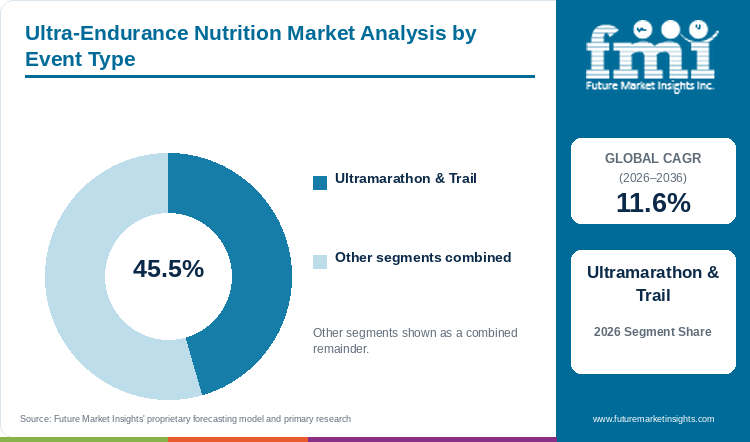
Ultramarathon & Trail is estimated to represent 45.5% of Event Type demand in 2026, reflecting extended race duration and frequent fueling needs.
Ultramarathon and trail events continue for longer hours and require athletes to consume food and fluid repeatedly across the course. Changing terrain and longer distances between aid stations increase the need for portable, calorie-dense nutrition. Athletes frequently utilize high-carbohydrate energy gels and drink mixes to maintain blood glucose levels over mountainous profiles. The presence of international circuits encourages athletes to test nutrition during training blocks, as runners avoid trying unproven products on race day. The 45.5% demand share reflects the multi-hour fueling requirement inherent in trail and ultra racing. Products providing steady gastric comfort and convenient carrying are expected to retain strong demand through 2036.
- Ultramarathon & Trail accounts for 45.5% share in 2026, reflecting extended event duration and continuous hourly energy requirements.
- In 2025, UTMB World Series engaged 146,933 runners across 55 events and 266 races in 28 countries[4].
What supports Glucose:Fructose 1:0.8 leadership within Carb System?
With an estimated 45.6% share in 2026, Glucose:Fructose 1:0.8 leads Carb System, driven by non-competing intestinal absorption pathways.
Glucose:Fructose 1:0.8 is a dual-source carbohydrate system used in endurance formulations designed for elevated hourly intake. By combining maltodextrin and fructose to utilize separate SGLT1 and GLUT5 intestinal transporters, this ratio enables higher total carbohydrate oxidation with reduced gastrointestinal distress compared to single-source glucose formulations. Maltodextrin-only and whole-food systems provide alternative options, while 1:0.8 ratios dominate high-performance racing lines. The 45.6% share is supported by scientific consensus on multiple transportable carbohydrates. Formulations that balance osmolality and gut comfort will continue to gain traction through 2036.
- Glucose:Fructose 1:0.8 accounts for 45.6% share in 2026, supported by multi-transporter intestinal absorption that facilitates high hourly intake.
- In June 2025, Science in Sport renewed its performance partnership with INEOS Grenadiers through 2026 for nutrition development[5].
Why do Drink Mixes lead the Form category?
Drink Mixes are anticipated to contribute 50.8% of Form sales in 2026, owing to adjustable concentration and integrated fluid replenishment.
Drink Mixes combine carbohydrate delivery with fluid hydration, allowing athletes to adjust caloric concentration according to environmental heat and race duration. Athletes frequently tailor intake through modular hydration systems that decouple sodium from carbohydrate volume. This format minimizes packet handling and pocket clutter during long bike legs or mountain runs. Gels, chews, and real-food bars serve complementary roles, while drink powders remain the primary volume carrier in multi-hour hydration packs and bottles. The 50.8% share is enabled by flexibility in mixing and preparation. Formulas offering clean taste and rapid dissolution are anticipated to maintain high adoption through 2036.
- Drink Mixes account for 50.8% share in 2026, enabled by adjustable caloric density and lower carrying complexity across multi-hour events.
- In August 2025, Skratch Labs launched a modular Hydration System featuring distinct hydration, high-carb, and electrolyte mix components[6].
What keeps Online / DTC ahead within Sales Channel?
Online / DTC is set to command 48.4% of Sales Channel revenue in 2026, reinforced by direct education-led selling and recurring subscriptions.
Online / DTC channels allow specialized nutrition brands to provide detailed mixing guides, fueling calculators, and educational content directly to athletes. Specialized formulations and high-carb systems are rarely stocked across conventional retail shelves, making direct brand websites the preferred discovery and replenishment hub. Availability of subscription models and international shipping further reinforces repeat purchasing across training cycles. The 48.4% share reflects direct customer relationships and educational marketing. Platforms offering personalized nutrition consultations and bundle savings will continue to lead sales through 2036.
- Online / DTC accounts for 48.4% share in 2026, underpinned by direct education-led selling and dependable repeat replenishment of specialty products.
- In March 2025, Tailwind Nutrition confirmed international direct-to-consumer shipping alongside localized partner distribution networks[7].
What are the drivers, restraints, and opportunities in the ultra-endurance nutrition market?
Expansion of long-distance participation is driving demand for repeatable nutrition, whereas gastrointestinal tolerance may limit high-dose intake. Personalized carbohydrate and sodium plans is expected to create new growth opportunities.
- Driver: Growing participation in trail, triathlon and long-course events is increasing demand for portable carbohydrate products.
- Restraint: Gastrointestinal tolerance and interaction between carbohydrate concentration and fluid intake may hamper product adoption.
- Opportunity: Personalized fuel and hydration plans can support bundles which are practised and purchased throughout a training block.
Expanding Race Calendars Increase Product Trial
Growing participation in organized multi-hour events is elevating the requirement for nutrition products that can be consumed continuously over several hours. In 2025, the International Trail Running Association recorded over 8,000 sanctioned trail races worldwide, reflecting expanding race calendars across continents.[17] Athletes generally purchase and test products during multi-week training blocks before using the same formulation on course. This dynamic creates steady demand for portable functional foods that sustain energy. An FMI analyst notes that rising participation in 50k and 100-mile events is expanding product consumption into multi-week training blocks. Expanding event participation is expected to drive category expansion through 2036.
Digestive Tolerance Restricts High-Dose Intake
Gastrointestinal tolerance is one of the primary factors restricting the widespread adoption of aggressive high-carbohydrate nutrition systems. A February 2026 review on endurance fueling stated that carbohydrate targets should be practised and adjusted according to event duration and individual athlete tolerance.[9] Consuming elevated carbohydrate concentrations without appropriate fluid intake frequently triggers gastric distress and cramping. Athletes also balance high-carb drinks with plant-based bars and solid snacks to avoid flavor fatigue. Owing to gastrointestinal limitations, many athletes continue with lower doses or familiar formulations even when advanced systems are available. Difficulty in establishing uniform intake guidelines across diverse athletic cohorts may hamper market expansion.
Personalized Fueling Strategies Open New Growth
Personalized carbohydrate, sodium, and fluid planning is creating substantial commercial opportunities for ultra-endurance nutrition companies. In March 2026, Precision Fuel & Hydration became title partner of the 2026, 2027 and 2028 IRONMAN 70.3 World Championship events, providing athlete hydration support and access to a free race-day nutrition planner.[10] Digital algorithms allow athletes to configure bespoke combinations of drink mixes, chews, and electrolytes tailored to ambient temperature, course duration, and individual sweat rates. Offering customized product bundles and training trial packs enables brands to convert initial event interest into recurring seasonal purchases over the forecast period.
Which country CAGRs are profiled in the ultra-endurance nutrition market?
Table 5: Country CAGR Comparison for the Ultra-Endurance Nutrition Market (CAGR percentage), 2026 to 2036
| Country | CAGR (2026 to 2036) |
|---|---|
| South Korea | 11.7% |
| USA | 11.2% |
| UK | 10.9% |
| Germany | 10.6% |
| Japan | 9.6% |
How do country-level CAGRs compare in the ultra-endurance nutrition market?
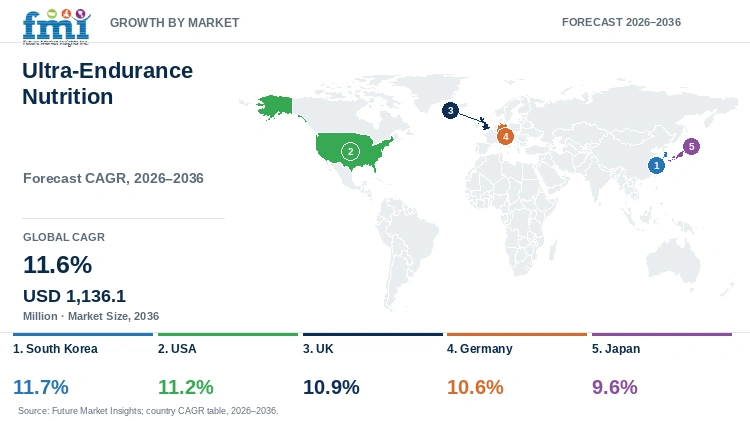
Commercial conditions differ across the profiled countries owing to variations in event density, specialist retail networks, and regional training cultures. In the FMI report, South Korea and the USA show comparatively stronger expansion profiles, whereas the UK, Germany, and Japan develop through established endurance communities and localized racing circuits. South Korea benefits from rapid growth in alpine trail series and organized fitness infrastructure, while the USA anchors demand through a vast trail running and gravel cycling base. The UK and Germany emphasize structured endurance retail access, and Japan prioritizes portable, digestive-friendly formulations. Regional adoption remains uneven, reflecting local event logistics, distribution access, and athlete purchasing behavior.
Country-wise Analysis
- South Korea is projected to grow at 11.7% CAGR between 2026 and 2036, supported by expanding alpine race circuits and growing outdoor fitness participation. In January 2026, the Ministry of Culture, Sports and Tourism [11] reported that 62.9% of citizens participated in weekly sports, with outdoor trail and hiking activities engaging 17.1% of participants[11]. TransJeju by UTMB listed four races ranging from 20 km to 148 km in October 2026, providing local runners opportunities to practice multi-hour fueling strategies.[2] FMI data suggests the higher expansion rate will depend on connecting organized trail circuits with wider retail distribution. Dependable product availability during training blocks and race weeks is expected to support sustained category growth in South Korea.
- Ultra-endurance nutrition demand in the USA is forecast to rise at 11.2% CAGR through 2036, supported by established trail running, gravel cycling, and ultra-distance triathlon communities. In February 2025, USA Triathlon [12] reported sanctioning over 4,000 multi-sport events nationwide across youth, age-group, and elite endurance divisions[12]. A large active participant base is increasing the use of portable carbohydrate products beyond professional ranks into everyday training. FMI research indicates that expanding participation across trail running and gravel events will continue to drive repeat consumption through 2036. Specialized running retailers, direct brand platforms, and organized club partnerships provide accessible channels for diverse flavor profiles and modular serving formats.
- The UK market is anticipated to expand at 10.9% CAGR from 2026 to 2036, owing to active fell and trail running traditions alongside specialized endurance retail networks. The Active Lives Adult Survey published by Sport England [13] in 2025 recorded approximately 7.1 million adults participating in running and athletics across England[13]. Preparing for multi-hour events in unpredictable weather elevates athlete demand for compact chewable energy formats and portable drink systems. Athletes generally validate product tolerance during wet and cold training sessions before adopting a fixed race-day regimen. Established specialist running outlets and expanding digital subscriptions are expected to underpin steady demand expansion across the UK.
- Germany is projected to register 10.6% CAGR through 2036, attributed to established trail running, mountain marathons, and long-course triathlon participation. In June 2025, IRONMAN reported that early registration for 2026 Hamburg races increased by 85% year on year, with over half of entrants selecting their first full-distance race[14]. First-time long-distance competitors require structured fueling guidelines and repeated product testing across training cycles to avoid race-day gastrointestinal complications. The Deutscher Olympischer Sportbund recorded robust membership across endurance athletics clubs, reinforcing grass-roots participation. Increasing competition entries and broad availability through domestic specialty sports shops and online channels are anticipated to drive German demand.
- Japan is estimated to expand at 9.6% CAGR between 2026 and 2036, supported by established mountain trail competitions and growing marathon participation. The Sasakawa Sports Foundation [15] reported in its national sports-life survey that jogging and running engaged 9.38 million adults across Japan[15]. Regional events such as Mt. Fuji 100 allow Japanese runners to refine hourly fueling protocols before competing internationally. Japanese buyers place high importance on clean flavor profiles, convenient small-volume packaging, and dependable gastrointestinal tolerance. Expanding regional trail circuits and domestic formulation availability are projected to maintain steady adoption across Japanese endurance athletes.
Who are the notable companies in the ultra-endurance nutrition market?
Maurten, Tailwind Nutrition, Spring Energy, GU Energy, Science in Sport (SiS), Precision Fuel & Hydration, Skratch Labs and Naak are the notable companies profiled in this market.
Ultra-endurance nutrition market is moderately fragmented with presence of engineered carbohydrate suppliers, portable multi-format companies and real-food oriented brands. Maurten, Tailwind Nutrition, Science in Sport and Precision Fuel & Hydration are focusing on measured carbohydrate delivery and endurance planning. GU Energy and Skratch Labs offers drink mixes, gels, chews and food formats, whereas Spring Energy and Naak has stronger presence in real-food and complete-fuel products. Companies are entering into event partnerships and launching higher carbohydrate products in order to cater the growing demand from runners, cyclists and triathletes. Expansion of product portfolio and direct online distribution is expected to increase market share and customer base over the forecast period.
- Engineered High-Carbohydrate Delivery Systems: Maurten, Tailwind Nutrition, Science in Sport, and Precision Fuel & Hydration compete through high-density formulations designed for 80 to 120 grams per hour.
- Modular and Portable Multi-Format Fueling: GU Energy and Skratch Labs provide versatile drink mixes, energy chews, and hydration powders adaptable to weather and sweat variations.
- Ultra-Specific Real-Food and Complete-Fuel Positions: Spring Energy and Naak offer natural whole-food purees, bars, and sustained-release nutrients that avoid gastrointestinal fatigue during multi-day events.
Competitive Benchmarking: Ultra-Endurance Nutrition Market
Table 6: Competitive Benchmarking for the Ultra-Endurance Nutrition Market (qualitative capability ratings), 2026
| Company | High-Carb Delivery | Format Breadth | Individualization / Race Integration | Geographic Reach |
|---|---|---|---|---|
| Maurten | High | High | High | Medium |
| Tailwind Nutrition | High | Medium | Medium | Medium |
| Spring Energy | Medium | High | Medium | Medium |
| GU Energy | Medium | High | Medium | Medium |
| Science in Sport (SiS) | High | High | Medium | Medium |
| Precision Fuel & Hydration | High | High | High | Medium |
| Skratch Labs | High | High | High | Medium |
| Naak | Medium | High | High | Medium |
High indicates wider documented capability, Medium indicates narrower documented capability and Low indicates limited documented breadth. Ratings do not indicate product quality, revenue share or company ranking.
Key Developments in the Ultra-Endurance Nutrition Market
- In July 2026, Maurten introduced Gel Mix 480 with 120 g of carbohydrate when mixed with 200 ml of water for soft flask carrying during ultra-distance running and cycling [16].
- In March 2026, Precision Fuel & Hydration became title partner of the 2026, 2027 and 2028 IRONMAN 70.3 World Championship events, integrating on-course hydration with its online fueling planner [10].
- In August 2025, Skratch Labs launched a modular Hydration System featuring distinct hydration, high-carb, and electrolyte mix components [6].
- In June 2025, Science in Sport renewed its performance partnership with INEOS Grenadiers through 2026, retaining embedded nutrition practitioners and research initiatives [5].
Key Players in the Ultra-Endurance Nutrition Market
Engineered High-Carbohydrate Delivery Systems
- Maurten
- Tailwind Nutrition
- Science in Sport (SiS)
- Precision Fuel & Hydration
Modular and Portable Multi-Format Fueling
- GU Energy
- Skratch Labs
Ultra-Specific Real-Food and Complete-Fuel Positions
- Spring Energy
- Naak
Ultra-Endurance Nutrition Market - Report Scope
Table 7: Report Scope for the Ultra-Endurance Nutrition Market (coverage fields and definitions), 2026 to 2036
| Coverage field | Report scope |
|---|---|
| Market breakdown | Product Type; Event Type; Carb System; Form; Sales Channel |
| Quantitative Units | USD Million |
| Market Definition | Revenue covers ultra-endurance nutrition products sold within listed product, event, carb-system, form and sales-channel categories. It excludes event or coaching revenue, equipment, generic foods not positioned for endurance fueling, recovery-only categories outside in-session fueling and substitute nutrition products. |
| Regions Covered | North America; Latin America; Western Europe; Eastern Europe; East Asia; South Asia and Pacific; Middle East and Africa |
| Countries Covered | USA; UK; Germany; Japan; South Korea |
| Key Companies Profiled | Maurten; Tailwind Nutrition; Spring Energy; GU Energy; Science in Sport; Precision Fuel & Hydration; Skratch Labs; Naak |
| Forecast Period | 2026 to 2036 |
| Approach | Primary and secondary research with market triangulation. |
Ultra-Endurance Nutrition Market - Research Methodology
Table 8: Research Methodology for the Ultra-Endurance Nutrition Market (research methods and approach), 2026 edition
| Method | Approach |
|---|---|
| Primary Research | The research study includes primary interviews with manufacturers, distributors, retailers, end users and industry experts. Interviews covers product evaluation, purchasing decision, price, adoption barrier and requirement before an initial trial develops into regular purchase. |
| Desk Research | Desk research includes government statistics, industry associations, sports organizations, technical literature, product information and official company announcements. Every source is reviewed according to publication date, direct relevance and consistency with the ultra-endurance nutrition market scope. |
| Market Sizing and Forecasting | Market size is calculated by combining baseline value, segment structure, product pricing, participation indicators, company activity and country demand condition. Segment and regional values are checked with each other before calculating the final market value. |
| Data Validation | Market estimates are checked against public data, company activity, event participation and primary interviews. Adjacent products, unsupported claims and overlapping revenue are removed from the final market calculation. |
Ultra-Endurance Nutrition Market by Segments
Ultra-Endurance Nutrition Market segmented by Product Type:
- High-Carb Drink Mixes (80 to 100 g/h Systems)
- Hydrogel Gels
- Real-Food Fuel Products
- Caffeine-Staged Products
- Others
Ultra-Endurance Nutrition Market segmented by Event Type:
- Ultramarathon & Trail
- Ironman & Long-Course Tri
- Ultra-Cycling
- Adventure & Multi-Day
- Others
Ultra-Endurance Nutrition Market segmented by Carb System:
- Glucose:Fructose 1:0.8
- Maltodextrin-Based
- Whole-Food Carbs
- Others
Ultra-Endurance Nutrition Market segmented by Form:
- Drink Mixes
- Gels & Chews
- Bars & Real Food
- Others
Ultra-Endurance Nutrition Market segmented by Sales Channel:
- Online / DTC
- Specialty Sports Stores
- Supermarkets & Hypermarkets
- Pharmacies
- Others
Ultra-Endurance Nutrition Market by Region
- North America
- United States
- Canada
- Latin America
- Brazil
- Mexico
- Argentina
- Chile
- Western Europe
- Germany
- France
- United Kingdom
- Italy
- Spain
- Benelux
- Nordics
- Eastern Europe
- Poland
- Czech Republic
- Romania
- Hungary
- East Asia
- China
- Japan
- South Korea
- South Asia and Pacific
- India
- ASEAN
- Australia and New Zealand
- Middle East and Africa
- GCC Countries
- South Africa
- Türkiye
- Israel
Research Sources and Bibliography
- [1] Outdoor Industry Association. (2026). 2026 Running Report.
- [2] UTMB World Series. (2026). TransJeju by UTMB: 2026 race distances and event program.
- [3] Tailwind Nutrition. (2025, April 9). Tailwind Nutrition launches High Carb Fuel.
- [4] UTMB World Series. (2025, December 17). UTMB World Series 2025: A season shaped by performance, inclusion and responsibility.
- [5] Science in Sport. (2025, June 12). Science in Sport announce partnership renewal with INEOS Grenadiers.
- [6] Skratch Labs. (2025, August 19). Why we created the Skratch Labs Hydration System.
- [7] Tailwind Nutrition. (2025, March 4). Where does your website ship?
- [8] IRONMAN. (2026). IRONMAN race directory.
- [9] Morton, J. P., et al. (2026, February 25). From metabolism to medals: Contemporary perspectives and revisiting carbohydrate guidelines for fueling endurance athletes during exercise. PubMed.
- [10] IRONMAN. (2026, March 24). Precision Fuel & Hydration to become title partner of the 2026, 2027 and 2028 IRONMAN 70.3 World Championship triathlons.
- [11] Ministry of Culture, Sports and Tourism, Republic of Korea. (2026, January 23). 2025 National Sports Participation Survey Report.
- [12] USA Triathlon. (2025, February 12). 2024-2025 Annual Impact and Participation Report.
- [13] Sport England. (2025). Active Lives Adult Survey Report: Running and Athletics Participation in England.
- [14] IRONMAN. (2025, June 20). Record-breaking start for 2026 IRONMAN and IRONMAN 70.3 races in Europe.
- [15] Sasakawa Sports Foundation. (2025). National Sports-Life Survey: Adult Running and Jogging Participation in Japan.
- [16] Maurten. (2026, July 21). Discover Gel Mix 480.
- [17] International Trail Running Association. (2025). Global Trail Running Race Directory and Calendar Statistics.
This bibliography is provided for reader reference. The full report contains the complete reference list and detailed citations.
This Report Answers
- What is the Ultra-Endurance Nutrition Market size in 2026 and what value is forecast for 2036?
- Which participation and fueling factors are supporting market demand?
- Why do High-Carb Drink Mixes hold the leading position in Product Type?
- How does Ultramarathon & Trail influence the timing and volume of endurance fueling?
- Why do Drink Mixes hold the leading position in Product Form?
- How do growth rates differ across South Korea, USA, UK, Germany, and Japan?
- Which companies provide engineered carbohydrate delivery, and which focus on modular or real-food formats?
- How do gastrointestinal tolerance, carbohydrate concentration, and sweat rates limit adoption?
- What should endurance athletes and race organizers evaluate before selecting a nutrition system?
Frequently Asked Questions
How large is the Ultra-Endurance Nutrition Market expected to be in 2026?
The ultra-endurance nutrition market is valued at USD 379.1 million in 2026 and is projected to reach USD 1,136.1 million by 2036. Market expansion is supported by rising participation across ultramarathons, long-course triathlons, and multi-day trail events.
What CAGR is forecast for the Ultra-Endurance Nutrition Market through 2036?
As per FMI, the ultra-endurance nutrition market is projected to grow at an 11.6% CAGR from 2026 to 2036. Demand is reinforced by athletes testing high-density fueling strategies during training cycles rather than relying solely on race-day supplies.
Which product type holds a notable ultra-endurance nutrition demand share in 2026?
High-Carb Drink Mixes are projected to hold 46.7% of Product Type demand in 2026. Concentrated bottle-based delivery allows athletes to meet elevated hourly carbohydrate goals while reducing packet handling during multi-hour efforts.
Which event type segment holds a notable ultra-endurance nutrition share in 2026?
FMI finds that Ultramarathon & Trail will hold 45.5% of Event Type demand in 2026. Extended race duration and remote mountain aid stations necessitate portable, highly concentrated caloric intake.
Which country has a notable ultra-endurance nutrition expansion outlook during the forecast period?
South Korea is anticipated to expand at an 11.7% CAGR during the 2026 to 2036 assessment period. Rapid development of international trail circuits and high outdoor sports participation underpin local market growth.
Which companies are active in the Ultra-Endurance Nutrition Market during 2026?
Notable companies include Maurten, Tailwind Nutrition, Spring Energy, GU Energy, Science in Sport, Precision Fuel & Hydration, Skratch Labs, and Naak. These brands are competing through high-carbohydrate drink mixes, hydrogel technology, modular electrolyte systems, and real-food formulations.
Preview the report firsthand - request a free sample
Get SampleGet the brochure for pricing and purchase details.
Get PDFTable of Content
- Key Takeaways
- Market Size and CAGR
- Top Growth Driver
- Fastest Growing Segment
- Leading Region
- Key Companies
- Emerging Opportunities
- Executive Summary
- Global Market Outlook
- Demand-side Trends
- Supply-side Trends
- Technology Roadmap Analysis
- Analysis and Recommendations
- Analyst Perspective (What is happening? Why now? What should investors know?)
- Key Questions Answered
- How large is the market?
- What is the CAGR?
- What are key trends?
- Which region dominates?
- Who are the leaders?
- Market Overview
- Market Coverage / Taxonomy
- Market Definition / Scope / Limitations
- Research Methodology
- Chapter Orientation
- Analytical Lens and Working Hypotheses
- Market Structure, Signals, and Trend Drivers
- Benchmarking and Cross-market Comparability
- Market Sizing, Forecasting, and Opportunity Mapping
- Research Design and Evidence Framework
- Desk Research Programme (Secondary Evidence)
- Expert Input and Fieldwork (Primary Evidence)
- Tooling, Models, and Reference Databases
- Data Engineering and Model Build
- Quality Assurance and Audit Trail
- Market Background
- Market Dynamics (Drivers, Restraints, Opportunity, Trends)
- Scenario Forecast (Optimistic, Likely, Conservative)
- Impact Analysis
- AI Impact
- Sustainability Impact
- Regulatory Impact
- Technology Impact
- Consumer / Buyer Analysis
- Purchase Drivers
- Adoption Barriers
- Buyer Journey
- Opportunity Map Analysis
- Product Life Cycle Analysis
- Supply Chain Analysis
- Investment Feasibility Matrix
- Value Chain Analysis
- PESTLE and Porter's Analysis
- Regulatory Landscape
- Regional Parent Market Outlook
- Production and Consumption Statistics
- Import and Export Statistics
- Global Market Analysis and Forecast, 2021 to 2036
- Historical Market Size Value (USD Million) Analysis, 2021 to 2025
- Current and Future Market Size Value (USD Million) Projections, 2026 to 2036
- Y-o-Y Growth Trend Analysis
- Absolute $ Opportunity Analysis
- Global Market Pricing Analysis, 2021 to 2036
- Global Market Analysis and Forecast, By Product Type, 2021 to 2036
- Introduction / Key Findings
- Historical Market Size Value (USD Million) Analysis By Product Type, 2021 to 2025
- Current and Future Market Size Value (USD Million) Analysis and Forecast By Product Type, 2026 to 2036
- High-Carb Drink Mixes (80 to 100 g/h Systems)
- Hydrogel Gels
- Real-Food Fuel Products
- Caffeine-Staged Products
- Others
- Y-o-Y Growth Trend Analysis By Product Type, 2021 to 2025
- Absolute $ Opportunity Analysis By Product Type, 2026 to 2036
- Global Market Analysis and Forecast, By Event Type, 2021 to 2036
- Introduction / Key Findings
- Historical Market Size Value (USD Million) Analysis By Event Type, 2021 to 2025
- Current and Future Market Size Value (USD Million) Analysis and Forecast By Event Type, 2026 to 2036
- Ultramarathon & Trail
- Ironman & Long-Course Tri
- Ultra-Cycling
- Adventure & Multi-Day
- Others
- Y-o-Y Growth Trend Analysis By Event Type, 2021 to 2025
- Absolute $ Opportunity Analysis By Event Type, 2026 to 2036
- Global Market Analysis and Forecast, By Carb System, 2021 to 2036
- Introduction / Key Findings
- Historical Market Size Value (USD Million) Analysis By Carb System, 2021 to 2025
- Current and Future Market Size Value (USD Million) Analysis and Forecast By Carb System, 2026 to 2036
- Glucose:Fructose 1:0.8
- Maltodextrin-Based
- Whole-Food Carbs
- Others
- Y-o-Y Growth Trend Analysis By Carb System, 2021 to 2025
- Absolute $ Opportunity Analysis By Carb System, 2026 to 2036
- Global Market Analysis and Forecast, By Form, 2021 to 2036
- Introduction / Key Findings
- Historical Market Size Value (USD Million) Analysis By Form, 2021 to 2025
- Current and Future Market Size Value (USD Million) Analysis and Forecast By Form, 2026 to 2036
- Drink Mixes
- Gels & Chews
- Bars & Real Food
- Others
- Y-o-Y Growth Trend Analysis By Form, 2021 to 2025
- Absolute $ Opportunity Analysis By Form, 2026 to 2036
- Global Market Analysis and Forecast, By Sales Channel, 2021 to 2036
- Introduction / Key Findings
- Historical Market Size Value (USD Million) Analysis By Sales Channel, 2021 to 2025
- Current and Future Market Size Value (USD Million) Analysis and Forecast By Sales Channel, 2026 to 2036
- Online / DTC
- Specialty Sports Stores
- Supermarkets & Hypermarkets
- Pharmacies
- Others
- Y-o-Y Growth Trend Analysis By Sales Channel, 2021 to 2025
- Absolute $ Opportunity Analysis By Sales Channel, 2026 to 2036
- Global Market Analysis and Forecast, By Region, 2021 to 2036
- Introduction
- Historical Market Size Value (USD Million) Analysis By Region, 2021 to 2025
- Current Market Size Value (USD Million) Analysis and Forecast By Region, 2026 to 2036
- North America
- Latin America
- Western Europe
- Eastern Europe
- East Asia
- South Asia and Pacific
- Middle East and Africa
- Market Attractiveness Analysis By Region
- North America Market Analysis and Forecast, By Country, 2021 to 2036
- Historical Market Size Value (USD Million) Trend Analysis By Market Taxonomy, 2021 to 2025
- Market Size Value (USD Million) Forecast By Market Taxonomy, 2026 to 2036
- By Country
- United States
- Canada
- By Product Type
- By Event Type
- By Carb System
- By Form
- By Sales Channel
- By Country
- Market Attractiveness Analysis
- By Country
- By Product Type
- By Event Type
- By Carb System
- By Form
- By Sales Channel
- Key Takeaways
- Latin America Market Analysis and Forecast, By Country
- Historical Market Size Value (USD Million) Trend Analysis By Market Taxonomy, 2021 to 2025
- Market Size Value (USD Million) Forecast By Market Taxonomy, 2026 to 2036
- By Country
- Brazil
- Mexico
- Argentina
- Chile
- By Product Type
- By Event Type
- By Carb System
- By Form
- By Sales Channel
- By Country
- Market Attractiveness Analysis
- By Country
- By Product Type
- By Event Type
- By Carb System
- By Form
- By Sales Channel
- Key Takeaways
- Western Europe Market Analysis and Forecast, By Country
- Historical Market Size Value (USD Million) Trend Analysis By Market Taxonomy, 2021 to 2025
- Market Size Value (USD Million) Forecast By Market Taxonomy, 2026 to 2036
- By Country
- Germany
- France
- United Kingdom
- Italy
- Spain
- Benelux
- Nordics
- By Product Type
- By Event Type
- By Carb System
- By Form
- By Sales Channel
- By Country
- Market Attractiveness Analysis
- By Country
- By Product Type
- By Event Type
- By Carb System
- By Form
- By Sales Channel
- Key Takeaways
- Eastern Europe Market Analysis and Forecast, By Country
- Historical Market Size Value (USD Million) Trend Analysis By Market Taxonomy, 2021 to 2025
- Market Size Value (USD Million) Forecast By Market Taxonomy, 2026 to 2036
- By Country
- Poland
- Czech Republic
- Romania
- Hungary
- By Product Type
- By Event Type
- By Carb System
- By Form
- By Sales Channel
- By Country
- Market Attractiveness Analysis
- By Country
- By Product Type
- By Event Type
- By Carb System
- By Form
- By Sales Channel
- Key Takeaways
- East Asia Market Analysis and Forecast, By Country
- Historical Market Size Value (USD Million) Trend Analysis By Market Taxonomy, 2021 to 2025
- Market Size Value (USD Million) Forecast By Market Taxonomy, 2026 to 2036
- By Country
- China
- Japan
- South Korea
- By Product Type
- By Event Type
- By Carb System
- By Form
- By Sales Channel
- By Country
- Market Attractiveness Analysis
- By Country
- By Product Type
- By Event Type
- By Carb System
- By Form
- By Sales Channel
- Key Takeaways
- South Asia and Pacific Market Analysis and Forecast, By Country
- Historical Market Size Value (USD Million) Trend Analysis By Market Taxonomy, 2021 to 2025
- Market Size Value (USD Million) Forecast By Market Taxonomy, 2026 to 2036
- By Country
- India
- ASEAN
- Australia and New Zealand
- By Product Type
- By Event Type
- By Carb System
- By Form
- By Sales Channel
- By Country
- Market Attractiveness Analysis
- By Country
- By Product Type
- By Event Type
- By Carb System
- By Form
- By Sales Channel
- Key Takeaways
- Middle East and Africa Market Analysis and Forecast, By Country
- Historical Market Size Value (USD Million) Trend Analysis By Market Taxonomy, 2021 to 2025
- Market Size Value (USD Million) Forecast By Market Taxonomy, 2026 to 2036
- By Country
- GCC Countries
- South Africa
- Türkiye
- Israel
- By Product Type
- By Event Type
- By Carb System
- By Form
- By Sales Channel
- By Country
- Market Attractiveness Analysis
- By Country
- By Product Type
- By Event Type
- By Carb System
- By Form
- By Sales Channel
- Key Takeaways
- Key Countries Market Analysis
- United States
- Pricing Analysis
- Market Share Analysis, 2025
- By Product Type
- By Event Type
- By Carb System
- By Form
- By Sales Channel
- Canada
- Pricing Analysis
- Market Share Analysis, 2025
- By Product Type
- By Event Type
- By Carb System
- By Form
- By Sales Channel
- Mexico
- Pricing Analysis
- Market Share Analysis, 2025
- By Product Type
- By Event Type
- By Carb System
- By Form
- By Sales Channel
- Brazil
- Pricing Analysis
- Market Share Analysis, 2025
- By Product Type
- By Event Type
- By Carb System
- By Form
- By Sales Channel
- Chile
- Pricing Analysis
- Market Share Analysis, 2025
- By Product Type
- By Event Type
- By Carb System
- By Form
- By Sales Channel
- Germany
- Pricing Analysis
- Market Share Analysis, 2025
- By Product Type
- By Event Type
- By Carb System
- By Form
- By Sales Channel
- United Kingdom
- Pricing Analysis
- Market Share Analysis, 2025
- By Product Type
- By Event Type
- By Carb System
- By Form
- By Sales Channel
- Italy
- Pricing Analysis
- Market Share Analysis, 2025
- By Product Type
- By Event Type
- By Carb System
- By Form
- By Sales Channel
- Spain
- Pricing Analysis
- Market Share Analysis, 2025
- By Product Type
- By Event Type
- By Carb System
- By Form
- By Sales Channel
- France
- Pricing Analysis
- Market Share Analysis, 2025
- By Product Type
- By Event Type
- By Carb System
- By Form
- By Sales Channel
- India
- Pricing Analysis
- Market Share Analysis, 2025
- By Product Type
- By Event Type
- By Carb System
- By Form
- By Sales Channel
- ASEAN
- Pricing Analysis
- Market Share Analysis, 2025
- By Product Type
- By Event Type
- By Carb System
- By Form
- By Sales Channel
- Australia and New Zealand
- Pricing Analysis
- Market Share Analysis, 2025
- By Product Type
- By Event Type
- By Carb System
- By Form
- By Sales Channel
- China
- Pricing Analysis
- Market Share Analysis, 2025
- By Product Type
- By Event Type
- By Carb System
- By Form
- By Sales Channel
- Japan
- Pricing Analysis
- Market Share Analysis, 2025
- By Product Type
- By Event Type
- By Carb System
- By Form
- By Sales Channel
- South Korea
- Pricing Analysis
- Market Share Analysis, 2025
- By Product Type
- By Event Type
- By Carb System
- By Form
- By Sales Channel
- Poland
- Pricing Analysis
- Market Share Analysis, 2025
- By Product Type
- By Event Type
- By Carb System
- By Form
- By Sales Channel
- Hungary
- Pricing Analysis
- Market Share Analysis, 2025
- By Product Type
- By Event Type
- By Carb System
- By Form
- By Sales Channel
- Türkiye
- Pricing Analysis
- Market Share Analysis, 2025
- By Product Type
- By Event Type
- By Carb System
- By Form
- By Sales Channel
- South Africa
- Pricing Analysis
- Market Share Analysis, 2025
- By Product Type
- By Event Type
- By Carb System
- By Form
- By Sales Channel
- United States
- Market Structure Analysis
- Competition Dashboard
- Competition Benchmarking
- Market Share Analysis of Top Players
- By Regional
- By Product Type
- By Event Type
- By Carb System
- By Form
- By Sales Channel
- Emerging Startups
- Innovation Benchmarking
- Competition Analysis
- Competition Deep Dive
- Maurten
- Overview
- Product Portfolio
- Profitability by Market Segments
- Sales Footprint
- Strategy Overview
- Marketing Strategy
- Product Strategy
- Channel Strategy
- Tailwind Nutrition
- Spring Energy
- GU Energy
- Science in Sport (SiS)
- Precision Fuel & Hydration
- Skratch Labs
- Naak
- Maurten
- Case Studies
- Success Stories
- Recent Developments
- Competition Deep Dive
- Assumptions & Acronyms Used


