

- Industry Size (2026)
- USD 5.82 Bn
- Forecast (2036)
- USD 8.53 Bn
- CAGR (2026 to 2036)
- 3.9%
Demand for Heavy Duty Bag and Sack in USA Size, Market Forecast and Outlook By FMI
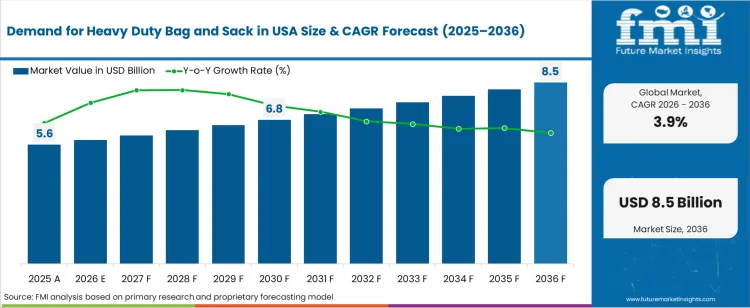
The demand for heavy duty bag and sack in usa was valued at USD 5.60 billion in 2025, projected to reach USD 5.82 billion in 2026, and is forecast to expand to USD 8.53 billion by 2036 at a 3.9% CAGR. Industrial packaging requirements across food, agriculture, chemicals, and construction sectors continue to sustain procurement volumes for heavy duty bags and sacks. The shift toward recyclable and reusable packaging formats under extended producer responsibility frameworks is reshaping material selection, with plastic-based bags retaining volume leadership while woven and jute alternatives gain share in agriculture and bulk commodity applications.
Summary of Demand for Heavy Duty Bag and Sack in USA
- Market Snapshot
- The demand for heavy duty bag and sack in usa is valued at USD 5.60 billion in 2025 and is projected to reach USD 8.53 billion by 2036.
- The industry is expected to grow at a 3.9% CAGR from 2026 to 2036, creating an incremental opportunity of USD 2.71 billion.
- The market occupies a compliance-sensitive industrial packaging category where material recyclability mandates, chemical compatibility requirements, and extended producer responsibility legislation increasingly govern procurement specifications.
- Demand and Growth Drivers
- Industrial packaging requirements across food, agriculture, chemicals, and construction sectors sustain high-volume procurement of heavy duty bags and sacks.
- Extended producer responsibility frameworks and state-level packaging waste legislation are driving material format transitions toward recyclable and reusable configurations.
- Growth of bulk commodity distribution through e-commerce wholesale channels is increasing demand for standardised heavy duty packaging formats.
- Among tracked regions, the West leads at 4.5% CAGR, followed by the South at 4.0%, the Northeast at 3.6%, and the Midwest at 3.1%.
- Product and Segment View
- The market covers open mouth bags, pasted valve bags, gusset bags, rubble sacks, woven sacks, and trash sacks used for industrial and commercial packaging.
- Material formats include plastic (polyethylene, polypropylene) and jute, across capacity bands of less than 20 kg, 20 to 40 kg, and above 40 kg.
- Open Mouth leads by product type with 24.7% share in 2026.
- Plastic leads by material format with 53.7% share in 2026.
- The scope includes heavy duty industrial bags and sacks and excludes retail carrier bags, lightweight produce bags, and flexible film wrapping.
- Geography and Competitive Outlook
- The West leads demand growth driven by agricultural packaging volumes and state-level packaging waste reduction mandates.
- The South and Northeast sustain steady procurement tied to chemical packaging and urban food distribution respectively.
- Competition is shaped by material format range, recyclability certifications, and bulk supply contract capabilities, with key players including Mondi Group, Berry Global, Inc., LC Packaging International BV, Muscat Polymers Pvt. Ltd., Al-Tawfiq Company, Inteplast Group.
Demand for Heavy Duty Bag and Sack in USA Key Takeaways
| Metric | Details |
|---|---|
| Industry Size (2026) | USD 5.82 billion |
| Industry Value (2036) | USD 8.53 billion |
| CAGR (2026 to 2036) | 3.9% |
Source: Future Market Insights, 2026
The incremental opportunity between 2026 and 2036 amounts to USD 2.71 billion. FMI is of the opinion that the market is transitioning from a pure commodity packaging category into a compliance-driven segment where material recyclability, post-consumer recycled content mandates, and chemical compatibility certifications increasingly determine supplier selection. Plastic bags retain volume dominance due to moisture barrier performance, but state-level packaging waste reduction legislation is creating procurement incentives for woven polypropylene and multi-trip sack formats.
Sub-national growth trajectories reflect regional industrial and agricultural concentration. West at 4.5%, South at 4.0%, Northeast at 3.6%, Midwest at 3.1% CAGR characterise the forecast landscape. The West leads, driven by California's agricultural packaging volumes and state-level packaging waste reduction mandates accelerating material format transitions. The South follows, supported by chemical and fertiliser packaging demand along the Gulf Coast industrial corridor. The Northeast reflects food packaging demand from dense urban distribution networks, while the Midwest's growth stems from agricultural commodity bagging and construction material packaging requirements.
Demand for Heavy Duty Bag and Sack in USA Definition
Heavy duty bags and sacks are industrial packaging containers designed to hold, transport, and store bulk materials weighing from less than 20 kg to above 40 kg per unit. The USA market covers open mouth bags, pasted valve bags, gusset bags, rubble sacks, woven sacks, and trash sacks manufactured from plastic (polyethylene, polypropylene) and jute materials. These packaging formats serve food, agriculture, chemical, fertiliser, construction, and automotive product distribution channels.
Demand for Heavy Duty Bag and Sack in USA Inclusions
Market scope includes open mouth bags, pasted valve bags, gusset bags, rubble sacks, woven sacks, and trash sacks manufactured from polyethylene, polypropylene, and jute materials. Multi-wall paper sacks with polymer liners and coated woven bags for chemical containment fall within defined boundaries.
Demand for Heavy Duty Bag and Sack in USA Exclusions
Retail carrier bags, lightweight produce bags, flexible film wrapping, shrink wrap, stretch film, and corrugated shipping containers are excluded. Flexible intermediate bulk containers (FIBCs) and bulk liquid transport containers are outside the analytical scope.
Demand for Heavy Duty Bag and Sack in USA Research Methodology
- Primary Research: Analysts engaged with procurement managers, laboratory directors, and supply chain specialists to map decision triggers, specification requirements, and adoption timelines across institutional and commercial channels.
- Desk Research: Data collection aggregated regulatory filings, public procurement records, industry association publications, and manufacturer financial disclosures to establish baseline market parameters.
- Market-Sizing and Forecasting: Baseline values derive from a bottom-up aggregation of unit shipment data and average selling prices, applying region-specific adoption curves to project forward demand trajectories.
- Data Validation and Update Cycle: Projections are cross-validated against publicly reported financial disclosures from leading manufacturers and verified against institutional procurement records.
What Is Driving the Demand for Heavy Duty Bag and Sack in the USA?
Demand for heavy duty bags and sacks in the USA is growing as industries such as agriculture, construction, chemicals and mining require durable packaging solutions to transport bulk materials safely and efficiently. These sectors rely on heavy duty bags made from woven polypropylene, multi layer laminates or coated fabrics that resist moisture, tearing and UV damage. Growth in infrastructure spending, increased mining activity and agricultural expansion all contribute to increased consumption of such packaging formats. The trend toward mechanised handling of bulk products and automated bagging lines also supports the use of standardised heavy duty sacks to enable quicker fill rates and improved containment.
Another factor bolstering this demand is the increasing emphasis on sustainability and reuse in industrial packaging. Manufacturers and end users are favoring bags that can be reused multiple times or recycled, reducing total cost of ownership and environmental footprint. Additionally, regulatory pressures on packaging waste and landfill diversion motivate companies to choose heavy duty sacks that meet both performance and eco efficiency criteria. Challenges include fluctuations in raw material costs, competition from alternative containment systems such as bulk bins and flexible intermediate bulk containers (FIBCs), and stringent safety standards for bags used in hazardous materials transport. Nonetheless, the combination of industrial growth, mechanised packaging trends and sustainability imperatives suggests that demand for heavy duty bags and sacks in the USA will continue to expand.
What Is the Current State of the Demand for Heavy Duty Bags and Sacks in the USA in Terms of Product and Material Format?
The demand for heavy-duty bags and sacks in the USA is primarily driven by product type and material format. The leading product type is open mouth bags, which capture 24.7% of the market share, while plastic is the dominant material format, accounting for 53.7% of the demand. Heavy-duty bags and sacks are essential in a wide range of industries, including agriculture, construction, and retail, for packaging, storing, and transporting bulk materials. The demand for these bags continues to grow as industries increasingly require durable, high-quality packaging solutions.
How Are Open Mouth Bags Leading the Demand for Heavy Duty Bags and Sacks in the USA?
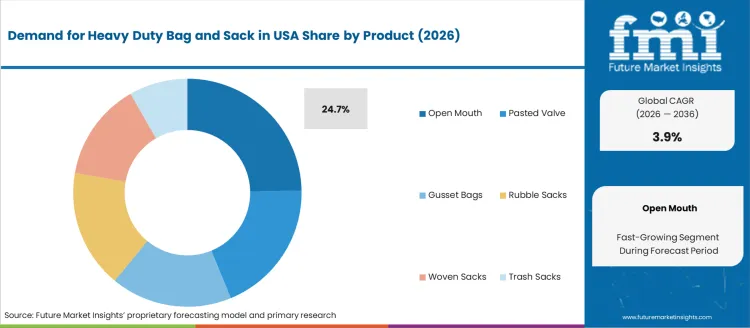
Open mouth bags are the leading product type in the heavy-duty bags and sacks market in the USA, accounting for 24.7% of the demand. Open mouth bags are commonly used for packaging bulk materials such as grains, fertilizers, and chemicals. These bags are typically made from durable materials such as plastic or woven fabric and are designed for easy filling and sealing.
The demand for open mouth bags is driven by their versatility, cost-effectiveness, and suitability for a wide range of industries. They are particularly popular in agriculture, manufacturing, and construction, where large quantities of materials need to be stored and transported. Open mouth bags offer ease of use and efficiency in handling and are ideal for materials that do not require an airtight seal. As industries continue to require packaging solutions that can handle large quantities and provide durability, open mouth bags are expected to remain a dominant product type in the market.
How Is Plastic Leading the Demand for Heavy Duty Bags and Sacks in the USA?
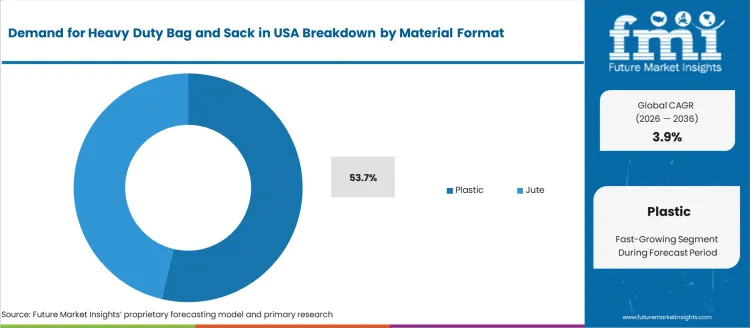
Plastic is the leading material format for heavy-duty bags and sacks in the USA, holding 53.7% of the demand. Plastic bags are preferred for their strength, flexibility, and moisture resistance, making them ideal for packaging a wide variety of bulk materials. Plastic is particularly useful for heavy-duty sacks that are used to transport items such as chemicals, fertilizers, construction materials, and food products.
The demand for plastic-based bags is driven by their ability to offer a cost-effective, durable, and versatile solution for a wide range of industries. Plastic bags can be manufactured in various sizes, strengths, and designs to meet specific requirements, from bulk packaging to retail and industrial use. Additionally, plastic bags are lightweight, easy to store, and can be sealed effectively, ensuring that the contents remain secure during transportation and storage. As industries continue to demand efficient and durable packaging solutions, plastic bags will remain a dominant choice in the heavy-duty bag and sack market in the USA.
Key Factors Shaping Demand for Heavy Duty Bags and Sacks in the United States
What Are The Key Market Dynamics Influencing Demand for Heavy Duty Bags and Sacks in the United States?
Demand in the USA is driven by industries requiring durable packaging for transport, storage and handling of bulk materials-such as agriculture, chemicals, construction and shipping. As manufacturing and logistics operations grow, the need for strong bags that can bear heavy loads and resist tear or moisture increases. At the same time, environmental regulation, raw material cost volatility (for plastics, paper or woven polypropylene) and competition from alternative packaging formats present moderation in demand growth.
What Are the Primary Growth Drivers for Heavy Duty Bag and Sack Demand in the United States?
Several drivers bolster market growth. One is the rise of bulk material handling in agriculture (feed, grain, fertiliser) which needs large capacity sacks. Another is the construction and infrastructure sector where materials must be packaged securely for transport and storage. Third, the expanding e commerce and logistics sectors place higher requirements on durable sacks for shipping and returning heavy goods. Fourth, improvements in material technology-such as woven plastics, multi wall paper sacks and higher strength fabrics-enable heavier loads and better protection, opening more applications.
What Are the Key Restraints Affecting Heavy Duty Bag and Sack Demand in the United States?
Despite positive progress, some restraints exist. Rising cost of raw materials (such as polypropylene, HDPE or kraft paper) can drive up final product price and limit demand. Regulatory pressure and sustainability initiatives may lead users to seek alternative packaging formats (for instance reusable containers or pallets) or lower single use sack volumes. Some sectors may already be mature, meaning incremental demand is limited. Additionally, imported competition and pricing pressure reduce margins for domestic producers.
What Are the Key Trends Shaping Heavy Duty Bag and Sack Demand in the United States?
Key trends include increased adoption of multi wall paper sacks and reusable or returnable heavy duty bags in line with sustainability goals. There is greater use of speciality sacks that offer moisture, UV or chemical resistance for applications in harsh environments. Customisation-such as printed branding, specific valve types, gussets or high capacity (> 40 kg) formats-is growing. Suppliers are also developing sacks compatible with automated filling and packaging equipment to support higher throughput and efficiency in industrial settings.
What Are the Key Drivers Behind the Demand for Heavy Duty Bags and Sacks in the USA?
The demand for heavy-duty bags and sacks in the USA is driven by their widespread use across various industries, including agriculture, construction, food packaging, and waste management. These durable packaging solutions are essential for transporting bulk materials such as grains, chemicals, construction materials, and waste. Heavy-duty bags and sacks are also increasingly used for packaging consumer goods, as businesses prioritize protective, robust, and cost-effective packaging for products.
Additionally, the growing emphasis on sustainability in packaging solutions, coupled with the rise of eco-friendly alternatives like biodegradable bags, is further supporting the market's growth. The increasing demand for bulk handling, combined with regulations encouraging environmentally responsible packaging practices, plays a significant role in the rise of heavy-duty bags and sacks. Regional variations in demand are influenced by the industrial activities, production volumes, and sustainability preferences in different parts of the USA. Below is an analysis of the demand for heavy-duty bags and sacks across various regions in the USA.
.webp "Top Country Growth Comparison Demand For Heavy Duty Bag And Sack In Usa Cagr (2026 2036)")
4.5%
| Region | CAGR (2026 to 2036) |
|---|---|
| West | |
| South | 4% |
| Northeast | 3.6% |
| Midwest | 3.1% |
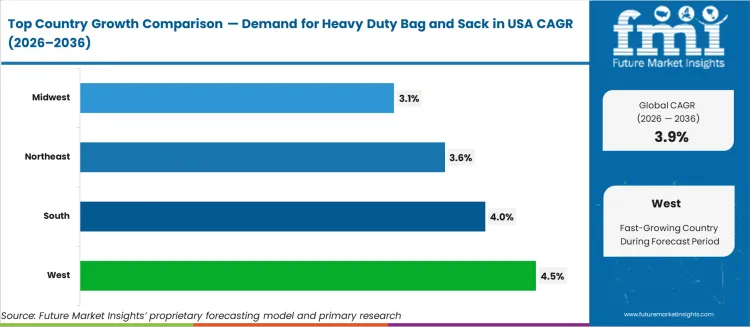
Why Is the Demand for Heavy Duty Bags and Sacks Highest in the West?
The West leads the demand for heavy-duty bags and sacks in the USA with a CAGR of 4.5%. This can be attributed to the region's strong agricultural, construction, and waste management sectors. States like California, Washington, and Oregon have significant agricultural production, including the cultivation of grains, fruits, and vegetables, which require durable packaging for storage and transportation. Additionally, the West’s focus on sustainable packaging solutions and increasing environmental regulations supports the rising demand for eco-friendly heavy-duty bags and sacks.
The region's rapid adoption of sustainable materials and the emphasis on reducing plastic waste further drive the demand for alternatives such as biodegradable or recyclable heavy-duty sacks. As industries in the West continue to focus on efficient, eco-friendly, and durable packaging solutions, the demand for heavy-duty bags and sacks remains strong and is expected to grow at a higher rate than other regions.
What Factors Are Supporting the Growth of Heavy Duty Bag and Sack Demand in the South?
The South shows strong demand for heavy-duty bags and sacks with a CAGR of 4.0%. The region has a significant presence of agriculture, especially in states like Texas, Florida, and Georgia, where large volumes of grains, produce, and other bulk materials are produced and transported. This industrial activity contributes to the high demand for durable, large-capacity packaging solutions such as heavy-duty bags and sacks.
The South’s manufacturing base, including construction and packaging industries, also contributes to the growth in demand for these products. The region’s rising emphasis on sustainability and environmentally responsible packaging materials further supports this market trend. As the demand for bulk packaging continues to increase in sectors like agriculture and construction, the demand for heavy-duty bags and sacks will continue to grow steadily in the South.
Why Is the Demand for Heavy Duty Bags and Sacks Steady in the Northeast?
The Northeast shows steady demand for heavy-duty bags and sacks with a CAGR of 3.6%. While the region is more industrialized and less focused on agriculture compared to the West and South, it still has significant demand for heavy-duty bags and sacks in industries such as food packaging, waste management, and construction. The region’s dense urban population and growing demand for packaged food products drive the need for durable packaging solutions like heavy-duty sacks.
Additionally, the Northeast’s focus on sustainability and environmental initiatives contributes to the increasing demand for eco-friendly alternatives to traditional plastic bags, such as compostable or biodegradable heavy-duty bags. While the growth rate is slower compared to the West and South, the steady demand for heavy-duty bags and sacks in the Northeast is expected to continue due to the region's focus on packaging innovation and sustainability.
What Is Driving the Demand for Heavy Duty Bags and Sacks in the Midwest?
The Midwest shows moderate growth in the demand for heavy-duty bags and sacks with a CAGR of 3.1%. The region is an important agricultural producer, especially in states like Illinois, Iowa, and Indiana, where grains and other bulk materials are grown and transported. However, compared to the West and South, the Midwest's demand for heavy-duty bags and sacks is slightly slower due to the region’s lower level of manufacturing activity in packaging and construction sectors.
Despite this, the Midwest’s large-scale farming operations and growing awareness of the need for sustainable and durable packaging materials contribute to a steady rise in demand. As more industries in the region seek efficient and eco-friendly packaging solutions, the market for heavy-duty bags and sacks is expected to continue growing at a moderate pace.
How Are Companies Competing in the Heavy Duty Bag and Sack Industry in the USA
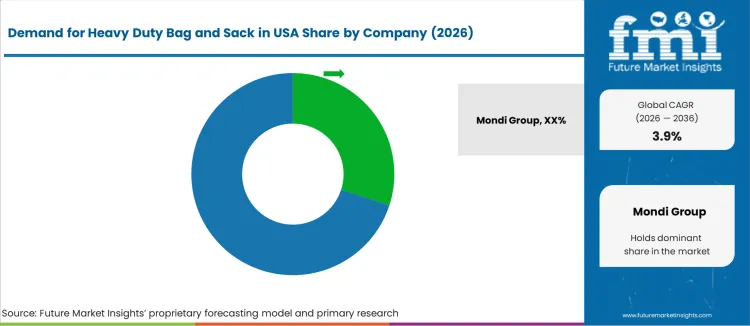
The demand for heavy-duty bags and sacks in the United States is increasing, driven by the need for durable, high-capacity packaging solutions across industries such as agriculture, construction, chemicals, and food products. Companies like Mondi Group (holding approximately 30.3% market share), Berry Global, Inc., LC Packaging International BV, Muscat Polymers Pvt. Ltd., Al-Tawfiq Company, and Inteplast Group are key players in this market. These bags are commonly used for packaging bulk goods like grains, sand, fertilizers, and other heavy materials that require secure, reliable, and cost-effective containment.
Competition in the heavy-duty bag and sack industry is primarily driven by material innovation, strength, and sustainability. Companies are focusing on developing high-quality, tear-resistant bags made from various materials, such as polypropylene, woven fabric, and plastic, that can withstand harsh handling and transport conditions. Another competitive factor is the growing emphasis on sustainability, with manufacturers increasingly offering eco-friendly bags made from recycled materials or that are fully recyclable themselves. Additionally, companies are providing customized solutions to meet the specific needs of industries, including printed branding, specialized closures, and sizes for various applications. Marketing materials often highlight features such as load capacity, durability, sustainability, and cost-effectiveness. By aligning their offerings with the increasing demand for high-performance, sustainable, and customizable packaging solutions, these companies aim to strengthen their position in the U.S. heavy-duty bag and sack market.
Key Players of the Heavy Duty Bag and Sack Industry in USA
- Mondi Group
- Berry Global, Inc.
- LC Packaging International BV
- Muscat Polymers Pvt. Ltd.
- Al-Tawfiq Company
- Inteplast Group
Scope of the Report
| Metric | Value |
|---|---|
| Quantitative Units | USD 5.82 to USD 8.53 billion, at a CAGR of 3.9% |
| Market Definition | Heavy duty bags and sacks are industrial packaging containers designed to hold, transport, and store bulk materials weighing from less than 20 kg to above 40 kg per unit. The USA market covers open mouth bags, pasted valve bags, gusset bags, rubble sacks, woven sacks, and trash sacks manufactured from plastic (polyethylene, polypropylene) and jute materials. |
| Segmentation | Product (Open Mouth, Pasted Valve, Gusset Bags, Rubble Sacks, Woven Sacks, Trash Sacks), Material Format (Plastic, Jute), Capacity (Less than 20 kg, 20-40 kg, Above 40 kg), End Use (Food Packaging, Agriculture Packaging, Chemical & Fertilizers Packaging, Building & Construction Related Product Packaging, Automotive Product Packaging, Others) |
| Regions Covered | West, South, Northeast, Midwest |
| Key Companies Profiled | Mondi Group, Berry Global, Inc., LC Packaging International BV, Muscat Polymers Pvt. Ltd., Al-Tawfiq Company, Inteplast Group |
| Forecast Period | 2026 to 2036 |
| Approach | Forecasting models apply a bottom-up methodology starting with unit shipment and average selling price data, cross-validated against manufacturer financial disclosures and institutional procurement records. |
Key Segments of the Demand for Heavy Duty Bag and Sack in USA
Product
- Open Mouth
- Pasted Valve
- Gusset Bags
- Rubble Sacks
- Woven Sacks
- Trash Sacks
Material Format
- Plastic
- Jute
Capacity
- Less than 20 kg
- 20-40 kg
- Above 40 kg
End Use
- Food Packaging
- Agriculture Packaging
- Chemical & Fertilizers Packaging
- Building & Construction Related Product Packaging
- Automotive Product Packaging
- Others
Region
- Northeast
- West
- Midwest
- South
Bibliography
- United States Environmental Protection Agency. (2024). Advancing Sustainable Materials Management: Facts and Figures Report. EPA.
- Flexible Packaging Association. (2024). State of the Flexible Packaging Industry Report. FPA.
- Organisation for Economic Co-operation and Development. (2024). Extended Producer Responsibility: Updated Guidance for Efficient Waste Management. OECD.
- Berry Global, Inc. (2024). Annual Report 2024. Berry Global.
- American Chemistry Council. (2024). Resin Production and Sales Statistics. ACC.
- USA Department of Agriculture. (2024). Agricultural Packaging Standards and Guidelines. USDA.
This bibliography is provided for reader reference. The full Future Market Insights report contains the complete reference list with primary research documentation.
Frequently Asked Questions
How large is the demand for heavy duty bag and sack in usa in 2026?
The demand for heavy duty bag and sack in usa is estimated to be valued at USD 5.82 billion in 2026.
What will be the market size of demand for heavy duty bag and sack in usa by 2036?
Market size for demand for heavy duty bag and sack in usa is projected to reach USD 8.53 billion by 2036.
What is the expected growth rate for demand for heavy duty bag and sack in usa between 2026 and 2036?
The demand for heavy duty bag and sack in usa is expected to grow at a CAGR of 3.9% between 2026 and 2036.
Which product is poised to lead by 2026?
Open Mouth accounts for 24.7% share in 2026, driven by established procurement patterns and broad institutional adoption.
How is the role of plastic in driving adoption in 2026?
Plastic holds 53.7% share of the material format segment in 2026, reflecting concentrated demand from primary end-use sectors.
What is the growth outlook for West?
West is projected to grow at a CAGR of 4.5% during 2026 to 2036.
What is included in the scope of this report?
Market scope includes open mouth bags, pasted valve bags, gusset bags, rubble sacks, woven sacks, and trash sacks manufactured from polyethylene, polypropylene, and jute materials. Multi-wall paper sacks with polymer liners and coated woven bags for chemical containment fall within defined boundaries.
How does FMI build and validate the demand for heavy duty bag and sack in usa forecast?
Forecasting models apply a bottom-up methodology starting with unit shipment and average selling price data, cross-validated against manufacturer financial disclosures and institutional procurement records.
Preview the report firsthand - request a free sample
Get SampleGet the brochure for pricing and purchase details.
Get PDFTable of Content
- Executive Summary
- Global Market Outlook
- Demand-side Trends
- Supply-side Trends
- Technology Roadmap Analysis
- Analysis and Recommendations
- Market Overview
- Market Coverage / Taxonomy
- Market Definition / Scope / Limitations
- Research Methodology
- Chapter Orientation
- Analytical Lens and Working Hypotheses
- Market Structure, Signals, and Trend Drivers
- Benchmarking and Cross-market Comparability
- Market Sizing, Forecasting, and Opportunity Mapping
- Research Design and Evidence Framework
- Desk Research Programme (Secondary Evidence)
- Company Annual and Sustainability Reports
- Peer-reviewed Journals and Academic Literature
- Corporate Websites, Product Literature, and Technical Notes
- Earnings Decks and Investor Briefings
- Statutory Filings and Regulatory Disclosures
- Technical White Papers and Standards Notes
- Trade Journals, Industry Magazines, and Analyst Briefs
- Conference Proceedings, Webinars, and Seminar Materials
- Government Statistics Portals and Public Data Releases
- Press Releases and Reputable Media Coverage
- Specialist Newsletters and Curated Briefings
- Sector Databases and Reference Repositories
- FMI Internal Proprietary Databases and Historical Market Datasets
- Subscription Datasets and Paid Sources
- Social Channels, Communities, and Digital Listening Inputs
- Additional Desk Sources
- Expert Input and Fieldwork (Primary Evidence)
- Primary Modes
- Qualitative Interviews and Expert Elicitation
- Quantitative Surveys and Structured Data Capture
- Blended Approach
- Why Primary Evidence is Used
- Field Techniques
- Interviews
- Surveys
- Focus Groups
- Observational and In-context Research
- Social and Community Interactions
- Stakeholder Universe Engaged
- C-suite Leaders
- Board Members
- Presidents and Vice Presidents
- R&D and Innovation Heads
- Technical Specialists
- Domain Subject-matter Experts
- Scientists
- Physicians and Other Healthcare Professionals
- Governance, Ethics, and Data Stewardship
- Research Ethics
- Data Integrity and Handling
- Primary Modes
- Tooling, Models, and Reference Databases
- Desk Research Programme (Secondary Evidence)
- Data Engineering and Model Build
- Data Acquisition and Ingestion
- Cleaning, Normalisation, and Verification
- Synthesis, Triangulation, and Analysis
- Quality Assurance and Audit Trail
- Market Background
- Market Dynamics
- Drivers
- Restraints
- Opportunity
- Trends
- Scenario Forecast
- Demand in Optimistic Scenario
- Demand in Likely Scenario
- Demand in Conservative Scenario
- Opportunity Map Analysis
- Product Life Cycle Analysis
- Supply Chain Analysis
- Investment Feasibility Matrix
- Value Chain Analysis
- PESTLE and Porter’s Analysis
- Regulatory Landscape
- Regional Parent Market Outlook
- Production and Consumption Statistics
- Import and Export Statistics
- Market Dynamics
- Global Market Analysis 2021 to 2025 and Forecast, 2026 to 2036
- Historical Market Size Value (USD Million) Analysis, 2021 to 2025
- Current and Future Market Size Value (USD Million) Projections, 2026 to 2036
- Y-o-Y Growth Trend Analysis
- Absolute $ Opportunity Analysis
- Global Market Pricing Analysis 2021 to 2025 and Forecast 2026 to 2036
- Global Market Analysis 2021 to 2025 and Forecast 2026 to 2036, By Product
- Introduction / Key Findings
- Historical Market Size Value (USD Million) Analysis By Product , 2021 to 2025
- Current and Future Market Size Value (USD Million) Analysis and Forecast By Product , 2026 to 2036
- Open Mouth
- Pasted Valve
- Gusset Bags
- Rubble Sacks
- Woven Sacks
- Trash Sacks
- Open Mouth
- Y-o-Y Growth Trend Analysis By Product , 2021 to 2025
- Absolute $ Opportunity Analysis By Product , 2026 to 2036
- Global Market Analysis 2021 to 2025 and Forecast 2026 to 2036, By Material Format
- Introduction / Key Findings
- Historical Market Size Value (USD Million) Analysis By Material Format, 2021 to 2025
- Current and Future Market Size Value (USD Million) Analysis and Forecast By Material Format, 2026 to 2036
- Plastic
- Jute
- Plastic
- Y-o-Y Growth Trend Analysis By Material Format, 2021 to 2025
- Absolute $ Opportunity Analysis By Material Format, 2026 to 2036
- Global Market Analysis 2021 to 2025 and Forecast 2026 to 2036, By Capacity
- Introduction / Key Findings
- Historical Market Size Value (USD Million) Analysis By Capacity, 2021 to 2025
- Current and Future Market Size Value (USD Million) Analysis and Forecast By Capacity, 2026 to 2036
- Less than 20 kg
- 20-40 kg
- Above 40 kg
- Less than 20 kg
- Y-o-Y Growth Trend Analysis By Capacity, 2021 to 2025
- Absolute $ Opportunity Analysis By Capacity, 2026 to 2036
- Global Market Analysis 2021 to 2025 and Forecast 2026 to 2036, By End Use
- Introduction / Key Findings
- Historical Market Size Value (USD Million) Analysis By End Use, 2021 to 2025
- Current and Future Market Size Value (USD Million) Analysis and Forecast By End Use, 2026 to 2036
- Food Packaging
- Agriculture Packaging
- Chemical & Fertilizers Packaging
- Building & Construction Related Product Packaging
- Automotive Product Packaging
- Others
- Food Packaging
- Y-o-Y Growth Trend Analysis By End Use, 2021 to 2025
- Absolute $ Opportunity Analysis By End Use, 2026 to 2036
- Global Market Analysis 2021 to 2025 and Forecast 2026 to 2036, By Region
- Introduction
- Historical Market Size Value (USD Million) Analysis By Region, 2021 to 2025
- Current Market Size Value (USD Million) Analysis and Forecast By Region, 2026 to 2036
- North America
- Latin America
- Western Europe
- Eastern Europe
- East Asia
- South Asia and Pacific
- Middle East & Africa
- Market Attractiveness Analysis By Region
- North America Market Analysis 2021 to 2025 and Forecast 2026 to 2036, By Country
- Historical Market Size Value (USD Million) Trend Analysis By Market Taxonomy, 2021 to 2025
- Market Size Value (USD Million) Forecast By Market Taxonomy, 2026 to 2036
- By Country
- USA
- Canada
- Mexico
- By Product
- By Material Format
- By Capacity
- By End Use
- By Country
- Market Attractiveness Analysis
- By Country
- By Product
- By Material Format
- By Capacity
- By End Use
- Key Takeaways
- Latin America Market Analysis 2021 to 2025 and Forecast 2026 to 2036, By Country
- Historical Market Size Value (USD Million) Trend Analysis By Market Taxonomy, 2021 to 2025
- Market Size Value (USD Million) Forecast By Market Taxonomy, 2026 to 2036
- By Country
- Brazil
- Chile
- Rest of Latin America
- By Product
- By Material Format
- By Capacity
- By End Use
- By Country
- Market Attractiveness Analysis
- By Country
- By Product
- By Material Format
- By Capacity
- By End Use
- Key Takeaways
- Western Europe Market Analysis 2021 to 2025 and Forecast 2026 to 2036, By Country
- Historical Market Size Value (USD Million) Trend Analysis By Market Taxonomy, 2021 to 2025
- Market Size Value (USD Million) Forecast By Market Taxonomy, 2026 to 2036
- By Country
- Germany
- UK
- Italy
- Spain
- France
- Nordic
- BENELUX
- Rest of Western Europe
- By Product
- By Material Format
- By Capacity
- By End Use
- By Country
- Market Attractiveness Analysis
- By Country
- By Product
- By Material Format
- By Capacity
- By End Use
- Key Takeaways
- Eastern Europe Market Analysis 2021 to 2025 and Forecast 2026 to 2036, By Country
- Historical Market Size Value (USD Million) Trend Analysis By Market Taxonomy, 2021 to 2025
- Market Size Value (USD Million) Forecast By Market Taxonomy, 2026 to 2036
- By Country
- Russia
- Poland
- Hungary
- Balkan & Baltic
- Rest of Eastern Europe
- By Product
- By Material Format
- By Capacity
- By End Use
- By Country
- Market Attractiveness Analysis
- By Country
- By Product
- By Material Format
- By Capacity
- By End Use
- Key Takeaways
- East Asia Market Analysis 2021 to 2025 and Forecast 2026 to 2036, By Country
- Historical Market Size Value (USD Million) Trend Analysis By Market Taxonomy, 2021 to 2025
- Market Size Value (USD Million) Forecast By Market Taxonomy, 2026 to 2036
- By Country
- China
- Japan
- South Korea
- By Product
- By Material Format
- By Capacity
- By End Use
- By Country
- Market Attractiveness Analysis
- By Country
- By Product
- By Material Format
- By Capacity
- By End Use
- Key Takeaways
- South Asia and Pacific Market Analysis 2021 to 2025 and Forecast 2026 to 2036, By Country
- Historical Market Size Value (USD Million) Trend Analysis By Market Taxonomy, 2021 to 2025
- Market Size Value (USD Million) Forecast By Market Taxonomy, 2026 to 2036
- By Country
- India
- ASEAN
- Australia & New Zealand
- Rest of South Asia and Pacific
- By Product
- By Material Format
- By Capacity
- By End Use
- By Country
- Market Attractiveness Analysis
- By Country
- By Product
- By Material Format
- By Capacity
- By End Use
- Key Takeaways
- Middle East & Africa Market Analysis 2021 to 2025 and Forecast 2026 to 2036, By Country
- Historical Market Size Value (USD Million) Trend Analysis By Market Taxonomy, 2021 to 2025
- Market Size Value (USD Million) Forecast By Market Taxonomy, 2026 to 2036
- By Country
- Kingdom of Saudi Arabia
- Other GCC Countries
- Turkiye
- South Africa
- Other African Union
- Rest of Middle East & Africa
- By Product
- By Material Format
- By Capacity
- By End Use
- By Country
- Market Attractiveness Analysis
- By Country
- By Product
- By Material Format
- By Capacity
- By End Use
- Key Takeaways
- Key Countries Market Analysis
- USA
- Pricing Analysis
- Market Share Analysis, 2025
- By Product
- By Material Format
- By Capacity
- By End Use
- Canada
- Pricing Analysis
- Market Share Analysis, 2025
- By Product
- By Material Format
- By Capacity
- By End Use
- Mexico
- Pricing Analysis
- Market Share Analysis, 2025
- By Product
- By Material Format
- By Capacity
- By End Use
- Brazil
- Pricing Analysis
- Market Share Analysis, 2025
- By Product
- By Material Format
- By Capacity
- By End Use
- Chile
- Pricing Analysis
- Market Share Analysis, 2025
- By Product
- By Material Format
- By Capacity
- By End Use
- Germany
- Pricing Analysis
- Market Share Analysis, 2025
- By Product
- By Material Format
- By Capacity
- By End Use
- UK
- Pricing Analysis
- Market Share Analysis, 2025
- By Product
- By Material Format
- By Capacity
- By End Use
- Italy
- Pricing Analysis
- Market Share Analysis, 2025
- By Product
- By Material Format
- By Capacity
- By End Use
- Spain
- Pricing Analysis
- Market Share Analysis, 2025
- By Product
- By Material Format
- By Capacity
- By End Use
- France
- Pricing Analysis
- Market Share Analysis, 2025
- By Product
- By Material Format
- By Capacity
- By End Use
- India
- Pricing Analysis
- Market Share Analysis, 2025
- By Product
- By Material Format
- By Capacity
- By End Use
- ASEAN
- Pricing Analysis
- Market Share Analysis, 2025
- By Product
- By Material Format
- By Capacity
- By End Use
- Australia & New Zealand
- Pricing Analysis
- Market Share Analysis, 2025
- By Product
- By Material Format
- By Capacity
- By End Use
- China
- Pricing Analysis
- Market Share Analysis, 2025
- By Product
- By Material Format
- By Capacity
- By End Use
- Japan
- Pricing Analysis
- Market Share Analysis, 2025
- By Product
- By Material Format
- By Capacity
- By End Use
- South Korea
- Pricing Analysis
- Market Share Analysis, 2025
- By Product
- By Material Format
- By Capacity
- By End Use
- Russia
- Pricing Analysis
- Market Share Analysis, 2025
- By Product
- By Material Format
- By Capacity
- By End Use
- Poland
- Pricing Analysis
- Market Share Analysis, 2025
- By Product
- By Material Format
- By Capacity
- By End Use
- Hungary
- Pricing Analysis
- Market Share Analysis, 2025
- By Product
- By Material Format
- By Capacity
- By End Use
- Kingdom of Saudi Arabia
- Pricing Analysis
- Market Share Analysis, 2025
- By Product
- By Material Format
- By Capacity
- By End Use
- Turkiye
- Pricing Analysis
- Market Share Analysis, 2025
- By Product
- By Material Format
- By Capacity
- By End Use
- South Africa
- Pricing Analysis
- Market Share Analysis, 2025
- By Product
- By Material Format
- By Capacity
- By End Use
- USA
- Market Structure Analysis
- Competition Dashboard
- Competition Benchmarking
- Market Share Analysis of Top Players
- By Regional
- By Product
- By Material Format
- By Capacity
- By End Use
- Competition Analysis
- Competition Deep Dive
- Mondi Group
- Overview
- Product Portfolio
- Profitability by Market Segments (Product/Age /Sales Channel/Region)
- Sales Footprint
- Strategy Overview
- Marketing Strategy
- Product Strategy
- Channel Strategy
- Berry Global, Inc.
- LC Packaging International BV
- Muscat Polymers Pvt. Ltd.
- Al-Tawfiq Company
- Inteplast Group
- Mondi Group
- Competition Deep Dive
- Assumptions & Acronyms Used


