

- Industry Size (2025)
- USD 0.2 Bn
- Forecast (2035)
- USD 1.6 Bn
- CAGR (2025 to 2035)
- 21.9%
Demand for Medical Drones in USA Forecast and Outlook 2025 to 2035
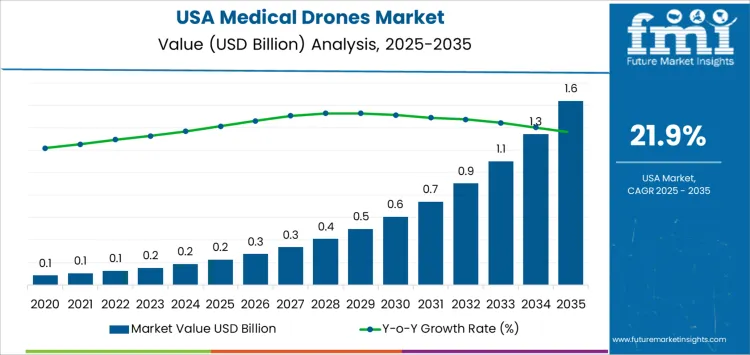
Demand for medical drones in the USA is expected to grow from USD 0.2 billion in 2025 to USD 1.6 billion by 2035, reflecting a compound annual growth rate (CAGR) of 21.9%. This rapid growth is driven by the increasing adoption of drones for healthcare logistics, including transporting medical supplies, blood samples, and vaccines. Medical drones offer a faster, more efficient, and cost-effective solution for delivering critical medical items, especially to remote or hard-to-reach areas. The market is also supported by advancements in drone technology, regulatory approval for their use in healthcare, and the rising demand for contactless, on-demand delivery services.
The increasing focus on improving emergency medical response times and reducing healthcare system inefficiencies is further contributing to the growing demand for medical drones. As the technology becomes more reliable and widely accepted, its use in various healthcare applications is expected to expand, providing a crucial role in the future of healthcare delivery. Additionally, partnerships between healthcare providers, drone manufacturers, and regulators are expected to accelerate the adoption of medical drones in the USA.
Quick Stats of the Demand for Medical Drones in USA
- Demand for Medical Drones in USA Value (2025): USD 0.2 billion
- Demand for Medical Drones in USA Forecast Value (2035): USD 1.6 billion
- Demand for Medical Drones in USA Forecast CAGR (2025-2035): 21.9%
- Demand for Medical Drones in USA Leading Product Type: Logistics Drones (52%)
- Demand for Medical Drones in USA Key Growth Regions: West USA, South USA, Northeast USA, Midwest USA
- Demand for Medical Drones in USA Key Players: Zipline Inc., Flirtey, Matternet, SkyDrop, Flytrex
What is the Growth Forecast for the Medical Drones Market through 2035?
The acceleration and deceleration pattern for the medical drones market in the USA demonstrates significant early-stage growth, followed by a slight moderation as the market matures. Starting at USD 0.2 billion in 2025, the market shows rapid initial growth, reaching USD 0.3 billion in 2026 and USD 0.3 billion in 2027. This period marks the early adoption phase, driven by initial trials and limited-use cases in healthcare logistics.
The acceleration becomes more pronounced after 2027, with the market reaching USD 0.4 billion in 2028, USD 0.5 billion in 2029, and USD 0.6 billion in 2030. As the technology matures, regulatory frameworks solidify, and public-private partnerships develop, the demand for medical drones continues to grow at an accelerated pace. By 2035, the market reaches USD 1.6 billion, reflecting the increased adoption and integration of medical drones in the healthcare supply chain. The deceleration pattern after 2030 is evident as the growth rate moderates due to the market’s maturation and broader implementation, but the overall demand continues to rise, supported by technological advancements and expanding use cases in healthcare delivery.
USA Medical Drones Industry Key Takeaways
| Metric | Value |
|---|---|
| Industry Sales Value (2025) | USD 0.2 billion |
| Industry Forecast Value (2035) | USD 1.6 billion |
| Industry Forecast CAGR (2025-2035) | 21.9% |
Why is the Demand for Medical Drones Growing in the USA?
Demand for medical drones in the USA is rising strongly as healthcare providers, hospitals, and logistics companies increasingly rely on drones to deliver critical medical supplies and improve emergency response. Medical drones, unmanned aerial vehicles outfitted to transport medicines, vaccines, blood products, diagnostic samples, and emergency equipment, offer speed and reliability that traditional road transport often cannot match. As demand grows for rapid delivery of time sensitive items like medications, blood for transfusion, or even organs in certain pilot projects, drones offer a practical solution for both urban and rural healthcare logistics, cutting delivery times and expanding access to care.
At the same time, technological advances, increasing regulatory acceptance, and a greater focus on healthcare efficiency and resilience support further growth of the medical drone market in the USA. Improvements in drone navigation, payload handling, and autonomous or semi autonomous flight systems make drone operations more viable and safer. The COVID 19 pandemic and growing demand for decentralized and rapid healthcare delivery, including for remote areas or underserved communities, have underscored the value of drone-based logistics. As a result, investment and deployment of medical drone systems across hospitals, emergency services, pharmacies, and public health networks in the USA is expected to continue growing in the coming years.
What Are the Key Segments in Medical Drones Market in the USA?
Overview The medical drones market in the USA is segmented by product type and application. Logistics drones lead the market, holding 52% of the share. In terms of application, emergency medical services dominate, accounting for 41% of the market. The growing demand for efficient, rapid, and cost-effective medical delivery solutions is driving the adoption of medical drones in various healthcare applications, particularly in emergency response and supply chain management.
Which Product Type Drives Medical Drones Demand in the USA?
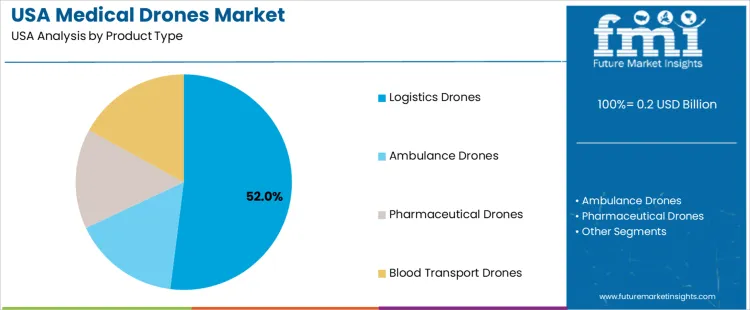
Logistics drones are the most prominent product type in the medical drone market in the USA, accounting for 52% of the market share. These drones are used primarily for the transportation of medical supplies, including medications, vaccines, and medical equipment, to remote or hard-to-reach areas. The ability of logistics drones to carry a variety of medical items and deliver them quickly, safely, and without the need for ground infrastructure makes them an essential tool in improving healthcare delivery, particularly in emergencies or areas with limited access. While ambulance drones, pharmaceutical drones, and blood transport drones also contribute to the market, logistics drones lead due to their versatility and broad use cases in the medical sector, offering solutions for both routine deliveries and urgent needs.
Which Application Drives Medical Drones Demand in the USA?
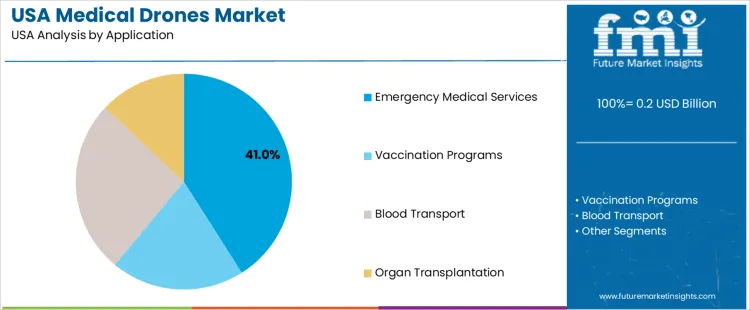
Emergency medical services (EMS) is the largest application for medical drones in the USA, representing 41% of the market share. Drones in EMS are used to transport critical medical supplies, such as defibrillators, medications, and emergency kits, to accident sites or areas affected by natural disasters where traditional ambulance services may be delayed. The speed and efficiency of drones make them ideal for responding to medical emergencies, especially in remote locations or congested urban areas where traffic may cause delays. In addition to EMS, other applications like vaccination programs, blood transport, and organ transplantation are also growing, driven by the need for faster, more efficient logistics solutions. The ability to transport time-sensitive items like blood and organs is particularly critical for ensuring the success of medical treatments and saving lives, making drones a valuable tool in the healthcare sector.
What is the Demand for Medical Drones in USA?
The demand for medical drones in the USA is increasing as the healthcare sector seeks faster, more efficient, and cost-effective ways to transport medical supplies, such as vaccines, blood samples, and pharmaceuticals. Drones offer the potential for rapid delivery, especially in rural or hard-to-reach areas, reducing delivery times and improving healthcare access. As advancements in drone technology and regulatory frameworks continue to evolve, the use of medical drones is expected to expand, offering enhanced logistics and support for emergency medical services. The growing interest in autonomous delivery systems in healthcare, combined with the increasing demand for more efficient medical supply chains, is driving the adoption of medical drones in the USA.
What are the Drivers of Demand for Medical Drones in USA?
Several factors are driving the demand for medical drones in the USA First, the need for faster and more efficient delivery of critical medical supplies, especially in remote or underserved areas, is a key driver. Drones can bypass road traffic and transport goods quickly, improving patient outcomes by reducing the time it takes to receive essential treatments. Second, the rise in demand for last-mile delivery solutions, especially after the COVID-19 pandemic, has pushed healthcare systems to explore more innovative and flexible logistics options. Third, advancements in drone technology, such as better flight times, payload capacity, and autonomous navigation systems, are making drones a more reliable solution for medical deliveries. Additionally, regulatory changes and the increasing acceptance of drones for commercial use in the USA have facilitated the development of medical drone services.
What are the Restraints on Demand for Medical Drones in USA?
Despite the growing demand, several challenges may limit the widespread adoption of medical drones in the USA. One of the major constraints is regulatory hurdles. While regulations for drone use are evolving, challenges related to airspace management, privacy, and safety remain a concern, especially in densely populated urban areas. Second, the cost of drone technology, including high-quality drones, maintenance, and necessary infrastructure, may be prohibitive for some healthcare providers, especially smaller organizations or those in rural settings. Third, while drones are capable of delivering smaller payloads, limitations in cargo capacity may restrict their use for certain types of medical deliveries, such as large medical equipment. Finally, public and institutional resistance to adopting new technologies, particularly concerns about the safety and reliability of drones, may slow down their integration into medical supply chains.
What are the Key Trends Influencing Demand for Medical Drones in USA?
Several key trends are shaping the demand for medical drones in the USA. One trend is the growing focus on reducing healthcare delivery times and costs, which is driving interest in drone technology for quick transport of medical supplies, especially in emergency situations. Another trend is the increasing integration of drones with digital healthcare platforms, allowing for real-time tracking of medical deliveries and more efficient management of resources. Additionally, as the technology becomes more cost-effective and reliable, the use of medical drones is expanding to include routine deliveries of medicines, vaccines, and samples between healthcare facilities. Another important trend is the development of drone infrastructure, including landing zones and charging stations, which will make it easier for healthcare providers to integrate drones into their operations. Lastly, the growing interest in autonomous delivery systems and advancements in artificial intelligence are likely to further improve the efficiency and effectiveness of medical drone services in the coming years.
What is the Regional Demand Outlook for the Medical Drones Market in the USA?
The Medical Drones market in the USA is poised for significant growth, with the West USA leading the way at a projected CAGR of 25.2%. South USA follows closely with a growth rate of 22.6%, while the Northeast USA is expected to grow at 20.2%. The Midwest USA shows moderate growth with a CAGR of 17.6%. The adoption of drones for medical applications, such as delivering medications, vaccines, and medical supplies, is rapidly increasing. As healthcare systems seek more efficient, cost-effective, and timely solutions for medical deliveries, the demand for medical drones is expected to rise substantially across the United States.
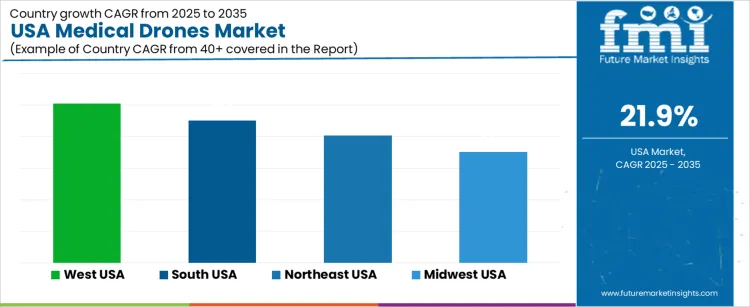
| Region | CAGR (2025-2035) |
|---|---|
| West USA | 25.2% |
| South USA | 22.6% |
| Northeast USA | 20.2% |
| Midwest USA | 17.6% |
What is Driving the Growth of Medical Drones in West USA?
The West USA is projected to experience the highest growth in the Medical Drones market, with a projected CAGR of 25.2%. The region’s strong focus on technology innovation, healthcare advancement, and logistics efficiency is a key driver of this growth. States like California, Washington, and Oregon have been early adopters of drone technology and are now leveraging drones for medical deliveries, especially in rural or hard-to-reach areas. The West USA's robust healthcare infrastructure, combined with its high level of technological expertise, positions it as a leader in adopting drones for time-sensitive deliveries such as emergency medications, blood samples, and vaccines. Additionally, regulatory support and investments in drone technology in this region are further accelerating the adoption of medical drones, driving market expansion.
Why is the Medical Drones Market Expanding in South USA?
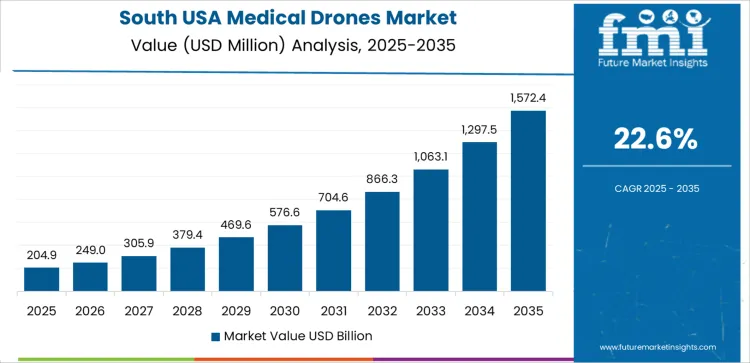
In South USA, the demand for medical drones is projected to grow at a CAGR of 22.6%. The region’s large geographic area, coupled with a rapidly growing healthcare demand, is driving the adoption of drones for delivering medical supplies and vaccines. States like Texas, Florida, and Georgia, which are seeing significant population growth and healthcare infrastructure expansion, are leading the adoption of medical drones. Drones are seen as an efficient solution to address logistical challenges, particularly in delivering urgent medical supplies to remote or underserved areas. The South’s increasing emphasis on improving healthcare delivery, coupled with the cost-saving benefits of drones, is further contributing to the growth of the market. The rise in demand for innovative, scalable solutions for time-critical medical deliveries is making medical drones a crucial component of the healthcare system in South USA.
How is the Medical Drones Market Growing in Northeast USA?
In Northeast USA, the Medical Drones market is projected to grow at a CAGR of 20.2%. The region’s well-established healthcare systems, particularly in urban centers like New York and Boston, are seeing growing interest in drone technology to enhance delivery times for medical supplies, prescriptions, and blood samples. With a dense population and high healthcare demand, the Northeast USA is adopting medical drones to reduce transportation costs, improve response times, and ensure efficient deliveries of critical health products. The region's strong support for technological innovation in the medical field, combined with increasing consumer expectations for faster, more reliable services, is fueling market growth. As drones become a more integrated part of the region’s healthcare supply chain, their use for emergency and routine medical deliveries is expected to rise steadily.
What is Contributing to the Growth of Medical Drones in Midwest USA?
In Midwest USA, the Medical Drones market is expected to grow at a more moderate rate of 17.6%. The Midwest’s healthcare sector, with its large hospitals, medical research centers, and rural communities, is increasingly adopting medical drones to enhance the efficiency and speed of medical supply deliveries. States like Illinois, Ohio, and Michigan are leveraging drones for the transportation of critical supplies, including vaccines and blood samples, especially to rural or hard-to-reach areas. The Midwest’s focus on improving healthcare access and reducing logistical barriers is a key factor in the rising demand for medical drones. As the region invests in advanced technologies to improve patient care and streamline delivery systems, the use of drones in medical applications is expected to expand. Additionally, growing public and private investments in drone infrastructure are contributing to market growth in the Midwest.
What is the Competitive Landscape for the Medical Drone Market in the USA?
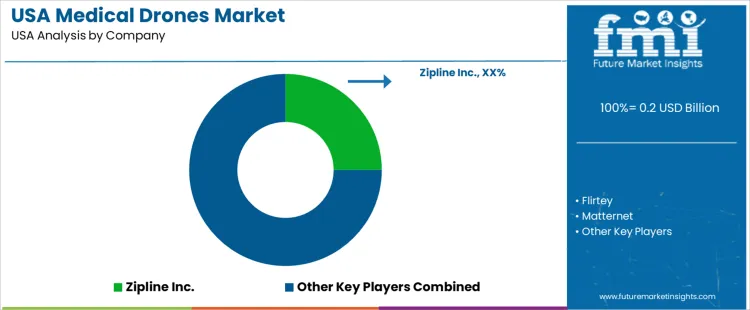
Demand for medical drones in the USA has grown rapidly as hospitals, clinics, and emergency response services recognize the need for faster, more efficient delivery of critical medical supplies, blood products, lab samples, and pharmaceuticals. The demand is driven by growing emphasis on emergency care, rural and remote area healthcare access, cold chain logistics for vaccines and biologics, and the need for rapid turnaround time in diagnostics and treatment. The increasing pressure on healthcare systems, aging populations, and greater focus on disaster response and supply chain resilience have pushed providers to seek airborne delivery solutions. As regulatory acceptance and drone delivery infrastructure improve, adoption of medical drones is accelerating across both urban and rural settings in the USA.
On the supply side a handful of specialized drone service providers lead the market. Key players include Zipline Inc., Flirtey (now operating as SkyDrop), Matternet, SkyDrop, and Flytrex. Zipline is known for large scale operations delivering blood, medications, vaccines, and medical supplies in multiple regions, including the USA. Competition among these providers is shaped by several factors: drone reliability and payload capacity (medical grade transport), speed and delivery reach (especially for remote or rural areas), regulatory compliance and safety standards, ability to maintain cold chain logistics for sensitive supplies, and integration with hospital and supply chain systems. Providers that offer robust drone fleets-with both rotor and VTOL (vertical take off and landing) platforms-plus software for logistics, tracking, and regulatory compliance are best positioned to succeed. As medical drone deployment expands in emergency care, blood/organ transport, vaccines, and pharmaceuticals, suppliers with proven performance and strong partnerships with healthcare institutions are likely to capture growing share of the USA market.
Key Players of the Medical Drones Industry in USA
- Zipline Inc.
- Flirtey
- Matternet
- SkyDrop
- Flytrex
Scope of the Report
| Items | Details |
|---|---|
| Quantitative Units | USD Billion |
| Regions Covered | USA |
| Product Type | Logistics Drones, Ambulance Drones, Pharmaceutical Drones, Blood Transport Drones |
| Application | Emergency Medical Services, Vaccination Programs, Blood Transport, Organ Transplantation |
| End User | Hospitals and Clinics, Blood Banks, Emergency Services, Government & Humanitarian Organizations |
| Key Companies Profiled | Zipline Inc., Flirtey / SkyDrop, Matternet, SkyDrop (formerly Flirtey), Flytrex |
| Additional Attributes | Dollar sales by product type and application show growing adoption of drone based medical logistics-especially for blood transport, vaccine delivery, and emergency supply missions. Growth driven by need for rapid delivery, remote/rural access, and improved EMS response times. Regulatory support and technology advances (autonomous flight, VTOL drones, cold chain payloads) accelerate rollout. |
Key Segments in the Demand for Medical Drones in USA
Product Type
- Logistics Drones
- Ambulance Drones
- Pharmaceutical Drones
- Blood Transport Drones
Application
- Emergency Medical Services
- Vaccination Programs
- Blood Transport
- Organ Transplantation
End User
- Hospitals and Clinics
- Blood Banks
- Emergency Services
- Government and Humanitarian Organizations
Region
- Northeast USA
- West USA
- Midwest USA
- South USA
Frequently Asked Questions
How big is the demand for medical drones in USA in 2025?
The demand for medical drones in USA is estimated to be valued at USD 0.2 billion in 2025.
What will be the size of medical drones in USA in 2035?
The market size for the medical drones in USA is projected to reach USD 1.6 billion by 2035.
How much will be the demand for medical drones in USA growth between 2025 and 2035?
The demand for medical drones in USA is expected to grow at a 21.9% CAGR between 2025 and 2035.
What are the key product types in the medical drones in USA?
The key product types in medical drones in USA are logistics drones, ambulance drones, pharmaceutical drones and blood transport drones.
Which application segment is expected to contribute significant share in the medical drones in USA in 2025?
In terms of application, emergency medical services segment is expected to command 41.0% share in the medical drones in USA in 2025.
Preview the report firsthand - request a free sample
Get SampleGet the brochure for pricing and purchase details.
Get PDFTable of Content
- Executive Summary
- USA Market Outlook
- Demand-side Trends
- Supply-side Trends
- Technology Roadmap Analysis
- Analysis and Recommendations
- Market Overview
- Market Coverage / Taxonomy
- Market Definition / Scope / Limitations
- Market Background
- Market Dynamics
- Drivers
- Restraints
- Opportunity
- Trends
- Scenario Forecast
- Demand in Optimistic Scenario
- Demand in Likely Scenario
- Demand in Conservative Scenario
- Opportunity Map Analysis
- Product Life Cycle Analysis
- Supply Chain Analysis
- Investment Feasibility Matrix
- Value Chain Analysis
- PESTLE and Porter’s Analysis
- Regulatory Landscape
- Regional Parent Market Outlook
- Production and Consumption Statistics
- Import and Export Statistics
- Market Dynamics
- USA Market Analysis 2020 to 2024 and Forecast, 2025 to 2035
- Historical Market Size Value (USD Million) Analysis, 2020 to 2024
- Current and Future Market Size Value (USD Million) Projections, 2025 to 2035
- Y-o-Y Growth Trend Analysis
- Absolute $ Opportunity Analysis
- USA Market Pricing Analysis 2020 to 2024 and Forecast 2025 to 2035
- USA Market Analysis 2020 to 2024 and Forecast 2025 to 2035, By Product Type
- Introduction / Key Findings
- Historical Market Size Value (USD Million) Analysis By Product Type , 2020 to 2024
- Current and Future Market Size Value (USD Million) Analysis and Forecast By Product Type , 2025 to 2035
- Logistics Drones
- Ambulance Drones
- Pharmaceutical Drones
- Blood Transport Drones
- Y-o-Y Growth Trend Analysis By Product Type , 2020 to 2024
- Absolute $ Opportunity Analysis By Product Type , 2025 to 2035
- USA Market Analysis 2020 to 2024 and Forecast 2025 to 2035, By Application
- Introduction / Key Findings
- Historical Market Size Value (USD Million) Analysis By Application, 2020 to 2024
- Current and Future Market Size Value (USD Million) Analysis and Forecast By Application, 2025 to 2035
- Emergency Medical Services
- Vaccination Programs
- Blood Transport
- Organ Transplantation
- Y-o-Y Growth Trend Analysis By Application, 2020 to 2024
- Absolute $ Opportunity Analysis By Application, 2025 to 2035
- USA Market Analysis 2020 to 2024 and Forecast 2025 to 2035, By End-User
- Introduction / Key Findings
- Historical Market Size Value (USD Million) Analysis By End-User, 2020 to 2024
- Current and Future Market Size Value (USD Million) Analysis and Forecast By End-User, 2025 to 2035
- Hospitals and Clinics
- Blood Banks
- Emergency Services
- Government and Humanitarian Organizations
- Y-o-Y Growth Trend Analysis By End-User, 2020 to 2024
- Absolute $ Opportunity Analysis By End-User, 2025 to 2035
- Market Structure Analysis
- Competition Dashboard
- Competition Benchmarking
- Market Share Analysis of Top Players
- By Regional
- By Product Type
- By Application
- By End-User
- Competition Analysis
- Competition Deep Dive
- Zipline Inc.
- Overview
- Product Portfolio
- Profitability by Market Segments (Product/Age /Sales Channel/Region)
- Sales Footprint
- Strategy Overview
- Marketing Strategy
- Product Strategy
- Channel Strategy
- Flirtey
- Matternet
- SkyDrop
- Flytrex
- Zipline Inc.
- Competition Deep Dive
- Assumptions & Acronyms Used
- Research Methodology


